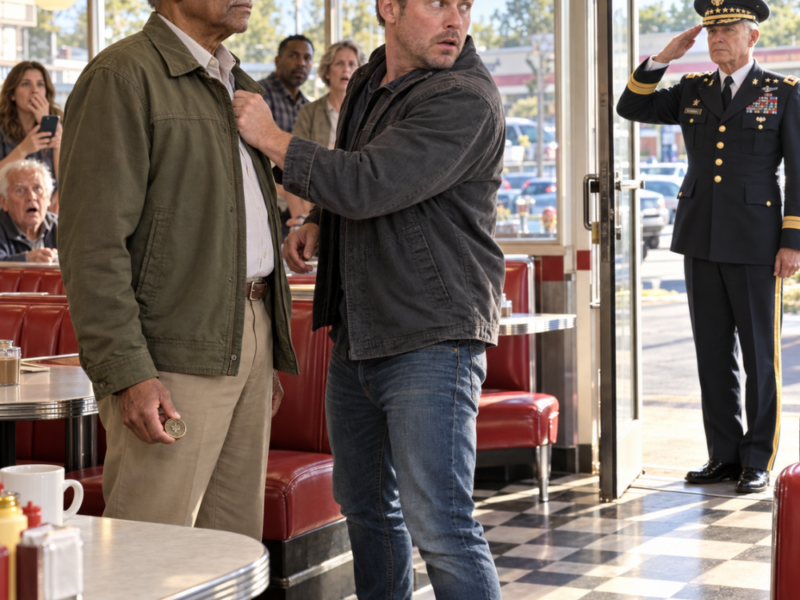
The police chief’s son humiliated a Black man at a diner. The man didn’t argue or defend himself. Then a four-star general at the next table suddenly stood, faced him, and saluted—and the police chief’s son realized he had just insulted the wrong man.
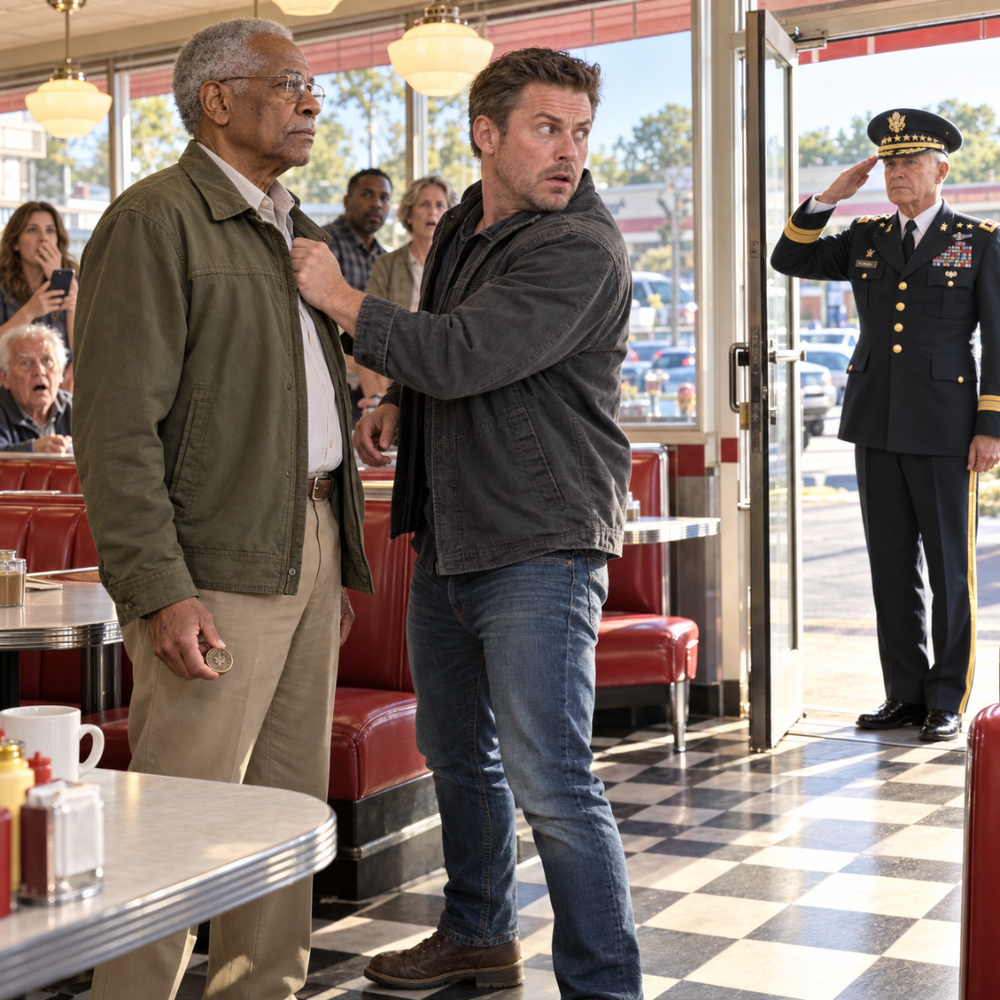
A bully dragged an old man from his diner booth, then a four-star general walked in and saluted him
“You’re sitting in my booth, old man.”
Abraham Meeks looked over the top of his glasses at the young man standing beside the table.
He did not look frightened.
He looked inconvenienced.
At seventy-six, Abe had reached the age when most of the things young men used to impress one another had stopped impressing him. Loud trucks. Expensive watches. Fathers with important jobs. The kind of confidence that existed mainly because nobody had yet charged interest on it.
He lifted his coffee cup.
“Happy to move when I’m finished, son.”
Wyatt Prior stared at him.
“That’s not what I said.”
Behind Wyatt, his girlfriend Sierra held up her phone.
The camera was already recording.
Abe noticed the phone.
He noticed everything.
He also noticed Donna Taylor behind the register, one hand frozen around the coffee pot.
He noticed the retired mail carrier near the window slowly put down his fork.
He noticed the two farmers in seed-company caps who suddenly found the menus fascinating.
And he noticed the untouched plate of silver-dollar pancakes across from him.
Hazel’s plate.
That mattered more than the boy.
“I heard you,” Abe said.
Wyatt planted both hands on the table.
“My daddy runs the police in this town.”
Abe took another sip of coffee.
“That sounds like a tiring job.”
Sierra laughed.
Wyatt did not.
“Last chance, Grandpa.”
Abe lowered the cup.
“I’ve been eating breakfast in this booth since 1966.”
“Nobody asked.”
“I’m explaining.”
“I don’t need the history lesson.”
Abe glanced at the untouched pancakes.
“My wife said yes to me right where you’re standing.”
That made Wyatt look toward the empty seat.
“Your wife?”
“She’s gone now.”
For one brief second, something almost human crossed the younger man’s face.
Then Sierra turned the phone toward the empty plate.
“Wait. You ordered breakfast for somebody who isn’t even here?”
Abe’s expression changed.
Only slightly.
“That’s for Hazel.”
Wyatt grinned.
“Man, they let you come in here and order food for ghosts?”
Nobody laughed.
Sierra did, at first.
Then she heard herself laughing alone and stopped.
Donna came around the end of the counter.
“Wyatt, honey, I’ve got two clean seats right over here.”
She pointed toward the counter.
“You and Sierra sit down. I’ll bring coffee.”
“The counter?”
Wyatt said the word as though Donna had offered him a chair beside the dumpster.
“It’s Tuesday.”
“So?”
Donna hesitated.
Everybody who worked at the Starlight knew what Tuesday meant.
Every Tuesday at eight in the morning, Abraham Meeks sat in the corner booth beside the big front window.
Rain.
Snow.
Heat.
Holidays.
For thirty-one years.
The arrangement had started when Hazel was alive.
It continued after she was gone.
Nobody had formally assigned the booth to him.
There was no reservation card.
No plaque.
No rule.
It simply became one of those small local agreements decent people observe because not everything meaningful needs to be written down.
Donna set a second plate of silver-dollar pancakes across from Abe every Tuesday.
Abe never asked.
Donna never charged him.
Abe left an extra five dollars anyway.
The cook knew.
The other waitresses knew.
Regular customers knew.
Nobody said Hazel’s name unless Abe did first.
It was, in the quiet way small communities create their rituals, the most sacred thing the Starlight did all week.
Wyatt had never cared enough to notice.
Tuesday was not usually his morning.
Sunday was.
On Sundays, Wyatt came with friends after staying out too late Saturday. He put his boots on the booth seat, snapped his fingers at waitresses, complained about how long eggs took, and sometimes paid.
Sometimes the manager quietly comped the meal because arguing with Wyatt often meant eventually speaking to Wyatt’s father.
Chief Marshall Prior.
Twenty-six years in local law enforcement.
Ten as chief.
A man who knew every business owner in town and had helped half of them at some point.
Permit problem.
Parade route.
Noise complaint.
Teenager caught drinking where he should not have been.
Marshall had built a reputation as practical.
What the town rarely said aloud was that practicality became surprisingly flexible whenever his only son was involved.
Wyatt had wrecked two vehicles before graduating high school.
Neither incident became as serious on paper as witnesses remembered.
At twenty-one, he broke a pool cue during a fight at the lake bar.
Charges disappeared after everybody “agreed it had been a misunderstanding.”
Last summer he made a nineteen-year-old busboy cry over a milkshake spilled near his shoes.
The restaurant manager apologized to Wyatt.
Not the boy.
That was how Wyatt had learned the world worked.
Other people adjusted.
Wyatt remained where he wanted.
His father had given him many lessons without saying them directly.
The most important was simple.
Someone else would absorb the consequences.
That Tuesday morning, unfortunately for him, Wyatt had arrived at the Starlight at 7:58.
And Abraham Meeks was sitting in what Wyatt had decided was his booth.
Nineteen minutes earlier, Abe had entered through the same glass door he used every Tuesday.
The bell above it gave its small familiar ring.
Donna looked up.
“Morning, Mr. Meeks.”
“Morning, Miss Donna.”
“You’re two minutes early.”
“My watch is running reckless.”
“Same thing as last week?”
“Unless you’ve learned to make decent coffee.”
“Thirty-one years you’ve been saying that.”
“One day you’ll take the criticism seriously.”
She smiled.
Abe removed his old denim jacket and folded it beside him.
He always dressed neatly.
Clean shirt.
Pressed pants.
Shoes polished enough that Hazel would have approved.
He carried exact change plus a five-dollar tip folded inside his shirt pocket because he still believed cash prevented unnecessary complications before nine in the morning.
Donna brought coffee.
Then two plates.
Silver-dollar pancakes.
One stack in front of Abe.
One in Hazel’s place near the window.
Abe looked at the second plate.
“Thank you.”
Donna pretended she had not noticed the emotion behind those two words.
“You need anything else?”
“Better coffee.”
“There he is.”
She walked away.
Abe cut one pancake into quarters.
Through the window, morning traffic rolled along the old highway.
A pickup with a lawn trailer.
School bus.
Utility van.
The county waking up.
To anybody watching him, Abraham Meeks was simply an elderly Black man eating alone.
The town knew him as Mr. Meeks from the old lumberyard.
Forty years there.
Started stacking boards.
Ended with keys to nearly every building on the property.
He had repaired forklifts, trained new hires, fixed loading equipment, and remembered which foreman had borrowed which tool before computers existed to track anything.
When the lumberyard retired him, half the town attended the cookout.
Abe lived in a small brick house with a vegetable garden that produced far more tomatoes than one man could possibly eat.
Every summer he left paper bags of them on neighbors’ porches.
No notes.
People knew.
Children brought broken bicycles to his garage.
Abe fixed chains.
Brakes.
Flat tires.
He never charged.
If parents insisted, he told them to send the child back with a tomato plant in spring.
At the barber shop, when veterans talked about service, Abe listened.
Someone would eventually ask:
“You serve, Mr. Meeks?”
He always gave the same answer.
“Did a little time in the Army.”
That was all.
Nobody pushed.
The town believed him because quiet old men are easy to summarize.
Lumberyard.
Garden.
Dead wife.
Army once.
Breakfast Tuesdays.
A whole life reduced to a few facts because nobody thought there was anything else to ask.
The rest of Abraham Meeks’s history sat inside a cigar box on the highest shelf of his bedroom closet.
Behind two winter blankets.
Beneath forty-nine years of Hazel’s letters tied together with string.
The box contained photographs.
A folded ribbon.
Several old insignia.
One black-and-white photograph of two young soldiers standing beside sandbags, arms around each other’s shoulders, smiling with the reckless relief of men who had survived something the photograph could not show.
And one military decoration Abe had not worn publicly in more than half a century.
He did not consider the box a secret.
Secrets ask to be kept.
Abe simply never saw a reason to display it.
That same Tuesday morning, nineteen miles away, a black staff car rolled through the gates of an Army post.
Inside sat General Nathan Kirby.
Fifty-two years old.
Silver beginning at the temples.
Four stars on his shoulders.
Newly installed as commanding general.
He had commanded troops overseas.
Briefed cabinet secretaries.
Sat across from presidents.
Spoken in rooms where every sentence became part of somebody’s official memory.
That morning, none of those experiences helped him decide how to introduce himself to Abraham Meeks.
In the breast pocket of his uniform sat an envelope.
Yellowed.
Soft at the corners.
Stamped more than fifty years earlier.
Never mailed.
General Kirby had found it seven months earlier in the bottom drawer of his father’s desk.
Eugene “Buddy” Kirby had died that winter at seventy-five.
Peacefully.
In his own bed.
Rosary looped around one hand.
A stack of fishing magazines beside him.
Nathan returned home afterward to help his mother sort through paperwork.
Tax statements.
Insurance policies.
Old hunting licenses.
Property records.
Then the envelope.
SERGEANT ABRAHAM MEEKS
The address beneath it was a small town nineteen miles from the post Nathan had just been assigned to command.
Nathan recognized the name immediately.
He had heard it his entire childhood.
Not as part of military history.
As family history.
Buddy Kirby had told his children one war story more often than any other.
He had been nineteen.
Vietnam.
A remote firebase.
Darkness.
Confusion.
Enemy soldiers had reached the perimeter.
Buddy went down near the wire.
In every version, the story turned on one sentence.
Then Sergeant Meeks came for me.
Nathan knew that part before he understood what war was.
He knew Meeks crossed open ground.
Knew he dragged Buddy back.
Knew he went out more than once for other wounded men.
Knew Buddy believed every child, grandchild, birthday, fishing trip, Christmas morning, and ordinary Monday he ever received afterward existed because one soldier had refused to leave him where he fell.
Nathan had never known where Sergeant Meeks lived.
Buddy never said.
The unopened letter provided an address.
Nathan’s aide verified it.
Abraham Meeks.
Seventy-six.
Retired lumberyard employee.
Same service record.
Same county.
Alive.
And according to Donna Taylor at a roadside diner called the Starlight, there every Tuesday morning at eight.
“Sir,” Nathan’s aide had suggested, “we can invite him to the post. Full honors.”
Nathan looked at him.
“No.”
“Sir?”
“You don’t summon a man like that.”
He looked again at the old envelope.
“You go to him.”
So they did.
No convoy.
No band.
No escort.
One staff car.
Driver.
Aide.
General.
Letter.
Nineteen miles.
Nathan spent most of the drive staring out the window.
The aide finally asked:
“You all right, sir?”
“I’ve briefed combat operations with less anxiety.”
The aide smiled.
Nathan touched the envelope through his uniform.
“My father waited fifty-six years to say thank you.”
He looked toward the road.
“I can handle nineteen miles.”
At 7:58, Wyatt Prior entered the Starlight.
At 8:00, General Nathan Kirby’s staff car turned into the parking lot.
Inside the diner, Wyatt leaned over Abraham Meeks.
“Last chance.”
Abe looked around him toward the front door.
Not because he knew anybody was coming.
Because he had made a decision.
The booth was not worth what a confrontation might cost.
That was one lesson seventy-six years had taught him.
Another was more specific.
Abe had been a Black man in that county his entire life.
He knew exactly how quickly descriptions could change once someone called police.
If he stood suddenly, aggressive.
If he pushed a younger man’s hands away, combative.
If he raised his voice, threatening.
Abe had spent decades learning the arithmetic of situations before everybody else in the room realized numbers were being counted.
He reached slowly for his napkin.
“All right, son.”
Donna frowned.
“Mr. Meeks, you don’t have to—”
“It’s fine.”
“No, it isn’t.”
“It’s pancakes.”
Abe wiped his mouth.
He looked at Hazel’s plate.
For three seconds he remained seated.
Three seconds.
Enough to remember her laugh.
Spring 1966.
Abe had been twenty-two.
One good shirt.
Ten dollars in his wallet.
A thin gold engagement ring he could barely afford.
He slid it across this exact table.
Hazel laughed because he had rehearsed a speech and forgotten every word.
The ring stopped beside the sugar dispenser.
Hazel picked it up.
“Yes.”
Abe had blinked.
“I haven’t asked.”
“You were getting there.”
She wore that ring forty-nine years.
Abe allowed himself three seconds with the memory.
Wyatt decided three seconds were defiance.
His arm swept across the table.
Both plates hit the floor.
Ceramic broke against checkered tile.
Pancakes scattered beneath stools.
Syrup splashed across Abe’s shoe.
Donna cried out.
The retired mailman rose halfway.
Sierra’s phone shook.
“Wyatt.”
For the first time, doubt appeared in her voice.
Wyatt grinned.
“There.”
He looked at Abe.
“Table’s clear.”
Then he grabbed the front of the old man’s jacket.
“Now you.”
Everything after that happened very quickly.
Wyatt pulled.
Abe came out of the booth.
His glasses shifted crooked across his nose.
One shoe slipped in syrup.
The room froze.
Nobody moved fast enough.
Some because they were afraid of Wyatt.
Some because they were afraid of Chief Prior.
Some because bystanders often need several seconds to understand that a moment has crossed from ugly into unacceptable.
The bell above the diner door rang.
General Nathan Kirby stepped inside.
His aide entered behind him.
Nathan had spent nineteen miles planning his first sentence.
Hello, Sergeant Meeks.
My father was Eugene Kirby.
He told me about you.
Nothing he rehearsed survived what he saw.
A large young man had both fists twisted into the collar of the man from his father’s bedtime story.
Broken dishes covered the floor.
An untouched plate of pancakes lay upside down.
Abraham Meeks’s glasses were crooked.
Nathan stopped.
Then four decades of military training made the decision before thought could interfere.
His heels came together.
Right hand rose.
He saluted.
The diner became silent enough for everyone to hear grease crackling behind the kitchen pass-through.
Even people who knew nothing about military rank understood the uniform.
Four stars.
Rows of ribbons.
Gold braid.
Authority large enough that it looked almost unreal beneath the fluorescent lights of a county diner.
And that four-star general was saluting Abraham Meeks.
Not the flag.
Not another officer.
The old man Wyatt was holding by the jacket.
Wyatt turned his head.
“What is this?”
Nathan did not lower the salute.
His aide stepped forward.
His voice became crisp.
“You are addressing General Nathan Kirby, United States Army, commanding general of the post.”
Wyatt stared.
The aide continued.
“I strongly recommend you remove your hands from Mr. Meeks.”
Wyatt laughed nervously.
“I don’t care if he’s—”
“Let him go.”
Nathan said it quietly.
He did not look at Wyatt.
That made it worse.
Wyatt’s hands opened.
Abe stepped backward.
Straightened his glasses.
Adjusted his jacket.
Looked at the broken pancakes.
Then at the general.
Nathan lowered his salute only after Abe was free.
He removed his cap.
Tucked it beneath his arm.
Then crossed the diner.
China crunched beneath his polished shoes.
He stopped in front of Abe.
“Sergeant Meeks.”
Abe went still.
“Sergeant Abraham Meeks.”
Nathan swallowed.
“Vietnam. 1969.”
Something passed over Abe’s face.
Nobody in that town had called him Sergeant in decades.
He looked at the general carefully.
“I’m sorry. Do I know you?”
“No, sir.”
Nathan’s jaw moved once.
“But you knew my father.”
He took a breath.
“My name is Kirby.”
The name landed.
Abe’s expression changed completely.
The old man from the lumberyard vanished for one second.
In his place stood somebody much younger.
Somewhere far away.
“Kirby.”
Barely audible.
Nathan nodded.
“Eugene Kirby.”
Abe stared.
“Buddy?”
Nathan’s voice broke slightly.
“Yes, sir.”
Abe’s mouth opened.
Closed.
“Buddy’s boy?”
“Yes.”
The diner had no idea what that meant.
Yet.
They watched two men stand several feet apart on a syrup-covered floor, both suddenly struggling to speak.
Wyatt recovered before either did.
“Okay.”
He stepped forward.
“Whatever this is, he was still—”
Nathan turned his head.
Only his head.
He looked at Wyatt for the first time.
Later, several witnesses would describe the look differently.
Donna called it cold.
The retired postman said it was the way a man looks at a damaged machine before deciding whether repair is possible.
The aide called it command attention.
Nathan simply said afterward that he had been trying not to lose his temper.
“Son.”
His voice stayed controlled.
“The next sentence you speak may follow you for a very long time.”
Wyatt swallowed.
“I would choose it carefully.”
Sierra lowered her phone.
“Babe, let’s go.”
But the phone was still broadcasting.
The live stream had started as entertainment.
Local rich kid throws old man out of booth.
Sierra had expected laughs.
Maybe a few hundred views.
Now comments moved faster than she could read.
IS THAT GENERAL KIRBY?
WHO IS THE OLD GUY?
CALL THE SHERIFF.
SAVE THIS VIDEO.
WHAT TOWN IS THIS?
Viewer count climbed.
Then sirens arrived.
One city patrol vehicle came into the lot.
Chief Marshall Prior stepped out.
No hat.
Duty belt.
Jaw tight.
He entered the Starlight the way he had entered every problem involving Wyatt for years.
Already preparing the version everyone could live with.
“All right.”
He spread one hand.
“Everybody relax.”
Then he saw the room.
His son.
Broken plates.
Abraham Meeks.
Phones.
And General Nathan Kirby.
Marshall stopped.
People watching Sierra’s live stream later replayed the next few seconds more than almost anything else.
Chief Prior’s face changed.
He knew who Nathan was.
The new commanding general had been in the newspaper.
County officials had attended the installation ceremony.
Marshall had even commented publicly that the military post was one of the region’s proudest institutions.
Now the institution stood in front of him.
Wyatt looked at his father.
For twenty-three years, that look had meant one thing.
Fix this.
Marshall looked back.
For the first time, his face answered differently.
Be quiet.
Wyatt either did not understand or could not.
“Dad, this old guy—”
“Wyatt.”
Marshall’s voice broke sharper than anyone in the diner had ever heard him use with his son.
“Stop.”
Nathan turned back to Abe.
“Sergeant.”
He reached into his breast pocket.
“Before anything else happens, I came nineteen miles this morning to bring you something.”
He held out the envelope.
“It is fifty-six years late.”
Abe looked down.
His name was written on the front in careful ballpoint.
SERGEANT ABRAHAM MEEKS.
The handwriting shook him harder than the assault had.
He reached for it.
“Buddy wrote this?”
“My father.”
Nathan nodded.
“He never mailed it.”
Abe’s fingers hovered over the envelope.
“When?”
“Years ago. I don’t know exactly when he finished it.”
Abe looked at Nathan.
“He’s gone?”
Nathan lowered his eyes.
“January.”
Abe breathed out slowly.
“How?”
“In his sleep.”
Nathan smiled faintly.
“Holding the rosary you gave him.”
Abe’s eyes closed.
One second.
Two.
He accepted the envelope with both hands.
Then returned to the booth.
Hazel’s side was still empty.
His own side covered with syrup.
Abe sat anyway.
Pressed the envelope against his chest.
Nathan remained standing beside him.
“Sergeant.”
Abe looked up.
“May I tell them?”
Abe frowned.
“Tell them what?”
“Who you are.”
Abe gave the smallest wave.
“Took Buddy fifty-six years to write one letter.”
He looked at Nathan.
“I expect talking too much runs in the family.”
A few nervous smiles appeared.
Nathan took that as permission.
He turned toward the diner.
“April 1969.”
His voice carried without shouting.
“Vietnam.”
The room settled.
“My father, Private First Class Eugene Kirby, was nineteen years old.”
Nathan glanced at Abe.
“Everybody called him Buddy.”
Abe lowered his eyes toward the envelope.
Nathan continued.
“During a night attack, the perimeter was breached.”
He kept the language clean.
No graphic detail.
No unnecessary description.
The facts did enough.
“Buddy was wounded and stranded near the outer wire.”
Nathan looked toward the diners.
“The men who survived that night all agreed on one thing. Going into that area under fire was nearly impossible.”
A pause.
“Sergeant Abraham Meeks went anyway.”
Donna pressed one hand over her mouth.
“He crossed exposed ground and brought one wounded soldier back.”
Nathan’s voice tightened.
“Then he went again.”
Abe stared at the table.
“Then a third time.”
Nathan stopped.
“The third man he carried was my father.”
Nobody moved.
“Sergeant Meeks was wounded himself.”
Nathan looked directly at Abe.
“He refused treatment until his men were secured.”
Abe shook his head slightly.
Nathan ignored the objection.
“For his actions that night, Abraham Meeks received the Medal of Honor.”
Silence.
Even Sierra’s livestream comments seemed irrelevant now.
People in the diner understood the phrase even if they knew little about the decoration.
Nathan continued.
“It is the nation’s highest military award for valor.”
He looked toward Wyatt.
“Military tradition recognizes Medal of Honor recipients with honors that cross rank.”
Nathan’s voice became flatter.
“I have four stars.”
A pause.
“That did not make me hesitate for one second about whom I should salute when I walked through this door.”
Wyatt looked toward Abe.
The old man was still holding Buddy Kirby’s letter.
“You’re saying he’s…”
Wyatt struggled.
“He fixes bicycles.”
The absurdity hung there.
Abe looked up.
“Yes.”
Wyatt stared.
“You work on lawn mowers too?”
“When they behave.”
Nobody laughed loudly.
But the tension shifted.
Then Donna’s anger finally overcame caution.
“You threw Hazel’s pancakes on the floor.”
Marshall looked at her.
“Donna.”
“No.”
Thirty years of pouring coffee for Chief Prior sat behind that one word.
She pointed toward the broken plate.
“That second breakfast is for his wife.”
Abe closed his eyes.
Donna’s voice shook.
“Forty-nine years married.”
She looked at Wyatt.
“She died six years ago.”
Sierra stared at her phone screen.
Donna continued.
“He comes here every Tuesday because this is where he proposed.”
Nathan turned toward Abe.
Abe rested one hand on the table.
“1966.”
His fingers moved over the scratched laminate.
“She said yes before the ring stopped sliding.”
Nathan smiled.
Then asked:
“Why didn’t anybody know?”
Abe looked at him.
“The medal.”
Nathan glanced toward the room.
“Your service.”
Abe followed his gaze toward the big front window.
For a long time, he said nothing.
The Starlight had changed since his youth.
New vinyl booths.
New flooring.
Different sign.
Different owners.
Same basic building.
Same front window.
Abe finally spoke.
“When I came home in 1969, I tried to eat here.”
Nobody moved.
He looked toward the glass.
“There was a sign in that window.”
Donna’s face changed.
She knew the town’s history.
Older regulars did too.
Abe’s voice remained patient.
That was what made the words difficult to hear.
“The sign said people who looked like me were not served inside.”
Sierra slowly lowered the phone.
Abe looked at the booth.
“I was twenty-five.”
“Dress uniform.”
He smiled faintly.
“Medal and all.”
His hand rested on the table.
“Man behind the register told me the rules were the rules.”
Nobody spoke.
Nathan’s face hardened.
Abe continued.
“So I left.”
“What happened later?” Donna asked softly.
“Years later, management changed.”
He smiled.
“Hazel heard the old policy was gone.”
He looked toward the empty seat.
“She said we were eating here.”
A few people smiled through tears.
“I told her there were better diners.”
“She said that wasn’t the point.”
Abe nodded slowly.
“So we came.”
“Tuesday?”
“Tuesday.”
“Why Tuesday?”
“First morning we were both off.”
He looked toward Nathan.
“After a while, it became ordinary.”
Abe tapped the table gently.
“That mattered to Hazel.”
He turned toward Wyatt.
“That’s what this booth is.”
Wyatt looked down.
Abe continued.
“It isn’t yours.”
He paused.
“It isn’t really mine either.”
His voice softened.
“It’s where they finally let us sit.”
Then:
“And those were her pancakes.”
The diner remained completely silent.
No camera could improve the moment.
No narration.
No outrage.
Just an old man explaining the price of a booth nobody else had considered important.
Nathan let the silence remain.
Then he turned toward Chief Marshall Prior.
“Chief.”
Marshall straightened.
Nathan’s tone became professional.
“Your son put his hands on an elderly man in front of multiple witnesses.”
Marshall opened his mouth.
Nathan continued.
“The incident is also being broadcast publicly.”
Wyatt’s face changed.
Sierra looked down at her phone.
Viewers had multiplied into the thousands.
Nathan did not threaten.
Did not mention influence.
Did not ask for special treatment.
That was important.
“This should be handled exactly as it would be if my uniform were not in this room.”
Marshall stared.
Nathan stepped closer.
“The only question you need to answer is whether you are here as police chief or as Wyatt’s father.”
Marshall’s face tightened.
“General, nobody is seriously hurt.”
Abe looked toward him.
Nathan’s eyes cooled.
“That is not the legal standard for whether an assault occurred.”
Marshall spread both hands.
“We can calm this down.”
“Can we?”
“Wyatt apologizes.”
Marshall looked toward Abe.
“We cover the meal.”
Donna laughed once.
Everybody looked at her.
She picked up the diner telephone.
“Donna.”
Marshall’s warning came automatically.
She dialed.
“This is the Starlight on Old Highway Nine.”
The room listened.
“I need the county sheriff’s department.”
Marshall’s face darkened.
Donna continued.
“I’m reporting an assault on an elderly customer.”
She looked directly at the chief.
“The city police chief is present, and because the suspect is his son, I would prefer an outside agency take the report.”
She gave the address.
Then hung up.
For years, Donna had tolerated small things.
Comped meals.
Apologies she did not owe.
Waitresses warned before Wyatt arrived.
An eighteen-year-old dishwasher sent into the kitchen because Wyatt thought his hair looked stupid.
Tiny accommodations.
Each one individually easier than conflict.
Now Donna looked at Marshall.
“I’m sorry.”
She meant it.
“But everybody saw.”
The sheriff’s deputies arrived eleven minutes later.
By then, the diner had found its voice.
Twenty witness statements.
Donna.
The cook.
Retired postman.
Two farmers.
Nathan’s aide.
Nathan himself.
Sierra’s live stream was preserved before she could decide whether to delete it.
A deputy photographed the broken plates.
The syrup.
The booth.
Abe’s crooked glasses.
No one performed.
No one needed to.
Wyatt stood beside his father as a deputy explained what was happening.
“Wyatt Prior, you are being detained while we investigate an assault complaint.”
His face went white.
“Dad.”
Marshall stared at the floor.
“Dad.”
The deputy reached for the handcuffs.
“Do something.”
Marshall looked at his son.
For the first time, the response was not rescue.
He stepped backward.
“That is the something, son.”
The deputy cuffed Wyatt properly.
No humiliation.
No rough handling.
Just procedure.
That somehow made it more real.
Sierra stood near the pie display.
Mascara running.
Phone dead in her hand.
Nobody arrested her.
She had committed no assault.
Her consequences would belong to another category entirely.
Wyatt was led outside.
Abe watched.
Nathan sat across from him only after looking toward Hazel’s seat and waiting.
Abe gave one small nod.
Permission.
Nathan sat.
“You could smile a little, Sergeant.”
Abe looked toward the patrol vehicle.
“The law is working.”
“That doesn’t happen perfectly every day.”
“No.”
Abe rubbed one thumb along Buddy’s envelope.
“But I’ve seen young men lose their whole lives in one bad morning.”
Nathan studied him.
Abe continued.
“That never made me happy.”
“He assaulted you.”
“Yes.”
“He insulted your wife.”
Abe’s jaw tightened.
“Yes.”
“You’re still worried about him?”
“I’m worried about what built him.”
Nathan looked toward Chief Prior.
Abe followed his gaze.
“His daddy protected him too long.”
Abe sighed.
“Now strangers have to teach the boy what his father wouldn’t.”
Nathan sat quietly.
Finally he smiled.
“My father said you were like this.”
“Buddy lied constantly.”
“He said you once defended the character of men who had just spent a night trying to kill you.”
Abe almost smiled.
“That sounds exaggerated.”
“He said it made him crazy.”
“That part may be true.”
Nathan looked at the envelope.
“He spent fifty-six years trying to write that.”
Abe’s humor disappeared.
His hands, steady through Wyatt’s aggression, began trembling.
“I don’t know if I can read it here.”
Nathan leaned closer.
“You carried him alone.”
Abe looked at him.
“You do not have to read him alone.”
Abe sat with that.
Then slid one finger beneath the envelope flap.
The paper inside had been folded twice.
Buddy’s handwriting filled both sides.
Abe read silently.
One line.
Two.
Then his breath changed.
He stopped.
Nathan waited.
Abe pushed the letter across the table.
“You read.”
Nathan looked down.
“Out loud?”
Abe nodded.
“If we’re doing this, General.”
He glanced around.
“Suppose we do it properly.”
Nathan stood.
The diner had begun slowly moving again.
Donna sweeping pieces of plate.
Somebody putting on fresh coffee.
The sheriff’s vehicle pulling away.
When Nathan stood with the letter, movement stopped again.
He unfolded it.
“Dear Sergeant Meeks.”
His voice was steady.
His eyes were not.
“I have started this letter more times than I can count.”
Nathan swallowed.
“I am not much of a writing man, so I will go straight at it the way you went at that wire.”
Abe bowed his head.
“I was nineteen years old.”
Nathan continued.
“I thought I was going to die.”
The room listened.
“I had made peace with that as much as a nineteen-year-old knows how.”
A pause.
“Then somebody had my collar.”
Nathan looked toward Abe.
“And a voice said, ‘Not tonight, kid.’”
Abe covered his eyes with one hand.
“You did not know my name yet.”
Nathan continued.
“You carried me anyway.”
“The medic told me later you were wounded yourself.”
Nathan’s voice tightened.
“You never put me down.”
The retired postman near the door was standing now.
Not because anyone ordered him.
Because sitting no longer felt right.
Nathan kept reading.
“You should know what you bought with that night.”
Abe lowered his hand.
“I came home.”
“I married Ellen.”
“We had three children.”
Nathan paused.
“The oldest is Nathan.”
A soft laugh moved through the diner.
“He is too serious.”
Nathan smiled despite tears.
“I blame the Army.”
The room laughed softly.
Then he continued.
“I carried mail for thirty-one years.”
Abe looked up sharply.
“You carried the mail?”
Nathan stopped reading.
“Yes.”
Abe laughed through tears.
“Buddy.”
Nathan returned to the letter.
“Every letter I put in a mailbox reminded me of something.”
“A man carried me once.”
The retired postman put one hand against the wall.
“So I got to spend my life carrying small pieces of other people’s lives from one place to another.”
“Birthdays.”
“Bills.”
“Love letters.”
“Bad news.”
“Good news.”
“I know it sounds foolish, Sergeant, but you made a mailman’s job feel like holy work.”
Donna abandoned the broom entirely.
Nathan continued.
“My children think they come from a military family.”
“They do.”
“But before any Kirby wore stars, there was a hillside in Vietnam.”
“Before my son existed, there was a sergeant who decided one frightened kid did not get to die in the wire.”
“Every Kirby after 1969 grows from that decision.”
Nathan stopped.
His hands tightened around the paper.
Abe stared at him.
“I never mailed this because every time I finished, the words thank you looked too small beside what you did.”
“I used manners as an excuse for cowardice.”
“If you are reading this, then my boy found the letter after I ran out of mornings.”
Nathan’s voice broke.
He waited.
Then finished.
“Do me one final kindness.”
“You stubborn, quiet man.”
“Let somebody thank you out loud before you run out of mornings too.”
“Your friend always.”
“Buddy.”
The diner remained silent.
The fryer hissed in the kitchen.
Abe rested one hand flat on Hazel’s side of the table.
“He carried the mail.”
Nathan sat again.
“Yes.”
“Thirty-one years?”
“Yes.”
Abe laughed weakly.
“I spent fifty-six years wondering whether that skinny boy even made it home.”
Nathan folded the letter carefully.
“He made it.”
Then:
“He carried you too.”
Abe looked at him.
Nathan smiled.
“In his way.”
The legal case unfolded over the following weeks.
It did not become the military spectacle local rumor predicted.
The Army did not prosecute Wyatt.
General Kirby did not call Washington.
There was no special federal law invoked because Abraham Meeks wore a medal.
That would have cheapened the point.
The county treated the assault as it should have treated an assault against any seventy-six-year-old man.
Wyatt’s attorney reviewed Sierra’s video.
Read the witness statements.
Saw the sheriff’s report.
Then advised him to accept responsibility.
Wyatt pleaded guilty to assault-related charges involving an elderly victim and disorderly conduct stemming from the diner incident.
The sentence included ninety days in county jail, probation, restitution to the Starlight, and four hundred hours of community service.
The judge assigned much of that service to the state veterans’ home.
Not because Abe requested it.
He did not.
The judge explained the decision carefully.
“You behaved as though another man’s lifetime had less value than your preferred breakfast seat.”
Wyatt stared forward.
“You need experience around people whose lives cannot be summarized by what you see in ten seconds.”
The sentence circulated around town.
Wyatt hated it.
At first.
His father’s consequences were not criminal.
Not immediately.
Marshall Prior had done one honest thing in the diner.
He stepped back.
But Sierra’s live stream did something that one confrontation alone never could.
It attracted attention.
Attention attracted questions.
A local reporter began reviewing old incidents involving Wyatt.
The pool-hall fight.
The vehicle crashes.
A complaint at the lake.
The busboy.
Each story alone might have remained gossip.
Together they suggested a pattern.
The county requested an outside review.
State investigators examined department files.
Not every rumor was true.
Some were exaggerated.
But enough documentation problems existed to become serious.
Reports amended without clear reason.
Charging decisions overridden without explanation.
Conflicts of interest never documented.
Cases involving the chief’s son handled informally.
Marshall had spent years telling himself he was protecting his family from mistakes.
Investigators saw something else.
Abuse of discretion.
By the first frost, Chief Marshall Prior resigned.
His letter was four sentences long.
No admission.
No attack.
He thanked the department.
Thanked the county.
Said leadership required maintaining public confidence.
Then stepped down.
Abe read the newspaper story at the Starlight.
Donna placed it beside his coffee.
“What do you think?”
Abe folded the paper.
“About?”
“The chief.”
Abe looked through the window.
“I think fathers can love their sons badly.”
Donna waited.
“That all?”
“That’s enough before breakfast.”
Sierra ended her engagement to Wyatt two weeks after sentencing.
She mailed the ring back certified.
Donna thought that detail was funny enough to repeat for years.
Sierra’s social-media account never fully recovered from the live stream.
She deleted the original.
The internet had already copied it.
For several months, strangers recognized her in grocery stores.
That too faded.
The world always finds another story.
The town’s attention did not fade from Abraham Meeks as quickly.
Reporters came.
He disliked them immediately.
The first asked:
“How does it feel to finally be recognized?”
Abe frowned.
“I’ve been recognized all my life.”
The reporter became confused.
Abe continued.
“My wife recognized me.”
“My neighbors do.”
“The lumberyard did.”
“You mean publicly.”
“I mean honestly.”
The quote ran in the Sunday paper.
General Kirby tried to organize a formal ceremony.
Abe refused three versions.
“No parade.”
“No sirens.”
“No highway named after me.”
“Sergeant.”
“No.”
“What will you accept?”
Abe thought.
“Donna says the high school band needs money for new uniforms.”
Nathan stared.
“That is not the question.”
“It is my answer.”
Eventually, they compromised.
A Saturday morning ceremony.
No enormous production.
The Army post sent an honor guard and a small band.
The county closed part of the old highway.
Several hundred people attended.
Abe wore a dark suit Hazel had selected years earlier for funerals and weddings.
For the first time since 1969, he publicly wore the Medal of Honor.
People who had known him for decades struggled to reconcile the image.
Mr. Meeks who repaired lawn mower engines.
Mr. Meeks who handed out tomatoes.
Mr. Meeks whose checks had handwriting from another century.
Standing beneath a flag while a four-star general described a night in Vietnam.
Nathan kept his remarks focused.
Not on war.
On debt.
“My father owed Sergeant Meeks a life.”
He looked toward Abe.
“My family owes him generations.”
Then Nathan turned toward the Starlight.
Toward the window.
“His hometown owed him something different.”
People became quiet.
Nathan told the story Abe had told him.
The sign.
The uniform.
The medal.
The refusal of service.
He did not soften it.
Did not say things were different then.
Did not excuse people as products of their time.
“This county had a decorated soldier standing outside a diner hungry.”
Nathan’s voice carried across the road.
“And it valued the color of his skin above the uniform he wore.”
Several older residents lowered their heads.
Nathan continued.
“Years later the sign came down.”
“But removing a sign does not automatically pay the debt created while it was hanging.”
He looked toward Abe.
“Today is not payment.”
A pause.
“It is a receipt.”
Abe shook his head as if Nathan was overdoing it.
Nathan smiled.
“Sergeant says I talk too much.”
The crowd laughed.
“He is correct.”
The Starlight did not hang a giant banner afterward.
Donna objected to anything that looked like turning Abe into a tourist attraction.
The owner agreed.
Instead they changed one piece of the front window.
Low in the corner, near where the old exclusion sign had once been, six words were etched permanently into the glass.
EVERYONE EATS AT THE STARLIGHT. EVERYONE.
Near the corner booth, a small brass plate appeared.
MEEKS BOOTH.
Underneath:
Ask him about the pancakes.
Better yet, buy some.
Abe complained.
“You made me sound homeless.”
Donna ignored him.
“You’re getting free pancakes.”
“I’ve had free pancakes for six years.”
“Now they’re official.”
“Hazel would think this is ridiculous.”
“Hazel would love it.”
Abe looked toward the empty seat.
“Probably.”
General Nathan Kirby began driving the nineteen miles once a month.
Tuesday mornings.
Eight o’clock.
The first time he returned, he stopped beside the booth.
Abe looked toward Hazel’s seat.
Nathan waited.
Abe nodded.
Permission.
Nathan sat.
That became the rule.
He never simply took the place.
The commanding general of a major Army post asked silently every time whether he could sit in the empty seat of a woman he never met.
Abe answered with a nod.
Donna began bringing three cups.
One for Abe.
One for Nathan.
One near the window.
“Buddy didn’t drink coffee like this,” Nathan said the first time.
“How did he take it?”
“Too much sugar.”
Abe pushed the sugar bowl toward the empty cup.
“There.”
They talked about Vietnam occasionally.
Mostly when one of them remembered Buddy doing something stupid.
“He stole my socks,” Abe said once.
Nathan stared.
“My father?”
“New pair.”
“He told us you stole his.”
“Buddy told stories creatively.”
Nathan laughed.
They talked about tomatoes.
Engines.
Weather.
Army bureaucracy.
The Starlight coffee.
Both men agreed it had declined.
Donna informed them they were liars.
It became ordinary.
Just as Hazel would have wanted.
Wyatt spent his first weeks at the veterans’ home angry.
He performed tasks because the court ordered them.
Pushed wheelchairs.
Carried trays.
Cut meat for residents with limited hand strength.
Changed television channels.
Read mail aloud to one man whose vision had failed.
At first, everyone knew who he was.
Some had seen the video.
Nobody mentioned Abraham Meeks.
That irritated Wyatt more than confrontation would have.
An eighty-two-year-old Marine named Carl became his most difficult assignment.
Carl had lost one leg decades earlier and three quarters of his patience sometime afterward.
“Too fast.”
Wyatt slowed the wheelchair.
“Now too slow.”
Wyatt stopped.
“What do you want?”
“Competence.”
“You’re enjoying this.”
“Immensely.”
One afternoon Wyatt muttered something disrespectful.
Carl looked up.
“You know what your problem is?”
Wyatt almost laughed.
“Apparently everybody does.”
“You think humiliation is the same thing as accountability.”
Wyatt stopped pushing.
Carl continued.
“You were humiliated in that diner.”
“Yeah.”
“Good.”
Wyatt’s face hardened.
Carl shook his head.
“No. See?”
He pointed.
“That’s the part you don’t understand.”
“Accountability is what happened after.”
“Court.”
“Work.”
“Apology.”
“Changing.”
“Humiliation just made you angry.”
Wyatt stared.
“What am I supposed to do with that?”
Carl shrugged.
“I’m old. I’m allowed to say things and leave you with the labor.”
Wyatt hated him.
Then liked him.
Then hated that he liked him.
Winter came.
His ninety days ended.
Probation continued.
Community service hours accumulated.
Something changed so gradually even Wyatt did not recognize it.
He stopped checking the clock constantly.
Started learning residents’ names.
Remembered who wanted coffee.
Who hated peas.
Who wanted to watch baseball.
One resident, a Korean War veteran, received a birthday card from a granddaughter.
His hands shook too much to open it.
Wyatt opened it.
Read it.
The old man cried.
Wyatt pretended not to notice.
He began arriving five minutes early.
Then ten.
When his four hundred hours ended in spring, the volunteer coordinator signed the final sheet.
“You’re done.”
Wyatt looked at the paper.
“Okay.”
“You need a copy for probation?”
“Yes.”
She handed it over.
He remained standing there.
“Something else?”
“Can I still come Thursdays?”
The coordinator stared.
“You want to?”
“Carl says nobody else pushes his wheelchair correctly.”
From behind them Carl yelled:
“He still doesn’t.”
Wyatt smiled.
“Yeah.”
“Thursday is fine.”
Wyatt did not post about it.
No redemption video.
No photograph beside veterans.
He came.
That mattered.
One Tuesday in May, he returned to the Starlight.
The bell over the door rang.
Conversation stopped.
Wyatt stood just inside.
Older.
Not physically.
Something else.
No sunglasses indoors.
No Sierra.
No performance.
Donna watched from behind the register.
“What can I get you?”
He looked toward the corner booth.
Abe sat there.
Nathan was not visiting that week.
Hazel’s plate waited near the window.
Wyatt did not approach immediately.
“Two orders of silver-dollar pancakes.”
Donna studied him.
“Coffee?”
“Yes, ma’am.”
“And?”
Wyatt hesitated.
“One plate boxed.”
Donna understood.
“Other?”
He looked toward Abe.
“If he’ll take it.”
Donna said nothing.
She put in the order.
When the pancakes came, Wyatt carried them himself.
He stopped several feet from the booth.
Abe looked up.
“Morning.”
“Morning, Mr. Meeks.”
Abe waited.
Wyatt swallowed.
“Could I talk to you?”
“You are.”
Wyatt almost smiled.
“I mean sit.”
Abe looked toward the opposite bench.
Hazel’s side.
Then toward the empty section beside him.
He moved slightly.
“Here.”
Wyatt sat beside Abe rather than across.
Hazel’s seat remained empty.
Donna placed one plate in front of them.
The second stayed boxed.
Nobody in the diner pretended not to watch.
Wyatt looked down.
“I’m sorry.”
Abe said nothing.
“I know that’s small.”
Still nothing.
“I thought about making some big speech.”
Abe looked at him.
“Thank God you reconsidered.”
A few people nearby smiled.
Wyatt took a breath.
“My whole life…”
He stopped.
“Start somewhere easier.”
Abe poured coffee.
Wyatt nodded.
“I thought if people were scared of my dad, they had to respect me.”
Abe waited.
“Then I thought if they didn’t respect me, I could make them.”
Abe stirred his coffee.
“That sounds tiring.”
“It was.”
Wyatt looked at Hazel’s plate.
“I didn’t know.”
“No.”
“That isn’t an excuse.”
“No.”
“I’m sorry about Mrs. Meeks’s pancakes.”
Abe’s expression changed.
“Thank you.”
Wyatt’s eyes filled unexpectedly.
“I’m sorry I put my hands on you.”
Abe nodded.
“And I’m sorry everybody had to find out who you were before I understood you deserved respect.”
That sentence mattered.
Abe looked at him for a long time.
“Son.”
Wyatt waited.
“You didn’t owe me respect because of the medal.”
“I know.”
“You didn’t owe me because a general saluted.”
“I know.”
“You owed it before you knew my name.”
Wyatt looked down.
“Yes, sir.”
“That’s the lesson.”
Silence.
“Not the war story.”
Wyatt nodded.
Abe cut one pancake in half.
“You hungry?”
“Yes.”
“Good.”
They ate.
Nobody knows everything said afterward.
Donna claimed she heard Wyatt say the words start over.
The retired postman said Abe talked for twenty minutes about fathers and sons.
A farmer nearby insisted they discussed lawn mower repair.
All three may have been right.
When Wyatt stood to leave, he offered his hand.
Abe looked at it.
Then shook it.
Not dramatically.
No applause.
Just one man treating another man’s hand as something he had finally learned not to grab.
Wyatt paid.
Left five dollars extra.
Donna noticed.
He did it again the next time.
Never asked whose tradition it was.
He knew.
Abe framed Buddy’s letter.
It hangs in the hallway of his small house beside Hazel’s photograph.
One dead man’s handwriting beside one laughing woman.
The two people who knew versions of him the world never did.
Nathan offered to have the Medal of Honor professionally displayed.
Abe refused.
It went back into the cigar box.
“Sergeant.”
“I wore it.”
“For one morning.”
“Long morning.”
“You could put it somewhere people see it.”
Abe looked toward Hazel’s photograph.
“The people who need to know already know.”
Nathan eventually stopped arguing.
Mostly.
The county changed in small ways.
Not magically.
One ceremony did not erase old racism.
One resignation did not fix local government.
One guilty plea did not cure entitlement.
But people became less comfortable with things they had previously called normal.
The sheriff’s department added conflict-of-interest rules requiring outside review whenever close family members were involved.
The city council established a citizen complaint process that did not run through the police chief’s office.
Old files were reviewed.
Some complaints turned out to be nothing.
Others resulted in apologies, settlements, or policy changes.
Donna stopped comping meals for people simply because arguing seemed expensive.
That became her personal revolution.
“Pay for what you order.”
She said it with a smile.
Everyone did.
The old highway ceremony became an annual veterans’ breakfast, but Abe insisted it include every veteran who wanted to attend, regardless of medal, rank, branch, combat history, or whether anybody knew their service story.
“No hero tables,” he said.
The mayor had suggested one.
“What’s wrong with a hero table?”
Abe looked toward the Starlight window.
“Too many tables have been deciding who belongs for too long.”
The mayor never suggested it again.
The breakfast became popular.
Veterans arrived in baseball caps.
Some with medals.
Most without.
Families.
Widows.
Young soldiers from the post.
Older veterans whose uniforms no longer fit.
Donna served silver-dollar pancakes to all of them.
No one paid.
A donation jar covered the difference and then some.
One year, a middle-school teacher brought students.
A boy asked Abe:
“What did it feel like winning the Medal of Honor?”
Abe frowned.
“Winning?”
“Getting it.”
“That’s not something you win.”
The teacher looked nervous.
Abe softened.
“The things medals are made from are usually days you wish hadn’t happened.”
The boy considered that.
“Are you proud?”
Abe looked toward Nathan.
Then toward the children.
“I’m proud I brought men home.”
“That’s different.”
Another student asked:
“Were you scared?”
Abe smiled.
“Terrified.”
The children looked surprised.
“You can be scared and still do something?”
Abe nodded.
“Most courage is exactly that.”
Nathan listened from the back.
He never got tired of hearing Abe explain things simply.
Years passed.
The monthly breakfasts continued.
Abe’s garden became smaller because his knees finally objected to his ambitions.
Wyatt started helping.
The first time he arrived at Abe’s house carrying fertilizer, Abe looked suspicious.
“What are you doing?”
“Donna said you need help.”
“Donna has opinions.”
“She said you were going to pretend your knees work until you fall in the tomatoes.”
Abe stared.
“That woman talks too much.”
Wyatt looked toward the garden.
“Where do you want me?”
Abe pointed.
“Weeds.”
Wyatt worked for three hours.
Abe supervised from a lawn chair with the cruelty of a foreman who had waited decades for retirement to become fun.
“You missed one.”
“Where?”
“Behind you.”
Wyatt turned.
Nothing.
Abe smiled.
“You are enjoying this.”
“Immensely.”
Carl from the veterans’ home would have approved.
Wyatt’s relationship with his father became more complicated.
Marshall retired from public life after resigning.
For months he barely left the house.
He blamed reporters.
Then the state.
Then politics.
Then eventually, in quieter moments, himself.
One afternoon Wyatt found him at the kitchen table reading the outside review report.
Marshall looked older.
“I thought I was helping you.”
Wyatt stopped.
“I know.”
“I didn’t realize…”
“You did.”
Marshall looked up.
Wyatt had never spoken to him like that.
“You knew when things should’ve had consequences.”
Wyatt sat across from him.
“You just thought consequences would hurt me.”
Marshall closed the report.
“They did.”
“Not having them hurt worse.”
The sentence stayed between them.
Marshall looked toward the backyard.
“I raised you wrong.”
Wyatt swallowed.
“You can’t put all of it on yourself.”
Marshall almost smiled.
“That sound like Meeks?”
“Maybe.”
“You seeing him?”
“Sometimes.”
Marshall nodded.
For several minutes neither spoke.
Then Wyatt said:
“You could come to breakfast.”
Marshall’s face tightened.
“No.”
“Why?”
“Your mother…”
“Dad.”
Marshall looked down.
“I don’t know what I’d say.”
“Maybe don’t start by talking.”
Marshall laughed once.
It was the first real laugh Wyatt had heard from him in months.
He did not come that week.
Or the next.
Three months later, he did.
Tuesday.
8:10.
Abe was already eating.
Wyatt sat nearby.
Marshall walked in.
Donna stopped pouring coffee.
Nobody said anything.
Marshall approached the booth.
Abe looked up.
“Morning, Chief.”
“Not chief anymore.”
“I heard.”
Marshall swallowed.
“Could I talk to you?”
Abe glanced toward Wyatt.
Then back.
“Coffee?”
Marshall nodded.
Donna brought it.
He remained standing until Abe pointed toward a chair from the next table.
Not the booth.
Not Hazel’s seat.
A chair.
Marshall took it.
“I’m sorry.”
Abe waited.
“I used my job to protect my son from things he needed to face.”
Abe looked at Wyatt.
Wyatt remained silent.
Marshall continued.
“I told myself every father would do the same.”
“Most fathers want to protect their children.”
“That doesn’t make what I did right.”
“No.”
“I also knew what kind of trouble he caused around town.”
Marshall looked toward Donna.
“I let businesses absorb it because I didn’t want paperwork.”
Donna’s expression remained guarded.
Marshall looked back at Abe.
“I don’t expect forgiveness.”
Abe drank coffee.
“Good.”
Marshall almost smiled.
“I’m trying to do better.”
“That’s slower than saying sorry.”
“I know.”
Abe nodded.
“Then do it slow.”
That was all.
Marshall never regained his job.
That was appropriate.
Some consequences should remain consequences even after a person changes.
But over time, he became useful in other ways.
He volunteered with a county mediation program.
Helped veterans fill out local benefit paperwork.
Eventually worked part-time for the legal-aid office.
Not a redemption headline.
A quieter life.
The county stopped talking about the Priors every day.
That helped.
People become more honest when they are no longer performing reform for an audience.
Sierra moved away.
Abe wished her well when someone told him.
Donna asked why.
“She filmed you.”
“Yes.”
“She laughed.”
“Yes.”
“You are exhausting.”
Abe smiled.
“She was twenty-two.”
“So?”
“I knew people at twenty-two who became better by forty.”
Donna crossed her arms.
“You plan to forgive the entire world?”
“No.”
“Good.”
Abe looked at Hazel’s seat.
“Just trying not to die carrying more anger than I can use.”
Donna left without answering.
She returned five minutes later with pie.
No charge.
Abe left five dollars.
On the third anniversary of Buddy Kirby’s death, Nathan brought Abe to the cemetery.
Buddy was buried several counties away.
Abe had never visited.
He stood beside the grave with both hands resting on the handle of his cane.
EUGENE KIRBY
BELOVED HUSBAND, FATHER, GRANDFATHER
Nathan stood several feet back.
Abe read the stone.
“He had grandchildren.”
“Seven.”
“Good Lord.”
Nathan smiled.
“He complained about noise constantly.”
“He always hated noise.”
“You knew him three months.”
“Enough.”
Abe touched the top of the stone.
“You carried the mail, huh?”
Nathan looked away.
Abe remained there a long time.
Finally:
“Your boy brought the letter.”
The wind moved through the trees.
“Late.”
Abe smiled.
“But he brought it.”
Nathan’s eyes filled.
On the drive back, they stopped at a roadside diner Nathan had never visited.
The hostess asked:
“Booth or table?”
Nathan looked at Abe.
Abe looked at him.
“Booth.”
They sat by a window.
No history.
No plaque.
No memory.
Just lunch.
That mattered too.
Not every table needed to carry a story.
Sometimes ordinary was enough.
When Abraham Meeks turned eighty, the town tried to organize a huge birthday celebration.
He vetoed it.
Donna ignored the veto partially.
The Starlight made a cake.
Nathan drove over.
Wyatt came.
Marshall too.
Neighbors.
Lumberyard retirees.
Children whose bicycles Abe had repaired were adults now and brought their own children.
Someone gave him a photograph album.
Pages of tomatoes.
Bicycles.
Hazel.
Lumberyard.
Nathan.
Buddy’s letter.
The ceremony.
Abe looked through slowly.
Then reached one page.
A photograph from the famous morning.
Taken by Sierra’s live stream.
Nathan saluting.
Abe still in Wyatt’s grip.
Abe stared.
Wyatt, standing several feet away, became pale.
“I didn’t know they put that in.”
Abe looked up.
“You want me to take it out?”
“No.”
Wyatt stared.
“Why keep that?”
Abe looked again at the photograph.
“Because it happened.”
“That’s it?”
“That’s enough.”
Wyatt sat down.
“I hate who I was in that picture.”
“Good.”
Wyatt looked confused.
Abe smiled.
“If you loved that boy, we’d have a problem.”
Wyatt laughed despite himself.
Abe closed the album.
“You don’t erase old versions of yourself.”
“Why not?”
“How would you measure distance?”
Wyatt sat with that.
Abe pointed toward the cake.
“Now cut me a piece before Donna decides eighty means I’m diabetic.”
Donna shouted from behind the counter:
“I heard that.”
The Starlight continued serving Tuesday pancakes.
Years after the incident, new customers still asked about the brass plate.
Older regulars told the story.
Often badly.
The general had supposedly arrived with fifty soldiers in some versions.
Wyatt had thrown Abe through a window in another.
Buddy had become a helicopter pilot.
Hazel somehow appeared as a diner waitress.
Abe corrected only the worst errors.
“Three soldiers, not twelve.”
“No helicopter.”
“Hazel never worked here.”
He stopped trying to correct exaggeration completely.
Small towns edit stories according to appetite.
But one detail never changed.
The words in the window.
EVERYONE EATS AT THE STARLIGHT. EVERYONE.
A child asked once why the last word appeared twice.
Donna answered.
“Because sometimes people need to hear the obvious more than once.”
Abe approved.
The deeper meaning of the famous morning never became the medal for him.
Reporters wanted that.
The four-star salute.
The historic recognition.
The old hero revealed.
Those made strong photographs.
Abe cared more about what happened before anybody knew.
Twenty-four people had watched Wyatt humiliate an elderly man because they were afraid of the bully’s father.
That bothered him.
Not because he wanted them punished.
Because he understood the mechanism.
Communities rarely become unfair through one villain alone.
They become unfair through thousands of decisions made by people saying:
Not my business.
Not worth the trouble.
Somebody else will deal with it.
I have children to think about.
I own a business.
I don’t want police involved.
Maybe it’s not as bad as it looks.
Abe had heard versions of those sentences his entire life.
Sometimes spoken.
Usually not.
The remarkable thing about the morning was not that General Kirby walked in.
It was that afterward Donna picked up the phone.
The retired postman blocked no door once the sheriff arrived.
Farmers gave statements.
People preserved the video.
Marshall stepped backward.
Each person finally performed the small piece that belonged to them.
That was how systems changed.
Not because everybody became brave at once.
Because enough people stopped outsourcing courage.
Nathan once asked Abe if he was angry that the town needed a general and a medal before it learned to respect him.
They were sitting at the Starlight.
Rain against the glass.
Hazel’s coffee cooling beside the window.
Abe thought before answering.
He always did.
“Some days.”
Nathan waited.
“Some days I think it shouldn’t have taken that.”
“No.”
“Most days?”
Abe looked toward the etched words.
“They took fifty years to read my name.”
He smiled faintly.
“But they carved the lesson in glass when they finally did.”
Nathan looked toward the window.
“That enough?”
“No.”
Abe laughed.
“Nothing is ever enough if you mean does it fix the past.”
He picked up his coffee.
“But enough can still be worth doing.”
That became Nathan’s favorite Abraham Meeks sentence.
He used it years later during a speech at the post.
Enough can still be worth doing.
Abe complained he was stealing material.
Nathan told him to sue.
They argued about royalties over pancakes.
By the time Abe was eighty-two, his garden was mostly run by Wyatt, who had long since become simply Wyatt instead of “Chief Prior’s boy.”
He worked at his uncle’s dealership for real now.
Sales.
Inventory.
Closing.
A boring job he was unexpectedly good at once people stopped smoothing every mistake.
He still volunteered Thursdays at the veterans’ home.
Carl died one winter at eighty-six.
Wyatt attended the funeral.
Sat in the back.
Afterward, Carl’s daughter found him.
“You’re the young man from the diner.”
Wyatt’s face reddened.
“Yes, ma’am.”
“My father loved bossing you.”
“He was excellent at it.”
She smiled.
“He talked about you.”
Wyatt looked surprised.
“He said you were proof people could become less stupid if forced to sit still long enough.”
Wyatt laughed.
“That sounds like him.”
She handed him a folded piece of paper.
Carl had left a note.
Kid,
You pushed the chair too fast.
Then too slow.
Eventually you learned.
Keep learning.
Wyatt cried in the parking lot.
He never told Abe.
Abe knew anyway.
Old men often do.
Marshall died several years later after a short illness.
Wyatt sat beside him near the end.
His father apologized again.
Wyatt stopped him.
“You already did.”
“I’m your father.”
“That isn’t a reason to keep punishing yourself.”
Marshall looked at him.
“You sound like Meeks.”
“Everybody says that.”
His father smiled.
“Good.”
At the funeral, Abraham Meeks attended.
Some people thought that generous.
Abe thought attending funerals was simply what one did when someone had lived imperfectly near you for decades.
Wyatt found him afterward.
“You didn’t have to come.”
“No.”
“Then why?”
Abe adjusted his jacket.
“Because you loved him.”
That was enough.
General Nathan Kirby eventually retired.
The day after his ceremony, he drove to the Starlight without uniform.
Abe looked up.
“Lose your job?”
“Finally.”
“Good.”
Nathan sat after receiving the nod.
Donna brought coffee.
“You look strange without stars.”
“People keep telling me.”
“What are you going to do now?”
Nathan looked at Abe.
“I thought I might grow tomatoes.”
Abe frowned.
“You Army people overestimate training transfer.”
Nathan laughed.
Abe taught him anyway.
Poorly, at first.
Nathan drowned three plants.
Abe called it war crimes against vegetables.
Eventually they produced something edible.
Buddy would have enjoyed the joke.
Hazel too.
The morning at the Starlight became history.
But not the kind stored only in archives.
It survived in habits.
Ask before taking a seat.
Speak when something is wrong.
Do not assume the quiet person has a small story.
Do not wait for medals before offering dignity.
Do not confuse somebody’s restraint with weakness.
Do not confuse family protection with justice.
And never put your hands on an old man’s pancakes.
That last rule was Donna’s.
She considered it equally important.
One Tuesday, long after cameras had stopped appearing, a new family came through town.
Parents.
Two children.
They took a table near the window.
The younger boy noticed the empty coffee cup in Hazel’s place.
“Why is there a cup with nobody sitting there?”
His mother whispered:
“Don’t stare.”
Abe heard.
“It’s all right.”
The boy looked toward him.
“Who’s it for?”
“My wife.”
“Where is she?”
Abe looked through the window.
“Gone a while.”
The boy thought.
“Then why coffee?”
“Habit.”
“Does she drink it?”
“No.”
“Then isn’t it wasted?”
The boy’s mother looked horrified.
Abe smiled.
“Probably.”
The child considered the answer.
“Was she nice?”
“Usually.”
“Did she like pancakes?”
“Very much.”
The boy pointed toward the brass plate.
“Are you famous?”
Abe looked at Nathan, now retired, sitting across from him.
“Unfortunately.”
Nathan laughed.
The boy’s father noticed the medal photograph on the wall.
He began to explain.
Abe raised one hand.
“Let him finish breakfast.”
The family did.
That was the whole point.
Ordinary dignity.
No ceremony required.
When people later asked Abraham Meeks what he wanted remembered, he almost never mentioned Vietnam.
He mentioned Hazel.
The lumberyard.
Buddy’s letter.
The window.
Sometimes Wyatt.
Once, a reporter pushed.
“But surely the salute was the defining moment.”
Abe frowned.
“Defining for who?”
“For you.”
“No.”
The reporter looked confused.
Abe continued.
“I knew who I was before General Kirby walked through that door.”
That sentence ended the interview.
It also explained everything.
Nathan’s salute did not make Abraham Meeks worthy.
The Medal of Honor had not made him worthy.
The Army had not.
The town eventually carving his name into brass had not.
Abe had walked into the Starlight in 1969 deserving a seat before anyone knew what he had done overseas.
He deserved the same seat in 1966.
And at seventy-six.
And on the Tuesday morning Wyatt Prior saw only an old man occupying something he wanted.
That was the debt the town had missed.
The problem with hidden heroes is not that we fail to celebrate them.
Celebration is optional.
Dignity is not.
Abraham Meeks had spent half a century living quietly enough that people mistook silence for emptiness.
Then one young man grabbed his collar.
A general walked in.
And an entire room discovered how little it knew.
But the best thing that came afterward was not that everybody finally knew his medal.
It was that, over time, they learned something they should have understood before the salute.
You should not need to know a person’s greatest achievement before deciding not to humiliate him.
You should not need four stars in a doorway before standing up for the man in the booth.
You should not need a livestream, a headline, an old letter, or a military citation before remembering that the person sitting quietly across the room has already lived a life you cannot see.
On Tuesday mornings, Abraham Meeks still sits beside the big front window whenever his health allows.
The Starlight opens early.
Donna retired but comes in often enough to criticize the new coffee.
Wyatt sometimes stops by before work.
Nathan drives the nineteen miles when he can.
Hazel’s cup remains by the window.
Buddy’s appears when Nathan is there.
Some Tuesdays there are two cups.
Some three.
Steam rising into morning light.
The etched words remain low in the glass.
EVERYONE EATS AT THE STARLIGHT. EVERYONE.
And if somebody new asks why a little brass plate marks the corner booth, the regulars will tell the story.
They will tell it too long.
The eggs will cool.
Coffee will need refilling.
Somebody will get the year wrong.
Somebody will exaggerate the number of stars as though four were not enough.
Eventually Abe will interrupt.
“Finish your breakfast.”
Then everyone will laugh.
And the diner will return to what Hazel wanted it to become all those years ago.
Ordinary.
A place where an old man can sit by a window.
Drink bad coffee.
Remember his wife.
And be left in peace until he decides for himself that the story is worth telling.









