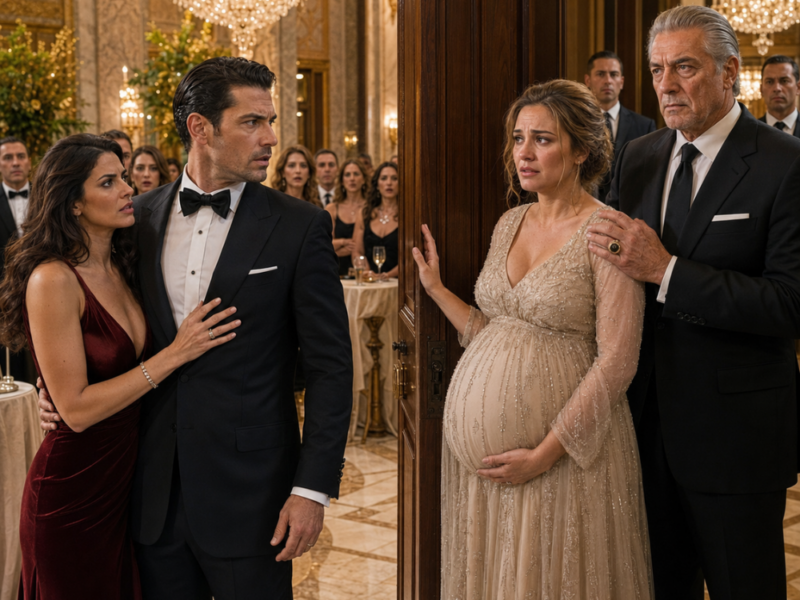
The Mafia Boss Saw His Pregnant Wife as a Cheap Toy—Unaware She Was the Sicilian Don’s Daughter
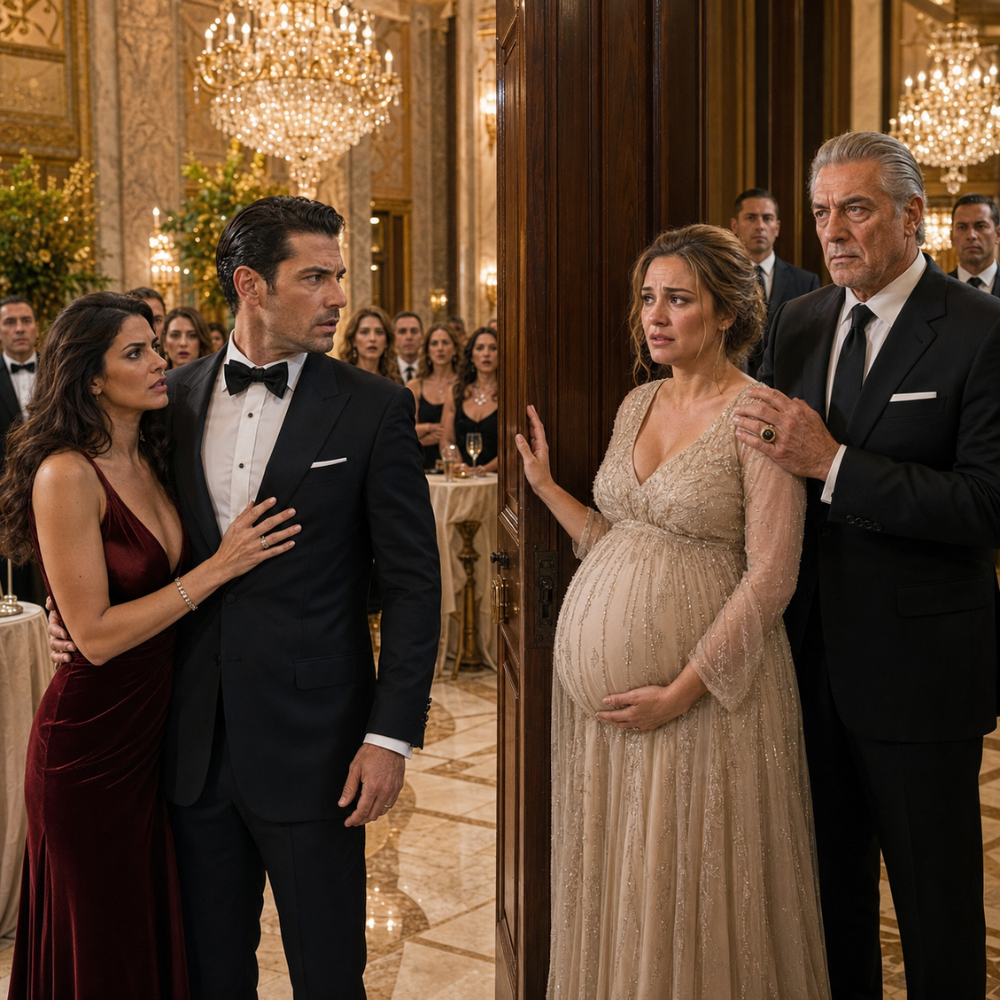
Seven Months Pregnant, Elena Was Humiliated by Her Millionaire Husband at the Plaza—Then a Message Told Her Not to Go Home
Elena Belandi had learned, somewhere between her husband’s first lie and the third trimester of pregnancy, how to smile without letting anyone see what the smile was costing her.
That talent carried her through the ballroom of the Plaza Hotel on a cold December night while more than three hundred guests celebrated the tenth anniversary of Belandi Maritime Holdings.
Crystal chandeliers glittered above white roses and polished silver. Wall Street investors stood beside shipping executives discussing port expansion over champagne. A state senator laughed too loudly near the stage. Several younger analysts kept glancing at stock prices on their phones beneath the tables. Beyond the tall windows, Manhattan shone against the winter darkness.
Elena stood near the entrance in a navy maternity dress that had cost less than some of the women around her spent on shoes.
One hand rested over the curve of her stomach.
The other remained near the handbag hanging from her shoulder.
Inside was a small Tiffany-blue box containing a watch that had once belonged to Marco’s father.
It was not particularly valuable.
Not compared with the Rolex Marco wore now.
But Elena had spent four months finding an old watchmaker in Queens who could restore the damaged movement without replacing the scratched face.
She wanted Marco to recognize it.
More than that, she wanted him to recognize himself.
Before the Park Avenue office, before private cars and investor dinners and European shipping contracts, Marco had been a twenty-six-year-old warehouse supervisor drinking burned coffee with Elena in a freezing office in Brooklyn.
He had owned two suits.
One leaked umbrella.
And an idea.
Elena had owned slightly more.
A nursing degree.
A reliable night-shift position at a Manhattan hospital.
Twenty-eight thousand dollars in savings left partly from her adoptive mother’s estate.
And a willingness to believe Marco when he said they could build something together.
They had worked from a kitchen table in a rent-stabilized apartment while radiator pipes knocked inside the walls.
Elena reviewed shipping insurance clauses between hospital shifts.
Marco met drivers at dawn.
She learned enough about maritime compliance to catch a contract provision that could have bankrupted them during their first year.
When the company could not make payroll one February, she sold jewelry Grace Miller had left her and transferred the money without asking whether she would ever get it back.
Marco cried when he saw the deposit.
“One day,” he had told her, “I’m going to give you everything.”
At the time, Elena had believed he meant they would share a life.
Only later did she realize Marco had gradually changed the meaning of everything.
He stood near the stage now in a custom tuxedo, laughing with investors.
Beside him was Bianca Russo.
Bianca wore a red Dior gown that seemed designed to make every other color in the ballroom disappear. A Cartier bracelet flashed at her wrist whenever she moved her hand.
Elena had seen that bracelet once before.
Three months earlier, Marco had shown her a photograph from a client dinner and casually explained that he had ordered jewelry as a corporate gift for the daughter of an important European investor.
Elena had believed him.
Or, more accurately, she had chosen not to investigate the part of herself that had not believed him.
The baby kicked.
Elena pressed her palm against her stomach.
“You should sit.”
Thomas Greco had appeared beside her.
At fifty-eight, Thomas had driven for Marco’s family since Marco was a teenager. Gray now touched his temples, and he still wore dark suits with the old-fashioned neatness of a man who believed being properly dressed was a form of respect.
“I’m fine.”
“You’ve said that three times.”
“That doesn’t make it less true.”
“It usually does.”
Elena smiled faintly.
Thomas looked toward the stage.
His expression changed.
“Your doctor told you to avoid stress.”
“My doctor does not attend my husband’s corporate anniversaries.”
“Smart woman.”
Elena had been seven months pregnant for three days.
Thirty-one weeks and two days.
Her blood pressure had begun creeping upward over the previous two appointments. Dr. Rachel Cohen had warned her that pregnancy did not care about investor calendars.
Rest.
Hydrate.
Call if contractions developed.
Go directly to the hospital for bleeding, severe headache, visual changes, or decreased fetal movement.
Marco knew all of that.
He still insisted Elena attend.
“People invest in stability,” he had told her while fastening cuff links in their Fifth Avenue penthouse.
Elena had looked at him through the bedroom mirror.
“You mean marriage.”
“I mean confidence.”
“Those are not the same thing.”
Marco sighed.
“Elena, please. One evening.”
She had almost stayed home.
Then she thought about the restored watch.
One evening, she told herself.
Maybe she would give it to him after the speech.
Maybe something familiar would reach him.
Maybe marriages did not always break in one dramatic moment. Maybe they drifted, and sometimes people could still swim back.
The applause began.
Marco stepped onto the stage.
He thanked the board.
Investors.
Port authorities.
The Russo family for helping establish new European financing relationships.
He praised the company’s “relentless culture of growth.”
He mentioned his late father.
He did not mention Elena.
She told herself not to care.
Then Marco looked toward Bianca.
“And tonight, I’m pleased to announce that Bianca Russo will join Belandi Maritime as strategic adviser for European partnerships.”
More applause.
Bianca joined him.
Someone at a nearby table looked toward Elena.
Samuel Hart, the company’s oldest outside director, raised his voice enough to reach the stage.
“And what role will Mrs. Belandi have going forward?”
The question was not hostile.
If anything, Samuel sounded confused.
Elena felt the room become attentive.
Marco looked at her.
For one second she believed he would remember.
The cold office.
The contracts.
Payroll.
His mother’s illness, when Elena spent her days at the hospital as a nurse and her nights at another hospital as family.
Bianca smiled before Marco spoke.
“Elena has always been more comfortable with domestic matters.”
A few people glanced down.
Marco could have corrected her.
He could have said Elena had been there from the beginning.
He could have said she was carrying their child and had chosen to step back temporarily.
He could even have said nothing.
Instead he lifted his champagne glass.
“She was useful when I had nothing.”
Somebody near the front gave a nervous laugh.
Marco continued.
“Now?”
He looked directly at Elena.
His expression was almost playful.
“Now she’s like a cheap toy I forgot to throw away.”
The laughter died before it fully began.
Three hundred people became silent.
Not politely silent.
Stunned.
Elena felt her son move beneath her hand.
She looked at Marco.
There were moments in a marriage when time split.
Before this.
After this.
She waited for him to see what he had done.
He did.
That was the worst part.
He knew.
And pride would not allow him to take it back in front of Bianca.
Elena opened her handbag.
The Tiffany box was there.
So was her phone.
A small packet of antacids.
A folded ultrasound photograph.
She reached instead for her wedding ring.
Marco watched.
The ring had felt tight for weeks because of pregnancy swelling.
Elena eased it over her knuckle.
Then crossed the ballroom.
Nobody stopped her.
She stood below the stage.
Marco lowered the champagne glass.
“Elena.”
She dropped the ring into it.
The tiny sound of gold against crystal carried farther than she expected.
“A toy doesn’t need to say goodbye.”
Then she turned.
Thomas was already moving toward her.
“Elena.”
“I’m leaving.”
“I know.”
She walked through the ballroom while people pretended not to stare.
The elevator doors closed.
Only then did her hands begin shaking.
Her phone vibrated before the elevator reached the lobby.
Unknown number.
One message.
Do not go home. They are waiting for you.
Elena stared.
Her first thought was that Bianca had arranged some cruel extension of the ballroom humiliation.
Then she remembered Marco’s face after the ring hit the glass.
Not regret.
Anger.
The elevator descended.
Floor numbers glowed one by one.
Elena’s breathing became too fast.
She placed both hands beneath her stomach.
“Easy,” she whispered.
To herself.
To the baby.
Maybe both.
The doors opened into the hotel lobby.
Thomas stood near the private entrance.
A black Mercedes waited beyond the glass.
“Mr. Belandi asked me to take you home.”
Elena held up the phone.
“Did he send this?”
Thomas read the message.
Something crossed his face.
Too quick for most people.
Not for Elena.
“You know something.”
“I know we should leave.”
“That is not an answer.”
“No.”
Thomas opened the rear door.
“It is the answer I can give you while we are standing on a public sidewalk.”
Cold air swept beneath Elena’s coat.
She looked back through the lobby.
No Marco.
No apology.
No husband chasing an elevator after realizing he had gone too far.
She got into the Mercedes.
Thomas pulled into Fifth Avenue traffic.
Christmas lights hung above storefronts.
Tourists crowded sidewalks.
People carried shopping bags and paper cups and cameras.
New York had always comforted Elena because the city could contain any private disaster without changing pace.
Somebody could lose a marriage at 9:14 p.m. and at 9:15 a yellow cab would still honk because a delivery van blocked the lane.
She called Marco.
Voicemail.
Again.
Rejected.
Elena lowered the phone.
Thomas looked into the rearview mirror.
A black SUV had turned behind them.
He changed lanes.
The SUV changed lanes.
He turned onto Madison.
It followed.
“Thomas.”
“I see it.”
“Who?”
“I don’t know.”
“That is becoming your favorite answer.”
His jaw tightened.
Elena felt pressure low in her abdomen.
She shifted.
Another tightening came.
Not sharp.
Not yet.
But strong enough that she stopped speaking.
Thomas noticed.
“What was that?”
“Nothing.”
“Elena.”
“Braxton Hicks.”
“How do you know?”
“I’m a nurse.”
“You’re also the worst kind of patient.”
The pain eased.
Thomas’s phone lit on the center console.
A message.
He tried to turn the screen away.
Too late.
Elena read enough.
Bring her to penthouse. Collect phone and laptop. No attorney contact until property reviewed.
“Stop the car.”
Thomas gripped the wheel.
“Elena—”
“Stop.”
“If I stop, that SUV stops.”
“Did Marco send that?”
“It came from the company security director.”
“That was not the question.”
“I don’t know if Marco personally wrote it.”
The contraction returned.
Stronger.
Elena closed her eyes.
Counted.
Twenty seconds.
Twenty-five.
Thirty.
Then easing.
Thomas looked terrified.
“Hospital.”
Elena nodded.
“Hospital.”
He turned east.
The SUV followed.
Thomas called ahead to the private medical center where Elena still worked occasional maternity shifts.
“This is Thomas Greco. I’m bringing in Elena Belandi, thirty-one weeks pregnant, possible contractions, elevated blood pressure. We may be followed. I need security at underground intake.”
The hospital operator transferred him.
Elena’s phone rang.
Marco.
She answered.
“Someone is following us.”
“Where are you going?”
Not Are you safe?
Not What happened?
Where are you going?
“The hospital.”
“You were told to go home.”
She closed her eyes.
“So you did give the order.”
“I told security to recover company property.”
“I walked out with my handbag.”
“You still have the MacBook.”
“The MacBook I owned before Belandi Maritime existed?”
“Do not make this worse.”
“I’m having contractions.”
Silence.
Elena waited.
Some part of her, humiliated and foolishly loyal, still believed pregnancy might reach the man that marriage no longer could.
Marco finally said, “Bianca thinks you’re creating a public scene because of what happened.”
Elena stared at the city beyond the window.
“Bianca is not my doctor.”
“She understands what is at stake.”
“Our son is at stake.”
Another contraction hit.
Hard enough that Elena dropped the phone.
Thomas accelerated.
Hospital security waited at the underground entrance.
The Mercedes crossed the barrier.
The SUV slowed outside.
Then continued past.
Thomas stopped near the emergency doors.
Elena tried to stand.
Warm fluid ran down the inside of her legs.
She looked down.
Then at Thomas.
“My water broke.”
The next ten minutes became motion.
Wheelchair.
Questions.
Blood pressure cuff.
Hospital ID bracelet.
Elevator.
White ceiling tiles passing above.
Elena knew every routine.
That made it worse.
Dr. Rachel Cohen met her outside obstetric triage.
“How long have contractions been happening?”
“I don’t know.”
“Any bleeding?”
“No.”
“Fluid?”
“Garage.”
“Baby moving?”
“Yes.”
Rachel helped her onto the bed.
Two monitors were strapped around her abdomen.
For several seconds they heard static.
Elena forgot how to breathe.
Then the fetal heartbeat filled the room.
Fast.
Alive.
She covered her mouth.
“He’s there,” Rachel said.
The contractions appeared on the screen.
Closer than Elena wanted.
Her blood pressure was too high.
Rachel reviewed the first numbers.
“I’m admitting you.”
“I figured.”
“We’ll try to slow labor. Steroids for lung maturity. Medication for blood pressure.”
“How long can we stop it?”
Rachel did not lie.
“Maybe days.”
Elena waited.
“Maybe hours.”
Thomas stood near the door holding her handbag and phone.
A nurse brought admission forms.
“Emergency contact?”
Elena took the pen.
The line seemed absurdly simple.
For ten years she had written Marco Belandi.
She could write his number without looking.
She thought about the ballroom.
The rejected calls.
His response when she said contractions.
Bianca thinks you’re creating a scene.
Elena wrote Thomas Greco.
Thomas saw.
His eyes lowered.
“You should put family.”
“I don’t have any.”
The sentence hurt more than expected.
That was not completely true.
Elena had once had family.
Grace and Henry Miller adopted her when she was four.
Henry worked as an electrical technician for Boston Public Schools.
Grace managed a neighborhood library where half the books seemed to come home with her accidentally.
They lived in a two-story house with a narrow driveway in Dorchester.
Not wealthy.
Never close.
Loved.
Elena remembered pancake Sundays.
Used-book stores.
Henry swearing at plumbing.
Grace leaving birthday presents in recycled Amazon boxes because wrapping paper was “a conspiracy invented by department stores.”
On Elena’s eighteenth birthday, Grace gave her a worn paperback.
Inside she had written:
You do not need to know where your story began to decide how it continues.
Because Elena did not know.
Police found her outside Saint Matthew’s Church in Boston when she was about three.
No birth certificate.
No confirmed surname.
No reliable explanation.
A silver bracelet with a tiny bird.
Half a burned photograph tucked inside her coat.
That was all.
Grace and Henry never pretended the mystery did not exist.
They also never treated Elena as temporary because of it.
Henry died when Elena was twenty-four.
Grace followed two years later after a stroke.
Elena sold the house because every room sounded wrong without them.
She moved to New York.
Met Marco.
Built a new family.
At least that was what she believed she had done.
Rachel returned.
“Baby’s heart rate is dipping during contractions.”
“How badly?”
“Not badly enough that we deliver this minute.”
“This minute.”
Elena heard the qualifier.
Rachel sat beside her.
“We watch closely.”
“Can I lose him?”
Rachel placed one hand over Elena’s.
“We are not there.”
“That was not my question.”
“No.”
Rachel took a breath.
“You could have complications. He could. That is why you’re here.”
Elena looked toward the monitor.
The nursery at the penthouse was unfinished.
The crib still sat inside a box.
Marco had promised three Sundays in a row they would assemble it.
Each Sunday something came up.
Paris investors.
A board call.
Bianca.
Thomas stepped into the hallway.
Only then did he remove the white envelope he had found beneath the Mercedes windshield after the emergency team wheeled Elena away.
Inside was a photograph taken at the Plaza.
Elena.
Pregnant.
Silver bracelet visible.
On the back, four words.
We found Alicia Marino.
Thomas stared.
He had seen that bird before.
Not in New York.
In Sicily.
Decades earlier.
He called an old friend.
Carlo Vitale had served maritime security for several old European shipping families before retiring outside Palermo.
Thomas sent a photograph of the bracelet.
Carlo called within two minutes.
“Where did she get it?”
“She has had it since childhood.”
Silence.
“Thomas.”
“What?”
“Do not let her remove it.”
“Why?”
“That bird belonged to Rosa Marino’s family line.”
Thomas looked through the glass toward Elena.
“What are you telling me?”
“A child disappeared.”
“When?”
“Almost thirty years ago.”
Thomas’s stomach tightened.
“Name?”
“Alicia Rose Marino.”
Back inside, Elena’s phone buzzed.
Marco.
A message.
You need to stop making this public. Come home when they discharge you.
Nothing about the baby.
Elena switched off the phone.
Thomas entered.
He placed the Plaza photograph on the blanket.
Elena looked at it.
Then read the back.
“What is this?”
“I need you not to panic.”
“That is never a useful sentence.”
Thomas showed her the photograph Carlo sent.
An old family picture outside a stone villa.
A man.
A woman.
A little girl in a white dress.
The child wore a silver bird bracelet.
Elena stared.
“That could be anyone.”
“Yes.”
“Why are you showing me this?”
Thomas enlarged the image.
Behind the child’s left shoulder was a curved scar.
Elena’s hand moved automatically to the matching scar beneath her gown.
“No.”
“I am not saying this proves anything.”
“You just showed me a missing child who looks like me.”
“She was never confirmed dead.”
“Who are they?”
“The Marino family.”
Elena laughed once.
There was no humor in it.
“Of course.”
“Elena.”
“No. Tonight my husband humiliates me, someone follows me, I go into premature labor, and now apparently I am a lost heiress from Sicily?”
Her monitor showed another contraction.
Rachel entered.
“What happened?”
Elena held up the photograph.
“Apparently I need a soap opera consultant.”
Rachel looked at Thomas.
He explained briefly.
Rachel’s expression hardened.
“She is in preterm labor.”
“I know.”
“Then nobody gives her another family mystery until her blood pressure comes down.”
“Agreed.”
Elena looked at Rachel.
“I want my attorney.”
“Who?”
“Clare Donovan.”
Clare had known Elena before Marco’s first warehouse.
They met through a patient advocacy project when Clare was still a junior attorney.
Marco never liked her.
That now seemed meaningful.
Clare arrived forty minutes later with a legal folder and two coffees.
She took one look at Elena.
“Tell me what is urgent first.”
“The baby.”
“What else?”
“Marco froze company access. Maybe personal accounts too.”
“Anything signed?”
“No.”
“Anyone ask you to sign?”
“Not yet.”
“Good.”
Clare opened her notebook.
“First rule: you sign nothing tonight.”
Elena nodded.
“No visitors without approval.”
“Yes.”
“Medical information stays private.”
“Yes.”
“Your devices?”
“Phone here. Old MacBook at the penthouse.”
“Passwords?”
“Changed last month.”
“Marco know them?”
“No.”
Clare looked toward Thomas.
“And mystery Sicilian relatives?”
Thomas handed her the documents.
Clare studied them.
“No DNA until we choose the lab.”
Thomas nodded.
“They requested testing.”
“Of course they did.”
“I already said no on Elena’s behalf.”
“Good.”
Elena looked between them.
“I can say no myself.”
Clare softened.
“You can.”
She looked directly at her.
“And that is the point.”
An independent test was arranged the following day through the hospital’s approved laboratory, with results to be delivered simultaneously to Elena, Clare, and the Marino family’s attorney.
Before signing consent, Elena removed the silver bracelet.
She had worn it nearly her entire life.
Grace told her police found it on her wrist.
The clasp had been repaired twice.
Elena held it in her palm.
A tiny bird with spread wings.
For the first time, she whispered the name from the old photograph.
“Alicia.”
Across the Atlantic, Salvatore Marino received the image before dawn.
His office overlooked Palermo harbor.
Container ships moved through the water beneath a pale morning sky.
For twenty-nine years, Salvatore had lived with one unanswered question.
Where was his daughter?
Alicia vanished at age three during a period of bitter conflict between branches of several old shipping families.
The first investigators believed the abduction was tied to inheritance.
Others believed it was retaliation.
Salvatore spent years paying investigators in Europe and the United States.
Every few years, someone produced a woman claiming to be Alicia.
DNA ended each hope.
Rosa, Alicia’s mother, refused to close the child’s bedroom.
Every Sunday she opened the curtains.
She died still believing Alicia lived.
Now Salvatore stared at Elena Belandi’s photograph.
The eyes.
The scar.
The bracelet.
His sister Margaret stood near him.
“Those are Rosa’s eyes.”
Salvatore did not answer.
His attorney, Daniel Walsh, reviewed the Boston discovery record.
“Found nine days after Alicia disappeared.”
Salvatore gripped the table.
“Where?”
“Saint Matthew’s Church.”
“Why did no one connect it?”
“Different state. No confirmed name. Record systems were not what they are now.”
Salvatore walked away.
Hope had become something he distrusted.
Daniel continued.
“Elena has requested independent DNA.”
“Good.”
“You will not contact her.”
Salvatore looked at him.
Margaret stepped forward.
“She is pregnant.”
“I know.”
“She is hospitalized.”
“I know.”
“She has spent thirty years without us.”
Salvatore’s jaw tightened.
Margaret lowered her voice.
“If she is Alicia, do not arrive in New York like a man coming to reclaim property.”
“She is my daughter.”
“She is also an adult woman who may be terrified of your name.”
That stopped him.
Salvatore looked toward the locked room at the rear of his office.
Alicia’s room.
Rosa had insisted it remain.
Inside were children’s books.
A yellow sweater.
Tiny white shoes.
Salvatore opened the drawer where the shoes remained.
One lace still tied badly.
Alicia had insisted on doing it herself.
The memory broke something.
“Prepare the plane,” he told Daniel.
Margaret stared.
“Salvatore.”
“Four people.”
“Who?”
“You. Daniel. Dr. Moretti. Me.”
“No security?”
“One driver in New York.”
Margaret nodded.
“Better.”
“And if she says no?”
Salvatore looked at the shoes.
“Then I wait.”
The DNA result arrived fourteen hours later.
Probability of biological paternity greater than 99.99 percent.
Daniel read it twice.
Salvatore closed his eyes.
“Is she safe?”
Daniel looked at his phone.
“She is in active labor.”
At the hospital, medication had failed to slow Elena’s contractions.
Noah’s fetal heart rate dipped longer each time.
Rachel stood beside the monitor.
“We need to deliver.”
“No.”
“Elena.”
“He needs nine more weeks.”
“I know.”
“Give me another hour.”
“I cannot promise that hour is safe.”
Elena looked toward Clare.
“Call Marco.”
Clare hesitated.
“He is Noah’s father.”
That remained true.
Clare called.
Marco sat in a private dining room on Fifth Avenue.
Bianca beside him.
Investors across the table.
A European financing agreement waited for signatures.
When his phone lit with the hospital number, Bianca touched his wrist.
“If you leave now, they will wonder whether you can control the situation.”
“My wife may be in labor.”
“She has been dramatic all night.”
Marco stared at her.
The phone stopped.
Then Thomas called.
Marco answered.
“What?”
“Your son may be born tonight.”
Marco pushed back from the table.
“How serious?”
“They are preparing the operating room.”
One investor cleared his throat.
“The financing commitment expires at midnight.”
Marco looked at the contract.
Then his phone.
“I’ll come after we sign.”
Thomas’s voice went cold.
“Your son may not schedule his birth around your closing.”
Marco disconnected.
At the hospital, Clare placed the phone down.
Elena looked at her.
“He is coming?”
Clare could not lie.
“After the meeting.”
Something inside Elena settled.
Not broke.
Settled.
For years she had defended Marco by describing his choices as obligations.
Tonight, finally, she stopped.
Rachel entered.
“We’re going now.”
The operating room was painfully bright.
The neonatal team waited beside a warming bed.
Clare stood near Elena’s head in sterile clothing.
Elena felt pressure.
Voices.
Hands moving efficiently.
Then silence.
Too much silence.
“Why isn’t he crying?”
Nobody answered immediately.
Elena’s pulse filled her ears.
“Please.”
The neonatal team worked.
Then a small sound entered the room.
Weak.
Thin.
But unmistakable.
Noah cried.
Elena covered her mouth.
Rachel smiled beneath her mask.
“There he is.”
They brought Noah close for seconds.
He was tiny.
Far too tiny.
A breathing mask covered most of his face.
Elena touched one finger to his hand.
He closed his fingers around it.
“Hello, Noah.”
Her voice broke.
“I’m your mother.”
The neonatal team moved him to intensive care.
Elena watched until he disappeared through the doors.
Later, in recovery, Clare showed her the first photograph.
Noah inside the incubator.
Stable.
Fragile.
Fighting.
Elena asked the question she already knew the answer to.
“Did Marco come?”
Clare looked away.
Elena’s phone displayed a news photograph.
Marco leaving the restaurant.
Bianca beside him.
Timestamp.
Eleven minutes after Noah’s birth.
At nearly the same time, Salvatore Marino’s plane landed at Teterboro.
He stepped onto the tarmac holding a small cardboard box containing his missing daughter’s shoes.
He arrived at the hospital shortly after midnight.
Security stopped him.
“Mrs. Belandi has not approved you.”
Salvatore looked toward the elevators.
“She is my daughter.”
“That may be true, sir. I still cannot allow you upstairs.”
Daniel expected an argument.
Instead Salvatore nodded.
“I will wait.”
For forty minutes, one of Europe’s wealthiest shipping owners sat beneath fluorescent lights beside a family sleeping across three chairs.
He made no calls.
No threats.
No demands.
He waited.
Upstairs, Clare entered Elena’s room.
“Salvatore is downstairs.”
Elena stared at Noah’s photograph.
“He agreed not to come up.”
“That was his choice.”
“Yes.”
“What happens now is yours.”
Elena thought.
“Margaret first.”
Salvatore’s sister entered carrying the box.
She did not approach the bed.
“I brought something that belonged to you.”
Elena opened it.
Tiny shoes.
Worn leather.
One lace neat.
One crooked.
“You always insisted on tying them yourself,” Margaret said.
Elena touched the knot.
“What was my mother like?”
“Rosa?”
Elena nodded.
“She loved jazz.”
Margaret smiled through tears.
“She drank coffee cold because she forgot it existed.”
“She laughed too loudly at formal dinners.”
“And she called you her little bird.”
Elena stopped.
A sound came from somewhere inside memory.
A woman near an open window.
Music.
Little bird, come home.
Elena covered her mouth.
For thirty years she had thought it was a dream.
“Let him come up.”
Salvatore stopped outside the neonatal unit.
Elena stood beside Noah’s incubator in a hospital gown.
They looked at each other through the glass.
All of Salvatore’s imagined reunions disappeared.
Elena did not run to him.
She did not call him father.
She looked tired.
Guarded.
Like a woman whose life had already changed too much in one day.
“Elena,” he said.
Not Alicia.
She noticed.
“I am sorry.”
“For what?”
He had prepared speeches.
None survived.
“For not finding you.”
Elena’s eyes hardened.
“You had ships. Money. Investigators.”
“Yes.”
“I grew up believing somebody left me because they did not want me.”
Salvatore accepted the blow.
“Your mother opened your curtains every Sunday.”
Elena looked away.
“She believed you would come home.”
“Then why didn’t you find me?”
“I searched the places powerful men told me to search.”
“That is not an answer.”
“No.”
His voice broke.
“It is my failure.”
Elena looked at him again.
For the first time, not as Salvatore Marino.
As an old man.
A father.
A man who had lost a child and spent decades discovering that money could buy information but not certainty.
Down the hall, the elevator opened.
Marco stepped out carrying white roses.
Clare intercepted him.
“I want to see my wife.”
“She has restricted visitors.”
“I am her husband.”
“You were her husband when the hospital called.”
Marco’s face tightened.
Then he saw Salvatore.
He knew the name immediately.
Anyone in global shipping did.
Salvatore Marino had controlled Mediterranean routes before Marco owned his first truck.
Marco’s face lost color.
Salvatore looked through the glass toward Elena.
Then at Marco.
“My daughter survived.”
The words landed.
Marco stared at Elena.
The woman he had called disposable now stood beside a man Marco had spent years hoping to meet professionally.
Clare handed Marco legal papers.
“What is this?”
“Notice preserving Elena’s financial claims and demanding return of personal devices.”
“This is ridiculous.”
“You froze her access to accounts.”
“Company accounts.”
“Some were joint.”
“I was protecting confidential information.”
“You attempted to stop her from contacting counsel.”
“I never said that.”
Clare looked toward Thomas.
“He has the message.”
Marco’s jaw tightened.
“I want to see my son.”
“Elena will decide when.”
Marco pushed the flowers toward Clare.
“Give these to her.”
“No.”
“They are not for you.”
Clare met his eyes.
“Exactly.”
Marco left carrying the flowers.
At the penthouse, Bianca sat beside Elena’s MacBook.
Marco stopped.
“What are you doing?”
“Finding out what she has.”
“You told security to take this?”
“You told them to secure company property.”
“This is hers.”
“She has company files.”
Marco closed the laptop.
Then noticed the access history.
Bianca’s account.
Private folders.
Financial documents.
“Why did you download these?”
“To know whether she could hurt us.”
“Us?”
Bianca stood.
“Marco, stop pretending your wife is innocent.”
“She just gave birth.”
“She humiliated you.”
“I humiliated her.”
Bianca’s expression sharpened.
“You said what everyone in that room already thought.”
“No.”
Marco stared.
“I said what you wanted them to think.”
For the first time, he began seeing the distance between Bianca’s influence and his own responsibility.
Bianca had encouraged.
He had chosen.
At the hospital, Elena sat beside Noah’s incubator.
Salvatore waited several chairs away.
“You can leave,” she said.
“I have people who run the company.”
“I don’t want Noah growing up around men who solve everything with power.”
Salvatore nodded.
“Then tell me what you want.”
“Privacy.”
“Yes.”
“Medical decisions stay mine.”
“Yes.”
“No one moves me anywhere without asking.”
“Yes.”
“And stop treating me like a lost child you can simply bring home.”
Pain moved through Salvatore’s face.
“What should I call you?”
“Elena.”
“And Alicia?”
“That belongs to a child I barely remember.”
Salvatore lowered his eyes.
Before leaving, he asked one question.
“Where are Grace and Henry Miller buried?”
Elena looked at him.
“Why?”
“I want to thank them.”
Her composure broke.
Of all the things Salvatore could have said, that was the one she had not prepared for.
He did not try to replace the people who raised her.
He understood they were part of her.
Elena reached for his hand.
Only briefly.
Enough.
The next major revelation came from Clare.
She had retrieved old company documents from a storage box Elena kept in her office.
Bank statements.
Emails.
The first Belandi Maritime registration.
“Elena.”
“What?”
“You are a founding investor.”
Elena looked at her.
“I gave Marco money.”
“No.”
Clare slid the papers over.
“You invested.”
“There is a difference.”
Elena read.
Twenty-eight thousand dollars classified as initial capital.
Another transfer after the first truck accident.
Money from Grace’s estate used for payroll.
Old emails.
Marco, ten years younger.
Your investment makes you a founding partner. When we grow, we grow together.
Elena sat back.
“I thought we changed this.”
“You never did.”
“Marco said the paperwork was temporary.”
“There is no transfer.”
Clare opened another file.
“You also built early compliance procedures.”
“That was helping.”
“In corporate governance, helping has documents.”
Elena almost laughed.
Salvatore entered.
“Marino Global can purchase Belandi Maritime.”
“No.”
He stopped.
“You did not hear the structure.”
“I do not need to.”
“It would protect you.”
“It would replace Marco controlling my life with you controlling the company.”
“I am your father.”
“And Marco is my husband.”
Elena held his gaze.
“Titles do not create permission.”
Salvatore sat.
“What do you want?”
“Independent audit.”
“No takeover.”
“No retaliation against employees.”
“No deals made because everyone is frightened of your surname.”
“You are protecting Marco.”
“I am protecting people who have mortgages.”
Salvatore studied her.
Then nodded.
“All right.”
The independent review uncovered a different problem.
Bianca’s family firm, Russo Capital, had borrowed heavily against a shipping partnership that depended on Marco’s approval.
Without the Belandi deal, the Russo financing was in serious trouble.
Bianca had needed Marco.
Emotionally, perhaps.
Financially, certainly.
Thomas found a recording from the ballroom audio system.
After Marco called Elena a toy, Bianca’s voice could be heard beneath the silence.
Now everyone knows she has no place here.
Elena listened once.
Then closed the file.
For months she had wondered what she lacked.
Beauty?
Excitement?
Status?
Now the question seemed almost childish.
Marco’s betrayal had not been created by Elena’s deficiency.
It had been enabled by his hunger to feel larger than the person who knew who he had once been.
Marco requested a supervised visit with Noah.
Elena agreed.
He stood beside the bassinet and cried.
“I’m sorry.”
Elena remained near the doorway.
“Come home.”
There it was.
The apology still carrying a request.
“We can repair this.”
Elena looked at him.
“Do you want me back?”
“Yes.”
“Or do you want everything that disappeared when I left?”
Marco saw the financial documents.
His old emails.
Her investment records.
The audit request.
Understanding arrived.
The woman he had described as having no role could challenge his control of the company.
“I love you.”
“You loved me when you believed I had nowhere else to go.”
Marco looked at Noah.
“I made a mistake.”
“No.”
Elena’s voice remained quiet.
“You made many choices.”
The distinction mattered.
The board meeting began the following morning.
Twelve directors sat around a Park Avenue conference table.
Marco stood at the head.
“Elena’s claims are personal retaliation.”
Company counsel adjusted his glasses.
“Mrs. Belandi is listed as a founding shareholder.”
“That was temporary.”
“There is no document saying so.”
“She stopped participating.”
Counsel opened old communications.
Samuel Hart read one.
Without you, there is no Belandi Maritime.
Marco had written it.
The room changed.
At ten, Elena entered with Clare.
Cream suit.
Silver bird bracelet.
Old MacBook Air.
Marco watched her sit across from him.
“Did Salvatore prepare this?”
Elena connected the computer.
“My father did not build this company.”
The screen filled with files from the first three years.
Insurance negotiations.
Driver schedules.
Compliance procedures.
Early account forecasts.
Emails.
She looked toward the board.
“I am not asking you to choose between a husband and wife.”
“I am asking you to protect a company we both created.”
Her requests were limited.
Independent audit.
Freeze transactions with Russo Capital.
Restore her lawful shareholder access.
Protect employees from retaliation.
Marco tried again.
“This is a family dispute.”
Elena opened another email.
Marco thanking her for catching the insurance clause that would have exposed the company to millions in liability.
Another.
Marco thanking her for covering payroll.
Another.
You should focus on the baby now. I’ll handle the company. We can update the papers later.
Elena looked at him.
“I did not leave the business.”
“I was removed one decision at a time.”
No director defended him.
The vote passed eight to four.
Audit.
Russo freeze.
Elena’s access restored.
Marco temporarily suspended pending review of security misuse and conflicts of interest.
Elena did not smile.
The meeting was not revenge.
Then Rachel called.
Noah was having trouble breathing.
Elena left before the board finished discussing executive authority.
At the hospital, Noah required several hours of respiratory support.
Marco arrived separately.
He stood at the glass.
For once, no company.
No Bianca.
No defense.
“I should’ve been here the first time.”
Elena looked at him.
“Regret is not change.”
“I know.”
Two detectives arrived.
Marco assumed they had come for him.
They had not.
A warrant had been issued for Bianca Russo relating to unauthorized access, financial manipulation, obstruction, and unlawful acquisition of private medical information.
Bianca cooperated quickly after her father publicly distanced himself.
Her phone contained messages.
Payments.
Edited photographs.
The story became larger.
She admitted hiring a media contractor to portray Elena as unstable.
She admitted directing someone to photograph Noah at the hospital for possible use in a custody dispute.
Marco had not approved that.
For Elena, the distinction mattered.
Accountability required accuracy, even for people she hated.
Then Bianca revealed something none of them expected.
She had recognized Elena’s bracelet before the gala.
Her father, Victor Russo, possessed old records from a decades-old conflict involving the Marino family.
A photograph showed three-year-old Alicia wearing the silver bird.
Bianca suspected Elena might be the missing child.
Instead of warning her, she had Elena followed.
“Why?” investigators asked.
Bianca looked down.
“Because if she was Salvatore’s daughter, my father thought she could become leverage in a shipping negotiation.”
The investigation moved backward nearly thirty years.
Names returned from old files.
One mattered most.
Catherine Doyle.
She was eighty now.
Living outside Worcester, Massachusetts.
Elena traveled there with Clare and a federal investigator.
Salvatore remained in the car at Elena’s request.
Catherine’s house was small.
White siding.
A porch leaning slightly.
Wind chimes beneath the eaves.
Catherine opened the door wearing an oxygen cannula.
The moment she saw Elena, her knees weakened.
“Alicia.”
Elena did not correct her.
They sat inside.
Clare placed a recorder on the table.
Catherine had once worked for a transportation contractor connected to the Russo family.
She was told a little girl had been removed from a dangerous household for protection.
At first, Catherine believed it.
Then she overheard two men.
“A dead child cannot inherit anything.”
Catherine understood.
She took Alicia from the safe house.
Drove through the night.
Reached Massachusetts.
“Why the church?” Elena asked.
“My sister volunteered nearby.”
“You left me outside.”
Catherine lowered her head.
“Yes.”
“In winter.”
“Yes.”
“You could have called police.”
“I thought police might be paid.”
“You could have stayed.”
“I thought they would find me.”
Elena’s hands tightened.
For years she imagined the person who left her as careless.
Catherine had been terrified.
Fear explained.
It did not erase.
“I woke up screaming for years.”
Catherine cried.
“I know sorry does not fix it.”
“No.”
Elena’s voice softened.
“But you saved my life.”
Catherine covered her face.
Elena did not forgive everything in one beautiful moment.
Real forgiveness did not work on command.
“Tell me the rest.”
Catherine described the drive.
The burned photograph.
The bracelet Alicia refused to remove.
Six months later, Catherine wrote to Salvatore.
The letter gave the church name.
Date.
Clothing.
It never reached him.
Investigators later found evidence an employee within the mail system connected to Russo associates intercepted it.
One envelope.
One hidden letter.
Almost three decades.
Salvatore eventually entered.
Catherine tried to stand.
“I’m sorry.”
He looked at the woman who saved and abandoned his daughter.
“Why didn’t you bring her to me?”
“I did not know which men around you wanted her alive.”
Salvatore sat down.
That truth hurt because his power had helped create the fear that kept Alicia away.
“You gave her a chance to live.”
“And then I left her.”
“We failed her differently.”
Elena looked at both of them.
There was no villain large enough to carry every consequence.
Only decisions.
Fear.
Greed.
Power.
Silence.
Later, Elena took Salvatore to the cemetery where Grace and Henry Miller were buried.
He placed white roses between the headstones.
“These are the parents who found me when you couldn’t.”
Salvatore lowered his head.
“Then they are my family too.”
Elena took his hand.
Not because the past was repaired.
Because he had finally understood that love did not require erasing whoever came before.
The divorce process began quietly.
Marco sent Elena a letter.
Not flowers.
Not jewelry.
A letter.
He wrote that he would tell the truth publicly.
Even if it ruined him.
Weeks later, he returned to the Plaza ballroom.
The same chandeliers.
The same stage.
Reporters now filled seats once occupied by investors.
Marco stood alone.
No Rolex.
No Bianca.
No champagne.
“I stood in this room and called my pregnant wife a cheap toy.”
The original recording played.
His laughter.
The ring striking the glass.
Elena’s voice.
A toy doesn’t need to say goodbye.
Marco waited.
“I could blame Bianca Russo.”
“Alcohol.”
“Pressure.”
“Ambition.”
“All would be excuses.”
He looked into the cameras.
“I humiliated the woman who helped build my company.”
“I froze access to money she helped earn.”
“I allowed company security to be used inside a marital dispute.”
“I failed to go to the hospital when my son was born premature.”
The room remained silent.
Then Marco said the sentence Elena had never expected.
“I did not lose Elena because I failed to recognize that she belonged to a powerful family.”
“I lost her because I believed she mattered less when I thought she didn’t.”
At Long Island, Elena watched from a sofa with Noah sleeping against her chest.
She did not cry.
The apology did not make them married again.
Truth was not reconciliation.
The board audit found no evidence that Marco stole company money.
It did find serious governance failures.
Conflict of interest.
Improper restriction of a founding shareholder.
Misuse of internal security authority.
Failures involving Russo Capital.
Marco was removed as chief executive for three years.
Independent leadership took over.
He accepted.
When a reporter asked whether he believed Elena would return, Marco shook his head.
“An apology does not create an obligation to forgive.”
Elena switched off the screen.
“That chapter is over,” she whispered to Noah.
Salvatore later asked Elena to join Marino Global’s legal board.
She refused at first.
“I’m a nurse.”
“So?”
“I have never run an international shipping company.”
“Neither had I before I did.”
“That is not reassuring.”
Eventually she agreed to present a governance plan rather than accept a title automatically.
The board challenged her.
Good.
She wanted that.
One older director said, “You carry Salvatore Marino’s blood. That does not qualify you to manage.”
Elena opened her old MacBook.
“I agree.”
The man blinked.
“I am not asking you to trust my surname.”
She presented compliance reforms.
Employee protections.
Independent audits.
Medical logistics.
Insurance modernization.
Separation of family influence from company governance.
She referenced the systems she had helped build at Belandi.
For two hours, the board questioned her.
Salvatore stayed silent.
That was his gift.
Not defending her.
Allowing the room to evaluate her work.
She earned a narrow majority appointment overseeing legal businesses and charitable assets.
“My son will inherit family,” Elena told them.
“He will not inherit wars.”
The statement mattered sooner than expected.
Someone leaked Noah’s medical information to a national newspaper.
A photograph taken through the NICU glass.
Premature baby.
Marino heir.
Temporary custody dispute.
Elena stared at the image.
One of the most frightening moments of her life turned into content.
Salvatore said, “I can call the owner.”
“No.”
“One call.”
“No threats.”
“They are using my grandson.”
“They are using him because everyone assumes our family solves problems above the law.”
She looked at her father.
“We use the law.”
Clare obtained an emergency injunction limiting publication of illegally obtained medical records.
The newspaper could still report Elena’s identity.
Instead of hiding, Elena held a small press conference in Brooklyn.
No ballroom.
No luxury hotel.
A rented community room.
Local reporters.
Hospital workers.
Adoption advocates.
“My name is Elena Grace Marino.”
She paused.
“I was born Alicia Rose Marino.”
“I was raised as Elena Grace Miller.”
“Both are mine.”
She confirmed Noah’s relationship to Salvatore.
Then drew the boundary.
“My son is not a dynasty.”
“He is not a future corporate alliance.”
“He is not a headline.”
“His medical history belongs to him.”
A reporter asked whether Noah would inherit the Marino empire.
Elena answered.
“He may inherit a name.”
“He will not inherit a war.”
Then she announced the Alicia Grace Foundation.
The name honored both lives.
Alicia, the lost child.
Grace, the mother who raised her.
The foundation would help families searching for missing children.
Fund independent DNA testing in unresolved cases.
Provide legal assistance to adoptive families navigating old records.
Support women facing financial control inside relationships.
And create temporary housing for parents staying near neonatal intensive care units.
Elena remembered sitting beside Noah’s incubator reading the same Kindle paragraph four times because fear had made language useless.
No parent should have to choose between rent and staying near a sick newborn.
Funding came from Elena’s Belandi dividends, a portion of Marino Global’s audited legal profits, and outside donations overseen by an independent board.
Salvatore offered to finance all of it.
Elena refused.
“Why?”
“Because foundations should survive fathers.”
He frowned.
“That sounds insulting.”
“It is governance.”
He laughed.
Three months later, the first Alicia Grace Family Center opened in Brooklyn.
Counseling rooms.
Legal clinic.
Children’s library.
Six small apartments for parents with babies receiving long-term hospital treatment.
The first Amazon delivery contained donated books.
Elena opened one box.
Inside was a new copy of Women Who Run with the Wolves.
A note had been written inside.
For every woman learning she was never powerless.
Elena sat for a moment.
Grace would have loved it.
Marco began supervised visits with Noah.
He no longer arrived asking for Elena back.
He brought diapers once.
The wrong size.
Elena laughed before she could stop herself.
Marco looked embarrassed.
“I asked the store clerk.”
“She has clearly never met a premature baby.”
“I’ll exchange them.”
He did.
Therapy became part of his custody requirements.
At first Marco treated it like another condition to complete.
Then something changed.
His therapist asked him why providing money had always felt easier than being emotionally present.
Marco did not know.
He began learning.
Slowly.
Not because Elena promised a reward.
She promised none.
At the center, Marco handed her a sealed envelope.
“Donation.”
“No name?”
“No.”
“This does not buy access to Noah.”
“I know.”
“It does not repair the marriage.”
“I know.”
He looked through the glass at his son.
“I want to become someone he won’t be ashamed of.”
Elena studied him.
“I hope you do.”
Then she added, “For him. Not for me.”
Marco nodded.
The divorce was finalized quietly.
Elena received primary custody.
Marco’s visitation could expand if he followed every condition.
Outside the courthouse, he asked one final question.
“Is there truly no future for us?”
Elena looked at the man she had once loved.
“There is a future.”
His eyes lifted.
“Just not one where I have to become your wife again so you can become a better father.”
She walked away.
No anger.
No victory.
Clarity.
One year after the Plaza gala, Noah’s first birthday arrived beneath a clear spring sky.
Elena refused hotels.
The party took place in the garden behind the Alicia Grace Family Center.
Paper birds hung between trees.
Nurses attended.
Adoptive families.
Former Belandi employees.
Parents who had slept beside NICU incubators.
Thomas Greco wore a tie even though nobody asked.
Margaret brought too much food.
A Costco sheet cake sat beside homemade cannoli because no family gathering involving Salvatore Marino could happen without a dispute about dessert.
Elena stood near the children’s library holding Noah.
He was small for his age.
Healthy.
Curious.
Obsessed with the silver bracelet Elena had worn since childhood.
Salvatore was attempting to adjust Noah’s stroller.
He watched the instruction video twice.
The buckle still defeated him.
“You have it backward.”
Salvatore looked offended.
“I manage ships across four continents.”
“And yet a stroller has won.”
Margaret laughed loud enough that two people turned.
Salvatore finally laughed too.
Their relationship was not perfect.
That mattered.
Sometimes he tried to solve problems before asking.
Sometimes Elena rejected help simply because needing anyone still felt dangerous.
They argued.
Then tried again.
He listened more than before.
She accepted more than before.
Love became something they practiced rather than something their blood automatically guaranteed.
Inside the center, two photographs hung side by side.
Rosa and Salvatore with three-year-old Alicia.
Grace and Henry at Elena’s nursing-school graduation.
Elena refused to choose.
Both families belonged.
Marco arrived before cake.
Alone.
He carried the restored watch Elena had planned to give him at the gala.
He had found the Tiffany box in her abandoned handbag afterward.
For months he could not open it.
Now he placed it in her hand.
“This should belong to Noah someday.”
Elena looked at the watch.
Marco continued.
“Not because it’s worth anything.”
“My father wore it for thirty years.”
“He should know where he came from.”
Elena closed the box.
“Thank you.”
Marco looked toward Noah.
His visits were no longer supervised.
He had followed the court plan.
Continued counseling.
Stopped asking Elena to reconsider the divorce.
Belandi Maritime had appointed a permanent chief executive.
Marco remained a shareholder but no longer controlled daily operations.
“I used to think money made me a good husband.”
Elena looked at him.
“You used money to avoid giving us your time.”
“I know.”
No defense.
That was new.
Marco crouched beside Noah.
Helped him stack wooden blocks.
The tower collapsed.
Noah laughed.
Marco handed him another block.
Elena watched.
She did not confuse good fatherhood with restored marriage.
That distinction had taken her too long to learn.
Clare arrived carrying a letter from Bianca Russo’s attorney.
Elena read it privately.
Bianca had entered a rehabilitation and counseling program while serving part of her sentence.
She did not ask for forgiveness.
She did not blame her father.
She wrote:
I treated you as an obstacle because I believed another woman’s loss could become my gain. I used your loneliness against you. I am sorry.
Elena folded the letter.
Put it in a drawer.
Did not reply.
Healing did not require every door to reopen.
After cake, Margaret asked Elena to say something.
“No.”
“You founded the place.”
“That does not make me a public speaker.”
Salvatore smiled.
“She is afraid.”
Elena looked at him.
He immediately corrected himself.
“She is wisely considering.”
Everyone laughed.
Elena finally stood beneath the paper birds with Noah in her arms.
A year earlier, she had stood in another room beneath crystal chandeliers.
Everything she thought she had was disappearing.
Now the people around her were not investors.
They were nurses.
Parents.
Children.
People who understood hospital cafeterias at midnight.
Custody paperwork.
Adoption records.
Medical bills.
Fear.
Elena looked at them.
“One year ago, I walked out of a ballroom believing I had lost my marriage, my home, and the future I had planned.”
She looked toward Salvatore.
“Then I discovered a family had been looking for me for almost thirty years.”
He lowered his head.
Elena continued.
“For a while, people told the story as though finding that family made everything right.”
“It didn’t.”
The garden quieted.
“Money did not make me valuable.”
“My father’s name did not create my dignity.”
“Marco losing power did not give me power.”
She looked toward Noah.
“I was worthy when I was an unknown nurse working twelve-hour shifts.”
“I was worthy when I sat alone in the hospital wondering whether my son would survive.”
“I was worthy before anybody knew who my father was.”
A mother near the front began crying.
Elena smiled gently.
“The greatest thing I can give Noah is not an empire.”
“It is a home where love is never used as control.”
“Where an apology does not demand forgiveness.”
“Where help does not erase choice.”
“And where nobody’s value depends on how powerful a person finally recognizes them.”
She kissed Noah’s forehead.
Applause moved through the garden.
Not the grand applause of a ballroom.
Something warmer.
Noah squirmed until Elena placed him on the grass.
Salvatore offered one finger.
Elena offered the other.
Noah stood.
Wobbled.
Released both.
One step.
Then another.
Toward the open doors of the center.
Everyone cheered.
Elena laughed.
Marco watched from several yards away.
Thomas wiped his eyes and pretended allergies were involved.
Margaret shouted too loudly.
Salvatore looked terrified that Noah might fall.
Elena did not reach for him immediately.
Her son was learning balance.
Sometimes love meant being close enough to catch someone.
Not so close that they never learned they could stand.
Noah reached the doorway.
Turned.
Smiled.
Elena followed.
The silver bird moved softly against her wrist.
For most of her life, that bracelet had represented a question.
Who was she?
Where had she come from?
Why had nobody returned?
Now she knew.
She was Alicia Rose Marino.
She was Elena Grace Miller.
She had been Elena Belandi.
She was Noah’s mother.
A nurse.
A founder.
A daughter twice over.
None canceled the others.
Years later, when people summarized her story, they often began with the Plaza.
The insult.
The ring in the champagne.
The warning message.
The lost heiress.
The powerful father.
The boardroom.
Those details made good headlines.
Elena always thought the more important parts were quieter.
Thomas turning toward the hospital instead of the penthouse.
Rachel refusing false reassurance.
Clare telling Elena not to sign while frightened.
Salvatore waiting downstairs because his daughter had not invited him up.
Margaret refusing to force a reunion.
Marco finally apologizing without asking for marriage in return.
Catherine telling a truth that made her neither hero nor villain.
A board examining Elena’s work instead of her bloodline.
A foundation designed to survive its founder.
A father asking before helping.
A mother allowing a one-year-old boy to take two unsteady steps without grabbing him too soon.
Power had surrounded Elena all her life without her knowing it.
She eventually learned that power itself was not the lesson.
Restraint was.
The ability to have influence and not use it to control somebody.
The ability to love and still hear no.
The ability to apologize and not demand absolution.
The ability to protect someone without turning protection into ownership.
Marco had failed because he confused control with love.
Salvatore nearly made the same mistake from the opposite direction.
One wanted Elena smaller.
The other initially wanted to wrap her in enough power that nothing could touch her.
Elena rejected both.
She wanted something harder.
A life that remained hers.
On the first anniversary of the Family Center, Elena arrived before anyone else.
No cameras.
No event.
She unlocked the front doors with the brass key Salvatore had given her.
The children’s library smelled faintly of paper and lemon cleaner.
Sunlight crossed the floor.
On a low shelf sat the copy of Women Who Run with the Wolves donated on opening day.
Elena took it down.
Grace’s original copy remained at home.
This one belonged here.
She opened to the first page.
A woman had written another note beneath the original inscription.
Thank you for giving me somewhere to go when I thought I had nowhere.
No name.
Elena sat down.
For several minutes she simply held the book.
That was success.
Not the board seat.
Not Marino voting rights.
Not the apartment she could now afford.
Someone who thought she had nowhere found a door.
Later, Noah arrived with Margaret.
He ran badly and enthusiastically toward Elena.
She caught him.
“You’re early.”
Margaret shrugged.
“He refused breakfast until he saw you.”
“That sounds manipulative.”
“He is a Marino.”
Elena laughed.
Salvatore arrived ten minutes later carrying coffee.
One for himself.
One for Elena.
He handed hers over.
“Decaf.”
She looked suspicious.
“You remembered?”
“I listen occasionally.”
“Progress.”
They sat outside while Noah played with wooden blocks.
Salvatore watched him.
“I rewrote my will.”
Elena closed her eyes.
“Why does every peaceful morning eventually become governance?”
“I am old.”
“You are dramatic.”
“Also true.”
“What did you change?”
“No direct corporate control to Noah.”
Elena looked at him.
“Trust structure.”
“Yes.”
“Independent oversight?”
“Yes.”
“Education before board eligibility?”
“Yes.”
“No mandatory role?”
Salvatore smiled.
“He can become a musician and disappoint all of us.”
Elena laughed.
“That is the best thing you have ever said.”
Salvatore became serious.
“You taught me something.”
“What?”
“My father believed inheritance was obligation.”
Elena looked toward Noah.
“It can be opportunity.”
“No.”
She shook her head.
“It can also be a burden.”
Salvatore nodded.
“That is what I mean.”
He watched his grandson knock down the blocks.
“I wanted to give you everything because I could not give you your childhood.”
“I know.”
“I thought more could compensate for missing.”
“It cannot.”
“I know that now.”
Elena took a sip of coffee.
“What can?”
“Nothing.”
Salvatore’s answer surprised her.
Then he continued.
“Only whatever we build from here.”
Elena smiled.
“That is enough.”
Across the city, Marco sat in a much smaller office than the one he once occupied.
He consulted for maritime companies under restrictions imposed by the Belandi board.
No private driver.
No executive floor.
No assistants waiting outside.
He attended Noah’s school events when invited.
Never assumed.
One rainy Tuesday, he called Elena.
“Can I switch Saturday?”
“Why?”
“Therapy appointment.”
“You still go?”
“Yes.”
The question embarrassed Elena.
Not because she thought Marco had stopped.
Because part of her had assumed people only worked on themselves while someone watched.
“What did your therapist say?”
“That is private.”
“Good answer.”
Marco laughed.
“Sunday?”
“Two to six.”
“I’ll bring him back by six.”
“Five-fifty.”
“You still do that.”
“Do what?”
“Turn boundaries into accounting.”
“They are easier to audit.”
Marco smiled.
“Five-fifty.”
He returned Noah at 5:47.
Progress.
Bianca disappeared from Elena’s life.
No dramatic reconciliation.
No second-chance friendship.
Years later, Elena heard Bianca worked for a nonprofit after completing her legal obligations.
She hoped it was real.
She did not investigate.
Some stories could continue without her.
Catherine Doyle died peacefully two years after their meeting.
Elena attended the funeral.
So did Salvatore.
They sat in the back.
Catherine’s niece gave Elena the old family Bible.
Inside was a folded copy of the letter Catherine had tried to send decades earlier.
Saint Matthew’s Church. Boston. Silver bird bracelet. White dress.
Evidence that truth had once been one envelope away from changing everything.
Elena kept it at the Foundation.
Not as an accusation.
As a reminder.
Systems failed when truth depended on one person succeeding against every obstacle.
The Alicia Grace Foundation eventually funded a searchable partnership between hospitals, adoption agencies, missing-person organizations, and DNA services.
Transparent.
Legally reviewed.
Privacy protected.
No child should remain missing because one frightened worker sent one letter that disappeared.
That became Elena’s work.
Not full-time.
She remained a nurse.
People were always surprised.
“Why?”
Reporters asked.
“You could run companies.”
“I could.”
“You are wealthy now.”
“Yes.”
“You sit on boards.”
“Sometimes.”
“Then why still work shifts?”
Elena looked toward the maternity unit.
Because money had entered enough parts of her life.
She liked one place where the important questions stayed basic.
Is the baby breathing?
Is the mother bleeding?
Does she have somewhere safe to go?
Has someone explained what happens next?
At the hospital, Elena was not Salvatore Marino’s daughter.
Not Marco Belandi’s ex-wife.
Not a missing child.
Not a founding shareholder.
She was Nurse Miller on the older badge she had chosen to keep.
Grace’s name.
One evening, a pregnant woman arrived in triage crying because her husband had frozen their joint account after she said she wanted to leave.
Elena sat beside her.
The woman whispered, “I have no money.”
Elena knew that sentence.
Not from memory exactly.
From the body.
The way it felt to believe someone else controlled all exits.
“You have options.”
The woman shook her head.
“No.”
Elena did not argue.
She called the hospital advocate.
A lawyer.
The Foundation’s emergency assistance team.
Transportation.
Temporary housing.
Then she returned.
The woman looked at her.
“Why are you helping me?”
Elena thought of the Plaza.
Thomas.
Clare.
Grace.
Salvatore waiting downstairs.
“I’m not deciding anything for you.”
She pulled a chair closer.
“I’m just making sure you have more than one door.”
That became the quiet philosophy beneath everything she built.
Not rescue.
Doors.
Not power.
Choice.
Not revenge.
Structure.
By Noah’s fifth birthday, the silver bird bracelet was too fragile for daily wear.
Elena placed it in a small box.
Noah watched.
“Why?”
“It’s old.”
“Is it mine?”
“Someday.”
“What is it?”
“A bird.”
“I know.”
Elena smiled.
He was Marco’s son in that moment.
Impatient with obvious answers.
“It helped people know who I was.”
Noah frowned.
“You didn’t know?”
“Not everything.”
“Did Grandpa know?”
“Eventually.”
“Did Dad?”
“Different question.”
Noah considered.
“Can I wear it?”
“When you’re older.”
“How old?”
“Thirty.”
“That’s forever.”
“That is the plan.”
He ran away.
Elena watched.
Salvatore entered behind him.
“He will find the box.”
“I moved it.”
“He is five.”
“He has your genes.”
“Exactly my concern.”
Elena laughed.
The bracelet no longer frightened her.
It was not destiny.
Not inheritance.
Not proof of worth.
Just an object that survived.
Like she had.
At the Family Center, an updated sign eventually appeared beside the entrance.
ALICIA GRACE FAMILY CENTER
Underneath:
No one should need power to deserve safety.
Elena had resisted the sentence.
“It sounds like a slogan.”
Clare argued.
“It sounds true.”
“It sounds fundraising-approved.”
“It tested well.”
“You tested my trauma in focus groups?”
Clare stared.
“No.”
Elena smiled.
“Good.”
The line stayed.
Years after the gala, Elena passed the Plaza Hotel in a taxi.
No event.
No anniversary.
Just traffic.
She looked through the window.
For a moment she saw the old ballroom in memory.
Marco on the stage.
Bianca in red.
The ring falling.
A room deciding whether to watch.
Then the hotel passed behind them.
Elena felt nothing dramatic.
No anger.
No ache.
No urge to prove how far she had come.
That surprised her most.
Healing had not turned the place into a symbol of victory.
It had turned it back into a hotel.
She looked at Noah asleep beside her.
“Mom?”
He opened one eye.
“Yes?”
“Are we there?”
“Almost.”
He closed his eye.
Elena smiled.
Once, she had believed everything depended on someone else finally recognizing her value.
Marco.
Salvatore.
The board.
The press.
Family.
The world.
She had been wrong.
Recognition could restore records.
Return money.
Correct injustice.
Open opportunities.
Those things mattered.
But dignity came earlier.
Before the ballroom.
Before the DNA.
Before the inheritance.
Before anybody powerful said her name.
Elena had possessed it in the Brooklyn apartment when she worked overnight nursing shifts and reviewed contracts before sleeping.
She possessed it when Grace packed used books into old Amazon boxes.
When Henry fixed a bicycle chain in the driveway.
When Thomas turned the car toward the hospital.
When Elena filled the emergency-contact line with someone else’s name.
When she refused Salvatore’s takeover.
When she told Marco regret was not change.
When she told her father Noah would inherit family, not war.
No title created those choices.
The choices created the woman.
That was what she eventually taught Noah.
Not in one speech.
In hundreds of ordinary ways.
Ask before taking.
Listen after no.
Say sorry without adding but.
Do not use gifts as leverage.
Do not confuse helping with deciding.
Tell the truth before it becomes convenient.
A family name can open a door.
It does not make you better than the person holding it.
One Saturday Noah asked why so many people knew their family.
Elena was making pancakes.
He sat at the kitchen island swinging his legs.
“Because Grandpa owns ships?”
“Partly.”
“Because Dad owns ships?”
“Partly.”
“Because you were missing?”
“Partly.”
Noah frowned.
“Everything is partly.”
“That is adulthood.”
He considered that deeply.
“Do I have to own ships?”
“No.”
“Good.”
“Why?”
“I want to build dinosaurs.”
Elena smiled.
“Excellent.”
“What if Grandpa says no?”
“He gets one vote.”
“Who gets the other vote?”
“You.”
Noah brightened.
“That means I win.”
“That is not exactly how votes work.”
“It should be.”
Elena laughed.
Maybe he would become an architect.
A doctor.
A teacher.
A musician.
A man who built dinosaurs.
She did not care.
Her greatest inheritance to him would not be money.
It would be the absence of obligation disguised as love.
Years later, when Salvatore died, Noah was old enough to understand grief but not shipping politics.
The funeral drew powerful people.
Politicians.
Executives.
Men who spoke about Salvatore in careful voices.
Elena stood beside Noah.
Afterward, Marino directors approached her.
“Chairwoman.”
“No.”
One looked confused.
“You hold the voting trust.”
“Yes.”
“You are the natural successor.”
“No.”
“Elena—”
She smiled.
“We built a succession plan for exactly this reason.”
The board followed it.
No emergency dynasty.
No family panic.
No single person inheriting unchecked power because grief made everyone sentimental.
Salvatore had learned.
So had she.
That evening, Noah asked whether Grandpa had been powerful.
“Yes.”
“More than you?”
Elena thought.
“In some ways.”
“Are you powerful?”
She smiled.
“Sometimes.”
“Am I?”
“Yes.”
He looked surprised.
“How?”
“You decide what you do with yourself.”
Noah rolled his eyes.
“That’s not power.”
“It is the first kind.”
He did not believe her.
Not yet.
That was fine.
Some lessons took years.
Elena had needed most of her life.
The first time she stood beneath the Plaza chandeliers, she believed power was what Marco had.
A stage.
Money.
People laughing when he laughed.
The ability to define her in one sentence.
Cheap toy.
Forgotten.
Disposable.
The sentence had felt devastating because she still believed he had authority over the meaning of her life.
Years later, Elena understood Marco’s words had only described Marco.
His arrogance.
His insecurity.
His need for an audience.
They had never described her.
The message that changed her night said not to go home.
For a long time Elena thought that warning had saved her.
Thomas turning the car saved her.
Rachel saved Noah.
Clare saved her legal rights.
DNA returned her history.
Salvatore gave her missing truth.
The board restored what Marco erased.
Catherine explained how she survived.
All true.
Still incomplete.
Elena’s life changed because she stopped going back to places where other people required her to become smaller in exchange for belonging.
That was the choice beneath every other choice.
Years later, standing outside the Family Center one evening after staff had gone home, Elena watched a young mother walk through the doors carrying a sleeping infant.
The woman looked exhausted.
A caseworker greeted her.
Took one bag.
Did not take the baby.
Asked before helping.
Elena smiled.
That detail mattered.
Always.
No one needed to know the entire history of the building to benefit from what had been learned.
Somewhere inside, six temporary apartments were warm.
A children’s library stayed open late.
A lawyer was meeting with a woman whose partner controlled their finances.
A DNA counselor was explaining test results to an adoptive family.
A NICU mother was borrowing a Kindle because she had forgotten hers at home.
Small things.
Practical things.
Doors.
Elena looked at the silver bird now hanging on a chain beneath her blouse.
She still wore it sometimes.
Not because it told her who she was.
Because it reminded her how long people can spend searching for something that was never worthless simply because it was lost.
Noah came running through the doors.
“Mom!”
“What?”
“Grandpa Marco says we’re late.”
Elena checked the time.
“For what?”
“Dinner.”
“Tell him adults can wait.”
“He said you always say that.”
“Then he’s learning.”
Noah grinned.
They walked toward the car.
Marco stood beside it.
Older.
Quieter.
A good father more often than not.
Not Elena’s husband.
That boundary had held.
He opened Noah’s door.
Elena buckled herself into the passenger seat.
Marco looked at her.
“Ready?”
“Yes.”
He started the car.
Noah talked the entire way to dinner.
School.
A science project.
A boy named Ethan who cheated at four square.
A drawing competition.
Nothing about empires.
Nothing about kidnappings.
Nothing about old family wars.
Elena listened.
This, she thought.
This was winning.
Not destroying Marco.
Not exposing Bianca.
Not becoming a Marino.
Not reclaiming Belandi Maritime.
A child talking too much from the back seat because he had never learned to be afraid of the adults in front.
At a red light, Noah asked, “Mom?”
“Yes?”
“Do you still have your wedding ring?”
Marco’s hands tightened slightly on the steering wheel.
Elena looked back.
“No.”
“What happened?”
“I gave it back.”
“To Dad?”
“In a way.”
Marco cleared his throat.
Noah leaned forward.
“Did he lose it?”
“No.”
Marco said, “Your mother put it in my drink.”
Noah stared.
“Why?”
Elena looked at Marco.
He nodded slightly.
Her choice.
“Because your father and I stopped knowing how to treat each other properly.”
“That sounds boring.”
“It was not boring,” Marco said.
Elena laughed.
Noah thought.
“Did Dad say sorry?”
“Yes.”
“Then why didn’t you marry again?”
Marco looked through the windshield.
Elena answered.
“Because sorry is for repairing what you can.”
“It does not require the other person to rebuild the same thing.”
Noah frowned.
“I don’t understand.”
“You will.”
“I hate when you say that.”
“I know.”
The light changed.
They drove on.
Marco smiled faintly.
Elena looked through the window at Manhattan moving around them.
Restaurants.
Apartments.
Hospital towers.
People carrying groceries.
People hurrying home.
Years earlier, she had looked at the same city from the back seat of Thomas’s Mercedes while another vehicle followed.
She had believed everything was ending.
Her marriage.
Her safety.
Her child’s future.
Her life as she understood it.
Something had ended.
But endings, Elena learned, were not always losses.
Sometimes they were boundaries drawn too late.
Sometimes a life had to stop continuing in the wrong direction before anything better could begin.
She reached back.
Noah placed his hand in hers.
Marco drove.
No one owned the moment.
That was what made it good.
The Marino name had once frightened people.
The Belandi name had once impressed them.
Elena had lived long enough to understand both reactions were unreliable.
Names could carry history.
Money could create reach.
Influence could change outcomes.
None of those things created character.
Character appeared in smaller choices.
Thomas turning toward the hospital.
Margaret telling her brother not to arrive like a don.
Salvatore waiting downstairs.
Clare refusing to let Elena sign while medicated.
Rachel telling the truth about Noah’s risk without taking away hope.
Catherine admitting that saving a child did not erase abandoning her.
Marco accepting that fatherhood did not entitle him to marriage.
Bianca apologizing without asking for a response.
Elena allowing all of them to be complicated.
That last part may have been the hardest.
People wanted heroes and villains.
Elena had met both kinds of behavior inside the same human beings.
Marco had once slept in a plastic chair beside her hospital bed.
Then humiliated her publicly.
Salvatore loved his daughter desperately.
His reputation still helped make people afraid to return her.
Catherine saved Alicia’s life.
Then left a terrified child outside a church.
Bianca manipulated Elena.
Then eventually told investigators the truth at enormous cost to herself.
Elena herself had ignored warning signs because acknowledging them threatened the future she wanted.
Nobody became innocent because they later did something good.
Nobody’s good act disappeared because they later failed.
Maturity, Elena decided, was learning to hold the whole record.
Then choose what boundaries the record required.
That belief guided the Foundation.
Help without mythology.
Accountability without spectacle.
Forgiveness without obligation.
Support without control.
And always, wherever possible, more than one door.
On another spring morning, years after Noah’s first birthday, Elena unlocked the center early.
A paper bird still hung in her office from the original celebration.
Its color had faded.
She should have thrown it away.
She never did.
She sat at her desk.
Opened her laptop.
A message waited from a hospital social worker.
Pregnant patient, twenty-eight, partner controls accounts, needs temporary legal consult and safe lodging.
Elena read it once.
Then forwarded it to the response team.
No grand intervention.
No speech.
No powerful father.
No ballroom.
Just a system working the way it was designed.
Elena closed the laptop.
Outside, Brooklyn woke.
Delivery trucks.
School buses.
People opening coffee shops.
Somewhere a mother was being given an option she had not known existed the night before.
Elena touched the silver bird beneath her blouse.
Grace’s sentence returned to her.
You do not need to know where your story began to decide how it continues.
Elena finally knew where hers began.
Sicily.
A family photograph.
A child named Alicia.
Fear.
An abduction.
A church in Boston.
But Grace had still been right.
Knowing the beginning had not decided the ending.
Elena had.
Again.
And again.
And again.
That was the inheritance she intended to keep.









