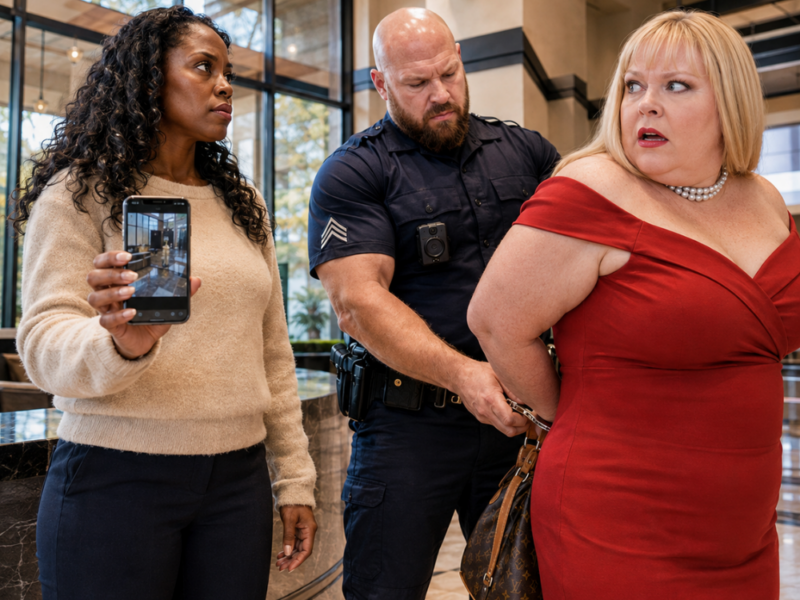
The HOA President Laughed as Police Handcuffed a Black Woman—But the Next Morning, She Was Arrested
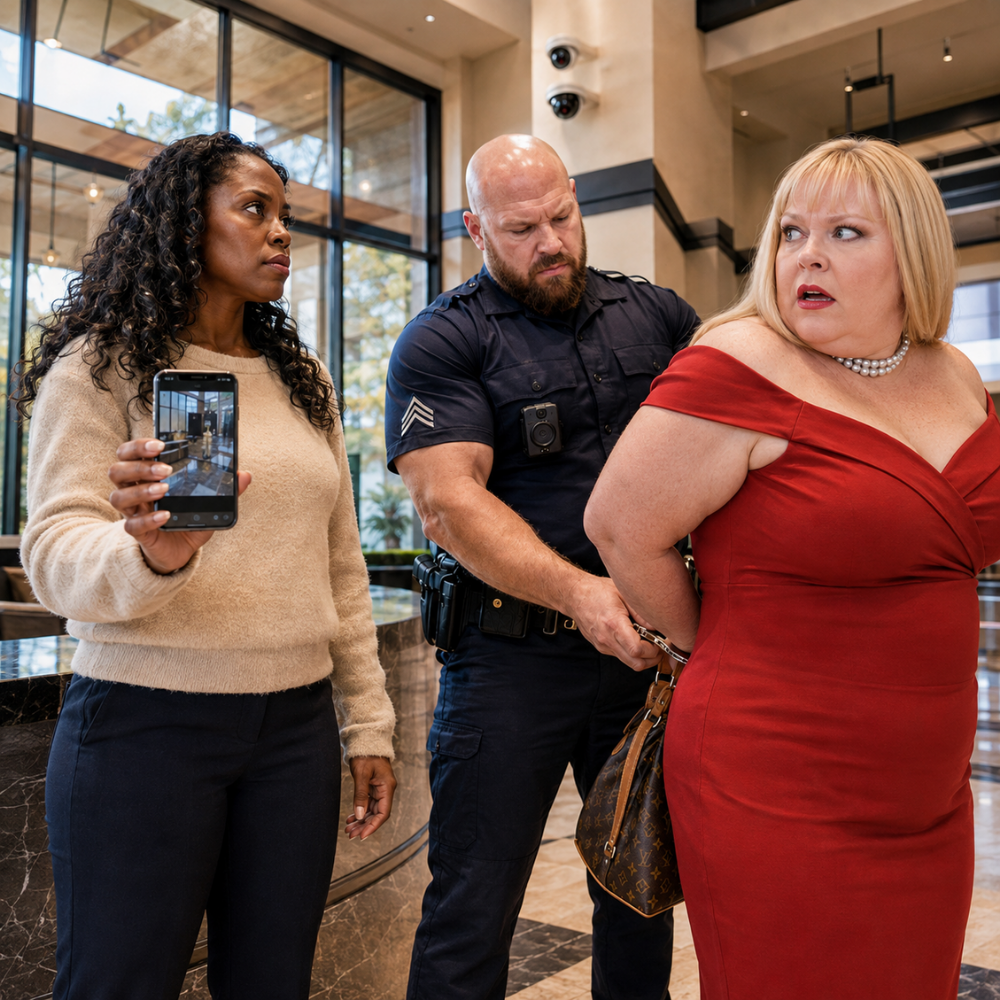
They planted HOA records in her bag and watched police cuff her—then nine missing minutes changed everything.
At 6:07 on a gray Thursday morning, Maya Williams stopped in the doorway of her home office and did not take another step.
The bottom drawer of the filing cabinet was open.
Not slightly open. Pulled all the way out.
Folders leaned crookedly against one another. Two insurance binders had been shifted. A packet of old tax returns sat upside down. The shallow metal box where Maya kept property documents had been moved six inches from its usual place.
Her laptop was still on the desk.
So was the television in the living room.
Her mother’s silver serving tray remained in the dining room cabinet, visible through the glass.
Nothing looked ransacked in the way people imagined a burglary.
That was what frightened her.
Whoever had been inside had not come for valuables.
Maya remained at the threshold with one hand on the doorframe.
She was fifty-six years old, divorced, the mother of a grown daughter, and six years removed from a career she had deliberately walked away from because she had grown tired of spending her days inside other people’s disputes.
For fifteen years she had investigated housing complaints.
Retaliatory fines.
Altered inspection reports.
Property managers who claimed records did not exist until a subpoena proved otherwise.
Landlords who spoke beautifully in conference rooms and differently in emails.
Boards that did nothing illegal in any single sentence but somehow produced the same unfair result year after year.
Maya had left all of that behind.
Or thought she had.
She took out her phone.
The old habits returned without permission.
Photograph first.
Touch later.
She photographed the doorway.
The carpet.
The filing cabinet.
The desk.
The hallway leading toward the office.
Then she switched to video and recorded the path from the back door through the kitchen and into the hall.
The lock on the back door showed no obvious damage.
Maya photographed that too.
Only after she finished did she go to the laundry room, pull on a pair of disposable gloves from the box she kept beside the cleaning supplies, and return to the filing cabinet.
She checked each folder without reorganizing anything.
Tax records.
Home insurance.
Mortgage satisfaction papers.
Repair receipts.
A copy of her divorce decree she had forgotten she still owned.
Then the folder she was looking for.
Gone.
The handwritten tab had read:
ASHFORD RIDGE — SOUTH CREEK ENGINEERING.
Maya stood very still.
The missing folder contained a copy of an engineering report concerning a retaining wall and drainage system on the lower end of Ashford Ridge, the large planned community outside Raleigh where she had lived for eleven years.
No bank statements were missing.
No Social Security records.
No checks.
No passport.
One engineering file.
Maya pulled off the gloves and called Denise Harper.
The call went to voicemail.
Maya waited for the tone.
“Someone came into my house. They weren’t looking for money.”
She looked toward the open cabinet.
“They took the South Creek copy.”
She ended the call.
Then she stood there for nearly a minute, not moving.
The smart thing would have been to wait.
Call police immediately.
Cancel the morning.
Stay home.
Instead, Maya went upstairs and changed into dark slacks, a white blouse and a navy jacket.
She put a notebook, reading glasses, phone charger and bottle of water into a canvas tote. Then she checked the thin folder she had prepared the night before.
Photocopies.
She had made them at a FedEx Office after dinner because years of investigation work had left her with one habit she could never break.
Never carry your only copy into a room where somebody wants it gone.
At 7:14, Maya locked her house and drove to the Ashford Ridge Clubhouse.
The community had been built in stages over nearly twenty years.
The upper neighborhoods had detached homes with stone facades, golf-course views and landscaping packages residents complained about despite paying extra for them.
South Creek, at the lower end, contained mostly town homes and smaller single-family houses near a natural drainage corridor.
The clubhouse sat between the two worlds.
Brick columns.
White trim.
A pool behind black iron fencing.
A ballroom that hosted retirement parties, Christmas brunches and the occasional wedding.
A lobby decorated in the bland beige confidence of places funded by association dues.
Maya arrived at 7:53.
HOA president Evelyn Whitmore stood beside the front table speaking with Rachel Kim, the association treasurer.
Tom Alvarez, head of community security, was behind the desk reviewing overnight reports.
Evelyn saw Maya enter.
Her expression did not change.
Evelyn was sixty-two, silver-blond, always pressed, always composed, and had chaired the board for nearly a decade.
She did not raise her voice.
She did not need to.
Her preferred form of authority was the sentence spoken as though the decision had already been made somewhere else.
Maya walked to the table and placed her folder on it.
“I need a receipt confirming the board received these documents.”
Evelyn glanced at the folder.
She did not touch it.
“We don’t accept resident complaints this way.”
“I sent the same documents by email.”
“Then the office has them.”
“I never received confirmation.”
“That doesn’t create a new procedure.”
Maya opened her notebook.
“I also sent them by certified mail.”
Evelyn’s mouth tightened.
“They were returned.”
Rachel looked toward the folder.
“Returned by whom?”
“The management office.”
Rachel glanced at Evelyn.
Maya continued.
“I contacted the property management company directly. They declined to accept the packet and told me to submit through the board.”
Evelyn folded her arms.
“Then you should wait for the board’s normal review.”
“I’m not asking you to agree with the complaint today.”
Maya slid the folder forward.
“I’m asking for a signature confirming I delivered it.”
“No.”
The word came gently.
Maya did not argue.
She turned her head toward Tom.
Above the lobby, a black dome camera faced the front desk and seating area.
“Mr. Alvarez?”
Tom straightened.
“Yes, ma’am?”
“Is that camera operating?”
Rachel looked at Maya.
“Why are you asking about the camera?”
Maya kept her eyes on Tom.
“Is it recording?”
Tom nodded.
“Yes.”
“Continuously?”
“Motion and continuous archive during staffed hours.”
“Thank you.”
Evelyn’s expression changed by less than an inch.
Maya noticed anyway.
She had noticed such changes for a living.
She stepped toward the security desk.
“What is the retention period?”
Tom looked uncertain.
“Usually thirty days.”
“Locally?”
“Vendor storage.”
“Can footage be manually deleted?”
Rachel stared at her.
“Maya, what exactly are you doing?”
Maya finally looked at her.
“Making sure the morning has a record.”
There was a silence.
Evelyn smiled.
Not warmly.
“You’ve always enjoyed procedure.”
“Only when people follow it.”
Tom cleared his throat.
Maya turned back to him and asked whether residents could request preserved footage if an incident occurred.
While they spoke, Evelyn moved closer to Rachel.
The conversation appeared private.
The lobby camera watched both women.
Maya’s canvas tote sat open on a chair near the table.
Evelyn picked up a gray envelope.
“That’s her resident packet,” she said quietly.
Rachel looked at it.
“What resident packet?”
“The records she claims management wouldn’t provide. Put it in her bag so she can’t say we withheld anything.”
Rachel hesitated.
“For what?”
“Just put it in.”
Rachel glanced toward Maya.
Maya was still speaking with Tom.
Rachel slid the gray envelope into the open tote.
She did not open it.
Less than a minute later, Evelyn turned sharply toward the desk.
“Rachel.”
Rachel looked over.
“Where is the reserve reconciliation file?”
“What?”
“The preliminary worksheets. They were right here.”
Rachel frowned.
“I thought you moved them into the office.”
“No.”
Evelyn looked across the lobby.
Her eyes settled on Maya’s tote.
The performance was so smooth that Rachel did not understand it immediately.
Evelyn pointed.
“Check her bag.”
Maya turned.
“No one touches that bag.”
Evelyn stared at her.
“That’s an interesting response.”
“It’s an appropriate response if you’re accusing me of taking something.”
“Confidential financial records are missing.”
“Then call the police.”
Evelyn blinked.
Maya stepped away from the tote.
“Don’t let me touch it. Don’t let Rachel touch it. Don’t touch it yourself. Call the police.”
Tom stared at her.
Evelyn pulled out her phone.
“Gladly.”
She reported that a resident was refusing to leave the clubhouse and that confidential HOA financial records had disappeared while the resident was present.
Maya listened without interrupting.
She took out her own phone and opened a draft email she had created the previous night.
The recipients included the association’s property management company, the surveillance vendor and Denise Harper.
Maya changed only the time.
Then she scheduled the message to send automatically in six minutes.
Rachel watched her.
“What are you doing?”
“Nothing you need to worry about.”
Two Raleigh-area police officers arrived twelve minutes later.
Neither came in aggressively.
One spoke with Evelyn.
The older officer, Sergeant Daniel Mercer, approached Maya.
“Ma’am, is the canvas bag yours?”
“Yes.”
“Mrs. Whitmore says association records are missing and may be in that bag.”
“I understand.”
“Do you consent to us searching it?”
“Yes.”
Mercer seemed mildly surprised.
Maya continued.
“But I want the search recorded by your body camera. Please state the time before you begin, and please remove each item separately where the lobby camera can see it.”
“Our body cameras are already recording.”
“I know. Please state the time anyway.”
Mercer studied her.
Then he looked at his watch.
“Eight twenty-three a.m.”
“Thank you.”
Maya stepped back.
He removed the contents one by one.
Notebook.
Phone charger.
Reading glasses.
Bottle of water.
A small cosmetics pouch.
Two pens.
A folded grocery list.
Then his hand returned to the bottom of the tote.
He pulled out the gray envelope.
Rachel’s face lost color.
Maya looked at it without speaking.
Mercer opened the flap.
Inside were HOA banking worksheets, draft reserve-fund reconciliation pages and several sheets stamped CONFIDENTIAL — BOARD USE.
Evelyn gave a short laugh.
“There it is.”
Maya kept her eyes on the envelope.
“I’ve never seen that before.”
“Of course you haven’t.”
Evelyn turned to the officers.
“She came in demanding board records. Now our confidential financial documents are in her personal bag.”
Maya did not answer Evelyn.
She looked at Mercer.
“Please document where the envelope was found.”
“I will.”
“And note that its position inside the bag was not photographed before removal.”
Mercer’s brows rose.
“It’ll be in my report.”
“Thank you.”
The second officer spoke quietly with him.
Then Mercer turned toward Maya.
“Miss Williams, we’re going to detain you while we sort this out.”
Rachel’s mouth opened.
Maya simply nodded.
“I understand.”
“Please turn around.”
Maya did.
The handcuffs closed around her wrists.
For one second the metal brought back an old case from years earlier, a tenant advocate arrested after refusing to leave a county office.
Maya remembered telling him afterward that anger was allowed but details were useful.
Time.
Words.
Names.
Sequence.
She breathed slowly.
Evelyn smiled.
Tom looked toward the desk.
Rachel did not look away.
As Mercer prepared to escort Maya outside, Maya turned her head.
“Sergeant?”
“Yes?”
“I’d like the clubhouse surveillance footage covering at least thirty minutes before your arrival preserved.”
Evelyn stepped forward.
“You are not running this investigation.”
Maya looked at her.
“I know.”
Then to Mercer:
“I’m asking that evidence be preserved.”
“We’ll note the request.”
“Thank you.”
At the entrance, Maya stopped.
“May I make one phone call before we leave?”
Mercer nodded.
“Keep it brief.”
Maya called Denise.
This time Denise answered immediately.
“Maya?”
“I’m being detained at the Ashford Ridge Clubhouse.”
“Stop.”
Denise’s voice changed at once.
Maya closed her mouth.
“Do not explain the incident over an open phone line.”
Maya looked across the lobby.
Evelyn was no longer smiling.
Denise asked, “Did the preservation email send?”
Maya glanced at the clock above the desk.
“It should have gone six minutes ago.”
“I have it.”
“Good.”
“Don’t say anything else until you’re somewhere you can speak privately.”
“Understood.”
Maya ended the call.
Mercer led her outside.
Rachel remained beside the table.
The gray envelope now sat inside a police evidence bag.
She knew she had put it in Maya’s tote.
She also knew who had handed it to her.
For the first time that morning, Rachel began to understand what she might have participated in.
She slowly turned toward Evelyn.
Evelyn stepped close enough that Tom could not hear.
“Not one word.”
The drive to the station took eighteen minutes.
Maya sat in the rear seat with her cuffed hands behind her and watched Raleigh wake through the side window.
People carried coffee into office buildings.
A landscaping truck merged beside them.
A school bus stopped at a corner.
The ordinariness helped.
At the station, officers removed the cuffs and placed Maya in a small interview room.
Her tote sat across the table.
The gray envelope had already been separated as evidence.
Sergeant Mercer returned carrying a legal pad.
“Miss Williams, you’re being detained while we determine what happened. You have not been formally charged.”
“I understand.”
“You have the right to speak with an attorney before answering questions.”
“Not yet.”
Mercer sat.
“Why did you go to the clubhouse?”
“To deliver documents concerning South Creek.”
“What kind of documents?”
“An engineering report and related correspondence.”
“Why did you need someone to sign for them?”
“Because I had already tried email, certified mail and property management.”
“Why does acknowledgment matter?”
Maya looked at him.
“Because people can disagree about what a document means.”
She paused.
“It’s harder to disagree about whether they received it if they signed for it.”
Mercer wrote that down.
“You expected resistance.”
“Yes.”
“Trouble?”
“Not necessarily.”
“There’s a difference?”
“Usually.”
He glanced up.
“You asked about surveillance almost immediately.”
“Yes.”
“Why?”
Maya had been waiting for that question.
“Because someone entered my home this morning.”
Mercer’s pen stopped.
“What?”
Maya told him about the open filing cabinet.
The untouched valuables.
The missing South Creek folder.
The photographs.
The video.
“Did you report the break-in?”
“I started documenting it. I left a message for someone I trust. I had not completed a formal police report before going to the clubhouse.”
“Why not?”
“I wanted to confirm what was missing before I made a statement.”
Mercer leaned back.
“You choose your words carefully.”
“I try to.”
“Mrs. Whitmore says the missing financial records were on a table before you arrived.”
“I never saw them.”
“She says you had access to that area.”
“I was in the lobby.”
“The envelope was found in your bag.”
“Yes.”
“You’re saying someone put it there?”
“Yes.”
“Who?”
“I don’t know.”
Mercer looked up.
“You didn’t see anyone touch your bag?”
“No.”
“Then how do you know someone put it there?”
Maya considered the wording.
“I know I did not place it there.”
“That’s not exactly the same statement.”
“No.”
She nodded.
“You’re right.”
Mercer paused.
Most people became more certain when challenged.
Maya became more precise.
“Who is Denise?” he asked.
“A former colleague.”
“Attorney?”
“No.”
“Police?”
“No.”
“What kind of colleague?”
Maya said nothing for a moment.
Mercer noticed.
“You don’t have to answer.”
“I know.”
She looked at the tabletop.
“She works in housing compliance.”
Mercer’s expression changed slightly.
“You did too?”
Maya looked at him.
“Once.”
“Doing what?”
“Investigations.”
“For how long?”
“Fifteen years.”
Mercer leaned back.
That explained the timestamps.
The preservation request.
The wording.
The strange calm.
Maya had not walked into the clubhouse expecting to be arrested.
She had simply spent enough years watching records disappear to know that memory was the weakest witness in the room.
An officer entered and handed Mercer a note.
He read it.
Maya waited.
“The clubhouse surveillance footage has been requested for preservation.”
“Requested or confirmed?”
Mercer looked at her.
“Requested.”
“Then it isn’t preserved yet.”
“We’re working on it.”
Maya nodded.
She did not push.
Forty minutes later Detective Laura Bennett entered.
She was in her early fifties, with silver beginning at her temples and the patient expression of someone who disliked being hurried toward conclusions.
She placed a tablet on the table.
“I reviewed the body-camera recording from the clubhouse.”
Maya waited.
“You consented to the search immediately.”
“Yes.”
“You asked for the time to be stated.”
“Yes.”
“You stepped away from the bag.”
“Yes.”
“You didn’t attempt to leave or touch the envelope after it was removed.”
“No.”
Bennett folded her hands.
“That creates questions.”
“For me too.”
“We still have financial records found in your bag.”
“I understand.”
“We also have Mrs. Whitmore’s account.”
Maya nodded.
Bennett continued.
“And we have your request for video preservation before the search began.”
Maya looked at her.
“I asked about cameras before anyone accused me.”
“I know.”
That distinction mattered.
Bennett wrote something down.
“What happened at your house may become relevant. We’ll send someone to take a report.”
“Thank you.”
Another hour passed.
Then Mercer returned with Maya’s tote.
“You’re being released pending further investigation.”
“No charge?”
“Not today.”
Maya checked her bag before leaving.
“My phone?”
Mercer handed it to her.
There were twelve missed calls.
Two from Denise.
Three from her daughter Naomi.
One from the property management company.
One from a local television reporter.
The rest unknown.
Maya put the phone in her bag.
Before she left, she looked at Mercer.
“Has the clubhouse footage been preserved?”
He sighed.
“The management company acknowledged the request.”
“That’s not the same answer.”
Mercer almost smiled.
“You really did this for a living.”
“Currently?”
“Currently.”
“No.”
“That’s not much of an answer.”
Maya picked up her tote.
“Exactly.”
Denise Harper was waiting outside beside a dark blue sedan.
She did not hug Maya.
She opened the passenger door.
Maya got in.
For several seconds neither spoke.
Then Denise said, “Six years.”
“I know.”
“Six years since you left housing investigations and announced you wanted a smaller life.”
“I got one.”
Denise looked at her.
“Someone searched that smaller life this morning.”
Maya watched people move along the sidewalk.
“I noticed.”
“Fifteen years of fraud complaints, retaliation cases and altered records do not vanish because you start consulting part-time and plant tomatoes.”
“I also have basil.”
Denise gave her a look.
Maya’s mouth moved slightly.
It was the first thing close to a smile all morning.
Denise started the car.
“Leon Brooks called.”
Maya’s expression changed.
“He still has the original?”
“Yes.”
“Where?”
“Waiting for us.”
They met Leon at a diner off Capitol Boulevard.
The place had vinyl booths, chrome-edged tables and a pie case near the register.
Leon sat in the back with a mug of coffee and a brown document envelope beside his hand.
He was sixty-eight, retired from a commercial construction company, and had served four years on the HOA maintenance committee before the board suddenly decided his services were no longer necessary.
He stood when Maya approached.
“You all right?”
“I’m out.”
“I saw the video somebody posted from the clubhouse.”
Maya sat.
“Then you know I’m not in jail.”
Leon lowered himself into the booth.
“Pretty low standard for a good Thursday.”
Denise sat across from him.
A waitress arrived.
Nobody opened a menu.
Leon ordered more coffee.
Maya asked for water.
Denise ordered coffee black.
When the waitress moved away, Denise looked at the envelope.
“Original?”
Leon nodded.
“I haven’t let it out of my possession.”
“Who knows you have it?”
“You two. Maybe the engineer remembers giving me a copy, but he doesn’t know whether I kept it.”
“Any calls this morning?”
“Three from the HOA office.”
“Did you answer?”
“No.”
“Voicemail?”
“One.”
Leon reached for his phone.
Denise stopped him.
“Forward it to me before you play it.”
Leon raised his eyebrows.
“You two really did work together.”
Maya said nothing.
He forwarded the recording.
Denise then nodded toward the envelope.
“Walk me through this from the beginning.”
Leon wrapped both hands around his coffee.
“South Creek residents started complaining about water collecting behind the lower retaining wall after heavy rain.”
“When?”
“Late spring.”
“Who ordered the inspection?”
“The board approved it.”
“Engineering firm?”
“Holloway Civil and Structural.”
Denise wrote the name down.
“They spent two days on site. About a week later, I got the full report because I was still chairing maintenance review.”
Leon slid the envelope forward.
“Eleven findings.”
Maya opened her photocopy.
Leon tapped the summary page.
“Six marked urgent.”
Denise read.
Retaining wall movement.
Drainage failure.
Soil displacement.
Erosion behind the western section.
Need for additional structural assessment.
Restriction on additional loading until stabilization.
Leon leaned forward.
“I spent thirty-five years around concrete crews and site work. I’m not an engineer.”
He pointed to the page.
“But when an engineer writes urgent six times, I know it’s not a landscaping note.”
Denise kept reading.
“The report does not say collapse is imminent.”
“No.”
“It recommends monitoring, drainage correction, stabilization and further review.”
“Correct.”
“Before major construction nearby.”
“Exactly.”
Leon removed another document.
“This is what went to the insurance carrier.”
Maya took it.
Three findings.
No urgent classifications.
The language about wall movement had been reduced to routine maintenance.
Soil displacement became drainage observation.
The recommendation against additional loading had disappeared.
Denise placed both versions beside each other.
“Did Holloway sign this summary?”
“No.”
“Approve it?”
“I asked them.”
“And?”
“They said they’d never seen it.”
Maya looked up.
“Who transmitted it to insurance?”
“Property management office.”
“Individual name?”
“No.”
Denise turned a page.
“Who had the original?”
“Evelyn. Rachel. Property manager. Me. Two other maintenance members.”
“What happened when you challenged the difference?”
Leon smiled without humor.
“The first time I was told the board summary translated technical language for nontechnical readers.”
“And the second?”
“I asked why translating six urgent findings required deleting the word urgent.”
Maya almost smiled.
“What did they say?”
“I was confusing engineering terminology with insurance classifications.”
“And the third time?”
Leon looked toward the diner window.
“They removed me from the committee.”
“Reason?”
“Board restructuring.”
“Did they restructure?”
“No.”
“Who replaced you?”
“A real estate agent who works in Evelyn’s office.”
Denise wrote that down.
The waitress returned.
Everyone waited until she left.
Leon rubbed one hand over his jaw.
“I followed every procedure they gave me. Email. Written request. Asked for board review. Every path ended with somebody saying the matter was under consideration.”
Maya looked at him.
“You didn’t need them to agree.”
Leon met her eyes.
“I needed them to admit they’d received it.”
“Exactly.”
Denise continued reading.
“Who lives below the wall?”
“Twenty-two town homes.”
“Occupied?”
“All but one.”
“Residents notified?”
“Not about the six urgent findings.”
Maya asked, “Tom Alvarez’s daughter still lives down there?”
Leon nodded.
“Two buildings from the western section.”
Denise closed the report.
“Then we separate the problems.”
Leon frowned.
“What does that mean?”
“First, whether somebody altered or concealed engineering information.”
She tapped the report.
“Second, whether there is a current safety condition.”
Leon looked uneasy.
“Are you saying people need to leave?”
“I’m saying none of us is an engineer.”
Denise’s tone sharpened.
“We do not create an emergency because we’re angry about a document.”
Maya nodded.
“We verify.”
“Exactly.”
Leon sat back.
“What happens after that?”
Denise placed the original report back in its envelope.
“We find out who created the three-finding version.”
She looked at Maya.
“Then we find out what else was happening at the same time.”
The answer appeared before lunch.
Buried inside an old board packet was a proposal concerning a common parcel beside South Creek.
SOUTH CREEK EAST — PROPOSED DISPOSITION AND ACCESS AGREEMENT.
Maya read it twice.
“A land transaction.”
Leon nodded.
“Developer wanted the parcel for construction access.”
Denise compared dates.
Engineering report.
Insurance submission.
Land proposal.
Leon removed from committee.
All within several weeks.
“If the original six urgent findings stay in the disclosure packet,” Denise said, “the deal gets more difficult.”
“Because?”
“Additional review. Possible reserve spending. Insurance questions. Maybe lender questions. Maybe construction delays.”
Leon leaned back.
“So that’s the reason.”
Denise shook her head.
“Possible motive.”
Maya looked at him.
“Not proof.”
Leon nodded slowly.
“Right.”
Denise tapped the folder.
“But now we know where to look.”
Across Ashford Ridge, Rachel Kim was looking too.
She waited until Evelyn finished a phone call before knocking on her office door.
Evelyn glanced up.
“What is it?”
Rachel closed the door.
“Did you suspend Maya Williams’s water?”
Evelyn placed her phone beside the keyboard.
“Why are you looking at her account?”
“I’m treasurer.”
“Exactly.”
“I saw a manual service suspension entered this afternoon.”
Evelyn leaned back.
“Then you know the answer.”
Rachel kept her voice even.
“Her account isn’t delinquent.”
“She owes legal costs related to yesterday.”
“Those charges are pending.”
“They’ll be approved.”
“They haven’t been.”
Evelyn’s expression sharpened.
“Rachel, I have spent eleven years dealing with homeowners who believe rules apply only when convenient.”
“This isn’t a landscaping fine.”
“No. It’s a woman who disrupted board business and left this building in handcuffs after confidential records were found in her bag.”
Rachel looked at her.
“She didn’t leave with the records.”
“You know what I mean.”
“I’m not sure I do anymore.”
Silence.
Rachel continued.
“If there’s authority to suspend water, show me the policy.”
Evelyn turned toward her computer.
“You’re making this harder than necessary.”
“I’m asking a simple question.”
“And I’m giving you a simple answer. Pressure works.”
Rachel stared at her.
Evelyn spoke calmly.
“People behave differently when consequences become real.”
“Water is not a clubhouse privilege.”
“It’s a service administered through the association.”
“That doesn’t mean you shut it off because someone embarrassed you.”
Evelyn’s face changed.
“Be careful.”
“That’s why I’m asking for the written authority.”
Evelyn stood.
“I put you in that treasurer’s seat because I trusted your judgment.”
“I know.”
“Then use it.”
Rachel opened the door.
“I am.”
That evening Maya returned home carrying two gallons of water, groceries and a folder Denise had given her.
Police had finished documenting the entry into her house.
Nothing else appeared missing.
Maya had not reorganized the office.
She wanted the condition to remain consistent with her photographs for another day.
She set the groceries on the counter.
Then she turned on the kitchen faucet.
Nothing happened.
Maya tried again.
The handle moved.
No water.
She checked the downstairs bathroom.
Nothing.
Outside, Mrs. Carter two doors down was watering potted geraniums.
Maya went back inside.
She called the HOA emergency number.
“Ashford Ridge after-hours service.”
“This is Maya Williams, 184 Willowbend. My water has been shut off.”
Typing.
“Yes, ma’am. I see a service suspension.”
“For what?”
“Collection action.”
“My account is current.”
“I’m only reading what the system shows.”
“Please read me the balance.”
A pause.
“Ma’am, I don’t handle billing disputes.”
“I’m not asking you to resolve one. I’m asking you to read the overdue balance.”
More typing.
“$0 overdue.”
Maya opened her notebook.
“What time was the suspension entered?”
“Five twenty-three.”
She wrote it.
“Action code?”
“Emergency collection action.”
“Who entered it?”
“I can’t disclose employee information.”
“Is there a user ID attached?”
Silence.
“Sir?”
“Yes.”
“Is there a user ID?”
“I’m not authorized to provide it.”
“That’s fine. Give me your name and the incident number for this call.”
He did.
Maya repeated both.
“Was there a work order for a leak, damage or emergency at my property?”
“No, ma’am.”
“Thank you.”
She hung up.
The kitchen was suddenly very quiet.
Maya looked at the dry faucet.
Someone had entered her house.
Then she had been handcuffed.
Now a basic service had been shut off on an account with no overdue balance.
She did not call Evelyn.
Instead she opened her laptop.
New spreadsheet.
Columns:
DATE.
TIME.
ACTION.
USER.
DOCUMENT.
WITNESS.
She entered the unanswered emails.
Certified mail.
Returned envelope.
Home entry.
Missing engineering file.
Arrival at clubhouse.
Refusal to acknowledge documents.
Police search.
Gray envelope.
Detention.
Evidence preservation request.
Water suspension.
Incident number.
Her phone rang.
Naomi.
Maya answered.
“Hey.”
“Mom.”
“I know.”
“I’ve called three times.”
“I’m sorry.”
“I saw the video.”
Maya closed her eyes.
“Figured.”
“Are you okay?”
“Yes.”
“You were in handcuffs.”
“I was detained.”
“You were in handcuffs.”
“I’m home.”
Naomi became quiet.
Then she heard plastic scrape across Maya’s counter.
“What was that?”
“Water.”
“You bought water?”
Maya hesitated half a second too long.
Naomi’s voice changed.
“They shut yours off?”
“I’m handling it.”
“You’re current on your dues.”
“I know.”
“I can drive from Charlotte tonight.”
“No.”
“Mom.”
“Stay there.”
“Maya Williams.”
Despite herself, Maya almost smiled.
“Don’t use my government name.”
“Then stop using that voice.”
“What voice?”
“The one where you get extremely polite because you’re furious.”
Maya looked at the spreadsheet.
“I’m not asking you to come.”
Naomi exhaled.
“Then tell me what you need.”
Maya considered the question.
“Nothing tonight.”
“If that changes?”
“I’ll call.”
“Promise.”
“Yes.”
Afterward, Maya poured bottled water into the coffee maker so it would be ready in the morning.
At the clubhouse, Rachel reopened Maya’s account.
Balance: zero.
Service status: suspended.
Manual override.
User ID:
E. WHITMORE.
Rachel printed the page.
Then she opened Maya’s enforcement history.
Two minor violations in three years.
Trash container visible after pickup.
Seasonal lights left up too long.
Both corrected within the allowed period.
No outstanding fines.
No hearing history.
No delinquency.
Rachel should have stopped there.
Instead, she searched other homeowners.
Trash bins.
One resident received a friendly email.
Another received a formal notice.
Another an immediate fine.
Same rule.
Different response.
She checked parking.
Same pattern.
Fence maintenance.
Same pattern.
Some owners received thirty days.
Some ten.
Some no formal action at all.
Rachel created a spreadsheet.
Address.
Violation.
Initial response.
Correction period.
Fine.
Hearing.
Then she added one more column.
Neighborhood section.
After an hour, South Creek appeared too often among the faster escalations.
Rachel frowned.
She knew the neighborhood well enough to recognize another pattern she did not want to see.
Black homeowners appeared more often among cases involving immediate fines, shorter correction periods and rapid hearings.
Rachel did not write discrimination.
She was not prepared to claim something the records had not yet established.
Instead she created another tab.
ENFORCEMENT COMPARISON — REVIEW NEEDED.
She expanded the period to eighteen months.
The pattern did not disappear.
The next morning, Tom Alvarez called.
“You at the clubhouse?”
“Yes.”
“I’m at South Creek.”
“What happened?”
“Nothing.”
Rachel frowned.
“Then why are you calling?”
“Because nothing happening might be the problem.”
She straightened.
“What does that mean?”
“Come look at the wall.”
“Is anyone in immediate danger?”
“I don’t know.”
Tom’s answer was immediate.
“And I’m not pretending I do.”
Rachel looked at the printed engineering summary.
“I’ll be there in fifteen minutes.”
The ground behind South Creek remained wet from overnight rain.
Tom stood beside the concrete drainage channel.
He pointed toward the retaining wall.
Several blocks no longer aligned evenly.
A narrow crack ran near the base.
Soil had washed from beneath part of the slope.
Rachel crouched without touching anything.
“Has this always been here?”
“Drainage problems, yes.”
Tom pointed.
“That movement? I don’t think so.”
“You don’t think?”
“I’m security, Rachel. Not an engineer.”
She stood.
Tom walked several yards.
“Leon raised this before they removed him.”
“I know.”
“Know why they removed him?”
“Board restructuring.”
Tom gave her a look.
“That’s what the minutes say.”
Rachel understood.
She looked toward the town homes.
“Your daughter lives down here?”
“Two buildings that way.”
“You never mentioned that.”
“You never asked.”
His voice stayed calm.
“I’m not asking you to panic because my kid lives here. I’m asking you to determine whether that report is real.”
Rachel took out her phone.
“Give me Holloway’s number.”
She reached engineer Michael Grant after two transfers.
“My name is Rachel Kim. I’m treasurer for the Ashford Ridge HOA.”
There was a pause.
“I’ve heard about Ashford Ridge.”
“I’m calling about the South Creek structural assessment.”
“What about it?”
“I need to confirm the findings in the signed version.”
“Do you have our report?”
“I have a board summary dated May eighteenth.”
Grant became more careful.
“Read me the first finding.”
Rachel did.
“That isn’t our report.”
She looked at Tom.
“What do you mean?”
“Our assessment had eleven findings.”
“How many urgent?”
“Six.”
Rachel tightened her grip on the phone.
“The document I have lists three. None urgent.”
“That did not come from us.”
“Did Holloway approve a revised report for the insurance carrier?”
“No.”
“Were you asked to revise it?”
“Yes.”
Tom watched Rachel’s expression.
“By whom?”
“I’m not going to discuss client communications until I verify who I’m speaking with.”
“Fair.”
Rachel took a breath.
“Did your firm ever remove the urgent classifications?”
“No.”
“Is there an immediate evacuation condition?”
“I won’t make that statement based on a phone call.”
Grant sounded firm now.
“Our report recommended further structural review, drainage correction, monitoring and stabilization. We specifically advised against additional loading or major construction nearby until those concerns were addressed.”
“So it’s serious.”
“Serious enough that it should not have been reduced to routine maintenance.”
Rachel thanked him.
When the call ended, she stood staring at the wall.
Tom waited.
“The signed report had eleven findings.”
He nodded.
“Six urgent.”
Tom looked toward his daughter’s building.
“And Holloway never approved the version we sent to insurance.”
Tom exhaled.
“So Leon was right.”
“About the report.”
Rachel corrected him automatically.
“Yes.”
Tom gave a tired smile.
“You’re starting to sound like Maya.”
Rachel’s phone rang.
Evelyn.
“Where are you?”
“South Creek.”
A pause.
“Why?”
“Tom asked me to look at the drainage area.”
“You’re treasurer.”
“I remember.”
“Then why are you inspecting a wall?”
“I’m not.”
Rachel looked at Tom.
“I called the engineer.”
Evelyn’s tone changed instantly.
“You did what?”
“I called Holloway.”
“You had no authority to contact a vendor on an active board matter.”
“I asked whether they approved the three-finding version.”
Silence.
Rachel waited.
“Come back to the clubhouse.”
“Did they?”
“Did who what?”
“Holloway. Did they approve the version we sent to insurance?”
Another pause.
“That is more complicated than you understand.”
Something settled inside Rachel.
“It shouldn’t be.”
“Come back here.”
“I’ll be there later.”
“Rachel.”
She ended the call.
Tom raised his eyebrows.
“Did you just hang up on Evelyn Whitmore?”
Rachel looked toward the wall.
“I think I did.”
By early afternoon, an attorney representing the HOA called Maya.
His name was Richard Hale.
He requested a private meeting to discuss a possible resolution.
Denise listened to the voicemail.
“That was fast.”
Leon sat at Maya’s kitchen table with the engineering report.
“They know something.”
Denise shook her head.
“They know enough to want Maya in a room.”
Maya picked up her phone.
“I’m going.”
“You don’t have to.”
“I know.”
“What do you expect them to offer?”
Maya looked toward the bottled water beside the sink.
“I don’t know.”
She called Hale back.
The meeting was set for four.
The law office overlooked downtown Raleigh from the ninth floor of a glass building.
The conference room was almost aggressively neutral.
Gray carpet.
Pale wood table.
A framed photograph of the Blue Ridge Mountains.
A pitcher of water in the center.
Maya noticed the water.
She did not comment.
Evelyn sat beside Richard Hale.
“Miss Williams.”
“Mrs. Whitmore.”
Hale opened a folder.
“We appreciate you coming.”
“I agreed to listen.”
“That’s all we’re asking.”
Denise sat beside Maya.
“Then let’s keep it simple.”
Hale slid a document forward.
“The association wants to resolve the dispute without additional public conflict or unnecessary expense.”
Maya did not touch the papers.
“What are you offering?”
“Four hundred thousand dollars.”
Maya looked at him.
Hale continued.
“The association would purchase your property above current market value. Disputed fees would be waived. Reasonable legal expenses related to the clubhouse matter would be paid.”
Evelyn added gently, “You could leave Ashford Ridge without carrying any of this with you.”
Maya looked at her.
Hale turned a page.
“The association would also issue a statement describing the clubhouse incident as an unfortunate misunderstanding.”
Denise spoke.
“What does Maya give up?”
“She withdraws her HOA complaint and agrees not to pursue further civil claims against the association, board members or management arising from these events.”
“What else?”
Hale paused.
“A confidentiality provision concerning settlement terms, internal HOA records and the South Creek engineering matter.”
Maya’s attention sharpened.
“What happens to the engineering documents?”
“Original or duplicate association records in your possession would be returned through counsel.”
“Returned to whom?”
“The association.”
Maya looked at the number.
$400,000.
She knew exactly what it meant.
Her house could be paid off.
Retirement would become easier.
Naomi’s graduate-school loans could be helped if Naomi would accept it.
Maya could replace the Honda that had been repaired so many times the service manager sent her Christmas cards.
Four hundred thousand dollars was not an abstraction.
It was years.
It was breathing room.
Evelyn watched her.
“This does not have to become your life.”
Maya looked up.
“What happens to South Creek?”
Hale answered.
“The association will address South Creek through the normal engineering process.”
“That’s not my question.”
Evelyn’s expression tightened.
“What exactly are you asking?”
“If I sign, what happens to the six urgent findings?”
Hale folded his hands.
“They remain under review.”
“Will South Creek residents receive the original report?”
“That would be a board decision.”
“Will the insurance carrier?”
“That depends on counsel’s analysis.”
“Will the land transaction stop until the wall is reviewed?”
Hale hesitated.
“That transaction is outside the scope of your settlement.”
Maya nodded.
“And Leon Brooks?”
Evelyn answered.
“Mr. Brooks has nothing to do with your case.”
“He’s the person who kept the original.”
“He’s a former committee member with a history of disagreement with this board.”
Maya looked at Hale.
“If I sign, I give you my records.”
“Association records.”
“I stop helping with complaints.”
“You resolve your individual claims.”
“And I leave.”
“You receive substantial compensation.”
Maya pushed the agreement back.
“No.”
Evelyn stared.
“Excuse me?”
“I’m not signing.”
Hale remained calm.
“You should take time to consider the amount.”
“I considered it.”
“You haven’t read the full agreement.”
“I heard enough.”
Evelyn leaned forward.
“Four hundred thousand dollars is not an insult.”
“I didn’t call it one.”
“Then what is the problem?”
Maya’s voice stayed level.
“You’re offering to solve my problem by leaving everyone else with theirs.”
Evelyn shook her head.
“You are turning a maintenance disagreement into a moral crusade.”
“The engineer says six findings were urgent.”
“The board says the condition is being managed.”
“The engineer also says he never approved the version sent to insurance.”
Hale turned his head toward Evelyn.
Barely.
But Maya saw it.
Evelyn answered too quickly.
“There are multiple documents used for different administrative purposes.”
Maya stood.
Hale said, “I strongly advise you to have independent counsel review the offer before rejecting it permanently.”
“I will.”
Evelyn’s composure slipped.
“Everyone talks about principle until the number is high enough.”
Maya picked up her tote.
“Then stop raising the number.”
She and Denise left.
In the elevator, Denise waited until the doors closed.
“She didn’t expect that.”
“No.”
“Did you?”
Maya looked at the floor numbers.
“I expected them to ask for the engineering report.”
“They asked for everything around it.”
“Yes.”
That mattered more than the money.
The offer had not answered one question about the wall.
It had shown how badly somebody wanted Maya to stop asking.
The next morning Maya found three new notices in her online account.
Clubhouse privileges suspended.
Guest access restricted.
Potential legal costs pending.
Water still disconnected.
She printed each notice and wrote the exact access time at the top.
Denise watched from the kitchen table.
“They’re creating evidence every time they touch your account.”
“They’re also making living here miserable.”
“That’s probably the point.”
Maya looked at the gallon jugs beside the sink.
“No single action pushes most people out.”
Denise nodded.
“You stack inconvenience.”
“Until leaving feels easier.”
“Exactly.”
Maya closed the laptop.
“Power doesn’t always raise its voice.”
“No.”
Denise looked toward the dry faucet.
“Sometimes it changes a code in a computer.”
At the clubhouse, Rachel had spent the morning reading governing documents.
Management contract.
Collection policy.
Utility procedures.
Hearing requirements.
She found no authority allowing the HOA president to suspend water for a homeowner with no delinquent balance and no completed enforcement process.
Rachel carried the pages into Evelyn’s office.
“Restore Maya’s water.”
Evelyn looked up.
“Good morning.”
“I’m serious.”
“So am I. Close the door.”
Rachel closed it.
“Maya’s current. No board vote. No hearing. No delinquency.”
“She disrupted operations.”
“That’s not a water policy.”
“Confidential records were found in her bag.”
“She hasn’t been charged.”
“The records were there.”
Rachel felt the familiar pressure to let the sentence stand.
She did not.
“I put the envelope in her bag.”
Evelyn’s face went still.
“You put a resident packet in her bag.”
“That’s what you told me it was.”
“Because that’s what it was supposed to be.”
Rachel shook her head.
“You handed it to me.”
“Yes.”
“Then less than two minutes later you announced a reserve file was missing.”
Evelyn’s voice dropped.
“Be extremely careful.”
“I have been.”
Rachel took another paper from her folder.
“I checked enforcement too.”
Silence.
“What enforcement?”
“Eighteen months.”
Evelyn stared.
Rachel placed paired records on the desk.
“Same violations. Different responses.”
“Context.”
“I checked context.”
“Different board members.”
“Same enforcement office.”
“Rachel.”
“Courtesy emails for some owners. Immediate fines for others. Longer correction periods in one section. Rapid hearings in another.”
Evelyn pushed the pages aside.
“You are trying to manufacture discrimination because people are using that word online.”
“Maya never used that word with me.”
“She doesn’t need to. Everybody else is doing it for her.”
Rachel kept her voice controlled.
“I’m reading our records.”
“Which prove nothing.”
“Maybe not.”
“Then stop.”
“Help me complete the review.”
Evelyn’s expression hardened.
“I have work to do.”
“So do I.”
Rachel picked up the pages.
“Restore the water.”
“No.”
“Then I will not sign anything saying the board authorized it.”
“You’re treasurer. You don’t decide association policy.”
Rachel met her eyes.
“Neither do you.”
Evelyn stood.
“Remember who put you in that chair.”
Rachel opened the door.
“I’m starting to remember too much.”
She walked out.
Her hands were shaking by the time she reached her car.
She sat behind the wheel and called the number on Denise Harper’s preservation notice.
“Harper.”
“My name is Rachel Kim.”
A pause.
“I know who you are.”
“I need to talk.”
“About what?”
Rachel looked through the windshield at the clubhouse.
“The envelope.”
Denise’s voice changed.
“Are you somewhere private?”
“Yes.”
“Do not delete anything. Do not email files to yourself. Do not alter your board account. Tell me where you are and we’ll arrange a meeting.”
Rachel swallowed.
“There’s something you need to know first.”
“What?”
“I’m the person who put it in Maya’s bag.”
Denise did not gasp.
“Did you know what was inside?”
“No.”
“Did you open it?”
“No.”
“Who gave it to you?”
“Evelyn.”
“What did she say?”
“That it was Maya’s resident packet.”
“Did Maya see you put it there?”
“No.”
“Did Evelyn report the financial documents missing before or after you placed it in the bag?”
Rachel closed her eyes.
“After.”
“How long?”
“Maybe two minutes.”
“You certain?”
“Yes.”
“Stop there.”
Rachel opened her eyes.
“What?”
“Do not tell me what Evelyn intended. Do not improve your memory. Do not guess.”
Rachel stared at the clubhouse.
“I helped get Maya arrested.”
“You are going to give an accurate statement about what you did.”
“Is Maya there?”
A pause.
“Yes.”
Rachel almost asked Denise not to put her on.
Instead she said, “Can I speak to her?”
Maya’s voice came through.
“Rachel.”
“I’m sorry.”
Silence.
“I didn’t know what was inside.”
Maya replied, “I believe that’s what you’re saying.”
The precision hurt more than anger.
Rachel continued.
“Evelyn gave it to me. I should have questioned her.”
“Did you see her put financial documents in the envelope?”
“No.”
“Did you see anybody else touch it?”
“No.”
“Then say that.”
Rachel frowned.
“You’re not going to ask why she did it?”
“No.”
“Why?”
“Because you don’t know.”
Rachel leaned back against the seat.
Maya continued.
“If you want to help, give investigators the pieces you actually have. Don’t fill the spaces between them.”
Rachel looked down at her hands.
For the first time she understood that Maya’s careful language was not a performance.
Maya had been just as precise when precision helped someone who had put her in handcuffs.
Denise came back on.
“I’m sending an address. Bring yourself and your phone.”
Rachel looked at the clubhouse once more.
“I’ll be there.”
The statement took less than forty minutes.
Denise asked each question once.
Rachel answered only what she knew.
Then they returned to Ashford Ridge separately.
At the clubhouse, Rachel went to Tom’s security office.
“I need yesterday’s lobby footage.”
Tom pulled up the archive.
“Legal already requested preservation.”
“Can you export the full hour?”
“I’m trying.”
He clicked through the timeline.
Then stopped.
Rachel leaned closer.
“What?”
“Gap.”
“How long?”
“Eight minutes, forty-seven seconds.”
Rachel felt her stomach tighten.
“Which eight minutes?”
Tom pointed.
“The part before police arrived.”
The footage resumed with both officers already in the lobby.
“Could the system do that automatically?”
“Not normally.”
“Retention failure?”
“Not after one day.”
Tom opened the administrator log.
A manual export had been performed the previous afternoon.
Minutes later, the retention setting for that exact segment had changed.
Rachel pointed.
“User?”
Tom opened the field.
E. WHITMORE.
Neither spoke.
“Could someone have used her account?” Rachel asked.
“Possible.”
“Likely?”
“No.”
Rachel reached for her phone.
Tom stopped her.
“Don’t photograph it yet.”
She frowned.
“If this becomes evidence, we preserve it properly.”
Rachel lowered the phone.
“Right.”
Tom began documenting access logs.
Rachel looked at the system menu.
“Does the clubhouse record audio anywhere?”
“Not the lobby.”
“Board conference room?”
“Some meetings.”
“How long kept?”
“Ninety days normally. Capital projects can be longer.”
Rachel thought of South Creek.
“Check.”
Tom hesitated.
“You’re asking me to access board recordings.”
“I’m asking if they exist.”
He opened the conference archive.
Folders appeared.
BUDGET.
RESERVES.
LANDSCAPING CONTRACT.
SOUTH CREEK CAPITAL REVIEW.
Rachel stared.
“Call Denise.”
Twenty minutes later Denise arrived with an investigator.
They preserved the file before opening it.
The recording began routinely.
Reserve projections.
Drainage estimates.
Contractor bids.
Then Michael Grant’s voice.
“The six urgent findings need to remain in the report.”
Rachel recognized him immediately.
Evelyn answered.
“If that version goes to the carrier, the transaction stops.”
Grant said, “I’m not changing a report I signed.”
“I’m not asking you to.”
Another board member asked, “Then what are we sending?”
A pause.
Evelyn’s voice:
“The board summary.”
Rachel stopped breathing.
The recording continued.
Later, discussion moved to homeowners questioning the South Creek proposal.
A director asked whether Leon Brooks was organizing residents.
Evelyn answered.
“Use every enforcement tool the rules give us. Once people are fighting fines, they stop organizing around everything else.”
Denise stopped the audio.
Nobody spoke.
Rachel sat back.
“She said that in a recorded meeting.”
Tom looked at the archive details.
“Probably forgot the project recording was retained.”
Rachel looked at the participant list.
Her own name was there.
“I was in this meeting.”
Denise turned.
“You don’t remember?”
“I remember the meeting.”
Rachel looked ashamed.
“I was reviewing reserve numbers. Evelyn handled enforcement discussion.”
“That isn’t the same as not being present.”
“I know.”
Maya, who had arrived with Denise, said nothing.
Rachel looked at her.
“I kept telling myself I trusted her because she’d run the neighborhood for years.”
Maya closed her notebook.
“Trust isn’t a control.”
Denise looked at Tom.
“Preserve the audio, admin logs, surveillance access history and every related archive.”
Tom nodded.
Denise sent expanded preservation notices to the HOA, management company, engineering firm, surveillance vendor and financial-system provider.
By late afternoon, association counsel acknowledged receipt.
The notice was clear.
No responsive record was to be altered, moved or deleted.
Rachel read it twice.
At 8:11 that evening, her phone displayed an administrator alert.
Restricted archive modification.
She opened it.
SOUTH CREEK CORRESPONDENCE ARCHIVE.
DELETION IN PROGRESS.
USER: E. WHITMORE.
Rachel called Denise.
“It’s deleting.”
“Do not touch anything.”
“I can stop it.”
“No.”
“Why?”
“Because the system is logging the action.”
Rachel watched the progress bar.
Then:
DELETION COMPLETED.
The documents disappeared from active storage.
The record showing who had deleted them did not.
The next morning Denise assembled the timeline in a state office conference room.
Maya sat at one end with her notebook.
Rachel arrived with an attorney.
Two investigators worked from laptops.
Tom joined by secure video.
Denise stood beside a whiteboard.
“We do not start with Evelyn Whitmore.”
She wrote:
LEON BROOKS.
“We start with the earliest event we can support.”
Next:
SOUTH CREEK ENGINEERING REPORT.
Eleven findings.
Six urgent.
Next:
BOARD SUMMARY.
Three findings.
No urgent classifications.
Next:
INSURANCE TRANSMITTAL.
Next:
LAND TRANSACTION.
Next:
BROOKS REMOVED FROM MAINTENANCE.
Then:
MAYA SUBMISSION ATTEMPTS.
Email.
Certified mail.
Management office.
No acknowledgment.
Next:
ENTRY INTO MAYA’S HOUSE.
An investigator looked up.
“Walk through the house again.”
Maya did.
Photos.
Video.
Missing engineering folder.
Unmoved valuables.
The investigator checked metadata.
“Taken before clubhouse incident?”
“Yes.”
Denise added the times.
Then:
CLUBHOUSE.
Refusal to acknowledge report.
Rachel places gray envelope in tote after Evelyn gives it to her.
Missing financial documents announced.
Police search.
Maya detained.
Preservation requested.
WATER SUSPENSION.
Zero overdue balance.
Manual override.
E. Whitmore user ID.
ENFORCEMENT COMPARISON.
Inconsistent outcomes.
EXECUTIVE RECORDING.
Use enforcement tools against organizing residents.
SURVEILLANCE GAP.
Administrator change.
POST-PRESERVATION DELETION.
Another investigator leaned back.
“That is a lot of activity around one homeowner complaint.”
Denise capped the marker.
“Which is why we’re no longer treating it as one homeowner complaint.”
The door opened.
A third investigator entered carrying a folder.
“We received gate-access records.”
Denise turned.
“What do they show?”
“An emergency maintenance credential was used near Maya’s address the morning her home was entered.”
Maya looked up.
“Assigned to whom?”
“Curtis Bell. Subcontractor.”
“Work order?”
“None.”
“Leak report?”
“None.”
“Resident request?”
“None.”
Denise looked at Maya.
“Know him?”
“No.”
The investigator continued.
“Bell agreed to speak voluntarily. Says he was told there might be a water issue at the property.”
“Who told him?”
“Evelyn Whitmore.”
Rachel closed her eyes.
Maya did not react.
“Did he enter the house?” Denise asked.
“Initially he said no.”
“And now?”
The investigator placed a printed still on the table.
A community street camera showed a man leaving Maya’s home carrying a folder.
“He changed his statement.”
Maya studied the photograph.
“What does he say now?”
“That he entered under emergency-access procedure. Claims Evelyn told him to bring back any HOA engineering material he saw near the utility records.”
Rachel whispered, “She sent someone into your house.”
Denise corrected her gently.
“That is Bell’s statement. We corroborate it.”
The investigator nodded.
“There’s more.”
He opened his laptop.
“The property management company maintains a separate lobby camera.”
Tom’s voice came through the speaker.
“Different vendor from ours.”
“Different storage too,” the investigator said.
He played the footage.
Higher angle.
Maya speaking with Tom.
Evelyn beside Rachel.
Evelyn handing Rachel a gray envelope.
Rachel walking toward Maya’s open tote.
Rachel placing the envelope inside.
Later, Evelyn pointing toward the bag.
No one in the conference room spoke.
The video did not show the contents.
It did not need to.
Rachel’s statement established what she had been told.
Police body camera established what officers later removed from the same envelope.
Denise paused the recording.
“Any video of Maya touching the envelope?”
“None.”
“Any footage showing her near the bag between Rachel placing it and police searching it?”
“Not on the available recordings.”
Maya nodded.
“Use that wording.”
The investigator looked at her.
“Right.”
Denise began separating evidence into folders.
Unauthorized home entry.
Evidence placement.
False police information.
Retaliatory account actions.
Engineering concealment.
Property transaction.
Surveillance interference.
Post-notice deletion.
Rachel looked at the growing stack.
“What happens now?”
Denise did not answer her directly.
She looked toward the senior investigator.
“Enough to request judicial access to original systems and devices?”
He nodded.
“I think so.”
Rachel’s voice was quieter.
“And Evelyn?”
Denise closed the folder.
“We don’t decide what happens to Evelyn.”
She looked around the room.
“We show a judge what the records say.”
The warrants were signed shortly after sunrise the next morning.
At 7:32, investigators entered the Ashford Ridge Clubhouse.
Rachel arrived before Evelyn.
Tom stood near the security desk.
“You know why they’re here?”
“Some of it.”
“What do you need from me?”
“If they ask for access, give it.”
“Already planned to.”
Across town, Maya stood in her kitchen beside a gallon jug.
She turned the faucet out of habit.
Water came out.
Maya stared.
She turned it off.
Then on again.
Still water.
She opened the HOA portal.
Service suspension:
REVERSED.
Maya took a screenshot before making coffee.
At the clubhouse, Evelyn arrived carrying a leather portfolio and a paper cup.
She saw investigators immediately.
She did not slow.
“Good morning.”
Special Investigator David Norris stepped forward.
“Evelyn Whitmore?”
“Yes.”
“I’m David Norris. This is Investigator Helen Price.”
Evelyn glanced toward Rachel.
“Has counsel been notified?”
Norris held out papers.
“We have warrants relating to records maintained by the Ashford Ridge Homeowners Association.”
Evelyn read the first page.
“A search warrant.”
“Yes.”
Norris continued.
“We are also authorized to seize specified devices and electronic records.”
“My attorney needs to be here before anyone touches the server.”
“You’re free to contact counsel. Execution will not be delayed.”
Evelyn’s expression tightened.
“What exactly are you alleging?”
“We’re not litigating the case in the lobby.”
She turned toward Tom.
“Do not give them administrator access until legal arrives.”
Tom stayed behind the desk.
“Mrs. Whitmore, they have a warrant.”
“I heard him.”
“So did I.”
Evelyn looked back at Norris.
“Fine. Take what you need.”
Norris did not move.
“There’s another matter.”
Evelyn waited.
A uniformed officer stepped closer.
Norris said, “There is also an arrest warrant.”
For several seconds, the lobby was completely silent.
Evelyn looked toward Rachel.
“Rachel.”
Rachel did not answer.
“For what?” Evelyn asked.
“The formal warrant concerns alleged conduct involving evidence placement, false information during a police matter, interference with preserved records, and matters connected to the South Creek disclosures.”
Evelyn’s face changed.
“This is an HOA records dispute.”
Norris shook his head.
“This is not an HOA hearing.”
Evelyn looked at Rachel.
“You gave them records.”
Rachel finally spoke.
“I told them what I did.”
“What you did?”
“The envelope.”
Evelyn lowered her voice.
“Rachel, stop talking.”
“No.”
Evelyn stared.
“You handed it to me. You said it was Maya’s resident packet. I put it in her bag.”
“You misunderstood.”
“Then explain that to your lawyer.”
Evelyn turned toward Tom.
“Call counsel.”
“Management counsel was notified when investigators arrived.”
“My counsel.”
The officer stepped closer.
“Mrs. Whitmore, please turn around.”
Evelyn did not move.
“This is absurd.”
“Turn around, please.”
She looked across the lobby.
The same lobby where Maya had stood with cuffs around her wrists.
No homeowners gathered.
No cameras from television stations.
No laughter.
Only Rachel.
Tom.
A receptionist.
Investigators.
Evelyn placed her coffee on the desk.
Then she turned.
The officer brought one wrist gently behind her back.
“No need to pull,” Evelyn said.
“I’m not pulling, ma’am.”
The cuffs closed.
Tom lowered his eyes.
Rachel remained still.
There was no satisfaction on her face.
Only grief and embarrassment and the exhausted understanding that consequences looked less dramatic when they arrived than people expected.
As Evelyn was escorted out, her phone rang inside her handbag.
Nobody answered it.
Across town, Denise called Maya.
“It’s done.”
“The search?”
“Warrants were executed.”
Maya rinsed a spoon beneath the restored faucet.
“What about South Creek?”
“Independent engineers are going out this morning.”
“Residents notified?”
“Rachel and Leon are helping.”
Maya nodded.
Denise paused.
“You aren’t going to ask about Evelyn?”
“No.”
“You know she was arrested.”
“I assumed.”
“You don’t want details?”
“Not right now.”
Maya turned off the faucet.
“If the wall is being inspected and the records are out of one person’s control, then the part I needed to happen is happening.”
Denise was quiet.
“Six years away and you’re still impossible.”
Maya smiled.
“Apparently.”
Later that morning Detective Bennett asked Maya to return to the station.
Denise accompanied her.
Sergeant Mercer sat beside Bennett in the same interview room.
A thin folder lay on the table.
Bennett began immediately.
“We are not pursuing a theft charge against you.”
Maya looked at her.
“Will the report say that?”
“It will.”
Maya nodded.
Bennett opened the file.
“Additional surveillance footage shows Mrs. Whitmore giving a gray envelope to Rachel Kim. Miss Kim then places it in your tote while you’re speaking with security.”
“Can the footage show what’s inside?”
“No.”
“Then the sequence depends partly on Rachel’s statement.”
“And body-camera footage showing the same envelope being removed from your bag.”
Maya looked at Denise.
“Independent sources.”
“Several.”
Bennett continued.
“There is no evidence you threatened anyone, resisted officers or attempted to conceal the documents.”
Mercer folded his arms.
“I owe you something.”
Maya looked at him.
“When I first interviewed you, I thought you were being careful because you’d prepared a reasonable story.”
Maya waited.
Mercer shook his head.
“That was an assumption.”
He looked directly at her.
“You were being careful because you didn’t want to say more than you knew.”
Maya gave a small nod.
“There’s a difference.”
“I know that now.”
“Thank you.”
Outside the station, local reporters waited.
Denise stopped beside Maya.
“You do not have to speak.”
“I know.”
One reporter approached.
“Ms. Williams, could we ask a few questions?”
“A few.”
“Have police cleared you in the clubhouse theft?”
“They told me today they are not pursuing that allegation.”
“Do investigators believe the financial documents were planted?”
“That is what the evidence currently indicates.”
“How do you feel about Evelyn Whitmore being arrested?”
“That’s a question for her attorney.”
“Are you angry?”
“Yes.”
The reporter waited for more.
Maya gave it.
“But anger isn’t evidence.”
Another reporter raised a microphone.
“What do you want now?”
“South Creek repaired.”
Maya looked into the camera.
“The records preserved. Homeowners notified. And the same rules applied to everyone.”
“Do you want an apology?”
Maya considered it.
“I want accurate records more than I want an apology.”
She walked away.
At South Creek, engineers marked portions of the retaining wall for testing.
Temporary barriers went up.
Residents received a written notice explaining that no evacuation had been ordered but stabilization work would begin after structural review.
Tom stood near the lower access road when his daughter called.
“Dad, there are engineers behind our building.”
“I know.”
“Should we leave?”
“They haven’t told anybody to.”
“So the report was real.”
Tom watched two engineers take measurements.
“Yes.”
“And the board knew?”
Tom chose his words.
“Some people had information they should have handled differently.”
His daughter exhaled.
“They’re actually fixing it?”
“They’ve started.”
Tom looked toward the wall.
“This time, everybody gets the full report.”
That afternoon Rachel resigned as HOA treasurer.
She requested that her statement be included in the official minutes.
The emergency board meeting was crowded.
Rachel sat at the end of the table.
“I need to say something before my resignation is accepted.”
No one interrupted.
“I put the gray envelope in Maya Williams’s bag.”
A director shifted in his chair.
Rachel continued.
“I did not know what was inside. Evelyn told me it was Maya’s resident packet.”
She paused.
“That does not remove my responsibility.”
The room stayed quiet.
“I trusted a person more than I trusted the process I was supposed to protect.”
Rachel looked around the table.
“I thought loyalty meant standing beside the person I believed in.”
Her voice tightened.
“It does not mean you stop checking whether the truth is still standing there too.”
Her resignation was accepted.
The board suspended Evelyn’s remaining authority pending investigation.
The South Creek land transaction was paused.
Maya’s access restrictions were lifted.
The management company was ordered to review all discretionary enforcement actions from the previous eighteen months.
Leon Brooks sat in the back row.
After the meeting a director approached.
“We’d like you back on maintenance.”
Leon shook his head.
“Not under the old rules.”
“What would need to change?”
“Full engineering reports go to homeowners.”
“We can discuss that.”
Leon looked at him.
“No.”
The director paused.
Leon continued.
“You can decide it.”
The man nodded slowly.
“Fair.”
Three weeks later the clubhouse meeting room filled before an emergency governance session.
People who had skipped annual meetings for a decade arrived early.
Some brought printed documents.
Others carried tablets.
Maya sat in the rear beside Leon.
She had declined the invitation to sit at the front.
Leon looked around.
“Never seen this many people at an HOA meeting.”
“Usually takes a dues increase.”
“Or an arrest.”
Maya gave him a look.
Leon nodded.
“Point taken.”
An attorney for the association’s insurer sat beside an independent property management consultant.
None of the remaining directors led the review.
The consultant began with South Creek.
An independent engineering firm had confirmed that the wall required stabilization, drainage improvements and continued monitoring.
The condition was serious.
No evacuation was required.
No resident had been injured.
Construction on the common parcel remained suspended.
A visible wave of relief moved through the room.
Then came the harder sentence.
“The original engineering findings should have been distributed through the proper board and insurance channels. The later summary did not accurately reflect the urgency described by the engineer.”
A resident raised her hand.
“Who changed it?”
The attorney answered.
“That remains part of an active investigation. Tonight we’re addressing governance correction.”
Someone near the second row muttered.
“We’ve heard ‘active investigation’ for weeks.”
The attorney nodded.
“I understand.”
Then he said something Maya respected.
“That is why the reforms we’re proposing do not depend on asking you to trust the next president more than the last one.”
The room quieted.
The changes were presented one by one.
Full engineering reports involving common property would be posted on the resident portal.
Board summaries could still exist, but the original document would remain beside them.
No single board officer could authorize surveillance deletion.
Major financial transfers required two authorized users.
Suspension of an essential service required documented authority, written notice and management-company review except in a legitimate physical emergency.
Enforcement procedures would use standardized notice periods.
Homeowners would have a written appeal process.
Capital-project votes and meeting minutes would be posted.
A woman in her sixties stood.
“What about old fines?”
The consultant opened another section.
“Every discretionary enforcement action from the previous eighteen months is being reviewed.”
“Refunds?”
“If a charge was imposed outside the governing process or cannot be supported, yes.”
People began talking at once.
The consultant raised a hand.
“There’s another issue.”
The room settled.
“The review identified significant inconsistency in how comparable violations were handled.”
Maya watched Rachel from across the room.
Rachel sat alone along the side wall.
The consultant continued.
“Some owners received informal courtesy warnings. Others received immediate formal notices or financial penalties for similar first-time violations.”
A man near the front asked, “Are you talking about discrimination?”
The attorney answered carefully.
“The review found that Black homeowners were disproportionately represented among cases involving faster escalation and immediate penalties.”
The room became very quiet.
“We have not identified a written policy directing different treatment based on race. The outcomes nevertheless warrant additional civil-rights review.”
Maya appreciated the wording.
Precise.
No more than the records supported.
No less either.
Leon leaned toward her.
“Sound familiar?”
“Very.”
After the meeting, a reporter approached Maya near the exit.
“Do you consider tonight a victory?”
Maya adjusted the canvas tote on her shoulder.
“I consider it a correction.”
“But these changes happened because you challenged the board.”
“They happened because the records showed the board had a problem.”
The reporter continued.
“Evelyn Whitmore’s attorney released a statement saying she denies intentionally planting evidence and denies knowingly participating in fraudulent concealment connected to South Creek. Do you have a response?”
“No.”
“Nothing?”
“She has an attorney. She has a court process.”
Maya looked at the reporter.
“That’s where she should answer.”
“What about the deleted records?”
“Investigators.”
The reporter lowered the microphone.
“You are being very careful not to call her guilty after what happened to you.”
Maya nodded.
“The rules either apply to everyone or they don’t.”
The reporter waited.
Maya continued.
“I wanted people here to stop deciding what was true based on who they trusted.”
She glanced toward the clubhouse.
“I’m not going to make the same mistake because I’m angry.”
Across the parking lot Rachel was walking toward her car.
Maya called her name.
Rachel stopped.
For a moment neither knew how to begin.
Rachel spoke first.
“I heard police cleared you.”
“They did.”
“I’m glad.”
Maya nodded.
Rachel looked toward the building.
“The auditors asked me to reconstruct the old enforcement files.”
“You going to?”
“Yes.”
“Good.”
Rachel took a breath.
“I keep thinking if I’d checked one document earlier, none of this would have happened.”
Maya shook her head.
“You don’t know that.”
Rachel looked at her.
“I should have checked.”
“That part you do know.”
Rachel accepted it.
“I’m not asking you to forgive me.”
“I know.”
“I just don’t want you thinking I’m walking away.”
Maya looked at her for several seconds.
“Then don’t.”
Rachel nodded.
Months passed.
The criminal case moved slowly.
The land transaction remained suspended.
Auditors traced financial decisions.
Civil-rights reviewers examined enforcement outcomes.
Maya did not follow every hearing.
She did not read every online comment.
She went back to work.
Her consulting practice was small by design.
Two days a week she helped nonprofit housing organizations review complaint procedures.
The rest of the time she gardened, drove to Charlotte to see Naomi, volunteered once a month at a legal-aid intake clinic and tried to rebuild the ordinary life she had wanted in the first place.
Ordinary life returned gradually.
The repaired faucet.
A grocery run.
A pharmacy pickup.
Sunday laundry.
Her Honda needing another ridiculous sensor.
Naomi calling to complain about a coworker.
A neighbor asking Maya whether she knew a good plumber.
Nothing dramatic.
Maya valued all of it.
Several months after the arrest, she walked into the Ashford Ridge Clubhouse for an open HOA meeting.
The camera above the lobby glowed red.
A printed notice beside the entrance confirmed that the meeting was being recorded.
Maya stopped long enough to read it.
Then she went inside carrying the same canvas tote she had carried on the morning police found the gray envelope.
The clubhouse looked almost identical.
That was the strange thing about institutional change.
The walls did not know.
The beige chairs stayed beige.
The front desk remained exactly where it had been.
The difference lived in smaller places.
The agenda appeared on a monitor.
Printed minutes sat on a table for residents who preferred paper.
A QR code linked to the full meeting packet.
The resident portal now contained folders labeled:
ENGINEERING.
CONTRACTS.
RESERVE STUDIES.
CAPITAL PROJECTS.
The first agenda item that evening was:
SOUTH CREEK STABILIZATION — FINAL PROJECT REVIEW.
Maya sat near the back.
She had declined another invitation to join the board.
She also declined a seat on the compliance committee.
Leon accepted his maintenance position only after the board adopted the full-report policy.
He arrived carrying a folder.
“Drainage work finished yesterday.”
“I saw the trucks.”
“Final inspection passed.”
“Good.”
Leon opened his folder.
“You want to see the engineer’s report?”
Maya pointed toward the screen.
“It’s online.”
Leon smiled.
“Still getting used to that.”
Tom Alvarez entered and sat along the side wall.
His daughter still lived safely in South Creek.
Rachel was not on the board.
She had spent months cooperating with investigators and auditors.
Her name appeared in the findings where her actions had contributed to improper decisions.
She had not asked for those references to be softened.
The interim board president was Ellen Wallace, a sixty-three-year-old retired regional-bank executive who seemed almost aggressively uninterested in being adored.
She adjusted her glasses.
“Before we begin, the full packet is online and on the back table.”
She looked around.
“If we discuss a document you do not have, stop us and ask for it.”
Leon leaned toward Maya.
“That sentence alone was worth showing up.”
The independent engineer reviewed the completed work.
Retaining wall stabilized.
Drainage redirected.
Monitoring points installed.
Future inspection schedule documented.
No residents displaced.
No injuries.
Tom asked one question about seasonal inspection.
The engineer answered and pointed to the written plan.
No one asked whether another version existed.
There was one report.
Everyone could read it.
The board then reviewed enforcement reform.
Some fines had been refunded.
Others remained under review.
The civil-rights inquiry was still open.
Ellen addressed that directly.
“We are not going to pretend every question is answered.”
She looked at the room.
“We are going to keep the records available while the review continues.”
A homeowner raised his hand.
“What happened with Mrs. Whitmore’s criminal case?”
Board counsel answered.
“Proceedings remain active. Mrs. Whitmore has denied intentionally planting evidence and denies knowingly participating in improper concealment related to the South Creek transaction.”
Murmurs spread.
Ellen raised one hand.
“This board is not a courtroom.”
The room settled.
Maya liked that too.
Ashford Ridge had spent years allowing Evelyn’s certainty to replace process.
Replacing her certainty with everybody else’s would only change the person.
During public comment, an older resident named Harold Green stepped to the microphone.
He had lived in the neighborhood sixteen years.
“I got warnings for things other people apparently got fined for.”
A few people shifted.
Harold smiled sadly.
“I didn’t know that back then. I thought maybe the board liked me.”
Some quiet laughter.
He shook his head.
“That’s the problem, I guess. Most people only know whether a system feels fair from the place they’re standing.”
Maya wrote the sentence in her notebook.
After the meeting, residents remained in clusters.
Assessments.
Repairs.
Election rules.
Drainage.
The boring things a functioning HOA should have been arguing about all along.
Maya was putting her notebook into the tote when a woman approached.
“Excuse me. Are you Maya Williams?”
“Yes.”
“I’m Carol Benson. I moved into South Creek last month.”
Maya shook her hand.
“Welcome.”
“My realtor told me some of what happened.”
“I’m sure you got the short version.”
Carol smiled.
“Probably.”
She glanced toward the lobby camera.
“I heard you used to investigate housing cases.”
“Long time ago.”
“Can I ask something?”
“Sure.”
“How did you know what to do?”
Maya frowned.
“That morning. Your house. Then the clubhouse. The police.”
Carol hesitated.
“If that happened to me, I think I’d panic.”
Maya looked around.
The red camera indicator.
Printed minutes.
Public agenda.
Engineering reports people were carrying out of the room.
She could have talked about fifteen years of training.
Evidence rules.
Investigative interviews.
Chain of custody.
Instead she said, “If somebody with authority doesn’t want something written down, write it down.”
Carol nodded slowly.
“That simple?”
“Not always.”
Maya adjusted her bag.
“But that’s where I start.”
Leon waited near the door.
As Maya joined him, Tom caught up.
“My daughter told me to thank you.”
“For what?”
“The wall.”
“Engineers fixed the wall.”
Tom smiled.
“You know what she means.”
Maya did.
She did not argue.
Outside, Leon headed toward his truck.
Maya walked to her Honda.
Before getting in, she looked back at the clubhouse.
Months earlier she had entered that building carrying documents nobody wanted to receive.
She had stood beneath the same camera.
She had watched a police officer pull an envelope from her bag.
She had heard cuffs close behind her back while someone else controlled the story being told about her.
Now meetings were recorded.
Reports were public.
Fines could be appealed.
No single board officer could cut an essential service, erase surveillance records or move major money without another set of eyes.
Maya had not fixed everything.
No one had.
The criminal case was unresolved.
Some enforcement files remained under civil review.
Residents still disagreed.
The board still made mistakes.
That was normal.
What had changed was not that perfect people had replaced flawed ones.
What changed was that fewer decisions depended on one person’s character.
That mattered to Maya more.
For years, Evelyn Whitmore had controlled Ashford Ridge through a style of power so ordinary many residents had mistaken it for competence.
A letter not acknowledged.
A meeting delayed.
A fine escalated.
A summary substituted for a report.
A code entered into an account.
A complaint called disruptive.
A loyal board member told not to ask one more question.
Nothing looked dramatic alone.
That had been the genius of it.
Pressure delivered in small administrative pieces rarely looked like pressure to anyone not receiving all of them.
Maya had seen that before.
In apartment complexes.
County offices.
Housing programs.
Management companies.
People imagined abuse of authority arrived shouting.
Sometimes it arrived in twelve-point font.
Sometimes it came from a drop-down menu.
Sometimes it sounded like:
That’s the procedure.
The system won’t allow it.
Management already decided.
You missed the deadline.
We never received your email.
The board has discretion.
The record shows otherwise.
Maya had learned long ago that the quietest defense was often the strongest.
Keep the email.
Save the voicemail.
Write down the time.
Ask for the policy.
Do not argue with what you cannot prove.
Do not claim what you did not see.
And never confuse confidence with accuracy.
Rachel had learned the same lesson from the other side.
Trust could make decent people useful to bad decisions.
Not because they were cruel.
Because they stopped checking.
Rachel had spent four years believing loyalty meant supporting Evelyn when homeowners complained.
It took one gray envelope for her to understand what blind loyalty could become.
She never asked Maya to say the mistake was harmless.
It was not.
Maya had been arrested because Rachel placed that envelope in her bag.
Intent mattered.
So did consequence.
Rachel accepted both.
That was why Maya could speak to her later without pretending nothing had happened.
Accountability was not humiliation.
It was accuracy followed by repair.
Leon had his own lesson.
For months he had tried to win by making the board agree with him.
Eventually he realized acknowledgment was more important.
Once the original engineering report became visible, agreement mattered less.
People could read eleven findings.
They could compare them with three.
They could see which words disappeared.
Records moved the argument out of personality.
Maya preferred it there.
Even Sergeant Mercer changed.
Months after the incident, Maya saw him at a grocery store near Falls of Neuse Road.
He was standing beside the pharmacy counter holding a birthday card and a box of cereal.
For a second both looked uncertain whether to speak.
Mercer did first.
“Ms. Williams.”
“Sergeant.”
He nodded toward her cart.
“No notebook?”
“Not for produce.”
He smiled.
Then became serious.
“I read the final supplemental report.”
Maya waited.
“Glad we corrected it.”
“So am I.”
Mercer shifted the birthday card between his hands.
“I’ve thought about that first interview.”
“You already apologized.”
“I know.”
He looked embarrassed.
“I guess I’m saying I remember it.”
Maya nodded.
“That’s useful.”
He smiled.
“You really never give anybody the easy version, do you?”
“Not if there’s a more accurate one.”
They wished each other a good afternoon.
Maya continued toward frozen foods.
That was enough.
She did not need every person who failed her to become a villain.
She did not need every person who corrected himself to become a hero.
Most people lived between those categories.
Systems had to be designed for exactly that reason.
Because good intentions got tired.
Because loyalty blurred judgment.
Because fear changed behavior.
Because people forgot meetings.
Because presidents retired.
Because honest treasurers trusted the wrong person.
Because new homeowners did not know old history.
Because nobody stayed wise all the time.
The record stayed.
One Sunday afternoon, Naomi drove up from Charlotte.
She brought Thai takeout and a grocery-store cake even though nobody had a birthday.
Maya opened the door.
“Why is there cake?”
Naomi walked past her.
“Because I saw it.”
“That’s not a reason.”
“It’s the best reason.”
They ate at the kitchen table.
After dinner, Naomi noticed Maya’s evidence spreadsheet folder on the counter.
“You still updating that?”
“Not regularly.”
“Meaning yes.”
“Meaning occasionally.”
Naomi shook her head.
“You retired from investigations.”
“I know.”
“Six years ago.”
“I remember.”
Naomi looked toward the office where the filing cabinet had once been left open.
“Did it scare you?”
Maya knew exactly what she meant.
“Yes.”
Naomi seemed surprised.
“You never looked scared.”
“That’s not the same thing.”
“I know.”
Naomi picked at the edge of her cake.
“I watched that video of you being walked out of the clubhouse maybe twenty times.”
Maya frowned.
“Why?”
“Because I kept waiting for you to look at the camera.”
“Why would I?”
“I don’t know. Like you knew people would eventually see.”
Maya shook her head.
“I wasn’t thinking about anybody watching later.”
“What were you thinking about?”
Maya considered it.
“The envelope.”
Naomi laughed once.
“Of course you were.”
“I was trying to remember whether I had seen it before.”
“And?”
“I hadn’t.”
“So that’s what you were thinking while somebody put handcuffs on you.”
“Mostly.”
Naomi stared at her mother.
“You’re a very strange woman.”
“I raised you.”
“Exactly.”
They laughed.
Then Naomi became quiet.
“I was scared for you.”
Maya reached across the table.
“I know.”
“You could have taken the settlement.”
“Yes.”
“Four hundred thousand.”
“I remember the number.”
“I would’ve understood.”
Maya studied her daughter.
“I know.”
“Why didn’t you?”
Maya looked toward the window.
The Ashford Ridge clubhouse roof was not visible from her house, but she could see the tops of pine trees beyond the neighboring homes.
“Because the money solved the wrong problem.”
Naomi waited.
“It would’ve solved mine.”
Maya touched her daughter’s hand.
“But by then I knew mine wasn’t the only one.”
Naomi nodded slowly.
“You sound annoyingly noble.”
“Don’t ruin my reputation.”
“I’m serious.”
“So am I.”
Maya smiled.
“I wasn’t trying to be noble. I was angry.”
“That I believe.”
“And stubborn.”
“Definitely.”
“And once someone offers you a lot of money to stop looking at something, it becomes very difficult not to keep looking.”
Naomi laughed.
“There she is.”
After Naomi left, Maya washed two plates and put the leftover cake in the refrigerator.
Her kitchen felt wonderfully uneventful.
She turned on the faucet.
Water.
She still noticed.
Maybe she always would.
The following spring, Ashford Ridge held its annual board election.
Turnout tripled.
No candidate ran unopposed.
Every candidate questionnaire included questions about records retention, conflict-of-interest procedures, enforcement consistency and resident access to engineering reports.
People complained that the packet was too long.
Maya considered that progress.
She did not run.
Leon asked once.
“Sure you don’t want to?”
“Very sure.”
“You’d win.”
“That’s not a reason.”
He laughed.
“You really hate authority.”
“No.”
Maya looked toward the clubhouse.
“I distrust authority that depends on personality.”
“Same difference.”
“It isn’t.”
She pointed toward the posted meeting notice.
“I like that authority has paperwork now.”
Leon shook his head.
“You are the only person I know who can make paperwork sound romantic.”
“It’s not romantic.”
Maya opened the door.
“It’s harder to erase.”
Inside, the camera light was already red.
Ellen Wallace called the meeting to order.
A homeowner interrupted ten minutes later because one exhibit was missing from the printed packet.
The meeting stopped.
Staff found the exhibit.
Copies were made.
Nobody rolled their eyes.
Nobody said it was unnecessary.
Nobody told the resident to trust the summary.
Maya sat in the back and watched people wait.
It took seven minutes.
Seven boring, procedural minutes.
Maya smiled.
That was what change often looked like after the dramatic part ended.
Not applause.
Not revenge.
A meeting pausing because one person asked for page forty-three.
A contractor waiting for a second approval.
A homeowner receiving the same correction period as the house across the street.
A camera archive requiring two credentials to delete.
A full engineering report sitting online where anyone could open it.
No one would make a television drama about those things.
Maya preferred them anyway.
When the meeting ended, Carol Benson caught up with her.
“I used your advice.”
Maya raised an eyebrow.
“What advice?”
“Write it down.”
Carol smiled.
“I had a roof leak. Management said they never got my maintenance request.”
Maya nodded.
“And?”
“I forwarded the original confirmation number.”
“What happened?”
“They found it.”
Maya smiled.
“Funny how that works.”
Carol laughed.
“You’re dangerous.”
“No.”
Maya adjusted her tote.
“Receipts are.”
They walked outside together.
The sun had gone down.
Sprinklers clicked somewhere beyond the parking lot.
Cars moved quietly along the community road.
Nothing about Ashford Ridge looked like a place where a battle over truth had happened.
Maybe that was the final lesson.
Injustice did not always live in dramatic places.
Sometimes it lived beside pool rules and landscaping notices.
Behind password-protected resident portals.
Inside board packets nobody read.
In the difference between a courtesy reminder and an immediate fine.
In a report summarized until the important words disappeared.
In a folder moved from one desk to another.
In an envelope placed inside an open bag.
And courage did not always look dramatic either.
Sometimes courage was a frightened woman standing at her own doorway at six in the morning, deciding not to touch a filing cabinet until she had taken a photograph.
Sometimes it was a treasurer admitting, “I put the envelope there.”
Sometimes it was a security director saying, “I’m not an engineer. Let’s ask one.”
Sometimes it was an old maintenance volunteer keeping the original report because something about the shorter version bothered him.
Sometimes it was a police sergeant correcting his assumption.
Sometimes it was a whole neighborhood finally admitting that fairness could not depend on whether the president happened to like you.
Maya reached her Honda.
The car was older now.
Still running.
Naomi had offered to help her buy another one.
Maya had refused.
Then the air-conditioning failed in July, and Maya reconsidered her position on stubbornness.
She opened the driver’s door.
Before getting in, she looked back at the clubhouse.
The camera above the entrance glowed red.
Months earlier, that camera had represented protection only because Maya had asked whether it was recording.
Then someone tried to erase nine minutes.
What ultimately protected her was not one camera.
It was redundancy.
A vendor copy.
A body camera.
Rachel’s statement.
System logs.
Email records.
A contractor’s credential.
A street image.
An engineering original.
No single piece told the whole story.
Together they made it difficult for anyone to tell a different one.
Maya liked that.
Truth was often described as something bright.
A light.
A revelation.
A moment when everything became clear.
Her experience had taught her something less poetic.
Truth was often a pile.
A receipt.
A timestamp.
A copy of a copy.
A voicemail saved in the right folder.
A line in a system nobody remembered existed.
A person willing to say, “I don’t know,” instead of inventing the missing part.
Truth did not always arrive dramatically.
Sometimes it survived by accumulation.
Maya got into the car and placed the canvas tote on the passenger seat.
The same tote.
She had considered throwing it away after the arrest.
Naomi had suggested burning it.
Denise had suggested keeping it until the case ended.
Maya kept it after that too.
Not as a trophy.
Not as a reminder of Evelyn.
Because it was still a good bag.
That answer amused Denise more than it should have.
Maya started the engine.
Before pulling away, she opened her notebook.
On the last page, beneath Harold Green’s sentence about fairness depending on where a person stood, Maya had written one more line.
A system should not require a hero to make it behave.
She underlined it once.
Then she closed the notebook.
The reforms at Ashford Ridge would probably be revised someday.
New board members would complain they were cumbersome.
A future president might argue two-person approval slowed things down.
Residents would stop attending meetings after the drama faded.
Somebody would say thirty pages of engineering documents were too much and ask for a simple summary.
Maya knew how institutions worked.
Memory faded.
Convenience returned.
That did not make reform pointless.
It made maintenance necessary.
Fairness, like a retaining wall, could fail slowly.
One crack.
One shortcut.
One ignored drain.
One person saying the problem was probably fine because it had not collapsed yet.
That was why inspection mattered.
That was why records mattered.
That was why people mattered who were willing to ask the boring question one more time.
Who approved this?
Where is the original?
What does the policy say?
When was that entered?
Who else received the same treatment?
Is the camera recording?
Maya pulled out of the parking lot.
At the intersection, she waited while a family crossed toward the pool carrying towels and a plastic cooler.
A little boy ran ahead.
His father called him back.
Two teenagers rode bicycles past the clubhouse.
Everything ordinary.
Everything worth protecting from the quiet damage institutions could do when nobody checked.
Maya turned toward home.
She no longer thought of the morning of her arrest as the day Evelyn Whitmore tried to destroy her.
That gave Evelyn too much importance.
Maya thought of it as the morning a hidden system became visible.
The envelope mattered.
The handcuffs mattered.
The missing nine minutes mattered.
But none of those events stood alone.
The real story had begun earlier.
With an engineering report somebody thought could be shortened without consequence.
With an old committee member refusing to discard his copy.
With residents in South Creek receiving harsher notices and assuming their neighbor must have done something differently.
With Rachel trusting Evelyn because trust was easier than checking.
With Maya sending certified mail nobody wanted to sign for.
By the time police arrived at the clubhouse, the problem was already years old.
It just had not been organized into a timeline yet.
Maya had organized it.
Others had filled in the missing pieces.
That distinction mattered too.
Maya did not expose Ashford Ridge by herself.
Leon kept the report.
Rachel told the truth about the envelope.
Tom preserved system logs.
Michael Grant refused to pretend his engineering findings had changed.
Investigators found the maintenance credential.
Detective Bennett followed evidence that contradicted the first accusation.
Residents showed up.
Auditors counted outcomes.
One person’s record became many people’s record.
That was what finally made it durable.
At home, Maya parked in her driveway.
Mrs. Carter waved from two doors down.
“Meeting run late?”
“Only twenty minutes.”
“That’s practically a miracle.”
Maya smiled.
“Don’t tell the board. They’ll get confident.”
Mrs. Carter laughed.
Maya carried her tote inside.
The house smelled faintly of the cinnamon candle she had left burning before the meeting.
She turned on the kitchen light.
Opened the refrigerator.
Took out the leftover cake Naomi had brought on her last visit.
Then she filled a glass from the faucet.
The water ran cold and clear.
Maya stood there for a moment with the glass in her hand.
Not because she feared it would stop.
Because once, someone had believed the quickest way to silence her was to make ordinary life harder.
Take the water.
Restrict the gate.
Suspend the clubhouse.
Add legal charges.
Turn inconvenience into pressure.
Make leaving easier than resisting.
The strategy might have worked on someone else.
Maya did not judge those people.
That was another thing her old work had taught her.
Not everyone could afford to fight.
A parent with two jobs might have taken the settlement.
A retired homeowner with medical bills might have moved.
Someone with no investigative background might never have known what records to request.
Someone terrified of police might have signed whatever ended the nightmare fastest.
That did not make them weak.
It made systems responsible for not requiring extraordinary resistance from ordinary people.
Maya drank the water.
Then she opened the hall closet.
On the top shelf sat a small archive box.
Inside were copies of the South Creek materials.
Police correspondence.
HOA notices.
The original spreadsheet.
The $400,000 settlement offer.
She no longer needed them for everyday use.
Investigators and attorneys had their own copies.
The association had preserved official records.
Still, Maya kept one set.
Not because she expected another fight.
Because forgetting was always easier than people admitted.
She slid Harold Green’s quote into the box.
Then she closed the lid.
The next morning, Maya woke before six.
Habit.
She made coffee.
Water ran through the machine.
Her phone had no urgent messages.
No reporter waiting.
No attorney.
No investigator.
No HOA notice.
She carried her mug to the small patio behind the house.
The neighborhood was quiet.
Somewhere beyond the trees, a garbage truck lifted a bin.
A dog barked once.
Sunlight began to reach the roofs of South Creek.
Maya sat in a patio chair.
For years she had believed leaving investigations meant leaving conflict.
She understood now that conflict was not what had exhausted her.
Power without accountability had.
There was a difference.
Conflict could be healthy.
Neighbors disagreed.
Boards argued.
Engineers revised plans.
Residents appealed fines.
That was normal.
The dangerous thing was a room where disagreement could be erased by whoever controlled the minutes.
Ashford Ridge was not perfect now.
It was simply harder to erase.
Maya could live with that.
Her phone buzzed.
A message from Leon.
FINAL SOUTH CREEK MONITORING REPORT POSTED.
Maya opened the resident portal.
There it was.
Forty-seven pages.
Stamped.
Signed.
Full attachments.
Photographs.
Measurement tables.
Inspection schedule.
No board summary replacing it.
At the top, a short plain-language overview explained what residents might want to know first.
Beneath it:
READ FULL ENGINEERING REPORT.
Maya smiled.
That was the difference.
A summary was useful.
A summary that replaced the source was power.
A summary sitting beside the source was service.
She closed the phone.
The neighborhood woke around her.
Garage doors opened.
Cars backed out.
A woman in running clothes passed with a golden retriever.
Someone’s sprinkler clicked on too early and sprayed part of the sidewalk.
Ordinary life.
Maya took another sip of coffee.
Months before, in the clubhouse lobby, Evelyn Whitmore had believed she controlled the story because she controlled the room.
She had the title.
The office.
The board.
The management company.
The missing file.
The accusation.
For a few hours, it worked.
Maya left in handcuffs.
People believed what the room told them to believe.
But rooms were temporary.
Records traveled.
A camera had another camera behind it.
A deleted archive left a log.
A shortened report had an original.
A planted envelope had a witness.
A shutoff order had a user ID.
A story built on control eventually met a timeline built on evidence.
And timelines did not care who sat at the head of the table.
Maya finished her coffee.
She carried the mug inside and rinsed it.
Then she turned off the kitchen light, picked up her keys and left for work.
No cameras followed.
No reporters waited.
No one applauded.
That was exactly how she wanted it.
Because Maya Williams had never needed to become the most powerful person in Ashford Ridge.
She only needed to make sure no one person ever became that powerful there again.
And in the end, that was what remained after the accusations, the warrants, the meetings and the arguments faded.
Not revenge.
Not a dramatic victory.
A functioning faucet.
A repaired wall.
A posted report.
A fairer process.
A red recording light above the clubhouse door.
And a simple rule Maya had spent half her life learning:
When someone with authority wants the record to disappear, keep the record.









