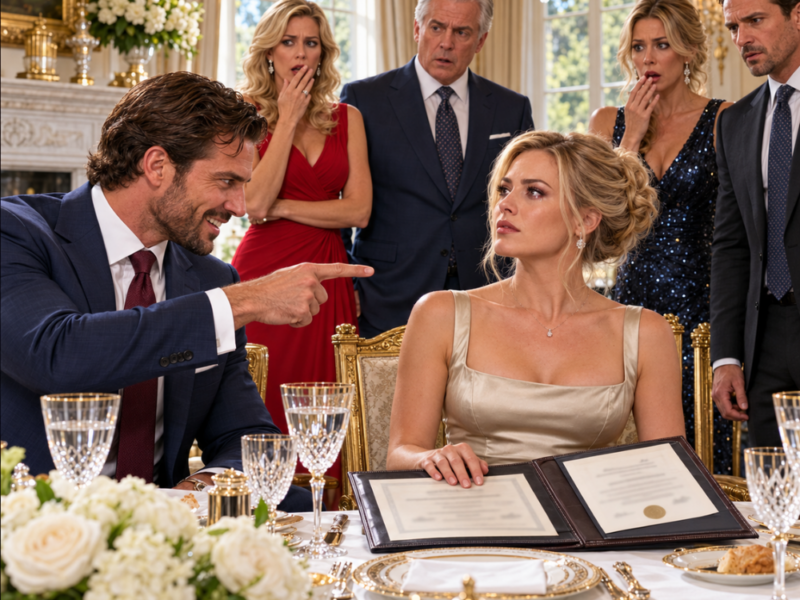
The Billionaire Invited His “Uneducated” Wife to Dinner as a Joke—What She Did Next Stunned Everyone
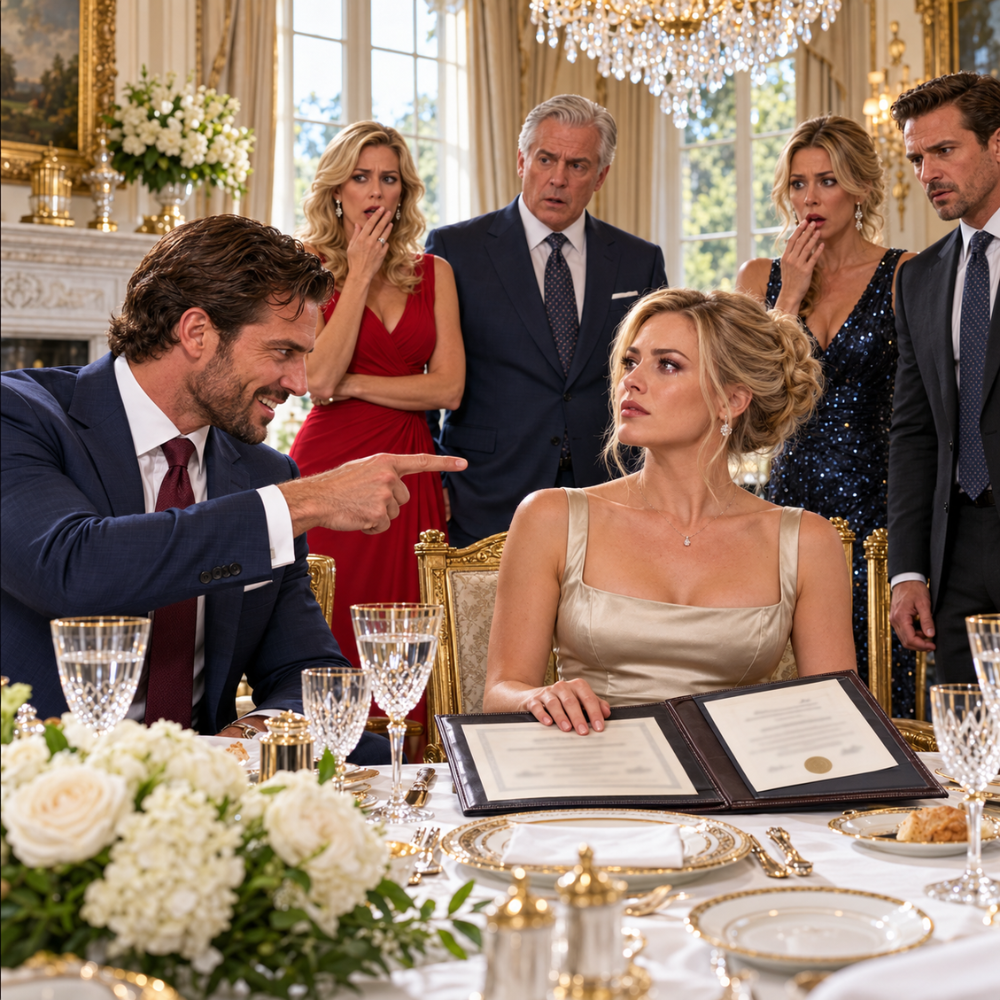
The billionaire invited his wife to dinner as a joke—then she opened the folder in her handbag
The laughter stopped when the woman in the silver dress pushed back her chair.
Until that moment, nearly everyone in Adrian Vale’s dining room had been enjoying the joke.
Some had laughed openly. Others had done what wealthy people often did when cruelty arrived dressed as sophistication: they lowered their eyes, lifted their wineglasses, and smiled just enough to remain part of the room without appearing responsible for it.
Elara Voss had noticed all of them.
She noticed the investment banker near the fireplace who covered his mouth when he laughed.
She noticed the hotel executive who glanced toward Adrian before deciding whether it was safe to join in.
She noticed the woman in emerald silk who whispered something to her husband and then looked at Elara with the pleasant concern people used when they wanted to enjoy someone else’s humiliation while pretending to disapprove of it.
Most of all, Elara noticed her husband.
Adrian stood near the head of the long dining table, one hand resting beside his wineglass, his expression composed and almost playful.
He had just introduced her to forty-two guests as “the one person in the house who has never had to worry about student loans because she never made it to college.”
The line had been delivered with perfect timing.
The room had laughed.
Adrian had laughed too.
Elara had smiled.
That was the part no one understood.
They assumed the smile meant she did not understand the insult.
Or perhaps that she was used to it.
Both were wrong.
Elara understood exactly what her husband had done.
And sitting beside her chair, inside a small black handbag she had purchased on sale six years earlier, was the reason the evening was about to become far less entertaining for him.
She stood.
The movement was so quiet that it took several seconds for the room to notice.
Her silver dress caught the light from the chandeliers. It was simple compared with the designer gowns surrounding her, though no one knew she had repaired the hem herself that afternoon after finding a loose seam.
Adrian looked toward her.
“Elara?”
She lifted her handbag from the back of her chair.
“I think,” she said calmly, “before we continue with the questions, there’s something everyone here should see.”
The laughter disappeared.
Three years earlier, no one in that room would have known her name.
Elara had grown up above Voss Auto & Small Engine Repair, a narrow brick shop on the edge of a working-class Pennsylvania town where the sidewalks buckled around maple roots and the same customers had been bringing lawn mowers, snowblowers, and aging pickup trucks to her father for decades.
Her bedroom had been directly above the garage.
As a child, she fell asleep to the metallic clink of tools being returned to drawers and woke on winter mornings to the smell of coffee, motor oil, and whatever Tomas Voss had burned in the toaster downstairs.
Her father had left high school at seventeen.
He was embarrassed by it for most of his life.
He could rebuild a transmission, repair a generator in the dark, and identify a failing bearing by sound before some certified mechanics could find it with a diagnostic machine. Yet whenever paperwork arrived from the bank or insurance company, he sat at the kitchen table longer than necessary, reading every paragraph twice because somewhere inside him lived the fear that educated people had access to a language he had missed.
Books became his way of arguing with that fear.
The apartment above the shop had books everywhere.
Automotive manuals.
Old encyclopedias from library sales.
Biographies.
History books.
A battered copy of The Intelligent Investor someone had left in a box beside a church rummage sale.
National Geographic magazines stacked under the radiator.
Tomas read slowly, often with a pencil.
He taught Elara to do the same.
“Don’t read to finish,” he would tell her. “Read until you understand what the writer is trying to make you believe.”
Elara loved school.
She loved libraries even more.
At fifteen, she had a guidance counselor who told her she should apply to college early.
At sixteen, she began taking advanced classes and dreamed of studying economics, though she could not have explained exactly why. She liked seeing hidden structures beneath ordinary things. Why a store stayed busy but still closed. Why two families earning similar incomes lived completely different lives. Why one repair shop survived recessions while another failed.
Then Tomas became sick.
At first, it was fatigue.
Then missed work.
Then appointments in Pittsburgh.
Then prescriptions lined up beside the sink.
Then insurance letters with phrases like patient responsibility and non-covered service.
Elara learned a new kind of mathematics.
How many hours at the grocery store covered the electric bill.
How many repair jobs her father could still manage before he needed to sit down.
How much medication remained if one bottle had twenty-three tablets and the pharmacy would not authorize the refill for eleven days.
She left school during what should have been her junior year.
Not because she stopped caring about education.
Because life gave her another assignment.
She worked mornings at a diner off the state highway, afternoons answering phones at the repair shop, and evenings caring for Tomas.
She completed what coursework she could from home, but the formal path narrowed quickly.
There was always something more urgent.
A medical appointment.
A late payment.
A customer who needed his truck before Monday.
A night when Tomas could not sleep.
A morning when he tried to work anyway.
For almost four years, Elara told herself she would return to school once things settled.
Things never settled.
Tomas died when she was twenty.
The shop lasted another eleven months.
Elara sold the remaining equipment, paid what debts she could, closed the business, and packed the apartment into boxes labeled KITCHEN, BOOKS, WINTER, and DAD.
The books filled fourteen boxes.
She kept every one.
By twenty-three, Elara was working at the front desk of a small independent hotel outside Philadelphia.
It was not glamorous.
The lobby had fake orchids.
The elevator made a sound guests frequently reported with alarm.
The night manager kept a screwdriver beside the printer because the paper tray jammed twice a week.
Elara loved the work.
Hotels, she discovered, were small societies.
Everything that happened inside them left evidence.
A guest complained about dirty towels, but the real problem might be a laundry contract negotiated by someone six states away.
Housekeepers quit, and management blamed the labor market, but Elara noticed the real reason was a supervisor who changed schedules with twelve hours’ notice.
The breakfast room ran out of coffee every Sunday not because the hotel was cheap but because no one had adjusted the order after a youth hockey league began booking weekend blocks.
Elara liked problems that revealed themselves indirectly.
She began keeping notes.
Not because anyone asked.
Because Tomas had taught her that machines spoke through patterns.
Hotels did too.
She took free online classes after work.
Accounting basics.
Excel.
Hospitality operations.
Introduction to corporate finance.
Business law.
She watched lectures while folding laundry.
She read textbooks purchased used online.
When a community college library sold outdated management books for two dollars each, she bought an entire box.
She became the employee managers consulted when a strange problem appeared.
She was promoted twice.
By twenty-seven, Elara managed guest operations for a regional hotel with 186 rooms.
That was where she met Adrian Vale.
He arrived during a thunderstorm.
His company, Vale International Hospitality, was considering purchasing the property as part of a larger regional expansion.
Everyone knew he was coming.
The general manager had replaced flowers in the lobby twice.
Someone polished the brass luggage carts until they looked new.
Staff were instructed to use Adrian’s formal title.
Then a storm knocked out power across half the county thirty-seven minutes before his arrival.
The backup generator started.
One elevator did not.
The kitchen refrigeration alarm began chirping.
Two wedding parties arrived simultaneously.
A bus carrying thirty-one stranded airline passengers pulled into the parking lot.
The general manager panicked.
Elara did not.
She reassigned rooms by floor to reduce elevator use, moved elderly guests closer to the working elevator, arranged cold food service before the kitchen lost safe refrigeration, and gave the airline passengers a conference room with coffee while the front desk handled check-ins in groups rather than creating a fifty-person line.
Adrian entered the lobby wearing a dark raincoat and found Elara kneeling beside an elderly woman’s suitcase, explaining which elevator was working.
He stood there for several seconds before anyone recognized him.
When the general manager finally rushed forward with apologies, Adrian asked one question.
“Who’s running this?”
The manager looked confused.
Adrian pointed toward Elara.
“Her.”
They spoke later that evening in the darkened hotel bar.
Elara drank club soda.
Adrian ordered bourbon and barely touched it.
“You studied hospitality?”
“No.”
“Operations?”
“No.”
“Business?”
“Mostly by accident.”
He smiled.
“What does that mean?”
“It means I read things when I need to know them.”
“What did you study formally?”
The question was innocent then.
Elara answered without embarrassment.
“I didn’t finish high school in the usual way. Family situation.”
Adrian seemed surprised.
Not disgusted.
Not yet.
“You managed that lobby better than people I pay six figures.”
“They probably manage other things better than I do.”
“You always qualify compliments?”
“Only oversized ones.”
He laughed.
That was the beginning.
Adrian was brilliant.
Elara never denied that.
He had built Vale International from four distressed hotels acquired with family investment and aggressive financing into a global hospitality company valued in the billions.
He could walk through a hotel lobby and estimate staffing costs from the number of employees visible.
He remembered occupancy rates months after hearing them once.
He understood capital markets, property values, brand positioning, and negotiation with an ease Elara found fascinating.
He was also, at first, unexpectedly kind.
He remembered her coffee order.
He asked about Tomas.
He sent her photographs from hotels when he traveled.
When she told him she missed working with her hands, he bought an old mechanical alarm clock at a flea market and asked her to help him repair it.
They dated quietly for almost a year.
Adrian’s world was unfamiliar but not immediately unpleasant.
There were restaurants where waiters knew his name.
Cars that arrived before he asked.
Airport lounges quieter than some libraries.
Homes where people had separate refrigerators for beverages.
Elara observed it all with curiosity rather than awe.
That amused him.
The first time he took her to a luxury resort he owned in Arizona, she spent twenty minutes admiring the housekeeping carts because they had adjustable shelves.
“You’re supposed to look at the mountains,” Adrian told her.
“The mountains aren’t costing you labor hours.”
He laughed and kissed her forehead.
“I love the way your mind works.”
She believed him.
They married eighteen months later in a small ceremony.
For a while, their differences felt complementary.
Then Adrian’s embarrassment began appearing in small places.
At a dinner with investors, someone asked Elara where she had gone to college.
Before she could answer, Adrian said lightly, “Elara took the practical route.”
Everyone smiled.
On the drive home, she asked why he had answered for her.
“I was saving you from an awkward conversation.”
“It wasn’t awkward for me.”
“You know what these people are like.”
“Yes.”
“That’s all I meant.”
She let it go.
Another time, a magazine profile mentioned Adrian’s “formally educated executive circle” and referred to Elara as having “an unconventional background.”
He joked that unconventional sounded better than dropout.
Elara did not laugh.
He apologized.
Then did something similar three months later.
The comments were never openly vicious.
That made them harder to confront.
They arrived wrapped in humor.
“You’re proof I should hire more people without MBAs.”
“My wife has never seen a campus she couldn’t turn into a hotel opportunity.”
“Elara skipped business school and went directly to correcting my business.”
At first the jokes included admiration.
Gradually, admiration became condescension.
Adrian began treating Elara’s insights as charming instincts rather than serious observations.
When she noticed that a hotel in Miami had rising complaints despite strong occupancy, she told him something was wrong with housekeeping turnover.
“We’ve already reviewed labor,” he said.
“Did anyone talk to the housekeepers?”
“Management did.”
“That wasn’t my question.”
The issue turned out to be exactly what Elara suspected.
A scheduling policy had caused experienced employees to leave.
Adrian fixed it.
He never mentioned her warning.
In Chicago, she noticed maintenance requests had increased after a purchasing change.
He dismissed it.
Months later, the company spent nearly $2 million replacing fixtures that had failed prematurely.
Again, no acknowledgment.
Elara did not need credit for every observation.
What began hurting was the pattern.
When Adrian was alone with her, he praised her mind.
In rooms full of people whose approval mattered to him, he softened her intelligence into something cute.
Practical.
Instinctive.
Street smart.
Never educated.
Never analytical.
Never expert.
She began to understand that Adrian loved her while also wishing parts of her résumé were different.
That contradiction sat quietly between them.
Then came Bellerive.
Bellerive Heritage Hotels was an old European luxury chain with eleven historic properties spread across France, Italy, Switzerland, Austria, and the United Kingdom.
The hotels were beautiful in photographs.
Stone facades.
Grand staircases.
Ceilings painted before electricity existed.
Lake views.
Courtyards.
Libraries.
Ballrooms where presidents, actors, diplomats, and minor royalty had supposedly stayed.
Adrian wanted Bellerive badly.
Not simply because it was profitable.
Because owning it would change how Vale International was perceived.
Vale was rich.
Bellerive was prestigious.
There was a difference, especially to Adrian.
The proposed purchase would be the largest acquisition of his career.
His executives spent almost a year negotiating.
Bankers were hired.
Lawyers reviewed documents.
Consultants produced presentations several inches thick.
By late spring, Adrian believed the deal was nearly complete.
Elara first became uneasy after staying at a Bellerive property outside Geneva.
She and Adrian were there for meetings.
He spent most of the trip with executives.
Elara spent time in the hotel.
She noticed the front desk line.
Not simply that it was long.
That the same employee kept leaving the desk to answer questions for newer staff.
At breakfast, she heard two servers discussing a supervisor who had resigned.
The spa receptionist apologized for a maintenance closure that online reviews showed had been “temporary” for nearly nine months.
Elara asked a housekeeper how long she had worked there.
“Seven years.”
“You like it?”
The woman hesitated.
That hesitation interested Elara.
She did not interrogate employees.
She listened.
Back home, she began reading.
Bellerive’s public filings were limited, but there was more information available than Adrian seemed to realize.
Local business records.
Historic preservation reports.
Planning applications.
Labor tribunal notices.
Tourism statistics.
Hotel review patterns.
Executive departures announced in industry publications.
Elara noticed that complaints at three flagship hotels were not random.
They rose in clusters.
Service complaints followed staffing turnover.
Maintenance complaints followed postponed renovation permits.
At one property, occupancy remained high but average guest ratings declined steadily.
That suggested discounting.
She compared listed room prices over time.
She was right.
The hotel was filling rooms by lowering rates during periods when competitors were raising theirs.
Revenue photographs looked attractive.
Margin reality might not.
Elara opened a spreadsheet.
Then another.
She had no access to Vale’s confidential diligence materials.
She did not ask for them.
Everything she used was public or lawfully obtained through conversations with former employees willing to discuss general working conditions.
She began with simple questions.
How many rooms?
Likely occupancy.
Typical average daily rate.
Estimated labor cost.
Deferred renovation.
Debt.
Lease commitments.
Energy expense.
Then she built ranges.
Best case.
Expected case.
Downside case.
What began as curiosity became concern.
One property in London appeared to carry obligations linked to an old ground lease that could become dramatically more expensive after a change in control.
A historic hotel in Florence had postponed structural work that preservation authorities had been discussing publicly for years.
A resort near Lake Geneva had extraordinary employee turnover, especially among experienced service staff.
Replacing those employees would not simply require hiring.
It would require training, temporary staffing, recruitment, and likely wage adjustments.
The acquisition price assumed the hotels could improve margins quickly under Vale management.
Elara thought the opposite might happen.
Vale could inherit years of deferred cost.
She tried speaking to Adrian.
The first time was over breakfast.
“Have your people looked closely at the staffing issues in Geneva?”
“Yes.”
“Not payroll. Turnover.”
“Yes, Elara.”
“What about the London lease?”
He lowered his phone.
“What lease?”
“The ground lease connected to the west wing.”
Adrian stared at her.
“Where did you hear about that?”
“It’s referenced in planning records.”
“I have lawyers for this.”
“I know.”
“Elara, Bellerive has been reviewed by three law firms and two banks.”
“I’m not saying they missed it.”
“That sounds exactly like what you’re saying.”
“I’m saying maybe they categorized it differently.”
Adrian sighed.
He was not cruel.
That would almost have been easier.
He sounded patient.
The way adults spoke to children who were trying to help repair something beyond them.
“I appreciate that you’re interested.”
Elara became still.
Interested.
Not concerned.
Not informed.
Interested.
She closed her notebook.
“Okay.”
He leaned across the table and kissed her cheek.
“Come to dinner with me tonight.”
“I have plans.”
“With who?”
“Myself.”
He smiled, assuming she was joking.
She was not.
After that, Elara stopped trying to warn him verbally.
She kept researching.
Her father used to say that when someone refused to hear a sound in an engine, arguing about the sound was useless.
You showed them the broken bearing.
Elara built the folder.
It took eighteen months in total.
Not eighteen months spent obsessing over Adrian’s acquisition.
Bellerive had only occupied the final six.
Before that, Elara had been keeping notes on Vale hotels generally because she was curious about the company her husband had built.
She collected guest satisfaction trends.
Compared staffing levels.
Read hospitality journals.
Saved articles.
Tracked public performance.
She did not think of herself as conducting financial analysis.
She thought of herself as trying to understand.
By the time Bellerive reached the final negotiation stage, understanding had become a warning.
The acquisition dinner was scheduled for a Friday evening in October.
Adrian’s home stood on several wooded acres outside Greenwich, Connecticut, close enough to Manhattan for executives to arrive after work and far enough away to feel removed from it.
The house had a formal dining room built for thirty-six.
Temporary tables were added to accommodate more.
The guest list included Bellerive executives, Vale board members, lenders, attorneys, private equity partners, two former ambassadors, several spouses, and Silas Mercer, a retired banker who had once helped Adrian secure financing when Vale International was still considered an ambitious regional operator.
Silas was seventy-four and almost impossible to impress.
Adrian respected him.
Elara knew that mattered.
The dinner was supposed to celebrate the acquisition before final signatures the following week.
Elara had not planned to attend.
Adrian insisted.
“Everyone expects you.”
“Since when?”
“You’re my wife.”
“I thought I was the practical route.”
He looked up from his cuff links.
“Are we still doing this?”
“Doing what?”
“Punishing me for bad jokes from six months ago.”
Elara stood in the dressing room doorway.
“I’m not punishing you.”
“It feels like you are.”
“Then imagine how the jokes feel.”
Adrian exhaled.
“Elara.”
She waited.
“I don’t think less of you.”
“Then stop making me the least educated person in every room before anyone else has a chance to decide what they think.”
“That isn’t what I do.”
“It is.”
He looked genuinely frustrated.
“You are extraordinarily sensitive about this.”
The sentence settled between them.
Elara felt something inside her become very quiet.
Not broken.
Quiet.
“All right,” she said.
Adrian softened.
“Come tonight.”
“Why?”
“Because I want you there.”
She looked at him for several seconds.
Then nodded.
“I’ll come.”
Her silver dress had been hanging in the back of the closet for nearly three years.
She had worn it once to a charity dinner.
That afternoon, she noticed part of the hem had loosened.
She sat by the window with a sewing kit that had belonged to her father’s mother and repaired it herself.
Then she placed the Bellerive folder in her handbag.
Not because she planned to embarrass Adrian.
Because there was a board member attending dinner she hoped to speak with privately.
If Adrian would not listen, perhaps someone else would.
The evening began politely.
Cocktails in the library.
Champagne on the terrace despite the cool weather.
Servers moving between guests with trays of small appetizers.
Elara spoke with a woman who ran a museum foundation and an older attorney whose grandson had just started nursing school.
For almost an hour, nothing happened.
Then Conrad Hale arrived.
Conrad was Adrian’s oldest friend from business school.
He was wealthy, loud in the confident way of men who had spent decades being rewarded for taking up space, and perpetually amused by his own ability to make other people uncomfortable.
He liked Elara in the way some people liked a neighborhood diner.
Genuinely, perhaps, but with an assumption that admiration flowed in one direction.
“Elara,” he said, kissing the air beside her cheek. “You look dangerously respectable.”
“I’ll try not to let it happen again.”
Conrad laughed.
“Still quick.”
“Still listening.”
He enjoyed that answer.
Later, after dinner began, Conrad asked where Elara was seated.
Someone pointed toward the far end of the extended table, partly obscured by a decorative screen separating the dining room from the conservatory entrance.
Conrad laughed.
“What is this, Adrian? The children’s table?”
Several people smiled.
Adrian had already had two glasses of wine.
He was relaxed.
Proud.
Surrounded by people whose approval had mattered to him for years.
He made a mistake.
“The advantage,” he said, “is that Elara won’t have to pretend she understands the acquisition conversation.”
A few guests laughed.
Elara heard him.
She kept eating.
Conrad looked delighted.
“Come on. She’s smarter than half the people here.”
“Smarter in her own way,” Adrian said.
There were words that bruised because of how gently they landed.
In her own way.
Elara put down her fork.
Conrad leaned toward Adrian.
“Didn’t you tell me she left school at sixteen?”
“Seventeen, technically.”
Elara closed her eyes for half a second.
Adrian was wrong.
She had been sixteen.
He had forgotten.
That hurt more than it should have.
Conrad looked down the table.
“We should test her.”
Several guests shifted uncomfortably.
One woman said, “Oh, leave her alone.”
But she was smiling.
Conrad lifted his glass.
“A friendly test. Finance. History. Culture. We’ve got enough experts in here to build a university.”
Adrian should have stopped him.
Elara waited for him to stop him.
Instead, he said, “She’d surprise you on history.”
More laughter.
Not vicious.
Worse.
Affectionate humiliation.
As though Elara were a clever pet someone might coax into performing.
Conrad called down the table.
“Elara, what do you say? One question from every professor in the room.”
Forty faces turned toward her.
Elara looked at Adrian.
He smiled.
And there it was.
The truth she had spent two years making excuses around.
He loved her.
She believed that.
But some part of him still believed her lack of credentials made her safe to diminish.
Not in private.
Only when the room was important.
Only when status was being measured.
Only when his own insecurity needed somewhere to stand.
Elara felt her heart break without making a sound.
Then she stood.
The laughter stopped.
She picked up her handbag.
Adrian’s smile faded.
“Elara?”
“I think before the quiz,” she said, “we should talk about Bellerive.”
Conrad leaned back, still amused.
“Oh, this should be good.”
Silas Mercer looked at him.
“Be quiet, Conrad.”
The older man’s tone changed the room.
Elara walked toward the center of the table.
She did not hurry.
Her shoes sounded softly against the hardwood.
When she reached Adrian, she set her handbag beside his plate and removed a thin gray folder.
He stared at it.
“What is that?”
“Something I tried to discuss with you in August.”
His expression changed.
“Elara.”
“No.”
She said it quietly.
That was enough.
“You’ve had a microphone all evening, Adrian. Let me finish one sentence without correcting me.”
No one moved.
Elara opened the folder.
“I believe your Bellerive acquisition model is underestimating the downside risk by somewhere between two hundred eighty million and four hundred ten million dollars over the first three years.”
Conrad stopped smiling.
Adrian stared at her.
“What?”
Elara slid the first page in front of him.
The room became silent enough that she could hear a server setting down a water glass near the wall.
“I built three scenarios,” she said. “Your public statements seem to assume Bellerive can reach Vale’s target operating margin within eighteen months.”
Adrian looked down at the page.
“How do you know our target?”
“I don’t. I estimated it from your investor presentation last spring and compared it to the margins you discussed publicly after the Armitage acquisition.”
Silas leaned forward.
Elara continued.
“That target may work at eight of the properties. I don’t think it works at three of the flagships without significantly more capital than the acquisition materials appear to acknowledge.”
One of the Bellerive executives, Laurent Deschamps, shifted in his seat.
Elara noticed.
“The Geneva property has a staffing problem,” she said. “Not a seasonal staffing problem. A retention problem. Experienced employees are leaving faster than replacements are being trained. Guest complaints about service inconsistency rose at the same time.”
Laurent frowned.
“That information is not public.”
“The individual employment files aren’t. Guest reviews are. Industry job postings are. Former employees discuss working conditions. Your annual labor expense is available in summarized filings. I didn’t need anyone’s private records.”
Adrian looked from her to Laurent.
“Elara, where is this coming from?”
She turned another page.
“The Florence property has deferred maintenance tied to historic preservation requirements. Public permits show that several projects were postponed. If Vale takes control and renovates to brand standards, you may inherit both the repairs and preservation restrictions that make those repairs more expensive.”
A Vale board member named Evelyn Price reached for the folder.
“May I?”
Elara handed her a copy.
Evelyn began reading.
“The London hotel,” Elara continued, “is the one that worries me most.”
Laurent’s face changed.
That was enough to tell Silas something.
He sat straighter.
“What about London?” he asked.
Elara opened a page containing highlighted excerpts from public property records.
“There appears to be a ground-lease provision affecting part of the site. The current rate structure is favorable. Under certain ownership changes, there may be a review or renegotiation mechanism.”
Adrian frowned.
“Our counsel reviewed the lease.”
“I know.”
“Then why are you presenting this as if they didn’t?”
“I’m not.”
Her voice remained level.
“I’m saying the financial model may treat it as a legal risk when it should be treated as a probable operating cost.”
That distinction silenced two lawyers at the table.
Silas held out his hand.
“Let me see.”
Elara passed him the page.
He read slowly.
Then looked toward Laurent.
“Is she wrong?”
Laurent hesitated.
“I would need to consult counsel.”
Silas looked at Adrian.
“That means she isn’t obviously wrong.”
Adrian’s face had lost color.
“Elara, you cannot calculate four hundred million dollars from hotel reviews.”
“No.”
She turned to the next section.
“That comes from everything else.”
She explained.
Not dramatically.
Not quickly.
She walked the room through occupancy patterns, discounting, renovation cost ranges, labor turnover, debt service sensitivity, inflation assumptions, likely temporary closures during renovation, and the possibility that Vale would need to invest substantially more before Bellerive’s prestige translated into profit.
She pointed out that one hotel was maintaining occupancy by reducing rates.
Another showed unusually high management turnover.
A third had public records indicating capital projects delayed for years.
Then she reached the contract issue.
“I don’t have your agreement,” she said. “But Bellerive’s lender disclosure references accelerated obligations under a change-of-control event. If the acquisition documents place those liabilities primarily on the buyer after closing, your downside case is significantly worse.”
One of Vale’s attorneys stared at her.
“Where did you find that disclosure?”
“Public bond records.”
“You read the bond records?”
“Yes.”
“All of them?”
“The relevant ones.”
Someone at the far end of the table whispered, “My God.”
Elara ignored it.
Silas turned pages.
“Your labor assumptions.”
“Conservative.”
“Too conservative, possibly.”
“I know.”
“And your capex estimate in Florence?”
“Range based on comparable preservation work and the square footage referenced in local planning records.”
Silas looked at her over his glasses.
“You made this?”
“Yes.”
“Who helped you?”
“No one.”
Adrian finally spoke.
His voice sounded almost angry.
“Enough.”
Everyone looked toward him.
Elara closed the folder.
For one terrible second, she thought he might dismiss her again.
Then Adrian looked at Laurent.
“Is any of it wrong?”
Laurent did not answer immediately.
“Some of these figures are estimates.”
“I asked whether the risks are wrong.”
“The risks are known.”
Adrian stared at him.
“Known to whom?”
“To our internal team.”
The temperature of the room seemed to drop.
Adrian’s chair scraped slightly against the floor.
“How significant?”
Laurent looked toward Vale’s bankers.
No one helped him.
Finally he said, “We prepared a downside analysis.”
Silas asked, “What number?”
Laurent did not answer.
Silas’s voice became sharper.
“What number?”
“Approximately three hundred seventy million over thirty-six months in an adverse integration case.”
Nobody moved.
Elara’s projection sat open on the table.
Her midpoint estimate was three hundred sixty-eight million.
Conrad looked down at his wine.
Adrian stared at the figures as though they had become something physical.
“How many people have seen that report?” he asked.
Laurent’s jaw tightened.
“A limited group.”
“Was it provided to our diligence team?”
“I would need to confirm exactly which version—”
“Was it provided?”
One of Adrian’s attorneys spoke.
“We have not received a downside analysis with that number.”
Adrian’s expression changed completely.
The husband who had been making jokes disappeared.
The CEO took his place.
“Then there will be no signing Monday.”
Laurent stiffened.
“Adrian, let’s not make a decision based on an informal analysis presented at dinner.”
Silas set down the papers.
“Informal analysis just found a report your buyer apparently never received.”
Laurent’s face tightened.
“That is an unfair characterization.”
Elara stepped back.
She no longer needed to speak.
This was Adrian’s world now.
Lawyers began asking questions.
Board members exchanged looks.
The head of Vale’s acquisition team requested copies.
The celebratory dinner had turned into an emergency diligence meeting in less than ten minutes.
Elara returned the papers to her folder.
Then Adrian looked at her.
“How long have you had this?”
“Most of it for several weeks.”
“Why didn’t you bring it to me?”
The question hurt so much she almost laughed.
“I did.”
He went still.
“In August. At breakfast.”
Adrian remembered.
Everyone saw him remember.
“I asked about Geneva.”
He said nothing.
“I asked about the London lease.”
Silence.
“You told me you had lawyers.”
“Elara—”
“I tried again after Chicago.”
His eyes lowered.
“You said the acquisition team had it handled.”
No one at the table looked comfortable now.
That was fine.
Elara had been uncomfortable for two years.
Adrian rose.
“I should have listened.”
“Yes.”
There was no softness in her answer.
He looked at the folder.
“How did you learn to do this?”
For the first time that evening, Elara smiled.
But there was no warmth in it.
“Books.”
A few people shifted.
“Free courses. Public filings. Hospitality journals. Financial reports. Property records. Talking to people who actually work in hotels.”
She looked toward Conrad.
“And a repairman who never graduated high school but taught me that when a machine starts making a new sound, you don’t insult the machine because it lacks a certificate.”
Conrad’s face reddened.
Silas almost smiled.
Adrian did not.
Elara continued.
“My father taught me to read until I understood what someone wanted me to believe. Life taught me the rest.”
Silas closed the folder.
“Mrs. Vale.”
“Elara.”
“Elara, where did you learn discounted cash flow?”
She considered the question.
“First from a library book I barely understood. Then from a free university lecture. Then by doing it badly until I could see why I was doing it badly.”
Silas nodded slowly.
“That is how most people actually learn it.”
Someone laughed quietly.
Not at Elara.
The difference mattered.
Adrian looked at her.
“I’m sorry.”
She met his eyes.
“Not here.”
He looked confused.
“You don’t get to repair this because the room has changed sides.”
That sentence landed harder than anything she had said about the acquisition.
Elara picked up the folder.
“One more thing.”
She turned toward the Bellerive executives and Vale board members.
“If this deal continues after proper review, the people carrying the cost should not be the lowest-paid employees.”
Laurent frowned.
“What are you proposing?”
“Protect existing frontline wages during integration. Fund real training instead of replacing experienced employees because a spreadsheet says new hires are cheaper. Fix the properties before demanding higher productivity from the people working in them.”
A Vale executive asked, “And you believe that changes the financial model?”
“Yes.”
“How?”
“Turnover costs money.”
She looked around the table.
“So does bad service. So does deferred maintenance. So does pretending workers are interchangeable until every experienced person leaves and management acts surprised.”
Silas leaned back.
“Anything else?”
“Yes.”
She hesitated.
“If Vale benefits from buying companies where employees had fewer educational opportunities, create a training fund. Certifications. English-language programs where needed. Management tracks for people without degrees. Tuition support for employees who had to leave school.”
Adrian stared at her.
“Why?”
Elara looked at him.
“You know why.”
He did.
The dinner ended early.
No one asked Elara a quiz question.
By eleven thirty, most guests had left.
Conrad attempted to apologize near the foyer.
“Elara, I was only trying to have fun.”
She looked at him.
“With me?”
He shifted.
“No. I mean, yes, but not cruelly.”
“You invited a room to test whether I was educated enough to sit at the table.”
“I didn’t think of it that way.”
“I know.”
That was all she said.
Some people would have preferred anger.
Anger gives the offender something to argue against.
Elara’s calm left Conrad alone with himself.
Silas was the last guest to leave.
At the door, he handed her the folder.
“You should keep doing this work.”
“I already do.”
“I mean professionally.”
Elara smiled faintly.
“That is a different conversation.”
He nodded.
“Yes.”
Then he looked toward the dining room, where Adrian stood alone among dozens of half-finished glasses.
“Do not let anyone turn your lack of formal education into proof that you owe them gratitude for respecting your mind.”
Elara looked at Silas.
“Did someone do that to you?”
He smiled.
“My father drove a city bus in Cleveland. I spent my first ten years in banking trying to sound like nobody I grew up with.”
He put on his coat.
“People spend fortunes trying to acquire instincts hardship teaches for free.”
Then he left.
Elara went upstairs.
Adrian followed twenty minutes later.
She was removing earrings at the dresser.
He stopped in the doorway.
“Elara.”
She did not turn.
“I postponed the signing.”
“I heard.”
“The board is convening tomorrow.”
“Good.”
“We’re bringing in an independent team to review everything you identified.”
“Good.”
Adrian waited.
She placed one earring beside the other.
“What do you want me to say?”
“I don’t know.”
“Then don’t ask me to make this easier for you.”
He flinched.
“I humiliated you.”
“Yes.”
“In front of everyone.”
“Yes.”
“I didn’t plan for it to become that.”
Elara turned.
“What did you plan?”
Adrian said nothing.
“That matters.”
“I thought Conrad would make a few jokes.”
“And?”
“And maybe ask you questions.”
“Why?”
Adrian looked miserable.
“I don’t know.”
“That’s not true.”
He walked into the room.
“I was proud of the deal.”
“That has nothing to do with me.”
“It does.”
“How?”
He struggled for words.
Then finally found the ugliest honest answer.
“Because sometimes I feel judged for marrying you.”
Elara did not move.
Adrian closed his eyes briefly.
“There.”
His voice became quieter.
“That is the truth.”
“By whom?”
“People.”
“What people?”
“Investors. Friends. People I went to school with.”
“And what do they say?”
“They don’t say anything directly.”
“So you imagined it.”
“No.”
“You absorbed it.”
He nodded.
Elara folded her arms.
“And instead of being ashamed of them for thinking less of me, you became ashamed of me.”
Adrian’s face tightened.
“I never wanted to.”
“That does not change what you did.”
“I love you.”
“I know.”
The answer surprised him.
Elara’s eyes filled, but her voice remained steady.
“That is why this hurts.”
Adrian took a step toward her.
She stepped back.
“Do not.”
He stopped.
“I have spent two years telling myself you were joking. That you were protecting me from awkward questions. That you were simplifying things for people. Every time you introduced me as the woman who ‘took the practical route,’ I gave you another excuse.”
“I’m sorry.”
“You loved me in private and edited me in public.”
Adrian looked as if she had struck him.
Elara continued.
“That is not partnership.”
“No.”
“No, it isn’t.”
He sat in the chair near the window.
“What happens now?”
“I don’t know.”
“Are you leaving?”
“I’m sleeping in the guest room tonight.”
Fear crossed his face.
“Elara.”
“You are not the person who gets comforted tonight.”
He nodded.
For once, he understood.
The acquisition did not close.
Over the following three weeks, Vale’s independent review confirmed most of Elara’s concerns.
Some numbers were better than she estimated.
Others were worse.
The London lease carried more exposure than Vale’s initial model assumed.
The Florence renovation could require partial closure.
Geneva’s employee turnover had been understated because temporary workers were categorized separately from permanent staff departures.
Most damaging of all, Bellerive had provided enough information to technically disclose several risks while presenting them across documents in ways that prevented their combined effect from appearing clearly.
It was not necessarily fraud.
It was enough to destroy Adrian’s confidence in the transaction.
Vale withdrew.
Business newspapers reported that “integration concerns” had ended the deal.
No one outside a small circle knew the first serious warning had come from Adrian’s wife.
Elara preferred it that way.
At home, things were colder.
She moved into a guest room for two weeks.
Then three.
She continued her routines.
Coffee at seven.
A long walk when weather allowed.
Visits to the local library.
Calls to an old friend from her hotel days.
Adrian did not pressure her.
He tried once to send flowers.
She left them on the kitchen counter.
The next morning, he moved them to another room.
That small act mattered.
He was learning not to turn every problem into a gesture large enough to purchase forgiveness.
His real apology came six weeks after the dinner.
Vale International held its annual leadership retreat at a hotel in Manhattan.
Elara had no intention of attending.
Adrian asked once.
“I would like you there.”
“No.”
“All right.”
He went alone.
At the opening dinner, nearly two hundred executives and managers sat in a ballroom overlooking the Hudson.
Adrian walked to the stage.
The planned remarks concerned the failed Bellerive acquisition.
He discarded them.
“There is something I need to correct publicly,” he said.
Several people in the room already knew about the dinner.
Most knew rumors.
Adrian looked toward the employees seated before him.
“I have spent years telling this company that information should be judged by its quality, not by the title of the person who provides it.”
He paused.
“I failed to live by that principle in my own home.”
The room quieted.
“My wife identified significant risks in the Bellerive transaction before our deal team did. She did it using public information, patience, and judgment. She raised concerns with me.”
He swallowed.
“I dismissed them.”
No one moved.
“I dismissed them partly because she does not have a college degree.”
The admission was not flattering.
That was why it mattered.
Adrian continued.
“I also made jokes about her education in front of other people because I cared more than I should have about what certain rooms thought of me.”
He looked down briefly.
“That was cowardice dressed as humor.”
The sentence traveled through the ballroom without sound.
“My wife saved this company from what could have become the most expensive mistake of my career. But even if she had been completely wrong about Bellerive, the way I treated her would still have been wrong.”
That distinction was important.
Elara heard about it later from Evelyn Price.
“He didn’t make the apology about you being secretly brilliant,” Evelyn told her over coffee.
“What do you mean?”
“He said you didn’t need to prove him wrong to deserve respect.”
Elara looked down at her cup.
That mattered too.
Adrian changed slowly.
Not dramatically.
He stopped introducing Elara through her relationship to education.
When people asked what she did, he said, “Ask her.”
When she offered an observation about Vale, he either listened or told her honestly that he disagreed.
He did not call disagreement disrespect.
He began asking frontline employees questions during property visits.
Not because Elara ordered him to.
Because he had finally understood how much management filtered reality before it reached him.
At a hotel in Boston, a dishwasher told him a new purchasing policy was causing breakage because cheaper glassware was cracking during commercial washing.
Six months earlier, Adrian might have referred the comment to operations and forgotten it.
This time he asked for the numbers.
The dishwasher was right.
Adrian called Elara from the hotel.
“You have ruined executive summaries for me.”
“Good.”
“I now distrust everything without a person’s name attached.”
“Also good.”
“Do you miss me?”
Elara stood in the grocery store comparing two brands of coffee.
“Sometimes.”
It was the first hopeful answer he had received in weeks.
They began having dinner together again.
Then walking.
Then talking about things other than the marriage.
Forgiveness came gradually.
It did not arrive as a declaration.
One night, nearly four months after the dinner, Elara moved her toothbrush back into their bathroom.
Adrian noticed.
He said nothing.
Smart man.
A week later, they were sitting in the kitchen eating takeout because a winter storm had caused half the household staff to leave early.
Adrian looked at her across a carton of noodles.
“Do you forgive me?”
Elara set down her fork.
“I think I’m getting there.”
He nodded.
“But I need you to understand something.”
“I do.”
“No. Let me say it.”
“All right.”
“Forgiveness is not an agreement that what happened was smaller than it was.”
“I know.”
“And loving you does not obligate me to stay if contempt becomes normal again.”
Adrian looked at her.
“It won’t.”
“You cannot promise you’ll never make another mistake.”
“No.”
“You can promise what you’ll do when you see it.”
He nodded slowly.
“I will listen before I defend myself.”
“Good start.”
“And I will never again use your education as a way to make myself larger in a room.”
Elara held his gaze.
“That one matters.”
“I know.”
She reached across the table.
He took her hand.
It was not a cinematic reconciliation.
No orchestra.
No grand speech.
Just two people in a kitchen with cardboard containers, doing the much harder work of deciding what came after an apology.
The training program began almost by accident.
Vale’s board asked Elara to present the Bellerive analysis privately.
She refused at first.
“I’m not an employee.”
Evelyn said, “You don’t need to become one.”
“I also don’t want a ceremonial position because everyone feels guilty.”
“Neither do I.”
Silas Mercer joined the conversation.
“What do you want?”
Elara thought about it.
She had spent years being asked what she lacked.
No degree.
No credential.
No formal title.
Silas asked what she wanted.
That changed the question.
“I want people like the employees I met in Geneva to have somewhere to go inside the company.”
“Meaning?”
“Someone leaves school at seventeen to care for a parent. Ten years later they’re still treated as if a decision made during an emergency tells you their ceiling forever.”
Evelyn listened.
Elara continued.
“Vale has thousands of employees who know how hotels actually work. Housekeepers. Maintenance workers. front desk staff. Kitchen employees. Drivers. Supervisors who learned everything on the job.”
“What do you propose?”
“A training path that doesn’t begin with ‘bachelor’s degree required.’”
Silas smiled.
“There it is.”
The first pilot launched at six U.S. hotels.
Employees could apply for paid training in budgeting, scheduling, guest operations, maintenance planning, digital systems, and management.
Vale partnered with community colleges and online programs.
Workers could earn certificates.
Some chose degrees.
Others did not.
That was deliberate.
Elara did not want the program’s message to become: You are worthy once you collect the credential we previously held against you.
The point was access.
Not permission.
One of the first participants was a fifty-two-year-old housekeeping supervisor in Atlanta named Denise Carter.
Denise had left school at eighteen when her first child was born.
She had worked in hotels for twenty-nine years.
She could look at a housekeeping board and tell within minutes whether the floor would finish on time.
She knew which room types took longer.
Which employees were fastest without cutting corners.
Which maintenance issues would create guest complaints before they appeared in surveys.
Yet every time she applied for an operations manager position, the posting required a degree.
Elara interviewed her.
“Why do you want management?”
Denise laughed.
“Honey, I’ve been managing for twenty years. I’d just like the paycheck to notice.”
Elara hired her into the pilot.
Eighteen months later, Denise became an assistant general manager.
Another participant was Miguel Alvarez, a night maintenance technician in Phoenix who had completed only part of community college.
He designed a preventive maintenance schedule that reduced emergency repair calls significantly at his property.
A front desk agent in Baltimore named Tasha Reed turned out to have exceptional revenue-management instincts after years of noticing booking patterns during convention weeks.
Elara began receiving emails.
Not inspirational notes.
Practical ones.
I got the promotion.
I passed accounting.
I thought Excel was going to kill me but I won.
My daughter says she wants to work here now.
I am fifty-eight. Thank you for not asking why I waited so long.
The program expanded.
Adrian proposed calling it the Voss Initiative.
Elara refused.
“That sounds like a foundation that owns a telescope.”
“What should we call it?”
“Open Door.”
He smiled.
“Too simple.”
“That is why it works.”
The Open Door Program became one of Vale International’s most successful internal development programs.
It also changed the company’s hiring language.
Degree requirements were reviewed role by role.
Some remained where specific education was necessary.
Others became “degree or equivalent experience.”
Managers were trained to evaluate demonstrated skills rather than rely automatically on credentials.
Elara accepted the title of director only after insisting she report to the board committee overseeing workforce development rather than to Adrian.
He understood immediately.
“You don’t want people thinking I gave you a hobby.”
“I don’t want you thinking that either.”
“Fair.”
They laughed.
That was another thing that had changed.
Their humor no longer needed a victim.
Years passed.
The silver dress remained in Elara’s closet.
She never wore it again.
Not because the memory was unbearable.
Because she did not need to turn the worst dinner of her marriage into a symbol she carried everywhere.
Life became larger than that night.
Adrian changed in ways other people noticed.
He still cared about winning.
Still negotiated aggressively.
Still became impatient when meetings wandered.
He remained ambitious enough that Elara occasionally told him he treated sleep like a hostile takeover.
But something fundamental shifted in the way he understood intelligence.
He started asking quieter people to speak.
During executive meetings, if someone said, “Operations says,” Adrian often interrupted.
“Who in operations?”
He wanted the person.
The name.
The actual observation.
At properties, he stopped relying exclusively on general managers for tours.
He walked laundry rooms.
Kitchens.
Loading docks.
Employee cafeterias.
Not theatrically.
Not with photographers.
He learned that a company looked different from the service elevator.
One afternoon in Seattle, he called Elara.
“You were right about something else.”
“That sentence never gets old.”
“I’m serious.”
“So am I.”
“I spent twenty years trying to get into rooms full of powerful people.”
“And?”
“I think I confused being invited into those rooms with understanding the world.”
Elara looked out her office window.
“That happens.”
“You sound very forgiving.”
“I’ve had practice.”
He laughed.
Then became quiet.
“I’m sorry it took hurting you for me to learn it.”
“So am I.”
She did not rescue him from the truth.
That was part of their marriage now too.
At the opening of the first permanent Open Door Training Center, six years after the Bellerive dinner, more than three hundred people gathered in a renovated industrial building outside Philadelphia.
Elara chose the location deliberately.
The building had once been a warehouse.
Now it held classrooms, computer labs, meeting rooms, a demonstration hotel suite, a teaching kitchen, and a maintenance workshop that smelled faintly of sawdust and machine oil.
The smell reminded her of Tomas.
Before the ceremony, Elara stood alone in the workshop.
On one wall hung several shadow boards holding tools.
Wrenches.
Pliers.
Screwdrivers.
A torque wrench.
She touched one handle lightly.
For a moment she was sixteen again, standing beside her father while he listened to a failing engine.
“What do you hear?” he had asked.
“A knocking sound.”
“Everybody hears the knocking.”
“What am I supposed to hear?”
“What happens before it.”
She had frowned.
Tomas smiled.
“Problems usually announce themselves quietly before they become expensive.”
Elara laughed softly at the memory.
He would have liked the training center.
Not because it was named after her.
It was not.
Because no one entering it needed to apologize for how long it had taken them to arrive.
A young woman from the program found Elara before the ceremony.
Her name was Rachel.
She was thirty-four and worked in hotel food service while raising two children.
“I wanted to meet you.”
Elara smiled.
“You just did.”
Rachel laughed nervously.
“I left community college when my son was born.”
“Okay.”
“I always feel like I’m supposed to explain that.”
“You don’t.”
Rachel’s eyes filled unexpectedly.
“I know. I’m just used to explaining.”
Elara understood that feeling completely.
“What are you studying here?”
“Operations.”
“You like it?”
“I love it.”
“Then that is the part worth explaining.”
When the ceremony began, Adrian stood in the back rather than on the stage.
Elara had asked him to.
“This isn’t about Vale’s CEO.”
“Agreed.”
“Or my marriage.”
“I know.”
“It’s about the people using the building.”
“I know.”
He smiled.
“You realize I’m getting very good at following instructions.”
“After extensive remediation.”
Elara walked to the podium.
She had spoken publicly many times by then.
The first few years, audiences often expected a polished motivational story about the woman without a diploma who embarrassed billionaires.
She disliked that version.
It was too simple.
It suggested the value of overlooked people was proven only when they performed something extraordinary.
Elara had come to believe almost the opposite.
People deserved dignity before they surprised anyone.
She looked across the audience.
Many wore hotel uniforms because they had come directly from work.
Some were managers.
Some housekeepers.
Some cooks.
Some technicians.
Some executives.
Several had brought spouses or children.
Elara began.
“My father repaired engines for most of his life.”
The room quieted.
“He left high school at seventeen. He was ashamed of that until the day he died.”
She paused.
“I wish he hadn’t been.”
At the back, Adrian lowered his eyes.
“He believed educated people had access to a world he had somehow failed to earn. The strange thing is that he was one of the most educated people I have ever known.”
Elara smiled.
“He just collected his education in places no institution knew how to print on paper.”
Several people nodded.
“He taught me to read carefully. To listen. To notice patterns. To admit when I did not understand something and keep learning until I did.”
She looked toward Rachel.
“Those lessons eventually helped me identify a business problem that people with far more impressive résumés had missed.”
A quiet laugh moved through the room.
“But I want to be very careful about what lesson we take from that.”
Elara’s voice strengthened.
“The lesson is not that people without degrees are secretly smarter than people with degrees.”
She shook her head.
“That would be just another lazy hierarchy.”
The room became completely still.
“Formal education matters. Expertise matters. Training matters. Credentials matter when they prove necessary knowledge.”
She paused.
“But they are not a moral ranking system.”
At the back of the room, Adrian watched her without moving.
“A person who left school to care for a sick parent is not less curious.”
“A mother who delayed college to raise children is not less capable.”
“A maintenance worker who learned systems by repairing them for twenty years is not intellectually invisible.”
“A housekeeper who understands workflow better than management is not valuable only after someone with a title notices.”
Elara gripped the sides of the podium gently.
“We built this center because opportunity should not require people to pretend their lives happened differently.”
Applause began.
Elara waited.
When the room settled again, she said, “Learn everything you can. Earn whatever certificates help you. Earn degrees if you want them. Change careers at fifty. Start over at sixty. Ask questions other people are embarrassed to ask.”
She smiled.
“But never confuse a missing credential with a missing mind.”
The room rose.
Elara did not see Adrian wipe his eyes until later.
That evening, after the guests left, they drove back toward Connecticut.
Rain streaked the windshield.
For a while neither spoke.
Then Adrian said, “I thought about that dinner today.”
“So did I.”
“I wish I could erase it.”
Elara looked out the window.
“I don’t.”
He turned slightly.
“No?”
“No.”
“That surprises me.”
“I wish it hadn’t happened.”
“That sounds closer.”
“But erasing it would erase everything we were forced to see because of it.”
Adrian considered that.
“The acquisition.”
“Not the acquisition.”
He knew what she meant.
“Us.”
“Yes.”
He drove quietly.
After several miles, Adrian said, “The worst part is that everyone thinks you humiliated me that night.”
Elara looked toward him.
“Did I?”
“No.”
His answer came immediately.
“I humiliated myself before you ever stood up.”
She rested her head against the seat.
“That took you years to say without adding an excuse.”
“I’m a slow learner.”
“You had access to excellent schools.”
He laughed.
Elara smiled.
“See? That joke works because I’m not the punch line.”
“I understand the system now.”
“Progress.”
They reached home after midnight.
The house was quiet.
Elara went upstairs and opened the closet while Adrian changed.
Her hand brushed the silver dress.
He noticed.
“Do you ever think about wearing it again?”
“No.”
“Because of that night?”
“Partly.”
Adrian sat on the edge of the bed.
“I’m sorry.”
“I know.”
Elara touched the sleeve.
“You know what I remember most?”
“What?”
“Not the laughter.”
Adrian waited.
“I remember the moment after I stood.”
She looked at him.
“Everything became quiet.”
“I remember.”
“For years I thought silence meant I was losing.”
She closed the closet.
“That night I realized silence can also mean the room finally has to listen.”
Adrian nodded.
“Did you know you were going to say any of it?”
“No.”
“You looked completely calm.”
“I was deciding whether I wanted to throw water at Conrad.”
Adrian laughed so suddenly he had to cover his face.
Elara sat beside him.
“I’m glad you didn’t.”
“So is he.”
“I’m serious.”
“I know.”
She smiled.
“I didn’t need to win the room.”
“No.”
“I needed to stop shrinking for it.”
Adrian took her hand.
There was a time when he would have told her she had never needed to shrink.
Now he understood that such a response would only defend his preferred version of the past.
So he said nothing.
He listened.
The final chapter of Bellerive came nearly a decade after the dinner.
Vale International received an offer to acquire one of the former Bellerive hotels individually.
The chain had changed ownership twice.
Several properties had been sold.
The Geneva flagship, the one where Elara first noticed the staffing problem, was available.
Adrian brought the proposal home.
He placed a summary on the kitchen counter.
Elara looked at it.
“You want my opinion?”
“Yes.”
“Professional or spousal?”
“Both.”
“That seems dangerous.”
“I’m learning to live bravely.”
She read the proposal.
The hotel had improved.
Management had changed.
Deferred maintenance had been addressed.
Labor turnover had fallen.
The price was far below what Vale would effectively have paid during the original Bellerive acquisition.
Elara spent two weeks reviewing the material.
This time she had official access.
No handbag.
No secret spreadsheet.
No need to prove why her questions belonged in the room.
At the investment committee meeting, Elara sat beside Vale’s chief operating officer.
Adrian sat across from her.
She recommended buying the property.
One executive asked about employee integration.
Elara answered.
Another asked about historical renovation costs.
She answered.
Silas Mercer, now fully retired and joining by video mostly because he enjoyed being difficult, asked whether the return assumptions were too optimistic.
“They are,” Elara said.
Adrian smiled.
The CFO frowned.
Elara continued.
“But not enough to change my recommendation.”
Silas nodded.
“Good.”
The deal was approved.
Vale acquired the hotel six months later.
When Adrian and Elara visited after closing, they walked through the lobby together.
It had been renovated, though the old staircase remained.
A young front desk manager greeted them.
Her name was Camille.
She had started at the hotel nine years earlier as a breakfast server.
She had participated in an international version of the Open Door Program after Vale licensed the curriculum to partner companies.
“Elara Voss Vale?” Camille asked.
“Elara is fine.”
Camille smiled.
“I know your story.”
Elara almost groaned.
“Which version?”
“The folder.”
“Of course.”
Camille lowered her voice.
“My mother worked here then.”
Elara stopped.
“In Geneva?”
“Yes. Housekeeping.”
Elara remembered dozens of conversations.
“Was she one of the employees who left?”
Camille nodded.
“She loved the hotel. She hated what it became.”
“I’m sorry.”
“She came back last year.”
Elara looked at her.
“She did?”
Camille smiled.
“She trains new housekeeping staff.”
Something tightened in Elara’s throat.
That evening, she and Adrian sat on the hotel terrace overlooking the lake.
The mountains were reflected faintly in the water.
Years earlier, Adrian had joked that Elara was supposed to admire mountains instead of hotel operations.
Now he placed a cup of coffee beside her.
“You’re staring at the staff entrance.”
“I’m watching shift change.”
“I assumed.”
She smiled.
Adrian looked toward the lake.
“If we had bought Bellerive that first time, I might have ruined this place.”
“Maybe.”
“Definitely.”
“You don’t know that.”
“You estimated it.”
“I estimated probabilities.”
“You’re very irritating when accuracy interferes with my self-criticism.”
“It’s a service I provide.”
He laughed.
Then his face softened.
“Thank you.”
“For what?”
“For standing up.”
Elara looked at him.
“That night?”
“Yes.”
She considered the question.
Then shook her head.
“I didn’t stand up for you.”
“I know.”
“I stood up because I was finished participating in my own humiliation.”
“I know that too.”
“And I would have left if you had stayed the same.”
Adrian did not flinch anymore when she said things like that.
“I know.”
Elara looked toward the mountains.
“That’s why we survived.”
“Because you would have left?”
“Because eventually you understood I could.”
Adrian nodded.
That was perhaps the most important lesson wealth had made difficult for him.
Money could create dependence very easily.
It could turn generosity into control without announcing when the transformation happened.
Elara had never wanted to become a woman who stayed because leaving looked financially impossible.
After the dinner, she had quietly ensured she had independent accounts, her own work, and a professional identity separate from Adrian.
He had encouraged it.
Not as proof of trust.
As recognition that genuine partnership required choice.
By then their marriage had survived enough ordinary strain that the dinner no longer defined them.
There had been arguments about work.
About family.
About Adrian traveling too much.
About Elara taking on too many employees’ problems personally.
About whether they needed another house they would barely use.
They disagreed about politics sometimes and furniture frequently.
They had survived a kitchen renovation that Elara later described as a greater threat to marital peace than Bellerive.
They learned each other in the unglamorous places.
Airport delays.
Flu season.
Tax appointments.
Hospital waiting rooms when Adrian’s mother needed surgery.
Sunday mornings when neither wanted to attend a charity brunch but both had promised.
The marriage became real in exactly the ways the original dinner guests would have found uninteresting.
That suited Elara.
At sixty-two, she returned to the town where she had grown up for the dedication of a new public library wing funded partly through the Open Door Foundation.
The old repair shop was gone.
A pharmacy occupied the corner now.
She parked across the street and stood for several minutes looking at the building.
Adrian remained beside the car.
He did not interrupt.
Finally Elara said, “The apartment window was there.”
She pointed.
“Above the second bay.”
Adrian looked.
“I used to sit there doing homework while Dad closed the shop.”
“You miss it?”
“Some parts.”
She smiled.
“Not the radiator.”
They walked to the library.
Inside, the director showed Elara a reading room filled with practical education materials.
Career certifications.
Financial literacy.
Adult high school completion.
Community college information.
Vocational programs.
Small business resources.
On one shelf sat several automotive repair manuals.
Elara stopped.
One had a blue spine.
For an instant, she saw Tomas’s hands again.
Grease in the lines of his fingers.
A pencil tucked behind one ear.
A book open on the kitchen table.
“Education,” he once told her, “is whatever makes you harder to fool tomorrow than you were yesterday.”
She had not understood how deeply the sentence would follow her.
At the dedication ceremony, a local reporter asked the question Elara had been asked hundreds of times.
“What do you consider your greatest achievement?”
The reporter clearly expected Open Door.
Or the Bellerive analysis.
Or perhaps the years Elara later spent helping expand workforce education programs beyond Vale.
Elara thought for a moment.
“Learning not to confuse being underestimated with being unseen.”
The reporter frowned slightly.
“What’s the difference?”
“Being underestimated is someone else’s mistake.”
She smiled.
“Feeling unseen becomes dangerous when you start using their mistake as your mirror.”
That evening, Adrian and Elara ate at a diner near the highway.
Not because they were performing humility.
Because the old place still made good pie.
The waitress recognized Elara from the library event.
“My daughter is in your training program.”
Elara smiled.
“What does she do?”
“Front desk at a hotel near Harrisburg.”
“She like it?”
“She wants to run the place.”
“Good.”
The waitress laughed.
“That’s what I told her.”
After she left, Adrian looked across the booth.
“You know what I remember about the first hotel where we met?”
“The broken elevator?”
“You.”
“That answer is suspiciously romantic.”
“You were handling a lobby full of stranded travelers while three managers stood around looking important.”
“They were having a difficult evening.”
“You defended them then too.”
“I knew things they didn’t.”
“And they knew things you didn’t.”
Adrian nodded.
“That’s what I didn’t understand when I was younger.”
“What?”
“I thought intelligence was a ranking.”
Elara took a sip of coffee.
“A lot of institutions encourage that.”
“I spent years collecting people with prestigious credentials because I thought a room became smarter when the résumés became more impressive.”
“And did it?”
“Sometimes.”
She smiled.
“Good answer.”
“Sometimes it made the room more expensive.”
Elara laughed.
Adrian reached across the table.
His hand was older now.
So was hers.
They had long since stopped imagining age would arrive politely.
He traced one finger along her wedding ring.
“I still hate what I did.”
“I know.”
“Does it bother you that people still tell the story?”
“Sometimes.”
“Why?”
“Because they love the revenge version.”
He nodded.
The internet version of the dinner had grown over the years.
In some retellings Elara had secretly owned half the hotel chain.
In others she had been a mathematical genius hiding her identity.
One particularly ridiculous version claimed she had purchased Bellerive herself the following morning.
None of it was true.
“What do they get wrong?” Adrian asked.
Elara looked toward the diner window.
“They think the victory was making everyone else feel stupid.”
“Wasn’t it a little?”
She smiled.
“A little.”
“Thank you.”
“But that wasn’t the important part.”
“What was?”
Elara thought of the silver dress.
The decorative screen.
Conrad laughing.
Adrian smiling.
Her hand closing around the handbag.
“The important part was realizing I could stand up without knowing whether anyone would believe me.”
Adrian said nothing.
“I had the folder that night.”
“Yes.”
“But even if I had been wrong about every number, I still deserved not to be humiliated by my husband.”
“Yes.”
“That took me longer to understand than the financial analysis.”
Adrian’s eyes lowered.
“I’m sorry.”
She squeezed his hand.
“I know.”
Outside, traffic moved along the highway.
A family entered the diner, shaking rain from their coats.
Someone put coins into the old jukebox near the bathrooms.
The waitress returned with two slices of pie.
Life continued in ordinary pieces.
That was how Elara preferred it.
She never earned the traditional college degree people once assumed she needed.
Years later, several universities offered honorary degrees.
She accepted one.
Declined two.
When asked why, she said she appreciated the honor but did not need a wall large enough to display everyone’s approval.
She continued taking classes well into her seventies.
History.
Architecture.
Behavioral economics.
Italian.
A disastrous six-week attempt at watercolor painting.
She remained curious because curiosity had never required permission.
Adrian, for his part, became almost annoyingly proud of her.
Once, at a dinner, someone introduced Elara as “the woman who saved Adrian Vale from a four-hundred-million-dollar mistake.”
She corrected him.
“I saved him from a bad acquisition.”
The man laughed.
“What’s the difference?”
Elara looked at Adrian.
“He had to save himself from the larger mistake.”
Adrian nodded.
“She means me.”
The table laughed.
So did he.
This time Elara laughed too.
There was no cruelty in it.
No hidden hierarchy.
No need for anyone else to become smaller.
Years after the original dinner, Conrad Hale approached Elara at a charity event.
They had seen each other many times since then, but never discussed the incident directly after his failed apology.
He was older.
Quieter.
“Elara, can I ask you something?”
“Of course.”
“Did you hate me after that night?”
She considered it.
“No.”
He looked surprised.
“I was furious with you.”
“Fair.”
“And I thought you were arrogant.”
“Also fair.”
“But hate would have required too much maintenance.”
Conrad laughed.
Then his expression turned serious.
“My granddaughter left college last year.”
Elara waited.
“Anxiety. She was miserable. She thinks she failed everyone.”
“I’m sorry.”
“I heard myself talking to her about going back.”
He looked embarrassed.
“I sounded like my father.”
“What did he sound like?”
“Like there was one respectable road and every other road was a ditch.”
Elara nodded.
“A lot of people inherit that map.”
Conrad looked at her.
“What would you tell her?”
“Ask what she needs next, not what story makes the family feel least embarrassed.”
He absorbed that.
“That simple?”
“No.”
Elara smiled.
“Simple and easy are rarely the same.”
Conrad nodded.
Before leaving, he said, “I am sorry about that dinner.”
This time he did not add that he had only been joking.
Elara noticed.
“Thank you.”
That was enough.
Near the end of Tomas Voss’s life, when Elara was exhausted and frightened and angry about everything she was losing, she once found him sitting alone in the repair shop after closing.
He had been too weak to work that day.
Yet there he was, turning an old spark plug between his fingers.
“You should be upstairs,” Elara said.
“So should you.”
“I was looking for you.”
“Found me.”
She sat beside him.
For several minutes they said nothing.
Then Elara said, “I’m never going back.”
“To what?”
“School.”
Tomas looked at her.
“I ruined it.”
“You didn’t ruin anything.”
“I left.”
“You came home.”
“Same result.”
He studied the spark plug.
“Elara, look at me.”
She did.
“You think school is a train.”
“What?”
“You think you missed it at the station and now it’s going somewhere without you.”
She started crying.
Tomas reached for her hand.
“Life isn’t a train schedule.”
“You don’t know that.”
“No.”
He smiled tiredly.
“I fix engines.”
She laughed through tears.
“But I know this. Nobody gets to tell you learning is over because your life got complicated.”
Years later, standing in rooms her father could never have imagined entering, Elara understood the gift inside those words.
He had not promised her success.
He had not told her hardship would secretly make everything better.
It did not.
His illness had cost them things that never came back.
Time.
Money.
Choices.
Years together.
What he gave her was permission not to treat interruption as conclusion.
That was different.
The world loved clean categories.
Educated.
Uneducated.
Successful.
Failed.
Professional.
Working class.
Qualified.
Unqualified.
Elara’s life had taught her how little those labels explained by themselves.
A degree could represent extraordinary discipline.
Its absence could represent lack of opportunity, bad decisions, sacrifice, poverty, illness, immigration, family duty, or simple preference.
A title could signal expertise.
It could also conceal ignorance.
Experience could create wisdom.
It could also harden bad habits.
There was no substitute for paying attention.
That was what Adrian forgot.
Not that Elara had secretly possessed the same credentials as everyone else.
She did not.
He forgot that credentials were evidence of one kind of learning, not ownership papers for intelligence.
The night of the Bellerive dinner, everyone thought the cruel question was whether Elara was educated enough for Adrian’s table.
It was the wrong question.
The better question was whether the table was wise enough to recognize the person sitting at it.
For a while, it was not.
Then Elara stood.
Not to demand their approval.
Not to prove a dropout could beat billionaires at their own game.
Not even primarily to save Adrian.
She stood because humiliation had finally become more expensive than silence.
The folder mattered.
The numbers mattered.
The acquisition mattered.
But none of those things created her worth.
They merely made it impossible for the room to keep pretending her worth was absent.
The laughter stopped because suddenly the joke had changed.
Everyone who had smiled was forced to see what their amusement had required them to believe.
That education could be reduced to a certificate.
That wealth could recognize intelligence better than hardship could create it.
That a man’s success gave him permission to define the woman beside him.
And that someone who entered the room without the right résumé should be grateful merely to be invited.
Elara did not destroy those assumptions with anger.
She opened a folder.
She asked people to look at facts.
Then she refused to let being right become the price of being respected.
That was the part Adrian remembered longest.
Decades later, when a young employee once asked him what he considered the worst business mistake of his career, Adrian answered without hesitation.
“It wasn’t Bellerive.”
The employee looked surprised.
“That deal could have cost hundreds of millions.”
“I know.”
“Then what was worse?”
Adrian smiled sadly.
“Believing a person had to prove her value in the language I respected before I was obligated to respect her.”
The employee did not know what to say.
Adrian looked across the lobby, where Elara was speaking with a group of trainees.
“She forgave me.”
He paused.
“But forgiveness should never be confused with permission.”
At the end of their lives, Elara and Adrian kept only a few objects from the years when everything changed.
Tomas’s battered copy of The Intelligent Investor.
The first Open Door participant list.
A photograph from the Geneva hotel after Vale finally purchased it.
And the gray folder from the dinner.
Elara almost threw it away several times.
Adrian stopped her once.
“Keep it.”
“Why?”
“So our grandchildren can see the most expensive thing that ever fit inside a handbag.”
Elara laughed.
“The acquisition never happened.”
“I wasn’t talking about the acquisition.”
She understood.
Pride had nearly cost him his marriage.
The folder had simply revealed the invoice.
Elara placed it back in the drawer.
One evening not long afterward, their oldest granddaughter found it.
She was sixteen.
The same age Elara had been when she left school.
“What’s this?”
“Ancient history.”
The girl opened it.
“These are spreadsheets.”
“Yes.”
“You kept spreadsheets?”
“Some people keep love letters.”
“Grandpa has terrible luck.”
“He survived.”
The girl flipped through the pages.
“Did you really teach yourself all this?”
“Most of it.”
“How?”
“Badly at first.”
Her granddaughter laughed.
“No, really.”
“Books. Courses. Practice. Asking questions.”
“Were you embarrassed that you didn’t go to college?”
Elara considered lying.
Then remembered Tomas.
“Yes.”
“For how long?”
“Too long.”
The girl looked at the folder.
“Did proving everyone wrong fix it?”
Elara smiled.
“No.”
“What did?”
“Realizing I didn’t need everyone to be wrong before I was allowed to be okay.”
Her granddaughter frowned.
“That sounds like something old people put on mugs.”
“It probably is.”
They laughed.
Then Elara became serious.
“Listen to me.”
The girl looked up.
“Education matters. Learn everything you can. Take opportunities when they come. Work hard.”
She touched the folder.
“But do not build your identity out of applause from rooms that enjoy making people audition for dignity.”
Her granddaughter was silent.
“That’s dramatic.”
“I’m old. I earned dramatic.”
From the next room Adrian called, “She really has.”
Elara smiled.
So much of life, she had learned, came down to what people believed counted.
What counted as education.
What counted as success.
What counted as intelligence.
What counted as a respectable life.
She had spent her youth believing other people were in charge of those definitions.
Then she spent adulthood learning they were not.
The silver dress eventually disappeared during a donation drive.
Elara realized months later that she had accidentally included it in a garment bag.
Adrian was horrified.
“That dress belongs in a museum.”
“No.”
“It’s historic.”
“It had a repaired hem and wine on the cuff.”
“That is provenance.”
“You’ve spent too much time around art donors.”
“Can we get it back?”
“No.”
“What if someone buys it for twelve dollars?”
“I hope it fits.”
Adrian stared at her.
“You really don’t care?”
Elara thought about it.
Then smiled.
“No.”
The dress had never been the important thing.
Neither had the mansion.
Or the billionaires.
Or the shocked faces.
The image people loved was dramatic: an underestimated woman rising at a glittering dinner, opening a folder, and silencing the powerful.
The truth was quieter.
The important work had happened long before she stood.
It happened above a repair shop while a tired teenager read beside her sick father.
It happened at a hotel front desk while she learned to recognize patterns no training manual had mentioned.
It happened late at night with free lectures playing on an old laptop.
It happened every time she asked one more question after someone implied the answer was beyond her.
And it happened after the dinner too, when she refused the easiest ending.
She could have humiliated Adrian and left.
She could have forgiven him immediately and taught him nothing.
Instead, she demanded change without pretending change happened overnight.
That required more courage than opening the folder.
Adrian had to learn that love without respect slowly becomes possession.
Elara had to learn that compassion without boundaries slowly becomes surrender.
Together they built something neither had understood when they married.
Not a relationship in which no one failed.
A relationship in which failure could no longer hide behind charm.
At the first dinner, Adrian had introduced Elara through what she lacked.
No degree.
No prestigious school.
No elite résumé.
Years later, when someone at a conference asked him to introduce his wife, he smiled and said only one sentence.
“This is Elara.”
Then he handed her the microphone.
He had finally learned.
She did not need his description.
And Elara, once the sixteen-year-old girl who thought leaving school had closed every important door in her future, walked to the front of the room without apology.
Not because every room would respect her.
Some would not.
Not because she had finally collected enough achievements to erase the old label.
She had stopped trying to erase it.
Her story contained interruption.
Loss.
Poverty.
Mistakes.
Self-education.
Humiliation.
Second chances.
It also contained curiosity that survived every interruption.
That mattered more.
Her father had been right.
A life was not a train schedule.
Missing one departure did not mean the journey was over.
Sometimes the road curved.
Sometimes it doubled back.
Sometimes a person learned in classrooms.
Sometimes in repair shops.
Sometimes in libraries.
Sometimes in hotel corridors at midnight.
Sometimes in the terrible silence after forty people laughed and one person finally decided she had heard enough.
That night, the guests believed Elara was about to prove she belonged at their table.
She did something better.
She proved to herself that belonging was no longer the prize.
And once she understood that, no joke Adrian made, no degree she lacked, no title another person carried, and no glittering room full of powerful strangers could ever decide her value again.









