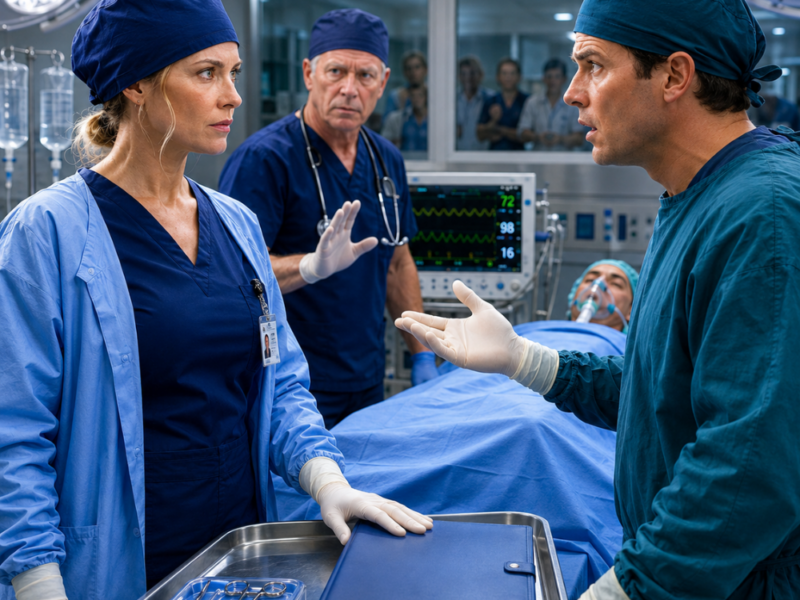
“That Procedure Is Classified,” the Surgeon Snapped—The Nurse Replied, “I Helped Write It.”
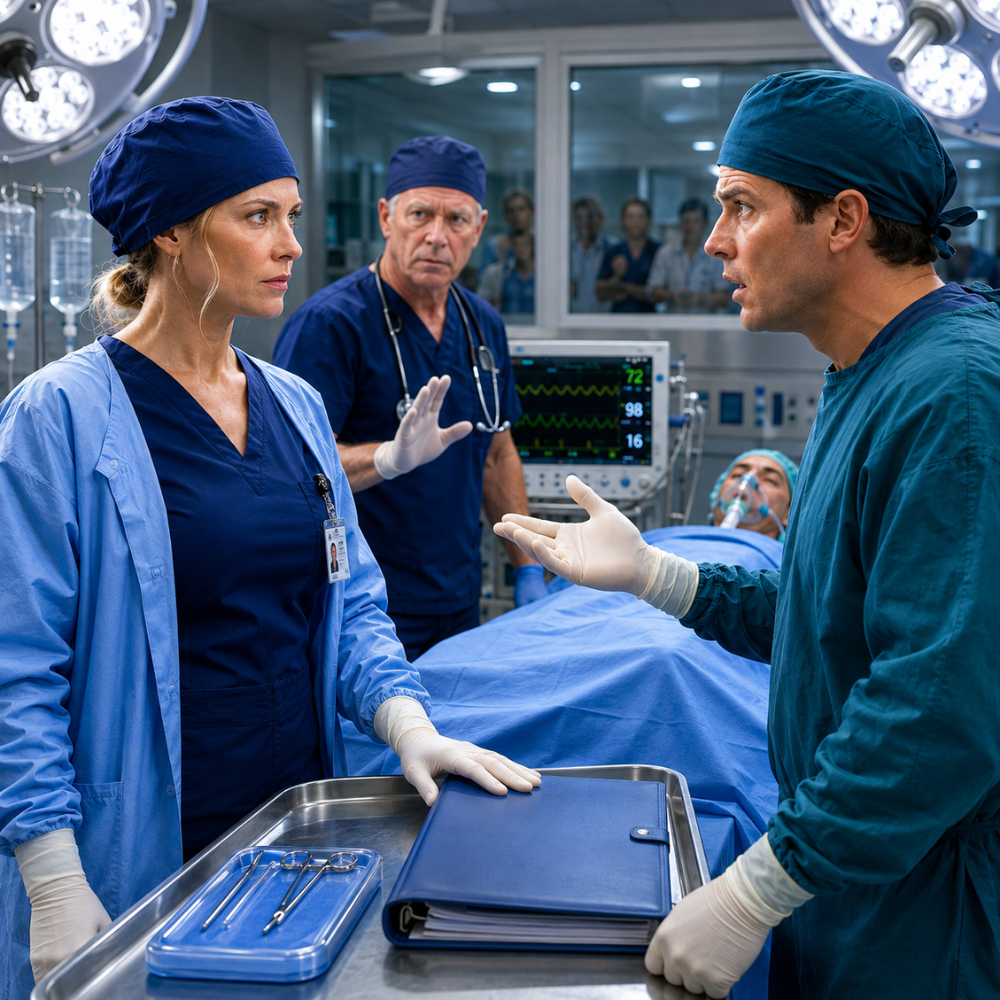
The famous neurosurgeon told the scrub nurse she didn’t understand his classified procedure—then she quietly said, “I helped write it.”
The permanent clip was already in Dr. Nolan Mercer’s hand when Claire Vanden realized he was about to kill the man on the table.
Not intentionally.
That was the terrible part.
Mercer was not careless. He was not incompetent. He was not some reckless physician cutting corners because he believed rules were beneath him.
He was one of the best neurosurgeons Claire had ever watched.
His hands were extraordinarily steady. His complication rate was low. He could move through deep, unforgiving anatomy with a confidence that came from genuine skill rather than performance.
But he was about to make a mistake that brilliance alone could not save.
“Not yet,” Claire said.
The operating room went still.
Mercer’s right hand remained extended over the surgical field.
“I asked for the clip.”
Claire did not hand it to him.
The monitors continued their steady electronic rhythm. Dr. Owen Reed, the anesthesiologist, read another blood-pressure value from the head of the table.
The number was dropping.
Slowly.
Not yet catastrophically.
But the direction mattered.
Claire had spent eleven years waiting to never hear the words she was hearing now.
Veyron-Pike sequence.
Posterior circulation.
Temporary flow diversion.
Basilar artery instability.
She had hoped that chapter of her life would remain sealed behind government classification, expired credentials, and an old cardboard storage box in the back of her bedroom closet.
Instead it had arrived in Operating Room Four at Mercy Ridge Medical Center on an ordinary Wednesday morning in October.
And the surgeon holding a permanent vascular clip did not know the one thing he needed to know.
“The shunt goes first,” Claire said.
Mercer finally looked at her.
His surgical mask hid most of his face, but his eyes sharpened.
“Excuse me?”
“Temporary shunt first. Then equalization.”
“Claire.”
His tone changed.
Not angry yet.
Warning.
The tone of an attending surgeon addressing someone lower in the formal chain who had just stepped outside the expected boundaries of her role.
She understood the hierarchy.
Everyone in the room did.
Mercer was the attending neurosurgeon.
Claire was the scrub nurse.
He made surgical decisions.
She maintained the sterile field, anticipated instruments, counted, prepared, monitored, and supported the procedure.
In six years of working together, Claire had never openly challenged him.
Not once.
That history was part of why the room felt suddenly so strange.
“Give me the clip.”
“No.”
The circulating nurse looked up.
One of the residents in the observation gallery above the suite stopped writing.
Mercer stared at Claire for another second.
Blood welled into the surgical field in a thin but persistent line.
Reed spoke from anesthesia.
“Pressure eighty-six over fifty-two.”
Mercer’s eyes went back to the patient.
“We don’t have time for this.”
“I know.”
“Then give me the clip.”
“If you permanently occlude before the pressure equalizes, proximal load rises against compromised tissue.”
Mercer looked at her again.
“That is not the sequence I was briefed.”
“Then the briefing was incomplete.”
Silence.
Mercer’s voice became very quiet.
“This protocol is classified.”
“I know.”
“You are a scrub nurse.”
“I know.”
“Then hand me the instrument.”
Claire met his eyes.
“I helped write the protocol.”
The room did not react immediately.
There was no gasp.
No dramatic movement.
For several seconds, everyone seemed to need time to decide whether the sentence had actually been spoken.
Mercer went completely still.
Not the controlled stillness that made him famous in surgery.
A different stillness.
The human kind.
“What?”
Claire could hear Reed’s breathing behind his mask.
The patient below them, Daniel Keane, had no idea that the next thirty seconds depended on a conversation between two people who had shared an operating room for six years without truly knowing each other.
“The temporary shunt first,” Claire said. “Twelve seconds minimum equalization before permanent clip placement.”
Mercer did not move.
“How do you know twelve?”
“I calculated it.”
The words sounded almost absurd in that room.
Mercer blinked once.
Claire continued.
“Four hundred fourteen modeled pressure sequences. Variable hypotension, variable proximal loading, altered vessel compliance. Below twelve seconds, failure probability rises sharply. The permanent clip goes after convergence.”
“Who are you?”
There was no time to answer.
“Temporary shunt.”
Mercer’s eyes dropped toward the instrument.
Claire placed it into his open hand.
“Now.”
The surgeon in him took over.
Whatever confusion had entered Nolan Mercer’s mind did not enter his fingers.
He positioned the temporary device with the same precise economy that had carried Daniel Keane safely through the previous two hours.
Reed called another pressure.
“Eighty-four over fifty.”
The flow profile shifted.
Claire watched the monitoring values.
Eight seconds.
Mercer’s shoulders changed.
She knew the motion.
He was preparing for the next step.
“Hold.”
His hand stopped.
Nine.
Ten.
Eleven.
Claire watched the pressure relationship narrow.
Twelve.
She placed the permanent clip into Mercer’s hand.
“Now.”
He moved.
The repair seated.
The bleeding stopped.
Reed’s next pressure reading came twelve seconds later.
Then another.
The trend reversed.
Nobody in the room celebrated.
Operating rooms did not work that way.
The relief appeared in smaller places.
A resident’s shoulders lowering.
The circulating nurse finally taking a full breath.
Reed’s voice losing the sharper register it had carried for the previous two minutes.
Nolan Mercer staring at the field and realizing the patient was still alive.
Claire returned her attention to the instrument tray.
The surgery still had hours to go.
Mercer said nothing else about her.
Neither did anyone.
But the room had changed.
Mercy Ridge Medical Center had never been one of those hospitals with marble fountains in the lobby or a donor’s name attached to every hallway.
It sat outside Boston in a cluster of brick and glass buildings surrounded by commuter roads, aging apartment complexes, a pharmacy, two chain hotels, and a diner where night-shift nurses ate pancakes at six-thirty in the morning.
Its reputation had been built slowly.
Good trauma outcomes.
Strong nursing.
Conservative infection rates.
Surgeons who generally knew when not to operate.
Patients from around New England came to Mercy Ridge because someone’s cousin had survived there, or somebody’s church friend said the oncology unit treated her mother well, or a primary-care physician had trusted the place for twenty years.
It was not glamorous.
It was reliable.
Claire Vanden trusted reliable.
At forty-six, she had spent nearly a decade making herself part of the hospital’s background.
She arrived early.
Usually before six.
She drank coffee from the same dented stainless-steel travel mug.
She brought lunch from home in a blue insulated bag she had owned long enough for the zipper to stick.
She parked on the third level of the employee garage because the fourth flooded near the stairwell whenever it rained and the second filled with surgeons who believed turn signals were optional.
She knew which vending machine on the fourth floor accepted dollar bills and which one stole them.
She knew the environmental-services worker named Luis always wanted the Red Sox score before he wanted good morning.
She knew Dr. Patel hated curved Mayo scissors and would ask for straight ones even when curved made more sense.
She knew which new residents would ask scrub staff for help and which would rather spend five minutes searching for an instrument than admit they did not know where it was.
She was excellent at her job.
That was all Mercy Ridge thought it knew about her.
Her employee file listed nursing school in Massachusetts, operating-room certification, trauma experience, vascular continuing education, and nine years at Mercy Ridge.
Nothing about Bethesda.
Nothing about the Department of Defense program that had occupied the previous part of her life.
Nothing about hemodynamic modeling.
Nothing about Veyron-Pike.
Claire had made sure of that.
Eleven years earlier, she had worked in a research building outside Bethesda where offices were identified by numbers rather than department names and certain conference rooms had no windows.
The official title on her badge had been Senior Clinical Systems Specialist.
It was intentionally broad.
Her actual work was narrower.
And stranger.
The program studied catastrophic vascular injuries suffered in environments where conventional hospital assumptions broke down.
Combat injuries.
Remote evacuation.
Damaged vessels exposed to unstable blood pressure.
Patients who sometimes reached surgeons alive but physiologically too fragile for techniques developed under normal conditions.
Claire was not a physician.
She had never wanted to be one.
Her background combined critical-care nursing, physiology, biomedical systems analysis, and a graduate degree in clinical modeling.
Her talent was not cutting.
It was seeing systems.
Blood flow.
Pressure.
Timing.
What happened at second six when something done at second two altered pressure three anatomical steps away.
The Veyron-Pike protocol began as an argument between two surgeons.
Dr. Malcolm Veyron believed a temporary diversion device could create a short window to stabilize selected catastrophic aneurysm repairs.
Dr. Roland Pike believed the concept was sound but the pressure dynamics were too unpredictable.
Claire had been asked to model both possibilities.
She spent two years proving that each man was partly right.
A temporary diversion could create the window.
But only if the timing sequence was treated as physiology rather than convenience.
Too short, and pressure had not sufficiently equalized.
Too long, and other risks increased.
Twelve seconds became the first critical threshold.
Not because twelve was magical.
Because hundreds of simulations made it the line beneath which the vessel behaved differently.
Claire built the model.
Then rebuilt it.
Then argued for changes after early animal trials showed their assumptions about tissue compliance had been too optimistic.
She was in the room when the first restricted clinical version was approved.
Her name appeared on the development archive.
Then her father had a stroke.
The call came on a Wednesday afternoon.
Claire had been working through pressure plots when her phone vibrated.
Her younger brother, Peter.
“Dad’s in the hospital.”
Those four words ended one life and started another.
Her father, Raymond Vanden, had been seventy-two.
Retired high-school math teacher.
Widower.
A man who wrote checks at grocery stores long after everyone asked him to stop.
He lost most movement on his right side and nearly all expressive speech.
Claire flew home.
At first, she assumed she would return to Bethesda after a few months.
Then a few months became a year.
Her father’s care became a complicated American patchwork of Medicare decisions, rehabilitation authorizations, home-health schedules, pharmacy receipts, transportation, and the quiet dignity problems nobody understood until someone they loved could no longer button his own shirt.
Claire left the program formally.
Returned to nursing.
Mercy Ridge hired her.
Her father died four years later.
By then Claire’s research clearance had lapsed, the Veyron-Pike program had moved into a different phase, and she had discovered she preferred direct patient care more than she expected.
She stayed.
And somewhere during those years, not telling people about Bethesda changed from privacy into habit.
Habit became identity.
At Mercy Ridge, she was Claire from OR Four.
Dependable.
Quiet.
Always ready.
Nobody asked why she knew pressure physiology better than most fellows.
Most assumed long experience.
Claire never corrected them.
Then Daniel Keane’s aneurysm ruptured.
Daniel was forty-three.
Civil engineer.
Husband.
Father of two girls, fourteen and nine.
He had been standing beside a highway drainage project in Waltham when he developed the kind of headache emergency physicians describe as thunderclap because ordinary vocabulary feels insufficient.
He told a coworker he felt like something exploded behind his eyes.
Then he collapsed.
Imaging at Mercy Ridge showed a complex basilar artery aneurysm deep near the brainstem.
The location was terrible.
The shape was worse.
Standard surgical clipping posed extreme access risk.
Endovascular repair was limited by the lesion’s irregular neck and branch involvement.
The neurosurgical team met that afternoon.
Mercer studied the scans.
Claire stood near the rear wall because scrub nurses attended complex case planning when instrument requirements were unusual.
“The Veyron-Pike temporary diversion protocol,” Mercer said.
Claire looked up.
Nobody noticed.
Dr. Owen Reed frowned.
“You’ve done one?”
“No.”
Mercer’s answer was immediate.
“I was briefed during fellowship.”
“Briefed or credentialed?”
“Briefed.”
Reed looked at the imaging again.
“That’s not the same thing.”
“No.”
Mercer’s tone remained calm.
“But we do not have a standard option I prefer.”
A vascular fellow shifted.
“What about transfer?”
“Where?”
“Philadelphia?”
“He may not tolerate it.”
Mercer pointed toward the scan.
“Slow leak now. That can become catastrophic without warning.”
The room went quiet.
This was what medicine looked like at its hardest.
Not good choice versus bad.
Bad choice versus worse.
Mercer continued.
“I understand the sequence.”
Claire felt something tighten inside her.
He understood the outline.
She could hear it in his language.
Temporary diversion.
Repair.
Restore.
Destination.
Not cliffs.
She considered speaking then.
Could have.
Perhaps should have.
But saying, I helped develop this classified protocol, would have created its own problem.
Verification.
Clearance.
Committee consultation.
Hospital administration.
Ethics.
Potential transfer delay.
Daniel Keane’s aneurysm was already leaking.
Claire made a decision she would later examine more harshly than anyone else did.
She stayed quiet.
She made sure she was assigned to the case.
At five-forty-five the next morning, she stood alone in OR Four and arranged the instruments.
Temporary micro-shunt at front.
Permanent clip behind it.
Backup vascular instruments.
Suction.
Everything exactly where she wanted it.
The surgery began at seven-twenty-three.
For almost two hours, Nolan Mercer was brilliant.
That fact mattered to Claire.
It would have been easy afterward to rewrite him as arrogant and therefore incompetent.
He was not.
He navigated the difficult approach with exceptional precision.
He minimized retraction.
Protected delicate structures.
Adjusted when anatomy differed slightly from imaging.
The observation gallery filled with residents and a visiting fellow from Massachusetts General.
Mercer deserved their attention.
Claire watched him and thought something uncomfortable.
Skill creates social momentum.
When someone has been right for two hours, the room begins expecting him to remain right.
Every successful decision makes the next person less likely to interrupt.
Excellence can become its own kind of pressure.
Then the aneurysm began leaking.
Mercer moved toward the protocol he believed he understood.
And Claire saw his hand reach for the wrong instrument.
After the repair held, they continued for another two hours and twelve minutes.
Nobody mentioned the confrontation.
At eleven-fifty-eight, Mercer completed closure.
Claire began final counts with the circulating nurse.
Correct.
Again.
Correct.
Daniel Keane moved to intensive care.
At twelve-forty, Claire sat alone in the staff lounge.
Her hands were wrapped around a paper cup of coffee she did not remember pouring.
Cassidy Moore, another OR nurse, entered.
She stopped.
“You okay?”
“Yes.”
“That looked convincing.”
Claire glanced toward her.
Cassidy sat.
“I heard something happened in Four.”
“You heard quickly.”
“Three residents were watching.”
“Right.”
Cassidy lowered her voice.
“Mercer almost used the wrong sequence?”
Claire said nothing.
“And you stopped him.”
“I corrected an instrument order.”
Cassidy stared.
“They’re saying you told him you wrote the procedure.”
“Helped.”
Cassidy leaned back.
“Claire.”
“Yes?”
“What exactly did you do before Mercy Ridge?”
Claire drank the coffee.
It had gone lukewarm.
“I worked in research.”
“That is criminally vague.”
“It’s accurate.”
“Is this why you can tell a vascular fellow he’s interpreting pressure compensation wrong and somehow be right?”
“I don’t tell vascular fellows that.”
“You told Kramer last year.”
“He was interpreting pressure compensation wrong.”
Cassidy stared.
Claire looked toward the clock.
“I have another case at two.”
“Claire.”
“Later.”
“Is later eleven years from now?”
“Possibly.”
At three-thirty, Dr. Everett Sloan, chief of surgery, sent the meeting request.
Four o’clock.
His office.
Mercer.
Claire.
Reed.
Sloan had run Mercy Ridge surgery for eleven years.
He was sixty-two, bald, and famous for speaking quietly when angry because he believed loudness confused employees into thinking emotion was more important than content.
Claire arrived first.
Mercer came two minutes later.
He did not look at her.
Reed closed the door.
Sloan began.
“Let’s avoid storytelling.”
He looked at Claire.
“You refused a direct instrument request during a critical point in surgery.”
“Yes.”
“You then instructed the attending surgeon regarding procedure sequence.”
“Yes.”
“You understand why that is a serious issue.”
“Yes.”
Sloan turned.
“Dr. Mercer. Were you fully credentialed for Veyron-Pike?”
“No.”
“Why did you perform it?”
Mercer sat straight.
“The patient had no conventional option I considered acceptably survivable. I had received protocol instruction during fellowship and reviewed the restricted materials available through Mercy Ridge.”
“Supervised case?”
“No.”
“Simulation?”
“Yes.”
“How many?”
“One.”
Sloan’s mouth tightened.
“You believed that was sufficient.”
“Yes.”
“Do you still?”
“No.”
The answer changed the room.
Sloan looked toward Reed.
“Your assessment?”
Reed folded his arms.
“He was moving toward permanent occlusion before equalization.”
“Would that have caused harm?”
“I can’t predict with certainty.”
Reed glanced toward Claire.
“But based on what I’ve reviewed since surgery, the pressure surge risk would have been substantial.”
“Potentially fatal?”
“Yes.”
Sloan turned to Claire.
“How did you know?”
Claire opened the folder she had brought.
The page inside was old.
Official.
Boring.
At the top:
VEYRON-PIKE DEVELOPMENT PROGRAM.
CONTRIBUTING SPECIALISTS.
CLAIRE E. VANDEN, RN, MS — CLINICAL HEMODYNAMICS.
She slid it across the desk.
Sloan read.
Then Mercer.
Mercer did not blink for several seconds.
“How long were you in the program?” Sloan asked.
“Two years full time. Additional consulting for eight months after my father’s stroke.”
“You built the pressure model?”
“Primary analyst with two computational engineers.”
“The twelve-second threshold?”
“I developed the initial model. The final protocol was multidisciplinary.”
Sloan stared.
“Does HR know any of this?”
“No.”
“Why not?”
“It was not relevant to my nursing credential.”
Sloan almost laughed.
“Apparently it became relevant.”
“Yes.”
Mercer finally spoke.
“You were in Bethesda.”
“Yes.”
“I trained on material you wrote.”
“Parts of it.”
“And you never said anything.”
Claire looked at him.
“You never asked.”
Sloan held up one hand.
“That conversation can happen elsewhere.”
He sat back.
“The hospital has two problems.”
Nobody interrupted.
“First, Dr. Mercer attempted an advanced restricted protocol without sufficient hospital credentialing.”
Mercer accepted it.
“Second, Ms. Vanden violated operating-room command procedure during a crisis.”
Claire accepted that too.
Reed frowned.
“She saved the patient.”
“I am aware.”
Sloan looked at him.
“That does not make process irrelevant.”
Reed leaned back.
Sloan continued.
“If I establish that anyone who believes they possess superior information may independently refuse an attending surgeon during a crisis, I create an unworkable room.”
Claire understood.
“But,” Sloan added, “if I establish that rank overrides critical information, I create a dangerous one.”
That was the actual problem.
Mercer would be suspended from complex surgical duties pending formal review.
Claire would receive a written warning for failure to use formal escalation procedure.
Hospital leadership would separately review why Mercy Ridge’s credentialing process had allowed Mercer access to restricted protocol materials without supervised qualification.
Sloan looked at Claire.
“I also want your Bethesda credentials verified.”
“Of course.”
“Full review.”
“Yes.”
“This may affect your role here.”
Claire’s face did not change.
“How?”
“I don’t know yet.”
“Then I’ll wait until you do.”
Sloan almost smiled.
“Fair.”
The meeting ended.
Mercer left first.
Claire returned to work.
That night, her father appeared in a dream.
Not sick.
Not in the wheelchair.
He was standing in the old kitchen writing a grocery list with the mechanical pencil he always carried.
Claire woke at three-seventeen.
She lay staring at the ceiling.
The operating room returned in fragments.
Mercer’s open hand.
Permanent clip.
His voice.
You’re a scrub nurse.
She had heard condescension from doctors before.
Every nurse had.
Sometimes openly.
More often through small architecture.
The surgeon gets the chair.
The nurse stands.
The physician’s question counts as clinical reasoning.
The nurse’s identical question becomes concern.
Mercer had not been cruel to Claire over the years.
Cruelty would have been easier to identify.
He had simply treated her knowledge as bounded by her role.
His hierarchy was polite.
That made it durable.
Claire slept again at four.
Mercer did not.
His suspension removed him from the schedule immediately.
For the first two days, he converted anxiety into productivity.
He read.
Exercised.
Wrote responses.
Reviewed Daniel Keane’s imaging.
Requested additional protocol literature.
On the third day, he asked for the OR recording.
Mercy Ridge stored surgical video for complex cases.
Mercer watched alone.
The first hour validated him.
Good exposure.
Clean technique.
Appropriate adjustments.
Then the leak.
He watched his own hand extend.
Clip.
Claire did not move.
His voice sounded harsher on recording than it had sounded inside his head.
“Give me the clip.”
Then Claire:
“Temporary shunt first.”
Then him:
“That procedure is classified. You’re a scrub nurse.”
Mercer stopped the footage.
He sat in the small review room.
Ventilation hummed above him.
The words sounded terrible.
Not because they were rude.
Because they revealed the assumption beneath them.
She cannot know because of what she is.
He restarted.
“I helped write it.”
Mercer watched his own face.
Confusion.
Disbelief.
Then urgency.
He watched Claire direct the timing.
Eight seconds.
His hand moved.
“Not yet.”
He stopped.
Twelve.
“Now.”
Clip.
Pressure recovery.
Mercer leaned back.
Then forced himself to answer the question he least wanted.
If Claire had not been there, would he have stopped?
No.
He knew enough about surgery to know.
He would have placed the clip.
He would have seen the pressure surge.
The aneurysm might have failed catastrophically.
Daniel Keane might have died.
And Mercer would have believed the complication represented the severity of the disease rather than the inadequacy of his preparation.
That was the part he could not tolerate.
Not error.
Unknown error.
Being wrong while possessing enough authority to make everyone else accept the wrongness as reality.
He watched the footage again.
This time he watched the people around him.
Reed.
Residents.
Circulating nurse.
Claire.
Nobody interrupted until Claire.
Why?
Because he had trained the room not to.
That realization hurt more than suspension.
Daniel Keane woke fully on the second ICU day.
His wife, Sarah, was sitting beside him.
He looked at her.
Then asked for the girls.
Sarah cried so hard the nurse brought tissues without being asked.
His first neurological examinations were encouraging.
Motor function.
Speech.
Recognition.
Small deficits that improved day by day.
When he transferred to step-down on day four, the treatment team called it close to best case.
Claire heard the update at the nursing station.
“That’s good.”
Cassidy looked at her.
“That’s all?”
“What?”
“You saved him.”
“Mercer saved him.”
“You stopped Mercer from killing him.”
“That is not how I would phrase it.”
“It is how everybody else is phrasing it.”
Claire shut the chart.
“Then everybody else likes simple stories.”
During lunch, she went to the sixth floor.
Daniel’s door was partly closed.
Claire looked through the glass.
He sat propped against pillows.
Sarah beside him.
Two girls appeared on a tablet screen.
The older one was talking.
The younger kept waving.
Daniel smiled.
Claire watched for ten seconds.
Then left.
She did not enter.
That evening, Sarah Keane found Nolan Mercer’s name on the care team and asked a nurse when she could thank him.
Mercer visited the following day.
Daniel spoke slowly but clearly.
“Doctor.”
“Mr. Keane.”
“You fixed it?”
Mercer sat.
“We fixed it.”
Daniel smiled faintly.
“Still modest?”
Mercer almost laughed.
“No.”
Sarah looked curious.
Mercer continued.
“Your surgery involved a complication.”
Her face tightened.
“You’re okay.”
He said it quickly.
“But something happened that I think you have a right to know.”
Mercer explained enough.
Not every technical detail.
He told them he had nearly used an incorrect sequence during the repair.
A member of the surgical team corrected him.
Sarah’s expression changed.
“Who?”
“Claire Vanden.”
“The nurse?”
“Yes.”
Daniel looked between them.
“She saved me.”
Mercer did not protect himself with nuance.
“Yes.”
The word cost him.
That was why it mattered.
Sarah asked, “Why isn’t she here?”
Mercer looked toward the door.
“Because Claire does not seem interested in being thanked.”
“That’s ridiculous.”
“I agree.”
Daniel’s mouth moved.
“Find her.”
Mercer almost smiled.
“That may be harder than the surgery.”
A week into his suspension, Mercer found Claire in sterile supply.
She was counting endoscopic kits.
He stood in the doorway.
“Can I talk to you?”
Claire finished the item in her hand.
Then turned.
“Yes.”
“I watched the footage.”
She waited.
“The whole thing.”
Still nothing.
“I know what would have happened if you gave me the clip.”
Claire’s expression remained neutral.
“I would have placed it.”
“Yes.”
“The pressure would have surged.”
“Most likely.”
“He could have died.”
“Yes.”
Mercer swallowed.
“I knew enough to believe I understood the protocol.”
Claire said nothing.
“I did not know enough to understand where it failed.”
“That’s accurate.”
“I’ve spent a week trying to find a version where I stop myself.”
He shook his head.
“There isn’t one.”
Claire placed the inventory tablet on a shelf.
Mercer continued.
“I need to apologize.”
She waited.
“For what I said in the room.”
He paused.
“And for six years.”
That got her attention.
“I treated you like equipment.”
Claire looked at him.
“That’s a dramatic way to say it.”
“It’s accurate.”
He exhaled.
“You were useful, so I valued the function.”
“That is common.”
“That doesn’t make it acceptable.”
“No.”
“I thought hierarchy meant clarity.”
Claire leaned against the storage cabinet.
“Hierarchy gives responsibility.”
Mercer waited.
“It doesn’t guarantee knowledge.”
“No.”
“You are exceptionally good.”
He looked uncomfortable.
“That isn’t flattery.”
“I know.”
“Your skill was never the problem.”
“What was?”
“You needed the room to confirm your skill.”
He stared.
Claire continued.
“You do not ask questions unless you believe the answer might come from someone whose expertise you already respect.”
Mercer thought about Reed.
Residents.
Scrub techs.
Nurses.
“You make other people’s scope of knowledge smaller because it keeps the decision chain clean.”
“That sounds efficient.”
“It is.”
Claire’s voice remained calm.
“It is also how you nearly killed Daniel Keane.”
Mercer absorbed it.
Claire continued.
“Authority in surgery is not proving you know the most.”
“Then what is it?”
“Knowing you are responsible for hearing the thing you don’t know.”
The supply room was quiet.
“No one person in an OR knows everything.”
She gestured toward the hallway.
“Anesthesiology knows something you don’t.”
“Nursing sees things you don’t.”
“The tech setting equipment sees failures before you do because they handle the equipment all day.”
“Residents remember details from new literature because they are studying for boards.”
“You have more surgical skill than all of them.”
She looked directly at him.
“That still does not make their information smaller.”
Mercer nodded slowly.
“I’m sorry.”
Claire did not say it was okay.
Because it had not been.
She nodded once.
That was enough.
The formal review took six weeks.
Mercer’s suspension became a structured return.
Ninety days of supervised complex procedures.
Full hospital credentialing before any nonstandard protocol use.
Patient-safety consultation for experimental or restricted techniques.
Mandatory multidisciplinary case conference documentation.
He appealed none of it.
Claire’s warning remained in her file.
That surprised people.
She could have challenged it.
Chief Sloan offered to note formally that the refusal saved Daniel’s life.
Claire agreed to the note.
She did not ask for the warning to disappear.
Cassidy confronted her in the locker room.
“That’s insane.”
“No.”
“You were right.”
“Yes.”
“Then why accept discipline?”
“Because Sloan was right too.”
Cassidy stared.
Claire continued.
“I violated normal OR protocol.”
“To stop a fatal mistake.”
“Yes.”
“So?”
“So the hospital needs a better emergency challenge procedure.”
Cassidy paused.
“That sounds like the most Claire response possible.”
“What does that mean?”
“You get written up and decide the policy is the problem.”
Claire almost smiled.
She did more than complain.
She joined the committee rewriting the operating-room escalation standard.
The previous procedure required staff to raise concerns through chain of command unless immediate patient harm was obvious.
The phrase immediate patient harm was less useful than it looked.
Who decided obvious?
How certain did a nurse have to be?
How many seconds counted as immediate?
Claire proposed a standardized phrase.
“Clinical stop.”
Any member of the sterile team could say it.
Surgeon.
Resident.
Nurse.
Technician.
Anesthesiologist.
If used, all nonessential movement paused for a defined short interval.
The person calling it had to state one specific concern.
The attending surgeon retained final authority after hearing the concern unless another formal safety mechanism applied.
Mercer supported it.
That surprised everyone except Claire.
At the committee meeting, one surgeon objected.
“You’ll have techs stopping cases because they don’t like an instrument choice.”
Mercer answered.
“Then we listen for ten seconds and continue.”
“That interrupts flow.”
“So does killing a patient.”
The room went quiet.
Mercer did not say Daniel Keane’s name.
He did not need to.
The policy passed.
His first morning back in surgery, Mercer stood at the assignment board at six-forty.
Reed approached carrying coffee.
Mercer looked over.
“What are your concerns about anesthesia today?”
Reed stopped.
“What?”
“Case one.”
Reed looked toward the board.
“Mrs. Bernstein.”
“Yes.”
“You’re asking before the briefing?”
“Yes.”
Reed stared.
Mercer sighed.
“Owen.”
“Sorry.”
Reed smiled.
“I’m adjusting to the software update.”
“What’s the concern?”
“Her pulmonary pressures.”
Then Reed gave him three minutes of detailed reasoning.
Mercer listened.
They modified induction planning.
Before case two, Mercer asked the surgical tech about backup visualization equipment.
The tech suggested moving an additional micro-endoscope into the room rather than leaving it in central supply.
Mercer agreed.
They used it.
At case three, Claire stood at the instrument table.
Complex posterior fossa surgery.
Mercer looked across the room.
“Claire.”
“Yes?”
“Anything I’m missing?”
She checked.
“Not yet.”
“Tell me when I do.”
She placed the scalpel into his hand.
The surgery began.
In the gallery above, two residents watched.
One whispered, “He asks everyone everything now.”
The other said, “He got burned.”
Claire heard none of it.
If she had, she would have disagreed.
Mercer had not been burned.
He had been corrected.
There was a difference.
Six months later, Daniel Keane returned to Mercy Ridge for imaging.
He walked without assistance.
His right hand remained slightly weaker than the left.
His speech had recovered.
He had gone back to work part time.
Sarah brought their daughters.
They arrived with a bakery box.
Not some extravagant donor gift.
Chocolate cupcakes from a shop near their house.
Daniel insisted on delivering them to OR staff himself.
Claire was reviewing counts when Cassidy appeared.
“There’s a family asking for you.”
“I’m working.”
“They have cupcakes.”
“That changes nothing.”
“Chocolate.”
“Still nothing.”
“Your emotional range is alarming.”
Claire finally went.
Daniel stood near the waiting area.
He recognized her immediately.
“You’re Claire.”
She stopped.
“Yes.”
He held out his right hand.
Slight tremor.
Strong enough.
They shook.
“My wife says I’m supposed to hug you.”
Claire looked at Sarah.
Sarah lifted both hands.
“I said no such thing.”
Daniel smiled.
“Good. I hate hugging strangers.”
Claire almost laughed.
His older daughter held the cupcake box.
“We brought these.”
“That was kind.”
Daniel looked at Claire.
“Mercer told me what happened.”
Claire glanced toward the hallway.
“He told you?”
“Everything that mattered.”
Daniel’s expression became serious.
“I don’t remember the surgery.”
“Good.”
“I’ve tried to picture it.”
“Don’t.”
“Probably good advice.”
He looked down.
“What do you say to somebody who kept you alive?”
Claire thought.
“You don’t have to say anything.”
Daniel shook his head.
“That sounds convenient for you.”
“It is.”
His younger daughter stepped forward.
She was ten now.
“Thank you.”
Claire looked down at her.
The girl’s eyes were clear and matter-of-fact.
No complicated understanding.
Her father was alive.
This woman helped.
Thank you.
Claire felt something move in her chest.
“You’re welcome.”
That was enough.
Her old research history became less hidden after Daniel’s case.
Not public.
Not dramatic.
But hospital credentialing updated her file.
Bethesda verified the unclassified portions.
Chief Sloan asked whether she would serve as a permanent patient-safety consultant while remaining in perioperative nursing.
Claire declined initially.
Then accepted eight hours a week.
Cassidy called it “becoming management by accident.”
Claire called it “eight hours.”
She reviewed advanced-protocol credentialing.
Helped create a database showing not only who had read procedure materials but who had performed supervised simulations and cases.
Mercer helped.
That relationship developed into something neither would have predicted.
Not friendship exactly.
Professional trust.
The kind built slowly after being broken before it existed.
Sometimes Mercer brought her a paper.
“What am I missing?”
Claire would read.
Sometimes nothing.
Sometimes something.
One afternoon he handed her an article on vascular pressure modeling.
She read the methods.
“This assumption is wrong.”
He frowned.
“Where?”
“Linearity.”
“They acknowledge nonlinear response.”
“They acknowledge it and then model around it.”
Mercer took the article.
“That’s standard.”
“So was your briefing.”
He stared at her.
Then laughed.
A real laugh.
Claire looked surprised.
“That was almost funny,” he said.
“I wasn’t joking.”
“I know.”
Years earlier, Nolan Mercer would have heard correction as challenge.
Now he heard it as information.
That did not make him less decisive.
If anything, his surgical outcomes improved.
Not dramatically.
He had already been excellent.
The difference appeared in complicated cases.
He abandoned bad plans earlier.
Asked anesthesia for concerns sooner.
Invited residents to disagree during planning rather than after outcomes.
A fellow once challenged his approach during conference.
The room waited for Mercer to crush him.
Instead:
“Show me why.”
The fellow did.
Mercer changed the plan.
Afterward, Claire passed him in the corridor.
“You enjoyed that.”
“No.”
“You did.”
“He was right.”
“That is not the same as enjoying it.”
“You smiled.”
Mercer looked offended.
“I do that occasionally.”
“Not historically.”
“You’re becoming disrespectful.”
“Clinical stop.”
He laughed.
Mercy Ridge’s culture changed in small ways.
The phrase spread.
Clinical stop.
A circulating nurse used it when medication labeling did not match.
A resident used it when laterality documentation differed from imaging.
A tech used it when a device package appeared compromised.
Most stops lasted less than thirty seconds.
Almost none revealed major danger.
That was success.
A safety system did not justify itself only through dramatic saves.
Sometimes its value was making ordinary uncertainty speakable.
Chief Sloan understood that.
At a hospital board meeting, a trustee asked whether the new process suggested Mercy Ridge had previously had a safety problem.
Sloan answered:
“Every hospital has a safety problem. Patients are fragile and humans are fallible.”
The trustee frowned.
“That is not reassuring.”
“It is accurate.”
Claire heard about the exchange later.
She approved.
Two years after Daniel Keane’s surgery, Sloan asked Claire to attend a national patient-safety conference in Chicago.
“No.”
“You haven’t heard why.”
“It involves a conference.”
“Yes.”
“No.”
“You helped create the clinical-stop protocol.”
“The committee created it.”
“You created the first draft.”
“The committee changed it.”
“Claire.”
“I dislike conferences.”
Sloan stared.
“You worked for the Department of Defense.”
“Yes.”
“You can survive the Marriott.”
“Debatable.”
Mercer heard about it.
“You should go.”
“No.”
“Why?”
“Because I don’t want to.”
He nodded.
“That is annoyingly difficult to argue.”
“Correct.”
She did not go.
Instead Sloan presented the policy.
Claire’s name appeared on one slide.
That was enough.
Her life outside Mercy Ridge remained quiet.
She lived in a small condo outside Newton with a narrow balcony that faced a parking lot and three maple trees.
She shopped Saturday mornings.
Still bought the same coffee.
Her father’s old mechanical pencil remained in the kitchen junk drawer.
Every Thanksgiving, Peter’s family came.
His wife made turkey.
Claire made pie badly.
Peter’s teenage son once asked:
“Mom says you used to work for the government.”
“I did.”
“Doing what?”
“Medical research.”
“Like secret medical research?”
Claire cut apples.
“Some of it was classified.”
His eyes widened.
“Were you a spy?”
“No.”
“That’s what a spy would say.”
Peter laughed from the dining room.
“Leave your aunt alone.”
Claire smiled.
The old life no longer felt like something she was hiding.
It was simply something she did not owe everyone.
That distinction mattered.
Mercer eventually left Mercy Ridge.
Not immediately.
Five years after Daniel Keane.
He accepted a department-chair position at a larger academic hospital in Philadelphia.
On his final day, OR staff organized cake in the lounge.
Cassidy insisted on Costco because “surgeons don’t deserve boutique frosting.”
Mercer accepted the insult.
When the room emptied, he found Claire by the sink.
“I have something for you.”
“That sounds ominous.”
He handed her a thin black notebook.
She opened it.
First page:
QUESTIONS I SHOULD HAVE ASKED SOONER.
Claire looked at him.
“Is this sentimental?”
“Unfortunately.”
She turned pages.
Notes from five years.
Case planning.
Leadership.
Team communication.
Some pages contained quotes.
One was hers.
AUTHORITY IS RESPONSIBILITY FOR HEARING WHAT YOU DON’T KNOW.
She looked up.
“You wrote that down?”
“Yes.”
“My condolences.”
Mercer smiled.
“I was difficult.”
“You still are.”
“Less.”
“Marginally.”
He became serious.
“Daniel Keane changed my career.”
Claire closed the notebook.
“He changed mine too.”
“How?”
She thought.
“I stopped pretending my old work had nothing to do with the person I became here.”
Mercer nodded.
“I’ve wondered something.”
“What?”
“Why didn’t you speak at the conference before surgery?”
Claire understood.
The question had stayed with her too.
“I thought the institutional delay would be dangerous.”
“Was that the only reason?”
“No.”
“What else?”
She looked toward the empty lounge.
“I didn’t want to explain who I was.”
Mercer waited.
“That almost cost more than speaking did.”
“Yes.”
She had admitted it slowly over years.
The story had not contained only Mercer’s arrogance.
Claire had made her own dangerous assumption.
She had assumed no one would listen unless she proved extraordinary credentials.
Maybe they would not have.
Maybe Mercer would have dismissed her.
But she had never tested it.
Hiding had felt safer.
Until it wasn’t.
“I should have spoken earlier,” she said.
Mercer nodded.
“Yes.”
She looked at him.
“Thank you for not making that easier.”
He almost laughed.
“I’ve learned.”
They shook hands.
No dramatic reconciliation.
No hug.
Mercer left Mercy Ridge.
Claire stayed.
Ten years after Daniel Keane’s surgery, Claire became director of perioperative clinical systems.
She did not seek the position.
Sloan retired.
His replacement wanted someone who understood workflow, nursing, safety, advanced procedural credentialing, and why every policy eventually collided with actual people.
Claire met the description inconveniently well.
Her office had a window.
She disliked it at first.
People could see her.
Cassidy, now charge nurse, found this hilarious.
“You spent your whole life becoming visible and now you’re mad your office has glass.”
“I did not spend my whole life becoming visible.”
“Fine. Ten years.”
“Also inaccurate.”
“Whatever helps you sleep.”
Claire still scrubbed into cases several times a month.
She refused to become an administrator who forgot what the rooms smelled like.
One afternoon, she stood in OR Four beside a young surgeon named Dr. Priya Shah.
Brilliant.
Fast.
Thirty-four.
The kind of physician who might become exceptional if her talent did not outrun her humility.
A resident expressed concern about an anatomical variation.
Shah answered quickly.
“It’s fine.”
The resident hesitated.
Claire noticed.
“Clinical stop.”
The room paused.
Shah looked over.
“What?”
Claire nodded toward the resident.
“He has a concern.”
The resident looked terrified.
Shah waited.
“Say it.”
He did.
Imaging showed a vessel variant that could alter approach.
Shah studied the screen.
Then changed the plan.
Nothing dramatic happened.
Nobody almost died.
The case proceeded safely.
Afterward, Shah found Claire near the scrub sinks.
“Was that really worth stopping for?”
“Yes.”
“It added four minutes.”
“Yes.”
“You knew I would listen.”
Claire looked at her.
“Then it cost four minutes.”
Shah nodded.
Fair.
She started walking away.
Then stopped.
“Is it true?”
Claire sighed.
“What?”
“You’re the Veyron-Pike nurse.”
Claire stared.
“I hate residents.”
Shah laughed.
“My fellowship director told me.”
“Who?”
“Nolan Mercer.”
Claire closed her eyes.
“Of course.”
“He said if I ever worked with you and you told me to stop, I should stop first and ask questions second.”
“That is also bad policy.”
“He said you’d say that.”
Claire almost smiled.
Years had changed the story.
People simplified it.
Famous surgeon nearly makes mistake.
Quiet nurse reveals secret expertise.
Patient saved.
Surgeon humbled.
It was a good story.
It was not the whole story.
The part Claire cared about happened afterward.
Mercy Ridge created a system where nobody had to secretly be a former classified research specialist to deserve ten seconds of attention.
That was the important change.
Because Claire knew something people often missed when retelling the Daniel Keane case.
She had been right because she happened to possess extraordinary knowledge.
But a nurse should not need extraordinary hidden credentials to raise a concern.
A technician should not need to have designed the device.
A resident should not need to be secretly more experienced than the attending.
The value of speaking up could not depend on a surprise reveal.
The room had to be structured to listen before knowing whether the speaker was impressive.
That was the lesson Nolan Mercer eventually understood too.
Years after moving to Philadelphia, he returned to Mercy Ridge for a symposium.
He and Claire stood near the rear of the auditorium while a patient-safety researcher presented data showing the clinical-stop policy had reduced near-miss escalation across multiple departments.
Mercer leaned toward her.
“You know what still bothers me?”
Claire kept watching the slide.
“Many things, I assume.”
“That people tell the story like the surprise was who you were.”
“It was surprising.”
“No.”
He shook his head.
“The real problem was that I should have listened even if you had never been in Bethesda.”
Claire looked at him.
Mercer continued.
“You should not have needed the line ‘I helped write it.’”
There it was.
Ten years late.
Still important.
“No,” Claire said.
“I shouldn’t have.”
They watched the presentation.
A chart changed.
The researcher explained that most safety stops resulted in no change to the original plan.
Some administrators had initially used that as evidence the stops were unnecessary.
The researcher disagreed.
“An alert system where every alert reveals catastrophe is not a good alert system,” she said. “It is a late one.”
Claire smiled.
Mercer noticed.
“What?”
“She’s right.”
“Obviously.”
“You enjoy being right too much.”
“I learned from excellent people.”
Claire gave him a look.
He laughed.
Daniel Keane turned fifty-four that same year.
He still sent Mercy Ridge Christmas cards.
The most recent photograph showed Sarah beside him, their daughters now adults, one in graduate school and the other wearing nursing scrubs.
Cassidy brought the card into Claire’s office.
“Look.”
Claire took it.
The younger daughter, Grace, had become an ICU nurse.
On the back Daniel had written:
Grace says she chose nursing because of “some woman Dad never stops talking about.”
Claire stared.
Cassidy grinned.
“No.”
“Yes.”
“This is emotional blackmail.”
“It’s adorable.”
“I’m calling him.”
“To complain?”
“Yes.”
“You are truly broken.”
Claire placed the card beside her computer.
She never called Daniel.
She kept the photograph.
At sixty, Claire reduced her hours.
Not retirement.
She disliked that word.
She moved to three days a week.
One administrative.
Two clinical.
Her travel mug finally broke after the handle cracked.
Cassidy bought her another.
Exactly the same model.
“You found this?”
“Internet.”
“It’s discontinued.”
“I have skills.”
Claire stared.
“Were they classified?”
“Very.”
They laughed.
On a rainy Tuesday morning, Claire entered OR Four for a vascular-neurosurgery case.
The room had been renovated.
New lights.
Different monitors.
The observation gallery had been converted into a digital teaching suite.
The instrument tables were newer.
The people were younger.
But the basic logic remained.
Patient first.
Sterile field.
Count.
Communication.
Check.
Recheck.
A first-year resident stood near the wall.
Nervous.
Claire recognized the posture.
The attending asked:
“Anybody see anything I’m missing?”
The resident hesitated.
Then spoke.
“Yes.”
Nobody looked offended.
Nobody rolled their eyes.
The surgeon said:
“Show me.”
The resident did.
The plan adjusted.
Claire watched from the instrument table.
No drama.
No revelation.
No one had to say:
I helped write it.
That was what progress looked like.
Boring.
Almost invisible.
The kind Claire trusted.
After the case, she went downstairs for coffee.
The Mercy Ridge cafeteria had finally replaced its ancient coffee machines.
The new ones were worse.
Claire bought a cup anyway.
She sat near the window.
Outside, rain streaked the glass.
Employees crossed the parking lot under umbrellas.
Ambulances arrived.
Visitors struggled with the parking kiosk.
Ordinary hospital life.
She thought about her father.
About Bethesda.
About Mercer’s hand reaching for the wrong instrument.
About the silence before she spoke.
For years, she had treated that silence as a story about courage.
Eventually she understood it was also a story about hesitation.
She had known something.
She had not been sure whether the room would permit her to know it.
So she waited.
That uncertainty was familiar far beyond operating rooms.
People carried it into offices.
Classrooms.
Factories.
Family dinners.
Church meetings.
Courtrooms.
Someone knew a number was wrong.
A process unsafe.
A story incomplete.
A person being treated unfairly.
But hierarchy whispered:
Not your place.
Not your title.
Not your decision.
Claire had spent a career learning that the question was not whether everyone should challenge everything.
That produced chaos.
The question was whether a system could distinguish disruption from essential dissent.
Whether authority was secure enough to hear information without treating the speaker as competition.
Whether expertise could arrive from unexpected places without needing permission first.
The coffee tasted terrible.
Claire drank it anyway.
Her phone vibrated.
A message from Mercer.
Photo attached.
He was standing beside a graduating neurosurgery fellow.
Caption:
SHE CORRECTED ME TWICE THIS WEEK. PROMOTING HER ANYWAY.
Claire typed:
Maybe because she’s right.
Mercer replied:
YOU HAVE RUINED ME.
Claire smiled.
Another message arrived.
From Grace Keane.
She had never contacted Claire directly before.
Hi Ms. Vanden. My dad gave me your number after asking permission through the hospital. I started my ICU job last month. Yesterday I caught a medication concentration problem because something felt off and I asked the pharmacist to recheck it. It was wrong. Nobody got hurt. Dad told me I should tell you because apparently this is “your whole thing.” So, thank you, I guess.
Claire read it twice.
Then typed:
You caught it. You should thank yourself.
Grace responded:
HE SAID YOU’D SAY THAT.
Claire laughed alone at the cafeteria table.
Several people looked.
She did not care.
That afternoon, she went back upstairs.
OR Four was being cleaned between cases.
Environmental services moved efficiently around the tables.
Luis, now a supervisor, saw her.
“Red Sox lost.”
“I didn’t ask.”
“You always ask.”
“I was hoping they improved during lunch.”
“Impossible.”
Claire stood at the doorway.
The room smelled like disinfectant.
Years ago, she had nearly lost her job there.
Had accepted a written warning there.
Had made herself visible there.
Not because she wanted recognition.
Because a patient needed information to matter more than hierarchy.
Eventually the hospital learned the same lesson.
So did Mercer.
So did Claire.
That last part mattered.
She had spent years believing humility meant keeping parts of herself hidden.
Sometimes it did.
Not every accomplishment needed an audience.
Not every room deserved your biography.
But there was a difference between humility and erasure.
Privacy and shrinking.
Knowing you did not need recognition and behaving as though your knowledge had no right to influence the room.
Claire had crossed that line without noticing.
Mercer’s arrogance had nearly harmed Daniel Keane.
Claire’s silence before the surgery had carried risk too.
Both truths could exist.
That was the thing about mature accountability.
It left fewer comfortable villains.
More responsibility.
Mercer had to learn that authority did not make him complete.
Claire had to learn that refusing visibility could become its own distortion.
Mercy Ridge had to learn that a safe system could not depend on extraordinary people breaking rules at exactly the right moment.
The clinical-stop policy did not produce headlines.
No one made television dramas about it.
Nobody donated a wing because of it.
It simply gave every person in an operating room ten seconds in which rank temporarily stepped aside for information.
Sometimes ten seconds changed nothing.
Sometimes it changed an instrument.
A medication.
A positioning decision.
Once, years earlier, twelve seconds had changed whether Daniel Keane went home to two daughters.
Claire walked into OR Four.
The next case was already being prepared.
A young nurse stood at the tray.
She looked up.
“Ms. Vanden?”
“Claire.”
“Claire.”
The nurse hesitated.
“Can I ask you something?”
“Yes.”
“How do you know when something is important enough to stop for?”
Claire considered.
There was no perfect answer.
“You don’t always.”
The nurse looked surprised.
“That’s not reassuring.”
“No.”
Claire smiled.
“You ask yourself whether you would rather explain why you stopped or explain why you stayed quiet.”
The nurse absorbed that.
“What if I’m wrong?”
“Then you’re wrong.”
“That simple?”
“No.”
“But being wrong honestly is usually repairable.”
Claire glanced toward the operating table.
“Silence is harder to repair when you were right.”
The nurse nodded.
Claire continued toward the supply room.
Behind her, the OR team worked.
Not perfectly.
Nothing human was perfect.
But differently than it had years before.
The room no longer depended on one brilliant surgeon knowing everything.
It depended on everyone knowing what they knew, admitting what they did not, and speaking when the difference mattered.
Nolan Mercer had once thought greatness meant being the most capable person in the room.
Claire had once thought humility meant never needing the room to know what she was capable of.
They had both been wrong.
Greatness was not making everybody else smaller.
Humility was not making yourself smaller either.
The real work was harder.
Bring the full truth you possess.
Leave room for somebody else’s.
And when a life is sitting between those two things, choose the truth over the hierarchy before the clock runs out.









