Sheriff Hit Black Grandma in Restaurant — Then Someone Walked In That Made Him Go Pale
The sheriff ordered a 68-year-old grandmother out of a Sunday restaurant—then a black SUV pulled into the parking lot and her son stepped out.
“Ma’am, I asked you for identification.”
Irene Taylor looked up from her sweet tea.
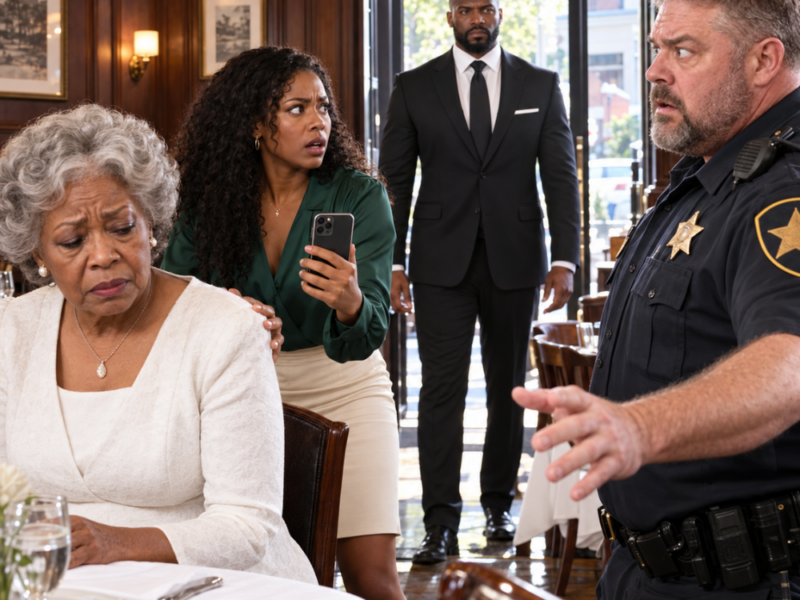
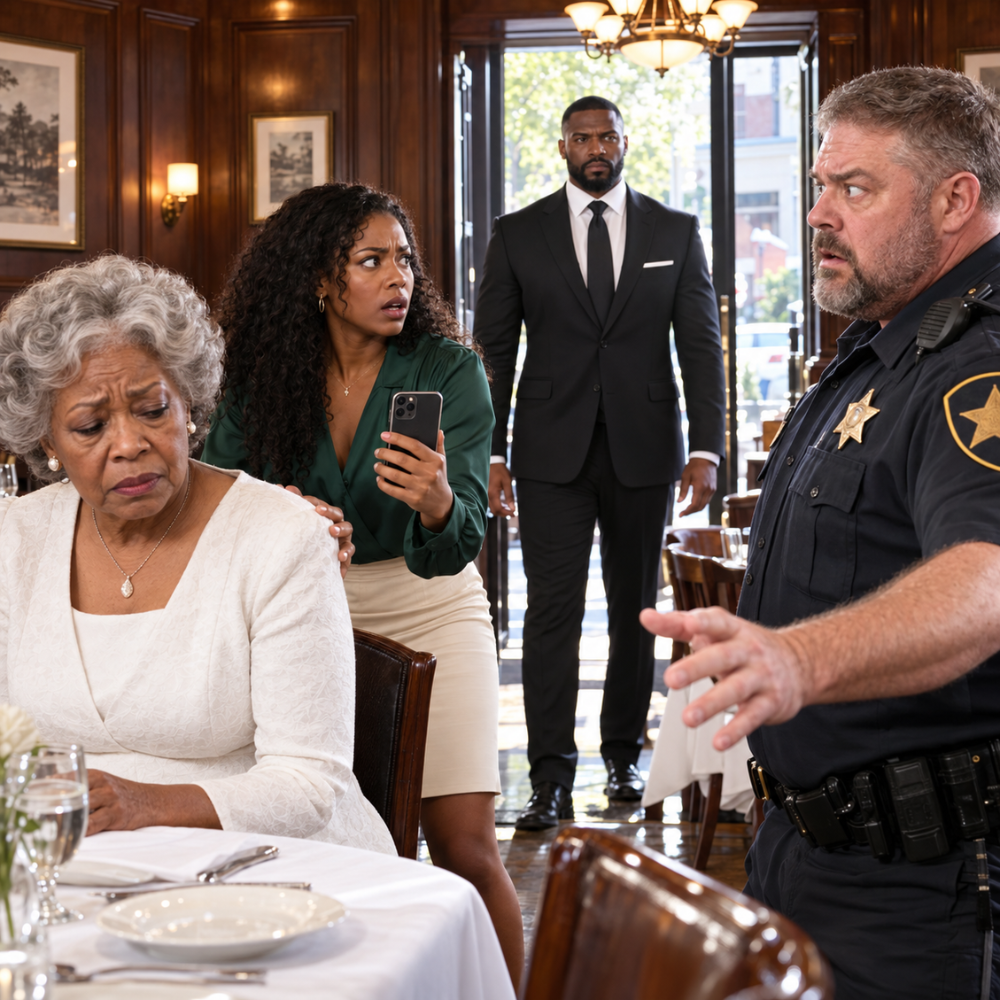
The sheriff stood beside her table with both thumbs hooked behind his duty belt, blocking the warm light that came through the windows of Magnolia House. Behind him, half the restaurant had stopped pretending not to listen.
Irene folded her napkin once and placed it beside her plate.
“I heard you.”
Sheriff Dale Crawford’s jaw tightened.
“Then show me some ID.”
Irene’s granddaughter Naomi stared at him.
“Why?”
Crawford did not look at her.
“I wasn’t speaking to you.”
Naomi was twenty-four, halfway through her final year of law school, and had spent enough time in classrooms discussing constitutional procedure to recognize when an encounter had taken a wrong turn.
She also knew her grandmother.
Irene Taylor had survived widowhood, factory layoffs, three jobs, one mortgage foreclosure scare, a son’s tuition bills, two surgeries, and forty years of Georgia summers without becoming a woman who enjoyed confrontation.
If Irene was refusing to reach for her purse, it was not because she wanted an argument.
It was because she understood something was wrong.
“I’m having lunch with my granddaughter,” Irene said.
Her voice was quiet.
That made Crawford lean closer.
“What did you say?”
“I said I’m having lunch.”
“Where do you live?”
“Here in the county.”
“Address?”
Naomi reached slowly for her phone.
Crawford noticed.
“Put that away.”
She stopped.
“Am I not allowed to use my phone?”
His eyes moved to her now.
Something in his expression made the nearby tables even quieter.
Sunday lunch at Magnolia House was usually noisy.
Children asked for biscuits.
People discussed football.
Church ladies compared flower arrangements.
The kitchen bell rang every few minutes when another order was ready.
Now the only clear sound was ice shifting in water glasses.
Irene looked around.
She recognized almost everyone.
Greta Simmons, the restaurant owner, stood behind the counter holding an order pad against her chest.
Dr. Howard Blake sat near the front window with his wife.
Two deacons from First Baptist were three tables away.
A middle-school teacher Irene had known for years was pretending to adjust something in her purse.
Nobody met Irene’s eyes.
That hurt more than she wanted to admit.
Crawford extended one hand.
“Identification.”
Irene looked back at him.
“Sheriff, what exactly have I done?”
The question changed his face.
He was accustomed to people answering questions.
Not asking them.
“I’m investigating suspicious activity.”
“What activity?”
Naomi’s voice was firmer now.
Crawford turned.
“Your grandmother is being questioned.”
“About what?”
“Naomi.”
Irene spoke her name as a warning.
Her granddaughter stopped.
Crawford looked almost pleased.
“See? Your grandmother understands how to cooperate.”
Irene’s fingers tightened around the edge of the table.
Then she said the sentence that would later appear in newspaper stories, court filings, television transcripts, and testimony.
“I understand how to be polite, Sheriff. That isn’t the same thing as agreeing that you’re right.”
Something shifted in the room.
Crawford’s expression hardened.
He reached toward Irene’s purse.
Naomi stood.
“Don’t touch her things.”
“Sit down.”
“That’s her property.”
“I said sit down.”
Irene rose too.
Not quickly.
Not aggressively.
She simply stood because she did not like a man reaching across her table.
Crawford caught her wrist.
Irene gasped.
“Let go of me.”
Naomi moved around the table.
“Sheriff—”
Everything happened in seconds after that.
Crawford pulled Irene forward.
She stumbled against the chair.
He told her to stop resisting even though she had barely moved.
When she twisted her arm, trying to free herself from his grip, he struck her once across the face.
The sound silenced the restaurant.
Irene lost her balance.
Her glasses fell to the tile.
One lens cracked.
She caught the edge of the table on the way down and landed on one knee before Naomi grabbed her arm.
“Grandma!”
For perhaps two seconds, nobody moved.
Then Naomi turned on Crawford.
“What is wrong with you?”
Crawford pointed toward her.
“Back away.”
“You hit her.”
“She resisted.”
“She is sixty-eight years old.”
“I said back away.”
Naomi pulled out her phone.
This time she did not hesitate.
She started recording.
Crawford noticed immediately.
“Turn that off.”
“No.”
“Turn it off.”
“No.”
His voice dropped.
“Do not interfere with an investigation.”
Naomi’s hand trembled.
But the camera remained pointed toward him.
Irene slowly stood.
There was a small cut at the corner of her lip.
Her cheek had begun to redden.
Her pale blue church dress was wrinkled where she had fallen.
She reached down for her glasses.
The cracked lens distorted one side of the room when she put them back on.
That tiny gesture changed something in Naomi.
Her grandmother had dressed carefully that morning.
Pressed the dress herself.
Pinned her silver hair.
Put on the small gold cross Granddaddy James had given her in 1978.
She had wanted fried chicken, collard greens, and two quiet hours asking Naomi about school.
Now she stood in a crowded restaurant trying to see through broken glasses while a sheriff told everyone he was conducting official business.
Naomi kept recording.
Crawford called to his deputy.
“Brennan.”
Deputy Cole Brennan had been sitting near the center of the dining room.
He was thirty-two, six years into law enforcement, and so pale that even from several tables away Naomi could see the color had left his face.
“Get her purse.”
Brennan stood.
He walked toward the table slowly.
“Sheriff.”
“What?”
“I don’t see—”
“Get the purse.”
Brennan swallowed.
He looked at Irene.
Then Naomi.
Then the room.
“Irene,” he said quietly, “I’m going to pick this up.”
It was the first time anyone with a badge had used her name.
She nodded once.
Brennan lifted the purse from where it had fallen against the chair.
He opened it carefully.
Reading glasses in a soft case.
Tissues.
A worn leather wallet.
Blood-pressure medication.
Hand lotion.
Mints.
A grocery receipt from the Piggly Wiggly.
A church bulletin folded into quarters.
A small Bible with a faded gold cross on the cover.
Brennan stopped.
“That’s all.”
Crawford looked irritated.
“Outside.”
Naomi stared at him.
“For what?”
“I’m not explaining procedure to you.”
“You don’t have a reason.”
“Naomi.”
Irene’s voice was soft again.
Her granddaughter looked at her.
Irene nodded toward the phone.
“Keep recording.”
That frightened Crawford more than anything Naomi had said.
His gaze sharpened.
“You’re making this harder than it needs to be.”
Irene looked at him through the cracked lens.
“I don’t think I’m the one doing that.”
He took her arm again.
This time Brennan stepped forward.
“Sheriff, I can walk her.”
Crawford stared at him.
For a moment, Naomi thought the younger deputy might finally do something meaningful.
Then Crawford said, “Fine.”
Brennan walked beside Irene toward the entrance.
Naomi followed.
The diners watched them cross the room.
Not one person stood.
Not Greta.
Not Dr. Blake.
Not the church deacons.
Not the teacher.
Not one.
The front door opened.
Georgia sunlight poured inside.
Irene stepped into the parking lot.
The heat had settled heavily over the blacktop, trapped between parked SUVs, pickup trucks, sedans still carrying church programs on their dashboards, and the sheriff’s cruiser sitting crooked across two spaces near the entrance.
Crawford followed.
“What am I being detained for?” Irene asked.
He pointed to the patrol car.
“Put your hands where I can see them.”
“I asked you a question.”
“Hands on the car.”
Brennan looked at his boss.
“Sheriff, she’s not armed.”
Crawford turned toward him.
“Do you want to run this stop?”
Brennan said nothing.
Irene looked at the hood.
Then at Crawford.
“Is it necessary for me to touch that?”
“Do what you’re told.”
Irene placed both palms lightly against the edge of the hood.
The metal was hot.
She flinched and pulled one hand back instinctively.
Crawford grabbed her wrist.
Naomi took a step closer.
“I have that on video.”
He ignored her.
Crawford used his radio to request a check on Irene’s name.
While they waited, Irene stood beside the cruiser.
Naomi kept filming.
Brennan shifted his weight from one foot to the other.
People appeared behind the restaurant windows.
Greta stood near the front door but did not come outside.
A white-haired man who had been eating with his family held his phone near his chest.
Another person walked past the parking lot, slowed, and looked.
The radio crackled.
Dispatch reported no warrants.
No arrest record.
Nothing that required further action.
Brennan exhaled.
“There.”
He looked at Crawford.
“She’s clear.”
Crawford did not move.
Irene turned her head.
“May I go back to my lunch?”
He stared at her.
Naomi would later say that this was the exact moment everything could have ended.
Crawford could have stepped back.
He could have said there had been a misunderstanding.
He could have allowed Irene to return to her table.
Pride would have been bruised.
Nothing more.
Instead, he reached for his handcuffs.
Naomi’s voice broke.
“No.”
Brennan stared at him.
“Sheriff.”
“Failure to comply.”
“With what?” Brennan asked.
The question came out before he could stop it.
Crawford looked at his deputy.
Brennan’s eyes dropped.
That was the moment Crawford won him back.
Not because Brennan agreed.
Because Brennan was afraid.
Irene listened to the handcuffs open.
The sound was small.
Metal against metal.
She turned around.
“Sheriff Crawford.”
He looked at her.
“I am sixty-eight years old.”
“Turn around.”
“I went to church this morning. My granddaughter picked me up. We came here for lunch.”
“Turn around.”
“You asked for my name. You checked my record. You know I have no warrant.”
He stepped closer.
“I said turn around.”
Irene did.
Not because she believed he was right.
Because she knew Naomi’s camera was still recording.
Crawford fastened the cuffs around her wrists.
Brennan looked away.
Naomi did not.
Irene stood beside the cruiser with her hands behind her back.
For the first time that afternoon, her composure cracked.
Only slightly.
Her shoulders shook once.
Naomi saw it.
So did Brennan.
“I want you to remember this,” Irene said.
Crawford frowned.
“What?”
“This moment.”
He almost laughed.
Irene continued.
“You will have a lot of explanations later. I want you to remember what happened before all those explanations.”
Naomi’s phone vibrated in her hand.
A message.
DAD CALLING.
She declined it.
Her father had been dead for years, but his contact was still saved that way because the number now belonged to his old office and Naomi had never changed the label.
Another call appeared almost immediately.
UNCLE ISAAC.
Naomi answered without lowering the camera.
“Uncle?”
She tried to keep her voice steady.
He heard something in it immediately.
“What happened?”
“We’re at Magnolia House.”
“Are you okay?”
“No.”
“What happened?”
“It’s Grandma.”
Silence.
Then:
“What about Grandma?”
Naomi looked at Irene in handcuffs.
“The sheriff hit her.”
Another silence.
This one felt different.
“Naomi.”
“Yes?”
“Is she conscious?”
“Yes.”
“Is she standing?”
“Yes.”
“Is he still touching her?”
“He handcuffed her.”
“Put me on speaker.”
Naomi did.
A calm male voice came through the phone.
“Grandma?”
Irene turned.
The first genuine emotion crossed her face.
“Isaac?”
“I’m here.”
“How?”
“Naomi called.”
“No, baby, how are you here?”
“I’m twenty minutes away.”
Irene closed her eyes.
That was when Crawford finally paid attention.
Naomi’s uncle had been scheduled to speak that afternoon at a judicial conference outside Savannah. He had traveled with a temporary security detail because threats connected to a recent federal case had caused the U.S. Marshals Service to increase protection for several judges involved.
Magnolia House happened to be not far from the highway between the conference and the airport.
Isaac Taylor was already nearby.
Naomi had texted him about lunch that morning.
He knew exactly where they were.
Crawford pointed toward the phone.
“Who is that?”
Naomi ignored him.
Isaac’s voice continued.
“Grandma, listen to me. Stay calm.”
“I’m calm.”
“I know.”
“Don’t make trouble.”
Even then.
Even handcuffed.
Her first instinct was to protect her son from trouble.
Isaac went quiet.
Then he said, “I’m coming.”
The call ended.
Crawford looked at Naomi.
“Who was that?”
“My uncle.”
“Is he a lawyer?”
Naomi almost answered.
Then stopped.
“Why?”
Crawford’s mouth tightened.
“You people think knowing lawyers changes anything.”
Irene looked at him.
“My son has nothing to do with what happened here.”
Crawford smirked.
“At least we agree on something.”
He had no idea.
Twenty-two minutes earlier, Irene Taylor had been sitting in a wooden pew at New Hope Baptist Church while sunlight moved across stained-glass windows and Reverend Miles preached from the Book of Micah.
Do justice.
Love mercy.
Walk humbly.
Irene had heard that verse hundreds of times.
Her late husband James used to tease that New Hope repeated it often enough for God to assume everyone had forgotten.
That morning, Irene wore the pale blue dress she had sewn herself more than fifteen years earlier.
The sleeves had been altered twice.
The hem once.
The fabric had faded slightly along the shoulders, but Irene maintained clothes the way other people maintained property.
Carefully.
She had always believed that if something was still useful, you respected it.
Her house was the same.
Two bedrooms.
One bathroom.
A narrow kitchen.
Front porch.
Screen door that needed a little lift before it would latch.
The house sat on Pine Street, two blocks from the old elementary school and four from New Hope.
James bought it with a VA loan after leaving the Army.
Two tours.
Twenty-one years old when he enlisted.
Thirty-nine when illness finally forced him to slow down.
He died when Isaac was nine.
Irene was thirty-six.
People expected her to remarry.
She never did.
Not because there had never been opportunities.
Because there was too much work and very little time for imagining a second life.
During the week she sewed alterations for a uniform company.
At night she hemmed dresses and repaired church clothes for people around town.
When the uniform factory reduced hours, she washed dishes at a diner near the highway.
On Saturdays she cleaned two houses.
The work was never glamorous.
It was steady.
Isaac remembered falling asleep at the kitchen table while Irene counted bills.
Light bill.
Water.
Mortgage.
Groceries.
School shoes.
He remembered finding coins stacked beside the sugar jar.
He remembered the month Irene ate toast for dinner four nights in a row because she had bought him a used trumpet.
“You don’t even like trumpet,” she told him years later.
“You bought it anyway.”
“You said you wanted to learn.”
“I was nine.”
“You sounded serious.”
“I quit in six weeks.”
“That part I remember.”
Isaac had laughed.
There was a photograph of him in Irene’s hallway.
Federal courthouse steps behind him.
Dark suit.
Hands folded.
His judicial commission had just been confirmed.
Irene rarely explained the picture.
“That’s my baby.”
That was enough.
The town knew Isaac Taylor had become an important lawyer.
Some knew he had become a federal judge.
Others remembered only that Irene’s son had “done well.”
Irene preferred it that way.
She did not introduce herself as Judge Taylor’s mother.
She did not mention him when discussing prescriptions at the pharmacy.
She did not use his name to get better tables.
She had raised him to understand something she considered basic.
A title could explain your responsibilities.
It could not increase your humanity.
Isaac had built his career around that sentence without realizing it.
Now a black SUV turned into Magnolia House.
Not fast.
No siren.
No dramatic skid.
It rolled across the lot and stopped several spaces away.
The driver’s door opened.
A deputy U.S. marshal stepped out.
Then another.
The rear door opened last.
Isaac Taylor emerged.
He was forty-three.
Tall.
Charcoal suit.
White shirt.
Dark tie.
No robe.
No gavel.
Nothing announcing a federal court.
Only the security identification one marshal carried and the stillness of a man who had seen something from the vehicle window that his mind had not yet accepted.
His mother.
Beside a patrol car.
Hands cuffed behind her.
Cracked glasses.
Wrinkled church dress.
A mark on her cheek.
Naomi holding a phone.
Isaac stopped.
One of the marshals said something to him.
He did not hear it.
“Mama.”
Irene raised her head.
Her face changed instantly.
“Isaac.”
Crawford turned toward the newcomer.
“You need to stand back.”
Isaac walked toward Irene.
The marshal beside him stepped slightly ahead.
“Sir, give us room.”
Crawford looked at the man’s credentials.
Then at the SUV.
Then back.
“This is county law enforcement business.”
The marshal glanced at Irene.
“Is she under arrest?”
Crawford hesitated.
“She is being detained.”
“For what offense?”
“Failure to comply during an investigation.”
“Investigation of what?”
Crawford’s eyes moved toward Isaac.
“Who are you?”
Isaac finally looked at him.
“My name is Isaac Taylor.”
Nothing registered.
Isaac continued.
“I’m Irene Taylor’s son.”
Crawford looked between them.
“You’re the lawyer?”
Isaac’s voice remained level.
“I’m a United States district judge.”
Everything became still.
Naomi later remembered a cicada buzzing somewhere near the trees.
She remembered a car passing on the road.
She remembered the restaurant’s front door opening three inches, then closing again.
Crawford stared.
Isaac did not raise his voice.
“I am not here in any judicial capacity.”
That distinction mattered.
Even then.
Perhaps especially then.
“I am here because that is my mother.”
He pointed toward Irene’s hands.
“What is the lawful basis for restraining her?”
Crawford opened his mouth.
Closed it.
Brennan finally spoke.
“There was no warrant.”
Crawford turned.
“Deputy.”
Brennan continued.
“Her name came back clear.”
Isaac looked at him.
“Was she accused of a crime?”
Brennan’s silence answered first.
Then:
“No specific crime, sir.”
Crawford stepped toward him.
“That’s enough.”
One of the marshals moved slightly, not threateningly, simply making sure distance remained between the men.
Isaac looked at Crawford.
“Sheriff, I recommend you consult your department’s counsel immediately.”
“You don’t tell me how to run my county.”
“No.”
Isaac nodded.
“I don’t.”
He looked toward the handcuffs.
“But if your own deputy cannot state a basis for continuing this detention, you may want to consider whether leaving my mother restrained is helping your position.”
Crawford understood.
Not because Isaac was his superior.
He was not.
Not because federal judges could simply order local sheriffs around in parking lots.
They could not.
Crawford understood because the situation had changed from a private exercise of authority into a documented event involving witnesses, video, federal security officers, and a man whose profession revolved around evidence.
Brennan stepped closer.
“Sheriff.”
For the first time, he looked directly at Crawford.
“Take the cuffs off.”
Crawford’s face hardened.
“Excuse me?”
Brennan swallowed.
Then repeated it.
“We don’t have grounds to keep her.”
That was the moment Brennan finally chose something.
Late.
Far too late.
But he chose.
Crawford looked around.
Naomi’s phone.
The restaurant windows.
The marshals.
Isaac.
Irene.
He reached for his keys.
His hands were not steady.
He unlocked the cuffs.
Irene brought her arms forward slowly.
Isaac stepped to her.
He took both hands in his.
“Mama.”
“I’m all right.”
“No.”
“I am.”
“You’re not.”
She looked at him.
“I said I’m all right enough to stand.”
That was Irene.
Precision even in pain.
Isaac closed his eyes.
Then lowered his forehead against her hands.
Not dramatically.
Not for the cameras.
His shoulders simply dropped.
For the first time since leaving the SUV, he stopped being a judge.
He became the nine-year-old boy Irene had held the night James Taylor died.
Irene placed one hand against his head.
“Baby.”
Naomi turned the phone slightly away.
That part felt private.
After a moment, Isaac stood.
He looked at Crawford.
The sheriff spoke first.
“Judge, if I’d known—”
Irene interrupted.
“No.”
Everyone turned.
She looked at Crawford.
“You finish that sentence carefully.”
He stared at her.
Irene adjusted her broken glasses.
“You were going to say if you had known who my son was.”
Crawford said nothing.
“That is not the problem.”
Her voice remained quiet.
“You should not have needed to know.”
The words moved through the parking lot differently than anything shouted could have.
Behind the restaurant glass, Greta covered her mouth.
A woman began crying.
Isaac looked at his mother.
Pride and grief crossed his face together.
Crawford tried again.
“This got out of hand.”
Irene nodded.
“Yes.”
“I was responding to—”
“To what?”
He stopped.
That question would follow him for months.
To what?
There had been no theft report.
No disturbance call.
No complaint from the restaurant.
No description of a suspect.
No warrant.
No visible crime.
Nothing.
Crawford had seen Irene and Naomi sitting in a restaurant and decided to question them.
Everything afterward flowed from that choice.
Isaac turned to one of the marshals.
“Please contact local EMS.”
“I don’t need an ambulance,” Irene said.
“Mama.”
“I do not.”
Naomi stepped closer.
“Grandma.”
Irene looked at both of them.
“Urgent care.”
Isaac almost laughed.
Even now she was negotiating medical care.
“Fine.”
He looked toward Crawford.
“I will not discuss this incident with you.”
“Judge—”
“No.”
“I’m trying to explain.”
“Then explain it to investigators and your attorney.”
He glanced toward Naomi’s phone.
“Preserve the video.”
Naomi nodded.
Isaac looked at Greta standing near the restaurant door.
“Does the building have security cameras?”
Greta finally stepped outside.
“Yes.”
Her voice shook.
“One inside. Two outside.”
“Please preserve everything.”
She nodded.
“I will.”
Crawford said, “Nobody is subpoenaing anything yet.”
Isaac looked at him.
“No one said they were.”
That was enough to silence him.
Isaac had spent eighteen years learning the difference between anger and process.
Anger demanded immediate punishment.
Process demanded facts.
He wanted to be a son.
He forced himself to behave like someone who understood why evidence mattered.
By three-thirty, Irene was sitting in an urgent-care examination room wearing a disposable ice pack against her cheek.
Naomi sat beside her.
Isaac stood near the window talking quietly to an attorney.
He had called a longtime friend who specialized in civil-rights litigation, not because Isaac intended to personally direct any case, but because he knew his involvement created conflicts he could not touch.
“I will be a witness,” he said.
His friend understood immediately.
“You stay out of investigative decisions.”
“I know.”
“Out means out.”
“I know.”
“If state or federal prosecutors become involved, you do not call them asking for updates.”
Isaac looked at his mother.
“I know.”
“You sound like you don’t like knowing.”
“I don’t.”
“That’s why I’m telling you.”
He almost smiled.
That conversation protected him from himself.
Outside, Naomi uploaded the video to a secure cloud folder and sent copies to two classmates.
Then she stared at the file.
“Don’t post it yet,” Isaac said.
She looked at him.
“Why?”
“Because Grandma gets to decide first.”
They both looked at Irene.
She heard them.
“I don’t want to be famous.”
“No one said famous,” Naomi replied.
“That is how these things start now.”
Isaac sat beside her.
“Mama.”
She sighed.
“What?”
“What do you want?”
“To go home.”
“After that.”
She thought.
“I don’t want him doing this to someone else.”
Naomi’s eyes filled.
Irene looked toward the window.
“And I don’t want the story to become that he picked the wrong woman because her son happened to be a judge.”
Isaac stared at her.
“That is exactly what people will say.”
“They will say he messed with a federal judge’s mother.”
“Yes.”
“And that is not the lesson.”
“No.”
Irene touched his hand.
“The lesson is that he should not have treated anybody that way.”
Naomi posted the video that evening.
Not the entire forty-minute recording.
Only the clearest portions.
The questioning.
The demand for identification.
The moment Irene asked what she had done.
The escalation.
The restraint.
The clean records check.
The handcuffs.
Brennan admitting there was no specific crime.
Isaac arriving.
And Irene’s sentence at the end.
You should not have needed to know who my son was.
Naomi did not include her uncle’s title in the caption.
She wrote:
My grandmother Irene Taylor is 68 years old. She was eating Sunday lunch with me today when Sheriff Dale Crawford detained her without ever explaining what crime he believed she committed. This video speaks for itself. We are preserving all original footage.
For the first hour, fewer than three hundred people watched it.
Then one of Naomi’s classmates shared it.
Then a local pastor.
Then an Atlanta attorney.
By midnight, it had spread far beyond Jessup County.
The part people shared most was not Isaac’s arrival.
It was Irene asking:
“What have I done?”
Because no answer came.
Local television arrived the following morning.
So did lawyers.
So did state investigators.
By Tuesday, the Georgia Bureau of Investigation had announced an independent review of the incident at the request of county authorities.
The sheriff’s department placed Crawford on administrative leave while the investigation proceeded.
Not arrested.
Not marched from his office.
Not instantly convicted.
Real accountability moved more slowly than social media wanted.
But for the first time in twelve years, Dale Crawford no longer controlled the process examining Dale Crawford.
That changed everything.
The security footage from Magnolia House was preserved.
Naomi’s original file was copied.
Bystanders submitted videos.
Dispatch recordings were collected.
Radio logs.
Incident reports.
Body-camera records.
Restaurant receipts confirming when Irene arrived.
Church members confirmed where she had been that morning.
Every ordinary detail became evidence.
When investigators reviewed the initial sheriff’s report, they found language claiming Crawford had approached Irene following “suspicious conduct observed inside the restaurant.”
No conduct was identified.
Greta Simmons was interviewed.
“What suspicious conduct?” the investigator asked.
Greta looked at the table.
“I didn’t report any.”
“Did any employee?”
“No.”
“Any customer?”
“Not that I know of.”
“Had Mrs. Taylor caused a disturbance?”
“No.”
“Refused to pay?”
“No.”
“Threatened anyone?”
“No.”
“Been asked to leave?”
“No.”
The investigator closed the folder.
“Then why did the sheriff approach her?”
Greta cried.
“I don’t know.”
But people in Jessup County had ideas.
Once Crawford lost control of the complaint process, older stories surfaced.
Not all involved race.
That was important.
Crawford had bullied people he considered weak across the county.
Young men.
Poor families.
People with addiction histories.
Teenagers who talked back.
A disabled veteran he accused of being drunk during a medical episode.
But investigators also found a striking concentration of complaints from Black and Latino residents.
Thirty-one written complaints over twelve years.
Twenty-four from Black or Latino complainants.
That did not prove every allegation.
Investigators did not treat it as proof.
They treated it as a pattern requiring review.
Some complaints were weak.
A few had been investigated and reasonably closed.
Others had barely been examined at all.
One file contained only a cover sheet and a handwritten note.
NO ACTION.
Another had a witness statement but no supervisor review.
Another referenced body-camera footage that supposedly did not exist.
The more investigators looked, the less Irene’s case resembled an isolated bad afternoon.
One complainant was eighteen-year-old Marcus Reed.
He had been driving home from football practice two years earlier when Crawford stopped him for an alleged broken taillight.
The light worked.
Crawford searched the car anyway after claiming to smell marijuana.
Nothing was found.
Marcus’s mother filed a complaint.
She never received a response.
Another complaint came from Elena Ruiz, who owned a small landscaping company.
Crawford’s deputies visited her business repeatedly after a dispute involving one of his political supporters.
No criminal charges resulted.
She filed a complaint alleging harassment.
Closed without review.
Pastor Samuel Green, seventy-three, had been stopped while walking home from Bible study because Crawford said he resembled a burglary suspect reported miles away.
The suspect description listed a man in his twenties.
Samuel had laughed when investigators reminded him of it.
“I was seventy-one.”
“Did you complain?”
“Yes.”
“What happened?”
“Nothing.”
Deputy Brennan sat through a six-hour interview.
At first he answered carefully.
Then the investigator asked him about Magnolia House.
“When did you first believe the sheriff lacked reasonable grounds?”
Brennan stared at his hands.
“When he walked toward their table.”
The investigator paused.
“That early?”
“Yes.”
“Why?”
“There had been no call.”
“Then why did you follow?”
Brennan did not answer.
The investigator waited.
Finally:
“Because that’s what we did.”
“What does that mean?”
“If Dale decided someone was a problem, you backed Dale.”
“Even if you disagreed?”
Brennan looked away.
“If you wanted to keep working there.”
“And when he grabbed Mrs. Taylor?”
“I knew it was wrong.”
“When he struck her?”
“Yes.”
“When he ordered you to search her purse?”
“Yes.”
“When dispatch said she had no warrants?”
“Yes.”
“Why didn’t you stop him?”
Brennan’s voice dropped.
“I was afraid of him.”
The investigator leaned forward.
“You were armed. You were a sworn deputy.”
“I know.”
“Mrs. Taylor was sixty-eight.”
“I know.”
“You had more legal authority to intervene than every civilian in that restaurant.”
“I know.”
Brennan began crying.
“I know.”
He resigned before the investigation finished.
That did not erase what he had failed to do.
He never claimed it did.
Greta Simmons struggled with the same question.
Why had no one in the restaurant stood up?
At first she gave practical answers.
It happened fast.
People were shocked.
Crawford had a gun.
No one knew what was happening.
Then, two weeks after the incident, New Hope Baptist held a community meeting.
Not a protest.
Not a rally.
A conversation.
The fellowship hall filled beyond capacity.
Black families.
White families.
Teachers.
Business owners.
Church members.
Police officers from neighboring towns.
People stood along the walls holding paper cups of weak coffee and slices of pound cake.
Greta attended.
So did Dr. Blake.
So did the teacher who had looked into her purse.
Irene sat near the front beside Naomi.
Isaac remained in Washington because he had decided that every public appearance risked turning his mother’s story into his.
Reverend Miles asked one question.
“What did silence cost us?”
People shifted in folding chairs.
Nobody wanted to answer.
Then Greta stood.
Her voice shook.
“I own the restaurant.”
Everyone turned.
“I could have told Dale to leave.”
No one interrupted.
“I could have told him Irene was my customer and had done nothing.”
She looked toward Irene.
“I didn’t.”
Tears filled her eyes.
“I told myself he was the sheriff. I told myself I didn’t know the whole situation. I told myself interfering might make it worse.”
She swallowed.
“The truth is I was afraid he could make trouble for my business.”
A man in the back said, “He could have.”
Greta nodded.
“Yes.”
She looked around.
“And that was enough for me to let him make trouble for her instead.”
The room became silent.
That sentence mattered more than any public-relations apology could have.
Dr. Blake stood next.
Then the teacher.
Then one of the deacons.
None of them had dramatic excuses.
They had fear.
Uncertainty.
Social habit.
The assumption that someone else would act.
The knowledge that Crawford controlled licenses, deputies, arrests, and local political relationships.
That was how systems like his survived.
Not because every person supported him.
Because enough people believed resisting him would cost more than staying quiet.
The investigation lasted months.
Naomi returned to law school.
That surprised some people.
They assumed she would take a semester off and become the public face of the case.
She refused.
“I have exams.”
Irene approved.
“Good.”
Naomi laughed.
“Grandma, your video has twenty million views.”
“And constitutional law still has a final.”
“Yes.”
“Then study.”
Naomi studied.
She also attended interviews with lawyers and helped Irene organize documents.
Prescription receipts.
Medical bills.
Letters.
Statements.
Irene kept everything in a blue accordion folder on her dining table beside coupons and church bulletins.
The contrast amused Isaac.
“You have federal correspondence next to a Kroger coupon.”
“Fifty cents off coffee is still fifty cents.”
“Mama.”
“What?”
“You are impossible.”
“You got into Stanford because of me.”
“That is not historically accurate.”
“You got into somewhere because of me.”
“Harvard.”
“See?”
She smiled.
These conversations kept Isaac sane.
His anger had nowhere official to go.
He recused himself from every legal matter connected to Crawford.
When reporters asked whether he had contacted prosecutors, he gave the same answer.
“No. I am a witness and a family member. I will not interfere with any investigation.”
Some commentators accused him of using influence anyway.
Others accused him of not using enough.
Isaac learned again that public life creates demands no ethical answer can satisfy.
Irene ignored most coverage.
She watered her flowers.
Went to church.
Cooked.
Mended clothes for neighbors even though she no longer needed the extra income.
One afternoon, Isaac found her replacing a zipper in Greta Simmons’s Sunday dress.
He stared.
“You are fixing Greta’s dress.”
“The zipper broke.”
“You know what I’m asking.”
“She apologized.”
“That doesn’t mean you have to sew for her.”
“She paid me.”
Isaac shook his head.
“You are unbelievable.”
Irene threaded a needle.
“She stood up in front of that room and told the truth when it made her look bad.”
“That’s the minimum.”
“Maybe.”
She looked at him.
“But people rarely become better because someone tells them they can never be anything except the worst thing they did.”
Isaac sat down.
“You forgive everybody too easily.”
“No.”
She shook her head.
“I just don’t confuse forgiveness with pretending.”
That became another sentence he carried.
By spring, the investigation had expanded beyond Magnolia House.
State authorities referred evidence to federal prosecutors regarding possible civil-rights violations and obstruction connected to earlier incidents.
Digital forensics became important.
Crawford’s body camera had repeatedly been marked as malfunctioning during disputed encounters.
Investigators discovered that in several cases video files had been manually deleted.
Some data could be recovered.
Not all.
But enough.
One recovered video showed Crawford detaining a motorist long after the traffic purpose of the stop had ended.
Another contradicted a written report regarding a search.
A third captured Crawford instructing a deputy not to document something because “we don’t need paperwork for every little thing.”
The government did not charge him for being arrogant.
Arrogance is not a federal crime.
They built charges around provable conduct.
Civil-rights violations under color of law.
Falsification and destruction of evidence in specific cases.
State charges related to the assault on Irene.
The final indictment was narrower than social media wanted and more serious than Crawford had expected.
His lawyers called the prosecution politically motivated.
The prosecutors responded with records.
Crawford’s campaign signs disappeared slowly.
For twelve years, his face had been attached to fence posts throughout the county.
LAW AND ORDER FOR JESSUP COUNTY.
After the indictment, signs began coming down.
Some supporters kept theirs.
People were entitled to opinions.
That mattered too.
Jessup County did not become morally unanimous overnight.
At the diner, people argued.
At church lunches, people whispered.
A hardware-store owner said Crawford was being sacrificed because of “one bad day.”
A teacher replied that one bad day did not explain thirty-one complaints.
Someone else said Naomi’s video had been edited.
Then the restaurant footage became public during pretrial proceedings and showed the same sequence from beginning to end.
That argument faded.
The trial began fourteen months after the Sunday at Magnolia House.
Not in Isaac’s courtroom.
Not in any courtroom connected to him professionally.
A visiting federal judge from another district handled the case after the local court took extraordinary steps to avoid conflicts.
Isaac attended only when called as a witness.
Irene arrived each morning in simple clothes.
No stylist.
No media consultant.
No carefully designed image.
On the second day, she wore a white blouse, navy skirt, low shoes, and the same gold cross.
The courtroom filled early.
Naomi sat behind the prosecution team.
Greta was several rows back.
Brennan sat alone near the aisle.
Crawford looked smaller without a uniform.
That was one of the first things Irene noticed.
Not physically smaller.
Ordinary.
Gray suit.
Blue tie.
Reading glasses.
A man in a courtroom chair.
For years, his badge had done so much of the speaking that people had forgotten the person underneath it could be required to answer questions too.
Irene testified before lunch.
The prosecutor did not begin with the strike.
She began with church.
“What did you do on the morning of October 13?”
“I went to New Hope Baptist.”
“What time did the service end?”
“About eleven forty.”
“What happened next?”
“My granddaughter picked me up.”
“Why?”
“We had lunch plans.”
“Where?”
“Magnolia House.”
“What did you order?”
A small smile appeared.
“Fried chicken.”
Several jurors smiled too.
“Anything else?”
“Collard greens.”
“Drink?”
“Sweet tea.”
“Did you commit any crime while having lunch?”
“No.”
“Did anyone tell you that you had?”
“No.”
“Did the restaurant ask you to leave?”
“No.”
“Did an employee complain about you?”
“Not that I know.”
Then the prosecutor moved through the encounter.
Question by question.
No embellishment.
No speeches.
When Irene described Crawford grabbing her wrist, she demonstrated only the position.
When asked about the strike, she paused.
“He hit me.”
“What happened?”
“My glasses came off.”
“Did you fall?”
“Yes.”
“What did you think at that moment?”
Irene looked toward the jury.
“I was trying to understand what I had done.”
The prosecutor waited.
“Had you done anything?”
“No.”
That silence did more than graphic description ever could.
On cross-examination, Crawford’s attorney tried to establish that Irene had refused lawful instructions.
“Mrs. Taylor, the sheriff asked for identification.”
“Yes.”
“And you did not immediately provide it.”
“No.”
“You questioned his authority.”
“I asked what I had done.”
“You challenged him.”
“I asked a question.”
The attorney changed phrasing.
“You were not fully cooperative.”
Irene thought.
“I was polite.”
“That wasn’t my question.”
“I know.”
A juror looked down.
The attorney continued.
“Is it possible your refusal contributed to the escalation?”
Irene looked at Crawford.
Then back at the attorney.
“I did not make him hit me.”
Nothing more was needed.
Naomi testified next.
The video played.
The courtroom heard the restaurant fall silent.
Crawford demand identification.
Irene ask what she had done.
Brennan say there was nothing in her purse.
Dispatch confirm no warrants.
The handcuffs closing.
Then Isaac arriving.
The defense argued that the presence of a federal judge made the aftermath look more sinister than it was.
The prosecutor agreed with half the point.
Isaac’s status should not determine whether the treatment was lawful.
That became central to the government’s case.
The jury was told repeatedly:
Do not convict because Irene’s son is powerful.
Do not acquit because Crawford was sheriff.
Evaluate conduct.
Evidence.
Law.
Isaac’s testimony was deliberately short.
“What did you see when you arrived?”
“My mother restrained beside a patrol vehicle.”
“What injuries did you observe?”
“Her glasses were damaged. Her cheek was swollen. Her lip had been cut.”
“Did you order Sheriff Crawford to release her in your capacity as a federal judge?”
“No.”
“Why not?”
“I had no case before me and no authority to conduct an impromptu hearing in a parking lot.”
A few jurors smiled faintly.
“What did you do?”
“I asked what the legal basis was. Deputy Brennan said he could not identify a specific crime and that her record check was clear.”
“Did you call federal prosecutors from the parking lot?”
“No.”
“Did you threaten Sheriff Crawford?”
“No.”
“What did you tell him?”
“That he should consult counsel.”
The prosecutor nodded.
“What did your mother tell him?”
Isaac looked toward Irene.
“That he should not have needed to know who I was.”
His voice almost broke.
That was the closest he came to losing control.
Brennan’s testimony lasted nearly a day.
He did not make himself a hero.
The prosecution did not allow it.
He had participated.
Searched the purse.
Failed to stop the detention.
Followed orders he believed were improper.
“Why are you testifying?” Crawford’s lawyer asked.
“Because what happened was wrong.”
“And you want immunity?”
“I received an agreement regarding certain conduct.”
“So you benefited.”
“Yes.”
“You’re saving yourself.”
Brennan looked toward Crawford.
“For years, that’s exactly what I did.”
The attorney paused.
Brennan continued.
“I kept saving myself while other people dealt with the consequences.”
The courtroom remained silent.
“That day I watched an old woman get hurt because I was afraid of my boss.”
He looked down.
“I can’t undo it.”
The trial lasted three weeks.
Some charges related to older allegations did not survive.
One was dismissed.
The jury acquitted Crawford on another count where prosecutors could not establish intent beyond a reasonable doubt.
That mattered.
The case was not a morality play where every accusation became truth.
The process separated what people believed from what prosecutors could prove.
On the core civil-rights charges involving Irene and two earlier incidents, along with evidence-related offenses, the jury found Crawford guilty.
The foreperson read the verdict.
Crawford stared straight ahead.
Irene closed her eyes.
Naomi took her hand.
There was no applause.
The judge had warned the gallery.
More importantly, Irene did not want celebration.
“I’m glad it’s over,” she whispered.
“It isn’t completely,” Naomi said.
“I know.”
Sentencing came later.
The federal judge spoke carefully.
“This proceeding is not a referendum on every officer in Jessup County, nor on law enforcement generally. It concerns one defendant and conduct proved at trial.”
Then:
“Public authority depends on restraint. A badge grants responsibility, not personal ownership of the people subject to it.”
Crawford received a substantial federal prison sentence.
Less than activists demanded.
More than his lawyers requested.
He would serve most of it under federal sentencing rules.
State matters were resolved separately.
No dramatic thirty-five-year stacking of maximum penalties.
No cinematic instant justice.
A real sentence.
Years.
Loss of office.
Loss of pension benefits associated with misconduct findings.
A criminal record.
The consequences he once assumed belonged to other people now belonged to him.
Jessup County faced its own reckoning.
The state required policy changes.
Federal authorities negotiated reforms tied to discriminatory policing findings and evidence procedures.
Body-camera compliance became independently audited.
Complaints could no longer be reviewed solely inside the sheriff’s chain of command.
A civilian review panel was created with access to records.
Supervisors had to document stops extending beyond their original purpose.
Training changed.
Not because training fixes character.
Because systems should not rely on character alone.
Elections changed too.
For the first time in years, three people ran seriously for sheriff.
One was a retired state investigator.
One was a Black police captain from a neighboring county.
One was a local deputy who had openly criticized Crawford after the investigation began.
The campaign was messy.
Healthy things often are.
People debated policies instead of personalities.
Records instead of campaign slogans.
The winning sheriff removed Crawford’s photograph from the main lobby.
Not as an act of erasure.
Because elected offices were not supposed to be shrines.
Greta Simmons changed Magnolia House.
Not dramatically.
The white tablecloths stayed.
The sweet tea stayed.
The mason jars stayed.
She did not rename the restaurant or cover every wall with social-justice slogans.
Instead, she trained staff on handling law-enforcement encounters.
Installed better cameras.
Created a written policy stating that staff should call counsel or emergency services when an officer’s conduct toward a customer appeared unsafe.
She also did something more difficult.
She asked Irene whether she would ever come back.
Irene said:
“Eventually.”
It took seven months.
The first Sunday Irene returned, Naomi offered to choose another restaurant.
Irene refused.
“I like their chicken.”
“Grandma.”
“What?”
“You can eat chicken anywhere.”
“Not good chicken.”
Naomi laughed.
So they went.
Greta met them at the door.
She looked nervous.
“Mrs. Taylor.”
“Greta.”
“I have your old table.”
Irene glanced toward the back corner.
“No.”
Greta’s face fell.
Irene pointed toward the window.
“I want that one.”
Greta smiled.
“Of course.”
Irene did not want a memorial booth.
She wanted sunlight.
That became their table.
The first few visits were uncomfortable.
People looked up.
Some smiled too hard.
Others looked away.
One woman approached Irene while she was eating and apologized for being in the restaurant that day.
Irene thanked her.
Then returned to lunch.
She did not want to spend the rest of her life managing strangers’ guilt.
Isaac visited when he could.
He usually drove rather than bringing any security detail after the temporary threat period ended.
The first time he joined Irene at Magnolia House after the trial, the entire room recognized him.
He hated that.
Irene noticed immediately.
“Sit down.”
“Mama.”
“You’re making people nervous.”
“I’m making people nervous?”
“You have a federal-judge face.”
“What does that mean?”
“Like somebody owes you paperwork.”
Naomi laughed.
Isaac sat.
Greta brought biscuits.
No one discussed Crawford.
They talked about Naomi’s job applications.
Church roof repairs.
Isaac’s terrible habit of buying expensive coffee.
Whether Irene needed a new water heater.
Ordinary things.
The best revenge against an event that tries to define your life is eventually becoming ordinary again.
Naomi graduated the following spring.
Her grandmother wore a new dress.
Not because Irene wanted one.
Because Naomi insisted.
“I’m graduating once.”
“You already graduated from college.”
“Law school is different.”
“It all looks like robes to me.”
Naomi took offers from two corporate firms seriously.
The salaries were impressive.
Isaac encouraged her not to romanticize public-interest work.
“You have loans.”
“I know.”
“Civil-rights litigation can be exhausting.”
“I know.”
“You don’t have to turn one terrible afternoon into your entire career.”
Naomi looked at him.
“It isn’t because of one afternoon.”
“Then why?”
She thought.
“Because of the thirty-one complaints.”
Isaac understood.
Irene’s video mattered because people watched it.
Twenty-four people from Black and Latino families had complained earlier.
Others had complained too.
No federal judge drove into a parking lot for them.
No video went viral.
No national newspaper called.
Their stories sat in drawers.
Naomi joined a legal-aid and civil-rights organization in Atlanta.
Not because she thought every police officer was an enemy.
Several of her closest professional relationships were with officers who wanted better systems.
She learned quickly that reform work was less dramatic than law school made it sound.
Public-record requests.
Depositions.
Policy meetings.
Municipal budgets.
Insurance questions.
Body-camera retention schedules.
Settlement language.
Phone calls with scared people.
Hours in county record offices where fluorescent lights hummed overhead.
Change arrived through paperwork far more often than speeches.
She loved it anyway.
Deputy Brennan never returned to law enforcement.
For a while he worked construction with his brother.
Then he trained in community mediation and conflict resolution.
Naomi met him once, two years after the trial, at a professional conference.
He approached cautiously.
“Ms. Taylor.”
“Cole.”
He looked older.
“I don’t expect you to forgive me.”
“That’s good.”
He nodded.
“I just wanted to say—”
“You’ve already apologized.”
“I know.”
She waited.
“What I’m trying to say is I used to believe doing nothing was neutral.”
Naomi looked at him.
“It isn’t.”
“No.”
He swallowed.
“It never was.”
That was enough.
Irene never became an activist in the way reporters wanted.
She agreed to exactly one long interview.
It took place in her living room.
Her hallway photographs were visible behind her.
James in uniform.
Isaac at graduation.
Naomi in a school robe.
Family reunions.
Christmas mornings.
The interviewer asked:
“Mrs. Taylor, what do you want people to remember about what happened to you?”
Irene took her time.
“I don’t want them remembering me because my son is a judge.”
“Why?”
“Because that is not why what happened was wrong.”
The interviewer waited.
Irene continued.
“I had no title that day.”
She looked toward the hallway.
“I was a widow. A grandmother. A retired seamstress who washed dishes when money got tight.”
She smiled slightly.
“I still deserve to sit down and eat lunch.”
The interviewer nodded.
“Do you think your son’s position changed what happened afterward?”
“Of course.”
“Does that bother you?”
Irene’s expression became serious.
“Yes.”
“Why?”
“Because there were people before me.”
She folded her hands.
“They complained.”
“No one listened.”
She nodded.
“That is what bothers me.”
The interviewer asked whether she was proud of Isaac.
Irene laughed.
“Too proud.”
“Because he became a federal judge?”
“No.”
That surprised the interviewer.
“Then why?”
“Because he remembers what being poor felt like.”
Irene looked toward James’s photograph.
“Power makes people forget.”
“Isaac didn’t?”
“Not yet.”
She smiled.
“I remind him.”
Isaac watched the interview alone in chambers.
When she said that, he laughed.
Then cried.
Months later, he established a scholarship with money from his own savings and donations from colleagues.
Not a massive foundation.
Not an institution with his name.
The Irene and James Taylor Public Service Scholarship.
It helped law students from working-class families who committed to public-interest work.
Irene objected.
“You put my name on something expensive.”
“It isn’t expensive to you.”
“That is not how money works.”
“Mama.”
“You could have bought municipal bonds.”
Isaac stared at her.
“You want me to cancel a scholarship and buy bonds?”
“They’re reliable.”
He called Naomi afterward.
“Your grandmother is trying to move philanthropy into fixed income.”
Naomi laughed for five minutes.
Irene eventually accepted the scholarship.
On one condition.
James’s name stayed beside hers.
“He paid too,” she said.
Isaac understood.
Several years later, Isaac was considered for elevation to a federal appellate court.
During confirmation hearings, one senator asked him what had shaped his view of equal justice.
Isaac knew the question would come.
Staff had prepared several answers.
Constitutional history.
Professional experience.
Prior cases.
He ignored all of them.
“My mother washed dishes.”
The senator blinked.
Isaac continued.
“She sewed uniforms during the day, washed dishes at night, and cleaned houses when she needed extra money. Nothing about her work made her less worthy of being heard.”
He paused.
“That shaped me.”
The clip circulated widely.
Irene called him that evening.
“You made me sound poor.”
“Mama.”
“We were doing fine.”
“You worked three jobs.”
“Lots of people work three jobs.”
“That was my point.”
“Well, you could have mentioned I also did wedding alterations.”
He closed his eyes.
“Yes, ma’am.”
She laughed.
Irene stayed in the same house.
Isaac offered to buy her something larger.
She refused.
He offered to renovate.
She allowed a new roof and bathroom grab bars after Naomi joined his side.
The rocking chair remained.
So did the flowers.
Every morning Irene watered them after making tea.
People sometimes drove slowly past the house.
That annoyed her.
One afternoon she put a handwritten sign near the porch.
PRIVATE HOME. PLEASE DO NOT TAKE PHOTOS.
The sightseeing stopped.
Mostly.
New Hope Baptist remained central to her life.
The church had one difficult Sunday after a national reporter arrived without warning.
Reverend Miles stopped the service.
“This is a church.”
The reporter nodded.
“I understand.”
“No, you are standing in an aisle filming during prayer. You do not.”
The reporter left.
Irene bought Reverend Miles lunch afterward.
“I didn’t need rescuing.”
“I was rescuing the service.”
“Fair.”
Jessup County changed, but not into a perfect place.
That would have been another lie.
Bias did not vanish when Crawford went to prison.
Fear did not disappear because body cameras were audited.
People did not suddenly agree about policing, race, class, or authority.
Some residents believed Crawford had been treated unfairly.
Some believed the sentence was too light.
Others wanted the sheriff’s department dismantled.
Still others worried reforms would make officers hesitant.
Arguments continued.
What changed was that complaints no longer disappeared as easily.
Records existed.
Review existed.
People understood that silence could be examined too.
The new sheriff held quarterly public meetings.
Attendance was miserable after the first year.
That made Naomi oddly happy.
“Why?”
Irene asked.
“Because boring accountability is working.”
“That sounds like something only a lawyer would say.”
“It probably is.”
At one meeting, a resident complained about traffic enforcement on his road.
Another complained about response time.
Someone else wanted more school-resource officers.
No national cameras.
No speeches about history.
Just people arguing about budgets.
Naomi leaned toward Irene.
“This is what normal looks like.”
Irene nodded.
“Normal is noisy.”
Years after the original incident, Magnolia House replaced its old sign.
Greta put the original in storage.
She did not want the restaurant permanently branded by the worst thing that happened there.
Near the entrance, she installed a small plaque.
Not bronze.
Just brushed steel.
EVERY GUEST DESERVES DIGNITY.
Irene objected at first.
“It sounds like I died.”
Greta laughed through embarrassment.
“You did not.”
“Then why does it sound like a memorial?”
“What would you write?”
Irene thought.
Then said:
“Feed people and mind your manners.”
Greta nearly changed it.
The plaque stayed.
But below it, in much smaller letters, she added:
AND MIND YOUR MANNERS.
Irene approved.
On Sundays, she still ordered sweet tea.
Still complained when the collard greens were too salty.
Still asked Naomi too many questions about marriage.
Still told Isaac he needed more sleep.
Sometimes strangers recognized her.
Most left her alone.
One afternoon, a young Black mother approached the table with a boy around nine.
“Mrs. Taylor?”
Irene looked up.
“Yes?”
The woman seemed nervous.
“My son asked to meet you.”
The boy stared at his shoes.
Irene smiled.
“What’s your name?”
“Caleb.”
“Do you like fried chicken?”
He nodded.
“Then sit down.”
His mother looked startled.
“We don’t want to interrupt.”
“You already did.”
The woman froze.
Then Irene smiled.
“I’m teasing. Sit.”
They did.
Caleb asked whether Irene had been scared.
She answered honestly.
“Yes.”
“You looked brave.”
“I was scared and brave.”
He frowned.
“You can be both?”
“Most people are.”
He thought.
“My mom says brave means doing something when you’re scared.”
“Your mother sounds smart.”
The woman smiled.
Caleb asked one more question.
“Were you happy when your son came?”
Irene’s eyes softened.
“Yes.”
“Because he’s a judge?”
“No.”
She leaned closer.
“Because he’s my son.”
Caleb seemed satisfied.
After they left, Naomi stared at her grandmother.
“What?”
“You really don’t understand what you mean to people now.”
Irene took another bite.
“People should find somebody more interesting.”
“You were handcuffed by a sheriff and told the country it shouldn’t matter who your son was.”
“I said something obvious.”
“Sometimes obvious things need saying.”
Irene thought about that.
Then shrugged.
“Eat your greens.”
The years softened some parts of the memory.
Others stayed sharp.
Naomi never forgot the sound of her grandmother’s glasses hitting tile.
Isaac never forgot seeing the cuffs.
Irene never forgot looking around the restaurant after falling and realizing people were avoiding her eyes.
That silence stayed with her more than the strike.
One Sunday, years later, she spoke about it during a church lunch.
Not from the pulpit.
Irene did not like pulpits unless preachers were standing behind them.
She sat at a folding table eating macaroni casserole while several younger women discussed what people should do when witnessing abuse of authority.
One asked Irene:
“Do you wish somebody had confronted him?”
Irene wiped her mouth.
“I wish somebody had stood beside Naomi.”
They looked at her.
“Not fought him?”
“No.”
“Why not?”
“Because shouting at an armed man who is angry is not always wise.”
She looked around the table.
“But somebody could have said, ‘I saw what happened.’”
She tapped one finger against the table.
“Somebody could have called for help.”
Another tap.
“Somebody could have walked outside and made sure she wasn’t alone.”
Another.
“Courage has more than one shape.”
That lesson spread farther than Irene ever knew.
Training programs used anonymized portions of the incident to discuss bystander responsibility.
Police academies discussed Brennan’s role.
Civil-rights groups used the video when explaining documentation.
Churches discussed fear.
Law schools discussed the difference between moral outrage and legally provable claims.
Isaac hated when people called the case “The Judge’s Mother Incident.”
Naomi hated it more.
At a conference, she corrected a moderator.
“My grandmother’s name is Irene Taylor.”
The moderator apologized.
That mattered.
People can become symbols so easily that the symbol replaces the person.
Irene was not only the woman Crawford detained.
She made exceptional peach cobbler.
She hated television remotes with too many buttons.
She had a weakness for scratch-off lottery tickets despite calling them foolish.
She left three voicemail messages instead of one.
She believed every child looked cold without a sweater.
She had once backed into a church mailbox and blamed the mailbox for being badly positioned.
She loved her husband for thirty-seven years after his death.
She could be stubborn, funny, impatient, generous, and occasionally impossible.
She had a life before the parking lot.
She deserved one after it.
That became Naomi’s goal whenever journalists called.
“Please do not ask only about Crawford.”
Some reporters understood.
Others did not.
Isaac learned the same boundary.
When colleagues praised his restraint that afternoon, he corrected them.
“I was not restrained.”
They looked surprised.
“I wanted to do several things that would have been wildly inappropriate.”
That usually ended the myth.
The difference was not that he felt no rage.
The difference was that he did not confuse rage with authority.
Crawford had.
That was the center of the story.
Authority without restraint turns ordinary encounters into tests of submission.
Crawford believed the badge settled every question.
Irene believed dignity existed before the badge entered the room.
In the end, only one of those beliefs survived scrutiny.
On the tenth anniversary of James Taylor’s death, Isaac, Naomi, and Irene visited his grave together.
Not because of Crawford.
Because the date came every year.
They brought flowers.
Irene cleaned the stone with a cloth.
Isaac stood with hands in his pockets.
Naomi crouched beside the marker.
“I wish he’d seen all this.”
Irene looked at her.
“Your granddaddy hated attention.”
“So do you.”
“Exactly.”
Isaac smiled.
“What would Dad have done at Magnolia House?”
Irene gave him a look.
“We are not discussing hypothetical felonies in a cemetery.”
Naomi burst out laughing.
Isaac did too.
Then Irene smiled.
“Your father would have been very loud.”
“That sounds right.”
“Too loud.”
She touched the marker.
“I spent half our marriage telling that man to lower his voice.”
They stood quietly for a while.
Then Irene said:
“He would have been proud of both of you.”
Naomi looked at her.
“And you?”
Irene pretended to think.
“I’m considering it.”
They laughed again.
That evening they ate at Magnolia House.
The restaurant was crowded.
Not because anyone knew they were coming.
Just Sunday.
Families.
Children.
Church clothes.
Football on the small television near the kitchen.
Sweet tea.
Biscuits.
An elderly couple splitting pie.
Greta waved from the register.
Irene took the table by the window.
Isaac sat across from her.
Naomi beside him.
A sheriff’s cruiser drove past on the road.
Irene noticed.
So did Isaac.
Neither said anything.
The cruiser kept going.
That ordinary moment meant more than anyone outside the family would have understood.
No one stopped eating.
No one became silent.
No one asked Irene for identification.
The world simply continued.
Isaac reached for a biscuit.
His mother slapped his hand lightly.
“You’ve had three.”
“I’m forty-nine years old.”
“And?”
Naomi laughed.
“You’re never winning that argument.”
Isaac took the biscuit anyway.
Irene shook her head.
Then smiled.
Years earlier, a sheriff had looked at her and seen someone he believed he could control.
A room full of people had looked at the sheriff and seen someone too powerful to challenge.
Then a judge arrived, and suddenly everyone understood power differently.
But Irene had spent years insisting they were still missing the point.
Her son’s title did not give her dignity.
Crawford’s badge had not taken it away.
The cameras did not create it.
The verdict did not restore it.
It had been there the entire time.
At the table.
On the floor.
Beside the patrol car.
In the courtroom.
On her porch watering flowers the next morning.
Dignity did not wait for someone important to recognize it.
That was why Irene kept returning to Magnolia House.
Not to prove courage.
Not to create a symbol.
Because she liked lunch with her granddaughter.
Because she had spent too much of her life working to let one man take an ordinary pleasure away.
When people later asked Isaac what he remembered most from the afternoon, they expected him to mention the cuffs.
Or the wound on his mother’s lip.
Or the sheriff’s face when he learned who Isaac was.
He never did.
He remembered what his mother said after Crawford began apologizing.
You should not have needed to know.
Four decades earlier, Irene Taylor had stood over a kitchen sink after midnight, washing dishes because nine-year-old Isaac needed new school shoes.
Nobody photographed that.
Nobody called it important.
No newspaper covered the mornings she woke before daylight to sew uniforms.
No television crew filmed her counting grocery money.
No senator saw her clean houses on Saturdays.
No one knew the cost of the bus rides, the late fees she avoided by paying bills in person, the lunches she skipped, the college brochures she kept folded beside the telephone because her son had dreams larger than their checking account.
Power had entered Irene Taylor’s life long before a federal title did.
It looked like endurance.
Responsibility.
Love without an audience.
Crawford understood authority only when it came with visible symbols.
Badge.
Gun.
Office.
Uniform.
Irene understood something larger.
You could hold responsibility without demanding fear.
Isaac learned that from her.
Naomi did too.
So did, eventually, much of Jessup County.
Not perfectly.
Not forever.
People forget.
Institutions drift.
New leaders require oversight.
Old habits return when nobody watches.
That was why the little red light above Magnolia House continued blinking.
Not because cameras create justice.
They do not.
They preserve facts.
People still have to decide what to do with them.
Every now and then, Irene looked up at that camera before entering.
Not with fear.
With amusement.
Greta once caught her.
“You checking whether it works?”
“No.”
“What then?”
Irene smiled.
“Making sure it gets my good side.”
Greta laughed.
Then held the door.
“Your table’s ready.”
Irene stepped inside.
She did not walk as a judge’s mother.
She did not walk as a national symbol.
She did not walk as a victim.
She walked as Irene Taylor.
Sixty-something became seventy-something.
Widow.
Mother.
Grandmother.
Church member.
Retired seamstress.
Occasional meddler.
Sweet-tea critic.
Woman who had spent a lifetime understanding that respect was not something powerful people distributed to everyone else.
It was the minimum owed when one human being stood in front of another.
And no badge, title, silence, fear, courtroom, viral video, or family connection had ever changed that.









