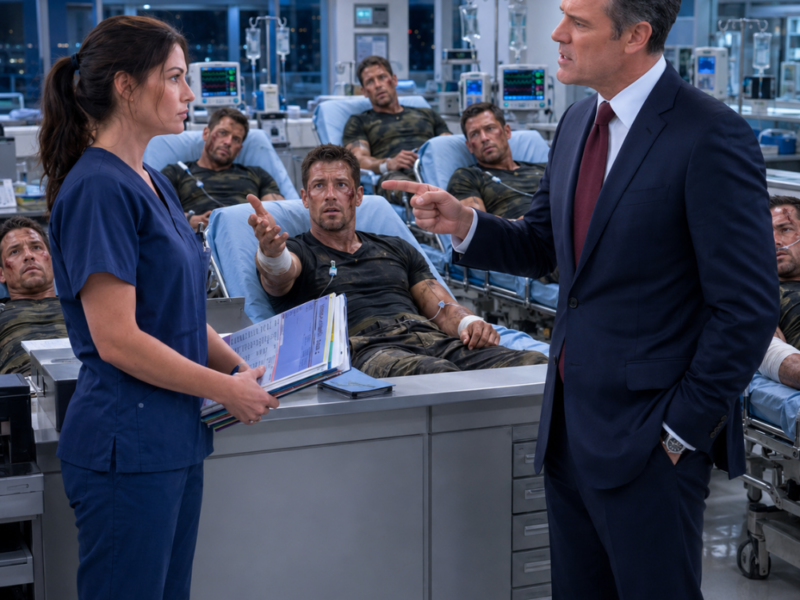
“She Was Just The Night Shift Nurse — Until Six Dying Navy SEALs Called Her By Name”
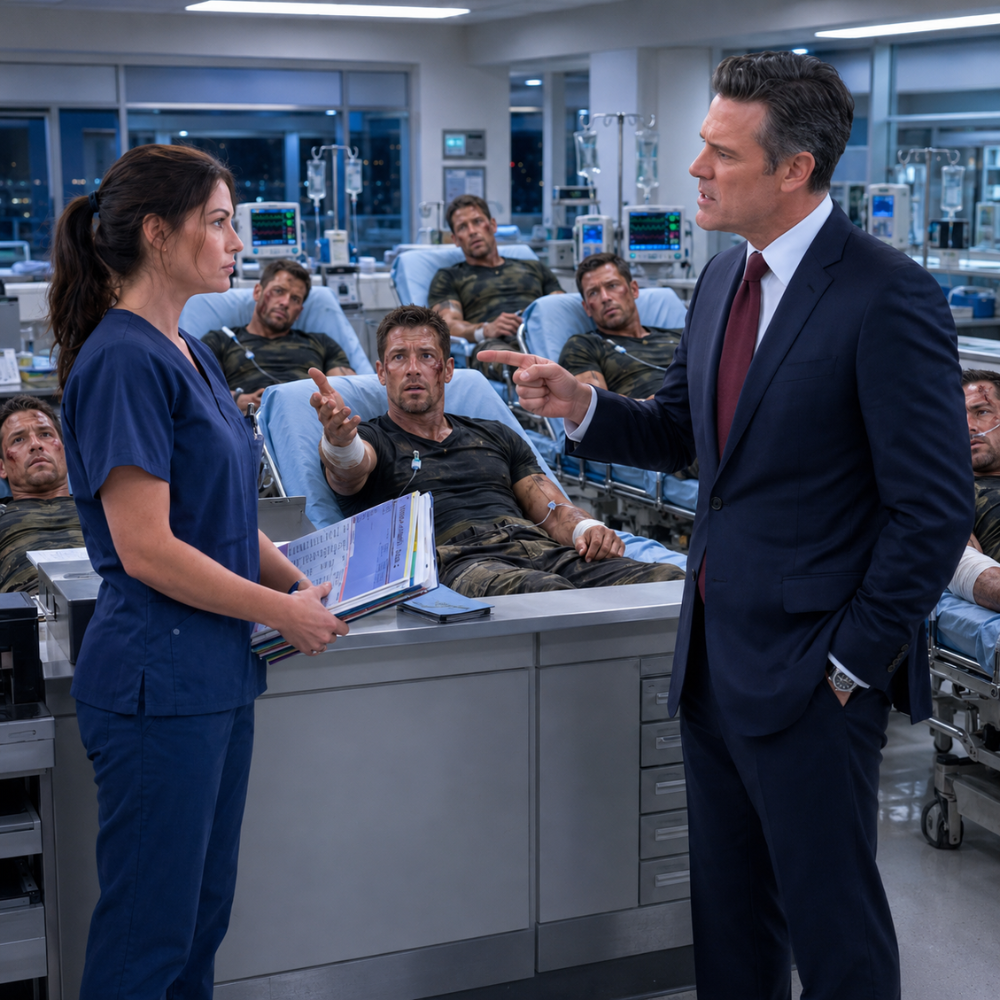
She Was Just the Night-Shift Nurse—Until Six Navy SEALs Called Her by Name
The first monitor started screaming before the ambulance-bay doors had fully opened.
Elena Cross was standing at the medication counter with a paper cup of coffee she had already reheated twice when the trauma radio cracked overhead.
“Six incoming. Multiple penetrating injuries. Special operations personnel. Medevac diverted. ETA three minutes.”
The emergency department changed shape around her.
It always did when a real emergency came through.
Casual conversations stopped. Chairs scraped. Phones rang. Rubber soles squeaked across the polished floor. A respiratory therapist abandoned his vending-machine crackers. Two nurses hurried toward the supply room. Dr. Nathan Mercer, the emergency physician covering the overnight shift, stared at the trauma board as if another doctor might suddenly materialize beside his name.
No one did.
Their regional medical center sat twelve miles outside a coastal military town in North Carolina, close enough to hear training aircraft on clear mornings and far enough from the major teaching hospitals that most complicated cases were normally flown somewhere else.
Normally.
That night, a storm had closed one route, an accident had overwhelmed the military medical center closer to the base, and the nearest available Level I trauma center had reported a diversion delay.
So six critically injured men were coming to them.
Dr. Mercer looked at the charge nurse.
“Where’s Lang?”
“Still upstairs.”
Dr. Alan Lang, the hospital’s only trauma surgeon in the building, was operating on a motorist brought in after a highway collision less than an hour earlier.
“Can he come down?”
The charge nurse gave him the kind of look medical professionals used when there was no point pretending.
“He’s scrubbed in.”
Mercer rubbed the bridge of his nose.
“We have three trauma rooms.”
“Four if we clear procedure two.”
“We have six patients.”
“I can count, Nathan.”
Across the station, Elena put down her coffee.
Nobody noticed.
That was something she had learned to live with.
She had been working nights there for almost three years, long enough to become part of the background architecture of the place. Elena was the nurse who appeared at 6:42 every evening with her dark hair pulled into a practical knot, a canvas lunch bag in one hand, and a stainless-steel water bottle in the other.
She never fought for the interesting cases.
She rarely joined gossip at the desk.
She knew which elderly patients needed an extra blanket before they asked, which paramedic was allergic to latex, which surgeon preferred a size seven glove even though the supply cabinet insisted he wore seven-and-a-half.
She remembered the names of patients’ children.
She wrote down medication changes twice.
She carried pens that worked.
People appreciated those things without necessarily appreciating her.
There was a difference.
In hospitals, as in most workplaces, reputations formed quickly and hardened quietly.
Dr. Mercer was clever but nervous under unfamiliar pressure.
Nurse Claire Donovan could start an IV in almost anyone.
Respiratory therapist Jamal Brooks could make frightened children laugh while fitting an oxygen mask.
Dr. Lang was technically excellent and aware of it.
And Elena?
Elena was dependable.
That was the word people used.
Dependable.
Not brilliant.
Not formidable.
Not the person you would want running a six-patient mass-casualty event.
Just dependable.
Three months earlier, during a slow Tuesday shift, Elena had corrected a junior resident who nearly ordered a medication that would have interacted badly with an elderly patient’s blood thinner.
The correction had been quiet.
The resident had been embarrassed anyway.
Later, in the break room, someone had asked Elena how she had caught it so quickly.
“Old habit,” she said.
“What kind of habit?”
“I used to work trauma.”
Dr. Lang, pouring coffee at the sink, glanced over.
“Where?”
“Overseas.”
“With the military?”
“Attached to a forward surgical team.”
Lang had smiled.
Not cruelly.
That somehow made it worse.
“Sure,” he said. “And I used to play quarterback for Navy.”
A couple of people laughed because doctors laughed when surgeons made jokes.
Elena had smiled too.
Then she returned to the emergency department and never mentioned it again.
Now the medevac radio crackled.
“Two minutes.”
Elena stepped toward the trauma bays.
“Claire, procedure two needs to become trauma four. Move anything nonessential into the hall.”
Claire turned.
“Elena?”
“Jamal, we need oxygen in every room, two backup tanks, and another suction setup.”
Jamal was already moving.
“Got it.”
Elena pointed toward a newer nurse named Molly Reed.
“Call blood bank. Tell them we need uncrossmatched O-negative ready now, and tell them this is not a drill.”
Molly stared at her.
“Shouldn’t Dr. Mercer—”
“Call them.”
Something in Elena’s voice settled the question.
Not volume.
Certainty.
Molly picked up the phone.
Elena turned to the charge nurse.
“Who’s available from anesthesia?”
“Dr. Patel’s downstairs.”
“Get him here.”
Dr. Mercer approached.
“Elena, what are you doing?”
“Preparing.”
“I know, but I need everybody working from the same plan.”
“So give us one.”
For half a second, nobody spoke.
Elena had not said it disrespectfully.
She had simply said the thing that was true.
Mercer looked toward the ambulance doors.
The sirens were audible now.
He swallowed.
“Okay. We stabilize and triage. Most critical first.”
Elena nodded.
“Good. Put one nurse and one tech on each incoming patient. Nobody leaves their assigned stretcher unless reassigned. Label them one through six immediately. We don’t have time for names.”
Mercer frowned.
“You’re assigning teams?”
“You need me to stop?”
Another second passed.
“No.”
“Then I’m assigning teams.”
The first set of doors burst open.
Cold rain blew across the threshold.
The first stretcher came through with two military medics running beside it.
The man on the stretcher was young.
That was the first thing Elena noticed.
He might have been thirty. Maybe younger.
Most severely injured people looked younger when unconscious. Their faces relaxed into something close to childhood.
His tactical clothing had been cut open by the medics. A pressure dressing covered one side of his upper chest. His skin had the grayish cast Elena knew too well.
“Thirty-one-year-old male,” the medic said rapidly. “Penetrating trauma left chest, worsening respiratory status, blood pressure dropping during flight—”
Elena put two fingers against the patient’s neck.
Weak pulse.
Fast.
His breathing was asymmetrical.
“Room one.”
The stretcher turned.
The second arrived before the first disappeared.
Then the third.
Then the fourth.
Suddenly the hallway was full of wet boots, flight suits, blood-stained gauze, equipment cases, and voices speaking too quickly.
One patient was conscious and trying to sit up.
Another had a badly injured leg stabilized in a field splint.
A third kept asking for someone named Ryan.
A medic shouted, “Ryan’s behind us.”
Nobody had time to tell him that reassurance was not a clinical intervention.
Elena moved from stretcher to stretcher, touching shoulders, checking pulses, scanning dressings.
“Patient two, room three.”
“Patient three, procedure two.”
“Patient four stays here for thirty seconds. Claire, with me.”
Dr. Mercer looked at her.
“Why is four staying?”
“Because one is deteriorating faster.”
“How do you know?”
“Listen to him.”
Mercer listened.
Patient one was barely moving air on his injured side.
Elena was already beside him.
“Pressure?”
“Seventy-eight over forty-six.”
“Sat eighty-two.”
“Elena,” Mercer said, “we need imaging.”
“No time.”
She reached for the prepared equipment.
Mercer watched her hands.
“What are you—”
“His chest pressure is building. We relieve it now or imaging becomes irrelevant.”
The room went strangely quiet despite all the alarms.
There are moments in medicine when knowledge stops being academic and becomes physical.
A person either recognizes the moment or does not.
Elena did.
She moved with the speed of someone who had performed the procedure before, not once in training, but often enough that her hands seemed to remember ahead of her conscious thought.
Mercer hesitated.
“Are you credentialed for—”
Elena looked at him.
“Nathan.”
That was all.
One word.
His first name.
A reminder that the patient did not have time for professional insecurity.
“Do it,” Mercer said.
Elena did.
Within seconds, the man’s breathing changed.
The numbers on the monitor began climbing.
Eighty-four.
Eighty-eight.
Ninety-one.
Jamal looked at the screen.
“Well, okay then.”
No one laughed.
Another nurse appeared in the doorway.
“Elena, patient three’s pressure is falling.”
She was already moving.
For the next twenty minutes, the emergency department existed outside ordinary time.
People later disagreed about exactly what happened first.
Claire remembered Elena ordering warm fluids.
Jamal remembered Elena asking for a second suction machine before anyone realized the first was malfunctioning.
Molly remembered Elena looking at patient five and asking, “What’s his abdomen doing?” seconds before his blood pressure crashed.
Dr. Mercer remembered that the first time he stopped feeling afraid was when he started doing exactly what Elena told him to do.
She never announced herself as leader.
She simply became the center around which everyone else organized.
“Two units here.”
“Hold pressure there.”
“Not that line. The other one.”
“Jamal, airway in room three.”
“Claire, stay with five.”
“Molly, look at me.”
Molly’s eyes lifted.
“You’re doing fine. Now repeat his pressure.”
“Eighty-six over fifty-two.”
“Good. Tell me when systolic drops below eighty.”
“What if—”
“You tell me. I’ll handle what comes after.”
Molly nodded.
That was Elena’s gift.
She made the next step seem possible.
Not the whole night.
Not whether the men would survive.
Just the next step.
During chaos, sometimes that was enough.
Patient four was the only one fully conscious.
His name, according to the temporary tag clipped near his shoulder, was Lieutenant Commander Matthew Hale.
He had dark hair, sand still embedded around one ear, and an injury beneath a compression dressing that the medics had stabilized well enough for the moment.
He watched Elena move between beds.
When she came back to check his pulse, his hand closed around her wrist.
His grip was surprisingly strong.
“Ma’am.”
“I’m here.”
His voice was thin.
“Ryan?”
“Which one is Ryan?”
“Tall. Red beard.”
Elena looked toward room three.
“I saw him come in.”
“That doesn’t answer me.”
“No.”
“Is he alive?”
“Yes.”
The man closed his eyes.
A moment later, he opened them again.
“What about Torres?”
“I don’t know yet.”
He swallowed.
Then his face changed.
For the first time, the officer disappeared and a frightened man took his place.
“Am I dying?”
Elena leaned closer so he would not have to struggle to hear.
“No.”
“You sure?”
“No one is sure of anything in this room.”
His eyes stayed on hers.
“That’s a terrible answer.”
“It’s the honest one.”
He almost smiled.
Then Elena said, “But you are here. You are talking to me. Your pressure is holding. So you keep doing your job, and I’ll keep doing mine.”
“What’s my job?”
“Stay with us.”
His fingers loosened around her wrist.
“Yes, ma’am.”
Elena moved away.
She did not know that years later Matthew Hale would still remember those exact words.
Stay with us.
Not fight.
Not be brave.
Not be a hero.
Stay.
There had been enough heroism already.
The fifth patient deteriorated eleven minutes later.
A nurse called Elena.
She crossed the room, checked the monitor, looked at the man’s face, then at the dressing covering his side.
“His pressure changed after transport?”
“Dropped twenty points.”
“Pulse?”
“One-thirty-eight.”
Elena placed a hand lightly against his abdomen.
Rigid.
“Call Mercer.”
“He’s in two.”
“Then call him louder.”
Dr. Mercer came running.
“What?”
“Internal bleeding.”
“How can you—”
“Look at him.”
Mercer did.
This time he did not argue.
“Ultrasound.”
The bedside scan confirmed what Elena suspected.
Mercer stared at the screen.
“He needs surgery.”
“So does patient three.”
“Lang is still upstairs.”
“Then call the OR and tell them we’re bringing one up the second he’s clear.”
“Nathan!”
Someone shouted from the next room.
Mercer looked at Elena.
She nodded toward the doorway.
“Go.”
“You’ve got this?”
“Yes.”
He went.
That exchange would have been unthinkable an hour earlier.
A physician asking Elena if she had the room.
Elena answering yes.
No one questioning either of them.
The night continued.
Rain hammered the ambulance-bay windows.
The cafeteria closed.
A janitor named Lewis, who had been mopping the administrative hallway, pushed his cart aside and quietly brought every blanket he could find.
The hospital administrator arrived wearing khaki pants and an old university sweatshirt, having been called from home. He started asking questions about capacity until the charge nurse told him, “Unless you can start an IV, stand somewhere else.”
He stood somewhere else.
At 1:17 a.m., Dr. Alan Lang came through the double doors from surgery.
He was still wearing his surgical cap.
“Where are they?”
Dr. Mercer pointed.
“Everywhere.”
Lang entered trauma one expecting disaster.
Instead he found patient one ventilated, pressure improving, chest stabilized, blood products running, and lab results already posted.
He moved to patient two.
Stabilized.
Patient three.
Prepared for immediate surgery.
Patient four.
Stable enough for imaging.
Patient five.
Likely abdominal bleed, ready for OR.
Patient six.
Multiple injuries but responding to treatment.
Lang turned slowly.
“Who organized this?”
Mercer looked through the glass toward Elena.
She was checking a medication label with Molly.
“Elena.”
Lang laughed once.
Not because anything was funny.
“What do you mean, Elena?”
“I mean Elena.”
“Cross?”
Mercer looked at him.
“How many Elenas work here?”
Lang stared.
Mercer lowered his voice.
“You should see her.”
“I am seeing her.”
“No. I mean you should have seen her.”
Lang did not respond.
A surgical tech appeared.
“OR two is ready.”
Lang switched instantly back to work.
“Which one first?”
“Patient five,” Elena said from behind him.
Lang turned.
For a second, the old hierarchy reappeared in his face.
The surgeon.
The nurse.
The question of who had authority.
Elena held his gaze.
“Patient five first. He’s temporarily responding to blood, but he’s bleeding internally. Patient three is more visually dramatic, but his pressure has stayed higher for eight minutes.”
Lang looked at the monitors.
Then the records.
Then back at Elena.
“How long has five been unstable?”
“Twenty-three minutes.”
“Response to transfusion?”
“Partial.”
“Urine output?”
“Minimal.”
Lang looked at Mercer.
“You agree?”
Mercer nodded.
“Yes.”
Lang pointed toward the hallway.
“Five goes first.”
The stretcher moved.
No one mentioned the joke about Navy football.
Not then.
Some humiliations do not need to be discussed while they are being corrected.
By two in the morning, the worst of the immediate crisis had passed.
Not resolved.
Passed.
There was a difference.
Two men were in surgery.
One had been transferred by ground critical care to a larger medical center after the weather improved.
Three remained under close observation.
None had died.
That fact felt too fragile to celebrate.
Elena stood at the sink washing her hands.
The water ran pink for several seconds before clearing.
She stared at it.
For most of the night, memory had remained where she kept it.
Behind a locked door.
Now, with the noise finally lowering, the lock slipped.
For one second, the emergency department disappeared.
She smelled diesel exhaust.
Burned canvas.
Dust.
She saw a canvas surgical tent shaking under distant concussions.
Someone shouting for more gauze.
A young medic asking her whether a twenty-year-old soldier was going to survive.
She had answered him then too.
Not tonight.
Not if I can help it.
Her hands stopped beneath the faucet.
“Elena?”
She looked up.
Claire stood beside her.
“You okay?”
“Fine.”
Claire glanced at Elena’s hands.
“You’ve been washing the same fingers for about a minute.”
Elena shut off the water.
“Then they’re extremely clean.”
Claire leaned against the counter.
For once, she did not smile.
“Where did you learn all that?”
Elena reached for paper towels.
“Tonight isn’t about me.”
“Maybe not.”
Claire lowered her voice.
“But I’ve worked with you three years. I didn’t know you could do half of what you just did.”
Elena dried her hands.
“You never asked.”
The words were gentle.
That made them land harder.
Claire looked away.
“No,” she admitted. “I guess I didn’t.”
Elena threw away the towel.
“Most people don’t.”
She returned to the trauma room.
Her past had taught her something civilian life had later confirmed: people loved biographies after extraordinary moments.
Before extraordinary moments, they generally preferred categories.
Nurse.
Woman.
Night shift.
Quiet.
Dependable.
Categories kept the world simple.
Elena had never expected anyone at Harbor County Regional to understand what had brought her there.
She was not sure she understood it herself.
Years earlier, she had been Elena Varela, the daughter of a high-school science teacher and a Coast Guard mechanic who believed every child should know how to change a tire, balance a checkbook, and cook eggs without burning them.
She grew up in a narrow ranch house outside Corpus Christi, Texas, where the air smelled of salt and hot asphalt and her mother kept hurricane supplies organized in blue plastic bins.
Elena had wanted to become a physician from the age of eleven.
Not because of some dramatic childhood illness.
Nothing that cinematic.
She simply liked the logic of medicine.
Bodies made sense to her.
Causes.
Effects.
Systems.
When her father’s truck would not start, he tested one thing after another until he found the failure.
Medicine felt similar.
Except the machines were alive.
She earned scholarships, entered an accelerated medical sciences program, and later joined a military-supported clinical training pathway that helped cover tuition in exchange for service.
Elena was twenty-six the first time she worked inside a field hospital overseas.
She had imagined medicine under pressure.
She had not imagined noise.
That was what she remembered most.
Generators.
Aircraft.
Radios.
Metal trays.
Boots.
People shouting numbers.
People praying.
The sound of Velcro being torn open.
Nothing in civilian hospitals sounded like Velcro in a combat surgical tent.
She learned quickly.
Everyone did.
They had to.
Her supervisors discovered that Elena did not panic.
That became valuable.
She learned damage-control principles, emergency stabilization, vascular procedures, airway management, blood replacement, triage decisions, and the difficult discipline of understanding that saving one patient sometimes meant temporarily turning away from another.
She worked under surgeons who could perform miracles and medics who knew more practical trauma medicine than many residents with twice their education.
For two years she saw enough human vulnerability to permanently change how she thought about time.
Then a roadside blast killed three members of a convoy she had treated days earlier for minor injuries.
One had shown Elena a photograph of his newborn daughter.
Another had borrowed her pen and forgotten to return it.
The third had complained about instant coffee.
Their deaths were not unique.
That was part of what broke something in her.
They became three more names among too many names.
Elena completed her deployment.
She returned.
She entered surgical residency.
She lasted eleven months.
Technically, she excelled.
Emotionally, she disappeared.
She slept three hours at a time.
She avoided loud restaurants.
She became angry at surgeons who treated routine complications like personal insults.
One morning, after a senior physician screamed at a nurse for bringing the wrong brand of dressing into an operating room, Elena walked into a stairwell and could not make herself go back.
She sat on the concrete step for forty-seven minutes.
Then she resigned.
People tried to talk her out of it.
Program directors.
Mentors.
Her mother.
Her fiancé at the time.
Especially her fiancé.
He could not understand why someone would walk away from prestige after sacrificing so much to reach it.
“What are you going to do instead?” he asked.
“I don’t know.”
“That’s not a plan.”
“I know.”
“Do you want to teach?”
“No.”
“Research?”
“No.”
“You’re throwing away your career.”
Elena looked at him across the kitchen table in their rented apartment.
“No. I’m trying not to throw away myself.”
Their relationship ended six months later.
There was no dramatic betrayal.
No affair.
No screaming.
They simply became two people headed toward lives that could no longer coexist.
Elena eventually retrained and moved into advanced trauma nursing.
She wanted patient care without ambition attached to every room.
She wanted shifts that ended.
She wanted to help without needing to become important.
When a job opened at Harbor County Regional, she took it.
The hospital was small enough that everyone knew which vending machine stole dollar bills.
The town was ordinary.
There were Friday-night football games, grocery-store conversations that lasted too long, church signs with changing Bible verses, pickup trucks filling the diner parking lot before sunrise, and military families who learned not to ask too many questions about why training schedules suddenly changed.
Elena rented a two-bedroom townhouse near a cul-de-sac where children left bicycles in driveways and neighbors decorated aggressively for Christmas.
She bought herbs at the Saturday farmers market.
She called her mother every Sunday.
She worked nights.
And for three years, she became dependable.
She liked it that way.
Until six stretchers came through the doors.
At 3:08 a.m., patient four woke again.
Matthew Hale.
Elena was adjusting an IV line when his eyes opened.
“Still here?”
“You sound disappointed.”
He tried to smile.
“Checking whether you abandoned ship.”
“Wrong branch.”
His expression sharpened.
“You military?”
Elena paused.
“Used to be attached to military medicine.”
“I knew it.”
“You’re on enough medication to think everyone is military.”
“No.”
His eyes drifted closed again.
“You move like them.”
“Like who?”
“The people who already know what happens next.”
Elena did not answer.
Matthew opened his eyes.
“Ryan?”
“Still alive.”
“Torres?”
“In surgery.”
“Price?”
“Stable.”
His throat moved.
“Ben?”
“Transferred.”
“Cooper?”
“Also stable.”
Matthew breathed slowly.
“All six?”
“All six are alive.”
His eyes filled unexpectedly.
He turned his face toward the wall.
Elena gave him the dignity of pretending not to notice.
After several seconds, he said, “What’s your name?”
“Elena.”
“Last name?”
“Cross.”
“Like the symbol?”
“Exactly like the symbol.”
He nodded faintly.
“I’m going to remember that.”
“You should remember to breathe.”
“I can do both.”
“Good.”
She adjusted his blanket.
“Then start with breathing.”
The first family arrived before dawn.
Not because anyone had publicly announced what happened.
No official report appeared on television.
No local reporter stood outside the emergency entrance.
The hospital received instructions from military liaisons about confidentiality and security.
But emergencies created ripples.
A spouse got a phone call.
A commanding officer made another.
A government sedan appeared in the parking lot.
Then another.
At 4:25 a.m., a woman named Rebecca Hale walked through the emergency department doors wearing jeans, running shoes, and an old gray sweatshirt.
Her hair looked as though she had tied it back while running.
A hospital security officer walked beside her.
“I’m looking for Matthew Hale.”
Elena was at the desk.
She recognized the surname immediately.
“Are you his wife?”
Rebecca’s face tightened.
“Yes.”
“He’s stable.”
The woman stopped walking.
Not because the sentence frightened her.
Because it released something.
Her shoulders dropped.
Her eyes closed.
Then she covered her mouth.
“Stable?”
“Yes.”
“Can I see him?”
“Give us a minute.”
Rebecca reached across the counter and caught Elena’s hand.
“Is he awake?”
“On and off.”
“Did he say anything?”
Elena thought about the man asking for his teammates.
“He asked about his men.”
Rebecca made a sound halfway between a laugh and a sob.
“That sounds like Matt.”
Elena guided her to a chair.
“Sit down. I’ll come get you.”
Rebecca looked at Elena’s stained scrubs.
“You were with him?”
“Yes.”
“Since he arrived?”
“Yes.”
“Then thank you.”
Elena shook her head.
“You don’t need to—”
“I do.”
Rebecca held her gaze.
“You don’t know how long we’ve been waiting for somebody to tell us anything.”
Elena understood.
Waiting had its own violence.
She squeezed the woman’s hand once.
“I’ll get you as soon as I can.”
At 5:12, another family member arrived.
Then another.
By sunrise, a quiet cluster of relatives sat in the small family waiting room near the chapel.
The military liaison tried to maintain order and privacy.
Coffee appeared from somewhere.
So did grocery-store muffins.
Someone’s mother brought a cardigan even though nobody needed one.
A teenage son sat with his elbows on his knees, staring at the floor.
A father walked to the vending machine every fifteen minutes without buying anything.
Normal American life had been interrupted for these families in the ordinary ways.
A dishwasher still contained clean dishes at somebody’s house.
An alarm clock would go off in an empty bedroom.
A dog would be waiting near a back door.
Children would need explanations before school.
The enormous event had arrived inside small routines.
That was always how tragedy worked.
It entered houses through ordinary doors.
At six-thirty, Elena’s shift technically ended.
She did not leave.
Claire pointed toward the clock.
“You know you’re not getting overtime approved for half of this.”
Elena checked an IV.
“I know.”
“You’ve been here twelve hours.”
“I know.”
“Your coffee is probably legally classified as hazardous waste.”
“That I also know.”
Claire folded her arms.
“Go home.”
“After handoff.”
“You handed off twenty minutes ago.”
Elena looked toward the family room.
“Not everything.”
Claire followed her eyes.
“You don’t have to take care of everybody.”
“No.”
“But you’re going to.”
“For another ten minutes.”
Claire smiled.
“That means forty-five in Elena time.”
“Twenty.”
“Thirty.”
“Deal.”
Elena eventually left at 7:18.
Outside, the storm had passed.
The world looked indecently normal.
Sunlight reflected off puddles.
A delivery truck backed toward the hospital loading dock.
Someone in the parking lot argued over the phone about a dentist appointment.
Elena stood beside her twelve-year-old Honda Accord with one hand on the roof.
She had held herself together all night.
Then she sat in the driver’s seat and started shaking.
Not dramatically.
Her teeth did not chatter.
She did not cry.
Her hands simply trembled so badly she could not put the key into the ignition.
So she stopped trying.
She leaned back and breathed.
Five seconds in.
Five seconds out.
The method had been taught to soldiers, paramedics, firefighters, trauma survivors, and anyone whose body sometimes failed to realize danger had ended.
After several minutes, the shaking slowed.
Elena started the car.
She drove home past a Waffle House, a pharmacy, two gas stations, and an elementary school where crossing guards were already putting on reflective vests.
At home, she placed her keys in the ceramic bowl beside the door.
She fed her cat, Atticus.
She showered.
Then she sat on the edge of her bed wearing clean pajamas and stared at the wall.
The faces returned.
Not the men from that night.
Older faces.
A medic named Lewis.
A lieutenant named Harper.
A young Afghan interpreter who had spoken four languages and laughed whenever Elena mispronounced his name.
Memory did not respect chronology.
Atticus jumped onto the bed.
Elena rested a hand on his back.
“I know,” she whispered.
The cat purred.
She slept for three hours.
When she woke, her phone contained nineteen messages.
Most were from coworkers.
YOU WERE INSANE LAST NIGHT.
Where did THAT come from?
Dr. Mercer told administration you basically ran the MCI.
Claire had written:
Lang looks like somebody told him Santa isn’t real.
Elena smiled despite herself.
Then she saw a message from an unknown number.
This is Rebecca Hale. Matt asked me three times whether “Elena” was working tonight. I told him I’d try to find out. Also, he says you still owe him an answer about Navy.
Elena stared at the screen.
She did not reply immediately.
Recognition made her uncomfortable.
Not because she disliked gratitude.
Because gratitude could easily become mythology.
People liked to create a single hero when complicated systems worked.
Six men had not survived because of Elena alone.
They survived because combat medics controlled bleeding before transport.
Because pilots flew through terrible weather.
Because blood-bank technicians responded immediately.
Because Claire, Molly, Jamal, Mercer, Lang, Patel, surgical staff, lab staff, radiology staff, and dozens of other people did their jobs.
Elena knew what happened when stories simplified survival.
They became untrue.
She eventually typed:
I’ll be in tonight. And tell him Navy still isn’t getting an answer.
Rebecca replied with a laughing emoji.
When Elena arrived that evening, the emergency department fell silent.
Not completely.
A phone still rang.
A printer still spit out labels.
But conversations stopped.
Molly looked up first.
“There she is.”
Elena frowned.
“Who?”
“The person everybody has been talking about all day.”
“I was hoping you meant the pizza delivery guy.”
Jamal leaned back in his chair.
“We ordered pizza?”
“No.”
“Then I’m disappointed twice.”
Claire came around the desk.
“How’d you sleep?”
“Poorly.”
“Good. Means you’re human.”
Elena hung her bag beneath the station.
Dr. Mercer approached from the physician workroom.
“Elena.”
“Nathan.”
“I wanted to tell you something.”
Several nurses became very interested in paperwork.
Mercer noticed.
“Can we talk privately?”
Elena gestured toward an empty consultation room.
Inside, Mercer closed the door.
He looked exhausted.
“I almost froze last night.”
Elena said nothing.
“On the first patient.”
“I know.”
Mercer winced.
“You could pretend you didn’t notice.”
“You asked to talk privately, not dishonestly.”
He nodded.
“Fair.”
He sat down.
“I’ve treated major trauma before. But never six at once. Not like that.”
“You kept working.”
“Because you took over.”
“I helped organize.”
“You took over.”
Elena crossed her arms.
“If you’re worried I’m going to report that you lost control—”
“I’m not.”
He looked at her.
“I’m trying to thank you.”
That silenced her.
Mercer continued.
“I also owe you an apology.”
“For what?”
“For assuming I knew what you were capable of because I knew your job title.”
Elena looked toward the closed door.
“You’re not the only one.”
“I know.”
He gave a tired smile.
“I’m starting with the only apology I control.”
That was a good answer.
Elena respected good answers.
“Accepted.”
Mercer exhaled.
Then he said, “Administration wants to meet with you.”
“Why?”
“You know why.”
“No.”
He laughed.
“I forgot. You’re going to make them actually say it.”
“Yes.”
“They want to discuss what happened, your credentials, possible role changes.”
“I have a role.”
“They may think you should have a different one.”
Elena stood.
“Then they can ask.”
“You don’t want it?”
“I don’t know what it is.”
Mercer nodded.
“Another annoyingly reasonable answer.”
“I have several.”
When Elena entered Matthew Hale’s room later that evening, he was awake and sitting slightly elevated.
Rebecca was beside him reading messages from her phone.
Matthew saw Elena first.
“Cross.”
Rebecca looked up.
“You found her.”
“You make me sound missing,” Elena said.
Matthew pointed weakly.
“That woman refused to tell me whether she was Army.”
“I told him you had patient confidentiality.”
“That doesn’t even make sense.”
“It kept him busy for four minutes.”
Elena checked his monitor.
“Pain?”
“Manageable.”
“Nausea?”
“No.”
“Dizziness?”
“Only when people ask annoying medical questions.”
“Good. Your personality survived.”
Rebecca laughed.
Matthew watched Elena carefully.
“Torres came out of surgery.”
“I heard.”
“He’s stable.”
“Yes.”
“Ryan’s awake.”
“I know.”
“Price too.”
“Yes.”
He fell quiet.
Then he said, “I remember you telling me all six were alive.”
Elena looked at him.
“They were.”
“You understand what that means to me?”
“Yes.”
“No.”
His expression changed.
“I don’t think you do.”
Rebecca placed a hand over his.
Matthew looked down at their hands.
“I’ve spent twenty years learning that sometimes you don’t get everybody home.”
Elena felt the sentence somewhere beneath her ribs.
“I know.”
Matthew looked up sharply.
Not many civilians answered that statement correctly.
He studied her.
“You really do.”
Elena pulled the blanket higher over his leg.
“Yes.”
Matthew waited.
She did not elaborate.
Finally he said, “We asked about you.”
“We?”
“All of us who were awake enough to ask anything.”
Elena shook her head.
“You had excellent people caring for you.”
“I know.”
“But you asked for me.”
“Yes.”
“Why?”
Matthew looked almost offended.
“Because we remember who was there.”
That sentence stayed with Elena longer than she expected.
Over the next two weeks, the six men left Harbor County Regional in stages.
Not all walked out.
The original version of the story that later circulated around town exaggerated that part.
Reality was slower.
Recovery usually was.
One transferred to a rehabilitation hospital.
Another required additional surgery at a military medical center.
Two left using crutches.
Matthew walked with assistance.
Ryan Cooper, the red-bearded operator Matthew had asked about first, rolled toward the hospital exit in a wheelchair and insisted on standing for the final photograph with his family.
His physical therapist threatened him.
His wife threatened him more effectively.
He sat back down.
Before leaving, each man asked whether Elena was working.
One by one, they found her.
Ryan gave her a unit challenge coin.
She tried to refuse.
He closed her fingers around it.
“Don’t make this weird, ma’am.”
“I’m making it weird?”
“Yes.”
“You’re arguing with a nurse on your discharge day.”
“Exactly. So let me win one.”
She kept the coin.
Ben Torres, still pale after multiple surgeries, simply said, “Hale says you’re impossible to impress.”
“Hale talks too much.”
“He also says you saved his life.”
“Your medics saved your life before you reached my hospital.”
Torres nodded.
“Then you helped finish the job.”
That phrasing Elena could accept.
Helped finish the job.
Not hero.
Not miracle.
Work.
Price shook her hand.
Cooper hugged her despite hospital policy and despite the look on Elena’s face.
Matthew came last.
He wore civilian clothes and moved carefully.
Rebecca walked beside him carrying the plastic hospital bag that contained medication instructions, spare dressings, and the strange collection of items that accumulated around anyone hospitalized more than a few days.
Matthew stopped at the emergency department desk.
Everyone recognized him.
He looked healthier.
Still tired.
Still thinner than before.
But alive.
“Elena.”
She stepped around the station.
“You’re leaving.”
“That’s what they tell me.”
“You understand the discharge instructions?”
“My wife understands them aggressively.”
Rebecca raised the paperwork.
“I have a spreadsheet.”
Elena smiled.
“Then you’re doomed.”
Matthew reached into his jacket pocket.
He held out a small black box.
Elena stared at it.
“No.”
“You haven’t even seen it.”
“It’s military, sentimental, or expensive.”
“It is two of those three.”
“No.”
Rebecca sighed.
“I told you she’d say no.”
Matthew ignored her.
“Open it.”
“Matt.”
“Please.”
Elena looked at Rebecca.
Rebecca shrugged.
“He practiced this speech.”
“I did not.”
“You absolutely did.”
Matthew looked irritated.
Elena took the box.
Inside was a small metal insignia mounted on dark felt.
Nothing ornate.
Nothing with her name.
Just a piece of the team’s history.
Matthew said, “That belonged to a team kit we carried overseas. Not the mission where we got hit. Earlier.”
Elena looked at him.
“You shouldn’t give this away.”
“I’m not giving it away.”
“It is literally in my hand.”
“I’m placing it somewhere it belongs.”
Elena closed the box.
Matthew continued.
“You said staying alive was my job that night.”
“I remember.”
“You said you’d do yours.”
“Yes.”
“You did.”
The hallway seemed quieter.
Matthew’s voice lowered.
“We don’t forget people who hold the line for us.”
Elena looked at the box again.
Then she nodded.
“Thank you.”
Matthew smiled.
“There. Was that physically painful?”
“Almost.”
Rebecca laughed.
Before leaving, Matthew turned back.
“One more question.”
“No.”
“You don’t even know the question.”
“It’s the military question.”
He grinned.
“Army?”
Elena shook her head.
“Go home, Commander.”
He laughed all the way to the elevator.
The hospital changed after that night.
Not dramatically.
There was no movie-style scene where everyone suddenly applauded when Elena entered the room.
Real workplaces were not like that.
Change appeared in smaller ways.
A resident who once interrupted Elena began waiting until she finished speaking.
Molly started asking why Elena made certain clinical decisions instead of merely following them.
Mercer consulted her on complicated trauma cases.
The charge nurse requested funding for expanded mass-casualty training.
Administration reviewed its disaster-response protocols and discovered enough gaps to fill a binder.
Dr. Lang changed too.
His change took longer.
For several weeks, he became unusually formal around Elena.
“Good morning, Nurse Cross.”
“Thank you, Nurse Cross.”
“Excellent observation, Nurse Cross.”
Finally, one night Elena found him alone near the physician lockers.
“Alan.”
He looked up.
“Yes?”
“You can stop.”
“Stop what?”
“Talking to me like I’m the hospital inspector.”
His mouth tightened.
Then, unexpectedly, he laughed.
“I’m trying not to be an ass.”
“You’re overcorrecting.”
“I deserve that.”
Elena leaned against the counter.
Lang rubbed his jaw.
“I owe you an apology.”
“You do.”
He looked surprised.
“Most people say I don’t.”
“You’d know they were lying.”
That earned another laugh.
Then he grew serious.
“When you told us you’d worked forward trauma, I thought you were exaggerating.”
“I know.”
“I shouldn’t have.”
“No.”
“I made a joke.”
“Yes.”
“In front of other people.”
“Yes.”
“You’re going to make me say every part, aren’t you?”
“Yes.”
Lang nodded.
“Fair enough.”
He looked at the floor.
“I was arrogant.”
Elena waited.
“I assumed that because you were working nights as a staff nurse at a regional hospital, whatever experience you had couldn’t possibly be comparable to mine.”
Elena said nothing.
Lang looked up.
“I was wrong.”
“Yes.”
He smiled faintly.
“You really don’t waste apologies by making the other person feel better.”
“No.”
“Is there any chance you’ll let me finish with dignity?”
“Probably not.”
He laughed again.
Then Elena said, “Apology accepted.”
The humor left his face.
“Thank you.”
She turned to leave.
“Elena.”
She looked back.
Lang hesitated.
“Why are you here?”
“At the hospital?”
“You know what I mean.”
She did.
He continued.
“With your training. Your experience. Why this job?”
Elena considered telling him it was none of his business.
For three years, that had been her answer to the world.
But Lang had done something difficult.
He had apologized without defending himself.
That deserved something.
“I wanted a life where my value wasn’t measured by how close I could stand to catastrophe.”
Lang absorbed that.
“That sounds like there’s a story.”
“There is.”
“You going to tell me?”
“No.”
“Thought not.”
Elena smiled.
Then she left.
Months passed.
The story of the six men spread despite every effort to keep details private.
In a military town, stories rarely required public confirmation.
A spouse told a neighbor that a nurse had stabilized her husband.
A neighbor told someone at church.
A corpsman told a bartender.
A hospital employee told her sister, carefully leaving out names.
Within weeks, people had created several versions.
In one, Elena had been a battlefield surgeon.
In another, she was supposedly former special operations herself, which made Jamal laugh so hard he nearly dropped a box of respiratory tubing.
In the most ridiculous version, Elena had performed surgery on all six men alone during a power outage.
“Please tell me that one is true,” Jamal said.
“It is not.”
“You could let us have something.”
“We had electricity.”
“Fine. Ruin everything.”
Elena learned to ignore the stories.
What mattered was what changed inside the hospital.
Mass-casualty drills became mandatory.
Nurses received more emergency-procedure training.
The hospital established a formal partnership with the nearby military medical network.
Dr. Mercer helped create simulation exercises based on the failures and successes of that night.
And Elena, against her own instincts, accepted a new position.
Not management.
She refused that immediately.
The final role was called Clinical Trauma Preparedness Coordinator, a title Elena said sounded as though three committees had invented it.
She continued working several night shifts each month.
She also trained nurses, paramedics, residents, and technicians in high-pressure trauma response.
Her first class filled in six minutes.
Dr. Lang attended.
He sat in the front row.
Jamal took a photograph because nobody believed him.
Elena started each class the same way.
She wrote three words on a whiteboard.
SEE THE PATIENT.
Then she turned to the room.
“You will have machines.”
She pointed toward the monitors.
“You will have protocols.”
Then toward the binders.
“You will have physicians, nurses, respiratory therapists, surgeons, medics, lab technicians, and maybe, on the worst night of your career, fewer resources than you need.”
She paused.
“But the most important skill is seeing what is actually happening in front of you before your assumptions tell you what should be happening.”
A resident raised his hand.
“What assumptions?”
“Every assumption.”
“Like what?”
“That the loudest injury is the most dangerous.”
She wrote it down.
“That the highest-ranking person always has the best answer.”
Another line.
“That experience only counts if it came with the job title you respect.”
Another.
The room became quiet.
Elena capped the marker.
“Those assumptions waste time.”
She looked around.
“In trauma, time is tissue, blood, oxygen, brain function. Sometimes time is the difference between somebody going home and somebody’s family getting a phone call.”
She never described the six operators in detail.
She did not need to.
Most people knew.
A year after the incident, Elena received an invitation.
Heavy cream paper.
Embossed lettering.
The kind of invitation that looked expensive enough to make her suspicious.
It came from Matthew and Rebecca Hale.
BACKYARD DINNER. NO UNIFORMS. NO SPEECHES. YOU ARE REQUIRED TO ATTEND.
Elena called Rebecca.
“Required?”
“Yes.”
“That sounds legally questionable.”
“Matt said you respond well to direct orders.”
“Matt is mistaken.”
“He also said you’d say that.”
The dinner was held at the Hales’ house on a quiet street fifteen minutes from the coast.
It was not glamorous.
That surprised Elena.
She had unconsciously expected something dramatic from men whose jobs remained mostly unspoken.
Instead, Matthew lived in a two-story house with faded patio furniture, children’s sidewalk chalk near the garage, and a grill that leaned slightly to one side.
Cars filled the driveway.
People stood in the backyard holding paper plates.
Someone had brought macaroni salad in a plastic grocery-store container.
Someone else brought a sheet cake from Costco.
Elena stopped at the gate.
Rebecca spotted her.
“You came.”
“You threatened me.”
“I motivated you.”
Rebecca hugged her.
Elena was still getting used to hugs from people she had once met covered in hospital blankets.
In the yard, five familiar men turned.
For a moment, Elena did not recognize them.
Civilian clothes changed people.
So did recovery.
Ryan Cooper had gained weight back.
Ben Torres walked with a slight limp.
Price had a scar near his jaw that Elena did not remember.
Another man wore a baseball cap backward while chasing a toddler around a picnic table.
Then Matthew stepped forward.
“Elena Cross.”
“Matthew Hale.”
He spread his arms.
“Look what you did.”
Elena looked around.
Six men.
All alive.
Some carried scars.
Some moved differently.
One would eventually leave active service.
Another would spend years dealing with nerve damage.
Recovery had not magically erased the night.
But they were there.
A child screamed happily near the sprinkler.
Rebecca argued with someone about hamburger buns.
A dog stole a hot dog from a plate.
Ryan’s wife shouted his full name from across the patio because he had ignored a physical restriction.
Normal life.
Messy, noisy, unremarkable normal life.
Elena felt something tighten behind her eyes.
Matthew saw it.
He was kind enough not to mention it.
Instead he handed her a paper plate.
“You eat meat?”
“Yes.”
“Good. Cooper burned the vegetarian option.”
“It was zucchini,” Cooper shouted from the grill. “Zucchini is naturally disappointing.”
His wife yelled, “Stop blaming vegetables for your incompetence.”
People laughed.
Elena sat beneath a patio umbrella.
For the first hour, nobody mentioned the hospital.
That was the greatest kindness they could have offered.
They talked about school districts.
Home repairs.
Fishing.
A homeowner association dispute over a boat trailer.
One man complained that his daughter had joined competitive gymnastics, which appeared to require the financial planning of a small government.
Elena listened.
She laughed.
She saw who the men were outside stretchers and monitors.
That mattered.
Trauma professionals met people during the worst hours of their lives and then rarely saw the rest.
They saw the wreckage but not the rebuilding.
The operating room but not the birthday party.
The ambulance but not the grocery run.
The blood pressure but not the mortgage payment.
The family waiting room but not Thanksgiving.
That evening, Elena saw the rest.
Near sunset, Matthew sat beside her on the back steps.
Children chased fireflies across the lawn.
“You hate being thanked,” he said.
“I don’t hate it.”
“You’re deeply uncomfortable with it.”
“That’s different.”
“Why?”
Elena considered the question.
“Because gratitude simplifies things.”
“How?”
“You think I saved you.”
“You did.”
“No. Your medic saved you. The flight crew saved you. Mercer saved you. Claire saved you. The blood bank saved you. Lang saved you. You survived because dozens of things went right after a lot of things went wrong.”
Matthew looked toward the yard.
“That can all be true.”
Elena said nothing.
He continued.
“You know what people like me learn?”
“What?”
“The person who keeps saying they didn’t do it alone usually did more than they’ll admit.”
“That sounds convenient.”
“It is.”
He smiled.
Then his expression became serious.
“I remember that room.”
Elena looked at him.
“Not everything. Pieces.”
He touched his chest unconsciously.
“I remember thinking I wasn’t going to see Rebecca again.”
Across the yard, his wife was helping a child open a juice box.
“I remember Cooper screaming about Torres.”
Elena nodded.
“I remember the lights.”
His voice slowed.
“And I remember grabbing your wrist.”
Elena remembered too.
“You told me not that night.”
“Yes.”
“You said it like you were irritated death had interrupted your shift.”
Elena laughed softly.
“That was not my intention.”
“It worked.”
Matthew looked at her.
“You gave me something to believe for the next ten minutes.”
Elena watched the children.
“That’s sometimes part of the job.”
“Exactly.”
He stood.
“You keep calling it the job like that makes it smaller.”
“It keeps it honest.”
Matthew considered that.
“Maybe.”
He walked toward the yard, then turned.
“For what it’s worth, Elena, nobody here thinks you acted alone.”
He gestured toward the six men.
“But every man here remembers your face.”
Then he left her sitting beneath the porch light.
Years later, Elena would think about that evening more often than she thought about the night they arrived.
Not the alarms.
Not the emergency procedures.
The backyard.
The crooked grill.
The Costco cake.
Ryan Cooper being yelled at by his wife.
Matthew’s children running through wet grass.
Proof of survival was rarely dramatic.
Usually it looked like ordinary life continuing.
Elena remained at Harbor County Regional.
That surprised almost everyone.
Offers came.
Larger hospitals.
Military medical centers.
Universities seeking instructors with operational trauma experience.
A private trauma network offered her nearly twice her salary.
She declined.
Claire called her insane.
Jamal asked whether Elena understood basic economics.
Even Dr. Lang said, “You know loyalty is admirable until it becomes financially stupid.”
Elena considered the offers seriously.
Then she stayed.
Not because she feared change.
Because she had finally found the version of medicine she wanted.
The hospital changed around her without demanding that she become someone else.
She trained.
She treated patients.
She went home.
She planted tomatoes badly.
She forgot to pick up dry cleaning.
She argued with her mother about whether twenty dollars was too much to spend mailing homemade cookies overnight.
She dated occasionally.
She adopted another cat.
She became godmother to Claire’s daughter after insisting she had no idea what godmothers were actually expected to do.
“Mostly birthday presents,” Claire explained.
“I can handle that.”
“And moral guidance.”
“Find someone else.”
“You’re stuck.”
Normal life.
That was the reward Elena had once thought she needed to earn.
Eventually she understood that normal life was not the opposite of courage.
It was often what courage protected.
Three years after the six men arrived, a young nurse named Sophie Kim joined Harbor County Regional.
She was smart, quiet, and frequently overlooked by louder colleagues.
Elena noticed immediately.
One night after a complicated case, Sophie approached her.
“Can I ask you something?”
“Sure.”
“People say you used to be a military surgeon.”
Elena closed her eyes.
“That story refuses to die.”
“So it’s not true?”
“No.”
Sophie looked disappointed.
“I was attached to military trauma teams. I completed medical training and surgical residency work, but I was not some secret battlefield surgeon living undercover in a county hospital.”
“Oh.”
“Sorry to ruin the movie.”
Sophie smiled.
Then she hesitated.
“Why didn’t you tell people?”
“About my background?”
“Yes.”
Elena organized a stack of forms.
“Why should I have needed to?”
Sophie frowned.
“I guess so they’d respect you.”
Elena stopped.
There it was.
The heart of it.
Not merely her story.
A larger one.
She turned toward Sophie.
“You should never have to hand people a résumé before they decide whether your observations are worth hearing.”
Sophie looked uncertain.
“That sounds nice, but people don’t work like that.”
“No.”
Elena smiled.
“They often don’t.”
“So what do you do?”
“You become very good.”
“That’s it?”
“No.”
“You speak when something matters.”
Sophie nodded.
“Even if they don’t listen?”
“Especially then.”
“What if you’re wrong?”
“You learn.”
“And if you’re right?”
Elena glanced down the emergency department hallway.
“Then maybe somebody gets to go home.”
Six years after the original night, Matthew Hale returned to the hospital.
Not as a patient.
He walked through the emergency entrance wearing jeans and a navy polo shirt.
His hair had more gray.
Elena almost missed him because she was reading a chart.
He leaned against the desk.
“You people ever improve the coffee?”
She looked up.
“Commander.”
“Retired commander.”
Elena came around the desk.
“When?”
“Last month.”
“Congratulations.”
“Depends who you ask.”
He smiled.
“I was nearby.”
“You were twelve miles from your house.”
“That is nearby.”
“What do you want?”
“Still suspicious.”
“Always.”
He reached into his pocket and set something on the desk.
A photograph.
The six men stood together near a beach.
Older.
Smiling.
One held a little girl on his shoulders.
Another leaned on a cane.
Behind them, someone had written the date.
The sixth anniversary.
Elena stared at it.
Matthew said, “Cooper insisted.”
“Of course he did.”
“Torres wanted you to have one.”
Elena picked up the photograph.
“All six came?”
“All six.”
“For what?”
“Nothing.”
He shrugged.
“That was the point.”
Elena looked at him.
Matthew smiled.
“We had dinner.”
That was all.
Dinner.
Six men who once arrived as numbered stretchers had dinner together.
Elena ran a thumb lightly along the edge of the photograph.
Matthew watched her.
“You okay?”
“Yes.”
“Your face says otherwise.”
“My face is private.”
“I remember that line.”
“You should.”
He pushed away from the desk.
“Rebecca says hello.”
“Tell her hello.”
“She also says you still owe us dinner.”
“I attended the barbecue.”
“Six years ago.”
“It was long.”
“Elena.”
“Fine.”
Matthew grinned.
“See you Sunday.”
“I did not say Sunday.”
He walked backward toward the door.
“Six o’clock.”
“Matt.”
“Rebecca already made lasagna.”
“That is emotional manipulation.”
“Yes.”
The doors opened behind him.
“Sunday!”
Then he disappeared into the parking lot.
Elena stood holding the photograph.
Molly, now a charge nurse herself, walked by.
“Friend?”
Elena looked at the six men.
“Yes.”
It took her a moment to realize how true that had become.
There was never an official monument to what happened that rainy night.
No plaque appeared outside the trauma bay.
No newspaper ran Elena’s photograph.
Most residents of the town never learned the details.
The mission that had injured the men remained something people avoided discussing, partly because of security and partly because some stories belonged to the people who had lived them.
Elena preferred it that way.
But inside Harbor County Regional, the night became institutional memory.
New employees heard about the mass-casualty event during orientation.
They learned how limited staffing nearly became catastrophic.
They learned why blood-storage procedures had changed.
They learned why disaster drills mattered.
Sometimes someone would point toward Elena and whisper, “That’s her.”
Elena hated that.
She also understood that stories could teach what policies could not.
So when she eventually began telling the story herself during training, she told it differently.
She never started with six Navy SEALs.
She started with the first mistake.
“We had already decided what kind of hospital we were,” she told a room of new nurses one winter morning.
They looked confused.
Elena continued.
“We called ourselves a regional hospital. Which was accurate. But somewhere along the way, some of us translated that into, ‘Big emergencies happen somewhere else.’”
She walked slowly between the rows.
“That was the mistake.”
A nurse raised her hand.
“But you can’t prepare a small hospital for everything.”
“Correct.”
Elena nodded.
“You cannot prepare for everything.”
She stopped.
“But you can prepare people to think.”
That distinction became the foundation of her teaching.
Preparation was not memorizing every possible disaster.
It was learning how to remain useful when reality stopped matching the plan.
Years after the event, Dr. Mercer told her something she had never known.
They were sitting in the hospital cafeteria eating soup from paper bowls.
Mercer had become medical director of the emergency department.
He was calmer now.
Experience had done what experience usually did when paired with humility.
“Elena, do you remember that first patient?”
“Of course.”
“You told me exactly what needed to happen.”
“Yes.”
“I almost stopped you.”
Elena looked at him.
“I know.”
“No. I mean I almost physically stepped between you and the patient.”
That part she had not known.
“Why?”
“Liability.”
Elena stared.
Mercer laughed bitterly.
“I know.”
“You were thinking about liability?”
“For maybe two seconds.”
“In a crashing trauma patient?”
“I said I know.”
He stirred his soup.
“That night changed how I think about authority.”
Elena listened.
Mercer continued.
“I had more formal authority in that room than you.”
“Yes.”
“But you had more relevant experience.”
“Yes.”
“I had been taught those things were usually the same.”
Elena took another spoonful of soup.
“They often aren’t.”
“I know that now.”
Mercer looked at her.
“What would you have done if I’d told you to stop?”
Elena did not answer immediately.
“What do you think?”
Mercer smiled.
“I think you would have ignored me.”
“I would have explained once.”
“And then ignored me.”
“Yes.”
They laughed.
Then Mercer said, “Good.”
The word surprised her.
He leaned back.
“Because I think about that sometimes.”
“The liability?”
“No.”
He looked toward the emergency department doors.
“The families.”
Elena understood.
There are decisions that become philosophical only after the emergency is over.
During the emergency, someone either acts or does not.
The philosophy comes later.
Elena never told people to disregard authority casually.
Hospitals depended on structure.
Medicine depended on standards.
But she taught that authority without listening was dangerous.
Expertise without humility was dangerous.
And perhaps most dangerous of all was the habit of seeing another person only through the smallest title attached to them.
She had lived on both sides of that mistake.
There had been a time when Elena herself viewed night-shift nursing as a retreat.
Something smaller than the career she had abandoned.
She eventually recognized the arrogance in that belief too.
She had judged the job by the same hierarchy others later used to judge her.
Prestige above usefulness.
Title above skill.
Visibility above service.
The six men had changed that understanding.
Not because they proved Elena was secretly more important than people believed.
Because they showed her that importance had been the wrong measurement from the beginning.
There was work.
There was competence.
There was responsibility.
There were human beings who needed help.
Everything else was decoration.
Elena kept Matthew’s photograph in her locker for years.
She did not frame it.
That would have felt too ceremonial.
It stayed tucked beneath a magnet beside a grocery coupon and an old photograph of Claire’s daughter missing her front teeth.
Six men on a beach.
Six ordinary-looking lives.
Some mornings, after particularly difficult shifts, Elena looked at it before driving home.
Not every patient survived.
That was another truth stories often softened.
Elena lost people.
Children.
Parents.
Teenagers.
Old men whose spouses still packed medications into seven-day plastic organizers.
People whose families begged the medical team for another option when no option remained.
Skill did not defeat mortality.
Experience did not guarantee miracles.
The night of the six operators remained extraordinary partly because extraordinary outcomes were rare.
Elena understood that better than anyone.
When she lost a patient, she did not reassure herself by remembering people she had saved.
Medicine did not work like a moral bank account.
One life did not cancel another death.
Instead she asked herself the same questions after every difficult case.
Did we see clearly?
Did we act quickly?
Did we listen?
Did ego cost time?
Did fear cost time?
Did assumptions cost time?
Could we do better next time?
Sometimes the answers hurt.
They were still necessary.
One spring morning, almost a decade after the original incident, Elena finished a night shift and walked through the same ambulance doors where the six stretchers had entered.
The hospital looked different now.
A new trauma wing had been built.
The parking garage was larger.
A coffee shop occupied the corner where vending machines once stood.
Several of the nurses who had worked that night had moved away.
Molly was a nursing supervisor.
Jamal managed respiratory services.
Claire worked part-time after having two children.
Dr. Lang had retired and sent Elena an irritating Christmas card every year featuring photographs of himself fishing.
Dr. Mercer still worked too much.
The town had grown.
New subdivisions replaced stretches of pine forest.
The old diner near Route 17 closed and became a bank.
A grocery chain opened where an empty field used to be.
Military families came and went.
Children grew up.
Nothing stayed still.
Elena stood outside with her travel mug.
A helicopter passed far overhead.
For years, that sound had pulled something tight inside her.
Now it was simply a helicopter.
Not every memory disappeared.
Some became quieter.
That was enough.
Her phone buzzed.
A group text.
Matthew Hale.
Cooper.
Torres.
Price.
Ryan.
Ben.
Names that had once existed on temporary trauma labels.
Matthew had written:
Annual dinner Saturday. No excuses. Cooper is banned from vegetables.
Cooper replied:
This is slander.
Rebecca Hale:
It’s documented fact.
Elena smiled.
Then another message appeared.
Matthew:
Elena, you coming?
She typed:
Yes.
Three dots appeared immediately.
Matthew:
Screenshotting this before you change your mind.
Elena slipped the phone into her pocket.
She walked toward her car as the morning shift arrived.
A young nurse passed her near the employee entrance.
“Good night, Ms. Cross.”
“Good morning.”
The nurse laughed.
“You know what I mean.”
Elena did.
She reached her car.
Before opening the door, she looked back at the hospital.
Years earlier, six men had arrived during a storm and forced everyone in that building to discover something they should have already known.
Not that Elena Cross was extraordinary.
That was the version people preferred because it made the lesson easy.
The deeper truth was more uncomfortable.
She had already possessed the knowledge.
She had already carried the experience.
She had already survived the years that taught her how to remain calm while other people panicked.
None of it had appeared suddenly that night.
The people around her simply had not bothered to see it.
They saw a night nurse.
A quiet woman.
Someone who refilled medications, checked vitals, answered call lights, and worked the hours most physicians avoided.
Then the world became chaotic enough that titles stopped protecting anyone.
Competence became visible.
Listening became necessary.
And the person they had underestimated became the person they followed.
That lesson stayed with Elena because she knew how easily it could be forgotten.
People underestimated janitors who knew every room in a building.
Receptionists who could identify trouble from the tone of a stranger’s voice.
Older workers whose experience no longer arrived wrapped in ambition.
Young employees who spoke softly.
Mothers returning to work after years at home.
Veterans who rarely discussed what they had done.
Immigrants whose English caused strangers to confuse accent with intelligence.
Nurses standing beside physicians.
Technicians standing beside executives.
People whose titles sounded ordinary.
People whose lives were not.
Most of them would never receive a dramatic moment in which everyone suddenly realized their value.
That did not make the value less real.
Elena opened her car door.
Inside her bag, beneath a wallet, a pharmacy receipt, two granola bars, and a charger tangled around itself, was the small black box Matthew had given her years earlier.
She carried it without thinking about it most days.
That seemed fitting.
The things that mattered most were often carried quietly.
No medals.
No speeches.
No audience.
Just weight.
Memory.
Responsibility.
Elena sat behind the wheel.
Across the parking lot, the hospital doors opened for another ambulance.
A nurse stepped outside to meet it.
Someone Elena had trained.
Elena watched for a moment.
The nurse stood ready.
Calm.
Prepared.
Seen.
Then Elena started the engine and drove home.









