She Slept on the Cold Floor Every Night — The Mafia Boss Didn’t Know Until Morning

She slept on the cold floor every night — the mafia boss didn’t know until morning
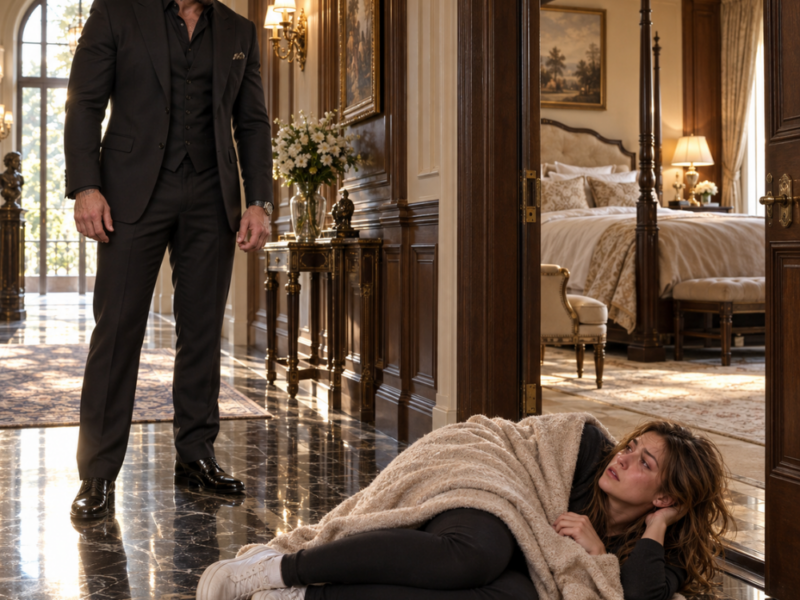
At 4:47 in the morning, Adrien Viscari walked past the east wing of his own house and saw a pair of white sneakers sticking out from behind a half-open bedroom door.
He stopped.
For several seconds, the rest of the hallway remained exactly as it had been.
Low amber sconces.
Polished stone floor.
Tall windows turned black by the November night.
The faint mechanical hum of heat moving through a house large enough to have three separate climate-control zones and no reasonable excuse for being cold.
Adrien had been awake for almost twenty-two hours.
He had spent the evening negotiating a dispute between two men who believed raising their voices made their positions stronger. By the time he drove the twenty minutes back from the industrial district, his jaw hurt from not saying what he wanted to say.
He almost kept walking.
Then he looked through the doorway.
Quinn Mercer was asleep on the floor.
Not fallen.
Not drunk.
Not sick.
Asleep.
She had folded a thin beige blanket beneath one shoulder and curled on her side against the wall beside the door. Her shoes remained tied. One hand gripped the edge of the blanket near her chin. Her face was angled toward the opening.
The room behind her was large enough for a small New York apartment.
There was a bed with a carved walnut headboard, a thick mattress, fresh white linens, two pillows, a velvet throw, a reading chair, and a wool rug imported from somewhere Adrien had never bothered learning because someone else had chosen it.
The bed had not been touched.
The comforter was perfectly flat.
Even in sleep, Quinn looked ready to leave.
Adrien remained in the hallway.
He did not enter.
That was instinct, though not the sort his reputation was built on.
Adrien Viscari was thirty-eight and had spent most of his adult life in rooms where hesitation could be interpreted as weakness. His family controlled legitimate logistics companies, commercial real estate, private security contracts, and several restaurants. There were also older businesses nobody placed on brochures.
His father had believed in spectacle.
Long cars.
Public arguments.
Men standing behind him in restaurants.
Adrien had watched that philosophy put his father in a hospital parking garage at forty-nine.
Afterward, Adrien changed the family style.
Quiet money.
Quiet meetings.
Quiet leverage.
If a problem could be handled by accountants instead of men in leather jackets, Adrien preferred accountants.
If a dispute could be buried in a contract, even better.
Federal investigators had looked at him more than once and found an expensive lawyer waiting every time.
Adrien did not think of himself as gentle.
Nobody else did either.
But he knew what fear looked like.
The woman on the floor was not afraid of his house.
She was afraid of sleep.
That distinction kept him standing there longer than he intended.
Quinn shifted.
Her shoulders tightened.
Her eyes remained closed.
A tiny movement traveled through her body, not quite a flinch, more like a system checking itself.
Listening.
Adrien looked at the open door.
Then the shoes.
Then the untouched bed.
He walked away without waking her.
The next morning, Quinn came back from breakfast carrying a stack of folded towels and found two maintenance workers inside her room.
She stopped so suddenly one towel slid from the pile.
The bed was gone.
Not stripped.
Gone.
Headboard.
Frame.
Mattress.
Everything.
In its place was a low platform bed pushed near the east wall, only several inches above the floor. It had a firm mattress and plain cotton sheets. Nothing decorative.
The door had also been modified.
A small magnetic catch prevented it from swinging fully closed unless someone deliberately pushed it into place.
A warm floor lamp had been added near the far wall.
The overhead light remained.
The room was still hers.
Just changed.
Quinn stared.
One of the maintenance men looked uncomfortable.
“Ms. Mercer?”
She said nothing.
He glanced toward his coworker.
“Mr. Viscari asked us to make a few adjustments.”
Quinn looked at the low bed.
“Why?”
The man clearly had not been given an answer.
“He said you’d know.”
That was worse.
Quinn placed the towels on the chair.
For one terrible second, she felt observed in a way she had spent years avoiding.
Someone knew.
Someone had seen her.
Someone had looked into a private weakness she had never explained.
Her first impulse was to pack.
That was how her body solved almost everything.
Leave before questions.
Leave before sympathy.
Leave before concern turned into control.
Her two duffel bags were inside the closet.
She could be downstairs in four minutes.
Out the service gate in seven.
She knew the bus schedule from the county road.
She knew where the nearest cheap motel was.
She knew how much cash she had in an envelope beneath the lining of her second bag.
Then she noticed something else.
No one had removed the thin blanket.
It lay folded exactly where she left it.
No one had gone through her bags.
No note asked her to explain.
No appointment had been made with the house manager.
No one stood in the doorway waiting for gratitude.
The maintenance worker picked up his toolbox.
“Anything else?”
Quinn looked at him.
“No.”
They left.
She stood alone.
Forty seconds passed.
She knew because she counted.
She had counted since childhood.
Seconds until a door closed.
Steps between exits.
Cars between one street corner and the next.
The number of rooms between wherever she slept and the nearest staircase.
She walked to the platform bed.
Sat.
The mattress compressed beneath her.
Low.
Close to the floor.
Her feet touched stone.
She could see the doorway clearly.
The lamp gave off enough light to distinguish the hallway without making the bedroom bright.
Something painful moved through her chest.
Not relief.
Relief implied fear had gone somewhere.
It hadn’t.
This was recognition.
Someone had seen a problem and changed the room instead of demanding that Quinn change herself.
She pressed the back of one hand against her mouth.
Stayed like that for a moment.
Then stood, picked up the towels, and went to work.
Quinn had arrived at the Viscari estate forty-two days earlier.
The property sat beyond the last dense subdivision outside the city, where streetlights became fewer and mailboxes farther apart.
Stone walls.
Iron gate.
Cameras.
Two long drives.
Old trees.
The house itself had originally belonged to a manufacturing family and looked more like an East Coast boarding school than the home of a man people described in newspapers as a “controversial businessman.”
Quinn had come because the pay was high and the questions were few.
At twenty-six, that combination mattered.
Her résumé was ordinary.
Commercial laundry in Pittsburgh.
Hotel housekeeping in Cleveland.
Private residential staff in Columbus.
Before that, restaurant work.
Warehouse work.
One nursing-home kitchen.
She had never stayed anywhere longer than three years.
Usually less than two.
Doreen Walsh, the estate manager, noticed the pattern while processing the application.
“You move a lot.”
Quinn looked at the paper.
“Better jobs.”
“Every eighteen months?”
“Sometimes rent goes up.”
Doreen had worked for the Viscaris eleven years.
She recognized a person who had already decided which questions she would answer.
“References are good.”
Quinn nodded.
“Can you start Tuesday?”
“Yes.”
That was the interview.
Her first day, Marco Diaz from the kitchen offered to carry one of her duffel bags upstairs.
Quinn refused.
“I’ve got it.”
“They’re heavy.”
“I’ve got it.”
Marco, twenty-two and incapable of respecting emotional distance when food was involved, held up both hands.
“Okay.”
Quinn carried both herself.
When Doreen showed her the bedroom, Quinn barely looked at the furniture.
She looked at the windows.
Then the door.
Then the hallway beyond Doreen’s shoulder.
Doreen noticed.
She said nothing.
Good household employees were difficult to find.
Quiet ones who arrived on time were almost sacred.
That first night, Quinn lay on the mattress for eleven minutes.
She tried.
The room was warm.
The sheets smelled faintly of detergent.
Nobody had locked the door.
She knew this.
Still, the mattress lifted her too far above the floor.
The closed bedroom felt wrong.
The silence felt wrong.
Her heartbeat grew louder.
She opened the door.
One inch.
Two.
More.
Then dragged the extra blanket onto the floor.
Shoes on.
Back to the wall.
Eyes toward the doorway.
She slept.
Not well.
Enough.
Every morning she made the bed carefully before leaving.
The habit had started years earlier in temporary housing because a made bed made a room look occupied correctly.
Nobody needed to know it had not been used.
For six weeks, nobody did.
Until Adrien.
After he changed the room, he said nothing about it for nine days.
Quinn began eating breakfast with the kitchen staff instead of taking coffee downstairs.
Marco treated this as a personal achievement.
On Monday he placed two pastries near her plate.
She ignored them.
A minute later she ate one.
Marco smiled into his cereal.
On Tuesday there were three.
“Don’t.”
“What?”
“You know.”
“They’re leftovers.”
“They were not leftovers five minutes ago.”
“Future leftovers.”
Quinn almost smiled.
Doreen saw.
She said nothing.
The estate operated on routine.
Morning deliveries.
Kitchen prep.
Laundry.
Security shift changes.
Grounds crews.
Office meetings in the west wing where domestic staff knew not to interrupt unless the building was physically burning.
Adrien rarely ate with employees.
He rarely ate with anybody.
Quinn saw him crossing halls.
On phone calls.
Leaving before dawn.
Returning after midnight.
He acknowledged staff without becoming familiar.
That suited her.
Then, one late afternoon, Quinn sat at the kitchen counter eating toast when Adrien walked in.
No entourage.
No jacket.
He poured coffee.
The machine had already brewed because Doreen believed beverages should exist before powerful men discovered thirst.
Adrien drank half the cup standing twelve feet away.
Quinn looked at her phone.
Then he said, “The room working?”
She looked up.
He did not smile.
The expression wasn’t unfriendly.
Simply neutral.
“Yes.”
He nodded.
No follow-up.
No:
Why were you on the floor?
No:
What happened to you?
No:
You should sleep normally.
Just:
The room working?
Quinn said, “Yes.”
Adrien finished his coffee.
“Good.”
He left.
Quinn stared at the door afterward.
Marco came in through the pantry carrying onions.
“What?”
“Nothing.”
“You look weird.”
“Thank you.”
“Was he mad?”
“No.”
“Then why do you look weird?”
Quinn picked up her toast.
“Because you’re asking questions.”
Marco nodded as if that made perfect sense.
Over the next month, Quinn noticed changes around the estate.
At first she thought she was imagining them.
The service-wing door that used to slam against its frame received a pneumatic closer.
Security guards stopped shouting shift confirmations across the courtyard and switched to radio acknowledgments.
The hallway lights near staff rooms were changed from white LED to warmer bulbs.
A metal laundry cart with a bad wheel stopped appearing because someone finally replaced it.
None of these changes was individually meaningful.
Together, they were.
Doreen noticed too.
One morning she stood beside Quinn folding napkins.
“Boss suddenly hates noise.”
Quinn’s hands paused.
“Maybe.”
“Marco thinks he has migraines.”
“Marco thinks the refrigerator light has emotions.”
“True.”
Doreen stacked napkins.
Then quietly:
“He notices more than people think.”
Quinn continued folding.
“So do you.”
Doreen smiled.
“I’ve lived too long.”
The first time Quinn told Adrien anything about her past was because of a fireplace.
Late January.
Cold enough that frost held to the outer windows after sunrise.
An older guard lit the fireplace in the main sitting room around five in the afternoon.
Nobody thought about it.
It had been lit on winter Fridays for years.
Quinn crossed the room carrying clean table linens.
She smelled smoke.
The stack left her hands.
One second she was walking.
The next she was on the stone floor beside the sofa.
Not screaming.
Not shaking.
Worse.
Her lungs had stopped cooperating.
She pressed both palms against the floor.
Cold.
Real.
Stone.
Present.
But the room was gone.
The smoke belonged somewhere else.
A corridor.
Heat behind a door.
Children crying.
A metal sound.
Dragging.
She tried to inhale.
Could not make the breath deep enough.
Footsteps approached.
Then stopped.
“Quinn.”
Adrien.
She saw only his shoes.
He did not come closer.
“Tell me if you need something.”
Quinn shook her head.
“Okay.”
He stayed.
No hands reaching.
No questions.
No calling three people to solve her.
Just presence.
Quinn concentrated on the floor.
Cold stone.
Her palm.
One breath.
Then another.
It took four minutes.
She knew.
When she finally looked up, Adrien was sitting on the floor on the opposite side of the sofa.
His back rested against it.
One knee raised.
He looked oddly normal there.
The man who owned the estate sitting on the floor because a housekeeper could not breathe.
“The smoke,” Quinn said.
Adrien nodded.
“From when you were young?”
She looked away.
Did not confirm.
Did not deny.
Adrien stood.
“The fireplace won’t be lit again.”
“You don’t have to—”
“I know.”
He left.
Within five minutes, the fire was extinguished.
No announcement.
No employee discussion.
Marco complained that the house was “losing ambiance.”
Doreen told him to find ambiance in the soup.
Quinn said nothing.
That night, she slept on the platform bed.
Shoes still on.
Door open.
But for the first time in years, she woke before dawn and realized she had turned her back to the exit.
The change lasted only seconds.
Still, she remembered it.
Adrien found the Ashcroft Children’s Home file three weeks later.
Not because he was investigating Quinn.
That was what he told himself at first.
His legal team was reviewing a distressed commercial parcel north of the city as part of a real-estate acquisition.
The land had been vacant for more than twenty years.
Fire damage.
Complicated title.
Old insurance litigation.
Potential environmental problems.
Routine reasons to avoid buying something.
Adrien almost dismissed the property after the first summary.
Then one line caught his attention.
Former site of Ashcroft Children’s Home. Closed following fatal 2005 fire.
He read on.
Forty-one children and three employees died.
One unidentified female child, approximately eight years old, survived after being found outside the building.
State records listed the girl under a provisional emergency-services identity until permanent documentation could be established.
Quinn Mercer.
Adrien stopped reading.
He went back.
Same name.
Same approximate age.
The report said the girl had been found in wet grass shortly before dawn with smoke exposure and minor injuries.
No known relatives.
No facility records survived.
Adrien stared at the page.
The doorway.
The shoes.
The floor.
Smoke.
He should have stopped there.
The file belonged to Quinn.
Not him.
He knew that.
Then he opened the next document.
The fire had officially been ruled electrical.
But archived litigation from the insurance dispute referenced an “early suppression concern.”
Adrien asked his attorney what that meant.
The attorney did not know.
Four days later, the answer became much worse.
The original fire investigation had multiple drafts.
An intermediate report noted evidence inconsistent with a single electrical source and recommended further examination of three separate areas.
That recommendation disappeared from the final report.
Why?
No clear answer.
One investigator later took a consulting position connected to the nonprofit umbrella organization that funded Ashcroft.
Another retired.
The nonprofit itself dissolved within two years.
Adrien hired a retired federal investigator named Ellen Grant to conduct lawful archival research.
Public filings.
Court records.
Old licensing reports.
State archives.
Nothing stolen.
Nothing hacked.
Ellen worked through channels Adrien’s reputation usually ignored because legal records created cleaner leverage than secrets.
Within a week, she found references to missing transfer documentation involving children who supposedly left Ashcroft for other programs.
The receiving facilities sometimes had no record of them.
Some facilities barely existed.
Payments moved through several philanthropic entities.
The name appearing repeatedly in old donor lists was Halverson.
William Halverson.
Industrial heir.
Philanthropist.
Chairman of a foundation whose annual reports were filled with photographs of children, scholarships, hospital wings, and ribbon cuttings.
Adrien knew the name.
Everybody did.
Halverson sat on boards.
His foundation funded university programs.
He had an auditorium named after his father.
Adrien had once attended a charity dinner where Halverson spoke for seventeen minutes about civic duty.
Ellen warned him.
“You are looking at fragments.”
“I know.”
“Fragments are not proof.”
“I know.”
“You don’t sound like you know.”
Adrien leaned back.
“What do you want me to do?”
“Nothing stupid.”
“I pay lawyers specifically to prevent that.”
Ellen did not smile.
“Talk to Quinn.”
He looked toward the window.
“That is the part I haven’t figured out.”
“You figured out her childhood without asking her.”
“I found a property.”
“You kept going.”
“Yes.”
“Then tell her.”
He intended to.
That night, four dark SUVs appeared beyond the estate’s east gate.
The plates looked federal.
Milo Serrano, Adrien’s head of security, called at 1:38 a.m.
“Come downstairs.”
Adrien entered the security office.
Milo pulled up camera feeds.
“Four vehicles.”
“Who?”
“Don’t know.”
“Federal?”
“No.”
“The plates?”
“Appear federal.”
Adrien looked at him.
Milo turned another screen.
One man near the rear vehicle had been identified by facial comparison against internal security files.
Former private contractor connected to a Chicago organization Adrien had dealt with years earlier.
Another worked for a security company that held contracts with Halverson Foundation properties.
Adrien felt cold.
“Police?”
“Already contacted county sheriff through counsel.”
“Response?”
“Units dispatched.”
Milo paused.
“But whoever is outside is not acting like they expect a patrol car to matter.”
Adrien looked toward the east wing.
“How did they know?”
“We don’t know.”
The estate had security.
Walls.
Cameras.
Men who took threats seriously.
For years, Adrien believed those things made it safe.
Now he thought about a woman who slept beside her door because she understood safety differently.
He took the stairs two at a time.
Quinn’s door was half open.
He knocked once.
“Quinn.”
No response.
He knocked again.
“Get up.”
The door opened.
Quinn was already dressed.
Shoes laced.
Two duffel bags packed beside the wall.
Adrien looked at them.
She looked at him.
Neither spoke about it.
Finally she asked:
“How long?”
He almost asked what she meant.
Then understood.
“Not enough.”
She lifted both bags.
“Where?”
“Service side.”
She followed.
No panic.
No confusion.
Downstairs, Doreen was moving staff into the reinforced interior area under the estate’s emergency plan.
Marco stood in the kitchen holding a backpack and looking terrified.
He saw Quinn.
“You okay?”
“Yes.”
“You’re leaving?”
“For now.”
“Come back.”
She looked at him.
Something in his face made the words different from every other request she had heard to stay somewhere.
No demand.
Just hope.
“I’ll try.”
Milo met Adrien near the service stairs.
“Sheriff units are five minutes out.”
“Good.”
“West service road clear.”
“Vehicle?”
“Caruso.”
Adrien turned to Quinn.
“You stay beside me.”
She looked at him.
“If something happens to you?”
“You keep moving.”
“No.”
He stopped.
“That isn’t—”
“I understood you.”
Her voice stayed calm.
“I’m saying no.”
There was no time to argue.
Adrien felt a strange flicker of frustration and respect.
“Fine.”
They moved.
The estate had an old service tunnel built decades earlier for utilities and deliveries. It ran beneath the west retaining wall and ended near a maintenance easement.
The plan was not some criminal escape route.
It existed because rich people built unnecessary infrastructure.
Tonight, it mattered.
Milo went first.
Adrien.
Quinn.
Two security employees.
The tunnel smelled of damp concrete.
Work lights spaced along the wall left long sections dark between them.
Quinn counted automatically.
Nine lights.
Thirteen steps average between bright sections.
A drainage hatch twenty yards behind them.
She had noticed it her first week.
Of course she had.
At the far end, Milo stopped.
“Movement outside.”
He checked a radio.
“County deputies at the main entrance.”
“Good.”
“Unknown vehicles repositioning.”
Adrien looked behind them.
Quinn stood with one hand on her duffel strap.
Head tilted.
Listening.
“There is another exit.”
Milo looked at her.
“Where?”
“Drainage grate.”
“Back there?”
“East side.”
“That puts us farther from Caruso.”
“Also outside their current line of sight.”
Milo looked at Adrien.
Quinn said, “When I first arrived, I walked the property perimeter during break.”
Adrien almost laughed from disbelief.
“You mapped my house.”
“I mapped exits.”
Difference.
He understood.
They went back.
The grate was old but functional.
Milo removed bolts with maintenance tools stored nearby.
Cold air entered.
They emerged outside the east curve of the wall, opposite the direction strangers would expect anyone to leave.
County sirens sounded near the main road.
The unknown SUVs began pulling away from the gate.
No shots.
No chase.
No cinematic battle.
Just an increasingly messy situation nobody wanted to explain to actual police.
Caruso waited in a utility van beyond the easement.
They got in.
Adrien called his attorney.
Milo called the sheriff’s investigator.
Quinn sat in back with both bags between her feet.
Only when the van reached the county road did her hands begin trembling.
Adrien saw.
He said nothing about it.
After several minutes, he placed his phone facedown.
“I need to tell you something.”
Quinn looked at him.
“That’s usually a terrible opening.”
“Yes.”
Adrien took a breath.
Then told her about Ashcroft.
The property.
The fire report.
The missing transfers.
Halverson.
He did not tell her what to remember.
He did not describe every disturbing possibility.
He kept to documents.
Quinn listened.
Her face flattened.
Not indifference.
Containment.
When he finished, she looked out the window.
“You went looking.”
“The property came up in a deal.”
“You went beyond the deal.”
“Yes.”
“Why?”
Adrien considered lying.
Or offering something respectable.
Concern.
Security.
Due diligence.
Instead:
“Because I saw you sleeping on the floor with your shoes on.”
Quinn looked at him.
“I wanted to understand what had taught somebody to do that.”
The van continued through dark county roads.
Quinn’s hands became still.
“You could have asked.”
“Yes.”
“Why didn’t you?”
“I thought you wouldn’t tell me.”
“You were probably right.”
“That doesn’t make it okay.”
She turned toward the window again.
Adrien accepted that.
After almost a minute, Quinn said, “I don’t remember everything.”
“You don’t have to tell me.”
“I know.”
She looked at the road.
“That’s why I’m telling you.”
Adrien waited.
“Smoke.”
A pause.
“A metal scraping sound.”
Another.
“Kids moving at night.”
Her voice lost expression.
“There was a basement.”
Adrien said nothing.
“We weren’t allowed down there.”
Quinn closed her eyes.
“I went once when I was six.”
“What did you see?”
“Filing cabinets.”
“Anything else?”
“A locked door.”
She opened her eyes.
“I heard people behind it.”
Adrien’s stomach tightened.
“I ran upstairs.”
Quinn looked at him.
“If they burned the place to destroy records, what happened to the basement?”
The question shifted everything.
The Ashcroft site was already under contract review.
Adrien’s lawyer controlled access through the seller’s broker.
They did not go there that night.
That would have been reckless and legally disastrous.
Instead, Adrien’s counsel contacted the state attorney general’s office through a retired prosecutor they trusted.
The original fire report and the newly surfaced transfer discrepancies were enough to justify a formal request for law-enforcement review.
Quinn gave an initial protected statement with her own attorney present.
Adrien made sure the attorney did not work for him.
That was Quinn’s condition.
“I choose the lawyer.”
“Yes.”
“I want every record copied to me.”
“Yes.”
“I decide what I say.”
“Yes.”
She stared at Adrien.
“You’re agreeing very quickly.”
“I learn.”
“Slowly.”
“Still counts.”
Quinn almost smiled.
The state investigation moved more slowly than she wanted.
Evidence needed legal custody.
The Ashcroft property needed a warrant and forensic safety inspection.
Structural engineers had to determine whether the basement could be entered safely.
The waiting was unbearable.
For twenty years, Quinn had lived with pieces.
Now there might be answers sitting behind chain-link fencing less than an hour away.
She spent three nights in a secure hotel booked under her own name, with police aware of the threats connected to the case.
Adrien stayed elsewhere.
He checked once each evening.
Text only.
Room okay?
First night:
Yes.
Second:
Yes.
Third:
Stop asking.
He replied:
Understood.
Then:
Tomorrow?
Quinn stared.
He was impossible.
She wrote:
You get one message.
He replied:
Efficient.
The search of Ashcroft happened six days later.
Quinn was not initially allowed on the property.
She waited in a state vehicle with her attorney while investigators entered the ruins.
The site looked smaller than memory.
That disturbed her.
Childhood fear had enlarged it.
The main structure was mostly collapsed.
Trees had grown through parts of the foundation.
Weeds filled what had once been a playground.
The basement bulkhead on the east side survived beneath debris.
Investigators cleared it.
Structural engineers approved entry.
Two hours passed.
Then three.
Quinn’s attorney, Lena Park, returned to the vehicle.
“They found files.”
Quinn’s hands went cold.
“What kind?”
“Ledgers.”
“What else?”
“Storage containers.”
Quinn stared.
“The room?”
“What room?”
“The one behind the chained door.”
Lena looked at her carefully.
“They found a smaller storage room.”
Quinn closed her eyes.
For a second she was six again.
Metal.
Darkness.
Sound behind a door.
Then twenty-six again.
Car seat.
Cold coffee.
Police tape.
Lena said, “You don’t have to go in.”
Quinn looked at the ruins.
“Yes.”
“Not today.”
“I need to see it.”
“Not today.”
Quinn turned.
Lena did not soften.
“The scene is active. You are a witness. Evidence collection is underway.”
Quinn hated her.
Then respected her.
“Fine.”
It was not fine.
But the rules protected the case.
So she waited.
The recovered material was worse than anyone expected and cleaner than prosecutors dared hope.
Paper records had survived because heavy institutional filing cabinets protected them from much of the fire and weather.
There were transfer ledgers.
Payment records.
Visitor logs.
Copies of licensing correspondence.
Some names were clear.
Others codes.
There were also sealed archival audio tapes.
The tapes required professional conservation.
Nothing was played immediately.
Everything was photographed in place, logged, bagged, and transferred through evidence custody.
Quinn watched from a distance.
No one rushed.
Nobody grabbed dramatic artifacts for television.
That mattered.
For the first time in her life, adults were taking what happened at Ashcroft seriously enough to become boring about it.
She found that strangely comforting.
The tapes were restored over the following weeks by a forensic audio laboratory working under state and federal investigators.
The first recording began with a woman’s voice.
Calm.
Professional.
“This is Diane Voss, licensed social worker…”
Quinn stopped breathing.
She knew the voice.
Not consciously.
Her body knew first.
Diane had visited Ashcroft in late 1999.
She conducted interviews with children without administrators present.
The tapes contained accounts of children being moved between facilities under irregular circumstances.
Financial references.
Descriptions of adult visitors.
Fear.
Things children did not have vocabulary to interpret fully.
The accounts were painful but not graphic.
They were enough.
Fourteen children.
Nine tapes.
Then tape seven.
Diane spoke alone after one interview.
She said she had copied documents.
She had concerns about senior donors and administrators.
She intended to provide evidence to state investigators and journalists.
She feared materials would disappear if she used only official channels.
Then:
“If you are hearing this because I was unable to finish what I started, preserve everything. Do not let the children become numbers in somebody else’s explanation.”
Quinn sat in a government interview room beside Lena Park.
Across from them, Assistant U.S. Attorney Cass Morrow listened.
The recording ended.
Nobody spoke.
Quinn asked, “What happened to her?”
Cass looked down at the file.
“Diane Voss disappeared six weeks after recording this.”
“Found?”
“No.”
“Ever?”
“No.”
Quinn looked through the small window in the interview-room door.
“Did she send copies?”
“We’re investigating.”
“Were they received?”
“We don’t know yet.”
Quinn pressed both hands against the table.
“William Halverson?”
Cass took her time.
“The visitor logs contain initials corresponding to him.”
“That isn’t what I asked.”
“No.”
Cass met her eyes.
“The financial records also appear to connect several entities historically associated with Halverson family philanthropy.”
“Appear?”
“Forensic accounting isn’t finished.”
Quinn almost laughed.
Adrien had taught her to appreciate careful language even when she hated it.
“So we wait.”
“Yes.”
“I’ve been waiting twenty years.”
Cass did not say she understood.
Good.
She couldn’t.
Instead:
“We’re going as fast as evidence allows.”
That answer Quinn could live with.
Adrien stayed out of the formal investigation.
Mostly.
He gave prosecutors everything his legal team had collected.
Signed affidavits explaining how the property research began.
Turned over security footage of the fake federal vehicles at his estate.
His attorneys objected to half of it.
Adrien ignored them.
Milo identified a problem.
One of Adrien’s own security employees, Reyes, had accessed confidential property research shortly before the threatening vehicles appeared.
Eight years with the organization.
Trusted.
No obvious reason.
Adrien did not confront him privately.
Instead, he brought counsel into the room.
That was a change.
Reyes eventually admitted someone connected to Halverson’s security contractors had pressured him for information about Adrien’s real-estate interest and Quinn’s presence at the estate.
They had leverage involving Reyes’s younger brother and a financial crime he had committed years earlier.
Reyes had convinced himself he was providing low-level information.
Employment dates.
Property searches.
Security schedules.
He did not believe anyone would hurt Quinn.
That sentence again.
Adrien heard it and thought about every catastrophe built on a person saying:
I didn’t think they would go that far.
Reyes sat in the conference room with his attorney.
“I’ve been with you eight years.”
Adrien looked at him.
“I know.”
“I never wanted this.”
“I know.”
“Does that matter?”
Adrien thought.
“Yes.”
Reyes looked surprised.
“It doesn’t erase anything.”
“No.”
“It matters because you’re a person, not a line item.”
Reyes lowered his eyes.
“What happens?”
“That depends on prosecutors.”
Not Adrien.
That distinction surprised everyone.
Milo confronted him afterward.
“Your father would’ve handled that differently.”
“Yes.”
“You getting soft?”
“No.”
Adrien looked toward the window.
“I’m getting tired of inheriting consequences.”
Reyes cooperated with investigators.
His information helped establish the source of the surveillance around Quinn.
He faced charges tied to improper disclosures and related conduct.
His cooperation mattered at sentencing later.
It did not erase responsibility.
Quinn asked about him once.
“Why?”
Adrien looked at her.
“I want to understand.”
“What?”
“What somebody trades another person’s safety for.”
Adrien told her about the brother.
Quinn became quiet.
Then:
“I wish monsters were more common.”
He frowned.
“What?”
“Monsters are easy.”
She looked out the window.
“Regular people with reasons are worse.”
Adrien understood.
Ashcroft had not operated for years because every person involved woke up wanting to harm children.
It survived because accountants processed payments.
Inspectors accepted explanations.
Employees feared jobs.
Officials trusted donors.
People decided one strange transfer was not their problem.
Then another.
Then another.
Systems became cruel by distributing responsibility until no one person felt responsible enough to stop them.
William Halverson entered the investigation publicly two months after the Ashcroft search.
His foundation denied wrongdoing.
Lawyers called the records incomplete.
Old.
Misinterpreted.
They emphasized Halverson’s decades of charitable work.
Scholarships.
Pediatric programs.
Residential care.
Food assistance.
Hospitals.
All real.
That complexity did not weaken the evidence.
It made the story more American and more difficult.
People wanted heroes and villains.
William Halverson had funded genuine good work.
He had also, according to emerging evidence, participated in a network that exploited vulnerable children and later helped suppress evidence of what happened.
Good deeds did not create immunity.
Bad deeds did not make every good deed imaginary.
Quinn learned to tolerate both facts.
What frightened investigators most was that Halverson’s current foundation still funded residential programs in six states.
Nothing yet proved those modern programs replicated Ashcroft.
That distinction was critical.
The programs had children living in them.
Workers.
Foster partnerships.
Therapists.
Schools.
A careless shutdown could harm people it was meant to protect.
Halverson’s attorneys used that reality aggressively.
“If you freeze everything, children lose housing.”
Cass Morrow responded with court-supervised receivership proposals rather than theatrical seizure.
Independent administrators could keep legitimate programs functioning while investigators examined finances and safety.
That became important later.
Quinn respected it.
Punishing Halverson was not the same as protecting children.
The system needed to do both.
The media learned about Ashcroft before prosecutors were ready.
A courthouse filing became public.
Then a reporter found Quinn’s provisional emergency identity.
By noon, she had fourteen interview requests.
By evening, thirty-two.
Her phone rang constantly.
She turned it off.
Adrien arrived at her temporary apartment with groceries.
Quinn stared at the bags.
“You cannot keep showing up with food.”
“I called.”
“You texted.”
“You said okay.”
“I said fine.”
“That’s okay in your language.”
“No.”
Adrien considered.
“Noted.”
He put the groceries on the counter.
Quinn looked at him.
“You read the coverage?”
“Some.”
“They’re calling me the Ashcroft Girl.”
“I saw.”
“I’m twenty-six.”
“I know.”
“I hate it.”
“I know.”
“They’re using that old state photograph.”
“I know.”
“Stop saying you know.”
Adrien waited.
Quinn sat.
The photograph showed an eight-year-old in a hospital gown.
Hair cut unevenly.
Eyes too wide.
No family beside her.
“That girl didn’t know her name.”
Adrien stayed standing.
“They gave her one.”
Quinn looked at him.
“Mercer came from the caseworker?”
“Yes.”
“My real last name is gone.”
“Yes.”
“What if Quinn isn’t my real first name either?”
Adrien thought carefully.
“Would that change who answered to it for eighteen years?”
She stared.
Then looked down.
“No.”
“Then maybe you can decide whether it stays.”
Quinn had spent a lifetime letting records define her because records were the only authority she trusted.
Now she realized she could choose something too.
“I’m keeping it.”
Adrien nodded.
“Good.”
A reporter named Cass Morrow approached through Lena Park rather than calling Quinn directly.
Not the federal prosecutor; another Cass Morrow would have been absurd, so the reporter used her full name Cassandra Monroe professionally.
Cassandra had investigated Halverson Foundation finances for three years.
She had already found irregularities unrelated to Ashcroft.
Quinn agreed to meet.
Public place.
Morning.
A diner.
Of course a diner.
Cassandra arrived with no camera.
No producer.
Just a notebook.
“I want the records more than I want your face.”
Quinn liked her immediately.
“But?”
“But people understand systems through people.”
“I hate that.”
“So do I.”
Cassandra sipped coffee.
“Documents don’t cry on television.”
“I’m not crying on television.”
“Good.”
Quinn looked at her.
“What do you want?”
“A source interview.”
“On background?”
“At first.”
“And later?”
“Your choice.”
The word mattered.
Cassandra spent two hours asking dates.
Rooms.
Smells.
What Quinn remembered.
What she did not.
She never asked Quinn to fill gaps.
When Quinn said, “I don’t know,” Cassandra wrote:
Doesn’t know.
That was trust.
Over the following weeks, the evidence became increasingly difficult for Halverson’s foundation to dismiss.
Forensic accountants traced historical transfer payments through multiple entities to donor-controlled accounts associated with Halverson interests.
The original fire report was unsealed.
Diane Voss’s recordings were authenticated.
Her surviving notes were found among an old colleague’s archived legal files after publicity renewed attention to the missing-person case.
One note included:
W.H. aware of transfers.
Another:
Facility leadership believes donor wants records eliminated before state follow-up.
Still not a confession.
Strong evidence.
Then investigators discovered something more immediate.
A former Halverson executive had preserved meeting notes from 2005.
One entry read:
WH approved closure strategy after Voss exposure risk escalated.
Lawyers argued closure did not mean fire.
Prosecutors agreed the words alone could not prove that.
Quinn found this caution maddening.
Then remembered what she wanted.
Truth that could survive attack.
Not simply conclusions that felt emotionally correct.
The direct admission came unexpectedly.
William Halverson requested to meet Quinn through attorneys.
Lena Park refused immediately.
Quinn asked why.
“He’s a subject of an active federal investigation.”
“So?”
“So you are a witness.”
“He wants to manipulate me.”
“Yes.”
“I know.”
“That doesn’t make it safe.”
Adrien was in the room but silent.
Lena looked toward him.
“Please don’t encourage this.”
Adrien raised both hands.
“I am enjoying not being the lawyer.”
Quinn looked at him.
“Do you think I should go?”
“No.”
“Why?”
“Because I don’t want you in a room with him.”
“That isn’t what I asked.”
Adrien recognized the trap.
He corrected himself.
“I think the legal risk is high.”
“Better.”
Lena rubbed her forehead.
“Wonderful. You’re training a crime boss in consent language.”
Adrien almost smiled.
Quinn became serious.
“What if prosecutors wire me?”
Lena stared.
“This is not television.”
“I know.”
“It would require authorization and strategic value.”
“Could it have value?”
Lena sighed.
“That is not my decision.”
Federal prosecutors eventually considered the meeting.
Halverson’s lawyers had already initiated contact.
His stated purpose was to discuss minimizing disruption to current child programs and “correcting historical misinterpretation.”
With Quinn’s consent, investigators authorized monitored communication.
No secret dangerous solo mission.
No mob ambush across the street.
No loaded gun.
Lawyers.
Federal agents.
A controlled audio feed.
Quinn hated how bureaucratic it felt.
She also understood bureaucracy was keeping her alive.
The meeting took place at Halverson Foundation headquarters.
Glass tower.
Bronze mission statement about protecting children.
Quinn read it once.
Then entered.
Halverson was sixty-nine.
White hair.
Tailored gray suit.
Silver signet ring on his right hand.
The ring did it.
Memory arrived not as a movie.
A sensation.
Being eight.
Standing in a line.
Clean clothes.
Adults telling children to smile.
A man walking slowly.
That ring catching light.
Quinn stopped near the doorway.
Halverson gestured toward a chair.
“Ms. Mercer.”
“Quinn.”
He nodded.
“Quinn.”
She did not sit.
Neither did he.
For several seconds, they simply looked at each other.
Halverson spoke first.
“You’ve had an eventful few months.”
“You’ve had an eventful thirty years.”
His expression barely changed.
“I understand your anger.”
“No.”
He paused.
Quinn continued.
“You understand the public-relations value of saying you understand.”
Halverson looked almost amused.
“You’ve learned quickly.”
“I’ve been learning since I was eight.”
That removed the amusement.
He walked toward the windows.
The city looked small from twelve floors up.
“Some of what has been released is incomplete.”
“Then complete it.”
“History is rarely as clean as prosecutors prefer.”
“Forty-one children died.”
“Yes.”
The word came without visible pain.
Quinn watched him.
“Diane Voss disappeared.”
His eyes shifted slightly.
“Tragic.”
“You knew her.”
“I met many social workers.”
“She named you.”
“By initials.”
“You wore the ring.”
Halverson looked at his hand.
For the first time, he seemed irritated by it.
Quinn continued.
“You asked to meet me.”
“Yes.”
“Why?”
“Because the current foundation funds care for hundreds of children.”
“That’s what your lawyers keep saying.”
“Because it’s true.”
“I know.”
Halverson turned.
“If prosecutors freeze operations indiscriminately, those children face abrupt relocation.”
“Receivership plans already exist.”
“You have been briefed.”
“Yes.”
“That does not mean transition will be smooth.”
“No.”
“Some children will be harmed by instability.”
“Yes.”
He studied her.
That was not the answer he expected.
Quinn continued.
“Some will lose staff they trust. Some will move. Some placements will be bad. Some state agencies will make mistakes.”
Halverson said nothing.
Quinn stepped closer.
“That does not mean you get to remain in control because dismantling your control has a cost.”
Something changed.
Not much.
Enough.
Halverson sat.
“Do you think systems are clean?”
“No.”
“Do you think the state protects every child it takes responsibility for?”
“No.”
“Then you understand what happens when idealism breaks structures faster than replacements can be built.”
Quinn looked at him.
“That’s what you told yourself?”
He frowned.
“What?”
“When Diane Voss started documenting Ashcroft.”
Halverson’s face became unreadable.
“You told yourself you were preserving a structure.”
“This conversation is becoming theatrical.”
“No.”
Quinn’s voice remained flat.
“It’s becoming specific.”
She sat across from him now.
“Did you order Ashcroft destroyed?”
Halverson leaned back.
“You know I won’t answer that.”
“Why?”
“Because you have legal counsel and I’m not an idiot.”
Quinn almost smiled.
“Fair.”
Halverson looked at her.
For several seconds, the strangest thing happened.
He relaxed.
Maybe because he thought the question had passed.
Maybe because he wanted to explain himself.
People who had justified things for decades often became desperate to be understood.
“Ashcroft had become unsustainable,” he said.
Quinn stayed silent.
“Voss was pushing material she did not understand.”
“She understood children were being transferred outside licensed channels.”
“The system then was different.”
“Was the fire different?”
Halverson’s jaw tightened.
“The intent was to close the facility.”
“With children inside.”
“The building was supposed to be cleared.”
Quinn felt every nerve in her body sharpen.
She did not move.
Halverson seemed to hear himself a second too late.
“The evacuation plan failed.”
Quinn’s voice became quieter.
“Who authorized the fire?”
Halverson looked at the window.
Silence.
Quinn waited.
He rubbed one thumb against the signet ring.
Then:
“I approved destruction of records and closure of the structure after evacuation.”
Her heartbeat filled her ears.
“Who ordered ignition?”
Halverson did not answer.
Quinn let the silence stretch.
There were trained investigators listening elsewhere.
She imagined Cass reading a transcript someday.
Diane Voss’s voice:
Do not let the children become numbers in somebody else’s explanation.
Quinn said, “Forty-one.”
Halverson closed his eyes briefly.
“I know the number.”
“Say what happened.”
He opened them.
“The building was not empty.”
“No.”
“I was told it would be.”
“Did you stop the program afterward?”
Halverson’s mouth tightened.
“Parts of the network continued under different structures.”
There.
Not enough by itself.
More than he intended.
Quinn said, “You monitored me.”
His eyes returned to her.
“We monitored the sole survivor.”
“Why?”
“Risk.”
Quinn felt almost physically sick at the word.
“What kind of risk does an eight-year-old create?”
“Memory.”
He said it before caution returned.
Quinn sat very still.
Halverson continued more carefully.
“For years, we did not know what you remembered.”
“So you followed my jobs.”
“We maintained awareness.”
“Pittsburgh?”
No answer.
“Cleveland?”
Silence.
“Columbus?”
He looked away.
Quinn felt something inside her settle.
All those moves.
The sense of being found.
Small things.
A landlord asking questions about a previous name.
A stranger near a workplace entrance.
An old car sitting too long outside.
Maybe not all connected.
Some probably coincidence.
But not all.
“Why did men come to the Viscari estate?”
Halverson’s face hardened.
“That was not intended to become confrontational.”
“Then what?”
“Retrieve you for discussion.”
“With fake federal plates.”
No answer.
“Would I have been allowed to leave?”
Halverson looked at her.
Quinn waited.
He did not say yes.
That silence was enough for her.
She stood.
Halverson did too.
“Quinn.”
She looked at him.
“The current children are not responsible for any of this.”
“I know.”
“Remember that.”
“I do.”
She moved toward the door.
Then stopped.
“That is why you don’t get to use them as your shield.”
Halverson’s composure finally cracked.
Only slightly.
“You think removing me fixes what happened?”
“No.”
Quinn turned.
“Nothing fixes it.”
She looked at his ring.
“That is what you never understood.”
Then she left.
Federal prosecutors considered the meeting highly significant.
Not because Halverson delivered a perfect movie confession.
He did something more realistic.
He admitted enough.
Approved destruction after planned evacuation.
Acknowledged the building had not been empty.
Admitted the network continued in altered form.
Admitted Quinn was monitored because of memory risk.
Characterized the attempted pickup at the Viscari estate as retrieval.
Combined with records, witnesses, financial trails, Diane’s tapes, and the fire investigation, the statements became powerful corroboration.
Halverson was indicted months later.
The counts were extensive.
Conspiracy.
Obstruction.
Financial crimes.
Trafficking-related offenses.
Charges tied to the Ashcroft fire followed after further grand-jury review.
The case would take years.
Quinn accepted that.
Justice was slower than fear.
Fear could change a life in one night.
Justice needed subpoenas.
Motions.
Audits.
Judges.
Appeals.
Meanwhile, children in Halverson-funded residential programs could not be treated as collateral to a prosecution.
Independent receivers were appointed.
Some programs remained open under new administration.
Others closed gradually.
Children were transferred through supervised processes.
It was imperfect.
One fourteen-year-old was moved twice in six weeks because the first placement failed.
Quinn read about it and cried in her kitchen.
The legal outcome could be correct and still hurt someone.
That truth mattered.
No clean endings.
The Halverson Foundation’s name disappeared from buildings.
Institutions returned donations or redirected them.
News panels debated how philanthropy could conceal power.
Former board members claimed shock.
Some were sincere.
Others had spent years not asking questions because the checks cleared.
Diane Voss became nationally known twenty-six years after she disappeared.
Her family held a memorial service.
Quinn attended quietly.
Diane’s younger sister found her afterward.
She was seventy.
“You were one of the children she recorded.”
“Yes.”
The woman looked at Quinn’s face.
“She used to talk about you.”
Quinn stopped.
“What?”
“Not your name.”
The sister smiled sadly.
“She said there was one little girl who watched every door.”
Quinn’s throat tightened.
“She said you were very brave.”
“I wasn’t.”
“You were eight.”
Quinn looked away.
Diane’s sister touched her arm.
“She wasn’t brave every day either.”
Quinn looked back.
“She was terrified.”
That helped more than praise.
Bravery without fear felt impossible.
Terrified and still doing something—Quinn understood that.
The Ashcroft property eventually transferred through court-approved sale to a nonprofit trust.
Adrien funded part of it anonymously.
Quinn found out anyway.
“You promised not to buy my life.”
They were sitting in her apartment.
Adrien looked offended.
“I did not buy your life.”
“You funded the property trust.”
“One portion.”
“Why?”
“Because the land was being sold and the nonprofit needed capital.”
“You could have asked.”
“Yes.”
She stared.
Adrien sighed.
“I made the same mistake again.”
“You did.”
“I’m sorry.”
Quinn waited.
He continued.
“I will not make further commitments involving the site without your input.”
“Better.”
“Do I get credit for growth?”
“No.”
“Harsh.”
Quinn almost smiled.
The nonprofit planned a rehabilitation and education center for children affected by institutional trauma.
Not a memorial museum.
Quinn hated the idea of a building where strangers walked through exhibits describing dead children and then bought coffee.
She wanted something useful.
The architects met with survivors.
Trauma clinicians.
Former foster youth.
Residential-care specialists.
Quinn initially attended one meeting.
Then three.
Then all of them.
She surprised herself.
“What should bedrooms look like?” an architect asked.
Quinn thought about the estate.
“Different.”
The architect frowned.
“Different how?”
“Don’t make every room identical.”
“Why?”
“Institutions make identical rooms.”
She looked at the plans.
“Give kids choices.”
Wall color options.
Bed height.
Lighting.
Furniture placement.
Doors that could not be locked from the outside.
Clear sight lines to hallways without surveillance cameras pointing into private spaces.
Quiet-closing doors.
Accessible windows that complied with safety requirements.
Small personal safes controlled by residents.
Outdoor areas visible from common rooms.
A kitchen where kids could get food without asking permission after certain hours.
The staff debated that one.
Nutrition.
Supervision.
Safety.
Quinn said, “A child who has had food controlled needs somewhere to get a sandwich without explaining hunger.”
The kitchen changed.
Adrien attended none of the planning meetings unless invited.
That was growth too.
Quinn noticed.
Therapy began six months after the Ashcroft search.
Dr. Elena Brooks specialized in childhood institutional trauma.
First session.
Quinn sat near the office door.
Elena noticed.
Said nothing.
Second session, same chair.
Third.
Fourth.
Eventually Quinn said, “You know why I sit here.”
“Yes.”
“Why don’t you move the chair?”
“Do you want me to?”
“No.”
“Then I won’t.”
That was therapy for one afternoon.
Quinn hated how effective it was.
They worked slowly.
Sleep.
Smoke.
Locked doors.
Hypervigilance.
The strange grief of learning the reason for fear after spending decades believing fear was personality.
Quinn told Elena about moving eight times.
“Every time something felt wrong, I left.”
“Did leaving keep you safe?”
“Sometimes.”
“Then it worked.”
Quinn stared.
“You’re supposed to tell me avoidance is unhealthy.”
“Not everything that keeps a child alive remains useful forever.”
Elena leaned back.
“That doesn’t mean it was wrong then.”
The distinction softened something.
Quinn had treated every survival habit as evidence that she was damaged.
Maybe some were old tools.
Good tools once.
Heavy now.
She did not have to hate the child who built them.
One night, months later, Quinn closed her bedroom door.
Not fully.
Almost.
She stood looking at it.
Then opened it again.
Progress was annoying.
Another night she slept without shoes.
Woke at 2:10.
Panicked.
Put them back on.
Slept again.
Two weeks later, tried again.
Eventually the shoes stayed beside the bed.
Then across the room.
The low mattress remained.
Quinn liked it.
Healing did not require buying a tall bed.
That was another useful correction.
Not every adaptation needed elimination.
Some things could simply become choice.
Adrien visited occasionally.
Never without texting.
He still ran businesses Quinn did not fully approve of.
Their relationship remained complicated.
She knew who he was.
He never pretended his world was clean.
He had begun distancing legitimate companies from older criminal structures before meeting her.
After Halverson, he accelerated.
Not because Quinn demanded redemption.
Because exposure showed him something familiar.
Systems built on secrecy eventually used secrecy against everyone inside them.
Reyes’s betrayal had not come from nowhere.
Adrien started requiring independent oversight in legitimate companies.
Sold several holdings that depended on cash relationships he could not defend.
His attorneys were delighted and suspicious.
Milo complained about compliance.
Quinn said, “You love paperwork now.”
Adrien looked at her.
“This is your fault.”
They sometimes ate dinner.
No label.
No dramatic romance.
Quinn did not need a powerful man as proof that her life had become safe.
Adrien seemed to understand that.
One spring evening, he came to her apartment.
She cooked pasta badly.
He ate it anyway.
They sat at the kitchen table.
The bedroom door was open behind her.
Adrien glanced toward it.
Low mattress.
Not against the wall anymore.
Centered in the room.
Quinn caught him looking.
“What?”
“Nothing.”
“You always have something.”
He smiled faintly.
“The room changed.”
She looked over her shoulder.
“A little.”
“You moved the bed.”
“Yes.”
“How long?”
“Three weeks.”
“Sleeping?”
“Mostly.”
“Shoes?”
“By the door.”
He looked toward the entrance.
Her shoes were there.
Adrien nodded.
Quinn became annoyed.
“Don’t look proud.”
“I’m not.”
“You are.”
“I changed a mattress.”
“You know that’s not what I mean.”
“Yes.”
He looked down at his plate.
“I also know you did the rest.”
The answer landed correctly.
Quinn looked at her hands.
Thin pale marks remained across one palm from moving broken debris at Ashcroft during a later supervised site visit.
“The center offered me the director position.”
Adrien looked up.
“You taking it?”
“I don’t know.”
“Why?”
“Because directors stay.”
He understood immediately.
Quinn continued.
“I have spent eighteen years making sure I can leave anywhere in under five minutes.”
“How long can you stay here?”
She looked around the apartment.
“Ten months.”
“That is a record.”
“Yes.”
“Do you want the job?”
“Yes.”
“Then what’s the question?”
“Whether wanting something is enough reason to let it trap me.”
Adrien thought.
“Maybe staying isn’t the trap.”
Quinn stared.
He continued carefully.
“Maybe being unable to choose is.”
She looked toward the open bedroom.
Outside, somebody on the street laughed.
A bus passed.
Ordinary city noise.
Quinn had lived in eight cities.
She could name every bus system and almost no neighbors.
Here, she knew Mrs. Fields downstairs.
The grocery clerk who saved cardboard boxes for the center.
The barista who always put too much milk in coffee.
She had begun collecting ordinary attachments.
Dangerous things.
Wonderful things.
“I’ll take the job,” she said.
Adrien nodded.
No applause.
No declaration that she had defeated fear.
Just:
“Okay.”
Then he ate another bite of terrible pasta.
The center opened in October.
Quinn refused a ribbon cutting.
The board pushed.
Donors wanted photographs.
Local politicians offered appearances.
Quinn said no.
“This isn’t being built for them.”
The compromise was a private open house for staff and families after the first month.
No press.
No podium.
Children arrived gradually.
Eleven in the first cohort.
Seven to fourteen.
Different histories.
Different needs.
Quinn banned phrases like “these kids are all traumatized” from staff meetings.
“No.”
The clinical director looked at her.
“No what?”
“They are eleven people.”
“I know.”
“Then talk about them that way.”
Not every child was afraid of doors.
Not every child hoarded food.
Not every child had nightmares.
Trauma did not create one personality.
That had been one of Quinn’s deepest frustrations when her own story became public.
People wanted to know what survivors were like.
She wanted to answer:
Which survivor?
The center emphasized routine without rigidity.
Breakfast available between six thirty and nine.
School support.
Therapy.
Art room.
Small garden.
Quiet room.
Gym.
Staff were trained to explain rules.
Not because children always got a vote.
They didn’t.
Safety still required adults to decide things.
But unexplained authority could feel too much like old danger.
One boy named Noah arrived in November.
Nine years old.
Small.
Quiet.
His first night, a staff member called Quinn.
“He won’t get into bed.”
Quinn walked upstairs.
Noah stood in his doorway.
The bed was low.
Window partly open behind safety stops.
Lamp on.
He looked at the mattress.
Then the floor.
Then Quinn.
She understood before he spoke.
“Do I have to?”
“No.”
He looked suspicious.
“The floor is clean.”
“What if staff gets mad?”
“They won’t.”
“People say that.”
Quinn sat on the floor beside the door.
Noah watched.
She leaned back against the wall.
“There isn’t a rule about sleeping on the bed.”
He remained standing.
“The bed is there if you want it.”
“Door?”
“You can leave it open.”
“Can somebody lock it?”
“Not from outside.”
“Promise?”
“Yes.”
“How do I know?”
Quinn thought.
Then stood.
“Come here.”
She showed him the latch.
Simple privacy lock from inside.
Emergency staff override for safety, documented and limited.
No exterior deadbolt.
No hidden lock.
“Try it.”
Noah tested it.
Opened.
Closed.
Opened.
He left it open.
Then sat on the floor.
Quinn sat beside him.
They watched the last light move across the hallway window.
After several minutes:
“Do you sleep here?”
“No.”
“Where?”
“Apartment.”
“Far?”
“Twenty minutes.”
“Do you sleep on the floor?”
Quinn smiled.
“Not anymore.”
Noah considered that seriously.
“Why?”
“Bed got easier.”
“Did somebody make you?”
“No.”
He nodded.
That answer mattered.
From the garden came laughter.
Two children chasing each other around a bench.
Noah’s shoulders dropped slightly.
Quinn noticed.
Did not mention it.
After fifteen minutes, he asked:
“You staying?”
“For a while.”
“How long?”
“Until you don’t need me to.”
That night, Noah slept on the floor.
Third night too.
Fifth night, halfway on a floor mattress staff gave him.
Two weeks later, he tried the bed.
Nobody celebrated.
Nobody told him he was brave.
Nobody turned healing into performance.
He moved because he wanted to.
Quinn understood how precious that was.
The Halverson case continued.
Trials.
Motions.
Cooperating witnesses.
Historical charges were complicated by time, unavailable witnesses, and evidentiary rules.
The modern financial and obstruction cases moved faster.
Halverson was convicted on multiple federal counts several years after the first broadcast.
Some allegations connected directly to the 2005 fire were resolved through broader conspiracy findings rather than the exact dramatic verdict the public expected.
Quinn attended sentencing.
Not because she needed to see him punished.
Because Diane could not.
Because forty-one children could not.
Halverson sat at the defense table older and smaller than he had looked in the foundation office.
The ring was gone.
Quinn had not expected to notice.
She did.
Victim statements lasted hours.
Families.
Former residents.
Employees.
Quinn had written twelve pages.
At the podium, she used two.
“I spent eighteen years believing fear was something wrong with me.”
She looked toward the judge.
“It wasn’t.”
The courtroom remained silent.
“It was evidence that my body remembered something adults had worked very hard to erase.”
She looked toward Halverson once.
Then back to the judge.
“I do not ask the court to repair what happened. Courts cannot do that.”
Her voice stayed steady.
“I ask only that the record remain accurate.”
That was all.
She sat.
Adrien attended.
Back row.
No visible entourage.
Afterward, outside, he did not ask how she felt.
He knew better now.
He said, “Lunch?”
Quinn looked at him.
“That is your response?”
“You skipped breakfast.”
She almost laughed.
“Yes.”
They went to a diner.
Quinn ordered pancakes.
Life was strange.
Diane Voss’s recordings were eventually copied to a university archive under strict survivor protections.
Originals remained evidence until appeals concluded.
Quinn insisted access policies prevent sensational use.
No documentaries playing children’s voices without review.
No entertainment licensing.
No turning trauma into content because somebody had a streaming contract.
The archive agreed.
Ashcroft’s surviving records became material for researchers studying institutional failures, regulatory capture, and child-welfare reform.
Boring words.
Useful words.
Quinn visited once.
She stood in a climate-controlled room looking at gray archive boxes.
Each labeled.
Numbered.
Preserved.
She smiled.
Someone asked why.
“Nothing.”
But it was not nothing.
For most of her childhood, the story had existed only inside her body.
Now it existed in records nobody could pretend were imagination.
That did not free her from memory.
It freed memory from having to prove itself alone.
Years passed.
The center expanded carefully.
Not too fast.
Quinn resisted donors who wanted growth before systems were ready.
“We have twenty-four beds.”
A board member once said, “We could fund forty.”
“Funding isn’t staffing.”
“We can hire.”
“Hiring isn’t culture.”
The man sighed.
“You are difficult.”
“That’s why you hired me.”
Adrien, sitting in the back as a nonvoting donor representative, hid a smile.
Afterward Quinn said, “Don’t enjoy that.”
“I enjoyed it tremendously.”
“Of course.”
Their relationship changed slowly enough that neither could identify a beginning.
Adrien stayed for dinner more often.
Quinn attended one family birthday at his mother’s house.
She hated it less than expected.
His mother, Teresa, treated Adrien like a mildly disappointing boy despite his reputation.
“You never call.”
“I called Tuesday.”
“You sent a message.”
“That is communication.”
“No.”
Quinn laughed.
Teresa pointed.
“See? She understands.”
Adrien looked betrayed.
Later, driving home:
“My mother likes you.”
“She likes anyone who disagrees with you.”
“Disturbing.”
Quinn smiled.
They did not move in together.
Not for years.
Quinn needed a home chosen by herself.
Adrien respected that.
When he eventually asked whether she would consider sharing a place, he phrased it badly.
“I found a house.”
Quinn stared.
“You found?”
“Poor opening.”
“Very.”
He started again.
“Would you like to look at a house with me?”
“Better.”
They looked.
Then six more.
Quinn rejected the first because the upstairs hallway had no window.
Adrien did not ask why.
The second had a beautiful kitchen and only one practical exit.
No.
Third too large.
Fourth too isolated.
Fifth sat near a commuter rail line and shook every time a train passed.
Sixth was an ordinary brick house in an older suburb.
Three bedrooms.
Big kitchen.
Front porch.
Back door.
Side gate.
Neighbors close enough to borrow sugar.
Quinn stood in the living room.
Adrien watched her look.
Windows.
Stairs.
Door.
Then, for the first time in his memory, she looked at the fireplace without changing expression.
It was gas.
She walked closer.
Adrien said, “We don’t have to use it.”
Quinn looked at him.
“I know.”
That answer told him more than yes would have.
They bought the house together.
Equal ownership.
Quinn insisted.
Adrien’s attorney began explaining estate-planning efficiency.
Quinn said, “Half.”
The attorney looked at Adrien.
Adrien shrugged.
“You heard her.”
They moved in.
Quinn brought the low mattress.
Adrien bought a normal bed frame for his room.
Separate bedrooms at first.
Not because the relationship was less real.
Because sleep mattered.
Nobody outside the house needed to understand.
Months later, Quinn moved the mattress into the center of her room.
A year later, she chose a slightly higher frame.
Not because healing required it.
Because she liked storage drawers underneath.
Adrien teased her.
“Practicality finally defeated trauma.”
Quinn gave him a look.
“Do you want to sleep in the garage?”
“Excellent drawers.”
He escaped.
Marco eventually left the estate kitchen and opened a breakfast café.
Quinn attended opening day.
He gave her pastries.
“Future leftovers.”
She laughed.
Doreen retired to Florida and sent photographs of birds nobody asked for.
Milo remained with Adrien long enough to complain about everything modernization required.
Reyes rebuilt a quieter life after serving his sentence and completing supervision.
He wrote Quinn one letter.
No request for forgiveness.
Only an apology and an acknowledgment that fear for his brother had not made exposing Quinn acceptable.
She kept it.
Did not respond.
That was her choice.
Adrien’s organization became increasingly legitimate over time.
Not pure.
Not magically cleansed.
Some old relationships ended badly.
Some businesses were sold.
Some investigations continued.
Adrien accepted scrutiny he once would have treated as attack.
Quinn never described herself as the person who changed him.
That was too much responsibility.
He changed because he became tired of inheriting a life where secrecy was confused with strength.
Quinn merely refused to pretend the old model was noble.
One evening, years later, she found Adrien sitting on the kitchen floor.
She stopped.
“What happened?”
He held up a cabinet hinge.
“Repair.”
“You’re sitting on the floor.”
“Yes.”
“Interesting.”
He looked at her.
“What?”
“Nothing.”
She sat beside him.
The floor was warm from the radiant heat they had installed during renovation.
Adrien handed her a screwdriver.
“Help?”
“You’re asking?”
“I’ve evolved.”
“Barely.”
They fixed the cabinet badly.
Called someone the next day.
Ordinary incompetence became one of Quinn’s favorite luxuries.
Not every mistake needed survival.
The rehabilitation center celebrated its tenth anniversary without a gala.
Quinn still hated galas.
Instead, staff and former residents held a cookout.
No press.
Kids who had once lived there returned as adults.
College students.
Mechanics.
Nurses.
Parents.
One young man brought his daughter.
Quinn recognized him immediately.
Noah.
Twenty years old now.
Taller than Adrien.
He hugged Quinn.
Then pointed toward the building.
“You still let kids sleep on the floor?”
“If they need to.”
He smiled.
“I did six weeks.”
“Five.”
“Was it?”
“I keep records.”
“Of course you do.”
His daughter ran toward the garden.
Noah watched.
Then said, “You know what I remember?”
“What?”
“You showing me the lock.”
Quinn’s throat tightened.
“Not sitting with me.”
She nodded.
“Not the mattress.”
He looked toward the building.
“The lock.”
“Why?”
“Because everybody kept telling me I was safe.”
His voice softened.
“You showed me how the door worked.”
Quinn looked down.
Evidence.
Always.
Safety was not a statement.
It was a mechanism a frightened person could test.
That night, back home, Quinn stood in her bedroom.
Door open.
Shoes downstairs.
Window cracked for spring air.
The mattress was no longer low.
Not particularly high either.
Just a bed.
Adrien appeared at the doorway.
“You okay?”
“Yes.”
He waited.
Quinn smiled.
“That is the real answer.”
“I know.”
He leaned against the frame.
Neither spoke.
The room had changed so many times across her life.
Institution.
Emergency shelter.
Foster home.
Apartment.
Rented room.
Staff room.
Safe house.
Another apartment.
This house.
Quinn once believed home was where a person no longer needed an exit.
That had been wrong.
Every good building still had exits.
Home was where knowing the exits did not become the most important fact about the room.
She looked at Adrien.
“I didn’t count tonight.”
He understood.
“The exits?”
“Yes.”
“How many?”
Quinn frowned.
Then laughed.
“I don’t know.”
Adrien smiled.
That was bigger than either of them said.
The next morning, Quinn drove to the center before sunrise.
She liked arriving early.
Not because she was checking security.
Mostly.
Because the east windows caught morning light across the hall.
The building was quiet.
A night staffer finished notes.
Coffee brewed.
One child slept on a floor mattress beside the bed.
Another had music playing softly.
Somebody had left a cereal bowl in the common room despite repeated reminders.
Life.
Quinn walked through the hallway.
She did not count doors.
At the director’s office, she opened the blinds.
The garden was gray with dawn.
Years earlier, she arrived at the Viscari estate with two bags and no intention of staying.
Adrien saw her asleep on stone and thought the important question was what had put her there.
He had been partly right.
That question uncovered Ashcroft.
The fire.
Diane.
Halverson.
A buried record.
A system that survived because people preferred not to look closely at what powerful institutions did to children without families positioned to ask questions.
But years later, Quinn believed another question had mattered just as much.
Not:
What happened to you?
What do you need now?
The difference was enormous.
One question turned a person backward.
Sometimes necessary.
Sometimes painful.
The other allowed movement.
Low mattress.
Open door.
No fireplace.
Time.
Choice.
Quinn had spent most of her life thinking safety meant distance from danger.
Eventually she learned safety also meant control over small things.
Where to sleep.
Whether the door stayed open.
Whether help entered before being invited.
Whether a story became public.
Whether to stay.
Whether to leave.
Whether to forgive.
Whether not to.
No powerful man could hand those things to her as gifts.
Not Adrien.
Not a judge.
Not a therapist.
They could build conditions where choices survived.
Quinn had to make them.
That was why she never told children at the center:
You’re safe now.
She said:
Here is how the lock works.
Here is who has keys.
Here is where the night staff sits.
Here is what happens if you want to leave your room.
Here is the kitchen.
Here is the garden.
Here is the complaint number.
Here is your advocate.
Here is the rule.
Here is how you challenge the rule.
Safety you could verify.
Diane Voss had understood the same principle in another form.
She did not ask the world to trust her.
She made recordings.
Copied ledgers.
Preserved names.
Hid originals.
Evidence that could outlive fear.
Twenty years later, Quinn had found it.
She did what Diane asked.
Not perfectly.
Not alone.
But enough.
The federal cases eventually closed one by one.
The Halverson name became associated more with scandal than philanthropy, though some institutions preserved historical plaques with explanatory context rather than pretending the donations had never existed.
Quinn liked that.
Erasing names was sometimes too easy.
A clean wall could lie as effectively as a clean report.
History should show who paid for something and what else they did.
The Ashcroft center kept one small archive room.
Not open to children casually.
Available to researchers and survivors under controlled access.
On one wall were forty-four names.
Forty-one children.
Three staff.
Diane Voss appeared separately beneath a simple line:
She preserved their voices.
Quinn’s name was nowhere.
Her decision.
The center did not need to turn her survival into branding.
One afternoon, a donor objected.
“People would give more if they knew your story.”
Quinn looked at him.
“They already know enough.”
“But your name could increase funding.”
“Then raise money another way.”
He looked frustrated.
“You’re leaving impact on the table.”
Quinn smiled faintly.
“I spent too much of my childhood around adults who calculated children’s value.”
That ended the discussion.
Adrien heard about it later.
“You frightened him.”
“Good.”
“Poor man only has three houses.”
Quinn laughed.
She no longer felt guilty when laughter came easily.
That change took years too.
At fifty, Quinn was interviewed for an oral-history project about Ashcroft.
She agreed because the project focused on institutional reform rather than sensational crime.
A graduate student sat across from her.
“Do you consider Adrien Viscari the person who saved you?”
Quinn smiled.
“No.”
The student looked surprised.
“He protected you.”
“Yes.”
“He found the property records.”
“Yes.”
“He funded the center.”
“Partly.”
“Then why no?”
Quinn looked toward the garden.
“Because rescue is a moment.”
She thought.
“Life is what happens after the person who helped you leaves the room.”
The student wrote quickly.
Quinn continued.
“Adrien changed a mattress.”
She smiled.
“It mattered more than he knew.”
“Why?”
“Because he didn’t ask me to prove I deserved the change.”
The student waited.
“But he didn’t make me sleep in the bed.”
Quinn looked back.
“That part was mine.”
Years later, Adrien would still tell the story differently.
He insisted Quinn saved him from becoming exactly like his father.
Quinn told him this was melodramatic.
“You were already changing.”
“Slowly.”
“That is still changing.”
“You accelerated the process.”
“I worked in housekeeping.”
“Terrifying profession.”
“You are ridiculous.”
He smiled.
Then Quinn became serious.
“You know what you actually did?”
“What?”
“You noticed.”
Adrien looked at her.
“That was the first thing.”
Not fixing.
Not investigating.
Not confronting Halverson.
Not money.
He noticed a woman sleeping on a floor in a room with a perfectly good bed and refused to call the behavior irrational.
He looked for the logic inside it.
Sometimes compassion began there.
Assuming a behavior that made no sense to you might make perfect sense to the person doing it.
Quinn did not romanticize that attention.
Adrien had crossed boundaries too.
Investigated without asking.
Funded things before consulting her.
Tried to turn protection into decision-making more than once.
She corrected him.
He learned.
That was why trust became possible.
Not because he never got things wrong.
Because he could be corrected without punishing the person correcting him.
The difference between control and care lived there.
On the final evening of her last year as center director, Quinn stayed late.
Retirement was too strong a word.
She was fifty-nine.
The board had hired a younger director named Marisol Vega, a former foster youth who had spent fifteen years in child-welfare law.
Quinn would remain on the board.
Teach occasionally.
Probably interfere more than promised.
The building settled into nighttime routine.
Quinn walked upstairs.
At the end of one hallway, a boy sat in his doorway.
Different child.
Different story.
He looked at Quinn.
“You work here?”
“Today.”
“What does that mean?”
“Long story.”
He looked at the floor.
“You leaving?”
“Yes.”
“Why?”
“Somebody else gets to do the job.”
He considered.
“Do you want to leave?”
Quinn smiled.
“Yes.”
That answer once would have frightened her.
Now it felt complete.
The boy pointed toward his room.
“Can I leave the door open?”
“Yes.”
“All night?”
“Yes.”
“What if somebody says no?”
“Tell night staff.”
“What if they still say no?”
Quinn pointed toward the wall.
“See that number?”
A complaint line.
He nodded.
“Call.”
“Kids can call?”
“Especially kids.”
He seemed impressed.
Quinn sat beside him for a moment.
They looked through the hall window.
Garden lights.
Trees moving.
Nothing dramatic.
When Quinn stood, he asked:
“Do you ever get scared here?”
She thought.
“Yes.”
His eyes widened.
“You do?”
“Sometimes.”
“Then how do you know it’s safe?”
Quinn considered the question.
It deserved better than reassurance.
“Because if I get scared, I can say so.”
She looked at him.
“And people are supposed to listen.”
The boy nodded.
Not fully convinced.
Good.
Children deserved the right to verify adults too.
Quinn walked toward the stairs.
At the lobby, Marisol waited with a cardboard box containing Quinn’s books, two framed photographs, an old coffee mug, and the warm lamp from the Viscari estate.
Adrien had given it to her years earlier after the staff wing was renovated.
Quinn kept it in every office after that.
Marisol picked it up.
“Taking this?”
“Yes.”
“Ugly.”
“It is.”
“Sentimental?”
“No.”
Marisol stared.
Quinn smiled.
“Fine. A little.”
Outside, Adrien waited beside the car.
Older.
Silver hair.
Still standing like somebody had given him an assignment.
“You ready?”
Quinn looked back at the center.
Windows glowing.
Children inside.
Staff moving through hallways.
Doors that locked correctly.
Records that could be reviewed.
Rules that could be challenged.
A building created because one terrible building had once existed and too many people had allowed it to continue.
Quinn did not believe the new center erased Ashcroft.
It wasn’t supposed to.
Nothing good needed to erase something bad to matter.
Good things could simply exist afterward.
Built differently.
Maintained carefully.
Checked.
Corrected.
That was enough.
She turned toward Adrien.
“Yes.”
They drove home.
The house was quiet when they arrived.
Quinn went upstairs.
Her bedroom door was closed.
She opened it.
Not because it had frightened her.
Because she wanted to go inside.
The bed stood near the center of the room.
Normal height now.
No shoes beside it.
The old warm lamp sat temporarily on the dresser until Quinn decided where it belonged after bringing it home from the center.
She switched it on.
Amber light spread across the floor.
Adrien appeared at the doorway.
“You keeping that thing forever?”
“Yes.”
“It is objectively ugly.”
“You bought it.”
“An early mistake.”
“Preserved for audit history.”
Adrien laughed.
Quinn sat on the edge of the bed.
For a moment, she remembered the first floor.
Cold marble.
Thin blanket.
Shoes.
Door cracked open.
A woman who believed every room needed an escape plan before it could contain sleep.
She did not pity that woman.
She had kept Quinn alive.
She had counted.
Packed.
Moved.
Listened.
Run when running was necessary.
The mistake would have been demanding that she disappear once danger changed.
Instead, Quinn let her become something else gradually.
A person who could stay.
A person who could leave.
Both.
That was freedom.
Adrien turned toward the hallway.
“Good night.”
“Adrien.”
He looked back.
“Door?”
He smiled faintly.
“Your choice.”
Quinn considered.
Then pushed it almost closed.
Not all the way.
Not because she couldn’t.
Because she liked hearing the house.
Somewhere downstairs, the refrigerator motor started.
A pipe shifted.
Wind moved against the windows.
Ordinary sounds.
No threat beneath them.
Quinn lay down.
Pulled the blanket over herself.
Turned toward the wall.
Her back to the door.
She noticed.
Smiled.
Then closed her eyes.
For most of her life, people would later say, Quinn Mercer had been running from something she could not name.
That was only partly true.
She had also been carrying something.
The memory of children whose names disappeared.
Diane Voss’s unfinished record.
A building.
Smoke.
A door.
A silver ring.
The knowledge buried so deep that her body remembered it before language did.
When the truth finally surfaced, Quinn did not become fearless.
She became informed.
Then supported.
Then angry.
Then tired.
Then slowly, almost annoyingly, ordinary.
That final stage mattered most.
She went grocery shopping.
Paid utility bills.
Argued about board budgets.
Forgot dentist appointments.
Burned pasta.
Learned neighbors’ names.
Changed sheets on Sundays because old housekeeping habits never left completely.
She loved a complicated man without turning him into a rescuer.
She built a place for children without turning herself into a saint.
She went to therapy.
She sometimes still woke at 3:00 a.m.
Sometimes smoke from a neighbor’s fireplace tightened her chest.
Sometimes she counted exits.
Healing never became a clean line.
It became something better.
A life large enough that fear was only one thing inside it.
Years earlier, Adrien Viscari had stopped in a hallway at dawn and seen a young woman sleeping on cold stone beside a bed she could not use.
He could have called her strange.
Ungrateful.
Difficult.
He could have ordered her into the mattress because he had paid for it.
He could have demanded an explanation.
Instead, the next morning, Quinn found a lower bed.
A door that stayed open.
A lamp.
No questions.
That was not the moment she was healed.
There was no such moment.
It was simply the first time in a very long time that another person looked at one of her survival habits and asked, without words, how the room could change instead.
Everything else came later.
The records.
The ruined building.
The tapes.
The investigation.
The indictment.
The center.
The children.
The ordinary house.
The bedroom door that could close.
But the first change was small enough that nobody outside the house would ever have noticed it.
Eight inches from the floor.
One quiet lamp.
A door that stayed where Quinn left it.
Sometimes that was how a life began opening again.
Not with someone telling you there was nothing left to fear.
With someone finally understanding that you had a reason to be afraid.
And giving you enough control over the room to decide, in your own time, what came next.









