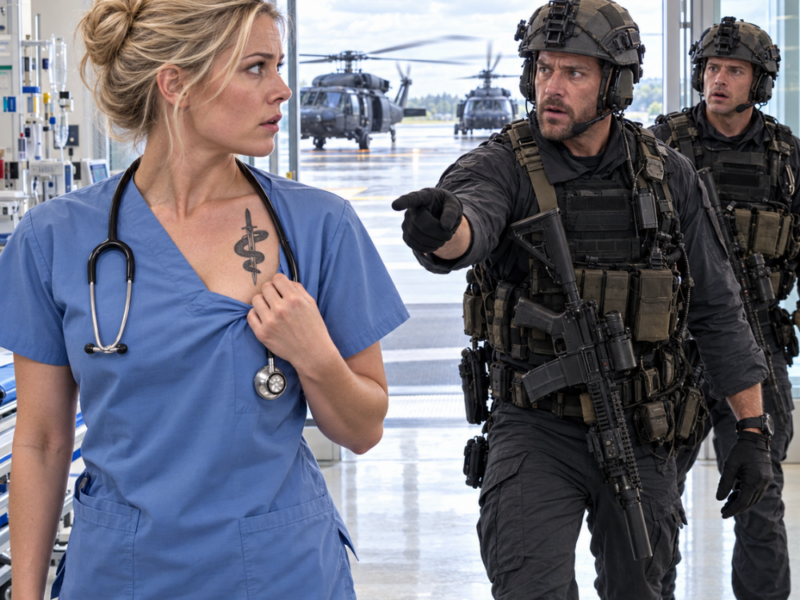
She Kept Her Tattoo Hidden—Then Two Black Hawks Landed as SEALs Called Her “Viper”
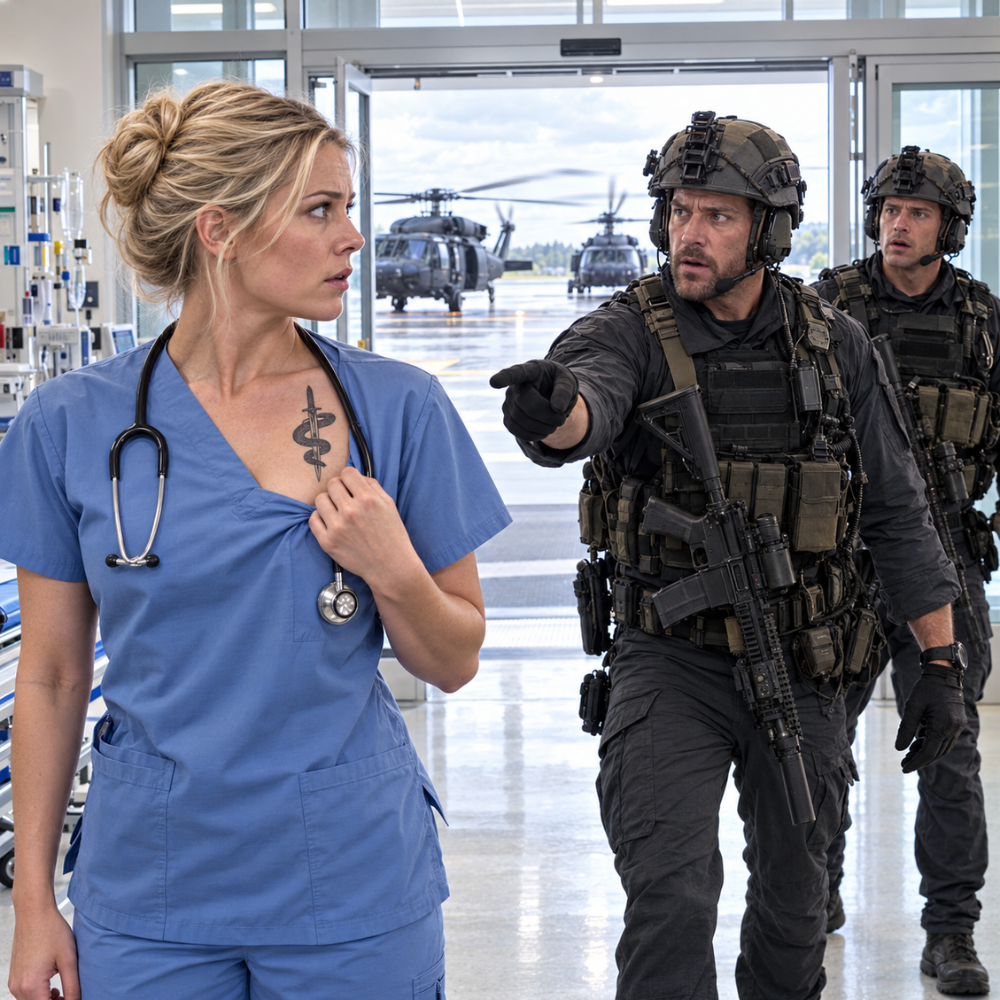
The nurse they pushed out of the ER was the only person the Blackhawk crew had come looking for
The first helicopter came down through the rain so hard that the windows along Coastal Ridge Medical Center’s emergency department trembled in their frames.
Dara Ellison was standing ten feet from the employee exit with her purse over one shoulder and a disciplinary notice folded inside the pocket of her rain jacket.
She had been told to go home.
Three minutes later, six soaked men in tactical gear came through the ambulance entrance carrying one of their own on a field stretcher, and the man leading them looked straight past the attending physician.
“Where is Viper?”
Nobody at the nurses’ station answered.
Nobody except Dara knew that the name had once belonged to her.
Outside, the storm had swallowed most of Brunswick, Georgia.
Rain moved sideways beneath the parking-lot lights. Water had already risen over the curbs near the visitors’ entrance, and the access road leading toward the marsh had disappeared beneath a thin sheet of standing water. Palm fronds snapped against one another in the wind. Somewhere beyond the hospital, the dark Atlantic pushed weather inland with the steady force of something that did not care what people had scheduled.
Coastal Ridge was not a large hospital.
It had seventy-four inpatient beds, two emergency trauma rooms, one CT scanner that administrators prayed over every time lightning struck nearby, and an overnight surgical staff thin enough that difficult cases sometimes required transfer to Savannah or Jacksonville.
It served fishermen.
Retirees.
Shipyard workers.
Tourists who underestimated rip currents.
Truck drivers coming off Interstate 95.
Children with fevers.
Grandfathers with chest pain.
People who had no interest in how impressive a hospital was as long as somebody there knew what to do when their worst night arrived.
For twenty-six months, Dara had been one of those people.
At 6:58 that evening, she had clocked in two minutes early.
She always did.
Not because anyone rewarded punctuality.
Because being early gave her enough time to know the room before the room became hers.
She walked into the staff locker area, hung up her rain jacket, and checked herself in the narrow mirror above the sink.
Dark hair pulled back.
No jewelry except a cheap watch.
Navy scrubs.
Hospital badge.
Nothing remarkable.
That had been intentional for years.
She tugged the left sleeve of her undershirt down another half inch until the edge covered the tattoo along her forearm.
Then she walked onto the emergency floor.
Felicity Monroe from day shift was waiting with handoff notes.
Felicity had already put one arm through her coat.
“You picked a good night.”
“Storm?”
“Storm, pharmacy software, and Voss.”
Dara glanced at her.
“All three?”
“You’re blessed.”
Dara almost smiled.
Felicity pointed toward the board.
“Bay One, chest pain. Troponins are trending okay, but cardiology wants observation. Bay Two, Mrs. Lester from the assisted-living place. Fell in the bathroom. Hip looks okay, waiting on final read. Two pediatric fevers out front. And pharmacy’s dispensing system is acting possessed.”
“What does possessed mean?”
“Orders go in. Some clear. Some sit there pretending they’ve never met us.”
“IT notified?”
“Three times.”
“Charge nurse?”
“Sandra called pharmacy directly.”
Dara nodded.
“And Voss?”
Felicity pulled the other sleeve of her coat on.
“Already annoyed by something.”
“When is he not?”
Felicity lowered her voice.
“He asked about you.”
Dara stopped.
“What about me?”
“Whether you were on tonight.”
“Why?”
“No idea.”
That stayed with Dara for less than thirty seconds.
She had patients.
The first hour passed normally.
That word, normally, had become important to her over the years.
She had once lived in a world where normal was a temporary state between emergencies.
Now she protected ordinary evenings almost stubbornly.
She checked IV sites.
Reviewed medication reconciliation.
Called an assisted-living facility because an elderly patient could not remember whether she was still taking a blood thinner.
Found crackers for a six-year-old whose fever had broken and whose mother looked more exhausted than the child.
Called pharmacy twice.
Documented both calls.
Rechecked the chest-pain patient.
Listened when the man admitted he was less frightened about his heart than about the bill.
“You have insurance?” she asked.
“Technically.”
“That sounds ominous.”
He gave a tired laugh.
“My deductible is the size of my truck.”
Dara adjusted the blanket over his legs.
“Let us worry about your heart tonight. You can be angry at Blue Cross tomorrow.”
At 8:17, the medication system stalled completely.
The nitroglycerin adjustment for Bay One remained locked in pharmacy review. A nausea medication for another patient sat pending. Two antibiotic orders could not be released from the automated cabinet.
Charge nurse Sandra Ye made another call.
“They’re switching to downtime procedure,” she told Dara.
“Paper verification?”
“Looks like.”
“Do we have approval yet?”
“Not yet.”
Dara documented the delay.
Eight twenty-two.
Clinical order pending pharmacy release because of hospital medication-system outage.
Charge nurse notified.
Pharmacy contacted.
Patient reassessed.
No acute change.
It was exactly the kind of note she had learned to write after working with Marcus Voss.
Dr. Marcus Voss was good at being admired.
He was forty-eight, silver beginning at the temples, confident without appearing hurried, and capable of turning an ordinary case review into something that sounded like a teaching moment.
His photograph appeared in the lobby beside an article about Coastal Ridge expanding emergency services.
He gave talks at regional medical conferences.
Administrators mentioned his name when discussing donor relations.
Residents rotating through Coastal Ridge competed for his approval.
Hospital board members knew him.
So did local newspaper reporters.
Patients liked him because he looked directly at them when speaking.
Staff liked him when he wanted to be liked.
Dara had never been sure what he wanted from her.
At first, she assumed he simply disliked being questioned.
Then the counseling notices began.
One for a medication administered several minutes outside the requested window during a night when the department had received five patients from a highway collision.
One for a charting correction she had entered herself.
One for a supposedly incomplete handoff that two other nurses confirmed had been complete.
One for “resistance to clinical direction” after she asked whether a discharge order should include follow-up instructions for a patient whose blood pressure remained dangerously high.
The patient returned two days later.
That detail never appeared in Dara’s disciplinary file.
Her question did.
The first notice upset her.
The second made her angry.
By the fourth, she became careful.
She responded in writing.
Saved copies.
Printed electronic timestamps.
Never raised her voice.
Never gave anyone a sentence they could quote without context.
That was an old survival skill wearing a civilian uniform.
At 8:47, Voss came out of Bay One holding a tablet.
“Ellison.”
Dara turned from the medication station.
“Yes?”
“The nitroglycerin adjustment.”
“Still waiting on pharmacy release. System outage.”
“How long?”
“Twenty-five minutes.”
His expression changed.
“Why?”
“I don’t control the pharmacy system.”
“You control whether you solve a problem.”
“Sandra called twice. Pharmacy has initiated downtime verification.”
“I don’t want a process summary.”
Dara remained still.
“I’m telling you why the medication isn’t available.”
Two nurses nearby became suddenly interested in computer screens.
Voss lowered the tablet.
“There are workarounds.”
“For some medications.”
“For medication delays.”
“This is a titrated medication requiring pharmacy verification. Which workaround are you recommending?”
There was nothing confrontational in her tone.
That was the problem.
Voss preferred uncertainty he could correct.
Dara had asked him to be specific.
His eyes hardened.
“You’re a nurse, Ellison.”
“Yes.”
“Act like one.”
The words were quiet.
Only people within a few feet heard them.
Dara looked at him.
He continued.
“Stop turning every instruction into a discussion you aren’t qualified to have.”
Sandra Ye looked down at the desk.
Dara felt the old instinct rise inside her.
Measure the room.
Measure the person.
Do not react to the insult.
Identify the actual problem.
“I’ll document that the medication remains unavailable and reassess the patient every ten minutes until it clears.”
Voss gave her a tight smile.
“That would be a good start.”
He walked away.
Dara returned to work.
The medication system came back at 9:31.
The order cleared.
She administered it at 9:33.
Documented.
Reassessed.
Moved on.
She might have forgotten the exchange by morning.
Voss had not.
At 10:12, Sandra approached her.
“Dara, can you come into the supervisor office?”
She saw Brenda Kaufman inside.
Kaufman served as the hospital’s overnight administrator several nights each month. She was responsible for staffing issues, compliance, bed flow, and the broad category of problems no department wanted to own after regular business hours.
Voss stood near the door.
Dara entered.
Sandra closed it behind her.
Kaufman opened a leather portfolio.
“We need to discuss the incident with Dr. Voss.”
“Which part?”
“The medication delay and your interaction afterward.”
“The medication was delayed by pharmacy.”
“We understand there was a system issue.”
“Then what are we discussing?”
Kaufman folded her hands.
“Dr. Voss reported that your response was argumentative.”
Dara looked toward him.
“I asked what alternative procedure he was recommending.”
Voss spoke from the corner.
“You challenged clinical direction in front of staff.”
“You didn’t give clinical direction. You criticized the delay.”
Kaufman raised a hand.
“This is exactly the kind of communication concern we’re talking about.”
Dara looked at her.
“I’m answering the question.”
“There isn’t a question.”
That sentence settled heavily.
Kaufman continued.
“Considering tonight’s interaction and the performance concerns already documented in your file, we’re removing you from trauma assignment pending review.”
Dara looked at Sandra.
Sandra’s eyes remained on the table.
“Tonight?”
“Yes.”
“What am I being accused of?”
“This isn’t disciplinary termination.”
“I didn’t ask that.”
Kaufman’s expression remained carefully neutral.
“You can use PTO for the remainder of the shift or work in a reduced non-trauma capacity if staffing requires it.”
Dara looked at Voss.
He had been waiting for this.
Not the meeting.
Her reaction.
She recognized that now.
“What performance issue occurred tonight?”
Kaufman exhaled.
“We are not going to litigate your entire file at ten o’clock.”
“I’m asking about tonight.”
“Your medication response was delayed.”
“By pharmacy.”
“Your interaction with the attending physician was adversarial.”
“I asked for clarification.”
Voss finally stepped forward.
“This is the pattern.”
“What pattern?”
“You consistently place your judgment beside physician judgment as though they carry equal authority.”
Dara stared at him.
“No.”
His eyebrows lifted.
“I place patient safety beside every person’s authority.”
The room went silent.
Kaufman closed the portfolio.
“Take the night, Dara.”
That was the decision.
Clean.
Administrative.
Impossible to fight without creating exactly the behavior they expected to document.
Dara stood.
“All right.”
Sandra looked up then.
“Dara—”
“It’s fine.”
It was not fine.
But those were the two most useful words she had learned in six years of trying to stay invisible.
She walked into the locker room.
Changed.
Pulled on jeans.
Kept the hospital undershirt beneath her sweater.
Put her badge inside her purse.
Then stood in front of the mirror.
Twenty-six months.
She had spent twenty-six months at Coastal Ridge doing competent work while Marcus Voss assembled a paper version of her that barely resembled the woman in the mirror.
Uncooperative.
Questioning.
Difficult.
Inconsistent.
She had tolerated it because fighting required visibility.
Visibility had once been dangerous.
Maybe it still was.
She pulled her sleeve down.
Covered the tattoo.
Picked up her purse.
Then the helicopter arrived.
The sound struck first.
A deep mechanical beating beneath the wind.
Dara stopped three steps from the exit.
The windows shook.
A security officer near the entrance looked outside.
“What the hell?”
The first helicopter dropped into the flooded parking lot.
Not a civilian medical transport.
Military.
Dark.
Unmarked from the distance Dara could see.
The side door opened before the rotors slowed.
Men came out carrying another man between them.
The second helicopter hovered beyond the hospital roofline, holding position against the storm before disappearing briefly into rain.
Dara’s entire posture changed.
She did not decide to change it.
Her body remembered before her civilian mind caught up.
Number of incoming.
Direction of movement.
Who was carrying weight.
Who was injured.
Who was guarding.
Which person was leading.
Which person was looking for exits.
Which one carried medical gear.
She set her purse down.
The ambulance doors opened.
Four men entered first.
Two carried the casualty.
One held a portable medical bag.
One moved directly to the nurses’ station.
Rainwater ran from their clothing onto the floor.
Sandra stepped forward.
“Sir, we need to get him into—”
“Trauma support.”
The man leading them spoke clearly.
He was broad through the shoulders, older than most of the others, with two pale scars along his jaw.
“Our corpsman thinks tension pneumothorax. Possible blood loss. Deteriorating for fifteen minutes.”
Voss appeared immediately.
“I’m Dr. Marcus Voss. Attending emergency physician.”
The man barely looked at him.
“Where is Viper?”
The name entered the ER like a dropped instrument.
Small sound.
Huge consequence.
Dara stopped breathing for one second.
Only one.
Voss went still.
Dara saw it.
Most people would not have.
The slightest loss of color.
His eyes narrowed.
Then recovered.
Sandra looked confused.
“Viper?”
The scarred man looked around the ER.
“Medical officer. Former military. Call sign Viper.”
“No one here by that name.”
Voss stepped toward the patient.
“Whoever you’re looking for isn’t here. Let’s get your man into Trauma One.”
The scarred man’s gaze passed over Voss and continued.
Dara was standing near the employee hallway.
His eyes reached her.
Stopped.
Not recognition.
Not yet.
Something else.
He looked at the way she was standing.
Feet balanced.
Purse abandoned.
Hands free.
Watching the patient, not the uniforms.
Dara walked forward.
“Bring him here.”
Voss turned.
“Ellison.”
She ignored him.
The casualty was placed on a gurney.
His face was pale beneath the oxygen mask. One side of his chest barely rose.
Dara put gloves on.
“When did breath sounds drop?”
The operator with the medical bag answered immediately.
“Ten minutes, maybe twelve.”
“Any neck-vein distention?”
“Yes.”
“Tracheal shift?”
“Starting.”
She listened.
Checked.
Looked at the monitor.
Oxygen saturation was falling.
Voss came closer.
“You’re not assigned to this case.”
Dara looked at him.
“He needs decompression.”
“I know what he needs.”
“Then do it.”
For the first time, Voss hesitated.
Perhaps because thirty people were watching.
Perhaps because the military team had entered the department with an authority he could not easily dominate.
Dara looked toward Sandra.
“Trauma kit. Now.”
Voss said, “I’m the physician here.”
The scarred man turned toward him.
“Then help her.”
Dara opened the kit.
In a civilian hospital, the procedure belonged under physician authority and emergency protocol.
Voss gave the order.
Dara performed it because she was closest, trained, and already positioned.
She located the appropriate site with the quick certainty of someone who did not have to search for memory.
Needle in.
Pressure released.
Air escaped.
The patient’s next breath came deeper.
Oxygen saturation began climbing.
Eighty-one.
Eighty-five.
Eighty-nine.
Dara secured the line.
“Chest tube tray.”
Sandra was already moving.
“Call surgery.”
“Who?”
“Whoever is on.”
“Moore.”
“Call Dr. Moore. Tell her penetrating chest trauma and probable hemothorax. We may need OR.”
Voss looked at Dara.
“What exactly do you think you’re doing?”
“Keeping him alive.”
The scarred operator crouched opposite her.
His voice dropped.
“We were told you died.”
Dara’s hands stopped for less than a second.
Then continued.
“I know.”
His face changed.
“Viper?”
“Not now.”
“Mara?”
“Not now.”
His eyes dropped toward her forearm.
Her sleeve had ridden upward while she worked.
The tattoo was exposed.
A dark serpent coiled around a narrow dagger.
Beneath it were coordinates.
And beneath those, one word.
VIPER.
The youngest operator saw it first.
He went silent.
Then another.
The wounded man opened his eyes.
He followed their gaze.
His lips moved beneath the oxygen mask.
“No.”
Dara looked at him.
“Stay still.”
“You’re—”
“Don’t talk.”
“Viper died.”
“Apparently not.”
His eyes widened.
“Breathe.”
Outside, the second helicopter descended.
The ambulance doors opened again.
Three more men came through.
Two more casualties.
The room went from tense to overloaded in seconds.
One had a severe leg injury controlled with a field tourniquet.
The other was unconscious with an abdominal wound and unstable blood pressure.
Dara stood.
Her jacket lay forgotten near the entrance.
Voss began issuing commands.
Some good.
Some unnecessary.
The scarred operator looked at Dara.
“Can you handle this?”
She was already moving toward the abdominal patient.
“Yes.”
“What do you need?”
“Space.”
He immediately pulled his men back.
That was when Marcus Voss turned away from the trauma area.
Dara saw him take out his phone.
She saw him type.
She saw his face reflected faintly in the black monitor beside the nurses’ station.
Not irritation.
Not professional concern.
Fear.
She filed it away.
The abdominal casualty became the priority.
His name, she learned later, was Tomas Reed.
Twenty-eight.
Unconscious.
Pulse fast.
Pressure falling.
Dara assessed him with Dr. Voss nearby and Sandra at her shoulder.
“Call Moore again.”
“She’s coming.”
“Tell her we need the OR ready before she arrives.”
Voss snapped, “You don’t tell surgery to open a room.”
Dara did not look at him.
“Then you tell them.”
He stared at her.
Sandra picked up the phone.
The leg-injury patient was awake.
Derek Holt.
Petty officer.
Thirty-one.
Terrified but controlled.
Dara crouched beside him.
“Derek.”
He looked at her.
“Tourniquet stays where it is until surgery evaluates you.”
He nodded through clenched teeth.
“I know.”
“Good. Two IVs. Blood work. Pain control once we know pressure is holding.”
Gabe Morales, the ER tech, stood beside her.
“On it.”
Dara looked at him.
“Stay with him.”
Gabe nodded.
No hesitation.
No question about why the nurse who had supposedly been sent home was now directing the room.
The emergency department had moved beyond titles.
Competence had become visible.
Dr. Philippa Moore arrived eleven minutes later.
She came through the doors fastening the back of her surgical cap.
Mid-fifties.
Compact.
Famous inside Coastal Ridge for hating unnecessary adjectives.
She assessed Tomas in under thirty seconds.
“OR Two.”
“Pressure is dropping,” Dara said.
“I see it.”
“We may have internal bleeding worse than the external wound suggests.”
Moore looked at her.
Not dismissively.
Assessing.
“You checked rigidity?”
“Yes.”
“FAST?”
“Voss ordered it. Positive.”
Moore nodded.
“Upstairs now.”
The surgical team moved.
Dara stepped back.
That was another thing military medicine had taught her.
Knowing when to take over mattered.
Knowing when to get out of the way mattered more.
When Tomas disappeared toward surgery, Dara turned.
Voss stood behind her.
Too close.
“You are not credentialed to run trauma in this department.”
“I didn’t run the department.”
“You issued orders.”
“I identified immediate needs.”
“You were removed from duty tonight.”
“I remember.”
“Everything you’ve done since those men arrived will be documented.”
“Okay.”
He blinked.
“What?”
“I said okay.”
“You understand your nursing license could be reviewed?”
“Yes.”
“You don’t seem concerned.”
Dara looked at him.
Then she understood.
Not everything.
Enough.
“You knew the name.”
Voss’s face became very still.
“What name?”
“Viper.”
“I heard them say it.”
“You recognized it.”
“That’s absurd.”
“You went pale.”
“I was watching a critical patient enter my ER.”
“You picked up your phone before the second casualties arrived.”
“I documented an operational incident.”
“Who did you contact?”
Voss’s voice cooled.
“You were just removed from this unit for insubordination, and you think you’re going to interrogate me?”
Behind Dara, the scarred operator spoke.
“Step away from her.”
His voice was not loud.
It did not need to be.
Voss looked toward him.
The operator held a secure phone.
Something had changed in his expression.
Dara saw it immediately.
“What happened?”
“Come here.”
She stepped away from Voss.
The operator positioned himself between them without touching anyone.
“My name is Joel Straker,” he said quietly. “Commander. Naval Special Warfare.”
“I figured something close.”
“Our command ran your name.”
“Which one?”
“Both.”
Dara held his gaze.
Straker continued.
“We also ran the hospital environment.”
“Why?”
“Because a person officially listed as dead just appeared in a civilian ER.”
Fair.
“What did you find?”
He glanced toward Voss.
“Marcus Voss had a federal contractor clearance eight years ago.”
Dara said nothing.
“Medical-records review. Administrative support. Joint operations command.”
Something inside her shifted.
Not shock.
Alignment.
A shape she had been staring at for years finally turned until all its edges matched.
“Which command?”
Straker did not answer.
He did not need to.
Dara looked at Voss.
Two years of counseling notices.
Two years of small humiliations.
Two years of documentation carefully written to make her appear defensive, argumentative, unstable.
Not incompetent enough to fire immediately.
Just questionable enough to discredit.
“He recognized me.”
“That’s what we think.”
“When?”
“We don’t know.”
“I do.”
Dara looked toward him.
“Early.”
Straker’s jaw tightened.
“Your official casualty file was processed through the command where he worked.”
Dara closed her eyes briefly.
Six years earlier, she had been Lieutenant Mara Whitfield.
Navy medical officer.
Attached temporarily to a special operations support element whose existence rarely appeared on paperwork the way it had functioned in reality.
Her call sign was Viper.
She had been thirty-one.
Excellent under pressure.
Bad at ceremony.
Known for carrying too many medical supplies and never enough socks.
The final deployment ended with two men dead, three evacuated, and a mission report that did not match what she had witnessed.
The official record said the operation failed because of rapidly changing ground conditions.
That was not true.
The official casualty report listed incorrect identities for two members of the support element.
That was not an accident.
The after-action record omitted a series of warnings made before the mission.
Those warnings had been hers.
Mara had preserved copies.
Then the vehicle evacuating her team was hit.
She survived.
Barely.
The report sent back through the chain listed her among the dead.
For several days, nobody outside a narrow medical pipeline knew she was alive.
In that gap, Mara made a decision she would question for six years.
She did not correct the record.
Not immediately.
Because in the hospital where she recovered, she saw an amended mission summary.
Somebody had changed it again.
Names removed.
Timelines altered.
Warnings attributed to people who had never made them.
The people rewriting the record had access above her level.
She had evidence.
They had institutions.
So Mara Whitfield disappeared.
Not into some cinematic intelligence program.
Nothing so clean.
She built a legal civilian identity through protected channels with help from one former colleague and one attorney whose name she never wrote down.
She completed state licensing requirements.
Became Dara Ellison.
Moved twice.
Worked short contracts.
Avoided social media.
Stayed small.
Kept the evidence.
And waited for someone outside the original chain of command to begin asking the right questions.
Eight months earlier, she heard that someone finally had.
Lieutenant Commander Ray Solis.
An investigator attached to an independent review team.
He had mentioned at a closed professional conference that he was examining anomalies in casualty documentation connected to an old joint operation.
Dara had not contacted him.
Not yet.
She needed to know whether he would survive long enough to become trustworthy.
Then Marcus Voss began increasing pressure on her at Coastal Ridge.
Now she knew why.
“Where is your evidence?” Straker asked.
“Safe.”
“We need it.”
“I know.”
Before he could continue, the ambulance entrance opened again.
Coast Guard personnel pushed a gurney inside.
A man lay beneath wet blankets.
Gray skin.
Blue lips.
Barely conscious.
Straker turned.
His face changed.
“Ray.”
Dara looked at him.
“Ray who?”
“Ray Solis.”
The name hit harder than Viper had.
Straker moved toward the gurney.
“They found him in the water.”
“How long?”
“Forty minutes. Maybe more.”
Dara was already pulling gloves on.
Solis was late thirties, lean, athletic, and dangerously cold.
His breathing was shallow.
Pulse slow.
He had a small head wound and clear signs of prolonged exposure.
Dara touched his neck.
“Core temperature.”
“No reliable reading in the field,” the Coast Guard medic said. “He was conscious when we pulled him out. Faded after transfer.”
“Vomiting?”
“Once.”
“Aspiration?”
“Possible.”
Dara looked at Sandra.
“Warm blankets from the warmer. Warmed IV fluid. Cardiac monitoring. Slow handling.”
Voss approached.
“I’ll take him.”
Dara did not move.
“You can take him with me.”
His eyes flashed.
Straker looked at Voss.
“This one stays with her.”
That ended the argument.
The thermometer returned a core temperature just under ninety degrees.
Moderate hypothermia.
Serious, but survivable.
Dara watched the cardiac rhythm.
Slow.
Organized.
She kept the rewarming controlled.
No dramatic movements.
No aggressive intervention where careful warming would do more good.
Minutes passed.
Solis’s heart rate crept upward.
His color changed by degrees.
The hospital around them began settling into the strange rhythm of a prolonged emergency.
Burke, the first casualty, stabilized after chest-tube placement.
Holt’s bleeding remained controlled.
Tomas Reed was in surgery.
Solis warmed.
Rain continued beating against the windows.
Marcus Voss moved toward the nurses’ station.
Then toward the administrative hall.
Dara noticed.
She also noticed two men enter through the main corridor.
Civilian clothes.
Dark jackets.
Federal credentials shown quickly to security.
They did not go to Dara.
They went directly to Voss.
One spoke quietly.
Voss replied.
The man held out his hand.
Voss hesitated.
Then surrendered his phone.
Dara looked at Straker.
“Who are they?”
“Not my people.”
“Do you know the agency?”
“I have an idea.”
The taller man photographed the screen of Voss’s device, then stepped aside to make a call.
Voss looked across the room at Dara.
Fear was visible now.
Not dramatic fear.
The kind adults try hardest to hide.
His jaw tightened.
Shoulders rigid.
Eyes moving between exits.
Solis opened his eyes at 11:48.
Dara leaned toward him.
“Ray.”
His gaze wandered.
“Ray Solis. You’re at Coastal Ridge Medical Center in Brunswick.”
He blinked.
“The others?”
“Burke stable. Holt stable enough. Reed is in surgery.”
“Tomas.”
“Still alive.”
Solis exhaled.
Then his eyes focused on her.
He looked at her face.
Then her exposed forearm.
Everything inside him seemed to stop.
“Viper.”
“Yes.”
“Mara Whitfield?”
“Dara here.”
“I’ve been looking for you.”
“I heard.”
“The records.”
“Later.”
“No.”
He tried to sit.
Dara pressed a hand lightly against his shoulder.
“You spent forty minutes in cold water. You can investigate the fall of Rome later.”
His mouth almost formed a smile.
“You don’t understand.”
“I understand hypothermia.”
“Voss.”
Dara looked at him.
Solis swallowed.
“Marcus Voss.”
“What about him?”
“He’s in my files.”
Straker came closer.
Solis continued.
“Contract medical records. Tier-two access. He formatted amendments.”
Dara’s eyes moved toward Voss.
“He changed the casualty documents?”
“Processed them. Maybe more. I don’t know yet.”
Dara looked back at Solis.
“Who directed it?”
He closed his eyes for a moment.
“Rear Admiral Calvin Pruitt.”
Retired.
The name lived in a place inside Dara she had not touched in years.
A signature.
At the bottom of one amended report.
She remembered it exactly.
“And who else?”
“Douglas Ferrell.”
That name she did not know.
“Program manager. Administrative side. Pruitt signed. Ferrell built the environment around everything.”
“Meaning?”
“People. Records. assignments. transfers.”
Solis’s breathing grew shallow.
Dara touched his shoulder.
“That’s enough.”
“They knew someone survived.”
“Yes.”
“They didn’t know who for years.”
Dara stared at him.
“Until me.”
“Until somebody found you.”
She looked across the room at Voss.
The federal man in the dark jacket was walking toward her now.
He stopped several feet away and opened a credential wallet.
“Defense Intelligence Agency. Garrett Foss.”
Dara looked at the identification.
Then at him.
“Dara Ellison?”
“Yes.”
“Also Mara Whitfield?”
“Yes.”
“Dr. Voss sent a message approximately forty-five minutes ago to a number associated with retired Rear Admiral Calvin Pruitt.”
Straker’s expression hardened.
“What did it say?”
Foss looked at Dara.
“It reported that a woman matching Lieutenant Whitfield’s description had been positively identified at Coastal Ridge and had made contact with Naval Special Warfare personnel.”
Dara felt no fear at first.
Just calculation.
“Has the building been secured?”
“We have people moving now.”
“That isn’t yes.”
“No.”
“Then secure it.”
Foss’s expression shifted.
Perhaps he was not accustomed to being ordered around by hospital nurses.
Then he looked at Solis.
At Straker.
At the tattoo.
“Working on it.”
Dara looked toward the administrative corridor.
Voss was gone.
“Where is he?”
Straker turned.
The operator nearest the hall looked back.
“He went through the fire door.”
Dara moved.
Foss caught her gently at the elbow.
“We have security.”
“He’s worked here for years.”
“So have you.”
“That’s my point.”
She pulled free.
“I know where that hallway goes.”
Straker followed her.
The administrative corridor was operating under partial emergency lighting.
The storm had knocked out one primary circuit.
Dara moved past compliance offices, finance, records, and the small management suite.
At the far end, the hallway split.
Left to pharmacy administration.
Right toward facilities and the service passage connecting the hospital to the parking structure.
The facilities door stood slightly open.
Dara slowed.
Straker came alongside her.
“You don’t have to do this.”
“Yes, I do.”
“No. You want to.”
She looked at him.
“There’s a difference.”
He was right.
That irritated her.
They entered together.
Voss stood near the service exit.
Phone gone.
Breathing hard.
For the first time since Dara met him, Marcus Voss looked ordinary.
Not celebrated.
Not commanding.
Not protected by the hospital hierarchy around him.
Just tired and frightened.
“You shouldn’t have followed me,” he said.
Dara stopped several feet away.
“You recognized me.”
He said nothing.
“How long?”
His jaw worked.
“Three weeks.”
“After I started?”
“Yes.”
“How?”
“Hendricks case.”
Dara remembered.
A fisherman with a catastrophic chest injury.
Voss had called surgery late.
Dara had assisted during an emergency procedure until the surgical team arrived.
The movements had been old.
Automatic.
Too efficient for an ordinary civilian background.
“You knew my file.”
“I had read the original casualty review.”
“And then you started building a personnel record against me.”
“I started protecting myself.”
“You wrote false reports.”
“I documented concerns.”
“You manufactured concerns.”
“You don’t understand what I knew.”
“Then explain it.”
Voss looked past her toward Straker.
Then back.
“I knew the reports were altered.”
“Because you helped alter them.”
“I formatted revisions. I didn’t make the decisions.”
“You knew the identities were wrong.”
“Yes.”
“You knew the timeline was false.”
“Yes.”
“You said nothing.”
His voice sharpened.
“You think everyone gets to be brave?”
Dara stared at him.
“No.”
The answer disarmed him.
She continued.
“I think everyone gets to decide what kind of coward they’re willing to become.”
Voss’s shoulders dropped.
“When I saw you here, I panicked.”
“For twenty-six months?”
“I thought if an investigation found you, then somebody would eventually ask who in this hospital knew. I needed distance.”
“So you created a record that made me look unreliable.”
“Yes.”
The honesty was colder than a lie.
“If I ever spoke about the old operation, I would look unstable.”
“Yes.”
“And tonight?”
“I sent the message before I knew what else to do.”
“To Pruitt.”
He nodded.
“What will he do?”
“I don’t know.”
“You knew enough to warn him.”
Voss looked down.
Then he said, “He won’t sit still.”
Foss entered behind Straker.
“What does that mean?”
Voss saw the credential.
Closed his eyes.
“It means he has people.”
“What people?”
“Consultants.”
“Names.”
“I don’t know all of them.”
“Give us the ones you know.”
Voss looked at Dara.
Something resembling shame passed through his face.
“Douglas Ferrell.”
Dara glanced toward Foss.
He already knew the name.
Voss noticed.
“You have him?”
“Keep talking.”
“Ferrell manages logistics. Placement. surveillance. contractors.”
“Was Dara placed at Coastal Ridge intentionally?”
Voss’s face changed.
Dara caught it.
“What?”
Voss looked at her.
“I didn’t bring you here.”
“Nobody said you did.”
“I recognized you after you arrived.”
Dara felt the entire structure shift again.
“If you didn’t place me here…”
Voss looked toward Foss.
“Ask Ferrell.”
A message buzzed on Straker’s phone.
He read it.
His face drained.
“OR Two lost power.”
Dara turned.
“What?”
“Thirty seconds. Backup recovered. Moore requested security.”
Tomas Reed was in OR Two.
Dara was already moving.
The elevator opened on the fifth floor instead of six.
The corridor was dark.
A man stood near the stairwell.
Not hospital staff.
No badge.
No scrubs.
Straker shifted in front of Dara.
“Who are you?”
The man answered calmly.
“This floor is restricted.”
“By whom?”
“Facilities.”
“You’re not facilities.”
No response.
The stairwell door behind the man moved.
Another shadow.
Dara’s attention sharpened.
Straker saw it too.
He spoke quietly.
“Back in the elevator.”
Dara did not.
The man’s gaze fixed on Straker.
That gave Dara half a second.
She moved toward the stairwell while Straker stepped between them.
No fight.
No dramatic confrontation.
Just confusion.
Movement.
Security arriving from below.
Dara took the stairs to six.
Dr. Anita Farrow, Coastal Ridge’s chief of surgery, stood outside OR Two.
Inside, Philippa Moore was still operating.
Reed was alive.
Dara’s first full breath came then.
Farrow turned.
“Who are you?”
“Dara Ellison. ER.”
“I know the name. Why are you on my floor?”
“Power loss.”
Farrow’s mouth tightened.
“Manual interruption.”
Dara stared at her.
“Not storm?”
“No.”
“Backup?”
“Failsafe restored it.”
“How long?”
“Thirty-two seconds.”
“That could have been worse.”
“It almost was.”
The OR doors remained closed.
Moore worked.
Farrow lowered her voice.
“Someone accessed the facilities controls downstairs.”
Dara thought of Voss moving through that corridor.
“He was in facilities.”
“Voss?”
“Yes.”
“He’s in federal custody now.”
Dara looked toward the stairwell.
“The man on five isn’t.”
Farrow frowned.
“What man?”
Straker came through the stairwell door.
“Federal security has him contained in the parking structure.”
“Who is he?” Dara asked.
“Contractor tied to a local consulting company.”
Foss appeared moments later.
He looked at Dara.
“We traced the company.”
“To Pruitt?”
“Indirectly.”
“Ferrell?”
“Yes.”
That answered one question.
Then Foss gave her another.
“The Brunswick office connected to the contractor was leased twenty-seven months ago.”
Dara stared at him.
One month before she arrived at Coastal Ridge.
She felt something colder than fear.
“Who placed the nursing job listing?”
“We’re checking.”
“No.”
She shook her head.
“Check Meridian Health Placement.”
Foss looked surprised.
“That’s the registry?”
“Yes.”
“How do you remember?”
“Because I used two registries under this name. Meridian sent the Coastal Ridge position.”
Straker looked at her.
“You told anyone you were searching there?”
“One person.”
“Who?”
Dara hesitated.
“Patricia O’Day.”
“Military?”
“Former medical colleague. She helped me after I disappeared.”
“Does she know you’re alive?”
“She’s always known.”
Foss was already using his phone.
Dara looked through the OR window.
Tomas Reed lay beneath surgical lights.
People had arranged an entire environment around her without her seeing it.
A job opening.
A hospital.
A physician who recognized her.
A consulting office nearby.
A paper trail labeling her difficult.
Not a prison.
Something smarter.
An ordinary life with walls she could not see.
“She wasn’t hiding in Brunswick,” Straker said quietly.
Dara looked at him.
“They put her here.”
Foss nodded.
“So somebody could watch.”
The nursing registry traced back through two corporations to a Delaware holding company.
Douglas Ferrell appeared at the end.
The placement itself had been real.
The position genuinely open.
Hospital HR had done nothing improper.
Someone connected to Ferrell had simply made sure the listing reached the exact registry Dara used.
Dara called Patricia from a secure phone.
Patricia answered after five rings.
“Mara?”
The old name felt strange.
“It’s me.”
“What happened?”
“Do you remember sending me the Coastal Ridge listing?”
Silence.
“Yes.”
“Where did it come from?”
“Meridian.”
“You verified it?”
“Hospital HR. Directly.”
“Did anyone contact you separately?”
“No.”
“Think.”
Another pause.
“I had gotten an email from the recruiter earlier that week asking whether I had any nurses interested in coastal night work.”
“Did you answer?”
“I said I might.”
“Did you give them my name?”
“The name you were using.”
Dara closed her eyes.
Patricia’s voice sharpened.
“What is this?”
“You were used.”
“Oh, God.”
“You didn’t know.”
“Mara—”
“Listen to me. Stay home. Federal investigators are going to contact you.”
“What happened?”
Dara looked around the surgical floor.
“It’s finally moving.”
The raid on the Brunswick consulting office happened before three in the morning.
Douglas Ferrell was inside.
Packing files.
He did not resist arrest.
Retired Rear Admiral Calvin Pruitt was taken into federal custody before sunrise at his Charleston-area home.
Marcus Voss asked for an attorney.
Then, on the attorney’s advice, he began talking.
For the first time in six years, different pieces of the same history entered one legal record.
Solis’s investigation.
Dara’s contemporaneous field notes.
Voss’s administrative access.
Ferrell’s surveillance network.
Pruitt’s authorization chain.
The amended casualty documents.
The correct names.
Those mattered most to Dara.
Two names had been wrong for six years.
Men she had treated.
Men she had tried to evacuate.
Men whose families had received explanations built from paperwork she knew was false.
Solis had found the original identities through archived records and witness interviews.
He gave Dara a printed sheet while they waited outside recovery.
She unfolded it.
Read the names.
Once.
Then again.
She slipped the paper into her pocket.
“What?” Straker asked.
“They’re right.”
He understood.
Nothing else needed saying.
At 12:47 a.m., Dr. Moore came downstairs.
Dara went to her immediately.
“Tomas?”
“Alive.”
Dara closed her eyes.
Moore continued.
“More internal bleeding than we expected. Controlled now. He’ll need another surgery, but the acute problem is handled.”
“The power interruption?”
“Backup caught it.”
“How close?”
Moore studied her.
“Closer than I’d like.”
That answer was enough.
Burke was stable.
Holt would keep his leg, though orthopedic surgery lay ahead.
Solis reached normal temperature before dawn.
Tomas survived surgery.
Four men entered Coastal Ridge in life-threatening condition.
Four remained alive.
Only then did Dara agree to leave the hospital briefly.
Her evidence was stored in a climate-controlled self-storage facility on the south side of Brunswick.
Unit 214.
Paid through a prepaid account.
Visited four times in twenty-six months.
Inside a waterproof case were a sealed hard drive, a duplicate storage device, a paper notebook, and copies of documents she had kept since the deployment.
Foss accompanied her.
Straker drove separately.
The storm had weakened to steady rain.
Roads shone beneath streetlights.
A traffic signal blinked uselessly at an intersection where the power was out.
At the storage facility, Dara entered her gate code.
They walked between rows of metal doors.
She unlocked 214.
The case remained exactly where she had left it.
Dara checked the tamper seal.
Intact.
Foss’s agent documented everything before touching it.
Photographs.
Time.
Condition.
Chain of custody.
Dara watched with more relief than she expected.
“What?” Straker asked.
“They’re doing it correctly.”
“You doubted they would?”
“I doubt everybody.”
“Healthy.”
“No. Useful.”
Foss opened the paper envelope after documenting the seal.
The first pages were Dara’s field notes.
Dates.
Times.
Warnings.
Names.
Medical observations.
Communication failures.
The final page was written in handwriting that became less controlled as the events worsened.
Foss looked up.
“You wrote this during the operation?”
“Parts during. Parts in the field hospital.”
“This supports Solis’s timeline.”
“I know.”
Straker looked at the hard drive.
“You kept this for six years.”
“Yes.”
“You could have released it.”
“To whom?”
He said nothing.
Dara continued.
“I needed somebody outside the original chain to find the case independently.”
“Solis.”
“Yes.”
“And you knew he was looking eight months ago.”
“I knew someone was.”
“So you waited.”
“I’ve been waiting six years.”
The words did not sound heroic.
They sounded tired.
Straker leaned against the storage-unit wall.
“And you let Voss keep writing reports about you.”
“Yes.”
“Why?”
“Because challenging him aggressively would create attention. Attention creates questions. Questions create background checks. Background checks create contradictions.”
“That’s a long time to let someone reduce you.”
Dara looked at him.
“I wasn’t reduced.”
Her voice remained calm.
“I was quiet.”
Straker accepted the correction.
Back at the hospital before dawn, Foss received confirmation that Pruitt and Ferrell were both in custody.
Voss had provided four months of direct messages with Pruitt.
The messages were damning.
Updates on Dara’s work schedule.
Notes about her clinical performance.
Warnings that she seemed likely to become visible inside the hospital.
Instructions to “manage credibility.”
Three weeks earlier, Pruitt had written:
If the review reaches original unit records, Whitfield becomes dangerous. Maintain containment.
Dara read it twice.
Containment.
That was what her ordinary life had been to them.
Not a life.
Containment.
Her apartment.
Her job.
Her shift schedule.
Her disciplinary file.
Voss.
The nursing registry.
The office two miles away.
A cage without bars.
She handed the tablet back.
“Is it enough?”
“With your records and Solis’s investigation?”
Foss nodded.
“Yes.”
“Then use it.”
By six-thirty, the storm began moving offshore.
Brunswick emerged slowly from darkness.
Gray dawn over the marsh.
Utility trucks appeared on flooded streets.
Coffee shops opened late.
People checked roofs and yard fences.
At Coastal Ridge, the night shift looked as though it had lived through a week.
Brenda Kaufman returned to the hospital after being called by the chief executive.
She entered expecting an administrative crisis.
Instead, federal investigators met her at the ER.
Kaufman was not involved in the old military cover-up.
That became clear quickly.
Her failure was smaller.
More ordinary.
She had trusted Marcus Voss because the institution had rewarded him.
She accepted his descriptions of Dara because questioning a high-revenue physician was inconvenient.
She had seen a paper file and mistaken repetition for truth.
When Sandra Ye testified during the hospital review, she did not protect Kaufman.
She did not protect herself either.
“I believed Dr. Voss,” Sandra told the board.
“Why?”
“Because he was Dr. Voss.”
One board member waited.
Sandra continued.
“And Dara was a nurse.”
The room became uncomfortable.
That was the point.
Sandra described the pharmacy outage.
Dara’s documentation.
The meeting.
Her own silence.
Then the Blackhawks.
The casualties.
What Dara had done.
Not as proof that Dara deserved respect because of a secret military identity.
Sandra understood the mistake in that framing.
Dara had deserved fair treatment before anyone knew who Viper was.
Her competence had been visible long before the storm.
People had simply been trained by hierarchy not to see it.
Kaufman resigned.
The hospital voided every disciplinary notice Marcus Voss had placed in Dara’s file.
A review of her actual record found what the notices had obscured.
Excellent attendance.
Strong patient outcomes.
Consistent documentation.
Multiple physician compliments from doctors other than Voss.
No medication errors causing patient harm.
No pattern of unsafe conduct.
Just work.
Dara read the board’s letter in the staff break room.
Then drank the rest of her coffee.
Then went back to the ER.
That surprised administrators more than anything else.
She returned three days after the storm.
Sandra found her entering orders at the nurses’ station.
“You came back.”
“I work here.”
Sandra looked down.
“I need to say something.”
Dara waited.
“I should have questioned him.”
“Yes.”
“I should have backed you in that office.”
“Yes.”
Sandra looked at her.
“I don’t have an excuse.”
“No.”
For several seconds, neither spoke.
Then Sandra said, “I’m sorry.”
Dara believed her.
That did not make the previous twenty-six months disappear.
But truth did not have to erase consequences to matter.
“Do better with the next person,” Dara said.
Sandra nodded.
“I will.”
The federal case moved slowly.
That was normal.
People expecting dramatic justice rarely understand how much justice resembles paperwork.
Subpoenas.
Interviews.
Authentication.
Motions.
Classification review.
Jurisdictional disputes.
Independent counsel.
Arguments over what records could become public.
Eleven weeks after the storm, the inspector general completed the military-record review.
The final casualty report from Mara Whitfield’s deployment was formally declared falsified.
The original warnings were restored.
The chronology was corrected.
The two operators’ names entered the permanent record correctly.
Their families were notified privately before the findings became public.
Mara Whitfield’s service status was amended.
Her record no longer ended with a false death report.
Awards that had disappeared in administrative corrections were restored.
The package arrived at Dara’s apartment on a Wednesday.
No ceremony.
No officials.
Just a government envelope.
Inside were documents.
A Navy commendation.
A joint-service medal.
A note from Straker.
These were always yours.
Dara sat at her kitchen table with the package unopened beside her for nearly an hour.
Then she called no one.
She made tea.
Stood by the window.
Watched a neighbor drag a recycling bin toward the curb.
The world had become ordinary again.
She liked that.
Pruitt was indicted on charges including obstruction and falsification connected to federal and military records.
Ferrell faced conspiracy charges tied to surveillance and witness manipulation.
Their attorneys fought.
Motions came.
Some were granted in part.
Most were denied.
The cases would take time.
Voss cooperated.
His medical license became the subject of a separate proceeding.
The state board acted faster than the federal courts.
He eventually surrendered his license.
Dara never searched his name afterward.
People at Coastal Ridge occasionally sent her articles.
She stopped opening them.
Marcus Voss had occupied enough space in her life.
She refused to rent him more.
Four weeks after the internal review, Coastal Ridge offered Dara a formal position on its expanded trauma team.
Better pay.
Better title.
More authority.
She read the letter twice.
Then waited three days.
Her answer came with conditions.
Not demands for personal privilege.
A proposal.
Twelve pages.
Military-to-civilian trauma-readiness training.
Hemorrhage control.
Hypothermia management.
Multi-casualty triage.
Resource-limited emergency response.
Field lessons adapted safely to civilian nursing scope and hospital protocols.
The document landed on Dr. Anita Farrow’s desk.
Farrow read it.
Called Dara to her office.
The chief surgeon’s window overlooked the Brunswick River.
“You wrote this yourself?”
“Yes.”
“It’s extensive.”
“Yes.”
“You want nurses trained in techniques they may rarely use.”
“I want them to recognize situations early enough that physicians have more time to act.”
Farrow turned another page.
“Mass-casualty simulations.”
“Yes.”
“Offshore exposure.”
“Yes.”
“Medication-system downtime.”
Dara almost smiled.
“That one seemed relevant.”
Farrow leaned back.
“I owe you an apology.”
“For what?”
“Not the storm.”
Dara waited.
“The two years before it.”
“You didn’t supervise the ER.”
“I supervised physicians who influenced its culture.”
“That’s broader than your role.”
Farrow shook her head.
“That’s what people say when they want responsibility to stop one office before it reaches them.”
Dara respected the answer.
Farrow tapped the proposal.
“I’m approving the pilot.”
“Good.”
“And recommending you direct it.”
Dara frowned.
“As a nurse?”
“As the person who wrote it.”
“The hospital has never had a non-physician program director.”
“I’m aware.”
“Some people won’t like that.”
Farrow looked at her.
“That is not a clinical concern.”
Dara accepted.
Ray Solis returned to Coastal Ridge six weeks later.
This time he came through the main entrance wearing jeans and a navy jacket.
No stretcher.
No thermal blankets.
No Coast Guard.
He found Dara at the nurses’ station reviewing training notes with Gabe Morales.
“You look less blue,” she said.
“I’ve been working on that.”
“How’s the heart?”
“Still attached.”
“Promising.”
He sat.
Gabe looked between them.
“I’ll come back.”
“No,” Dara said. “Stay.”
Solis looked at the training manual.
“What’s this?”
“Your near-death experience became curriculum.”
“Do I get royalties?”
“No.”
“Government work.”
Gabe laughed.
Dara looked at Solis.
“How are the others?”
“Burke’s on light duty. Holt has another surgery. Reed is in physical therapy.”
“Good.”
Solis became quiet.
“The corrected report is final.”
“I saw.”
“The names too.”
“Yes.”
He watched her.
“You carried those coordinates six years.”
Dara looked at her forearm.
“I wanted to remember where they were when everything went wrong.”
“You don’t need the coordinates anymore.”
“I know.”
“Going to remove the tattoo?”
“No.”
“Why?”
She thought.
“Because fixing the record doesn’t erase what happened.”
Solis nodded.
“That sounds right.”
He stayed for an hour.
Gabe asked him questions about offshore casualty evacuation.
Solis answered.
Dara listened.
Knowledge moved between them.
That was the part she liked most.
For years, everything she knew had been something to conceal.
Now it could become useful again.
Commander Joel Straker visited in December.
The training room was almost finished.
It had once been storage.
Now there was a simulation mannequin, stocked trauma carts, whiteboards, portable monitors, and shelves labeled by scenario.
Straker stood in the doorway.
“This is yours?”
“Hospital’s.”
“You know what I mean.”
Dara kept writing on the board.
“Twelve nurses. Three techs. First class Monday.”
He walked in.
“Burke asked me to tell you he still hates needles.”
“He should stop getting chest injuries.”
“I’ll pass that along.”
Straker studied the board.
Then he became more serious.
“Naval Special Warfare wants to talk to you.”
“No.”
“You don’t know what about.”
“I assumed reenlistment.”
“No.”
“Good.”
“Consulting.”
She turned.
“Medical training.”
“Civilian.”
“Yes.”
“No command authority over me.”
“No.”
“No moving.”
“No.”
“No secret job title.”
He almost smiled.
“No.”
“Then maybe.”
“They want your protocols.”
Dara looked at the whiteboard.
“All of them?”
“Whatever you’re willing to give.”
“When do they need an answer?”
“No rush.”
She considered it.
Six years earlier, Lieutenant Mara Whitfield had vanished because visibility could get her killed.
Twenty-seven months earlier, Dara Ellison arrived in Brunswick believing anonymity might become a permanent form of safety.
Then a storm came.
A helicopter landed.
Someone asked for Viper.
And the smaller life she had built around herself split open.
Not because the old version of her defeated the new one.
Because they had never been different people.
Mara had been a medical officer.
Dara was a nurse.
Both showed up when somebody was dying.
Both stayed calm when a room became chaotic.
Both trusted evidence more than authority.
Both asked questions powerful people disliked.
The name had changed.
The work had not.
“Tell them yes,” she said.
Straker nodded.
At the door, he stopped.
“One thing.”
“What?”
“That night.”
“Which part?”
“When we came into the ER.”
Dara waited.
“We asked for Viper. Nobody knew what we were talking about.”
“I remember.”
“Then you started walking toward us.”
He looked at her.
“Do you know what that looked like?”
“No.”
“Like somebody who had spent years being invisible and had finally decided she didn’t need to be.”
Dara thought about that after he left.
He was close.
Not entirely right.
She had not decided to become visible.
There had been no dramatic decision.
A patient arrived unable to breathe.
Then another bleeding internally.
Then another freezing from the inside out.
She did what she knew how to do.
Visibility came afterward.
That distinction mattered.
People liked stories where strength announced itself.
Where a mistreated person suddenly reveals a hidden rank, a secret fortune, an impressive credential, and everyone who underestimated them is forced to apologize.
Real strength was rarely so clean.
Sometimes strength looked like showing up at 6:58 for a shift where nobody particularly valued you.
Sometimes it meant documenting a pharmacy delay correctly even though a celebrated physician had already decided the problem was yours.
Sometimes it meant sitting inside an administrative office while people described a fiction about you and refusing to become the reaction they expected.
Sometimes it meant hiding.
Sometimes speaking.
Sometimes waiting six years because telling the truth to the wrong person could destroy the truth along with you.
Dara had been afraid.
That did not make her weak.
She had hidden.
That did not make every part of hiding healthy.
She had endured things she might have challenged under different circumstances.
That did not mean the people who mistreated her had been justified.
Two truths could occupy the same room.
She had survived because she was careful.
She had also spent years paying for that survival.
The program’s first training session began on a cold Monday morning.
Gabe arrived twenty minutes early.
Sandra came too.
So did two nurses who had watched Voss humiliate Dara over medication months earlier.
Nobody mentioned it.
They did not need to.
Dara stood beside the simulation mannequin.
Her sleeves were pushed to her elbows.
The tattoo was visible.
Nobody stared anymore.
“Scenario One,” she said. “Multiple arrivals, limited staff, unstable weather, pharmacy outage.”
Gabe laughed.
“That seems familiar.”
“It should.”
Dara handed him a scenario card.
“Your first patient is hypoxic.”
“What do I do?”
“Tell me what you see before you tell me what you do.”
He looked at the monitor.
Dara watched him think.
That was the work.
Not proving Marcus Voss wrong.
Not proving herself extraordinary.
Teaching somebody else to see clearly under pressure.
Months later, a framed copy of the corrected casualty record arrived for her office.
She did not put it on the wall.
She placed it in a drawer beside her fatherless childhood documents, nursing certifications, tax records, and the ordinary paperwork of an adult life.
The medals went into the same drawer.
Farrow asked why.
“People would understand if you displayed them.”
“Understand what?”
“Who you were.”
Dara looked around the training room.
“I’m still her.”
Farrow smiled.
“Fair enough.”
The most important document stayed somewhere else.
The small sheet Solis had given her during the storm.
The two corrected names.
She kept that in a simple frame beside her desk.
No explanation.
No rank.
No photograph.
Just names.
One evening, almost a year after the Blackhawks landed, another storm rolled toward the Georgia coast.
Not as strong.
Heavy rain.
Wind.
The kind of weather that made everyone at Coastal Ridge check generators twice.
Dara worked the night shift.
At 8:20, the medication system briefly went offline.
Sandra walked over.
“You have got to be kidding.”
Dara looked at the notification.
“Downtime procedure.”
“Already called.”
“Good.”
A young nurse named Keisha stood beside them.
“Dr. Harlan wants an antibiotic released, but pharmacy hasn’t cleared it.”
Dara looked at her.
“What does policy say?”
“Wait for verification unless it’s emergent and physician activates override.”
“Good.”
“Harlan is annoyed.”
“That’s allowed.”
Keisha smiled nervously.
“He said I should find a workaround.”
Sandra and Dara looked at each other.
For half a second, the old night returned.
Then Dara said, “Ask him to specify the workaround he wants documented.”
Keisha blinked.
“Really?”
“Yes.”
“What if he gets mad?”
Dara shrugged.
“Then he gets mad.”
Sandra added, “And I’ll be standing beside you.”
Keisha walked away.
Sandra watched her go.
“I should have done that for you.”
“Yes.”
“I know.”
Dara looked at the board.
“Now you know what to do next time.”
A helicopter passed somewhere beyond the hospital.
Civilian this time.
Probably Coast Guard.
The sound moved away.
Dara barely noticed.
She checked the clock.
8:24.
The night was young.
A child in the waiting room had a fever.
A fisherman needed stitches.
A woman in Bay Four was crying because her husband had been admitted upstairs and she did not have anyone to drive her home.
Normal problems.
Human problems.
The kind Dara had once thought were too small for the person she used to be.
She no longer believed that.
Keeping people alive was never small.
Neither was listening.
Neither was making sure the right name stayed attached to the right person.
Neither was asking one more question when an answer did not make sense.
She rolled her sleeve down because the air-conditioning was cold.
Not to hide anything.
Just because she was cold.
Then she picked up her chart and walked toward the next patient.
Viper had never really returned that night.
She had been there all along.
The hospital simply learned her name.









