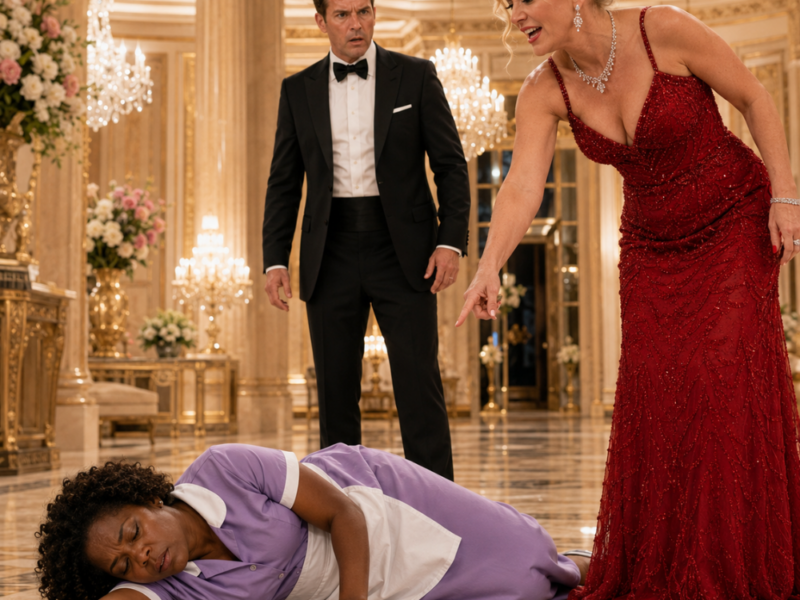
She Cruelly Mocked the ‘Unconscious’ Maid, Unaware of Who Was Listening

The maid collapsed in the middle of his engagement gala, and the woman laughing at her had no idea the billionaire on his knees had just recognized the person who once saved his life
The champagne tray hit the marble before Maria Alvarez did.
Twenty-four crystal flutes seemed to hang in the air for one impossible second beneath the ballroom chandeliers, catching gold light as they fell. Then glass exploded across the floor, champagne spread beneath the shoes of three hundred startled guests, and Maria’s knees folded under her.
She never felt herself land.
The string quartet stopped in the middle of a song.
A waiter near the terrace doors froze with a tray balanced against his palm. Conversations died one table at a time. Heads turned toward the center of the ballroom.
For three full seconds, nobody moved.
Then Victoria Hale laughed.
It was not nervous laughter. It was not shock.
It was the bright, incredulous laugh of a woman who had just watched something inconvenient happen at the most important party of her life.
“Oh, come on.”
Victoria stood beneath a chandelier in a red evening gown that had required two fittings in Manhattan and cost more than Maria earned in several months. Her engagement ring flashed as she lifted one manicured hand toward her mouth.
“Is she seriously doing this tonight?”
A few guests smiled automatically because Victoria was smiling.
That was how rooms like this worked.
People took their emotional instructions from whoever seemed to own the evening.
Victoria stepped around the shattered glass.
Maria lay motionless on her side in her black service dress, one arm bent beneath her, dark hair partly covering her face.
“Maria.”
Victoria nudged the sole of Maria’s shoe with the pointed toe of her heel.
“Get up.”
Nobody laughed now.
A woman near the orchestra lowered her champagne flute.
Victoria glanced around, embarrassed less by Maria’s condition than by the silence surrounding it.
“This is ridiculous,” she said. “If she needed to leave early, she could have asked.”
“Victoria.”
The voice came from behind her.
Daniel Whitmore was moving through the crowd.
He did not walk quickly very often.
At forty, he had spent most of his adult life in rooms that adjusted themselves to his pace. Assistants hurried so he did not have to. Drivers waited. Elevators were held. Reservations appeared. Problems were handed to people whose job was to solve them before Daniel ever saw the inconvenience.
Now he pushed between guests hard enough to make two men step backward.
“What happened?”
“She fainted,” Victoria said. “Or she’s pretending to.”
Daniel dropped to his knees beside Maria.
The words seemed not to register.
“Call 911.”
Someone behind him said, “Already calling.”
Daniel touched two fingers gently to the side of Maria’s neck.
He found a pulse.
Fast.
Too fast, he thought.
Her skin looked wrong under the chandelier light. Pale beneath her olive complexion, damp along the forehead. Her lips were dry.
He leaned closer.
“Maria?”
No response.
Behind him, Victoria sighed.
“Daniel, please. The staff can handle this.”
He looked over his shoulder.
Victoria gestured toward his tuxedo trousers touching the wet floor.
“You’re kneeling in champagne.”
Daniel stared at her as though she had spoken in another language.
Then he turned back toward Maria.
He moved the hair away from her face.
Her left hand had fallen open beside her.
Something silver caught the light.
A narrow bracelet.
Old. Scratched. Nothing expensive.
Three engraved letters sat inside an oval plate.
M.A.R.
Daniel stopped breathing.
For several seconds, the ballroom disappeared.
The chandeliers were gone.
The marble was gone.
Victoria was gone.
He smelled antiseptic.
He heard a heart monitor.
He was twenty-nine again, lying beneath a hospital blanket with a fractured rib, a collapsed lung, and blood pressure that refused to stabilize after a rain-slicked highway accident outside Columbus.
He remembered a woman’s hand wrapped around his.
Stay with me.
He remembered trying to joke because he was terrified.
I have meetings tomorrow.
Then cancel them.
I don’t cancel meetings.
You do now.
He had asked her name while medication pulled him in and out of consciousness.
Maria.
She had tapped a silver bracelet against the rail of his hospital bed.
My father gave me this when I finished nursing school. If you forget everything else, remember somebody was stubborn enough to keep bothering you until you stayed alive.
He had remembered.
He had simply never found her again.
Daniel looked down at the unconscious woman on his ballroom floor.
The years between the hospital bed and the marble mansion seemed to collapse into nothing.
“Maria.”
This time he did not say her name as an employer.
He said it like a man recognizing a ghost.
Victoria heard the difference.
“You know her?”
Daniel lifted Maria’s wrist carefully and looked again at the bracelet.
M.A.R.
Maria Andrea Rivera.
He remembered asking what the R stood for.
Rivera, she had told him.
Years before Alvarez.
Years before he became Daniel Whitmore, founder and majority owner of Whitmore Development Group, the man whose engagement gala drew senators, professional athletes, CEOs, museum trustees, television personalities, and half the city’s country-club board.
Back then he had simply been Daniel, frightened and bleeding in an Ohio hospital while a young nurse refused to let him give up.
He looked toward the nearest staff member.
“Bring pillows.”
Then toward another.
“Move everyone back.”
Victoria stepped closer.
“Daniel, you’re making this into something enormous.”
He looked up at her.
“She’s unconscious.”
“I can see that.”
“Then stop talking.”
The words were quiet.
Victoria went still.
Nobody in the ballroom had ever heard Daniel speak to her that way.
He slid one hand beneath Maria’s shoulder only enough to keep her comfortably positioned until emergency personnel arrived.
“Do not move her,” a physician among the guests called as he approached. “Let’s wait for EMS unless there’s immediate danger.”
Daniel nodded and shifted back.
The physician knelt beside him.
“Pulse is rapid. She’s breathing.”
Daniel looked toward the wide front doors.
“How long?”
“Ambulance says six minutes,” someone answered.
Victoria folded her arms.
“This is unbelievable.”
Daniel heard her.
So did several people around them.
“She works here,” Victoria continued in a lower voice. “We have supervisors for this.”
Daniel turned slowly.
“No.”
She blinked.
“No what?”
“She is not a broken appliance.”
Victoria’s face tightened.
“I did not say she was.”
“You told me to leave an unconscious woman on the floor because you were worried about my suit.”
“That is not what I meant.”
“And you laughed at her.”
Victoria glanced at the crowd.
Some of the same people who had laughed with her thirty seconds earlier were now looking away.
Her voice became clipped.
“I thought she was being dramatic.”
“You kicked her shoe.”
“I touched her with my foot.”
Daniel looked at her.
Victoria stopped.
The room had shifted away from her.
She could feel it.
That frightened her more than Daniel’s anger.
The paramedics arrived eight minutes after Maria fell.
By then Daniel had moved the gala into the adjacent drawing rooms, not because he cared whether the party continued but because emergency workers needed space.
He remained beside Maria while they checked her blood pressure and blood glucose.
One paramedic frowned at the reading.
“How long has she been working today?”
A banquet supervisor answered.
“She clocked in at five-thirty this morning.”
The paramedic looked at the wall clock.
It was nearly nine.
“Did she eat?”
The supervisor hesitated.
“I don’t know.”
Daniel looked at him.
“How do you not know?”
The man swallowed.
“Mr. Whitmore, we had two hundred ninety-seven confirmed guests, plus vendors, setup crews—”
“That was not an accusation.”
Daniel stopped himself.
He looked back at Maria.
“When did anyone last see her eat?”
Nobody answered.
The paramedic inserted an IV while his partner prepared the stretcher.
“She’s severely depleted. We’ll know more at the hospital.”
Daniel stood.
“I’m coming.”
Victoria stared.
“Daniel.”
He looked at her.
“This is our engagement gala.”
He almost said something sharp.
Instead he studied her face.
The anger.
The humiliation.
The disbelief that he could possibly choose an employee’s medical emergency over an evening centered on her.
Something that had bothered him for months suddenly became clear.
There had been the restaurant in Boston where Victoria sent a steak back twice, then laughed when the server apologized.
The driver she made wait forty minutes outside a boutique because she decided to continue shopping after telling him she would be five minutes.
The hotel housekeeper in Palm Beach whom Victoria accused of stealing an earring that was later found inside her makeup bag.
Victoria had never apologized.
Daniel had told himself she was stressed.
Wedding planning.
Family pressure.
Public attention.
Bad days.
There was always an explanation available when you loved the person receiving the benefit of it.
Now Maria was being lifted onto a stretcher.
Daniel remembered Victoria’s shoe touching her.
Get up.
He looked at his fiancée.
“Go home.”
Victoria stared.
“What?”
“I’m going to the hospital.”
“And our guests?”
“They can go home too.”
“You cannot simply end a gala.”
Daniel looked around at the broken champagne flutes being swept from the marble.
“Yes,” he said. “Apparently I can.”
The hospital was forty-two minutes from the Whitmore estate.
Daniel spent the drive in the front passenger seat of the ambulance because the paramedics would not allow him in the treatment compartment.
He texted his chief of staff once.
Find out everything we legally can about Maria’s emergency contact and family. Do not invade her privacy. I need to know if someone should be notified.
Then he put the phone away.
At the emergency department, Daniel learned how useless money could feel when nobody needed it yet.
He could not negotiate with a blood-pressure cuff.
He could not speed up laboratory work.
He could not make a nurse violate triage procedure because his name was engraved on buildings.
He sat in a molded chair beneath fluorescent lights while Maria was treated behind double doors.
His tuxedo shirt had dried stiff where champagne had splashed across it.
At midnight, Victoria called.
He let it ring.
She called again.
He answered the third time.
“Daniel, we need to discuss what happened.”
“Not tonight.”
“I have people calling me asking if our engagement is over.”
Daniel looked at the emergency-room doors.
“Why are they asking that?”
“Because you abandoned me at my own engagement party.”
“Our engagement party.”
“Fine. Our party.”
“A woman collapsed.”
“A staff member collapsed.”
Daniel closed his eyes.
“You keep saying that like it changes what happened.”
“I’m saying there were people whose job was to deal with it.”
“Deal with it.”
“You know what I mean.”
“I’m beginning to.”
Victoria lowered her voice.
“What is that supposed to mean?”
Daniel did not answer.
“Daniel.”
“I’ll speak with you tomorrow.”
“Are you staying there all night?”
“Yes.”
“For her?”
He looked across the waiting room.
A man slept with his head against a vending machine. An elderly woman knitted beside a husband whose wrist carried a hospital band. A mother walked a crying toddler up and down the hallway.
“For a person who collapsed in my home after working for me since before sunrise.”
Victoria was silent.
Then she said, “You are humiliating me.”
Daniel disconnected the call.
At one-thirty in the morning, a doctor named Priya Shah came through the doors carrying a tablet.
“Mr. Whitmore?”
Daniel stood.
“How is she?”
“Stable.”
The word loosened something in his chest.
Dr. Shah continued.
“She was severely dehydrated, her blood sugar was dangerously low, and she’s physically exhausted. We’re keeping her overnight.”
“Was it her heart?”
“We don’t see evidence of an acute cardiac event. We’re still running tests, but everything so far points toward prolonged stress, inadequate nutrition, dehydration, and sleep deprivation.”
Daniel looked down.
“She hasn’t been eating?”
“Not enough.”
“Why?”
“That is really something she needs to tell you.”
He nodded.
“Of course.”
Dr. Shah glanced at her screen.
“She woke briefly and became very distressed about her daughter.”
Daniel looked up.
“Her daughter?”
“Sophia.”
He had not known Maria had a child.
The realization embarrassed him.
Maria had worked inside his home for nearly three years.
He knew which brand of sparkling water appeared in the kitchen.
He knew which housekeeper arranged the guest-room flowers.
He knew the estate manager’s golf handicap.
He had never known that Maria Alvarez went home each night to a daughter.
“Is her daughter all right?”
Dr. Shah hesitated.
“She is actually in this hospital.”
Daniel’s stomach tightened again.
“What happened?”
“I can’t disclose her medical information without permission.”
“Right. Sorry.”
“But I can tell you Maria has been trying to get upstairs since she arrived. We had to convince her that collapsing a second time would not help her child.”
Daniel sat.
“Can she have a visitor?”
“Not yet.”
Dr. Shah turned to leave.
“Doctor.”
She stopped.
“Could you tell her something when she wakes up?”
“What?”
“Tell her Daniel Whitmore is here.”
The doctor studied him.
“She knows you’re her employer.”
“No.”
Daniel touched his own wrist as though feeling the remembered bracelet there.
“Tell her Daniel from St. Catherine’s Hospital is here.”
Dr. Shah frowned slightly, then nodded.
“All right.”
He discovered the rest gradually.
Not through private investigators.
Not through staff digging into Maria’s life.
Through Maria herself once she woke the next morning and gave permission for Daniel to know why she had spent the previous month moving through his house like someone carrying a secret weight.
Sophia Alvarez was seven years old.
Three weeks earlier she had fallen from a set of playground bars at school.
At first, doctors thought she had escaped with a painful but manageable back injury. Further imaging revealed damage near her lower spine that required surgery and a long rehabilitation plan.
The procedure itself was not being denied because Maria lacked cash. The emergency hospital system did not work that way.
The financial disaster surrounding it was quieter and more realistic.
Maria had a basic employer health plan that covered Sophia but carried a high deductible and coinsurance. The pediatric specialist best suited for Sophia’s case practiced partly out of network. Physical therapy would continue for months. Maria had already exhausted most of her paid time off during appointments, imaging, and hospital stays.
Her late husband, Javier, had died five years earlier from an undiagnosed heart condition.
There was no second income.
No parent nearby who could take Sophia to rehabilitation.
No savings large enough to absorb weeks without work.
Maria had been paying old medical bills while new estimates arrived in envelopes that she stopped opening until Sophia went to sleep.
She had sold a dining-room set.
Canceled her car insurance’s extra coverage.
Taken weekend cleaning work in two houses across town.
Stopped buying lunch.
Then breakfast.
She told herself it was temporary.
Just until the surgery.
Just until the next paycheck.
Just until she could breathe.
Daniel learned much of that from a hospital social worker named Janet Kim, but only after Maria signed a release allowing Janet to discuss the financial barriers affecting Sophia’s care.
“What about charity care?” Daniel asked.
“We’re helping her apply.”
“And Medicaid?”
“She earns slightly too much under one calculation and may qualify under another depending on projected income during unpaid leave. We’re working through it.”
“This is insane.”
Janet gave him a patient look.
“It is paperwork.”
“That’s what I said.”
She almost smiled.
“There are also rehabilitation expenses, transportation, time away from work, and childcare during appointments. The surgery is only one part of the problem.”
Daniel sat back.
“How much does she need?”
Janet’s expression changed.
“That is not really my question to answer.”
“No. You’re right.”
He rubbed both hands over his face.
“What can I do without turning her into a charity project?”
Janet closed the folder.
“That may be the first useful question you’ve asked.”
Daniel looked at her.
She continued.
“You can ask Maria.”
Maria was awake when he finally entered her room.
Her hair was loose around her shoulders. She looked smaller in the hospital bed than she did moving through the Whitmore estate, where she was always carrying something, straightening something, answering someone.
Her bracelet rested against the white sheet.
Daniel stopped just inside the doorway.
Maria looked at his tuxedo from the night before.
Then at his face.
“Mr. Whitmore?”
“Daniel.”
Her brow furrowed.
He stepped closer.
“Do you remember St. Catherine’s in Columbus?”
Maria stared at him.
He held up his wrist.
“You told me your father gave you that bracelet when you finished nursing school.”
Her eyes moved slowly toward her own bracelet.
Then back to him.
He watched recognition arrive.
Not all at once.
First confusion.
Then disbelief.
Then the faintest widening of her eyes.
“No.”
Daniel smiled despite himself.
“You kept telling me to breathe.”
Maria’s hand moved to her mouth.
“You were the highway accident.”
“Yes.”
“You had the broken ribs.”
“Among other things.”
“You kept asking for your laptop.”
“I was twenty-nine and stupid.”
“You told me your meeting was more important than your lung.”
Daniel laughed softly.
“That sounds right.”
Maria stared at him for several more seconds.
“Oh my God.”
Her eyes filled.
“You made it.”
The sentence nearly undid him.
She was lying in a hospital bed after collapsing from exhaustion, and the first thing she expressed was relief that he had survived nine years earlier.
Daniel pulled a chair closer.
“I made it.”
Maria smiled weakly.
“I wondered sometimes.”
“I looked for you.”
“You did?”
“I called the hospital after I recovered. They said you’d left.”
Maria nodded.
“My husband got a job in Pennsylvania. We moved that year.”
“I hired someone to search once.”
She looked surprised.
“They never found you?”
“You changed your last name.”
“I was Rivera then.”
“I know that now.”
Maria looked at him carefully.
“How?”
“The bracelet.”
She touched it.
“My father had my initials engraved before I married Javier. I never changed them.”
Daniel nodded.
For a while neither spoke.
Hospital sounds filled the room.
A cart rolling past.
A distant phone ringing.
A nurse speaking softly in the hallway.
Finally Maria looked at Daniel’s clothing again.
“You stayed here?”
“Yes.”
“Why?”
He seemed almost offended by the question.
“Because you collapsed.”
“You didn’t have to.”
“Yes, I did.”
“Mr. Whitmore—”
“Daniel.”
She smiled faintly.
“Daniel, I work for you.”
“I know.”
“People who work for you faint sometimes.”
“No, Maria. People should not be collapsing in my ballroom because they haven’t eaten in two days while I’m serving three hundred people lobster.”
Her expression changed.
“Who told you that?”
“Your doctor told me you were severely depleted. The rest came from the social worker after you gave permission.”
Maria looked toward the window.
“I’m embarrassed.”
Daniel leaned forward.
“Why?”
“Because I should have managed things better.”
Something about that answer made him angry, though not at her.
“You were working fourteen-hour days and sleeping in a hospital chair.”
“I made choices.”
“You were trying to keep your daughter’s life from falling apart.”
“So are millions of people.”
“That doesn’t make it acceptable.”
She looked back at him.
“Acceptable to whom?”
Daniel had no answer.
Maria sighed.
“Sophia needs me. My job needs me. Bills need paying. There isn’t a committee that decides which part I can ignore.”
“No.”
Daniel thought of Janet’s words.
Ask Maria.
He took a breath.
“What do you need?”
Maria looked wary.
“Nothing.”
“That is not true.”
“I mean from you.”
“Why not from me?”
“Because you’re my employer.”
“Which means I should care if someone working in my home is starving herself.”
“I was not starving myself.”
“You stopped buying lunch.”
Her expression tightened.
“Please don’t make this worse.”
Daniel stopped.
Maria turned her face away.
“I don’t want everyone looking at me like I’m some tragic story.”
“I don’t.”
“You’re sitting here in your tuxedo from last night because I fainted.”
“That is mostly because I was too stubborn to go home.”
She almost smiled.
He softened his voice.
“I owe you more than money.”
“No, you don’t.”
“You saved my life.”
“I did my job.”
“You held my hand after your shift ended.”
Maria was quiet.
“You remember that?”
“I remember everything about that night that mattered.”
She closed her eyes briefly.
“I was young.”
“So was I.”
“You were terrified.”
“Yes.”
“You hid it badly.”
“I still do.”
Maria opened her eyes.
Daniel smiled.
“Tell me what would actually help.”
She shook her head.
“I don’t know.”
“All right.”
“That’s the truth.”
“Then we figure it out.”
“Daniel.”
“No blank check. No grand gesture without asking. I’ll talk to the hospital financial office only with your permission. I can arrange paid leave from the house. We can cover the insurance gaps through an employee emergency grant if our policies allow it. If they don’t, I’ll fund something separately.”
Maria stared.
“You can’t rewrite an employee program for me.”
“No. That would be unfair.”
He nodded toward the hallway.
“But if one person working in my house can end up here because our benefits failed her, I want to know whether we have a larger problem.”
Maria’s eyes filled again.
She looked angry about it.
“Please stop making me cry.”
“I’m doing terribly so far.”
A laugh escaped her.
It was small but real.
Daniel sat back.
“May I go see Sophia?”
Maria looked at him.
“You want to?”
“Yes.”
“She talks constantly.”
“I survived a collapsed lung.”
“She likes dinosaurs.”
“I own earplugs.”
“She will ask how rich you are.”
Daniel paused.
“That might be worse.”
Maria laughed again.
Two floors above, Sophia Alvarez was sitting upright in a pediatric bed watching a cartoon about talking dogs when Daniel entered.
She had Maria’s dark eyes and Javier’s thick black hair, according to the photograph taped to her bedside table.
A purple blanket covered her legs.
She looked Daniel over with direct suspicion.
“You’re the mansion man.”
Daniel stopped.
“I’m sorry?”
“My mom works at your mansion.”
“I do own the house, yes.”
Sophia considered him.
“Is it actually a mansion?”
“It has too many rooms.”
“How many?”
Daniel thought.
“I genuinely don’t know.”
“That means yes.”
He smiled.
“Probably.”
She pointed toward the chair.
“You can sit.”
Daniel obeyed.
Sophia looked at his wrinkled tuxedo.
“Are you getting married?”
He paused.
“That was the plan.”
“To the red-dress lady?”
Daniel looked at her.
“How do you know about the red dress?”
“My mom called Aunt Rosa before she fell asleep, and Aunt Rosa talks loud.”
Daniel decided not to ask more.
Sophia studied him.
“My mom says your house has a room just for coats.”
“It does.”
“That’s dumb.”
Daniel laughed.
“Yes.”
Sophia returned to her cartoon.
After a moment she said, “My mom cries in the bathroom.”
Daniel’s smile disappeared.
“She thinks I don’t hear.”
He looked toward the television.
Sophia kept watching.
“She says everything is okay when she comes out.”
Children could deliver truths without any interest in what they did to the adults receiving them.
Daniel sat beside her for almost an hour.
They discussed dinosaurs, school lunches, whether chocolate pudding counted as breakfast, and a stuffed rabbit named Sergeant Bunny whose ears had somehow become tied into a knot.
By the time Daniel returned downstairs, something inside him had changed.
Not because Maria had saved his life nine years earlier.
That mattered.
But gratitude alone did not explain the heaviness in his chest.
He was thinking about the distance between the ballroom and the pediatric floor.
Forty-two minutes by car.
Less than an hour.
Maria had lived between those two worlds for weeks.
Polishing silver for people drinking hundred-dollar champagne, then sleeping beside a child whose medical future depended on forms, insurance approvals, rehabilitation schedules, and whether Maria could afford to miss work.
Daniel had owned the house at one end of that journey.
He had never noticed.
Victoria arrived at the Whitmore estate the following afternoon wearing sunglasses despite the rain.
Daniel was waiting in his study.
He had showered, changed clothes, and slept for three hours.
He had also removed every engagement-party photograph from the room.
Victoria entered without knocking.
“This has become a nightmare.”
Daniel closed the file he was reading.
“Hello, Victoria.”
“Don’t.”
She placed her handbag on the chair.
“I have had twelve people call me.”
“I’m sorry.”
“No, you’re not.”
“That part is true.”
She stared at him.
“I was humiliated in my own home.”
Daniel looked around the study.
“This is my house.”
Victoria’s face changed.
The correction was unlike him.
For eight months of engagement, Daniel had called it our home.
She noticed.
“So that’s where we are.”
“Sit down.”
“I don’t want to sit.”
“Then stand.”
Victoria folded her arms.
“Are you ending our engagement because a maid fainted?”
“No.”
“Then explain what happened last night.”
Daniel rose.
“You laughed.”
“She dropped an entire tray in the middle of our gala.”
“She was unconscious.”
“I didn’t know that at first.”
“You kicked her shoe.”
“I touched her.”
“With your foot.”
Victoria’s jaw tightened.
“She has worked in that house for years. She knows the standards expected at an event like that. I thought she was overwhelmed and being dramatic.”
Daniel walked toward the window.
Rain moved across the lawn.
“You know what I did all morning?”
“I’m sure you’ll tell me.”
“I kept remembering things.”
Victoria said nothing.
“The server in Boston.”
She rolled her eyes.
“Daniel.”
“The driver in Chicago.”
“Please.”
“The housekeeper in Palm Beach.”
“She lost my jewelry.”
“You found the earring in your makeup case.”
“And I apologized.”
“No.”
Daniel turned.
“You never did.”
Victoria stared at him.
“You told the hotel manager it was resolved. You never apologized to the woman you accused.”
“This is ridiculous.”
“No. It’s repetitive.”
“What does that mean?”
“It means I have spent almost a year watching you be charming to anyone who could affect your life and cruel to people you believed could not.”
Victoria’s face flushed.
“That is unfair.”
“I wanted it to be.”
“What?”
“Unfair.”
Daniel returned to the desk.
“I kept telling myself I was misreading you.”
“You are.”
“I told myself you were under pressure.”
“I am.”
“I told myself wedding planning was making you impatient.”
“It is.”
“I told myself your mother raised you in a certain social world, that you were learning, that everyone has bad moments.”
He looked at her.
“Last night was not a bad moment.”
Victoria’s voice dropped.
“What was it?”
“Clarity.”
She laughed without humor.
“All this because you discovered some romantic little coincidence that she was your nurse?”
Daniel’s expression hardened.
“Do not reduce her to that.”
“I’m reducing nothing. You’re the one turning a household employee into Saint Maria because she held your hand in a hospital nine years ago.”
“She saved my life.”
“She was a nurse. That was her job.”
Daniel thought of Maria saying exactly the same thing.
The difference between the two women using those words was almost unbearable.
“She stayed after her shift.”
“So?”
“She didn’t have to.”
“People do things for rich families all the time hoping it matters later.”
Daniel stared.
“She didn’t know who I would become.”
Victoria hesitated.
“She knew your family.”
“My father’s construction company was nearly bankrupt that year.”
Victoria looked away.
Daniel continued.
“Maria didn’t ask me for anything then. She hasn’t asked me for anything now.”
“You honestly believe that?”
“Yes.”
“She fainted at your engagement party and now you’re paying attention to her daughter’s medical bills.”
“She almost worked herself into the ground trying not to ask anyone.”
“You are unbelievably naive.”
Daniel was silent for several seconds.
Then he opened the desk drawer.
Victoria looked at him.
He removed a small velvet ring box.
Her face changed.
“No.”
Daniel placed it on the desk.
“I’m sorry.”
“Daniel.”
“I’m ending the engagement.”
She stared at the box as though it were something dead.
“You cannot make this decision after one night.”
“I’m not.”
“You just said—”
“I’m making it after eight months.”
Victoria’s eyes filled with angry tears.
“My father has spent half a million dollars preparing for this wedding.”
“I’ll reimburse every documented cost.”
She recoiled.
“Do you hear yourself?”
“Yes.”
“You think money solves everything.”
Daniel almost laughed at the irony.
“I’m starting to think it solves much less than I believed.”
Victoria removed the ring.
Her hand shook.
“You’ll regret this.”
“Maybe.”
“She will embarrass you.”
“This is not about Maria.”
“It obviously is.”
“She showed me something about you.”
Daniel took a breath.
“And about myself.”
Victoria set the ring on the desk.
“So what happens now? You marry the maid?”
“No.”
The answer came immediately.
For some reason, that angered her more.
Daniel continued.
“I make sure Maria can take care of her daughter without losing her livelihood. I review whether the people who work in my homes have reasonable benefits. I figure out why I spent three years walking past someone in trouble without seeing it. And you and I stop pretending this marriage would have been good for either of us.”
Victoria picked up her handbag.
At the doorway, she turned.
“People are going to say she did this.”
“I know.”
“And if I tell them she did?”
Daniel looked at her.
“Then you’ll be lying.”
Victoria left.
By evening, the story had begun moving through the social networks of people who believed discretion was a moral virtue right up until somebody else had news worth repeating.
Nobody posted publicly at first.
That was considered tacky.
Instead there were private texts.
Calls between country-club locker rooms.
Messages in alumni-group chats.
Questions disguised as concern.
Have you heard from Victoria?
Is Daniel all right?
Was the woman really unconscious?
Someone told me he recognized her from years ago.
Apparently the engagement is done.
Within two days, a society columnist learned enough to publish a vague item about a “prominent real-estate executive whose glittering engagement celebration ended in medical drama and private heartbreak.”
No names.
Everyone knew the names.
Victoria began telling her version.
She never said Maria planned to faint.
She was too careful for anything that obvious.
Instead she asked questions.
Was it not interesting that Maria had never mentioned her connection to Daniel?
Was it not unusual that she collapsed at precisely that event?
Was Daniel perhaps emotionally vulnerable because of an old traumatic memory?
Had Maria accepted financial assistance immediately afterward?
Polite cruelty rarely announced itself as accusation.
It preferred implication.
A week later, an entertainment website published a headline suggesting that Daniel Whitmore’s former housekeeper had become “the mystery woman behind his broken engagement.”
Maria read it in the hospital cafeteria.
Sophia’s surgery was scheduled for the next morning.
Maria had spent the day meeting the surgeon, signing consent forms, arranging post-operative therapy, and speaking with Whitmore’s human-resources department about paid family leave Daniel had ordered expanded for all estate employees, not just her.
She was exhausted.
The headline was one pressure too many.
“I should quit.”
Daniel looked up from his coffee.
Maria pushed her phone across the table.
He read the article.
Nothing in it was entirely false.
That was the cleverness.
Maria had once treated him as a nurse.
She did now receive help from a Whitmore employee emergency fund.
Daniel’s engagement had ended after she collapsed.
The implication did the rest.
“I should leave your house and find another job.”
“No.”
She looked at him.
“You don’t get to decide that.”
“You’re right.”
He set the phone down.
“That was automatic. Sorry.”
Maria rubbed her forehead.
“You see what’s happening.”
“I do.”
“They think I planned this.”
“Some people do.”
“You know how this looks.”
“Yes.”
“I’m a widow who cleans your house. You’re a billionaire. You paid for benefits my daughter needed and ended your engagement the same week.”
“I didn’t pay you to leave Victoria.”
“That isn’t how people think.”
Daniel folded the article.
“Maria, do you want to quit?”
She stared at the table.
“I want my life back.”
“That is different.”
“I don’t want photographers knowing Sophia’s name.”
“Neither do I.”
“I don’t want strangers deciding I’m sleeping with you because you visited my daughter.”
“We are not sleeping together.”
“I know that.”
“Then there is nothing to confess.”
She gave him a tired look.
“That is a very rich-man answer.”
Daniel stopped.
Maria continued.
“You think truth wins because eventually somebody can prove it.”
He listened.
“For people like me, reputation is often the only thing we have that nobody can repossess. I walk into another employer’s house and they Google my name. What do they see? Gold-digger. Opportunist. Woman who broke up a rich man’s engagement.”
Daniel looked at the folded article again.
“I hadn’t thought about it that way.”
“I know.”
There was no accusation in her voice.
That made it harder to hear.
Daniel leaned back.
“What would help?”
“I don’t know.”
“Do you want me to make a statement?”
“No.”
“You’re sure?”
“If you publicly defend me, they’ll think we’re together.”
“We’re not.”
“Again. Rich-man answer.”
He almost smiled.
She did not.
“All right.”
Daniel took out his phone.
“I will have our attorneys send corrections only where factual statements are false. No mention of you beyond what is necessary. No press conference. No interviews.”
Maria nodded slowly.
“And Sophia stays out of it.”
“Absolutely.”
“Your mother called me.”
Daniel looked up.
“What?”
Maria’s expression told him she had been waiting to mention it.
“She called the hospital yesterday.”
“What did she say?”
“She was very polite.”
Daniel closed his eyes.
That was worse.
His mother’s politeness could make hostility sound like a charity luncheon.
“What did she say?”
“She said she appreciated everything I had done for your family and hoped I would understand the importance of giving you space during a difficult transition.”
Daniel’s jaw tightened.
Maria continued.
“She offered me six months’ salary if I resigned quietly.”
He put his phone down.
“She did what?”
“Daniel.”
“I’m going to call her.”
“No.”
“She tried to pay you to disappear.”
“Your mother believes she is protecting you.”
“She is protecting herself from gossip.”
“Probably.”
“I’m calling her.”
Maria leaned forward.
“Do not make me another reason you fight with someone.”
Daniel stopped.
She looked tired.
“I already hate that Victoria can point at me and say your engagement ended because of me. I’m not becoming the reason you stop speaking to your mother.”
“You are not the reason.”
“Maybe not. But I’m standing in the middle of it.”
Daniel stared at her.
Finally he nodded.
“I will speak to her without mentioning that you told me.”
“She’ll know.”
“Yes.”
“Then wait until after Sophia’s surgery.”
Daniel leaned back.
“Fine.”
Maria looked suspicious.
“Fine?”
“I can follow instructions.”
“That must be new.”
“It has been a difficult week.”
She laughed.
The next morning, Sophia was taken to surgery at 7:12.
Maria stood until the doors closed.
Then she sat.
Daniel sat beside her in the surgical waiting room.
He did not tell her everything would be fine.
He had learned enough from hospitals to know those words could sound cruel when nobody actually knew.
Instead he brought coffee.
Maria did not drink it.
At nine, she stood and walked to the window.
At nine-fifteen, she sat.
At nine-forty, she checked her phone.
At ten, she went to the restroom.
At ten-ten, she came back.
Daniel watched the same weather update repeat on the waiting-room television four times.
At ten-twenty-eight, a surgeon in blue scrubs entered.
Maria stood so quickly her chair tipped backward.
Daniel caught it.
The surgeon smiled.
That was all Maria needed.
Her hands went to her face.
“The procedure went very well.”
Maria began crying.
Daniel looked down.
The surgeon continued explaining stabilization, nerve response, recovery, pain management, and rehabilitation.
Maria nodded at everything and remembered almost nothing.
When the surgeon left, she sat.
Daniel sat beside her.
“She’s okay.”
Maria pressed both hands against her mouth.
Daniel did not touch her.
He simply stayed there.
Eventually she leaned sideways until her forehead rested against his shoulder.
He went perfectly still.
“I thought I was going to lose her,” she whispered.
“You didn’t.”
“I thought I couldn’t afford to save my own child.”
“You were never supposed to carry that alone.”
Maria closed her eyes.
For the first time since he had known her, Daniel understood something about strength.
It was not always composure.
Sometimes strength was the moment after composure finally became unnecessary.
Sophia’s recovery took longer than everyone hoped and went better than Maria feared.
There were painful mornings.
Physical therapy sessions Sophia hated.
Medication schedules taped to the refrigerator.
A walker decorated with purple ribbons because Sophia announced that “medical gray is depressing.”
Daniel did not become a permanent fixture immediately.
He visited carefully.
At first he came only when Maria invited him.
Then Sophia began asking.
“Is Mansion Man coming?”
Daniel objected to the nickname.
Sophia kept it.
He brought books, not expensive gifts.
The first time he arrived with a tablet for her, Maria made him return it.
“She already has a television problem.”
“I thought hospitals were boring.”
“They are. She can read.”
Sophia groaned from the couch.
“Mom.”
Daniel returned the tablet.
The next time he brought a library card application.
Maria laughed for almost a minute.
Their relationship changed so gradually that neither could identify the point at which it stopped belonging only to gratitude.
They talked in hospital cafeterias.
Then over takeout at Maria’s apartment.
Then during Sophia’s therapy appointments.
Daniel learned Maria had trained as a registered nurse in Ohio.
After Javier died, she tried to continue hospital work while raising a two-year-old alone. Night shifts became impossible. Childcare cost almost as much as she earned. Her license remained current for several years, but eventually she let it lapse after moving again and choosing predictable housekeeping hours over rotating hospital schedules.
The Whitmore estate had offered health insurance, regular hours, and enough stability to get Sophia into one school district.
“So you gave up nursing,” Daniel said one evening.
Maria shook her head.
“I changed jobs.”
“You loved it.”
“I loved parts of it.”
“Do you miss it?”
She considered the question.
“Sometimes I miss knowing I was useful.”
Daniel looked offended.
“You are useful.”
“That isn’t what I mean.”
He understood.
Months later, at his urging but entirely on her timetable, Maria began exploring a return-to-nursing program at a community college connected to a regional hospital.
She insisted on paying tuition herself.
Daniel did not argue.
Much.
He found another solution.
Whitmore Development already funded workforce scholarships for construction apprentices.
Daniel persuaded the board to expand the program into health-care retraining for employees and immediate family members.
Maria qualified under the same rules as everyone else.
When she discovered what he had done, she called him.
“You built an entire scholarship category instead of paying my tuition?”
“Yes.”
“You are absurd.”
“I have been told.”
“You spent more creating the program than my tuition costs.”
“Probably.”
“Why?”
“Because you said you didn’t want special treatment.”
There was a long silence.
Then Maria said, “That might be the first billionaire thing you’ve done that I actually approve of.”
Daniel smiled at his desk.
“I’m framing that.”
His mother did not approve.
Eleanor Whitmore had spent forty years developing a reputation for graciousness.
She wrote thank-you notes by hand.
Remembered spouses’ names.
Sent flowers before anyone else heard about an illness.
She served on museum boards, chaired hospital galas, and could communicate disappointment with a smile gentle enough to make the recipient wonder whether he had imagined being insulted.
Daniel invited her to lunch two weeks after Sophia returned home.
They met at the country club where Eleanor had held the same corner table every Thursday for nineteen years.
She ordered iced tea.
Daniel ordered coffee.
“I hear Sophia is recovering.”
“Yes.”
“I’m glad.”
“Are you?”
Eleanor set down the menu.
“Daniel.”
“You offered Maria money to quit.”
Her expression did not change.
“So she told you.”
“That is your concern?”
“My concern is that she promised discretion and then repeated a private conversation.”
“She promised nothing.”
Eleanor looked toward the windows.
“I was trying to prevent this situation from becoming even more destructive.”
“To whom?”
“To you.”
“How does Maria working in my house harm me?”
“Do not be deliberately obtuse.”
“I’m not.”
“People are already talking.”
“People always talk.”
“They are saying you broke your engagement because you became emotionally attached to a housekeeper.”
“I broke my engagement because Victoria treated another human being terribly.”
Eleanor sighed.
“You have always been idealistic at inconvenient moments.”
Daniel smiled faintly.
“You raised me.”
“I raised you to understand the difference between compassion and impulse.”
“This is not impulse.”
“You found a woman from your past at an emotionally charged moment. She reminded you of a period when you were frightened and dependent. You responded by reorganizing your household benefits, involving yourself in her daughter’s care, ending your engagement, and now restructuring employee scholarships.”
“When you say it like that, I sound productive.”
Eleanor gave him a look.
“Daniel.”
He leaned forward.
“Mother, Victoria laughed while Maria was unconscious.”
“I know.”
“She touched her with her shoe.”
“I heard.”
“And your concern was what people would say if I defended Maria.”
“My concern was what would happen when gratitude became attachment.”
Daniel studied her.
“That part sounds personal.”
Eleanor’s face tightened.
She looked away.
His father had died when Daniel was twenty-three.
Eleanor had spent the next seventeen years preserving both a company and a social structure she believed protected her son.
Only then did Daniel understand something he had missed.
“You’re afraid I’ll marry her.”
Eleanor’s eyes returned to him.
“I’m afraid you will confuse rescue with love.”
Daniel sat back.
“That is a better argument.”
She seemed surprised.
He continued.
“And it’s one I’ve thought about.”
“Good.”
“I am not dating Maria.”
Eleanor relaxed slightly.
“Then give the situation time.”
“I am.”
“Distance would help.”
“No.”
Her expression hardened again.
“I’m not sending her away because you are uncomfortable with people’s assumptions.”
“Daniel.”
“And I am not paying her to disappear.”
Eleanor picked up her tea.
“I should not have offered her money.”
It was not quite an apology.
From Eleanor Whitmore, it was close.
Daniel nodded.
“Thank you.”
She looked at him for a moment.
“Do you care for her?”
He could have avoided the question.
Instead he answered honestly.
“Yes.”
Eleanor closed her eyes.
“But I am trying to be certain I care for who she is now, not only for what she did for me nine years ago.”
His mother opened her eyes.
“That is the first sensible thing you’ve said.”
Daniel smiled.
“There she is.”
Maria and Daniel did not begin dating until almost five months after the gala.
Their first official dinner happened at a neighborhood Italian restaurant Sophia chose because it served garlic knots “the size of baseballs.”
Sophia came too.
Maria had objected.
“It is not a date if my child is sitting between us.”
Daniel disagreed.
“It is a highly supervised date.”
Sophia ordered spaghetti and spent twenty minutes explaining school gossip.
Daniel listened as though negotiating an acquisition.
Maria watched him.
Later, after Sophia fell asleep in the car on the way home, Daniel helped carry her upstairs.
Maria tucked her into bed.
When she returned to the living room, Daniel was standing beside the front door.
“You don’t have to rush.”
“I’m trying not to overstay.”
Maria smiled.
“You are becoming almost normal.”
“I have staff working on it.”
She laughed.
Then the room became quiet.
Daniel looked at her.
“There’s something I should say before this becomes complicated.”
“It became complicated when I fainted at your engagement party.”
“More complicated.”
Maria folded her arms.
“Okay.”
“I don’t want you to feel like you owe me anything.”
“I don’t.”
“That was immediate.”
“Because I don’t.”
He smiled.
“Good.”
“And I don’t want you treating me like I’m fragile.”
“I don’t.”
“You do sometimes.”
Daniel considered.
“Fair.”
“And I’m not interested in being hidden.”
His expression changed.
“Why would I hide you?”
“Because if this becomes something, your world will have opinions.”
“My world always has opinions.”
“I have a daughter.”
“I know.”
“I cannot have photographers outside her school because someone thinks our relationship is entertaining.”
Daniel nodded.
“That is a real concern.”
“I don’t want Sophia learning that money means she can have everything.”
“I’m probably the worst person to help with that.”
“You can learn.”
“So I’ve been told.”
Maria smiled.
Then she became serious again.
“And I will never work in your house while dating you.”
Daniel blinked.
“Why?”
“Because I am not going to have people wondering whether I’m your employee, your girlfriend, or both.”
“That makes sense.”
“I’ve already spoken to the estate manager.”
“You quit?”
“I gave notice.”
“Maria.”
“You said you wouldn’t control my choices.”
Daniel closed his mouth.
She smiled.
“That physically hurt you, didn’t it?”
“A little.”
“I start the nursing refresher program next month.”
His face changed.
“You decided?”
“Yes.”
Daniel smiled so broadly that Maria laughed.
“Do not make it a big thing.”
“I am saying nothing.”
“You look like you’re about to buy the college.”
“I am absolutely not buying the college.”
“Good.”
“Unless it has parking issues.”
“Daniel.”
“I’m joking.”
She walked him to the door.
For several seconds neither moved.
Then Daniel said, “Can I kiss you?”
Maria looked at him.
“You ask?”
“I’m learning.”
She stepped closer.
“Yes.”
Their first kiss happened in the doorway of a two-bedroom apartment with a stack of rehabilitation paperwork on the kitchen counter and Sophia’s backpack on the floor.
No chandelier.
No orchestra.
No photographers.
Daniel later thought it was the most luxurious moment of his life.
Victoria Hale tried to rebuild her reputation.
She did not vanish.
Life was not a morality play where cruel people were automatically destroyed and kind people immediately rewarded.
Victoria still had friends.
Still attended charity events.
Still traveled.
Still appeared in photographs.
But something had changed.
Three hundred people had been in that ballroom.
Some had laughed with her.
That made them especially eager to remember that they had become uncomfortable afterward.
Stories traveled.
A museum board quietly passed over Victoria for a committee leadership position.
A designer who once rushed private fittings became less available.
Nothing dramatic happened.
No door slammed.
They simply opened less quickly.
Polite society punished in the same language it used to wound.
Calendar conflicts.
Scheduling issues.
Prior commitments.
We’ll circle back.
Victoria became engaged again eighteen months later to a hotel investor from California.
The announcement received one society-column paragraph.
Daniel saw it while drinking coffee one morning.
Maria noticed.
“You okay?”
“Yes.”
“You can be honest.”
“I am.”
He folded the newspaper.
“I hope she’s happier.”
Maria stared at him.
“You mean that?”
“I think so.”
“You have become annoyingly mature.”
“I was worried about that.”
By then Maria was working three shifts a week as a registered nurse in a pediatric outpatient center while completing additional certification.
The first time Daniel visited her at work, she wore navy scrubs and the same silver bracelet.
He stopped in the hallway.
Maria noticed.
“What?”
He looked at the bracelet.
“Nothing.”
She understood.
“You still remember the hospital.”
“Every time I see that.”
Maria touched the bracelet.
“My father would enjoy this.”
“What?”
“That this cheap thing survived long enough to confuse a billionaire.”
Daniel laughed.
The publicity around them faded gradually.
They never held a formal press conference about their relationship.
Daniel refused several magazine profiles.
Maria refused all of them.
But the employee-benefit review Daniel began after her collapse grew into something larger.
Whitmore Development discovered that many hourly employees across its properties faced the same problem Maria had.
Insurance existed.
Technically.
But high deductibles, unpaid caregiving leave, transportation costs, and gaps in emergency assistance pushed people toward impossible choices.
The company expanded paid family leave.
Created an emergency medical assistance pool with independent oversight.
Raised the minimum hourly wage across several service subsidiaries.
Introduced anonymous reporting when supervisors discouraged meal breaks.
Daniel initially wanted to call the assistance program the Maria Alvarez Fund.
Maria threatened to stop speaking to him.
It became the Whitmore Family Emergency Grant instead.
A year later, Daniel created a separate philanthropic foundation focused on emergency family support for hospital, hospitality, and domestic-service workers.
That time he asked Maria before naming anything.
Sophia named it.
“The Stay With Me Fund.”
Daniel went silent when she suggested it.
Maria understood why.
Nine years earlier, she had said those words beside a hospital bed.
Stay with me.
Now the foundation used them for something larger.
It began with fifty million dollars from Daniel and matching commitments from several other donors.
The program did not simply pay hospital bills.
It provided temporary wage replacement, transportation, childcare assistance, rehabilitation support, and emergency grants so caregivers did not have to choose between keeping a job and remaining beside a sick child.
At the launch event, Daniel was asked to speak.
He disliked prepared speeches but accepted one from his communications director.
He carried the pages to the podium.
Then set them down without reading.
Maria sat in the front row beside Sophia.
Daniel looked around the room.
“There is a story people like to tell about what happened in my house a little over a year ago.”
Cameras clicked.
“They say a woman collapsed at my engagement party, I recognized her as the nurse who once cared for me, and everything changed.”
He paused.
“That story is true.”
Maria watched him.
“But it leaves out the part that bothers me most.”
The room became quiet.
“Maria had worked in my home for almost three years.”
He looked toward her.
“I had spoken to her. I knew she was dependable. I knew which rooms she supervised. I knew guests liked her.”
He looked back at the audience.
“I did not know she had a seven-year-old daughter in the hospital.”
No one moved.
“I did not know she was taking extra cleaning jobs. I did not know she was skipping meals. I did not know she was trying to manage medical bills, unpaid leave, childcare, transportation, and fear while continuing to show up in my house each morning and make my life easier.”
His voice tightened.
“Recognizing her bracelet was dramatic. Failing to recognize her life for three years was the real story.”
Maria lowered her eyes.
Daniel continued.
“I used to think kindness was mostly about generosity.”
He looked around.
“Writing checks. Funding hospitals. Putting names on scholarship programs.”
A few people smiled.
“I was wrong.”
He paused.
“Kindness also requires attention.”
That sentence appeared in newspapers the next morning.
Daniel hated that.
Maria framed it.
Their relationship remained deliberately ordinary.
Tuesday dinner became a habit.
Daniel learned to make grilled cheese because Sophia declared his chef’s version “too fancy.”
Maria learned that Daniel became impossible when his phone battery dropped below twenty percent.
Sophia convinced him to adopt an elderly golden retriever from a rescue organization, then named the dog Chairman because Daniel kept saying he did not have time for a dog.
Chairman slept in Daniel’s office during board calls.
Eleanor Whitmore resisted for longer than anyone admitted.
She was never cruel to Maria.
Cruelty was not Eleanor’s style.
She was simply correct about everything.
Maria wore the wrong shoes to a winter benefit.
The pediatric center was admirable, though surely exhausting.
Nursing was noble work, of course, but such difficult hours for a mother.
Sophia might enjoy a better private school if Daniel knew the right trustees.
Maria responded with the same quiet firmness she had used on frightened patients.
“Thank you, Eleanor. We’re happy with her school.”
“Thank you, Eleanor. I like my job.”
“Thank you, Eleanor. These shoes are comfortable.”
Daniel watched the two women negotiate boundaries over lunches, holidays, and family dinners.
Then came Thanksgiving.
Eleanor hosted twenty-four people at her home outside Philadelphia.
There were polished silver serving pieces, handwritten place cards, flowers arranged to look effortless, and a kitchen staffed by professionals who had been preparing food since dawn.
Maria offered to bring something.
Eleanor said no three times.
Maria brought flan.
Eleanor looked at it.
Sophia announced, “Grandma Whitmore, you have to try this because Mom makes it better than anybody.”
The entire table went quiet.
Grandma Whitmore.
Eleanor looked at Sophia.
Sophia, completely unaware she had detonated a social device, continued cutting her turkey.
Maria started to speak.
Eleanor lifted one hand.
“It’s all right.”
She looked at the flan.
“Give me a small piece.”
Maria served it.
Eleanor tasted it.
Everyone watched.
She set down her fork.
“This is irritatingly good.”
Daniel laughed.
Maria smiled.
Sophia said, “I told you.”
Something eased after that.
Not completely.
Real relationships rarely changed in one sentimental moment.
But Eleanor began calling Maria directly instead of communicating through Daniel.
She asked questions about Sophia’s school.
Later, when Eleanor needed minor surgery, she called Maria from the hospital.
“I know this is ridiculous.”
“What?”
“I don’t like being here.”
Maria smiled into the phone.
“Most people don’t.”
“Daniel says I should stop bothering the nurses.”
“Daniel is correct.”
“I dislike hearing that.”
“I know.”
Eleanor was quiet.
Then she asked, “Would you come by tomorrow?”
Maria did.
Love arrived without announcement.
There was no moment when Daniel suddenly knew.
There were hundreds.
Sophia sleeping against him during a movie.
Maria standing barefoot in his kitchen arguing that nobody needed four kinds of mustard.
Daniel sitting in the parking lot outside Maria’s nursing exam because he knew she was nervous even though she insisted she was not.
Maria meeting him after his father’s old company warehouse was sold and understanding why he was unexpectedly sad.
Arguments too.
Daniel once arranged a private car to take Sophia to school for an entire week without asking Maria.
Maria canceled it the first morning.
“You cannot solve my parenting with transportation staff.”
“It was raining.”
“Children survive rain.”
“It was heavy rain.”
“She has an umbrella.”
Daniel muttered something.
Maria looked at him.
“What?”
“I said billionaires hate umbrellas.”
She laughed despite herself.
He apologized.
Maria had her own habits to change.
She was terrible at accepting help.
She would work until exhaustion, then insist she was fine.
One evening Daniel found her asleep at the kitchen table over certification notes.
He woke her gently.
“I’m fine.”
“You were unconscious.”
“I was sleeping.”
“At the table.”
“That is allowed.”
“No studying tomorrow.”
“You are not my supervisor.”
“Correct.”
“Then stop supervising.”
Daniel sat across from her.
“I’m asking.”
Maria looked at him.
That mattered.
She closed the book.
“All right.”
Two years after the engagement gala, Daniel proposed.
Not in the ballroom.
Maria had refused to enter that room for months after collapsing there.
Eventually Daniel renovated it, not because of the memory but because he finally admitted the gold wallpaper looked terrible.
The proposal happened on a Tuesday night in Maria’s backyard.
Daniel had helped Sophia string inexpensive patio lights between two trees.
Chairman slept beneath the table.
Maria wore jeans and one of Daniel’s old sweatshirts.
Dinner had been takeout.
Nothing was photographed.
Daniel did not kneel immediately.
He sat across from her.
“I have a question.”
Maria looked suspicious.
“You have that face.”
“What face?”
“The board-meeting face.”
“I do not have a board-meeting face.”
“You absolutely do.”
Sophia appeared in the doorway behind him and gave Daniel an exaggerated thumbs-up.
Maria saw her.
“Oh no.”
Daniel closed his eyes.
“She was supposed to stay inside.”
Maria laughed.
“What have you two done?”
Daniel stood.
Now he knelt.
Maria stopped laughing.
He opened a small box.
The ring was elegant but not enormous.
Maria had once informed him that any diamond large enough to interfere with medical gloves was “a structural defect.”
Daniel remembered.
“I spent a long time thinking the important thing you gave me nine years ago was my life.”
Maria’s eyes filled.
He continued.
“It wasn’t.”
She looked confused.
“You taught me how to stay.”
Daniel took a breath.
“In the hospital. Later with Sophia. Later when I wanted to solve things instead of listening. You keep teaching me that being present is different from taking control.”
Maria covered her mouth.
“So I’m asking, not arranging.”
He smiled.
“Maria Alvarez, will you marry me?”
Sophia whispered much too loudly from the doorway, “Say yes.”
Maria laughed through tears.
“Your assistant is terrible at discretion.”
Daniel looked toward Sophia.
“She was not involved in the planning.”
“I picked the lights!”
Maria laughed harder.
Then she looked at Daniel.
“Yes.”
He stood.
She kissed him before he could put the ring on.
Sophia ran outside cheering.
Chairman woke and barked because everyone else was making noise.
The wedding took place the following spring.
Small by Whitmore standards.
One hundred fourteen guests.
Enormous by Maria’s.
She invited former nurses from Ohio, people from the pediatric center, neighbors, Javier’s sister Rosa, Sophia’s teachers, and three women from the housekeeping team at the estate.
The ceremony was held in a garden.
No ice sculptures.
No ballroom.
No three hundred people evaluating one another’s clothing.
Eleanor wore blue.
Sophia served as maid of honor because she refused the title flower girl on grounds that she was “almost ten.”
Bailiff Daniel Miller did not attend.
Neither did Judge Josephine Carter, because neither existed in this story.
But Dr. Priya Shah came.
So did Janet Kim, the hospital social worker who had once asked Daniel the question that changed his approach to everything.
What can you do without turning her into a charity project?
Daniel remembered it often.
Maria remembered something else.
A marble floor.
A red dress.
Three hundred people standing around while her body finally did what she had refused to let herself do.
Stop.
For years she had considered the collapse the most humiliating moment of her life.
Eventually she stopped seeing it that way.
Her body had not betrayed her.
It had told the truth she would not.
You cannot keep carrying everything.
Not forever.
There was another truth Maria came to understand.
Daniel had not rescued her.
She disliked that version of the story.
He helped.
He used resources she did not have.
He opened doors.
He paid attention.
But Maria had built her own life long before Daniel learned how to see it.
She had survived Javier’s death.
Raised Sophia.
Worked.
Returned to nursing.
Set boundaries with a man accustomed to having none.
Fallen in love without surrendering herself to gratitude.
Daniel understood that too.
Years later, when someone at a fundraiser introduced Maria as “the woman Daniel Whitmore saved,” Daniel corrected him before Maria could.
“No.”
The man looked embarrassed.
Daniel smiled.
“Maria saved herself.”
He glanced toward his wife.
“I was lucky enough to finally notice.”
At the annual Stay With Me Fund dinner five years after the gala, Sophia stood backstage wearing a navy dress and complaining about the shoes her grandmother had selected.
“They hurt.”
Maria looked down.
“Take them off.”
“Grandma says they complete the outfit.”
“Grandma is not wearing them.”
Sophia kicked them off.
Daniel entered.
“Your mother is going to blame me.”
“Good.”
He looked toward Maria.
“You ready?”
She nodded.
The foundation had assisted more than four thousand families by then.
Nursing aides.
Hotel housekeepers.
Restaurant workers.
Hospital technicians.
Home-health aides.
Custodians.
Single parents.
Grandparents raising children.
People whose crises would once have been described as personal financial failures rather than the predictable result of a medical emergency meeting an hourly wage.
Maria served on the foundation board but refused the title of chair.
Daniel asked why.
“I already work full-time.”
“You don’t need to.”
Maria gave him a look.
He corrected himself.
“You choose to.”
“Yes.”
“See? Growth.”
She kissed him.
The ballroom doors opened.
It was not the Whitmore ballroom where Maria had collapsed.
She had rejected that venue without discussion.
This one belonged to a downtown hotel.
The room held nurses, donors, social workers, hospital administrators, hospitality companies, former grant recipients, and enough executives to keep Daniel occupied if he became bored.
He did not.
Maria walked to the stage.
Applause rose around her.
Years earlier, three hundred people had looked at her lying on a floor and known almost nothing about her.
Now she stood before another crowd and understood she did not need them to know everything.
She only needed them to listen.
“When people tell this story,” she began, “they usually start with the night I fainted.”
Sophia smiled from the front row.
Daniel folded his hands.
“I understand why. It was dramatic.”
Soft laughter moved through the room.
“But my story did not begin on that floor.”
Maria looked over the audience.
“It began in all the days before it.”
She spoke about unpaid hours.
Medical forms.
The fear of opening envelopes.
Eating less so a grocery budget would last.
Telling a child everything was fine because children needed to believe adults had answers.
She spoke about pride.
“I was ashamed to ask for help because I believed needing help meant I had failed.”
Her voice remained steady.
“I know now that some systems survive because exhausted people are too embarrassed to tell anyone they are drowning.”
The ballroom became completely silent.
Maria continued.
“I also know something about kindness.”
She looked at Daniel.
He smiled.
“Kindness is not rescuing someone before you know what they need.”
Daniel lowered his eyes, smiling wider.
“It is noticing.”
Maria paused.
“It is asking.”
Another pause.
“It is listening after you ask.”
Daniel looked toward Sophia.
Sophia whispered, “That part is about you.”
“I know.”
Maria finished without slogans.
No promise that kindness always came back.
No claim that cruel people always lost.
She knew too much about hospitals, grief, and ordinary life to believe the world kept such neat accounts.
Instead she told them something simpler.
“The person carrying your luggage may be worried about a biopsy result.”
“The woman cleaning your office may have spent last night in an emergency room.”
“The cashier moving slowly may be trying to calculate whether her card will clear at the pharmacy after work.”
“The coworker who seems distracted may be making decisions you know nothing about.”
She looked across the room.
“We cannot solve every stranger’s life.”
Then she smiled.
“But we can stop making it harder just because we failed to imagine they had one.”
Daniel stood first when the applause began.
Not because he owned the foundation.
Not because his name had helped fund it.
Because the woman on the stage was his wife.
Sophia stood beside him.
Eleanor stood on Sophia’s other side.
Soon the entire room was standing.
Maria looked at them and laughed softly.
For half a second she remembered another ballroom.
Another crowd.
Another night.
Glass breaking.
Champagne spreading across cold marble.
A woman in red looking down at her.
Daniel dropping to his knees.
The silver bracelet against her wrist.
So much of what followed had once seemed like coincidence.
Years later, Maria no longer saw it that way.
Not fate.
Not repayment.
Not the universe balancing some invisible account.
People liked those explanations because they made life feel organized.
Maria knew better.
Life was mostly choices made after accidents.
A nurse deciding to remain beside a frightened patient after her shift ended.
A widowed mother deciding to get out of bed when she did not want to.
A wealthy man deciding that humiliation was less important than the truth it revealed.
A woman deciding not to marry someone who treated kindness as weakness.
A family learning to ask instead of assume.
A child deciding an expensive pair of shoes was uncomfortable and taking them off.
Small choices.
Ordinary choices.
Repeated until they became a life.
After the dinner, the Whitmores returned home.
Sophia, nearly twelve, went upstairs complaining about homework.
Eleanor had already left with her driver after packing three slices of cake into a box “for later.”
Chairman, gray around the muzzle now, waited beside the kitchen island.
Daniel loosened his tie.
Maria removed her earrings.
The house was quiet.
“You were good tonight,” he said.
“I know.”
Daniel laughed.
“You could pretend to be modest.”
“I was nervous for three days. I’m taking the compliment.”
He poured two glasses of water.
Maria leaned against the counter.
Her bracelet caught the kitchen light.
Daniel noticed.
She saw him noticing.
“You still do that.”
“What?”
“Look at the bracelet.”
He handed her the water.
“I probably always will.”
Maria smiled.
“My father paid twenty-two dollars for it.”
“Best investment anyone in your family ever made.”
“Sophia would disagree.”
Daniel sat beside her.
For a while they drank water in silence.
No staff.
No guests.
No chandeliers.
No string quartet.
Maria looked around the kitchen.
“Do you ever think about that night?”
“Yes.”
“What part?”
Daniel considered.
“Victoria laughing.”
Maria waited.
“I spent a long time thinking that was the worst moment.”
“It wasn’t?”
“No.”
“What was?”
He looked at her.
“Realizing I had seen you almost every day for three years and knew nothing about what you were carrying.”
Maria’s expression softened.
“You were not responsible for knowing everything.”
“No.”
He nodded.
“But I was responsible for noticing the people around me.”
Maria reached across the counter and touched his hand.
Daniel turned his palm upward and held hers.
“You know what I remember?” she asked.
“What?”
“Waking up and seeing you in that terrible tuxedo.”
“It was a very good tuxedo before the champagne.”
“You looked awful.”
“I had not slept.”
“You looked scared.”
“I was.”
“You were scared I was dying?”
Daniel shook his head.
“Not exactly.”
Maria waited.
“I was scared I had found someone I had spent nine years wanting to thank, and I had found her too late.”
Maria squeezed his hand.
“You didn’t.”
Daniel looked down at their hands.
“No.”
He smiled.
“I didn’t.”
Outside, rain began tapping softly against the kitchen windows.
Chairman sighed beneath the table.
Upstairs, Sophia shouted that the Wi-Fi had stopped working.
Daniel looked toward the ceiling.
Maria laughed.
“Go save your daughter.”
“Apparently that is my role.”
“You are not saving her. You are restarting the router.”
“Let me have this.”
He stood.
Maria watched him leave the kitchen.
The man who once believed every problem could be solved by enough money was about to walk upstairs in socks and negotiate with a twelve-year-old over whether restarting a modem counted as a household emergency.
She looked down at the silver bracelet her father had given her when she became a nurse.
It was scratched now.
The clasp had been repaired twice.
She could have replaced it with something finer.
Daniel had once offered.
Maria had laughed.
Some things were valuable precisely because money had nothing to do with them.
She finished her water and followed her husband upstairs.
Behind her, the kitchen lights reflected in the dark windows, warm and ordinary.
Years earlier, Maria had spent her days moving silently through someone else’s mansion, carrying trays, making beds, polishing surfaces, trying not to take up space.
She had believed strength meant continuing no matter what it cost.
Daniel had believed power meant never having to depend on anyone.
Victoria had believed status revealed a person’s worth.
All three had been wrong in different ways.
Maria learned that strength included allowing someone to help.
Daniel learned that power without attention could make a person blind.
And Victoria, whether she ever admitted it or not, learned that the way you treat someone who appears unable to benefit you may eventually become the clearest thing anyone remembers about you.
The night Maria collapsed had begun with three hundred people noticing a broken tray.
It ended with one man finally noticing the woman who had been carrying it.
That difference changed everything.









