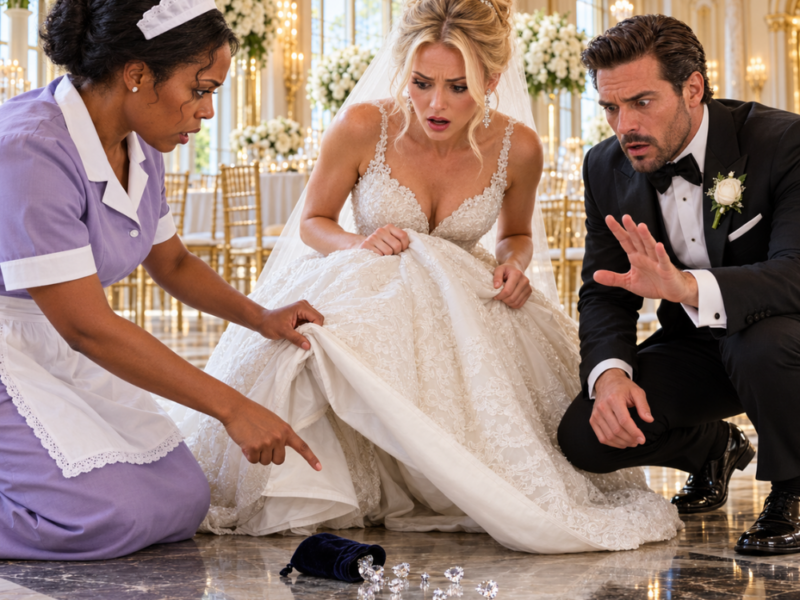
“Search the Dress!” the Maid Cried — The Billionaire’s Fiancée Turned Pale as Diamonds Fell
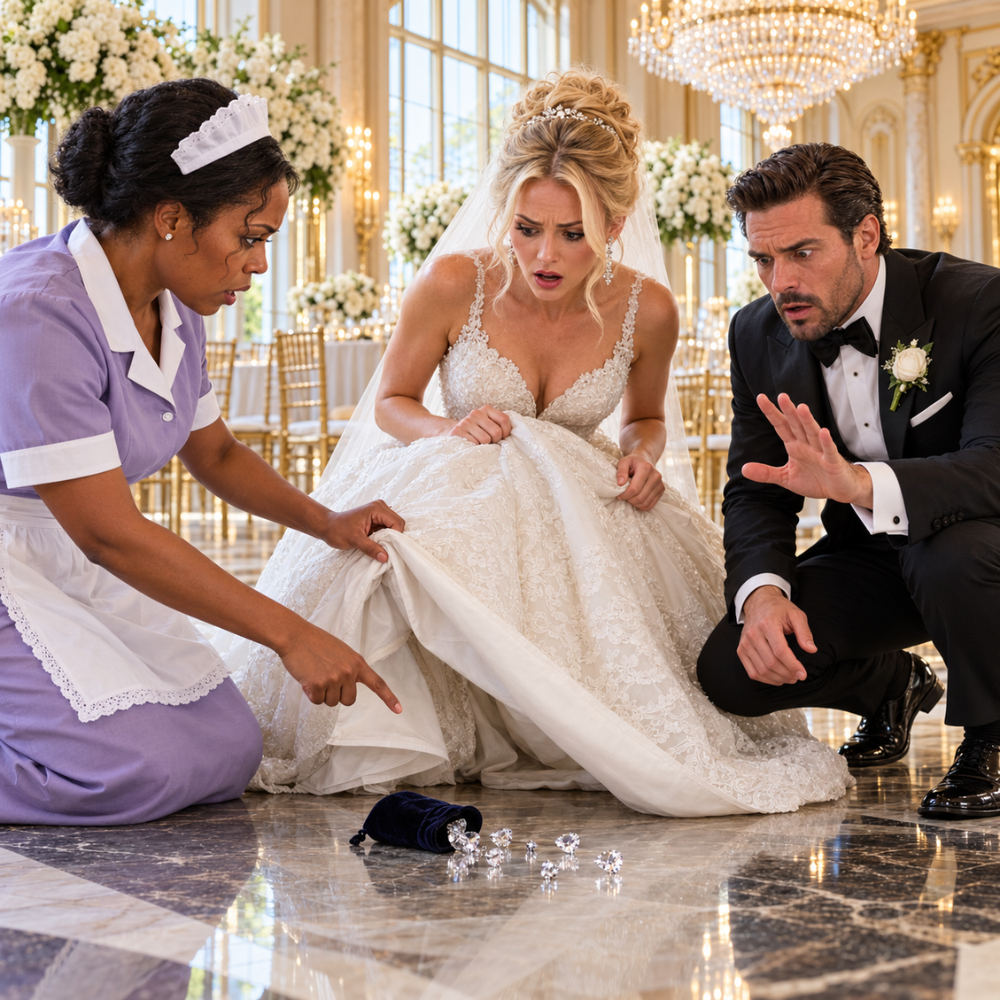
“Search the dress,” the maid cried—then five missing diamonds fell onto the billionaire’s marble table
“Search the dress.”
Maya Brooks did not mean to shout.
She had spent most of her life learning how not to draw attention to herself in rooms where attention belonged to people with more money, more authority, or better last names.
But there were nearly two hundred wedding guests inside the marble hall of the Cross estate, Celeste Vale was already turning toward the side doors, and the pale blue train of her ivory wedding gown was dragging across the floor with the same faint, uneven weight Maya had noticed three days earlier.
So Maya raised her voice.
“Search the dress.”
The quartet stopped playing.
A woman in the third row lowered her champagne flute.
Someone near the back whispered, “What did she say?”
At the altar, Adrian Cross stared at Maya as if she had just spoken from the ceiling.
Maya stood halfway down the aisle in a light lavender staff uniform, one hand wrapped around the wooden handle of an old sewing box.
Twenty-nine years old.
Suspended from the Cross household only forty-eight hours earlier.
Publicly suspected of stealing six heirloom diamonds worth enough money to change several lives.
One of those diamonds had been found inside her locker.
Security footage had appeared to place her near the family vault during the hour of the theft.
And now she had walked into the wedding of one of the wealthiest men in the region and accused somebody of hiding the missing stones inside the bride’s gown.
Celeste’s face remained composed.
Only her hands betrayed her.
Her fingers tightened around the pale blue train.
“Maya,” Adrian said quietly.
Celeste turned toward him.
“She should not even be here.”
Maya did not look at Adrian.
She looked at the train.
The lower left corner sagged by less than an inch.
Nobody else in the room would have noticed.
Maya had.
Because Maya Brooks had grown up above an alteration shop.
Her mother could find a crooked hem from across a church sanctuary.
Maya could hear a bad stitch before she saw one.
Three days earlier, while lifting Celeste’s train during a private fitting, Maya had heard something tap softly beneath the silk.
Not fabric.
Not boning.
Something hard.
Something small.
Something that should not have been there.
Now the train dragged exactly the same way.
Celeste recovered first.
“This is absurd.”
Her voice carried cleanly through the silent hall.
She turned toward the guests with the graceful embarrassment of a woman apologizing for somebody else’s bad manners.
“Maya is under enormous stress. She has been accused of something serious, and apparently—”
“I was framed.”
Celeste looked back.
There was steel beneath the bridal smile now.
“You were found with one of the diamonds.”
“In my locked employee locker.”
“Yes.”
“Which Victor Shaw has a master key to.”
The security director stood near the side of the hall.
Tall.
Clean-shaven.
Dark suit.
For almost two years, Victor had managed the estate’s electronic locks, security cameras, contractor access, visitor logs, and staff key system.
He did not move.
Maya continued.
“The security footage supposedly showing me near the vault had the wrong time attached to it.”
A murmur traveled through the guests.
Celeste’s composure weakened.
“That is a lie.”
Adrian spoke.
“No.”
The single word silenced the room again.
He looked older than he had an hour earlier.
Not physically.
Simply like a man who had learned too much in too little time.
“The timestamp was false.”
Celeste stared.
Adrian continued.
“The linens Maya was carrying in that recording did not arrive at the estate until almost four hours after the time shown on the video.”
Victor’s face changed.
Barely.
Enough for Maya to see.
Celeste looked toward him.
Then quickly away.
Maya felt the pieces settle.
Not proof yet.
But pressure.
Exactly where it belonged.
Celeste took one step backward.
“This is supposed to be our wedding.”
“It was,” Adrian said.
The sadness in his voice cut deeper than anger would have.
Then movement appeared at the rear of the hall.
Detective Daniel Alvarez entered with two officers.
He held a folder in one hand.
The guests shifted aside.
Celeste’s face lost its color.
“What is this?”
Alvarez stopped several feet from her.
“Ms. Vale, I have a court order authorizing examination of the detachable train of your wedding gown, its protective garment bag, and designated luggage connected to the wedding party.”
Someone gasped.
Celeste laughed.
The sound was brittle.
“You cannot possibly be serious.”
“I am.”
“You want to cut open my wedding dress in front of two hundred people?”
“No.”
Alvarez’s voice remained calm.
“The detachable train can be removed. We can conduct the examination privately.”
Celeste looked at Adrian.
“You’re allowing this?”
Adrian’s jaw tightened.
“I’m asking for the truth.”
“You believe her.”
“I believe the evidence needs to be examined.”
“On our wedding day.”
Adrian did not answer.
That answer said enough.
Celeste’s eyes moved toward the side door.
Victor moved at almost the same moment.
Too small a motion for most people to notice.
Maya saw it.
So did Alvarez.
“Mr. Shaw.”
Victor stopped.
“Stay where you are.”
The entire wedding hall seemed to inhale.
And three days of fear, suspicion, humiliation, and tiny details nobody had thought important finally converged on the blue train pooled around Celeste Vale’s feet.
It had begun Tuesday morning with a sound so faint Maya nearly ignored it.
At twenty-nine, Maya had worked for the Cross family for four years.
She had never expected to spend that much of her life in domestic service.
At nineteen, Maya assumed she would inherit Brooks Alterations from her mother.
The shop occupied the ground floor of a narrow brick building on a commercial strip in suburban Maryland, wedged between a barber shop and a tax-preparation office.
Above it was a two-bedroom apartment where Maya had grown up.
The shop smelled of steam, chalk, fabric sizing, and coffee her mother routinely forgot until it went cold.
Evelyn Brooks could alter almost anything.
Wedding gowns.
Prom dresses.
Choir robes.
Men’s suits.
Military uniforms.
Funeral clothes.
She understood cloth the way mechanics understood engines.
“If something hangs wrong,” she told Maya when Maya was seven, “don’t start cutting.”
“Why?”
“Because fabric tells you why it’s unhappy if you look long enough.”
By twelve, Maya could replace a zipper.
By sixteen, she was altering bridesmaid dresses.
By twenty-one, she could rebuild a lined jacket without leaving visible evidence that it had ever been opened.
The shop paid bills but rarely created savings.
Then Evelyn became ill.
Nothing catastrophic at first.
Joint pain.
Fatigue.
Then an autoimmune diagnosis that turned ordinary work into a fight against her own hands.
Some mornings Evelyn could sew.
Others, she could barely close scissors.
Maya took more jobs.
Then caregiving.
Then debt.
Eventually they closed the storefront.
They kept the lease for almost six desperate months because surrendering the shop felt like surrendering Evelyn’s identity.
Finally the landlord posted a late notice.
Maya handed over the keys.
She cried in the parking lot.
Two weeks later, she accepted work at the Cross estate.
The job came through a former Brooks Alterations customer who managed staffing for several wealthy households.
The starting wage was higher than Maya expected.
Health insurance.
Paid time off.
A retirement contribution.
Most importantly, predictable hours.
At first Maya told herself she would stay one year.
Then Evelyn’s treatments became more expensive.
One year became two.
The Cross household was large enough to require structure but not so large that employees became anonymous.
The estate sat outside Washington on wooded acreage behind stone walls and wrought-iron gates, though the Cross family itself was less theatrical than the property suggested.
Adrian Cross had inherited part of his wealth and multiplied it through technology investments, hotels, and commercial real estate.
His mother, Eleanor Cross, still lived at the estate when Maya arrived.
Eleanor was seventy-eight and already ill.
She disliked nurses in her bedroom.
She disliked strangers touching her clothes.
She disliked being helped in general.
Maya won her over accidentally.
One afternoon, Eleanor insisted on wearing an old navy suit to a family lunch.
The jacket would no longer close comfortably.
A private nurse suggested another outfit.
Eleanor snapped.
Maya quietly said, “I can give you an inch and a quarter without cutting the outer cloth.”
Eleanor turned.
“You can?”
“Yes, ma’am.”
“How?”
“The back seam allowance.”
Eleanor narrowed her eyes.
“You know tailoring?”
“My mother does. I learned.”
Twenty minutes later, the jacket fit.
Eleanor ate lunch downstairs.
After that, Maya became the only staff member allowed near certain clothes.
Then near Eleanor.
During the final eighteen months of Eleanor’s life, Maya helped with small things.
Buttons when fingers hurt.
Shoes.
A blanket in the garden.
Tea.
Once, at two in the morning after Eleanor woke frightened and confused, Maya simply sat beside the bed until dawn.
Adrian never forgot it.
Maya never mentioned it.
She was paid for work.
Some of that work happened to require kindness.
After Eleanor died, Adrian offered Maya a raise.
She accepted.
Nothing more.
There was never anything improper between them.
No secret romance.
No Cinderella fantasy hidden beneath the uniform.
Maya liked Adrian.
Respected him.
Sometimes felt sorry for him.
Wealth created certain comforts and removed certain privacy.
His mother’s death became public news.
His business decisions became gossip.
His engagement to Celeste Vale attracted reporters before invitations had even been mailed.
Celeste came from a wealthy family too, though not Cross wealthy.
Her father had run an investment firm.
Her mother sat on museum boards.
Celeste knew how to enter a room.
She knew photographers’ names.
She remembered donors.
She sent elegant handwritten notes.
At charity lunches, older women adored her.
With household staff, she was never openly cruel.
That would have required effort.
She simply became colder.
“Maya, this water is room temperature.”
“Maya, please tell the florist white means white, not cream.”
“Maya, that tablecloth has been pressed, but not well.”
Always polite enough to deny.
Never warm enough to mistake.
Maya did her job.
The wedding grew around them.
Imported roses.
A chamber ensemble.
Temporary flooring over part of the garden.
A six-tier cake from a bakery that charged more than Evelyn had once charged for an entire month of wedding alterations.
Nearly two hundred guests.
Governors.
Executives.
Old family friends.
University presidents.
People Maya recognized from television and people important enough not to appear there.
Celeste planned every detail.
Three days before the ceremony, Adrian’s aunt Margaret Cross arrived with a bonded courier and a velvet case.
Maya saw the arrival only because she was carrying fresh table linens through the East Wing.
Margaret was Eleanor’s younger sister.
Sixty-seven.
Elegant in the unstudied way of women who had worn good clothes long enough to stop using them for performance.
She had known Maya since Eleanor’s illness.
“Good morning, sweetheart.”
“Morning, Mrs. Cross.”
“Margaret.”
“You’ve been telling me that four years.”
“One day you’ll listen.”
Maya smiled and continued down the hall.
Inside the velvet case were six loose diamonds from an old Cross necklace.
Maya learned that later.
The necklace had belonged to Adrian’s grandmother and had been damaged decades earlier.
The family kept the stones loose in a bank safe-deposit box.
Margaret had recently brought them out because Adrian planned to give them to Celeste after the wedding so she could choose a new setting.
The stones were not enormous movie jewels.
They did not need to be.
Each was valuable.
Together they carried history more important to the Cross family than their market price.
Margaret placed the case inside the estate’s small family vault.
The vault sat inside a secure room near Adrian’s study.
It was opened with a brass key stored separately inside a locked drawer.
Victor Shaw supervised the process.
He logged the courier.
Recorded the handoff.
Checked the camera.
Returned the study key ring.
Everything appeared routine.
At 11:15, Celeste called Maya to the bridal suite.
“Hold this.”
She stood before a three-panel mirror wearing her wedding gown.
Maya lifted the pale blue detachable train.
The gown itself was ivory silk.
Elegant.
Minimal.
The train provided the drama, a long wash of muted blue attached at the back waist and flowing several feet behind.
Maya had seen more complicated gowns in her mother’s shop.
This one was beautifully made.
The designer’s internal stitching was tiny and regular.
Hand finishing almost invisible.
Maya adjusted the left side.
Something felt wrong.
She ran her fingers lightly along the hem.
Machine stitches.
Machine stitches.
Machine stitches.
Then white hand thread.
Cheap thread.
Not bad thread.
Ordinary.
Wrong for a garment constructed at this level.
Maya looked closer.
The original stitch line stopped.
A hand seam began.
Fresh.
She lifted the train.
A small section sagged.
Then she heard it.
Tap.
Soft.
Metal or stone against a hidden layer.
Celeste turned.
“What?”
“This hem has been opened.”
Celeste’s face tightened.
“It has not.”
“Did the designer repair it?”
“No.”
“There are fresh stitches.”
Celeste pulled the train from Maya’s hands.
“It caught on something during transport.”
“Then I should reinforce it before Saturday.”
“No.”
Maya blinked.
“I can do it without changing the fall.”
“I said no.”
The tone sharpened.
Then softened immediately.
“I’m sorry. I’m simply exhausted.”
Maya watched her.
Celeste smiled.
“The designer does not want anyone else touching it.”
“If the seam opens while you’re walking—”
“It won’t.”
A movement appeared in the mirror.
Victor stood in the doorway.
Celeste looked at him.
Victor looked at the train.
A glance.
Fast.
Maya noticed because she noticed things.
Victor said, “Your car is ready.”
Celeste stepped down from the fitting platform.
“Maya, put the gown back in the garment bag.”
Maya did.
She thought about the sound for perhaps another ten minutes.
Then florists arrived.
A rental company delivered chairs.
The caterer needed freezer space.
Wedding houses manufacture emergencies.
By noon, the strange hem had almost left Maya’s mind.
At 12:48, a soft alarm sounded in the East Wing.
Victor moved first.
Doors closed.
Security personnel appeared.
Adrian came from his office.
Margaret followed.
Within minutes, everyone knew something was wrong.
The diamonds were gone.
The velvet case remained inside the family vault.
Open.
Empty.
The brass key was missing.
No damaged lock.
No broken window.
No forced entry.
Victor called the county police.
Detective Alvarez arrived with two officers.
Maya knew him only as the man who had investigated a vehicle break-in at the estate the previous year.
Quiet.
Middle-aged.
No dramatic attitude.
He asked staff to stay where they were.
Nobody was searched immediately.
That detail mattered later.
Victor listed everyone with access near the East Wing that morning.
Seven employees.
Two family members.
Celeste.
Adrian.
Margaret.
Victor himself.
A catering manager.
A florist.
Maya, who had carried linens past Adrian’s study.
Celeste stood near Adrian.
Her hand covered her mouth.
Then she said:
“I saw Maya watching when Margaret put the key away.”
Maya stared.
Adrian turned.
“Celeste.”
“What?”
“That is an accusation.”
“It is an observation.”
“I walked through the hallway,” Maya said.
Celeste looked at her.
“You stopped.”
“To speak with Mrs. Cross.”
Margaret nodded.
“She did.”
Celeste’s eyes moved toward Maya.
“I’m only saying what I saw.”
The politeness made it worse.
Victor suggested checking staff lockers.
Alvarez stopped him.
“Not yet.”
Victor looked surprised.
“We have a stolen item and employees leaving throughout the day.”
“Then we preserve exits.”
He assigned an officer near the service area.
“Voluntary locker access only. Anyone who declines, we deal with through proper process.”
Maya appreciated that.
So did several employees.
Nobody refused.
The search began with the lockers belonging to staff who had worked closest to the East Wing.
Maya opened hers herself.
Victor stood behind Alvarez.
Maya removed her tote.
Coat.
Sweater.
Spare shoes.
When she lifted the left work shoe, something struck the metal shelf.
A tiny click.
Then rolled.
A diamond landed on the bench.
For perhaps three seconds, Maya did not understand what she was seeing.
Then every face changed.
Alvarez moved quickly.
“Nobody touch it.”
He covered the stone with an evidence cup.
Maya stared.
“I did not put that there.”
Celeste stepped closer.
“Oh my God.”
“I did not put it there.”
Victor said, “Detective—”
Alvarez lifted one hand.
“No one talks over her.”
He looked at Maya.
“When did you last open this locker?”
“This morning.”
“Time?”
“Before seven.”
“Was the shoe inside?”
“Yes.”
“Did you wear it?”
“No. I changed into flats because we were moving furniture.”
“Who has keys?”
“My key.”
“Anyone else?”
Maya looked toward Victor.
“Security has master access.”
Victor answered evenly.
“For emergencies.”
Alvarez wrote that down.
Celeste said, “Surely this is enough.”
“Enough for what?”
“To arrest her.”
Alvarez looked at Celeste.
“No.”
Her face showed genuine surprise.
“A stolen diamond is in her locker.”
“Yes.”
“That is not enough?”
“It is evidence.”
He looked toward Maya.
“It is not an explanation.”
Adrian stood several feet away.
Maya looked at him.
She saw hurt.
And uncertainty.
The uncertainty hurt more.
Four years.
His mother’s final months.
Every breakfast tray.
Every evening schedule.
Every key she had been trusted with.
And one stone had created a question in his face.
Maya knew that was human.
Knowing did not make it painless.
The camera problem appeared thirty minutes later.
Victor informed Alvarez that the East Wing hallway file covering the relevant hour was missing.
“Missing how?”
“Server corruption.”
“Only that camera?”
Victor hesitated.
“That file block.”
“Other cameras?”
“Operating.”
Alvarez wrote again.
Victor added:
“Our technicians may be able to recover a partial local cache.”
Alvarez looked up.
“Do not alter anything until my digital unit reviews the system.”
Victor smiled professionally.
“Of course.”
Maya was interviewed in the library.
She explained the linens.
Margaret.
The fitting.
The changed hem.
At first Alvarez seemed unsure why the dress mattered.
Then Maya described the tap beneath the silk.
His pen stopped.
“What did it sound like?”
“Hard object against something stiff.”
“Metal?”
“Maybe.”
“Could it have been decorative?”
“No decoration belongs inside that portion of the train.”
“Could the hem have been weighted?”
“Yes, but not like that. Dress weights are distributed differently.”
“How sure are you?”
Maya thought.
“Enough that I told Celeste it needed to be opened.”
Alvarez wrote that down.
“Who was present?”
“Celeste.”
“Anyone else?”
“Victor came to the doorway.”
“What happened?”
“She refused.”
Alvarez’s eyes lifted.
“Refused what?”
“To let anyone repair it.”
He wrote another line.
By evening, Maya had not been arrested.
That did not make the day less devastating.
Adrian asked her to take paid leave.
“We need to let police work.”
Maya stood beside the service entrance holding her tote.
“I understand.”
“I’m not firing you.”
“That is a low bar.”
The sentence escaped before she could stop it.
Adrian’s face tightened.
“You’re right.”
Maya regretted hurting him.
Not enough to apologize.
He continued.
“I don’t know what happened.”
“I do.”
He looked at her.
“I didn’t steal them.”
“I want to believe you.”
There it was.
Want.
Not do.
Maya swallowed.
Victor approached with her handbag.
“Ms. Brooks.”
She took it.
As she turned toward the door, Victor said quietly:
“Go home.”
Maya stopped.
“Keep your mother out of this.”
She looked back.
Victor’s expression remained neutral.
“Excuse me?”
“News travels.”
“What does my mother have to do with anything?”
“Nothing. Keep it that way.”
Then he walked off.
That was the first moment Maya became afraid.
Not of losing her job.
Of being chosen.
Somebody had picked her specifically.
The diamond did not fall into the locker by accident.
The threat confirmed it.
Maya drove to her mother’s apartment above the old alteration shop.
They no longer operated the storefront, but the landlord allowed them to keep the upstairs unit under a separate residential lease.
The dark shop below remained empty.
Its old sign still hung over the sidewalk.
BROOKS ALTERATIONS
Appointments Welcome
The word Welcome had faded most.
Evelyn was asleep when Maya arrived.
Maya did not wake her.
She went downstairs.
Unlocked the shop.
Dust covered part of the cutting table.
The old industrial sewing machines were draped under sheets.
A rack of forgotten garment hangers stood against the wall.
Maya turned on the lamp above the table.
Then sat.
For almost twenty minutes she did nothing.
Finally she opened her mother’s sewing box.
Pins.
Tailor’s chalk.
Black thread.
White thread.
Small embroidery scissors.
The silver seam ripper Evelyn gave Maya on her sixteenth birthday.
Maya picked it up.
The bridal train returned to her mind.
Machine stitches.
Fresh white hand thread.
Sagging left corner.
Tap.
She grabbed paper.
Six diamonds missing.
One found in locker.
Five unaccounted for.
Key missing.
Fresh seam.
Something hard inside.
Victor near fitting.
Victor controls cameras.
Victor controls master locker keys.
Maya stared at the list.
Then added:
Why Celeste?
She did not know.
Suspicion was not proof.
Her mother would have told her that.
Evelyn did tell her, twenty minutes later.
Maya had not heard her come downstairs.
“What are you doing?”
Maya turned.
Evelyn stood in the doorway wearing a robe and slippers.
“You should be asleep.”
“So should you.”
“I’m serious.”
“So am I.”
Evelyn saw Maya’s face.
“What happened?”
Maya told her.
Not every fear.
Enough.
Her mother listened.
When Maya finished, Evelyn looked at the paper.
“Who do you trust there?”
Maya thought.
“Margaret.”
“Then call Margaret.”
“Adrian?”
“Do you trust him?”
Maya hesitated.
Evelyn nodded.
“That answers it for tonight.”
“Mama.”
“I didn’t say he’s bad.”
“He isn’t.”
“I said call the person you trust.”
Maya looked at the sewing box.
Evelyn sat across from her.
“You think it’s in the dress?”
“Yes.”
“You know?”
“No.”
“Good.”
Maya frowned.
“Good?”
“Knowing what you don’t know keeps you from sounding like a fool.”
Evelyn tapped the paper.
“Proof first.”
Margaret arrived an hour later wearing rain boots under tailored pants because the forecast had turned unexpectedly wet.
She entered the dark alteration shop and looked around.
“I haven’t been here in years.”
“You came when Mom altered that blue gown.”
Margaret smiled.
“She saved me from wearing something that made me look upholstered.”
Evelyn called from upstairs:
“It did.”
Margaret laughed.
Then Maya showed her the notes.
The smile disappeared.
Margaret listened carefully.
“So you think the other stones may be in Celeste’s train.”
“I think something was sewn inside it after the designer finished the dress.”
“Different claim.”
“Yes.”
Margaret nodded approvingly.
“Good.”
Maya looked at her.
“My mother said almost the same thing.”
“Smart woman.”
They needed evidence the gown had been altered.
Margaret searched her phone.
Two weeks earlier she had attended Celeste’s final fitting at the designer’s studio.
Photographs.
Mirror shots.
Celeste smiling.
The designer pinning the veil.
One showed the train spread across a white platform.
Maya enlarged it.
Left lower corner.
Smooth.
Continuous machine stitch.
No sag.
No white hand thread.
“There.”
Margaret leaned closer.
“You’re sure?”
“Yes.”
“Could the photograph hide it?”
“No. The entire hem section is visible.”
Margaret sent the original image to Alvarez.
Then wrote down when and where it had been taken.
Maya said, “Do not tell Victor.”
Margaret looked at her.
“You think he’ll move the dress.”
“If he has anything to move.”
Margaret nodded.
“What about Celeste?”
“Do not tell her either.”
“You’re asking me to keep a secret from my nephew’s bride three days before their wedding.”
“Yes.”
Margaret sighed.
“Eleanor would love this.”
Despite everything, Maya smiled.
The next morning, Adrian asked Maya to return for a private meeting.
Alvarez attended.
Margaret.
Celeste appeared uninvited.
“If my gown is being discussed, I am staying.”
Maya described the seam.
Margaret showed the photograph.
Adrian zoomed in.
Celeste watched him.
Finally she said:
“The train tore after that fitting.”
Maya looked at her.
“Who repaired it?”
“The designer.”
“Yesterday you said no seamstress had touched it.”
“I didn’t want household staff doing additional work.”
“That was not what you said.”
Celeste’s eyes hardened.
“Are you calling me a liar?”
Maya could feel every class distinction in the room.
A maid accusing the future Mrs. Cross.
Uniform versus silk blouse.
Hourly wage versus family money.
Maya answered carefully.
“I’m saying the explanation changed.”
Alvarez stepped in.
“Can I examine the train?”
Celeste’s answer came instantly.
“No.”
“Why?”
“Because my wedding is in two days and I am not allowing the police to cut open an irreplaceable couture gown because a suspended employee heard something tap.”
“We can begin non-destructively.”
“No.”
Adrian looked at her.
“Celeste.”
She turned.
“You cannot possibly think this is reasonable.”
“I think six diamonds are missing.”
“And one was in her locker.”
Maya felt the sentence strike.
Then Victor entered carrying a tablet.
“I’m sorry to interrupt.”
Alvarez immediately looked toward the device.
Victor continued.
“My technician recovered part of the hallway file.”
Maya’s stomach tightened.
Victor placed the tablet on the table.
Video.
East Wing.
Maya carrying folded towels.
Timestamp:
9:12 A.M.
She walked past Adrian’s study.
Slowed.
Disappeared around the corner.
Fifty-two seconds later, she reappeared without the towels.
Celeste looked at Adrian.
Maya stared.
The video was real.
She remembered doing exactly that.
But not Tuesday morning.
“When was this recorded?”
Victor pointed.
“Timestamp is embedded.”
“No.”
He looked at her.
“Maya.”
“I carried those towels later.”
“Do you have proof?”
Maya looked again.
Blue monogram.
A dark C inside a silver circle.
Wedding guest towels.
New order.
Her heart changed rhythm.
“Pause it.”
Victor did not move.
Alvarez took the tablet.
Paused.
Maya pointed.
“Those linens.”
Adrian leaned closer.
“What?”
“They were delivered Tuesday afternoon.”
Victor said, “You’re mistaken.”
“No.”
Maya pulled out her phone.
“I signed for them.”
She searched email.
Delivery notification.
Shipment receipt.
1:07 P.M.
Margaret stood.
“My God.”
Alvarez took the phone.
Compared it to the image.
Blue monogram.
Silver circle.
He called the supplier from the library.
Tracking confirmed the truck reached the Cross estate just after one.
The camera footage was authentic.
The timestamp was not.
Maya had passed Adrian’s study.
But almost four hours after the diamonds disappeared.
Victor’s face remained controlled.
“That could be a server synchronization error.”
Alvarez looked at him.
“Then why does the file metadata show manual export?”
Victor said nothing.
Alvarez’s attention sharpened.
“You told me technicians recovered this.”
“They did.”
“Who?”
Victor named an employee.
Alvarez wrote it down.
Then turned toward Adrian.
“Your original camera system backs up externally?”
“Yes.”
Victor interrupted.
“Not continuously. Certain data—”
Alvarez looked at him.
“I’ll ask the provider.”
That meeting ended differently.
Maya was not cleared.
The diamond remained unexplained.
But the case had changed.
Somebody had manipulated time.
Maya no longer looked like the only person with something to explain.
At the station, Alvarez reviewed the clip again.
“Who can edit exported files?”
“Victor,” Maya said.
“Anyone else?”
“Security technician, maybe.”
“Adrian?”
“He can view cameras from his phone. I don’t think he manages files.”
Alvarez confirmed it.
Victor had administrative access.
Two technicians had limited privileges.
The outside vendor held independent backups.
Alvarez requested preservation and recovery directly.
Then he asked about the staff lockers.
Victor’s original written report had not mentioned his master key.
Only when Alvarez specifically asked had he admitted that one existed.
Another omission.
Another little seam.
Maya returned to the closed alteration shop.
This time Evelyn was downstairs at the sewing machine.
“You look better.”
“I’m still suspected of grand theft.”
“You look better while suspected.”
Maya sat.
“Useful.”
Evelyn kept sewing.
“What are you making?”
“Curtain.”
“For who?”
“My kitchen.”
“You hate sewing now.”
“I hate deadlines.”
Fair.
Maya told her about the towels.
Her mother nodded.
“Thread tells on people.”
“It was a timestamp.”
“Same principle.”
“Mama.”
“Everything leaves a seam.”
That afternoon, Margaret called.
“I found the designer.”
Celeste had claimed the woman was traveling and unreachable.
Technically true.
She was in Paris.
Her business manager contacted her.
No repairs had been made after the final fitting.
The studio transfer record documented the gown leaving in perfect condition.
And someone surprising had collected it.
Victor Shaw.
Maya stood.
“Victor?”
“Signed personally.”
“When?”
“Ten thirty-four Tuesday morning.”
“What time did he return to the estate?”
Margaret had already checked with Alvarez.
Gate log:
11:47.
The studio was twenty minutes away.
Victor had nearly an hour unaccounted for with the gown.
The transfer sheet contained another note.
Do not open garment bag during transport.
Requested by collector.
“Victor requested that?”
“Yes.”
Maya felt the case locking into place.
Not completely.
But enough to see its shape.
Cameras.
Master locker key.
Gown.
Missing time.
“Take it to Alvarez.”
“Already driving.”
The detective asked a judge for authorization to examine the train and related luggage.
Until then, nobody touched it.
That legal delay frightened Maya.
If Victor realized the investigation had shifted, he could remove the stones.
But investigators did not get to destroy privacy because a theory felt convincing.
Maya understood that.
So they waited.
Adrian came to the station that evening.
Maya sat across from him.
He watched the false timestamp video.
Then the supplier record.
Then read the designer transfer sheet.
Victor’s signature.
Adrian leaned back.
For a long time, he said nothing.
Finally:
“I owe you an apology.”
Maya looked at him.
“Yes.”
He seemed almost relieved she did not make the moment easier.
“I wanted to believe you.”
“There’s that phrase again.”
He winced.
“I know.”
“You trusted Victor’s title more than my word.”
“I trusted footage.”
“Edited footage.”
“I didn’t know that.”
“Neither did I.”
He looked at her.
Maya continued.
“But I knew who I was.”
Adrian nodded.
“That is fair.”
“No.”
She shook her head.
“Fair would have been looking at all of us equally.”
Adrian absorbed it.
“What do you want me to do?”
“Clear my name.”
“I mean afterward.”
“I’m not there yet.”
He nodded.
The wedding should have been postponed immediately.
Adrian wanted to do exactly that.
Alvarez asked him not to alert Victor until they understood more.
Celeste had not yet been tied directly to the theft.
Suspicious behavior was not enough.
Adrian agreed.
That decision turned the remaining wedding preparations into the strangest two days Maya had ever lived through.
The estate moved toward celebration while police quietly moved through the background.
Florists filled the hall.
Caterers stocked refrigerators.
A pianist tested acoustics.
Tailors steamed suits.
Guests began arriving at hotels.
Victor continued giving security instructions.
Celeste attended rehearsal.
Everyone smiled.
Friday night, an officer watching the property saw Victor enter the bridal wing carrying an empty garment case.
By then Margaret had already moved Celeste’s gown into her suite, claiming the bridal room had too much foot traffic.
Victor tried the door.
Locked.
He waited.
Then left.
Minutes later, he sent a text.
Investigators later learned it went to Celeste.
At the time, Margaret saw only Celeste look at her phone across the guest hall and visibly relax.
Interesting.
Saturday morning arrived bright and cold.
The Cross estate looked like a magazine spread.
White roses.
Ivory ribbons.
Tall glass candles.
Musicians tuning in the hall.
Guests entering through the front terrace.
Maya arrived beside Margaret at nine.
For the first time in four years, she entered through the formal front door.
Not the service entrance.
She carried Evelyn’s old wooden sewing box.
Victor spotted her almost immediately.
His face showed nothing.
Then Celeste came downstairs.
The gown moved beautifully.
Except for the train.
Maya saw the weight instantly.
Still there.
The stones had not been removed.
Celeste saw Maya.
Her smile vanished.
“What is she doing here?”
Margaret answered.
“She’s with me.”
Celeste looked toward Victor.
“Remove her.”
Two security guards shifted.
Adrian stepped into the hall.
“No.”
The guests nearest the front began watching.
Celeste lowered her voice.
“Adrian.”
“Maya is here at my invitation.”
“You cannot be serious.”
“I am.”
Celeste looked around.
The room was filling.
Her public face returned.
She smiled.
“All right.”
Then she walked toward the ceremony.
Maya saw Victor move toward the side corridor.
An officer dressed as event staff followed.
The ceremony began.
Music.
Guests rose.
Celeste appeared at the back of the hall.
Her father beside her.
The train slid across the marble.
One weighted corner.
Maya’s heart pounded.
She knew Alvarez was waiting for the signed search authorization.
She knew he could not act until it arrived.
Celeste walked.
Adrian stood at the altar.
For a strange moment Maya wished she were wrong.
Not because she doubted herself.
Because being right would destroy people.
The officiant began.
Then an officer appeared quietly near Alvarez and handed him a folder.
Authorization.
Alvarez nodded toward Adrian.
Adrian looked at Celeste.
“Maya.”
Celeste turned.
“What?”
Maya stepped into the aisle.
The train pulled slightly around Celeste’s hand.
Maya saw fresh pressure in the hem.
Celeste began moving toward the side doors.
And Maya shouted.
“Search the dress.”
Everything stopped.
Now, inside the marble hall, Alvarez explained the order.
Celeste refused.
Then cried.
Then appealed to Adrian.
“You are humiliating me.”
Adrian’s face was pale.
“I am trying not to marry into a lie.”
That sentence ended the argument.
An attendant unfastened the detachable train.
No scissors near Celeste.
No public stripping.
The ivory gown itself remained untouched.
The train was carried to a long marble serving table along the side wall.
Maya did not touch it immediately.
Alvarez documented the condition.
Photographs.
Video.
Exact location.
Then he asked:
“Show me.”
Maya put on gloves.
She pointed toward the lower left corner.
“Designer machine stitch.”
Her finger moved.
“Stops here.”
Then the white thread.
“Hand repair begins.”
“How do you open it without damaging whatever is inside?”
“Cut thread only.”
He nodded.
Maya opened her mother’s sewing box.
The silver seam ripper lay inside.
For one second she remembered being sixteen.
Evelyn handing it to her.
Never force fabric.
Find the stitch holding the problem closed.
Maya slid the tip beneath the first white thread.
Cut.
Second.
Third.
The wedding hall was silent.
Four.
Five.
Six.
The seam opened slightly.
Something shifted beneath her fingers.
Hard.
Maya looked at Alvarez.
He brought an evidence tray closer.
Maya separated the lining.
A diamond rolled out.
It struck marble with a small bright click.
Someone gasped.
Another stone followed.
Then another.
Five diamonds in total.
The last object landed differently.
Metal.
A small brass key.
Margaret covered her mouth.
“The vault key.”
Celeste stepped backward.
Adrian did not move.
Maya looked toward Victor.
He had gone pale.
Then he turned toward the service exit.
Two plainclothes officers stepped into his path.
“Mr. Shaw.”
Victor stopped.
Celeste pointed at him.
“He did this.”
Victor looked toward her.
Open disbelief.
“He transported the gown,” Celeste continued. “He had access to everything.”
Alvarez raised one hand.
“Ms. Vale, stop.”
“He used my dress.”
“Stop speaking for a moment.”
“I had no idea.”
The explanation was possible.
Victor had possessed the gown.
Victor controlled cameras.
Victor controlled lockers.
Maya understood that.
So did Alvarez.
Nobody arrested Celeste simply because she looked frightened.
Then Alvarez’s tablet signaled.
The offsite security vendor had recovered the preserved hallway files.
Not Victor’s exports.
Original backup.
Alvarez moved to a side table.
Adrian.
Margaret.
One officer.
Maya stayed where she was.
The first recording appeared.
Tuesday.
9:06 A.M.
Adrian’s study hallway.
Victor stood near the corner.
Then Celeste entered.
She looked both directions.
Unlocked the study door.
Inside for less than a minute.
She emerged carrying something small in her hand.
The brass key.
Adrian whispered:
“Celeste.”
She closed her eyes.
The next camera showed Celeste and Victor entering the secure hall.
Seven minutes later, returning.
Celeste carried the velvet case beneath a folded shawl.
Victor disappeared toward the security room.
Another restored file showed Victor entering staff storage twenty minutes before the voluntary locker search.
Master key.
Maya’s locker.
Forty-five seconds.
He left.
Empty-handed.
Maya felt her knees weaken.
There it was.
The moment her life had been narrowed to one diamond.
Not bad luck.
Not suspicion.
A man unlocking her locker because he believed she was an easy person to sacrifice.
Celeste sat in the nearest chair.
Nobody approached her.
Adrian looked at the woman he had planned to marry.
“Why?”
Celeste said nothing.
Alvarez read her rights.
Victor’s too.
They were taken away separately.
The wedding guests remained in stunned clusters.
No one knew whether to leave.
The cake still waited in another room.
Flowers still filled the hall.
A quartet had rehearsed six weeks for a wedding that no longer existed.
Adrian stood alone near the altar.
Maya almost went to him.
Then stopped.
Comfort had been part of her job for too many years.
This was not her responsibility.
Margaret crossed instead.
She put one arm around her nephew.
Maya quietly closed the sewing box.
Police work continued for weeks.
The hidden diamonds solved the theft.
The restored cameras solved the framing.
Victor’s phone explained the motive.
He and Celeste had been involved romantically for months.
Neither had intended to remain loyal to the other.
That became painfully clear in their messages.
Celeste had hidden large personal losses from Adrian after making reckless private investments.
The amounts were not enough to bankrupt her family.
They were enough to expose lies.
Adrian’s attorneys were preparing a prenuptial financial review before the wedding.
Celeste feared the review would reveal debts, undisclosed borrowing, and money she had told Adrian remained invested.
Victor knew.
They began discussing escape.
The diamonds offered liquidity.
Portable value.
No bank transfer easily frozen.
The original plan was crude but plausible.
Steal the stones days before the wedding.
Frame an employee with access near the vault.
Hide the remaining diamonds somewhere police were unlikely to search immediately.
Leave after the reception using honeymoon luggage and travel arrangements as cover.
Maya became the target because she worked near the East Wing.
Because Victor had a key to her locker.
Because Celeste had noticed Maya watching the vault delivery.
And because, according to one recovered message, Celeste believed:
“She is staff. Everyone will believe it.”
That sentence hurt Maya more than the accusation.
Not because it was clever.
Because Celeste had been almost right.
One diamond.
One altered video.
One uniform.
For several hours, people who had known Maya for years found doubt easier than disbelief.
Victor’s final betrayal appeared in a Friday-night message.
He told Celeste he had removed the diamonds from the train after sensing police presence at the estate.
He had not.
Investigators concluded he was preparing to abandon Celeste while letting her be discovered with the evidence.
The partnership had been built on using people.
It ended the same way.
Both eventually entered guilty pleas to theft-related charges, conspiracy, evidence tampering, and attempting to frame an innocent employee.
The case lasted months.
Maya testified only as required.
She avoided cameras.
Reporters wanted the story.
Maid Finds Diamonds in Bride’s Dress.
Wedding Theft Mystery.
Billionaire Bride Arrested.
Maya disliked all the headlines.
Every version reduced her to either victim or miracle.
She had been neither.
She noticed thread.
She kept notes.
She remembered the linens.
She asked questions.
That was less glamorous.
It was also true.
Adrian issued a public statement clearing her name.
His first draft referred to Maya as “a loyal member of our household whose integrity was ultimately vindicated.”
Maya called him.
“No.”
Silence.
“What?”
“Don’t release that.”
“Why?”
“Because it sounds like I’m a servant you’re praising for being good.”
“That was not my intention.”
“I know.”
“What do you want it to say?”
“The truth.”
He waited.
Maya dictated:
“Maya Brooks did not steal from the Cross family. Evidence shows she was deliberately framed. Her observations regarding the altered garment and security recording materially assisted the investigation.”
Adrian was quiet.
“That sounds like a police statement.”
“Good.”
He released almost exactly those words.
Two weeks after the case ended, Adrian came to Brooks Alterations.
The storefront remained closed.
Maya had been spending afternoons cleaning it.
Not because she had a plan.
Because dust was easier to manage than uncertainty.
Adrian entered carrying nothing.
No flowers.
No envelope.
No dramatic gift.
Maya appreciated that.
Evelyn was upstairs resting.
Adrian stood beside the old cutting table.
“I’m sorry.”
Maya kept folding fabric remnants.
“I know.”
“No.”
She looked up.
He continued.
“I said it before we knew everything.”
“Yes.”
“I was apologizing for doubting you.”
“Yes.”
“I need to apologize for why I doubted you.”
Maya became still.
Adrian looked toward the covered sewing machine.
“Celeste had social standing.”
Maya said nothing.
“Victor had a title and authority.”
Still nothing.
“You wore a staff uniform.”
Maya met his eyes.
“And when evidence became confusing, I treated those differences like information.”
There it was.
The real apology.
Not I’m sorry because you were innocent.
I’m sorry because I ranked credibility before I understood I was doing it.
Maya rested both palms on the cutting table.
“You did refuse to fire me.”
“That is not much to be proud of.”
“No.”
“I thought it was at the time.”
“I know.”
Adrian looked around.
“You won’t come back.”
It was not a question.
Maya shook her head.
“No.”
“I increased the position’s salary.”
“That’s good for the next person.”
“Your missed wages have been restored. We’re covering the legal fees caused by the investigation.”
“Those were appropriate.”
“Yes.”
“I’m still not coming back.”
Adrian nodded.
“Why?”
Maya looked toward the front window.
Faded lettering.
Brooks Alterations.
“Because I spent four years being trusted until the wrong person told a believable story.”
“That isn’t fair.”
“No.”
She smiled slightly.
“Trusting you again isn’t the same as working in your house again.”
Adrian accepted it.
Then Maya said something else.
“You need to change how staff access is handled.”
“We already have.”
“What?”
“Security keys now require electronic checkout.”
“Victor’s key didn’t.”
“No.”
“Camera administration?”
“Separated. No single employee can delete original footage.”
“Locker access?”
“Two-person authorization outside emergencies.”
“Complaint process?”
Adrian hesitated.
Maya raised an eyebrow.
“We’re building one.”
“Build it somewhere staff don’t report misconduct to the person managing the accused employee.”
He nodded.
“I will.”
That conversation ended without reconciliation theater.
They shook hands.
Adrian left.
Maya stood in the doorway watching his car disappear.
Evelyn called from the stairs.
“He apologize properly?”
Maya turned.
“Were you listening?”
“I am your mother.”
“That does not answer the question.”
“It answers every question.”
Maya laughed.
Three days later, Margaret came to the shop.
She carried a garment bag.
Maya stared.
“If there’s another diamond in there, I’m moving.”
Margaret smiled.
“No diamonds.”
She placed the bag on the cutting table.
Inside was an old evening gown belonging to Eleanor Cross.
1930s-inspired silk.
Water staining near the hem.
Weak shoulder seam.
Beading coming loose.
“She wore this to Adrian’s father’s inaugural foundation dinner.”
Maya touched the fabric.
“Beautiful.”
“It needs work.”
“Yes.”
“Would you take it?”
Maya looked at Margaret.
“As a favor?”
“No.”
“Then what?”
“A contract.”
Margaret opened a folder.
The Cross family possessed dozens of historic garments and textiles.
Eleanor’s gowns.
Quilts.
Military uniforms from earlier generations.
Christening clothes.
Handmade lace.
Embroidered linens.
Several pieces valuable enough to justify professional conservation.
Margaret wanted Maya to restore them.
Five-year service agreement.
Guaranteed minimum annual work.
Professional rates.
Material reimbursement.
No exclusivity.
Maya read the first page.
Then looked up.
“This is a lot.”
“Yes.”
“Why?”
“Because the work exists.”
“That isn’t what I mean.”
Margaret sat.
“I am not offering you charity.”
“Good.”
“I know.”
“Do you?”
Margaret smiled.
“Eleanor would haunt me if I insulted you with charity.”
Maya touched the gown.
“What if I’m not qualified for conservation?”
“You are qualified for restoration work within your skill. The contract includes funding for you to complete an accredited textile-conservation certificate.”
Maya stared.
“No.”
Margaret’s face fell.
“No?”
“I’m paying for my own course.”
“Maya.”
“The contract can guarantee work.”
She pushed the paper back slightly.
“It does not pay for my education.”
Margaret thought.
“Why?”
“Because I need to know the business belongs to me.”
Margaret nodded slowly.
“All right.”
“Also Mom becomes co-owner.”
“That is none of my business.”
“Correct.”
“And you’ll have an attorney review this.”
“Yes.”
Margaret smiled.
“Eleanor would definitely approve.”
The bank cared about guaranteed contracts more than dreams.
With the Cross restoration agreement, a small business loan became possible.
Not easy.
Possible.
Maya spent three afternoons assembling documents.
Income projections.
Equipment estimates.
Lease costs.
Insurance.
Her credit history.
Evelyn sat at the old shop table watching.
“When did sewing become this much paperwork?”
“When money became involved.”
“Money was always involved.”
“You charged people ten dollars to hem pants.”
“Exactly. Clean business.”
Maya laughed.
They renegotiated the storefront lease.
The landlord had been trying to rent it for almost two years.
Commercial vacancies in the strip had risen.
He gave them a manageable rate.
Maya signed only after a lawyer reviewed the agreement.
That amused Evelyn.
“You used to sign apartment renewals without reading.”
“I was twenty-two.”
“You were foolish.”
“Thank you.”
“Mothers provide continuity.”
They repaired the shop slowly.
The old cutting table stayed.
Maya sanded it.
Not completely.
She left several scratches.
History deserved some evidence.
They bought one industrial straight-stitch machine.
One specialty machine.
Better lighting.
Humidity controls for conservation work.
Archival storage boxes.
A proper pressing station.
Evelyn’s hands no longer allowed full-time sewing.
That hurt.
It also created a new role.
She became the person who looked at work before it left.
Maya called her quality control.
Evelyn called herself the woman who stopped Maya from becoming arrogant.
Their first independent customer was not Adrian.
Maya insisted.
A woman from their old church brought in her daughter’s wedding dress.
“Your mother altered mine.”
Evelyn smiled.
“I remember.”
“You do?”
“No.”
Everyone laughed.
The second customer brought choir robes.
The third a vintage coat.
Then Margaret delivered the first Cross pieces under contract.
Work returned one garment at a time.
Six months after the wedding that never happened, Brooks Restoration & Alterations officially opened.
The ribbon-cutting was small.
No reporters.
Maya refused.
Margaret attended.
Adrian came.
He waited near the back like everybody else.
Evelyn wore navy.
Her hands trembled slightly as she held the scissors with Maya.
“You ready?”
“No.”
“Good.”
They cut.
Applause.
Inside the front window stood the old cutting table.
Above it hung a glass shadow box.
Inside:
The silver seam ripper.
Maya had resisted the idea.
Evelyn insisted.
“People frame diplomas.”
“This is a tool.”
“Exactly.”
“Tools belong in drawers.”
“That one nearly got you arrested.”
“It got me cleared.”
“Then it earned glass.”
Maya lost the argument.
Near noon, Adrian approached the counter with Eleanor’s restored gown.
Maya handed him the invoice.
He looked at it.
“You charged me.”
“Obviously.”
He smiled.
“Full rate.”
“You have money.”
“That seems unfair.”
“Capitalism.”
He laughed.
Maya liked the sound.
It meant some things had healed.
Not everything.
That was enough.
The Cross restoration contract changed Maya’s business.
It did not create it alone.
Within a year, Brooks Restoration secured work from two museums, a theater company, three churches, and several private collectors.
Maya completed her textile-conservation coursework at night.
Evelyn complained that she studied too much.
Maya reminded her who taught her to work late.
They hired an apprentice.
Then another.
One was a twenty-year-old named Hannah who had left college after one semester because tuition became impossible.
During her interview, Hannah apologized three times for not having a degree.
Maya finally stopped her.
“You know how to sew?”
“Yes.”
“You know fibers?”
“Some.”
“You willing to learn?”
“Yes.”
“Then stop apologizing for the part of your résumé that is not a crime.”
Hannah stared.
Then smiled.
Maya heard her own younger self somewhere in the answer.
Years passed.
The diamond story faded from headlines.
Celeste served her sentence and disappeared from society coverage.
Victor did the same.
Adrian never married quickly afterward.
People assumed Maya knew details.
She did not.
They were not close in that way.
He became a client.
Sometimes a friend.
That distinction felt healthy.
When he eventually married several years later, it was to a cardiologist named Rebecca Lin who came into Brooks Restoration six months before the wedding carrying her mother’s thirty-year-old silk dress.
“Maya Brooks?”
“Yes.”
Rebecca placed the garment bag on the table.
“I was told you are the only person allowed to touch this.”
“Who said that?”
“Adrian.”
Maya closed her eyes.
“That man exaggerates.”
Rebecca smiled.
“My mother does too. You’ll get along.”
The gown needed substantial work.
Maya handled it.
No diamonds.
She checked anyway.
Rebecca noticed.
“Do you always pat the hem like that?”
Maya laughed.
“Occupational superstition.”
Adrian’s second wedding was small.
Maya did not work it.
She attended as a guest.
That mattered more than she expected.
At the reception, Adrian introduced her to someone as:
“Maya Brooks. She owns Brooks Restoration.”
Nothing about the estate.
Nothing about his mother.
Nothing about the diamond case.
Just her name.
Her work.
Maya smiled.
Progress could be very quiet.
Evelyn lived long enough to see the business become stable.
Her illness never disappeared, but treatment improved.
She worked mornings.
Sat near the window.
Corrected everyone.
Hannah once asked Maya whether Evelyn had always been intimidating.
“Yes.”
Evelyn called across the room:
“I can hear you.”
Hannah turned red.
Maya laughed.
One afternoon, a young bride arrived carrying a heavily beaded dress bought online.
The hem had been altered badly by someone else.
She was crying.
“My wedding is Saturday.”
Maya looked.
Wednesday.
Three days.
Exactly the kind of job she had promised herself never to accept.
Evelyn watched from her chair.
Maya sighed.
“Put it on.”
The bride looked up.
“You can fix it?”
“I said put it on.”
Evelyn smiled.
Later, after closing, Maya worked alone beneath the bright cutting-table lights.
The shop was quiet.
She opened the damaged hem.
White hand thread.
For a moment her fingers stopped.
Memory arrived.
Celeste’s train.
The marble table.
The diamonds.
The crowd.
Maya exhaled.
Then kept working.
Not every hidden seam concealed betrayal.
Sometimes it concealed somebody’s bad alteration.
That realization pleased her.
The silver seam ripper remained behind glass.
Maya used a newer one now.
Better handle.
Sharper blade.
One evening Adrian stopped by without an appointment.
Maya was closing.
“You need something?”
“Advice.”
“That is more expensive after five.”
He smiled.
“I deserve that.”
“What happened?”
He handed her a printed proposal.
The Cross Foundation wanted to create a training grant for skilled trades connected to historic preservation.
Sewing.
Upholstery.
Wood restoration.
Metal work.
Bookbinding.
The staff suggested naming Maya as an advisory board member.
She read.
“Why me?”
“Because you run a restoration business.”
“That answer improved.”
Adrian understood.
Years earlier, he might have said:
Because of what happened.
Because you proved yourself.
Because my mother loved you.
Now:
Because you run a restoration business.
Maya nodded.
“I’ll consider it.”
“You always say that.”
“Because you always bring paper.”
She eventually joined.
Not because she owed the Cross family anything.
Because the grant helped people whose skills rarely received glamorous funding.
A seventeen-year-old upholsterer.
A sixty-year-old immigrant tailor.
A former construction worker learning furniture restoration after an injury.
A young mother training in archival textile care during school hours.
Maya understood all of them.
Not their exact lives.
The feeling beneath them.
Knowing you could do something before the world had decided what to call it.
At a foundation luncheon, a reporter recognized Maya.
“You’re the maid from the diamond wedding.”
Maya looked at the woman.
The reporter immediately knew something was wrong with the sentence.
“I mean—the woman who found the diamonds.”
“Better.”
“Do you ever get tired of being associated with that?”
“Yes.”
“Why?”
Maya looked across the room.
“Because people like transformation stories.”
“What’s wrong with that?”
“Nothing.”
She thought.
“But they usually start the transformation too late.”
The reporter waited.
“People say I went from maid to business owner.”
“Yes.”
“I was already a seamstress before I became a maid.”
The reporter nodded.
“I took estate work because my mother got sick.”
Maya continued.
“The uniform didn’t erase what I knew.”
That quote appeared in the article.
The uniform didn’t erase what I knew.
It became more popular than Maya wanted.
Hannah printed it on a mug.
Maya threatened to fire her.
Hannah said:
“You have to document cause.”
Maya regretted teaching employees their rights.
The mug remained.
Ten years after the failed wedding, Brooks Restoration occupied three connected storefronts.
The original alteration-shop sign still hung inside the first room.
Not outside.
Too faded.
Maya refused to throw it away.
Evelyn, now largely retired, came twice a week.
Mostly to judge work.
They employed twelve people.
Some had degrees.
Some did not.
Maya cared about competence.
Curiosity.
Patience.
Honesty.
One employee, Luis, had trained as an upholsterer with his father and could identify horsehair stuffing by touch.
Another, Rebecca Owens, had an art-history master’s degree and could explain nineteenth-century dyes for an hour without breathing.
They learned from each other.
Maya made sure of it.
“No one here becomes decorative labor.”
That became another shop rule.
If an apprentice contributed to a restoration report, their name appeared.
If a bilingual employee translated historical records, they were credited and paid for language work.
If somebody noticed a problem, they were expected to say it.
Especially if the person making the mistake held a higher title.
That rule created arguments.
Maya liked that.
Better an argument under fluorescent lights than a quiet mistake behind expensive fabric.
The Cross family diamonds were eventually reset.
Not for a bride.
Adrian and Margaret decided to divide the stones among several small pieces that could be passed through branches of the family instead of remaining concentrated in one necklace.
One stone went into a pendant.
Margaret wore it once to Brooks Restoration.
Maya noticed immediately.
“You’re wearing evidence.”
Margaret laughed.
“Family history.”
“Same thing in your family.”
They drank coffee beside the cutting table.
Margaret looked toward the silver seam ripper.
“Do you ever wish none of it happened?”
Maya considered.
“Yes.”
The answer surprised Margaret.
Maya continued.
“I hate when people say everything happens for a reason.”
“So do I.”
“I didn’t need to be framed to open a business.”
“No.”
“My mother didn’t need to get sick for me to become responsible.”
“No.”
“Adrian didn’t need to nearly marry someone who betrayed him to become less trusting of titles.”
Margaret smiled faintly.
“He may have needed something.”
“Not my problem.”
“Fair.”
Maya looked around the shop.
“I’m proud of what came afterward.”
“That’s different.”
“Yes.”
That distinction mattered more as Maya got older.
Pain was not retroactively justified by growth.
Celeste’s betrayal remained betrayal.
Victor’s framing remained deliberate.
Adrian’s doubt remained painful.
Maya did not need to call those things blessings in order to appreciate the life she later built.
People created meaning after damage.
Damage did not become necessary because meaning followed.
When Evelyn died at seventy-four, the shop closed for a week.
No rush orders.
No exceptions.
Maya sat beside her mother’s hospital bed during the final night.
The room was quiet.
Evelyn’s hands rested over the blanket.
Hands that had altered thousands of garments.
Hands illness had gradually changed.
Maya held one.
“Shop doing okay?” Evelyn whispered.
“Yes.”
“Hannah still leaves pins everywhere?”
“Yes.”
“Fire her.”
Maya laughed through tears.
“You love Hannah.”
“Still messy.”
They were quiet.
Then Evelyn said:
“You remember what I told you?”
“You told me everything repeatedly.”
“About fabric.”
Maya smiled.
“It tells you why it’s unhappy.”
Evelyn nodded.
“People too.”
“What?”
“Usually.”
Maya leaned closer.
“Mom, are you trying to become philosophical now?”
“No.”
“Good.”
“Too late.”
Evelyn died before dawn.
At the funeral, Adrian attended quietly.
So did Margaret.
Hannah spoke.
Luis spoke.
Customers sent flowers.
Someone from the old church brought a sheet cake large enough for fifty people and apologized that it was from Costco.
Maya cried when she saw it because her mother had loved Costco cake.
Grief had different seams than fear.
You did not repair it.
You learned how to carry it without pulling the whole garment crooked.
Weeks later, Maya returned to the shop.
She sat at Evelyn’s chair.
Nothing happened.
No revelation.
No sudden peace.
Then Hannah came in holding a jacket.
“Sorry.”
“What?”
“This sleeve is wrong and I cannot figure out why.”
Maya stood.
Work.
That helped.
At fifty, Maya still used the old cutting table.
The Cross contract had expired years earlier.
The family remained customers anyway.
Adrian’s daughter brought prom dresses.
Margaret sent antique linens.
Rebecca brought one of her late mother’s coats.
Nobody received a discount simply for being Cross.
Adrian learned not to ask.
One afternoon, a documentary producer requested an interview.
The working title:
Diamonds in the Dress.
Maya declined.
He called again.
She declined.
Then he sent a long email explaining that the story was about class, justice, and an overlooked woman proving powerful people wrong.
That phrase irritated her.
Proving powerful people wrong.
Maya called.
“I have a question.”
The producer sounded thrilled.
“Of course.”
“If there had been no diamonds in the gown, would I still have deserved not to be framed?”
Silence.
“Yes.”
“If I had been wrong about the seam, would Adrian’s staff procedures still have been weak?”
“Yes.”
“If I had not grown up sewing, would Celeste believing everyone would suspect ‘the maid’ be less ugly?”
“No.”
Maya waited.
“That is the story.”
The producer said:
“I think I understand.”
“No.”
Maya smiled.
“But you might.”
She eventually agreed to participate only if the program focused as much on evidence, workplace systems, and class assumptions as on the wedding reveal.
The resulting documentary was less dramatic than the producer originally wanted.
It was also better.
Petra from another job saw it and called Maya.
“You always get strange rich people.”
“Occupational hazard.”
The documentary led to invitations.
Maya accepted few.
At one trade-school graduation, she spoke to students entering tailoring, upholstery, conservation, and costume construction.
She stood at the podium.
No dramatic music.
No diamonds displayed.
She told them:
“People will sometimes confuse what you do with what you are.”
The room quieted.
“If you clean a house, they may decide you know only cleaning.”
“If you drive a truck, they may decide you know only the road.”
“If you answer phones, they may decide you have nothing to say.”
“If you sew, some people will call it a hobby until they need you to save a ten-thousand-dollar dress.”
People laughed.
Maya smiled.
“Do not make the opposite mistake.”
She leaned slightly toward the microphone.
“Your skill does not make you better than the person beside you either.”
The laughter faded.
“The point is not to discover that the maid secretly has extraordinary talent.”
Maya looked across the graduates.
“The point is that nobody should have to reveal extraordinary talent before they deserve ordinary respect.”
That became the line people remembered.
Maya wished her mother had heard it.
Then she imagined Evelyn saying:
“Good. Now shorten it.”
Maya smiled during the applause.
Years passed.
Adrian eventually sold the original estate.
The property had become too large for the family’s actual life.
Before the closing, he called Maya.
“There’s something you may want.”
“I don’t want the marble table.”
“You guessed.”
“Absolutely not.”
“It’s a very nice table.”
“It has emotional problems.”
Adrian laughed.
“What about the service-room locker?”
Maya stopped.
“You’re joking.”
“I am.”
“Growth.”
“What I actually have is Eleanor’s sewing chair.”
Maya became quiet.
During Eleanor’s illness, there had been a small upholstered chair near her dressing table.
Maya sat there while repairing buttons.
Hemmed scarves.
Once hand-sewed a torn nightgown because Eleanor refused to throw it away.
“Why me?”
Adrian answered correctly.
“Because you used it.”
Not because you were loyal.
Not because you saved us.
Because you used it.
Maya accepted.
The chair went into a corner of Brooks Restoration.
Not behind glass.
People sat in it.
That felt right.
One rainy afternoon, a bride came in crying.
Her wedding was forty-eight hours away.
The detachable overskirt on her gown hung unevenly.
Maya examined it.
Fresh hand stitches.
She laughed.
The bride looked horrified.
“Is it ruined?”
“No.”
“Why are you laughing?”
“Long story.”
Maya opened the seam.
Inside was not a diamond.
A forgotten packet of spare beads had been caught in the lining during a rushed alteration.
Maya held it up.
The bride stared.
“That’s it?”
“That’s it.”
“Thank God.”
Maya smiled.
“Usually it’s beads.”
They both laughed.
That evening, after everyone left, Maya stood alone at the cutting table.
Rain moved down the front windows.
The old Brooks Alterations sign hung on the wall.
Evelyn’s quality-control chair sat empty.
The silver seam ripper remained in its case.
Maya thought about Celeste occasionally.
Not with hatred.
Mostly curiosity.
What kind of fear made someone with every visible advantage decide another woman’s reputation was expendable?
Debt.
Shame.
Entitlement.
Panic.
Maybe all of it.
Understanding motive did not require forgiveness.
It also did not require permanent rage.
Maya had enough to carry.
She did not need Celeste forever.
Victor too became smaller in memory.
At first Maya imagined confronting him.
Asking why her.
Years later, she already knew.
Because he had access.
Because she was convenient.
Because people like Victor rarely selected victims through deep personal hatred.
They selected through probability.
Who will be believed?
Who will be questioned?
Who can be isolated from authority?
That realization shaped how Maya managed employees.
No anonymous accusations treated automatically as truth.
No complaints ignored because the accused person was important.
Evidence.
Process.
Documentation.
Respect.
Every employee at Brooks Restoration received a key to their own locker.
No universal master key sat with one manager.
If emergency access was needed, two people logged it.
Hannah once teased:
“You know we store aprons, not diamonds.”
Maya replied:
“Today.”
The system remained.
People sometimes called Maya cautious.
She accepted the word.
Caution had once saved her.
So had speaking.
Wisdom was knowing which one the moment required.
On the twentieth anniversary of the wedding that never happened, Margaret visited.
She was eighty-seven.
Still elegant.
Moved more slowly.
Maya made tea.
They sat near the window.
Margaret brought a small velvet box.
Maya stared.
“No.”
Margaret laughed.
“It’s not what you think.”
Inside was not a diamond.
It was a brass key.
The old vault key.
Maya became still.
“How?”
“The police returned it after the case. Adrian kept it even after the vault was replaced.”
“I don’t want this.”
“I know.”
Margaret closed the box.
“I thought you might want to see it.”
Maya touched the lid.
That tiny piece of brass had once disappeared into a dress hem and nearly destroyed her life.
Now it looked ordinary.
That was almost disappointing.
“Funny.”
“What?”
“Important objects never look important after.”
Margaret smiled.
“You could say that about people too.”
Maya looked at her.
“Careful. You’re becoming philosophical.”
“Age.”
They drank tea.
Margaret asked:
“Do you forgive Adrian?”
“Yes.”
“Celeste?”
Maya thought.
“I don’t know.”
“Victor?”
“Probably not.”
Margaret laughed.
“Honest.”
Maya continued.
“I don’t think about forgiveness as one door anymore.”
“What is it?”
“More like storage.”
Margaret looked confused.
Maya smiled.
“Some things you stop carrying every day. That doesn’t mean you throw them away.”
Margaret nodded slowly.
“Eleanor would have liked that.”
“Mama would have said it needed editing.”
They laughed.
After Margaret left, Maya returned to the worktable.
An apprentice was restoring an old silk christening gown.
“Ms. Brooks?”
“Yes?”
“I think somebody opened this seam before.”
Maya walked over.
“How can you tell?”
The apprentice pointed.
“Different thread.”
Maya smiled.
“Good.”
“What should I do?”
Maya heard Evelyn.
Don’t start cutting.
“First,” she said, “we figure out why.”
The apprentice nodded.
They examined the garment under light.
No drama.
No hidden diamonds.
Just old repairs.
Still, Maya felt the old satisfaction.
Fabric told the truth eventually.
People did too.
Sometimes slowly.
Sometimes only after someone noticed the seam.
That was what had saved Maya all those years earlier.
Not luck.
Not Adrian.
Not Margaret alone.
Certainly not a silver tool.
Attention.
Maya had spent years in households where people looked through staff.
Celeste looked through her until she needed someone believable to blame.
Victor looked through her until her locker became useful.
Adrian, even with genuine affection, briefly looked at evidence through the hierarchy already built into his life.
Maya saw something they did not.
Not because she was secretly magical.
Because she knew her work.
The irregular stitch.
The weighted corner.
The wrong monogram at the wrong time.
The gap between a designer’s studio and an estate gate.
The difference between suspicion and proof.
The courage to wait until the facts could carry the accusation instead of asking anger to carry it.
That mattered.
People often remembered Maya yelling “Search the dress.”
She remembered everything that happened before she was strong enough to say it.
Sitting alone at her mother’s cutting table.
Writing questions on scrap paper.
Being told to keep her mother out of it.
Seeing doubt in Adrian’s eyes.
Watching fake security footage.
Finding the delivery receipt.
Calling the designer.
Waiting while police sought a warrant.
Not knowing whether the train would still contain anything by morning.
The shout was the smallest part.
Truth rarely appeared in one heroic moment.
Usually it was assembled.
Receipt by receipt.
Thread by thread.
Question by question.
Years later, when a young employee asked Maya what she had learned from the entire experience, Maya did not say always trust your instincts.
Instinct could be wrong.
She did not say never trust wealthy people.
Margaret and Adrian had helped repair what happened.
She did not say evil always reveals itself.
Sometimes it did not.
Maya answered:
“Notice what doesn’t fit.”
The employee frowned.
“That’s it?”
“No.”
Maya smiled.
“Then do the boring work to find out why.”
The young woman laughed.
“That isn’t very inspirational.”
“It is accurate.”
Accuracy had saved Maya once.
She respected it.
At closing time, she switched off the front lights.
The old shop settled into quiet.
She locked the archival room.
Checked the pressing equipment.
Left the silver seam ripper above the cutting table.
Then paused near the window.
Outside, ordinary traffic moved along the street.
A bus.
Two teenagers carrying takeout.
A woman locking the neighboring salon.
Nothing dramatic.
Maya thought of the marble hall.
Two hundred people.
Celeste frozen beside the altar.
Five diamonds striking stone.
The brass key.
Everybody looking.
At the time Maya had believed clearing her name would restore whatever had been damaged.
It had not.
Reputation returned.
Trust changed.
Work changed.
Maya changed.
That was not tragedy.
It was simply consequence.
The woman who entered the Cross estate four years earlier believed stability meant working hard enough that trustworthy people would keep trusting her.
The woman who left understood stability had to rest somewhere deeper.
Skills.
Evidence.
Her own name.
Work she could carry from one building to another.
A business nobody could revoke because a powerful household changed its mind.
She had once been afraid that refusing Adrian’s job offer meant walking away from security.
Instead, it became the first independent decision of her new life.
Maya stepped outside.
Locked the front door.
Above her, the current shop sign read:
BROOKS RESTORATION & ALTERATIONS
EVELYN & MAYA BROOKS
Maya had never removed her mother’s name after Evelyn died.
Some names belonged where the work began.
She looked through the glass.
At the cutting table.
At the old chair.
At the seam ripper.
Then she smiled.
The diamonds had been returned to a bank vault years ago.
The brass key no longer opened anything.
Celeste and Victor had long since disappeared from Maya’s daily life.
But the shop remained.
The apprentices remained.
The restored garments.
The clients.
The knowledge passed from one pair of hands to another.
That was the ending Maya preferred.
Not a maid proving a billionaire’s bride was a thief.
Not a dramatic wedding destroyed beneath chandeliers.
A woman noticing bad stitches.
Protecting her name.
Choosing not to return to the house that doubted her.
Then building a place where nobody’s uniform decided how seriously they were heard.
Years earlier, Celeste had looked at Maya and thought she had found the easiest person in the estate to blame.
A maid.
A woman who needed the wages.
Someone without wealth, title, or influence.
Celeste had been wrong about the simplest thing.
Maya was not powerful because Adrian Cross eventually believed her.
She was not powerful because five diamonds fell from a wedding gown.
She was powerful because when the evidence turned against her, she did not let fear make her careless.
She looked closer.
She remembered.
She checked the seam.
And when the moment finally came, she spoke loudly enough for the entire room to hear.
“Search the dress.”
The diamonds made everyone else listen.
Maya had already learned to listen to herself.









