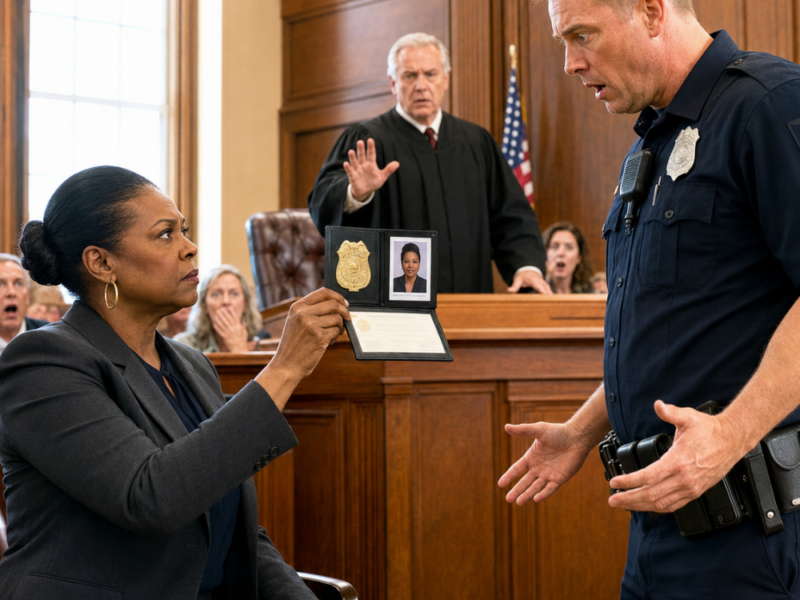
Racist Cop Kicks Black Woman in Court, Then Freezes When She Turns Out to Be His New Police Chief
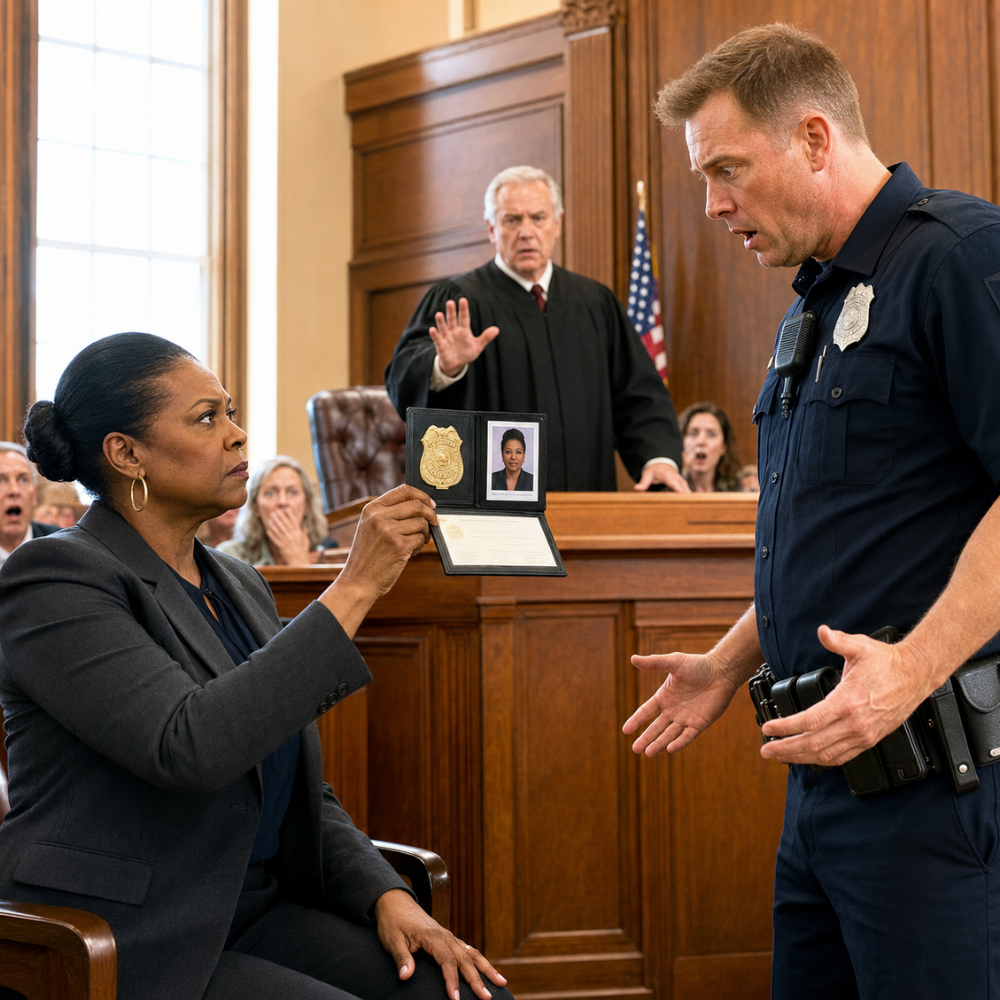
The officer kicked a quiet woman in municipal court because he thought she was nobody—an hour later, he learned she was his new police chief.
Municipal Courtroom 4B smelled like industrial floor wax, old coffee, damp winter coats, and the particular kind of anxiety that collects wherever ordinary people wait for strangers to make decisions about their lives.
By nine on Monday morning, every bench except the last two was crowded.
A mother in nursing scrubs held a sleeping toddler against her chest while whispering into her phone about missing another shift. A college student in a thrift-store blazer kept rereading a citation folded so many times the paper had gone soft. Two construction workers sat shoulder to shoulder in muddy boots, staring at the floor. Near the center aisle, an elderly man turned his hearing aid up every time the clerk spoke and then down again whenever the prosecutor started laughing with the officers waiting to testify.
Nobody paid much attention to the woman in the back row.
That was exactly what Diane Rollins wanted.
She was fifty-four years old and dressed in a charcoal wool coat over a dark navy blouse, black trousers, sensible shoes, and no jewelry except a narrow watch and the small silver chain that held her reading glasses.
A worn leather notebook rested on her lap.
Her hair was pulled neatly away from her face.
She had spent thirty-one years in law enforcement and knew how to disappear in plain sight.
People expected authority to announce itself.
A uniform.
A motorcade.
A row of aides.
A radio whispering against someone’s shoulder.
Diane had learned early in her career that the most honest version of an institution usually appeared when the institution believed nobody important was watching.
So she had come alone.
At seven that morning, in a small conference room inside City Hall, the mayor had administered Diane’s oath as chief of police in the presence of only the city clerk, corporation counsel, Deputy Chief Marcus Harris, and two members of the public safety commission.
The formal announcement was scheduled for the following morning.
There would be television cameras.
A podium.
Police flags.
A speech about restoring trust after three civil rights settlements, a federal consent review, and an internal survey showing that fewer than half the department’s own officers believed misconduct complaints were handled fairly.
Diane had already written the speech.
She hated it.
Speeches were the easiest part of reform.
Everybody applauded accountability when accountability remained a noun.
The difficult part began when it became a verb.
That was why, instead of riding to headquarters with Harris after the private oath, Diane told him she wanted three hours alone.
“To do what?” he asked.
“Look around.”
“At headquarters?”
“Everywhere.”
Harris knew better than to argue long.
He had worked with enough incoming chiefs to recognize when one was trying to understand a city before the city began performing for her.
Still, he frowned.
“You’re officially chief as of seven-oh-three.”
“I’m aware.”
“And nobody outside the mayor’s office knows.”
“Also aware.”
“Take security.”
“No.”
“Chief.”
“I spent eleven years doing field investigations for the state inspector general.”
“That was before half the local news stations started running your photograph.”
“They’re running my old photograph.”
“That does not make you invisible.”
Diane put on her gray coat.
“It makes me less recognizable than if I arrive with you.”
Harris sighed.
“What’s the plan?”
“Municipal court first.”
“Why there?”
“Because that’s where arrest reports turn into consequences.”
Harris looked at her for a long moment.
Then he nodded.
“Call me if anything feels wrong.”
Diane almost smiled.
“Marcus.”
“Yes?”
“It already feels wrong.”
Courtroom 4B confirmed that instinct within twenty minutes.
She noticed the bailiff watching sports clips on his phone whenever the judge looked down.
She noticed a young assistant prosecutor laughing with a uniformed officer whose case was next on the docket.
She noticed the defense attorney at the far table working through a stack of manila folders with the exhausted concentration of a man trying to stop a flood with paper towels.
His name tag read:
TIEMANN WEAVER
PUBLIC DEFENDER
He looked thirty-four and sixty at the same time.
His suit fit badly.
His tie had a coffee stain near the bottom.
His briefcase looked as though someone had driven over it.
Unlike almost everyone else in the room, he was actually working.
Diane made a note.
At 9:14, the rear doors opened.
Officer Brian Price entered.
He did not need anyone to explain that he considered himself important.
Some men carried authority as responsibility.
Price carried it as theater.
He was large, broad-chested, and wearing a uniform tailored tightly enough to display the hours he spent at the gym. His duty belt creaked when he walked. His boots hit the linoleum with unnecessary force.
He greeted the bailiff by first name.
The prosecutor waved.
Price leaned over the rail and said something that made both men laugh.
Diane watched the interaction without expression.
Ten years on a department could create familiarity.
Familiarity was not automatically corruption.
Still, police officers waiting to testify should not look more socially comfortable with prosecutors than defendants looked with their own lawyers.
She wrote another note.
Price turned toward the gallery.
The front benches were crowded.
He wanted an aisle seat.
Diane knew this because she watched his eyes scan the room.
There was an empty aisle seat on the opposite side.
Several, actually.
Price ignored them.
He walked toward the back row.
Toward her.
Diane almost felt something like curiosity.
He stopped beside her.
“Move over.”
No greeting.
No please.
No reason.
Diane looked to her right.
Seven empty spaces.
Then she looked up at him.
“There’s plenty of room.”
Price stopped chewing his gum.
“I said move over.”
“You can sit beside me.”
“I want the aisle.”
“There’s another aisle seat across the room.”
Price stared.
Diane had watched officers enter danger with calmer faces than the one he wore after being offered an alternative.
That interested her.
Tiemann Weaver looked up from the defense table.
He saw Price.
Then Diane.
His shoulders tightened.
That told Diane something too.
Weaver knew him.
Not casually.
The way public defenders knew particular officers whose names changed how they read arrest reports.
Price leaned down.
“I’m not asking for directions.”
Diane’s tone stayed mild.
“No.”
“You’re asking me to move without a reason.”
“I’m a police officer.”
“Yes.”
He waited.
Diane waited too.
“You think this is funny?”
“No.”
“Then move.”
“No.”
One syllable.
Calm.
Not challenging.
Price looked around.
A few people nearby were watching.
The audience changed everything.
Diane saw it happen.
His issue was no longer the seat.
It was obedience.
He stepped closer until his thigh pressed against her knee.
Diane moved her leg slightly away.
“Officer.”
He lowered his voice.
“You people always have to make everything difficult.”
There it was.
Not explicit enough to become a headline by itself.
Clear enough in context.
Diane’s eyes sharpened.
“What people?”
Price’s face changed.
He knew he had said too much.
Instead of retreating, he became angry at her for noticing.
“Get up.”
“No.”
Diane did not raise her voice.
Price glanced toward the judge.
The judge was reading something on the bench.
Toward the bailiff.
The bailiff’s eyes were on his phone again.
Toward the prosecutor.
The prosecutor was arranging files.
Nobody with institutional power appeared to be watching.
Price made his choice.
He moved his right leg back and drove the toe of his tactical boot hard into the outside of Diane’s lower leg.
Pain flashed up to her knee.
Her shin struck the wooden divider beside the bench.
The notebook fell.
Several people gasped.
Diane inhaled sharply.
For half a second, old reflexes surged through her.
Thirty-one years of training.
Distance.
Hands.
Weapon.
Exit.
She could have stood.
Could have identified herself.
Could have ended the scene instantly.
She did none of those things.
Not yet.
Because Price still believed she was nobody.
And Diane needed to know what he did next.
He leaned toward her.
“I said move.”
Tiemann Weaver’s chair scraped hard against the floor.
“Hey.”
His voice cracked through the room.
“Price.”
The public defender came around the table.
“Back away from her.”
Price straightened.
Weaver approached quickly.
“Are you out of your mind?”
“She refused a lawful order.”
Weaver stared.
“She was sitting on a bench.”
“Stay out of it.”
“I saw you kick her.”
“You saw nothing.”
“I saw the whole thing.”
Price stepped toward him.
Weaver was six inches shorter and looked as though he had lived on vending-machine dinners since law school.
He did not move.
That impressed Diane.
“Go back to your table before you interfere with an officer,” Price said.
Weaver’s jaw tightened.
“With what police function?”
Price pointed toward him.
“Careful.”
The judge finally looked up.
“What is going on back there?”
The bailiff stood so fast he nearly knocked over his chair.
Weaver turned.
“Your Honor, Officer Price just struck a woman in the gallery.”
The judge frowned.
Price answered before Diane could.
“She refused repeated instructions and became obstructive.”
Diane looked at him.
Obstructive.
A word with institutional weight.
A word officers knew could turn ordinary refusal into probable cause if enough paper followed.
The judge looked toward Diane.
“Ma’am, are you injured?”
Diane tested her leg.
It hurt.
Probably a deep bruise.
Nothing felt broken.
“I can remain seated.”
The judge seemed relieved by the answer.
“Then let’s keep order in my courtroom.”
Diane watched him.
That was not enough.
Not remotely.
But she did not correct him yet.
Price smirked at Weaver.
Then began to turn away.
Diane spoke.
“Officer.”
He looked back.
“Your name and badge number.”
His smile returned.
He actually seemed pleased by the question.
“Brian Price.”
He tapped his chest.
“Badge 4092.”
“Thank you.”
“You want to complain?”
Price laughed quietly.
“Go to the Fourteenth Precinct.”
He leaned toward her.
“Ask for the desk sergeant.”
Weaver’s face changed.
Price continued.
“Tell them Brian sent you.”
He walked away.
Diane bent down and retrieved her notebook.
Her leg throbbed.
Weaver crouched beside the bench.
“Ma’am.”
“I’m fine.”
“You’re not fine.”
“I am functional.”
“That is a lawyer answer.”
Diane looked at him.
“And you would know.”
Despite himself, Weaver smiled.
Then became serious.
“My name is Tiemann Weaver.”
“I saw the badge.”
“I watched everything.”
He glanced toward Price, who had taken another seat as though nothing unusual had happened.
“If you file a complaint, call me.”
Weaver dug through his suit pocket and handed her a worn business card.
“I’ll give a statement.”
“No charge.”
Diane took the card.
“Why?”
“What?”
“Why are you offering?”
Weaver looked almost offended.
“Because he kicked you.”
“That doesn’t answer the question.”
His face settled.
Diane recognized the expression.
The moment a tired person decided honesty cost less than caution.
“Because Price has been a problem for years.”
Diane waited.
Weaver glanced toward the judge.
Then back.
“His reports don’t match body-camera timestamps.”
“He uses ‘furtive movement’ like punctuation.”
“People he arrests somehow resist after handcuffs are already on.”
“I’ve filed complaints for clients.”
“What happened?”
“Nothing.”
“Nothing?”
“Letters.”
“Case numbers.”
“Internal review pending.”
“Then closed.”
“Usually not sustained.”
Diane opened her notebook.
“How many?”
“I personally filed eleven in three years.”
“Against Price?”
“Yes.”
“Any settled cases?”
“One client got money from the city.”
“Internal Affairs still cleared Price?”
Weaver nodded.
Diane wrote.
“Why?”
He gave a tired laugh.
“If I knew that, I’d sleep better.”
“Try.”
Weaver hesitated.
“Price’s precinct commander and his uncle have been friends twenty years.”
“The union grievance chair used to patrol with him.”
“One Internal Affairs sergeant plays softball with half the Fourteenth.”
Diane looked up.
“Those are relationships.”
“Yes.”
“Not proof.”
“No.”
Weaver rubbed his forehead.
“But if you spend five years in this building, you learn the difference between a system failing and a system functioning exactly as designed.”
That sentence went into Diane’s notebook verbatim.
She closed it.
“Thank you.”
“Take my card.”
“I did.”
“Call me.”
“I may.”
Weaver looked toward her leg.
“You should get that checked.”
“I will.”
“Promise?”
Diane smiled faintly.
“That sounds dangerously personal for a lawyer I met four minutes ago.”
“Occupational hazard.”
He stood.
Then paused.
“You’re not scared of him.”
“No.”
“Why?”
Diane put the notebook back on her lap.
“Because I already know more about his future than he does.”
Weaver stared.
Before he could ask what that meant, the clerk called his next case.
He returned to the defense table.
Diane remained until the judge called recess.
Then she left through a side door.
In the hallway, she found an alcove near the elevators.
Her leg hurt more now.
Adrenaline was fading.
She pressed one finger lightly against the fabric over her shin.
Tender.
Swelling.
She took out a secure phone.
Deputy Chief Harris answered on the first ring.
“Rollins.”
“It’s Diane.”
“Chief, where are you?”
“At municipal court.”
“I know that.”
Harris sounded irritated.
“The mayor’s communications director is asking whether you have been kidnapped.”
“Not yet.”
“Chief.”
“I need a personnel file.”
His tone changed immediately.
“Name.”
“Brian Price.”
A pause.
Keyboard.
“Badge?”
“4092.”
More typing.
“Fourteenth Precinct.”
Harris went quiet.
“What?”
Diane waited.
“Ten years.”
“Several commendations.”
“Three sustained attendance violations.”
“Five use-of-force complaints in four years.”
“Only five?”
“Formal complaints.”
“Two closed not sustained.”
“One exonerated.”
“One pending.”
“One resulted in city settlement but no departmental finding.”
Diane’s jaw tightened.
“Any credibility disclosures to prosecutors?”
“Let me check.”
More typing.
“No Brady designation.”
“Any supervisory intervention?”
“Counseling memo two years ago.”
“For?”
“Professional demeanor during traffic stop.”
Diane looked toward the hallway.
Price was laughing near the vending machines.
“What happened?”
Harris heard something in her voice.
“Chief.”
“He assaulted me.”
Silence.
“What?”
“He kicked me in Courtroom 4B because I declined to give him my seat.”
Harris said nothing.
The silence lasted so long Diane checked the phone.
“Marcus?”
“He what?”
His voice was lower now.
“He kicked you?”
“Yes.”
“Knowing who you are?”
“No.”
That was the point.
Harris cursed under his breath.
Diane said, “Enough.”
“I’m sending Internal Affairs.”
“Yes.”
“And court security.”
“Yes.”
“And I’m coming.”
“Yes.”
“And we are taking his badge.”
“Administratively relieving him of police powers pending investigation.”
Harris exhaled.
“You are correcting my verbs right now?”
“Yes.”
“You were assaulted.”
“Which is why process matters more, not less.”
Diane leaned against the wall.
“Listen carefully.”
Harris stopped.
“I want the prosecutor’s office notified independently.”
“State bureau too.”
“Why state?”
“Because I am both chief and complainant.”
“We need separation.”
“Good.”
“I want courthouse video preserved.”
“Bailiff body camera if he has one.”
“Building surveillance.”
“Witness names.”
“Price’s body camera.”
“He may not have activated it.”
“That becomes its own issue.”
“Agreed.”
Harris said, “I’ll have him relieved immediately.”
“No hallway tackle.”
“I wasn’t planning one.”
“You were imagining one.”
“I’m human.”
“Be deputy chief.”
Harris sighed.
“What else?”
Diane looked toward the elevator.
“The press pool is already waiting at headquarters, yes?”
“For tomorrow’s preview materials.”
“Bring them here.”
“Chief.”
“Bring the mayor’s communications team too.”
“This is going public.”
“It should.”
“We do not identify Price as criminally guilty.”
“No.”
“We identify what I personally witnessed and what administrative action has been taken.”
“Yes.”
“Union gets notified before suspension meeting.”
“Yes.”
“His due-process rights stay intact.”
“Yes.”
Harris became quiet.
Then said, “You’ve been planning this since he kicked you.”
“I’ve been planning this job for six months.”
She ended the call.
Then Diane stepped into a courthouse restroom.
She locked herself in a stall for two minutes.
Not because she was afraid.
Because she was furious.
People liked stories where calm leaders never felt rage.
Diane considered that mythology dangerous.
Rage existed.
The question was who got to drive.
She stood with both hands against the metal door and let herself feel it.
The boot.
The insult.
The confidence.
Tell them Brian sent you.
He had said it because he believed the complaint system belonged to him.
That was larger than one bruise.
Diane breathed.
Then she removed the gray coat.
Beneath it was a dark navy uniform blouse.
Not ceremonial dress.
The working uniform she had worn for the private oath.
Her gold chief’s shield remained covered by a plain black credential wallet clipped inside her waistband.
She had hidden the insignia under the coat intentionally.
The rank stars on her collar had been removed for the courthouse visit and remained in a pouch inside her bag.
Diane did not put them on immediately.
She did not need theater.
Then she reconsidered.
The department needed clarity.
She pinned the collar insignia carefully.
Attached the shield.
Looked at herself in the mirror.
Not triumphant.
A middle-aged Black woman with a swelling leg, tired eyes, and a job that had become more difficult before breakfast.
“Fine,” she whispered to herself.
Then went back into the hallway.
Brian Price was telling the story near the vending machines.
Of course he was.
Three officers stood around him.
One was young enough to look uncomfortable.
Price leaned against the wall.
“She acts like I kicked her down the stairs.”
The others laughed weakly.
“I barely touched her.”
The young officer said, “Still, Brian.”
“What?”
“In court.”
“So?”
Price chewed his gum.
“You know how people are.”
Diane stopped twenty feet away.
The young officer saw her first.
His face changed.
Price did not notice.
“The new chief is supposed to be some state investigator,” the young officer continued.
“Rollins.”
“Exactly.”
“Everybody says she’s serious.”
Price snorted.
“They always say that.”
He took another piece of gum from his pocket.
“New chiefs talk accountability until the first time the mayor calls because arrests dropped.”
The young officer’s eyes stayed on Diane.
Price finally noticed.
He turned.
Saw the uniform.
Saw the shield.
His body became still.
Recognition came slowly.
Not because he knew Diane.
Because the face belonged to the woman he had kicked.
His eyes moved to the collar.
Then the badge.
Then back to her face.
The gum stopped moving in his mouth.
Diane approached.
The hallway quieted around her.
“Officer Price.”
His face had lost color.
“Ma’am.”
Not chief.
Not yet.
His mind was still trying to reject what his eyes had already confirmed.
Diane stopped six feet away.
“Do you recognize me?”
Price swallowed.
“Yes.”
“From where?”
“The courtroom.”
“What happened in the courtroom?”
His eyes flicked toward the other officers.
Diane waited.
Price’s voice dropped.
“There was a misunderstanding.”
Diane almost smiled.
There it was.
The first institutional defense.
Language.
Not denial.
Reclassification.
“What did you misunderstand?”
“You were sitting where I needed to sit.”
Diane looked toward the young officer.
He stared at the floor.
Then back at Price.
“That is not what I asked.”
Price’s breathing changed.
“I didn’t know who you were.”
The sentence entered the hallway and stayed there.
Diane looked at him.
“Exactly.”
Price closed his eyes briefly.
“Chief.”
Now he said it.
Diane heard footsteps approaching.
Harris.
Two Internal Affairs investigators.
A representative from Professional Standards.
Union attorney Stan Kowalski hurrying behind them.
No cameras yet.
Good.
The administrative action came first.
Diane said, “Officer Price, you are being relieved of police powers pending investigation into an allegation of excessive force and official misconduct arising from an incident in Courtroom 4B this morning.”
His mouth opened.
“Chief, please.”
“You will surrender your firearm, duty belt, badge, department identification, and access credentials to Internal Affairs.”
“This is insane.”
Kowalski stepped forward.
“Chief Rollins.”
Diane turned.
“Mr. Kowalski.”
The union attorney was in his late fifties and had spent enough years defending officers to know when the best move was silence.
Price was not making silence easy.
Kowalski said, “My member has representation rights before any compelled questioning.”
“Agreed.”
“You are personally the complainant.”
“Correct.”
“Then you cannot control the criminal investigation.”
“Correct.”
That stopped him.
Diane continued.
“The county prosecutor and state investigative bureau are being notified because I am both chief and alleged victim.”
Kowalski blinked.
“And administrative action?”
“Temporary relief of police powers is authorized under department policy pending a safety and integrity review.”
Kowalski looked at Harris.
Harris handed him the policy citation.
Diane said, “No interrogation is occurring here.”
Kowalski nodded slowly.
“Officer Price, do not answer substantive questions.”
Price stared at him.
“You’re just going to let her do this?”
Kowalski’s jaw tightened.
“I am advising you of your rights.”
Price looked around.
His fellow officers had moved away.
That appeared to hurt him more than Diane expected.
“Come on.”
His voice cracked.
“This is because I didn’t know.”
Diane looked at him.
“Say that again.”
Kowalski immediately raised one hand.
“Brian.”
But Price was panicking.
“If I knew she was chief, obviously I wouldn’t have—”
He stopped.
Too late.
The hallway went completely still.
Diane’s voice became quieter.
“That is the problem.”
Price’s face collapsed.
“You are not in trouble because you failed to recognize a superior officer.”
She pointed toward the courtroom.
“You are in trouble because you believed the person sitting on that bench had no power.”
She let the sentence settle.
“You believed that made her safe to mistreat.”
Price shook his head.
“No.”
“Then explain what part is wrong.”
Kowalski closed his eyes.
Price said nothing.
Internal Affairs collected his equipment.
No handcuffs.
No public humiliation.
A criminal allegation was being investigated.
Not pre-judged.
Diane insisted on that distinction even while every instinct in her wanted the opposite.
Price’s firearm went into an evidence-security case.
Badge.
Identification.
Access card.
Radio.
The silver shield left his chest last.
His hand shook slightly when he removed it.
He looked at Diane.
“Ten years.”
She waited.
“I gave ten years to this department.”
Diane’s expression did not change.
“So the department has ten years of your work to examine.”
He stared.
The answer frightened him more than firing would have.
Because Price knew what those ten years contained.
The press arrived twelve minutes later.
By then Price was in a private conference room with his union representative and an Internal Affairs lieutenant.
Diane would not parade him before cameras.
Accountability was not spectacle.
She walked into the main rotunda with Harris beside her.
Reporters gathered.
The mayor’s communications director looked ill.
“Chief, the announcement was tomorrow.”
“It still is.”
“What is this?”
“Work.”
Diane stopped beneath the courthouse’s concrete atrium.
Cameras rose.
She did not use a podium.
“Good morning.”
The room quieted.
“My name is Diane Rollins.”
She paused.
“As of seven-oh-three this morning, I am the chief of police.”
Questions began immediately.
She raised one hand.
“I will answer questions after a brief statement.”
The reporters quieted again.
“This morning, before my public introduction, I came to municipal court alone because I wanted to observe routine department interactions without ceremony.”
She looked directly into the nearest camera.
“During that visit, a uniformed officer ordered me to vacate a public bench for his convenience.”
Murmurs.
“When I declined, he used physical force against my leg.”
The room erupted.
Diane waited.
Then continued.
“The officer has been relieved of police powers pending administrative review.”
“The alleged assault has been referred to independent criminal investigators because I am personally involved.”
A reporter shouted, “Who is the officer?”
Diane answered.
“Brian Price, badge 4092.”
Another reporter asked, “Did he know you were chief?”
“No.”
That answer produced more noise.
Diane waited again.
Then said the sentence she had decided mattered most.
“If his conduct would have been different only because I was chief, then his problem is not that he mistook my identity.”
She looked at the cameras.
“His problem is how he treats people he believes have none.”
Silence.
Even the communications director stopped sweating long enough to listen.
Diane continued.
“I will not tell you today that this incident proves every complaint ever made against Officer Price.”
“It does not.”
“I will not tell you he is guilty of a crime before an independent investigation is completed.”
“That is for investigators, prosecutors, and courts.”
“What I will tell you is that I personally experienced conduct serious enough to trigger immediate administrative review.”
She took a breath.
“And that one of my first directives as chief will be a review of Officer Price’s prior force complaints, supervisory files, body-camera compliance, and cases in which his testimony was central.”
Now the public defenders standing along the hall began paying attention.
Diane looked toward them.
“So should defense counsel.”
Tiemann Weaver stood near Courtroom 4B holding three folders.
Their eyes met.
Diane continued.
“Accountability cannot mean one thing when the complainant is powerful and another when the complainant is not.”
“That standard begins today.”
The questions came.
Was she injured?
“Yes.”
Would she sue the city?
“I have not considered civil action.”
Was she seeking Price’s termination?
“I am seeking a complete process.”
Had Internal Affairs failed?
“That is part of what we are reviewing.”
Was the department corrupt?
Diane paused.
“Departments are not abstractions.”
“They are people, incentives, rules, habits, and leadership choices.”
She looked around the courthouse.
“I have been chief for less than three hours.”
“I am not going to diagnose an entire institution from one morning.”
“But I am going to treat the symptoms I can already see.”
That quote ran on every evening broadcast.
The more important work happened without cameras.
Tiemann Weaver skipped lunch.
By one-thirty he had pulled twenty-three open cases involving Brian Price.
By three, thirty-seven.
By the next morning, fifty-two.
Some were minor.
Possession.
Disorderly conduct.
Resisting.
One more serious assault case.
Several involved defendants who claimed Price initiated force.
Weaver filed emergency credibility notices.
The county public defender’s office created a small review team.
The district attorney initially resisted.
“We cannot dismiss cases because one officer is under investigation.”
Weaver agreed.
“Then review them.”
“What do you think we’re doing?”
“I think you’re hoping this becomes administratively inconvenient enough that everyone forgets.”
The chief deputy prosecutor stared.
“You always this charming?”
“Usually worse.”
Diane’s department simultaneously opened every relevant file.
She recused herself from the investigation of her own assault.
That frustrated reporters.
They wanted the new chief personally tearing apart the bad officer.
Reality was more disciplined.
State investigators interviewed her like any other complainant.
“What did he say?”
Diane answered.
“What did you say?”
She answered.
“Did you identify yourself?”
“No.”
“Why not after he became aggressive?”
“I wanted to observe.”
“Could your refusal have escalated the interaction?”
Diane did not take offense.
“Yes.”
The investigator looked up.
“Explain.”
“I could have ended the uncertainty by showing credentials.”
“But?”
“A citizen should not need to reveal institutional power to avoid being kicked for refusing a seat.”
The investigator wrote that down.
Courtroom surveillance captured most of the incident.
No sound from the rear camera.
Enough movement.
Weaver gave a statement.
Two defendants did too.
The bailiff admitted seeing the final portion.
His own failure to intervene became part of an administrative review for court security.
The judge issued a written statement saying he had not witnessed the initial force.
That was technically true.
Diane did not attack him publicly.
Privately, she sent the chief judge a note:
Your courtroom culture permitted an officer to believe he could use force in the gallery without meaningful interruption. I recommend we discuss joint training.
The chief judge called within an hour.
They met Friday.
Changes followed.
Slowly.
No phones for bailiffs while court was in session.
Clear procedures for reporting officer misconduct witnessed in court.
Video retention rules.
A standing liaison between public defense, prosecution, and professional standards.
Boring policies.
Diane trusted boring policies.
Public outrage was fast.
Culture was administrative.
Three weeks after the incident, Diane sat behind the chief’s desk at headquarters with her right leg propped on a small padded stool.
The bruise had faded from purple to yellow.
Still tender.
Rain made it ache.
Harris entered carrying a thick folder.
“Fourteenth Precinct audit.”
Diane looked at it.
“How bad?”
He sat.
“Depends whether you want the short answer or the one that ruins your afternoon.”
“The afternoon is already ruined.”
“Seven officers flagged for repeat complaint patterns.”
“Supervisory reviews inconsistent.”
“Body-camera nonactivation disproportionately high on one shift.”
“Sergeant approvals copied and pasted.”
“Complaint closure times suspiciously fast in cases involving the same command staff.”
Diane removed her glasses.
“Evidence of coordinated falsification?”
“Not yet.”
“Good.”
Harris frowned.
“Good?”
“Do not give me a conspiracy because a pattern looks ugly.”
“We prove what exists.”
He nodded.
“You are deeply inconvenient.”
“So I’ve been told.”
Harris slid another folder forward.
“Price.”
Diane’s face changed slightly.
“The state bureau completed its initial investigation.”
“And?”
“County prosecutor presented assault and official misconduct charges to a grand jury.”
Diane waited.
“Indicted.”
She looked toward the city map pinned behind Harris.
No satisfaction came.
She had expected some.
There was none.
“Status?”
“Released on bond with no-contact orders for witnesses and suspension from law-enforcement employment.”
Diane looked at him.
“Good.”
“You don’t sound happy.”
“This is not entertainment.”
“I know.”
Harris leaned back.
“Union says we’re making an example of him.”
“We are.”
He raised his eyebrows.
Diane continued.
“Every disciplinary case is an example.”
“The question is whether the example is fairness or impunity.”
Harris smiled faintly.
“I’m stealing that.”
“Credit me.”
“Never.”
They turned back to the Fourteenth.
Over the next several months, the audit grew.
Diane found what frightened her most was not dramatic corruption.
It was normalization.
Supervisors who stopped reading reports carefully.
Internal Affairs investigators carrying caseloads too large to examine video thoroughly.
Union representatives who treated every allegation as betrayal.
Prosecutors who accepted officer narratives because challenging them cost time.
Public defenders too exhausted to pursue every discrepancy.
Judges who had seen so many terrible cases that small procedural violations no longer triggered alarm.
Nobody had to meet in a basement and agree to break the Constitution.
Systems could become unjust through fatigue.
Friendship.
Convenience.
Career incentives.
Fear.
Numbers.
Diane attacked those instead.
Body-camera activation audits became automatic.
Supervisors could not close repeated complaints involving officers from their own direct teams.
Serious force allegations went to a separate professional-standards unit with civilian review participation.
Officer credibility findings were forwarded to prosecutors under formal policy rather than informal relationships.
The department ended an unofficial arrest productivity system that had encouraged low-level street stops.
The union sued over several changes.
Diane expected that.
Kowalski sat across from her during one negotiation.
“You are destroying morale.”
“No.”
“You have officers afraid to act.”
“Good officers should not be afraid to act lawfully.”
“That sounds nice in a conference room.”
“So does ‘officer safety’ when used to excuse everything.”
Kowalski’s face hardened.
“You don’t trust cops.”
Diane leaned back.
“I am a cop.”
“You know what I mean.”
“Yes.”
She folded her hands.
“And that sentence is part of the problem.”
“What sentence?”
“The idea that questioning an officer is anti-police.”
Kowalski shook his head.
“You are giving civilians ammunition.”
“They already have ammunition.”
“Phone cameras.”
“Settlements.”
“Bruises.”
“Dead relatives.”
Diane’s voice remained calm.
“My job is not to protect officers from public knowledge.”
“It is to protect officers who do the job correctly and remove the ones who make that harder.”
Kowalski stared.
“You’ll lose people.”
“Yes.”
“Good people.”
“Probably.”
That answer surprised him.
Diane continued.
“Change has cost.”
“That is not an argument against it.”
The department did lose officers.
Some retired early.
Some transferred.
A handful resigned angrily after new reporting rules went into effect.
Recruitment became difficult for six months.
Then something else happened.
Applications began increasing.
Not from everyone.
From people who believed the new culture might allow them to work without becoming somebody they did not want to be.
One applicant wrote in his essay:
I want to join a department where stopping another officer from doing something wrong is considered police work.
Diane put that sentence in a drawer.
She read it on difficult mornings.
Tiemann Weaver appeared at headquarters a month after Price’s indictment.
His suit was still cheap.
His briefcase more damaged.
He looked less defeated.
Harris showed him into Diane’s office.
“Tiemann.”
“Chief.”
“What can I do for you?”
He placed a stack of court orders on her desk.
“Fifty-two cases.”
Diane recognized the number.
“Price.”
“All reviewed.”
“What happened?”
“Eleven dismissed outright because prosecutors concluded Price’s testimony was essential and unreliable pending litigation.”
“Seventeen reduced.”
“Eight defendants entered revised agreements after body-camera review contradicted portions of the arrest narrative.”
“Sixteen continued because there is independent evidence unrelated to Price.”
Diane nodded.
That sounded credible.
Not the magical version where every case disappeared because one officer was charged.
Weaver sat.
“I wanted all fifty-two gone.”
“I know.”
“That would’ve felt better.”
“Probably.”
“But some were real cases.”
“Yes.”
He sighed.
“I hate when reality damages my rhetoric.”
Diane smiled.
“Common problem.”
Weaver became serious.
“One young man had been held almost four months on a resisting charge.”
“Original arrest was trespassing.”
“Video showed he was already on the ground when Price claimed he lunged.”
Diane looked down.
“What happened?”
“Dismissed.”
“He went home Friday.”
Tiemann leaned back.
“His mother called me six times because she thought there had to be another hearing.”
“She couldn’t believe it was over.”
Diane looked toward the window.
“Four months.”
“Yep.”
“What did he lose?”
“Job.”
“Apartment.”
“His truck got repossessed.”
Diane closed her eyes.
One bad arrest rarely stayed one bad arrest.
The system distributed damage.
Employer.
Landlord.
Credit report.
Children.
Medication.
Missed appointments.
Diane said, “Send the family to the city claims clinic.”
Weaver raised an eyebrow.
“There’s a claims clinic?”
“There will be Monday.”
“You invent offices when upset?”
“Frequently.”
He smiled.
Then noticed the stool beneath her desk.
“Leg still bad?”
“Improving.”
“You should sue.”
“Everybody says that.”
“You were assaulted.”
“I know.”
“City liability.”
“I also run the city department.”
“Conflict can be managed.”
Diane looked at him.
“Tiemann.”
“Yes?”
“Do you ever stop lawyering?”
“No.”
“Good.”
She slid a folder toward him.
“What’s this?”
“Invitation.”
He read.
Public Defense–Police Evidence Integrity Working Group.
Weaver looked up.
“You’re serious?”
“Yes.”
“You want public defenders in departmental policy meetings?”
“Yes.”
“Do your people know?”
“Some.”
“Are they angry?”
“Several.”
“Excellent.”
He picked up the invitation.
“When?”
“Thursday.”
“I have arraignments.”
“Friday?”
“Probation hearings.”
Diane sighed.
“You are ruining reform with your clients.”
“Story of my life.”
They settled on Tuesday evening.
That working group became one of the quiet successes of Diane’s first year.
Defense lawyers identified recurring problems officers rarely saw.
Incomplete property receipts.
Vague probable-cause language.
Interpreter failures.
People signing forms they could not read.
Police supervisors explained constraints defense lawyers rarely considered.
Chaotic scenes.
Bad radio information.
Witnesses disappearing.
Body-camera limitations.
They argued.
Sometimes bitterly.
Then wrote better forms.
Changed training.
Built checklists.
Boring.
Again.
Diane grew convinced civilization depended largely on people willing to improve forms.
Price’s criminal trial began nine months after the courtroom incident.
Diane testified.
So did Weaver.
Several former complainants were allowed to testify only within evidentiary limits.
The prosecution focused on that morning.
That was enough.
Price’s attorney argued that the contact was a misguided attempt to move an uncooperative person and not an intentional assault.
Diane refused exaggeration.
“He did not knock me unconscious.”
“He did not use a weapon.”
“He did not threaten my life.”
The prosecutor asked, “Then why is the incident serious to you?”
Diane looked toward the jury.
“Because policing is built on discretion.”
She folded her hands.
“An officer who uses force because a person inconveniences his ego cannot be trusted with greater discretion where nobody is watching.”
Price looked at her.
He appeared older.
Smaller.
Not because the courtroom had changed dimensions.
Because the badge was gone.
The jury convicted him of misdemeanor assault and felony official misconduct.
Not the maximum charges the first headlines predicted.
The judge imposed a sentence that included incarceration, probation after release, and permanent loss of state law-enforcement certification.
Diane attended sentencing because she was the victim.
She did not sit with the press.
Price spoke.
He apologized.
At first badly.
“I made a mistake.”
Diane’s expression did not change.
Then he stopped.
Started again.
“I thought I could make her move.”
The courtroom quieted.
Price looked at Diane.
“I knew I could.”
He swallowed.
“That’s the truth.”
Diane listened.
“I thought nobody would care.”
He looked down.
“I thought if somebody complained, I knew the people who handled complaints.”
A union attorney shifted behind him.
Price continued anyway.
“I didn’t think about whether what I was doing was police work.”
“I thought about whether I could get away with it.”
For the first time, Diane believed he understood at least part of what had happened.
That did not erase it.
Understanding was not acquittal.
After sentencing, a reporter asked Diane whether she forgave him.
She hated the question.
“My forgiveness has no legal function.”
The reporter blinked.
“Personally?”
Diane considered.
“I hope prison does not make him worse.”
“I hope he eventually becomes someone who understands why this happened.”
“That is the most personal answer I have.”
She walked away.
By Diane’s second year, the city’s arrest numbers were lower.
The mayor hated that headline.
Diane brought charts.
Calls for service.
Case clearance.
Response times.
Complaints.
Use of force.
She explained that arrest volume was not itself public safety.
“You’re telling voters fewer arrests are good?”
“I’m telling voters meaningless arrests are expensive.”
The mayor rubbed his forehead.
“This is not an academic seminar.”
“No.”
Diane opened another chart.
“This is overtime.”
Low-level arrests had consumed court time.
Officer hours.
Jail processing.
Public defender resources.
Dismissed cases.
“Reducing bad arrests saved money.”
The mayor stared.
“You came prepared.”
“I came from the inspector general’s office.”
“I assume everyone is lying until spreadsheets become available.”
He laughed despite himself.
“Fine.”
The reforms survived.
Not all.
Some were weakened.
One civilian oversight proposal died in council.
The union won part of a grievance.
Budget cuts slowed training.
Politics remained politics.
Diane learned not to treat partial failure as betrayal.
Institutions changed by inches.
Tiemann Weaver reminded her of that.
He became head of the public defender’s municipal division at thirty-eight.
Still tired.
Better suit.
Same terrible briefcase until colleagues bought him a new one and he refused to use it.
He visited Diane occasionally.
One afternoon, three years after Courtroom 4B, he placed a photograph on her desk.
A graduation.
The young man whose resisting charge had been dismissed.
Community college.
Diane looked at it.
“He finished?”
“Associate degree.”
“What in?”
“HVAC.”
“Good money.”
“Apparently.”
Weaver sat.
“His mom made me promise to show you.”
Diane touched the edge of the photograph.
“He did that.”
“I know.”
“Not us.”
“I know.”
She looked at Weaver.
“But systems can make doing it easier or harder.”
“Yes.”
That was why she kept the photograph.
Her own injury healed completely.
The bruise disappeared in weeks.
The deeper ache took months.
Eventually only a faint sensitivity remained when she pressed the exact spot.
For a long time she used the injury in speeches.
Then stopped.
She did not want reform forever attached to the story of the chief who got kicked.
That story was useful because people paid attention when power experienced what ordinary people had reported for years.
That fact also embarrassed her.
Why had the city needed the victim to be chief before everyone believed the pattern deserved urgency?
One evening she discussed that with Harris.
They were eating takeout in her office after a fourteen-hour day.
“People listened because it happened to me.”
“Yes.”
“That bothers me.”
“It should.”
“What about everybody before?”
Harris put down his fork.
“They mattered.”
“Not enough.”
“No.”
Diane looked toward the city map.
“So how do you build a system that believes them before somebody important gets hurt?”
Harris thought.
“You can’t make it believe everybody.”
“No.”
“But you can make disbelief harder.”
Diane looked at him.
“Explain.”
“Multiple review points.”
“Outside eyes.”
“Recorded reasons when complaints close.”
“Patterns trigger automatic review.”
“Supervisor cannot bury one file forever.”
Diane smiled.
“Bureaucracy.”
“Your favorite.”
She raised her takeout container.
“To bureaucracy.”
Harris clinked his plastic fork against it.
Those principles became the department’s new complaint architecture.
Every closure required a written rationale available for audit.
Repeat allegations triggered independent pattern review even when individual cases were inconclusive.
Civilian complainants could track status online.
Language access expanded.
Anonymous officer reporting became genuinely external.
The union complained.
Some officers loved it quietly because it protected them too.
A rookie named Elena Martinez used the system to report a sergeant directing illegal ticket quotas.
Under the old culture, she might have stayed silent.
Instead, she filed.
The investigation proved the quota.
The sergeant was disciplined.
Martinez remained employed.
Nothing spectacular happened.
That was the point.
Good systems prevented courage from needing to become martyrdom.
Five years after Diane took office, Room 4B still smelled like floor wax.
Buildings resisted symbolism.
The benches remained scratched.
The vending machine outside still ate dollar bills.
Tiemann Weaver entered one rainy morning to argue a misdemeanor case.
He looked toward the back row.
For half a second, he remembered Diane in the gray coat.
Then his client tugged his sleeve.
“Mr. Weaver?”
“Yeah?”
“Do you think the judge is going to lock me up?”
Weaver turned.
“No idea.”
The young woman looked terrified.
“Great.”
“But I know the evidence.”
He held up the file.
“And we’re going through it.”
The courtroom bailiff stood near the wall.
Phone away.
Watching.
Two police officers waited to testify.
Neither sat with the prosecutor.
One approached Weaver before court.
“Counselor, I uploaded an amended body-camera index last night.”
Weaver looked at him.
“Why are you telling me?”
“Because the original missed a clip.”
Weaver stared.
The officer became defensive.
“What?”
“Nothing.”
“You look shocked.”
“I’m old.”
“You’re forty.”
“Ancient.”
The officer walked away.
Weaver smiled.
In Diane’s office across town, the city map now contained fewer red pins marking force complaints in several precincts.
Not none.
Diane distrusted perfect charts.
A city with zero complaints usually had a complaint system nobody trusted.
She wanted reporting.
Then fair review.
That distinction became part of her leadership philosophy.
At six years, the mayor asked whether she wanted another term.
Diane surprised everyone.
“No.”
“Why?”
“Because chiefs who stay forever eventually begin thinking the building belongs to them.”
The mayor laughed.
“I’m serious.”
“So am I.”
“You’re leaving while reforms are incomplete.”
“They will always be incomplete.”
He stared.
“What are you going to do?”
“Teach.”
“Consult.”
“Sleep.”
The mayor shook his head.
“You know whoever follows you may undo half of this.”
“Yes.”
“That doesn’t bother you?”
“Of course.”
“Then stay.”
Diane smiled.
“If reform depends on Diane Rollins remaining chief, then I failed.”
That became her final lesson.
She had once believed leadership meant being indispensable.
Experience taught her the opposite.
Healthy institutions survived leaders.
Her retirement ceremony was held in a public library auditorium because she refused the ballroom proposed by the police foundation.
Tiemann attended.
Harris spoke.
So did Officer Elena Martinez, now a lieutenant.
The mayor gave a speech too long by twelve minutes.
Diane’s own remarks lasted six.
She talked about trust.
Not as sentiment.
As infrastructure.
“Trust is not created because the public likes police.”
“It is created when people know what will happen after something goes wrong.”
She looked toward the officers in the audience.
“Will the complaint be recorded?”
“Will evidence be preserved?”
“Will supervisors read it?”
“Will the rules change because the accused has friends?”
“Will a citizen’s dignity depend on whether anyone important knows their name?”
Diane paused.
“That last question brought me into this job faster than I expected.”
A few people laughed softly.
She smiled.
Then became serious.
“I was fortunate.”
“I had rank.”
“I had access.”
“I had a deputy chief who answered the phone.”
“Most people assaulted by authority do not have those things.”
She looked around.
“So do not remember my story as the day a bully accidentally picked the wrong woman.”
“That makes the lesson too small.”
The room went quiet.
“Remember it as the day we were forced to ask why there was ever supposed to be a right woman to bully.”
Harris lowered his head.
Weaver stopped writing.
Diane continued.
“The badge does not make a person more important than the citizen.”
“It makes the officer more accountable for what happens next.”
She closed her notes.
“That is all.”
After the ceremony, Tiemann found her near the library entrance.
He held his old briefcase.
Diane pointed.
“You still have that thing.”
“It’s historic.”
“It’s hazardous.”
“I’m emotionally attached.”
“That is unhealthy.”
He smiled.
They stepped outside.
Early spring rain darkened the pavement.
“You remember the business card?” he asked.
“What business card?”
“The one I gave you in Courtroom 4B.”
Diane laughed.
“You told me you’d represent me for free.”
“Very generous.”
“I had better lawyers.”
“That remains insulting.”
He looked toward the street.
“Do you know what I remember?”
“What?”
“You asked why Price kept getting away with it.”
Diane nodded.
“I gave you this whole cynical speech.”
“Old boys club.”
“Internal Affairs.”
“Union.”
“Precinct captain.”
“Then you wrote everything down.”
“That frightened me more than if you’d gotten angry.”
Diane smiled.
“Paper has a reputation.”
Tiemann became thoughtful.
“You actually changed a lot.”
“We changed some.”
“You know what I mean.”
“I do.”
She looked back through the library doors.
“Just don’t turn it into mythology.”
“Why not?”
“Because mythology lets people wait for another chief in a gray coat.”
Rain tapped the awning.
Diane continued.
“Most change is somebody filing the complaint.”
“Somebody preserving the video.”
“Somebody reading page nineteen instead of assuming page one told the whole story.”
“A supervisor saying no.”
“A rookie speaking up.”
“A lawyer refusing to let a bad report become an easy plea.”
“Nothing cinematic.”
Tiemann looked at her.
“You did march into a courtroom wearing four stars.”
“That part was cinematic.”
He laughed.
Diane smiled.
Then winced slightly as an old memory of pain touched her shin.
Tiemann noticed.
“Still?”
“Sometimes in damp weather.”
“Sorry.”
Diane shook her head.
“Don’t be.”
“You once called it a small price.”
“I was being dramatic.”
“Finally.”
She looked at him.
“It was not a price I should have paid.”
Tiemann nodded.
“Better.”
They stood quietly.
Then he asked, “What happened to Price?”
Diane knew.
She had checked once a year without admitting it.
“He served his sentence.”
“Worked construction afterward.”
“Then maintenance for a warehouse.”
Tiemann looked surprised.
“You keep tabs?”
“Occupational damage.”
“Any more trouble?”
“Not that I know.”
Diane looked toward the rain.
“I hope not.”
“You mean that?”
“Yes.”
Tiemann stared.
She shrugged.
“If accountability only satisfies us when the person remains ruined forever, then we are not actually talking about public safety.”
“That is annoyingly mature.”
“I’m retired.”
“Already?”
“As of twelve minutes ago.”
He smiled.
“So what now?”
Diane looked at the wet street.
Cars moved slowly.
A city bus stopped.
People climbed aboard.
Nobody recognized her.
She liked that.
“Lunch.”
“That’s your grand plan?”
“Yes.”
“You buying?”
“I am retired on a public pension.”
“You’re paying.”
They walked toward a diner two blocks away.
Diane no longer wore a uniform.
The gray wool coat was different now, but similar enough to remind her.
They entered the diner.
A waitress pointed toward an open booth.
“Anywhere you like.”
Diane looked at the aisle seat.
Then at Tiemann.
“You want it?”
He laughed.
“No.”
She sat.
Nothing happened.
No badge.
No cameras.
No confrontation.
Just two people ordering coffee while rain ran down the windows.
That ordinariness became the ending Diane preferred.
People kept repeating the dramatic version anyway.
Officer kicks ordinary woman.
Woman reveals she is police chief.
Officer loses badge.
Justice.
Easy.
Satisfying.
Incomplete.
Brian Price’s career did not end because he chose the wrong person to kick.
It ended because he demonstrated a dangerous belief about who deserved restraint and who did not.
Diane’s success did not come from outranking him.
Rank merely prevented the system from ignoring her as easily as it had ignored others.
The real work began after the cameras left.
Fifty-two cases reviewed.
Complaints reopened.
Policies rewritten.
Supervisors trained.
Union grievances fought.
Good officers protected from bad incentives.
Public defenders invited into rooms where police had once preferred talking only to themselves.
Not every problem disappeared.
Some officers still lied.
Some citizens still filed false complaints.
Some prosecutors still became too comfortable with police.
Some public defenders still became too cynical.
Some politicians still valued statistics more than substance.
No reform made human beings stop being human.
The goal was not perfection.
It was friction.
Make abuse harder.
Make concealment slower.
Make retaliation riskier.
Make honesty less expensive.
Make records survive personalities.
Years after retiring, Diane taught a police leadership class at a state university.
The students expected stories.
She gave them spreadsheets.
They complained.
One young captain finally raised his hand.
“Chief Rollins.”
“Professor is fine.”
“No one calls you professor.”
“Then start.”
The class laughed.
He continued.
“What is the single biggest indicator that a department has a culture problem?”
Diane thought.
She could have said complaints.
Force rates.
Turnover.
Discipline.
Instead she asked, “What happens when a junior employee tells a senior employee no?”
The captain frowned.
“What do you mean?”
“Exactly what I said.”
She walked toward the board.
“Does disagreement become insubordination?”
“Does correction become humiliation?”
“Does the senior person become curious or offended?”
“Does everyone else in the room go quiet?”
She looked at them.
“Watch what an organization does with no.”
“That tells you a great deal.”
A student in the back raised her hand.
“Is that because of Price?”
Diane smiled.
“Partly.”
She told the story without names at first.
The bench.
The demand.
The kick.
The notebook.
Then she asked what she always asked.
“What was his first mistake?”
Hands went up.
“Using force.”
“Wrong.”
“Failing to de-escalate.”
“Later.”
“Discriminatory assumption.”
“Closer.”
A student near the window said, “He decided the seat belonged to him because he had authority.”
Diane nodded.
“Yes.”
“Before force came entitlement.”
She wrote the word on the board.
ENTITLEMENT.
Then beneath it:
IMPUNITY.
Then:
NORMALIZATION.
“Force was the visible act.”
“These were the conditions.”
The class became quiet.
Diane continued.
“Bad officers rarely wake up one morning and decide to become bad.”
“They learn what the environment rewards.”
“What supervisors ignore.”
“What colleagues laugh at.”
“What prosecutors tolerate.”
“What unions excuse.”
“What judges fail to challenge.”
“And what citizens are too exhausted to report again.”
She capped the marker.
“Culture is accumulated permission.”
That sentence eventually appeared in a training manual.
Diane disliked that because training manuals had a way of turning useful sentences into slogans.
Still, she let it remain.
One evening after class, a young Black woman waited near the lectern.
She was a patrol officer from a neighboring city.
“Can I ask something?”
“Of course.”
“Were you scared?”
Diane knew exactly what she meant.
“In the courtroom?”
“Yes.”
The officer seemed almost embarrassed.
“Everybody tells the story like you were calm because you knew you were chief.”
Diane smiled sadly.
“I knew I was chief.”
“That did not make a steel-toed boot softer.”
The officer laughed.
Diane became serious.
“I was angry.”
“I was afraid of what he might do next.”
“I was also very aware that I had options most citizens did not.”
The young officer nodded.
“What if you hadn’t?”
Diane looked at her.
“That is the question that kept me in the job six years.”
The officer stood quietly.
Diane added, “Courage is useful.”
“But do not build a department that requires citizens to be courageous to survive contact with it.”
The young woman wrote that down.
Diane smiled.
“Now you’re becoming me.”
“Sorry.”
“Fair.”
The officer left.
Diane packed her notebook.
Not the original leather one.
That one sat in a box at home.
She had kept it.
The page from Courtroom 4B remained.
Brian Price
Badge 4092
Force after seat refusal
Weaver witness
Complaint history?
Culture question
The handwriting looked surprisingly ordinary.
That was perhaps the strangest detail.
Lives often changed around notes that looked too small to matter.
A receipt.
A timestamp.
A badge number.
A witness card.
A complaint number.
A line in a notebook.
The world celebrated dramatic justice.
Diane learned to trust documentation.
By then Tiemann Weaver had become a judge.
Nobody saw that coming least of all Tiemann.
He called Diane after receiving the appointment.
“You’re laughing.”
“I am.”
“This is serious.”
“You spent half your career complaining about judges.”
“Exactly.”
“Now become the one you wanted.”
“That sounds exhausting.”
“Everything worthwhile apparently is.”
His courtroom was 6C.
Different floor.
Same building.
On his first morning, Diane sat in the last row.
He spotted her immediately.
Not because she wore a uniform.
Because he had learned to look.
At recess he came down.
“You came.”
“Obviously.”
“How am I doing?”
“You sustained an objection while checking your phone.”
“I was checking the calendar.”
“Still bad optics.”
He sighed.
“Anything else?”
“You let the defendant finish speaking.”
“High praise.”
“It is.”
They walked toward the hallway.
A police officer approached.
Young.
Nervous.
“Judge Weaver?”
Tiemann turned.
“Yes?”
“I need to correct part of my testimony from this morning.”
Tiemann looked at Diane.
She raised an eyebrow.
The officer continued.
“I said the vehicle was traveling east.”
“It was west.”
“I reviewed my notes during recess.”
Tiemann nodded.
“Tell the prosecutor.”
“Then we’ll put it on the record.”
The officer left.
Tiemann stared after him.
Diane smiled.
“What?”
“You noticed.”
“What?”
“He corrected himself.”
“Yes.”
“Before somebody caught him.”
Tiemann understood.
“Culture.”
Diane nodded.
“An inch.”
He smiled.
“Then tomorrow?”
“We push another.”
The municipal courthouse still smelled like floor wax.
It probably always would.
The building had not become noble.
Courts remained crowded.
Public defenders remained overworked.
Police still made mistakes.
Some terrible.
Some ordinary.
People still sat on wooden benches waiting for decisions they could not control.
But a few things had changed.
A complaint could move.
A video was harder to lose.
A supervisor had to explain why.
A public defender knew someone might answer the phone.
An officer knew “I was wrong” could protect more honor than a false report.
And somewhere in the city, citizens slowly learned that a badge could be questioned without the world ending.
That was not a revolution.
Diane distrusted revolutions.
They promised clean beginnings and often forgot that Tuesday still required payroll.
She believed in maintenance.
Daily.
Unromantic.
Repeated.
The same way trust was built.
The same way it was destroyed.
Brian Price had once believed power meant making someone move from a seat because he wanted it.
Diane Rollins spent the rest of her career teaching a city a harder definition.
Power meant having the ability to force compliance and choosing the rule instead.
It meant preserving the rights of a man who had violated hers because those rights were not rewards for good behavior.
It meant correcting the judge without humiliating him.
Working with the union without surrendering to it.
Listening to public defenders without treating criticism as betrayal.
Allowing officers to admit mistakes before mistakes became lies.
Making the system strong enough that nobody needed to recognize the chief in order to be treated like a person.
That was why, when people later asked Diane which moment from Courtroom 4B she remembered most, they were usually disappointed by her answer.
Not the kick.
Not Price seeing the stars on her collar.
Not the badge leaving his hand.
She remembered the seven empty spaces beside her on the bench.
There had been room.
That was the whole thing.
Nobody needed her seat.
Nobody needed conflict.
Nobody needed force.
A man with authority saw another person occupying something he wanted and decided her refusal to surrender it was an offense.
Everything after that grew from the belief that his preference mattered more than her right to remain where she already was.
Diane thought institutions failed the same way.
A person in authority began treating public space, public money, public rules, even public dignity as something privately owned.
The cure began with one word.
No.
Not shouted.
Not dramatic.
Just spoken clearly enough that the person hearing it had to decide what kind of power they actually possessed.
Brian Price made his decision.
Diane made hers afterward.
The city spent years living with both.
And in the end, the lesson was never that the officer should have been more careful about whom he kicked.
He should never have believed there was anyone safe to kick in the first place.









