
“On Your Knees and Clean It Up!” But the Mafia Boss Heard Every Word
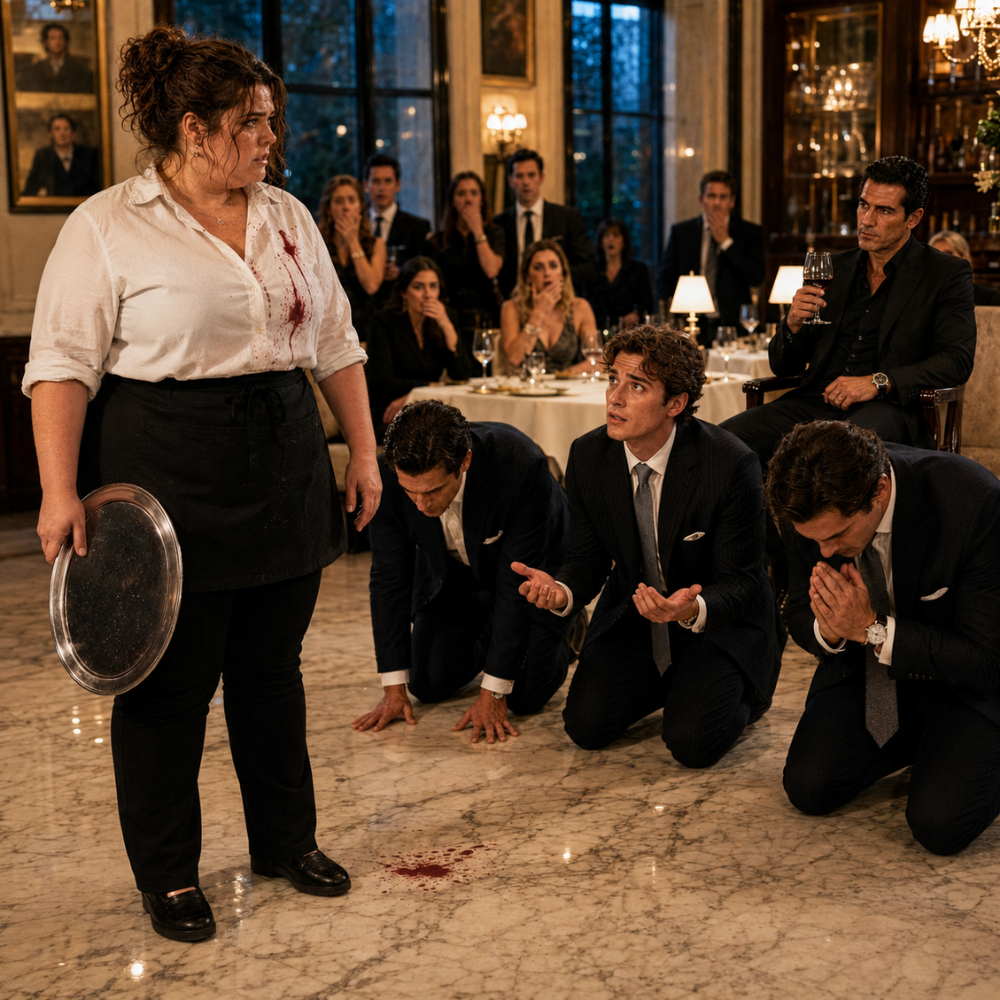
“On your knees and clean it up,” he said. Then the man by the window set down his fork.
The wine hit Katie Mercer before she understood what was happening.
Cabernet swept across the white tablecloth in a dark red arc, splashed over the front of her pressed black uniform, and soaked through the cotton blouse beneath it. A few drops struck her chin. One slid coldly toward her collar.
For one suspended second, the dining room at Aurelio seemed to stop breathing.
A fork remained halfway to a woman’s mouth.
The violinist near the bar lifted his bow from the strings.
Somewhere behind Katie, a server carrying two plates of sea bass went completely still.
Katie did what she had been doing since childhood whenever a room turned against her.
She read it.
At twenty-eight, she had spent enough years being the largest girl in the classroom, the easiest waitress to wave at, the employee asked to cover one more shift because she was “reliable,” to know how quickly people could decide they had not seen something.
Her manager, Dennis, stood in the kitchen doorway.
He saw the wine on her uniform.
He saw the guests laughing.
He also saw the platinum card on the table.
Katie knew which one mattered more.
The corner banquet was Aurelio’s best table, tucked beneath an antique brass light fixture where the guests could see the room without feeling watched themselves. Three people in their twenties occupied it that night, each carrying the casual confidence of someone who had never had to check a bank balance before ordering dinner.
The first was Nicholas Vitelli, though Katie only knew him as Mr. Vitelli from the reservation book.
His watch looked heavy enough to pay off her student loans.
Beside him sat Vanessa Calder, blond, diamond earrings, cream silk dress, the expression of a woman disappointed by almost everything.
The third, Aaron DeLuca, was long-limbed and handsome in a way that had probably excused him from consequences since middle school.
Nicholas lifted his nearly empty wineglass.
“Oh, no,” he said, smiling. “Look what you did.”
Katie stared at him.
“You moved your glass into my tray.”
Vanessa laughed.
“You really want to argue with a customer while you’re wearing his wine?”
Nicholas picked up a dinner roll.
For an instant Katie thought he was going to eat it.
Instead he tossed it.
The roll bounced from her shoulder and landed beneath the table.
A few people nearby looked up.
Then they looked down again.
Aaron leaned back, enjoying himself.
“Maybe she can clean while she’s down there.”
Vanessa dragged her spoon through the remaining risotto on her plate and flicked a small spoonful toward Katie. It struck the front of her uniform and fell harmlessly to the floor.
The three of them laughed.
Not loudly.
That made it worse.
It was private laughter performed publicly, the sound of people certain the room belonged to them.
Katie’s face burned.
She could feel eighty diners pretending not to watch.
Dennis finally moved.
Not toward the table.
Toward Katie.
His mouth formed the professional little smile he used whenever a wealthy guest became difficult.
“Katie,” he said softly, “why don’t we just take care of this?”
Just take care of this.
She knew what it meant.
Do not defend yourself.
Do not embarrass the customer.
Do not make me choose between your dignity and Saturday night’s receipts.
Katie looked down at the wine spreading across the marble.
Her mother had once told her that pride was expensive.
At sixteen, Katie had thought that sounded sad.
At twenty-eight, she understood exactly what it cost.
Rent was due Friday.
Her hospital payment drafted on Monday.
Her MetroCard needed refilling.
Aurelio’s dinner shifts paid better than anything else she could get without finishing the nursing degree she had left two years earlier.
So when Aaron pointed toward the floor and said, in a pleasant conversational voice, “On your knees. Clean it up. That’s what you’re here for,” something old and obedient moved through Katie before anger could catch it.
Her knees began to bend.
Not because Aaron DeLuca had authority over her.
Because money did.
Because Dennis was watching.
Because the rent did not care about humiliation.
Because somewhere inside Katie still lived the twelve-year-old girl who had learned that the fastest way through cruelty was sometimes to give it nothing to fight against.
She had barely lowered herself when a man’s voice came from the table near the window.
“That’s enough.”
He did not shout.
He did not need to.
The room changed before Katie even turned toward him.
The man sat alone except for an untouched second place setting. He wore a charcoal suit with no visible label, white shirt, no tie. Early forties, perhaps. Dark hair beginning to show silver near the temples. Tall even seated.
He had been eating quietly for almost an hour.
Katie remembered bringing him sparkling water.
She remembered that he had thanked her and looked directly at her when he did.
She remembered nothing else remarkable about him.
Now he placed his fork beside his plate with a precise little click.
Dennis stopped moving.
The maître d’, who had been approaching from the host stand, went pale.
“Mr. Falco,” he said.
The name did something to the room.
Katie saw it travel through the diners before she understood why.
Two men near the bar exchanged a look.
An older couple suddenly became fascinated by their check.
Dennis took one step backward.
At the corner table, Nicholas Vitelli’s smile disappeared.
Cristiano Falco turned his head toward him.
There was no visible anger in his face.
That was what Katie noticed first.
He looked almost tired.
“Nicholas.”
The young man’s throat moved.
“Mr. Falco.”
Cristiano’s gaze shifted to the bread on the floor, then to the wine on Katie’s uniform.
“Did I misunderstand what I just watched?”
Nobody answered.
Cristiano waited.
The silence grew uncomfortable.
Nicholas straightened in his chair.
“We were joking.”
“With whom?”
Nicholas frowned.
Cristiano glanced toward Katie.
“Was she laughing?”
Katie felt every eye in the room land on her.
Nicholas tried another smile.
“Come on. It got out of hand.”
“Yes,” Cristiano said. “It did.”
His voice stayed mild.
That mildness frightened Nicholas more than shouting would have.
Cristiano folded his hands loosely in front of him.
“I saw your father last month.”
Nicholas’s face changed.
“Did you?”
“We spoke about his company.”
Cristiano gave him a moment to understand there was more behind the sentence than Katie could hear.
“Your father is a practical man. He understands that reputation is difficult to build and very easy for one’s children to damage.”
Nicholas no longer looked wealthy.
He looked twenty-six.
Cristiano continued.
“If I call him tonight and tell him I watched his son throw food at a woman who was working, do you think he will defend you?”
Nicholas said nothing.
“I don’t.”
Cristiano’s attention moved to Vanessa.
“And your mother serves on the board of the Metropolitan Children’s Foundation, doesn’t she?”
Vanessa’s lips parted.
“Yes.”
“Then I imagine she has given several speeches about dignity.”
He paused.
“That could become awkward.”
Vanessa looked down.
Aaron had stopped smiling entirely.
Cristiano did not threaten anyone.
He did not have to.
He simply reminded them that the world was larger than the table where they had been performing.
That parents had businesses.
Boards remembered names.
Country clubs remembered scenes.
Charity committees remembered embarrassment.
People who lived on reputation could lose more from a story told to the right person than from any shouting match.
Cristiano’s gaze returned to Nicholas.
“You asked her to kneel.”
Nicholas swallowed.
“It was stupid.”
“It was.”
Another silence.
“Now stand up.”
Nicholas obeyed.
Vanessa and Aaron followed.
Cristiano looked at Katie’s name tag.
“Katie.”
Hearing her own name from him felt strangely intimate after ten minutes of being treated like furniture.
Cristiano looked at the three young people.
“Apologize to Katie.”
Vanessa went first.
“I’m sorry.”
Cristiano’s expression did not change.
Vanessa looked directly at Katie this time.
“I’m sorry, Katie.”
Aaron followed.
“So am I.”
Nicholas hesitated the longest.
Then he stepped around the table.
He did not kneel.
Cristiano had never told him to.
That mattered to Katie.
Humiliation was not being repaid with humiliation.
The young man merely stood before her with his hands at his sides, stripped of the performance that had made him cruel.
“I’m sorry, Katie.”
She looked at him.
For a second she thought about everything she could say.
Instead she said, “I hope you mean it tomorrow.”
Nicholas’s face tightened.
Then he nodded.
Cristiano turned toward Dennis.
“She’s done for the evening.”
Dennis hurried forward.
“Absolutely. Of course.”
Katie almost laughed.
Five minutes earlier Dennis had been ready to have her wipe wine off the floor while people watched.
Now he sounded as though giving her the evening off had been his own idea.
Cristiano took the unused linen napkin from the place setting across from him.
He held it toward her.
Katie walked over and took it.
He did not wipe her face.
He did not touch her.
He simply gave her something clean and let her take care of herself standing upright.
“Go home,” he said.
She dabbed wine from her chin.
“What happens to them?”
“Nothing involving you.”
His eyes stayed on hers.
“This won’t follow you.”
Katie wanted very badly to believe him.
She nodded.
Then she walked through the kitchen, opened her locker with shaking hands, changed into the gray sweatshirt she kept for late subway rides, and left Aurelio before anybody could ask her what had happened.
Outside, Manhattan kept going as if the last twenty minutes had not mattered at all.
Taxis moved down the avenue.
A delivery cyclist cursed at a cab.
Someone walked past carrying grocery bags from Whole Foods.
A couple argued quietly beside a parking meter.
Katie stood beneath Aurelio’s striped awning with her ruined uniform folded inside a plastic takeout bag and breathed cold March air until her hands stopped trembling enough to open her phone.
She rode the subway north.
By the time she climbed the stairs in Washington Heights, the humiliation had begun to turn into anger.
Her apartment occupied the fourth floor of an old walk-up where the radiator clanged whenever the heat came on and the kitchen window stuck in damp weather.
Katie loved it anyway.
It was the first place that had ever been entirely hers.
She made tea she forgot to drink.
She showered twice and still imagined she could smell Cabernet.
At 1:43 in the morning, against every instinct telling her not to, she typed Cristiano Falco into a search engine.
The results were worse than she expected.
Businessman.
Real estate investor.
Shipping interests.
Nightclubs.
Charitable donations.
Several photographs of him entering courthouses without ever appearing to be the defendant.
Older articles connected the Falco family name to organized crime in the careful language newspapers used when everyone knew more than anyone could prove.
Questioned.
Associated.
Alleged.
No charges filed.
One photograph showed Cristiano leaving a federal building in Lower Manhattan while reporters called questions after him.
He looked exactly as he had in the restaurant.
Calm.
Unreadable.
Katie closed the article.
Then she opened another.
The Falco name appeared beside words she did not like.
She put the phone facedown.
Men like that were supposed to belong to another version of New York, the city tourists believed had disappeared and locals knew had simply learned better tailoring.
He had defended her.
That did not make him safe.
Katie carried her tea out onto the fire escape.
She sat wrapped in an old NYU sweatshirt her cousin had given her years ago and watched windows glowing in neighboring buildings.
She thought about Cristiano noticing her name.
She thought about Nicholas Vitelli apologizing.
Mostly she thought about the way Cristiano had looked at her.
Not like a man seeing a waitress.
Like a man recognizing someone.
That made no sense.
She had never met him.
Katie Mercer did not move in rooms where people like Cristiano Falco remembered faces.
Her world was bus schedules, pharmacy receipts, laundry cards, double shifts and monthly billing statements.
The largest of those statements sat beneath a magnet on her refrigerator.
$139,842.17.
The balance had started with her mother’s last eighteen months of illness.
Insurance had covered enough to make the uncovered part look almost reasonable until home health care, rehabilitation co-pays, medications and two procedures began stacking up.
Katie had signed as guarantor on several bills because somebody had needed to sign.
Her mother had died anyway.
The debt had stayed.
Katie had been paying it for three years.
She worked lunch at a neighborhood café three mornings a week and dinner at Aurelio five nights, sometimes six.
Every second Friday she transferred money toward the balance.
It was not enough.
But it moved.
That mattered to her.
Her mother had raised Katie on a secretary’s salary after Katie’s father disappeared into another marriage in Pennsylvania.
They had survived by paying things in order.
Rent.
Electricity.
Food.
Everything else.
Katie had learned early that numbers could frighten you less if you faced them directly.
So she kept the hospital bill on the refrigerator.
She wanted to see what she was fighting.
At three in the morning she finally went to bed.
She slept less than two hours.
At seven fifteen, her phone rang.
Dennis.
Katie stared at the screen before answering.
“Hello?”
“Katie, I need you to take tonight off.”
She sat upright.
“Am I fired?”
“No.”
“Then why are you calling me before breakfast?”
Dennis lowered his voice, though Katie had no idea who might be listening.
“Mr. Falco spoke to ownership.”
Her stomach tightened.
“About me?”
“About what happened.”
“And?”
“And Nicholas Vitelli’s party is permanently barred from Aurelio.”
Katie blinked.
“You’re serious.”
“Very.”
Dennis hesitated.
“Look, Katie, about last night.”
She waited.
He sighed.
“I should have stepped in.”
“Yes.”
“I was trying to manage the situation.”
“You were trying to manage me because I was cheaper to upset.”
Silence.
Dennis did not argue.
That surprised her.
“I’m sorry,” he said finally.
Katie looked toward the hospital bill on her refrigerator.
“Are you sorry because it was wrong or because Cristiano Falco noticed?”
Another silence.
This one lasted longer.
“I don’t know,” Dennis admitted.
That answer, at least, was honest.
Katie rubbed her eyes.
“Call me when you figure it out.”
She hung up.
Twenty minutes later someone buzzed from downstairs.
Katie pressed the intercom.
“Yes?”
A man’s voice answered.
“Miss Mercer?”
She froze.
“This is Anthony. Mr. Falco asked me to drive you to breakfast if you’re willing.”
Katie said nothing.
The man continued quickly.
“He also told me to be very clear that you can say no. If you say no, I leave. Nobody comes back.”
Katie looked through the front window.
A black sedan waited at the curb.
Of course it did.
She almost laughed.
Instead she buzzed him in.
Anthony did not come upstairs.
He waited in the lobby, a man in his late fifties with silver hair, a navy overcoat and the exhausted courtesy of someone who had spent decades opening doors for difficult people.
Katie came down in jeans, sneakers and a brown cardigan.
“You’re Anthony?”
“Yes, ma’am.”
“Don’t call me ma’am. I’m twenty-eight.”
His mouth twitched.
“Understood.”
“Where?”
“Coffee shop downtown.”
“Public?”
“Yes.”
“Other customers?”
Anthony paused.
“Technically.”
Katie narrowed her eyes.
He smiled despite himself.
“Mr. Falco rented the place until ten.”
“That’s the opposite of public.”
“Fair.”
Katie looked toward the street.
“If I walk away?”
“I wish you a good morning.”
“And that’s it?”
“That’s it.”
She believed him.
What bothered her was that she wanted to get into the car anyway.
Curiosity had always been one of her worst qualities.
So had stubbornness.
Together, they had led her into most of the significant moments of her life.
Katie opened the rear door herself.
“Fine.”
Anthony nodded toward the seat.
“He’s going to like you.”
“Anthony.”
“Yes?”
“Let’s not get ahead of ourselves.”
The coffee shop was in Tribeca, narrow and old-fashioned, with black-and-white tile floors and handwritten pastry labels behind glass.
Cristiano sat at a table near the window.
He rose when Katie entered.
Actually rose.
She noticed because almost no man she had served in the previous five years bothered to do it anymore.
He pulled out her chair.
Katie stared at him.
“What?”
“Nothing.”
She sat.
Cristiano returned to his chair.
“Coffee?”
“Yes.”
“Milk?”
“Little.”
“Sugar?”
“No.”
He poured it himself.
Katie wrapped both hands around the cup.
“You know this is strange.”
“I do.”
“Good.”
A small crease appeared beside his mouth.
Not quite a smile.
Katie studied him in daylight.
The restaurant had made him look powerful.
Morning made him look tired.
There were faint lines beneath his eyes, and when he reached for his cup she noticed a small scar near one knuckle.
“You looked me up,” he said.
She nearly spilled her coffee.
“How do you know?”
“Because you have common sense.”
“That isn’t an answer.”
“It’s the only one I’m giving.”
Katie stared.
He took a sip.
She almost smiled.
“Fine. Yes. I looked you up.”
“And?”
“And half the internet thinks you’re a businessman.”
“The optimistic half.”
“The other half thinks you’re the reason people suddenly become cooperative.”
This time the crease deepened.
Katie leaned forward.
“Why did you help me?”
Cristiano looked out the window.
A delivery truck blocked part of the street.
“Because they were cruel.”
“Lots of people are cruel.”
“True.”
“You don’t rent a coffee shop for every waitress somebody embarrasses.”
“No.”
“So why me?”
The question settled between them.
For the first time she saw him hesitate.
Not visibly enough for most people.
Katie noticed anyway.
Working restaurants trained a person to read fractions of expressions.
The guest who was about to complain.
The husband who had forgotten an anniversary.
The woman pretending she was not waiting for someone.
Cristiano Falco was choosing his words.
“I don’t like seeing people abused by someone who believes money excuses it.”
“That’s still not the whole answer.”
“No.”
“Are you going to give me the whole answer?”
“Not today.”
Katie sat back.
“That’s irritating.”
“I’ve been told.”
“Frequently?”
“More recently.”
She looked at him.
There it was again.
That feeling.
Recognition.
He knew something about her.
She was certain now.
Katie decided to change direction.
“My medical debt.”
Cristiano’s face did not move.
She noticed that too.
“If it disappears,” she said, “I’ll know it was you.”
He remained silent.
“And if you pay it, I’ll pay you back.”
“Katie.”
“I’m serious.”
“I haven’t offered to pay anything.”
“No, but you look like a man who solves problems without permission.”
A real smile almost appeared.
She continued.
“The balance is mine. I signed for it. I pay it.”
“You work two jobs.”
“Sometimes three.”
“You left nursing school.”
Katie’s cup stopped halfway to her mouth.
“How do you know that?”
He knew immediately he had said too much.
Katie set the cup down.
“You investigated me.”
“I made sure I understood who I’d put in the middle of something.”
“What something?”
Cristiano’s jaw tightened.
“The Vitelli family will dislike being embarrassed.”
“Then maybe don’t embarrass powerful families for strangers.”
His eyes met hers.
“I told you. You aren’t exactly a stranger.”
Katie went very still.
Cristiano realized it.
He leaned back.
“Forget I said that.”
“No.”
“Katie.”
“No. You don’t get to say something like that and then turn mysterious.”
He looked almost amused.
“You say no often.”
“People should hear it more.”
For several seconds they simply watched each other.
Then Cristiano said, “I won’t touch your debt.”
Katie relaxed slightly.
“Good.”
Eleven days later, the entire balance was marked paid.
Katie found out during her lunch break.
She had called the billing office because the automatic payment had not drafted.
The woman on the phone asked her to hold.
Then she returned.
“Ms. Mercer, your account has been satisfied.”
Katie frowned.
“Satisfied how?”
“Paid in full.”
“By whom?”
“I don’t have a donor name.”
“That’s impossible.”
“Apparently not.”
Katie stood behind Aurelio near the employee entrance holding her phone.
Cars whispered over wet pavement.
“Are you telling me somebody paid a hundred and thirty-nine thousand dollars anonymously?”
“Yes.”
Katie closed her eyes.
She called Cristiano.
He answered on the second ring.
“Hello, Katie.”
“You paid it.”
A pause.
“What makes you think that?”
“Because I don’t know any other terrifyingly polite millionaires.”
“I’m not a millionaire.”
“That isn’t the part of that sentence you should correct.”
Silence.
Katie pressed her forehead against the brick wall.
“I told you not to.”
“You told me you’d repay it.”
“So you admit it.”
“I admit nothing.”
“Cristiano.”
Another pause.
“It was a burden you should never have carried.”
“That isn’t your decision.”
“No.”
His voice softened.
“It was mine.”
Katie wanted to be angry.
She was angry.
Then something worse happened.
She started crying.
Quietly at first.
She hated crying in public, even in an alley.
“I have to go.”
“Katie.”
She hung up.
That evening she sat at her kitchen table with a notebook and calculated how long it would take to pay Cristiano Falco $139,842.17.
Eleven years, conservatively.
Seven if she finished nursing school.
Five if she became an RN, worked overtime and kept living like a student.
Katie wrote at the top of the page:
FALCO.
Then beneath it:
$139,842.17.
She mailed the first check the following Friday.
It came back three days later.
Across the envelope someone had written RETURN TO SENDER in Anthony’s neat handwriting.
Katie mailed it again.
It came back again.
She began setting the money aside in a separate savings account.
Cristiano eventually learned about the account.
He found it deeply irritating.
Katie found his irritation deeply satisfying.
That was how they started.
Not with candlelight.
Not with declarations.
With an argument over a hospital bill.
Cristiano began appearing occasionally at the little café near Katie’s apartment on Tuesday mornings, the one morning she usually had free.
The first time, she accused him of following her.
“The coffee is good,” he said.
“It’s terrible.”
“I like the chairs.”
“They wobble.”
He looked down at his chair.
It wobbled.
Katie crossed her arms.
Cristiano finally smiled.
The second time, he brought a book.
The third time, he brought her coffee too.
After that, neither pretended the meetings were accidental.
They talked.
At first about safe things.
Books.
Food.
New York.
Katie told him the best bagel shop in Washington Heights was not the one with the most reviews.
Cristiano told her every restaurant in Manhattan eventually ruined itself by expanding brunch.
She told him about her mother’s habit of saving plastic containers from takeout even though none of the lids ever matched.
He told her about his younger sister Elena, whom he had raised since he was nineteen.
Their father had died unexpectedly.
Their mother had been gone long before that.
Cristiano had become guardian, brother and parent in the same week.
Elena had been twelve.
“That explains a lot,” Katie said.
“Does it?”
“You’re bossy.”
“I am not bossy.”
“You sent a car to invite me to breakfast.”
“You got in.”
“I didn’t say I was smart.”
He laughed.
A real laugh.
Katie stopped speaking.
Cristiano’s laughter disappeared almost immediately.
“What?”
“Nothing.”
“You looked surprised.”
“I was.”
“Why?”
“You don’t laugh much.”
His eyes dropped toward the table.
“No.”
“Why not?”
“Nothing’s been especially funny.”
Katie studied him.
“That’s a terrible way to live.”
“I’ve managed.”
“Managing isn’t living.”
He looked at her for a long time after that.
Katie eventually told him about nursing school.
She had completed almost two years at Borough of Manhattan Community College.
Then her mother’s health deteriorated.
Class became work.
Work became caregiving.
Caregiving became debt.
One semester away became two.
Then three.
Eventually Katie stopped telling people she was taking time off.
She simply became a waitress who had once planned to be a nurse.
“Do you want to go back?” Cristiano asked.
They were walking along Fort Tryon Park one Sunday afternoon, the Hudson gray beyond the trees.
Katie shrugged.
“Wanting and doing are different things.”
“That’s not an answer.”
She glanced at him.
“Look who’s complaining about incomplete answers.”
He accepted that.
Katie shoved her hands into her coat pockets.
“Yes. I want to go back.”
“Then why don’t you?”
“Because wanting doesn’t pay tuition.”
“The debt is gone.”
“The debt isn’t gone. It moved from a hospital to a man who refuses checks.”
Cristiano looked toward the river.
“It’s gone.”
“To you.”
“Yes.”
“Unfortunately, I have to live with myself.”
His mouth curved.
He liked that about her.
Katie knew he did.
She also knew she liked that he liked it.
That frightened her more than his reputation.
Cristiano Falco had spent most of his adult life around people who wanted something.
Money.
Access.
Permission.
Protection.
A table.
A contract.
A favor.
He understood wanting so well that he usually recognized it before the person asking finished the first sentence.
Katie seemed built in reverse.
She wanted fiercely and asked for almost nothing.
When she needed help, she considered it a problem to solve rather than a favor to request.
When he offered a nicer apartment after someone followed her home from Aurelio one evening, she said no.
When he offered a driver after her closing shifts, she said no twice and finally agreed only after Anthony showed her crime reports from her block and told her he had grandchildren who worried less than she did.
When Cristiano sent flowers, Katie thanked him and told him twelve roses were a waste of money.
The next time he brought one.
She kept it until the petals fell.
He learned that Katie remembered names.
Not strategically.
Naturally.
She knew the doorman’s daughter’s first name.
She knew Anthony’s wife had arthritis and asked after her hands.
She knew Cristiano’s assistant drank decaf after three because regular coffee kept him awake.
She remembered a busboy at Aurelio was waiting on an immigration hearing and quietly traded shifts so he could attend it.
Invisibility had made Katie attentive.
She knew what it felt like when people looked through you.
She refused to do that to anyone else.
Cristiano found the habit almost incomprehensible.
Power had taught him to notice threats.
Katie noticed loneliness.
One morning he arrived at the café and found her filling out an application to return to nursing school.
She covered the papers.
“No.”
He sat.
“No what?”
“You are not paying.”
“I didn’t say anything.”
“Your face did.”
“My face rarely says anything.”
“It says plenty. People are just scared to tell you.”
Cristiano took off his coat.
“How much is tuition?”
“Knew it.”
“I’m asking.”
“I’m not answering.”
He sighed.
Katie smiled.
“Welcome to my world.”
He should have walked away.
He knew that.
For nearly twenty years Cristiano had survived by understanding leverage and refusing unnecessary attachments.
Attachment created predictability.
Predictability created weakness.
That was how men like Marco Vitelli thought.
It was also, Cristiano knew, how he had been taught to think.
But Katie was already becoming a habit.
Tuesday coffee.
Sunday walks.
Phone calls after closing.
Arguments about books.
Pictures of terrible diner menus she sent him because she knew bad grammar irritated him.
Once, at the café, a loose strand of her brown hair fell across her cheek.
Cristiano lifted his hand without thinking.
It stopped halfway between them.
Katie looked at the hand.
Then at him.
Neither moved.
Cristiano withdrew.
Katie finished her coffee.
They did not mention it.
Both thought about it for three days.
The first real warning came eight weeks after Aurelio.
Cristiano was meeting Marco Vitelli in the private dining room of a social club in Brooklyn.
Marco was seventy, silver-haired and unfailingly courteous.
He had the soft voice of a retired principal and the memory of a tax auditor.
His son Nicholas had been the young man with the watch.
Marco waited until coffee arrived before mentioning Katie.
“The waitress.”
Cristiano looked up.
Marco added sugar to his espresso.
“My boy tells me you took an unusual interest.”
“I took an interest in his behavior.”
“Quite right.”
Marco smiled.
“Nicholas needed correcting.”
Cristiano said nothing.
“A young man raised too comfortably can become careless. His mother spoils him.”
Marco stirred his coffee.
“I was curious, though.”
“About what?”
“Why you cared.”
“A woman was being humiliated in public.”
Marco’s smile remained.
“Since when has public humiliation troubled you?”
Cristiano’s eyes cooled.
Marco raised one hand.
“I’m not criticizing. I’m asking.”
“Then you’ve asked.”
Marco regarded him.
“Who is she?”
“No one.”
“A waitress.”
“Exactly.”
Marco laughed softly.
“Cristiano, you’ve never done anything ‘exactly’ in your life.”
He finished his espresso.
“You’ve become many things, but impulsive isn’t one of them.”
Cristiano felt the danger in the conversation before Marco ever named it.
The politeness gave it away.
Men shouted when they wanted to intimidate.
Men whispered when they already knew where they intended to press.
Marco stood.
“I suppose curiosity will answer itself.”
Cristiano remained seated.
“Leave her out of whatever grievance you think you have with me.”
Marco looked almost offended.
“I have no grievance.”
“Good.”
“I’m simply interested.”
Cristiano’s voice went cold.
“Don’t be.”
For one second Marco’s pleasant expression disappeared.
Then it returned.
“Enjoy your afternoon.”
Three days later, Katie found a photograph outside her apartment.
The building had a doorman now.
She had finally accepted the move after a stranger had lingered twice near her old building.
The photograph was still there when she opened her door at six in the morning.
A long-lens image of Katie leaving nursing-school orientation.
Across it lay a white rose with the bloom snapped from the stem.
She did not scream.
She did not cry.
She picked up neither item.
She stepped back inside, locked the door and called Cristiano.
He answered immediately.
“Where are you?”
“Home.”
“What’s wrong?”
“Somebody left a picture outside my door.”
Silence.
“Don’t touch it.”
“I didn’t.”
“What picture?”
“Me.”
Cristiano inhaled.
“Anything else?”
“A rose.”
Another silence.
“Katie, step away from the door.”
“I am.”
“I’m coming.”
He arrived eleven minutes later.
Anthony came behind him with two other men Katie had seen but never been introduced to.
Cristiano looked at the photograph.
The temperature in his face changed.
Katie understood then why strangers moved aside for him.
He did not explode.
He became still.
“Who?” she asked.
Cristiano did not answer immediately.
“Cristiano.”
“The Vitellis.”
“The people from Aurelio?”
“The family.”
Katie folded her arms.
“Why?”
“They want to know why you matter.”
“I don’t.”
His eyes lifted.
She felt the sentence before he spoke.
“Yes, you do.”
Katie stared at him.
Cristiano turned to Anthony.
“Have a bag packed.”
Katie’s head snapped around.
“No.”
Anthony looked between them.
Cristiano said, “Katie.”
“No. I’m not leaving my home because some rich family has a hobby.”
“This isn’t a hobby.”
“Then explain it.”
“Pack first.”
“No.”
Cristiano’s jaw set.
“This is not a negotiation.”
Katie stepped closer.
“Then you’ve misunderstood me badly.”
Anthony lowered his eyes.
One of the security men suddenly found the hallway ceiling interesting.
Katie pointed toward the photograph.
“You told me this wouldn’t follow me.”
“I was wrong.”
“Yes.”
Cristiano absorbed that.
Katie continued.
“You want me to leave my job, my school application and my life because of something you started in a restaurant?”
“I want you somewhere safe.”
“For how long?”
“Until this is handled.”
“Today? A week? Six months?”
“I don’t know.”
“Then don’t tell me to pack like I’m a suitcase you can put somewhere until your problem goes away.”
His voice dropped.
“You could be hurt.”
Katie’s eyes flashed.
“Do not use fear to end a conversation you’re losing.”
Anthony closed his eyes briefly.
Cristiano stared at her.
Katie had never been more frightened in her life.
She did not let it move her.
“I have spent twenty years counting costs,” she said. “Every prescription. Every rent increase. Every shift I could afford to miss when my mother was sick. I know what danger means.”
“This isn’t the kind you know.”
“Then teach me.”
Cristiano looked away.
Katie’s voice softened.
“Tell me the truth.”
He did not respond.
She stepped even closer.
“Why me?”
Cristiano went still.
“You’ve looked at me like you recognized me since Aurelio.”
His face confirmed it.
Katie’s heartbeat quickened.
“I thought I imagined it.”
She touched the thin pale scar on her left forearm without thinking.
Cristiano’s eyes followed the movement.
That was the answer.
Katie saw it.
Her hand dropped.
“What does this have to do with anything?”
Cristiano closed his eyes for one second.
“Not here.”
“That’s not good enough.”
“I will tell you.”
“When?”
“Tonight.”
“Where?”
“Somewhere Marco can’t reach you while I explain.”
Katie stared at him.
Then she looked toward the photograph on the floor.
For once, practicality defeated pride.
“Fine.”
The safe place was not what Katie expected.
She imagined a penthouse with cameras and men in hallways.
Instead Cristiano took her to a converted lighthouse on a quiet stretch of the Connecticut coast.
The original stone tower had been restored beside a modest cedar house facing Long Island Sound. Wind moved constantly across the property. The windows were thick. The nearest visible neighbor was a distant roof beyond a stand of winter-bare trees.
Anthony stocked the refrigerator.
Two security men remained elsewhere on the property.
Then the house became quiet.
Katie walked through the kitchen.
“This is yours?”
Cristiano nodded.
“You come here?”
“Sometimes.”
“To relax?”
“No.”
Katie looked at the gray water beyond the windows.
“I can see why. Very cheerful.”
He almost smiled.
The first evening passed without explanations.
Cristiano kept checking windows, phones, locks.
Katie tolerated it until nine.
Then she opened the refrigerator.
“Have you eaten?”
“I’m not hungry.”
“That’s not what I asked.”
Cristiano looked at her.
Katie removed eggs, vegetables and a package of bread.
“What are you doing?”
“Making food.”
“You don’t need to.”
“I know.”
Twenty minutes later she placed an omelet in front of him.
Cristiano sat.
Katie made one for herself.
Rain tapped the windows.
“You cook when you’re nervous,” he said.
“I cook when other people become useless.”
“I’m not useless.”
“You’ve checked the same window six times.”
“Seven.”
“That’s worse.”
He ate.
Katie watched him until half the plate was gone.
Then she said, “Talk.”
Cristiano set down his fork.
“Katie.”
“You promised.”
“I know.”
“Then start with the scar.”
For a long time there was only the rain.
Cristiano finally leaned back.
“Two years ago, Elena was seventeen.”
Katie waited.
“She was coming home from a friend’s birthday. Her driver stopped near a building we owned in the Bronx because Elena wanted to pick something up from an office.”
Cristiano’s hands remained still on the table.
“Someone had been watching her.”
Katie’s stomach tightened.
Cristiano continued carefully.
“Men connected to Marco Vitelli tried to take her.”
The kitchen seemed to shrink.
Katie said nothing.
“Not because of her. Because of me.”
Cristiano looked toward the dark window.
“Elena managed to get away.”
Something stirred in Katie’s memory.
Rain.
A loading dock.
A white commercial van.
A girl’s terrified face.
Cristiano looked back at her.
“She got away because a woman coming off a double shift saw what was happening.”
Katie stopped breathing.
Cristiano’s eyes dropped to her left arm.
“The woman screamed. She ran toward them. She forced herself between Elena and the vehicle long enough to create confusion.”
Katie looked at the scar.
The room disappeared.
She was back on that street.
She had been exhausted.
Her shoes hurt.
She had worked lunch, stayed for dinner and agreed to close because another server’s child was sick.
The street was wet.
She remembered hearing a girl say, “Let go of me.”
Katie had turned.
Three other people had been nearby.
One man crossed the street.
A woman hurried into a laundromat.
Katie had not thought.
That was the truth.
There had been no bravery.
No decision.
Her body had simply moved before fear arrived.
She had shouted.
Grabbed the girl’s coat.
Thrown her weight into the closing door.
The edge had caught Katie’s forearm.
The girl twisted free.
Katie yelled for her to run.
The entire thing lasted perhaps thirty seconds.
Then the van left.
The girl disappeared down the block.
Katie stood in rain with a bleeding arm and the strange embarrassment people sometimes felt after doing something too public.
She had never told anyone.
“Elena,” Katie whispered.
Cristiano nodded.
Katie covered her mouth.
“Oh, my God.”
“She remembered almost nothing about you.”
Katie looked at him.
“She was terrified.”
“She remembered that you were wearing a restaurant uniform. She remembered your size. Your hair. Your voice.”
His own voice tightened.
“And the scar.”
Katie stared.
“I spent two years trying to find you.”
Her eyes filled.
“You?”
“Every restaurant employee within miles of that street. Every report I could get. Elena couldn’t identify you from photographs because she’d barely seen your face.”
He gave a quiet, humorless laugh.
“We looked everywhere.”
Katie understood before he finished.
“Aurelio.”
Cristiano nodded.
“I was there for a meeting I didn’t want.”
His eyes were wet now.
“When the wine hit you, I noticed because everyone noticed.”
He swallowed.
“Then they threw the bread.”
Katie’s throat tightened.
“You started to kneel.”
Cristiano looked at her arm.
“Your sleeve pulled up.”
Silence filled the kitchen.
“I saw the scar.”
Katie stared at him.
“That’s why you stopped them.”
“That’s why I couldn’t stay seated.”
He looked away.
“For two years I had imagined meeting the woman who saved Elena. I thought I would know what to say.”
His mouth tightened.
“Then I found her being ordered onto a restaurant floor while eighty people looked away.”
Katie could not speak.
Cristiano continued.
“Not one person stood up.”
His voice became quieter.
“And all I could think was that when my sister needed someone, you had.”
Tears slipped down Katie’s face.
She wiped them away angrily.
“You could have told me.”
“Yes.”
“That first breakfast.”
“Yes.”
“Why didn’t you?”
Cristiano looked directly at her.
The answer seemed harder for him than anything he had said.
“Because then I could repay you.”
Katie frowned.
“And?”
“And debts end.”
Rain beat against the glass.
Cristiano’s hands tightened.
“I told myself I owed you safety. The hospital balance. A better apartment. Whatever you needed.”
“Things.”
“Yes.”
“But you didn’t tell me.”
“No.”
“Because?”
He breathed out.
“Because by the third cup of coffee, I didn’t want you to become somebody I’d thanked and never saw again.”
Katie looked at him.
Cristiano Falco, the man who could silence a restaurant without raising his voice, suddenly seemed completely defenseless.
“I kept finding reasons to see you.”
He looked almost embarrassed by the admission.
“Then I stopped needing reasons.”
Katie stood.
Cristiano watched her cross the kitchen.
She stopped beside him.
“I didn’t save Elena for you.”
“I know.”
“I didn’t save her because she was a Falco.”
“I know.”
“I didn’t even know her last name.”
“I know.”
Katie rested one hand lightly against his jaw.
Cristiano went absolutely still.
“I did it because everybody else was looking away.”
His eyes closed beneath her touch.
“That’s the part I can’t understand,” he said.
“What?”
“How someone can go through what you’ve gone through and still move toward another person’s trouble.”
Katie smiled sadly.
“I don’t think kindness comes from having an easy life.”
“No?”
“I think sometimes it comes from knowing exactly what you wish someone had done for you.”
Cristiano opened his eyes.
Katie’s thumb moved once along his cheek.
“There’s one thing you need to understand.”
“Anything.”
“I will not be your debt.”
His expression tightened.
“You’re not.”
“I won’t be your project either.”
“I know.”
“And if you decide what’s best for me without talking to me again, I will make your life extremely unpleasant.”
Cristiano almost laughed.
“I believe you.”
Katie looked at him.
“If you want me in your life, I come in as myself.”
“Meaning?”
“You don’t hide everything ugly and hand me the cleaned-up version.”
His eyes lowered.
“You may not like the unclean version.”
“That’s my decision.”
He considered her.
“I don’t know how to do this.”
It might have been the most honest sentence Cristiano Falco had spoken in twenty years.
Katie’s face softened.
“Good.”
“Good?”
“I don’t either.”
She gave a small shrug.
“We can be bad at it together.”
Cristiano’s hand rose.
This time he did not stop halfway.
He touched her cheek.
Katie leaned into his palm.
When he kissed her, there was no audience.
No power.
No reputation.
Only rain on the windows, cooling dinner on the table and two people who had spent years believing needing someone was a weakness.
The next morning the storm cleared.
For several hours the world outside the lighthouse looked scrubbed clean.
Katie made coffee.
Cristiano stood at the kitchen counter reading messages.
His face gradually hardened.
“What?”
He looked at her.
“Marco knows we’re here.”
Katie’s stomach dropped.
“How?”
“I’m finding out.”
She put down her cup.
“What happens now?”
“We leave.”
“Where?”
“Somewhere else.”
“And then another somewhere else?”
Cristiano did not answer.
Katie shook her head.
“No.”
“Katie.”
“We cannot spend six months changing houses.”
“I can end this.”
She studied him.
“How?”
The old Cristiano would have answered vaguely.
Or not at all.
Instead he set the phone down.
“Marco has businesses that survive because people cooperate with him. Partners. Banks. Property owners. Men who believe he is stronger than the alternative.”
Katie listened.
“I can make that belief disappear.”
“Without anybody getting hurt?”
Cristiano looked at her.
The question clearly reached somewhere he had hoped not to examine.
Finally he said, “Yes.”
“Can you?”
Another pause.
“Yes.”
“Then do it that way.”
Cristiano’s jaw tightened.
“You make it sound simple.”
“It’s not simple.”
Katie stepped closer.
“It’s a choice.”
He looked toward the sea.
She could almost see the two versions of his life facing each other.
The rules that had kept him alive.
And the woman asking whether survival had to remain the only rule.
Cristiano’s phone rang.
Before he could answer, the lights went out.
Katie froze.
The refrigerator stopped humming.
A second later the backup lamps near the hallway flickered on.
Cristiano moved instantly.
“Kitchen. Away from the windows.”
Katie obeyed.
For the next few minutes the lighthouse became unnaturally quiet.
Cristiano spoke into his phone.
Short sentences.
Names.
Positions.
Katie did not understand most of it.
She understood one thing.
Someone had entered the property.
The fear that came over her was clean and cold.
Not movie fear.
Not screaming.
Real fear made ordinary objects strange.
The coffee cup on the counter.
Her sweater over a chair.
The grocery receipt beneath the fruit bowl.
She wanted badly to return to the version of morning where these things were the only things that mattered.
Cristiano came back from the hallway.
“Anthony’s people are outside. We stay here.”
“How many?”
“Enough.”
“That’s not an answer.”
“Katie.”
She caught his sleeve.
“Wall down.”
His eyes closed for half a second.
Then he nodded.
“Marco came with several men. They expected me to move you.”
“Why?”
“Because making me react proves you’re leverage.”
Katie looked around the room.
The emergency lights made the windows black mirrors.
“So don’t react the way he expects.”
Cristiano stared at her.
“What?”
“He’s been studying you.”
“Yes.”
“He thinks he knows what you’ll do.”
“Probably.”
“Then do something else.”
Cristiano went still.
Katie continued.
“If Marco needs you to behave like the man everybody is afraid of, don’t.”
“You don’t understand this.”
“Maybe not.”
She pointed toward his phone.
“But I understand bullies.”
Cristiano almost objected.
Katie cut him off.
“People like Nicholas do things because the room lets them. His father is doing the same thing on a bigger scale.”
She nodded toward the dark windows.
“He brought an audience.”
Cristiano looked at her for several seconds.
Then he picked up his phone.
He made three calls.
The first was to Anthony.
The second was to an attorney.
The third lasted less than a minute.
Katie heard the name of a bank.
Then a development company.
Then a union representative.
Cristiano did not threaten anyone.
He simply began withdrawing cooperation.
A lease.
A guarantee.
A vote.
A business partnership.
A line of credit supported indirectly through one of his companies.
What Katie witnessed over the next thirty minutes was stranger than violence would have been.
Marco Vitelli had come to the lighthouse expecting fear to produce a familiar response.
Instead, his world began shrinking through phone calls.
The men outside received messages of their own.
Two walked away.
Then another.
A driver left.
Someone important stopped answering Marco’s calls.
By the time the police vehicles Cristiano’s attorney had requested turned onto the coastal road, Marco’s show of strength had become something closer to trespassing by an aging man with nowhere useful to go.
Katie watched from inside as Marco stood near the front drive arguing with someone on his phone.
He looked smaller than she expected.
That surprised her.
Fear had built him into something larger.
Reality reduced him.
Cristiano stayed inside until law enforcement had secured the property.
Only then did he walk out.
Katie followed.
He turned.
“Stay inside.”
She gave him a look.
Cristiano sighed.
“Of course.”
Marco saw her.
Everything on his face changed.
“You.”
Katie stopped.
Cristiano moved slightly between them.
Marco stared at the scar on her arm.
Then at her face.
His expression became almost disbelieving.
“You’re the woman from the dock.”
Katie’s skin went cold.
Marco laughed once.
Not with humor.
“Two years.”
Cristiano’s voice sharpened.
“Enough.”
But Marco continued looking at Katie.
“My people could never describe you properly. A waitress, they said.”
His eyes narrowed.
“Someone who wouldn’t mind her business.”
Katie surprised herself by answering.
“A frightened girl was my business.”
Marco’s face hardened.
“You cost me a great deal.”
Katie looked at him.
“No.”
She nodded toward Cristiano.
“You did that yourself.”
Something behind Marco’s eyes faltered.
It was only a second.
Katie saw it anyway.
Cristiano saw it too.
That was the moment the contest ended.
Not with shouting.
Not with a blow.
With an old man realizing the waitress he had dismissed understood him better than the people who had spent decades fearing him.
Marco was escorted away.
The legal problems began afterward.
Trespassing.
Weapons violations connected to members of his group.
Financial investigations reopened after associates began cooperating.
Businesses that had tolerated him quietly found reasons not to renew agreements.
Organizations removed his name from boards.
Old allies stopped returning calls.
The world Marco had built did not collapse dramatically.
It simply stopped holding him up.
Cristiano could have pushed harder.
He did not.
Katie never asked exactly what that restraint cost him.
She only knew that one evening, weeks later, he came to her apartment and stood by the kitchen window while she cooked pasta.
“It’s done,” he said.
Katie turned.
“Marco?”
“He’s leaving New York.”
“Voluntarily?”
Cristiano considered the word.
“Mostly.”
She smiled.
“Nobody hurt?”
He looked at her.
“Nobody.”
Katie nodded.
“Good.”
Cristiano watched her return to the stove.
“That’s all?”
“What do you want, a parade?”
“I expected more approval.”
“You did one normal human thing.”
He stared.
Katie tasted the sauce.
“Do it again tomorrow.”
The laugh that came from him filled the kitchen.
That spring, Katie returned to nursing school.
She paid tuition herself.
Cristiano complained.
Katie ignored him.
He eventually learned the correct supportive response was not, “I can make this easier.”
It was, “What do you need?”
Usually the answer was coffee.
Sometimes dinner.
Occasionally silence while she studied.
Cristiano became unexpectedly skilled at all three.
Katie kept working at Aurelio for four more months.
Dennis changed after the incident, though not all at once.
That mattered to her.
Instant transformation would have felt dishonest.
At first he simply became more careful.
Then one night Katie saw him intervene when a drunk guest snapped his fingers repeatedly at a young server.
Dennis walked over and said, “Sir, we don’t speak to employees that way.”
The customer threatened to complain.
Dennis smiled.
“You’re welcome to.”
Afterward Katie found him near the service station.
“You meant it.”
Dennis looked embarrassed.
“I told you I was trying to figure it out.”
“Figure what out?”
“Whether I was sorry because Falco scared me or because I failed you.”
Katie waited.
Dennis polished a wineglass unnecessarily.
“Turns out both can be true.”
She nodded.
“That’s a start.”
Aurelio’s owners offered Katie an assistant manager position.
She turned it down.
For years she had believed moving upward in restaurants was the only future available to her.
Now she wanted scrubs.
Hospital hallways.
Twelve-hour shifts with people frightened for reasons that had nothing to do with a dinner reservation.
She wanted to notice pain professionally.
During clinical rotations at NewYork-Presbyterian, Katie discovered she was good at the things nobody graded.
Sitting beside an elderly man until his daughter arrived.
Remembering that a patient with dementia hated orange juice.
Explaining discharge instructions twice without making someone feel stupid.
Calling a pharmacy because a widow had misunderstood which prescription insurance covered.
She was not the fastest student.
She was not the youngest.
She was the one patients remembered.
Cristiano never told anyone she was connected to him.
Katie made him promise.
“I don’t want special treatment.”
“You may get it anyway.”
“Then they better be subtle.”
He kissed her forehead.
“I’ll warn the entire hospital to discriminate against you equally.”
“Thank you.”
Their relationship did not become easy.
Katie had never learned to rely on anyone.
Cristiano had never learned to include anyone in decisions.
They fought about security.
Money.
Work.
His habit of appearing outside the hospital when she finished after midnight.
Her habit of forgetting to eat during exams.
Once Katie discovered he had quietly replaced the tires on her aging Honda after seeing the tread.
She arrived at his apartment furious.
“You changed my tires.”
“They were unsafe.”
“They were mine.”
“They were nearly bald.”
“You could have told me.”
“You would have argued.”
“I’m arguing now.”
“Yes, but now the tires are safe.”
Katie stared at him for five full seconds.
Then she said, “I understand why people fear you.”
Cristiano smiled.
She threw a couch pillow at him.
He caught it.
Neither of them was especially good at ordinary love.
That became one of the things Katie loved most.
Nothing was automatic.
Every piece had to be learned.
Cristiano learned to ask.
Katie learned sometimes to say yes.
He learned that protecting her did not mean controlling the size of her world.
She learned that accepting care did not create a debt.
Some nights they still got it wrong.
Then they tried again.
Elena returned from college for Easter.
Cristiano had postponed introducing them because he wanted Elena to choose the moment.
Katie understood.
Knowing someone had saved your life created its own kind of pressure.
They arranged lunch at Cristiano’s home.
Katie spent the entire morning pretending not to be nervous.
“You’ve faced Marco Vitelli,” Cristiano said.
“Marco wasn’t nineteen.”
“That’s your argument?”
“Teenagers are terrifying.”
“She’s technically an adult.”
“That makes it worse.”
Cristiano smiled.
The door opened.
Elena stepped into the room.
She had Cristiano’s dark eyes, though hers held warmth his had needed years to recover.
For several seconds nobody spoke.
Elena looked at Katie.
Then at the scar.
Her hands flew to her mouth.
Katie stood.
“Hi.”
Elena crossed the room so fast Katie barely had time to brace herself.
The girl wrapped both arms around her.
Katie felt the first sob against her shoulder.
Everything she had prepared to say disappeared.
She held Elena.
“I’m sorry,” Elena whispered.
Katie frowned.
“For what?”
“For not finding you.”
Katie pulled back.
“You don’t apologize for surviving.”
Elena cried harder.
“I couldn’t remember your face.”
“You didn’t need to.”
“I tried.”
“I know.”
Katie touched her hair.
“You’re here.”
Elena looked at her.
“So are you.”
“That’s enough.”
Across the room Cristiano turned away.
Katie saw him wipe his eyes.
She pretended not to.
Elena did not.
“Oh, wow.”
Cristiano frowned.
“What?”
“Are you crying?”
“No.”
Katie laughed.
Elena laughed too.
Cristiano looked betrayed.
For the first time in years, his home sounded like a place where ordinary people lived.
By autumn, Katie finished nursing school.
At the graduation ceremony, Cristiano sat between Elena and Anthony.
Katie spotted them from the stage.
Anthony clapped too loudly.
Elena waved despite being told not to.
Cristiano simply stood.
Katie had never seen pride look so serious.
Afterward they ate sheet cake from a supermarket because Katie refused the elaborate celebration Cristiano tried to arrange.
“You rented an entire restaurant for breakfast,” she reminded him. “You lost celebration privileges.”
He accepted the punishment.
Mostly.
There was still champagne.
Katie pretended not to notice it was expensive.
Three weeks later, she started her first RN position.
Her first paycheck was larger than any she had earned in her life.
She transferred the amount she had always set aside for Cristiano into the savings account labeled FALCO.
The balance had grown considerably.
Cristiano discovered it one evening when Katie left her laptop open.
“You are still doing this?”
She looked over from the couch.
“Doing what?”
“Saving money to repay me.”
“Yes.”
“Katie.”
“We’ve discussed it.”
“Repeatedly.”
“And I remain right.”
He sat beside her.
“Marry me.”
Katie blinked.
“What?”
Cristiano looked almost as startled as she was.
That was how she knew he had not planned it.
He glanced toward the laptop.
“I was going to do this properly.”
Katie’s mouth fell open.
“Properly?”
“There is a ring.”
“You have a ring?”
“Not here.”
“Where?”
“Somewhere Elena cannot find it.”
Katie started laughing.
Cristiano looked annoyed.
“This was not supposed to happen during an argument about a savings account.”
“Then why did you say it?”
“Because I am tired of arguing with my future wife about whether she owes me money.”
Katie stopped laughing.
Cristiano took her hand.
His expression changed.
The irritation disappeared.
What remained was the man from the lighthouse kitchen, the man with no rehearsed language for things that mattered.
“Katie.”
She squeezed his fingers.
He continued.
“I spent most of my life believing the safest way to love someone was to build walls around them.”
His eyes moved toward the window.
“You taught me that a wall can protect a person and still become a prison.”
Katie’s throat tightened.
“You also taught me that being needed and being loved are not the same thing.”
He looked at her again.
“I don’t need you to owe me anything.”
His thumb moved across her knuckles.
“I need you to argue with me about tires when we’re seventy.”
Katie smiled through tears.
“That’s your proposal?”
“It’s deteriorating.”
“A little.”
“I had a speech.”
“I’m sure it was terrifying.”
“It was excellent.”
“Of course.”
Cristiano took a breath.
“Katie Mercer, will you marry me?”
She looked at the man whose name once frightened an entire restaurant.
He seemed more nervous waiting for her answer than he had facing Marco Vitelli.
Katie let him wait three seconds.
Only three.
“Yes.”
Cristiano closed his eyes.
She touched his cheek.
“But the savings account stays.”
His eyes opened.
“Katie.”
“Consider it a marriage condition.”
He kissed her before she could continue.
They married the following spring.
Katie vetoed the ballroom.
Cristiano vetoed City Hall.
They compromised on a small stone chapel overlooking the Connecticut coast, close enough to the lighthouse that its tower could be seen beyond the trees.
There were forty-two guests.
Katie knew because she counted.
Elena stood beside her as maid of honor.
Anthony cried before the ceremony and denied it afterward.
Dennis came from Aurelio with his wife.
Several nurses from Katie’s unit attended.
So did two of her former professors.
There were no newspaper photographers.
No society pages.
No elaborate security visible enough to make the day feel like anything except a wedding.
Katie wore an ivory dress with sleeves that ended just above the scar on her left forearm.
She had considered covering it.
Elena stopped her.
“Please don’t.”
Katie looked at her.
Elena touched the scar lightly.
“That’s how he found you.”
Katie smiled.
“No.”
Elena frowned.
“What?”
“That’s how he recognized me.”
Katie looked toward the chapel doors.
“He found me later.”
The ceremony was short.
Cristiano’s vows were shorter.
“I spent years believing the strongest thing a person could be was feared,” he said.
His voice almost failed on the next sentence.
“You taught me I was wrong.”
Katie squeezed his hands.
“When everyone else looked away, you didn’t.”
Cristiano’s eyes held hers.
“I promise I won’t either.”
Katie had written her vows on three index cards.
She put them away.
“I had something prepared.”
A few guests laughed softly.
Katie looked at Cristiano.
“But I think this is simpler.”
She took a breath.
“You never needed to save me.”
Cristiano nodded.
“I know.”
“You needed to see me.”
His eyes filled.
Katie smiled.
“And you did.”
After the ceremony, the guests stayed for dinner in a small inn overlooking the water.
No one threw wine.
No one asked anyone to kneel.
Cristiano ate cake.
Katie danced with Anthony.
Elena made a speech that embarrassed both of them.
By nine, most of the guests had left.
Katie returned to the chapel to retrieve the wrap she had forgotten.
Cristiano found her standing by a narrow window.
Outside, the last blue of evening settled over the water.
The lighthouse beam turned slowly in the distance.
Katie heard Cristiano enter.
She did not turn.
“You know what I’ve been thinking about?”
“Should I be worried?”
“Probably.”
He came beside her.
Katie rested her head against his shoulder.
“The night at Aurelio.”
Cristiano became quiet.
“I thought that was the strangest thing that would ever happen to me.”
He waited.
“The whole restaurant pretending not to see me.”
Katie watched the lighthouse beam sweep across the water.
“Then this man I’d never met set down his fork and suddenly everybody remembered I had a name.”
Cristiano slipped one arm around her waist.
“I thought you were defending a stranger.”
“I was.”
Katie looked up.
“You knew who I was.”
“I knew what you’d done.”
“Not who I was.”
Cristiano considered that.
“Fair.”
Katie smiled.
“I used to think that night was the first time one of us stood up for the other.”
His arm tightened slightly.
“It wasn’t.”
“No.”
She looked toward the dark water.
“Two years earlier, I stood in the rain and saw a scared girl.”
“You saved my sister.”
“I didn’t know she was your sister.”
“I know.”
“I didn’t know she was anybody important.”
Cristiano looked at Katie.
“She was important.”
“Exactly.”
Katie turned toward him.
“That’s the point.”
His expression softened.
“The strange thing is, when I helped Elena, nobody was watching. There wasn’t a reward. There wasn’t a story.”
She looked toward the chapel behind them.
“And somehow that thirty seconds followed both of us all the way here.”
Cristiano touched the scar on her arm.
“I spent two years trying to repay it.”
“You were very annoying about that.”
“I was.”
“You still are.”
“Also true.”
Katie smiled.
“I think maybe some things aren’t debts.”
Cristiano waited.
“Maybe they’re just things people carry forward.”
The lighthouse beam swept across the glass.
Katie continued.
“Someone helps you when you can’t help yourself. Then one day you see somebody else standing alone, and for some reason you don’t look away.”
Cristiano lowered his head until his forehead touched hers.
“I made Nicholas apologize to you that night.”
“Yes.”
“I thought I was restoring something.”
“You were.”
“It still never felt like enough.”
Katie rested one hand over his heart.
“Because it wasn’t supposed to be payment.”
He looked at her.
She smiled.
“You finally figured it out.”
“Eventually.”
“Only took you a year.”
“I had poor instruction.”
Katie laughed.
Cristiano held her tighter.
For a while they said nothing.
They simply watched the lighthouse.
Katie thought about the girl she had been.
The heavy child who had learned to disappear before anyone could ask her to.
The teenager who understood every restaurant booth was designed for smaller bodies.
The daughter who sat beneath fluorescent hospital lights signing forms she barely understood because her mother needed treatment.
The waitress who calculated her value in tips and hours and how much trouble a manager thought she was worth.
She had believed visibility was something other women received.
Beautiful women.
Rich women.
Important women.
Then one night a glass of wine hit her in a dining room full of people.
For a few terrible minutes, Katie had been more visible than she had ever wanted to be.
She had mistaken humiliation for being seen.
They were not the same.
Being watched was not being seen.
Being judged was not being seen.
Being desired was not being seen.
Being rescued was not being seen.
Cristiano had learned the difference too.
He had first seen Katie as the woman who saved Elena.
Then as a debt.
Then as a mystery.
Eventually he saw the whole person.
Her stubbornness.
Her fear.
Her terrible coffee habits.
The nursing textbooks stacked beside her bed.
Her refusal to throw away grocery coupons even after money stopped being urgent.
The way she checked on Anthony’s wife after every rheumatology appointment.
The way she got quiet near the anniversary of her mother’s death.
The way she still sometimes examined restaurant chairs before sitting, an old reflex from years of wondering whether she would fit comfortably.
The way compliments about her appearance made her suspicious but compliments about her competence made her glow.
The way she hated roses but loved grocery-store daisies.
He saw all of it.
And Katie saw him.
Not the newspaper version.
Not the name whispered through restaurants.
Not the man whose silence frightened rich people.
She saw the nineteen-year-old brother who had learned to become hard because a twelve-year-old girl needed someone solid.
She saw the man who checked doors twice because once, long ago, a door had not been enough.
She saw how badly he wanted to control outcomes because uncertainty had taken too many things from him.
She saw that fear and power often wore the same suit.
She loved him without pretending his past was uncomplicated.
Cristiano loved her without asking her goodness to cleanse it.
Neither became the other’s salvation.
That was important.
Katie finished nursing school because Katie returned to nursing school.
Cristiano changed because Cristiano chose to change.
Elena healed because Elena did the long work healing required.
Love helped.
Love did not do the work for them.
Years later, Katie would still occasionally hear the Aurelio story repeated incorrectly.
Someone would tell a version in which Cristiano Falco walked into a restaurant, saw a helpless waitress being mistreated and rescued her.
Katie always hated that version.
She had never been helpless.
Humiliated, yes.
Tired, certainly.
Afraid of losing a paycheck, absolutely.
But not helpless.
Two years before Cristiano knew her name, she had run toward danger for his sister.
Months after they met, she had stood in a dark lighthouse and told the most feared man she knew that he had another choice.
Years after that, she would become the nurse families requested because she was the one who noticed what frightened patients were too embarrassed to say.
Katie Mercer had never needed anyone to give her courage.
What Cristiano gave her was rarer.
He gave her room to stop spending that courage entirely on survival.
The savings account labeled FALCO still existed when they celebrated their tenth anniversary.
Cristiano discovered it had become a scholarship fund.
Katie used it to help nursing students who had left school to care for family and wanted to return.
He stared at the paperwork for almost a minute.
“You spent my repayment.”
“Our repayment.”
“You never repaid me.”
Katie kissed his cheek.
“Exactly.”
The first recipient was a thirty-seven-year-old single mother from Queens who had dropped out after her father suffered a stroke.
Katie never told the woman where the money originally came from.
It did not matter.
A debt had finally turned into something else.
Not payment.
Continuation.
Elena eventually married and had a daughter.
She named the child Katherine.
Katie objected.
Elena ignored her.
Cristiano supported his sister purely because irritating Katie remained one of his favorite hobbies.
On Katherine’s fifth birthday, the family gathered at the lighthouse.
The property no longer felt like a safe house.
Children’s rain boots crowded the mudroom.
A basketball leaned beside the old stone tower.
There were fingerprints on the glass doors.
Someone had left crayons on the dining table.
Cristiano pretended to disapprove of the disorder.
Nobody believed him.
Katie stood in the kitchen cutting a supermarket sheet cake while Katherine told Anthony, now retired, a very long story involving a unicorn and a school bus.
Cristiano entered carrying paper plates.
He stopped beside Katie.
“What?”
She glanced at him.
“Nothing.”
“You’re staring.”
“I do that.”
“It’s strange.”
“You married me.”
“One of my weaker decisions.”
Cristiano smiled.
Then his eyes dropped toward her arm.
The scar had faded considerably.
It was still there.
Katie followed his gaze.
“Still looking for it?”
“No.”
His expression softened.
“I like knowing where the story turned.”
Katie shook her head.
“The story didn’t turn there.”
“No?”
“It turned before that.”
“When?”
Katie looked toward the yard where Elena was chasing her daughter through the grass.
“When somebody decided not to look away.”
Cristiano considered that.
Then he kissed Katie’s temple.
Outside, evening settled over the water.
The lighthouse began its slow rotation.
Its beam crossed the kitchen window, disappeared toward the horizon and returned again.
Katie had once thought being seen meant somebody powerful choosing her from a crowd.
She knew better now.
Sometimes being seen was much smaller.
A waitress noticing a frightened girl beside a loading dock.
A man noticing a scar.
A manager finally noticing that protecting a customer could mean failing an employee.
A nurse noticing a patient had not understood the instructions but was too proud to admit it.
A sister remembering a stranger she could barely describe.
A husband learning that love meant asking instead of deciding.
A woman learning that accepting kindness did not make her weak.
Those moments rarely looked important while they were happening.
Most occurred without witnesses.
No applause.
No cameras.
No guarantee the person you helped would ever remember your name.
But Katie had stopped measuring goodness by whether it came back.
That was never why she had run toward Elena.
It was not why Cristiano eventually chose a different way to deal with Marco.
It was not why Katie sat beside frightened patients after her shift had technically ended.
Somebody had to not look away.
That had been her answer from the beginning.
Years earlier, in Aurelio’s dining room, Aaron DeLuca had pointed at a marble floor and told Katie Mercer where he believed she belonged.
For one exhausted second, she had almost believed him.
Then a fork touched china.
A man said, “That’s enough.”
Katie used to think those two words changed her life.
They did.
Just not in the way she first believed.
Cristiano Falco did not give Katie dignity that night.
It had always been hers.
He simply refused to participate in the lie that anyone at that table had the power to take it.
And perhaps that was why she eventually trusted him.
Not because an entire room feared him.
Not because wealthy families returned his calls.
Not because he could make problems disappear.
She trusted him because when the room decided she was easier not to see, he looked directly at her.
Years before that, when another frightened person had been easier not to see, Katie had done exactly the same thing.
The lighthouse beam swept slowly over the dark water.
Katie watched it return.
Cristiano came up behind her and wrapped his arms around her waist.
She leaned back against him.
Neither spoke.
They did not need to.
For most of her life, Katie had believed the opposite of loneliness was being wanted.
Later she thought it might be being protected.
She had been wrong about both.
The opposite of loneliness was being known.
Completely.
Without having to kneel.
Without having to earn it.
Without having to make yourself smaller so another person could remain comfortable.
Cristiano rested his chin lightly against her hair.
Katie covered his hands with hers.
Outside, the beam turned once more across the water, steady and patient, illuminating a little piece of darkness before moving on.
Then returning.
Always returning.
And Katie smiled.
Because neither of them was looking away anymore.









