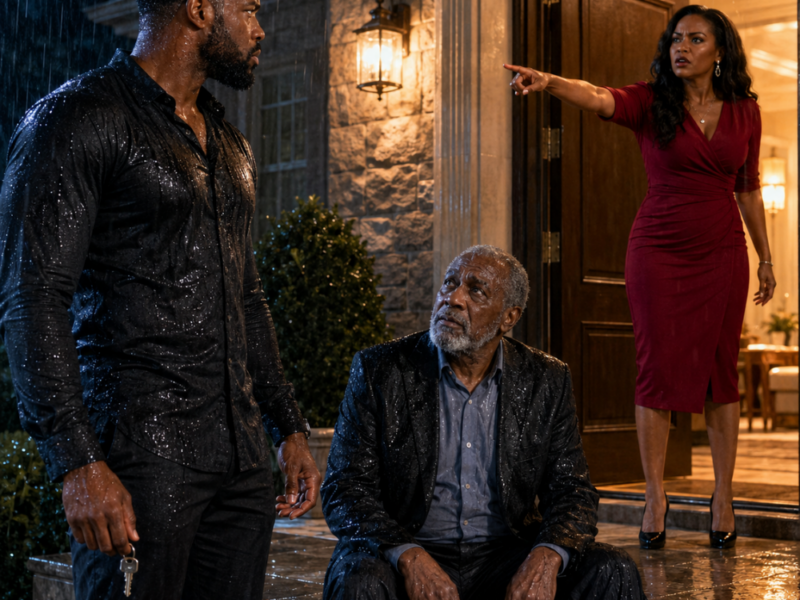
My Wife Locked My Father Outside In The Rain—She Had No Idea What I’d Do Next.
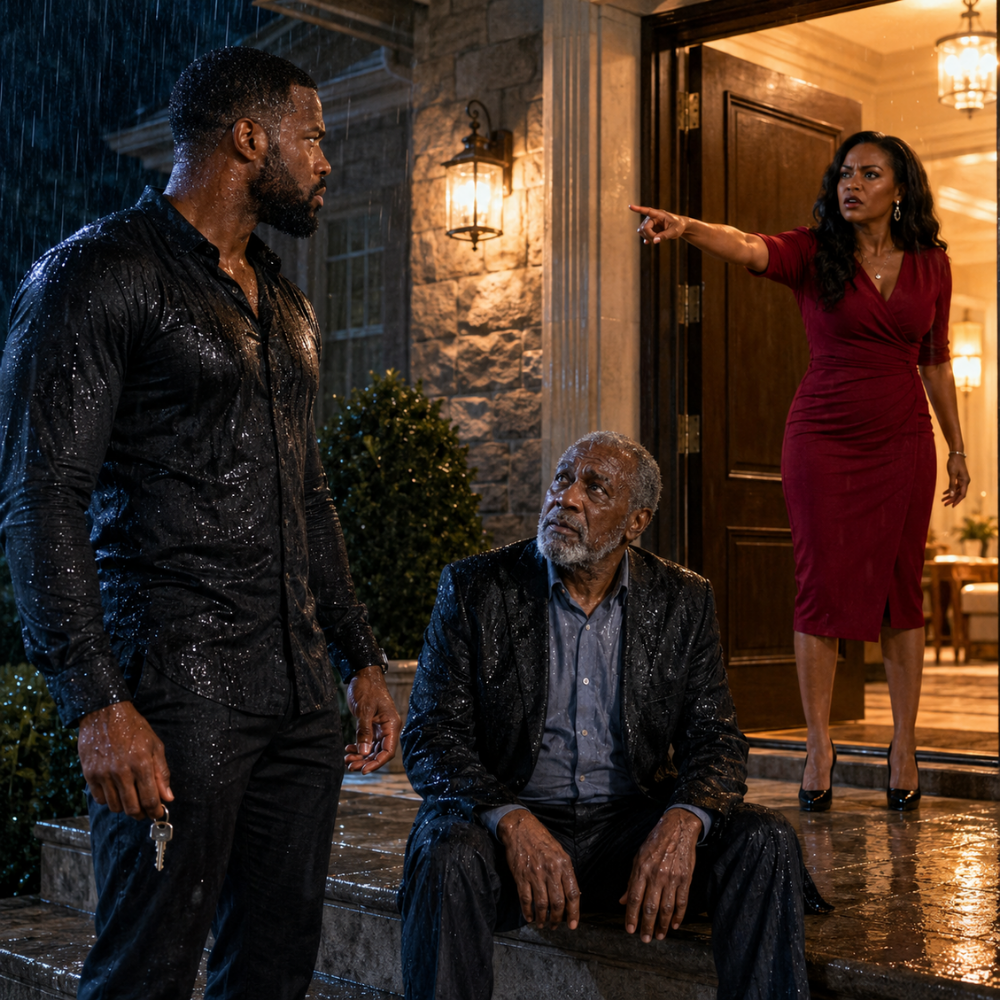
My wife left my father sitting in the rain for 40 minutes. What he told me on the front step changed everything.
The porch light was on, which was the first thing that bothered me.
Cassandra never left it burning once guests had gone. She was too particular about small household routines for that. The dishwasher could still be running, a wineglass could be waiting beside the sink, there could be half a lemon drying on the cutting board, but the porch light went off when the evening was over.
It was 8:15 on a Thursday night, and I had just closed my laptop after nearly three hours in the study.
The rain had been falling long enough to cover the windows in moving gray lines. I had barely noticed it while working. I had been buried in a revised development budget that needed approval before an eight-thirty meeting the next morning, the kind of spreadsheet where one wrong line could move several million dollars into the wrong quarter and give fifty people a very bad Friday.
I walked through the front hall on my way to the kitchen for water and saw the light glowing through the narrow pane beside the door.
Then I saw my father.
He was sitting on the front step.
For one second I assumed I was mistaken.
Thomas Hale did not sit on front steps.
My father was seventy-one, still worked five days most weeks despite repeatedly claiming he was “mostly retired,” wore polished leather shoes even to the hardware store, and treated umbrellas as objects designed for people who did not know how to read a weather forecast.
But there he was.
His gray jacket was dark with rain.
Water dripped from his hair.
His hands rested loosely between his knees.
He was not pounding on the door.
He was not checking his phone.
He was simply sitting.
I opened the door.
“Dad?”
He looked up.
“Evening.”
I stared at him.
“How long have you been out here?”
He glanced at his watch as casually as if I had asked how long he had been waiting for a table at a diner.
“About forty minutes.”
For a moment I did not understand the sentence.
“Forty minutes?”
“Give or take.”
“Why didn’t you call me?”
He looked toward the rain.
Then back at me.
“I wanted to see what you would do.”
I stood in the doorway with one hand still on the knob.
Behind me was a warm house.
Recessed lights.
A kitchen that had been renovated two years earlier.
A half-empty bottle of Sauvignon Blanc on the counter from the women Cassandra had invited over that evening.
In front of me was my father, soaked through on the front step.
I did not ask him again why he had not called.
I did not go inside to find Cassandra.
Instead, I pulled the door mostly closed behind me and sat down beside him.
The concrete was wet and cold through my pants.
My father looked at me once.
Not approvingly.
Not dramatically.
Just long enough to register the choice.
Then he looked back toward the street.
Rain whispered through the oak trees along the cul-de-sac.
Across from us, the Perrys’ porch lights reflected on their black SUV. Somewhere farther down the block, a dog barked behind a fence.
Neither of us spoke for almost a minute.
Then my father said, “There’s something I should’ve told you a long time ago.”
I leaned my elbows on my knees.
“I’m listening.”
What he told me on that step had begun thirty years before, but the reason he was telling me now began three weeks before my wedding.
I remembered that dinner clearly.
My father took me to Lenny’s Grill, an old restaurant tucked between a dry cleaner and a family pharmacy in a part of town that had somehow avoided becoming fashionable.
The booths were cracked at the edges.
The same waitress had worked Tuesday nights since I was in high school.
My father ordered meatloaf, mashed potatoes and unsweetened iced tea, because he had ordered the same thing there since approximately the Reagan administration and viewed menu experimentation as a sign of weak character.
We were halfway through dinner when he put down his fork.
“I want to ask you for something.”
That got my attention.
My father rarely asked.
He advised.
Suggested.
Announced.
Occasionally informed you that something had already been arranged.
Asking was different.
“What?”
“Don’t tell Cassandra everything about Meridian yet.”
I looked at him.
“What does that mean?”
“She knows what you do.”
“Yes.”
“Keep it there.”
I leaned back.
Cassandra knew I worked in real estate development and investment.
That was true.
What she did not know was the scale.
Veil Meridian had started with my grandfather acquiring distressed commercial property in the 1970s. My father had nearly lost it, rebuilt it, expanded it, and eventually handed operational control to me in stages.
By the time I was thirty-eight, Veil Meridian had holdings spread across twelve cities: apartment redevelopment, commercial property, mixed-use projects, infrastructure partnerships and a private investment fund.
The number attached to the consolidated portfolio moved with the market, but at the time of my wedding it was already well into ten figures.
My personal life did not look like that.
That was deliberate.
I drove a five-year-old Lexus because I liked it.
I wore good suits to work and jeans most weekends.
Cassandra and I lived comfortably, but not extravagantly.
She knew I made a good living.
She did not know that the “family company” I occasionally referenced owned buildings she had probably driven past.
I stared at my father across the restaurant table.
“Why?”
He wiped his mouth with a paper napkin.
“Let her choose you before she knows what comes with you.”
“That sounds like a test.”
“It is.”
“I don’t like testing people.”
“Neither do I.”
“Then why are you asking?”
My father looked toward the front windows.
A pickup truck rolled through the parking lot with one headlight out.
When he looked back at me, something in his face had changed.
“Because I didn’t do it with your mother.”
I stopped.
He rarely talked about her.
My parents separated when I was five and divorced when I was six. I had seen my mother over the years, though not with any consistency that deserved to be called a routine. She had remarried twice, moved across the country, and built a life that did not contain much room for the family she had left.
I knew the outline.
My father had suffered serious business losses.
My mother had left.
He rebuilt.
That was the version I had carried since childhood.
At Lenny’s that night, he offered nothing more.
“It cost me,” he said. “In ways I don’t think I understood until much later.”
“What are you worried Cassandra will do?”
“I don’t know her well enough to be worried about something specific.”
“That’s not much of an endorsement.”
“It’s not an accusation either.”
He leaned forward.
“That’s the point, Ethan. I want her choice to be hers. Not influenced by something she can’t unknow once you tell her.”
I sat with that.
I loved Cassandra.
At that stage of our relationship, I did not doubt her.
We had met at a nonprofit fundraising dinner where neither of us particularly wanted to be. She had been helping her friend organize the event. I had attended because Veil Meridian sponsored a housing initiative and somebody from the company needed to appear.
She did not recognize my last name.
She did not ask where I lived.
She asked why I kept staring at the dessert table without taking anything.
I told her I was trying to decide whether pecan pie was worth pretending I had not already eaten two pieces of bread.
She said, “It isn’t. Take the pie.”
I liked her immediately.
She worked in design consulting at the time, had a sharp eye, an orderly mind, and a way of listening that made silence feel intentional instead of awkward.
Our first dates were ordinary.
Coffee.
A farmers market.
A terrible movie we spent the drive home criticizing.
She seemed more interested in what I read than what I earned.
When she learned I worked in development, she asked whether I liked it.
She did not ask my title.
When I told my father that, I could see his relief.
Maybe that was why his request bothered me.
It felt unnecessary.
Still, I agreed.
Not because I believed Cassandra needed to pass some hidden test.
Because my father had asked for one thing with a seriousness I could not ignore.
So Cassandra married the version of me she knew.
A man who worked in real estate.
A man whose father had done well in business.
A man with a comfortable income and some family advantages.
All true.
Just incomplete.
For the first few years, the incompleteness did not matter.
There was one night during our first year of marriage that I remembered often after everything changed.
A major deal collapsed.
We had been negotiating for nearly nine months to redevelop an old industrial district. The financing was arranged. The city had approved zoning. Then a pension fund changed strategy and withdrew from the capital stack two days before closing.
It cost Meridian real money.
More than that, it cost me confidence.
I came home after ten.
Cassandra was reading on the couch.
She looked at me once and closed the book.
“Bad?”
“Yes.”
“Do you want to talk?”
“No.”
“Okay.”
That was all.
She went to the kitchen.
A few minutes later she returned with tea.
Earl Grey.
A little milk.
No sugar.
I had never told her that was how I drank it.
She had noticed.
She sat beside me.
Did not ask for numbers.
Did not offer advice.
Did not say everything happened for a reason, which is a sentence I have always believed should result in a modest fine.
She simply stayed.
At some point I fell asleep sitting up.
When I woke after midnight, there was a blanket over me.
That was Cassandra.
At least that was the Cassandra I married.
People want marriage stories to have a clean point where someone changes.
They rarely do.
Cassandra did not wake up one morning and become materialistic.
My father did not suddenly become unbearable.
Her mother, Diana, did not arrive wearing a villain’s cape and poison her daughter over brunch.
It happened more quietly.
Diana Whitmore had a talent for interpretation.
That was the best way I knew to describe it.
She could take an ordinary event and give it meaning.
Not false meaning exactly.
Selective meaning.
If Cassandra told her I had worked late three nights in a row, Diana did not say, “Your husband is neglecting you.”
She said, “I hope Ethan understands that successful marriages require visible priorities.”
If I bought Cassandra a practical anniversary gift she had asked for, Diana did not call it cheap.
She said, “Men sometimes confuse solving a problem with making a woman feel cherished.”
If my father stopped by without warning, Diana did not call him rude.
She said, “It’s interesting that Ethan still hasn’t made it clear whose household this is.”
Always polished.
Always reasonable enough that objecting made you sound defensive.
Diana had spent most of her adult life measuring security through visible signs.
Her own marriage had been unstable financially. Cassandra’s father had gone through several businesses, two bankruptcies and one period when creditors called the house so often Diana unplugged the phone during dinner.
She had survived that instability by becoming obsessed with the opposite.
Predictability.
Status.
Evidence.
In Diana’s worldview, a man who was successful should look successful.
A man who loved you should demonstrate it in recognizable ways.
A home should clearly belong to the people living in it.
Boundaries were proof of adulthood.
Money was proof of competence.
Visible prioritization was proof of love.
None of these ideas were absurd by themselves.
That was what made them powerful.
Diana repeated them until they became the frame through which Cassandra increasingly interpreted our marriage.
The problem with my father was more complicated because, in fairness, Thomas could be intrusive.
He believed family did not require invitations.
If he was in the neighborhood, he stopped by.
Sometimes he brought tomatoes from his garden.
Sometimes mail that had gone to his house.
Sometimes nothing.
He would knock.
Wait thirty seconds.
Then knock again as though the first knock had been a clerical error.
I had talked to him about it.
“Dad, call before you come.”
“I usually do.”
“No. You usually text from the driveway.”
“That’s technically before I come in.”
“That isn’t what anyone means.”
He would nod.
“Understood.”
Then two weeks later he would appear carrying a bag from Costco and say, “I was nearby.”
He was not nearby.
The nearest Costco was twenty-five minutes in the opposite direction.
My father heard boundaries conceptually.
He simply had a difficult time believing they applied to him with people he loved.
That was his flaw in the story.
And I had failed to deal with it well enough.
I told Cassandra I would talk to him.
I did.
He improved for a while.
Then relaxed.
Cassandra’s irritation became sharper.
Diana noticed.
A month before the night in the rain, my father came by three times without calling.
The first visit was harmless.
He dropped off peaches from a roadside stand and stayed twenty minutes.
Cassandra smiled, made coffee, and afterward said, “Can you please remind him?”
I did.
The second time Diana happened to be visiting.
My father walked into the kitchen carrying a box of old tax documents he thought I needed.
Diana watched him place them on the counter.
“Thomas,” she said pleasantly, “you must feel very comfortable here.”
He missed the edge completely.
“I do.”
Cassandra heard it.
So did I.
I changed the subject.
Later that night Cassandra asked, “Did you hear what Mom was trying to say?”
“Yes.”
“And?”
“And Dad didn’t.”
“That’s not the problem.”
“What is?”
“The problem is he behaves like this is still his house.”
I almost answered.
Then didn’t.
That moment would matter later.
Because technically, legally, it was.
My father had bought the house eleven years earlier.
It was one of several properties he acquired personally, not through Meridian.
When Cassandra and I got married, he offered it to us.
Not as a grand gesture.
My father did not do grand gestures.
He called me one Saturday morning and said, “You’re going to need more space eventually. Move into Willow Ridge.”
I told him we could buy our own house.
He said, “You can also waste money if that’s emotionally important to you.”
The plan had always been to transfer title later.
We never prioritized the paperwork.
Taxes were paid.
Insurance handled.
Renovations completed.
I paid household expenses.
My father never treated the property as leverage.
Years passed.
The deed remained in his name mostly because none of us had cared enough to fix it.
Cassandra did not know.
Not because I hid it deliberately.
Because it had become one of those administrative facts so unimportant in daily life that I stopped thinking about it.
Once, early in our marriage, my father referred to “my house” while we were reviewing property tax documents at the kitchen table.
Cassandra walked through while looking at her phone.
She never registered the phrase.
I did.
I remember thinking I should explain.
Then the phone rang.
I didn’t.
That failure belonged to me too.
The third unannounced visit was the one that changed Cassandra’s tone.
She had invited several women from a local arts nonprofit to the house for a planning dinner.
She had arranged flowers.
Prepared food.
Moved furniture.
She cared about the impression because she was being considered for a committee position.
My father showed up halfway through carrying a package that had accidentally been delivered to his address.
Instead of leaving immediately, he chatted with two guests he knew.
Then he noticed one of the dining chairs had a loose leg and spent ten minutes inspecting it.
Cassandra was furious after he left.
“He cannot keep doing this.”
“I know.”
“No, Ethan. You say you know. Then nothing changes.”
“That’s fair.”
“I feel like I’m living in a house where your father can walk in whenever he wants.”
“He knocked.”
“That isn’t the point.”
I sighed.
“I’ll handle it.”
“When?”
“Tomorrow.”
Cassandra stared at me.
“I’ve heard tomorrow.”
She called Diana that night.
I did not hear the entire conversation.
I heard enough.
Diana told her a boundary only existed if there was a consequence for crossing it.
That part was true.
Then she added something else.
“If Ethan won’t establish the boundary, you may need to show both men that you’re capable of establishing it yourself.”
Cassandra lowered her voice after that.
I went upstairs.
The evening my father sat in the rain began normally.
Diana arrived around six with a woman named Patricia whom I had met twice.
Cassandra had prepared appetizers.
Wine.
Cheese.
Little pastry things that looked too delicate to qualify as food.
I greeted them, stayed fifteen minutes and excused myself to work.
At seven, Victor Reyes called.
Victor was Meridian’s director of operations and had worked for our family nearly fourteen years.
He was forty-nine, meticulous, and had a supernatural ability to locate the one number in a hundred-page document that would eventually cause a problem.
A contractor had revised a major cost estimate.
Victor needed approval.
I authorized the change and asked him to bring final documents in the morning.
The call took three minutes.
When I returned through the living room, Cassandra asked, “Who was that?”
“Victor.”
“The project manager?”
I had once described Victor that way after Cassandra overheard a call.
It was easier than explaining our corporate structure while brushing my teeth.
“Basically.”
Diana looked at me.
“What kind of project?”
“Mixed-use development.”
“Here?”
“Three states.”
Diana’s eyebrows rose slightly.
Then she looked at Cassandra.
It was a tiny exchange.
A half smile.
A glance.
The kind of thing meant to confirm a private theory.
I noticed.
I said nothing.
That too belonged to me.
I returned to the study.
At 8:15, I found my father outside.
Sitting beside him in the rain, I asked what he should have told me years ago.
He took a long breath.
“When you were four, I lost almost everything.”
“I know.”
“No.”
He looked at me.
“You know the version I tell at Christmas.”
That was true.
My father’s version went something like this:
The market turned.
We got overextended.
I made mistakes.
We recovered.
A business story.
Clean.
Useful.
The rainwater ran from his sleeve onto his hand.
“We were living on Hawthorne then.”
I remembered almost nothing of that house.
A yellow kitchen.
A staircase.
My mother wearing perfume too strong for the car.
My father continued.
“Meridian wasn’t what it is now. We were growing too fast. I thought leverage was intelligence.”
He gave a small smile.
“It wasn’t.”
He had acquired property at the top of an overheated market.
When credit tightened, several projects stopped producing cash at once.
Lenders demanded collateral.
Partners panicked.
One investor sued.
The company survived, barely.
My father’s personal assets did not.
He sold investment properties.
Then stocks.
Then cars.
Then the house.
“We didn’t become poor,” he said. “Not really. We still had food. I could pay rent. You had clothes. But compared to what your mother thought our life was, it felt like collapse.”
I listened.
“She stayed eight months.”
He said that carefully.
“That matters.”
“Why?”
“Because for years I told myself she left when the money disappeared. That’s too simple.”
The rain came harder for a moment.
My father looked toward the street.
“She stayed long enough for me to think we were going to survive it together.”
My mother cooked dinners.
Packed my preschool lunch.
Went with my father to meetings with accountants.
Told friends they were rebuilding.
Outwardly, she remained.
Inside, according to my father, she had already begun leaving.
“She stopped talking about next year,” he said.
“I didn’t notice it then.”
He rubbed water from his eyebrow.
“People tell you what they’re planning through the future tense. I learned that later.”
One morning she packed two suitcases.
By evening she was gone.
She had arranged an apartment in another state.
There was another relationship too, although my father did not make much of that.
The betrayal that stayed with him was not the other man.
It was the realization that he had spent eight months experiencing a marriage his wife had already emotionally exited.
“I spent years asking what I missed.”
I looked at him.
“And?”
“I missed that she loved the life we built more than she loved building a life.”
I did not answer.
He glanced at me.
“That’s harsh.”
“A little.”
“It’s also probably incomplete.”
That surprised me.
My father rarely revised himself while speaking.
He continued.
“Your mother had reasons. I worked constantly. I assumed providing was the same as being present. I treated business risk like it was mine alone even though she lived with the consequences.”
He paused.
“I’m not making her a villain.”
The rain softened.
“I’m telling you why I asked you not to tell Cassandra everything.”
I understood.
“You were afraid she’d choose the money.”
“No.”
He shook his head.
“I was afraid you would never know what she chose.”
That sentence stayed between us.
My father leaned forward.
“I rebuilt Meridian. You know that part.”
I did.
He spent the next decade buying distressed assets at prices that made other developers laugh.
Some became extraordinarily valuable.
He became conservative where he had once been reckless.
Slow where he had once been ambitious.
Veil Meridian grew precisely because my father never again believed good conditions would last forever.
“I built twice,” he said.
“Once because I was young enough to believe I couldn’t fail.”
He smiled.
“Then again because I had.”
I looked at him.
“Why tell me tonight?”
He took his time.
Then he said, “Because I’ve been sitting on this step for forty minutes.”
I stared at him.
“I don’t know exactly what happened inside.”
“You know Cassandra didn’t open the door.”
“Yes.”
“Did you knock?”
“Yes.”
“Did she see you?”
“Yes.”
That landed harder than I expected.
“What happened?”
My father looked toward the house.
“She opened the interior door but left the storm door locked.”
I felt my jaw tighten.
“She said you weren’t home and this wasn’t a good time.”
“And?”
“I told her I’d wait.”
“She left you outside?”
“Yes.”
“In the rain.”
“It wasn’t raining much yet.”
“Dad.”
“I’m not defending it.”
“You sound like you are.”
“I’m telling you what happened.”
I stood halfway, then sat again.
My father continued.
“She told me I needed to stop arriving without calling. She said this was her home and she was setting a boundary.”
I said nothing.
“She wasn’t entirely wrong.”
I looked at him.
“You sat outside forty minutes.”
“And I should’ve called before I came.”
“That isn’t the same thing.”
“No.”
He nodded.
“It isn’t.”
I rubbed both hands over my face.
“Why didn’t you call me?”
“Because I wanted to see what would happen.”
“What does that mean?”
He looked at me.
“I wanted to see what you would do when you found me.”
“That’s ridiculous.”
“Probably.”
“You could’ve gone home.”
“Yes.”
“You could’ve called.”
“Yes.”
“You could’ve stood under the covered part of the porch.”
He glanced above us.
“I realized that about twenty minutes in.”
Despite myself, I laughed once.
He smiled.
Then became serious.
“I’m not telling you what to do with Cassandra.”
“I know.”
“I mean that.”
He put a hand briefly on my shoulder.
“Don’t punish your wife to defend me. Don’t make tonight into some contest between us.”
“Then what am I supposed to do?”
“Ask what happened.”
He stood slowly.
“You married her. You owe her the whole conversation.”
I stood too.
Water ran from both of us onto the walkway.
My father looked toward the door.
“Just don’t lie to yourself while you’re having it.”
I opened the house.
Cassandra was in the kitchen.
She turned when we came in.
Her expression changed almost too quickly to follow.
First surprise.
Then irritation.
Then concern when she saw how wet I was.
Then something else when she realized I had been outside with him.
My father removed his shoes by the door without being asked.
Water dripped from his jacket onto the tile.
Cassandra looked at me.
“Ethan.”
I took off my wet shoes.
“Why didn’t you open the door?”
She breathed in.
“I was going to tell you.”
“When?”
“Tonight.”
“Tell me now.”
My father started toward the hall.
“I can give you two a minute.”
“No.”
I regretted how sharp it sounded.
I corrected myself.
“Please stay.”
He stopped.
Cassandra crossed her arms.
“Your father came over again without calling.”
“Yes.”
“I’ve asked you repeatedly to deal with it.”
“Yes.”
“You said you would.”
“I did.”
“It didn’t work.”
“No.”
“Then I handled it.”
Her voice was controlled.
She had rehearsed this.
Not cynically.
She had simply been thinking about it for weeks.
“This is our home, Ethan. I should be able to have people over without wondering whether your father is going to appear. I should be able to set a boundary in my own house.”
“I agree.”
She blinked.
My father looked at me.
I continued.
“I agree he should call.”
Cassandra’s shoulders relaxed slightly.
“But you left him outside in the rain.”
“It wasn’t raining when he got here.”
“It was raining when you didn’t let him in.”
“He said he would wait.”
“Cassandra.”
“What was I supposed to do? Reward the exact behavior we’ve been discussing?”
There it was.
Diana’s language.
Not because Diana had given her a script.
Because interpretation repeated often enough becomes instinct.
I kept my voice down.
“You could’ve let him sit inside and still told him the visit wasn’t okay.”
“Then nothing changes.”
“So you needed a consequence.”
“Yes.”
I looked at my father.
He looked tired.
Not humiliated.
Not angry.
Tired.
That made me angrier than if he had looked wounded.
I turned back to Cassandra.
“Do you know whose name is on the deed?”
She frowned.
“What?”
“The deed to this house.”
“I don’t understand.”
“It’s a straightforward question.”
“Our names.”
“No.”
She stared at me.
“My father’s.”
The kitchen became completely still.
Cassandra looked toward Thomas.
Then back at me.
“What do you mean?”
“He owns the house.”
“That doesn’t make sense.”
“He bought it eleven years ago.”
“You said he gave us the house.”
“He gave us use of it. We never transferred title.”
“Never?”
“No.”
Cassandra stared.
I could see her replaying years.
Property tax documents.
Insurance.
Renovations.
My father’s casual language.
Every moment she had assumed ownership because possession felt like ownership.
She looked at me.
“Why didn’t you tell me?”
“I should have.”
That answer stopped something before it grew.
I did not tell her she should have known.
I did not pretend I had clearly disclosed it.
I had not.
“I should’ve told you,” I repeated. “That’s on me.”
Cassandra sat down at the kitchen island.
My father remained by the hallway.
I continued.
“But the deed isn’t the main problem.”
She looked up.
“You just used it like it was.”
“Because I needed you to understand how much you assumed.”
Her face hardened.
“That isn’t fair.”
“Probably not.”
I pulled out a chair.
“But neither was leaving him outside.”
“He was violating a boundary.”
“Yes.”
“And you agree.”
“Yes.”
“Then why am I the only person being treated like I did something wrong?”
That question mattered.
I sat.
“You’re not.”
I looked at my father.
“Dad, you need to call before you come over.”
He nodded.
“I do.”
“No text from the driveway.”
“I know.”
“No appearing because Costco happened to place itself near our neighborhood.”
My father almost smiled.
“Understood.”
I turned back to Cassandra.
“I should’ve enforced that earlier. I made you keep asking for something reasonable until you felt like you had to prove it yourself.”
Her eyes filled slightly.
I continued.
“That part is mine.”
She looked down.
“But once you decided the right response was to leave a seventy-one-year-old man outside for forty minutes because he needed to learn a lesson, you moved past a boundary.”
Cassandra said nothing.
“You turned it into punishment.”
Her mouth tightened.
“Diana said if there was never a consequence—”
“I know what Diana said.”
Cassandra looked at me.
“You heard?”
“Enough.”
She looked away.
I softened my voice.
“Your mother has been interpreting our marriage for you for years.”
“That’s not fair.”
“Isn’t it?”
“She cares about me.”
“I know.”
“She watched my father bankrupt us twice.”
“I know.”
“She knows what it looks like when a woman keeps accommodating men until she doesn’t recognize her own life.”
“I know that too.”
I leaned forward.
“But caring about you doesn’t make every interpretation she gives you correct.”
Cassandra was quiet.
I said, “She told you a man who can’t set boundaries with his father is failing as a husband.”
Her expression told me I was close enough.
“I’ve failed to set one clearly,” I said. “That’s true.”
My father shifted near the hallway.
“But she turned Dad into a symbol before you finished dealing with him as a person.”
Cassandra swallowed.
“He’s not easy.”
“I know.”
“He walks in here like—”
“Like family doesn’t need permission.”
“Yes.”
“That’s his mistake.”
I looked at her.
“Your mistake was deciding that mistake told you who he was.”
She stared at me.
My father spoke.
“Ethan.”
I looked over.
“That’s enough.”
He said it quietly.
Not because he was defending Cassandra.
Because he understood the point had been made.
Continuing would turn truth into humiliation.
I nodded.
“You’re right.”
Cassandra wiped beneath one eye quickly.
The kettle sat beside the stove.
After a while she stood and filled it.
The sound of running water seemed unusually loud.
“Thomas.”
My father looked at her.
“I’m sorry you were sitting out there.”
He nodded.
She continued.
“I’m not ready to say I was wrong about needing a boundary.”
“You shouldn’t be.”
Cassandra looked surprised.
My father removed his wet jacket.
“I should call.”
“Yes.”
“I’ve been rude about that.”
She nodded.
“But I shouldn’t have left you outside.”
“No.”
He said it without drama.
“You shouldn’t have.”
The kettle clicked on.
For a moment nobody spoke.
Then Cassandra looked at him.
“Do you want dry clothes?”
“I keep some in the guest bath.”
She stared.
Of course he did.
My father added, “From when Ethan and I painted the upstairs hallway.”
Cassandra looked toward me.
I had forgotten about them.
Thomas walked down the hall.
Cassandra stood beside the kettle.
I watched her make tea.
Earl Grey for me.
Chamomile for herself.
Black coffee for my father once he came back, because apparently tea after eight was where he drew his line against reckless living.
She remembered all of it.
That complicated my anger.
People are easier to condemn when their worst action is the only thing visible.
Cassandra was still the woman who knew how I took my tea.
She was also the woman who had left my father in the rain.
Both were true.
That was what marriage required us to face.
Not which version was real.
How both had become possible in the same person.
Before going to bed, I texted Victor.
Bring the authorization documents to the house tomorrow instead of the office.
He replied thirty seconds later.
8:30?
8:40.
Then:
Everything okay?
I looked toward the kitchen.
No.
But maybe.
I typed:
Yes. See you then.
Victor arrived at 8:41 the next morning.
Cassandra opened the door.
She had slept badly.
So had I.
My father had stayed in the guest room rather than drive home in the storm.
Victor stood on the porch holding a leather document case.
“Morning, Mrs. Hale.”
“Good morning.”
His company badge was clipped to his jacket.
VICTOR REYES
DIRECTOR OF OPERATIONS
VEIL MERIDIAN GROUP
Cassandra read it.
Then read it again.
Something changed in her face.
“Come in.”
Victor stepped inside.
He saw my father at the kitchen table.
“Tom.”
“Morning.”
“How’s retirement?”
My father looked offended.
“I’ll let you know if I ever try it.”
Victor laughed.
“Coffee?”
“If it’s made.”
My father got up and poured him a cup.
The exchange lasted less than a minute.
It communicated more than I could have explained in an hour.
Victor did not treat my father like a retired relative visiting his son’s workplace.
He treated him like the man who had hired him fourteen years earlier.
He did not treat me like a project manager.
He handed me a document case containing approval authority for a nine-figure development budget.
We went into the study.
Cassandra stayed in the kitchen at first.
Then, sometime during the second set of documents, I noticed her standing near the doorway.
Victor walked me through the contractor revision.
“Base cost moved four point eight because the steel estimate changed.”
“I saw it.”
“Contingency absorbs two.”
“Move the remaining two point eight from phase-three discretionary.”
“That’s what finance recommended.”
“Good.”
He turned the next page.
“City wants the infrastructure guarantee executed before noon.”
“Legal cleared language?”
“Seven-thirty this morning.”
I signed.
Victor gathered the papers.
“We’ll have executed copies back to the project team within the hour.”
“Thanks.”
He stood.
Then noticed Cassandra.
“Good seeing you.”
“You too.”
She managed it naturally.
Victor left.
I returned to the study.
Cassandra followed.
“How many companies are there?”
I looked at her.
“Under Meridian?”
“Yes.”
I leaned back against the desk.
“Depends how you’re counting.”
“Don’t do that.”
“I wasn’t being evasive.”
“It sounded evasive.”
“Operating companies, investment entities or project-specific LLCs?”
Her expression told me the distinction was not helping.
“How big is Veil Meridian?”
I took a breath.
“Consolidated portfolio?”
“Yes.”
“Current estimate is around two point seven billion.”
She stared at me.
Then repeated it.
“Two point seven billion.”
“Approximately.”
She laughed once.
Not because anything was funny.
“You’ve been running a two-point-seven-billion-dollar company while I thought you were some kind of senior project manager.”
“I told you I worked in real estate development and investment.”
“That is like saying you work with water when you run a dam.”
“That’s fair.”
She walked to the window.
“How long?”
“How long what?”
“Have you been in charge?”
“Operationally? Most day-to-day control for six years. Full executive authority for four.”
She turned.
“And your father?”
“Chairman until three years ago. Still owns a major interest.”
“And you never thought I needed to know this?”
That question deserved more than a defensive answer.
“I thought you deserved to know.”
“That’s not the same thing.”
“No.”
“Then why?”
I sat down.
“Three weeks before our wedding, Dad asked me not to tell you the full scale.”
Her face changed.
“He wanted to test me.”
“He wanted you to choose before you knew.”
“That’s a test.”
“Yes.”
“And you agreed.”
“Yes.”
She stared at me.
“That is incredibly insulting.”
“I understand why it feels that way.”
“Feels?”
“It was a test, Cassandra.”
I did not soften it.
“I don’t like that word, but I’m not going to pretend it was something else.”
She folded her arms.
“So you thought I might be after money.”
“No.”
“How can you say that?”
“Because I didn’t agree because I suspected you.”
“Then why agree?”
“Because my father asked.”
“That’s worse.”
“Maybe.”
She looked away.
I continued.
“I knew you weren’t wealthy.”
Her head snapped back.
“Excuse me?”
“I knew enough about your family’s finances to know that learning Meridian’s scale would’ve changed what you thought you were marrying into.”
“So you investigated us.”
“I didn’t hire anyone to investigate you. Public records exist. Your mother talked. Your father talked more.”
She looked embarrassed.
I hated that.
“I didn’t care.”
“Apparently Dad did.”
“He cared because of what happened with my mother.”
“What happened?”
I looked toward the kitchen.
“Ask him.”
She frowned.
“You’re not going to tell me?”
“It’s his story.”
“You know now.”
“Yes.”
“And you won’t tell your wife.”
“I’ll tell you anything that’s mine.”
I stood.
“But what he told me last night belongs to him until he chooses otherwise.”
For once, Cassandra did not argue.
She walked toward the kitchen.
I stayed in the study.
I could hear voices but not words.
That was intentional.
I closed the door.
For fifteen minutes I pretended to review email.
I absorbed almost nothing.
Eventually I went out.
Cassandra and my father were sitting across from each other at the kitchen table.
Coffee between them.
Her hands wrapped around a mug.
I stopped near the doorway.
She was saying, “I don’t want to apologize in a way that makes me feel better and leaves you with the same thing.”
My father waited.
Cassandra continued.
“I’m sorry I left you outside.”
He nodded.
“But that’s too general.”
She looked down.
“I need to be honest about why.”
My father said nothing.
“I had decided what kind of man you were.”
Thomas watched her.
“You were the intrusive father-in-law who didn’t respect our marriage.”
Cassandra looked up.
“And once I put you in that category, everything you did became evidence for it.”
My father leaned back.
“That’s usually how categories work.”
She almost smiled.
Then didn’t.
“I told myself I was defending my home.”
She looked around the kitchen.
“I didn’t even know it was legally yours.”
Thomas took a drink of coffee.
“You didn’t.”
“But if I’m truthful…”
She paused.
“I don’t think knowing would’ve changed what I did.”
That surprised all three of us.
Cassandra continued.
“I had gotten so convinced that I needed to make a point that I would’ve told myself ownership wasn’t relevant.”
My father looked at her for a long moment.
She kept going.
“I built a story where leaving you outside wasn’t cruel. It was strong.”
Her voice became quieter.
“And I think that’s what I’m most ashamed of.”
Thomas set down his mug.
“You want my opinion?”
“Yes.”
“The door wasn’t the worst part.”
She waited.
“You locked it because you’d already decided what I deserved.”
Cassandra nodded.
“And you decided what you were entitled to.”
He glanced around the room.
“Those decisions worked together.”
She lowered her eyes.
Thomas continued.
“I’ve been disrespectful too.”
She looked up.
“I treat family access like it’s automatic.”
“It feels automatic to you.”
“It does.”
“Why?”
My father thought.
“Because I spent enough of my life losing people that I started treating the ones who stayed like they couldn’t reasonably ask me to stand outside.”
Cassandra’s face softened.
“That’s not fair to them.”
“No.”
He smiled faintly.
“Getting old hasn’t made me as wise as advertised.”
Cassandra laughed quietly.
Neither was comfortable.
That was good.
Comfort would have come too cheaply.
Cassandra said, “Your son told me you built the company twice.”
Thomas glanced toward the hallway.
He had seen me.
“Are you planning to stand there all morning?”
“I was considering it.”
“Stop considering and sit down.”
I joined them.
The three of us had sat at that kitchen table dozens of times.
Christmas morning.
Tax paperwork.
Takeout dinners.
A plumbing estimate.
One memorable Saturday when my father attempted to explain why our new refrigerator was “overengineered.”
The arrangement looked identical.
It felt nothing like before.
Thomas turned to me.
“What are you going to do about the house?”
“Transfer the deed.”
Cassandra looked at me.
I continued.
“We should’ve done it years ago.”
My father nodded.
“I agree.”
“County recorder Monday?”
“I’ll call Mason.”
Mason was the family attorney who handled property matters.
Cassandra looked from one of us to the other.
“You’re transferring it to us now?”
“Yes.”
She seemed almost offended by the timing.
“Because of last night?”
My father shook his head.
“No.”
“Then why now?”
“Because it was always supposed to happen.”
He looked at me.
“Ethan procrastinated.”
I stared at him.
“You owned the house.”
“You lived in it.”
“You had the deed.”
“You had a phone.”
Cassandra laughed.
It escaped before she could stop it.
My father smiled.
The tension loosened by one degree.
Then Cassandra grew serious.
“I need to talk to my mother.”
I said nothing.
She looked at me.
“Not because you’re telling me to.”
“I’m not.”
“I know.”
She traced one finger along the edge of her mug.
“I’ve let her give me explanations for things before I decided what I thought.”
My father said, “Parents are good at that.”
She looked at him.
“You don’t do that?”
Thomas glanced at me.
“Constantly.”
I nodded.
“He does.”
My father ignored me.
“The question is whether you know you’re being given an opinion or whether it arrives disguised as fact.”
Cassandra absorbed that.
“I think hers started arriving as fact.”
Thomas nodded.
“Then maybe that’s the conversation.”
The talk with Diana happened that afternoon.
I was not in the room.
Cassandra told me enough afterward.
Diana became defensive.
Not because she wanted her daughter unhappy.
Because she genuinely believed the advice she had given was protective.
She reminded Cassandra of every time Thomas had arrived without calling.
Every time I worked late.
Every moment Cassandra had complained that our life did not look as financially secure as she expected by our age.
Then Cassandra asked a question her mother apparently did not like.
“When I tell you about my marriage, do you listen for what happened or do you listen for what it means according to your life?”
Diana said the distinction was unfair.
Cassandra said maybe.
Then she told her mother she needed the interpretation to stop.
“I can ask for advice,” Cassandra told her. “But if I don’t ask, I need you to let an event be an event.”
Diana asked whether Ethan had put her up to this.
That, according to Cassandra, was the sentence that finally convinced her.
“No,” she said. “That’s exactly the problem.”
They did not resolve everything.
Families rarely do in one afternoon.
Diana left upset.
Cassandra cried afterward.
Then she made grilled cheese for dinner because neither of us had the energy for anything more complicated.
That felt more honest than a grand reconciliation.
My father went home around three.
Cassandra walked him to the door.
He put on dry clothes but left the soaked jacket hanging near the front hall.
She opened the door.
“Call next time.”
“I will.”
“Before you’re in the driveway.”
He sighed.
“Yes.”
“At least ten minutes.”
“Now you’re negotiating.”
“Thomas.”
He smiled.
“I’ll call.”
She held the door.
He stepped outside.
Then looked back.
“Thank you.”
Two ordinary words.
They carried the weight of the night before without reopening it.
Cassandra nodded.
“Drive safe.”
After he left, I sat on the back steps.
The rain had cleared.
Late afternoon sunlight came through the trees behind our yard and made the wet grass look brighter than it had any right to.
My phone rang.
Dad.
“You’ve been gone twelve minutes.”
“I forgot my jacket.”
“I saw.”
“I’ll get it tomorrow.”
“You did that on purpose.”
“Prove it.”
I smiled.
He asked, “Things settled?”
“Settling.”
“Better word.”
For a while we listened to each other breathe.
Then I said, “You still could’ve called.”
“I know.”
“If Cassandra didn’t open the door, I would’ve come out immediately.”
“I know.”
“So why sit there?”
He was quiet.
I thought the call had dropped.
Then he said, “Because I needed to know if you would sit beside me.”
I looked toward the front of the house as though I could see the porch through walls.
“What?”
“I’ve spent too much of my life solving things.”
He continued.
“Money problems. Company problems. Your problems when you were young.”
“You didn’t solve all my problems.”
“I paid your speeding ticket at nineteen.”
“I paid you back.”
“Eleven months later.”
“That’s not relevant.”
He laughed.
Then his voice softened.
“I didn’t want you to fix last night first.”
“What did you want?”
“To know whether you would see me.”
I stared at the wet yard.
“You were sitting on the front step.”
“Yes.”
“You were difficult to miss.”
“You know what I mean.”
I did.
My father said, “I wanted to know whether you’d walk past me into the house to ask what happened or sit down before you knew.”
“And?”
“You sat.”
“Of course I did.”
A pause.
“That’s what I wanted to hear.”
I closed my eyes.
“That’s an insane test.”
“Probably.”
“Apparently testing people runs in the family.”
“Don’t get clever.”
I laughed.
Then he said something I did not expect.
“You’ve proved enough.”
The smile left my face.
“What does that mean?”
“It means I spent too many years making you responsible for proving you were different from me.”
“I don’t think you did.”
“I did.”
He spoke calmly.
“I wanted you to be less reckless. Less proud. Better at choosing people.”
“Dad.”
“I wanted you to learn everything I learned without paying for it.”
He paused.
“That’s not possible.”
I looked down at my shoes.
“You don’t have to keep proving you’re the man I hoped you’d become.”
His voice became rougher.
“You are.”
I did not answer immediately.
My father and I had said I love you to each other over the years.
Birthdays.
Airport departures.
Hospital waiting rooms.
But some men from his generation could say I love you and still find I am proud of you too exposed.
This was the closest he had ever come.
“Thanks.”
“Don’t make it dramatic.”
“You made me sit in the rain.”
“That was yesterday.”
He hung up before I could answer.
I stayed on the steps.
A few minutes later Cassandra came outside.
She sat beside me.
Not too close at first.
“What are you thinking about?”
“My father.”
“That narrows it down.”
I smiled.
“He said he wanted to know whether I’d sit down beside him.”
She looked toward the house.
“You did.”
“Yes.”
“Before you knew what happened.”
“Yes.”
Cassandra was quiet.
Then she said, “I think that’s probably what love looks like more often than people admit.”
“What?”
“Doing the thing before the explanation makes it worthwhile.”
I looked at her.
She stared toward the trees.
“Not blindly.”
“No.”
“But before you know what you’re getting back.”
I thought about my father’s story.
My mother.
The company.
The request before my wedding.
Cassandra continued.
“I’ve been thinking about something.”
“Okay.”
“If you’d told me about Meridian before we married, I still would’ve married you.”
“I believe you.”
“But I don’t know what it would’ve changed.”
That honesty mattered more than certainty.
She looked at me.
“Maybe I would’ve acted exactly the same.”
“Maybe.”
“Maybe Mom would’ve talked about you differently.”
“Probably.”
“Maybe I would’ve listened differently.”
“Possibly.”
She rubbed her palms together.
“I hate that I don’t know.”
“You can’t.”
“I want to.”
“I know.”
I leaned back on my hands.
“That’s why Dad asked me not to tell you.”
She looked at me.
“I understand his reason now.”
“That doesn’t mean you have to agree with what I did.”
“I don’t.”
“Good.”
She gave me a look.
I continued.
“I shouldn’t have agreed to keep something that large from you indefinitely.”
“How long were you going to wait?”
I thought.
“Originally? A year.”
Her eyebrows rose.
“Then we were happy.”
“That’s your excuse?”
“No.”
I laughed once.
“Every time I thought about telling you, it felt increasingly strange that I hadn’t told you already.”
“So you avoided it.”
“Yes.”
“Very mature.”
“Extremely.”
She almost smiled.
I said, “I owe you an apology too.”
“For the company?”
“For making you live inside an incomplete version of our finances.”
She waited.
“I told myself I was respecting Dad’s request.”
I looked at her.
“After a while, I was also avoiding an uncomfortable conversation.”
Cassandra nodded.
“I appreciate that.”
“And the house.”
“Yes.”
“I should’ve told you about the deed.”
“Definitely.”
“And I should’ve dealt with Dad coming over.”
“Yes.”
I stared at her.
“You’re enjoying this.”
“A little.”
Then her face changed.
“I left him outside because I wanted him uncomfortable.”
I did not rescue her from the sentence.
She needed to hear herself say it.
“I told myself discomfort was the point.”
She looked toward the back door.
“That scares me.”
“Why?”
“Because I felt righteous.”
I understood.
Anger was easy to notice.
Cruelty was easier to correct when it felt ugly.
Righteousness was more dangerous.
It made people believe punishment was service.
Cassandra looked at me.
“I don’t want to become someone who can do something cold and call it strength.”
“Then don’t.”
She gave a small, unhappy laugh.
“That’s your advice?”
“Pretty much.”
“Very insightful.”
“I run a dam.”
That got her.
She laughed hard enough to cover her face.
It was the first uncomplicated sound either of us had made in twenty-four hours.
When we went inside, my father’s jacket hung by the front door.
The next morning I drove it to his house.
He lived fifteen minutes away in a brick ranch he had bought after selling the large family home.
His place was comfortable but unremarkable.
Front lawn.
Two-car garage.
American flag mounted near the porch because my father believed all homes over thirty years old should display either a flag or a bird feeder, preferably both.
He opened the door.
I held up the jacket.
“You forgot this.”
“No, I didn’t.”
“I knew it.”
“I left it so you’d visit.”
“You could call.”
He stared.
I stared back.
Then we both laughed.
“Coffee?”
“Yes.”
His kitchen had not changed in fifteen years.
Same oak cabinets.
Same refrigerator covered in magnets from places he claimed not to enjoy visiting.
Same ceramic bowl full of batteries, keys and objects that had no reasonable relationship to one another.
He poured coffee.
I sat at the table.
For the first time since the rain, we talked about my mother again.
Not dramatically.
I asked what happened after she left.
He told me about the apartment we moved into.
The folding table we ate dinner on before he bought furniture.
How he learned to pack my school lunch badly.
How he once sent me to kindergarten with a turkey sandwich, an apple and an entire unopened can of tomato soup because he had misunderstood the teacher’s request for “something warm.”
I laughed until I nearly spilled coffee.
“You never told me that.”
“You didn’t need to know.”
“Apparently I needed to know a lot of things.”
He gave me a look.
“Point taken.”
Then he told me something else.
“I wasn’t a good husband during the collapse.”
I stopped laughing.
“I was terrified.”
He stared into his mug.
“And when I get terrified, I work.”
I knew that.
“Your mother wanted me to talk to her.”
He shook his head.
“I gave her numbers instead.”
He would come home and tell her how much debt had been reduced.
Which property had sold.
What the lenders agreed to.
He believed information was reassurance.
She experienced it as distance.
“Did she tell you that?”
“Eventually.”
“Before she left?”
“Several times.”
“What did you do?”
“Worked more.”
I leaned back.
“So when you told me she left because the money disappeared…”
“I told you the version that made sense to me at forty.”
He looked at me.
“I’m seventy-one.”
“Different version?”
“More annoying version.”
“Meaning?”
“Two people can fail each other at the same time.”
That sentence may have been the wisest thing my father ever said.
He continued.
“Your mother chose to leave. That’s hers.”
He tapped the table.
“I made staying harder. That’s mine.”
I thought about Cassandra.
My father’s unannounced visits.
My failure to establish boundaries.
Her decision to punish instead of communicate.
Diana’s influence.
My hidden finances.
Nothing excused anything else.
Everything affected everything else.
That was marriage.
That was family.
Not a courtroom where only one person could be wrong.
I drove home with the jacket no longer in my car and a deed transfer appointment scheduled for Monday.
Mason met us at the county recorder’s office.
My father signed without ceremony.
Cassandra asked several questions about title insurance.
Mason answered.
Then my father slid the pen toward me.
“You two own it now.”
Cassandra looked at him.
“Thank you.”
He shrugged.
“Keep the gutters clean.”
That was Thomas Hale’s version of a blessing.
The transfer changed less than Cassandra expected.
The mortgage did not suddenly appear because there wasn’t one.
The kitchen remained the same.
Property taxes still arrived.
The HOA still sent newsletters nobody wanted.
The mailbox still leaned slightly because I kept postponing replacing the post.
Ownership did not change the feeling of the house.
What changed was that Cassandra understood how easily feeling could be mistaken for fact.
That lesson traveled.
She began asking different questions.
Not suspiciously.
More carefully.
If Diana said, “Ethan’s father is trying to control the situation,” Cassandra might ask, “What exactly did he do?”
If I said a business week was “busy,” she asked whether that meant twenty extra emails or a hundred-million-dollar closing.
I learned to answer.
That part was harder than it sounds.
After years of minimizing Meridian, disclosure felt almost boastful.
Cassandra hated that.
One evening she found me sitting at the kitchen island reviewing a quarterly statement.
“What are you working on?”
“Nothing interesting.”
She looked over my shoulder.
The page displayed asset values larger than the annual budget of several towns.
“That is not ‘nothing interesting.'”
“It’s normal work.”
“Normal to you.”
“Yes.”
She sat beside me.
“Explain it.”
So I did.
I showed her how the portfolio worked.
Where debt sat.
Which projects were stable.
Which depended on refinancing.
Which impressive-looking numbers represented assets rather than cash.
She learned that a two-point-seven-billion-dollar portfolio did not mean two-point-seven billion dollars sitting somewhere waiting to be spent.
I learned how much of my work I had excluded her from without realizing it.
Months later, she attended a Meridian holiday dinner.
Victor introduced her to several people who had known me since I was in my twenties.
Cassandra listened to stories I had forgotten.
The warehouse project where I slept in the office during a closing week.
The hotel redevelopment my father almost rejected.
The negotiation Victor claimed taught him never to play poker with me because I apparently had “the emotional range of a parking meter.”
Cassandra laughed.
Driving home, she said, “I married you without knowing half your life.”
“More than half.”
“That isn’t comforting.”
“I meant the work half.”
“Still not comforting.”
I reached for her hand.
“I’m sorry.”
She held mine.
“I know.”
The marriage did not become perfect because everyone learned a lesson.
That version belongs in stories written by people who have never been married.
My father still showed up once without calling.
Three months after the rain.
He stood at the door holding a bag of apples.
Cassandra opened it.
“Did you call?”
He froze.
I was in the living room and could see him calculating.
“No.”
She nodded.
“Okay.”
He held out the apples.
“I can leave these.”
“Yes.”
He looked almost wounded.
Cassandra smiled.
“Call tomorrow.”
“I will.”
She closed the door.
Then leaned against it.
I stared at her.
“What?”
“Nothing.”
“You look impressed.”
“I am.”
“Why?”
“You enforced a boundary without making anyone sit in weather.”
“Growth.”
The next morning my father called at nine.
“I’m planning to come by at eleven.”
Cassandra said loudly from the kitchen, “Look at him learning.”
He heard.
“I can stay home.”
She laughed.
“Eleven is fine.”
Diana changed more slowly.
For several months she maintained a polite distance from me.
I understood.
From her perspective, her daughter had discovered that her husband came from enormous wealth and had concealed it.
That did not make me automatically sympathetic.
One afternoon she asked me directly why I had done it.
We were at Cassandra’s birthday lunch.
People had gone outside.
Diana and I remained near the dining table.
“You realize I would tell my daughter to be cautious about a man who hid that kind of information.”
“Yes.”
“Even now?”
“Especially now.”
She seemed surprised.
I continued.
“I had reasons. That doesn’t make every consequence reasonable.”
Diana folded her napkin.
“Thomas put you up to it.”
“He asked.”
“And you obeyed.”
“I agreed.”
“Same thing.”
“No.”
She looked at me.
I said, “Your daughter also had a reasonable complaint about my father’s visits.”
Diana went still.
“I didn’t handle it.”
“No.”
“You gave her advice.”
“I did.”
“Part of it was good.”
That clearly was not the direction she expected.
I continued.
“A boundary without enforcement isn’t much of a boundary.”
“Exactly.”
“But you encouraged her to turn enforcement into proof of who controlled the house.”
Her expression hardened.
“I encouraged her not to be walked over.”
“I know.”
“Men like Thomas are used to rooms reorganizing around them.”
“Also true.”
Diana stared.
I smiled slightly.
“You keep waiting for me to tell you you’re entirely wrong.”
“Aren’t you going to?”
“No.”
That disarmed her more than disagreement would have.
I said, “I think you correctly identified a problem.”
I paused.
“And then interpreted it through thirty years of your own fear.”
Diana’s eyes narrowed.
“You think you understand my marriage?”
“No.”
“Then don’t psychoanalyze it.”
“Fair.”
I nodded.
“But don’t turn mine into yours either.”
She did not answer.
Cassandra came back inside a moment later carrying cake plates.
Nothing was resolved.
But Diana stopped giving unsolicited marriage commentary as frequently after that.
Progress.
Not transformation.
My relationship with my father changed too.
The rain had opened a door he had kept shut for decades.
Once a person tells you one true thing he has hidden for thirty years, smaller truths become easier.
He told me about the first year after my mother left.
How lonely he was.
How angry.
How afraid he would become the kind of father who showed up every other weekend with gifts because he did not know how to do anything else.
He had overcorrected.
He became intensely present.
Every baseball game.
Parent-teacher conference.
Dentist appointment.
School play.
When I left for college, he called every Sunday at seven.
If I missed the call, he tried again at seven-ten.
Then seven-fifteen.
Then he would leave a voicemail saying, “Not worried. Call when you can,” in the tone of a man already checking state police websites.
I had always interpreted his involvement as certainty.
Now I understood part of it was fear.
He did not believe people stayed automatically.
That explained his unannounced visits better than any argument about manners.
They were not dominance.
They were reassurance.
If the door opened, he still belonged.
That did not make the behavior appropriate.
Understanding is not the same as permission.
But it changed the way I spoke to him.
“Dad, call first.”
became
“Dad, you don’t need to test whether you’re welcome. Call first.”
He heard the second version differently.
Cassandra did too.
A year after the rain, we hosted Thanksgiving.
Twenty-one people.
Two folding tables.
One turkey slightly overcooked because I insisted on handling it despite no evidence that commercial real estate expertise transferred to poultry.
My father called three hours before dinner.
“Just confirming.”
Cassandra put the phone on speaker.
“We’re expecting you.”
“I know.”
“Then what are you confirming?”
“That you haven’t moved.”
She laughed.
“Come at two.”
“One-forty-five.”
“Two.”
“Fine.”
He arrived at 1:58.
Cassandra checked the clock.
“Miracles.”
My father handed her a pie.
“Store-bought.”
“I can tell.”
“You used to be nicer.”
“You used to enter without calling.”
He smiled.
The exchange lasted five seconds.
Nobody flinched.
That was healing in our family.
Not forgetting.
Building enough safety around the memory that it no longer controlled the room.
After dinner, my father and I sat on the front step.
Dry this time.
Cold air.
Football playing inside.
Children running somewhere in the house.
He looked toward the driveway.
“You remember that night?”
“Of course.”
“I shouldn’t have sat there forty minutes.”
I looked at him.
“That’s new.”
“I was being dramatic.”
“Very.”
“I could’ve waited in the car.”
“You could’ve called.”
“We’ve covered that.”
He put his hands in his pockets.
“I think I wanted the rain.”
“Why?”
He shrugged.
“Made the question feel important.”
I laughed.
“You’re unbelievable.”
“I know.”
Then he said, “Cassandra turned out all right.”
I looked toward the window.
She was inside laughing with Naomi, my cousin’s wife, while Diana carved another piece of pie she absolutely did not need.
“She was always all right.”
My father nodded.
“That’s probably true.”
“She did one bad thing.”
“More than one.”
“So have you.”
He looked offended.
“I’ve been excellent.”
“Dad.”
“Fine.”
He smiled.
Then grew serious.
“The test was unfair.”
I turned toward him.
“Which one?”
“All of them.”
He looked at the porch where he had once sat in the rain.
“I asked you to hide Meridian because of something your mother did to me.”
He shook his head.
“That wasn’t really fair to Cassandra.”
“No.”
“You agreed.”
“I know.”
“I shouldn’t have asked.”
That admission mattered.
“I shouldn’t have agreed.”
He nodded.
“Probably.”
“And I should’ve told her sooner.”
“Definitely.”
We sat quietly.
Then my father said, “Still glad I asked.”
I laughed.
“Of course you are.”
“I contain contradictions.”
“That’s one description.”
He smiled.
The years after that did not produce another dramatic family crisis.
Thank God.
Most of life is not dramatic, and I have come to believe that is one of its greatest luxuries.
There were grocery runs.
Quarterly taxes.
A new roof.
A surgery on my father’s knee that he insisted was “nothing” while carrying a list of fourteen specific complaints about physical therapy.
Cassandra left design consulting and started her own firm.
She did well.
Not because of Meridian.
She refused my investment when I offered it.
Then accepted a small loan six months later after our accountant convinced her refusing useful capital solely to prove independence was just pride wearing a nicer outfit.
She paid it back with interest.
My father said that was unnecessary.
Cassandra told him to mind his business.
He looked at me.
“I like her.”
“I know.”
Diana and Cassandra found a new rhythm.
Less constant interpretation.
More ordinary mother-daughter conversation.
Recipes.
Doctor appointments.
Books.
Neighborhood gossip.
Occasionally Diana slipped.
“Well, if Ethan really prioritized—”
Cassandra would say, “Mom.”
Diana would stop.
“Right.”
That was enough.
Years later, when my father turned seventy-five, Cassandra organized his birthday dinner.
Not a banquet.
Thomas hated banquets.
We rented the back room at Lenny’s Grill.
The same restaurant where he had asked me not to tell her the truth about Meridian.
The cracked booths had finally been replaced.
The lighting was still terrible.
My father walked in and stopped.
“You did this?”
Cassandra nodded.
“Unfortunately.”
“Why here?”
She looked at me.
“History.”
Thomas groaned.
“I’ve created sentimental people.”
We ate meatloaf.
My father complained theirs was better thirty years earlier.
The owner, who had heard him make the same complaint for two decades, said, “Thomas, thirty years ago you still had taste buds.”
Everyone laughed.
After dinner, Cassandra handed my father a small box.
Inside was a framed photograph.
Not a wedding picture.
Not a company photograph.
A picture I did not know she had taken.
My father and me sitting on the back steps the summer after the rain.
No suits.
No event.
He was looking toward the yard.
I was holding coffee.
The image was ordinary enough that nobody else would have understood why it mattered.
My father stared at it for a long time.
Then looked at Cassandra.
“Thank you.”
She nodded.
He cleared his throat.
“Very nice frame.”
That was as close to crying as Thomas Hale intended to get in a restaurant.
Driving home, Cassandra said, “He cried.”
“He did not.”
“His eyes were wet.”
“Allergies.”
“In December?”
“Indoor pollen.”
She laughed.
A week later my father hung the photograph in his kitchen.
Not his office.
Not the formal living room.
The kitchen.
Where he would see it every day.
The older I get, the less interested I am in the version of that rainy night where one person was right and another was wrong.
Cassandra was wrong to leave him outside.
My father was wrong to keep arriving without warning.
I was wrong to allow that issue to drift until my wife felt unheard.
I was wrong to conceal the true scope of Meridian for years after my father’s original request had served any defensible purpose.
My father was wrong to make Cassandra unknowingly answer a question created by his first marriage.
Diana was wrong to turn her own survival strategies into rules for her daughter’s life.
Every one of those things can be true at once.
That is harder to tell than the simple version.
The simple version is that my wife disrespected my father and learned the house belonged to him.
It makes a cleaner story.
It is also the least interesting thing that happened.
The deed mattered for about ten minutes.
The money mattered because it revealed how incomplete Cassandra’s picture of our life had been.
But neither was the center.
The center was my father sitting on a wet step.
He had enough money to call a driver.
Enough authority to contact me and have me home immediately.
Enough pride to leave.
Enough stubbornness to sit under the rain instead.
What he wanted was not entry into a house he legally owned.
If that had been the point, he could have produced a deed.
He wanted an answer to a question he had carried since my mother left.
When circumstances became uncomfortable, would the person he loved move toward him or away?
That question was unfair.
I know that now.
He knew it later.
But unfair questions can still expose real fears.
My father had spent thirty years building buildings, companies and financial structures strong enough to survive the kind of collapse that once destroyed his marriage.
He had learned leverage ratios.
Reserve requirements.
Risk diversification.
He knew how to protect a portfolio against interest-rate changes.
What he never learned was how to guarantee a person would stay.
There is no hedge for that.
No contract.
No insurance policy.
No deed.
So he tested.
First Cassandra indirectly through me.
Then me on the front step.
The irony is that both tests taught him the same lesson.
You cannot create trust by forcing certainty.
You build it by giving people the truth and allowing them to respond.
That is what we eventually did.
The full truth.
Not the flattering version.
Not the story where wealth proved I was secretly more successful than Cassandra thought.
Not the story where my father was a misunderstood saint.
Not the story where Cassandra was corrupted by her mother.
The useful truth was messier.
Cassandra had felt dismissed.
I had dismissed part of what she was asking for.
Thomas had been intrusive.
Diana had amplified resentment.
Cassandra turned a legitimate need for boundaries into an act of punishment.
My father responded with a test of his own.
Then all of us were forced to explain ourselves without the stories we had been using as shelter.
That was the real cost of the night.
Not a wet jacket.
Not forty minutes.
Not the county recording fee to transfer a house.
The cost was losing our preferred explanations.
Cassandra could no longer tell herself every hard boundary was strength.
I could no longer tell myself withholding financial truth was harmless because my intentions were good.
My father could no longer pretend his fear of abandonment had nothing to do with the way he treated family access.
Diana could no longer pretend her daughter’s marriage was simply another version of her own.
Those losses hurt.
They were also necessary.
My father once told me that when a development project is failing, the most dangerous moment is not when you discover the problem.
It is the period before discovery, when the structure is already under stress but everyone is still acting as though the original assumptions are valid.
A cracked foundation can be repaired.
A drainage problem can be corrected.
A bad financing structure can be refinanced.
What ruins projects is the refusal to admit conditions changed.
Families are not buildings.
But I understand why my father thought in those terms.
That rainy Thursday changed our assumptions.
We stopped pretending.
Years later, after my father finally retired for real, he called me one Sunday morning.
“I need a ride Tuesday.”
“Where?”
“Cardiologist.”
I sat up.
“What’s wrong?”
“Nothing.”
“If nothing was wrong, you’d drive.”
“He doesn’t want me driving afterward.”
“Why?”
“Procedure.”
“What procedure?”
My father sighed.
“You ask a lot of questions.”
“I learned from you.”
He had a cardiac catheterization scheduled.
Routine, his doctor said.
Still, I drove.
Cassandra packed sandwiches because hospital cafeterias offended my father on philosophical grounds.
After the procedure, I sat beside him in recovery while he complained about the blood pressure cuff.
He looked small in the hospital bed.
Not weak.
Just old in a way I had spent years refusing to notice.
He opened his eyes.
“You still here?”
“Where would I go?”
He smiled.
“Good answer.”
I knew what he was asking.
Not literally.
The old question.
Are you still there when it becomes inconvenient?
I pulled my chair closer.
“Go back to sleep.”
He did.
Cassandra arrived an hour later with coffee.
She leaned over his bed.
“How are you?”
My father opened one eye.
“Surrounded by unnecessary concern.”
“Perfect. You’re fine.”
He smiled.
Then reached for her hand.
She gave it.
No rain.
No locked door.
No test.
Just three people in a hospital room who had finally learned enough about one another to stop requiring proof.
My father lived several more years.
When he died, it was not dramatic.
He went to bed on a Tuesday night after watching baseball.
His housekeeper found him Wednesday morning.
The doctor said his heart stopped while he slept.
I was sixty miles away at a development meeting.
Cassandra called me.
She did not try to explain.
She simply said, “Ethan, you need to come home.”
I knew.
At his house, the kitchen looked exactly as it always had.
Coffee mug in the sink.
Newspaper folded.
The photograph Cassandra gave him still hanging on the wall.
Two men sitting on back steps.
I stood there longer than I expected.
Cassandra came beside me.
She did not speak.
Just as she had on the night that deal collapsed in our first year of marriage.
The earlier Cassandra.
The later Cassandra.
The same woman.
That realization felt like a final gift from my father.
People are not the worst thing they have done.
They are not the best thing either.
They are patterns.
Choices repeated.
Choices corrected.
Stories examined.
Apologies that become behavior or fail to.
Cassandra had once left my father in the rain.
Years later, she was the person who remembered his cardiology appointments, kept his preferred coffee at our house and organized a birthday dinner at the restaurant where he had unknowingly set our marriage on a strange course.
Both things were true.
I had hidden extraordinary wealth from my wife.
I also spent the rest of our marriage learning not to confuse privacy with secrecy.
Both true.
My father manipulated circumstances because he feared abandonment.
He also learned to stop demanding proof.
Both true.
Diana gave damaging advice.
She also loved her daughter and eventually learned to offer less of herself when less was what Cassandra needed.
Both true.
After my father’s funeral, Cassandra and I returned home.
Rain had started.
Not heavy.
A soft spring rain.
We stood inside the front hall.
Thomas’s old gray jacket hung on the same hook where he had left it years earlier.
After that first rainy night, I returned it.
Later he gave it back to me because the sleeves had become tight across his shoulders and he claimed I needed “one coat that didn’t look like it had been selected by a consultant.”
I had never worn it.
It remained on the hook.
Cassandra touched the sleeve.
“I still hate looking at this.”
I knew why.
“Do you want me to put it away?”
She shook her head.
“No.”
“Why?”
She looked at me.
“Because I don’t want to forget who I was capable of being.”
I leaned against the wall.
“That’s harsh.”
“It’s true.”
“You’re allowed to forgive yourself.”
“I have.”
She touched the jacket again.
“Forgiving isn’t forgetting.”
I thought about my father.
He would have agreed.
Probably with unnecessary commentary.
Cassandra smiled.
“You know what he would say?”
“What?”
“‘It’s a perfectly good jacket. Somebody should wear it.'”
I laughed.
“Exactly.”
The next morning I put it on.
It smelled faintly like cedar from his closet.
The sleeves were a little short.
Cassandra looked at me.
“It doesn’t fit.”
“Don’t tell him.”
She smiled through tears.
“I think he knows.”
I wore it to the grocery store.
Bought coffee.
Milk.
A box of Earl Grey.
Nothing meaningful.
That was why it mattered.
My father had spent so much of his life attaching meaning to difficult moments.
The failure.
My mother’s departure.
The rebuilding.
My wedding.
The rain.
Near the end, he had gotten better at ordinary things.
Calling before he visited.
Eating lunch.
Letting Cassandra bring him groceries without insisting on reimbursement.
Sitting in our backyard while no one asked him to prove anything.
I think that was the life he had been trying to build all along.
Not the portfolio.
Not the company.
A place where nobody had to wonder whether the door would open.
We still own the Willow Ridge house.
Cassandra sometimes talks about downsizing.
I refuse because I hate moving.
She says that is not a financial strategy.
I tell her I have professionals for financial strategy.
Our children are grown now.
They know about Meridian.
We told them early.
That decision was deliberate.
No tests.
No secret portfolio.
No dramatic revelation.
When our oldest son became serious about a woman he was dating, he asked me once whether he should protect himself financially before marriage.
“Yes,” I said.
He looked surprised.
“You mean a prenup?”
“If appropriate.”
“Granddad didn’t believe in those.”
“Granddad believed in a lot of things at forty that he revised by seventy.”
My son nodded.
Then asked, “How do you know if somebody would stay if the money disappeared?”
I looked at him.
There was my father’s question.
Passed down one more generation.
I could have given him the old answer.
Hide the wealth.
Watch.
Test.
Instead I said, “You don’t.”
He frowned.
“That’s it?”
“Pretty much.”
“That’s terrible.”
“It is.”
“What am I supposed to do with that?”
“Tell the truth.”
“About everything?”
“About enough that she’s choosing a real life, not a version you’ve manufactured.”
“And then?”
“Pay attention to how you handle difficult things together.”
He was dissatisfied.
I understood.
Young men want formulas.
My father spent half his life trying to create one.
I continued.
“Don’t manufacture hardship to see if someone survives it.”
My son laughed.
“That sounds oddly specific.”
“It is.”
“Did Granddad do that?”
“Something like it.”
“What happened?”
I looked toward the front porch.
“Your grandmother left his father sitting in the rain once.”
His eyes widened.
“Mom?”
“Your mother.”
“What?”
I smiled.
“Long story.”
He sat down.
“I have time.”
So I told him.
Not the simple version.
The whole thing.
The unannounced visits.
Diana.
The deed.
The hidden company.
My mother’s departure.
The rain.
The apology.
The years after.
When I finished, my son sat quietly.
Then he said, “Who was wrong?”
I laughed.
“Everyone.”
“Seriously.”
“Seriously.”
“That isn’t satisfying.”
“Most true things aren’t.”
He thought about it.
Then said, “Granddad really sat there forty minutes?”
“Yes.”
“Why?”
I looked toward the old gray jacket hanging by the door.
“Because he wanted to know whether I’d sit down beside him.”
My son frowned.
“Would I?”
“That’s not a question I’m going to test.”
He smiled.
“Good.”
I leaned back.
“But I hope so.”
That is the closest I can come now to explaining what happened that night.
The house was worth money.
Veil Meridian was worth much more.
None of that was the inheritance my father was actually trying to pass down.
He wanted me to know how quickly comfort could disappear.
How dangerous it was to confuse what someone enjoyed with what someone loved.
How fear could disguise itself as wisdom.
How badly people wanted certainty in relationships where certainty was impossible.
And eventually, though it took him most of his life, he learned something more.
Love was not proven by passing tests.
It was revealed through ordinary choices made when nobody had prepared a speech.
He sat on the step.
I sat beside him.
Cassandra opened the door too late that night, then spent years becoming someone who would never make that choice again.
My father learned to call.
I learned to tell the truth earlier.
None of us did it perfectly.
That may be the part I value most.
Perfect change is difficult to trust.
Real change leaves old habits around long enough for people to choose differently in front of them.
The doorbell rings.
You call first.
Someone gives advice.
You decide whether it belongs to their life or yours.
A hard conversation begins.
You stay.
A person disappoints you.
You correct the behavior without reducing the person to it.
Someone you love is sitting alone.
You sit down.
The money, in the end, was the easiest part.
Money could be counted.
The house could be transferred.
Corporate ownership could be explained.
Legal documents could be signed.
The harder questions had no paperwork.
Who do you become when you feel disrespected?
Who do you become when you are afraid someone will leave?
Do you punish?
Do you hide?
Do you test?
Do you tell the truth?
Do you listen after the truth becomes uncomfortable?
Do you stay long enough for the person across from you to become more complicated than the story you had already written about them?
My father had once believed the only way to learn whether someone would stay was to find out before they saw the exceptional landscape.
I think differently now.
People change.
Circumstances change.
Money comes.
Money goes.
The person who would have stayed at twenty-five may leave at forty.
The person who once failed you may become the person who sits beside you in a hospital room fifteen years later.
There is no test taken once that proves a lifetime.
You learn through repetition.
Through Tuesday mornings.
Through hospital corridors.
Through bills.
Through funerals.
Through family dinners where old tensions try to return and someone chooses a better sentence.
Through front doors.
Through wet steps.
Through cups of tea made without being asked.
Cassandra still makes mine with a little milk and no sugar.
She never forgot.
Some nights, even now, one of us sits on the back steps after dinner.
The yard is older.
The trees are taller.
The house belongs to us legally now, though ownership feels less important than it once did.
Sometimes we talk about my father.
Sometimes Diana.
Sometimes Meridian.
Often we talk about nothing.
A bird.
A neighbor’s new fence.
Whether the roof will make it another winter.
The ordinary things.
Every once in a while, when rain begins, Cassandra looks toward the front of the house.
I know what she is remembering.
I do not tell her to stop.
Some memories are not meant to punish us.
They are meant to keep a door from closing the same way twice.
And when I think about my father sitting there for forty minutes, soaked through in the jacket he wore to nearly every important event of my life, I no longer think first about Cassandra refusing to let him in.
I think about the sentence he gave me after I found him.
There’s something I should have told you a long time ago.
That was what changed everything.
Not the deed.
Not the billions.
Not the humiliation of discovering who legally owned the house.
The truth did.
A thirty-year-old truth spoken by an old man on a wet front step.
A truth about failure.
About fear.
About marriage.
About the dangerous stories people build when they are trying to protect themselves.
My father had spent most of his life building things twice.
A company.
A fortune.
A family after one version of it broke apart.
What I understand now is that marriages are often built twice too.
The first time out of hope.
The second time after you discover exactly where the weak places are.
The second construction is less beautiful while it is happening.
There is dust.
Noise.
Embarrassment.
Things have to be opened that everyone would rather leave covered.
But if you do it well, you stop pretending the cracks were never there.
You build around what you finally know.
Cassandra and I did.
My father did too, in the years he had left.
And maybe that is why the detail I remember most from that entire night is not the look on Cassandra’s face when I told her the deed was in my father’s name.
It is not Victor’s badge the next morning.
It is not hearing Cassandra repeat two point seven billion as if the number belonged to another language.
It is not even my father’s story about losing nearly everything.
I remember sitting down.
That is all.
My father was wet.
I did not know why he was there.
I did not know who was wrong.
I did not know what the conversation was going to cost.
I saw him sitting alone.
So I sat beside him.
Years later, when he called from a hospital and I sat beside him again, there was no test anymore.
There didn’t need to be.
He knew.
So did I.
And when Cassandra joined us, carrying coffee and complaining that both of us had ignored her texts, my father looked from her to me with the faintly satisfied expression of a man who had finally stopped worrying about whether the people in his life would open the door.
They were already in the room.









