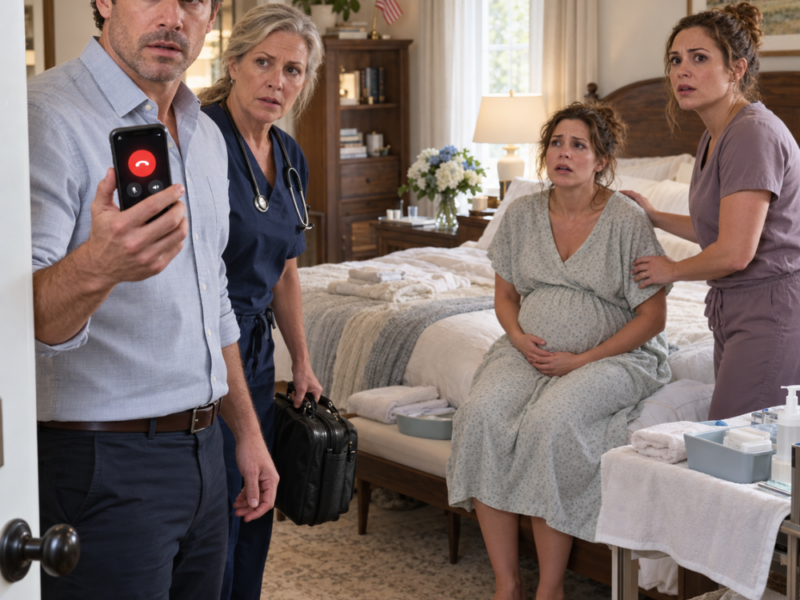
MY WIFE INSISTED ON A HOME BIRTH WITH HER OWN MIDWIFE. HALFWAY THROUGH, THE MIDWIFE WASHED HER HANDS, PICKED UP HER BAG, AND SAID QUIETLY, “SIR, WALK ME TO MY CAR.” IN THE DRIVEWAY SHE SAID, “CALL AN AMBULANCE AND DON’T LET ANYONE IN THAT ROOM ALONE WITH HER.” WHEN I WENT BACK UPSTAIRS, I STOOD FROZEN IN THE DOORWAY…
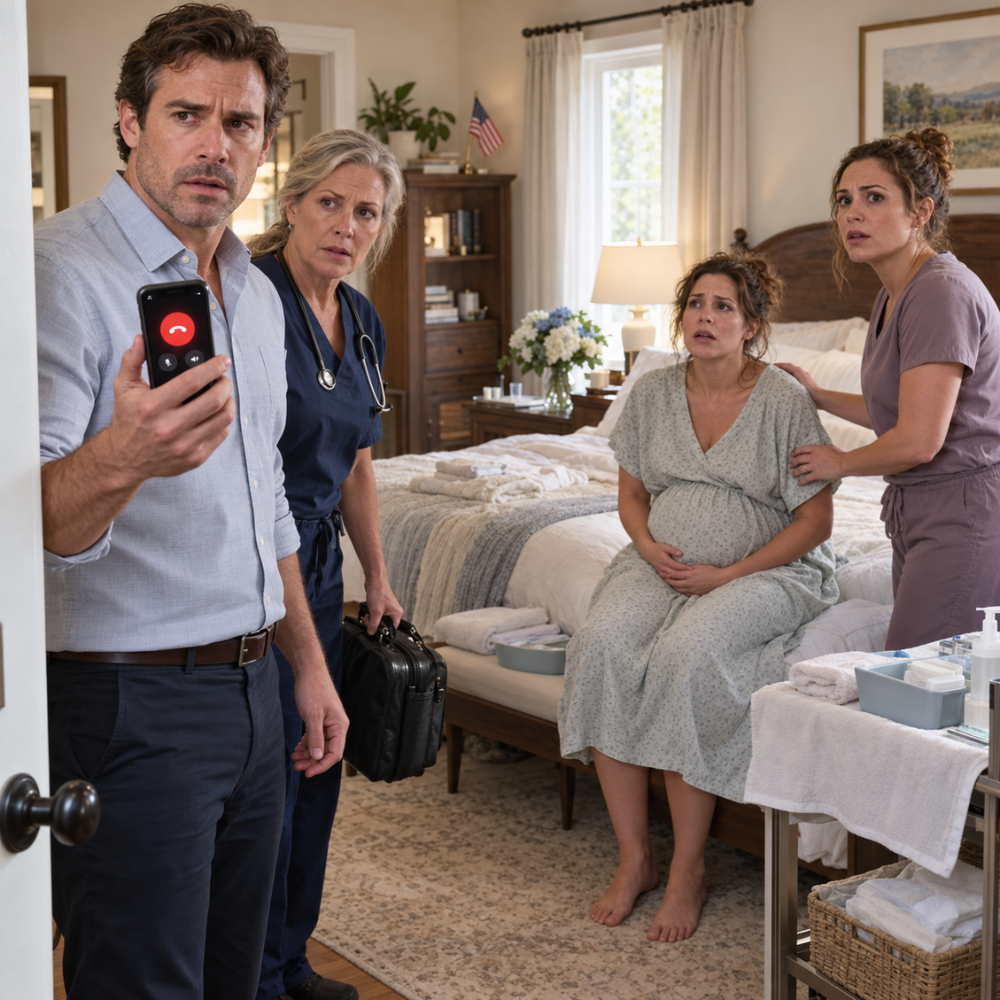
The Midwife Walked Out of Our Home Birth—Then She Told Me Not to Leave My Wife Alone With Her Own Family
For nine days, my wife and I argued about which room our daughter should be born in.
I wanted the nursery.
The nursery faced east, and in the early morning the sunlight came through the two narrow windows and spread across the hardwood floor in a long gold rectangle. I had painted the room myself, three coats of warm cream over the faded blue left by the previous owners. I had repaired the window trim, built a changing table from maple boards, and spent an entire Saturday assembling a white crib whose instructions had apparently been translated through four languages before reaching English.
It felt like a room waiting for a child.
Eleanor wanted our bedroom.
“The bathroom is right there,” she said.
“The nursery is twelve feet down the hall.”
“I know.”
“The bedroom is going to be crowded.”
“I know.”
“The light is better in the nursery.”
“I don’t care about the light.”
That should have been the sentence I listened to.
Instead, I kept trying to solve the argument as though it were about square footage.
On the ninth day, I gave in.
That was what I told myself anyway.
I carried the folded birth pool upstairs, dragged it through the bedroom doorway, and set it beneath the windows while Eleanor watched from the bed with one hand resting over the curve of her stomach.
“There,” I said. “Bedroom.”
She smiled.
“Thank you.”
I kissed her forehead and thought I had done the husbandly thing.
Compromise.
Pick your battles.
Let the pregnant woman win.
I did not think about the second door.
Our house was old by Kentucky standards, built in the 1920s when people expected houses to contain doors and staircases for reasons that no longer made much sense. The front stairs rose from the living room to the upstairs hall.
The back staircase was narrower.
It began behind a small door in our bedroom, descended steeply behind the pantry wall, and opened directly into the kitchen.
From the kitchen, it was six steps to the side porch.
From the side porch, twenty feet across gravel to the driveway.
We never discussed that staircase during the nine-day argument.
Years later, that was the detail I remembered most clearly.
The argument had never really been about light.
My name is Hayward Stamper.
I was thirty-six years old the night my daughter was born, and I made my living shoeing horses in a part of Kentucky where people knew which farm a truck belonged to before they knew the driver’s last name.
My father had been a farrier.
His father before him had been one too.
I drove a white flatbed with a portable forge mounted behind the cab and an anvil that had belonged to my grandfather. My workday usually started before sunrise with the smell of hay, cold metal, and horse sweat.
People who didn’t know the trade assumed it was about being strong.
Strength helped.
Listening mattered more.
A twelve-hundred-pound horse tells you what it is about to do before it does it.
The warning might be a shoulder tightening.
A hip shifting.
A change in breathing.
A fraction more weight settling onto one leg.
The shift comes first.
The kick comes second.
Any farrier who wants to keep his teeth learns to respect the shift.
I was much better at reading horses than people.
That was one of the mistakes I carried into my marriage.
I met Eleanor Gearhart at the front desk of Cazey Animal Hospital.
She handled scheduling, billing, records, and whatever other crisis occurred between the ringing telephone and the exam rooms. She usually had a headset over one ear, a pen tucked behind the other, and three separate things happening at once.
I came twice a month to trim and shoe horses boarded behind the clinic.
The first time I noticed her, she was arguing with a feed supplier on the telephone while printing vaccination records and calming a woman whose terrier had swallowed part of a dish towel.
She never raised her voice.
She simply kept moving until everything around her fell into place.
I liked that about her.
Three years later, we were married in her mother’s backyard beneath a rented white tent.
My parents had both died by then.
Dad went first, heart attack at fifty-nine.
Mom followed four years later after a long illness I still didn’t enjoy naming.
By the time I married Eleanor, I had spent six years without the thing most people mean when they say, “I’m going home.”
The Gearharts changed that.
Linda Gearhart, Eleanor’s mother, hugged me at the wedding reception and called me son.
I remember the exact weight of her hand between my shoulder blades.
It had been six years since anyone had called me that.
I let the word settle deep.
That matters.
You need to understand why I trusted Linda.
She had spent twenty-six years working in the county clerk’s office.
For the last nine of those years, she had managed the vital-records counter, where people came for birth certificates, death certificates, marriage licenses, certified copies, corrections, and all the paper evidence governments require before they agree that the important things in your life happened.
Linda knew forms.
She knew rules.
More importantly, she knew people.
Even after retirement, she could walk into the county building and greet every clerk behind the counter by name.
She remembered whose daughter had gotten married.
Whose husband had undergone surgery.
Who had moved desks.
Who would answer a phone after four thirty on a Friday.
If there was a system, Linda understood how the system moved.
At first, I admired that.
Eleanor’s older sister, Nicola, lived nearly three hours south outside Nashville with her husband, Derry Thacker.
Derry sold boats.
Bass boats.
Pontoons.
Ski boats.
Whatever could float, carry an engine, and produce a monthly payment.
He was good at it.
He had the permanent tan of a man who spent summer weekends on docks and the handshake of someone who never forgot that a conversation might become a sale.
He and Nicola lived in a brick house at the end of a cul-de-sac with a three-car garage and landscaping maintained by people who arrived in matching shirts.
They had been trying to have a child for six years.
Everyone in the family knew that without talking about it directly.
There had been fertility clinics.
Appointments.
Procedures.
Hope.
Then loss.
Three pregnancies ended early.
After the third, Nicola stopped attending family dinners for several months.
Nobody blamed her.
When she returned, the family learned to speak around the subject.
Nobody asked if they were still trying.
Nobody mentioned babies unless someone else did first.
Then Eleanor became pregnant.
We told the family at a Sunday dinner in March.
Linda cried.
But Nicola cried first.
She stood so quickly her chair scraped backward across the dining-room floor.
Then she crossed the room, took Eleanor’s face in both hands, and whispered, “Oh, Ellie.”
She held her sister for a long time.
I stood near the sideboard holding a plate of ham and watched them.
I remember thinking Nicola’s reaction was one of the most generous things I had ever seen.
After everything she had been through, she was happy for her sister.
That was the story I gave the moment.
For months, every strange detail came with a story I was willing to give it.
That is one reason families can hide things in plain sight.
Love makes excellent camouflage.
Eleanor wanted a home birth almost immediately.
I had assumed we would go to the hospital.
Not because I had thought deeply about it.
Hospitals were simply where babies came from in my understanding of the world.
One evening, sitting at the kitchen table with prenatal paperwork spread between us, Eleanor said, “I don’t want to deliver in a hospital.”
I looked up.
“Okay.”
She seemed surprised.
“That’s all?”
“I was going to ask why.”
She rested both hands on the table.
“My grandmother had all her babies at home.”
“That was a different time.”
“I know.”
“My grandmother also washed clothes by hand.”
“That’s not the same thing.”
“I’m aware.”
She gave me a look.
I smiled.
“All right. Tell me.”
She said she wanted to move during labor.
She wanted familiar rooms.
She wanted to decide who touched her.
She did not want strangers coming in every hour.
She did not want to feel like a patient unless she actually became one.
None of that sounded unreasonable.
I asked about safety.
She had already spoken to her doctor.
The pregnancy appeared low risk.
“We’d have a licensed midwife,” she said. “And an emergency transfer plan.”
“How far is the hospital?”
“Twenty minutes.”
“Twenty on a normal day or twenty when something is wrong?”
She smiled.
“Twenty normal.”
“Then find out emergency time.”
She reached across the table and squeezed my hand.
“I knew you’d make a checklist.”
“I shoe horses. We like exits.”
Her mother had already found a midwife.
Allethia Nickel was fifty-eight years old and lived two counties over.
She had attended hundreds of births.
She wore her gray hair short, drove an old green Subaru, and carried herself with the steady economy of someone who did not waste movement.
I met her at the second prenatal appointment, which took place in our living room.
I liked her almost immediately.
Not because she reassured me.
Because she didn’t.
She asked practical questions.
How far to the hospital?
Which road flooded?
Where would an ambulance park?
Did Eleanor have any history of bleeding?
Did either of us understand that a home-birth plan was not a promise that the birth would remain at home?
Then she asked me what happened when a horse panicked while I was underneath it.
I told her.
“You don’t fight twelve hundred pounds,” I said. “You get out of the bad position before the horse knows it wants you there.”
Allethia nodded.
“So you understand that changing plans quickly is not failure.”
That answer stayed with me.
I trusted her after that.
It was the last prenatal appointment I attended.
When I asked about the next one, Eleanor said Allethia preferred to see expectant mothers alone after a certain point.
“It’s a privacy thing.”
“Does she?”
“Yes.”
“Because she didn’t mention it.”
“Mama said that’s how she works.”
That should have bothered me more.
It did bother me some.
But there is a particular trap in wanting to be a good husband during pregnancy.
You are repeatedly told, correctly, that the pregnancy is happening to her body.
That you should support rather than control.
That her comfort matters.
That her decisions deserve weight.
All of that is true.
And when something seems slightly strange, you become afraid that questioning it makes you selfish.
So I told myself not to make everything about me.
Linda drove Eleanor to the appointments after that.
Sometimes Nicola came.
I worked.
I painted the nursery.
I built the changing table.
I installed shelves.
I learned more about infant car seats than I had expected to know in one lifetime.
In August, I came home late after working at a thoroughbred farm where three horses needed corrective shoeing.
It was after nine.
My hands still smelled of smoke and metal.
I had removed my boots in the hallway because Eleanor hated forge dirt on the upstairs carpet.
As I approached our bedroom, I heard her laughing on the phone.
It was a private laugh.
Soft.
Almost girlish.
Then she said something that stopped me outside the door.
“He won’t know the difference for years. Maybe never.”
I stood there holding my boots.
The house was quiet.
I heard nothing from the person on the other end.
When I opened the door, Eleanor was sitting against the headboard.
Her phone was facedown on the blanket.
“Hey,” she said.
“Hey.”
She smiled.
“You look exhausted.”
I set the boots down.
“Who were you talking to?”
“Nicola.”
“What won’t I know?”
There was a pause.
Small.
Probably less than a second.
But horses taught me about small pauses.
Then Eleanor laughed.
“Oh. Nursery colors.”
“What?”
“Nicola is redoing the guest room for when they come help after the baby. She wants to surprise you because you’ll say everything is too expensive.”
I looked at her.
“What won’t I know for years?”
She smiled again.
“That she spent too much.”
The explanation was weak.
I knew it was weak.
But I also knew Nicola and Derry had money.
I knew they had waited years to become an aunt and uncle.
I knew families became strange around first babies.
So I handed the moment back to the story I preferred.
“That sounds like Nicola.”
“It does.”
Six weeks later, I learned that every word of that answer had been selected for me.
By September, our bedroom had stopped belonging to us.
That was how I thought of it later.
It filled gradually.
First came the folded birthing pool.
Then a small table beneath the windows.
Then stacks of towels.
Plastic sheeting.
Gloves.
Absorbent pads.
A thermometer.
Bottled water.
Emergency phone numbers.
Disposable supplies in unopened packages.
Linda typed a fourteen-page birth plan and placed it inside a green three-ring binder.
That should tell you something about Linda.
Fourteen pages.
The plan contained headings.
Subheadings.
Check boxes.
Emergency contingencies.
Lists of who should be present.
One evening while Eleanor slept, I sat at the kitchen table and read it.
Under Support Persons, the names appeared in this order:
Linda Gearhart.
Nicola Thacker.
Hayward Stamper.
My own name looked strangely small between the others.
Another line read:
Father may remain downstairs during early labor to manage access, hot water, supplies, and communications and should enter the birth space when requested by the mother or attendant.
I circled the line.
The next morning, I showed it to Eleanor.
“What’s this?”
She glanced at the page.
“Mama writes everything like an office procedure.”
“That doesn’t answer the question.”
“You’ll be upstairs.”
“It says I’m supposed to stay downstairs.”
“That’s not what it means.”
“That is exactly what it means.”
She sighed.
“Hayward, please.”
I looked at her.
Her face had changed during pregnancy.
Softer in some ways.
More tired.
There were mornings she looked at me as though she wanted to say something and had forgotten how to begin.
I closed the binder.
“All right.”
“You’ll be with me.”
“Okay.”
Nicola arrived for what was supposed to be the final two weeks before Eleanor’s due date.
She slept on an air mattress in the nursery beside the crib I had assembled.
She was everywhere.
Coffee made before I woke.
Eleanor’s vitamins arranged in a dish.
Laundry folded.
Groceries bought.
She touched Eleanor constantly.
A hand on the shoulder.
A palm against the baby.
Fingers brushing hair from her sister’s forehead.
Eleanor accepted the attention with an odd passivity.
I told myself sisters were different.
Derry drove up the second weekend.
He stayed one night.
When he left the next morning, I walked him to his black Suburban.
He seemed uncomfortable.
Not unfriendly.
Just restless.
We shook hands.
“Big couple weeks,” he said.
“That’s what everybody keeps telling me.”
He nodded.
“You doing okay?”
“I guess.”
“Good.”
He opened the driver’s door.
Then closed it again.
For a moment, I thought he might say something.
He didn’t.
That evening, I went outside to move my truck.
I passed the Suburban because Derry had parked farther down the driveway.
Through the rear window, I saw a new infant car seat installed behind the passenger seat.
Rear-facing.
Tags still attached.
I stopped.
The porch light reflected in the glass.
Why did a couple who lived nearly three hours away already have an infant seat installed?
Then I supplied the answer.
They were excited.
They planned to help.
They could afford extras.
Maybe they had bought one so we wouldn’t need to move ours when visiting.
Reasonable explanations are dangerous when you need them too badly.
The final warning came from a horse.
It was a Thursday in late September.
A broodmare at Sloan Standardbreds had stood quietly for me a hundred times.
That morning, she would not settle.
Every time I took her left hind foot, she shifted weight and turned her head toward the barn door.
I put the foot down.
Tried again.
Same thing.
Dominique Sloan watched from the stall.
Dominique had spent nearly three decades as a labor-and-delivery nurse before she and her husband bought the farm.
She knew horses, babies, and people with approximately equal skepticism.
“She’s reading something,” Dominique said.
“There’s nothing there.”
“There’s always something there.”
“She’s being difficult.”
Dominique looked at me.
“No. Difficult feels different.”
The mare turned her head again.
Dominique ran a hand along the animal’s neck.
“How’s Eleanor?”
“Nine days out.”
“Home birth still?”
“Yes.”
“Who’s attending?”
“Allethia Nickel.”
Dominique’s eyebrows lifted slightly.
“You know her?”
“Know of her.”
“Good?”
“Very.”
The mare finally settled enough for me to lift the hoof.
Dominique leaned against the stall door.
“Who found her?”
“Linda.”
Something changed in Dominique’s face.
“What?”
“Nothing.”
“You did a face.”
“I have a face.”
“You did a specific one.”
She shrugged.
“Linda knows everybody.”
“That’s what people keep saying.”
Dominique watched me work.
Then she said, “Make sure the midwife is working for Eleanor. Not the family.”
I looked up.
“What does that mean?”
“It means exactly what I said.”
Before I could ask more, another horse banged a stall gate.
Dominique went to check.
The sentence stayed with me all day.
I drove home along the river road around six.
The sky had turned purple-gray over the trees.
My forge ticked behind the cab as it cooled.
When I turned into our driveway, three vehicles were already there.
Linda’s sedan.
Nicola’s white SUV.
Allethia’s green Subaru.
All three had been backed toward the side of the house.
The Subaru faced the road.
Nicola’s rear hatch stood open.
Inside was a folded quilt.
Upstairs, light glowed behind the bedroom curtains.
A shadow moved.
Then another.
Then another.
I had not received a call.
Eleanor’s water had broken shortly after three.
Linda told me at the kitchen door.
“There wasn’t time to call.”
I looked at the clock.
It was 6:07.
“You had three hours.”
“Things moved quickly.”
“My phone works in barns.”
“I know.”
“You know?”
“Hayward.”
Her voice softened.
That was one of Linda’s great skills.
She could make firmness sound compassionate and compassion sound final.
“The early hours belong to the mother. Allethia wanted things quiet.”
“Did she?”
Linda smiled tiredly.
“You’re here now.”
“That isn’t the point.”
“Do you want to spend this moment proving you’re right, or do you want to wash your hands and see your wife?”
It was an elegant question.
One answer made me a husband.
The other made me petty.
I washed my hands.
For a long time.
Black forge dust had settled into the creases around my nails.
I scrubbed until the water ran clear.
Then I went upstairs.
The bedroom no longer looked like ours.
Curtains drawn.
Lamps dimmed.
The birth pool filled and steaming slightly.
Towels stacked.
The small table by the windows now covered with a blue pad and neatly arranged medical supplies.
Eleanor lay on her side wearing one of my old T-shirts.
Her hair was damp against her temples.
Nicola pressed both hands against her lower back during a contraction.
Allethia knelt near the bed listening to the baby.
She glanced at me.
Nodded.
Then returned to her work.
I went to Eleanor and knelt.
She opened her eyes.
“Hey.”
“I’m here.”
“You’re supposed to be downstairs.”
The words came out before she seemed able to stop them.
I felt something tighten inside me.
“I’m here.”
She stared at me.
Then another contraction began.
She closed her eyes and gripped my hand.
When it passed, she whispered, “Okay.”
I did not know what she was agreeing to.
The next three hours survived in my memory as disconnected images.
Boiling water because Linda asked me to.
Standing in the kitchen afterward realizing nobody had told me why.
Nicola coming down the back stairs carrying an ice bucket with her phone pressed to her ear.
“Not yet,” she said.
Then she saw me.
“I’ll call you back.”
“Who was that?”
“Derry.”
“What’s not yet?”
“Nothing.”
She kept walking.
Allethia came downstairs once for water.
She drank at the sink slowly.
Then she stared at the back door.
Not absentmindedly.
Measuring.
When she returned upstairs, I followed after a minute.
I saw Linda holding a small prescription bottle.
Eleanor sat against pillows, exhausted.
Linda removed a tablet and gave it to her.
“For the nausea,” she said.
Allethia looked up.
Her eyes moved from Linda’s hand to the bottle.
Then to Eleanor.
She said nothing.
At the time, I gave that silence the wrong meaning.
I thought it meant approval.
Later, I understood that sometimes silence is not agreement.
Sometimes it is shock arriving before action.
Around nine, the labor changed.
I could not have explained medically what changed.
I only knew the rhythm became wrong.
Contractions that had once risen and faded like waves began arriving almost on top of one another.
Eleanor stopped talking between them.
Her breathing shortened.
Then she began making a thin sound I had never heard from her before.
Nicola rubbed her back.
“That’s good, Ellie. That means progress.”
Allethia did not say it was good.
She watched her wristwatch.
Listened to the baby.
Moved the stethoscope.
Listened again.
“When was the last contraction?”
“Just now,” Nicola said.
“And before that?”
Nicola hesitated.
“Not long.”
Allethia looked at Linda.
“May I see the bottle you gave her?”
Linda smiled.
“It’s only her nausea medicine.”
“I understand. Please hand it to me.”
The room stopped.
Not literally.
Eleanor was still breathing.
The pool pump still hummed.
Somewhere downstairs, the refrigerator compressor clicked on.
But everyone in that bedroom went still.
Linda’s hand did not move toward her cardigan pocket.
Allethia looked at her.
Then at Nicola.
Then at Eleanor.
Finally at me.
Something changed in her face.
Not fear.
Decision.
She removed the stethoscope.
Went into the bathroom.
Washed her hands.
She washed them slowly.
Long enough for everyone to notice.
Then she returned and began packing.
One instrument at a time.
Into her bag.
Nicola stared at her.
“What are you doing?”
Allethia did not answer.
Linda stood.
“Allethia.”
No answer.
“Allethia, this is not the time to become dramatic.”
The midwife closed her bag.
Buckled it.
Then walked directly toward me.
“Mr. Stamper.”
“Yes?”
“Walk me to my car.”
I looked at Eleanor.
Her eyes were open now.
She was staring at her mother.
“Now,” Allethia said.
There was something in her voice I recognized from barns.
Move first.
Understand later.
I followed her downstairs.
Through the kitchen.
Onto the side porch.
Across the gravel.
The September night had gone cold.
I could smell damp leaves and the river.
At the Subaru, Allethia placed her bag on the roof and turned to me.
“I’m going to say this once.”
“All right.”
“I need you to listen the way you told me you listen to a horse.”
I felt my stomach tighten.
“I’m listening.”
“Call an ambulance.”
“What?”
“Now.”
“What’s wrong?”
“Call first.”
She waited while I took out my phone.
My hands had started shaking.
I entered the wrong digit once and had to start again.
The dispatcher answered.
I gave our address.
“My wife is in labor. The midwife says we need an ambulance.”
Allethia listened.
When the dispatcher confirmed a unit was coming, she nodded.
“Tell them the contractions are too close together.”
I repeated it.
“Tell them an unknown medication may have been given during labor.”
I looked at her.
“What?”
“Tell them.”
I did.
The dispatcher began asking questions.
Allethia waited until I answered them.
Then she said, quietly, “Do not leave your wife alone with her mother or her sister.”
I stared at her.
“What are you saying?”
“I am saying you stay in that room until the medics arrive.”
“Why?”
“The medication Linda gave her was not something I approved.”
“Was it dangerous?”
“In this situation it can make labor dangerously intense.”
My mouth went dry.
“You knew?”
“I recognized it.”
“Why didn’t you stop her?”
“I should have asked sooner. I believed something I had been told about this pregnancy.”
“What were you told?”
Allethia looked toward the upstairs windows.
“Not here.”
“Tell me.”
“No.”
“You’re leaving.”
“I’m calling the hospital from the road.”
“Why are you leaving?”
Her jaw tightened.
“Because I was asked months ago to sign paperwork after this birth that I now believe contains false information.”
I stared at her.
Nothing in the sentence fit together.
“What paperwork?”
“I will explain when your wife is safe.”
“Allethia—”
“Stay in the doorway.”
The dispatcher’s voice came through my phone.
“Sir? Are you still there?”
“Yes.”
Allethia picked up her bag.
“Fourteen minutes from the station under normal conditions. I timed it.”
“You timed it?”
“In June.”
She opened the driver’s door.
“I should have called you months ago. I’m sorry.”
Then she drove away.
I stood in the gravel with the phone pressed to my ear.
For approximately five seconds, I could not move.
Then I remembered what she had said.
Do not leave them alone with her.
I ran inside.
I took the back stairs because they were closer.
Two at a time.
When I came through the second bedroom door, everything had changed.
The birth pool was draining.
A hose ran out the window.
The small table had been folded.
The lights were brighter.
Eleanor was sitting at the edge of the bed wearing her bathrobe.
And shoes.
Tennis shoes.
Nicola knelt in front of her tying the second lace.
Linda stood at the window talking on the phone.
“She’s gone,” she was saying. “No, I don’t know. It doesn’t matter. We’re coming now.”
She turned.
Saw me in the back doorway.
For one instant, her face was not kind.
Then the expression returned.
“Good. Grab Eleanor’s bag.”
I stayed where I was.
“We’re taking her to Nicola’s.”
I thought I had misheard.
“What?”
“There’s another midwife near Nashville.”
“Nashville is nearly three hours away.”
“Two and a half.”
“Eleanor is in active labor.”
“First babies take time.”
As if to contradict her, another contraction seized Eleanor.
She folded forward.
Nicola held her.
Eleanor began crying.
“Mama, I can’t sit in a car.”
Linda crouched.
“You can. You’re strong. We talked about this.”
Nobody noticed that sentence except me.
We talked about this.
I walked to the overnight bag near the dresser.
Picked it up.
Placed it on the top shelf of the closet.
Shut the door.
Linda stood.
“What are you doing?”
“Nobody is going anywhere.”
“Hayward.”
“An ambulance is coming.”
Her face hardened.
“You called an ambulance?”
“Yes.”
“On whose advice?”
“Allethia’s.”
Linda gave a short laugh.
“Allethia is not a physician. She panicked.”
“Maybe.”
“She lost confidence.”
“Maybe.”
“You are about to destroy the birth your wife wanted because a frightened midwife lost her nerve.”
“Maybe.”
Linda stared at me.
“You’ll regret this.”
“Maybe.”
Then I said the sentence that changed the room.
“I know what you gave her wasn’t for nausea.”
Silence.
Nicola stopped moving.
Eleanor stared at the floor.
Linda looked at me.
I had no proof beyond Allethia’s warning.
But I watched Linda’s face.
The shift before the kick.
She sat down.
Very slowly.
Then she smoothed the bedspread beside Eleanor.
“Ellie,” she said in a gentle voice, “tell your husband you asked for it.”
Nobody breathed.
Eleanor’s lips moved.
“I asked her.”
The words were almost inaudible.
I looked at my wife.
“Asked her for what?”
She did not answer.
Then we heard the siren.
Coming up the river road.
Nicola moved to the window.
“They’re here.”
The medic who entered our bedroom first was named Esau Wallen.
I knew him slightly.
Everyone in the county knew someone slightly.
He had worked emergency medical services for years and had the deliberate manner of a man who had learned panic was contagious.
He assessed Eleanor.
Looked at his partner.
Then said, “We’re moving.”
No discussion.
No debate.
Within minutes, they had her down the front stairs and onto a stretcher.
Linda approached.
“I’ll ride with her.”
Esau shook his head.
“One rider.”
“I’m her mother.”
“Her husband is riding.”
Linda’s mouth tightened.
Esau was already moving.
Before the ambulance doors closed, I said, “The midwife told me someone gave her a medication during labor. Her mother gave it to her.”
Esau stopped.
“What medication?”
“I don’t know.”
He looked past me toward the porch, where Linda and Nicola stood beneath the light.
“All right.”
He closed the door.
Eleanor grabbed my hand.
The ambulance pulled away.
For the first several minutes, she would not look at me.
She kept whispering something.
I leaned closer.
“I’m sorry.”
Again.
“I’m sorry.”
Again.
Not clearly to me.
Not clearly to anyone.
Just the words repeating with the tires beneath us.
I did not ask what she meant.
That night taught me the value of one question at a time.
At the hospital, the obstetric team moved quickly.
Eleanor was placed on monitors.
Nurses came and went.
A doctor named Carmel Dodson introduced herself and then immediately stopped speaking to me long enough to study the monitor.
That frightened me more than if she had looked frightened.
“How long have the contractions been this close?”
“Maybe an hour.”
“The ambulance crew told us a medication may have been given.”
“The midwife said it wasn’t approved.”
Dr. Dodson nodded.
“She called ahead.”
That meant Allethia had kept her promise.
The doctor explained that the baby was showing signs of stress and Eleanor’s labor pattern had become unsafe.
They would try to slow things down.
If that did not work, they would move to surgery.
I signed forms.
My handwriting was unexpectedly steady.
A nurse with gray braids took the clipboard.
“You did right calling.”
I looked at her.
It was the first time anyone had said it.
The intervention did not solve the problem quickly enough.
A little before eleven, Eleanor was taken through double doors.
I stood outside in hospital-issued clothes, staring at a beige wall.
Time changed shape.
Then a young doctor came through the doors.
“You have a daughter.”
Everything inside me stopped.
“She’s okay?”
“She’s angry at the whole world.”
That was the best sentence I had ever heard.
They took me inside.
My daughter was red-faced, loud, and perfect.
Seven pounds, one ounce.
A full head of dark hair.
They placed her against my chest.
For six hours, I had held myself together because somebody needed to.
The moment she touched me, all of it broke.
I cried harder than I had at either of my parents’ funerals.
Across the room, Eleanor looked toward us.
Her eyes landed on the baby.
Then on me.
Then on the ceiling.
She said nothing.
We had not settled on a name.
Eleanor liked Waverly.
I had not been convinced.
Holding that furious little girl, one name came into my mind.
Sarah.
My mother’s name.
I did not say it yet.
Sometime after midnight, the nurse with gray braids appeared at the recovery-room door.
Her badge said JAZELLA MADDEN.
She motioned me into the hallway.
I carefully placed the sleeping baby in the bassinet beside Eleanor and stepped outside.
Jazella closed the door.
“Your wife’s sister is downstairs.”
“Nicola?”
“Yes.”
“How’s she acting?”
“Perfectly polite.”
I waited.
“That isn’t why I came.”
“What happened?”
“She asked the front desk where the baby was.”
“That sounds normal.”
“She asked before she asked whether her sister was alive.”
I stared at her.
Jazella crossed her arms.
“She asked whether the baby had been moved to the nursery.”
My stomach tightened.
“Then she asked what time visitors could access the nursery.”
I said nothing.
“And whether a family member could sign an infant out.”
The hallway seemed to narrow.
“What did you tell her?”
“Nothing useful.”
Jazella looked directly at me.
“I’ve worked on this floor nineteen years. Families ask strange questions when they’re scared. That one wasn’t fear.”
I did not sleep.
I sat in the chair with my daughter against my chest and watched the door.
At four in the morning, Eleanor woke.
The room was dark except for the blue monitor lights.
She looked at the baby.
“Is she okay?”
“She’s perfect.”
“Did they say anything about what Mama gave me?”
“They’re asking questions.”
Eleanor turned toward the wall.
After a long time she whispered, “Don’t let Nicola hold her.”
I felt cold.
“Why?”
No answer.
“Eleanor.”
Her eyes closed.
“Please.”
That was all.
At seven, she requested a visitor-restriction form.
She listed only me.
Then, after a long pause, she added Dominique Sloan.
Not her mother.
Not her sister.
When the nurse asked if she was sure, Eleanor nodded.
“Please.”
Linda arrived at eight carrying a bakery box and a folder.
Hospital security turned her away.
Allethia called me at nine.
“I need to speak to you in person.”
“All right.”
“Not at the hospital.”
She gave me the name of a diner halfway between Cazey and the county seat.
“One o’clock.”
“Can you tell me what this is about?”
“No.”
She hung up.
I called Dominique.
She arrived before noon wearing barn boots and carrying a paperback.
She took one look at me.
“Go.”
“You’re sure?”
“I delivered babies for thirty years and raised three of my own.”
She picked up Sarah.
“I can survive an hour with this one.”
I looked at my daughter.
“You named her?”
“Not officially.”
Dominique smiled.
“But you’re thinking Sarah.”
“How do you know?”
“You’ve been calling her that when you think nobody hears you.”
I hadn’t realized.
The diner smelled like coffee, bacon grease, and lemon cleaner.
Allethia sat in a booth near the back.
She looked as tired as I felt.
A manila envelope lay beneath one hand.
I sat across from her.
She pushed the envelope toward me.
“Read that first.”
Inside was a photocopy of a state birth-record worksheet.
I recognized Linda’s handwriting immediately.
She had sent birthday cards in that handwriting for years.
The form was mostly completed.
Child’s name.
Residence.
Parents.
Attendant.
The date remained blank.
The signature line remained blank.
The names did not.
Mother:
Nicola Gearhart Thacker.
Father:
Derry Lee Thacker.
I read it twice.
Then I looked at Allethia.
“What is this?”
“Your mother-in-law gave it to me in July.”
I could not understand the words.
“She said she was saving me paperwork.”
“Why would Nicola and Derry be listed as the parents?”
Allethia wrapped both hands around her coffee.
“Because Linda told me Eleanor was carrying a child for them.”
I stared at her.
“What?”
“She told me there had been a private family arrangement.”
“No.”
“I know that now.”
“There was no arrangement.”
“I know.”
“She told you I knew?”
Allethia’s expression changed.
“She told me you opposed it.”
I stopped breathing.
“She said you were angry. Controlling. That you had refused to accept the arrangement.”
“An arrangement that never existed.”
“Yes.”
“What else?”
Allethia looked ashamed.
“She said the plan was to keep you downstairs during the delivery.”
The fourteen-page birth plan flashed into my mind.
“She said the baby would leave with Nicola and Derry.”
My hands went numb.
“No.”
“She claimed the legal situation was complicated but already settled inside the family.”
“No.”
“I asked for documentation.”
“And?”
“She always had a reason it wasn’t available.”
“Then why did you stay involved?”
Allethia looked down.
“That is the question I have been asking myself since last night.”
Her voice was quiet.
“I believed more than I should have because I had known Linda professionally for years. She understood records. She understood procedure. She spoke like someone describing a settled legal plan.”
“You met me.”
“In June.”
“And?”
“You didn’t match the man she described.”
I remembered our conversation.
Hospital routes.
Emergency plans.
Horses.
“I should have called you then,” Allethia said.
“Why didn’t you?”
“Because Eleanor was my patient. I convinced myself there might be complicated family circumstances I did not fully understand.”
She looked directly at me.
“Last night I stopped convincing myself.”
“The medication?”
“Yes.”
Allethia did not give me medical details.
She did not need to.
She explained only that Linda had given Eleanor something capable of intensifying labor and that it had no place being administered privately in that bedroom without medical supervision.
“I saw the bottle,” Allethia said. “I knew something was wrong.”
“Why leave?”
“Because staying would have made me part of an arrangement I believed was fraudulent and unsafe.”
“You could have stayed and called the ambulance yourself.”
“I considered it.”
“Why didn’t you?”
“Because I needed you out of that room without them understanding what I was telling you.”
That silenced me.
“If I had challenged Linda in front of everyone, I did not know what they would do next.”
She continued.
“The moment you walked me to the car, you were outside their plan.”
That sentence chilled me.
“What plan?”
“I don’t know all of it.”
She tapped the birth worksheet.
“But I know they expected that child to leave your house last night.”
I thought of the packed SUV.
The infant seat in Derry’s vehicle.
The bedroom at their house supposedly being prepared for “visits.”
“Why would Eleanor agree?”
“I don’t know.”
Allethia reached into her purse and placed a folded napkin on the table.
An address.
Nicola’s house.
“I think there is something you need to see.”
I looked at her.
“You think I should drive there?”
“I think you should decide for yourself.”
I called Dominique from the parking lot.
She listened without interrupting.
When I finished, she said, “Go.”
“What about Sarah?”
“I’m staying.”
“Eleanor?”
“Hospital security is staying.”
“Dominique—”
“Hayward, go find out what room they painted.”
That was exactly what I did.
Two and a half hours later, I turned into Nicola and Derry’s cul-de-sac.
The black Suburban was in the driveway.
I parked behind it.
Derry opened the front door.
He had a glass in one hand.
When he saw me, all the color disappeared from his face.
“Hayward.”
“Where’s Nicola?”
“Not here.”
“I know.”
He looked behind me toward the truck.
“Listen.”
“I want to see the guest room.”
His expression changed.
“What?”
“The one you prepared so you could help with the baby.”
“Hayward.”
“Show me.”
For a long moment, neither of us moved.
Then he stepped aside.
I climbed the stairs.
The room at the end of the hall was not a guest room.
It was a nursery.
Not temporary.
Not playful.
Finished.
Professional.
Walls painted a pale shell color.
White crib.
Rocking chair.
Changing table stocked with newborn supplies.
A stack of diapers.
A row of tiny clothes.
The same folded quilt I had seen inside Nicola’s SUV now lay across the rocker.
Above the crib, large brass letters spelled a name.
A name that was not Sarah.
A name Eleanor and I had never discussed.
I stood there staring.
Behind me, Derry spoke.
“She’s mine.”
I did not turn.
“How do you know?”
“Eleanor said.”
“That isn’t what I asked.”
His breathing changed.
“It happened last year.”
I turned around.
“What happened?”
Derry looked toward the stairs.
Then back at me.
He told me.
Not proudly.
Not defiantly.
Almost with relief.
There had been an affair.
Brief, according to him.
Over months, according to the dates he eventually admitted.
Nicola discovered messages.
The marriage nearly ended.
Then Eleanor became pregnant.
According to Derry, Eleanor told Linda the dates made him the likely father.
Linda saw a solution.
Nicola, devastated by infertility and betrayal, might receive the child she had wanted.
Eleanor might preserve her marriage.
Derry might preserve his.
And I—
I would be told something tragic had happened.
I stared at him.
“What exactly was I supposed to get?”
He looked sick.
“A clean break.”
“From my wife?”
“From all of it.”
“My daughter?”
“She wasn’t supposed to be yours.”
“Supposed to?”
“Eleanor said—”
“Did anyone test?”
Derry stopped.
“No.”
“Did anyone ask for a test?”
“No.”
“You built a nursery.”
He said nothing.
“You installed a car seat.”
Silence.
“You picked a name.”
Silence.
“You planned my daughter’s life on a guess.”
“She was supposed to be mine.”
“You don’t know that.”
“Neither do you.”
He was right.
That was the worst part.
I drove back north.
At the state line, I said my daughter’s name aloud in the truck.
“Sarah.”
Just once.
Not because I knew anything.
Because I needed to hear the name that belonged to the child I had held all night.
Linda approached me in the hospital parking lot on the third morning.
She was accompanied by a family attorney named Humphrey Wooten.
I had met him at Christmas dinners.
Soft voice.
Expensive shoes.
Leather folder.
He shook my hand.
“Hayward, we’re asking for ten minutes.”
I leaned against my truck.
“You have ten.”
Linda let him talk.
That was how I knew they had rehearsed.
Wooten explained that because Eleanor and I were married, the law generally treated me as the legal father unless additional steps were taken.
There was paperwork.
There could be a formal paternity process.
There were ways to resolve things without a public court battle.
Then he opened his folder.
A document.
An agreement.
And money.
Sixty thousand dollars.
The remaining loan on my truck paid.
A divorce Eleanor would not contest.
The house left to me.
No request for support.
No property fight.
A clean separation.
Linda finally spoke.
“I am sorry for the way this happened.”
I stared at her.
“I was frightened.”
“No.”
She stopped.
“You were organized.”
“That’s not fair.”
“You packed a car.”
“Hayward—”
“You prepared paperwork.”
Wooten shifted slightly.
“You had a nursery waiting in Tennessee.”
Linda’s mouth tightened.
“You gave my wife something during labor.”
Her face changed.
Wooten raised a hand.
“I think we should be careful discussing allegations—”
“I am being careful.”
I looked at Linda.
“You did not come here to tell me the truth. You came here because your plan still needs something from me.”
She looked down.
Wooten closed the folder halfway.
“What would you like?”
“A paternity test.”
Linda’s eyes lifted.
“A proper one.”
I continued.
“Independent collection. Independent lab. My lawyer handles it. Nobody in this family touches the samples, the paperwork, or the result.”
Linda said nothing.
“If Derry is the father, I’ll deal with that truth.”
I pointed toward the folder.
“But I’m not signing anything in a parking lot because you decided the truth seven months ago.”
That was when I saw it.
A tiny shift in Linda’s expression.
Fear.
Not of a court battle.
Of the test.
It lasted less than a second.
But a horseman sees the shift.
I called Dominique.
Dominique gave me the name of Anastasia Crisp.
Family-law attorney.
She arrived at the hospital that afternoon.
She was small, gray-haired, and carried no visible patience for foolishness.
She listened.
Asked questions.
Requested documents.
Then arranged an independent paternity collection before dinner.
I held Sarah while the technician took the sample.
She screamed as though we had betrayed every principle of parenthood.
Then they collected mine.
The technician sealed everything in front of me.
Signed across the package.
Left.
Three business days, she said.
Maybe less.
Afterward, Eleanor stared at the ceiling.
“You had it done.”
“Yes.”
“Mama told you Derry is the father.”
“Yes.”
“I told her he was.”
I sat beside the bed.
“Do you know?”
She was silent.
“Eleanor.”
“No.”
The answer barely existed.
“No, what?”
“No, I don’t know.”
For months, I had imagined betrayal as something hot.
Anger.
Shouting.
Breaking things.
In reality, the deepest betrayal can be very quiet.
It can sound like your wife admitting she helped plan your daughter’s disappearance because she had convinced herself the child probably belonged to someone else.
“When did you tell them?”
“March.”
“Why?”
“Nicola found Derry’s phone.”
Eleanor began crying.
“She was falling apart. Mama was trying to hold everyone together. I was already pregnant.”
She wiped her face.
“Mama asked if it could be Derry’s.”
“And?”
“I said yes.”
“Could it?”
“Yes.”
“Could it be mine?”
She closed her eyes.
“Yes.”
I sat back.
“Did Linda know that?”
“I told her the dates were messy.”
“Did Nicola?”
“No.”
“Did Derry?”
“I don’t know.”
“Did anyone?”
“Mama.”
The room felt suddenly smaller.
“What did she say?”
Eleanor stared toward the window.
“She said we didn’t need to make everything worse by chasing certainty.”
I laughed once.
There was no humor in it.
“And you agreed.”
“I wanted Nicola to stop hurting.”
“What about me?”
She began crying harder.
“I thought I could save our marriage.”
“By letting me believe our baby died?”
She covered her face.
I stood.
“I can’t do this conversation now.”
“Hayward.”
I turned at the door.
She looked smaller than I had ever seen her.
“I’m sorry.”
“I know.”
But sorry was nowhere near large enough yet.
The result arrived on the second business day.
Anastasia drove to the hospital herself.
We sat in a family consultation room.
She placed the report on the table.
Then she read it.
Probability of paternity:
99.99 percent.
I was Sarah’s biological father.
I asked her to read it again.
She did.
Then she pushed the page toward me.
“You are her legal father and her biological father.”
I stared at the number.
99.99.
The entire architecture of the Gearhart family’s plan collapsed into four characters and a decimal point.
They had not known.
They had never known.
They had simply needed one version of events badly enough that eventually needing became believing.
I returned to Eleanor’s room.
She was awake.
I stood near the foot of the bed.
“The result came back.”
Her hands tightened around the blanket.
“She’s mine.”
Eleanor stared at me.
“All right.”
That was all.
All right.
Then she turned toward the wall.
I understood something then.
She had spent seven months living inside a story constructed to solve everyone’s problems.
Nicola gets the baby.
Derry keeps his marriage.
Eleanor keeps hers.
Linda keeps the family from breaking.
And I—
I survive a tragedy.
Nobody had ever checked whether the foundation was true.
Because if they checked, the plan might disappear.
An investigator from child protective services had already begun interviewing the family.
Hospital staff had reported the circumstances surrounding the labor.
Allethia had reported her own concerns to her licensing board.
The medication issue was being investigated.
So were the documents.
Before the hospital discharged Sarah, an investigator asked me whether I had ever seen any other vital-record forms in our house.
“No.”
Then I remembered the green binder.
Fourteen pages.
Clear plastic sleeves.
One at the back I had never opened.
I called Anastasia.
The binder was collected with me present.
Inside the final sleeve was another worksheet.
Not a birth form.
A preliminary form used for reporting a pregnancy loss.
Much of it had already been filled out.
Eleanor’s name.
My name.
Our address.
Blank date.
Blank medical details.
A handwritten reminder in the margin indicating something still needed to be confirmed.
I sat at the kitchen table looking at the copy afterward.
That was the moment my fear became something else.
Not rage.
Clarity.
Linda had not merely hoped events would go a certain way.
She had prepared paperwork for multiple versions.
One version gave the baby to Nicola.
The other gave me a tragedy.
Both versions removed Sarah from my life.
Sarah herself did not matter to the plan as a person.
She was the object used to stabilize adults.
That realization stayed with me longer than anything else.
The months that followed were not dramatic in the way people expect stories like this to be.
There was no single courtroom speech that fixed everything.
No one thundered from a witness stand.
There were meetings.
Lawyers.
Statements.
Medical records.
Administrative reviews.
Investigators.
Family court.
Linda faced criminal charges connected to the unauthorized medication and the false-record scheme.
Eventually she accepted responsibility through a plea agreement.
She served a period of incarceration and remained under supervision afterward.
The former pharmacy employee who had helped her obtain medication outside proper procedure also faced consequences.
The county reviewed record-handling practices at the vital-records office after investigators learned how much Linda had relied on old relationships and assumptions about who would scrutinize familiar handwriting.
Allethia went before her licensing board.
She told them everything.
She admitted she should have withdrawn months earlier.
She admitted she had accepted explanations without documentation because the family appeared respectable and Linda spoke with confidence.
She admitted she had allowed sympathy to substitute for verification.
The board formally reprimanded her.
She kept her license.
Later, Dominique told me someone on the panel had said a midwife leaving a birth would normally be almost impossible to defend, but in this case leaving long enough to alert the husband and force a transfer may have been the decision that protected both mother and child.
Allethia mailed me a Christmas card.
Inside she wrote:
I should have called you in July.
Nothing else.
I kept it on the refrigerator for more than a year.
Nicola was never charged.
She had not administered anything.
She had not filed the paperwork.
She claimed she believed Eleanor had knowingly agreed to place the baby with her and Derry.
Maybe that was partly true.
Families can construct lies so completely that eventually every participant holds a slightly different version and calls it truth.
Her marriage did not survive.
Derry moved out before Christmas.
Months later, Dominique heard that the brass letters had been removed from the nursery wall.
The screw holes remained.
I never went back to see.
Eleanor did not return home after the hospital.
She went to stay with a cousin in Lexington while the divorce began.
She did not fight me over the house.
She did not fight over money.
Custody was different.
Anastasia pushed for strict protections.
At first, Eleanor’s visits with Sarah were supervised.
Two hours on Saturdays at a family visitation center near the county seat.
I drove Sarah there.
I sat in the truck.
I never watched through the observation window.
I didn’t need to see Eleanor being watched to know why she was there.
She attended every scheduled visit.
Never late.
Never missed one.
At the end of the first year, supervision was lifted.
Then she began coming to the house on Sundays.
The first time, she stood in the kitchen for almost fifteen minutes without stepping toward the stairs.
Sarah was learning to walk.
She toddled toward Eleanor with both hands raised.
Eleanor knelt.
She cried.
I went outside and fixed a gate latch that did not need fixing.
Forgiveness is a word people use too early.
I did not forgive Eleanor that day.
I am not sure when forgiveness began.
Maybe it has not finished.
But I eventually learned there are different kinds of responsibility.
Eleanor had betrayed me.
That was true.
She had also been raised by a mother who treated life as a set of problems to be managed and people as pieces that could be moved into less painful positions.
Linda had spent years solving crises.
Need a certificate corrected?
She knew the form.
Need a clerk after hours?
She knew the phone number.
Need a family scandal contained?
She believed there must be a process for that too.
When Nicola’s marriage broke and Eleanor’s pregnancy offered a possible solution, Linda did what she always did.
She built a process.
The horror was that other adults agreed.
Not because all of them were monsters.
Because each person saw something they could keep.
Nicola could get a child.
Derry could keep his marriage.
Eleanor could avoid losing me.
Linda could preserve the family.
The lawyer could produce clean paperwork.
Everyone had a reason not to examine the story too closely.
Everyone except me.
And Sarah.
The two people who would pay most had not been invited to negotiate.
I drained the birth pool myself the week Sarah came home.
The bedroom still smelled faintly of hospital disinfectant from all the supplies that had been carried back.
I attached the same hose.
Ran it out the window.
Opened the valve.
Water gurgled slowly into the flower bed below.
I watched the pool collapse in on itself.
Then I folded it.
Put it in the truck.
Drove to the county dump.
The attendant was an older man in a ball cap.
He looked at the pool.
“Baby come okay?”
I looked toward the car seat in my truck.
“She did.”
He nodded.
“Good.”
I paid five dollars.
It was the only time I told a stranger anything about the birth.
Life became small after that.
In a good way.
Wake at five.
Warm a bottle.
Pack diapers.
Drive to a barn.
Hand Sarah to Dominique while I worked.
Pick her up between horses.
Change her on the tailgate when necessary.
Learn which gas stations had clean changing tables.
Discover exactly how long a baby would tolerate sitting in a truck at a feed store.
My flatbed gained a car seat.
The cab gained wipes, blankets, toys, spare clothes, and a cooler of bottles.
I started carrying a stuffed rabbit beside horseshoes and hoof knives.
Men at farms pretended not to find this funny.
Dominique never asked how I was doing.
Not directly.
Instead she would take Sarah and say, “You look terrible. Go shoe the bay gelding before you start talking about feelings.”
That was how I knew she cared.
My family, such as it was, became people I had chosen.
Dominique.
Esau Wallen, who still waved whenever he saw my truck.
Jazella Madden, who sent Sarah a birthday card her first two years.
Anastasia Crisp, who charged me for every six-minute phone call and was worth every dollar.
Even Allethia, from a distance.
And eventually, carefully, Eleanor.
Not as my wife.
That ended.
Some things cannot be rebuilt in their original shape.
But she remained Sarah’s mother.
Over time, she became a better one.
The process was painful.
She went to counseling.
Not because a court ordered it forever, but because she eventually decided she needed to understand why she had allowed other people’s pain to become more important than truth.
Years later, she told me something I finally believed.
“I kept thinking if Nicola was happy, Mama was calm, Derry stayed married, and you eventually recovered, then I had minimized the total amount of pain.”
We were sitting in my kitchen while Sarah colored at the table.
I looked at Eleanor.
“You treated pain like bookkeeping.”
“Yes.”
“And Sarah?”
Her eyes filled.
“I made her the payment.”
That answer did not erase anything.
It did tell me she finally understood.
Sarah is three now.
She has dark hair like Eleanor.
My mother’s name.
My stubbornness.
And a habit of standing completely still when she enters an unfamiliar room, watching before she joins anything.
I recognize it.
I don’t tell her.
Her favorite part of the house is the back staircase.
Of course it is.
She discovered it shortly after turning two.
The first time, I was making pancakes.
I heard tiny feet above me.
Then the narrow door opened and Sarah came racing down the steps shouting:
“Daddy! Daddy! Daddy!”
She hit the kitchen floor laughing.
For weeks afterward, she refused to use the front stairs in the morning.
The back staircase was faster.
She believed it existed purely so she could reach me.
I let her believe that.
Some things deserve a new meaning.
She does not know what adults once intended that staircase for.
She does not know about the packed car.
The paperwork.
The nursery in Tennessee.
The name over someone else’s crib.
She does not know that before she took her first breath, several adults had already agreed on a future for her.
Someday she will know some of it.
Not yet.
Children do not need every truth at once.
But when I tell her, I will tell her one thing clearly.
She was never a solution.
She was never compensation.
She was never something owed to another person because life had been unfair.
She was never a piece that could be moved from one household to another so grown people could preserve the stories they preferred.
She was Sarah.
From the beginning.
That is the part everyone forgot.
When people hear what happened, they tend to focus on the dramatic moments.
The midwife packing her bag.
The ambulance.
The hidden forms.
The paternity result.
Linda’s charges.
The nursery.
Those things are memorable because they create clean turning points.
But the real danger began much earlier.
It began when a family discovered a version of events that solved everyone’s problems.
Then stopped checking whether the version was true.
That is how family lies become powerful.
Not because one person whispers a secret.
Because several people agree to stop asking questions.
Linda did not need every participant to know every detail.
She only needed each person to believe the part that allowed the plan to keep moving.
Nicola believed the baby was probably Derry’s.
Derry believed Eleanor knew.
Eleanor believed giving Nicola the baby might repair the damage she had helped create.
Allethia was told there was a private family arrangement.
I was told the increased family involvement was support.
Everybody held one piece.
Nobody laid all the pieces on the same table.
Until the night Allethia asked for the medication bottle.
That was the first moment somebody in that room stopped accepting the story.
I have thought about her washing her hands many times.
At first, I saw it as surrender.
She packed her instruments.
Closed her bag.
Walked out.
What kind of birth professional leaves?
But that is not what she did.
She refused to lend her name to something she no longer believed.
She created a reason to get me outside.
She forced the next decision into a different set of hands.
Then she accepted the consequences herself.
She reported her own mistakes before anyone forced her to.
There is courage in staying.
There is also courage in refusing to stay in the wrong room.
My father once told me that a good farrier is not the strongest man under the horse.
He is the man who knows when the horse is about to move.
For years, I thought he meant physical awareness.
Now I think about it differently.
Most disasters do not arrive without warning.
There is almost always a shift first.
A sentence that does not quite fit.
A plan that seems too organized.
A relative who answers a question you asked someone else.
A husband who will not meet your eyes in a driveway.
An infant car seat that appears months too early.
A birth plan that quietly places the father downstairs.
A second staircase nobody mentions.
A woman who says, “He may never know.”
The danger is not failing to see those things.
I saw almost all of them.
The danger is explaining them away because the truthful explanation would threaten the life you think you have.
I trusted Linda because she called me son.
I trusted Nicola because grief made her behavior understandable.
I trusted Eleanor because she was my wife.
I trusted my place in that family because I needed a family.
That need did not make me foolish.
But it made certain explanations easier to accept.
There is a difference.
I no longer believe trust means ignoring the shift.
Real trust can survive questions.
Real love can survive verification.
A family worth belonging to does not demand that you choose between belonging and knowing what is true.
Years after everything happened, Eleanor once asked me whether I regretted the home birth plan.
We were standing on my front porch after she returned Sarah from a Sunday visit.
Sarah was asleep in the car.
I thought about the question.
“No.”
Eleanor looked surprised.
“Really?”
“The plan wasn’t the problem.”
She knew what I meant.
Home was not the danger.
A midwife was not the danger.
Natural birth was not the danger.
The danger was adults using a private setting to hide decisions from the one person who had not agreed to them.
Any room can become unsafe when information is controlled.
Any institution can fail.
Any family can convince itself that love excuses control.
“What do you regret?” Eleanor asked.
I looked through the screen door toward the kitchen.
“The things I noticed and decided not to notice.”
She nodded.
“So do I.”
That was enough.
Not forgiveness.
Not absolution.
Just two people agreeing on what had happened.
Sometimes that is the most honest ending available.
My daughter still runs down the back stairs every morning.
She is getting faster.
Too fast, probably.
I keep telling her to hold the railing.
She ignores me halfway down.
Then she reaches the kitchen and throws herself against my legs.
“Daddy!”
Every time, I think about the night I came through that same doorway and found her mother wearing shoes, a car packed outside, and a plan already in motion.
Then I look down at Sarah.
She grins.
“Pancakes?”
“Again?”
“Yes.”
“You ate pancakes yesterday.”
“I know.”
“Strong argument.”
She climbs onto her chair.
Morning light comes through the kitchen windows.
The same house.
The same staircase.
A completely different meaning.
That is what I kept.
Not the family Linda offered me.
Not the marriage I thought I had.
Not the comforting belief that people who call you family always have your interests in mind.
I kept the truth.
I kept my daughter.
And eventually, I learned that the truth is not the thing that destroys a family.
Sometimes the truth is the first thing that gives everyone in it a chance to stop destroying one another.
Every adult in that bedroom had a story before Sarah arrived.
Mother.
Sister.
Grandmother.
Brother-in-law.
Even the midwife, for a while.
Everyone had been given a version that made enough sense to continue.
And the version was so tidy that almost nobody asked what it would cost the smallest person involved.
That is the question I think about now whenever a family agrees too easily on what someone else needs.
Who benefits from this story?
Who loses?
Who was allowed to speak?
Who was never asked?
And who checked?
Because a family lie is rarely just one secret.
More often, it is a settlement.
Everybody gets something.
Everybody agrees not to look too closely.
And somewhere outside the negotiation sits the person who will eventually pay for it.
In our family, that person weighed seven pounds and one ounce.
She had dark hair.
A furious voice.
And no idea that grown adults had already planned how to rearrange her life.
They thought she would become the answer to somebody else’s heartbreak.
They were wrong.
She was never the answer.
She was the question that finally made all of us tell the truth.









