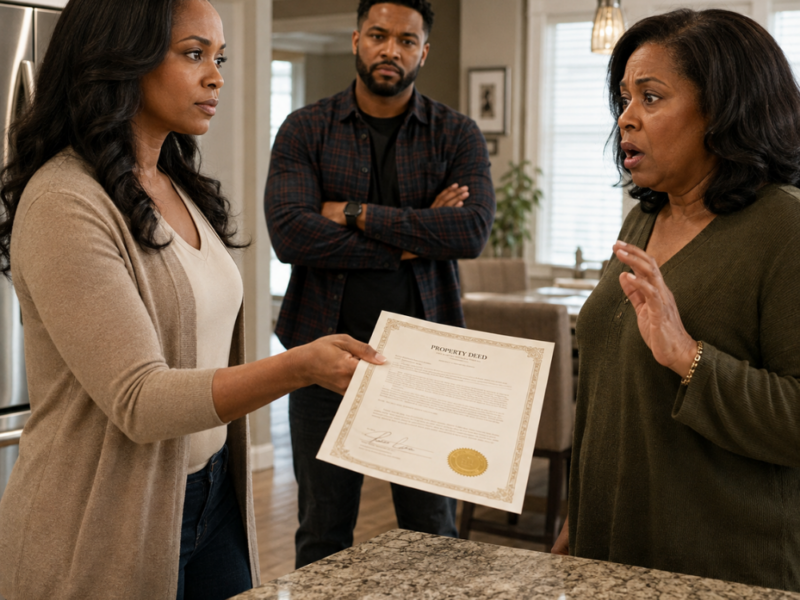
My Mother Called My New House a “Family Property”—Then I Showed Her the Deed

My mother told me to give my unemployed brother half my house—then I found the refinancing papers in her purse.
My mother had never cared where I kept the extra bath towels before.
That was the first thing that felt wrong.
She had been in my house for almost an hour that Saturday afternoon, moving from room to room with the curious, appraising attention of someone attending an open house rather than visiting her daughter. She opened the pantry. Looked through the laundry room. Stood in the doorway of my home office long enough to ask whether the built-in shelves had come with the property. Then she walked upstairs and examined the spare bedroom.
Twice.
The second time she opened the closet.
I stood in the hall holding two coffee mugs and watched her look inside.
“Mom.”
She turned.
“What?”
“What are you doing?”
“Nothing.”
“You’re looking through closets.”
She smiled like I was being difficult.
“I’m your mother, Bryer.”
That had always been her answer when the real answer would have created a problem.
I handed her the coffee.
She took it, looked around the spare bedroom one more time, and said, “You could fit a dresser against that wall.”
“For what?”
“For Dax.”
I stared at her.
My younger brother had been sleeping in that room for eleven days.
The arrangement was supposed to be temporary.
He had lost another job, this time at a tire distributor in Waterloo, and my mother called me before he had even finished packing his locker.
“He just needs somewhere stable for a few weeks,” she had said.
I agreed because that was what I did.
Agree.
Help.
Cover.
Fix.
Be reasonable.
My entire childhood had trained me for those verbs.
Now Mom touched the windowsill with one finger, checking for dust that was not there.
“So when are you planning to make this Dax’s room?”
I thought I had misheard.
“It is his room while he’s staying here.”
“No. I mean properly.”
“What does properly mean?”
“A bed he likes. A television. Somewhere to put his things.”
“He has somewhere to put his things.”
I pointed toward the dresser.
“And he isn’t moving in permanently.”
Mom looked at me as if I had said something childish.
“Bryer.”
“What?”
“You really need to stop thinking only about yourself.”
The sentence hurt more than it should have.
That bothered me too.
I was thirty-seven years old.
I owned the house.
I paid the mortgage.
I had spent fifteen years becoming a person who could hear criticism without collapsing under it.
Still, one sentence from my mother reached straight through all that work and found the twelve-year-old girl who had once been told to give her birthday money to Dax because he had broken his bicycle.
“I’m thinking about myself because this is my house.”
Mom sighed.
“Families share.”
“We do.”
“Do we?”
I almost laughed.
Instead, I carried my coffee downstairs.
Mom followed.
She sat at my kitchen table, the same solid oak table I had bought secondhand after closing on the house because nearly every dollar I had left had gone into moving costs, inspection fees and the first round of repairs.
For ten minutes she talked about Dax’s future.
He needed stability.
A break.
Confidence.
Someone who believed in him.
He had been through a hard few years.
The job market had been bad.
His last supervisor had treated him unfairly.
Rent had become impossible.
A decent family would not let someone struggle while another person had “more than enough.”
That phrase bothered me.
More than enough.
My three-bedroom house outside Cedar Falls, Iowa, was not a mansion.
It was a 1990s split-level on a quiet street with a maple tree that dropped leaves into my gutters every October and a furnace that had made an alarming noise during the inspection.
The kitchen had laminate counters.
The deck needed staining.
My garage door opener had to be pressed twice when temperatures fell below twenty degrees.
I loved every imperfect inch of it.
Mom looked around and saw abundance.
I looked around and saw overtime.
Two jobs.
Skipped vacations.
Packed lunches.
Cheap apartments.
Tax refunds transferred directly into savings.
Years of saying maybe next year whenever somebody suggested I deserved something nice.
I sat across from her.
“Why are you suddenly this worried about Dax?”
“I’ve always worried about your brother.”
“That’s not what I asked.”
She became quiet.
Outside, a lawn mower started somewhere down the block.
It was one of those mild early fall afternoons when Cedar Falls looked almost too tidy to contain a family argument.
Mom wrapped both hands around her coffee mug.
“Your brother deserves a chance.”
“I’m giving him one.”
“No.”
She looked at me.
“You’re giving him a deadline.”
“Those are not opposites.”
“He needs to know he has somewhere to land.”
“He does. Right now.”
“And later?”
“Later he supports himself.”
Her mouth tightened.
“You have always been harder on him than necessary.”
That was so completely opposite of reality that for a second I could not answer.
Then the front door opened.
Dax came in carrying a gas-station drink and a plastic bag from the convenience store.
He was thirty-three.
Four years younger than me.
Tall like our father had been.
Same brown hair.
Same quick smile that could make older women forgive him before they knew what he had done.
“Hey.”
He looked between us.
“Family summit?”
“No,” I said.
Mom answered at the same time.
“We’re talking about your room.”
Dax smiled.
“My room?”
“The guest room.”
Mom looked at me.
I stood.
“I have laundry.”
It was not brave.
But I had learned that arguing with my mother when she was in that particular mood only produced more material she could use later.
I carried the empty mugs to the sink and let them talk.
An hour later, Mom gathered her purse and cardigan.
I walked her to the door.
She had set her bag on the entry bench.
When she picked it up, a folded document slid partway from the top.
I noticed my address.
1847 Willow Ridge Drive.
The text was upside down, but I knew my own street.
“Mom.”
She turned.
“What’s that?”
“What?”
“The paper.”
Her hand moved quickly toward the purse.
Too quickly.
I reached it first.
Not because I was suspicious yet.
Because I thought it might be something connected to my insurance or a utility bill she had accidentally taken from the kitchen.
I unfolded it.
The first page was a county property record.
My property record.
Owner:
BRYER ELIZABETH WHITLOCK.
Parcel number.
Purchase date.
Assessed value.
Mortgage information was handwritten along the side.
Below that were notes.
Spare cottage estimate.
Equity approximately $148K.
Possible refinance 75–80% LTV.
Add Dax?
Business startup.
My stomach went cold.
I looked at my mother.
“What is this?”
She reached for it.
“Give me that.”
I stepped back.
“Why do you have my property record?”
“It’s nothing.”
“Then why is my address on it?”
“Bryer.”
“Why is Dax’s name written beside ‘add’?”
Her expression changed.
Not guilt.
Annoyance.
That was almost worse.
“We were exploring options.”
“We?”
Mom looked toward the hallway.
Dax had gone upstairs.
I lowered my voice.
“What options?”
“Ways to help your brother.”
“With my house?”
“No one has done anything.”
“Why are you researching refinancing?”
“You have equity.”
I stared at her.
“I have equity.”
“Exactly.”
“No.”
The word came out quietly.
Mom’s face tightened.
“You don’t even know what I was going to say.”
“I know enough.”
“Your brother wants to start a business.”
“He has wanted to start six businesses.”
“That is unfair.”
“It is accurate.”
“He needs capital.”
“Then he needs to save it.”
“Not everyone has your opportunities.”
That nearly made me laugh.
“My opportunities?”
“You have a good job.”
“I have a job because I kept one.”
“Dax has struggled.”
“I know.”
“You never understand how hard things have been for him.”
I folded the document.
“Mom, get out.”
She stared.
“What?”
“I need you to leave.”
“Over a piece of paper?”
“Over the fact that you are researching how to use my home as collateral for Dax.”
Her face flushed.
“That’s not what I said.”
“It is written right here.”
“Nothing has been decided.”
“Nothing is being decided.”
I handed her the document.
“Not by you.”
Mom pushed it back.
“Keep it if you’re going to be dramatic.”
She picked up her purse.
At the door, she turned.
“Your father would be ashamed of how selfish you’ve become.”
Then she left.
I stood in the entryway long after her car disappeared.
That sentence stayed.
Dad would be ashamed.
My father had been dead for nine years.
Mom had learned during those nine years that dead people were useful in arguments because they could not correct her.
Your father would want you to help.
Your father always worried about Dax.
Your father believed family came first.
Some of those statements were probably true.
Some were impossible to verify.
All had the same effect.
They turned my father’s memory into pressure.
I closed the door.
From upstairs, I heard Dax moving around.
For the first time, I wondered whether he knew.
Growing up, Dax and I had lived under two different versions of our parents.
Not because they loved one of us and hated the other.
It was subtler than that.
I was the capable child.
Dax was the fragile one.
Nobody announced those roles.
Families rarely do.
They simply repeat them until everyone forgets there was ever a choice.
When I was ten, I packed my own lunch.
Dax forgot his at fourteen and Mom drove it to school.
When I got a C in algebra, Dad took away my television privileges until the grade improved.
When Dax failed geometry, Mom said the teacher did not understand how he learned.
I got my first job at sixteen.
Dax quit his first job after eight days because the assistant manager spoke to him “like an employee.”
Mom called the store afterward.
I remember standing in our kitchen listening to one side of the conversation and thinking there must be some piece of the story I had missed.
There usually was not.
When Dax was nineteen, he borrowed Dad’s truck and damaged the passenger door against a concrete pole.
Dad made him pay part of the repair.
Mom secretly gave him the money.
When I found out, I said that defeated the lesson.
Mom told me not to be cruel.
I stopped saying things after that.
Silence was easier.
My father was different with me.
He did not rescue me.
At the time, I resented it.
Later, I understood he believed responsibility was a form of respect.
When I bought my first car, a used Toyota with 112,000 miles, he came with me.
The salesman tried to talk mostly to Dad.
My father pointed toward me.
“She’s buying.”
Afterward, when I asked whether I had paid too much, Dad said, “Probably.”
I stared at him.
“You could’ve said something.”
“You asked me to come look at the car, not buy it for you.”
That was Dad.
Sometimes infuriating.
Often right.
He expected me to recover from mistakes because he assumed I could.
He worried about Dax because he was never sure Dax would.
Mom worried too.
Then worry became rescue.
Rescue became expectation.
Expectation became entitlement.
By the time Dad died, the pattern was set.
His death made it worse.
He suffered a heart attack on a Wednesday morning at the warehouse supply company where he had worked for twenty-seven years.
I was twenty-eight.
Dax was twenty-four.
Mom called me first.
I drove home from Des Moines through freezing rain.
Dax arrived the next afternoon.
I handled the funeral home.
Church.
Flowers.
Obituary.
County death certificates.
Insurance forms.
The ham trays from Hy-Vee for the church lunch.
Everything.
People kept saying, “You’re so strong.”
I wanted someone to say, “Sit down.”
Dax promised to help with the reception.
He forgot.
Mom defended him.
“He’s grieving differently.”
I was grieving while writing checks.
That apparently counted less because I did it neatly.
Dad’s small life insurance policy covered most funeral expenses, but not all.
Mom had bills coming due.
I paid them.
Then another.
Then another.
For nearly two years, I sent her money most months.
Dax occasionally contributed.
Mostly he needed help too.
I did not hate him.
That is important.
I loved my brother.
I still remembered building blanket forts with him in the living room.
Teaching him to ride a bike after Dad lost patience.
Picking him up from a terrible date in college.
Sitting beside him at Dad’s funeral when both of us cried so hard neither could speak.
Love made the pattern harder to see.
If Dax had been a stranger, I would have recognized it immediately.
Because he was my brother, I called it family.
After Dad died, I made one decision that had nothing to do with anyone else.
I was going to buy a house.
Not immediately.
I had almost no savings.
But I wanted a front door no one could use as leverage.
My parents had rented until I was fifteen.
Every year, there was some anxiety around lease renewal.
Rent increase.
Security deposit.
A landlord deciding to sell.
When Dad finally bought their small ranch house, he changed.
Not dramatically.
He planted tomatoes.
Installed shelves.
Complained happily about property taxes.
He used the phrase “my place” with a quiet pride I never forgot.
I wanted that.
So I worked.
My primary job was in procurement for a regional manufacturing company.
It paid decently.
I took weekend bookkeeping work for a local equipment dealer.
During tax season, I prepared basic returns through a small accounting service.
Some weeks I worked sixty-five hours.
I rented the cheapest safe apartment I could find.
Brown carpet.
Thin walls.
A kitchen drawer that came off its tracks every third time I opened it.
I packed lunches.
Bought clothes on sale.
Drove the same Honda until the odometer passed 200,000 miles.
Every payday, money moved into a separate savings account labeled HOUSE.
Sometimes Mom called the same day.
The furnace needed service.
Dax’s electric bill was late.
She needed money for property taxes.
I sent it.
Then put less into my house account.
That delayed the purchase by years.
Nobody in my family noticed the connection.
Eventually, at thirty-six, I had enough.
The house on Willow Ridge appeared on a Tuesday.
I saw it online during lunch.
Three bedrooms.
Two bathrooms.
Small guest cottage behind the garage that the previous owners used as an art studio.
A quarter acre.
Quiet street.
Ten minutes from work.
The listing photographs made everything look brighter than reality.
I loved it anyway.
At closing, the title company woman slid documents across the table.
I signed my name again and again.
BRYER E. WHITLOCK.
When she handed me the keys, I sat in my car and cried.
Not because the house was impressive.
Because it was mine.
I called Mom.
She congratulated me.
Then asked the price.
I told her.
“How much did you put down?”
I answered.
“Interest rate?”
I answered.
“Monthly payment?”
I answered.
At the time I interpreted the questions as concern.
Then came insurance.
Equity.
Whether the cottage could be rented.
How much the neighborhood was appreciating.
I answered those too.
Families knew things about each other.
That was normal.
Or I thought it was.
Six months after I moved in, Dax lost the tire-distributor job.
Mom called that evening.
“He needs a fresh start.”
“I can help him look.”
“He needs somewhere to stay.”
I looked around my living room.
I knew where this was going before she asked.
“How long?”
“A few weeks.”
I said yes.
Dax arrived the following Saturday with two suitcases, a television, a gaming console and a box containing approximately forty-seven charging cables for devices he no longer appeared to own.
At the front door, I told him the rules.
“You buy some groceries.”
“Fair.”
“You clean up after yourself.”
“Obviously.”
“No smoking inside.”
“I don’t smoke.”
“You quit?”
“Mostly.”
I stared.
He smiled.
“I’ll go outside.”
“And this is temporary.”
“I know.”
“Meaning you look for work every day.”
“Absolutely.”
I wanted to believe him.
For the first week, it went fine.
He applied for jobs.
Made dinner twice.
Took out trash.
Replaced a broken latch on the shed.
Then small things changed.
I came home one Wednesday and found him opening my mail.
“What are you doing?”
“Checking if anything important came.”
“My mail is important to me.”
He laughed.
“Relax.”
“Don’t open it again.”
“I didn’t open anything.”
“You’re holding my mortgage statement.”
“It was already open.”
It was not.
I took it.
“Don’t touch my mail.”
He raised both hands.
“Fine.”
Three days later, I found the living room rearranged.
My chair had been moved to the corner.
The sofa rotated toward his television.
His gaming equipment covered the shelves where I kept books and family photographs.
“What happened?”
“Better layout.”
“Put it back.”
Dax stared.
“Seriously?”
“Yes.”
“It works better this way.”
“For you.”
“You don’t even use this room.”
“I use it every day.”
He laughed.
“You sit in that chair and read.”
“Yes. That is using a room.”
He shook his head.
“You’re getting weird about the house.”
That sentence chilled me.
Not because it was threatening.
Because it sounded like Mom.
The next Saturday, I came home from errands and found three of Dax’s friends drinking beer on the deck.
Nobody had asked.
One of them was sitting in my patio chair with muddy shoes against the table.
I waited until they left.
Then confronted Dax.
“You do not invite people here when I’m not home without asking.”
He rolled his eyes.
“I live here.”
“Temporarily.”
“Mom said you’d be like this.”
“What does that mean?”
“Controlling.”
I stared at him.
“It’s my house.”
“That’s exactly what she meant.”
I called Mom that evening.
Her response made the uneasiness I had been feeling sharpen into something clearer.
“Dax is family.”
“I know.”
“Stop treating him like a tenant.”
“He is not a tenant.”
“Then stop making rules like a landlord.”
I stood at the kitchen window.
The guest cottage sat dark beyond the yard.
“Mom, what exactly have you told him?”
“About what?”
“This house.”
“Nothing.”
“Has he told you I promised him anything?”
Silence.
“Mom?”
“You are overreacting.”
“What did you tell him?”
“I said family takes care of family.”
“That is not an answer.”
She sighed dramatically.
“I’m not doing this tonight.”
She hung up.
I went upstairs.
Dax was out.
His bedroom door was open.
A folder lay on the dining table near the stairs.
I did not search it.
I want that clear even though nobody would have blamed me later.
The folder was open.
My address was visible.
Again.
I walked over.
County property records.
A Zillow printout.
Estimated equity.
Contractor invoices I recognized from repairs I had paid for.
Then a handwritten page.
Mom’s writing.
Bryer can add Dax after refi.
Use cottage as business office?
$65K startup.
Possible line of credit.
If title changes, equal asset?
My hands went numb.
There was more.
A proposed list of improvements to justify a higher valuation.
Roof.
Guest cottage.
Kitchen.
Dax’s business idea written at the bottom:
Custom auto detailing / mobile fleet service.
I sat down.
For several minutes I simply listened to the refrigerator run.
This was not a conversation.
They had a plan.
A bad plan, perhaps.
A plan based on legal assumptions they did not understand.
Still a plan.
My house had become capital in a future they were designing without me.
Dax returned after ten.
I said nothing.
That was one of the most useful decisions I made.
The old Bryer would have confronted him immediately.
He would have denied.
I would have shouted.
Mom would have called.
By midnight, the facts would have disappeared beneath emotion.
Instead I photographed every page.
Put the folder exactly where it had been.
Went upstairs.
Locked my bedroom door.
And made a list.
The following morning, I called someone from work.
“Do you know a real-estate attorney?”
My coworker, Janet, gave me the name Alowen Mercer.
“She handled my mother’s property mess after my stepfather died.”
I wrote the number down.
“Good?”
“Terrifyingly calm.”
That sounded perfect.
Alowen’s office sat on the second floor of an old brick building near downtown Cedar Falls.
No glass walls.
No marble.
Waiting room with two chairs and a coffee machine that produced something legally adjacent to coffee.
Alowen was in her early fifties.
Short gray-streaked hair.
Navy suit.
Reading glasses attached to a thin chain she clearly hated.
She listened for nearly forty minutes without interrupting except to clarify dates.
Then she read the documents.
Deed.
Mortgage.
Insurance.
Tax records.
The papers from Dax’s folder.
Mom’s notes.
When she finished, she folded her hands.
“First, Dax owns nothing.”
I breathed out.
“I know that.”
“You know it emotionally.”
She tapped the deed.
“I want you to know it legally.”
Owner of record: Bryer Elizabeth Whitlock.
No co-owner.
No recorded lien attributable to Dax.
No contract conveying future interest.
No written promise.
No contribution to purchase.
Nothing.
“Your mother cannot add him to title.”
“Good.”
“Neither can he.”
“Good.”
“Only you can execute a deed.”
I nodded.
Then she reached for another page.
“However.”
There it was.
The lawyer word nobody wanted.
“What?”
“I ran a preliminary search after you emailed the address.”
My stomach tightened.
“Someone has made inquiries regarding refinancing.”
“What kind of inquiries?”
“Nothing completed.”
She looked at me.
“But enough that I want you paying attention.”
A mortgage broker had requested preliminary property data.
The request referenced an owner-occupied property and possible additional obligor.
My name.
Dax’s.
No application had been completed.
No credit pull on my file that I could see.
Still, someone had been asking questions.
“Could Mom do that?”
“Ask questions? Yes.”
“Refinance?”
“No.”
“Without me?”
“Not lawfully.”
The emphasis on lawfully did not comfort me.
Alowen continued.
“If someone starts representing that they have ownership or authorization they don’t have, that becomes more serious.”
“What do I do?”
“Document.”
She slid a legal pad toward me.
“Every message.”
“Every paper.”
“Do not delete voicemails.”
“Change passwords.”
“Call your mortgage servicer and ask for heightened verification.”
“Freeze your credit if you’re worried personal information has been shared.”
“Consider a title-monitoring alert through the county or a reputable provider.”
I wrote everything.
“And Dax?”
She looked at me.
“Do you want him in your house?”
“No.”
“Then you need to address that separately and correctly.”
Because he had been staying with me for more than a brief visit, Alowen wanted to make sure I did not create another problem by improvising.
She reviewed the facts.
No lease.
No rent.
Temporary permission.
We followed Iowa-specific procedure appropriate to the circumstances rather than assuming changing locks alone would solve everything.
That mattered.
Real life was more annoying than television.
You could be completely right about ownership and still create unnecessary legal trouble if you handled occupancy carelessly.
Alowen prepared written notice.
I delivered it properly.
Dax exploded anyway.
“You got a lawyer?”
“Yes.”
“Against your own brother?”
“For my property.”
“This is insane.”
“You have until the date in the notice.”
“Mom said I could stay.”
“Mom does not own the house.”
He laughed bitterly.
“You really love saying that.”
“I do now.”
Mom arrived within an hour.
She stood on my front porch.
“You are humiliating him.”
“No.”
“You served your brother a legal notice.”
“Yes.”
“He has nowhere to go.”
“He has options.”
“Where?”
“Your house.”
Mom stared.
Her small ranch still had Dad’s old room.
The basement was finished.
She had more space than she admitted.
“That’s different.”
“Why?”
“You know why.”
“I don’t.”
She looked away.
Dax had lived with her twice before.
Both times ended badly.
He did not clean.
Did not contribute.
Borrowed her car.
Had friends over.
Mom wanted me to absorb the inconvenience now.
I understood suddenly.
She was generous with my resources because generosity cost her less there.
“Take him home.”
Her face hardened.
“You have a bigger place.”
“So?”
“He needs independence.”
“Living in my guest room is independence?”
“At least he has space.”
I looked at her.
“Mom, you can help him.”
“I am helping him.”
“No.”
My voice stayed calm.
“You are assigning me to help him.”
She went quiet.
That was the first time I had ever said it plainly.
She left without answering.
Dax moved out before the deadline.
Not gracefully.
He packed most things.
Left trash.
Left a broken desk chair.
Took one of my extension cords and claimed it was his.
I let the extension cord go.
Peace had a price.
I changed the locks the day after he left.
Then changed every important password.
Mortgage company.
Bank.
Insurance.
County property portal.
Email.
Credit freeze.
I added a verbal security phrase to my mortgage account.
For the first time since Dax moved in, I slept through the night.
Three days later, certified mail arrived.
A lawyer’s letter.
I opened it at the kitchen table.
Dax claimed he had an equitable interest in the property.
He alleged that I had promised him an ownership share.
He claimed he had contributed labor and money toward improvements.
He demanded compensation.
I read the letter twice.
Then called Alowen.
“Do not respond yourself,” she said.
“I wasn’t going to.”
“Good.”
“He’s lying.”
“I believe you.”
“I never promised him anything.”
“Then we prove what happened.”
“What if everyone believes him?”
Alowen paused.
“Courts do not generally decide title based on who sounds more wounded at Thanksgiving.”
Despite everything, I laughed.
She continued.
“We use documents.”
So I gathered documents.
Mortgage payments.
Bank statements.
Wire confirmation from closing.
Home inspection.
Contractor invoices.
Cancelled checks.
Property-tax receipts.
Insurance.
Home Depot receipts.
Lowe’s receipts.
A Menards receipt for the deck materials Dax later claimed he helped pay for.
He had helped carry lumber one Saturday.
I bought lunch.
That was the full extent of his contribution.
I found text messages from when he first moved in.
Dax: Just a few weeks, promise.
Me: Fine. Job search every day.
Dax: Deal.
Another.
Me: Please don’t move furniture without asking.
Dax: It’s temporary anyway lol.
Temporary.
His own word.
I saved it.
Then my cousin Marla called.
“Bryer, I don’t know whether I should tell you this.”
“That is never a good opening.”
“Dax has been saying Dad left that house to both of you.”
I stopped.
“What house?”
“Yours.”
“That’s impossible.”
“I know.”
“Dad died nine years before I bought it.”
“I know.”
Marla sounded miserable.
“He said you used inherited money.”
I nearly dropped the phone.
There had been no inherited money.
Dad’s estate was small.
The ranch house went to Mom.
Life insurance covered debt.
There was no trust.
No secret account.
I bought Willow Ridge with savings accumulated years later.
“Who has he told?”
“I heard it at Aunt Donna’s.”
That meant everybody.
Our family did not need social media.
Aunt Donna could distribute misinformation across three counties before lunch.
I sat down.
For years, I had protected Dax’s reputation.
When relatives asked why he left a job, I said the position was not a fit.
When he borrowed money, I called it temporary.
When Mom complained he was struggling, I nodded.
I had believed family privacy was loyalty.
Now he was filling that silence with his version.
Dad left us a house.
Bryer took it.
Bryer promised half.
Bryer is throwing her brother out.
I called Alowen.
“What do I say to family?”
“The truth.”
“All of it?”
“What is your goal?”
“To stop the lie.”
“Then correct the fact. You don’t need to publish his entire life.”
So I did.
When Aunt Donna called, I said:
“Dad did not own my house. He died in 2016. I purchased Willow Ridge in 2025 with my own funds. The recorded deed is solely in my name. Dax has never owned any part of it.”
That was all.
No insults.
No history.
No speculation.
Facts were strangely calming.
The more Dax dramatized, the less I did.
Mom requested a “family meeting.”
I refused at first.
Then she said, “We need to settle this without lawyers.”
I replied, “Alowen will be there.”
Mom became offended.
“If you bring a lawyer, it isn’t family.”
I almost admired the logic.
“If the conversation involves ownership of my house, she will be there.”
The meeting happened at Alowen’s office.
Neutral ground.
Mom sat beside Dax.
I sat beside Alowen.
Dax had hired a general-practice attorney who looked increasingly uncomfortable as the meeting progressed.
Mom began.
“This family is being destroyed over property.”
I let her finish.
She talked about Dad.
Sacrifice.
Dax’s struggles.
My “good fortune.”
She said she had never imagined one child of hers would have so much while another struggled.
That sentence contained years.
I looked at her.
“Mom, I don’t have this because I was given more.”
“You always had better jobs.”
“I kept jobs.”
Dax scoffed.
Alowen touched my sleeve lightly.
Not a warning.
A reminder.
Facts.
Dax began discussing the business plan.
Mobile fleet detailing.
Commercial accounts.
Equipment.
A van.
He mentioned exactly how much equity he believed could be accessed through refinancing.
Alowen looked up.
“Where did that number come from?”
Dax stopped.
Mom immediately said, “It was an estimate.”
“Prepared by whom?”
Silence.
Dax’s attorney turned toward him.
Alowen repeated, “Who gave you the refinance estimate?”
Dax looked at Mom.
Mom said, “We were just asking questions.”
“With a mortgage broker?”
“Possibly.”
“Representing that you had authority over the property?”
“No.”
Alowen’s tone remained polite.
“Then what exactly did you tell the broker?”
Mom’s eyes filled.
That used to end arguments.
Not because the tears were fake.
They were real.
My mother felt deeply.
But feeling deeply and being right were different.
“I was trying to help my son.”
I said nothing.
She looked at me.
“You have no idea what it is like watching your child struggle.”
I nearly answered.
Then stopped.
Dad would have said something practical.
Ask the next question.
I did.
“Why was helping him supposed to involve my house?”
Mom stared.
“Because you could.”
“That is not an answer.”
“You have equity.”
“So?”
“You’re his sister.”
“So?”
Her frustration finally broke through.
“Because you are the responsible one.”
Silence.
There.
The real sentence.
Mom heard herself.
Dax looked away.
I said, “What does that mean?”
She wiped her eyes.
“It means you know how to manage things.”
“So I should finance Dax’s business.”
“I thought you would understand.”
“Understand what?”
“That family comes before money.”
I looked at the folder in front of me.
“This isn’t only money.”
“It’s a house.”
“Yes.”
“My house.”
Mom shook her head.
“You always come back to that.”
“Because you keep trying to give parts of it away.”
Dax’s attorney asked to speak with him privately.
They left the room.
Mom sat across from me.
Her face looked older than it had when we arrived.
Then she said something I had needed to hear for years, though I did not know it.
“I thought you would give in.”
I looked at her.
“You always do eventually.”
That hurt.
Because she was right.
Utility bill.
Grocery money.
Dax’s car repair.
Mom’s property taxes.
Christmas presents bought for everyone when she could not afford them.
I had trained my family too.
Not intentionally.
But every time I said yes after initially saying no, I taught them that my boundaries were opening bids.
Mom continued.
“You get upset.”
Her voice was quiet.
“Then you calm down and do what needs to be done.”
“What needs to be done for whom?”
She did not answer.
I felt something inside me settle.
Not rage.
Clarity.
“You didn’t protect Dax.”
Mom looked up.
“You protected him from his own choices.”
Her mouth tightened.
“And whenever protecting him became expensive, you expected me to pay.”
“That is not fair.”
“It is exactly what happened.”
“Your brother has had a harder life.”
“Why?”
She stared.
I continued.
“Because he lost jobs?”
“He has anxiety.”
“So do I.”
“He doesn’t handle pressure like you.”
“Because nobody ever required him to.”
“That’s cruel.”
“No.”
My voice stayed calm.
“This is cruel.”
I pointed to the papers.
“You looked at something I worked for fifteen years to build and your first question was how much of it could be used to fix Dax.”
Mom cried.
I cried too.
That surprised me.
“I am putting family first.”
My voice broke.
“I am just not destroying myself to do it anymore.”
Nobody spoke.
When Dax and his lawyer returned, the tone changed.
His attorney stated that based on documentation reviewed, Dax would withdraw claims of ownership.
A limited dispute remained over alleged labor.
Alowen produced the messages where Dax described his stay as temporary.
Receipts.
Contractor invoices.
No serious claim remained.
Within weeks, the legal letter disappeared into a settlement in which nobody paid anyone anything and everyone agreed Dax had no interest in the property.
I could have called that victory.
It did not feel like one.
Victory implies celebration.
What I felt was tired.
But safe.
Alowen helped me take additional protective steps.
Nothing dramatic.
No magical filing that made dishonesty impossible.
We ensured county records were current.
Set monitoring.
Kept copies of everything.
Notified the lender that no one else had authority.
Maintained the credit freeze.
Documented the prior inquiries.
Then I turned to the small guest cottage.
That cottage had become part of Dax and Mom’s imagined future almost as much as the house.
Dax had talked about converting it into an office.
Then living there.
Then using it as proof of business assets.
I realized I no longer wanted the cottage.
Not because I was afraid he could claim it.
He could not.
Because every time I looked at it, I imagined another family conversation.
You aren’t using it.
Dax could live there.
Mom could move there someday.
Why let space go to waste?
I subdivided and sold the cottage portion where legally feasible through the property’s existing lot configuration and local requirements, working with a surveyor and attorney so everything was clean.
The buyer was a retired art teacher named Helen who wanted a tiny studio residence.
At closing, she said, “I’ve dreamed about having my own little place for twenty years.”
I understood completely.
I used most of the proceeds to pay down my mortgage.
The day the principal balance updated online, I stared at it.
Then laughed.
Not because I had defeated anyone.
Because for once, a financial decision involving my house had been made entirely by me.
Dax moved into an apartment in Waterloo.
Small.
Second floor.
No dishwasher.
He complained to Mom.
Mom complained to me.
I did not fix it.
Then something unexpected happened.
Dax got a job.
Not a dream job.
Service advisor at an auto dealership.
He hated the hours.
Stayed anyway.
Three months.
Then six.
He began paying his own phone bill regularly.
I knew because Mom stopped asking me to cover it.
At Christmas, he came to Aunt Donna’s house.
We had not spoken in four months.
He stood near the dessert table holding a paper plate.
“Hey.”
“Hey.”
Awkward silence.
Then he said, “The house thing got out of hand.”
I nearly laughed.
“Interesting description.”
He looked embarrassed.
“I was mad.”
“I know.”
“Mom made it sound like you had promised.”
“I didn’t.”
“I know now.”
There was an apology somewhere near that sentence.
Not quite formed.
I decided not to drag it out of him.
“You doing okay?”
He shrugged.
“Work’s fine.”
“Apartment?”
“Terrible.”
I smiled.
He smiled too.
For two minutes we were brother and sister again.
Then Mom entered the room and the old tension returned.
Healing was not linear.
I stopped expecting it to be.
The hardest change was money.
For most of my adult life, Mom could call with a financial emergency and I would solve it.
Sometimes real emergencies.
Furnace.
Medical deductible.
Car battery.
Sometimes emergencies created by timing.
A utility bill she forgot.
Dax short on rent.
A credit-card payment.
After the house dispute, I changed the rule.
I did not send money automatically.
If Mom called, I asked questions.
“What happened?”
“What have you tried?”
“What can you cover?”
“What happens if I say no?”
That last question was revolutionary.
Often, nothing catastrophic happened.
The bill could be put on a payment plan.
Dax could work extra hours.
Mom could use savings she had been protecting while asking me to use mine.
Once she called about a $900 car repair.
“I can’t afford this.”
I asked, “How much is in your emergency account?”
Silence.
“Mom?”
“That’s for emergencies.”
I almost laughed.
“What is this?”
“A repair.”
“To a car you need.”
She became irritated.
“You’ve changed.”
“Yes.”
“I don’t know if I like it.”
“That’s okay.”
The sentence shocked both of us.
Her liking my boundary was not a condition of having one.
That took me thirty-seven years to understand.
Several months after the legal dispute ended, Mom came to my house alone.
I saw her car through the front window.
My stomach tightened automatically.
Then I reminded myself I could decide whether to open the door.
That thought was enough.
I opened it.
“Hi.”
“Can we talk?”
I hesitated.
Then stepped aside.
Mom entered.
She no longer moved through the house like it belonged to the family.
She sat in the living room.
For a few minutes we discussed nothing.
Weather.
A cousin’s surgery.
A church fundraiser.
Then she looked around.
“I still think this could have been family property.”
There it was.
Not an apology.
Not yet.
I breathed.
Then went to the kitchen drawer where I kept important originals inside a fireproof document pouch.
I brought out the deed.
Placed it on the coffee table.
Mom looked down.
“Why are you showing me this?”
“One name.”
She looked at me.
“Mine.”
“Bryer—”
“No.”
My voice was not angry.
“I need you to understand what I hear when you say family property.”
She sat back.
I touched the deed.
“I worked almost every weekend for six years.”
“I know you worked.”
“No.”
I shook my head.
“I don’t think you do.”
I told her about the bookkeeping job.
The tax seasons.
The lunches I packed.
The vacations I skipped.
The apartment where the upstairs neighbor vacuumed after midnight.
The years I delayed buying because money I intended for a down payment went to family expenses.
Mom looked down.
“I never asked you to do all that.”
“Sometimes you did.”
Her face tightened.
“I mean the saving.”
“I know.”
“That was your choice.”
“Yes.”
I nodded.
“So is what happens to the house.”
Silence.
I continued.
“What hurt was not that you wanted Dax to have a chance.”
My voice became softer.
“I want him to have one too.”
Mom looked at me.
“What hurt was that you saw the first major thing I ever built entirely for myself and immediately started calculating what part could be used for him.”
Her eyes filled.
“That made me feel like none of my work belonged to me.”
She began crying.
I waited.
Not coldly.
I did not rush to comfort her either.
Mom said, “I thought helping him would make things equal.”
I looked at her.
“Equal?”
“You’ve always been ahead.”
“Because I kept moving.”
“I know.”
She wiped her face.
“Now.”
That word mattered.
“What changed?”
“Dax living with me again.”
I almost smiled.
After he left my house, he had stayed with her briefly before renting the apartment.
Mom continued.
“I kept waiting for him to do the things I told everyone he would do.”
Her voice shook.
“Then I realized I’ve been telling that story for years.”
I said nothing.
“He’s not a bad person.”
“I know.”
“But I made excuses.”
“Yes.”
“I thought if I gave him enough chances, one would turn into stability.”
I looked toward the front window.
“And me?”
Mom cried harder.
“You didn’t need chances.”
There it was.
The wound beneath all the others.
I laughed once.
Not because it was funny.
“I did.”
She looked at me.
“I needed parents.”
“I was your parent.”
“You were.”
I nodded.
“But I needed someone to worry about me before I failed.”
The sentence surprised me as I said it.
Mom’s face broke.
“I worried.”
“You worried whether I would get things done.”
“No.”
“Yes.”
I looked at her.
“When Dad died, everybody asked me what needed to happen next.”
Funeral home.
Bills.
Insurance.
Food.
No one asked whether I could do it.
Because Bryer could always do it.
Competence had become camouflage.
Mom whispered, “I’m sorry.”
I believed her.
That did not erase anything.
We did not hug.
That mattered too.
Stories like ours often rush toward the hug because everyone wants reconciliation to become visually complete.
Real trust moved slower.
I said, “I forgive you for some things.”
Mom nodded.
“I’m not ready for others.”
“I understand.”
“I need you to stop asking about my finances.”
She looked embarrassed.
“Okay.”
“Do not discuss my house with Dax.”
“Okay.”
“If he needs money, don’t call me unless it is an actual emergency.”
She almost smiled sadly.
“You’ll ask me what an emergency means.”
“Yes.”
“Okay.”
“And if I say no, that cannot become a conversation about Dad.”
Mom closed her eyes.
“I shouldn’t have done that.”
“No.”
“He would’ve hated it.”
I looked at her.
That was probably true.
Mom stood.
At the door, she turned.
“I am proud of your house.”
I wanted that sentence to heal more than it did.
Still, I took it.
“Thank you.”
She left.
I closed the door.
And for once, I did not feel guilty.
A year after Dax moved out, Willow Ridge finally felt like my home again.
Not because the legal problem had ended.
Because I stopped waiting for the next demand.
The guest room became an office.
Not Dax’s room.
Not a future family room.
Mine.
I painted the walls a soft green.
Moved my desk upstairs.
Bought shelves.
Placed Dad’s old wooden toolbox on the bottom shelf because I still liked having something of his nearby.
He had written his name inside the lid in black marker.
DAVID WHITLOCK.
When I opened it, I remembered something from childhood.
Dad repairing the kitchen sink.
Dax standing nearby asking to help.
Dad gave him a wrench.
I wanted one too.
Dad said, “You’re holding the flashlight.”
I had been furious.
Years later, while cleaning the toolbox, I laughed.
I had spent most of my life holding the flashlight while somebody fixed Dax’s problem.
Maybe it started that early.
Maybe not.
Families love origin stories because they make patterns feel inevitable.
I no longer cared where ours began.
I cared that it stopped.
Dax kept his dealership job.
Then moved to another dealership where commission was better.
One afternoon he called me.
Not Mom.
Me.
“I’m thinking about getting a place.”
“You already have a place.”
“Buying.”
I stopped.
“Okay.”
“Can I ask you something?”
Every instinct in my body tightened.
Then I reminded myself questions were not demands.
“Sure.”
“How much did you save for closing costs?”
I almost said, That’s private.
Then I heard something in his voice.
Not entitlement.
Nervousness.
I answered generally.
We talked about down payments.
Inspection.
Insurance.
Property taxes.
The difference between what a bank approved and what a person could comfortably afford.
Dax listened.
“Mom said I should just ask you to cosign.”
I closed my eyes.
“What did you tell her?”
“No.”
I smiled.
“Good.”
He laughed.
“Figured you’d like that.”
“I do.”
“I’m trying.”
“I know.”
That was the first conversation where I believed he might be.
He did not buy a house that year.
Prices were too high.
He kept saving.
That was progress too.
Mom and I rebuilt something.
Not the old relationship.
I did not want the old one.
We created a new version with less information.
That sounds cold until you realize privacy can be kindness.
I stopped telling her my salary.
Savings.
Mortgage balance.
Promotions before they were final.
She stopped asking.
Mostly.
At Thanksgiving, she slipped once.
“How much do you still owe on—”
Then caught herself.
“Never mind.”
I smiled.
“Thank you.”
Aunt Donna noticed.
“What?”
“Nothing,” Mom said.
That small correction meant more to me than a dramatic apology.
Behavior was the part of remorse I trusted.
The deed remained in my kitchen drawer.
For the first months after the dispute, I checked it often.
Not because I thought it would change.
Because I needed reassurance.
BRYER ELIZABETH WHITLOCK.
One name.
Eventually, I stopped looking.
Ownership had moved inside me.
That is difficult to explain.
For years, I believed protecting what was mine required evidence everyone else would accept.
A deed.
A bank statement.
A lawyer.
Those things mattered legally.
Emotionally, something else had to happen.
I had to believe that wanting something for myself did not automatically mean I had stolen it from my family.
That was the guilt underneath everything.
If I had money, someone else lacked money.
If I had space, Dax lacked space.
If I had stability, someone else needed stabilizing.
Mom’s logic always began with comparison.
You have more.
He has less.
Therefore some part of yours should move toward him.
That can sound like generosity.
Sometimes it is.
The problem was that my consent had disappeared from the equation.
Generosity chosen is love.
Generosity expected can become extraction.
I had spent years confusing the two.
There were things I still gave freely.
When Mom had cataract surgery, I drove her.
Stayed overnight.
Made soup.
Picked up prescriptions.
She tried to pay for gas.
I refused.
That was help.
When Dax’s car battery died during a cold snap, he called.
I drove over with jumper cables.
I did not buy him a battery.
He bought one after payday.
That was help too.
Boundaries did not make me ungenerous.
They made generosity recognizable again.
I could say yes because no existed.
That changed everything.
Two years after the property dispute, Dax invited me to dinner.
He had moved into a better apartment.
Cleaner.
A plant sat near the window.
I stared at it.
“You own a plant?”
“Don’t be weird.”
“It’s alive.”
“Mostly.”
He made spaghetti.
Overcooked.
We ate anyway.
After dinner he said, “I owe you an apology.”
I put down my fork.
Dax looked uncomfortable.
Not charmingly uncomfortable.
Actually uncomfortable.
“I knew you never promised me half.”
I said nothing.
“Mom made it sound like you should.”
“That’s different.”
“I know.”
He looked toward the kitchen.
“I started saying Dad left it because it made people agree with me faster.”
The honesty hurt.
“Why?”
“I was angry.”
“At me?”
“At everything.”
He rubbed both hands over his face.
“You always made it look easy.”
I nearly laughed.
“Nothing was easy.”
“I know now.”
“How?”
“Because doing my own stuff sucks.”
That was so Dax I laughed.
He smiled too.
Then grew serious.
“I thought you had some trick.”
“What trick?”
“Like you understood money.”
“I do understand money.”
“You know what I mean.”
I did.
Dax had seen the result.
House.
Career.
Savings.
He had not seen Tuesday nights doing bookkeeping after my regular shift.
Neither had Mom.
He continued.
“When I stayed at your place, I started thinking if I had part of what you had, I could finally get ahead.”
“That makes sense.”
He looked surprised.
“It does?”
“Yes.”
I folded my hands.
“What doesn’t make sense is deciding you were entitled to it.”
He nodded.
“I know.”
“And lying about Dad.”
“I know.”
“And the legal claim.”
Dax winced.
“I know.”
He looked at me.
“I’m sorry.”
This time I believed him.
Not because the words were perfect.
Because his life had changed before the apology arrived.
He had kept a job.
Paid rent.
Stopped asking Mom for money.
That was the proof.
“I forgive you.”
He breathed out.
“Really?”
“Yes.”
I pointed toward him.
“But you are never getting my house.”
He laughed.
“Fair.”
A year later, Dax bought a small condo.
Two bedrooms.
Parking spot.
Tiny balcony facing another building.
He called me after closing.
“I have keys.”
His voice sounded exactly like mine must have.
I drove over.
He stood in the empty living room holding the keys.
Mom was there.
She looked at him with tears in her eyes.
Then looked at me.
For one second I worried she might say something about family property.
Instead she said, “You did this.”
To Dax.
Not we.
Not your sister helped.
You.
Dax smiled.
“Yeah.”
Mom hugged him.
I watched.
Something quiet healed.
Not because Dax finally matched me.
Because Mom allowed his accomplishment to belong to him.
And mine to belong to me.
Later, while we ate grocery-store sheet cake on paper plates because Mom believed every closing required cake, Dax looked around the condo.
“I need furniture.”
I said, “Facebook Marketplace.”
Mom said, “Your sister has that extra—”
She stopped.
All three of us froze.
Mom closed her eyes.
“Never mind.”
Dax started laughing.
I did too.
Mom eventually joined.
Humor arrived where tension used to.
That was progress.
Willow Ridge changed over the years.
I refinished the deck.
Replaced the furnace.
Painted the kitchen cabinets myself one disastrous weekend that convinced me some jobs existed for professionals.
The maple tree lost a branch in an ice storm.
I planted hydrangeas near the front walk.
The mortgage balance dropped.
Not as fast as I sometimes wanted.
Steadily.
The guest cottage was gone from my property, but Helen invited me over once after finishing renovations.
She had turned it into exactly what she imagined.
Bright studio.
Pottery wheel.
Tiny kitchen.
She handed me coffee.
“I hope you don’t regret selling.”
I looked around.
“No.”
I meant it.
Selling had never been about punishing Dax.
It had been one more way of reducing the number of conversations other people believed they could have about my property.
That may sound defensive.
At the time, I needed defensive.
Later, I no longer did.
One autumn evening, I sat on my porch while the sun lowered behind the houses across the street.
Mom had visited for lunch.
She left without opening a cabinet.
That amused me more than it should have.
Dax was at work.
My phone was quiet.
I looked at the front door.
The same key ring I had carried from closing hung beside it.
I remembered the woman I had been on closing day.
Crying in the car.
Believing homeownership meant nobody could tell me what I owed them.
I had been wrong.
People could still tell you.
Family especially.
A deed did not stop guilt.
Locks did not stop obligation.
Money did not automatically create freedom.
The hardest ownership was internal.
You had to decide you were allowed to keep what you built.
Allowed to say no before you were exhausted enough to make the no sound acceptable.
Allowed to disappoint people who benefited from your compliance.
Allowed to love someone without financing every consequence.
Allowed to be the responsible child without becoming the family infrastructure.
I thought about Dad.
For years, Mom had invoked him as if his memory belonged to whichever argument she wanted to win.
Eventually, I began remembering my own version of him.
Dad at the car dealership pointing toward me.
She’s buying.
Dad refusing to make decisions I could make myself.
Dad making Dax pay part of the truck repair before Mom secretly reimbursed him.
Dad telling me, after my first awful apartment flooded, “You can come home if you need to, but I think you can handle this.”
At twenty-two, I heard rejection.
At thirty-nine, I heard respect.
I wondered what Dad would have thought of the house dispute.
I stopped trying to answer.
Dead people deserve freedom from being recruited into arguments too.
I knew what I thought.
That was enough.
Several months later, Mom came over for Sunday dinner.
She brought a casserole.
Dax brought rolls.
We ate at the oak table.
The same table where I had first confronted Mom with the refinancing notes.
Nobody mentioned them.
After dinner, Mom helped load the dishwasher.
Dax took trash outside.
I stood in my kitchen and felt something I had once believed required perfect reconciliation.
Peace.
It did not.
The history remained.
Mom had planned to use my house for Dax.
Dax had made false claims.
I had spent years enabling both of them.
We had all done things that could not be made unhappened.
Peace did not erase history.
It made history stop driving.
That was better.
Before Mom left, she stood in the entryway.
“I want to tell you something.”
I waited.
“I used to think you needed less from me because you could do more.”
I swallowed.
Mom continued.
“I understand now that those aren’t the same thing.”
No tears.
No dramatic music.
Just a seventy-year-old woman in a cardigan standing near my coat rack trying to say something she should have understood thirty years earlier.
I nodded.
“Thank you.”
She hugged me.
This time I hugged her back.
Not because the past was gone.
Because the present was different enough to risk it.
After everyone left, I walked through the house.
Kitchen.
Living room.
Office.
Spare bedroom.
I opened the spare-bedroom closet.
Empty except for winter blankets and a vacuum.
I thought about Mom examining it years earlier and deciding where Dax’s dresser should go.
Then I laughed.
I closed the door.
The next morning, I received a mortgage statement.
I opened it.
Checked the balance.
Filed it.
No one touched my mail.
No one asked how much equity I had.
No one treated the number as a family resource waiting to be assigned.
It was just a bill.
That ordinariness felt luxurious.
People sometimes ask whether I think my family tried to steal my house.
I struggle with the word steal.
Not because their actions were harmless.
They were not.
They researched refinancing.
Discussed adding Dax to title.
Created a plan for equity that was not theirs.
Dax later made claims he knew were false.
All serious.
But the deeper problem started before any paper.
They believed access to me created access to what I had.
That belief was built over years.
Every bill I paid.
Every emergency I solved.
Every time Mom said family and I heard obligation.
Every time Dax failed and somebody moved the consequence onto another person.
The house did not create that pattern.
It revealed it.
That is why the legal solution alone could not fix my life.
Alowen could protect title.
She could answer Dax’s letter.
She could make sure the county record was clear.
She could not teach me to say no without apologizing.
That work was mine.
It happened slowly.
The first no felt cruel.
The tenth felt uncomfortable.
Eventually, no became a complete sentence when it needed to.
Yes changed too.
Yes became warmer.
When Mom asked me to come to a medical appointment, I said yes because I wanted to.
When Dax asked whether I could review his condo budget, I said yes.
When he asked whether he could borrow five thousand dollars for new furniture, I said no.
He laughed.
“Had to try.”
No fight.
No Dad would have wanted.
No accusation.
That was freedom.
Not getting everything I wanted.
Being allowed an answer.
I kept the original deed for many years.
Eventually, I refinanced on my own terms.
The closing attorney handed me another stack of papers.
I signed my name.
Again.
BRYER ELIZABETH WHITLOCK.
I smiled.
The attorney looked up.
“Something funny?”
“No.”
I handed back the page.
“Just familiar.”
The house was never extraordinary.
That became part of why I loved it.
In winter, snow collected along the deck rail.
In spring, the sump pump ran too much.
Every June, I fought ants near the patio door.
The upstairs bathroom fan made an annoying rattle.
Homeownership was not the fantasy I had built during those years in the cheap apartment.
It was maintenance.
Bills.
Work.
Still, no repair ever felt as heavy as the guilt my family once attached to keeping it.
A house could be fixed.
Guilt had to be unlearned.
One evening, years after everything, I found the old property packet in a storage box.
The handwritten note was still there.
Add Dax after refi.
$65K startup.
Equal asset?
Mom’s handwriting.
I sat on the floor holding it.
For a moment, anger returned.
Then something else.
Sadness.
Mom had genuinely believed the plan was fair.
That was perhaps the strangest part.
She was not sitting in a dark room plotting to take my house.
She believed she was balancing the family.
One child had stability.
One did not.
Move resources.
Problem solved.
She had reduced two adult lives into columns.
Responsible child.
Struggling child.
Surplus.
Need.
What she missed was the human cost of constantly correcting one person’s consequences with another person’s sacrifice.
I folded the note.
I considered destroying it.
Then did.
Not ceremonially.
I fed it through the shredder in my office.
The machine jammed halfway through.
I laughed so hard I had to sit down.
Even symbolic closure required maintenance.
I pulled the paper out.
Cleared the jam.
Tried again.
Done.
The deed stayed.
Not because I needed proof anymore.
Because some documents deserve keeping.
The note did not.
On my forty-fifth birthday, Dax gave me a small wooden sign.
I opened the box.
HOME
Where everyone knows to ask first.
I stared at him.
“You made this?”
“Ordered it.”
“Good. I was worried you had developed woodworking confidence.”
He smiled.
Mom laughed.
I hung the sign inside the mudroom.
Not the front hall.
I am not that sentimental.
But I kept it.
Because Dax finally understood what the house had meant all along.
Not wealth.
Not equity.
Not unused space.
Choice.
My family had once looked at my home and seen capacity.
A room Dax could use.
A cottage someone could claim.
Equity that could become business money.
A responsible daughter who would probably give in eventually.
I looked at it and saw the first place where my no had legal weight.
Then I learned legal weight was only the beginning.
The real work was believing the no belonged to me even before a lawyer confirmed it.
I did not destroy my family.
For years, I feared boundaries would.
That was Mom’s warning.
You’re breaking us apart.
You’ll regret this.
Look what you’re doing to your brother.
None of it happened.
Dax struggled.
Then adapted.
Mom got angry.
Then reflected.
I became less available for emergencies other people could solve.
They solved them.
The family changed shape.
That was not destruction.
It was correction.
Some relationships became smaller.
Some became more honest.
Some never returned to what they were.
Good.
What they were had required too much of one person.
I no longer measure love by how much I am willing to lose.
That may be the largest thing Willow Ridge taught me.
Love is not giving until resentment becomes the only thing left.
It is not saying yes because you fear what no will reveal.
It is not handing one child the bill for another child’s unfinished growing up.
It is not using a dead father’s memory as emotional collateral.
Love can include money.
Housing.
Rides.
Second chances.
But love without consent becomes something else.
The evening I first found the refinancing notes, I thought the great threat was losing my house.
I was wrong.
The greater threat was remaining the kind of person who believed everyone else had a vote on what I was allowed to keep.
Alowen protected the deed.
I protected the rest.
Years after the dispute, I sat on the same front porch at sunset.
The maple tree was larger.
My mortgage was much smaller.
Dax owned his condo.
Mom had finally replaced the old car she once expected me to repair.
No one owed anyone that evening.
At least nothing measurable.
My phone buzzed.
Dax.
Picture attached.
A leaking pipe beneath his kitchen sink.
Caption:
Dad would be disappointed.
I laughed.
Then typed:
Turn off the water before you flood the place.
He replied:
Already did. Plumber coming tomorrow.
I stared at the screen.
There it was.
A man with a problem.
Handling it.
No rescue.
No crisis.
No mother calling me.
Just my brother telling me something mildly irritating about his house.
His house.
I smiled.
Then put my phone down.
The porch went quiet again.
I looked through the front window at my living room.
My furniture.
My books.
The wall I had painted twice because the first gray turned blue at sunset.
Dad’s toolbox upstairs.
Mom’s casserole dish still in my cabinet because she forgot it last week.
Dax’s ridiculous wooden sign by the mudroom.
Family was still inside the house.
Just not on the deed.
That was exactly where it belonged.
For years, I believed revenge would mean making them understand how badly they had hurt me.
Mom apologizing perfectly.
Dax admitting every lie.
Everyone in the extended family agreeing I was right.
None of that happened as completely as I once imagined.
The better ending turned out to be smaller.
I stopped paying for problems that were not mine.
I stopped translating boundaries into apologies.
I stopped confusing being needed with being loved.
My brother learned how to stand on his own because nobody was standing behind him with my wallet anymore.
My mother learned that helping one child could not require quietly taking from another.
And I learned the most difficult lesson of all.
Being the responsible person does not mean being the available resource.
Responsibility includes responsibility to yourself.
The deed is still filed with the county.
My name is still on it.
But I do not need to open the drawer and check anymore.
I already know what it says.
More importantly, I finally know what it does not say.
It does not say responsible daughter.
It does not say family emergency fund.
It does not say Dax’s second chance.
It does not say Mom gets a vote.
It says owner.
One name.
Mine.
And for the first time in my life, I understood that keeping something I had worked for did not make me selfish.
It made me responsible in a way no one in my family had ever taught me.
Not responsible for everyone.
Responsible for my own life.
That was the home I had actually been trying to buy all along.









