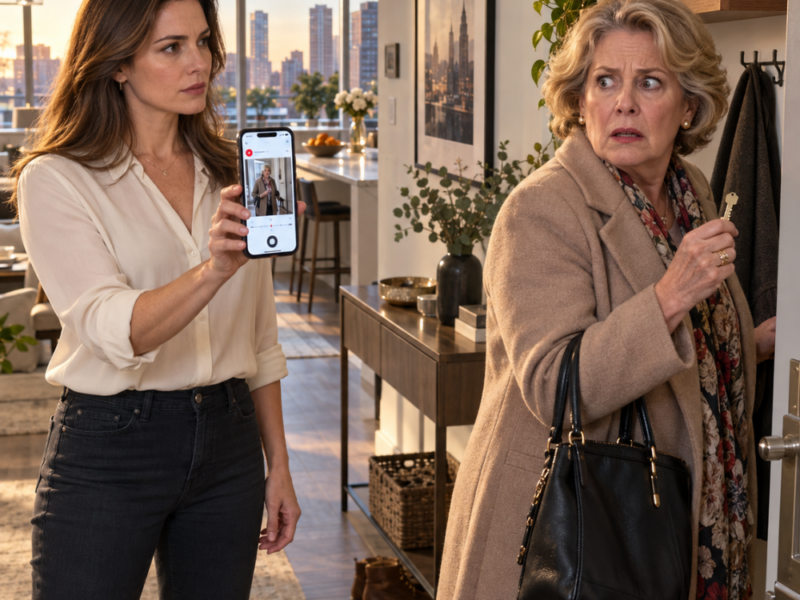
MY MOM KEPT BREAKING INTO MY APARTMENT, SO I DECIDED TO GIVE HER A SURPRISE. WHEN SHE FINALLY REALIZED WHAT I’D DONE, HER FACE FILLED WITH PANIC.
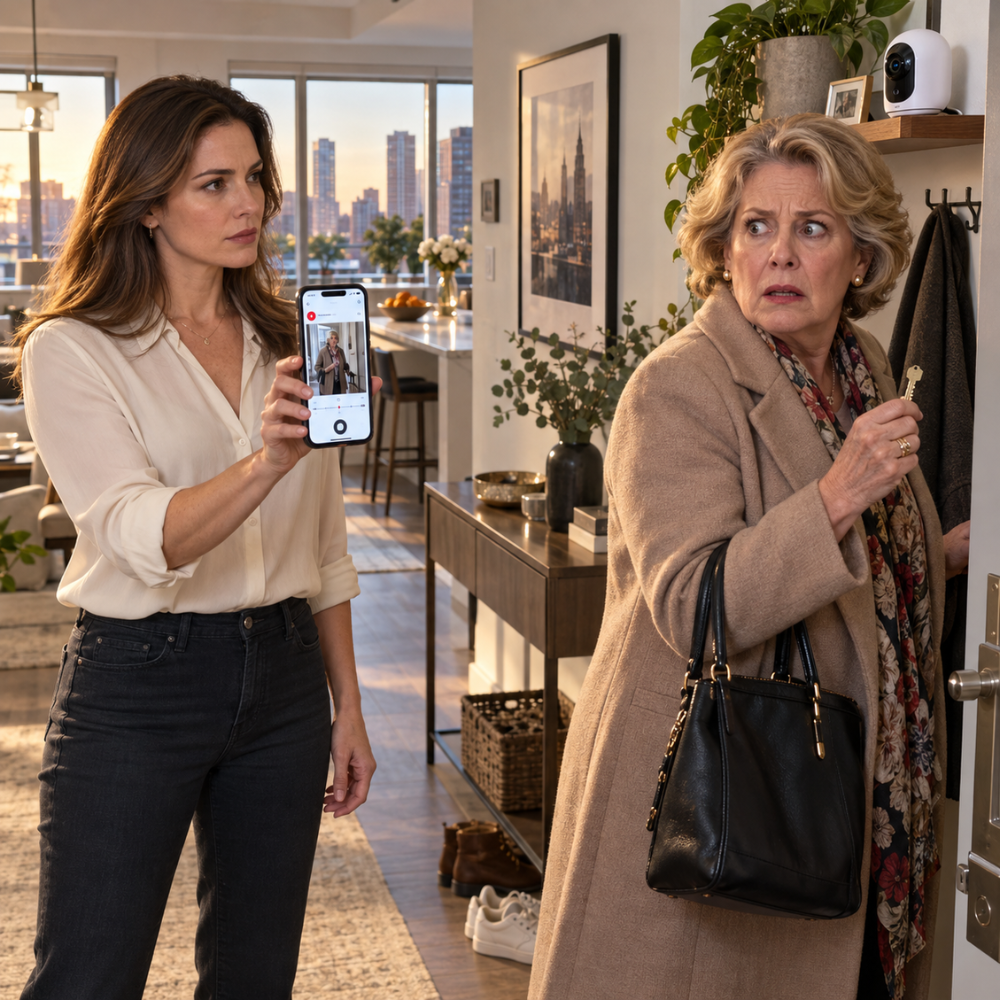
My mother kept letting herself into my apartment, so I changed one thing she never expected
The casserole on my kitchen counter was still warm.
That was how I knew she had been there recently.
I stood just inside my apartment door with my work bag hanging from one shoulder, staring at the foil-covered glass dish as if it had appeared by itself. A yellow sticky note had been pressed carefully onto the top.
You never eat enough. Love you. Mom.
The handwriting was familiar enough to make my stomach tighten before I even looked toward the hallway.
My bedroom door was open.
Not wide.
Just a few inches.
I never left it like that.
I closed and locked the front door behind me, set my bag down, and walked slowly across the living room.
Nothing looked stolen.
Nothing was broken.
My television was where I had left it. My laptop sat on the small desk near the window. The thrift-store lamp I had bought when I first moved in was glowing because apparently my mother had decided I needed better lighting too.
That was her specialty.
Improving things nobody had asked her to touch.
The throw blanket had been folded.
My mail was stacked neatly.
A pair of shoes I had kicked beside the couch that morning now sat aligned beneath the coat rack.
To anyone else, it might have looked like kindness.
To me, it looked like fingerprints.
I pushed the bedroom door open.
My bedspread had been pulled tight enough to bounce a quarter.
The laundry basket had been moved from the corner to the closet.
My dresser drawers were closed, though I distinctly remembered leaving the top one slightly open because I had been searching for a clean pair of socks at six that morning.
Then I saw the little wooden box on my dresser.
It had belonged to my grandmother.
Inside it, I kept things that meant nothing to anyone else and therefore meant everything to me: two letters from my father, a photograph from college, an old concert ticket, a cheap silver necklace, and a note from someone I had once thought I might marry.
The lid was not closed.
It rested crookedly against the edge.
I stood there for several seconds.
Then an old memory opened inside me.
I was sixteen again.
My bedroom at my parents’ house.
A journal lying open on the carpet.
My mother sitting on the edge of the bed with my private thoughts exposed between us.
I could still hear her voice.
“If you don’t have anything to hide, why do you care if I read it?”
She had said it gently.
That had always been the problem.
My mother rarely sounded cruel.
She sounded reasonable.
Concerned.
Helpful.
Love, in her vocabulary, came with excellent manners.
At twenty-six, ten years removed from that bedroom, I was standing in a different ZIP code with a different lock on the door and somehow having the same argument.
I walked back to the kitchen.
The casserole smelled like baked chicken, cheese, and rosemary.
Normally I liked my mother’s cooking.
That night the smell made me angry.
I picked up my phone.
She answered on the second ring.
“Hi, sweetheart.”
Bright.
Cheerful.
Completely unbothered.
“How’s my hardworking girl? Did you see what I left?”
“Yes.”
“You sound tired.”
“I am.”
“I told you that job is running you into the ground.”
I closed my eyes.
“Mom.”
“What?”
“Were you in my bedroom?”
A pause.
Tiny.
Almost invisible.
But I knew her pauses.
“I straightened up a little.”
“That wasn’t my question.”
“Debbie, please.”
She said my name the way parents do when they believe the child has become unnecessarily technical.
“Were you going through my things?”
“I was not going through anything.”
“The box on my dresser was open.”
“Well, maybe it was already open.”
“It wasn’t.”
She sighed.
I could picture exactly where she was.
Probably in the den of the four-bedroom house where my sister Grace and I had grown up, thirty-five minutes outside the city, sitting beneath the framed family photographs she had rearranged every Christmas.
“Honestly, I don’t know why you turn everything into a confrontation,” she said.
“I’m asking why you were in my bedroom.”
“You live alone.”
“That has nothing to do with it.”
“It has everything to do with it. I worry.”
“About what?”
“Everything.”
She said it as if that ended the discussion.
I leaned against the counter.
“You came into my apartment without asking.”
“I have a key.”
“That doesn’t mean you can use it whenever you want.”
“Then why did you give it to me?”
“I gave it to you for emergencies.”
“How was I supposed to know you weren’t lying unconscious somewhere?”
I stared at the casserole.
“Because I was at work.”
“You work too much.”
“You knew I was at work.”
“Well, maybe I wanted to make sure you were taking care of yourself.”
“By searching my bedroom?”
“I told you I wasn’t searching.”
“Then why was the box open?”
Another pause.
This one longer.
Finally she said, “I wanted to make sure there wasn’t some man staying there.”
For a second I thought I had misheard her.
“What?”
“You’ve been very secretive lately.”
“I’m twenty-six.”
“That doesn’t mean you suddenly make good decisions.”
My grip tightened around the phone.
“What exactly were you looking for?”
“Don’t use that tone with me.”
“What were you looking for?”
“I wasn’t looking for anything specific.”
“So you were looking.”
“I am your mother.”
There it was.
The sentence she had been using my entire life as a skeleton key.
I am your mother.
Therefore the bedroom door did not count.
I am your mother.
Therefore the diary was not really private.
I am your mother.
Therefore your silence is suspicious.
I am your mother.
Therefore what belongs to you can still be inspected by me.
“I need to know what’s going on in your life,” she continued.
“No, you want to know.”
“Same difference.”
“No. It isn’t.”
“You have always been impulsive.”
I laughed once, though nothing was funny.
“Here we go.”
“Remember Kevin?”
I knew immediately whom she meant.
A boy I dated junior year of high school.
He had a used Honda motorcycle, too much hair, and a permanent collection of guitar picks in his pockets.
He was seventeen.
My mother had spoken about him for ten years as though I narrowly escaped joining an outlaw gang.
“If I hadn’t read your journal back then,” she said, “who knows what would have happened?”
“I probably would’ve gone to prom with him.”
“You don’t know that.”
“I was there, Mom.”
“You were a child.”
“And that justified reading my diary?”
“I was protecting you.”
“You keep calling control protection.”
“I keep being your mother.”
I turned away from the counter and looked around the apartment.
It was not large.
One bedroom.
Third floor.
A narrow galley kitchen.
A little balcony barely wide enough for two chairs.
The building had been converted from an older brick office property, so every apartment had strange corners and windows that were slightly too tall.
When I signed the lease, I loved every awkward inch of it.
My mother had helped with the deposit.
She had also helped me move.
She had bought the first groceries.
She had stood in the empty living room holding a roll of paper towels and cried because her eldest daughter finally had “her own little home.”
I had believed the words.
My own.
Apparently we had understood them differently.
“This is my apartment,” I said.
“I know that.”
“No, I don’t think you do.”
“Don’t be ridiculous.”
“This is not my room in your house. It isn’t a place you get to inspect because you’re worried. You don’t get to let yourself in.”
“Debbie—”
“You call.”
“What if you don’t answer?”
“You wait.”
“What if something’s wrong?”
“Then there are emergency situations. That’s why you had the key.”
“Had?”
I had not meant to say it that way.
But now the word was between us.
Her voice changed.
“Are you threatening to take my key?”
“I’m telling you that if you keep coming in without permission, I’m changing the lock.”
Silence.
Real silence this time.
I could almost feel her disbelief traveling down the phone line.
“You would change the lock on your own mother?”
“I hope I don’t have to.”
“After everything I’ve done for you?”
I closed my eyes again.
The invoice.
That was another family tradition.
My mother did not give without remembering.
She remembered the deposit.
The used Honda Civic she helped me buy after college.
The phone bill she still insisted on paying half of because we were on the same family plan.
The furniture she found on sale.
The dentist bill she covered when my insurance changed jobs.
She never demanded repayment in dollars.
She wanted access.
Influence.
The right to say, after everything I have done for you, as if generosity accumulated into ownership.
“I’m grateful for everything you’ve done.”
“You certainly have a strange way of showing it.”
“I can be grateful and still need privacy.”
“You’re becoming very selfish.”
“I’m asking you to knock.”
“I brought you dinner.”
“You went through my bedroom.”
“Because I care.”
“No. You went through my bedroom because you don’t believe I have the right to tell you no.”
Her voice hardened.
“That is not true.”
“Then prove it.”
“How?”
“Don’t come over unless I invite you.”
“I’m coming tomorrow.”
I stared at the wall.
“What?”
“We need to have this conversation in person. I’ll bring groceries.”
“No.”
“Debbie.”
“Do not come tomorrow.”
“You’re upset.”
“Yes.”
“Exactly. We shouldn’t make decisions while you’re upset.”
“My apartment is not a decision you get to help make.”
“That’s enough.”
Something cold settled inside me.
For years, her saying that’s enough had ended things.
At sixteen, it ended arguments.
At nineteen, it ended phone calls from college.
At twenty-two, it ended debates about jobs she thought I should accept.
That evening, for the first time, it did not end me.
“No,” I said. “It isn’t.”
“What did you say?”
“I said no.”
Her breathing changed.
“I think you need to calm down.”
“I think you need to stop entering my home without permission.”
She laughed once.
Sharp this time.
“You’re being dramatic.”
That word.
Always that word.
Dramatic meant the problem was not what she had done.
The problem was my reaction.
I looked toward my bedroom.
The wooden box remained open.
“Okay,” I said.
“What does that mean?”
“It means I understand your position.”
“Good.”
“No, not good.”
“Debbie—”
“I have to go.”
“We aren’t finished.”
“I am.”
I ended the call.
My thumb remained over the screen.
For several seconds, I expected the phone to ring again.
It did not.
The apartment was suddenly silent except for the refrigerator.
I walked to the bedroom and closed the wooden box.
Then I carried the casserole to the refrigerator.
I did not throw it away.
That would have been easy to understand.
Instead, I slid it onto the middle shelf.
Love can be real and still come wrapped in behavior you cannot accept.
It took me years to learn that both things could be true.
Two nights later, I learned my mother had heard every word I said and respected none of them.
Friday had been miserable at work.
I was an account coordinator at a small advertising agency downtown, which sounded more glamorous than it was. Mostly I managed deadlines other people had missed and sat in meetings where clients used phrases like “make it pop” with complete seriousness.
That week we were finishing a campaign for a regional grocery chain.
By six-thirty Friday evening, I had answered seventy-four emails, fixed a pricing error that was not mine, and eaten half a granola bar for lunch.
I wanted a shower.
Takeout.
Silence.
When I pulled into the lot behind my apartment building, I saw my mother’s car.
A silver Lexus, parked crookedly near the visitor spaces.
I sat in my own car staring at it.
Maybe she was somewhere else.
It was technically possible.
The building had forty units.
My mother knew no one in the building.
I climbed the stairs anyway, irritation rising with every step.
The hallway smelled faintly of laundry detergent and someone’s garlic dinner.
When I turned the corner toward my apartment, I heard laughter.
My mother’s laughter.
From behind my door.
My door was partly open.
I stopped.
There are moments when your brain tries to protect you with denial even after your body understands.
Maybe she had called.
Maybe I had missed the message.
Maybe something happened.
Then I heard Grace.
“Mom, that is not enough butter.”
My sister was there too.
I pushed the door open.
My mother sat on my couch.
Shoes off.
A mug in her hand.
Grace, twenty-three, curled up beside her scrolling through her phone.
Two grocery bags were on the dining table.
My refrigerator door stood open.
A saucepan was already on my stove.
Mom smiled.
“Surprise.”
I remained in the doorway.
Grace looked up.
“Hey, Deb.”
“What are you doing here?”
My mother stood.
“Look who I brought.”
“I can see Grace.”
“Apparently you two haven’t seen each other in weeks.”
Grace lifted one shoulder.
“Mom said you were working nonstop.”
My mother reached for my bag.
I moved it away before she could take it.
She noticed.
Her smile tightened.
“You look exhausted.”
“I told you not to come here.”
“Oh, please. We’re not doing that again.”
She turned toward the kitchen.
“I brought everything for chicken piccata. Grace can help. You can sit down for once.”
I shut the door behind me.
“Mom.”
“What?”
“Did you let yourself in again?”
She looked at me as though I had asked whether the sky was blue.
“How else would we get inside?”
“You could have waited for me.”
“We were here first.”
“You could have called.”
She rolled her eyes.
It was small.
Practiced.
The same gesture she used when I complained about curfew in high school.
“If I called, you would have said you were tired.”
“Yes.”
“Exactly.”
I stared at her.
She smiled as if she had won something.
“That means no,” I said.
“What?”
“If you knew I would say no, and you came anyway, that doesn’t make this thoughtful. It makes it worse.”
Grace looked between us.
“Wait. You told her not to come over?”
“Yes.”
Mom immediately stepped in.
“She was upset when she said that.”
“I was very clear.”
“You were emotional.”
Grace put her phone down.
“Mom said you’ve basically been living at work.”
“I have a deadline.”
“She made it sound like you were falling apart.”
My mother looked offended.
“I did not.”
“You told me she wasn’t eating.”
“She isn’t.”
“You told me her apartment was a disaster.”
“It was.”
I looked around.
My apartment had never been a disaster.
It had been lived in.
A mug in the sink.
Shoes near the couch.
Mail on a counter.
The ordinary signs of a person who did not stage her own living room for approval.
“This is what you do,” I said.
My mother frowned.
“What exactly do I do?”
“You create an emergency that only you can solve.”
“Oh, for heaven’s sake.”
“You tell Grace I’m falling apart, so suddenly showing up uninvited becomes helping.”
“I am helping.”
“No. You are ignoring me.”
“Debbie, stop.”
There it was.
My childhood stop sign.
I heard myself answer before fear could interfere.
“No.”
Grace went still.
My mother did too.
I stepped farther into the room.
“I told you not to come without asking. I told you the key was for emergencies. You came anyway.”
“We are family.”
“That is not an emergency.”
“You live alone.”
“That is not an emergency either.”
“You’re working twelve-hour days.”
“Still not an emergency.”
“You barely eat.”
“I’m standing right here.”
Her face changed.
Not much.
But the pleasant surface cracked.
“How dare you speak to me like that in front of your sister?”
I almost laughed.
That was her concern.
Not that Grace might realize I had been right.
That I had made my mother look wrong.
Grace shifted uncomfortably.
“Mom, maybe you should’ve texted.”
My mother turned toward her.
“Excuse me?”
“I’m just saying. A text.”
“Whose side are you on?”
“There shouldn’t be sides,” I said.
Mom looked back at me.
“There aren’t. There is a family, and then there is you creating conflict where none needs to exist.”
I felt something in my chest break loose.
Maybe it was anger.
Maybe it was twenty-six years of pretending a boundary counted only when she agreed with it.
“Pack the groceries.”
She blinked.
“What?”
“You need to leave.”
Grace sat upright.
“Deb—”
“You too. I’m sorry. I love you. But both of you need to go.”
My mother laughed.
“You cannot be serious.”
“I am.”
“We just got here.”
“That was your decision.”
“I already unpacked everything.”
“Then pack it again.”
Her face reddened.
“You are throwing your mother and sister out?”
“I’m asking two people who entered my home without permission to leave.”
“Listen to yourself.”
“I am.”
That was new too.
I walked to the door.
My hands had started trembling.
I hated that.
I wanted to look calm.
Powerful.
Certain.
Instead I was shaking like a teenager about to get grounded.
I opened the door.
Grace stood first.
“Debbie, I don’t want to fight.”
“Neither do I.”
“We’ll talk later?”
“Absolutely.”
She looked toward Mom.
Then back at me.
“Next time I’ll text.”
“Thank you.”
She passed me.
Her shoulder brushed mine lightly.
It felt like an apology.
Mom remained seated.
One hand rested on the couch cushion.
She was testing me.
I recognized it immediately.
My mother had always believed silence would make me retreat.
When I was younger, it usually did.
I stood at the open door.
Finally she rose.
She walked toward me slowly.
At the threshold, she leaned close enough that Grace could not hear.
“If you push me out,” she said, “don’t expect me to keep rescuing you when things fall apart.”
I held her eyes.
Maybe exhaustion helped.
Maybe anger did.
“Maybe I need to find out whether things actually fall apart without you.”
Her mouth opened.
No words came.
She stepped into the hallway.
I closed the door.
Not slammed.
Closed.
Then locked.
I stood with my hand on the deadbolt while their footsteps moved away.
My hands shook harder.
For several minutes, I did nothing.
Then I went into the kitchen.
The grocery bags were gone.
One stick of butter remained on the counter.
I put it in the refrigerator.
That ordinary little motion nearly made me cry.
Not because I regretted what I had done.
Because for the first time, the apartment felt quiet in a different way.
Mine.
The next morning I called a locksmith.
I made the appointment before I could talk myself out of it.
He arrived Saturday afternoon in a white van and carried a small tool bag up the stairs.
The entire job took less than an hour.
I had spent two years arguing over a key.
A stranger removed its power in forty-seven minutes.
When he handed me the new keys, I turned one over in my palm.
“Want extra copies?”
“One.”
“Just one?”
“For now.”
He nodded.
Professionals are good at not asking questions.
I paid him.
After he left, I locked and unlocked the door three times.
Then I sat on the floor beside it.
I expected victory.
Instead, I felt sad.
My phone rang thirty minutes later.
Mom.
I did not answer.
She called again.
Then a third time.
Two messages followed.
Call me.
Then:
We need to talk.
At lunch I finally texted.
Cafe at five.
No arguing in my apartment.
She replied almost immediately.
Fine.
The café was halfway between my building and the suburbs.
We had met there many times under happier circumstances.
Birthday coffees.
Christmas shopping breaks.
The morning after Grace got engaged.
That evening, my mother was already seated at a small table near the window.
Her purse sat on the chair beside her.
A mug of tea steamed in front of her.
She looked composed.
That worried me more than anger.
I sat down.
She skipped hello.
“Did you actually change the lock?”
“Yes.”
Her jaw tightened.
“You couldn’t even wait until we talked?”
“We talked.”
“No. You issued threats.”
“I set a boundary.”
“Don’t use therapy language at me.”
“I’m not in therapy.”
“Maybe you should be.”
The sentence was intended to wound.
Instead, it clarified something.
“What exactly is cruel about me deciding who enters my apartment?”
She stared at me.
“After everything I have done for you.”
There it was again.
I leaned back.
“What does that sentence buy you?”
Her eyebrows pulled together.
“What?”
“Everything you’ve done for me. What does it buy?”
“I don’t know what you mean.”
“Yes, you do.”
My voice stayed calm.
“That deposit. The phone bill. Helping me move. Food. Furniture. All of it. What do I owe you for those things?”
“You don’t owe me anything.”
“Then stop presenting the bill whenever I tell you no.”
Her face went still.
“I cannot believe you think motherhood is some transaction.”
“I don’t. You do.”
“Watch yourself.”
“No.”
That word felt easier the second time.
She picked up her mug.
Put it down again.
“Do you have any idea how much I worry?”
“Yes.”
“No, you don’t.”
“Then tell me.”
Her expression changed.
For the first time, anger slipped enough for something else to appear.
“Your father is gone.”
My chest tightened.
Dad had died four years earlier from a sudden heart problem.
He had been sixty-one.
One Monday morning he was complaining about the garage-door opener.
Tuesday afternoon we were sitting in a hospital family room listening to a cardiologist explain why nothing else could be done.
My mother had been fifty-four.
She never fully learned how to be alone after that.
Grace moved out a year later.
Then I did.
The house emptied faster than she was prepared for.
She looked down at her hands.
“Grace has her own life,” she said. “You have your work. I sit in that house and wonder whether either of you are okay.”
I softened despite myself.
“Mom.”
“No. Let me finish.”
I nodded.
“I wake up at night sometimes and think about all the things that can happen. Car accidents. Someone following you. You getting sick. Some man you barely know—”
“Mom.”
“I know.”
She rubbed her forehead.
“I know how I sound.”
For a moment, she looked less like the woman who had gone through my bedroom and more like a widow who had lost control of the one thing she believed she was supposed to be able to control.
Her family.
“I don’t want you to be lonely,” I said.
“Then why are you shutting me out?”
“I’m not.”
“You changed the lock.”
“I changed the lock because you would not stop entering my apartment.”
“Same thing.”
“No.”
I leaned forward.
“You being inside my home whenever you want is not the same thing as being close to me.”
She looked away.
“You can call me.”
“You don’t always answer.”
“I can visit.”
“You’re always busy.”
“I can have dinner with you.”
“When it suits you.”
“That is how adult relationships work.”
Her eyes flashed.
“So I am just supposed to wait until I fit into your schedule?”
“You are supposed to have a life that does not depend on controlling mine.”
The sentence came out harsher than I intended.
Her face changed.
I regretted the phrasing.
Not the truth.
She sat very still.
Finally she said, “Maybe I should stop helping you financially.”
I knew the sentence was coming before she finished it.
My stomach dropped anyway.
She still paid half my phone bill.
She had occasionally transferred money when an unexpected expense hit.
The previous winter, when my car needed a new alternator, she covered part of it.
I was not financially dependent on her.
But I was not so comfortable that losing every safety net meant nothing.
She saw the hesitation.
Her shoulders settled.
For years, fear had restored the old balance.
“No phone bill,” she said. “No emergency money. Nothing. You want to be completely independent? Fine.”
I looked out the window.
Cars moved through the intersection.
A man in a red jacket walked a Labrador past the café.
My heart was beating fast.
Then another feeling arrived beneath the fear.
Relief.
If the help disappeared, so did the argument that the help entitled her to access.
I looked back at her.
“Okay.”
She blinked.
“What?”
“Okay.”
“You don’t mean that.”
“I do.”
“Debbie.”
“If your help makes you believe you get to override my decisions, then I need to stop accepting it.”
She stared at me.
“You would rather struggle than let your own mother help you?”
“I would rather know the help is actually help.”
Her eyes filled.
Not tears yet.
Something close.
“You are willing to throw away your mother over a lock.”
I shook my head.
“I’m trying not to lose my mother over what she does with one.”
The anger left her face for half a second.
That was when I said the thing I had not planned.
“I’m not doing this because I hate you.”
She said nothing.
“I’m doing it because if this keeps happening, I’m afraid I will.”
Her face changed.
That sentence landed.
For the first time that evening, she had no immediate response.
The café seemed suddenly loud.
Milk steaming behind the counter.
Cups hitting saucers.
Someone laughing near the door.
Mom reached for her purse.
“I need time.”
“Okay.”
She stood.
No hug.
No kiss on the cheek.
No instruction to drive carefully.
She walked out.
I watched her cross the parking lot.
Then I sat alone with a coffee I had forgotten to drink.
Changing the lock should have solved the practical problem.
It did not solve my mother.
For three days she said nothing.
No calls.
No texts.
Grace sent me one message.
Mom is furious.
Then another.
I am staying out of it.
I believed her.
Grace had spent her entire childhood surviving conflict by becoming agreeable furniture.
When Mom and I fought, Grace found dishes to wash.
She could disappear in a room without leaving it.
Monday evening, I called my friend Ella.
She had known me since college.
Unlike family, she had no investment in the story of who I was supposed to be.
We met at a coffee shop two blocks from my apartment.
The place had mismatched chairs, excellent espresso, and a front door that dragged on rainy days.
Ella listened without interrupting.
I told her about the casserole.
The bedroom.
Grace.
The lock.
The café.
When I finished, she sat back.
“Your mom brought your sister as backup.”
“Basically.”
“And threatened to cut money when the key stopped working.”
“Yes.”
“That isn’t worry.”
“I know.”
“It might come from worry.”
“I know.”
“But the behavior is control.”
I wrapped both hands around my cup.
“If I tell her that, she says I’m ungrateful.”
Ella nodded.
“Because ungrateful is useful.”
“What does that mean?”
“It changes the subject.”
She leaned forward.
“You say, ‘Don’t enter my apartment.’ She says, ‘After everything I’ve done for you.’ Suddenly you’re defending whether you appreciate Christmas presents from 2014 instead of discussing why she opened your dresser.”
I stared at her.
“That is exactly what happens.”
“Of course it is.”
“What am I supposed to do?”
“You already changed the lock.”
“She’ll find another way.”
Ella was quiet for a moment.
Then she said, “What does she care about most?”
“My safety.”
“No.”
I frowned.
“Your approval?”
“No.”
“Grace?”
“No.”
Ella tapped one finger against the table.
“Being seen as a good mother.”
I thought about it.
My mother loved being considered dependable.
Generous.
The woman who brought extra food to church lunches.
The neighbor with a spare key.
The mother who never missed a birthday.
The widow everyone described as strong.
She could tolerate my anger because she could tell herself I was unreasonable.
What she hated was the possibility that someone else might see the same behavior differently.
“You think she needs outside consequences.”
“I think your no has never cost her anything.”
“That sounds terrible.”
“It doesn’t have to be cruel.”
Ella shrugged.
“If she tries the old key, the lock says no. That’s a consequence. You don’t have to scream. You don’t have to scare her. You just stop protecting her from the reality that she’s entering a place where she no longer has permission.”
That idea followed me home.
My building had recently tightened security after several packages disappeared from the lobby.
The property manager, Mr. Reynolds, had sent everyone a long email about unauthorized visitors, duplicate keys, and hallway cameras.
My mother had always benefited from being my mother.
She smiled at maintenance workers.
She told the front desk she was “just dropping something off for Debbie.”
People let her pass because nobody wanted to be rude to a concerned woman carrying groceries.
I realized I had helped.
Whenever someone mentioned seeing her, I laughed.
“That’s just my mom.”
I had been translating intrusion into eccentricity for everyone.
Maybe I needed to stop.
The following morning, I visited Mr. Reynolds.
He was in his late forties, wore reading glasses on top of his head, and had the exhausted expression of a man responsible for plumbing in forty apartments.
“I need to change something on my access record,” I said.
He looked up.
“Sure.”
“My mother used to have a spare key.”
“Okay.”
“She does not anymore.”
He waited.
“She has entered my apartment several times without my permission.”
His expression sharpened.
“Using the old key?”
“Yes.”
“You changed the lock through a licensed locksmith?”
“Yes. I have the invoice.”
“Good.”
He typed something.
“I need it documented that nobody is authorized to enter my unit unless I confirm it.”
“Easy enough.”
He glanced at me.
“Is there a safety issue?”
“No. She’s not dangerous.”
“Family dispute?”
“Yes.”
He nodded.
Property managers apparently hear stranger things before breakfast.
“If she tries to access the unit, staff will tell her she needs tenant authorization.”
“Thank you.”
“You want security called?”
“Only if she refuses to leave.”
“That’s standard anyway.”
He paused.
“Debbie?”
“Yes?”
“You don’t need to apologize for deciding who enters your apartment.”
I had not realized I was apologizing.
Apparently my face had.
“Thanks.”
I left feeling lighter.
That evening, an idea began forming.
Not revenge exactly.
At least that was what I told myself.
A demonstration.
I wanted my mother to experience the feeling she kept dismissing.
Not danger.
Not humiliation for entertainment.
Just one moment in which she stood outside a boundary and discovered that wanting access did not create it.
I texted Ella.
I have an idea.
She responded immediately.
That sounds dangerous coming from you.
The plan became simple.
I would invite Mom over.
Not because I needed something.
Because we had to talk.
But before she came inside, I wanted her to try the old key.
I wanted the building, not me, to explain that she was a guest.
I wanted her to hear from a neutral adult that being my mother did not grant automatic access.
Then, inside, I wanted to confront the deeper issue.
At first I considered leaving the apartment completely normal.
Ella thought that was enough.
I was angrier than Ella.
I wanted a visual.
Something that made clear what her behavior had been pushing me toward.
I packed one suitcase halfway.
I stacked three moving boxes near the living-room wall.
Books.
Kitchen.
Bathroom.
Nothing fake except the implication.
I had been saving boxes from office deliveries anyway.
Then I printed a draft email I had written months earlier when I considered moving closer to work.
I changed the heading to Notice of Intent to Vacate.
I did not submit it.
I placed it on the coffee table.
Beside it, I left several real envelopes from bills.
Then I wrote one sentence on a yellow legal pad.
I need enough space to figure out what my life looks like when nobody else gets to manage it.
I stared at the room.
It was theatrical.
I knew that.
Part of me disliked myself for it.
Another part remembered every conversation she had dismissed because the consequences were invisible.
I called Mom.
She did not answer.
So I sent a message.
I know things are bad between us. I want to talk. Can you come Saturday afternoon?
The typing dots appeared almost immediately.
Do you need something?
I almost laughed.
Of course that was her first question.
I replied:
I need a conversation.
A minute later:
I’ll be there at two.
Saturday morning, my stomach hurt.
I cleaned the apartment, which was absurd considering I had intentionally staged boxes to make it look unsettled.
At eleven, I walked to the grocery store for coffee, milk, and bread.
Normal errands helped.
An elderly man argued with the self-checkout machine.
A little boy begged his father for chocolate cereal.
A woman compared pasta-sauce labels with intense concentration.
Nobody knew I was preparing for the most uncomfortable afternoon of my adult life.
At one-forty-five, Ella arrived.
“You don’t have to stay,” I told her.
“Yes, I do.”
“She’s my mother.”
“Exactly.”
“I don’t think she’ll do anything.”
“I don’t either.”
Ella looked around.
“I’m not here for protection. I’m here so you don’t get guilted into apologizing before she even sits down.”
Fair.
She went into my bedroom before two.
Not to hide dramatically.
Just to give us privacy while remaining nearby.
At 2:13, Mom texted.
Parking.
I sent Mr. Reynolds a message.
The visitor I mentioned is coming up. I invited her today, but please reinforce the access policy if she tries the old key.
He replied with a thumbs-up.
I left the front door locked.
That mattered.
I stood in the living room.
The elevator dinged.
Footsteps moved down the hallway.
My mother’s heels.
I knew the rhythm.
They stopped outside.
A handbag zipper opened.
Metal touched metal.
The old key slid toward the lock.
It did not fit.
A second attempt.
Then a third.
“What in the world?”
I almost smiled.
Not because she was confused.
Because the lock was doing what my words had failed to do.
No.
Then Mr. Reynolds spoke.
“Ma’am?”
Silence.
“Yes?”
“Can I help you with that unit?”
“This is my daughter’s apartment.”
“Are you visiting Debbie?”
“I’m her mother.”
“I understand.”
The calmness of his voice made the next part more powerful.
“She changed the lock.”
“I can see that.”
“She also updated her authorized-access instructions.”
My mother’s tone changed.
“What instructions?”
“Only the tenant has access. Guests need her permission to enter.”
“I have permission. She asked me to come.”
“Then she can let you in.”
A pause.
“I have always had a key.”
“I understand.”
“No, I don’t think you do.”
His voice remained polite.
“I understand that you had one previously. You are not listed as an authorized key holder now.”
“I am not some stranger.”
“I didn’t say you were.”
“This is ridiculous.”
“Ma’am, I’m just explaining the building policy.”
“I’m her mother.”
“I understand.”
The words that had ended every argument in my life had just failed against a property manager holding a clipboard.
I had to bite the inside of my cheek.
Finally Mom knocked.
Not lightly.
Three hard knocks.
“Debbie.”
I walked to the door.
Opened it.
She stood outside with color high in her cheeks.
Mr. Reynolds was several feet away.
“Everything okay?” he asked me.
“Yes.”
“She is your invited guest?”
“Yes.”
He nodded.
“Then you’re all set.”
Mom stared at him.
He gave us both a professional smile and walked away.
She stepped inside.
I closed the door.
She turned immediately.
“You discussed me with the building manager?”
“I told him no one is allowed into my apartment without permission.”
“You made me sound like some kind of trespasser.”
“You were trying a key that doesn’t belong to this lock anymore.”
“I have used that key for two years.”
“I know.”
“That man spoke to me like I was a stranger.”
“You were a guest.”
“I’m your mother.”
I looked at her.
“And guests knock.”
She opened her mouth.
Then saw the boxes.
Everything changed.
“What is this?”
Her eyes went toward the suitcase visible through the bedroom doorway.
Then the coffee table.
She grabbed the printed page.
“What is Notice of Intent to Vacate?”
I said nothing.
She read more.
“Are you moving?”
“I’ve thought about it.”
“Where?”
“I haven’t decided.”
“When were you going to tell me?”
I nearly laughed at the irony.
“When I had something to tell.”
Her breathing quickened.
“You cannot just move without discussing this.”
“I can.”
“You work downtown. Rent is already too high. You have that car payment. You barely have savings.”
“I know my finances.”
“I helped you budget.”
“And I appreciated it.”
“What is happening?”
Her voice cracked.
For the first time, the anger gave way to panic.
She walked toward the boxes.
“Are these packed?”
“Some.”
“Why?”
I looked at her.
“Because I started wondering how far away I would have to move before my front door counted.”
She turned.
The color left her face.
“That is cruel.”
“Is it?”
“You would leave because of me?”
“I considered leaving because I couldn’t get you to stop coming in.”
“Debbie.”
“I told you.”
Her eyes filled.
“You staged this.”
She was looking more carefully now.
The boxes were too neat.
The notice had not been signed.
The suitcase contained more empty space than clothing.
She understood.
“You’re not moving.”
“No.”
The shock disappeared.
Anger replaced it.
“You set me up.”
“I wanted you to understand.”
“You embarrassed me in front of that man.”
“I asked him to enforce the building rules.”
“You made me look like some criminal.”
“No.”
My voice stayed calm.
“You felt like someone who did not have automatic access. That is not the same thing.”
Her hand trembled around the paper.
“This is sick.”
“Mom.”
“No. You made this whole scene. The boxes. The paper. You wanted me scared.”
“I wanted you to feel what it is like when someone else decides whether you belong inside your own life.”
Her face went rigid.
“You think this is the same?”
“No.”
I stepped closer.
“I think this is smaller.”
She stared at me.
“For ten years, I remembered you reading my diary and telling me privacy was suspicious. Then you came into my apartment and opened my things. I told you no. You came back with Grace. I changed the lock. You threatened money. Every time I made a line, you explained why you were allowed to cross it.”
She looked toward the hallway.
“You told a stranger about family business.”
“I stopped hiding it.”
That landed differently.
She looked back at me.
“You’ve been covering for me?”
“Yes.”
Her brow tightened.
“When maintenance mentioned seeing you in my unit, I said it was fine. When Grace asked why you knew things I didn’t tell you, I changed the subject. When friends said it was strange that you still had a key, I defended you.”
My voice softened.
“I kept translating this into love because I knew you loved me.”
She blinked.
“But love is not the same thing as permission.”
For several seconds, she said nothing.
Then she looked at the boxes again.
“You wanted me to feel shut out.”
“Yes.”
Her eyes filled.
“You wanted me to feel like I didn’t matter.”
“No.”
“That is exactly how it felt.”
I swallowed.
“Then now you understand part of it.”
Her expression changed.
Something in the anger faltered.
“That’s how you feel?”
“When you walk into my apartment after I tell you not to, yes.”
“Like you don’t matter?”
“Like my decisions don’t.”
She lowered the paper.
The room became silent.
Neither of us had prepared for honesty to arrive in the middle of the argument.
Then she recovered.
Anger was easier.
“I cannot believe my own daughter would humiliate me this way.”
“I cannot believe my own mother needed humiliation before she would hear me.”
The sentence hurt her.
I saw it.
I wished it had not.
I also knew it was true.
She grabbed her purse.
“If this is how you want things, fine.”
“Mom.”
“No.”
She moved toward the door.
“You want your privacy? You have it.”
“I want a relationship with boundaries.”
“You can have all the boundaries you want.”
“That’s not what I said.”
“You won’t have to worry about me showing up again.”
Her voice trembled.
“You won’t have to worry about casseroles or groceries or anyone checking whether you’re alive.”
“Please don’t turn this into—”
“I am done trying.”
She opened the door.
Then stopped.
For a second, she looked over her shoulder.
The anger had slipped again.
What remained was hurt.
“You have no idea what it is like to spend your whole life being needed and then suddenly realize your children see needing you as a problem.”
The sentence struck me hard enough that I could not answer before she left.
The door closed behind her.
Not slammed.
That made it worse.
Ella came out of my bedroom several seconds later.
She looked toward the door.
“Well.”
I sat on the arm of the couch.
“That was awful.”
“She heard you.”
“She’s hurt.”
“Yes.”
“I hurt her.”
“Yes.”
I looked up.
“I thought you were supposed to make me feel better.”
“I’m your friend, not your defense attorney.”
I almost smiled.
Ella sat beside me.
“You can be right about the boundary and still feel bad about how it landed.”
I nodded.
“I don’t feel victorious.”
“Good.”
“Good?”
“If you enjoyed hurting her, I’d be worried about you.”
I looked at the moving boxes.
The apartment suddenly looked ridiculous.
“I staged a fake move.”
“You staged a demonstration.”
“I made my mother think I was leaving the city because of her.”
“For about thirty seconds.”
“That doesn’t make it noble.”
“No.”
Ella nudged my shoulder.
“But you also spent years explaining yourself politely to someone who believed politeness meant you were not serious.”
I was quiet.
“Now what?”
“Now you stop.”
“Stop what?”
“The game.”
I looked at her.
“No more demonstrations. No more trying to make her understand through force. You have the lock. You have the building policy. The boundary exists.”
“And if she never talks to me again?”
Ella’s answer came gently.
“Then you’ll have to grieve that. But you cannot buy closeness by surrendering ownership of your life.”
The next week was one of the quietest I had experienced since moving out.
No texts from Mom.
No missed calls.
No food on the counter.
Every evening, I returned from work and found the apartment exactly as I had left it.
The shoes remained where I kicked them.
The throw blanket stayed unfolded.
A coffee mug sat in the sink all day without being washed by invisible hands.
I had wanted this.
I had demanded it.
Some nights it felt wonderful.
Other nights the quiet had an edge.
Thursday evening, I reheated soup and caught myself looking toward the door.
No knock.
Friday, I bought groceries and almost called Mom to ask how long she cooked the pot roast Dad used to love.
I searched online instead.
Saturday morning, Grace called.
“Hey.”
Her tone warned me she was entering dangerous territory.
“Hey.”
“Can I say something without becoming the messenger?”
“Depends.”
“That was not encouraging.”
I sat on the couch.
“What did she tell you?”
“Her version?”
“Yes.”
“That you invited her over, had the building manager treat her like a burglar, staged a fake move, and announced she ruined your life.”
“I did not announce that.”
“I figured.”
Grace sighed.
“She is extremely angry.”
“I assumed.”
“And embarrassed.”
“Also assumed.”
“She keeps saying she cannot believe the building manager spoke to her that way.”
“How did he speak to her?”
“Apparently like ‘some random person.’”
“That means he asked her to knock.”
“I know.”
Silence.
Then I asked, “Do you think I went too far?”
Grace took her time.
“I think the fake moving thing was a lot.”
“Fair.”
“But I also think this is the first time Mom has described what happened without pretending she had every right to use the key.”
That surprised me.
“What do you mean?”
“She keeps saying, ‘I know Debbie told me not to, but—’”
Grace paused.
“That ‘but’ is new.”
I understood.
Before, Mom had rewritten the rule itself.
Now she acknowledged it existed.
“Is she okay?”
“Define okay.”
“You know what I mean.”
“She’s mad. She cries. She reorganized the pantry twice.”
“That bad?”
“She alphabetized spices.”
“Wow.”
Grace laughed softly.
Then her tone changed.
“She went to therapy.”
I sat up.
“What?”
“I know.”
“Mom?”
“Our mother.”
“Voluntarily?”
“Depends how you define voluntarily.”
“What happened?”
“She complained about the whole thing at book club.”
I covered my face.
Of course she did.
Grace continued.
“Apparently Carol told her that if both daughters say she has boundary issues, she might want to talk to someone.”
“Carol?”
“Yes.”
“She hates Carol.”
“Which apparently made the suggestion more effective.”
I laughed despite myself.
“She actually went?”
“Two sessions.”
“What did she say?”
“She said the therapist ‘has a lot of opinions.’”
“That sounds promising.”
“She came home furious after the first appointment.”
“And the second?”
“Quiet.”
That worried me more.
“What did they talk about?”
“She wouldn’t say.”
Grace hesitated.
“Except she keeps talking about being left behind.”
I leaned back.
The phrase settled uncomfortably.
Being left behind.
I pictured the suburban house.
The kitchen table.
Dad’s empty chair.
The hallway where family photographs still climbed the staircase.
My childhood bedroom, probably unchanged in ways I had never asked for.
Grace said, “She told me she doesn’t know who she is if nobody needs her.”
My chest tightened.
“I didn’t do this to abandon her.”
“I know.”
“I did it because I couldn’t breathe.”
“I know that too.”
Grace’s voice softened.
“But maybe both things are happening at once.”
That was the first time I understood the real shape of the problem.
I had believed Mom’s behavior was about whether she respected adulthood.
It was.
But underneath it was another wound.
My father had died.
Her daughters had moved out.
Her role had changed without asking permission.
Instead of building a new identity, she had tried to preserve the old one by force.
If we did not need her, she would create reasons to be needed.
Food.
Money.
Safety.
Advice.
Keys.
Our independence did not merely feel like distance.
It felt like unemployment from the job she had built her entire life around.
Understanding that did not make the behavior acceptable.
It made it sadder.
A month passed.
Then, on a Sunday afternoon, I received a text from a number I did not recognize.
It’s Mom. New phone. I know I’m probably the last person you want to hear from. I would like to talk. Your choice where.
I read it three times.
The phrase your choice where mattered more than she probably realized.
I replied:
Park near the old church. Tomorrow at four.
Her response:
Okay.
No argument.
No suggestion that I come to the house.
No demand that I answer immediately.
Monday afternoon was warm for the season.
The park sat behind the Methodist church we had attended when Grace and I were children.
I remembered Easter egg hunts there.
Church picnics.
Dad carrying folding chairs from the trunk.
Mom arranging macaroni salad on long tables covered with plastic cloths.
She was already sitting on a bench when I arrived.
Paper coffee cup between both hands.
She looked different.
Not older exactly.
Smaller in presence.
For most of my life, Mom entered spaces as if the room had been waiting for her.
That afternoon, she looked like a person occupying only the part of the bench she needed.
I sat at the opposite end.
“Hi.”
“Hi.”
For a minute, neither of us spoke.
A woman pushed a stroller along the path.
Two teenage boys threw a football badly.
A little girl dragged her father toward the playground.
Mom watched them.
Then she said, “I talked about you in therapy.”
“I heard.”
“Grace needs to learn confidentiality.”
“She did not give details.”
Mom almost smiled.
“She told you I went?”
“Yes.”
“I suppose that was inevitable.”
Another silence.
Then she looked at the coffee lid in her hands.
“My therapist asked when I stopped seeing you as a person.”
I looked at her.
“That seems harsh.”
“I thought so too.”
She gave a faint laugh.
“She clarified. She asked when I stopped seeing you as a person with a life separate from my responsibility for you.”
I did not answer.
“I told her I never did.”
Mom’s eyes moved toward the playground.
“She asked about the diary.”
My chest tightened.
“You told her?”
“Yes.”
“What did you say?”
“That you were sixteen and I was worried.”
I waited.
“And?”
“She asked what danger I found in the diary.”
Mom smiled sadly.
“I told her about Kevin’s motorcycle.”
I almost laughed.
“She asked if Kevin had ever hurt you.”
“No.”
“If he had threatened you.”
“No.”
“If you were using drugs.”
“No.”
“If there was anything that justified reading your private thoughts without permission.”
“No.”
Her eyes filled.
“I got very angry with her.”
“I can imagine.”
“She asked why.”
Mom took a long breath.
“I told her mothers have to know what is going on.”
I waited.
“She asked whether knowing everything about someone is the same as keeping them safe.”
That question stayed between us.
“She’s annoyingly good at her job,” Mom said.
I smiled despite myself.
Then she became serious.
“I think I decided a long time ago that if I was useful enough, nobody would leave.”
My expression changed.
She saw it.
“Your father depended on me for everything outside work. You girls depended on me. Meals. School. Doctors. Forms. Schedules. Clothes. College applications.”
“You did a lot.”
“I liked doing a lot.”
“There’s nothing wrong with that.”
“No.”
She nodded.
“But there is something wrong with deciding people owe you dependence in exchange.”
I stared at her.
That was not language my mother would have used a month earlier.
“When your father died,” she continued, “everybody kept telling me I was strong.”
Her voice wavered.
“I hated that word.”
I knew.
People use strong when they do not know what else to offer.
“They said I would find a new normal.”
She looked at me.
“I did not want a new normal. I wanted the old one.”
My throat tightened.
“Then Grace moved.”
“Yes.”
“And then me.”
“Yes.”
She smiled through tears.
“I told everyone I was proud.”
“You were.”
“I was terrified.”
A breeze moved through the trees.
“Every empty bedroom felt like proof that the part of my life I understood was over.”
I looked down.
“I wish you had said that.”
“I did not know how.”
“So you used the key.”
She nodded.
“At first I really did tell myself it was practical.”
“Emergency access.”
“Yes.”
“Food.”
“Yes.”
“Checking on me.”
“Yes.”
“And then?”
She rubbed the edge of the coffee cup with her thumb.
“Then I realized I liked being inside your apartment when you weren’t there.”
The honesty surprised me.
“Why?”
“Because I could see what you needed.”
I frowned.
“Laundry. Groceries. Cleaning. Things I could fix.”
“Things I had not asked you to fix.”
“I know.”
Her eyes filled again.
“When you were there, you could say no.”
That was the heart of it.
I felt the truth settle into place.
“When I wasn’t home, you got to be my mother the old way.”
“Yes.”
She whispered it.
“And when I told you to stop?”
“I heard something else.”
“What?”
“You don’t need me.”
I swallowed.
“That wasn’t what I said.”
“I know that now.”
She looked toward me.
“But it was what I heard.”
We sat quietly.
Then she said, “You humiliated me.”
I stiffened.
She held up a hand.
“I’m not saying that to restart the fight.”
I waited.
“The building manager. The boxes. The fake notice.”
“I know.”
“I hated it.”
“I know.”
“I went home furious.”
“I know.”
“I told myself you were cruel.”
I said nothing.
“Then my therapist asked why being asked to knock felt humiliating.”
That silenced me.
Mom laughed weakly.
“I told you. Annoying woman.”
“What did you say?”
“I said because I was not a stranger.”
“And?”
“She said, ‘Was Debbie asking you to become a stranger, or asking you to behave like an invited guest?’”
I looked down.
Mom continued.
“I did not have an answer.”
For a moment, the old anger returned in me.
“You could have listened when I told you that.”
“I know.”
“I shouldn’t have needed a building manager.”
“I know.”
“I shouldn’t have needed fake boxes.”
“I know.”
Her willingness to agree took some of the force from my anger.
I exhaled.
“I don’t feel great about that part.”
“You shouldn’t.”
I looked at her.
She almost smiled.
“That sounds like you.”
“I’m still your mother.”
The joke was risky.
But different.
We both knew it.
I smiled.
She wiped her eyes.
“I am still angry that you staged it.”
“Fair.”
“And I think you wanted to hurt me a little.”
I considered lying.
Instead I said, “I did.”
She nodded slowly.
“Thank you for admitting that.”
“I’m not proud of it.”
“I don’t need you to be.”
I looked toward the path.
“I wanted you to finally feel powerless.”
“That worked.”
“I know.”
“And that’s not something we should make a habit of doing to each other.”
“No.”
That sentence marked another change.
We.
Not mother versus daughter.
Two adults capable of damaging each other.
“So what now?” she asked.
I took a long breath.
“No more key.”
She nodded immediately.
“Ever.”
Another nod.
“No surprise visits.”
“Okay.”
“If you want to come over, call or text.”
“Yes.”
“If I say no, you cannot argue until it becomes yes.”
Her mouth tightened.
“That might be difficult.”
“Then therapy has material.”
She gave me a look.
I smiled.
She almost did too.
“No going through my things.”
“I know.”
“No asking Grace for information about me that I have chosen not to give you.”
Her face showed guilt.
“You did that?”
“More than once.”
She looked away.
“Okay.”
“No money with conditions.”
She looked back.
“I cancelled your part of the phone bill.”
“I moved to my own plan.”
“You did?”
“Yes.”
Something crossed her face.
Sadness.
Then pride.
“I suppose that makes sense.”
“I don’t want financial help unless it is truly a gift.”
“Okay.”
“And if you offer and I say no—”
“I accept no.”
“Yes.”
She took a breath.
“Do I get boundaries too?”
The question surprised me.
“Of course.”
“You cannot disappear for three weeks because you are angry and then expect me not to worry.”
I considered it.
“That’s fair.”
“If you need space, tell me.”
“Okay.”
“And I would like you to call sometimes.”
“I can do that.”
“Not because I guilt you.”
“No.”
“Because I miss you.”
My eyes burned.
“Okay.”
She looked down.
“If I mess up?”
“You probably will.”
“So will you.”
“Definitely.”
“What happens?”
I thought about it.
“We address the behavior.”
“And if I show up anyway?”
“You don’t come inside.”
She flinched.
But nodded.
“And if I keep doing it?”
“Then I see you less.”
Her eyes filled.
I hated saying it.
I said it anyway.
“I would rather have less of a relationship that respects me than more of one that makes me resent you.”
She absorbed that.
Finally, she nodded.
“I don’t want to lose you.”
“I don’t want to lose you either.”
That was the closest we came to reconciliation that day.
No dramatic hug.
No instant forgiveness.
No promise that everything would be different forever.
We sat on a park bench drinking bad coffee.
Then she asked whether I had eaten lunch.
I gave her a look.
She froze.
“What?”
I waited.
She started laughing.
“Oh.”
“Yes.”
“I was about to do it.”
“You were.”
She covered her face.
“I am going to be terrible at this.”
“Probably.”
“Can I ask differently?”
“Try.”
She lowered her hands.
“Would you like to have dinner with me?”
I smiled.
“Yes.”
“Tonight?”
“No.”
Her mouth opened automatically.
Then closed.
She nodded.
“Another night.”
That tiny moment mattered more than either of us realized.
She had heard no.
And nothing terrible happened.
The world continued.
Three days later, Mom texted.
Would you like to come Sunday? I’m making pot roast. No pressure.
I stared at the final two words.
No pressure.
I showed Ella.
She responded:
WHO STOLE YOUR MOTHER?
I went Sunday.
Grace was there.
Mom did not mention the apartment.
She did not mention the building manager.
She did not ask why I had not answered a text from the previous evening.
After dinner, she started to tell me what she thought I should do about a problem at work.
Then she stopped herself.
“Do you want my opinion?”
I almost dropped my fork.
Grace looked at me.
I looked at Grace.
Mom frowned.
“What?”
“Nothing.”
Grace started laughing.
Mom eventually did too.
Change did not happen cleanly.
Two weeks later, she called while I was in a meeting.
When I did not answer, she called three more times.
My old panic returned immediately.
I stepped into the hallway and called her back.
“What happened?”
“Nothing.”
“Then why did you call four times?”
“I was worried.”
“Mom.”
“I know.”
She caught herself.
“I know.”
“What were you worried about?”
“You usually answer at lunch.”
“It’s ten-thirty.”
“I thought it was later.”
I rubbed my forehead.
“Okay.”
She was quiet.
“Did I mess up?”
“A little.”
“Do you need space?”
“No.”
“Okay.”
That was it.
Another month, another small repair.
She came to the city once and parked near my building.
She texted:
I’m five minutes away. Are you up for coffee? Totally okay if not.
I was exhausted.
Every part of me wanted to say yes because she had driven in.
Then I remembered our agreement.
Not obligation.
Choice.
I replied:
Not tonight. Long day. Sunday?
Her response came a minute later.
Sunday works. Go rest.
I read that message three times.
No guilt.
No after everything.
No I was already here.
No sad-face emoji.
No surprise knock fifteen minutes later.
I sat on my couch feeling strangely emotional.
People think boundaries are walls.
Sometimes they are.
But good boundaries can become doors that open properly.
Months passed.
The spare key never returned.
Mom occasionally joked about it.
Only after enough time passed that the joke did not feel like pressure.
One Christmas, she handed me a small gift box.
Inside was a decorative keychain shaped like a tiny front door.
A note attached to it read:
For your keys. Not mine.
I laughed until I cried.
Grace took a photograph.
Mom made her delete it because she said she looked terrible.
Some things never change.
My relationship with Mom did not become a greeting card.
We still argued.
She still had opinions about my work, my clothes, the men I dated, and whether anyone under thirty understood the importance of good sheets.
Sometimes her old instincts came roaring back.
Once, when I mentioned having a fever, she appeared halfway through the sentence with, “I’m coming over.”
“No.”
Pause.
Then:
“Do you want me to come over?”
“Yes.”
That was the difference.
I chose.
She came with soup, medicine, electrolyte drinks, and enough groceries to survive a blizzard.
She knocked.
I opened the door.
She stood there holding two bags.
For a second we both looked at the lock.
Then at each other.
“May I come in?”
She was teasing.
Mostly.
“Yes.”
She smiled.
The simple exchange nearly broke my heart.
Love had always been there.
Permission was new.
A year after the lock changed, we were sitting in my kitchen on a rainy Sunday afternoon.
The apartment looked almost exactly the same.
Same couch.
Same thrift-store lamp.
Same awkward balcony.
I had replaced the little dining table with a larger one because I was finally earning enough to buy furniture without examining the price for three weeks first.
Mom had brought blueberry muffins.
Not a casserole.
Progress.
We were drinking coffee when she looked toward my bedroom.
“Do you still have that wooden box?”
I tensed before I could stop myself.
She saw it.
“I’m not asking what’s inside.”
“Okay.”
“I wanted to tell you something.”
I waited.
“I remember opening it.”
My stomach tightened.
“The night you called me?”
“Yes.”
She looked ashamed.
“I told myself I was just moving it.”
“You opened it.”
“Yes.”
“What did you read?”
“Nothing.”
I studied her.
“Really?”
“I saw the letters.”
My chest tightened.
“But I didn’t read them.”
“Why not?”
She gave a sad smile.
“Because I heard your voice in my head telling me not to.”
I almost laughed.
“That didn’t stop you from entering the apartment.”
“No.”
She nodded.
“But apparently some part of me knew.”
That mattered too.
People are rarely completely unaware of the lines they cross.
Sometimes they simply believe their reasons are more important than the line.
“I’m sorry,” she said.
She had apologized before.
For the argument.
For embarrassing me.
For upsetting Grace.
That was the first time she apologized directly for the box.
“Thank you.”
“And the diary.”
I looked at her.
“I’m very sorry about the diary.”
I swallowed.
“I’ve been carrying that for a long time.”
“I know.”
“No, I don’t think you did.”
She nodded.
“You’re right.”
Silence settled between us.
Rain moved against the window.
Down in the parking lot, someone ran toward the building with a grocery bag over his head.
Mom wrapped both hands around her coffee.
“I thought knowing everything about you was how I kept you safe.”
“And I learned hiding everything from you was how I kept myself safe.”
She closed her eyes.
“That is difficult to hear.”
“It was difficult to live.”
“I know.”
I believed her.
Not because the sentence fixed anything.
Because she had finally stopped arguing with my memory.
Sometimes that is the apology people need most.
Not an explanation.
Not a defense.
Someone looking at the same past and agreeing that what happened really happened.
There was another thing I had to learn.
My mother was not the only one changed by the lock.
I was too.
Before all of it, I avoided conflict until resentment made me cruel.
I said yes when I meant no.
Then I complained privately.
I accepted help I did not want because refusing felt ungrateful.
I answered messages immediately because delayed responses felt rude.
I thought being a good daughter meant making myself easy to love.
Afterward, those habits became visible everywhere.
At work, I had been staying late because my supervisor kept treating my availability as unlimited.
I started saying, “I can finish that tomorrow morning.”
The company did not collapse.
A friend regularly cancelled plans at the last minute, then expected me to rearrange mine whenever she became free.
I stopped doing it.
The friendship survived.
A man I dated complained that I was “hard to read” because I would not tell him passwords to my phone after three months.
I ended that relationship.
My mother had been the most obvious boundary problem in my life.
She was not the only reason I struggled with boundaries.
She had simply taught me the first rule:
Other people’s discomfort means you should reconsider your no.
It took changing one lock to begin unlearning it.
I also learned something less flattering.
Having boundaries does not make every action you take in defense of them wise.
I still thought about the fake move.
Years later, I would probably do parts of that day differently.
I would still change the lock.
I would still update the building manager.
I would still insist she knock.
I am less certain I would stage the boxes.
There was satisfaction in watching her panic.
That bothered me.
At the time, I told myself I only wanted her to understand.
If I am completely honest, part of me wanted her to hurt.
Not physically.
Not permanently.
I wanted a few minutes in which she felt powerless because I had spent years feeling powerless around her.
That impulse was human.
It was also dangerous.
Pain can teach.
It can just as easily create a new contest over who is allowed to wound whom.
Ella was right.
The useful part of that Saturday was not the trick.
It was the consequence.
The old key no longer worked.
The building recognized me as the tenant.
My mother had to knock.
Everything after that could have begun from those facts alone.
That understanding helped me forgive myself without romanticizing what I had done.
Forgiveness is easier when you do not require yourself to be perfectly innocent.
Mom was wrong.
I responded imperfectly.
We both survived the truth.
Two years after that first casserole appeared on my counter, Mom sold the big suburban house.
The decision surprised all of us.
For decades she had treated the house as part home, part museum.
Dad’s old workshop remained almost untouched.
Our school photographs filled the upstairs hallway.
A growth chart still marked the inside of the pantry door.
Grace and I assumed Mom would stay forever.
Then one afternoon she called us both.
“I put the house on the market.”
Grace nearly shouted.
“What?”
I laughed.
“Who are you?”
Mom sounded amused.
“I’m moving.”
“Where?”
“A condo.”
“Near us?”
“Near enough.”
My stomach tightened slightly.
She heard it.
“Not too near.”
That made all three of us laugh.
She bought a two-bedroom condo fifteen minutes from her church, twenty-five minutes from Grace, and thirty from me.
Smaller kitchen.
Small balcony.
No lawn.
No empty childhood bedrooms silently accusing her of being left behind.
Moving day was strange.
I stood in my old bedroom holding a cardboard box of high-school yearbooks.
The carpet had been replaced.
The walls were no longer lavender.
But I knew exactly where the diary had been hidden.
Mom appeared in the doorway.
She knocked on the frame.
Even though there was no door.
I looked at her.
She smiled.
“Habit.”
“Good habit.”
She came in.
For several minutes we packed without talking.
Then she found an old photograph.
Grace and me at the beach.
I was eleven.
Grace was eight.
Mom and Dad stood behind us.
Everyone sunburned.
Everyone squinting.
Our family before we knew it would eventually become the subject of therapy sessions and changed locks.
Mom sat on the bed.
“I used to think this was the best part.”
“What?”
“When you were little.”
I sat beside her.
“You were exhausted all the time.”
“I know.”
“You complained constantly.”
“I know.”
“Dad worked too much.”
“I know.”
“Grace cried because sand touched her feet.”
“She was dramatic.”
I laughed.
Mom looked at the photograph.
“But everybody needed me.”
There it was again.
I took the picture.
“We still need you.”
She looked at me.
“Differently.”
“Yes.”
She nodded.
“I’m learning differently.”
On the last night before closing, Grace brought pizza.
I brought a Costco sheet cake because Mom had served one at nearly every birthday party of our childhood.
We sat on folding chairs in the empty dining room.
No proper plates.
No table.
Dad’s old clock had already been packed.
The house echoed when we laughed.
Mom looked around.
“I thought leaving would feel like failure.”
Grace asked, “Does it?”
“No.”
Mom smiled.
“It feels like I’m finally admitting nobody is coming back here to become twelve again.”
I understood exactly what she meant.
The hardest thing about families is that love remembers every version of you at once.
Your mother can look at a grown woman and still see the child whose shoes she tied.
A daughter can look at an aging mother and still hear the voice that once made every rule final.
Growing up does not erase those people.
It asks us to stop letting them run the present.
After Mom moved, she built a life that belonged to her.
At first, almost reluctantly.
She joined a walking group.
She volunteered twice a month at the church pantry.
She took a community-college photography class and became strangely competitive about landscape pictures.
She travelled with Carol from book club, the same woman who had suggested therapy.
Mom returned from Charleston with nine hundred photographs and the opinion that Carol packed irresponsibly.
She started dating once.
That lasted six weeks.
She said the man chewed too loudly.
Grace and I suspected he had simply been too much like Dad.
She did not argue.
The more her own life expanded, the less she tried to crawl inside mine.
That might have been the deepest lesson of all.
Control often disguises an emptiness somewhere else.
You can demand somebody stop controlling you.
You cannot fill the emptiness for them.
They have to do that work themselves.
One Saturday morning, Mom called while I was cleaning.
“I’m going to the farmers market downtown.”
“Okay.”
“Would you like to meet me?”
I looked at the laundry piled on my bed.
“Yes.”
“What time works?”
I smiled.
“Eleven.”
“Perfect.”
I met her beneath the old train overpass.
She was standing beside a flower stall holding sunflowers.
For me, apparently.
“Do you want these?” she asked.
Not:
I bought these for your apartment because it needs color.
Not:
Put these on the table.
Not:
Your place always looks too dark.
Do you want these?
“Yes.”
She handed them over.
We walked through the market.
Bought tomatoes.
Bread.
Cheese.
She asked whether I was seeing anyone.
I gave her a look.
She raised both hands.
“Question. Not investigation.”
“I’ve had two dates with someone.”
Her eyes widened.
She caught herself before asking ten follow-up questions.
I almost laughed.
“That’s all I’m telling you.”
“Okay.”
“You’re suffering.”
“Terribly.”
“But you’re surviving.”
“Barely.”
We bought coffee.
Sat outside.
A dog tried to steal part of my muffin.
Mom laughed harder than necessary.
That afternoon, walking back to my car carrying sunflowers, I realized something that would once have seemed impossible.
I wanted to call her more often.
Not because I owed her.
Because I liked her more when I was allowed to choose the distance.
That is the strange thing about boundaries.
People who fear them often imagine boundaries destroy intimacy.
Sometimes boundaries are the only reason intimacy survives.
Before the lock changed, every call from Mom carried tension.
What did she know?
What had she touched?
Was she about to ask why I had not done something she discovered while invading my apartment?
Afterward, the uncertainty disappeared.
If I told her something, she knew it because I chose to tell her.
That transformed the information itself.
Trust returned slowly.
Choice by choice.
Knock by knock.
There was one evening, three years after everything happened, when I came home late.
Work had become easier after I moved into a management role, though “easier” mostly meant I could now delegate some of the emergencies I used to absorb myself.
It was raining hard.
My shoes were wet.
I was carrying groceries, my laptop, and an umbrella that had flipped inside out twice.
I climbed the stairs irritated with the entire world.
At my apartment door, I noticed a small cooler bag sitting against the wall.
A note was taped to it.
Made soup. I was nearby. Didn’t want to interrupt. Put this here and texted you. Love you.
I checked my phone.
A message from Mom sent forty minutes earlier.
I made too much soup after church. Left some outside your door. No need to answer. Hope work went okay.
I stood in the hallway.
Three years earlier, a casserole waiting inside my apartment had represented everything wrong between us.
That night, soup waited outside a locked door.
Same mother.
Same instinct to feed.
Different respect.
I picked up the bag.
My eyes unexpectedly filled.
Inside, the apartment was dark.
Exactly as I had left it.
I unlocked the door with my key.
Only mine.
I carried the soup inside.
Put my groceries away.
Changed into sweatpants.
Then I called her.
“You got it?” she asked.
“Yes.”
“You don’t sound good.”
“Long day.”
“Want to talk about it?”
I sat on the couch.
“Yes.”
So we talked.
Not because she entered.
Because I invited her voice in.
If someone had told twenty-six-year-old me, standing beside that first casserole, that the story would end with my mother and me becoming closer, I would not have believed them.
At the time, I believed I had only two choices.
Submit.
Or cut her off.
Most family conflicts are presented that way.
Accept everything because family is family.
Or close the door forever.
Sometimes either choice is necessary.
But sometimes there is a third option.
Change the rules.
Not to punish.
To make a relationship possible between the people who actually exist now, rather than the roles everyone learned decades earlier.
My mother needed to stop treating me like a daughter whose bedroom was part of her jurisdiction.
I needed to stop treating myself like a daughter who required permission to enforce that change.
Grace eventually found her own boundaries too.
That may have been the most unexpected consequence.
For years, she had been the easy child.
She lived ten minutes from Mom after college and answered every call.
She went to Sunday dinner even when she had other plans.
She let Mom choose paint colors in her townhouse because arguing seemed harder.
Six months after my confrontation, Grace called me.
“You ruined Mom.”
I panicked.
“What happened?”
“She asked before giving me advice.”
I laughed.
“I’m serious.”
“So?”
“Then I realized I should probably start doing the same thing.”
“Doing what?”
“Saying no.”
Apparently she had told Mom she would not host Thanksgiving that year.
Mom objected.
Grace repeated herself.
Mom objected again.
Then Grace said, “This is starting to sound like Debbie’s apartment.”
According to Grace, Mom became silent for five full seconds.
Then she said:
“Fine.”
We laughed until both of us cried.
A family system changes when one person stops performing the old role.
Sometimes everyone else adjusts.
Sometimes they do not.
We were fortunate.
Mom eventually chose adjustment.
That does not erase how hard it was.
It does not make every controlling parent secretly ready for therapy.
It does not mean everyone should create elaborate confrontations.
It simply means people are capable of surprising you once consequences become clearer than excuses.
I kept the old key.
The one Mom used for my first apartment.
I found it years later in a kitchen drawer beneath expired coupons and spare batteries.
The brass had dulled.
A tiny blue plastic cap covered the top.
For a while, I considered throwing it away.
Instead, I placed it inside the wooden box in my bedroom.
The same box she once opened.
Not as a trophy.
Not as evidence against her.
As a reminder.
A key is such a small object.
It can mean trust.
Emergency.
Welcome.
Access.
Ownership.
The metal itself cannot tell the difference.
People decide that.
For years, my mother and I had confused giving access with giving up ownership.
Changing the lock taught us both otherwise.
Today, when she visits, she rings the buzzer downstairs.
Sometimes she arrives carrying food.
Sometimes flowers.
Sometimes nothing.
If I am busy, I say so.
If she is disappointed, she is allowed to be disappointed.
Disappointment no longer changes the answer.
When I open the door, she waits on the other side until I step back.
It is such a small courtesy that most people would never notice.
I notice every time.
“Come in,” I say.
Then she does.
Not because she has a key.
Because I asked her to.
That difference gave me my home back.
Eventually, it gave me my mother back too.









