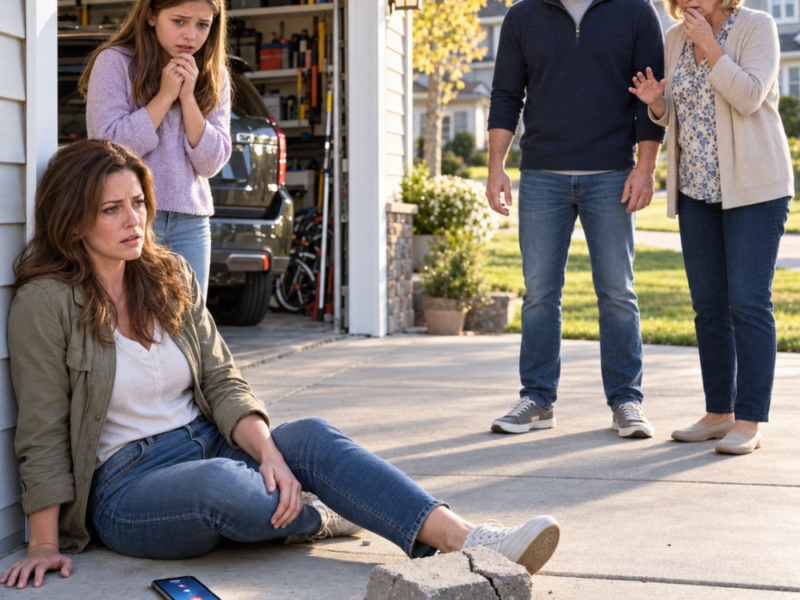
My brother dropped a concrete block on my leg in front of my daughter. When I reached for my phone to call the police, Mom stopped me. “Don’t ruin his future over this,” she said. I said nothing. Then both their faces went pale when…
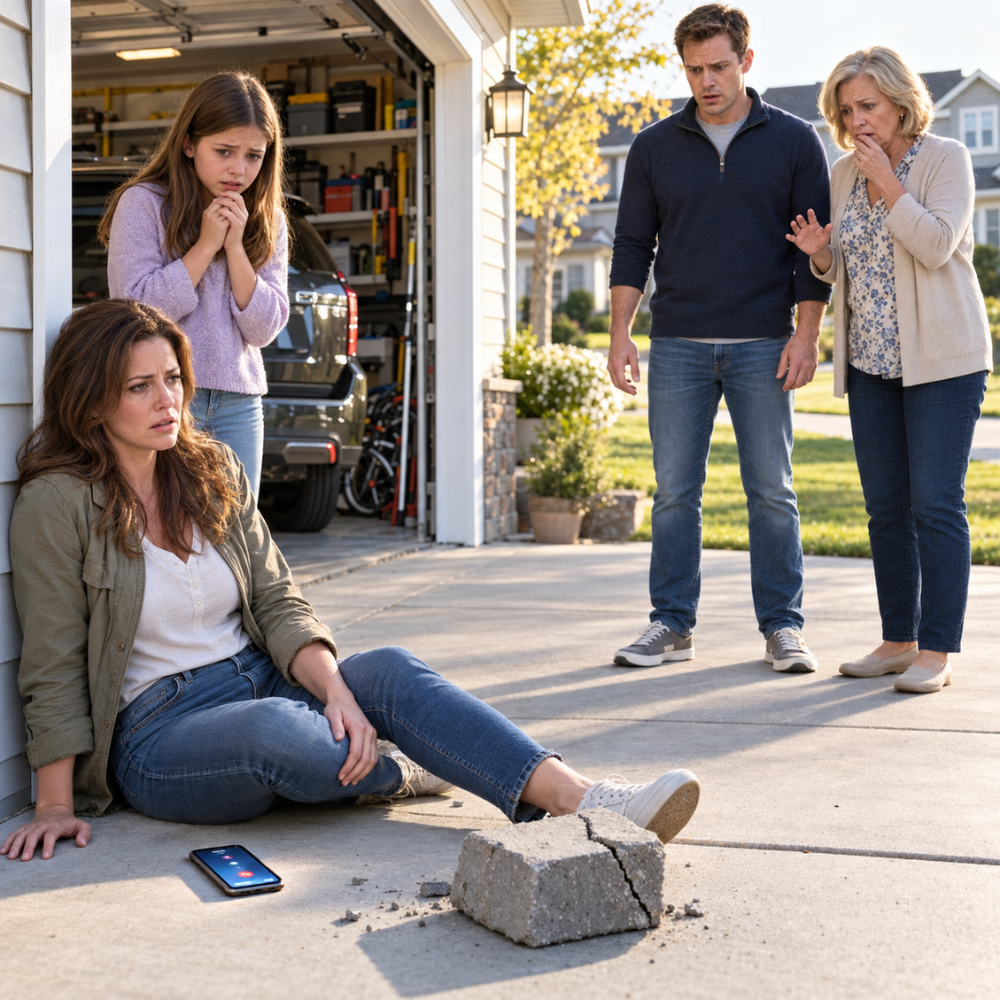
My brother shattered my leg in front of my daughter, then my mother stopped me from calling 911 because she was afraid I would ruin his future
Three minutes before my brother changed our family forever, my eight-year-old daughter was sitting beside my mother on the patio, showing her how to knot blue and yellow embroidery thread into a friendship bracelet.
That is the part I remember most clearly.
Not the ambulance.
Not the courtroom.
Not even the moment Derek finally understood that nobody was going to rescue him from consequences.
I remember Emma laughing because my mother had tied the knot incorrectly again.
“Grandma, no. You have to go under this one.”
My mother, Gloria Sinclair, held up the tangled thread and laughed.
“I told you I was terrible at crafts.”
“You’re not terrible. You’re learning.”
Emma said it with the absolute confidence children have when they still believe patience can fix almost anything.
I was sitting twenty feet away in a lawn chair, answering an email on my phone.
The subject line was FINAL LOAN APPROVAL.
I had read it three times already.
After nearly ten years of saving, planning, working holidays, taking extra patients, postponing vacations, and building a business plan one careful page at a time, Sinclair Rehabilitation Center was finally moving forward.
Construction financing had cleared.
The lease had been signed.
Equipment estimates were approved.
If everything stayed on schedule, we would open in six months.
I was thirty-four years old, a physical therapist, a single mother, and for the first time since my divorce, I could see a future that did not feel like something I was merely surviving.
I could see a future I had built.
Then Derek arrived.
My older brother had never understood that kind of building.
He understood beginnings.
Big promises.
Fresh ideas.
Announcements made over dinner.
New businesses with impressive logos before they had customers.
Investment opportunities described as “almost guaranteed.”
He loved the moment before reality started asking questions.
What is the budget?
Who is paying?
When is the loan due?
Where are the customers?
What happens if this fails?
Derek hated those questions.
For fifteen years, when reality answered him badly, he came back to family.
Usually to Mom.
Eventually to me.
That Saturday afternoon, I knew something was wrong before he crossed the backyard.
He had parked at the curb instead of the driveway.
He walked through the side gate without greeting anyone.
No joke for Emma.
No handshake for Uncle Raymond at the grill.
No beer from the cooler.
He came directly toward me.
“Ava.”
I locked my phone.
“What?”
“Need to talk.”
My stomach tightened.
There was a particular tone Derek used when “talk” meant money.
“How much?”
His eyebrows rose.
“Can we not do this right here?”
“We’ve done it everywhere else.”
He glanced around the yard.
Our mother’s house was in a quiet suburban neighborhood outside Columbus, Ohio, the kind with maple trees planted at regular intervals and mailboxes approved by the HOA. Several cousins were there. Two neighbors had come over. Children ran between the patio and the lawn carrying water balloons.
Derek lowered his voice.
“Twenty-five.”
I stared at him.
“Twenty-five what?”
“Thousand.”
I actually laughed.
Not because it was funny.
Because the number was so absurd I assumed I had misheard him.
He did not laugh.
“You’re serious.”
“Yes.”
“No.”
His jaw tightened.
“You didn’t even ask what it’s for.”
“I don’t need to.”
“Ava.”
“No.”
“You have it.”
“I have money committed to the clinic.”
“You can replace it.”
“No.”
“You make good money.”
“So do lots of people. That doesn’t mean they have twenty-five thousand dollars available for you.”
His face changed.
There were versions of Derek everyone else saw.
Charming Derek.
Funny Derek.
Derek who could walk into a sports bar and leave with three new friends.
Derek who remembered birthdays.
Derek who brought expensive bourbon he could not afford to Christmas dinner.
Then there was the Derek our family knew.
The man whose embarrassment converted to anger the moment someone stopped protecting him from himself.
“What exactly do you think you’re building over there?” he asked.
“A clinic.”
“No. I mean this whole thing.”
He waved toward me as if my life were a performance.
“The businesswoman act.”
I stared at him.
“Excuse me?”
“You think you’re better than everybody now.”
“No.”
“Because you got approved for some loan?”
“You asked me for money. I said no.”
“That simple?”
“Yes.”
He laughed without humor.
“It must be nice.”
“What?”
“To have everything work out.”
That sentence almost made me lose my temper.
Everything.
He had no idea what “everything” had cost.
He did not see the nights I stayed at the hospital until nine because another therapist called out.
He did not see me doing continuing-education modules after Emma fell asleep.
He did not see the spreadsheet where I tracked every dollar for the clinic.
He did not see me putting back a dress at Macy’s because three hundred dollars would pay for part of an ultrasound unit deposit.
He did not see the years I drove a Honda with a cracked center console because replacing a functioning car felt irresponsible.
He saw the result and called it luck.
“I worked for what I have.”
“So have I.”
I did not answer.
Derek noticed.
“What?”
“Nothing.”
“Say it.”
“I said nothing.”
“You don’t think I work?”
“I think you start things.”
His expression hardened.
“What is that supposed to mean?”
“It means I am not giving you twenty-five thousand dollars.”
“You have always been judgmental.”
“And you have always believed disagreement is judgment.”
His voice rose.
People began looking over.
Emma stopped tying thread.
I saw it from the corner of my eye.
Her hands became still.
That was when I should have left.
Maybe some part of me understood that before I consciously did.
I stood.
“We’re done.”
Derek stepped closer.
“No, we’re not.”
“Yes.”
“Ava.”
I turned toward Emma.
“Sweetheart, get your backpack.”
She looked confused.
“Are we leaving?”
“Yes.”
My mother stood quickly.
“Why?”
“Because Derek and I are finished talking.”
Mom looked at him.
Not at me.
“What happened?”
“Nothing,” Derek said.
“He asked me for twenty-five thousand dollars.”
My mother inhaled slowly.
“Ava.”
That was all she needed to say.
One word.
My name in the disappointed tone reserved for whatever boundary interfered with Derek.
“No.”
She came closer.
“Your brother is having a difficult time.”
“He has been having a difficult time since the first iPhone came out.”
Several relatives went silent.
My mother’s face hardened.
“There is no reason to embarrass him.”
“I’m not discussing this.”
“What does he need the money for?”
I stared at her.
“You don’t know?”
She glanced toward Derek.
He looked away.
That answered more than anything.
“Mom, do not ask me to fund something you don’t even understand.”
“He is trying to rebuild.”
“He is always rebuilding because he never stops long enough to understand why things collapse.”
Derek stepped forward.
“Watch yourself.”
Emma moved behind my chair.
I looked at her face.
Fear.
Not confusion anymore.
Fear.
That should have ended everything.
Any reasonable adult would have noticed a child was frightened and lowered the temperature.
Derek only seemed more offended.
“You do this every time.”
“Do what?”
“Make me look like some loser in front of everybody.”
“I said no to a loan.”
“You said no before hearing anything.”
“You still haven’t told me what it is.”
His mouth opened.
Nothing came out.
“Exactly.”
I reached for Emma’s hand.
“Let’s go.”
Derek moved between us and the side gate.
“Move.”
“No.”
“Derek.”
“You don’t get to talk down to me and walk away.”
I could hear my own pulse.
My training as a physical therapist had taught me a great deal about bodies.
How people moved when anxious.
How shoulders stiffened before pain.
How knees changed when someone shifted weight.
Derek’s body was not relaxed.
His fists opened and closed.
His breathing was shallow.
His gaze moved around the yard instead of staying on me.
I did not know what he was looking for.
Then his eyes settled near the back fence.
Several weeks earlier, Mom and Dad had hired a landscaper to rebuild part of the retaining wall beside the patio.
Unused concrete blocks were stacked near the edge of the grass.
Heavy masonry.
Ordinary landscaping material.
I saw Derek look at them.
Then at me.
Something cold moved through my chest.
“Emma,” I said.
She squeezed my hand.
“Go inside with Aunt Rachel.”
“I want to stay with you.”
“Please.”
My cousin Rachel stood.
“Come on, Em.”
Derek laughed.
“Oh, now everybody thinks I’m dangerous?”
Nobody answered.
He looked around.
That silence seemed to humiliate him.
His anger sharpened.
“You all want to act like I’m the problem?”
“Derek,” my father finally said from near the grill. “Enough.”
It was too late.
Derek walked toward the stack.
At first, I thought he was performing.
He had done that before.
Slamming doors.
Throwing his keys.
Kicking a trash can.
Creating a moment frightening enough that everyone would stop arguing and begin managing his emotions.
I believed the concrete block was another prop.
I was wrong.
He picked one up.
My father shouted his name.
A cousin stood.
Someone said, “Put that down.”
Everything seemed to happen both quickly and impossibly slowly.
Derek turned.
I moved Emma behind me.
He came toward us.
I remember taking one step sideways.
I remember seeing my mother’s hands lift toward her mouth.
I remember thinking:
He won’t.
Not here.
Not in front of Emma.
Then the block struck my lower leg.
The world disappeared into pain.
I hit the grass.
For several seconds, I could not understand what part of me had been injured because the sensation seemed to fill my entire body.
People were screaming.
Emma was screaming.
My father shouted for someone to call an ambulance.
I looked down once and immediately looked away.
My leg had been badly injured.
That was all my brain needed to know.
I did not need the details.
I rolled onto my side and tried to breathe.
“Mommy!”
Emma dropped beside me.
Rachel caught her before she could get too close.
“Emma, honey, stay with me.”
“No! Mommy!”
“I’m okay,” I tried to say.
The words came out broken.
“I’m okay.”
I was not.
Derek stood several feet away.
The block had fallen into the grass.
His face had changed.
The anger was gone.
He looked shocked.
Almost offended by his own action.
As if something had happened to him rather than something he had done.
Then he ran.
Not toward me.
Not toward Emma.
Toward the driveway.
“Derek!”
My father went after him.
Derek reached his truck first.
The engine started.
Tires scraped the curb.
He disappeared down the street.
I found my phone near the chair.
My hand shook so violently that I missed the screen twice.
That was all I needed.
I unlocked it.
Before I could complete the call, my mother grabbed my wrist.
“Ava.”
I stared at her.
“What are you doing?”
She took the phone.
“Mom.”
“Wait.”
“Give it back.”
“Just wait.”
My voice became something I did not recognize.
“Give me my phone.”
“Your father is handling it.”
“Derek just attacked me.”
“He panicked.”
“My leg is broken.”
“I know.”
“Call 911.”
Someone behind her said, “Gloria, give her the phone.”
Mom’s face twisted.
“If you call the police right now, you could ruin his entire future.”
The yard went silent.
Even through the pain, I understood the sentence completely.
Not our future.
His.
Not Emma’s future after watching this.
Not my future as a physical therapist whose career depended on mobility.
Not the clinic scheduled to open in six months.
Derek’s future.
I stared at the woman who had given birth to both of us.
“Mom.”
Her eyes filled.
“He made a terrible mistake.”
“A mistake?”
“You know what I mean.”
“No.”
I reached for the phone.
She held it away.
A neighbor came through the side gate.
“I called 911.”
Mom turned toward him.
The expression on her face changed immediately.
That was when she understood she no longer controlled what happened next.
Sirens became audible in the distance.
Emma was crying into Rachel’s shirt.
I looked at her.
That hurt worse than anything.
My daughter had just watched an adult she trusted become dangerous.
Then she watched her grandmother decide the dangerous adult deserved protection more than the injured person deserved help.
Something inside childhood ended in that yard.
The paramedics arrived quickly.
They did what professionals do.
Questions.
Vitals.
Pain control.
Stabilization.
Reassurance without promises they could not keep.
One of them crouched beside Emma.
“Your mom is going to the hospital. She is getting help.”
Emma looked at me.
“Can I go?”
Rachel promised to bring her with my father.
Mom stood apart.
She was talking to Aunt Gloria, then to Uncle Raymond, then to somebody else.
Already explaining.
Already smoothing.
Already turning the impossible into a family misunderstanding.
As the stretcher rolled toward the ambulance, I looked back once.
The friendship bracelet still sat unfinished on the patio table.
Blue thread.
Yellow thread.
One incorrect knot.
At the hospital, everything became fluorescent light and fragmented time.
Emergency department.
Imaging.
Orthopedic consult.
Questions about allergies.
Consent forms.
A nurse cutting away fabric near the injured leg.
Another nurse asking whether Emma had a safe adult with her.
A social worker appearing because the injury resulted from family violence.
Then surgery.
When I woke, my mouth was dry and my leg felt impossibly heavy.
A nurse noticed immediately.
“You’re at Riverside.”
I blinked.
“What time?”
“Just after six in the morning.”
“Emma?”
“Your daughter is with your cousin and father. She was here earlier.”
“Is she okay?”
The nurse hesitated.
That was the wrong question.
An eight-year-old who witnessed something like that was not “okay” because she had stopped crying.
“She is safe,” the nurse said.
That was better.
A surgeon came later.
Dr. Patel pulled a chair closer to my bed.
He explained the injury in calm language.
Multiple fractures below the knee.
Significant soft-tissue trauma.
Surgery had stabilized the worst damage.
More procedures might be necessary.
There was risk of nerve impairment.
Months of rehabilitation were likely.
Final mobility could not be predicted yet.
I listened like a clinician.
That was easier than listening like the patient.
“When can I bear weight?”
“Not soon.”
“How long?”
“We’ll evaluate as healing progresses.”
“I’m a physical therapist.”
“I know.”
He looked genuinely sympathetic.
“That can make this harder.”
It did.
I knew enough to understand every word he did not say.
I knew what prolonged non-weight-bearing meant.
Muscle loss.
Stiffness.
Balance changes.
Compensation patterns.
I knew what nerve symptoms could mean.
I knew the difference between returning to walking and returning to eight-hour days on a clinic floor.
I knew recovery was not a straight line.
For years, I had said those things to patients.
Now I hated every sentence.
A detective came that afternoon.
Michael Reynolds.
Early forties.
Dark suit.
Plain notebook.
Quiet manner.
He introduced himself and asked whether I felt able to talk.
“Yes.”
He asked what happened.
I told him.
Not dramatically.
The request for money.
My refusal.
The argument.
Derek blocking us from leaving.
The landscaping block.
The impact.
Derek leaving.
Mom taking my phone.
The comment about his future.
Detective Reynolds took notes.
Then he asked:
“Do you know whether any cameras captured the yard?”
“My parents don’t have backyard cameras.”
“The neighbor does.”
I looked at him.
He placed a tablet on the hospital tray.
“We got permission to review footage from the house next door.”
My pulse increased.
“How much did it capture?”
“Enough.”
He did not make me watch the impact.
I was grateful for that.
He showed me an earlier section.
Derek approaching.
Our argument.
Audio faint but understandable.
Then another angle showed the moment after I fell.
Mom taking the phone.
Her voice.
His future.
I closed my eyes.
When I opened them, Reynolds had paused the video.
“There were several witnesses too.”
“She’ll say it didn’t happen like that.”
“Who?”
“My mother.”
He studied me.
“She already is.”
Of course she was.
“What did she say?”
“That the argument was mutual. That your brother became frightened. That you may have moved toward him first.”
I laughed once.
My ribs hurt.
“Does the video show that?”
“No.”
“Then why tell me?”
“Because I don’t want you blindsided.”
He turned off the tablet.
“Evidence matters more than family stories.”
That sentence became important later.
Derek was gone.
His phone had been turned off within an hour of leaving Mom’s house.
His apartment was empty when police checked.
His truck appeared two days later in a motel parking lot in another county.
He was not there.
The search continued.
Meanwhile, my mother went to work.
Not employment.
Narrative management.
Gloria Sinclair had spent most of her adult life being the center of our extended family.
She hosted Thanksgiving.
Organized church meals.
Remembered anniversaries.
Collected information.
Connected relatives who had not spoken in months.
If two cousins were fighting, Mom knew both versions before dinner.
She had a gift for presenting an opinion as if it were simply the mature interpretation everyone should adopt.
By my third day in the hospital, texts started arriving.
At first they sounded concerned.
Aunt Carolyn:
Praying for healing. Your mom is devastated.
Then:
I hope you and Derek can both get past what happened.
Both.
Cousin Lisa:
Your mom said everyone was heated. I’m sure nobody meant for anybody to get hurt.
Another relative:
I heard Derek thought you were going to attack him.
Then the strangest:
Your mother says you’ve been under enormous stress with the clinic. Maybe emotions got out of control.
I stared at the screen.
Beside me stood an IV pole.
My injured leg rested inside a stabilization system.
A physical therapist from the hospital had spent the morning teaching me how to transfer from the bed to a chair safely.
And my family was discussing my emotional state.
Rachel sat beside the window.
“Give me the phone.”
“No.”
“You’re going to answer them.”
“I know.”
“Which is exactly why you should give me the phone.”
I let it fall onto the blanket.
She took it.
Muted the family group.
Then set it facedown.
“Ava.”
“What?”
“You do not have to conduct public relations from a hospital bed.”
I looked toward the ceiling.
“My mother is telling people I attacked him.”
“Your mother is panicking.”
“That doesn’t make it okay.”
“I know.”
“She watched it happen.”
“I know.”
“She stopped me from calling.”
“I know.”
I turned my face away.
Rachel squeezed my hand.
“What did Emma ask?”
I looked back.
“How do you know she asked something?”
“Because she’s eight.”
I started crying.
“She asked why Grandma helped him.”
Rachel’s eyes closed.
“What did you say?”
“That Grandma was scared.”
“That’s probably enough for now.”
“It’s not the truth.”
“It’s part of the truth.”
I stared through the hospital window.
There are truths adults can survive that children should not have to carry all at once.
The fuller truth was something I had been avoiding my entire life.
My mother loved Derek.
But somewhere along the way, she had confused loving him with preventing him from ever experiencing the full weight of his choices.
Every failure had an explanation.
Every unpaid debt had a reason.
Every broken promise had context.
The people hurt by him were expected to understand.
The people angry with him were expected to forgive.
And because I was the stable child, I was expected to absorb more.
I had built my life despite that system.
Derek had built his inside it.
A week after surgery, Dr. Nathan Cole came to visit.
Nathan had mentored me since my first year as a physical therapist.
He owned two rehabilitation clinics outside Columbus and had been advising me through the Sinclair Rehabilitation Center project.
When he entered, I knew something was wrong.
Not because he looked frightened.
Nathan almost never looked frightened.
Because he carried a folder.
“Ava.”
“No.”
He blinked.
“You don’t know what I’m going to say.”
“You brought a folder to a hospital.”
“That is fair.”
I sat straighter.
“What happened?”
He placed the folder in my lap.
“I got a call from one of the lenders connected to your project.”
My stomach tightened.
“Funding?”
“Still secure.”
“Then what?”
“They received a duplicate application.”
I stared at him.
“What?”
“Different entity name. Same clinic concept.”
I opened the folder.
My business plan.
Not similar.
Mine.
Sections I had written.
Patient-volume projections.
Referral models.
Equipment lists.
A rough architectural plan.
Even a paragraph where I had described the clinic’s focus on post-surgical mobility, neurological rehabilitation, chronic-pain management, and return-to-work programs.
Someone had copied it.
Then I saw the signature page.
AVA SINCLAIR.
It looked convincing from a distance.
It was not mine.
My mouth went dry.
“Who submitted this?”
Nathan did not answer immediately.
I already knew.
“Derek.”
“Yes.”
I closed my eyes.
For the past week I had tried to understand the attack as rage.
A terrible moment.
A man humiliated by being told no.
This was different.
The documents were dated after the barbecue.
While I was hospitalized.
My brother had been hiding from police and trying to use my business plans.
Nathan turned several pages.
“There are supposed partnership authorizations too.”
I looked.
One included my mother’s name.
My stomach turned.
“Is that her signature?”
“We don’t know whether she signed or he copied it.”
“What was he trying to do?”
“Access financing. Possibly present himself as a partner who could continue the project if you were medically unable.”
I stared at Nathan.
“Continue my clinic?”
“Yes.”
“He broke my leg and then tried to take over the clinic.”
Nathan’s jaw tightened.
“That appears to be what the paperwork suggests.”
“Did he get money?”
“No.”
Relief came so suddenly I nearly cried.
“The lender flagged inconsistencies. Nothing funded. Nothing transferred.”
I exhaled.
“Thank God.”
“But Ava.”
I looked at him.
“You need an attorney.”
“I have one for the clinic.”
“You need one for you.”
By that afternoon, the assault investigation and business fraud had collided.
My attorney contacted the lender.
The lender preserved the application.
Nathan preserved every email.
The police obtained copies through the proper process.
Forensic review began.
Two days later, Emma came after school.
She wore leggings, a purple sweatshirt, and the serious expression she had developed since the barbecue.
Her therapist had explained that routines mattered, so Rachel and I tried to keep them.
School.
Homework.
Bedtime.
Pancakes on Saturday.
Normal things arranged around an abnormal event.
Emma climbed into the chair beside my bed.
“How was school?”
“Fine.”
“What does fine mean?”
“Math was boring.”
“Good. That sounds normal.”
She almost smiled.
Then reached into her backpack.
“I need to show you something.”
My body tightened.
“What?”
Her tablet.
She held it with both hands.
“I was recording the bracelets.”
I stared.
“What?”
“I wanted to make a video for Aunt Rachel.”
She unlocked it.
The video began with Emma’s voice explaining how to make the bracelet.
Mostly grass.
Patio furniture.
Mom laughing.
Then Derek arrived.
Emma had apparently set the tablet against a cup.
The camera angle was poor.
The audio was not.
The money conversation was there.
My refusal.
His anger.
Then Derek said something I barely remembered hearing.
“If I can’t have what you’re building, maybe you shouldn’t have it either.”
My skin turned cold.
Emma paused the video.
“That was before.”
“Yes.”
“Before he hurt you.”
“Yes.”
Her eyes filled.
“Did he mean the clinic?”
I looked at her.
“I don’t know.”
That was the safest truth I could give.
Detective Reynolds came within the hour.
He listened.
Then listened again.
His expression changed.
“You okay?” I asked.
“I’m fine.”
“No, I mean why do you look like that?”
“Because this helps establish what he was thinking before the assault.”
He requested the original file.
With my consent and Emma’s guardian documentation, the tablet was copied and returned.
At the door, Reynolds turned.
“We’re updating the warrant request.”
“For Derek?”
“Yes.”
He paused.
“And the fraud investigation is developing quickly.”
My mother kept calling.
I did not answer.
Then she came to the hospital.
Security called first.
“Your mother is downstairs.”
My entire body tightened.
“I don’t want her up here.”
“Understood.”
Two minutes later my phone rang.
Mom.
I declined.
A voicemail appeared.
“Ava, I am your mother. You cannot keep me away forever. I need to explain what happened.”
Explain.
The family’s favorite word.
Rachel listened to the voicemail.
“Want me to delete it?”
“No.”
“Why?”
“I’m keeping everything.”
The legal system had taught me something quickly.
Save the texts.
Save the emails.
Save the voicemails.
Do not edit.
Do not threaten.
Do not conduct the trial through family group chat.
Preserve.
That discipline probably protected me almost as much emotionally as it did legally.
I stopped arguing with relatives.
When someone texted a rumor, I answered:
The matter is under investigation. I am not discussing details.
Some people became angry.
One aunt wrote:
So we’re strangers now?
I did not answer.
Silence felt better than defending reality to people who preferred Mom’s version because it was emotionally easier.
My hospitalization lasted longer than I expected.
Then came inpatient rehabilitation.
That was the humiliation I had not prepared for.
I had taught people to transfer safely for years.
Now someone stood beside me while I learned.
“Shift your weight.”
I knew.
“Bring your hips forward.”
I knew.
“Trust the walker.”
I knew.
Knowing did not make my body obey.
The first time I stood, my hands shook.
Twenty seconds.
Then thirty.
My therapist, Leah, smiled.
“That’s enough.”
“It’s nothing.”
“No.”
She looked directly at me.
“It is thirty seconds more than yesterday.”
I hated her for being correct.
The next day I stood longer.
Then came a small hop transfer.
Then parallel bars.
Then partial weight bearing once the surgeon approved it.
My professional knowledge made me impatient.
My injury made impatience useless.
One afternoon I was struggling with a basic exercise when my phone buzzed.
Detective Reynolds.
I waited until the session ended.
“Tell me.”
“We found him.”
I stopped.
“Derek?”
“Yes.”
“Where?”
“Cabin outside Cincinnati. Rental under another person’s name.”
“Is he okay?”
The question came out automatically.
Brother before defendant.
Old reflex.
“He’s alive. Arrest was peaceful.”
I closed my eyes.
“Did he say anything?”
“He asked for an attorney.”
“Good.”
Reynolds hesitated.
“There’s more.”
“Of course there is.”
“The financial investigators found additional applications.”
My stomach dropped.
“How many?”
“Enough that I don’t want to give you an incomplete number.”
He explained carefully.
What initially looked like one desperate attempt appeared broader.
Different lenders.
Forged partnership documents.
Financial projections copied from my plans.
False statements suggesting Derek had an ownership interest in the clinic.
Digital signatures attributed to me.
And communication with Mom.
“Is she being investigated?”
“Yes.”
That word changed something.
For weeks, I had still thought of my mother as Derek’s defender.
A terrible defender.
A liar.
A parent who chose him.
But legally, investigators were beginning to look at whether she had moved beyond protecting him after the attack and into participating in the financial scheme.
My attorney told me not to speculate.
So I did not.
Then the email appeared.
Detective Reynolds showed it to me during a meeting two weeks later.
It was from my mother to Derek, sent four days after the assault.
While I was still hospitalized.
If Ava can’t run the clinic, someone should benefit from all that work.
I read it.
Then again.
Then once more.
The words remained the same.
Not:
How is Ava?
Not:
Emma is traumatized.
Not:
You need to turn yourself in.
Not:
What have you done?
Someone should benefit.
The clinic had become available in my mother’s mind because my body was injured.
I put the page down.
“Is this real?”
“Yes.”
“Verified?”
“Yes.”
I looked out the conference-room window.
A parking lot.
Two bare trees.
A medical transport van.
Very ordinary scenery for the moment you finally stop hoping your mother will become someone else.
“I’m done.”
Reynolds thought I meant the meeting.
“Want a break?”
“No.”
I looked at the email again.
“I mean with her.”
He did not respond.
Good detectives understand when silence is more useful than advice.
My clinical future was still uncertain.
That frightened me more than the legal proceedings.
At each follow-up, the surgeon measured healing.
Nerve response improved.
Range of motion came slowly.
Pain changed from constant to situational.
Good signs.
Not guarantees.
Then Nathan called.
“Come to my office.”
“I hate when you say that.”
“You’ll survive.”
“Poor choice of phrase.”
He sighed.
“Fair.”
Rachel drove me.
Nathan’s office smelled like coffee and the peppermint gum he chewed constantly.
A folder waited on the desk.
I pointed at it.
“No.”
He smiled.
“Open it.”
“Every folder you give me ruins my week.”
“Not this one.”
Inside were construction approvals.
Updated financing documents.
Insurance confirmations.
Vendor schedules.
The clinic project.
Alive.
Moving.
I looked at him.
“I thought the timeline was frozen.”
“It was reviewed.”
“And?”
“Funding is still secure.”
My eyes filled.
“We had to restructure some dates. Your lenders required additional fraud protection after the forged submissions. But the project is intact.”
I put one hand over my mouth.
Nathan continued.
“The contractor broke ground last week.”
“What?”
“You were in rehab.”
“You started construction?”
“You told us not to stop unless the lenders stopped us.”
I had.
Before surgery.
I barely remembered it.
Nathan leaned forward.
“Derek injured your leg.”
He tapped the folder.
“He did not get your clinic.”
I cried.
Not elegant crying.
The kind that empties months out of your body.
Nathan handed me tissues.
“I’m also changing the ownership proposal.”
I looked at him through tears.
“What?”
“I want equity.”
“You already have equity in your clinics.”
“In yours.”
I stared.
“You want to invest?”
“Yes.”
“Why?”
“Because your plan is excellent. Because demand is there. Because the last four months have tested every weak point in the business model and it survived.”
He smiled.
“And because I want you working with me for a long time.”
I left his office feeling taller even though I still needed a cane.
For the first time since the barbecue, the future was something more than legal dates and medical appointments.
Construction.
Hiring.
Equipment.
Patients.
Life.
The prosecutor expanded Derek’s case over the following months.
The exact charges changed as evidence was reviewed, but the core allegations were serious.
The assault.
The threats leading up to it.
Forgery.
Attempted financial fraud.
Unauthorized use of my business information.
Derek’s attorney emphasized that no fraudulent loan had actually funded.
Prosecutors agreed.
That mattered.
The system distinguished attempts from completed harm.
But attempts still had consequences.
My mother’s legal situation developed separately.
She was not charged simply because she had defended Derek after the assault.
Being a terrible parent is not automatically a crime.
Investigators focused on specific conduct.
Her participation in documents.
Electronic communications.
Statements to lenders.
Whether she knowingly assisted false applications.
That distinction mattered to me.
I did not want a courtroom punishing her for failing me emotionally.
There is no statute for choosing the wrong child.
The legal system could address only what she had actually done.
The rest belonged to me.
Family opinion changed slowly.
Not because relatives became wiser overnight.
Because documents became harder to ignore.
The video was known to exist.
Derek had been arrested.
The lender confirmed fraudulent applications.
Mom’s story shifted too many times.
First I had fallen.
Then Derek had acted in self-defense.
Then nobody could remember exactly what happened.
Then the videos were “misleading.”
Every revision cost her credibility.
One cousin called.
“Ava, I owe you an apology.”
“For what?”
“I repeated something your mom said.”
“What?”
“That you threatened Derek.”
I closed my eyes.
“I never did.”
“I know.”
“How?”
“I saw part of the video through the lawyer.”
Silence.
“I should have believed you without needing video.”
That was the part that mattered.
“Yes.”
“I’m sorry.”
“Thank you.”
I did not say it was okay.
It was not.
Emma’s recovery moved differently from mine.
Children do not heal according to orthopedic schedules.
She could laugh all day and have a nightmare that night.
She began checking doors.
At family events she stayed close to me.
If an adult male raised his voice in a restaurant, she became quiet.
Her therapist helped.
So did routine.
So did distance from Mom.
Especially distance from Mom.
One night Emma asked:
“Does Grandma love us?”
I was washing dishes.
I stopped.
“Yes.”
“Then why did she help Uncle Derek?”
The easy answer would have been:
Grandma was scared.
The angry answer:
Because she loves him more.
Neither was enough.
I dried my hands and sat beside Emma.
“Sometimes people can love someone and still make very wrong choices.”
Emma looked doubtful.
“Even grandparents?”
“Especially adults.”
“Are you still her daughter?”
“Yes.”
“Is she still your mom?”
“Yes.”
“Do we have to see her?”
“No.”
That was the answer Emma cared about.
“No?”
“Not until we feel safe and want to.”
She nodded.
“Okay.”
Children understand boundaries faster than adults when nobody has trained them to confuse guilt with love.
Nine months after the barbecue, Derek’s trial began.
By then, I could walk independently for short distances.
I used a cane when fatigue made my gait uneven.
Cold mornings hurt.
Stairs required thought.
My clinic was nearing completion.
The distance between the woman in the courtroom and the woman on the grass felt both enormous and nonexistent.
I attended because I wanted to.
Not every day.
My attorney reminded me repeatedly that I did not have to turn the trial into another endurance test.
The prosecution began with the simplest evidence.
The neighbor’s security footage.
The courtroom lights dimmed.
I watched only what I could tolerate.
The argument.
The money request.
My refusal.
Derek moving toward the landscaping materials.
Then I looked down.
I did not need to watch the impact again.
The jury did.
When Mom’s voice came through the courtroom speakers afterward, something moved through the room.
“You’ll ruin his future.”
Hearing it outside that backyard made the sentence sound even stranger.
The prosecution did not dramatize it.
They did not need to.
The neighbor testified.
My father testified.
Two cousins.
The paramedics.
The surgeon.
Detective Reynolds.
Nathan testified regarding the clinic documents and the unauthorized application.
A lender representative explained how the application had been flagged and why no funds were disbursed.
Then came Emma.
The judge allowed her to testify using accommodations designed to reduce unnecessary stress.
She was never paraded dramatically in front of Derek.
No child should be turned into courtroom theater.
She spoke from a protected setting with counsel and support.
I was allowed to hear.
The prosecutor asked gentle questions.
“What were you doing that afternoon?”
“Making bracelets.”
“With whom?”
“My grandma.”
“Did your uncle arrive?”
“Yes.”
“What happened?”
“He asked my mom for money.”
“Did your mom give it to him?”
“No.”
“Then what happened?”
Emma paused.
“He got mad.”
“Did you hear anything he said?”
“Yes.”
“What?”
“He said if he couldn’t have what Mom built, maybe she shouldn’t have it.”
The tablet recording later confirmed it.
The prosecutor continued.
“After your mother was hurt, what did you see?”
Emma’s voice became quieter.
“Mom tried to call for help.”
“What happened?”
“Grandma took the phone.”
“Did Grandma say anything?”
“Yes.”
“What?”
Emma looked down.
“She said calling police would ruin Uncle Derek’s future.”
I closed my eyes.
There was something unbearable about hearing a child repeat an adult’s failure with no embellishment.
The defense did its job.
It challenged interpretation.
Argued Derek’s anger was impulsive.
Questioned whether the business statements had a direct relationship to the assault.
Separated the financial conduct from the family confrontation.
That was their role.
Trials are supposed to test evidence.
I had spent years in healthcare telling patients that discomfort did not necessarily mean something had gone wrong.
The same was true there.
Watching evidence challenged was uncomfortable.
It was also part of the process.
The financial portion of the case became especially important.
Forensic analysts walked through digital records.
Application dates.
Metadata.
Emails.
Signatures.
Accounts.
No dramatic hidden suitcase of cash.
Mostly screens, timelines, and documents.
Boring evidence.
Strong evidence.
Prosecutors argued that Derek’s resentment toward my clinic was not something invented after the assault.
He had discussed it before.
He demanded clinic money.
He threatened the project.
After injuring me, he attempted to present himself as someone able to continue or benefit from the business.
The defense argued that the applications came from panic and bad judgment after the fact, not a preplanned scheme.
The jury would decide what was proven beyond a reasonable doubt.
My mother’s email appeared.
If Ava can’t run the clinic, someone should benefit from all that work.
I did not look at her.
She sat behind counsel in a separate matter and had been advised not to communicate with me.
The woman who once controlled every room now sat silent while other people examined her words.
Not her intentions.
Her words.
That was the difference.
The jury deliberated for several days.
Waiting was worse than testimony.
I went to the clinic.
Construction crews were installing the final therapy flooring.
Boxes of resistance bands sat unopened in the supply room.
Our front desk had not yet been assembled.
I stood in the main therapy space and looked at the parallel bars.
Nathan came beside me.
“You okay?”
“No.”
“Good answer.”
“I hate waiting.”
“Everybody does.”
“What if he gets acquitted?”
“Then you still own the clinic.”
I looked at him.
“He still injured me.”
“Yes.”
“You still have Emma.”
“Yes.”
“You still built this.”
He gestured around.
“Yes.”
Nathan nodded.
“Then the verdict matters, but it does not own your future.”
I repeated that to myself when the call came.
Verdict.
We returned to court.
Derek stood beside his attorney.
I sat behind the prosecutor.
The clerk read the findings.
Guilty on the principal assault charge.
Guilty on multiple forgery and fraud-related counts.
Not guilty on one lesser financial count the jury apparently believed prosecutors had not established sufficiently.
I remember appreciating that.
Even in the middle of everything.
The jury had not simply punished him for being bad.
They had separated evidence.
Derek stared forward.
Then briefly looked toward me.
The first time our eyes met, he looked away.
Mom cried.
I did not.
I felt empty.
Then relieved.
Sentencing occurred later.
The judge discussed the injury.
The child witness.
The financial conduct.
Derek’s flight.
His lack of meaningful acceptance of responsibility.
The court imposed a significant prison sentence.
Not for disappointing our family.
Not for being the brother who always needed help.
For crimes proven in court.
The civil case followed.
That process was less emotionally dramatic and more financially complicated.
Medical expenses.
Future rehabilitation.
Lost earnings during recovery.
Business interruption.
Long-term impairment.
The costs associated with protecting the clinic from the fraudulent applications.
My attorney pursued compensation.
Derek’s assets were limited compared with the size of the judgment.
An investment property he owned was eventually sold.
Some savings were reached.
Insurance covered certain portions, not others.
Nobody handed me a magical fortune.
Civil judgments do not work like television.
Money was fought over.
Allocated.
Delayed.
Reduced by fees and liens.
Some may never be collected.
But the judgment mattered.
It was an official recognition that harm has costs beyond one violent afternoon.
My mother’s case ended differently.
Evidence showed that she had knowingly participated in part of the fraudulent documentation after my hospitalization.
Her attorney negotiated a plea.
She avoided prison.
She did not avoid consequences.
Probation.
Financial penalties.
Restitution obligations connected to her conduct.
A criminal record.
Court-ordered restrictions.
The loss she cared about most, however, could not be found on any sentencing sheet.
Her reputation.
Mom had spent decades being trusted.
Church committees.
Neighborhood events.
Family advice.
She was the woman people called when somebody was sick.
The person who knew which casserole to bring after a funeral.
The one organizing collections for families who had fallen behind on bills.
After the case, people looked at her differently.
Not everyone abandoned her.
Life is rarely that clean.
Some friends remained.
Some relatives forgave her.
Others created distance.
What disappeared was unquestioned authority.
She could no longer end an argument by saying:
I know my children.
Too much of what she had claimed about us existed in court records now.
For years she controlled stories.
Evidence had taken that power away.
I did not celebrate it.
By then I was too tired.
The clinic opened one year and three weeks after the barbecue.
I arrived before sunrise.
Sinclair Rehabilitation Center.
The sign had been installed the previous afternoon.
For a long time, I sat in my car looking at it.
Then Emma woke in the passenger seat.
“You’re staring again.”
“I know.”
“Are we going in?”
“In a minute.”
She had insisted on coming early.
Rachel followed in another car carrying coffee and a box of bagels.
Nathan arrived fifteen minutes later with balloons I had specifically told him not to bring.
“You said no giant ribbon.”
“I respected that.”
“You brought fourteen balloons.”
“Completely different.”
The clinic smelled new.
Fresh paint.
Clean flooring.
Coffee from the staff room.
The waiting area had pale wood, comfortable chairs, and wide windows.
I had designed everything for people who arrived frightened.
Not frightened of violence necessarily.
Frightened of bodies that no longer obeyed them.
A stroke.
A surgery.
An accident.
A neurological diagnosis.
A workplace injury.
The first version of my clinic plan had described “evidence-based, patient-centered rehabilitation.”
Those words were still true.
After my own injury, I added another principle.
Dignity during uncertainty.
I understood uncertainty differently now.
Patients ask:
Will I walk normally again?
Will I return to work?
Will this pain ever stop?
Will my hand work?
Can I carry my grandchild?
When I was younger, I wanted to give them reassurance.
After Derek, I learned better reassurance.
Not:
Everything will be fine.
Instead:
We will work with what is true today.
We will measure progress.
We will adjust.
We will not abandon you because recovery is taking longer than anybody hoped.
That became the culture of the clinic.
People responded to it.
Within months, referrals increased.
Orthopedic practices sent patients.
Neurologists.
Hospital discharge planners.
Workers’ compensation coordinators.
Former patients sent spouses and parents.
Our schedule filled.
I still limped when I was tired.
Cold weather made the lower leg ache.
I could no longer spend ten consecutive hours demonstrating movements the way I once had.
So I adapted.
A stool during long evaluations.
More administrative work.
Other therapists handling certain high-demand demonstrations.
Good clinical leadership turned out to require less physical perfection than my fear had told me.
There was an irony in becoming a better rehabilitation clinician because I had needed rehabilitation myself.
I would never call the injury a gift.
I hate that language.
Some terrible things remain terrible.
We do not have to thank them for teaching us.
But we can decide what we build afterward.
Emma improved too.
Slowly.
She stopped checking the lock twice before bed.
Then eventually stopped checking it at all.
Family gatherings remained difficult, so we stopped forcing them.
She continued therapy.
She joined an art club.
Started soccer again.
The friendship bracelets returned.
The first one she made after the trial was green and purple.
She tied it around my wrist.
“This one is stronger.”
I smiled.
“Why?”
“Because I used two strings in the middle.”
I wore it until the thread began fraying.
Nearly a year after Derek’s sentencing, Mom called.
I had not spoken to her directly since before trial.
Communication had gone through attorneys when necessary.
Then through Dad occasionally.
My father had been devastated by what happened.
He had made mistakes too.
He had minimized Derek for years.
But when the assault occurred, he called an ambulance after the neighbor did, cooperated with police, and refused to lie in court.
Our relationship was damaged.
Not destroyed.
Mom was different.
When her name appeared on my phone, I let it ring three times.
Then answered.
“Hello.”
Silence.
“Ava.”
Her voice sounded smaller.
“What do you want?”
She began crying.
Not immediately speaking through it.
Just crying.
I waited.
“We need help.”
The word we told me everything.
Derek.
Always Derek.
“What kind?”
“The judgments. The legal bills. Collections. Everything.”
I leaned back in my office chair.
Through the interior window, I could see the waiting room.
Emma sat in a chair finishing homework while Rachel chatted with the receptionist.
A patient walked slowly beside one of our therapists, practicing with a cane.
Life.
My life.
The life they once treated as available for transfer.
Mom continued.
“I’m losing the house.”
I closed my eyes.
“I’m sorry.”
“You could help.”
There it was.
Not shouted.
Not demanded.
But still there.
The old structure.
Ava is stable.
Ava will fix it.
“How?”
“You’re doing well now.”
I almost laughed.
Now.
As if the clinic had appeared because luck finally returned.
“I have business obligations.”
“I know, but this is family.”
My hand tightened around the phone.
“You are asking me to pay consequences connected to the scheme involving my clinic.”
Silence.
“I’m not saying all of it.”
“How much?”
She named a number.
Large enough that I immediately knew this was not emergency grocery money.
“No.”
“Ava.”
“No.”
“Please.”
That word stopped me.
Mom had rarely said please when requesting something from me.
She had preferred:
You need to.
Your brother needs.
Family does.
You should.
Now:
Please.
For a moment, I felt sorry for her.
That surprised me.
Compassion had returned once distance made it safe.
But compassion was not the same thing as access.
“Mom.”
“Yes?”
“I need to ask you something.”
She sniffed.
“What?”
“When I was on the ground that afternoon, did you understand how badly I was hurt?”
Silence.
“Yes.”
“Did you understand Emma was watching?”
Another silence.
“Yes.”
“When I tried to call 911, why did you stop me?”
She began crying harder.
“I panicked.”
“I know.”
“I thought if police came, Derek’s life would be over.”
“And mine?”
“Ava.”
“What about mine?”
“I wasn’t thinking.”
“I know.”
“What do you want me to say?”
“For once, nothing.”
That stopped her.
I looked through the glass toward Emma.
“She was eight.”
“I know.”
“She watched her uncle hurt her mother. Then she watched her grandmother try to protect him from consequences.”
“I know.”
“You spent the next week telling people I caused it.”
“I was scared.”
“You helped him with business documents while I was recovering.”
“I made terrible mistakes.”
“Yes.”
“I’m sorry.”
I believed she was sorry.
That did not produce the answer she wanted.
“I hope you get help managing the debt.”
“Ava.”
“I mean that.”
“Then help me.”
“No.”
Her breathing shook.
“We’re still family.”
I closed my eyes.
Blood had always been my mother’s strongest argument.
Family.
The word used to end boundaries.
Family lends money.
Family does not call police.
Family forgives.
Family keeps secrets.
Family rescues.
I had a different definition now.
“Family should be the place where a child is safe enough to ask for help.”
She cried quietly.
“Ava…”
“Family should not require me to choose between protecting myself and protecting the person who hurt me.”
“I know.”
“Do you?”
“Yes.”
I believed she might, finally.
That was sadder than if she had remained completely unchanged.
Understanding had arrived after the damage.
“What happens to us?” she asked.
“I don’t know.”
“You’re never going to forgive me?”
“I didn’t say that.”
“Then what?”
“Forgiveness is not paying your debts.”
Silence.
“It isn’t pretending the barbecue did not happen. It isn’t giving you access to Emma because you’re lonely. It isn’t taking responsibility for Derek because you finally ran out of ways to protect him.”
Mom said nothing.
“I don’t know whether we will have a relationship someday.”
Her crying became softer.
“But if we do, it won’t be built on me rescuing you.”
“I understand.”
I hoped she did.
“I’m going now.”
“Ava.”
“Yes?”
“I am sorry.”
I waited.
“For taking your phone.”
My throat tightened.
“For caring more about what would happen to Derek than what had happened to you.”
I looked away.
“And for what Emma saw me do.”
That was the first apology from her that reached the actual wound.
I did not tell her everything was okay.
It was not.
“I hear you.”
Then I ended the call.
Not dramatically.
No speech.
No threat.
No promise never to speak again.
Life rarely gives us endings that clean.
For several months, I heard nothing.
Dad eventually told me Mom had sold the larger house and moved into a smaller townhome.
She joined a court-approved financial counseling program.
She remained in therapy.
I did not pay her legal debts.
Derek remained incarcerated.
He sent one letter.
I almost returned it unopened.
Instead, I gave it to my therapist first.
She asked whether I wanted to read it.
“I don’t know.”
“You are allowed not to.”
That permission mattered.
A month later I opened it.
His handwriting looked exactly the same.
Ava,
I don’t know what I can say that doesn’t sound self-serving.
I spent most of my life believing every time you succeeded, it proved something about me.
I hated your clinic before it existed because you could point to years of work and say, “This is what I built,” and I couldn’t do that.
When I asked for the money, I told myself you owed me because you had more.
You didn’t.
When you said no, I felt humiliated.
That feeling belonged to me.
What I did afterward belongs to me too.
Mom protected me for so long that I thought consequences were things other people used against me.
I understand now that consequences are often just the shape your choices leave behind.
I hurt you.
I terrified Emma.
I tried to use your work after I had already harmed you.
There is no explanation that makes that smaller.
I am sorry.
I don’t expect you to write back.
Derek.
I read it twice.
Then put it away.
I never answered.
At least not then.
An apology does not create an obligation.
That lesson should be printed on every family refrigerator in America.
Two years after opening the clinic, we held an anniversary event.
Nothing extravagant.
Staff.
Families.
Former patients.
Physicians who had referred to us.
A few community partners.
Food from a local Italian place.
A Costco sheet cake so enormous that Nathan claimed it could feed the county.
Emma was ten.
She had grown taller.
More confident.
She moved easily through the room because these adults belonged to a category she had learned she could trust.
People who showed up consistently.
One of my first patients came with his wife.
He had arrived at the clinic after a stroke convinced he would never walk independently again.
That evening, he crossed the room with a cane.
Not perfectly.
Proudly.
“Ava.”
I hugged him.
“You look great.”
“So do you.”
He pointed toward my leg.
“Still gives you trouble?”
“Sometimes.”
“Good.”
I laughed.
“Good?”
“Means you can’t pretend you don’t understand us.”
Fair.
After most guests left, Emma helped me carry decorations toward the storage room.
She stopped near the waiting area.
“Mom?”
“Yeah?”
“Do you ever wish none of it happened?”
I knew exactly what she meant.
Children ask large questions casually when they feel safe.
I set down the box.
“Yes.”
She looked surprised.
“Yes?”
“Absolutely.”
“But the clinic…”
“Would still exist.”
“You don’t think everything happens for a reason?”
I smiled.
“I think people sometimes make meaning after things happen.”
She considered that.
“So you wish Uncle Derek never hurt you.”
“Yes.”
“And Grandma never…”
“Yes.”
She looked down.
I touched her shoulder.
“I don’t think we have to be grateful for terrible things in order to be proud of how we handled them.”
Emma looked at me.
“I like that better.”
“So do I.”
She slipped her hand into mine.
The same small hand that had gripped my blanket in the hospital.
Only now she was smiling.
I looked around the clinic.
At the therapy tables.
Parallel bars.
Exercise equipment.
Staff photographs.
Patient thank-you cards.
At the office window where I had once listened to my mother ask me for money because the consequences had finally reached her door.
Derek believed injuring me would make me smaller.
For a while, it did.
My physical world became a hospital room.
Then a rehabilitation gym.
Then a walker.
Then a cane.
One step.
Another.
Another.
But dependence during recovery was not the same thing as defeat.
That was a lesson I had taught patients before I understood it myself.
My mother believed protecting Derek would preserve his future.
Instead, every rescue delayed the moment he learned to take responsibility until the eventual consequences became far larger than anything she had once tried to prevent.
She did not destroy his future by calling police.
I did not destroy it either.
Derek made choices.
The legal system responded to them.
That distinction freed me from a guilt my family had trained me to carry since childhood.
I also learned that justice does not restore what was taken.
A guilty verdict did not remove the scar on my leg.
It did not erase Emma’s memory.
Money from a civil judgment did not buy back the months I spent wondering whether I would walk normally.
My mother’s apology did not give me back the version of her I thought I had before the barbecue.
Justice and healing are different jobs.
Courts handled accountability.
Doctors handled my bones.
Therapists helped Emma and me understand fear.
Friends helped rebuild normal life.
I handled the decision of what kind of future to make from what remained.
That was the part nobody could do for me.
Sinclair Rehabilitation Center expanded in our third year.
We added occupational therapy.
Then a return-to-work program.
Nathan and I hired another physical therapist specializing in complex lower-extremity trauma.
During her interview, she asked why I cared so much about that specialty.
I smiled.
“Personal experience.”
She looked at my gait.
Then understood.
I began speaking occasionally to physical therapy students about rehabilitation from both sides of the treatment table.
Not about Derek.
Not usually.
About identity.
Clinicians often build enormous parts of ourselves around competence.
We are the helpers.
We know the exercises.
We know what pain means.
We know how to teach stairs.
Then one day we may become patients.
The transition can feel humiliating.
I told students:
“Needing help is not the opposite of independence. Sometimes it is how independence is rebuilt.”
I believed that because I had lived it.
The same principle applied to families.
Asking police for help was not betraying family.
It was recognizing the situation had exceeded what family alone could safely handle.
Hiring lawyers did not make me vindictive.
It made the business fraud manageable.
Putting Emma in therapy did not mean she was damaged forever.
It meant I respected what she had witnessed.
Distance from Mom did not make me heartless.
It made room for safety.
People who wanted simple labels remained disappointed.
Was Mom evil?
No.
Was Derek a monster?
That word was less useful to me than people expected.
He did something monstrous.
He committed serious crimes.
He harmed people.
Calling him a monster would have made the story easier, but it would also let everybody ignore the years of smaller choices that led there.
The entitlement.
The rescue.
The excuses.
The demands.
The family habit of converting his shame into somebody else’s responsibility.
Those things mattered because they were recognizable.
The violence was shocking.
The system around it was ordinary.
That was what frightened me later.
How many times had Mom said:
Just help him this once.
How many times had I transferred money simply to keep Sunday dinner peaceful?
How many times had Dad changed the subject because confronting Derek would cause a scene?
How many times had relatives praised me for being strong when what they really meant was convenient?
Nothing guaranteed the barbecue would happen.
But we had spent years building a family culture where Derek’s anger received more attention than everybody else’s boundaries.
Then one afternoon, a boundary held.
He responded with violence.
Afterward, the entire system became visible.
I received a card from Mom on my thirty-seventh birthday.
No money.
No long letter.
Just:
Happy birthday, Ava.
I am proud of you.
I know I don’t have the right to ask for a place in your life. I am continuing therapy and trying to understand the harm I caused. Please tell Emma I think about her every day, but do not tell her unless you believe that is good for her.
Love,
Mom.
I showed the card to my therapist.
“What do you think?” she asked.
“I think it sounds different.”
“Does different mean safe?”
“I don’t know.”
“Good.”
I laughed.
“You therapists enjoy saying that.”
“We enjoy uncertainty?”
“You enjoy making people tolerate it.”
“Occupational hazard.”
I did not contact Mom immediately.
Six months later, I sent a short note.
I received your card. Thank you for respecting our space. I hope you are doing well.
That was all.
She did not use it as an opening to call.
She did not send ten messages.
She wrote:
Thank you for answering.
Nothing else.
That restraint told me more than another apology could have.
Eventually, cautiously, we began exchanging occasional letters.
Not visits.
Not yet.
Emma knew.
She made her own decision.
“I don’t want to see Grandma.”
“That’s okay.”
“Maybe when I’m older.”
“That’s okay too.”
“Will she be sad?”
“Probably.”
Emma looked uncomfortable.
I added:
“Someone being sad about your boundary does not automatically mean the boundary is wrong.”
She nodded slowly.
“Is that a therapist sentence?”
“Probably.”
“It sounds like one.”
She smiled.
So did I.
My father and I rebuilt more quickly.
He had failed to stop the family pattern for years, and I did not minimize that.
But after the attack he stopped protecting Derek.
He testified truthfully.
He apologized to Emma.
Not with gifts.
Not by asking her to forgive him.
He sat across from her in a therapist’s office and said:
“I should have stepped in sooner when Uncle Derek became angry. Adults are supposed to help children feel safe. I am sorry I failed that day.”
Emma asked:
“Were you scared?”
Dad answered honestly.
“Yes.”
“Me too.”
“I know.”
That conversation mattered.
Years later, Dad would sometimes pick Emma up from soccer.
Their relationship survived because he stopped demanding that she pretend the barbecue was not part of it.
Healing worked best when nobody edited the record.
Derek’s letter remained in a locked drawer.
When he became eligible for certain rehabilitation programming in prison, he enrolled.
Dad told me.
I did not become involved.
That was his work.
One afternoon Nathan asked:
“Do you ever think you’ll speak to him?”
“I don’t know.”
“You don’t have to.”
“I know.”
“That sounded annoyed.”
“I’m tired of people reminding me I don’t have to do things.”
Nathan laughed.
“Progress.”
Maybe.
For most of my life I had needed permission to stop helping.
Now being told I had permission irritated me.
That was probably growth.
Five years after the attack, I no longer used a cane.
My gait was not exactly what it had been.
I could feel the difference.
Most strangers could not.
Cold fronts still announced themselves through my leg.
Long days required planning.
I had accepted that complete recovery and meaningful recovery were not always the same.
Emma was thirteen.
She rolled her eyes professionally.
She had friends who filled our kitchen after school.
She played soccer.
Made bracelets only when nostalgic.
And no longer watched every adult in the room for signs of danger.
That was the outcome I cared about most.
The clinic employed twenty-seven people.
Our patient volume had outgrown the original space, and Nathan wanted to discuss a second location.
I told him he was insane.
He sent me real estate listings anyway.
On the fifth anniversary of the barbecue, I drove past Mom’s old house.
Different family now.
A swing set in the backyard.
The retaining wall had been completed years earlier.
For a moment I remembered the concrete blocks stacked beside the fence.
Then the image changed.
Emma teaching Grandma the bracelet.
That was the memory I chose to keep beside the others.
Not to soften what happened.
To remember that terrible moments do not erase every moment that came before them.
My mother was wrong.
Derek was responsible.
Our family system was unhealthy.
All of that was true.
It was also true that Mom once sat patiently while an eight-year-old explained friendship bracelets.
Human beings are difficult that way.
They can contain tenderness and failure in the same body.
Recognizing that did not require me to reopen my door.
It simply freed me from needing hatred in order to maintain distance.
People sometimes assume forgiveness means returning.
I no longer do.
Forgiveness, if that is even the right word, became the day I could think about my mother without rehearsing what I would say if she called.
It became hearing Derek’s name without my heart racing.
It became driving past that neighborhood and continuing to wherever I was going.
It became accepting that my leg would ache when it rained without turning every ache into a courtroom replay.
It became Emma laughing.
It became work.
Ordinary mornings.
A grocery list.
An overdue pharmacy pickup.
Staff meetings.
A patient ringing the small brass bell near our front desk because she had taken her first independent steps after surgery.
Life.
The day Derek attacked me, my mother said calling the police would ruin his future.
For years, that sentence lived inside me.
Eventually I understood everything wrong with it.
A future is not a fragile object other people can preserve by hiding consequences.
Derek’s future belonged to Derek.
Mine belonged to me.
Emma’s belonged to her.
Mom could not protect his by sacrificing ours.
I could not save his by pretending he had not hurt me.
The police did not ruin him.
The prosecutor did not ruin him.
The jury did not ruin him.
Consequences did not arrive from nowhere.
They followed choices.
The future Derek tried to destroy did something different.
It kept moving.
Not because I was stronger than everybody.
I hate that compliment sometimes.
“You’re so strong” can become another way of telling injured people not to need anything.
I moved forward because people helped.
Rachel.
Nathan.
Doctors.
Nurses.
Leah in rehab.
Emma’s therapist.
My attorney.
Detective Reynolds.
Clinic staff.
Friends who delivered groceries without asking for updates.
A neighbor who mowed my lawn while I was using a walker.
Patients who waited for me to return.
People who showed up without demanding ownership of the outcome.
That is what family eventually came to mean to me.
Not blood alone.
Not obligation.
Not endless forgiveness.
Family became the people who could stand beside your pain without making it about themselves.
The people who respected no.
The people who could help without taking control.
The people who cared about your future without assuming it belonged to them.
My daughter learned that earlier than I did.
One evening, years after the attack, she found an old photograph from the barbecue.
Taken perhaps an hour before Derek arrived.
Emma sat at the patio table beside Mom.
Blue and yellow thread between them.
Both laughing.
She brought it to me.
“Do you want this?”
I looked at it.
“Yes.”
“You don’t get sad?”
“Yes.”
“Then why keep it?”
I thought about that.
“Because being sad isn’t always a reason to throw something away.”
She nodded.
Then pointed at the bracelet.
“Grandma was doing it wrong.”
“She was.”
“I remember.”
“So do I.”
Emma put the photograph back in the box.
Then she looked at my leg.
“Does it hurt today?”
“A little.”
“Rain tomorrow.”
“Probably.”
She smiled.
“Human weather app.”
“Very expensive training.”
We laughed.
That was how the story ended for me.
Not with Derek losing everything.
Not with Mom asking for money.
Not with a judge.
Not with a settlement.
Not even with the clinic opening.
It ended when those memories stopped controlling the room.
When the photograph could be a photograph.
When the scar could be a scar.
When my brother’s name could exist without determining my heartbeat.
When my daughter could remember the patio and still feel safe in the world.
I wish Derek had never picked up that block.
I wish Mom had grabbed the phone and called 911 herself.
I wish Emma had finished the bracelet and spent the rest of that afternoon eating watermelon and chasing cousins through the yard.
I wish my clinic had opened through ordinary stress instead of surgeries and court dates.
I wish our family had learned boundaries through conversation rather than catastrophe.
I am not grateful for what happened.
I am grateful for what survived.
My daughter.
My work.
My ability to walk.
My capacity to trust carefully.
My future.
Years ago, Derek stood in a backyard and believed that if he could damage my body, he could damage everything I had built.
He was wrong.
My mother believed protecting him from one police call could protect his life.
She was wrong too.
The clinic opened.
Emma healed.
I learned to walk again.
The truth survived every story told around it.
And the future they were so willing to sacrifice turned out to be the one thing they never had the power to take from me.









