
“Maybe I’m Running Out of Tomorrows,” She Said Softly—Then the Quiet Millionaire Did the Unexpected
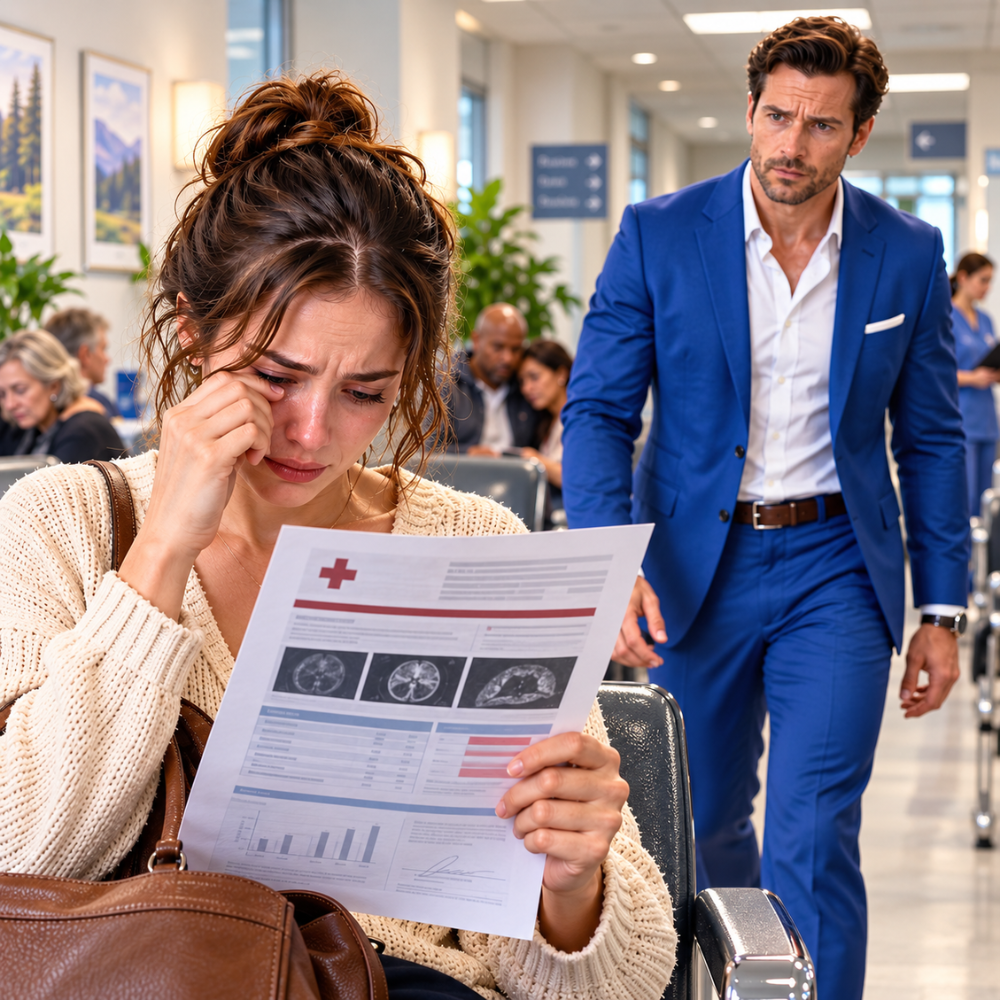
“Maybe I’m running out of tomorrows,” she whispered—then the quiet millionaire beside her made a choice she never expected
The folder was too thick for what it actually contained.
Emily Carter kept staring at it anyway.
A treatment calendar. Three prescriptions. A pharmacy printout with numbers in the right-hand column that made her stomach tighten. A stapled packet from the oncology department. A pamphlet called What to Expect During Chemotherapy, its cover showing a woman in a pale blue sweater smiling into a kitchen full of sunlight.
Emily wondered who had chosen that photograph.
Someone in a conference room, probably. Someone who had decided that a woman facing chemotherapy should look peaceful, well rested, and grateful for natural light.
She closed the folder.
Then she opened it again.
She had made it as far as the courtyard between the cancer center and the parking garage before her legs stopped cooperating. She hadn’t chosen the bench so much as arrived at it.
Portland had settled into one of those gray October afternoons when the sky seemed less like weather and more like a ceiling. Rain had passed through an hour earlier, leaving the brick walkway dark and slick. Wet maple leaves clung to the concrete. Somewhere behind the sliding glass doors, a cart squeaked. A volunteer in a burgundy vest pushed an empty wheelchair back toward the lobby.
Emily sat with the folder on her lap and rubbed the place where her wedding ring had been.
She had removed it three weeks earlier in the upstairs bathroom of the apartment she and Jason had rented for six years.
There had been no dramatic moment.
No shouting.
No ring thrown across a room.
She had simply stood beside the sink after brushing her teeth, twisted the band over her knuckle, and placed it in the ceramic dish where she kept hair ties and earrings.
The pale strip around her finger remained.
A small white ghost of permanence.
Her phone buzzed inside her purse.
She didn’t look.
She knew before checking that it would probably be Jason, his attorney, the pharmacy, the insurance company, or someone who wanted an answer from a woman who had spent the morning being told how many answers medicine still couldn’t give her.
The intake form clipped to the front of the folder listed Jason Carter under EMERGENCY CONTACT.
Emily stared at his name.
Then she pulled a cheap black pen from the side pocket of her purse and drew a line through it.
The pen was nearly dry.
She pressed harder.
The paper tore beneath the last name.
She stopped and looked at the rip.
For some reason, that almost made her cry.
Jason hadn’t left because he was a monster.
That would have been simpler.
If he had screamed at her, cheated openly, emptied their bank account, or said something unforgivable, she could have arranged the story into clean categories.
Victim.
Villain.
Before.
After.
Instead, he had fallen apart quietly.
At first, after the diagnosis, he had gone with her to every appointment. He took notes she didn’t remember asking him to take. He researched doctors. He ordered supplements until she told him to stop. He made spreadsheets with treatment dates.
Then came the biopsy confirmation.
Then staging.
Then the first serious conversation about chemotherapy.
Somewhere in those weeks, Jason’s usefulness began turning into panic.
He started staying later at work.
He stopped asking what the doctors said unless Emily brought it up.
He slept facing the wall.
One night, while the dishwasher ran in the kitchen, he told her he didn’t think he could do this.
Not marriage.
Not exactly.
“This,” he had said, gesturing helplessly at her as though illness had become a physical object standing between them.
Emily had waited for him to correct himself.
He didn’t.
Across the courtyard now, an older couple moved toward the cancer center doors.
The woman walked slowly, one careful step at a time. Her husband carried her coat over one arm and an insulated infusion bag in the other hand. Every few steps he adjusted his pace without seeming to notice he was doing it.
The woman said something.
He bent closer to hear.
She touched his wrist.
They kept walking.
Emily watched them with an ache so private she almost felt ashamed of it.
She had never wanted grand romance.
She hadn’t needed anniversary trips to Paris or flowers every Friday or declarations made in crowded restaurants.
She had wanted that.
Someone matching his pace to hers because it had become instinct.
She lowered her eyes to the folder.
And without deciding to speak, she whispered, “Maybe I’m running out of tomorrows.”
The words came out smaller than the feeling.
She hadn’t meant them for anyone.
A few yards away, a man sat at the opposite end of the courtyard with a paper coffee cup beside him.
He had been there when she arrived, though Emily had barely registered him. Late thirties, maybe forty. Dark hair. Gray jacket. Jeans. No tie. Nothing about him suggested hospital staff or doctor or anyone who had a reason to speak to her.
He had heard.
She knew because of what he did not do.
He didn’t look over immediately.
He didn’t turn with sympathy prepared on his face.
He simply became very still.
It was the stillness of someone who understood that hearing a private sentence did not automatically give him the right to enter it.
Almost a minute passed.
Then he looked at the bench beneath them and said, apparently to no one, “Whoever designed these things really believed suffering builds character.”
Emily blinked.
She looked down at the hard wooden slats digging into her back.
A short laugh escaped before she could stop it.
The man glanced at her.
“Sorry,” he said. “Bad joke for a place like this.”
“No.”
Her voice sounded unfamiliar.
“It was the right amount of bad.”
That earned a small smile.
Not a grin.
Not an invitation.
Just acknowledgment.
For another moment, they sat beneath the wet maples while people moved through the courtyard carrying medical folders, tote bags, coffee, fear, and ordinary conversation.
Then the man lifted his cup.
“Cold,” he said after tasting it.
“That’s your own fault.”
“I’ve been hoping it would improve with age.”
“Has it?”
“No.”
Emily smiled despite herself.
He nodded toward the folder without looking at it directly.
“Long morning?”
She considered giving the automatic answer.
I’m fine.
Instead she said, “Something like that.”
He nodded as if that were enough.
He didn’t ask what kind of cancer.
She didn’t ask why he was at the hospital.
A few minutes later he said, “Nathan.”
“Emily.”
That was all.
No last names.
No occupations.
No exchange of personal histories.
The simplicity felt almost luxurious.
When Emily finally stood, the courtyard tilted.
Not violently.
Just enough.
Her hand caught the back of the bench.
Nathan started to rise, one hand lifting instinctively toward her elbow.
“I’m fine,” she said.
Too sharply.
He stopped immediately.
His hand dropped.
“Okay.”
No insistence.
No hovering.
No expression suggesting that her refusal had offended him.
Emily waited until the dizziness passed.
Everyone had been offering concern since her diagnosis. Nurses, neighbors, people from Jason’s office, a cousin she hadn’t spoken to in four years.
What struck her about Nathan was not that he had wanted to help.
It was that he had stopped the instant she asked him to.
She walked toward the parking garage without looking back.
Her Subaru was on level three, parked between a dented minivan and a pickup truck with a University of Oregon sticker in the rear window.
Emily got inside, placed the oncology folder on the passenger seat, and turned the key.
Click.
She frowned.
Tried again.
The dashboard lights flickered.
Click.
Then nothing.
Emily sat very still.
There were moments when disaster felt proportional. A doctor said a frightening word, and your body reacted accordingly.
Other moments were absurdly small.
A dead battery.
A missing password.
A jar lid that wouldn’t open.
And suddenly every other thing you had been holding back came through the same crack.
Emily turned the key a third time.
Nothing.
Her eyes filled.
“No,” she whispered.
She gripped the steering wheel.
“Not today.”
The Subaru remained unimpressed.
Three floors below, cars hissed across wet pavement.
Emily lowered her forehead toward the wheel and stayed there until the urge to scream had passed.
When she finally looked through the open side of the garage, she saw Nathan walking toward a dark SUV two rows over.
He hadn’t noticed her.
She could call roadside assistance.
She could order a ride.
She could wait.
She could do what she had done for most of the past month and prove, one small miserable task at a time, that she did not require anybody.
Nathan reached his vehicle.
Emily opened her door.
“Hey.”
Her voice barely carried.
He looked over.
She almost wished he hadn’t heard.
Then he did something she would remember later.
He didn’t hurry.
He looked at her, looked at the open car door, understood there was probably a problem, and walked over at an ordinary pace.
Close enough to help.
Slow enough that she still had time to say never mind.
“Car trouble?”
“Understatement.”
“What’s it doing?”
“Nothing.”
“That’s usually not one of the better things a car can do.”
She gave him a tired look.
“Another hospital joke?”
“Parking-garage material. Different category.”
He leaned slightly toward the dashboard but didn’t reach inside.
“Lights come on?”
“They did. Then they faded.”
“Battery, maybe. I have cables.”
He paused.
“Or I can call roadside assistance and wait until they get here. Your call.”
There it was again.
Your call.
Emily looked at him.
“Let’s try the battery.”
Nathan brought the cables.
The Subaru started once.
It ran for eleven seconds, coughed, and died.
Nathan disconnected the cables and stepped back.
“Could be the alternator.”
“Which means?”
“Tow truck.”
Emily shut her eyes.
“Of course it does.”
“You have a shop?”
“Place on Twelfth. Alvarez Auto.”
Nathan took out his phone.
“Want me to call?”
She almost said no.
Instead she gave him the number.
The tow would take forty-five minutes.
Emily folded her arms against the cold.
Nathan glanced toward the opening of the garage, where another band of rain was crossing the city.
“Where are you headed?”
“Home.”
“Where’s home?”
“Southeast.”
“I’m going that direction.”
“I can get a rideshare.”
“You can.”
He said it so neutrally that she looked at him.
No sales pitch followed.
He wasn’t trying to convince her.
He was simply leaving the option where she could reach it.
She looked at the cancer-center folder through the passenger window.
“All right.”
The ride to her apartment took twenty-two minutes.
They talked about everything except the hospital.
Interstate 84 traffic.
A sinkhole that had closed part of a neighborhood street.
Portland drivers behaving as though rain were a weather event nobody could reasonably anticipate.
Emily complained that every grocery store had rearranged its aisles at the exact moment her life had become too complicated to remember where anything was.
Nathan said there should be federal regulations against moving the coffee.
She told him that sounded excessive.
He said he was willing to testify before Congress.
For twenty-two minutes, Emily was not a cancer patient.
She was simply a woman in a stranger’s car arguing about grocery-store design.
At her apartment, she reached into her bag.
“For gas.”
“No.”
“At least let me—”
“No debt.”
She looked at him.
“That’s not a real answer.”
“It’s the only one I’ve got.”
He eased away from the curb before she could make the moment larger than he intended.
Emily stood on the sidewalk as his SUV disappeared at the corner.
No debt.
She carried the words upstairs with her.
That evening, she received one text.
Car made it to Alvarez Auto. They’ll call you tomorrow.
Nothing else.
No question mark.
No request that she tell him how she was feeling.
No invitation disguised as concern.
Emily stared at the message and typed, Thank you.
Nathan replied with a thumbs-up.
Four days later, she saw him again.
The oncology floor was crowded that afternoon, and Emily was walking toward the coffee kiosk when she spotted him outside a patient room talking to a woman in green scrubs.
For half a second, she assumed he had somehow come looking for her.
The thought arrived so quickly that it embarrassed her.
Nathan noticed her.
“Emily.”
“Hospital-bench critic.”
“You remembered.”
“You seemed passionate about it.”
The woman in scrubs excused herself.
Nathan explained that one of his employees had undergone emergency surgery and he had come to visit.
“Small world,” he said.
“Or an aggressively large coincidence.”
He laughed.
They bought coffee.
When he reached for his wallet, Emily raised a finger.
“I’m paying for mine.”
Nathan immediately lowered his hand.
“Okay.”
She stared at him.
“What?”
“Nothing.”
“You’re surprisingly trainable.”
“I’ve been told that in performance reviews.”
They sat near a window overlooking the parking structure.
Emily stirred cream into her coffee and finally said, “I start chemo Monday.”
Nathan’s expression changed but didn’t collapse into pity.
“Okay.”
“They told me I may not be able to drive afterward.”
“What’s the plan?”
Emily stopped stirring.
“What?”
“For getting home.”
It was such a practical question that for a second she didn’t know how to answer.
People had asked if she was scared.
They had told her she was strong.
They had offered inspirational stories about women they knew who had beaten worse cancers.
Her mother called every night and asked if Emily was eating.
Jason’s attorney wanted signatures.
No one had asked, without assumption or performance, what the actual plan was.
“I don’t have one yet.”
Nathan nodded.
He didn’t say he would solve it.
He didn’t volunteer a driver.
He didn’t take his phone out.
He simply said, “You’ll figure out what works.”
That night Jason left a voicemail.
Emily listened while standing at her kitchen counter, surrounded by unopened mail.
“Hey. My attorney thinks it would be easier for everybody if we handled the remaining divorce paperwork before your treatment gets more complicated. No rush tonight, obviously. But sooner is probably cleaner.”
The message ended.
Emily remained still.
Ten years together.
Eight years married.
A shared storage unit. Two sets of wedding china they had never used. A Costco membership. A savings account. The ancient green sofa they had bought when they could barely afford it.
Sooner is probably cleaner.
She opened the legal envelope and spread the forms across the counter.
Two men occupied her thoughts that evening.
One had promised forever and now wanted efficiency.
The other had made no promises at all and had asked one question.
What’s the plan?
Chemotherapy taught Emily a new calendar.
Monday belonged to infusion.
Tuesday belonged to nausea.
Wednesday belonged to exhaustion so deep she sometimes sat on the edge of the bed for ten minutes before gathering enough energy to cross the room.
Thursday was negotiation.
Could she work?
Could she shower?
Could she tolerate toast?
By Friday, she often felt close enough to herself to answer emails, which meant she spent the day trying to rescue a freelance copyediting business that had no sympathy for blood counts or medication schedules.
Clients did not mean to be cruel.
They just had deadlines.
One publisher wrote, Hope you’re doing well. Checking on the manuscript.
Emily wanted to reply, I am currently measuring success by whether crackers stay down.
Instead she typed, I’ll have the pages to you Monday.
Her mother, Diane, offered repeatedly to have Emily move back to Salem.
“I have the whole downstairs bedroom,” she said. “You wouldn’t even need the stairs.”
“I’m thirty-four, Mom.”
“You’re sick, not fourteen. I know the difference.”
“I know.”
“Then come home.”
“I’m not ready.”
Diane sighed through the phone.
“I hate that you’re doing this alone.”
Emily looked around the apartment.
Jason’s half-empty bookshelf.
The square of darker paint where their framed wedding photo had hung.
“I’m not doing it alone.”
She wasn’t sure that was true yet.
The following Monday, her rideshare canceled twice.
Emily stood under the cancer-center awning with her coat pulled tight and watched cars arrive for everyone except her.
Her legs felt hollow.
A woman named Renata, whom Nathan had introduced briefly at the hospital, was nearby with her father. She noticed Emily but said nothing beyond hello.
Twenty minutes later Emily finally got a car.
The next Monday, when she walked out after infusion, Nathan’s SUV was parked at the curb.
He was leaning against the driver’s door.
Emily stopped.
“No.”
“That’s a strong opening.”
“How do you know what time I finish?”
“Renata saw you stranded last week.”
“So you investigated.”
“I received unsolicited intelligence.”
“Nathan.”
“She mentioned it.”
Emily folded her arms.
“I can get a car.”
“I know.”
“I don’t need a company driver.”
“I didn’t say anything about a company driver.”
“You were about to.”
“I actually wasn’t.”
He opened the passenger door.
Then waited.
“I can drive on the Mondays my schedule allows,” he said. “Nothing more complicated than that.”
Emily looked at him.
“And when your schedule doesn’t allow?”
“Then you make another plan.”
She searched his face.
“You’re not going to turn this into a system?”
“I’m trying very hard not to.”
Against her will, she smiled.
“Fine.”
The rides became routine.
Nathan never asked her to entertain him.
On good afternoons, Emily talked all the way home.
She complained about daytime television, the pharmacy line, medical forms that asked the same question six different ways.
On bad afternoons she leaned her head against the window and slept.
Nathan turned the radio down.
That was all.
One Tuesday, after an infusion had gone poorly, Emily snapped when he told her the nurse had called her brave.
“I hate that word.”
Nathan glanced over.
“What word?”
“Brave.”
“Okay.”
“I’m not brave. People keep saying it as if I signed up for this. I didn’t volunteer. I don’t have a heroic alternative sitting around.”
“Fair.”
She looked at him.
“That’s it?”
“What else should I say?”
“I don’t know.”
“Then fair seems efficient.”
Emily stared out the window.
A minute later she began laughing.
Nathan smiled but kept his eyes on traffic.
He started leaving small bags outside her apartment.
Never expensive things.
Saltines.
Ginger tea.
A container of chicken-and-rice soup from a deli nearby.
Once, a box of lemon ice pops after Emily mentioned that cold foods were easier after treatment.
The first time she called to protest, Nathan said, “Throw it away if you don’t want it.”
“That’s wasteful.”
“Then we’ve identified a flaw in the plan.”
“What am I supposed to do with you?”
“Apparently keep correcting my plans.”
So she did.
She learned things about him slowly.
He disliked sweet coffee.
He had a habit of checking his phone whenever conversation became emotionally complicated.
He could cook exactly four meals and considered that evidence of competence.
He traveled constantly for work but hated airports.
He had an employee named Mark who called him out when he was being unreasonable.
He was terrible at writing speeches.
That last discovery changed something.
Nathan had mentioned an upcoming industry conference while sitting in her kitchen one night.
“I have to give a keynote.”
“You sound thrilled.”
“I’d rather undergo a tax audit.”
“Let me see it.”
He hesitated.
Emily raised an eyebrow.
“Are you embarrassed?”
“Yes.”
“Now I definitely need to see it.”
He emailed the draft.
Emily opened it on her laptop.
Five minutes later she looked up.
“This reads like a committee pretending to be a human being.”
Nathan stared at her.
Then laughed so hard he had to put his coffee down.
“You asked.”
“I know.”
“You used ‘leveraging cross-functional operational excellence’ in the second paragraph.”
“I did not write that.”
“It has your name on it.”
“Legal distinction.”
“You should be ashamed.”
“Can you fix it?”
Emily did.
She spent three hours cutting jargon, replacing corporate phrases with actual sentences, and writing one story into the middle of the speech about a warehouse employee who had stopped an entire production line because one label was wrong.
Nathan used every change.
Emily discovered who he actually was two weeks later.
She was waiting for a café order when she noticed a business magazine abandoned on the table beside her.
Nathan’s photograph was on the open page.
Nathan Cole leads Meridian Foods through Northwest expansion.
Emily read the article twice.
Founder and chief executive.
Majority owner.
Distribution facilities across four states.
Private company valued high enough that she stopped reading the number carefully.
The article described him as “notoriously private.”
She carried the magazine home.
When Nathan arrived that evening, she placed it on the table.
“You could have mentioned this.”
He looked at the page.
“Oh.”
“‘Oh’?”
“I was wondering when that would happen.”
“When what would happen?”
“You’d find out.”
“You run a company.”
“Yes.”
“You own a company.”
“Most of one.”
“Stop making it smaller.”
He sat across from her.
Emily crossed her arms.
“Why didn’t you tell me?”
Nathan took a moment.
“Would it have changed the first few weeks?”
“That isn’t the point.”
“It’s part of the point.”
“No. The point is you knew things about me I didn’t know about you.”
“You told me what you wanted to tell me.”
“Because I thought we were on equal ground.”
“We were.”
“You’re a millionaire.”
“And you’re better at writing speeches than everyone on my communications team.”
Emily stared at him.
“That’s not charming enough to get you out of this.”
“I know.”
The humor left his face.
“People change when they know,” he said. “They become careful. Or impressed. Or suspicious. Sometimes all three.”
“And you decided for me that I would do that?”
“Yes.”
The answer irritated her because it was honest.
Nathan folded his hands.
“I liked being Nathan with you. The guy with the dead coffee and jumper cables. You talked to me like a person before you knew what I owned. I didn’t want to lose that before I had to.”
Emily looked down.
The anger remained.
But underneath it was something more uncomfortable.
“I don’t know if I’m angry because you hid it,” she said, “or because I started trusting you before I had all the information.”
Nathan nodded slowly.
“That makes sense.”
“You don’t get to say that like you’re my therapist.”
“I definitely don’t have the training.”
She almost smiled.
Almost.
Trust did not return in one conversation.
Nathan seemed to understand.
He made no grand gesture to repair it.
No expensive dinner.
No gift.
No explanation delivered like a courtroom closing argument.
He simply kept being consistent.
They went grocery shopping at nine at night because crowds made Emily tired.
They sat in his SUV during heavy rain because one evening she reached her apartment building and couldn’t imagine climbing the stairs yet.
They watched half an episode of a game show on his phone.
Nathan learned which laundromat dryer ran too hot.
Emily discovered he carried quarters because his company parking garage still had an ancient vending machine that somehow required them.
Her hair began falling out gradually.
At first, strands on her sweater.
Then clumps in the shower drain.
Then enough on her pillow that denial became impractical.
Nathan never mentioned it.
One morning Emily pulled a long strand from the shoulder of her sweatshirt.
“Well,” she said. “There goes the ponytail.”
Nathan looked at her.
“You have good ears.”
Emily frowned.
“What?”
“Your hair covered them before.”
“That’s your contribution?”
“They’re very good ears.”
She laughed.
Then she cried.
Nathan sat beside her without pretending the laughter had canceled the tears.
Jason came for the last of his boxes that Friday.
He texted first.
I can be there at five. Should only take twenty minutes.
Emily hated the message because it sounded like arranging a furniture delivery.
At exactly five, he arrived.
He looked thinner.
Or maybe she had forgotten his face.
He moved efficiently through the apartment, packing books, hiking gear, kitchen gadgets he had purchased and never used.
He looked at Emily often without quite meeting her eyes.
By then her hair had thinned visibly.
Her face was narrower.
She saw the moment he noticed.
Concern appeared first.
Then discomfort.
Then something Emily could not unsee once she recognized it.
Relief.
Not relief that she was suffering.
Relief that he no longer had to live beside the suffering.
Jason carried a box to the door.
“I’m sorry,” he said.
Emily wasn’t sure which part he meant.
“So am I.”
He nodded.
“I hope treatment works.”
“Thank you.”
He looked as though he wanted to say more.
Instead, he left.
Emily locked the door.
Then sat on the edge of the bed.
The apartment was quiet except for the refrigerator cycling on in the kitchen.
She asked herself a question she had been refusing to ask.
What if Jason had seen something true?
What if illness had made her too much?
Too needy.
Too uncertain.
Too expensive.
Too frightening.
Too close to mortality.
What kind of person watched someone they loved walk out and still wondered whether the person leaving had simply made the sensible choice?
Emily sat there for nearly an hour.
She had forgotten Nathan was bringing soup.
He knocked once, used the spare key only after she called for him to come in, and found her in the bedroom.
The empty shelves told him enough.
“Jason?”
“Gone.”
Nathan set the soup down.
He should have sat.
He should have done nothing.
Instead, he made a mistake.
“I made a call today.”
Emily looked up.
Nathan continued before reading her expression.
“There’s an oncologist at a research center in Boston. He’s one of the best in the country for your specific diagnosis. I got you a consultation next Thursday.”
Emily went completely still.
“You did what?”
“It’s only a consultation.”
“You called a doctor about me?”
“I spoke to someone on the center’s board.”
“You gave them my information?”
“Only what was necessary to—”
“You didn’t ask me.”
Nathan stopped.
“I was trying to give you another option.”
“No.”
Emily stood.
Her legs shook, but anger held her upright.
“You were trying to fix something.”
“If there’s another treatment possibility—”
“My life is not a supply-chain problem, Nathan.”
His face changed.
“You don’t get to reroute around whatever scares you. You don’t get to call people and move appointments and open doors and decide afterward that I should be grateful because the door is expensive.”
“That’s not what I—”
“You did not ask me.”
Nathan closed his mouth.
Emily’s voice cracked.
“I have had doctors tell me where to sit, insurance companies tell me what they’ll cover, lawyers tell me when to sign, Jason tell me when ending our marriage is most convenient. I do not need one more man arranging my life without asking.”
Silence filled the room.
Nathan looked down.
Then back at her.
“You’re right.”
Emily had been prepared for an argument.
The absence of one left her disoriented.
“I’ll cancel it.”
“Tonight.”
“Tonight.”
He did.
Then he left.
The next morning, Nathan did not appear.
No coffee.
No text asking how she was.
No attempt to explain himself again.
Emily told herself this was what she wanted.
On the second day, she went through treatment alone.
Her ride home smelled strongly of artificial pine air freshener.
She spent the evening beneath two blankets, chilled despite the heat running.
On the third day, she realized she had checked her phone eleven times.
That evening someone left a pharmacy delivery outside her door.
Inside was ginger tea and the anti-nausea mouth rinse she had mentioned running low on.
No note.
No message from Nathan.
No apology.
Nothing designed to force her response.
Emily stood in the hallway holding the bag.
He had heard her.
That was the infuriating part.
He had heard her so well that he had removed himself exactly as requested.
And now the quiet felt worse.
By the fourth day, Emily understood something she did not especially enjoy admitting.
His mistake had hurt.
His absence hurt more.
Not because she needed him to solve treatment.
Because somewhere along the way she had started wanting him there.
That afternoon she finished another difficult infusion and returned to the courtyard.
October had moved toward November.
The maple branches were thinner.
The bench was wet, so Emily wiped a spot with her sleeve and sat.
She took out her phone.
Typed three words.
Deleted them.
Typed again.
Can you come sit?
Her thumb hovered over the screen.
Then she sent it.
Nathan arrived nineteen minutes later.
He carried nothing.
No flowers.
No coffee.
No plan.
He sat at the opposite end of the bench.
Emily stared ahead.
“I’m still angry.”
“Okay.”
“I also missed you.”
Nathan nodded once.
“Okay.”
She looked at him.
“Those can both be true.”
“I know.”
“You don’t have to look so calm about it.”
“I am extremely not calm.”
That made her smile.
They sat quietly.
At last Emily said, “If you want to help me, ask.”
“I can do that.”
“And if I say no?”
“I stop.”
“And if I say yes, it doesn’t mean I owe you.”
Nathan looked at her.
“No debt.”
This time the words felt different.
Not a wall.
An agreement.
A week later Emily went to a volunteer packing event at one of Meridian Foods’ warehouses.
She had expected polished executives posing for photographs.
Instead she found forklift drivers, accountants, sales staff, managers, spouses, and teenagers packing shelf-stable food into boxes for regional food banks.
Nathan wore jeans and a company sweatshirt.
People liked him.
That surprised Emily, although she couldn’t have said why.
Warehouse workers teased him.
A supervisor told him he stacked canned goods badly.
Nathan accepted the criticism.
A young marketing employee asked whether he was seeing anyone.
Nathan deflected so smoothly that Emily almost missed it.
“Meridian and I are exclusive.”
Everyone laughed.
Later, an older employee asked the same question while sealing boxes.
Nathan changed the subject.
Then it happened again.
By the third time, Emily understood.
His privacy wasn’t accidental.
It was architecture.
He had built his life with rooms nobody entered.
That evening Nathan’s phone rang.
He glanced at the screen and answered immediately.
His chief operating officer, Mark Reynolds, had been taken to an emergency room with chest pain.
Nathan’s entire posture changed.
He began issuing instructions.
Cancel tomorrow’s flight.
Move the Seattle presentation.
Call the regional director.
Send Mark’s assistant home.
Get the board packet reassigned.
Within ten minutes, every business problem created by Mark’s absence had been addressed.
Nathan ended the call.
Emily waited.
“Did you call him?”
“I talked to his wife. They’re running tests.”
“That isn’t what I asked.”
Nathan looked at her.
“Did you call Mark?”
“He doesn’t need me bothering him while doctors are working.”
“Maybe.”
She pulled on her coat.
“Or maybe handling coverage is the version of caring that lets you avoid being scared.”
Nathan’s expression hardened slightly.
Emily almost let it go.
Then she remembered Boston.
She had asked him to change.
Change had to work both directions.
“You’re generous when generosity lets you stay useful,” she said. “You drive. You organize. You solve. You make calls.”
“That’s generally considered helpful.”
“It is helpful.”
She softened her voice.
“But what happens when someone doesn’t need a solution?”
Nathan said nothing.
“When somebody just needs you to sit there and admit that you’re afraid?”
His jaw tightened.
Emily saw that she had reached something real.
“My mother died when I was twenty-four,” he said.
The warehouse noise seemed to recede.
“She had a heart attack.”
Emily waited.
“No warning?”
“None.”
Nathan stared at the floor.
“I handled everything afterward. Her mortgage. Her utilities. The estate. Her car. The funeral home. Every account. Every person who needed a call got one.”
He rubbed his thumb against the edge of his phone.
“I was very competent.”
Emily said nothing.
Nathan looked toward the loading bay.
“I don’t remember grieving.”
His voice lowered.
“I remember being competent.”
Emily felt her anger toward him rearrange itself.
Not disappear.
Become dimensional.
“I think I learned that if I was useful,” Nathan continued, “nobody could ask me how I felt.”
“And you never unlearned it.”
“No.”
“You can’t keep buying distance with usefulness.”
Nathan looked at her.
“Not with Mark,” Emily said. “Not with me.”
Two mornings later he drove to Mark’s house.
No laptop.
No documents.
No folder.
He stayed three hours.
That night, he called Emily.
“I told him I was scared of losing him.”
Emily leaned back against her pillow.
“How did that go?”
“He called me an idiot.”
“That sounds promising.”
“Then he cried.”
Nathan paused.
“So did I.”
Emily closed her eyes.
“How did that feel?”
“Terrible.”
She laughed softly.
“Worth it?”
Another pause.
“Yes.”
The scan results in December were mixed.
Some tumors had responded.
Others remained stubborn.
No new spread.
Not the news Emily feared most.
Not the news she wanted.
More treatment.
More waiting.
More days in which every ordinary decision carried a shadow.
Money tightened.
Her freelance workload had dropped nearly sixty percent. She had savings, but savings vanished quickly when rent, insurance deductibles, prescriptions, transportation, groceries, and legal fees all arrived with the confidence of obligations that did not care whether she had spent Tuesday vomiting.
Then the lease-renewal notice came.
Two hundred dollars more per month.
Emily sat at the kitchen counter with a calculator, a yellow legal pad, and bank statements.
She added the numbers.
Subtracted.
Added again.
Moving back to her mother’s house in Salem no longer looked emotional.
It looked mathematical.
Nathan arrived with dinner and saw the calculator.
He looked at the renewal notice.
A year earlier, he would have paid the rent without blinking.
Emily could see the instinct appear.
Then disappear.
He put the dinner on the counter.
“What would actually help?”
She looked at him.
“If I’m not allowed to throw money at it,” he added.
Emily smiled.
“This.”
“This being?”
“You asking.”
He pulled out a chair.
They spent an hour reviewing practical options.
Smaller apartments.
Short-term work Emily could handle.
Insurance assistance programs.
Whether staying in Portland mattered enough to justify the cost.
Nathan didn’t offer to purchase anything, finance anything, or make a call to someone important.
He simply sat beside her with a calculator.
It felt more intimate than any expensive gesture could have.
The divorce became final in January.
Emily walked out of the county courthouse carrying a thin folder and feeling almost nothing.
That surprised her.
She had expected grief.
Maybe relief.
Instead she mostly felt hungry.
Nathan waited in the parking lot.
When Emily got in, he glanced at the folder.
“Done?”
“Done.”
“How do you feel?”
“Like I need fries.”
“I can work with that.”
He started the car.
Emily looked at him.
Then, before she could give herself time to retreat, she leaned across the center console and kissed him.
Nathan froze.
Emily pulled back.
“Well,” she said. “That was awkward.”
“I wasn’t prepared.”
“Your entire personality is preparation.”
“Not for that.”
“Would you like a calendar invitation next time?”
Nathan laughed.
Then he kissed her back.
Nothing about their relationship moved quickly after that.
Emily did not want illness to turn romance into emergency.
Nathan had learned that intensity could resemble control if he wasn’t careful.
So they built slowly.
Dinner.
Movies.
A Sunday walk when Emily had enough energy.
Nathan standing in her kitchen washing dishes while she sat at the table correcting one of his speeches.
Emily meeting Mark after he returned to work.
Nathan driving to Salem with her for her mother’s birthday and surviving Diane’s interrogation about his intentions.
“He owns how much of that company?” Diane whispered after Nathan went outside.
“Mom.”
“I’m just asking.”
“You are not just asking.”
“I raised you. I’m allowed one suspicious question.”
“You’ve asked twelve.”
Diane considered that.
“Fine. Eleven more than necessary.”
For all the progress, fear remained.
Nathan’s company was negotiating the acquisition of a specialty-food manufacturer outside Seattle.
The final weeks required him there constantly.
This time he did not pretend otherwise.
“I’ll miss two treatment days,” he told Emily.
She appreciated the honesty even though she hated the fact.
“My friend Rachel can take one.”
“And the other?”
“I’ll figure it out.”
Nathan started to suggest something.
Stopped.
Emily noticed.
“You can offer.”
“My assistant can arrange a car.”
“Yes.”
Nathan looked almost comically relieved.
“Thank you.”
“You’re welcome.”
They were learning.
Then Emily developed a fever.
At first, she dismissed it.
By evening it had climbed enough that her oncology team told her to go directly to the emergency department.
Rachel drove.
Emily sent Nathan a message before going inside.
Heading to ER. Fever. Don’t panic.
Nathan was two hundred miles away at a private dinner with the acquisition board.
His phone had been silenced.
He saw the message hours later.
Mark, sitting beside him, watched Nathan’s face change.
“What happened?”
Nathan stood.
“Emily’s in the hospital.”
“Go.”
“The vote is tomorrow morning.”
Mark stared at him.
“Nathan.”
“I need to—”
“Go.”
Nathan left before dessert.
The last flight to Portland was boarding when he reached the airport.
He arrived at Emily’s hospital room after midnight with his tie loosened, coat missing, dress shirt wrinkled, and the general appearance of a man who had run through at least one terminal.
Emily was already angry.
Not at him.
At the fever.
At the nurses checking her blood pressure.
At Rachel calling Diane.
At the way illness could turn one bad evening into a committee meeting about her body.
Nathan stepped inside.
Emily looked at him.
“Everyone acts like this proves I can’t manage my life.”
He said nothing.
“One fever and suddenly I’m a group project.”
Nathan pulled a chair closer.
Then stopped.
“What do you want me to do right now?”
Emily’s anger faltered.
The question had become theirs.
She closed her eyes.
“Stay until I fall asleep.”
“Okay.”
“Then go back to Seattle.”
Nathan frowned.
“I’m serious.”
“You want me to leave?”
“After I’m asleep.”
“The meeting isn’t more important.”
“I didn’t say it was.”
Emily looked at him.
“I want you to have a life that does not become smaller every time I get scared.”
Nathan sat down.
“That sounds suspiciously healthy.”
“Don’t ruin it.”
He smiled.
Nathan held her hand.
He stayed until her breathing slowed.
Near three in the morning, just as he thought she had fallen asleep, Emily opened her eyes.
“Nathan.”
“I’m here.”
“What happens to us if the next scan is bad?”
The question landed between them without warning.
Nathan could have lied.
A year earlier he might have built an answer large enough to shelter both of them.
Instead, he looked at the woman he loved and admitted the one thing he could not fix.
“I don’t know.”
Emily’s face changed.
Nathan continued carefully.
“I don’t know what the scan will show. I don’t know what treatment looks like after that. I wish I could promise you it’ll be fine.”
Emily turned her face toward the window.
Nathan knew immediately that the truth had hurt.
But he could not take it back without replacing it with something weaker.
He stayed until she slept.
Then he returned to Seattle because she had asked him to.
The acquisition vote passed.
Emily’s fever resolved.
And for the next two weeks, she pulled away.
Not dramatically.
She simply stopped calling first.
Nathan’s texts remained unanswered longer.
Dinner plans became maybe.
Maybe became not tonight.
Nathan noticed.
He did not chase.
But he did not vanish.
Every morning he sent the same simple message.
Thinking of you. No reply needed.
Emily hated how much those four words mattered.
She attended Mark’s retirement dinner with Diane instead of Nathan because she said she was tired.
Later she saw photographs online.
Nathan standing beside Mark.
Nathan laughing.
Nathan talking with employees.
For the first time, Emily saw him fully inside a life that did not revolve around her illness.
It frightened her.
It also relieved her.
A few nights later, she finally told him the truth.
They were sitting in her living room.
Jason’s old moving boxes had remained stacked in the corner for months because she had never found the energy to break them down.
“Healthy Emily was easy to love,” she said.
Nathan’s expression stayed calm.
“I don’t know her.”
“You know what I mean.”
“I do.”
“Sick Emily is complicated.”
“Yes.”
The answer startled her.
Nathan continued.
“You’re tired. Sometimes angry. Sometimes you cancel plans. Sometimes you tell me you need help and then hate me for helping.”
Emily stared at him.
“This is a terrible romantic speech.”
“I’m not finished.”
“You should probably improve quickly.”
Nathan leaned forward.
“You’re also funny when you’re exhausted. You rewrite menus in restaurants because the punctuation bothers you. You call your mother every Sunday even when she annoys you. You remember the names of nurses’ kids. You hate bananas. You pretend you don’t like terrible game shows and then yell at the contestants.”
Emily’s eyes filled.
Nathan’s voice softened.
“I didn’t meet some healthy version of you and then get tricked into staying for the hard part. I met you on a terrible day.”
She looked away.
“Jason stayed for terrible days too.”
“Yes.”
“Until he didn’t.”
Nathan nodded.
Emily pressed her palms together.
“I keep waiting for you to hit the wall he hit.”
“I might hit walls.”
Her eyes snapped back to him.
Nathan didn’t retreat from the sentence.
“I’m human, Emily. I get tired. I get scared. I’ll make mistakes. I already have.”
“That’s not comforting.”
“I know.”
He took a breath.
“But if I’m scared, I want to tell you I’m scared. If I need a night to myself, I want to say that. If you need space, I want you to say that. I don’t want us to build forever out of pretending nothing is difficult.”
Emily began to cry.
Nathan stayed where he was.
“I can’t promise I’ll never be overwhelmed,” he said. “I can promise I won’t make leaving easier by refusing to speak.”
That was the first promise from him she believed completely.
Not because it was enormous.
Because it had limits.
A week later, Nathan helped her carry three small plants upstairs.
A pothos.
A snake plant.
A little rosemary bush that Diane insisted was impossible to kill.
They placed them on the windowsill where Jason’s empty boxes had been.
Emily stood across the room looking at them.
“What?”
Nathan asked.
“Nothing.”
“You have a face.”
“I always have a face.”
“That one means something.”
Emily looked at the plants.
“Roots instead of leftovers.”
Nathan followed her gaze.
“Is that one of those things where I’m supposed to say something profound?”
“No.”
“Excellent.”
The day of the next major scan arrived cold and clear.
Nathan came to the apartment early.
He stood in the doorway with coffee in one hand.
“You want me in the room?”
“Yes.”
No hesitation.
The answer mattered to both of them.
At the cancer center, Emily sat on the examination table while her oncologist reviewed the results.
Dr. Patel was careful with hope.
Emily appreciated that now.
Doctors who had done this work long enough understood that optimism should not be used like confetti.
“There’s been substantial response,” Dr. Patel said.
Emily held Nathan’s hand.
“No new spread.”
She stopped breathing for a second.
“We’ll continue monitoring closely, obviously. But the direction is good.”
Good.
Such a small word.
Emily had spent months wanting words like miracle, cured, over.
Good turned out to be enough.
In the parking lot afterward, Nathan unlocked the car.
Emily waited.
He looked at her.
“What?”
“I don’t know.”
“You’re staring.”
“I thought you might say something.”
Nathan considered this.
“You want lunch?”
Emily stared at him.
“Lunch?”
“I’m hungry.”
She began laughing.
Then crying.
Nathan looked alarmed.
“What did I do?”
“Nothing.”
“That seems statistically unlikely.”
Emily wiped her face.
“That’s it?”
“What?”
“Lunch.”
“Yes.”
“No grand speech about second chances?”
“I can make one if necessary.”
“Please don’t.”
“Good. I didn’t prepare.”
She leaned against the car, still laughing through tears.
Nathan waited.
Emily finally understood why the question had broken something open inside her.
Lunch meant he could imagine one o’clock.
Traffic afterward.
A grocery run.
Tuesday.
Next week.
A life made of ordinary hours.
Nathan wasn’t celebrating because the illness had vanished.
It hadn’t.
He was simply behaving as though the future contained sandwiches.
Emily took his hand.
“I think I’d like to find out what happens next.”
Nathan squeezed gently.
“Lunch happens next.”
“For a millionaire, your imagination is limited.”
“It’s one of my strengths.”
For the first time since that October afternoon in the courtyard, the word next did not feel like a cliff.
It felt like a door.
Spring came slowly.
Emily finished active treatment on a Tuesday so ordinary that it almost seemed wrong.
The infusion room looked exactly the same.
The nurse wore purple sneakers.
Someone was watching a home-renovation show with the volume too high.
A man two chairs down slept beneath a fleece blanket.
At the end, the nurse removed Emily’s line.
“That’s it,” she said.
Emily looked at her.
“That’s it?”
“For today.”
“No bell?”
“There’s one downstairs if you want it.”
Emily thought about it.
Then shook her head.
“I think I’m okay.”
Outside, Nathan waited with coffee.
He had not brought balloons.
Emily loved him for that.
Her hair returned slowly, softer and curlier than before.
She complained that it had grown back with “opinions.”
She resumed work ten hours a week.
Then fifteen.
Then twenty-five.
One of her old publishing clients sent a full manuscript and said, No rush. We want you, not just an editor.
Emily cried over that email too.
She became embarrassingly easy to make cry.
Months later, she renewed the lease on her apartment.
In her name.
With her income.
No cosigner.
She printed the confirmation and stuck it to the refrigerator with a magnet.
Nathan saw it.
“You know I own a printer.”
“That’s not why it’s there.”
He looked at her.
Then understood.
“Congratulations.”
No offer.
No concern.
Just congratulations.
Nathan closed the Seattle acquisition the same month.
Mark’s retirement forced him to delegate in ways he would once have considered irresponsible.
The company survived.
More than survived.
Nathan discovered that competent people remained competent even when he wasn’t personally standing beside them.
This realization offended him slightly.
Emily enjoyed that.
They built something ordinary.
That turned out to be the whole point.
Saturday mornings at the farmers market.
Grocery lists.
Nathan’s catastrophic attempt at sourdough, which triggered the smoke detector twice despite bread not normally producing smoke.
Arguments about whether sixty-eight degrees constituted a reasonable winter thermostat setting.
Nathan believing every problem could be solved with a better storage container.
Emily refusing to throw away takeout menus from restaurants that no longer existed.
They were not transformed into perfect people by hardship.
Nathan still occasionally reached for his phone to solve something Emily had not asked him to solve.
Emily still occasionally rejected help before considering whether she actually wanted it.
Now they noticed.
One evening Emily was trying to move a small bookcase.
Nathan came through the door.
“I can call—”
She looked at him.
He stopped.
“Would you like help moving that?”
“Yes.”
“Excellent.”
Another night Emily had a bad follow-up appointment and answered every question with one-word replies.
After twenty minutes, Nathan finally said, “Do you want me here or are you trying to make me leave without having to ask?”
Emily closed her eyes.
“I want you here.”
“Then I’m staying.”
They got better at the things that once frightened them.
Not perfect.
Better.
Nathan proposed on a Thursday evening.
Emily was washing dishes.
He was drying.
No restaurant.
No candles.
No photographer hiding behind a tree.
Nathan set down a plate.
“I want to ask you something.”
Emily glanced at him.
“If this is about moving the mugs again, the answer is no.”
“It isn’t.”
He looked strangely nervous.
That got her attention.
Nathan dried his hands.
“I don’t want to marry you because we survived something.”
Emily turned off the faucet.
“I don’t want our whole story to be about cancer or hospitals or the worst year of your life.”
She said nothing.
Nathan gestured around the small kitchen.
“I want this.”
“The dishes?”
“Unfortunately, yes.”
Emily smiled.
“I want grocery lists and the thermostat argument and your mother calling during dinner. I want you editing my speeches and insulting my bread.”
“Your bread deserves it.”
“It does.”
His voice softened.
“I want the life we built after the crisis stopped being the only thing in the room.”
He took a small ring box from his pocket.
Emily stared at it.
“I’m asking because I like Tuesday nights with you.”
Tears filled her eyes.
Nathan smiled.
“Would you marry me?”
Emily looked at her soapy hands.
“Yes.”
“That was fast.”
“You want me to reconsider?”
“No.”
He opened the ring box.
She held up both wet hands.
Nathan laughed.
“Right.”
They stood in the kitchen laughing like teenagers.
Their wedding was small.
Diane offered her backyard in Salem, and for once Emily accepted help without treating it like surrender.
Folding chairs filled the lawn.
White grocery-store flowers went into mason jars.
Meridian’s catering director volunteered food, but Emily insisted on paying for ingredients.
Mark, officially retired and unofficially incapable of staying away from the company, gave a toast that began as a joke and ended with half the guests crying.
Rachel stood beside Emily.
Nathan wore a dark suit and looked terrified until Emily walked toward him.
Then he looked calm.
Afterward they cut a Costco sheet cake because Emily said expensive wedding cake was “financial performance art.”
Nathan argued that he could afford financial performance art.
She told him that was exactly why he shouldn’t be trusted with cake decisions.
Emily kept Carter professionally.
She had built a name under it.
Survived under it.
Rebuilt under it.
Nathan never questioned the choice.
Years passed the way years usually do.
Not through dramatic announcements.
Through dentist appointments.
Tax seasons.
Broken appliances.
New neighbors.
Birthdays.
Work deadlines.
A leaking roof at Nathan’s house that he insisted was “minor” until water appeared above the dining room table.
Mark becoming a grandfather and sending too many photographs.
Diane downsizing and giving Emily six boxes of childhood belongings she did not remember wanting.
There were follow-up scans.
At first, each one stole sleep for a week.
Then three days.
Then one night.
Eventually the fear became something Emily could carry rather than something that carried her.
On a bright October afternoon several years after treatment, she returned to the same medical center for another routine follow-up.
Nathan came with her.
The scan was clear.
They bought coffee afterward and walked into the courtyard.
Emily stopped.
“The bench.”
Nathan followed her gaze.
“They never upgraded it.”
“You should file a complaint.”
“I believe I did.”
They sat.
The courtyard looked different in sunlight.
The maples had begun turning gold.
Not brown.
Not bare.
Gold.
Patients and families passed through.
A nurse ate lunch at a small table.
Someone pushed a wheelchair toward the entrance.
Life had continued here every day while Emily was busy building her own somewhere else.
She rested her hands around the coffee cup.
“I used to think surviving would make me certain.”
“Certain about what?”
“Everything.”
Nathan waited.
“I thought if I made it through treatment, I’d stop being scared of the future.”
“Did that happen?”
“No.”
He nodded.
“Seems inconvenient.”
Emily smiled.
“I think I understand now that certainty was never the gift.”
“What was?”
She looked at him.
“This.”
Nathan took her hand.
Neither of them tried to improve the moment with more words.
Then Emily noticed the young woman.
She sat near the far end of the courtyard with a medical folder pressed tightly against her chest.
Maybe thirty.
Maybe younger.
Alone.
Her eyes were fixed on the pavement.
Emily recognized the posture before she recognized anything else.
The rigid shoulders.
The careful breathing.
The look of someone trying to remain physically composed because the emotional alternative felt too large for public space.
Emily stood.
Nathan followed her gaze.
She handed him her coffee.
“Hold this.”
“Very demanding.”
Emily walked over.
She did not ask what diagnosis the woman had.
She did not tell her things would be fine.
She did not call her brave.
She stopped a few feet away.
“Hi.”
The woman looked up.
Emily gestured toward the empty part of the bench.
“Would you like somebody to sit with you until your ride comes?”
The woman’s face changed.
Only slightly.
But Emily saw the tension leave her shoulders.
“Yes,” she whispered.
“If you don’t mind.”
“I don’t.”
Emily sat.
For several minutes neither spoke.
Across the courtyard, Nathan remained beneath the maple tree holding both coffees.
The young woman eventually asked, “Do you work here?”
“No.”
“Family?”
“Not today.”
The woman nodded.
Emily looked at the folder.
“I used to sit on this bench.”
“Were you…”
The woman stopped.
Emily understood.
“Yes.”
The woman swallowed.
“Did you know what to do?”
Emily smiled softly.
“Absolutely not.”
That earned the smallest laugh.
Emily remembered another bad joke in another October.
The woman looked toward the hospital entrance.
“My sister is coming. She got stuck in traffic.”
“Then I can sit until she gets here.”
“You don’t have to.”
“I know.”
The woman looked down at her hands.
After a while, she said, “Thank you.”
Emily nodded.
Across the courtyard Nathan lifted her coffee in silent question.
Emily shook her head.
Not yet.
He waited.
Eventually a compact car pulled up near the curb.
A woman hurried from it and crossed the courtyard.
The young patient stood.
“My sister.”
Emily rose too.
“Take care of yourself.”
“I’ll try.”
“That’s enough.”
The sisters went inside together.
Emily returned to Nathan.
He handed back her coffee.
It had cooled.
She took a sip anyway.
Nathan said, “And what exactly do I get for providing professional beverage-holding services?”
Emily looked at him.
Years earlier, she would have heard the answer as refusal.
A refusal to owe.
A refusal to be vulnerable.
A way of keeping every kindness cleanly separated from expectation.
Now she understood it differently.
“No debt.”
Nathan smiled.
The words had changed because they had.
No debt did not mean no dependence.
It did not mean refusing help.
It did not mean keeping score so carefully that nobody could ever accuse you of needing another human being.
It meant love was not a ledger.
Kindness was not a loan.
Care did not purchase obedience.
One person could give.
Another could receive.
And tomorrow, perhaps, the roles would reverse.
Nathan handed her his free hand.
Emily took it.
Together they walked toward the parking garage.
Years earlier, on the same path, Emily had believed the important question was how many tomorrows she had left.
She understood now that no doctor, marriage, bank account, promise, treatment plan, or carefully built life could guarantee anyone a number.
That had never been the bargain.
The gift was smaller.
And larger.
One damp October afternoon.
One stranger who knew when not to reach for her.
One ride home.
One question asked before help was given.
One mistake admitted without defense.
One invitation back to a cold bench.
One difficult truth spoken in a hospital room.
One ordinary lunch after good news.
One sink full of dishes.
One clear scan years later.
The day in front of you.
The person beside you.
The chance, while you still had it, to choose how you would spend both.
Emily had once whispered that she might be running out of tomorrows.
She never learned exactly how many she had.
None of us do.
But as she walked beside Nathan beneath the turning maples, she no longer needed the answer.
Tomorrow was not something life owed her.
It was simply something she would be grateful to meet when it arrived.
And today, warm coffee in one hand and Nathan’s fingers threaded through the other, was already enough.









