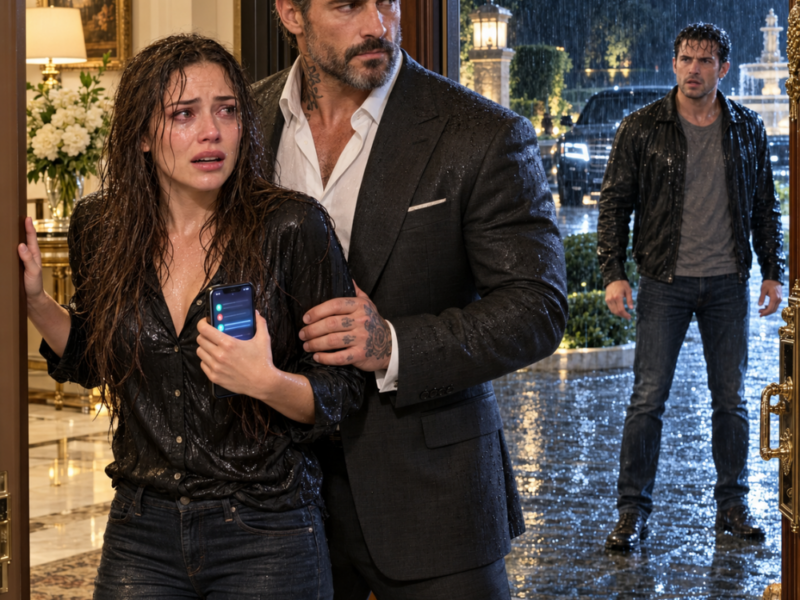
Mafia Boss Saved a Girl Running From Her Abusive Ex — Then Everything Turned Deadly
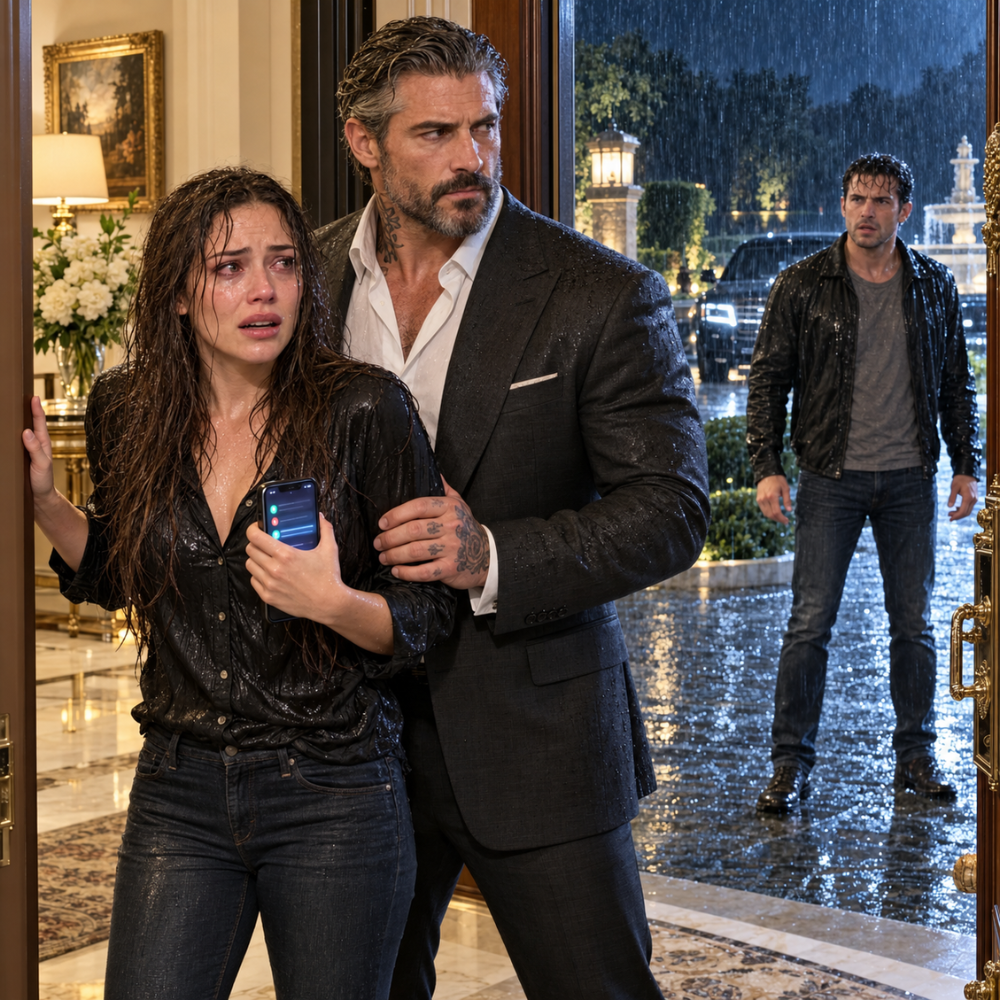
She collapsed at the gates of Georgia’s most feared man—then he learned why a prosecutor wanted her erased
By the time Allara Vane reached the iron gates at the end of Marsh Point Road, she had stopped feeling the rain.
It came down hard enough to flatten palmetto fronds and turn the low streets outside Savannah into sheets of moving water, but Allara barely noticed. She had lost one shoe somewhere near Whitaker Street. The hem of her evening dress was torn to her knees. Blood from a cut near her hairline had dried once, been washed clean by the storm, then started again.
She had been running for nearly three miles.
Behind her, headlights appeared at the far end of the private road.
Two vehicles.
Slow.
Searching.
Allara gripped the cold bars.
A camera above the gate pivoted toward her.
For one desperate second she wondered whether she had made the wrong choice.
Then an intercom clicked.
A man’s voice came through the rain.
“You’re bleeding on my gate.”
Allara looked up.
The voice was low, controlled, almost conversational.
“Who’s following you?”
Her lips moved, but thunder swallowed the answer.
The headlights behind her came closer.
Allara hit the call button with the heel of her hand.
“Please.”
It was the first time she had used that word in weeks.
The gate opened.
She made it three steps onto the property before her legs gave out.
Security footage later showed her collapsing at 2:47 a.m.
It also showed four men emerge from the darkness near the main drive, not running, not shouting, simply moving with the practiced speed of people accustomed to emergencies.
One of them spoke into a radio.
Another crossed toward the gate.
The headlights on Marsh Point Road stopped.
Then turned around.
Inside the estate house, Roman Virelli watched everything from a monitor in his study.
He was forty-three and had spent more than half his life becoming the kind of man people in Savannah discussed carefully.
Officially, he owned shipping warehouses, a regional logistics company, three restaurants, commercial property near the port, and a string of businesses that had grown from the remains of his late uncle’s freight operation.
Unofficially, people attached other words to the Virelli name.
Fixer.
Smuggler.
Underworld broker.
Mafia.
Roman disliked most of those descriptions.
He also knew he had done very little in his younger years to make them sound ridiculous.
By middle age, much of his money was legitimate, his taxes were professionally boring, and half his time was spent in meetings with lawyers who charged more per hour than his father had once earned in a week.
Still, fear lingered long after behavior changed.
Roman had learned to use that fact selectively.
He came downstairs barefoot, in black trousers and a white shirt with the sleeves rolled up.
Allara lay on the marble floor just inside the entry hall.
His head of security, Marco Bellini, stood near the front doors while another man, Nico Russo, checked Allara’s pulse.
“She needs a hospital,” Nico said.
Roman crouched.
Allara’s eyes opened.
Dark.
Alert despite everything.
“No hospital.”
Roman looked at Nico.
“What injuries?”
“Head wound. Bruising. Probably ribs. She needs imaging.”
“No hospital,” Allara said again.
Her voice cracked.
Roman studied her.
People who merely disliked hospitals did not run three miles through a coastal storm to avoid one.
“Who hurt you?”
She turned her face toward him.
For a moment she seemed to be deciding whether he existed.
Then she whispered:
“Declan Hollow.”
Marco’s expression changed.
Roman’s did not.
That took effort.
Everyone in Savannah knew the Hollow family.
Judge Everett Hollow had sat on the Georgia Superior Court bench for twenty-three years before taking senior status.
His son, Declan, was an assistant district attorney with a carefully polished public profile, a gift for television interviews, and political ambitions nobody in the county bothered calling secret.
Old family.
Old money.
Old connections.
The kind of legitimacy Roman’s family had spent decades being denied, then decades pretending not to want.
Nico looked at him.
Roman stood.
“Call Dr. Salazar.”
Marco frowned.
“Roman.”
“Now.”
“You understand who she named.”
“Yes.”
“That family can bury us under state investigations before breakfast.”
Roman looked down at Allara.
Her fingers had closed around the torn fabric at her side.
She was trying not to shake.
“They can try.”
Marco muttered something in Italian.
Roman ignored him.
“Get her upstairs.”
Allara flinched when Nico reached down.
Roman saw it.
“Tell her before you touch her.”
Nico stopped.
He looked at Allara.
“I’m going to help you stand. Is that okay?”
She stared at him.
Then nodded.
The movement was almost invisible.
They took her upstairs.
Roman remained in the entry hall.
Rain hammered the windows.
Marco closed the front doors.
“This is a mistake.”
“Probably.”
“You don’t know her.”
“No.”
“You don’t know what she did.”
“No.”
“You don’t know whether Hollow is telling the truth and she isn’t.”
Roman looked toward the staircase.
“No.”
Marco waited.
“That doesn’t bother you?”
“It bothers me a great deal.”
“Then why are we doing this?”
Roman looked at the rain.
“Because she asked for a hospital not to be called.”
“That is your standard now?”
“No.”
He turned.
“My standard is that frightened people get medical care before interrogation.”
Marco stared.
Roman went back to the study.
“Find out who she is.”
“That I can do.”
“And who those cars belong to.”
Marco nodded.
“No contact. No confrontation.”
“That disappoints me.”
“I know.”
Roman poured coffee instead of whiskey.
At 4:20, Dr. Teresa Salazar arrived through the service entrance.
She ran a small concierge medical practice in Savannah and had known Roman long enough to insult him professionally without hesitation.
“You should have called 911.”
“She refused.”
“Trauma patients refuse things because their brains are injured.”
“She was oriented.”
“She’s lucky.”
“How bad?”
Teresa pulled off gloves.
“No skull fracture signs I can detect clinically, but she still needs imaging. Two ribs likely cracked. Significant bruising. Some older, some new.”
Roman’s jaw hardened.
“She can walk?”
“Eventually.”
“Can she leave?”
“Roman.”
“I’m asking because she’ll ask.”
“Not tonight.”
Teresa looked at him.
“And if you actually intend to help, don’t turn this house into another place where men make every decision for her.”
He held her eyes.
“You assume I need that explained?”
“I’ve known you twenty years.”
Fair.
At 6:14, Allara woke.
She opened her eyes without moving.
First ceiling.
Then window.
Then door.
Then the chair.
Roman sat there with a cup of coffee and a folder he had not opened.
He recognized what she was doing.
Cataloging exits.
He stayed where he was.
“You’re at Virelli Point.”
Her gaze shifted to him.
“Outside Savannah?”
“Yes.”
She swallowed.
“Door locked?”
“No.”
“Can I leave?”
“When you can walk without fainting.”
“That wasn’t my question.”
Roman set down the cup.
“No one here will stop you from leaving.”
She studied him.
“You’re Roman Virelli.”
“Yes.”
Her mouth moved faintly.
“The gangster.”
“Among other disappointments.”
She almost smiled.
Then pain caught her.
Roman waited until it passed.
“You filed two protective-order petitions against Declan Hollow.”
Her face changed.
“You searched me.”
“Yes.”
“I’ve been here three hours.”
“Four.”
“That makes it better?”
“No.”
She looked toward the door.
Roman continued.
“Your name is Allara Vane. Twenty-six. Former paralegal assistant at McKinnon Legal Aid. Foster care until eighteen. Missing-person report filed fourteen days ago by a former employer.”
Her hands tightened under the blanket.
“Who closed it?”
“Savannah police marked it probable voluntary departure.”
“Of course they did.”
“You want to tell me why?”
“No.”
Roman nodded.
She stared.
“That’s it?”
“For now.”
“You don’t want a story?”
“I want to know whether there is an immediate threat to this property.”
“There is.”
“Declan?”
“Yes.”
“His father?”
Her jaw tightened.
“Yes.”
“Police?”
“I don’t know.”
“Federal agents?”
“No.”
“Did you commit a crime tonight?”
“No.”
No hesitation.
“Steal anything?”
“No.”
“Take documents?”
Her expression changed.
Roman noticed.
“Allara.”
“I had copies.”
“Had?”
“In my dress pocket.”
“You don’t now?”
She looked down.
“The rain.”
“Copies of what?”
Silence.
Roman waited.
At last:
“Serena Vale.”
“Who is she?”
“Declan’s girlfriend before me.”
Roman knew the name vaguely.
Society pages.
Charity photographs.
Then nothing.
“She moved away.”
Allara laughed once.
“No.”
“What happened?”
“They committed her.”
Roman did not move.
“Psychiatric facility.”
“Voluntarily?”
“No.”
“How do you know?”
“I found the records.”
The room seemed quieter.
Allara looked at him.
“Declan kept copies.”
“Why would he keep evidence of something illegal?”
“Because to him it wasn’t illegal.”
Roman’s eyes narrowed.
“Explain.”
“His father signed the commitment paperwork. Doctors signed evaluations. Lawyers prepared it. Serena had depression documented after her mother died. They built the rest around that.”
“What rest?”
“Danger to self. Unstable behavior. Paranoia.”
Allara’s voice became flatter with each phrase.
“Then Declan told friends she had a breakdown. Told her employer. Told her family she didn’t want contact.”
Roman thought about the missing-person file on Allara.
“What did he start saying about you?”
She looked toward the window.
“That I was anxious.”
Roman said nothing.
“That I was becoming obsessive.”
Nothing.
“That I imagined people following me.”
Her throat tightened.
“Then somebody from his office called the townhouse four nights ago asking whether the Vane psychiatric packet was ready for Judge Hollow’s review.”
Roman leaned forward slightly.
“They said your name?”
“My last name.”
“And?”
“Declan said it was a mistake.”
“You believed him?”
“No.”
For the first time, something like pride entered her voice.
“I waited until he left. Searched his office.”
“What did you find?”
“Serena.”
The name came out differently.
Not evidence.
A person.
“Records. Payments. Facility invoices. Copies of evaluations. A judge’s authorization.”
“Everett Hollow?”
“Yes.”
Roman looked toward the folder on the side table.
“How long ago?”
“Two years.”
“Where?”
“Private facility. I saw a billing address outside Augusta.”
“Name?”
“I don’t remember exactly. Riverside something.”
Roman stood.
Allara immediately stiffened.
He noticed and stopped farther from the bed.
“I’m getting Marco.”
“Why?”
“To find Serena.”
She stared at him.
“You believe me.”
“I believe there is enough to verify.”
“That is not the same.”
“No.”
It was probably the most reassuring answer he could have given.
He called Marco from the hallway.
Within three hours, they had a name.
Riverside Wellness Center.
A licensed private psychiatric facility north of Augusta.
A patient admitted twenty-two months earlier under the name Sarah Vale.
The bill was paid through an LLC linked to a law firm used by the Hollow family.
Not proof.
But not nothing.
Roman brought the information to Allara after Teresa returned from arranging discreet imaging at a private clinic.
Allara sat at the guest-room window wearing loose clothing provided by Mrs. Finch, Roman’s house manager.
“The facility exists.”
Her eyes closed.
“She’s there.”
“Possibly.”
“She is.”
“We need more.”
Allara turned.
“She has been there two years.”
“I know.”
“No, you don’t.”
Her voice rose.
“You were drinking coffee in your own house while they were medicating her into silence.”
Roman’s expression hardened.
“Do not confuse my calm with indifference.”
Allara stopped.
He continued.
“I will not send men into a psychiatric hospital and create a second crime around a woman whose legal status we have not verified.”
“You could get her out.”
“Maybe.”
“You have people.”
“Yes.”
“Money.”
“Yes.”
“Connections.”
“Yes.”
“So use them.”
Roman sat in the chair opposite her.
“That is how men like Declan think.”
Her face changed.
“What?”
“That having power means every difficult problem becomes permission.”
Allara looked away.
Roman continued.
“If Serena was committed unlawfully, we prove it. If records were forged, we preserve them. If doctors participated, we document that. Then we get lawful authority to move her.”
“The law put her there.”
“Some people using the law may have put her there.”
“Same thing.”
“No.”
His voice remained quiet.
“If it is the same thing, then everything outside force is useless.”
Allara said nothing.
Roman knew he had hit something deeper.
He leaned back.
“I’ve lived most of my life acting as if force solved problems law would not.”
“Did it?”
“Short ones.”
“And long ones?”
He looked toward the door.
“No.”
That afternoon, Roman brought in an attorney.
Dana Mercer.
Forty-seven.
Former federal prosecutor.
Now private counsel specializing in complex fraud and corruption cases.
She was not impressed by Roman.
That was one reason he used her.
Dana sat beside Allara.
“I represent Mr. Virelli’s companies.”
Allara nodded.
“I do not represent you.”
“Good.”
“I can arrange independent counsel.”
“Better.”
Dana continued.
“I need to know what you saw, not what you think it proves.”
Allara told her.
The hidden drawer.
Commitment renewals.
Serena.
Billing.
Medical forms.
Judge Hollow’s signature.
A second folder with Allara’s own name partly visible.
“What exactly?”
Dana asked.
“Allara Vane.”
“Any diagnosis?”
“I didn’t open it fully.”
“Why?”
“Declan came home.”
“Did he know you found it?”
“Yes.”
“What happened?”
Allara looked down.
Dana did not push for graphic details.
“Did he prevent you from leaving?”
“Yes.”
“For how long?”
“Four days.”
“Were you allowed your phone?”
“No.”
“Did anyone else see you?”
“Housekeeper once. She stopped coming after the first day.”
“Security?”
“Two men outside.”
“What happened tonight?”
“I got out through an upstairs window during the storm.”
“How did you know where to run?”
“I didn’t.”
“All the way here by chance?”
Allara hesitated.
“No.”
Roman looked at her.
She continued.
“Declan mentioned Virelli Point once.”
“When?”
“A fundraiser. He said this was the one place in the county police entered only when invited.”
Roman almost laughed.
Not because it was completely true.
Because Declan’s arrogance had accidentally provided his victim an address.
Dana wrote.
“We start with a protective order.”
Allara scoffed.
“I filed twice.”
“Dismissed by Judge Hollow.”
“Yes.”
“This time we file in another jurisdiction and disclose the conflict.”
“He’ll crush it.”
“Maybe.”
Dana met her eyes.
“But paperwork creates dates, sworn statements, and duties. Even when a system fails, records matter later.”
Roman said nothing.
He had learned the same lesson from an opposite direction.
The next week passed slowly.
Allara healed.
That irritated her.
Bodies demanded boring things.
Sleep.
Food.
Medication.
No dramatic revenge.
Roman did not keep her locked in the estate.
He offered two options.
Stay at Virelli Point.
Or relocate to a confidential domestic-violence safe residence coordinated through Dana’s contacts.
Allara chose the estate.
Not because she trusted Roman fully.
Because the gates were already between her and Declan.
She was honest about that.
“Convenient paranoia.”
Roman nodded.
“Useful.”
The door to her room stayed unlocked.
Nobody entered without knocking.
Meals appeared downstairs rather than on a tray unless she requested otherwise.
The first time Allara came to breakfast, Marco looked surprised.
He hid it badly.
She sat at the long table.
Roman read the newspaper.
No one asked how she slept.
That helped.
After several minutes, Marco said:
“The Augusta facility uses an outside psychiatric group.”
Allara’s fork stopped.
Roman looked up.
“Tell her.”
Marco did.
Three physicians rotated through evaluations.
One had been disciplined years earlier for incomplete documentation.
Another sat on a nonprofit board with Judge Hollow.
The facility’s attorney had represented Hollow family interests.
Dana had requested Serena’s court file through emergency legal channels.
Allara asked:
“How long?”
“Days.”
“Too long.”
Dana, joining by speakerphone, answered:
“Days are not nothing.”
Allara hated that phrase.
Then learned to live with it.
The most important discovery came from Detective Sarah Chen of Savannah Police.
She had been assigned Allara’s missing-person case.
Roman expected resistance.
Instead, Chen sounded angry.
Not at Allara.
At herself.
“I had two calls from Hollow’s office the morning after she was reported missing.”
Roman put her on speaker in Dana’s office.
“What did they say?”
“That she was emotionally unstable and had likely left voluntarily after a domestic disagreement.”
Allara closed her eyes.
Chen continued.
“Declan identified himself as her former partner and assistant district attorney.”
“Former?”
Allara whispered.
“He never said former to me.”
Chen heard.
“I’m sorry.”
“Why was the case closed?”
Chen took a breath.
“Because I was told she had contacted a friend saying she needed space.”
Allara looked up.
“What friend?”
“Name in the report is Melanie Cross.”
“I don’t know anyone named Melanie Cross.”
Silence.
Chen said:
“I’m reopening the case.”
That was the first crack in the official story.
The second came from the facility.
Dana obtained an emergency review by a judge from a different circuit after disclosing Everett Hollow’s involvement.
A court-appointed patient advocate went to Riverside.
Serena Vale was there.
Alive.
Heavily medicated.
Legally listed under a variant of her name.
Her original commitment included irregularities.
The judge authorized transfer to an independent medical center for assessment.
No armed extraction.
No fake ambulance.
No storming a hospital.
A patient advocate, court order, ambulance, two sheriff’s deputies from outside the county, and a lawyer.
It took nine days.
Allara cried when Dana called.
“She’s out.”
Allara sat on the edge of Roman’s library sofa.
“What does that mean?”
“She is being evaluated at Emory.”
“Can she leave?”
“Not immediately.”
“So she’s still confined.”
“For medical assessment.”
Allara’s face hardened.
Dana continued.
“But independent doctors. Independent judge. Her lawyer is present.”
Allara breathed.
“Does she know?”
“Know what?”
“That somebody found her.”
“I don’t know.”
Allara covered her mouth.
Roman stood near the window.
She looked at him.
“You were right.”
He raised an eyebrow.
“Record that.”
“Don’t ruin it.”
He almost smiled.
Then she started crying.
Not loudly.
Just exhausted relief.
Roman did not touch her.
He left a box of tissues nearby and stayed.
Two days later Serena asked to meet Allara.
They met at a secure medical facility outside Atlanta with Dana, Serena’s attorney, and a federal investigator present.
Serena was thirty-one.
Thin.
Hair cut shorter than the old photographs.
She looked at Allara as if trying to remember whether faces could be trusted.
“You were with Declan.”
“Yes.”
“For how long?”
“Almost two years.”
Serena looked down.
“He told me you moved to Europe.”
A strange laugh escaped her.
“He told people I did too.”
Allara sat opposite.
“Did you try to leave?”
“Yes.”
“Me too.”
Serena’s eyes filled.
Nobody said anything for a moment.
Then Serena asked:
“Why did you look for me?”
Allara swallowed.
“Because I found your name before I found mine.”
That was the beginning.
Not a dramatic sisterhood.
Trust damaged that deeply did not form in one meeting.
Serena spoke in pieces.
She had dated Declan for three years.
After she tried to end the relationship, he and his father began documenting concerns about her mental health.
Some concerns were real.
Serena had experienced severe depression after her mother died.
She had taken medication.
She had once voluntarily gone to an emergency room during a crisis.
Declan used those facts.
A private psychiatrist added language about paranoia.
A second physician signed emergency papers after a short interview.
Judge Hollow approved longer commitment based on filings prepared by people he knew.
Serena’s brother lived in Colorado and received letters telling him she refused contact.
He believed them.
For two years.
Allara listened.
Roman remained outside the room.
He had no need to sit in.
That mattered to Serena.
Afterward Agent Sarah Reeves from the FBI’s Atlanta field office spoke with Roman, Dana, and both women.
“The Hollow family is now part of a federal corruption inquiry.”
Allara asked:
“Because of us?”
“Because of evidence.”
Reeves was thirty-seven, sharp-eyed, direct.
“You matter. So do records.”
She placed a folder on the table.
Payments from shell companies.
Facility contracts.
Campaign donations.
Legal fees.
A pattern.
Not enough yet for the largest allegations.
Enough for subpoenas.
Serena’s restored testimony mattered.
Allara’s mattered.
Detective Chen’s missing-person report mattered.
And Judge Hollow’s repeated involvement in private psychiatric orders involving women connected to his son mattered a great deal.
“How many?”
Allara asked.
Reeves hesitated.
“We’ve identified three other women worth locating.”
Serena went pale.
The investigation became larger.
That frightened Allara more than Declan alone.
Declan was a person.
Systems were harder.
One of the three women had died years earlier after leaving Georgia.
Another lived in North Carolina under a different surname and refused contact after federal agents approached.
The third, Amanda Corso, was found in assisted psychiatric housing connected to another facility.
Her case had similar paperwork.
Not identical.
Similar.
The Hollow story was no longer a private horror.
It had architecture.
Roman understood architecture.
So did Dana.
They began tracing money.
This time Roman insisted his investigators stay inside legal lines.
Public records.
Corporate filings.
Licensed investigative work.
Records obtained with consent.
Documents provided by attorneys.
He had learned enough from his past to know that evidence was most useful when prosecutors did not have to apologize for how it appeared.
Marco complained.
“You have become boring.”
Roman looked at him.
“Age.”
“Cowardice.”
“Legal bills.”
“Fair.”
The Hollow family responded exactly as powerful families often did.
Not with black cars storming gates.
With statements.
Declan appeared on local television.
He looked tired.
Concerned.
He asked the public to respect Allara’s privacy.
He described her as “someone I care deeply about who has been struggling.”
Allara threw the remote across Roman’s sitting room.
It hit a cushion.
No damage.
Roman looked at it.
“Good restraint.”
“Do not.”
Judge Hollow released a statement through counsel denying inappropriate influence in any commitment proceedings.
The family said federal investigators were politicizing personal disputes.
A columnist wrote that Roman Virelli’s involvement made the allegations “murky.”
That infuriated Allara.
Serena read the same article and shut down for two days.
The system did not need to erase women physically when doubt could do cheaper work.
Dana told them:
“Do not litigate comment sections.”
Allara paced.
“He’s on television.”
“Good.”
“How is that good?”
“He is making statements.”
“So?”
“Statements create contradictions.”
Dana smiled.
“Let him talk.”
Declan did.
Too much.
During one interview, he claimed he had no role in Serena’s psychiatric care.
Subpoenaed billing records later showed his personal assistant arranged payments.
In another, he said Allara disappeared unexpectedly after “ending the relationship peacefully.”
Traffic camera footage showed two security vehicles waiting outside his townhouse the night she escaped.
A neighbor provided security footage of Allara climbing from a second-story balcony.
Another neighbor heard shouting.
Facts accumulated.
Judge Hollow’s problem grew worse.
One of his former clerks contacted federal investigators.
The clerk had kept copies of unusual after-hours orders because she was uncomfortable with the requests.
Not the patient files themselves.
Administrative logs.
Dates.
Case numbers.
Calls from Hollow’s chambers.
Six emergency mental-health matters over fourteen years connected indirectly to Declan, his friends, political donors, or family associates.
Not all abusive.
Not all fraudulent.
Two were plainly legitimate.
That distinction strengthened the remaining questions because investigators were not pretending every case was identical.
Roman watched the process with a mixture of satisfaction and impatience.
Allara noticed.
“You want faster.”
“Yes.”
“You want to do something.”
“Yes.”
“What?”
He looked toward the marsh.
“Old instincts.”
“Violent?”
“Efficient.”
“That is not an answer.”
“It’s the honest one.”
Allara understood.
She had her own version.
Every time Declan appeared on television, she imagined walking into the studio and forcing him to say Serena’s name.
Then imagined what would happen afterward.
Arrest.
Defense lawyers.
Headlines.
Unstable former girlfriend confronts prosecutor.
She hated how clearly she could see the trap now.
Roman once told her:
“Powerful men survive because they convince you to act in ways that make their story easier.”
She never forgot.
Instead they waited.
Federal subpoenas moved.
State judicial oversight opened its own inquiry.
The Georgia attorney general appointed an outside team because of conflicts within local prosecution.
Declan remained at work briefly, then was placed on administrative leave.
Judge Hollow stepped away from active cases.
Not victory.
Pressure.
Three months after Allara arrived at Roman’s gates, the biggest break came from an accountant.
Her name was Melissa Grant.
She had worked for a small financial-management firm that handled several Hollow-connected LLCs.
Dana’s investigators located her through public filings.
Melissa initially refused to speak.
Then learned Serena was alive.
That changed something.
She met federal investigators with her own attorney.
The records she provided showed repeated payments to psychiatric facilities, private physicians, and consulting firms.
The names were disguised behind generic descriptions.
“Case management.”
“Family wellness.”
“Private care.”
But dates aligned.
Serena.
Amanda.
Two other women.
Then Allara.
A newly created account had been funded only eleven days before Allara’s escape.
Purpose field:
VANE CONTINUITY SERVICES.
Allara read the line in Dana’s office.
Her stomach turned.
“That was for me.”
Dana said:
“It appears consistent.”
Not certainty.
Consistency.
Allara had learned to value the distinction.
The money trail reached beyond Declan and Everett Hollow.
A political consulting firm called Marsh Strategy Group appeared repeatedly.
Its founder, Elena Marsh, served as chief of staff to Governor Patricia Windham.
The name meant little to Allara at first.
Roman recognized it immediately.
“Elena Marsh is not a clerk.”
Dana looked at him.
“No.”
“She has been inside Georgia politics thirty years.”
“Yes.”
“Why is her firm in psychiatric payments?”
“That is the question.”
The investigation shifted.
Marsh Strategy Group had provided political consulting for Judge Hollow’s campaigns before judicial elections became less partisan in public branding.
It also managed several nonprofit entities linked to family “wellness assistance.”
Again, nothing illegal by itself.
But Melissa’s records showed communications between Marsh staff and lawyers preparing Serena’s commitment.
One email contained a sentence investigators later repeated for months.
We need a durable solution that minimizes reputational exposure.
No patient name in that email.
No direct order.
But the date was three days before Serena disappeared from public life.
When Serena heard the name Elena Marsh, she became visibly frightened.
“She came to see me.”
Reeves stopped writing.
“At Riverside?”
“Yes.”
“When?”
“Maybe six months ago.”
“What did she say?”
Serena’s fingers tightened around the chair.
“She said Declan’s career affected a lot of people.”
“Exact words?”
“Something like, ‘There are futures larger than your grievance.’”
Allara’s jaw clenched.
Serena continued.
“She told me if I cooperated with treatment, eventually people would stop asking questions.”
“Threat?”
“Yes.”
“How?”
“She never said anything threatening.”
That was the point.
Marsh did not need to.
The public scandal exploded before prosecutors were ready.
Someone leaked the payment records.
Not Roman.
He asked Marco twice.
Marco swore.
News outlets connected Judge Hollow, Declan, Marsh Strategy Group, private psychiatric facilities, and multiple women.
Governor Windham’s office announced an internal review.
Elena Marsh temporarily stepped aside as chief of staff.
Declan called the accusations politically motivated.
Judge Hollow said nothing.
Roman’s gates filled with reporters.
Allara moved to a protected apartment arranged by federal authorities.
That was the first time she left Virelli Point voluntarily.
The apartment was small.
Plain.
Government-issued furniture.
The front door locked from inside.
Allara loved it.
The first night, she turned the deadbolt.
Then opened it.
Then locked it again.
Roman saw none of that.
Good.
Freedom sometimes needed privacy.
Serena entered federal witness protection on a limited basis while the case developed.
Amanda Corso agreed to cooperate too.
The third surviving woman, Leah Brennan, initially refused.
Months later she changed her mind after seeing Declan indicted.
The indictment came in late spring.
Conspiracy.
Fraud.
Obstruction.
Unlawful restraint through falsified proceedings.
Financial crimes.
Not murder.
Not yet.
Judge Hollow faced separate corruption and obstruction charges.
Elena Marsh was not charged immediately.
That infuriated everyone except Dana.
“High-level cases take longer.”
Allara said:
“She built it.”
“Then let prosecutors prove she built it.”
“What if they can’t?”
Dana looked at her.
“Then we live in that reality.”
Allara hated reality.
Roman hated it more.
One evening he came to Allara’s apartment.
She opened the door.
He stood in the hallway carrying takeout.
“Why are you here?”
“Dinner.”
“You have chefs.”
“Marco says I need ordinary hobbies.”
“Entering protected witness apartments is not ordinary.”
“I cleared it.”
She stared.
“With whom?”
“Agent Reeves.”
Allara stepped aside.
“Fine.”
They ate barbecue at a small table.
Paper cartons.
Sweet tea.
Roman looked absurdly expensive beside plastic forks.
Allara watched him.
“You’re angry.”
“Yes.”
“Marsh.”
“Yes.”
“You want to confront her.”
“Yes.”
“Don’t.”
Roman looked at her.
“You think I need instruction?”
“I know you do.”
He almost smiled.
Then became serious.
“She visited Serena.”
“Yes.”
“She designed the payments.”
“Maybe.”
“Dana has enough.”
“Dana says prosecutors don’t.”
Roman pushed food around his plate.
“My sister died because powerful people knew the system would move too slowly.”
Allara had heard fragments of Lucia Virelli.
Not everything.
Roman finally told her.
Lucia was twenty-three when she tried to leave a husband from a wealthy family in New Jersey.
He used a psychiatric emergency petition after she threatened self-harm during an argument.
Whether she had actually made the threat was never clear.
Lucia spent six months moving between facilities.
Roman was nineteen.
Poor.
Angry.
Nobody took him seriously.
Lucia died after a medication complication.
No criminal case.
Her husband remarried the next year.
Roman’s life changed after that.
Not nobly.
He joined his uncle’s business.
Learned how money, fear, favors, and violence created their own version of authority.
“I thought if I became powerful enough, nobody could ever close a door on me again.”
Allara looked at him.
“Did it work?”
“No.”
“Why?”
Roman’s smile was tired.
“Too many doors.”
They sat quietly.
Then Allara said:
“If you go after Elena outside the law, her lawyers make you the story.”
“I know.”
“You become proof she’s the victim.”
“I know.”
“You could destroy the case.”
“I know.”
“So don’t.”
Roman looked at her.
“What do I do with the part of me that wants to?”
“Live with it.”
“That is unsatisfying.”
“I have survived a great deal of unsatisfying.”
He laughed.
That was how she stopped him.
Not physically.
Not dramatically.
By saying the thing he already knew and did not want to obey.
The final evidence against Elena Marsh came from Declan.
Not courage.
Self-preservation.
Judge Hollow’s case deteriorated first.
Former clerks cooperated.
Financial records accumulated.
A retired physician admitted the judge pressured him in at least one commitment matter.
Hollow’s lawyers began negotiating.
Declan saw the direction.
Then Serena testified before a grand jury.
Amanda followed.
Melissa Grant authenticated financial records.
Federal agents confronted Declan with the possibility of spending much of his adult life in prison.
He asked for a deal.
Reeves told Allara privately:
“People imagine conspiracies collapse when one person grows a conscience.”
“What actually happens?”
“Somebody gets scared first.”
Declan got scared.
His proffer lasted three days.
He named Elena Marsh.
According to Declan, his father had begun using informal political and legal networks years earlier to “manage” scandals involving donors and allies.
Marsh professionalized the system.
Law firms.
Medical consultants.
Reputation management.
Nonprofits.
Confidential settlements.
Not every matter involved abuse.
That was how the system survived.
Most work was legitimate.
Some was not.
Illegal actions were hidden among ordinary services.
Declan described Marsh as the person who taught him “documentation beats accusation.”
She had helped create medical narratives around Serena and later Allara.
Declan admitted he isolated Allara deliberately.
He admitted arranging people to watch the townhouse.
He admitted telling Detective Chen through intermediaries that Allara was unstable.
He admitted the account called VANE CONTINUITY SERVICES was intended to fund psychiatric placement if Allara became “unmanageable.”
When Dana told Allara, she sat silently for several minutes.
Then asked:
“Did he say my name?”
Dana understood.
“Yes.”
“How?”
“Allara.”
Not “the Vane girl.”
Not “subject.”
Not “patient.”
Name.
That mattered for reasons she could not explain.
Elena Marsh was arrested two weeks later.
No public gala.
No confrontation beneath chandeliers.
Federal agents arrived at her Atlanta townhouse at 6:10 on a Thursday morning.
Her attorney met her at the federal courthouse.
She pleaded not guilty.
Cameras captured her walking in wearing a gray suit and carrying a leather folder.
She looked exactly like the kind of woman the public trusted with a governor’s schedule.
That disturbed Allara.
People wanted evil to dress differently.
So did juries.
The trial did not begin for almost a year.
In the meantime, Allara lived.
That surprised her.
She had assumed waiting for trial would feel like suspended life.
At first it did.
Then bills came.
Laundry.
Therapy.
Grocery shopping.
A dental filling.
Normality invaded.
Allara found a job with a nonprofit legal clinic doing intake support.
Not under a fake name.
Her own.
The first payroll form made her hands shake.
ALLARA VANE.
Social Security number.
Current address.
Emergency contact.
She left that line blank.
Then stared.
Her therapist asked:
“Why?”
“I don’t know who to put.”
“You have people.”
Allara immediately resisted.
“Roman isn’t family.”
“Emergency contacts do not require shared DNA.”
“Dana is my lawyer.”
“Good reason not to call her if you’re unconscious.”
Allara laughed.
“Serena?”
“Would she want that role?”
Allara asked.
Serena said yes.
The first time in Allara’s adult life, an emergency form contained the name of someone who had chosen to be there.
She cried in her car afterward.
Not dramatically.
Five minutes.
Then went to work.
Roman dismantled parts of his old organization during the same year.
Quietly.
Businesses that existed mainly because of relationships he no longer wanted were sold or closed.
Marco was furious about some decisions.
Nico supported others.
Roman moved money into audited companies.
Hired outside compliance.
Cut ties.
Not redemption.
Administrative repair.
Very expensive administrative repair.
When Allara asked why, he said:
“You told me not to become the thing I hated.”
“I said that?”
“Repeatedly.”
“I’m wise.”
“Annoying.”
They did not become lovers.
That surprised people later.
Especially journalists.
Roman had been shelter.
Ally.
Sometimes friend.
Romance would have complicated a relationship born while Allara had almost no choices.
They both understood that.
One night, Roman told her:
“If I ever ask you to dinner, it will be after you can tell me no without losing anything.”
Allara looked at him.
“That is almost healthy.”
“Disturbing.”
They laughed.
He never asked.
Not then.
The federal trial began fourteen months after Allara collapsed at Virelli Point.
Elena Marsh faced conspiracy, obstruction, wire fraud, and charges related to unlawful deprivation of rights through fraudulent legal proceedings.
The most serious homicide-related allegations were not brought because prosecutors could not prove beyond a reasonable doubt that Marsh knew any specific woman would die.
That disappointed the public.
It did not surprise Dana.
“Courts punish what can be proved.”
Allara said:
“What happened to what happened?”
“It still matters.”
“Doesn’t feel like it.”
“No.”
Trial lasted seven weeks.
Serena testified first among the survivors.
Allara watched from a witness room.
She was not permitted in the courtroom before her own testimony.
She saw only transcripts later.
Serena described her depression.
The relationship.
The commitment.
The visits.
Marsh.
Defense lawyers challenged memory distorted by medication.
Fair question.
Experts explained which memories could be corroborated.
Some could.
Some could not.
The truth survived without needing every fragment.
Amanda Corso testified by video because appearing in the packed courtroom would have been medically difficult.
Leah Brennan testified in person.
A former facility nurse described being instructed to route certain complaints directly to outside counsel rather than normal patient advocacy.
Melissa Grant walked the jury through money.
Bank records were boring.
Boring can be devastating.
Then Allara took the stand.
She wore a navy suit Dana helped her choose because Allara did not want anything that looked like performance.
The prosecutor, Rachel Davidson, approached.
“Ms. Vane, how did you meet Declan Hollow?”
Allara began.
A legal-aid fundraiser.
He seemed attentive.
Interested in her plans.
She wanted to become a paralegal.
He encouraged her.
Helped her enroll in courses.
At first, generosity.
Then questions.
Why was she texting coworkers?
Why did she stay late?
Why did she need a separate lease when his townhouse had room?
Why maintain friends who did not understand “their world”?
Allara described isolation without melodrama.
Defense attorneys objected when the prosecutor wandered toward emotion without factual foundation.
Judge ruled carefully.
Allara learned to answer only what was asked.
She described the accidental phone call.
The search.
Serena’s file.
Her own half-prepared packet.
The locked doors.
The storm.
The gate.
Then the investigation.
When Davidson asked about Roman, Allara answered honestly.
“He gave me a place to stay.”
“Did he direct your testimony?”
“No.”
“Did he tell you what to say about Declan?”
“No.”
“Did he ever offer money for testimony?”
“No.”
“Did he pay expenses?”
“Medical care initially, yes. Later federal victim services reimbursed some costs.”
“Did that affect the truth of what happened?”
“No.”
Cross-examination was worse.
Marsh’s lead attorney, Philip Grant, was polite.
That made him more dangerous.
“Ms. Vane, you chose to remain in the home of a man widely associated with organized crime.”
“Yes.”
“You understood his reputation.”
“Some of it.”
“You accepted his protection.”
“Yes.”
“You worked with his investigators.”
“With lawyers too.”
“You wanted the Hollows destroyed.”
“Yes.”
Grant paused.
“Thank you.”
He wanted that word.
Revenge.
Motive.
Allara gave it to him.
Then he asked:
“So you have every reason to exaggerate.”
“No.”
“You hated Declan.”
“Yes.”
“You feared Judge Hollow.”
“Yes.”
“You believed Ms. Marsh participated in hurting women.”
“Yes.”
“Those are powerful biases.”
“Yes.”
Grant looked almost pleased.
Allara continued before he could stop her.
“That is why documents matter.”
He frowned.
“You were not asked another question.”
“I’m sorry.”
The judge instructed her to wait.
Grant resumed.
“You are asking this jury to trust your memory despite trauma.”
“I’m asking them to compare my memory with records.”
“You were injured the night you fled.”
“Yes.”
“You suffered a concussion.”
“Yes.”
“Your memory could be unreliable.”
“About some details.”
“So you admit uncertainty.”
“Of course.”
The answer slowed him.
Allara continued when permitted.
“I don’t remember which street I lost my shoe on.”
A few jurors looked up.
“I don’t remember whether the second car behind me was black or dark blue.”
She looked toward the jury.
“I remember finding my name on commitment paperwork.”
Grant objected.
The judge allowed the answer only to the extent previously testified.
Allara stayed calm.
She had spent years being told certainty was required to be believed.
Trial taught her something better.
Credibility could include saying:
I don’t know.
I don’t remember.
I’m sure about this.
I’m less sure about that.
Truth had edges.
She no longer feared them.
Roman testified later.
His legal history became a spectacle.
Defense wanted the jury focused on him.
He admitted past crimes for which he had already resolved legal exposure.
He admitted connections.
He admitted fear had been part of how his family did business.
When Grant asked:
“Why should this jury believe a man like you?”
Roman answered:
“They shouldn’t believe me because of who I am.”
He nodded toward the evidence table.
“They should believe records that do not care who I am.”
Dana nearly smiled.
The most damaging witness was Declan.
He entered under a cooperation agreement.
The public expected a monster.
He looked tired.
Smaller.
He admitted almost everything.
Not nobly.
He tried to minimize.
Prosecutors corrected him with records.
He admitted Serena.
Allara.
Amanda.
He admitted his father helped.
He admitted Marsh advised on “containment.”
When asked why, Declan said:
“Career.”
One word.
The courtroom was silent.
His career.
Women lost names, jobs, years, freedom.
Career.
Allara sat outside the courtroom after her testimony and thought about the word until it became meaningless.
The jury deliberated four days.
Guilty on conspiracy.
Guilty on obstruction.
Guilty on multiple fraud counts.
Guilty on deprivation-of-rights conspiracy tied to unlawful confinement.
Not guilty on one count prosecutors had stretched too far.
Mixed verdict.
Real.
Marsh received a substantial federal sentence.
Declan’s cooperation reduced his own sentence but still left him facing decades.
Judge Hollow, whose health deteriorated during the case, pleaded guilty to obstruction and judicial corruption charges before sentencing.
He died two years later in federal custody after a heart attack.
Allara felt nothing when told.
Then felt guilty for feeling nothing.
Therapy helped with that too.
“You are not required to manufacture grief because death occurred.”
Good.
Roman faced consequences of his own.
Not for rescuing Serena illegally because he never did.
Not for storming government buildings because he never did.
But federal scrutiny of his businesses uncovered older financial and regulatory misconduct.
Some from years before.
He cooperated.
Paid enormous penalties.
Sold several companies.
Entered a plea on a financial charge related to conduct early in his career.
No prison after prosecutors credited extensive cooperation and the age of the offense, but years of supervision and restrictions followed.
Roman accepted it.
Marco complained more than he did.
“All this because a bleeding woman came to the gate.”
Roman looked at Allara.
She raised both hands.
“I offered to leave.”
“Repeatedly.”
Nico said:
“She did.”
Roman glared at both.
They laughed.
Harbor House began as a folder on Allara’s kitchen table.
Not a mansion.
Not a dramatic refuge.
A plan.
She had learned what emergency shelters did well and where systems failed.
Emergency beds saved lives.
Then what?
Transportation.
Legal representation.
Financial counseling.
Childcare.
Digital privacy.
Employment help.
Longer-term housing.
Medication continuity.
People often left danger and then returned because danger had a lease, health insurance, school district, bank account, and groceries attached to it.
Allara wanted a program built around the boring reasons people stayed.
She told Roman.
He listened.
“How much?”
“I don’t know.”
“Then find out.”
“You’re not buying it.”
“Why not?”
“Because I need a board.”
“Fine.”
“And independent control.”
“Fine.”
“And your name cannot own it.”
Roman looked wounded.
“My name is lovely.”
“Your name scares bankers.”
“Fair.”
They built it properly.
A nonprofit attorney.
Board.
Domestic-violence specialists.
Former survivors.
Social workers.
One banker.
One accountant.
One skeptical church administrator who asked uncomfortable questions and became Allara’s favorite board member.
Roman donated seed money through a public charitable vehicle under independent oversight.
No cash bags.
No secret ownership.
No conditions.
Allara applied for grants.
Lost several.
Won one.
Then another.
Bought a former assisted-living property outside Savannah.
Not glamorous.
Twenty-two bedrooms.
Commercial kitchen.
Courtyard.
Bus access.
Good locks.
Doors that residents controlled.
The first resident arrived eighteen months after trial.
Her name was Keisha.
Two children.
One trash bag of clothes.
A phone turned off because her husband tracked it.
Allara met her in the lobby.
Keisha kept apologizing.
“For what?” Allara asked.
“Everything.”
“You haven’t done anything.”
“I’m taking a room someone else might need.”
Allara understood.
Scarcity taught people to apologize for surviving.
“There is another room.”
Keisha looked at her.
“All the doors lock from inside.”
That was the sentence.
Keisha cried.
Harbor House grew.
Not because Allara became inspirational.
Because the staff became competent.
They built partnerships.
Legal aid.
Community college.
Credit union.
Pediatric clinic.
Trauma therapists.
Employers willing to hire women with messy recent histories.
A property manager who understood protective addresses.
A retired police dispatcher who taught clients how to document harassment without living on their phones.
Serena served on the advisory board once she was ready.
Not immediately.
For the first year after her release, she wanted nothing to do with public advocacy.
Allara defended that.
Survivors did not owe movements.
Serena went back to school.
Studied library science.
People found that surprising.
She did not.
“I want quiet.”
She eventually married nobody.
Adopted a cat.
Loved her apartment.
That was an ending too.
Amanda Corso started a statewide psychiatric-patient rights organization.
The two nonprofits partnered years later.
By Harbor House’s fifth anniversary, three sites operated in Georgia.
Savannah.
Macon.
Outside Atlanta.
Roman appeared only when asked.
His own life shrank deliberately.
He sold Virelli Point.
Too large.
Too much history.
Moved into a renovated townhouse in Savannah’s historic district where neighbors complained about his delivery trucks and a woman across the street left cookies at Christmas without caring who he had been.
He liked that.
His relationship with Allara changed.
Friendship first.
Then distance.
Then something neither rushed.
Three years after Harbor House opened, Roman finally asked:
“Dinner?”
Allara looked at him over budget spreadsheets.
“We eat all the time.”
“Not that kind.”
She stared.
Roman waited.
“If I say no?”
“I complain privately.”
“And?”
“Order takeout.”
She smiled.
“No.”
He nodded.
Six months later, she asked him.
He looked offended.
“You stole my process.”
“Adapt.”
They went to a seafood restaurant where nobody cared about the Virelli name because the seventy-year-old owner had known Roman since childhood and considered him “still the boy who broke Mrs. Lombardi’s window.”
Allara laughed for ten minutes.
Their relationship remained complicated.
Roman still had instincts toward control.
Allara called them out.
Once he quietly arranged private security after a former Hollow associate was released from prison.
Allara discovered it.
“You put a car outside my apartment.”
“Yes.”
“Without asking.”
“Yes.”
“Remove it.”
“No.”
She went very still.
Roman saw the old fear return.
Not because of the security.
Because someone else had decided her boundaries were negotiable.
He closed his eyes.
“I’m sorry.”
“That was fast.”
“I know what I did.”
“Then?”
“The threat is credible.”
“Tell me the threat.”
He did.
Names.
Statements.
Police report.
Allara considered.
“What are the options?”
“Security.”
“Other options.”
Roman forced himself to think.
“Temporary relocation. Camera system. Police patrol request.”
“I choose cameras and patrol request.”
He hated it.
Accepted.
The security car left.
That argument became more important to Allara than any romantic gesture.
People could learn.
Slowly.
Roman eventually told her:
“Protecting without possessing is much harder.”
“Yes.”
“Terrible system.”
“Welcome.”
They married seven years after the storm.
Small ceremony.
Harbor House board members.
Marco.
Nico.
Serena.
Amanda.
Dana.
Agent Reeves, now promoted and deeply uncomfortable at being invited to a former underworld figure’s wedding.
Allara wore a simple cream dress.
No fantasy mansion.
Courthouse ceremony followed by dinner in a private garden.
Roman signed a prenuptial agreement without complaint.
Then asked for his own attorney.
Allara smiled.
“Good.”
Their marriage never became Harbor House’s story.
Allara made sure of that.
The organization existed because women needed resources, not because one woman eventually found a loving man.
Some residents remarried.
Some did not.
Some returned to partners after legal protections and treatment.
Some left again.
Human lives did not obey campaign slogans.
Harbor House’s job was choice.
Information.
Safety.
Time.
At the tenth anniversary, the original Savannah location held a remembrance service for eleven women and survivors confirmed in the Hollow network.
Not all dead.
That distinction mattered.
Names read aloud.
Serena Vale.
Amanda Corso.
Leah Brennan.
Others whose families had requested privacy in earlier years now permitted names to be spoken.
The final name was Lucia Virelli.
Roman’s sister.
Her case had never been legally connected to the Hollow network.
Allara initially objected to including her.
Roman did too.
Then Serena said:
“This room exists partly because nobody helped her.”
They included Lucia separately.
Not as a Hollow victim.
As the reason one man recognized the architecture of another woman’s disappearance.
Roman sat in the back.
When Lucia’s name was read, he lowered his head.
Allara did not touch him until he reached for her.
After the service, a young staff member asked Allara:
“Do you think Roman saved you?”
She smiled.
“No.”
The staff member looked embarrassed.
“He opened the gate.”
“Yes.”
“He paid for medical care.”
“Yes.”
“He helped investigate.”
“Yes.”
“Then?”
Allara looked toward Roman speaking with Marco.
“He helped.”
“What’s the difference?”
“Saving someone can turn into ownership if you aren’t careful.”
The young woman nodded slowly.
Allara continued.
“I arrived at his gate because I saved myself long enough to get there.”
She looked around Harbor House.
“Then a doctor helped. Lawyers helped. Detectives helped. Serena helped by telling the truth. Federal investigators helped. Roman helped.”
“But you built this.”
“With hundreds of people.”
The staff member smiled.
“You don’t like heroes.”
“I like teams.”
Years later, the Hollow scandal became part of Georgia legal history.
Judicial reforms followed.
Not miraculous reform.
Conflict-review procedures tightened for emergency psychiatric orders.
Independent patient advocacy expanded.
Some sealed cases reopened.
Training changed.
Political careers ended.
Others survived.
Elena Marsh served most of her sentence and disappeared from public life afterward.
Declan died in federal prison after more than a decade, following complications from an illness.
Allara did not celebrate.
She did not mourn.
News became weather.
Something happening far away.
Judge Hollow’s old cases continued being reviewed years after his death.
Some families found answers.
Some found only more questions.
Justice remained incomplete.
That was perhaps the most honest thing about it.
At forty-six, Allara stood on the porch of Harbor House on a humid Savannah evening.
Three locations had become five.
More than six hundred women and children had passed through programs in some form.
Not six hundred perfect success stories.
Some returned to abusive partners.
Some relapsed into financial dependence.
Some disappeared from services.
Some rebuilt dramatically.
Most rebuilt slowly.
Allara had learned to respect slow.
A car stopped at the curb.
A young woman stepped out.
No shoes.
One bag.
A Harbor House advocate approached.
Allara watched from the porch.
The woman kept looking behind her.
Every few seconds.
Allara remembered.
Rain.
Iron gate.
No shoes.
Blood.
Roman’s voice through the intercom.
You’re bleeding on my property.
At the time she believed safety would feel like relief.
It did not.
Safety initially felt suspicious.
Too quiet.
Too open.
No one watching.
No instructions.
A door you could close yourself.
It took months before her nervous system understood.
Years before trust stopped feeling like surrender.
The woman at the curb entered.
The front door closed behind her.
Not locked from the outside.
Never.
Roman came onto the porch carrying two cups of coffee.
“You’re staring.”
“I’m thinking.”
“Dangerous.”
She took a cup.
“Do you ever wish you left me at the gate?”
Roman considered.
“Yes.”
Allara laughed.
“Rude.”
“You asked honestly.”
“When?”
“During the legal bills.”
She smiled.
“Anything else?”
Roman looked toward the Harbor House sign.
“I wish you hadn’t needed the gate.”
That quieted her.
“Me too.”
They sat.
Savannah evening settled over oak trees and brick sidewalks.
Tourists walked near the river.
Cargo ships moved beyond the city.
Somewhere a church bell sounded six.
Allara thought about Serena.
Lucia.
Amanda.
The women whose names became files.
The women whose files became systems.
The people who believed paperwork could erase a human being if enough respectable signatures appeared at the bottom.
The Hollows had depended on silence.
On class.
On shame.
On mental-health stigma.
On the assumption that a woman isolated from family had no credible witness except herself.
Roman’s world had once depended on a different form of silence.
Fear.
Cash.
Loyalty enforced by consequence.
He had spent the later half of his life unlearning the idea that good intentions made coercion cleaner.
Allara had spent hers learning the opposite lesson.
Receiving help did not make her weak.
Trusting people selectively did not make her foolish.
A locked door was not always a prison.
An unlocked one was not automatically safe.
Everything depended on who held the key.
At Harbor House, residents held their own.
That was the rule.
The next morning, Allara led staff orientation.
A new advocate asked:
“What do we tell women when they first arrive?”
Allara answered:
“Very little.”
The room laughed uncertainly.
She smiled.
“Tell them where the bathroom is.”
A few people smiled.
“Tell them when food is available.”
She continued.
“Tell them which doors are theirs.”
More serious now.
“Tell them what services exist.”
“And then?”
“Ask what they need.”
One trainee raised a hand.
“What if they don’t know?”
“Most won’t.”
“So what do we do?”
“Give choices.”
Allara looked around the room.
“Do not replace one controlling person with a helpful institution that still decides everything.”
She wrote on the whiteboard:
SAFETY WITHOUT OWNERSHIP.
“That is the work.”
The phrase eventually appeared in Harbor House training materials.
Roman complained it sounded like an insurance slogan.
Allara told him nobody asked.
At fifty, she visited the remains of the old townhouse where Declan once lived.
The property had changed owners years earlier.
The building was renovated into law offices.
She stood across the street.
No dramatic emotion.
A receptionist watered plants inside.
A delivery driver carried boxes through the door.
Ordinary life had occupied the place where Allara once believed she would die.
That felt appropriate.
Roman waited at a coffee shop nearby.
He had learned not every pilgrimage required company.
When Allara joined him, he asked:
“How was it?”
“Smaller.”
“Places do that.”
“I thought I’d feel something.”
“You did.”
“What?”
“Disappointment about not feeling enough.”
She smiled.
“Therapy made you irritating.”
“It was already there.”
They drank coffee.
Across the table, Roman looked older.
Gray at the temples.
A scar along one hand from a life he rarely discussed now.
Allara asked:
“Do you still think about Lucia every day?”
“No.”
She was surprised.
Roman looked out the window.
“That used to make me feel guilty.”
“What changed?”
“I realized remembering someone is not a job.”
Allara nodded.
“Serena told me something similar.”
Roman looked back.
“About Declan?”
“Yes.”
“She said one day she went an entire week without thinking about him.”
“And?”
“She felt guilty.”
Roman smiled faintly.
“Survivors are strange.”
“Very.”
They sat quietly.
Then Allara said:
“I went three days last month.”
“Without thinking about what?”
“The gate.”
Roman looked at her.
“That’s good.”
“Yeah.”
She smiled.
“It is.”
By sixty, Allara no longer ran Harbor House day to day.
She remained board chair.
Mentored directors.
Raised money.
Argued with legislators.
Went to grocery stores without checking every reflection.
Sometimes she still did.
Healing was not purity.
Roman had mostly retired.
Marco ran a legitimate security firm specializing in nonprofits, domestic-violence programs, and high-risk witness services.
He claimed this proved Roman had infected everybody with morality.
Nico opened a medical transport company with Dr. Salazar.
Dana became a federal judge, which Roman found terrifyingly ironic.
Agent Reeves retired from the FBI and taught criminal justice.
Serena ran a small community library.
Amanda’s psychiatric-survivor organization merged its legal advocacy program with Harbor House.
Life accumulated.
That was the real ending.
Not one spectacular victory.
Accumulation.
Birthdays.
Board meetings.
Repairs.
Grant renewals.
Funerals.
New staff.
Coffee.
A broken washing machine at the Savannah location that caused more panic than one federal hearing because eighteen residents needed clean clothes.
Allara loved that problem.
Ordinary problems were proof the extraordinary ones were no longer controlling every day.
On the twentieth anniversary of the storm, Harbor House staff wanted a gala.
Allara refused.
“No chandeliers.”
The development director protested.
“Donors like chandeliers.”
“Donors can like folding chairs.”
Roman supported her because he disliked tuxedos now.
They held dinner in the courtyard.
Long tables.
String lights.
Local catering.
A Costco sheet cake because someone on staff remembered Allara once saying expensive cake tasted mostly like anxiety.
Serena gave a short speech.
Not about Declan.
About libraries.
That delighted Allara.
Amanda spoke about patient rights.
Marco complained publicly that Harbor House staff had forced him to install security cameras in five buildings “for nonprofit rates.”
Then Allara stood.
She looked at people.
Former residents.
Staff.
Lawyers.
Donors.
Children.
Roman near the back.
She had once believed the story began at the gate.
It did not.
It began long before.
Foster care.
Learning that affection could be conditional.
Wanting to be chosen.
Declan arriving with polish and attention and opportunities.
Mistaking visibility for love.
Then slowly losing her own life inside someone else’s concern.
The gate was not the beginning.
It was simply the night the pattern finally broke.
“When I first came here,” Allara began, “I thought safety meant finding somebody stronger than the person chasing me.”
The courtyard quieted.
“I was wrong.”
She looked toward Roman.
He nodded slightly.
“A stronger man can become another problem if strength is the only thing protecting you.”
She looked back at the room.
“What saved my life was not one powerful person.”
“It was layers.”
“A doctor who documented.”
“A lawyer who filed correctly.”
“A detective who reopened a report.”
“A patient advocate who walked into a facility with a court order.”
“Survivors willing to speak.”
“Investigators willing to follow money.”
“People who kept copies.”
“People who asked before touching.”
“People who left doors unlocked.”
Allara smiled.
“And, yes, one very difficult man who opened a gate in the middle of a storm.”
Laughter moved through the tables.
Roman looked offended.
Good.
Allara continued.
“Power matters.”
“So does money.”
“So do institutions.”
“But power without accountability is simply another kind of danger.”
She looked toward the Harbor House entrance.
“The goal here was never to build a place powerful enough to control what happens to women.”
“It was to build a place strong enough to give choices back.”
That was the legacy.
Not revenge.
Not Declan’s sentence.
Not Judge Hollow’s disgrace.
Not Elena Marsh’s conviction.
Choices.
After dinner, Allara returned to her office.
A package sat on the desk.
No postage.
Marco had delivered it from Roman’s house.
Inside was the original security still from 2:47 a.m.
Allara at the gates.
Rain.
Bare foot.
Torn dress.
One hand gripping the iron.
She hated the image.
Then saw the note behind it.
Roman’s handwriting.
I used to think this was the night I saved you.
I was wrong.
It was the night you found a gate that opened.
You did the rest.
Allara sat.
Read it again.
Then walked outside.
Roman was still in the courtyard.
She held up the note.
“You became sentimental.”
“Age.”
“Terrible.”
He smiled.
She sat beside him.
“What do you think happens next?”
Roman looked toward the building.
“Laundry problem tomorrow.”
“Probably.”
“Grant deadline Tuesday.”
“Yes.”
“Board fight in May.”
“Definitely.”
He leaned back.
“Sounds good.”
Allara nodded.
It did.
Normal work.
The door behind them opened.
A staff member stepped outside.
“Allara?”
“Yes?”
“One of the new residents wants to speak with you.”
Allara stood.
Roman stayed seated.
“You coming?”
“No.”
“Why?”
“She asked for you.”
Allara smiled.
“That was correct.”
She entered.
A young woman waited in the lobby.
Twenty-three, maybe.
Hands wrapped around herself.
She looked toward Allara with the same expression Allara must once have worn.
Suspicion fighting exhaustion.
Allara sat several feet away.
“Hi.”
The woman said nothing.
“My name is Allara.”
“I know.”
“Okay.”
Silence.
“They said you understand.”
Allara looked toward the hall.
“I understand some things.”
The woman’s eyes filled.
“My boyfriend says I’m crazy.”
Allara waited.
“He told my family.”
Still waited.
“He has texts. Videos. I’ve screamed before.”
“All right.”
“You don’t believe me.”
“I didn’t say that.”
The woman wiped her face.
“What happens now?”
Allara thought about Roman’s gate.
About Dr. Salazar.
Dana.
Reeves.
Serena.
Every person who had been tempted to tell Allara what to do next.
She answered:
“What do you want to happen tonight?”
The woman blinked.
“I don’t know.”
“That’s okay.”
Allara nodded toward the hallway.
“You can eat.”
“You can sleep.”
“You can call someone.”
“You can call no one.”
“We can talk to an advocate.”
“We can do that tomorrow.”
The woman stared.
“I can leave?”
“Yes.”
“Even tonight?”
“Yes.”
“Why?”
Allara smiled gently.
“Because it’s your door.”
The woman began crying.
Allara stayed.
Not too close.
Not too far.
Just present.
Outside, Savannah moved through another humid evening.
Tour boats along the river.
Freight moving through the port.
College students laughing near restaurants.
Old houses glowing beneath live oaks.
The city remained beautiful and imperfect.
Systems still failed people.
Power still protected itself.
Men and women still used concern as camouflage for control.
Harbor House did not solve any of that.
It simply created one place where someone could arrive with nothing and not immediately owe another person her future.
Allara had spent years thinking the great victory would be watching Declan lose everything.
Then watching Judge Hollow exposed.
Then Marsh convicted.
Each moment arrived.
None filled the space fear had occupied.
Only living did that.
Slowly.
Ordinarily.
A key in her own pocket.
Her own bank account.
Work.
Friends.
Serena listed as an emergency contact.
A husband who learned asking mattered.
A nonprofit whose board could vote against her.
A resident allowed to leave.
The ability to think about tomorrow without first wondering whether Declan knew where she was.
That was freedom.
Not the destruction of the person who trapped you.
The return of a future that no longer required him.
Years after the gate, people still occasionally asked Allara whether Roman Virelli had saved her life.
She always gave the same answer.
“He opened the gate.”
That was true.
It also preserved the part that mattered.
Allara reached it.
Bleeding.
Terrified.
Barefoot.
Still moving.
The powerful man inside did one useful thing first.
He let her in.
Then, eventually, he learned the harder thing.
How not to decide what she had to become after crossing it.
And Allara learned something harder still.
Being helped did not erase the fact that she had survived.
Trusting somebody did not return ownership of her life to them.
Safety did not mean surrender.
The monsters did not lose because one stronger monster arrived.
They lost because records survived, witnesses spoke, investigators listened, institutions were forced to look at themselves, and women who had been isolated discovered that isolation could be reversed.
One person.
Then another.
Then another.
By the time the Hollow family understood how many people were looking, silence no longer belonged to them.
That was the part Roman had never been able to buy.
That was the thing Declan had never understood.
Fear is powerful while it keeps people alone.
The moment they find one another, it begins losing interest.
Allara stood in the Harbor House lobby while the new resident cried.
After a while, the woman looked up.
“Can I lock my room?”
“Yes.”
“From inside?”
“Yes.”
“Who has a master key?”
“Staff have emergency access under two-person protocol.”
The woman nodded slowly.
“What if I don’t want anyone in?”
“Then no one comes in unless there’s a real emergency.”
The woman looked down the hall.
“Okay.”
Allara stood.
“I’ll show you.”
They walked together.
Not in front.
Beside.
At Room Seven, Allara handed her the key card.
The woman opened the door.
Bed.
Lamp.
Desk.
Window overlooking the courtyard.
Nothing luxurious.
Enough.
She stepped inside.
Then turned.
“Thank you.”
Allara shook her head.
“You don’t owe me that tonight.”
The woman frowned.
“Why?”
“Because safety shouldn’t begin with debt.”
The door closed.
Allara heard the lock click from the inside.
She smiled.
Once, that sound would have frightened her.
Now it sounded exactly like what it was.
A choice.









