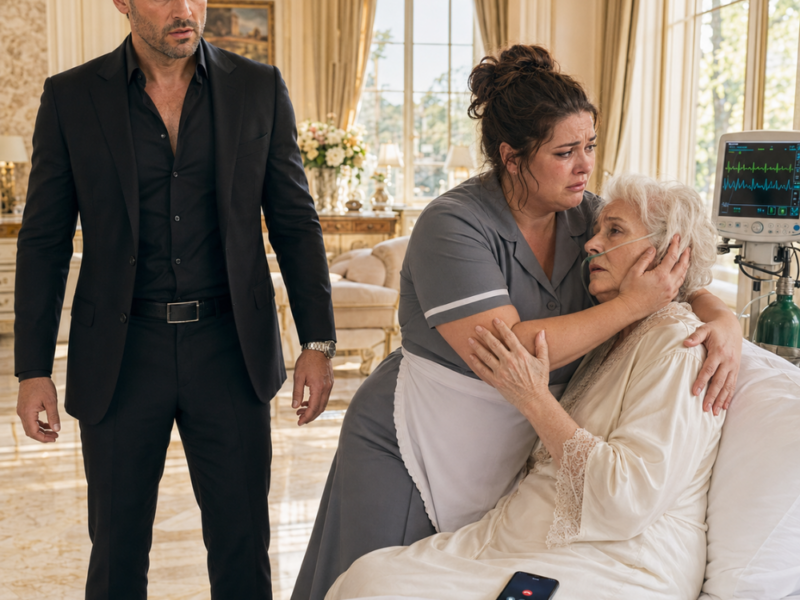
Mafia Boss Punished His Plus Size Maid—Hours Later, He Found His Dying Mother in Her Arms
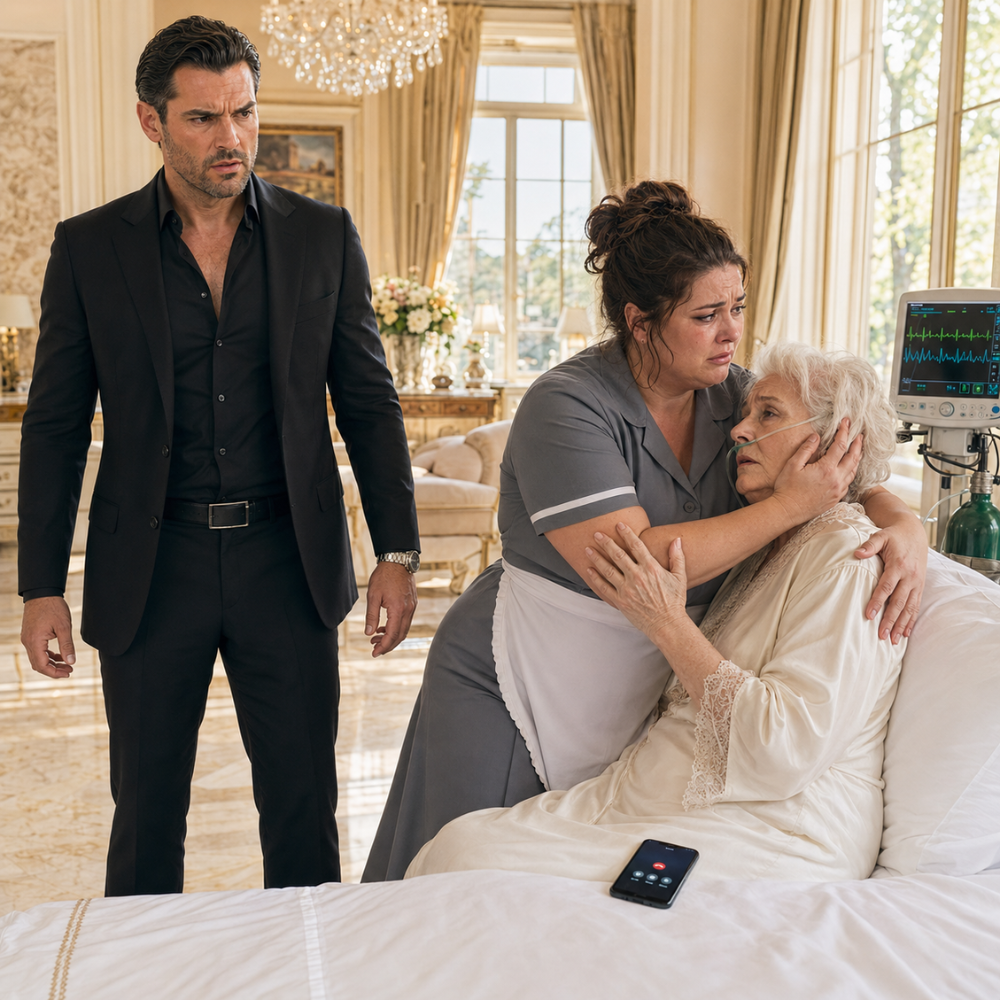
The Mafia Boss Punished His Plus-Size Maid—Hours Later, He Found His Dying Mother in Her Arms
The first thing Alessandra Galli noticed was that Rosa Romano’s medication looked wrong.
Not dramatically wrong.
Nothing a person passing through the bedroom would have noticed.
The IV bag hanging beside the old woman’s bed was clear. The printed pharmacy label matched the others stored in the locked cabinet. The tubing was new. The flow rate looked normal.
But Alessandra had spent enough years around hospital medication rooms to distrust anything that seemed almost normal.
She lifted the bag toward the afternoon light coming through the tall windows.
There.
A faint residue near the lower seam.
Barely visible.
She turned the bag once.
The particles shifted.
Her pulse changed.
Behind her, Rosa coughed weakly against the pillows.
“Alessandra?”
The seventy-four-year-old woman’s voice had become softer during the past month, the Italian vowels flattened by exhaustion.
Alessandra lowered the bag.
“I’m here.”
“Why are you staring at that thing like it insulted your mother?”
Despite herself, Alessandra smiled.
“It might have.”
Rosa managed half a laugh and immediately began coughing again.
Alessandra moved to her bedside.
“Slow breaths.”
“I am breathing slowly.”
“You’re arguing quickly.”
“That keeps me alive.”
“You and my father would have gotten along.”
“I doubt it.”
Rosa looked at her carefully.
“Why?”
“Because he argued with everybody.”
“Then I would have adored him.”
Alessandra looked away before Rosa could see what the mention of her father did.
Outside the bedroom doors, footsteps crossed the long marble corridor of the Romano estate.
The house occupied more land than any family needed in Lake Forest, north of Chicago, hidden behind stone walls, wrought-iron gates, and trees old enough to make the mansion appear as if it had grown there rather than been built.
The original house dated to the 1920s.
Santo Romano had renovated almost everything.
Security cameras.
Electronic gates.
Private offices.
A medical suite for his mother.
A kitchen large enough to feed fifty people without warning.
Yet certain things remained stubbornly old.
The stone fireplace in Rosa’s room.
The walnut staircase.
The little brass bell beside her bed that she refused to use because, as she often told Alessandra, “I still have a voice.”
Alessandra had been working there for seven months.
Officially, she was domestic staff.
Unofficially, Rosa had discovered within two weeks that Alessandra knew how to read a pulse oximeter and refused to let her go back to dusting downstairs.
“You are wasted on furniture,” Rosa had announced.
Santo had objected.
“She was hired through household staffing.”
Rosa had looked at her only son.
“And now I am household.”
That ended the discussion.
It was one of the few discussions Alessandra had ever seen Santo Romano lose.
Most people did not argue with Santo.
At forty-one, he controlled Romano Logistics, Romano Hospitality, and enough private construction and warehousing interests around Chicago to make his surname carry weight far beyond one company.
There were older stories too.
His father.
His grandfather.
Connections to organized crime that newspapers described carefully and neighborhood people described even more carefully.
Santo never discussed them.
He did not need to.
He had the kind of presence that made conversation around him become more precise.
He was tall.
Broad-shouldered.
Usually dressed in dark suits even at home.
He rarely shouted.
Alessandra had learned during her first month that his quietest voice was the one most likely to make a room nervous.
He also seemed to dislike her.
Not casually.
Consistently.
Her schedule was harder than the others’.
He assigned her to his mother’s wing, which meant long hours and constant attention.
If a tray arrived five minutes late, Santo noticed.
If Rosa’s medicine chart contained one unclear line, Santo asked about it.
If Alessandra disagreed with one of the private physicians, Santo’s expression went cold even when Rosa later proved Alessandra right.
At first Alessandra assumed he distrusted her because she came from outside his usual network.
Then she caught him looking at her once from the library doorway.
Not at her hands.
Not at the tray.
At her.
His eyes dropped away first.
After that, his cruelty made a different kind of sense.
A worse one.
Santo Romano did not know what to do with anything that made him feel uncertain.
So he controlled it.
Alessandra had spent most of her adult life being studied before she was understood.
She was thirty-three, five-foot-six, full-figured, and large enough that strangers often believed her body was an invitation for commentary.
Men made jokes.
Women occasionally made suggestions disguised as concern.
Doctors she worked beside years earlier assumed she lacked stamina until she completed sixteen-hour trauma shifts while younger nurses leaned against the supply cabinets.
Alessandra did not hate her body.
Life was too expensive for that.
Her body had worked night shifts.
Lifted patients.
Carried her father up apartment stairs after he broke an ankle.
Held dying strangers’ hands.
Survived grief.
It deserved more loyalty than other people’s opinions.
Before the Romano estate, Alessandra had worked six years as an emergency and trauma nurse at Cook County.
She had loved the work.
She had hated the hospital billing office.
More accurately, she hated what debt did to families.
Then debt reached hers.
Her father, Carlo Galli, spent years hiding a gambling problem behind jokes, small loans, and promises that the next week would be better.
When he died suddenly, Alessandra discovered how large the problem had become.
Some debts were legitimate.
Some questionable.
All urgent.
The family apartment had liens.
Her mother had already died years earlier.
There was no inheritance.
Only paperwork.
Alessandra left nursing after burnout and a disciplinary dispute with hospital administration over schedule changes she could no longer manage while dealing with the estate.
She intended to take three months off.
Instead, she accepted the Romano position because it came with unusually high wages, housing, health coverage, and an agreement that one of the family’s financial companies would restructure a portion of her father’s legitimate debts into something she could actually repay.
Nobody called it servitude.
It was not.
She could leave.
But leaving meant losing the income that made the numbers work.
Sometimes freedom existed legally before it existed financially.
Alessandra knew that difference.
That afternoon, holding Rosa’s IV bag toward the light, she felt the old hospital part of her mind become fully awake.
“Who changed this?”
Rosa looked toward the door.
“Dr. Evans’s assistant.”
“When?”
“Twenty minutes ago.”
“Did Dr. Evans come?”
“No. Thomas did.”
Thomas Keller was one of the estate medical aides.
Alessandra frowned.
“Did you see him open a new bag?”
Rosa smiled faintly.
“You think I supervise the nurses?”
“You supervise everyone.”
“That is true.”
Alessandra checked the line.
Rosa’s oxygen saturation had fallen during the past ten minutes.
Her heart rate was increasing.
The old woman had been suffering from unexplained episodes of respiratory weakness for nearly two months.
Specialists called it progressive pulmonary dysfunction.
Then medication sensitivity.
Then age-related decline complicated by prior pneumonia.
Each explanation seemed possible.
None completely fit.
Alessandra had said so twice.
Dr. Charles Evans, Rosa’s private physician, had dismissed her the first time.
“You’re household staff.”
“I’m also an RN.”
“Former RN.”
“My license is current.”
Evans had looked toward Santo.
Santo said, “Let the doctor work.”
Alessandra had stepped back.
She remembered that now.
She opened the medication cabinet.
Three sealed vials from the same delivery batch sat inside.
All carried the same faint residue.
Her stomach tightened.
She took one vial.
Held it under the lamp.
Rosa’s monitor began beeping faster.
Alessandra turned.
The old woman’s breathing had become shallow.
“Rosa?”
“I’m tired.”
“No.”
Alessandra moved immediately.
She stopped the infusion.
Clamped the line.
Disconnected the bag.
Rosa looked alarmed.
“What are you doing?”
“Stopping whatever is in this.”
“Alessandra.”
“Stay with me.”
She reached for a sterile syringe and drew a small sample from the bag through the medication port.
Evidence.
If she was wrong, the lab would say so.
If she was right, nobody would be able to claim later that she imagined it.
The bedroom doors opened.
Santo Romano entered.
He had been gone since early morning for a meeting near the stockyards.
Rain darkened the shoulders of his coat.
His expression already carried the anger of whatever had happened there.
Then he saw his mother.
The disconnected IV.
The syringe in Alessandra’s hand.
Everything went wrong at once.
“What did you do?”
Alessandra turned.
“Santo, listen to me.”
He crossed the room.
“What did you give her?”
“Nothing.”
Rosa tried to speak.
Her breath failed.
The monitor alarm sharpened.
Santo looked at the syringe.
Then the cut-off line.
Fear became fury before thought had time to intervene.
He grabbed Alessandra’s upper arms.
Hard.
“What did you put in her?”
“Nothing. The bag is contaminated.”
“You were holding the syringe.”
“Because I saved a sample.”
“From what?”
“The IV.”
His grip tightened.
Alessandra’s back touched the paneled wall.
“Santo.”
His face was inches from hers.
“You came into my house with debt tied to people I don’t trust.”
Her eyes widened.
“That has nothing to do with this.”
“My mother gets worse every week.”
“Yes.”
“And now I walk in and find you disconnecting her medication.”
“Because somebody is poisoning her.”
The word stopped the room.
Santo stared.
Behind them Rosa coughed.
Alessandra turned her head.
“She needs oxygen.”
Santo blocked her.
“No.”
“Move.”
“Not until security checks everything you touched.”
Alessandra looked at him in disbelief.
“You’re wasting time.”
His fear made him deaf.
“Renzo!”
The security director appeared almost immediately.
Two guards behind him.
Santo pointed toward Alessandra.
“Remove her from this wing.”
Rosa managed, “Santo.”
He went to his mother.
“I’m here.”
“Don’t—”
Her breath dissolved into coughing.
Santo turned to Renzo.
“Secure her somewhere downstairs until I know what happened.”
Alessandra stared.
“You cannot be serious.”
Renzo hesitated.
That mattered.
Santo saw.
“Now.”
Alessandra looked toward Rosa.
“Do not reconnect that bag.”
Santo’s jaw tightened.
“Take her.”
The guards escorted Alessandra through the service corridor.
No dragging.
No physical abuse.
That did not make the humiliation easier.
She passed two housekeepers.
Both looked down.
A kitchen worker stopped carrying a tray.
Nobody spoke.
Renzo took Alessandra to a temperature-controlled wine storage room on the lower level.
It was not an interrogation dungeon.
It was still a locked room.
Rows of bottles.
Stone floor.
Cool air.
A security camera above the door.
Renzo stood outside.
“Santo says you stay here until medical review is complete.”
Alessandra stared at him.
“You know me.”
“I know you work here.”
“You know I have been taking care of Rosa.”
“Yes.”
“Then check the bag.”
“I will.”
“Not with Evans.”
Renzo’s expression changed.
“Why?”
“I don’t trust him.”
“That is serious.”
“So is poisoning an old woman.”
Renzo studied her.
“Anything else?”
“Three vials in the medication cabinet. Same residue.”
“I’ll preserve them.”
“Do not let anybody administer another dose until an independent physician checks it.”
Renzo nodded.
“I hear you.”
He closed the door.
The lock engaged.
Alessandra sat on the small wooden bench.
Her arms hurt where Santo had gripped them.
Mostly she was furious.
At him.
At herself.
At the fact that a frightened man with power could turn an accusation into confinement before anyone else had time to object.
She closed her eyes.
Breathed.
Old trauma-nurse habit.
Inventory.
No immediate injury.
No dizziness.
No shortness of breath.
Hands steady.
Think.
Somebody had tampered with the medicine.
If Dr. Evans was involved, he would know Alessandra had seen too much the moment he learned she stopped the IV.
What happened next depended on who controlled Rosa’s care.
Alessandra stood.
Walked to the security camera.
“Renzo.”
No response.
She looked directly into the lens.
“If you can hear me, do not leave Rosa alone with Evans.”
Nothing.
She sat again.
Upstairs, Santo ordered the estate locked down.
Not because he knew there was an attack.
Because fear wanted structure.
Renzo preserved the IV bag and vials exactly as Alessandra requested.
That choice saved the evidence.
Dr. Evans arrived thirty-five minutes later.
He was sixty, polished, calm, and offended that anyone had interrupted a treatment plan he designed.
“What happened?”
Santo pointed toward the medication.
“Tell me.”
Evans examined the bag.
“Who disconnected this?”
“The maid.”
“Alessandra?”
“Yes.”
Evans shook his head.
“She had no authority.”
“Was the medication correct?”
“At first glance.”
“That isn’t what I asked.”
Evans looked at Santo.
“I need proper testing.”
Renzo stood near the door.
“I already sent samples.”
Evans turned.
“Sent where?”
“Independent laboratory.”
A pause.
Tiny.
Renzo noticed.
So did Santo.
“Why independent?” Evans asked.
Santo’s eyes narrowed.
“Why does that bother you?”
“It doesn’t.”
Evans moved toward Rosa.
“I need to restore her prescribed regimen.”
“No.”
Both men looked at Santo.
He pointed toward a replacement IV bag Evans’s assistant had brought.
“Nothing enters her until the outside lab clears it.”
Evans’s professional smile thinned.
“Santo, abrupt withdrawal may be dangerous.”
“So may continuing.”
Rosa opened her eyes.
“Stop arguing.”
Santo went to her.
“Ma.”
“Where is Alessandra?”
His face tightened.
“Downstairs.”
“Why?”
“Because I found her with—”
Rosa lifted one weak hand.
“She stopped it.”
Santo went still.
“What?”
“She looked scared.”
Rosa closed her eyes.
“Not of me.”
Santo stared.
“Why didn’t you tell me?”
“I tried.”
The answer hit.
Fear had not only made him wrong.
It had made him interrupt the one person he claimed to be protecting.
Renzo’s phone vibrated.
He read the message.
Then looked at Santo.
“We have another problem.”
“What?”
“Estate pharmacy records show two deliveries this week that never passed through the normal medical supplier.”
Evans spoke quickly.
“Temporary substitution.”
Renzo looked at him.
“Authorized by who?”
“My office.”
“Not documented.”
“I can explain.”
Santo turned toward Evans.
“You will.”
The doctor looked toward the door.
Renzo moved subtly into the path.
Nobody threatened him.
Nobody needed to.
“Sit,” Santo said.
Evans did.
At the same time, Thomas Keller, the aide who had hung Rosa’s IV, could not be found.
His car remained outside.
His coat remained in the staff room.
His phone went unanswered.
Renzo began reviewing camera footage.
That was when an informant from one of Romano Logistics’ South Side operations called.
The message was brief.
Marcus Moretti had been paying someone inside the estate’s medical operation.
Santo felt the room shift under him.
He looked at the disconnected bag.
Alessandra’s syringe.
Her face when she said somebody is poisoning her.
Then at his mother.
“What did I do?”
Renzo heard.
He had worked for Santo sixteen years.
Never heard him ask that question before.
“Boss.”
“Get her out.”
Renzo moved immediately.
Santo followed.
The wine-room door opened.
Alessandra was already standing.
“What happened?”
Santo looked at her.
For once, no command came.
“You were right.”
Her relief lasted half a second.
“Rosa?”
“Stable.”
“Right now?”
“Yes.”
“Who is with her?”
“Nurse Patel and an independent physician from Northwestern.”
“Evans?”
“Under supervision downstairs.”
Alessandra exhaled.
Then looked at Santo.
“You locked me in here.”
“Yes.”
“You grabbed me before I could explain.”
“Yes.”
“You accused me of trying to kill your mother.”
“Yes.”
He did not soften any answer.
Good.
She walked past him.
“I want to see Rosa.”
Santo stepped aside.
That was new.
They reached the second floor.
The hallway outside Rosa’s room was crowded with security and medical staff.
Alessandra stopped.
“Why are there so many people?”
“We’re moving her.”
“Where?”
“A hospital.”
“Good.”
Santo looked surprised.
“You agree?”
“She needs an actual hospital, not a bedroom controlled by people who may be compromised.”
He accepted the rebuke.
Inside, Dr. Mira Patel, a critical-care specialist Santo knew through Northwestern, reviewed Rosa’s chart.
“You were the nurse who stopped the infusion?”
Alessandra nodded.
“Former trauma nurse.”
“Current RN?”
“Yes.”
“Good catch.”
Santo looked at Alessandra.
Two ordinary words from another doctor hurt him more than accusation.
Good catch.
That was all he should have needed to hear hours earlier.
Rosa reached toward Alessandra.
She took the old woman’s hand.
“You disappeared.”
“I was downstairs.”
Rosa looked toward Santo.
Her eyes narrowed.
“What did you do?”
He said nothing.
Rosa understood anyway.
“You fool.”
Santo almost smiled.
“Yes.”
The independent lab called while the transfer team prepared Rosa for ambulance transport.
The preliminary screening detected a substance inconsistent with the prescribed medication.
Not a dramatic untraceable poison.
A powerful neuromuscular medication that, in the wrong dose and patient, could suppress breathing.
Enough.
Dr. Patel ordered emergency toxicology consultation and hospital transfer.
Police were notified because intentional tampering was now possible.
Santo did not object.
Renzo looked at him.
“CPD?”
“Yes.”
“Boss.”
Santo’s eyes remained on his mother.
“If someone tried to kill her, I want a case that survives court.”
That sentence marked the first major departure from the story everybody expected him to live.
Alessandra rode with Rosa to the hospital because Dr. Patel asked.
Not Santo.
That mattered to her.
At Northwestern Memorial, Rosa went directly into critical care.
The hospital environment changed everything.
No private household hierarchy.
No Romano rules.
Visitors waited.
Doctors decided.
Security followed hospital policy.
Santo sat beneath fluorescent lights like every other worried family member.
Alessandra watched him from across the waiting room.
His suit jacket lay folded beside him.
His hands stayed clasped.
He looked older.
Not less dangerous.
Less armored.
Two detectives arrived.
One from Lake Forest.
One from a regional public-corruption and organized-crime task force because of the family’s history and the possibility the attack involved business rivals.
They interviewed Alessandra separately.
“Tell us what you saw.”
She did.
No dramatic theories.
Medication residue.
Unexplained decline.
Bag discrepancy.
Why she stopped it.
The sample.
What she knew about Dr. Evans.
Then one detective asked about Marcus Moretti.
Alessandra hesitated.
“I overheard something.”
“When?”
“Two weeks ago.”
“Where?”
“Estate library.”
“What exactly?”
She described a conversation between Thomas Keller and a man she later recognized from a photograph as an employee of Moretti’s security company.
“Did you hear them discuss harming Rosa?”
“No.”
“Money?”
“Yes.”
“Exact words?”
“Something about the next delivery and double payment.”
The detective wrote.
“Why didn’t you report it?”
Alessandra looked down.
Because she had debts.
Because Santo distrusted questions.
Because wealthy families always seemed to have ten ways to make a poor person regret being inconvenient.
Instead she said:
“I was afraid I was interpreting it wrong.”
The detective nodded.
“Reasonable.”
Alessandra almost laughed.
Fear rarely felt reasonable while living inside it.
Santo gave his statement separately.
He did not minimize what he had done to Alessandra.
That surprised everyone.
“I restrained her arms.”
“Why?”
“I believed she harmed my mother.”
“Did she threaten you?”
“No.”
“Try to flee?”
“No.”
“Were you injured?”
“No.”
The detective looked at him.
“Mr. Romano, you understand she may have grounds to make a complaint about how she was treated.”
“Yes.”
“Any objection if we advise her of that?”
“No.”
Santo looked toward the ICU doors.
“She should be advised of everything she has a right to know.”
Renzo glanced at him.
Another new sentence.
Rosa stabilized overnight.
The toxicology team believed the medication had contributed significantly to her respiratory decline over weeks.
The latest dose had been larger.
Not necessarily enough to kill instantly.
Enough to make the situation life-threatening in an elderly patient.
The evidence pointed toward systematic tampering.
Dr. Evans retained counsel.
Thomas Keller was located the next morning at a motel near O’Hare and questioned.
Financial records tied both men to a private healthcare-consulting company with indirect connections to one of Marcus Moretti’s businesses.
The investigation expanded.
Santo wanted to move faster.
Renzo knew.
Everyone knew.
His old method sat inside him like a loaded spring.
Find Marcus.
Demand answers.
End the threat privately.
Instead, Santo remained in the hospital cafeteria at six in the morning while federal coffee burned his tongue and Detective Lena Park from the task force said:
“If you interfere, you contaminate our case.”
Santo looked at her.
“I understand.”
“Do you?”
“Yes.”
“You have people.”
“Yes.”
“Tell them to stand down.”
He almost smiled.
“You’ve done your homework.”
“I like keeping witnesses alive.”
Santo’s smile disappeared.
“So do I.”
“Good.”
She slid a preservation order across the table.
“Then sign acknowledgement.”
He did.
Alessandra saw him twenty minutes later.
She had changed into borrowed hospital scrubs after someone from the estate brought clothing.
She looked exhausted.
Santo stood.
She did not.
“Rosa asked for you.”
“I know.”
“She also asked whether you were all right.”
Alessandra stared.
“Did you tell her?”
“That I don’t know.”
“Good answer.”
Silence.
Then Santo said:
“I owe you an apology.”
She looked at him.
“That sounds small.”
“It is.”
“I almost killed my mother because I decided fear was evidence.”
Alessandra’s expression changed.
“You didn’t almost kill her.”
“I locked the person who recognized the danger in a room.”
“You also stopped the second medication once Renzo checked it.”
“After.”
“Yes.”
She did not let him erase failure.
She also did not let him turn it into a larger sin than the facts supported.
Santo sat across from her.
“I hurt you.”
“Yes.”
“I had no right.”
“No.”
He swallowed.
“I am sorry.”
Alessandra looked toward the cafeteria windows.
Morning light turned downtown buildings silver.
“What happens to my father’s debt?”
“Gone.”
She turned sharply.
“No.”
He looked surprised.
“What?”
“You do not erase debt because you feel guilty.”
“I can.”
“That is exactly the problem.”
His face hardened instinctively.
Then he stopped.
Alessandra continued.
“If the debt is legitimate, I want the documents.”
“If it isn’t, I want that in writing.”
“I do not want a gift that means I’m expected to forget what happened.”
Santo watched her.
Nobody in his adult life spoke to him like this.
Not anymore.
“What do you want?”
“Independent review.”
“By who?”
“My lawyer.”
“You have a lawyer?”
“I called one this morning.”
Another surprise.
“Good.”
Alessandra looked at him.
“You mean that?”
“Yes.”
“Why?”
“Because I’m learning that if the only people around me are people I pay, then I do not have advice.”
Her expression softened by one degree.
“Maybe.”
Santo looked toward his coffee.
“I noticed you from the day you arrived.”
Alessandra’s eyes narrowed.
“That seems unrelated.”
“It is.”
“Then don’t.”
He stopped.
She appreciated that.
Months later, that small moment would matter more than any confession he could have made then.
He had something he wanted to say.
She said no.
He did not say it.
Rosa spent six days in the hospital.
During that time, investigators built the first solid picture of what had happened.
Marcus Moretti had been trying to weaken Romano Holdings during a major port-contract dispute.
Not by launching a street war.
By creating instability.
Rosa’s worsening health consumed Santo’s time and attention.
Dr. Evans, facing major gambling and tax debts of his own, accepted money to alter medication.
Thomas Keller handled deliveries.
Neither was a professional assassin.
They were compromised people making increasingly dangerous decisions because each earlier decision made the next one easier.
Marcus had not personally ordered Rosa’s death in writing.
People rarely wrote crimes down so conveniently.
There were messages.
Payments.
Encrypted scheduling notes.
Enough for conspiracy and fraud investigations.
Potentially more.
Detective Park insisted on patience.
Santo hated patience.
Alessandra noticed.
“You’re pacing.”
They were outside Rosa’s room.
“I don’t pace.”
“You’re walking twelve feet in both directions repeatedly.”
“I’m thinking.”
“You’re pacing.”
He stopped.
“Are nurses always like this?”
“Good ones.”
Santo looked through the glass.
“My mother could’ve died.”
“Yes.”
“You say that very calmly.”
“So did many of my patients.”
He looked at her.
Alessandra continued.
“Anger does not make the next decision better.”
“Sometimes it does.”
“No.”
“Sometimes fear does.”
“No.”
He almost argued.
Then remembered the wine room.
“Fine.”
She smiled faintly.
“Progress.”
Rosa was discharged to a private rehabilitation apartment connected to a medical service independent of the estate.
Her choice.
Santo wanted her home.
Rosa refused.
“I am not returning until every person who touched my medication is identified.”
“Ma.”
“No.”
“You hate rehab.”
“I hate being poisoned more.”
Alessandra laughed before she could stop herself.
Rosa pointed.
“She agrees.”
Santo looked betrayed.
“Of course she does.”
Rosa turned toward Alessandra.
“Come work with me.”
Alessandra hesitated.
Not as a maid.
Not again.
Rosa understood.
“As my private nurse.”
“I’m not sure I want to work for your family.”
“Good.”
Rosa smiled.
“Then work for me.”
Independent contract.
Reviewed by Alessandra’s attorney.
Normal market salary.
Benefits.
No debt deductions.
Termination protections.
Clear medical authority.
Alessandra accepted for three months.
Temporary, she told herself.
The debt review produced another surprise.
Her father’s largest obligation to the Romano-associated finance company had already been settled two years earlier through the liquidation of his restaurant share and insurance proceeds.
Smaller legitimate debts remained, but nowhere near what Alessandra believed.
A payroll administrator had continued deductions using an outdated account schedule.
Not conspiracy.
Negligence.
Santo refunded every improper deduction with interest.
Alessandra accepted because it was hers.
That distinction mattered.
She used part of the money to pay off remaining legitimate debts.
Another part went into savings.
For the first time in years, she had a bank account containing enough money to make leaving an actual option.
Something inside her changed.
Not gratitude.
Breathing room.
Financial safety could feel almost physical.
The criminal investigation moved forward.
Marcus Moretti was charged months later in connection with fraud, conspiracy, bribery, and related offenses tied to Romano medical staff and several business disputes.
No nightclub shootout.
No revenge convoy.
No city war.
Santo cooperated through attorneys.
Privately, people called that restraint weakness.
Then they watched two banks cancel Moretti financing.
Three partners withdrew.
A state licensing board froze one company’s operating authority.
Federal prosecutors seized records.
Suddenly legality looked powerful too.
Renzo admitted he was impressed.
Santo said, “Don’t get sentimental.”
“I’m not.”
“You are.”
“I miss simpler days.”
“Which days?”
“When problems were stupid enough to announce themselves.”
Santo almost smiled.
The estate changed.
First security.
Then medical operations.
Then household policy.
No employee could be confined anywhere as discipline.
Santo’s lawyer had added that rule after hearing the wine-room story.
Alessandra had said:
“You needed a lawyer to tell you that?”
Apparently yes.
A new HR director reported independently outside household management.
Staff could document concerns without supervisor approval.
Medical care was entirely outsourced to licensed providers with dual verification of high-risk medication.
Santo hated how bureaucratic the house became.
Rosa loved it.
“Forms are irritating,” she told him.
“That is why they work.”
Alessandra returned to the estate occasionally but no longer lived there.
She rented a second-floor apartment in Evanston above a bakery.
The first morning she woke to the smell of bread and almost cried from how ordinary it felt.
Her furniture was mismatched.
Her couch came from Facebook Marketplace.
Her kitchen table was used.
She bought a houseplant.
Killed it within two months.
Rosa teased her.
“You can restart a woman’s breathing but not keep basil alive?”
“Basil is vindictive.”
“You forgot to water it.”
“That is your interpretation.”
Alessandra began taking hospital shifts again.
Per diem at first.
Then part-time.
The first night back in an emergency department, the noise hit her like memory.
Monitors.
Carts.
Phones.
Shoes against tile.
A resident asking for labs.
A frightened family demanding answers.
Alessandra stood near the trauma bay doors and thought:
Home.
Not completely.
Enough.
She kept working for Rosa two days a week during rehabilitation.
That meant seeing Santo.
Often.
He was different around his mother.
Still controlled.
Less polished.
Rosa ordered him to peel oranges.
He did.
Poorly.
Alessandra watched.
“You left half the fruit on the rind.”
“It is an orange.”
“It is now a financial loss.”
“You are enjoying this.”
“Immensely.”
Rosa smiled from the sofa.
“I hired her because she tells you things.”
Santo looked at his mother.
“You hired her because she saved your life.”
“Also useful.”
Months passed before Santo tried speaking about whatever existed between him and Alessandra.
He chose badly.
Of course he did.
They were standing outside Rosa’s rehabilitation apartment after a cardiology appointment.
“I want to take you to dinner.”
Alessandra stared.
“No.”
Santo blinked.
He was not accustomed to hearing no before a sentence ended.
“No?”
“No.”
“Why?”
“Because the last time you had strong feelings involving me, I ended up locked downstairs.”
That shut him up.
Alessandra continued.
“You are trying to move from guilt to romance because guilt is uncomfortable.”
His face hardened.
Then softened.
“Maybe.”
“Definitely.”
“I am attracted to you.”
“That is your problem.”
Santo almost laughed.
“I think about you.”
“Also yours.”
“I would like it to become partly yours.”
“Very efficient.”
He exhaled.
“What would make you believe this is not guilt?”
“Time.”
“How much?”
“If you ask that, more.”
He nodded.
“Fair.”
Then he left.
No pressure.
No gifts.
No surprise reservations.
That impressed her more than asking correctly would have.
Santo continued changing things because they needed changing.
Not because Alessandra was watching.
She verified that by not watching.
A year passed.
Rosa recovered far more than doctors initially expected.
Her respiratory function remained reduced but stable.
She moved back to a smaller guesthouse on the Lake Forest property rather than the main residence.
“I don’t need twenty-three rooms.”
Santo said, “There are eighteen.”
“That makes it reasonable?”
“No.”
The guesthouse had four.
Rosa filled one with books and another with sewing supplies she barely used.
She hosted Sunday lunch.
Bruno from the kitchen made too much pasta.
Renzo complained there were no quiet Sundays anymore.
Everyone ignored him.
Alessandra came twice a month after her nursing schedule became heavier.
Santo did not always attend.
Good.
Their relationship developed in absence as much as presence.
He became someone who respected her work schedule.
Did not call during shifts.
Did not send security to follow her without permission.
That last one required an argument.
After Moretti associates were released pending trial, Santo quietly assigned a car near Alessandra’s apartment.
She spotted it in two days.
Called him.
“Is that your person in the black Audi?”
Silence.
“Santo.”
“Yes.”
“Remove him.”
“I want you safe.”
“You want to manage your anxiety.”
“That too.”
“I did not agree.”
“He’s on a public street.”
“Santo.”
He exhaled.
“Fine.”
The car disappeared.
The next week he asked:
“Would you consider an emergency app tied to my security team?”
Alessandra thought.
“If I can turn it off.”
“Yes.”
“If it doesn’t share location unless activated.”
“Yes.”
“My lawyer reviews it.”
He looked wounded.
“You bring your lawyer into everything.”
“She likes you.”
“No, she doesn’t.”
“Exactly.”
He smiled.
“Fine.”
That was trust.
Not surrender.
Negotiation.
Alessandra’s body remained part of the world’s commentary.
Hospital patients occasionally made remarks.
A woman once told her she was “pretty for a bigger girl.”
Alessandra answered:
“And you are surprisingly healthy for someone with pneumonia.”
The woman stared.
Then laughed.
At the estate, nobody made jokes anymore.
Not because Santo threatened them.
Because Rosa heard one young security contractor comment on Alessandra’s weight and dismissed him from her guesthouse rotation.
Santo heard later.
“You fired him?”
Rosa raised an eyebrow.
“He works elsewhere on the property.”
“You removed him from your detail.”
“Yes.”
“Why?”
“He was boring.”
Alessandra laughed.
Rosa smiled.
“Also rude.”
What Santo loved about Alessandra eventually had almost nothing to do with the thing that first caught his attention.
Yes, she was beautiful.
He never pretended otherwise.
But beauty stopped being the interesting part.
She was difficult to impress.
Impossible to intimidate once financially independent.
Kind without performing kindness.
Fierce about patients.
Terrible with houseplants.
She bought used mystery novels and underlined sentences in pencil.
She knew the names of hospital janitors.
She called her father’s old voicemail for almost a year after his death because hearing him say his name mattered.
She forgave slowly.
Santo learned slowly.
One evening, eighteen months after Rosa’s poisoning, Santo came to the hospital cafeteria near the end of Alessandra’s shift.
He wore no suit.
Dark sweater.
Coat.
No Renzo.
Alessandra sat with terrible vending-machine coffee.
“What are you doing here?”
“You get off in twenty minutes.”
“How do you know?”
“You told my mother.”
“Information laundering.”
“She is skilled.”
He placed a paperback on the table.
Alessandra looked.
It was a used copy of a mystery novel she had complained was out of print.
No first edition.
No expensive collector’s copy.
Seven-dollar used bookstore sticker still attached.
She looked at him.
“You found this?”
“Yes.”
“How?”
“Internet.”
“You used the internet yourself?”
“I have people.”
She gave him a look.
He smiled.
“I found it myself.”
“Progress.”
He sat.
“I’m asking again.”
“Dinner?”
“Yes.”
Alessandra studied him.
He waited.
No entitlement.
No guilt.
No mention of what he had done for her.
No promise to protect her from the world.
Just a man asking.
“Saturday.”
His expression barely changed.
That was still enough.
“Seven?”
“Six-thirty.”
“Why?”
“I get hungry.”
“Six-thirty.”
“Public restaurant.”
“Yes.”
“My choice.”
He paused.
“Fine.”
“No security at the table.”
“They’ll be nearby.”
“Not visible.”
Santo sighed.
“Negotiable.”
“Then no.”
“Fine.”
Alessandra smiled.
Their first date was at a Greek restaurant in Lincolnwood.
Santo had never been.
That was why Alessandra chose it.
Nobody cared about his last name.
The waiter called him “boss” only because he called every male customer boss.
Santo hated it.
Alessandra loved it.
He ordered lamb.
She ordered fish.
They discussed almost everything except family business.
Hospital shifts.
Books.
Chicago winters.
Her father.
His mother.
When dessert arrived, Santo asked:
“Do you still hate me?”
Alessandra thought.
“No.”
“Did you?”
“Yes.”
He nodded.
“How long?”
“Long enough.”
“Fair.”
She looked at him.
“Do you hate yourself for what happened?”
His expression changed.
“Yes.”
“That is not useful forever.”
“No.”
“It also becomes selfish after a while.”
He frowned.
“Explain.”
“If you spend the rest of your life suffering over what you did to me, then I still have to live around your feelings about it.”
Santo stared.
“You make forgiveness sound like administrative policy.”
“I’m a nurse.”
“I like policies.”
“No, you don’t.”
“True.”
She took a bite of dessert.
“Do better.”
“That’s it?”
“That is plenty.”
He did.
Not perfectly.
Sometimes control returned.
Sometimes he mistook secrecy for protection.
Sometimes Alessandra withdrew too quickly because old fear told her dependence always turned into leverage.
They learned.
Slowly.
The criminal cases ended years later.
Dr. Evans lost his medical license and received a federal sentence after pleading guilty to charges tied to medication tampering, fraud, and conspiracy.
Thomas Keller cooperated and received a lesser sentence.
Marcus Moretti faced separate convictions related to financial crimes, bribery, and conspiracy.
Nobody in court called it a mafia war.
It was a case.
Documents.
Witnesses.
Bank transfers.
Medical records.
The kind of boring evidence that did more lasting damage to criminal networks than revenge often did.
Santo testified through counsel where required.
The newspapers loved that.
ROMANO BOSS TURNS TO COURTS.
He hated the headline.
Alessandra framed it.
He found it in her apartment.
“You framed this?”
“It brings me joy.”
“You are cruel.”
“Administrative cruelty.”
Rosa celebrated eighty with a Sunday lunch.
No ballroom.
Family.
Staff.
Former nurses.
A Costco sheet cake despite Santo’s offer to hire a pastry chef.
Rosa insisted.
“It tastes like birthdays.”
Nobody argued.
During lunch she lifted a glass.
“I was told I nearly died once.”
Santo groaned.
“Ma.”
“I was there.”
“You were unconscious for part.”
“Technicality.”
She looked toward Alessandra.
“This woman saved me.”
Alessandra started shaking her head.
Rosa continued.
“And this idiot locked her in a wine room.”
Everyone looked at Santo.
He stared at his mother.
“I thought we agreed not to tell that story at lunch.”
“I agreed to nothing.”
Renzo looked down to hide a smile.
Rosa raised her glass.
“To second opinions.”
Everyone laughed.
Santo did too.
Alessandra thought about how different the room felt from the Lake Forest house on her first day.
Nobody silent from fear.
Nobody pretending powerful people were automatically correct.
Rosa pointed at Santo.
“And apologies.”
He sighed.
“To apologies.”
Glasses clinked.
Later, Santo and Alessandra stood outside beneath maple trees turning orange.
“You enjoyed that.”
“Immensely.”
“My humiliation entertains you.”
“Only the deserved parts.”
He took her hand.
By then they had been together nearly three years.
No marriage yet.
Alessandra had refused the first proposal.
Santo had chosen an expensive rooftop restaurant.
Private terrace.
Ring.
Too much.
She looked at him.
“No.”
He almost dropped the box.
“No?”
“I love you.”
His face showed confusion.
“That is usually the difficult part.”
“No.”
“The difficult part is that you still think major decisions become safer when you surround them with expensive things.”
He stared at the skyline.
“What should I have done?”
“Ask me in my kitchen.”
“You hate your kitchen chairs.”
“Exactly.”
He laughed eventually.
Six months later, he asked while Alessandra was making coffee before an early shift.
No ring visible.
No speech.
“Would you marry me?”
She turned.
“Are you asking because Rosa told you to?”
“She told me not to.”
“Why?”
“She thinks you deserve better.”
“She is correct.”
Santo smiled.
Alessandra looked at him.
A man who once grabbed her arms before asking what happened.
A man who later learned to stop, ask, listen, document, wait.
Not transformed into someone harmless.
She did not want fiction.
He was still difficult.
Still carried a history she could not romanticize.
Still ran businesses built partly from a family legacy she sometimes disliked.
But he had spent years moving those businesses toward something cleaner.
Not because love erased history.
Because responsibility required direction.
“Yes.”
Santo went still.
“You’re sure?”
“Do not ruin this.”
“Yes, ma’am.”
They married at City Hall.
Rosa complained.
“I bought a dress.”
“You may wear it to lunch.”
“That is not the same.”
Bruno cooked afterward.
Renzo signed as witness.
Alessandra wore cream.
Santo wore dark blue.
No press.
No hundreds of guests.
No vows about kingdoms or obsession.
When it was Santo’s turn, he said:
“I promise to ask before deciding for both of us.”
Alessandra stared.
“That is extremely specific.”
“I was advised specificity improves compliance.”
Everyone laughed.
She answered:
“I promise to tell you the truth before I become so angry that I weaponize it.”
Rosa whispered, “Also useful.”
That was marriage.
Not perfect people.
Specific promises.
Years passed.
Alessandra eventually left trauma nursing full-time and helped establish a clinical advocacy service for homebound older adults whose families used private medical care.
The idea came directly from Rosa.
Wealthy patients, Alessandra discovered, could be vulnerable in unusual ways.
Private medicine often meant fewer independent eyes.
One doctor.
One household.
One family office.
Too much trust concentrated in too few people.
The service created medication reconciliation.
Outside review.
Family education.
Patient advocates independent from household employers.
Santo funded the first year.
Alessandra insisted an independent board control it afterward.
“Why do you keep removing me from things I pay for?”
“Governance.”
“I hate governance.”
“That is why you need it.”
The service expanded.
Not only wealthy clients.
Grants supported low-income seniors transitioning from hospitals to home care.
Alessandra spent more time in modest apartments than mansions.
She preferred that.
One patient, Mr. Williams, lived alone in Bronzeville and kept his medication inside an old cookie tin.
Alessandra reorganized everything.
He complained.
“You nurses like boxes.”
“We like you not taking Thursday pills on Monday.”
“Thursday pills look better.”
“They are identical.”
“Then how do they know it’s Thursday?”
Alessandra laughed.
Ordinary work.
Useful work.
Santo sometimes asked why she continued.
“You could stop.”
“I know.”
“You don’t need money.”
“I know.”
“Then why?”
She looked at him.
“Because needing money was never the only reason people work.”
He nodded.
He had learned that too.
Rosa died peacefully at eighty-six.
No poisoning.
No mystery.
Age.
Heart failure.
Family beside her.
Alessandra held one hand.
Santo held the other.
Near the end, Rosa opened her eyes.
Looked at Alessandra.
Then Santo.
“You two are exhausting.”
Those were nearly her last clear words.
Santo laughed and cried at the same time.
After the funeral, he spent three days barely speaking.
Alessandra did not tell him to be strong.
She hated that phrase.
Grief was not a test of masculinity.
One night Santo stood in the kitchen staring at Rosa’s old espresso cup.
“I almost lost all these years.”
Alessandra knew what he meant.
The poisoning.
“That is not what happened.”
“It almost did.”
“Yes.”
He looked at her.
“Because of me.”
“Partly.”
“Alessandra.”
“You stopped the second dose.”
“After accusing you.”
“Yes.”
“You brought in outside doctors.”
“Renzo found records.”
“Police built a case.”
“Rosa fought.”
She touched his arm.
“Stop turning the worst day of your life into proof that everything afterward was borrowed.”
Santo looked down.
“She got twelve more years.”
“Yes.”
“She hated my oranges for twelve more years.”
“Correct.”
He smiled through grief.
Alessandra leaned against him.
“That is the story.”
The Lake Forest estate was eventually sold.
Too large.
Too much memory.
Santo and Alessandra moved into a house in Evanston near the lake.
Still expensive.
Alessandra called it “almost human-sized.”
Santo pointed out six bedrooms.
“Exactly.”
He never won that argument.
The wine cellar was ordinary.
Unlocked.
The first time Alessandra saw it, she stopped.
Santo noticed.
“I can remove the door.”
“No.”
“You sure?”
“Yes.”
She walked inside.
Rows of bottles.
Cool air.
Nothing else.
She touched the shelf.
For years she had remembered the locked room as evidence of how quickly someone with power could take choice away.
Now it was a room.
Just a room.
She turned.
Santo waited outside rather than following her in.
That mattered.
“Come.”
He stepped inside.
She handed him a bottle.
“What is this?”
“Wine.”
“I gathered.”
“Open it.”
“It’s Tuesday.”
“Rebellion.”
They drank one glass each upstairs with pizza.
Healing was sometimes insultingly ordinary.
A room lost its terror.
A man learned not to follow until invited.
A woman stopped measuring every exit.
No dramatic victory.
Just Tuesday.
Years later, Alessandra spoke to a group of nursing students at Rush University.
The professor had invited her to discuss patient advocacy in private-care environments.
Nobody mentioned Santo.
Nobody mentioned organized crime.
One student asked:
“What do you do when a family member is powerful and refuses to listen?”
Alessandra thought.
“Document.”
The student waited.
“Escalate.”
“Use another clinician.”
“Use hospital policy.”
“Call authorities if safety requires it.”
She paused.
“And do not confuse the family’s confidence with medical evidence.”
Another student asked:
“What if you’re afraid of losing your job?”
Alessandra looked toward the room.
That question mattered.
“Then the system has already failed you.”
She continued.
“That doesn’t make fear disappear.”
“It means we need reporting structures where doing the safe thing does not require somebody to become heroic.”
She thought of herself years earlier.
An IV bag.
A syringe.
Santo entering angry.
Maybe the entire disaster would have been smaller if the house had contained one independent medical supervisor.
One clear reporting line.
One culture where a maid with a nursing license could say this looks wrong without being treated like an enemy.
Heroes were expensive.
Systems were supposed to make them unnecessary.
Afterward, a student approached privately.
“You’re Alessandra Romano.”
“Yes.”
“My uncle worked at one of your husband’s hotels.”
Alessandra smiled.
“That narrows nothing.”
“He said Mr. Romano used to be terrifying.”
“Used to?”
The student laughed.
“He said now everybody has to fill out forms before he can fire anyone.”
Alessandra laughed harder.
“That sounds right.”
“Was that you?”
“Partly.”
She went home.
Santo sat at the kitchen counter reading hotel reports.
“Someone at Rush says you are less terrifying because of paperwork.”
He looked offended.
“Who?”
“Confidential source.”
“I can still be terrifying.”
“Of course.”
He held up a forty-page compliance packet.
“Look.”
Alessandra kissed his forehead.
“Very scary.”
He smiled.
The old Chicago stories about Santo Romano never fully disappeared.
Some were true.
Some exaggerated.
Some belonged to men who needed old legends because the present had become too boring for them.
Alessandra never tried to clean his past into romance.
That would insult both of them.
Love did not make wrongdoing good.
It did not turn domination into protection.
It did not erase the afternoon he accused her before listening.
What love did, over years, was create enough honesty for two people to look at the worst parts without rewriting them.
One evening on their tenth anniversary, Santo asked:
“Do you ever think about leaving?”
Alessandra was reading on the sofa.
She looked up.
“What kind of anniversary question is that?”
“A real one.”
She closed the book.
“Sometimes.”
He looked surprised.
“Why?”
“Because everybody thinks staying means I decided every part of you was acceptable.”
“And?”
“I didn’t.”
Santo nodded.
“I know.”
“I stayed because you kept changing the parts that weren’t.”
“That sounds conditional.”
“All healthy love is conditional.”
He frowned.
“You love me conditionally?”
“Yes.”
“On what?”
“That you don’t lock me in cellars.”
He laughed.
“Very demanding.”
“I have standards.”
Then she became serious.
“On honesty.”
“Choice.”
“Respect.”
“On you remaining someone who can hear no.”
Santo looked at her.
“And if I stop?”
“I leave.”
He nodded.
“Fair.”
“What about you?”
“What?”
“Do you ever think about leaving?”
“No.”
She raised an eyebrow.
“That answer worries me.”
Santo considered.
Then corrected himself.
“I think about whether staying continues to be good for both of us.”
“Better.”
He smiled.
“Marriage is exhausting.”
“You wanted it.”
“Repeatedly.”
She returned to her book.
Santo went back to his reports.
That was what their life had become.
Less obsession.
More attention.
Less control.
More conversation.
Far less cinematic.
Much safer.
One winter afternoon Alessandra visited Cook County Hospital for a meeting.
She passed the old emergency department where she had once worked.
The hallway looked smaller.
A nurse pushed a medication cart.
A resident jogged toward imaging.
Someone argued with insurance on the phone.
Alessandra stood there briefly.
She had once believed leaving nursing meant losing the only version of herself that mattered.
Then she became a maid.
A caregiver.
A witness.
A patient advocate.
A wife.
None replaced the nurse.
They simply added.
A young orderly recognized her from an advocacy seminar.
“Ms. Romano?”
“Alessandra.”
He smiled.
“Right.”
That mattered too.
Names.
She had spent enough of her life around households where jobs replaced names.
Maid.
Guard.
Cook.
Doctor.
Driver.
The easiest way to mistreat somebody was often to turn the person into the function they served.
Santo had once looked at her and seen suspect before hearing nurse.
Marcus Moretti looked at physicians and saw assets.
Dr. Evans looked at Rosa and saw a problem attached to money.
The system failed because people became useful objects in other people’s plans.
Alessandra built her later work around the opposite idea.
Who is this person?
What do they want?
Who gets to decide?
Three small questions.
They prevented more harm than intimidation ever had.
At home that night, Santo was attempting to cook.
Smoke came from the kitchen.
Alessandra dropped her bag.
“What happened?”
“The recipe is wrong.”
“The recipe has been used by millions of people.”
“Collective error.”
She opened the oven.
“Why is the temperature five hundred?”
“It said high heat.”
“Four twenty-five is high heat.”
“That sounds subjective.”
She turned it down.
“You used to run half the logistics routes in Chicago.”
“I still do.”
“And chicken defeats you.”
“The chicken is unpredictable.”
Alessandra laughed.
Santo watched her.
“What?”
“Nothing.”
“You’re doing the face.”
“What face?”
“The one where you become sentimental and pretend you aren’t.”
He leaned against the counter.
“I was thinking about my mother.”
Alessandra softened.
“What about her?”
“She would be insulting this chicken.”
“Yes.”
“She would blame me.”
“She would be correct.”
Santo smiled.
Then looked toward the rain against the windows.
“I was also thinking about that day.”
Alessandra knew.
“You don’t have to.”
“I know.”
He looked at her.
“The thing I remember most is not the IV.”
“What?”
“You telling me to move.”
She had forgotten.
“I did?”
“You said, ‘Move. You’re wasting time.’”
Alessandra smiled faintly.
“That sounds like me.”
“I thought nobody in the house was afraid enough.”
He shook his head.
“I had it backward.”
“Fear made everybody slower.”
“Yes.”
“You too.”
“Yes.”
They stood quietly.
Then the smoke alarm beeped.
Alessandra looked toward the oven.
“Your dinner is dying.”
Santo grabbed the mitts.
“Finally, something I can save.”
She laughed.
The chicken was terrible.
They ate it anyway.
At one point Santo said:
“I could order something.”
“No.”
“Why?”
“Consequences.”
He sighed.
Years earlier, consequences had meant courts, betrayal, illness, violence narrowly avoided.
Now they meant eating dry chicken.
Alessandra preferred this version.
The Lake Forest story survived mostly among the people who had been there.
Renzo told it differently every year.
Rosa had told it most dramatically.
Santo told almost nobody.
Alessandra corrected anyone who described her as the maid who saved the mafia boss’s mother.
“I was a nurse working as household staff.”
The distinction mattered.
“What made you notice the medicine?”
“Training.”
“Were you fearless?”
“No.”
“Did you know Santo would apologize?”
“Absolutely not.”
“Why go back upstairs after he let you out?”
“Because Rosa needed help.”
“Even after what he did?”
“Patients do not become less sick because their relatives behave badly.”
That was the answer.
Simple.
The best part of Alessandra had never been that she was willing to love a dangerous man.
It was that she remained herself in rooms designed to make people smaller.
Her body.
Her intelligence.
Her boundaries.
Her profession.
Her anger.
Her capacity for forgiveness without amnesia.
She carried all of it.
Santo eventually understood that loving her did not mean building walls around her.
He had walls.
Gates.
Security.
Money.
Influence.
None of them saved his mother.
The person he almost removed from the equation did.
Not because she was physically strongest.
Not because she was fearless.
Because she saw something wrong and acted.
Then insisted on evidence.
Then demanded independent doctors.
Then refused to let gratitude become debt.
That was why, when people later called Alessandra the heart of Santo Romano’s empire, she hated the phrase.
“I’m not the heart of anybody’s empire.”
She told Rosa that once.
Rosa smiled.
“What are you then?”
Alessandra thought.
“Independent contractor.”
Rosa laughed so hard she had to use her inhaler.
Years later, Santo repeated the joke at dinner.
Alessandra corrected him.
“Former independent contractor.”
“Current wife.”
“Not a job title.”
“According to my accountant—”
“Santo.”
He raised both hands.
“Sorry.”
Their daughter, Sofia, sitting across the table, groaned.
“You two are weird.”
Alessandra smiled.
“Yes.”
“Were you always like this?”
Santo looked at Alessandra.
“No.”
She looked back.
“Definitely not.”
Sofia frowned.
“How did you meet?”
Santo opened his mouth.
Alessandra pointed.
“You are not telling the wine-room version at dinner.”
“There are versions?”
Their son Mateo looked delighted.
Santo smiled.
“Many.”
Alessandra sighed.
“Someday.”
“When?”
“When you’re forty.”
“That’s unfair.”
“Life.”
Santo leaned toward the children.
“Your mother saved your grandmother’s life.”
Alessandra looked at him.
That part she allowed.
Sofia asked:
“How?”
“She noticed something the rest of us missed.”
Santo’s voice became quieter.
“And then she kept doing the right thing after I made it very difficult for her.”
Alessandra looked at him.
No glorifying.
No hiding.
Good.
Mateo asked:
“Did you say sorry?”
Santo nodded.
“Many times.”
“Did Mom forgive you?”
Alessandra answered.
“Eventually.”
“Why?”
She thought.
“Because he changed.”
Santo smiled faintly.
“And because forgiveness helped me more than staying angry did.”
She added:
“But forgiving someone doesn’t mean you let them keep doing the same thing.”
The children nodded with the vague boredom of people receiving life lessons when dessert had not yet appeared.
Alessandra laughed.
Years later they would understand.
Maybe.
For now, the important thing was that they grew up in a house where no one had to whisper before disagreeing with their father.
Where employees had names.
Where medical care had outside oversight.
Where money did not decide whose fear mattered.
Where the locked wine room was simply where Santo kept bottles he understood less than he pretended.
One Sunday Sofia went downstairs looking for grape juice.
She returned carrying an expensive Barolo.
Santo nearly fainted.
“That is not juice.”
“It has grapes.”
Alessandra laughed.
“Your daughter has a point.”
“No.”
“Very weak point.”
“Still.”
Santo took the bottle away.
Sofia rolled her eyes.
Normal family.
That was the empire Alessandra cared about.
Not territory.
Not reputation.
A table where people could argue safely.
A mother who lived twelve extra years.
Children who knew their father could be wrong.
A husband who learned apology was not authority.
Work that protected people who had no security teams.
And the quiet knowledge that the body strangers once mocked had carried her through every version of her life without asking permission from anyone.
The worst night began with a medication bag that looked almost normal.
It ended years later in countless small changes that looked almost ordinary.
A policy.
A second opinion.
A locked room never used again.
An employee able to speak.
A doctor questioned.
A powerful man waiting for consent.
A woman returning to nursing because she wanted to.
Nothing about those things would have impressed the Santo Romano who once believed fear was the fastest route to order.
They impressed the man he became.
Alessandra preferred him.
Not because he stopped being powerful.
Because he finally understood power was most trustworthy when it knew where to stop.









