Judge Sentence Quiet Black Girl to Life | Has No Idea One Phone Call Will Bring Down the System
The judge sentenced a quiet 22-year-old to life, unaware her one phone call would unravel the courthouse
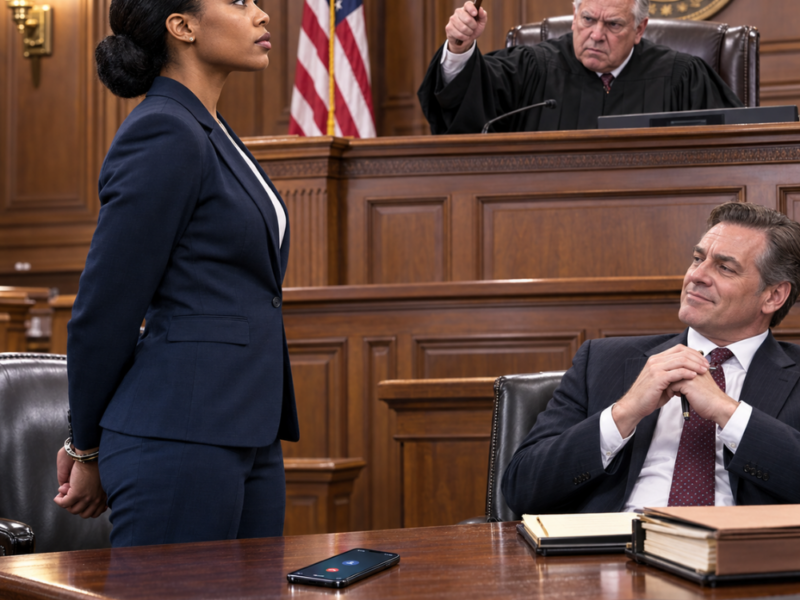
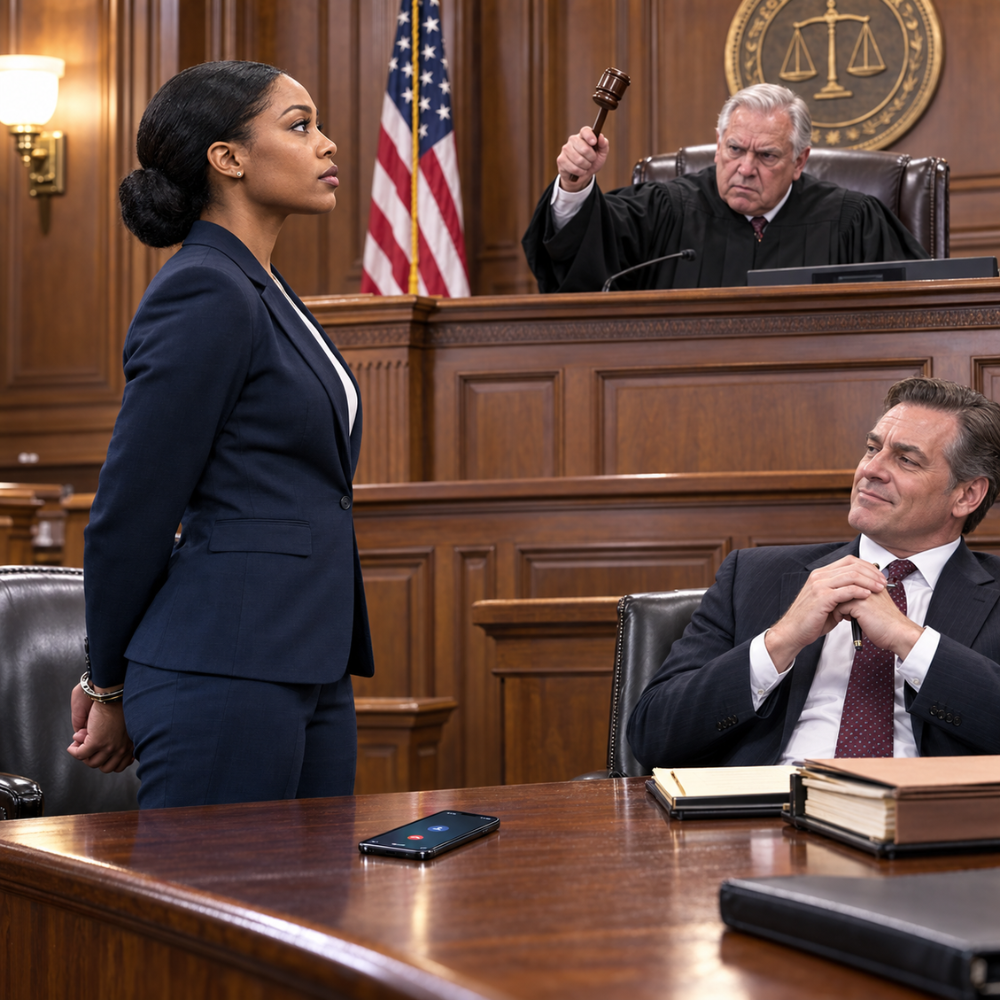
The gavel came down once.
Maya Washington did not flinch.
Around her, Courtroom 304 settled into the peculiar silence that follows a sentence everyone believes is final. Rain ticked against the tall courthouse windows. Somewhere beyond the double oak doors, a clerk pushed a cart down a hallway and a copier spat out another stack of forms. Inside the courtroom, though, nobody moved for several seconds.
“Life imprisonment without the possibility of parole.”
Judge Harrison Cole’s voice remained suspended in the room long after he had stopped speaking.
Maya stood beside the defense table in a navy blazer borrowed from a woman at the public defender’s office. It hung too loosely across her shoulders and reached farther down her wrists than it should have. She had lost weight during the six months she had spent in county custody awaiting trial, and the clothes she had owned before her arrest no longer fit.
She was twenty-two years old.
She had no husband waiting in the hallway.
No parents sitting behind her.
No sister covering her mouth in shock.
No uncle shouting that the court had made a mistake.
There was nobody in the gallery who belonged to her.
That was one reason they had chosen her.
The second reason was that she was quiet.
People frequently mistook quiet women for frightened ones.
Judge Cole removed his glasses and began stacking papers as if he had just finished reviewing an insurance dispute instead of condemning a young woman to spend the rest of her life behind concrete walls.
“Defendant is remanded immediately to the Department of Corrections.”
At the prosecution table, Assistant District Attorney Daniel Pierce whispered something to his second chair.
The younger prosecutor smiled.
Pierce did not.
His satisfaction was subtler than that.
He closed his yellow legal pad, capped an expensive fountain pen, and slipped it into the inside pocket of his suit. During the trial, local television reporters had repeatedly described him as one of the county’s rising legal stars.
He was forty-one, polished, camera-friendly, and careful about never appearing pleased by another person’s ruin.
He had perfected the expression of reluctant duty.
Maya knew better.
She had spent twelve days watching him manufacture a case against her.
She had watched him stand in front of a jury and call her calculating.
Secretive.
Resentful.
Dangerous.
He had described her work as an information-technology auditor for the Metropolitan Housing Development Authority as though checking access logs and procurement records were the activities of a conspirator.
According to Pierce, Maya had discovered that Robert Henderson, the authority’s senior internal auditor, had been investigating irregularities in her work.
She had supposedly panicked.
The state claimed she killed Henderson in a downtown parking structure, altered internal financial records, then attempted to steal city funds before investigators uncovered the scheme.
The story had been clean.
That was its greatest strength.
Real life rarely arrived in such neat paragraphs.
But juries liked neat paragraphs.
Especially after the evidence that complicated them disappeared.
Maya’s public defender, Leonard Fisk, had objected until even he sounded tired of hearing himself.
Security video from the parking structure?
Unavailable.
A backup data archive Robert had referenced in an email?
Inadmissible because the defense could not establish chain of custody.
Questions about Housing Authority contracts linked to companies represented by people close to Judge Cole?
Irrelevant.
Banking records Maya claimed had motivated Robert’s investigation?
Speculative.
An email she said proved Robert had requested a meeting with federal investigators?
Hearsay.
Again and again, Cole had leaned toward the microphone.
“Sustained.”
“Move on, counsel.”
“The jury will disregard that.”
By the second week, Maya understood that she was not attending a trial.
She was attending the official version of her disappearance.
Judge Cole looked down at her now.
“Ms. Washington, you were offered an opportunity to address the court before sentencing.”
Maya met his eyes.
“Yes, Your Honor.”
“And you declined.”
“Yes.”
His mouth tightened.
It bothered him.
She had known it would.
Men like Cole understood tears.
They understood begging.
They understood rage.
Every emotional reaction confirmed the hierarchy they had built.
A frightened defendant recognized the judge’s power.
A furious defendant could be dismissed as unstable.
An apologetic defendant validated the verdict.
Silence gave him nothing.
Cole leaned back.
“Then we are concluded.”
One of the bailiffs approached.
“Hands behind your back, ma’am.”
Maya turned.
Cold cuffs closed around her wrists.
She heard the small mechanical clicks as the bailiff checked them.
Across the aisle, Daniel Pierce was already packing his briefcase.
For the first time all day, Maya allowed herself to look at the clock mounted above the courtroom doors.
3:17 p.m.
Good.
She had expected sentencing to finish before four.
Timing mattered.
The bailiff touched her elbow.
“This way.”
Maya walked toward the rear doors.
The few reporters who had attended glanced up from their phones. One whispered to another. A courtroom sketch artist stopped shading Judge Cole’s profile and began drawing Maya’s back as she disappeared.
Pierce never looked at her.
Neither did Cole.
That was their mistake.
They thought the dangerous part was over.
Maya stepped through the doorway and entered the secured corridor behind the courtroom.
The heavy door closed.
Her sentence had begun.
So had their problem.
The courthouse basement had no windows.
The walls were painted the faded green used in old government buildings where nobody had bothered to ask whether color affected mood. Fluorescent lights hummed overhead. A corrections officer pushed a laundry cart past holding cells. Somewhere farther down the corridor, a man argued with a deputy about property that had not been returned after arraignment.
Maya was placed in Cell Four.
The steel door closed behind her.
She sat on a concrete bench.
For several minutes she did nothing.
That had become one of her best skills.
Waiting.
Six months earlier, Maya had not thought of herself as patient.
She had worked quickly, walked quickly, ate lunch at her desk, and became irritated when grocery-store customers blocked entire aisles while reading cereal labels.
Her life had once been built from ordinary inconveniences.
A one-bedroom apartment above a dry cleaner.
A thirteen-year-old Honda that needed front brakes.
Sunday morning laundry at a coin-operated place near her building because the dryer downstairs never fully dried towels.
Frozen Trader Joe’s dinners.
Library books.
Direct deposits.
A chipped blue mug she carried from one foster home to another because it had somehow survived every move.
At twenty-two, she believed stability meant knowing what your electricity bill would be.
She had grown up in foster care after her mother died when she was nine.
Her father had disappeared before that.
There had been no trust fund.
No family law firm.
No grandfather who knew a senator.
Maya had built her life through scholarships, public schools, part-time jobs, and the kind of stubborn academic discipline that teachers praised because they did not understand the fear underneath it.
Children who know nobody is coming to rescue them become excellent planners.
By nineteen, Maya had earned a degree in information systems.
By twenty-one, she worked for the city.
Not glamorous work.
She audited user permissions, reviewed payment systems, checked whether employees accessed databases they were authorized to access, and produced reports supervisors often ignored until something went wrong.
She liked systems because systems were supposed to make sense.
A human being could lie.
A database log usually did not.
That was how she met Robert Henderson.
He was fifty-eight, recently divorced, perpetually tired, and known around the Housing Authority for drinking terrible vending-machine coffee even though there was a decent café across the street.
Robert had worked internal audit for almost twenty years.
He wore the same brown belt with nearly every pair of pants.
He kept peppermint candies in his desk.
He had a daughter teaching middle school outside Indianapolis and a grandson whose photograph sat beside his computer.
The first time Robert came to Maya’s cubicle, he carried a paper folder.
Not an email.
Not a shared spreadsheet.
Paper.
“Can you check something without putting in a ticket?”
Maya looked up.
“Depends what something is.”
“Access history.”
“For whose account?”
“Mine.”
She frowned.
“You think somebody used your credentials?”
“I think somebody is reading what I’m reading.”
That sentence began everything.
Robert had been reviewing development contracts involving vacant lots acquired through eminent domain.
The paperwork seemed routine at first.
Land purchased.
Properties transferred.
Developers selected.
Tax incentives approved.
But the numbers repeated in ways Robert disliked.
The same consulting firms appeared.
Different corporations shared mailing addresses.
Construction companies subcontracted work to entities that seemed unrelated until Maya traced ownership records.
Money moved through accounts with innocent names.
Midwest Community Renewal LLC.
Urban Neighborhood Partnership Group.
Lakefront Strategic Services.
Some existed only on paper.
Robert believed city development funds were being siphoned through shell companies connected to lawyers, zoning officials, donors, and people close to the district attorney’s office.
Maya initially thought he was overstating it.
Then she found the access logs.
Someone with administrator privileges had entered Robert’s research folders three nights in a row.
That alone did not prove corruption.
But the next week, documents disappeared.
Not entire folders.
Specific pages.
Specific invoices.
Specific payment histories.
Whoever was deleting them understood exactly which records mattered.
Robert came to her desk again at seven-thirty one evening.
Most employees had left.
Rain streaked the office windows.
He set a USB drive beside her keyboard.
“Take this home.”
Maya stared at it.
“No.”
“Maya.”
“We have data-handling rules.”
“We also have people deleting evidence from a government server.”
“Then call the inspector general.”
“I did.”
“What happened?”
“Nothing.”
“Call the state auditor.”
“I did.”
“And?”
“They referred me back internally.”
Maya leaned away from the drive.
“Then federal.”
Robert laughed without humor.
“You’re young.”
“That doesn’t mean I’m stupid.”
“No. It means you still believe there’s one clean door somewhere in the building.”
His face softened.
“I hope you’re right.”
Maya looked at the drive.
“What’s on it?”
“Enough to make somebody nervous.”
“Then why give it to me?”
“Because nobody notices you.”
She should have been offended.
Instead, she understood.
Robert had not meant she was unimportant.
He meant invisible.
Nobody stopped talking when Maya entered an elevator.
Executives did not lower their voices when the young Black IT employee came to reset a conference-room display.
Lawyers walked past her without recognizing the woman whose credentials could show them exactly when their accounts had accessed protected files.
People assumed technology workers existed below the level of the conversations happening around them.
Maya picked up the drive.
“Robert, if this is what you think it is, we need a lawyer.”
“I called one.”
“Who?”
“A retired federal investigator.”
She looked at him.
“Why retired?”
“Because he’s the only one I know who hates enough people on both sides of town that I trust him.”
His name was Arthur Brooks.
He worked out of a narrow storefront office between an upholstery shop and a tax-preparation business in an aging commercial strip near the river.
His sign said INVESTIGATIVE CONSULTING.
Nothing else.
He had once worked public corruption cases for the federal government.
Now he investigated insurance fraud, corporate misconduct, missing assets, and the occasional divorce where one spouse believed the other had hidden money.
Robert knew him from an old contracting case.
Maya met him once.
It was two in the morning at a twenty-four-hour diner with cracked red vinyl booths.
Brooks was sixty-four and looked as though sleep had become optional sometime during the Clinton administration.
He listened while Maya explained what she had found.
Then he asked questions.
Good questions.
Not dramatic ones.
“How do you know the records weren’t altered before you saw them?”
“What independent source confirms the account ownership?”
“Who else had access?”
“What would happen if the original server disappeared tomorrow?”
By sunrise, Maya trusted him more than anyone she had met in six months.
That frightened her.
Trust was expensive.
Three nights later, Robert Henderson died in a parking garage.
Maya was supposed to meet him there.
She arrived late because the elevated train had been stopped between stations.
Five minutes.
That was all.
She heard voices before she reached the level where they had agreed to meet.
Robert’s voice.
Another man.
Then a sharp burst of argument.
Maya moved behind a concrete support pillar.
What she saw afterward would return to her in fragments for years.
She never liked remembering the physical details.
What mattered was simpler.
Robert had been confronted.
The confrontation became deadly.
Maya saw enough to identify one of the men.
Evan Pierce.
Daniel Pierce’s brother-in-law.
A political consultant whose name appeared on payments connected to two of the shell companies.
Robert saw Maya behind the pillar.
Their eyes met.
He did not call her name.
That choice saved her.
She slipped down the stairwell before anyone else saw her.
By sunrise, she had copied every record Robert had given her into a protected evidence package.
She contacted Arthur Brooks.
By the following afternoon, police were asking where she had been.
Two days later, Daniel Pierce’s office announced that Robert Henderson’s death was linked to a financial-fraud investigation.
A week after that, Maya was arrested.
The state’s case arrived remarkably complete.
Her work credentials had accessed records tied to missing funds.
A knife recovered near the garage contained forensic evidence investigators said connected her to the scene.
Emails appeared suggesting tension between Maya and Robert.
Financial files were found on her work computer.
A witness remembered seeing a woman matching her description nearby.
The more evidence police collected, the less any of it resembled reality.
Maya told Leonard Fisk the case was being manufactured.
Fisk listened.
He even believed portions of her account.
But belief was not evidence.
He needed admissible records.
Verified copies.
Witnesses willing to testify.
Original video.
The parking garage’s main security footage had supposedly been overwritten.
Robert’s backup archive could not be found.
The shell companies denied any relationship with Judge Cole or Daniel Pierce.
People who had previously spoken to Robert became suddenly forgetful.
Arthur Brooks urged Maya not to reveal the entire package she had preserved.
Not yet.
“You show them every card now, they’ll know what to destroy.”
“I’m facing murder.”
“I know.”
“You’re asking me to sit in jail.”
“I’m asking you not to bet your life on the same system that just manufactured evidence against you.”
Maya hated him for saying it.
Then she realized he was right.
She and Brooks created a plan.
Not a miraculous computer attack.
Not a cinematic hack into government networks.
Something far more ordinary and therefore harder to stop.
Redundancy.
Copies.
Lawyers.
Journalists.
Outside custodians.
Maya prepared a sealed evidence archive containing original audit logs, copies of Robert’s financial records, metadata supporting when the files had been created, and a fragment of parking-garage video recovered from a secondary storage device Robert had obtained before his death.
The archive did not prove everything.
It proved enough.
Brooks stored one copy.
Another went to an attorney in another state under instructions that it could be released if specific conditions were met.
A third was placed with an investigative reporter who did not know the decryption key.
The key was split between two people.
No single person could open everything alone.
Maya built the plan because she knew the first question corrupt people ask after learning evidence exists is where the only copy is.
There was no only copy.
Still, she waited.
Waiting had a purpose.
If the archive was released too early, Pierce could characterize it as fabricated defense material.
Cole could bury hearings in procedural disputes.
Witnesses could disappear.
Accounts could move.
The prosecution might offer Maya a plea that quietly sealed evidence and allowed the people behind Robert’s death to survive.
Maya decided the strongest moment to release everything was the moment Cole and Pierce believed the case had ended.
After the verdict.
After the sentence.
After their own public statements had committed them to a version of events that documentary evidence could disprove.
Not because double jeopardy magically made Maya untouchable.
Fisk had explained that the law was not that simple.
A conviction overturned for trial error could sometimes be retried.
No clever timing guaranteed immunity.
What sentencing did provide was finality of another kind.
Cole and Pierce would have completed the act.
They would have placed every important representation on the record.
They would no longer be preparing for exposure.
They would be celebrating survival.
And Maya would finally have proof that the people who convicted her knew contradictory evidence existed before the trial ended.
The difference mattered.
Now, sitting in Cell Four, Maya watched the minute hand on the wall clock.
3:42.
A corrections officer stopped outside.
His name tag read PETERSON.
He was in his early fifties, with graying hair and the exhausted expression of a man counting the years until retirement.
“Transport’s delayed.”
Maya looked up.
“How long?”
“Maybe two hours.”
She nodded.
Peterson started walking away.
“Officer?”
He turned.
“I’d like my call.”
He looked at his clipboard.
“You didn’t make one upstairs?”
“No.”
“To your lawyer?”
“No.”
Peterson sighed.
“Give me a minute.”
He came back with a key ring.
Ten minutes later, Maya stood at the wall phone at the end of the corridor.
The receiver was scratched from years of use.
Peterson leaned against a nearby desk with a paperback novel.
“You’ve got ten.”
Maya dialed.
Brooks answered on the third ring.
He said nothing.
Neither did she for a moment.
They had agreed on one sentence.
Nothing dramatic.
Something meaningless to anyone overhearing.
Maya looked at the institutional-green wall.
“The foundation is cracked.”
Silence.
Then Brooks inhaled.
“You sure?”
“Yes.”
“No turning back.”
“I know.”
“I saw the sentence.”
Maya closed her eyes.
“Then you know why I’m calling.”
Brooks’s voice softened.
“Hold on, kid.”
He set the phone down.
In his office three miles away, Arthur Brooks opened a steel drawer beneath his desk.
He removed a flash drive and a paper envelope.
Inside the envelope were instructions.
He had reviewed them so often he no longer needed the paper.
First, contact the attorney holding the second key.
Second, unlock the archive.
Third, transmit copies through prearranged secure channels to the federal public-corruption unit, the state attorney general’s independent review team, Maya’s appellate counsel, and three investigative news organizations.
Fourth, upload a checksum record to establish that the evidence package had not been modified after Maya’s arrest.
Fifth, preserve his own machine and leave everything else alone.
Maya had made him promise that last part.
No cleverness.
No retaliation.
No breaking into anyone’s network.
Just evidence delivered to enough independent people that nobody could make it vanish.
Brooks called the attorney.
She answered immediately.
“I saw the news,” she said.
“Heard from Maya.”
A pause.
“She gave the phrase?”
“Yes.”
“Sending my key half now.”
Brooks watched a message arrive.
His hand hovered over the keyboard.
For years he had watched investigations die because one frightened witness recanted, one hard drive disappeared, one politician made a call.
He thought of Robert Henderson.
Then he entered the combined key.
The archive opened.
Folders filled the screen.
Housing contracts.
Bank records.
Corporate ownership charts.
Access logs.
Emails.
Audio.
The parking-garage footage.
A private calendar linking Harrison Cole to people whose companies had repeatedly benefited from his rulings.
Messages between Daniel Pierce and Evan Pierce discussing Robert’s audit.
A draft email from Robert to a federal investigator written hours before his death.
Brooks stared.
“My God.”
Then he began sending.
At 3:58 p.m., an FBI public-corruption intake attorney opened an encrypted package.
At 4:01, a deputy state attorney general received the same materials.
At 4:03, investigative reporter Simone Grant received instructions explaining how the evidence had been independently authenticated.
At 4:07, Maya’s appellate lawyer called the courthouse demanding that transfer be halted until emergency motions could be filed.
At 4:09, someone in the federal building watched seventeen seconds of parking-garage footage and stood up so quickly his chair rolled backward.
By 4:16, Daniel Pierce’s phone began ringing.
He was in his office across the street from the courthouse drinking lukewarm coffee and dictating a statement about the successful prosecution of Maya Washington.
His assistant appeared in the doorway.
“Daniel?”
“Give me five minutes.”
“There are federal agents downstairs.”
Pierce stopped.
“For what?”
“I don’t know.”
His desk phone rang.
Then his cell.
Then the secure line used for senior prosecutors.
He looked at the three devices.
His assistant remained in the doorway.
“Daniel?”
“Close the door.”
She did.
Pierce answered his cell.
Judge Cole.
“Harrison?”
Cole’s voice came low and strained.
“Have you received anything?”
“Received what?”
“Don’t play games.”
Pierce opened his email.
The first message sat at the top.
EVIDENCE PRESERVATION NOTICE: STATE V. WASHINGTON.
He clicked.
Read two lines.
Stopped breathing.
A list of attachments followed.
The Cayman account ledger.
Contract records.
Communications.
Security footage.
Pierce stood.
“No.”
“What?”
“This can’t be real.”
“It’s real.”
“We destroyed—”
Cole cut him off.
“Do not say another word on the phone.”
Pierce lowered his voice.
“How?”
“The girl.”
“That’s impossible.”
“The girl.”
Pierce stared through his office window toward the courthouse.
Six months earlier, Maya Washington had sat across from him during a pretrial meeting while he offered her forty years in exchange for a guilty plea.
She had barely spoken.
He remembered telling a colleague afterward that she had no survival instinct.
Now he understood.
She had been surviving on a level he had never bothered to imagine.
“Harrison, what do we do?”
Cole did not answer immediately.
For the first time in their relationship, Daniel Pierce heard fear in the judge’s voice.
“We get counsel.”
Judge Cole’s chambers occupied a corner of the third floor.
The room had been designed to communicate permanence.
Dark wood.
Framed legal degrees.
Photographs with governors.
A shelf of leather-bound books few people touched anymore.
A bronze scale of justice on a side table.
Cole had spent twenty-seven years collecting symbols that reminded visitors where power lived.
At 4:23, none of them helped.
His judicial assistant stood in front of his desk.
“Judge, the chief judge is on line one.”
Cole ignored it.
“The U.S. Attorney’s Office is on line two.”
“Tell them I’m unavailable.”
“She said it’s urgent.”
“Everything is urgent when people want attention.”
His private cell vibrated.
Daniel Pierce.
Cole declined the call.
Then someone knocked.
Not his assistant’s knock.
Three firm strikes.
Cole looked toward the door.
His assistant did too.
“Judge Harrison Cole?”
A man’s voice.
“Federal Bureau of Investigation. We need to speak with you.”
Cole’s face changed.
His assistant slowly stepped away from the desk.
Cole adjusted his robe.
It was instinct.
Armor.
“Open it.”
She did.
Three federal agents entered with an attorney from the U.S. Attorney’s Office.
The lead agent held a folder.
“Judge Cole, we have warrants authorizing the seizure of specified electronic devices and records in connection with a federal public-corruption investigation.”
Cole’s voice became cold.
“You do understand you are standing in a sitting judge’s chambers?”
“Yes, sir.”
“And you obtained this warrant from whom?”
“A federal judge outside this district.”
Cole’s jaw tightened.
“You will speak to my counsel before touching anything.”
“Your counsel is welcome to meet us here.”
The agent handed him a copy.
Cole looked at the first page.
His name.
Wire fraud.
Bribery.
Obstruction.
Conspiracy.
The words no longer belonged to other people.
In the basement, Officer Peterson’s radio crackled.
He looked down from his paperback.
“Unit supervisors, maintain secure access. Federal warrant service in progress on third floor.”
Peterson frowned.
Another transmission followed.
“Hold all prisoner transports until further notice.”
He stood.
“What in the world?”
Maya sat inside Cell Four.
Her hands rested in her lap.
Peterson walked toward her.
“Washington.”
She looked up.
“Transport’s canceled.”
“All right.”
He studied her.
“You know something?”
Maya said nothing.
His radio sounded again.
“District attorney’s office requesting building access restrictions.”
Peterson stared at her.
The young woman who had been sentenced to die in prison less than an hour earlier appeared calmer than every officer in the courthouse.
“What did you do?”
Maya looked toward the corridor.
“I made a phone call.”
By six that evening, the courthouse steps were filled with reporters.
News traveled differently when documents accompanied rumors.
Simone Grant’s investigative team had not published everything.
Responsible journalists rarely did.
But they had verified enough to release a carefully worded breaking report:
New evidence appeared to show that prosecutors in the Maya Washington murder case withheld material contradicting the state’s theory while senior public officials had financial connections to entities involved in the underlying housing-fund investigation.
The parking-garage video changed everything.
It did not show Maya killing Robert Henderson.
It showed her hiding behind a pillar while two men confronted him.
One of those men closely resembled Evan Pierce.
The timestamp matched.
More importantly, internal emails indicated Daniel Pierce’s office had been informed that a secondary copy of the footage might exist.
That information had never been disclosed to the defense.
Leonard Fisk was at home changing out of his courthouse suit when his phone began ringing.
He answered while standing in his kitchen.
“Maya?”
It was not Maya.
It was appellate attorney Rachel Levin.
“Mr. Fisk, did the state disclose a secondary parking-garage archive?”
Fisk stopped.
“What secondary archive?”
“That answers my question.”
“Who are you?”
“Counsel retained on Ms. Washington’s emergency post-conviction motion.”
“Retained by whom?”
“A third party.”
Fisk sat at the kitchen table.
“What is happening?”
Rachel told him.
By seven-thirty, Fisk was back downtown.
He brought every file he had.
For the first time in months, he did not look tired.
He looked furious.
Maya was moved from Cell Four to an attorney interview room.
Rachel Levin entered first.
She was forty-eight, wore practical black flats, and carried three binders.
Arthur Brooks followed.
Maya stood when she saw him.
Brooks stopped.
For a second, neither spoke.
Then Maya exhaled.
“You did it.”
“You told me to.”
Rachel set the binders down.
“Sit.”
Maya obeyed.
“You are still under sentence,” Rachel said. “That matters. We are asking the court to stay your transfer immediately.”
“Will they?”
“The state attorney general is joining the request.”
Maya blinked.
“That fast?”
“The evidence is extraordinary.”
“Pierce?”
“Relieved of his duties pending investigation.”
“Cole?”
“Administrative action underway. Federal agents are executing warrants.”
Maya’s shoulders lowered one fraction.
Rachel noticed.
“We are not done.”
“I know.”
“Your conviction does not evaporate because a news story broke.”
“I know.”
“We have to go through the process.”
“I know.”
Rachel studied her.
“You’ve thought about this.”
“For six months.”
Brooks leaned against the wall.
“More than I’d recommend for anybody’s blood pressure.”
Rachel opened the first binder.
“The prosecution’s failure to disclose the footage may constitute a major Brady violation. The fabricated financial trail may be worse. If we establish that evidence was knowingly manufactured, the state’s case becomes structurally compromised.”
“Can they retry me?”
Rachel did not patronize her.
“Possibly. It depends on what the investigation proves and on the grounds for vacating the conviction.”
Maya looked disappointed for the first time.
Rachel continued.
“But listen carefully. The attorney general’s office has already begun an independent review. If the evidence establishes what we think it establishes, there may be no lawful case left to retry.”
Maya’s gaze dropped to the table.
“What about Robert?”
“The federal investigation is reopening his death.”
“Evan Pierce?”
“Being sought for questioning.”
Maya closed her eyes.
Rachel waited.
Brooks did too.
When Maya opened them again, the cold concentration had returned.
“I’ll testify.”
Rachel nodded.
“I expected that.”
“But not before you show me exactly what the government has.”
A faint smile touched Rachel’s mouth.
“Also expected that.”
The emergency hearing began at nine-fifteen the next morning.
Judge Cole did not preside.
He had been suspended from judicial duties overnight.
An outside judge took the bench.
Daniel Pierce was absent.
A representative from the state attorney general’s office stood at the prosecution table and did something Maya had not seen anyone from the government do during her entire trial.
She acknowledged uncertainty.
“Your Honor, our office has reviewed newly recovered material raising substantial concerns regarding the integrity of the conviction. The state therefore joins the defense request to stay execution of sentence and return Ms. Washington to county custody pending expedited review.”
The judge looked at Rachel.
“Anything further?”
“Yes.”
Rachel stood.
“My client has spent six months incarcerated on a case that now appears to include concealed exculpatory evidence, manipulated digital records, and potentially compromised judicial rulings. We request immediate release under supervision.”
The attorney general’s representative looked uncomfortable.
“We do not oppose release subject to protective arrangements.”
The judge removed his glasses.
“Ms. Washington.”
Maya stood.
Less than eighteen hours earlier, another judge had told her she would die in prison.
Now the courtroom looked different.
Same flag.
Same polished wood.
Same clerk.
Same seal.
Yet authority had changed hands.
“You understand your conviction remains under review?”
“Yes, Your Honor.”
“You understand you must remain available to counsel and investigators?”
“Yes.”
The judge looked at the government.
“I am ordering Ms. Washington released into protective supervision pending further proceedings.”
Maya’s fingers tightened around the edge of the defense table.
That was all.
No gavel.
No cheering.
No cinematic eruption.
A clerk began typing the order.
Rachel touched Maya’s arm.
“You heard him.”
Maya nodded.
But her body did not understand yet.
Freedom is strange when it returns first as paperwork.
She was processed for release just before noon.
Her property came in a clear plastic bag.
Shoelaces.
Wallet.
Keys to an apartment she no longer had.
A transit card.
Three dollars and twelve cents in cash.
A receipt.
The blue mug had been packed away months ago by her landlord.
Brooks waited outside the secured exit.
When Maya stepped through, he held up a paper cup.
“Coffee.”
She stared at it.
“That’s what you brought?”
“I panicked.”
She laughed.
The sound surprised both of them.
Then Maya began crying.
Not loudly.
Her face simply folded.
Brooks set down the coffee.
He did not hug her immediately.
He knew enough about incarceration to understand that people who had been searched, cuffed, escorted, and touched without permission sometimes needed the right to choose contact again.
Maya stepped toward him.
Only then did he wrap his arms around her.
“I thought it wouldn’t work,” she whispered.
Brooks closed his eyes.
“So did I.”
She pulled back.
“That wasn’t what you said.”
“You had enough problems.”
Federal authorities placed Maya in a protected residence while the investigation unfolded.
The house was deliberately forgettable.
One story.
Beige siding.
Small backyard.
Rental furniture.
A grocery store seven minutes away.
A pharmacy in the same shopping center.
The kitchen contained mismatched mugs, generic cereal, coffee filters, canned soup, and a frozen lasagna someone in the victim-services office had bought because they did not know what Maya liked.
The first night, Maya stood in the kitchen barefoot.
No one told her when lights had to be out.
No officer looked through a window in the door.
No metal toilet sat three feet from her bed.
She opened the refrigerator.
Closed it.
Opened it again.
She was free to eat anything inside.
She could not decide what she wanted.
She eventually made toast.
Halfway through the first slice, she started shaking.
The next morning she woke at 4:52.
For several seconds she did not know where she was.
Then she remembered.
Safe house.
Federal protection.
Rain tapped against the bedroom window.
Maya sat on the edge of the bed until sunrise.
Brooks arrived later carrying a bag from a diner.
“Egg sandwich.”
“I’m not hungry.”
“You’ve said that for seven months.”
“It remains accurate.”
He put the bag on the counter.
Rachel arrived behind him carrying legal papers.
Maya immediately looked at the folder.
Rachel noticed.
“You are allowed to ask how everyone’s doing before asking about the case.”
“How’s everyone doing?”
“Terrible.”
“The case?”
Rachel smiled.
“The attorney general filed a joint motion to vacate your conviction.”
Maya went still.
“On what grounds?”
“Suppression of exculpatory evidence, government misconduct, and newly discovered evidence undermining the verdict.”
“With prejudice?”
“They are asking the court to dismiss the indictment after vacatur.”
Maya looked at Brooks.
He nodded.
“Not because of some legal trick,” Rachel said. “Because their evidence against you has collapsed.”
“What changed?”
Rachel opened the folder.
“Evan Pierce was arrested at a hotel near the state line.”
Maya’s mouth tightened.
“He talk?”
“His attorney is exploring cooperation.”
“Of course.”
“Daniel Pierce has counsel.”
“Cole?”
“Also.”
Rachel hesitated.
“There’s more.”
Maya waited.
“Investigators found records suggesting Judge Cole received payments indirectly tied to rulings involving development properties.”
“How much?”
“Millions over several years.”
Brooks whistled.
Rachel continued.
“The mayor’s office is implicated in portions of the contracting scheme. Several zoning officials are under investigation. This is larger than your case.”
Maya stared out the window.
“Robert knew.”
“Yes.”
“He kept saying nobody wanted the whole picture because the whole picture was expensive.”
Rachel sat down.
“Maya, I need you to hear something that has nothing to do with strategy.”
Maya looked at her.
“You survived.”
Maya’s expression hardened.
“Not yet.”
“You are out.”
“That isn’t the same thing.”
Rachel said nothing.
Maya looked at her wrists.
Faint marks remained.
“Robert died. I sat in jail for six months. People watched Pierce lie about me on television. Cole called me cold-blooded in front of a courtroom. My apartment’s gone. My job is gone. Half the internet thinks I’m a murderer and the other half thinks I’m some kind of mastermind.”
Her voice began trembling despite her effort.
“That isn’t winning.”
“No.”
Rachel’s answer surprised her.
“No, it isn’t.”
Maya looked up.
Rachel closed the folder.
“Winning is a word people use because they want stories to end cleanly.”
For the first time, Maya’s eyes filled.
“I was so scared.”
Brooks turned toward the window.
Not because he was uncomfortable.
Because he understood she deserved privacy even in a room with people she trusted.
Maya pressed her palms against her face.
“For six months, every time a guard opened the door at night, I thought something had happened to you. Or the lawyer. Or the backups. I thought maybe Pierce had found everything.”
Her shoulders shook.
“I thought maybe I’d made the wrong decision and Robert died for nothing and I was just going to disappear too.”
Rachel reached across the table.
Maya took her hand.
The crying lasted less than two minutes.
It felt longer.
When she stopped, her breathing was uneven.
Brooks quietly pushed the diner bag toward her.
“Now?”
Maya laughed through tears.
“Fine.”
She opened it.
The egg sandwich was lukewarm.
It was one of the best things she had ever eaten.
The court formally vacated Maya’s conviction twelve days later.
The state dismissed all charges.
Not postponed.
Not reduced.
Dismissed.
The judge’s written order was forty-three pages long.
Maya read every page.
Rachel told her she did not have to.
Maya read it anyway.
The order found that the integrity of the prosecution had been fundamentally compromised by concealed evidence and material misrepresentations.
It did not give Maya back six months.
Nothing could.
But it created a record nobody could quietly edit later.
She requested ten certified copies.
Brooks asked why.
“I don’t know.”
“You planning to wallpaper a room?”
“Maybe.”
She kept one in a desk drawer.
One went to Robert Henderson’s daughter.
Maya met her in Indianapolis three weeks later.
Emily Henderson was thirty-four and taught seventh-grade English.
She had Robert’s eyes.
That made the first few minutes difficult.
They met at a bakery near Emily’s school.
Maya arrived early.
She almost left twice.
Then Emily walked in carrying a canvas tote bag and wearing the exhausted expression of a teacher in late spring.
They recognized each other immediately.
Emily sat.
Neither knew how to begin.
Finally Maya slid an envelope across the table.
Inside was the certified court order.
Emily touched it.
“Why are you giving me this?”
“Because your father was right.”
Emily looked down.
Maya continued.
“He found it. Before anyone else.”
Emily swallowed.
“The news makes it sound like you uncovered everything.”
“I finished what he started.”
Tears formed in Emily’s eyes.
“Did he know you were there?”
Maya looked at her.
“In the garage?”
Emily nodded.
Maya had dreaded this question.
“Yes.”
“Did he say anything?”
“No.”
Emily looked down.
“He would have.”
“What?”
“If he thought it would save him, he would have called for help.”
Maya could not answer.
Emily wiped her cheek.
“He didn’t say your name, did he?”
“No.”
A long silence passed.
Emily smiled sadly.
“That sounds like Dad.”
Maya looked toward the bakery window.
“He saved me.”
Emily reached across the table.
“Then make it count.”
Seven months later, Harrison Cole entered a federal courtroom through a side door.
The man who had once sat above Maya in a black robe now wore plain detention clothing.
He had lost weight.
His silver hair had thinned.
Nothing about him looked grand.
Arthur Brooks sat beside Maya in the gallery.
He wore the same battered tweed jacket he had owned the night they first met.
“Stop staring,” he whispered.
“I’m not.”
“You’ve been looking at the door for fifteen minutes.”
“I’m observing.”
“That’s investigator language for staring.”
Maya almost smiled.
Daniel Pierce had already pleaded guilty.
Faced with documentary evidence, witness testimony, financial records, and his brother-in-law’s cooperation, he abandoned the polished certainty that had defined his career.
His plea included obstruction, conspiracy, fraud, and civil-rights violations connected to Maya’s prosecution.
Evan Pierce pleaded to charges arising from Robert Henderson’s death and agreed to testify.
Several city officials followed.
The mayor resigned before indictment and later faced federal charges related to the contracting scheme.
Harrison Cole held out the longest.
He filed motions.
Challenged warrants.
Attacked witnesses.
Claimed political persecution.
Blamed Pierce.
Blamed advisers.
Blamed investigators.
Eventually, the evidence became heavier than his excuses.
He pleaded guilty to racketeering, bribery, obstruction, and conspiracy counts related to the broader scheme and Robert’s death.
Now he waited for sentence.
The federal judge entered.
Everyone rose.
Maya found herself thinking about Courtroom 304.
The smell of floor wax.
The borrowed blazer.
The cuffs.
She remembered Cole looking at his phone after sentencing her, already mentally somewhere else.
This time he could not leave first.
The judge reviewed the offenses in a steady voice.
Years of corruption.
Public money diverted.
Official decisions sold.
Evidence concealed.
A murder investigation manipulated.
An innocent person prosecuted to protect the scheme.
“The harm in this case,” the judge said, “cannot be measured solely in dollars.”
Cole stared at the table.
“You occupied a position requiring unusual public trust. You used that position not merely for personal enrichment, but to make the judicial process itself part of the criminal enterprise.”
Maya felt Brooks shift beside her.
The judge asked whether Cole wished to speak.
Cole stood.
For a moment, the old courtroom voice returned.
“I deeply regret the damage caused to this institution.”
Maya’s expression did not change.
Cole continued.
“I made decisions under pressure and allowed relationships to compromise my judgment.”
Brooks leaned toward Maya.
“Still allergic to active verbs.”
Maya almost laughed.
Then Cole turned.
His eyes found her.
The courtroom seemed to contract.
He looked older than Maya remembered.
Not merely because of jail.
Power had once filled the space around him.
Without it, she saw a man.
Just a man.
Cole’s voice softened.
“Ms. Washington, I owe you an apology.”
Maya waited.
“I should never have allowed your case to proceed as it did.”
Allowed.
Even now.
As though injustice had wandered into his courtroom without his participation.
Maya gave him nothing.
No nod.
No anger.
No forgiveness.
Cole turned back toward the judge.
His shoulders sank.
The sentence ensured he would spend the remainder of his natural life in federal custody.
When the hearing ended, marshals escorted him toward the side door.
Cole did not look back.
Maya watched until the door closed.
Brooks exhaled.
“How do you feel?”
She considered the question.
“Hungry.”
“That’s progress.”
They went to the same diner where Maya had handed him the first drive.
The waitress refilled their coffee without asking.
Brooks ordered eggs, potatoes, toast, and bacon despite his doctor’s repeated objections.
Maya ordered pancakes.
“You know,” Brooks said, “you’ve ruined my retirement.”
“You weren’t retired.”
“I was emotionally retired.”
“You were investigating insurance claims.”
“Exactly. Peaceful corruption.”
Maya poured syrup over her pancakes.
The diner door opened.
David Raburn entered.
Maya had met the FBI public-corruption supervisor during the investigation.
Raburn was fifty-six, heavyset, patient, and usually looked as though somebody had interrupted him halfway through a bad night’s sleep.
He slid into the booth.
Brooks looked at him.
“You buying?”
“No.”
“Then leave.”
Raburn took a piece of toast from Brooks’s plate.
“I have an offer.”
Maya looked at him.
“For whom?”
“You.”
“No.”
“You haven’t heard it.”
“I know how government offers work.”
Brooks raised his mug.
“She learns fast.”
Raburn ignored him.
“Cyber and public corruption are building a joint analytics unit.”
Maya cut into a pancake.
“Congratulations.”
“They want people who understand financial systems, access controls, public records, shell-company structures, and how corruption moves through ordinary administrative systems.”
“I’m sure you can hire someone.”
“We can.”
“Then why are you here?”
Raburn smiled.
“Because the person who designed the evidence-preservation package that saved your case has been anonymously discussed in three different federal training meetings.”
Maya looked up.
“Anonymously?”
“Mostly.”
“Mostly isn’t anonymously.”
“Government.”
Brooks snorted.
Raburn continued.
“You would not be an agent.”
“Good.”
“Civilian specialist. Background investigation. Clearance process. Training. Oversight.”
Maya shook her head.
“I spent six months in a cage because government employees decided procedure was whatever protected them.”
“Yes.”
“And your sales pitch is government employment?”
“Yes.”
“That’s terrible.”
“I’m not in sales.”
Brooks pointed at Raburn’s tie.
“That part was obvious.”
Raburn leaned forward.
“I’m not asking you to trust institutions blindly.”
“Good.”
“I’m asking whether you want to become the person inside the room who notices when everyone else is too comfortable.”
Maya stopped cutting her pancake.
Outside the diner window, office workers crossed the street.
A bus pulled to the curb.
A mother hurried past holding the hand of a little girl wearing a pink backpack.
Ordinary life.
The kind of life Maya once thought she wanted more than anything.
After the case, private cybersecurity firms had contacted Rachel on her behalf.
Consulting companies.
Banks.
Two universities.
A technology company offered more money than Maya’s entire foster family had probably earned in a year.
She had turned all of them down.
Not because she disliked money.
She had spent enough years worrying about rent to respect it.
But she could not imagine spending her life protecting corporations from inconvenience.
Robert’s death had changed the scale of the questions she wanted to ask.
She looked at Raburn.
“What happens when I find something embarrassing to the FBI?”
Raburn smiled.
“I assume you become my problem.”
“Bad answer.”
“It’s the honest one.”
“And if somebody above you wants it buried?”
“You document everything. You use inspector-general channels. You keep counsel. You never rely on one custodian. And if you ever hear me tell you to stop asking a legitimate question because it makes important people uncomfortable, you call Arthur.”
Brooks raised both hands.
“Leave me out of this.”
Maya looked at him.
“You’d love it.”
“I would complain enthusiastically.”
Raburn slid a business card across the table.
“No pressure.”
Maya picked it up.
“What would I actually do?”
“Follow money.”
“Anything else?”
“Find where systems are being used to hide decisions.”
“That’s broad.”
“Corruption is broad.”
Maya turned the card over.
The back was blank.
“What about school?”
Raburn frowned.
“What school?”
“Graduate school.”
“You thinking about going?”
“Maybe law.”
Brooks nearly choked on his coffee.
“Oh, that’s horrifying.”
Maya smiled.
“Why?”
“A person with your personality and a law license?”
Raburn nodded gravely.
“Civilization may not recover.”
For the first time since Robert Henderson walked into her cubicle with a paper folder, Maya laughed without forcing it.
Not because the past had disappeared.
It never would.
She still woke at certain sounds.
She disliked rooms without windows.
She kept copies of important documents in too many places.
She sat facing restaurant entrances without consciously choosing the seat.
Whenever someone said, “Trust the process,” Maya’s shoulders tightened.
Healing did not arrive like the judge’s order dismissing her case.
There was no signed page stating she was whole again.
It came in ordinary pieces.
Buying groceries without being watched.
Standing in a pharmacy aisle comparing shampoo brands.
Getting her own apartment again.
Replacing the thirteen-year-old Honda with a used Subaru because Brooks claimed her old car was “a mechanical cry for help.”
Calling Emily Henderson on Robert’s birthday.
Answering Rachel’s texts.
Going three consecutive nights without dreaming about Courtroom 304.
Keeping the blue mug after her former landlord found it in a box and mailed it to her.
Months later, Maya accepted the federal civilian position.
She also enrolled in evening law-school courses.
Brooks said she needed a hobby less expensive than tuition.
Maya told him exposing corruption had not been particularly cheap either.
Her first government office was smaller than the cubicle she had occupied at the Housing Authority.
She liked that.
No marble.
No grand title.
No expensive desk.
Two monitors, a government laptop, a locked cabinet, and a window looking across rooftops.
On her first Monday, Raburn brought her a stack of procurement records.
“This is boring,” Maya said.
“Extremely.”
“Why me?”
“Because boring is where they hide money.”
She opened the first file.
Six hours later, she found three companies sharing the same registered agent.
Nothing criminal by itself.
Possibly nothing at all.
She flagged it anyway.
Then she kept reading.
The lesson Harrison Cole never understood was that corruption rarely begins with dramatic men carrying envelopes through dark parking garages.
It begins quietly.
A conflict nobody discloses.
A contract nobody questions.
A complaint nobody reads twice.
A missing attachment.
A supervisor who decides making noise is worse than letting something slide.
A prosecutor who tells himself the end justifies the method.
A judge who mistakes the robe for the law.
Robert Henderson had noticed small inconsistencies.
Maya had listened.
That was all it took to begin.
Years later, reporters would still describe her case as the story of a quiet young woman who destroyed a corrupt courthouse with one phone call.
Maya never liked that version.
The phone call mattered.
But it was not magic.
Behind it were months of copying records carefully.
People willing to preserve evidence.
A retired investigator who kept his word.
Lawyers who understood procedure.
Journalists who verified before publishing.
Federal agents who followed warrants instead of rumors.
A teacher in Indianapolis who wanted her father remembered accurately.
And a twenty-two-year-old woman who understood that powerful people often become careless only after they are certain the powerless have lost.
The phone call did not create the truth.
It merely gave the truth somewhere to go.
One evening, long after the court cases had ended, Maya drove past the old county courthouse on her way home.
Courtroom 304 was somewhere behind the third-floor windows.
The building looked smaller from the street.
Traffic moved around her.
A delivery truck double-parked near the curb.
Office workers hurried toward the train.
The courthouse steps were empty.
At a red light, Maya looked up.
She remembered the borrowed blazer.
The rain.
Cole’s voice.
Life without parole.
For months, she had believed that memory would always have the power to make her feel twenty-two and alone.
It did not.
Not anymore.
The light changed.
A driver behind her tapped his horn.
Maya smiled and drove on.
She no longer needed Harrison Cole to understand what he had done.
She no longer needed Daniel Pierce to fear her.
She did not need the courthouse to apologize every time she passed it.
The record existed.
Robert’s name had been cleared.
Her name had been cleared.
The people who had treated law as private property had finally been forced to answer to it.
That was enough.
Not perfect.
Not complete.
Enough.
On her desk the next morning sat a new file.
Nothing dramatic.
A county redevelopment contract.
Four hundred pages of invoices, zoning approvals, grant records, corporate disclosures, and emails.
Raburn stopped at her door.
“Anything interesting?”
Maya turned one page.
“Probably not.”
He smiled.
“That usually means yes.”
Maya looked at a payment schedule.
A consulting fee had been divided into three smaller transactions.
Maybe ordinary accounting.
Maybe not.
She opened a second database.
Cross-checked an address.
The same registered office appeared on another corporation.
She leaned closer to the screen.
Raburn watched her expression change.
“What?”
Maya did not answer immediately.
She printed one page.
Then another.
On the corner of her desk sat the old blue mug from childhood.
Beside it was a framed photograph Emily Henderson had given her.
Robert standing beside his grandson at a county fair, holding an absurdly large stuffed bear.
Maya looked at the photograph for half a second.
Then back at the records.
“There’s a crack in the foundation,” she said.
Raburn stepped into the office.
“How big?”
Maya opened another file.
“That’s what I’m going to find out.”
Outside the window, the city moved through another ordinary morning, unaware that somewhere inside a small government office, somebody had decided to read the first letter right.









