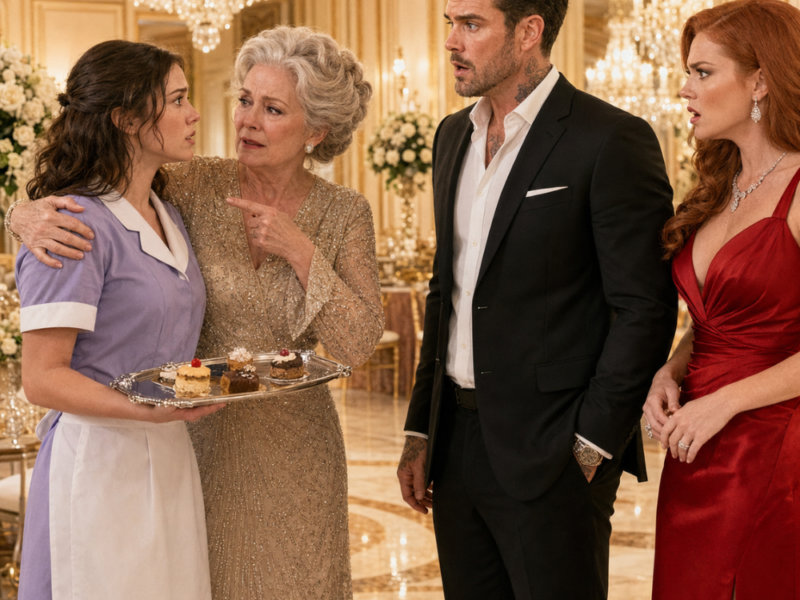
“I Want Her As My Daughter-In-Law,” The Mafia Boss’s Mother Cried — Pointing at the Maid
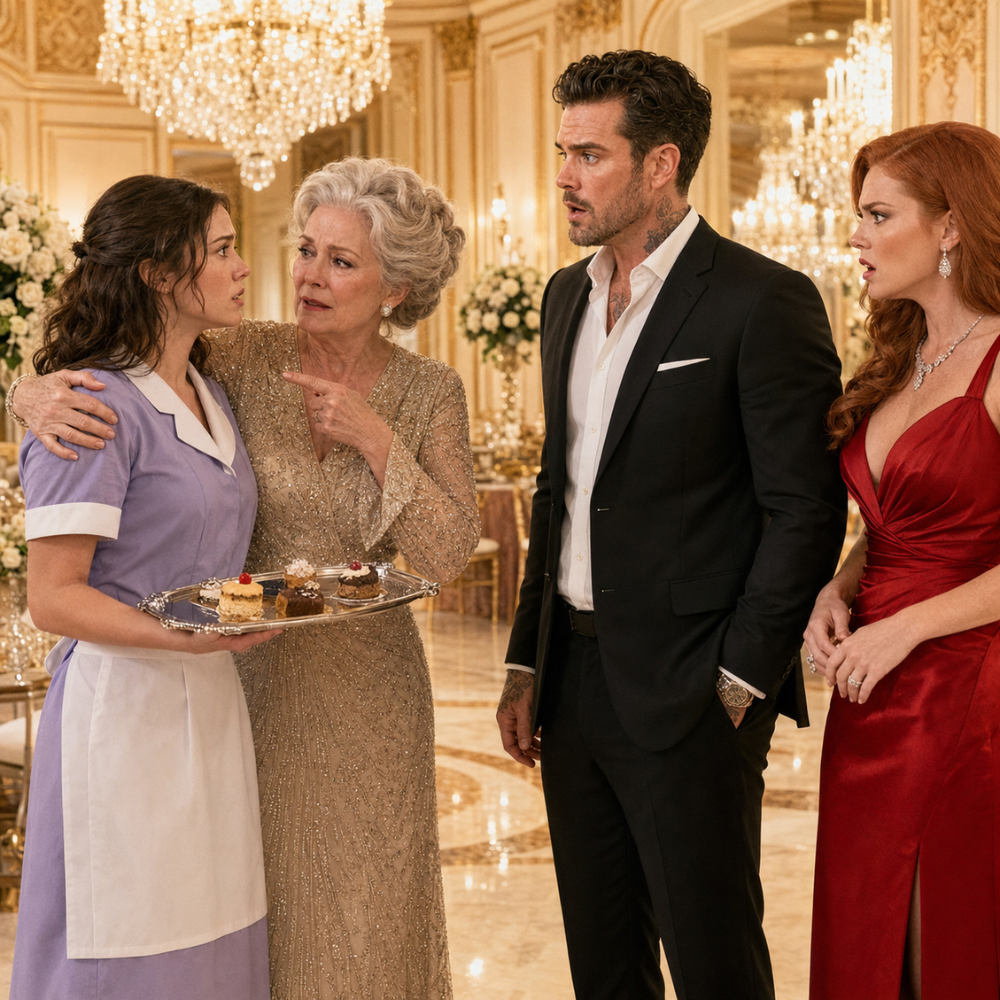
His mother forgot names, faces, even her own son on bad days, but at his engagement party she crossed a ballroom full of Chicago’s most powerful people to choose the one woman everyone else had trained themselves not to see
Rosalind Ferraro pushed her chair back before anyone realized she intended to stand.
The engagement ballroom had been designed for spectacle.
A wall of windows looked across a frozen stretch of Lake Michigan. Tall arrangements of white roses stood between silver candlesticks. One hundred twenty guests filled the tables beneath amber chandeliers while a jazz trio played quietly near the French doors.
Outside, January wind crossed the grounds of the Ferraro estate hard enough to bend the bare branches along the lake.
Inside, everything was controlled.
Valets moved cars.
Waiters replaced glasses before they were empty.
Politicians laughed at jokes they had already heard.
Attorneys who usually billed by the tenth of an hour stood near the bar discussing nothing important.
At the front of the room, Dante Ferraro waited beside the small stage where, before dessert, he was expected to announce formally that he would marry Sienna Blake in September.
At thirty-seven, Dante had spent most of his adult life becoming the kind of man rooms adjusted themselves around.
The respectable version of his biography called him president of Ferraro Maritime Holdings, a diversified Chicago transportation and commercial-property company inherited from his father and aggressively modernized afterward.
The less respectable version required fewer words.
People said the Ferraros had once controlled more than shipping contracts.
Dante did not discuss that version.
Neither did his guests.
Beside him stood Sienna, thirty-one, elegant in ivory silk, daughter of a family whose name appeared on downtown redevelopment signs, luxury condominium projects, and political donor lists.
Her hand rested lightly on Dante’s arm.
She was smiling toward a photographer when Rosalind stood.
Dante noticed immediately.
His mother had been having a difficult week.
That morning, she had asked him why his father had not come down for breakfast.
His father had been dead six years.
Two days earlier, she had looked directly at Dante and called him by his uncle’s name.
By dinner, she remembered everything again.
That was the particular cruelty of her illness.
It did not take the world and leave it gone.
It returned pieces.
Sometimes perfectly.
Sometimes only long enough for Rosalind to understand what she had lost.
Dante started toward her.
“Mom?”
She ignored him.
Rosalind steadied herself against the table.
Several guests nearby became quiet.
Margaret Hale, who had managed the Ferraro household for more than twenty years, moved discreetly from the side wall.
Rosalind waved her away.
Then the seventy-one-year-old woman walked across the ballroom.
Past a state senator.
Past an alderman.
Past three senior partners from one of Chicago’s largest law firms.
Past Victor Cain, Dante’s longtime business adviser, who sat near the head table with an unreadable expression.
Rosalind stopped in front of Elena Novak.
Elena had been carrying a silver tray of champagne.
She wore the black service uniform Sienna had selected for the household staff because it looked “cleaner in photographs.”
Twenty-seven years old.
Dark blond hair pinned at the nape of her neck.
No jewelry except a cheap watch.
Shoes she had bought with her first paycheck seven months earlier.
She had learned quickly that the safest employee inside the Ferraro house was the one people forgot as soon as she left a room.
So when Rosalind approached, Elena lowered the tray.
“Mrs. Ferraro?”
Rosalind took hold of her sleeve.
Her hands were trembling.
For one moment she simply looked at Elena.
Then she began crying.
Not loudly.
That made the room quieter.
Rosalind turned toward her son.
“I want her.”
Dante stopped.
Nobody seemed to understand.
Rosalind tightened her grip on Elena’s sleeve.
“I want Elena.”
“Mom,” Dante said carefully, “what do you mean?”
Rosalind looked around at the decorated ballroom, the photographers, the flowers, Sienna standing beside the stage.
Then she said it.
“I want her as my daughter-in-law.”
The tray slipped from Elena’s hands.
It struck the carpeted edge of the dance floor.
Two glasses broke.
The sound was small.
The effect was enormous.
Conversation disappeared.
Sienna’s smile remained on her face for half a second after the rest of her expression changed.
Dante said nothing.
He was looking at his mother.
Not because of what she had said.
Because of Elena’s name.
Rosalind forgot names constantly.
Some mornings she forgot Margaret, who had worked in the house since before Dante finished college.
She had twice forgotten Dante himself.
But in seven months, she had never forgotten Elena Novak.
Not once.
Rosalind released Elena’s sleeve.
Then she faced the room.
“I need to say something.”
Sienna stepped toward her.
“Rosalind, maybe we should go upstairs.”
“No.”
Her voice was stronger than it had been all week.
“I need everyone to listen while I still know what I’m saying.”
Dante felt something inside him turn cold.
Because suddenly he was not thinking about an elderly woman making an embarrassing declaration at an engagement party.
He was remembering another evening.
October.
The greenhouse.
His mother insisting she had seen Sienna with Victor.
He was remembering the exact moment he had opened his calendar and explained to her, gently, that Victor had been in Milwaukee.
He was remembering Elena standing in the corner.
Silent.
Watching him.
And for the first time he wondered whether silence had been the most important thing anyone in that room had said.
Seven months earlier, Elena Novak had been kneeling on the fourth floor of a commercial office building in Avondale, wiping dried coffee from a hallway carpet.
Someone had dropped the paper cup before lunch.
Nobody had picked it up.
At six forty-five that evening, Elena wrung out the rag, sprayed the stain again, and checked the time.
If she missed the 7:08 bus, she would be late for her second job.
The laundromat on Belmont handled linens for two boutique hotels and a small nursing home.
Elena worked there until two most mornings, folding sheets still warm from industrial dryers.
Then she walked four blocks to the apartment she shared with her younger brother, Tomas, slept perhaps four hours, and returned to the cleaning job.
She had been living like that for six months.
Since the funeral.
Her phone vibrated inside her apron.
The number belonged to the hospital’s billing department.
Elena considered letting it go to voicemail.
Then answered.
“Ms. Novak?”
“Yes.”
The man on the other end had the careful, neutral voice used by people whose jobs required them to discuss frightening numbers all day.
He confirmed her identity and explained that the balance remained unresolved.
Elena already knew the amount.
She knew it so well that it had stopped feeling like money.
One hundred ninety thousand dollars.
It felt like weather.
Always there.
She asked again about assistance.
He explained, again, that the bills involved several facilities and that Elena’s liability came partly from agreements she had signed as guarantor.
The words were technically correct.
They also erased the rooms where she had signed them.
Her mother had developed early-onset Alzheimer’s in her fifties.
The first hospitalization came after she wandered out of their apartment and collapsed from dehydration.
Elena had been twenty-three, still wearing her student-nurse identification badge when an admissions clerk placed documents in front of her.
Her mother lay on a gurney several feet away asking repeatedly whether Tomas had finished his homework.
He was fifteen then.
The clerk told Elena where to sign.
She signed.
Later came memory care.
Specialists.
Emergency visits.
A second financial guarantee.
A nursing program placed on hold.
Elena kept telling herself she would return the following semester.
Alzheimer’s did not care about semesters.
What she remembered most was not the forgetting.
It was the lucid afternoons.
Her mother sitting perfectly aware of what was happening, apologizing for becoming expensive.
“I should have saved more.”
“Mom.”
“I should have made things easier.”
“You did.”
“You’re missing school.”
“I’ll go back.”
Her mother would look at her.
Both of them knew Elena was lying.
The billing call ended.
Elena sat on the concrete step inside the emergency stairwell.
She opened her backpack.
A tuition notice from Tomas’s community college sat inside.
Second year.
Engineering program.
The amount due was not enormous compared with the hospital debt.
That made it worse somehow.
Because it was small enough that Elena should have been able to protect him from it.
She had recently discovered Tomas was working extra shifts at an auto-parts store.
He had hidden the uniform.
Elena found it hanging behind the bathroom door.
He was nineteen.
Their father had begun taking multiple jobs at almost the same age.
Elena knew where that road ended.
Their father, Peter Novak, had spent four years working days in warehouses, evenings making deliveries, and nights at a gas station after losing his long-term position at the Calumet-area docks.
He died at forty-nine.
Heart failure in a gas-station parking lot.
Tomas barely remembered him.
Elena did.
She remembered his swollen feet.
His hands.
The mornings when he was too tired to eat.
She folded Tomas’s tuition notice.
Her phone vibrated again.
A staffing agency.
Elena had applied months earlier for private caregiving jobs and forgotten most of the applications.
The recruiter sounded unusually direct.
“A family in Lake Forest needs a live-in caregiver for an elderly woman with dementia. Six days weekly. Private room. Household support when needed.”
“What does it pay?”
The recruiter gave the number.
Elena asked her to repeat it.
The salary was nearly four times what Elena made between both current jobs.
“There are conditions,” the recruiter said.
Of course there were.
Confidentiality agreement.
No visitors.
No public discussion of the household.
No photographing the property.
No asking about family business.
Elena paused.
“Why is that a condition?”
The recruiter was silent for two seconds.
“If that question is important to you, Ms. Novak, this may not be the right placement.”
Elena looked at her cracked hands.
One hundred ninety thousand.
Tomas’s tuition.
Her father’s work shoes.
“I’ll interview.”
“There isn’t really an interview.”
“What is there?”
“A background check.”
Two days later, Elena signed papers in a downtown office.
One clause received most of her attention.
Immediate termination for disclosure of confidential household information.
The recruiter pointed to the final line.
“Any questions?”
Elena looked at her.
“I think I already learned not to ask those.”
The woman almost smiled.
Monday morning, a black sedan left Elena outside iron gates near Lake Michigan.
Two men occupied the guard booth.
One checked her identification.
The other looked at the canvas bag she carried.
Nothing opened automatically.
Someone inside had to decide.
The gates slid apart.
Elena walked up the long gravel drive.
Lake Forest was not unfamiliar to anyone from Chicago.
People knew the area through newspaper society pages, real-estate listings they could never afford, and stories about century-old estates hidden behind walls of trees.
The Ferraro property stood on the lake side of a quiet road.
Stone exterior.
Slate roof.
Formal gardens.
Greenhouse.
A main residence that looked old enough to have inherited its own secrets.
Three dark vehicles sat near a service garage.
Elena noticed they had temporary dealer plates.
She kept walking.
Margaret Hale met her at the side entrance.
Fifty-eight.
Hair in a neat bun.
Clipboard.
No wasted words.
“The family values discretion.”
“I understand.”
“I’m going to explain the rules once.”
Elena set down her bag.
Margaret began.
When guests were present, staff did not initiate conversation.
If spoken to socially, staff remained polite but brief.
The east wing was restricted.
No personal phones on the second floor.
They stayed in a locked cabinet near the stairs.
Emergencies went through the kitchen landline.
Elena glanced at the cream-colored telephone mounted beside the pantry.
Then came the final rule.
“Do not ask about things outside your job.”
Elena met Margaret’s eyes.
“What exactly is my job?”
“For Mrs. Ferraro, you are caregiver, companion, meal support, medication observer, and transportation aide when assigned. When she rests, you assist household staff.”
“And if she needs a doctor?”
“You come to me.”
“Even at night?”
“Yes.”
Elena nodded.
That was the only answer she needed immediately.
Margaret took her through the house.
There were cameras in most hallways.
Not in bedrooms.
Not in bathrooms.
The smallest mercy.
They passed the east wing just as a man came out.
Elena knew who he was before Margaret spoke.
Dante Ferraro looked younger in person than in the newspaper photographs Elena had once seen near stories about labor negotiations and commercial-port acquisitions.
Thirty-seven.
Tall.
Dark hair.
Dark suit without a tie.
He held a phone in one hand.
When he saw Elena, he stopped.
Margaret said, “The new caregiver.”
Dante looked at Elena.
Not rudely.
Not warmly.
He seemed to be reading her.
Three seconds.
Then he continued upstairs.
Margaret waited until he was gone.
“Mr. Ferraro.”
“I assumed.”
“You won’t need to speak to him often.”
Elena looked toward the staircase.
“That seems manageable.”
Later, while carrying her bag toward the third-floor staff rooms, Elena struggled with a heavy door.
A man about her age caught it.
“Got it.”
“Thank you.”
He smiled.
“Nico.”
“Elena.”
He pointed toward the kitchen.
“Coffee’s always fresh until somebody forgets it and burns it. Usually me.”
It was the first uncomplicated sentence anyone had spoken to her since she arrived.
Elena smiled.
“I’ll remember.”
At four that afternoon, Margaret brought her to Rosalind’s room.
Before knocking, she said, “Four caregivers in ten months.”
Elena looked at her.
“What happened?”
“She dismissed them.”
“Why?”
“She never explained.”
Margaret knocked twice.
Opened the door.
Rosalind Ferraro sat by the window wearing a pale blue cardigan.
Back straight.
Hands on the chair.
She looked at Elena.
Then said, “Get out.”
Margaret sighed.
“Mrs. Ferraro, this is—”
“I heard you.”
Rosalind pointed toward the door.
“Get her out.”
Elena remained where she was.
Rosalind looked at her.
“You don’t understand English?”
“I do.”
“Then leave.”
“All right.”
Elena stepped backward.
“I’ll sit outside.”
Rosalind frowned.
“What?”
“If you need something, I’ll be in the hallway.”
“I don’t need anything.”
“Then I’ll have a quiet afternoon.”
Elena closed the door.
Pulled a wooden chair from against the wall.
Sat.
Margaret stared.
“That usually doesn’t work.”
“I’m not trying to make it work.”
“What are you doing?”
“My shift.”
Margaret eventually left.
Elena sat there four hours.
At eight, Rosalind opened the door.
“What are you doing?”
“Waiting.”
“For whom?”
“You.”
Rosalind studied her.
“You think you’re clever.”
“No.”
“They all think they’re clever.”
“I don’t know the others.”
Rosalind stared another moment.
Then turned back into the bedroom.
She left the door open.
Elena waited.
Rosalind looked over her shoulder.
“Well?”
That was the first invitation.
Three days later, Rosalind asked about her husband.
“Has anyone called him?”
Elena knew Antonio Ferraro had died six years earlier.
Margaret had instructed her to say he was away when Rosalind forgot.
Elena disliked that method.
She disliked correcting people harshly too.
Instead she asked, “What does he drink in the afternoon?”
Rosalind blinked.
“Coffee.”
“Sugar?”
“He would sooner put ketchup in it.”
Elena smiled.
“Strong?”
“Very.”
Elena went downstairs.
Made two cups.
Returned.
She placed one before Rosalind and another across the small table.
Rosalind stared at the empty chair.
Neither woman said Antonio was alive.
Neither said he was dead.
Eventually Rosalind drank her coffee.
That night, she spoke while looking toward the window.
“The others corrected me.”
Elena remained in her corner.
“They told me he was dead every time I asked.”
Rosalind’s voice hardened.
“As if I were stupid.”
Elena said nothing.
“Do you know the worst thing about forgetting?”
“No.”
“It isn’t forgetting.”
Rosalind looked at her.
“It is being told you forgot.”
The following afternoon, Elena purchased a small digital voice recorder from an electronics shop.
She placed it on Rosalind’s table.
“What is this?”
“A place to put things you don’t want to lose.”
Rosalind picked it up.
“You think I need a machine to remember my life?”
“I think everybody needs somewhere to put what matters.”
Rosalind turned it over.
“Who listens?”
“Only whoever you choose.”
Rosalind set it beside the lamp.
It remained untouched for several days.
Then Elena heard Rosalind mention almond ricotta cake.
“My mother made it.”
“Recipe?”
“Probably gone.”
Elena found a tin recipe box in basement storage.
Faded cards.
Blue handwriting.
English mixed with Italian.
That night, Elena and Rosalind made the cake.
Ricotta.
Almond flour.
Lemon zest.
Rosalind stopped halfway through.
Her face tightened.
“What comes next?”
Elena did not tell her.
She placed cinnamon and vanilla on the counter.
Then turned to wash a bowl.
Behind her, Rosalind said, “Vanilla.”
Elena kept washing.
“Of course.”
“And cinnamon.”
“Yes.”
The cake came out slightly uneven.
Rosalind took one bite.
“Almost.”
“Next time.”
Rosalind gave her a suspicious look.
“Don’t assume there will be a next time.”
The next morning Margaret asked whether another caregiver should be sent.
Rosalind said no.
On Elena’s eleventh day, Margaret woke her near midnight.
“Mr. Ferraro wants you downstairs.”
Elena followed her toward the east wing.
The forbidden hallway.
The study door stood open.
Dante sat behind a large desk covered with papers.
“Sit.”
Elena did.
He finished writing.
Closed his pen.
Then looked at her.
“My mother has never kept someone this long.”
“Eleven days isn’t very long.”
“For her, it is.”
He opened a drawer.
Placed a thick envelope on the desk.
“I want reports.”
“You already receive care notes.”
“Not clinical notes.”
Dante pushed the envelope toward her.
“What she remembers. Who she mentions. What she says after visitors leave. Anything unusual.”
Elena looked at the envelope.
“Why?”
“You signed an agreement saying you wouldn’t ask questions.”
“This one concerns her care.”
Dante leaned back.
“Fine.”
Elena folded her hands.
“I’ll tell you things that matter.”
“And?”
“I don’t want the envelope.”
His expression barely changed.
“You know what’s in it?”
“Money.”
“Yes.”
“That’s enough.”
“Why refuse it?”
Elena looked at him.
“If I take private money from you, then every time I report something we’ll both wonder whether I’m speaking for your mother or for whoever paid me.”
Dante became very still.
“Nobody refuses money in this house.”
“I’m not refusing your money.”
“What are you doing?”
“Refusing that arrangement.”
His eyes narrowed.
Elena continued.
“I’ll report what matters. But I have a condition too.”
“You’re making conditions?”
“One.”
He waited.
“If I ever come downstairs and tell you something about your mother that sounds impossible, you have to be willing to believe her long enough to check.”
Dante stared.
“If you only want reports that fit what you already believe, you don’t need me.”
The house seemed unusually quiet.
Outside, tires moved over gravel.
Dante looked toward the window.
Then back.
“You’re bargaining with me inside my own house.”
“I’m bargaining for your mother.”
“After eleven days?”
Elena took a breath.
“I owe one hundred ninety thousand dollars. I sleep in a room you own. You can fire me tomorrow.”
She looked at the envelope.
“So I don’t have much leverage anyway.”
For the first time, Dante looked less intimidating than puzzled.
“Why are you telling me about your debt?”
“You already know.”
He said nothing.
Elena understood from his face that she was correct.
“The agency told you.”
“Yes.”
“Then we can stop pretending money is the reason I’m being brave.”
Something shifted in his expression.
He pulled the envelope back.
Placed it inside the drawer.
“You can go.”
Elena stood.
At the door, Dante said her name.
The first time.
“Elena.”
She turned.
“Does she mention me?”
Elena thought.
“Tuesday she told me you broke your arm when you were eight because you climbed onto a shed roof.”
Dante looked down.
“She said you lied for two days because you thought your father would be angry.”
A faint memory moved across his face.
“She laughed.”
Elena did not tell him that thirty minutes later Rosalind had asked when her son was coming home.
Some truths needed context.
Dante nodded.
“You can go.”
After Elena left, Dante remained behind the desk.
He remembered an interstate shoulder three years earlier.
Two in the morning.
A state trooper had called.
They found your mother walking beside I-94.
Dante arrived to find Rosalind barefoot in a thin robe, wrapped in a patrol blanket.
He knelt beside the open police-car door.
“Mom.”
Rosalind looked at him politely.
“Yes?”
“It’s Dante.”
She smiled.
“I’m sorry. Have we met?”
Dante had spent a lifetime understanding what to do when men became difficult.
Lawyers.
Money.
Pressure.
Negotiation.
Fear.
He had no idea what to do when his mother forgot him.
He wrapped his coat around her.
That night he learned there were enemies no amount of power could intimidate.
By the third week of Elena’s employment, Sienna Blake became a regular visitor.
She arrived for Saturday dinner wearing a cream coat and immediately kissed Rosalind’s cheek.
“Hi, Mom.”
Rosalind stiffened slightly.
Sienna did not notice.
Or pretended not to.
Victor Cain arrived ten minutes later.
Forty-one.
Salt-and-pepper hair.
Quiet.
Dante’s business adviser for fifteen years.
The only non-family member allowed freely inside the east wing.
Dinner was polished and pleasant.
Sienna cut Rosalind’s meat before Rosalind picked up the knife.
Rosalind looked at her plate.
“I can do that.”
“I know.”
Sienna smiled.
“I’m helping.”
“I didn’t ask.”
Sienna touched her arm.
“It’s fine, Mom.”
Elena saw Rosalind’s jaw tighten.
Everyone else seemed determined not to see it.
Victor asked Rosalind about Taylor Street.
Rosalind talked for ten minutes about the Chicago neighborhood where she grew up.
She repeated one story twice.
Victor never corrected her.
He nodded as if hearing it for the first time.
Elena remembered that.
After dinner, Elena overheard Sienna speaking with Margaret.
The old photographs in the living room should be removed.
Not destroyed.
Stored.
“The pictures confuse Rosalind.”
Margaret hesitated.
“She likes them.”
“She also asks when Antonio is coming home after looking at them.”
Sienna’s voice remained gentle.
“This house is full of triggers.”
Then came the larger argument.
Rosalind needed professional memory care.
Medical staff.
Emergency call systems.
Night coverage.
Secure outdoor spaces.
Sienna was not entirely wrong.
That was what disturbed Elena.
Good manipulation often borrowed half its strength from truth.
“This isn’t a medical facility,” Sienna said. “Dante thinks keeping her here is love.”
“What do you think it is?”
Margaret asked.
“Guilt.”
Sienna paused.
“After the wedding, we’ll have to make difficult decisions.”
Elena moved away before she was seen.
That night, Rosalind asked, “Did that girl leave?”
“Yes.”
“She cut my meat.”
“I saw.”
Rosalind looked toward Elena.
“I have used a knife for seventy-one years.”
“Tomorrow you’ll cut your own.”
Rosalind closed her eyes.
“You may be the least irritating caregiver they’ve hired.”
Four months passed.
Rosalind eventually told Elena to stop calling her Mrs. Ferraro.
“You say it every three minutes. It makes me feel eighty.”
“You’re seventy-one.”
“I know.”
“Today.”
Rosalind glared.
Then laughed.
October brought dry leaves and cold evenings.
One afternoon Rosalind sat outside facing the greenhouse.
Elena left briefly to answer Margaret.
When she returned, Rosalind’s hands were gripping the blanket.
“What happened?”
Nothing.
“Cold?”
“No.”
Rosalind did not speak until evening.
When Dante came home, she rose.
“Sit down.”
He obeyed.
That alone made Margaret pause with the tea tray.
Rosalind looked at her son.
“I saw Sienna in the greenhouse.”
Dante’s expression remained neutral.
“With Victor.”
Now it changed.
“What were they doing?”
“Talking.”
“Could you hear them?”
“No.”
Rosalind looked frustrated.
“The glass was closed.”
Dante waited.
Rosalind touched her own hair.
“Her hair fell across her face.”
She demonstrated.
“He moved it back.”
Dante did not answer.
Rosalind’s eyes sharpened.
“Victor moved it.”
Dante took out his phone.
Checked his calendar.
Elena watched.
“Victor wasn’t here today.”
Rosalind went still.
“He’s been in Milwaukee since morning.”
Dante’s voice became gentle.
Too gentle.
“Mom, maybe you’re remembering last Thursday. Victor was here then.”
Rosalind stared at him.
“I forget days.”
“I know.”
“I forget meals.”
“I know.”
“Sometimes I forget your name.”
Dante looked down.
“But I was married to a man for almost forty years.”
Rosalind leaned forward.
“I know how a man touches a woman when he thinks she belongs to him.”
Nobody spoke.
Dante placed his phone on the table.
“I’ll ask Victor.”
“Do you believe me?”
Dante hesitated.
The hesitation answered for him.
He stood.
Kissed her forehead.
“You’ve been outside too long.”
Rosalind pulled away.
“I’m not tired.”
“Margaret.”
Margaret approached.
Rosalind rose without taking her arm.
She climbed the stairs alone.
Elena remained in the corner.
She remembered her bargain with Dante.
Believe her long enough to check.
She said nothing.
Later she would hate that silence.
Not because she knew Rosalind was right.
Because she knew Rosalind deserved more than being dismissed by a calendar.
That night, Rosalind caught Elena’s wrist.
“Do you believe me?”
Elena looked at her.
She thought of how carefully Rosalind had limited her claim.
She had not claimed to hear words.
Had not invented a date.
Had not exaggerated.
She described exactly what she remembered.
“Yes.”
Rosalind released her.
“The worst thing isn’t that he didn’t believe me.”
“What is?”
“He did.”
Rosalind looked toward the dark window.
“He simply didn’t want to.”
Nine days later, Sienna moved several suitcases into the house.
Wedding planning.
Reasonable.
Temporary.
Within days, she reorganized Rosalind’s schedule.
Breakfast later.
Dinner earlier.
Fixed bedtime.
No afternoon naps.
Elena objected.
“Sustained routine usually helps.”
Sienna looked at her with perfect politeness.
“You were a nurse?”
“I completed three years of nursing school.”
“But you didn’t graduate.”
“No.”
Sienna smiled sympathetically.
“Then perhaps we should follow the professionals.”
The new schedule began.
Soon the longtime night nurse was replaced by a woman recommended through the Blake family.
Elena was reassigned more household work downstairs.
Officially, it was fairness.
Practically, it separated her from Rosalind.
Elena climbed twenty-two stairs three times daily on her breaks.
She noticed Rosalind becoming unusually drowsy.
Some days worse than others.
Then came the night Rosalind woke confused at three in the morning.
She stood in the center of her bedroom calling Antonio’s name.
The replacement nurse held water at the doorway.
Sienna appeared from the master bedroom.
“Handle it.”
Then closed her door.
Elena entered Rosalind’s room.
She did not turn on bright lights.
Did not insist Rosalind was home.
She sat on the floor.
“It’s cold outside.”
Rosalind looked at her.
“This isn’t my house.”
“Okay.”
“I want home.”
“How many steps are at the front door?”
Rosalind stopped.
“Three.”
“Anything wrong with them?”
“The middle one is cracked.”
“Who sits on them?”
“My sister.”
“What’s her name?”
“Antonia.”
Rosalind began talking.
Taylor Street.
Summer evenings.
Her mother calling through the kitchen window.
Neighbors on folding chairs.
Three steps.
A cracked middle step.
A father who kept promising repairs.
As memory took Rosalind backward, panic released her.
At four-thirty she sat on the bed.
At five, she slept.
Elena remained on the floor, one hand caught in Rosalind’s.
At five-fifteen, Dante came home.
He opened the door.
Saw his mother asleep.
Saw Elena asleep against the mattress.
The window had been opened slightly because Rosalind said the room was too warm.
Cold air moved through.
Dante removed his overcoat.
Placed it over Elena’s shoulders.
Then left without waking either woman.
The coat appeared folded outside his study the next morning.
Neither mentioned it.
Rosalind’s birthday in November became Sienna’s next project.
Forty guests.
Photographer.
Flowers.
Music.
By four-thirty, Rosalind was overwhelmed.
Three strangers leaned into her for a photograph.
She pulled away.
“I want upstairs.”
“One picture.”
Sienna held her elbow.
“Mom, please.”
Elena stepped close.
“She needs quiet.”
Sienna’s smile froze.
For a moment Elena expected an argument.
Then Sienna released Rosalind.
Elena took her through the kitchen corridor.
No audience.
She poured water.
Cut a piece of cake.
Then saw the old record player on the china cabinet.
She selected a record.
A scratchy ballad from the 1960s filled the kitchen.
Rosalind began singing.
Every word.
Not most.
Every one.
Elena turned from the sink.
Rosalind sang the chorus.
Then the verse.
Then another.
At the kitchen doorway, Dante stopped.
He had been looking for his mother.
He listened.
Rosalind, who had forgotten his name twice that week, remembered a song she first heard more than fifty years earlier.
When the record ended, Rosalind said, “My father was a terrible dancer.”
Elena smiled.
Dante stepped away before either saw him.
Three days later, Elena found Rosalind’s wedding dress in basement storage.
Yellowed.
Brittle in places.
The lace sleeves remained beautiful.
Elena asked Margaret.
“Does anyone use this?”
“It hasn’t left that box in twenty years.”
Over three evenings, Elena removed part of the salvageable lace and made a light shawl.
When Rosalind touched it, she became silent.
Sienna saw it.
“What did you do?”
Elena explained.
“That dress was family property.”
“Yes.”
“You destroyed an heirloom.”
“I used the lace.”
“You had no permission.”
“No.”
Sienna’s voice remained calm.
“You are an employee. You don’t alter family possessions because you think it’s sentimental.”
Footsteps sounded.
Dante entered.
He looked at Sienna.
Then Rosalind.
Rosalind stroked the lace.
“The church smelled wet.”
Everyone became still.
“It rained that morning.”
She smiled faintly.
“The flowers were late.”
Her fingers followed the old pattern.
“I was nineteen. I couldn’t remember which foot to move first.”
Sienna started to speak.
Dante raised one hand.
She stopped.
He looked at his mother.
Then said, “The matter is closed.”
He walked out.
That evening, Elena found the shawl folded beside Rosalind’s pillow.
December brought snow.
One afternoon Elena needed to collect Rosalind’s medication from a Highwood pharmacy.
The household car was unavailable because Sienna had taken it shopping downtown.
Nico could not leave the gate.
Elena walked toward the bus stop.
Wet snow soaked her shoes.
Halfway down the road, a car slowed.
The passenger window lowered.
Dante.
“Get in.”
“I’m wet.”
“I can see that.”
“I’ll ruin the seat.”
“Elena.”
She opened the rear door.
“Front.”
She hesitated.
Then sat beside him.
“Where?”
“Highwood pharmacy.”
He turned the car.
The windshield wipers moved steadily.
After several minutes, Dante said, “Why this job?”
“The money.”
“I know about the debt.”
Elena looked out the window.
“Then that answers it.”
“No.”
Dante kept driving.
“You could earn money somewhere else.”
“Not this much.”
“You know what I mean.”
Elena thought.
Then said, “I cared for my mother four years without pay.”
Dante did not interrupt.
“She had Alzheimer’s too.”
He glanced toward her.
“One afternoon at a clinic, she was sitting right beside me.”
Elena looked at her hands.
“The doctor spoke to me for fifteen minutes about her.”
Can she still eat alone?
Does she wander?
She needs supervision.
“He never asked her one question.”
Dante’s jaw tightened.
“She was completely lucid.”
“What did she do?”
“Nothing.”
Elena looked through the windshield.
“On the drive home she asked me whether she had become a subject.”
Dante remained quiet.
“That was when I decided I couldn’t leave her alone in those rooms.”
Snow moved through the headlights.
After a long time, Dante said, “I sat in a room like that once.”
Elena did not ask more.
At the pharmacy, Dante waited.
On the drive back, he asked, “Are you afraid of me?”
Elena looked at him.
“Yes.”
He seemed surprised.
“You are.”
“Yes.”
“Most people who are afraid of me deny it.”
“I’m more afraid of my debt.”
Something almost like amusement touched his mouth.
“How is my mother today?”
“Good.”
“Meaning?”
“She remembered a former mail carrier’s name this morning.”
Dante waited.
“Asked twice what day it was.”
“And the greenhouse?”
“No.”
Elena looked toward him.
“She hasn’t mentioned it.”
He nodded.
“That doesn’t mean she forgot.”
Dante’s hands tightened slightly on the wheel.
He said nothing.
At the estate, he stopped near the staff entrance.
“Next time the car isn’t available, tell me.”
“I can take the bus.”
“That wasn’t what I said.”
Elena almost smiled.
“Yes, Mr. Ferraro.”
From an upstairs window, Sienna watched Elena leave the passenger side of Dante’s car.
Later that week, Nico helped Elena move heavy Christmas decorations.
He opened one carton.
“Thirty-two porcelain reindeer.”
Elena laughed.
“How many does a house need?”
“Apparently thirty-two.”
It was the first real laugh Elena had given the house.
Dante heard it from the hallway.
That afternoon he asked her what had been funny.
“The reindeer.”
“That’s all?”
“Yes.”
From the doorway, Sienna said lightly, “You never asked Nico why he was laughing.”
Dante looked at the papers before him.
“Nico wasn’t working upstairs.”
Sienna smiled.
“Of course.”
That night she waited for Elena near the laundry corridor.
“I want to say something woman to woman.”
Elena stopped.
Sienna’s voice was soft.
“Working in a house like this can confuse boundaries.”
“I’m not confused.”
“Good.”
Sienna smiled.
“Attention can feel important when you’re not used to receiving it.”
Elena stared.
“Dante is grateful for what you do for his mother.”
“I know.”
“Gratitude isn’t something else.”
“I know.”
Sienna’s smile became gentler.
“Men like Dante don’t marry women who work in their houses.”
There it was.
Perfectly polite.
Elena felt neither humiliation nor anger.
Only fatigue.
“I came here to repay debt.”
“Good.”
“When that is done, I leave.”
Sienna nodded.
“Then we understand.”
“Yes.”
On Elena’s next day off, a woman approached her near a Green Bay Road bus stop.
Mid-forties.
Gray coat.
Coffee.
“Elena Novak.”
It was not a question.
The woman showed identification.
Special Agent Clare Whitmore.
Elena looked once.
“What do you want?”
Whitmore did not waste time.
She knew about Elena’s debt.
Tomas.
The Ferraro residence.
Elena’s schedule.
“You’ve done your homework.”
“Yes.”
“I clean floors and care for an old woman.”
“I know.”
“I don’t go into the east wing.”
“I know.”
“Then why are you talking to me?”
“Because people with access to very little sometimes notice what people with access to everything stop seeing.”
Elena looked toward the road.
Whitmore offered a card.
“I’m not asking you to cooperate today.”
“Then what?”
“Know the number exists.”
Elena did not take it.
Whitmore continued holding it.
“You can throw it away.”
Elena took it.
The bus arrived.
She placed the card inside her wallet beside an old family photograph.
That night Rosalind seemed unusually confused.
Elena began keeping a record.
Not because she suspected anyone.
Because nursing school had taught her to record patterns before guessing causes.
Date.
Sleep.
Visitors.
Meals.
Confusion.
Drowsiness.
Three weeks later, Elena read the notes at the kitchen island.
Something was wrong.
Rosalind’s worst days clustered around visitors.
The Blake family dinner.
Men visiting the east wing.
Sienna’s wedding designer.
Certain photographs.
Every time outsiders had reason to see Rosalind, Rosalind appeared less lucid than usual.
On quiet days she argued about soup.
Read newspapers.
Remembered names.
Elena went upstairs after the night nurse left.
She opened the pill organizer.
Four prescribed medications.
She knew them.
A fifth tablet sat in several compartments.
Elena stared.
Copied the identifying mark.
Photographed her notes downstairs.
Then used the kitchen landline to call the pharmacy.
The pharmacist confirmed the tablet was not part of Rosalind’s prescription.
A sedating medication.
Particularly concerning in elderly dementia patients.
It had been prescribed under another name to the estate address.
Collected by a registered nurse.
The name belonged to Sienna’s replacement night nurse.
Elena thanked him.
Hung up.
Then stood with both hands against the kitchen counter.
Her first instinct was Dante.
Her second stopped her.
October.
Victor is in Milwaukee.
Nine seconds to produce a calendar.
If Elena went downstairs with one unexplained pill, a reasonable story might appear before dinner.
She hid the evidence inside Rosalind’s recipe box.
That morning, after Elena’s pharmacy call, she noticed Sienna replacing the pantry extension phone.
The night nurse disappeared the same day.
Family emergency.
The pill organizer was replaced.
For two weeks, no unknown medication appeared.
Rosalind became markedly clearer.
That was when Elena contacted Clare Whitmore again.
She asked only one thing.
“If an elderly person is removed from her house using family paperwork, can anyone stop it?”
Whitmore studied her.
“Yes.”
“What would it take?”
“Someone willing to tell us why intervention is necessary.”
Elena did not yet give her evidence.
Not then.
The last Thursday in December, Rosalind held Elena’s employee badge.
“Elena Novak.”
“Yes.”
“Your father?”
Elena frowned.
“Peter.”
Rosalind’s hand stopped.
“What did he do?”
“He worked at the docks before he lost his position.”
“Calumet?”
“Yes.”
Rosalind became very still.
Then she said, “I knew him.”
Elena straightened.
Rosalind spoke slowly.
Years earlier, Antonio Ferraro controlled influence in several shipping and labor organizations.
A shipment record needed signatures.
Most workers signed.
Peter Novak refused.
Not dramatically.
He simply would not certify cargo he had not personally seen counted.
“He said he wouldn’t put his name on something he couldn’t verify.”
Elena felt cold.
“What happened?”
“Nothing.”
Rosalind looked ashamed.
“That was how Antonio did things.”
No threat.
No assault.
No obvious retaliation.
Peter’s shifts disappeared.
Then other employers stopped calling.
The silence spread.
Chicago.
Gary.
Milwaukee.
A man with twenty years of dock experience suddenly became unemployable.
Elena remembered her father returning home exhausted from his third job.
She remembered his funeral.
“You knew?”
Rosalind’s eyes filled.
“Yes.”
“I confronted Antonio.”
“How many times?”
“Twice.”
Rosalind looked at Elena.
“Then he told me if he changed the decision, other men would refuse the next time.”
“You stopped asking.”
“Yes.”
Rosalind’s voice broke.
“That is what I am ashamed of.”
She reached for Elena’s hand.
Elena let her touch it but did not close her fingers.
“I waited fifteen years to apologize to someone in your family.”
Elena could barely breathe.
All those years.
Her father had not simply failed financially.
Someone had closed doors.
The debt.
Nursing school.
Tomas working nights.
Their mother’s inability to save.
Every part of the family’s later life had grown around an injury created by the house now paying Elena’s salary.
Rosalind whispered, “I’m sorry.”
Elena looked at her.
“I don’t know what to say today.”
Then she carried the tea tray downstairs.
Finished every task.
Walked into the snow.
Sat beside the greenhouse.
She remained there until snow collected on her shoulders.
She did not blame Rosalind.
Antonio was dead.
Rosalind’s guilt could not rehire Peter.
Could not restore fifteen years.
Could not bring him home.
All Elena knew was that the next morning she still needed to count Rosalind’s pills.
Three days before the engagement gala, Elena wrote her resignation.
Four lines.
She slid it beneath Dante’s study door.
Near midnight he found her in the kitchen.
He placed the paper on the island.
“Why?”
Elena kept wiping the counter.
“You’re getting married.”
“That isn’t what I asked.”
“You know why.”
Dante sat.
“Have you considered that leaving might hurt someone?”
“My presence is causing problems.”
“I wasn’t talking about my mother.”
Elena stopped.
The kitchen became silent.
“In three days,” she said, “you will announce your engagement in front of one hundred twenty people.”
Dante looked toward the letter.
“I haven’t decided what I’m announcing.”
“That is worse.”
“Elena.”
“No.”
She finally looked at him.
“You can afford uncertainty.”
Dante went still.
“I can’t.”
He did not argue.
That surprised her.
“Stay through the party.”
“I planned to.”
“For my mother?”
“Yes.”
Dante nodded.
He picked up the resignation.
“I haven’t accepted this.”
“That’s not how resignation works.”
The faintest change touched his face.
“Apparently we disagree.”
The following afternoon, Elena found Rosalind sitting on the bedroom floor.
Sienna had just left.
“What happened?”
Rosalind clutched the lace shawl.
For several minutes she said nothing.
Then:
“She told me if I speak to Dante again, I’ll wake up in Wisconsin.”
Elena sat beside her.
“She said you’ll be gone too.”
Rosalind’s breathing quickened.
“She said I won’t remember the conversation tomorrow.”
Elena’s blood ran cold.
That night, while straightening the room, she found the small recorder beneath the bedside table.
Dead battery.
After replacing it, Elena checked the recordings.
Names.
Recipes.
Songs.
Fragments.
Recording twenty-nine was forty-one seconds.
Wind.
Pruning shears.
Two distant voices.
Sienna.
Victor.
Elena listened twice.
Then sat in darkness.
The recording did not capture an entire conspiracy.
It captured enough.
Intimacy.
Discussion about Rosalind.
Victor saying they needed Dante to believe the decline was faster than it was.
Sienna replying that once the wedding took place, decisions could be made “without his mother interfering.”
Nothing in the audio alone solved anything.
But it confirmed Rosalind had been telling the truth about the greenhouse.
The next morning Elena called Dr. Adrienne Kesler.
He confirmed the unknown medication was dangerous to change abruptly without medical supervision.
He agreed to attend the engagement gala early and examine Rosalind.
Later, Elena met Clare Whitmore.
This time she got into the gray sedan.
She played the recording.
Whitmore listened.
“What do you want from us?”
“One thing.”
“Money?”
“No.”
“Debt assistance?”
“No.”
“Immunity?”
“I’ve committed no crime.”
“Relocation?”
“No.”
Elena looked at her.
“If Rosalind Ferraro is removed from that house against her will through paperwork or guardianship arrangements, I want someone to intervene immediately.”
Whitmore studied her.
“That’s all?”
“Yes.”
“You understand cooperation may create risks for you.”
“I already work there.”
Whitmore wrote the condition.
Elena signed.
Saturday evening, the ballroom filled.
Rosalind had been examined at five by Dr. Kesler.
Clear.
Calm.
No unauthorized medication.
At eight-thirty, Dante prepared to make the announcement.
Rosalind stood.
Walked toward Elena.
“I want her as my daughter-in-law.”
The room froze.
But Rosalind was not finished.
Elena put down the broken tray.
“Let’s go upstairs.”
Rosalind shook her head.
“No.”
She faced the guests.
“I need to say three things.”
Nobody stopped her.
“The first is that I saw Sienna with Victor in the greenhouse.”
Sienna’s face did not change.
Rosalind continued.
“I don’t remember the date.”
Victor remained still.
“I remember the gardener cutting the southern rose hedge.”
Margaret stepped forward.
“I approve the groundskeeping logs.”
Everyone turned.
“The southern hedge was pruned October fourteenth.”
The ballroom changed.
Rosalind’s second statement came more slowly.
“Three days ago, Sienna came into my bedroom and told me that if I spoke to my son again, I would wake up in Wisconsin.”
Sienna approached gently.
“Rosalind.”
“And Elena would be gone.”
“Please.”
Sienna turned toward nearby guests.
“You all know she’s been having difficult periods.”
Rosalind stepped away from her.
“The third thing.”
Her hands trembled.
“Someone was putting medication in my pills.”
A murmur.
Sienna sighed softly.
It was an excellent performance.
“Dante, please.”
She lowered her voice.
“Her doctor warned us paranoia can happen.”
Dante did not move.
Everyone watched him.
Months earlier, he had made a promise.
Believe her long enough to check.
He finally walked toward his mother.
“Are you certain?”
Rosalind looked directly at him.
“I’m certain.”
Elena stepped forward.
She had brought her phone because the gala was on the ground floor.
She opened photographs.
“The organizer photographed December twentieth.”
She swiped.
“Dr. Kesler’s prescription.”
Another image.
“This fifth medication isn’t listed.”
Sienna looked at Elena.
“You photographed private medical information?”
Dr. Kesler moved from among the guests.
“I’m Rosalind’s physician.”
He examined Elena’s phone.
“I did not prescribe this medication.”
Sienna’s face tightened.
Kesler continued.
“I examined Rosalind at five this afternoon.”
He looked toward Dante.
“She was more lucid than I’ve seen her in months.”
Silence.
Elena touched the recorder inside her apron.
The forty-one seconds could end the argument.
But two senators stood nearby.
Lawyers.
Business people.
Victor.
Elena lowered her hand.
She did not need spectacle.
She needed Rosalind believed.
Sienna turned toward Dante.
“Please don’t let this destroy tonight.”
Her voice remained controlled.
“My parents are here.”
Dante looked at her.
“Someone in this house has been telling me the truth for months.”
Sienna stared.
“And I kept explaining it away.”
“Dante.”
“There will be no engagement announcement.”
For the first time, her composure cracked.
“You cannot do this here.”
Dante walked onto the small stage.
Took the microphone.
“The evening is over.”
Guests became perfectly still.
“Thank you for coming.”
He looked toward the doors.
“Your cars will be brought around.”
Three sentences.
No accusations.
No public trial.
No shouting.
Sienna stood in the ballroom.
“You’re humiliating me because of a confused old woman and a maid.”
Dante stopped.
He did not turn.
Rosalind heard.
So did everyone else.
Elena simply picked up the tray.
She took Rosalind out through the side corridor.
By eleven-twenty, the last guest had left.
Rosalind was upstairs.
Margaret found Elena.
“Study.”
Victor was already there.
Three photographs lay across Dante’s desk.
Elena at the bus stop.
Elena speaking with Clare Whitmore.
Elena entering the gray vehicle.
Victor explained.
Federal agents had approached employees connected with several Ferraro properties.
He had ordered surveillance.
Tonight, he said, Dante ended an engagement in front of one hundred twenty witnesses after choosing to trust a household employee who had secretly met with a federal agent three times.
Dante looked at Elena.
“Is it true?”
“Yes.”
Victor said nothing.
He did not need to.
“What did you give her?”
Dante asked.
Elena thought of the recorder.
Victor stood two steps away.
“I can’t prove something I didn’t do.”
Dante’s face hardened.
“That wasn’t my question.”
“I met her.”
“Why?”
Elena looked at him.
For seven months, Rosalind had begged people to believe facts she could not always prove.
Elena suddenly refused to do the same.
“Believe whatever is easiest.”
Dante stared.
“Elena.”
“No.”
Her voice remained calm.
“I will not beg you to trust me.”
He looked at the photographs.
Victor waited.
Dante picked up the phone.
“Nico.”
Pause.
“Take Miss Novak home.”
Another pause.
“Stay until she is safely inside.”
He hung up.
Elena stood.
“You’re dismissing me.”
“No.”
“What would you call it?”
“I’m getting you away from this house tonight.”
She studied him.
“Why?”
Dante looked toward Victor.
“Because I don’t know enough.”
Elena understood.
She packed in seven minutes.
She did not visit Rosalind.
That was the hardest decision.
The care log remained open on the kitchen table beside Dr. Kesler’s new medication instructions.
The recipe box remained above the cabinet.
Nico drove her toward Union Station.
“You okay?”
“I’m fine.”
He glanced over.
“You’re not.”
“No.”
He did not ask again.
Twenty minutes after Elena’s train left the station, Nico texted.
Mrs. Ferraro is going to the hospital.
Thought you should know.
Elena read it three times.
She almost got off at the next stop.
Then stopped herself.
Dr. Kesler was monitoring Rosalind.
A hospital was safer than a house where someone had manipulated medication.
Returning now would make Victor’s accusation more convincing.
Elena turned off the screen.
Rested her forehead against the train window.
She did not go back.
Rosalind had awakened after midnight and called Elena.
No answer.
She checked the third-floor room.
Empty wardrobe.
Empty bed.
By the time Dante reached her, she was shouting that they had taken Elena.
Her blood pressure rose dangerously.
Confusion followed.
At the hospital, she stopped recognizing him.
Dante sat outside her room until sunrise.
Two women had told him the truth.
His mother.
Elena.
He had failed both in different ways.
He wanted to go after Elena.
Instead he stayed.
Because for the first time, Dante understood that bringing someone back into his house before he knew who had corrupted it would not be protection.
He had to clean his own life first.
Rosalind spent nine days in the hospital.
When she returned, the medication fog had lifted.
Dr. Kesler supervised everything.
Dante brought breakfast upstairs himself.
“Where’s Elena?”
“She left.”
“Why?”
“I made a mistake.”
“What mistake?”
“I’m still figuring that out.”
One morning Rosalind handed him a comb.
“Braid my hair.”
Dante stared.
“I don’t know how.”
“Elena did.”
“That doesn’t mean I do.”
“Learn.”
He tried.
Twenty minutes.
Three strands.
Tangled.
Restart.
The result leaned sideways.
Rosalind looked in the mirror.
“Elena did this in three minutes.”
Dante sighed.
“I’m aware I’ve failed.”
Rosalind looked at him.
“I never noticed how many things she did.”
Neither had he.
That afternoon, Dante tried making almond ricotta cake.
First one burned.
Second collapsed.
Third overcooked because his phone rang.
Rosalind took one bite.
“You can stop.”
“That bad?”
“No.”
She put down the fork.
“Everything tastes like someone left.”
Dante went downstairs.
Opened the study.
Then finally did what he should have done in October.
Financial review.
Call records.
Employment records.
Background on the nurse Sienna brought in.
Corporate documents Sienna’s family had requested.
Over six days, the shape emerged.
Sienna had asked family attorneys about spousal authority in legitimate Ferraro companies.
Victor and Sienna exchanged hundreds of calls, many late at night.
The replacement nurse received unexplained payments through a corporate entity connected indirectly with Blake interests.
Sienna’s plan depended on marriage giving her legal influence over legitimate assets.
Victor already possessed knowledge of the parts of the Ferraro organization that lived in shadows inherited from Dante’s father.
Rosalind was the problem.
Not because she controlled money.
Because she watched.
An elderly woman sitting by windows.
Present while conversations happened around her.
Ignored because people assumed she would forget.
The medication had not been about making Rosalind ill.
It had been about making her unreliable.
And Dante had helped.
Every time he checked a calendar instead of asking another question.
Every time he called a memory false because the date was wrong.
The final file arrived on the ninth day.
Unsealed material from a federal investigation.
One source.
One audio file.
Forty-one seconds.
No business records.
No financial documents.
No organizational secrets.
Only the greenhouse recording.
Beside the source agreement were blank sections for money, immunity, and relocation.
All crossed out.
One handwritten condition remained.
If Rosalind Ferraro is removed from her residence against her will, authorities must intervene to protect her.
Signed:
Elena Novak.
Dante read it three times.
Then once more.
She had owed one hundred ninety thousand dollars.
She had been offered opportunity.
Leverage.
Possible debt help.
She asked for nothing.
Except protection for his mother.
Dante remained in the study until sunrise.
The next day, he asked to meet Clare Whitmore.
He brought everything.
Not only material against Sienna and Victor.
Everything he knew about the inherited business network his father had built.
The following months were not dramatic.
That was deliberate.
Dante had no interest in turning accountability into another family performance.
He cooperated.
Attorneys negotiated.
Investigators reviewed.
Illegal operations were dismantled.
Assets connected with unlawful activity were surrendered.
Legitimate transportation and property companies entered monitored restructuring.
Victor was arrested at a Calumet-area warehouse under a federal warrant.
Sienna and others connected with her family’s financial activities were later indicted on fraud-related and elder-endangerment charges arising from the investigation.
Nothing happened because Dante ordered private retaliation.
That world was exactly what he was trying to end.
He let courts do what his family once believed only families could do for themselves.
Dante entered his own cooperation agreement.
He acknowledged offenses connected with the operation he inherited and continued.
There were penalties.
Asset forfeitures.
Restrictions.
A period of electronically monitored home confinement.
Court supervision over legitimate businesses.
His old world became smaller.
Rosalind approved.
Every morning, the ankle monitor sat beneath Dante’s trousers while he attempted her braid.
By the fourth month, it finally came out straight.
“Not terrible,” she said.
“High praise.”
“I said not terrible.”
In March, Dante sent an attorney to Elena’s apartment.
The lawyer carried a check.
Elena read the number.
Then slid it back.
“Mr. Ferraro believes his family owes yours.”
“My father is dead.”
“Yes.”
“So is Antonio Ferraro.”
The attorney waited.
Elena looked at the check.
“My father worked himself to death because doors were closed to him.”
Her voice remained calm.
“This doesn’t open those years again.”
“You still have medical debt.”
“I know.”
“He wants to help.”
“I don’t want to repay my mother’s medical bills with money from the family that helped create the problem.”
The attorney took the check.
Two weeks later, Margaret came to Elena’s apartment.
No driver.
No formal clothes.
She stood in the hallway.
“I owe you an apology.”
Elena waited.
“I worked in that house twenty-two years.”
Margaret looked down.
“I learned to survive by deciding who counted as staff and who counted as family.”
She swallowed.
“I called you a servant in my own mind because that made it easier not to ask who you really were.”
Elena said nothing.
“The night Rosalind told us about the greenhouse, I knew she might be right.”
Margaret looked up.
“I said nothing.”
Elena thought of her own silence that night.
Then opened the door wider.
“Tea?”
Fourteen months passed.
Elena returned to nursing school.
Evening classes.
Clinical hours.
Exams.
She passed her licensing examination and accepted a position at a memory-care center in Evanston.
Her old medical debt was eventually reduced substantially after a financial counselor helped reopen hardship reviews related to her mother’s care.
Elena negotiated the remainder into payments she could manage.
Not a miracle.
Paperwork.
Appeals.
Income documentation.
Months of letters.
The kind of ordinary institutional work no dramatic story bothered to show.
Tomas transferred to a state university and reduced his hours at the auto-parts store.
For the first time in years, Elena slept more than five hours most nights.
She rented a small apartment near work.
Bought a secondhand dining table.
Returned library books on time.
Ordinary victories.
One Thursday, Dante waited outside the memory-care center.
No car service.
No flowers.
No ring.
Elena came out after her shift wearing navy scrubs.
She stopped.
“You found me.”
“I knew where you worked.”
“That sounds worse.”
“I asked Margaret.”
“Still worse.”
Dante almost smiled.
“I wanted to speak to you.”
“You’re speaking.”
He looked at her uniform.
“I noticed that too soon.”
“What?”
“The uniform.”
Elena waited.
“And the person wearing it too late.”
She looked away.
Dante continued.
“My mother chose you months before I understood why.”
“This isn’t about your mother.”
“I know.”
That made Elena look back.
“I came because I made my own choice.”
“What choice?”
“To ask.”
“Ask what?”
“Whether you would have dinner.”
Elena folded her arms.
“That’s all?”
“That is what I’m asking today.”
She studied him.
Then stated conditions.
“I won’t return to work in your house.”
“Agreed.”
“I keep my job.”
“Yes.”
“I keep my apartment.”
“Yes.”
“Your mother does not carry messages between us.”
Dante nodded.
“She’s spent enough of her life carrying things adults refused to say themselves.”
“Yes.”
“And if I say no to something, you don’t turn it into a negotiation because negotiation happens to be your favorite form of breathing.”
Something at the corner of his mouth moved.
“I’ll try.”
“That isn’t an agreement.”
“I agree.”
Elena considered.
“One dinner.”
Dante waited.
“No expectations.”
“None.”
“You don’t send a driver.”
“I drove myself.”
“That is already suspiciously normal.”
“Don’t tell anyone.”
Their first dinner was at a small Italian restaurant in Highland Park.
Not private room.
No security table.
No imported wine.
Elena ordered pasta.
Dante ordered fish.
They spoke about Rosalind.
Then Tomas.
Then nothing important.
At the end, Elena paid for her own coffee.
Dante objected.
She stared.
He stopped objecting.
Progress.
The following Sunday, Elena visited Rosalind.
Not as employee.
By invitation.
The porch overlooked the frozen lake.
Rosalind sat wrapped in a coat with the lace shawl beneath it.
The old record player had been carried into the sunroom.
The same song played.
Dante had made almond ricotta cake.
This time it was edible.
Rosalind took a bite.
“Better.”
Dante looked pleased.
“I’ve practiced.”
“Still too much lemon.”
He sighed.
Elena laughed.
Rosalind turned toward her.
Then slipped an old wedding ring from her finger.
She placed it in Elena’s palm.
Elena immediately shook her head.
“No.”
“Take it.”
“It’s yours.”
“I know.”
“Then keep it.”
Rosalind closed Elena’s fingers around it.
“I wore it almost forty years.”
“Exactly.”
“It belonged to a complicated life.”
Rosalind looked toward Dante.
“Not all good.”
She looked back.
“But it reminds me that people are not the worst thing they failed to stop.”
Elena became quiet.
Rosalind continued.
“I stopped asking Antonio to repair what he did to your father.”
Her voice trembled.
“You didn’t stop asking me to be heard.”
Elena looked at the ring.
“I can’t erase what happened.”
“No.”
“I don’t forgive everything.”
“I didn’t ask.”
Rosalind smiled.
“Good.”
She squeezed Elena’s hand.
“Elena Novak.”
Elena looked up.
Rosalind said the full name slowly.
Perfectly.
Then she smiled.
“I remembered.”
Years later, that was not the part Elena valued most.
Rosalind’s memory continued to change.
There were good months.
Difficult months.
Names returned and vanished.
Sometimes Rosalind called Elena by her mother’s name.
Sometimes she knew exactly who everyone was.
There came a Sunday when she looked at Dante across the breakfast table and asked whether he was married.
“No.”
“Why not?”
He glanced toward Elena.
Elena almost laughed.
Rosalind followed his gaze.
Then leaned toward him.
“She seems nice.”
“She is.”
“Ask her.”
Elena laughed.
“Rosalind.”
“What?”
Dante shook his head.
“We’ve discussed this. You aren’t the messenger.”
Rosalind frowned.
“I don’t remember discussing it.”
“That doesn’t mean we didn’t.”
The three of them laughed.
The illness remained.
Love did not cure it.
Dante’s cooperation with federal authorities did not cure it.
Elena’s nursing training did not cure it.
Money certainly did not.
But the house changed.
Rosalind’s care plan was built around dignity instead of convenience.
Photographs stayed where she liked them.
The record player remained accessible.
Medication decisions went through one physician and a properly documented care team.
Nobody corrected every forgotten date.
Nobody discussed Rosalind in the third person while she sat in the room.
If she claimed something unusual, the first response became a question.
Tell us what you remember.
Sometimes the answer was mistaken.
Sometimes it was true.
The point was no longer whether Rosalind could always be right.
Nobody was.
The point was that memory loss had not canceled her citizenship in her own life.
Dante learned that slowly.
So did Margaret.
So did everyone who remained.
Elena eventually became a nurse manager.
She trained young caregivers.
One morning she found a new aide correcting an elderly resident for the fourth time in ten minutes.
“His wife died twelve years ago,” the aide whispered.
“I know.”
“He keeps asking when she’s coming.”
Elena looked through the doorway.
The resident sat beside a window holding two paper cups of coffee.
“What does his wife drink?”
The aide frowned.
“What?”
“Ask him.”
The young woman looked confused.
Elena smiled.
“You do not have to win every argument with a memory.”
At home, Elena kept Rosalind’s ring inside a small wooden box.
She did not wear it.
Not for years.
Dante never asked.
Their relationship moved slowly.
Painfully normally.
Dinner.
Arguments.
Sunday afternoons.
Months before Elena agreed to meet one of Dante’s old business acquaintances socially.
A year before she allowed him to pay for a vacation.
Two years before she gave him a key to her apartment.
He gave her one to his house earlier.
She returned it.
“You’re impossible.”
“I have my own key schedule.”
“Is that a nursing concept?”
“It is now.”
When Dante eventually proposed, he did not use Rosalind’s ring.
Elena had made that clear long before.
Rosalind’s ring belonged to Rosalind’s history.
Dante chose something simple.
He proposed in Elena’s kitchen while she was putting groceries away.
No lake.
No ballroom.
No one hundred twenty guests.
He asked once.
Elena took nearly a minute before answering.
Dante waited.
That mattered.
“Yes.”
The wedding was small.
Rosalind attended.
She wore the lace shawl.
Halfway through the ceremony, she became confused and asked Margaret why everyone was standing outside.
Margaret answered softly.
“Dante’s getting married.”
Rosalind looked toward Elena.
“To her?”
“Yes.”
Rosalind smiled.
“Good.”
She did not remember making the declaration years earlier in the ballroom.
Nobody corrected her.
Nobody needed to.
At the reception, Tomas danced badly.
Nico ate too much cake.
Margaret cried during the toast she insisted she had not prepared.
Dante stayed beside his mother when the noise became too much.
Elena watched him lead Rosalind quietly away from the crowd before she had to ask.
That was the moment Elena knew how much he had changed.
Not the courtroom agreements.
Not the forfeited businesses.
Not the public scandal.
He noticed discomfort before it became crisis.
Attention had become a kind of repentance.
Rosalind died several years later on an ordinary spring morning.
Dante sat beside her.
Elena was on the other side.
For most of that final week, Rosalind spoke little.
Sometimes nothing.
On the last afternoon she became unexpectedly alert.
She looked at Elena.
Then Dante.
“Antonio?”
Dante answered carefully.
“No, Mom.”
Rosalind studied him.
For one second Elena thought the correction had been a mistake.
Then Rosalind smiled.
“I know.”
She looked toward the window.
“Dante.”
“I’m here.”
“Elena.”
“I’m here too.”
Rosalind closed her eyes.
“Good.”
Those were the final clear words she spoke.
After the funeral, the house filled again.
Not like the engagement gala.
Fewer people.
Family.
Staff.
Old neighbors.
People from Taylor Street.
Former employees.
A union retiree who remembered Antonio Ferraro differently than the newspaper obituaries did.
A woman from the memory-care center brought a Costco sheet cake because Elena had once told her Rosalind secretly preferred grocery-store frosting to expensive bakery fondant.
Dante laughed when he saw it.
“She would have approved.”
“She would have taken the corner piece.”
“Absolutely.”
Weeks later, Elena opened Rosalind’s old recipe box.
Inside were the cards.
Almond ricotta cake.
Christmas cookies.
Sunday gravy.
A recipe written partly in Italian that neither Elena nor Dante could completely translate.
Between two cards Elena found a folded piece of paper.
Not evidence.
Not a secret confession.
Rosalind’s handwriting.
Uneven.
Several words repeated.
My name is Rosalind Ferraro.
My son is Dante.
Elena is the girl who waits outside the door.
Believe her.
Elena read the final line twice.
Then handed the paper to Dante.
He sat at the kitchen table.
For a while he said nothing.
Finally:
“She knew.”
“What?”
“That one day she might not be able to explain.”
Elena looked toward the old recorder sitting on the shelf.
Rosalind had spent the last years of her life trying to leave bridges between one version of herself and another.
Recipes.
Songs.
Recordings.
Names.
A lace shawl.
A sentence on paper.
The lesson Elena carried from Rosalind was never that people with dementia possessed some mysterious ability to see truths everyone else missed.
Sometimes Rosalind was wrong.
Sometimes she confused days.
Faces.
Events.
That was precisely why the lesson mattered.
A person did not have to be infallible to deserve to be heard.
No one else in the Ferraro house was infallible either.
Dante trusted a calendar too quickly.
Margaret chose silence.
Elena stayed silent once when she wished she had spoken.
Rosalind stopped confronting her husband years before.
Human beings were complicated combinations of courage and failure.
Memory loss did not make Rosalind uniquely unreliable.
It simply made other people more comfortable dismissing her.
And that had nearly cost her everything.
Years after the ballroom incident, someone asked Elena during a caregiver-training seminar why Rosalind had chosen her.
The audience expected a sentimental answer.
Elena thought for a moment.
“She didn’t choose me because I was special.”
The room became quiet.
“I sat outside her door.”
A few people smiled.
“That was all.”
She looked across the classroom.
“Everyone else entered her room believing care meant convincing her to cooperate.”
Elena paused.
“I was tired. I was broke. I had nowhere better to be.”
Soft laughter.
“So when she told me to leave, I left.”
Elena leaned against the table.
“But I didn’t disappear.”
That, she said, was the difference.
Rosalind had spent years watching people respond to her diagnosis by treating every disagreement as another symptom.
Elena did something simpler.
She stayed near enough to hear the next sentence.
Sometimes care looked like medication schedules and medical appointments.
Sometimes it looked like protecting a person from dangerous decisions.
Sometimes it required saying no.
But dignity required another skill too.
Waiting.
Waiting long enough for someone to finish.
Waiting long enough to determine whether confusion and truth could exist in the same story.
Waiting before translating a human being into a problem to be managed.
Dante had once controlled rooms by making people move quickly.
Rosalind taught him the opposite kind of power.
He learned to wait.
For answers.
For evidence.
For Elena.
For his mother to find the word she wanted.
For relationships that could not be negotiated into existence.
The old Ferraro organization disappeared.
Some legitimate companies survived under new leadership and oversight.
Dante never rebuilt the old structure.
He said he had no interest in inheriting it twice.
The lake house became quieter.
Several unused rooms were eventually converted into office space for a nonprofit Elena helped establish for families caring for relatives with dementia.
They called it the Rosalind Center.
Elena initially opposed naming it after her.
Dante insisted his mother would enjoy having a building with her name.
“She hated vanity.”
“She loved being right.”
“That is not the same thing.”
“With my mother, it was close.”
The center provided caregiver education, respite grants, financial-navigation help, and legal referrals for families worried about elder exploitation.
No grand slogan.
No marble donor wall.
Elena insisted that the money go first toward social workers.
One afternoon, a woman came in carrying a grocery bag filled with prescription bottles.
Her father had dementia.
She believed something about his medication had changed.
Nobody in the family could agree whether he was actually more confused or whether they were imagining it.
Elena sat with her.
They made a chart.
Dates.
Dosages.
Sleep.
Meals.
Visitors.
Symptoms.
The ordinary method that had once changed Rosalind’s life.
When the woman apologized for “probably overreacting,” Elena stopped her.
“Write first.”
“Then what?”
“Then we ask.”
“What if we’re wrong?”
Elena smiled.
“Then we learn we’re wrong.”
“And if we’re right?”
“Then we’re glad somebody asked.”
At home that evening, Dante was trying to make almond ricotta cake.
Elena smelled it from the hallway.
“You’re burning something.”
“I am perfecting something.”
She entered the kitchen.
He opened the oven.
Smoke appeared.
Elena stared.
“Perfecting?”
“Rosalind said mine had too much lemon.”
“She also said your first one tasted like drywall.”
“She was harsh.”
“She was accurate.”
Dante turned off the oven.
Elena began laughing.
The same real laugh that had once escaped over thirty-two porcelain reindeer.
Dante looked at her.
“What?”
“Nothing.”
“That is never true.”
She leaned against the counter.
“There was a time Sienna warned me not to confuse your gratitude with something else.”
Dante’s face tightened.
“I remember.”
“She told me men in your position didn’t marry women in mine.”
“What position are you in now?”
“Hungry.”
Dante looked at the ruined cake.
“That creates a problem.”
They ordered pizza.
Later, Elena opened the small wooden box in the bedroom.
Rosalind’s wedding ring remained inside.
Dante stood behind her.
“You could wear it.”
“No.”
“You never have.”
“I know.”
“Why keep it?”
Elena touched the ring.
“Because she gave it to me for the wrong reason.”
Dante looked confused.
“She said it belonged to the one who stayed true.”
“You did.”
Elena shook her head.
“I failed sometimes too.”
“So did she.”
“That’s why I keep it.”
She closed the box.
“It reminds me that love doesn’t require pretending somebody was perfect.”
Dante thought about his father.
About Rosalind.
About himself.
“That might be the only kind of love worth having.”
Elena looked at him.
“Careful.”
“What?”
“That sounded wise.”
“I’m getting older.”
“Thirty-seven was already old enough to know better.”
He laughed.
Outside, Lake Michigan disappeared into darkness.
The greenhouse glass reflected the lights from the house.
Years earlier, Rosalind had looked through that same glass and seen something everyone else found easier not to believe.
Her memory had been imperfect.
Her dignity was not.
Elena had entered the estate because she needed money badly enough to accept almost any rule.
Do not ask.
Do not look.
Do not speak.
Stay out of certain rooms.
Keep the phone downstairs.
Be invisible.
Seven months later, the same invisible employee became the person who noticed what happened to an elderly woman when everyone else became too accustomed to explaining her away.
Elena did not save Rosalind by being fearless.
She was afraid almost constantly.
Of Dante.
Of losing work.
Of the debt.
Of federal investigators.
Of making accusations she could not prove.
Of being wrong.
She saved Rosalind because fear did not stop her from counting.
Dates.
Pills.
Names.
Patterns.
Small facts.
She noticed.
Rosalind, in turn, gave Elena something no repayment could buy.
The truth about Peter Novak.
Painful.
Late.
Incomplete.
But true.
It did not restore Elena’s father.
It allowed his children to understand that the exhaustion that killed him had not come entirely from personal failure.
Somebody had closed doors.
That knowledge hurt.
It also ended an old shame Elena had never realized she carried.
Tomas once told her that after Rosalind’s confession, he stopped remembering their father as the man who could never earn enough.
He remembered him as the man who refused to sign something he had not seen.
That mattered.
Peter Novak had lost work.
He had not lost himself.
Rosalind had lost memories.
She had not lost herself either.
And Elena, who had spent most of her twenties wearing uniforms other people barely noticed, discovered that dignity did not come from being invited upstairs.
It came from knowing that the person in the uniform still existed whether anyone looked or not.
The Ferraro engagement gala was remembered publicly as the night an elderly woman disrupted her son’s announcement.
That was the easiest version.
It fit into gossip.
The stranger version was true.
Rosalind Ferraro had forgotten birthdays, appointments, addresses, and sometimes the face of the son she loved most.
Yet through seven months of confusion, there was one person she continued to recognize.
Not because dementia had granted her some miraculous clarity.
Because Elena had never asked Rosalind to perform memory in exchange for respect.
When Rosalind forgot, Elena stayed.
When Rosalind remembered, Elena listened.
When everyone else argued about whether her words were reliable, Elena asked what she had actually seen.
Perhaps that was why, in the middle of a ballroom full of powerful people, Rosalind crossed the room toward a woman holding a tray.
She was moving toward the person who had never required her to prove she was still there.









