
He Knocked a Waitress Unconscious—Then the Mafia Boss Destroyed Him Within Seconds
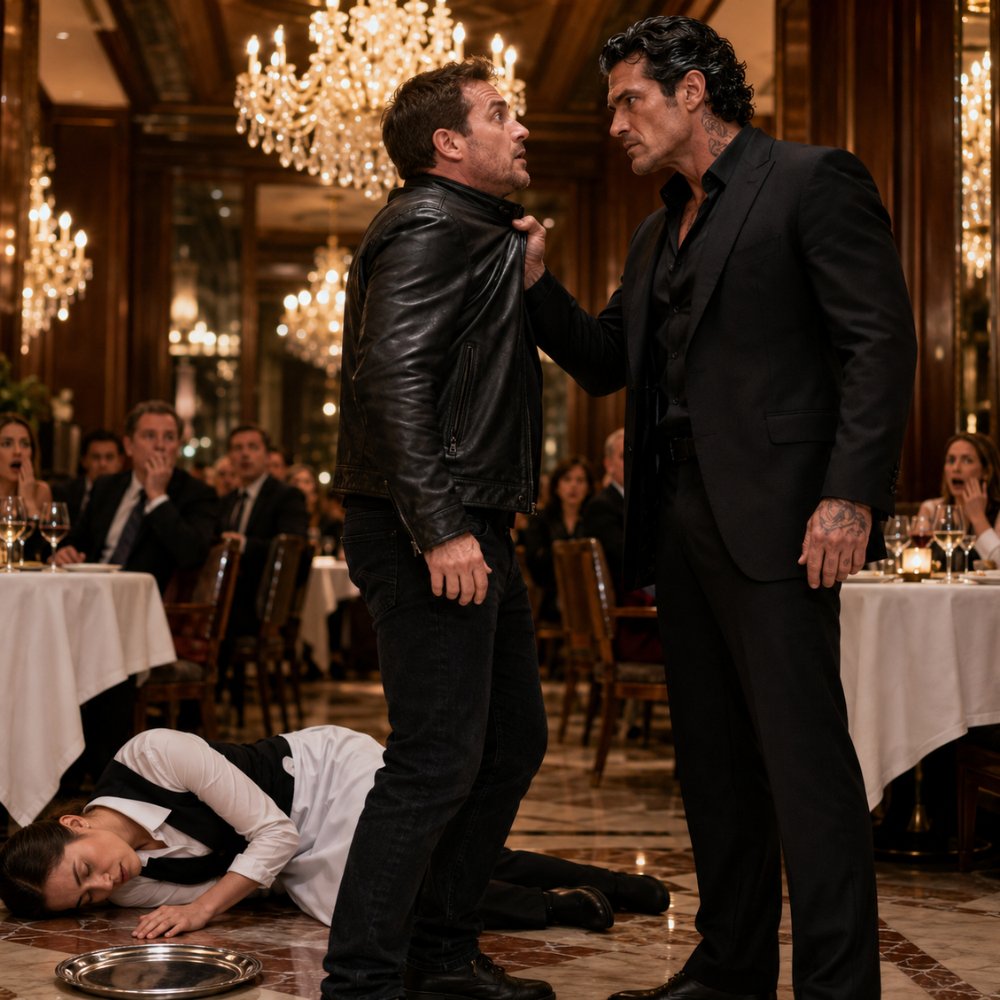
A thug struck a waitress in Castellano’s diner, not knowing who had just walked through the door
The coffee pot was still in Amelia Hayes’s hand when Derek Lawson reached across the booth and caught her by the wrist.
For half a second, she stopped breathing.
Not because he was squeezing particularly hard.
Because three years disappeared.
The red vinyl booth vanished. The chrome napkin holder vanished. The smell of onions on Tony’s griddle and the faint rattle of dishes behind the counter disappeared with them.
She was twenty-six again, standing in a narrow Albany apartment kitchen while Raymond Fletcher held her wrist exactly the same way.
Not hard enough to leave a mark anybody else would notice.
Hard enough to remind her who was stronger.
Amelia looked down at Derek’s hand.
“Let go of me.”
He smiled.
It was the smile that frightened her more than the grip.
Men like Raymond had smiled that way too. Calmly. Almost playfully. As if cruelty became harmless when wrapped in a joke.
“I said I wasn’t finished talking to you, sweetheart.”
Across Castellano’s Diner, conversations died one by one.
An elderly man near the front window lowered his coffee cup.
A truck driver at the counter turned on his stool.
Angela, the senior waitress on the evening shift, stopped halfway through wiping down a table and stared.
Even Tony Russo, who had been working the grill since before Amelia was born, leaned through the kitchen pass-through with a spatula still in his hand.
Everyone in that room knew something Amelia did not.
Derek Lawson had just broken the one rule nobody broke inside Castellano’s.
No threats.
No fights.
No putting your hands on another person.
For twenty-six years, that rule had made the diner one of the strangest peaceful corners of Brooklyn.
Police officers ate breakfast there beside union contractors. Longshoremen shared the counter with attorneys from downtown. Men who would cross the street to avoid one another anywhere else sometimes sat four booths apart, drank the same coffee, and minded their own business.
The reason was simple.
The diner belonged to Vincent Castellano.
And Vincent did not permit trouble on his floor.
Amelia had never needed to know anything more than that.
To her, Castellano’s was simply a neighborhood diner with slightly faded awnings, a brass bell over the front door, Formica tables polished so many times that the edges had gone dull, and regulars whose orders she could recite before they sat down.
It was the first place in years where predictability felt like luxury.
Mr. Del Monaco wanted decaf, two sugars, and toast burned darker than any reasonable person would request.
Freddy Pike, a retired sanitation worker, wanted coffee before he took his coat off.
Mrs. Lupo came every Thursday after evening Mass and split lemon pie with her sister.
Truckers knew Tony would make eggs at midnight without complaining.
Cops knew Vincent gave no discounts and tolerated no arguments about it.
Nobody asked Amelia where the thin scar beside her left eyebrow had come from.
Nobody asked why sudden male laughter sometimes made her shoulders tighten.
Nobody asked why she always chose the apartment above a family-owned pharmacy where the owners knew her name, even though it cost more than rooms farther east.
Nobody asked why she changed subway cars if she thought someone had been watching her too long.
She had been working at Castellano’s for eleven months.
Eleven quiet months.
That mattered more than she could explain.
At twenty-nine, she had learned to measure peace in small things.
A deadbolt that stayed locked.
A paycheck deposited every Friday.
A grocery bag on her own kitchen counter.
A landlord who knocked before entering.
Sunday afternoons at the laundromat.
A booth full of regulars arguing about baseball instead of a man deciding whether she had looked at him with the wrong expression.
She had built her life from those small pieces.
Then Derek Lawson grabbed her wrist and made three years disappear.
“Let go,” she said again.
His friends sat across from him.
The quieter one, a narrow-faced man everyone called Nicky, shifted uncomfortably.
“Derek,” he murmured. “Come on. Not here.”
Derek glanced at him.
“What?”
“This is Castellano’s.”
“So?”
“You know the rule.”
Derek laughed.
He released Amelia only to lean back as though the decision had been his.
“I don’t care whose diner it is.”
That caused a different kind of silence.
Nicky looked toward the front windows.
“Lower your voice.”
Derek spread his arms.
“Why? What’s everybody scared of?”
Amelia stepped away.
Her wrist burned where his fingers had been, though there was no mark.
She tucked her order pad against her apron.
“What do you want to drink?”
Derek looked pleased with himself.
“Coffee. Black.”
“Anything else?”
“A smile would be nice.”
One of his friends laughed weakly.
Amelia turned without responding.
“Hey.”
She kept walking.
“Sweetheart.”
She made it three steps.
“I’m talking to you.”
The old instinct told her to stop.
That instinct had once kept her safe.
Stop when he calls you.
Don’t make him follow.
Don’t embarrass him.
Don’t correct him in front of people.
Don’t make your voice sound disrespectful.
Don’t look frightened because fear encourages him.
Don’t look confident because confidence insults him.
There had never been a right way to survive Raymond’s moods. There had only been different versions of losing.
Amelia kept walking.
Behind the counter, Angela caught her elbow.
“Come here.”
Amelia let herself be guided into the narrow space beside the pie display.
“Breathe.”
“I’m fine.”
“No, honey.”
Angela was fifty-four, with silver hoop earrings and a smoker’s voice despite having quit eight years earlier. She had worked at Castellano’s long enough to remember when the register still opened with a brass key.
“I saw your face.”
“He grabbed me.”
“I know.”
“He just grabbed me like…”
Amelia stopped.
Angela’s expression softened.
“Like somebody else used to.”
Amelia looked away.
She had never told Angela the whole story.
She hadn’t needed to.
Women sometimes recognized one another’s history without being given every detail.
Angela squeezed her arm.
“You don’t have to go back over there.”
“It’s my section.”
“To hell with sections.”
“Vincent doesn’t like us switching tables.”
Angela almost laughed.
“Trust me, sweetheart. Vincent is not going to complain because you wouldn’t serve Derek Lawson.”
“Who is Derek Lawson?”
“Somebody who thinks he has more weight than he does.”
“With who?”
Angela hesitated.
“The Moretti crowd.”
Amelia stared at her.
She knew the name in the vague way most people in the neighborhood knew certain names. Not from newspapers exactly. From conversation that went quiet when outsiders approached. From old men who used first names and expected everyone to know which Joey or Frankie or Sal they meant.
“I don’t want trouble.”
“You didn’t bring trouble.”
“He’s sitting in my section.”
“That doesn’t make him yours.”
Amelia looked toward the booth.
Derek was laughing again.
His shoulders loose.
His face comfortable.
He believed the moment had already passed.
That bothered her.
Not because she wanted revenge.
Because she suddenly understood something she had failed to understand during her years with Raymond.
A man could humiliate you and be completely relaxed afterward because he expected you to carry all the discomfort for both of you.
He got to move on.
You got the shaking hands.
The sleepless night.
The apology you rehearsed even though you had done nothing wrong.
The careful explanation to yourself about why it probably wasn’t worth making a bigger issue.
Derek would finish his coffee.
He would leave.
He would tell somebody later about the waitress who had “attitude.”
Amelia would go home and check the lock twice.
The thought exhausted her.
Angela reached for the coffee pot.
“I’ll take it.”
Amelia stopped her.
“No.”
“Honey.”
“No.”
Something had changed.
Not dramatically.
There was no sudden courage flooding through her. No movie moment where fear disappeared.
She was still afraid.
Her hands still trembled.
She was simply more tired of surrendering than she was afraid of what came next.
Amelia took the pot.
“I’ll give him his coffee.”
“Then you come straight back.”
Amelia nodded.
She walked across the diner.
Derek watched her approach.
“There she is.”
She put a mug on the table.
Then the coffee pot.
She did not pour.
“I’d like you to pay for what you ordered and leave.”
His grin faded.
“What?”
“You put your hands on me. I’m not serving you anymore.”
Nicky closed his eyes.
The third man whispered something Amelia couldn’t hear.
Derek looked around as though expecting the room to join him in disbelief.
“You’re throwing me out?”
“I’m asking you to leave.”
“You know who I am?”
“No.”
That answer irritated him more than anything else had.
“I’m Derek Lawson.”
“Okay.”
Nicky muttered, “Derek.”
Derek stood.
He was bigger than Amelia had realized while he was seated.
Broad through the chest.
Maybe six-two.
The sort of man who had spent his life learning that physical size often ended conversations before they began.
Amelia’s body reacted before her mind did.
One step backward.
Her hip touched the counter.
Derek saw it.
His confidence returned.
“There,” he said softly. “That’s better.”
Amelia hated him for noticing.
“You forgot your place for a second.”
From behind the counter Angela said, “Derek, leave.”
He did not look at her.
Tony came around the kitchen opening.
“Enough.”
Derek turned his head.
“Everybody suddenly got brave?”
Nicky stood.
“Come on, man. We’re leaving.”
Derek shoved him back into the booth.
“Sit down.”
Amelia saw his arm move.
Then came the impact.
It happened too quickly to become a sequence in her memory.
A sharp blow.
The sensation of losing balance.
The checkered tile rising beneath her.
Then sound collapsed into a distant ringing.
Someone screamed her name.
A chair scraped.
A coffee mug shattered.
Amelia lay on her side, stunned, tasting metal and trying to understand why the ceiling was sideways.
Derek stood above her breathing hard.
The whole diner had frozen.
Tony took one step forward.
Derek pointed toward him.
“Anybody else?”
Nobody answered.
Not because nobody cared.
Because the room had reached that terrible second in which ordinary people understood that one more uncontrolled movement might make everything worse.
Derek laughed.
“Yeah.”
Nicky wasn’t looking at him anymore.
He was looking toward the front window.
His face had lost all color.
“Derek.”
“What?”
“Derek.”
“What?”
“Look at the door.”
A black Lincoln had stopped outside.
Two men stepped onto the sidewalk first.
Then an older man.
Late sixties.
Silver at his temples.
Long dark overcoat.
No hurry in his walk.
No visible anger.
The brass bell above the door rang.
Vincent Castellano entered.
He saw Amelia before he saw anyone else.
His eyes moved immediately to the floor.
Angela was kneeling beside her now, holding a clean towel against the side of her face.
Amelia’s apron had twisted around her waist.
One shoe had come off.
The coffee pot lay under a table.
Vincent stopped inside the doorway.
For several seconds he said nothing.
Then he asked, “Is she breathing?”
Angela nodded quickly.
“Yes.”
“Conscious?”
“Barely.”
“Tony.”
“Yes, Mr. Castellano.”
“Call 911.”
In the original old neighborhood, Vincent might once have trusted private doctors more than ambulances and public systems. Age had changed him in certain ways. So had loss. So had enough funerals where men had tried to handle serious problems quietly rather than correctly.
“Tell them she took a hard fall and needs trauma evaluation. Tell them police should respond too.”
Derek’s face changed.
Police.
That word had not been part of the scene he expected.
“Mr. Castellano.”
Vincent did not look at him.
“Angela, don’t move her neck.”
“I won’t.”
“Give her room.”
The regulars stepped back.
Vincent took off his coat and folded it beside Amelia, not touching her.
Only then did he raise his eyes.
“Who did it?”
Nobody needed to answer.
Derek stood beside the booth with one hand still clenched.
Vincent looked at him.
Derek began talking immediately.
“Mr. Castellano, sir, there’s been a misunderstanding.”
Vincent’s expression remained almost gentle.
“The name of my diner is printed on the window.”
Derek swallowed.
“Yes, sir.”
“It is printed on the menu.”
“Yes.”
“It is embroidered on her apron.”
Derek looked toward Amelia.
Vincent’s voice became quieter.
“Do not look at her unless I tell you to.”
Derek’s eyes returned immediately.
“Yes, sir.”
“You knew where you were.”
Derek tried to gather himself.
“She got disrespectful.”
No one in the diner moved.
Vincent took one slow step toward him.
“What did you say?”
“She told me to leave.”
“I heard that part.”
“She embarrassed me.”
Vincent stared at him.
“Son, if being asked to leave a diner embarrasses you, what you need is maturity, not a bigger audience.”
Derek said nothing.
Vincent glanced at Nicky.
“You were with him?”
“Yes, Mr. Castellano.”
“Did you touch her?”
“No, sir.”
“Did you tell him to stop?”
“Yes.”
“You also sat there while he grabbed her.”
Nicky lowered his eyes.
“Yes.”
“We’ll discuss that separately.”
Vincent looked at Derek again.
“Sit down.”
“Mr. Castellano…”
“Sit.”
Derek sat.
Vincent took the opposite side of the booth.
It was strangely ordinary.
An older man sitting across from a younger one at a diner table.
Sugar dispenser between them.
Two menus.
One untouched coffee mug.
But every person watching understood that something fundamental had shifted.
Vincent folded his hands.
“I opened this place twenty-six years ago.”
Derek nodded.
“In twenty-six years, do you know how many fights we’ve had?”
“No.”
“Zero.”
Derek looked surprised.
“Not one punch.”
Vincent leaned back.
“That wasn’t because everybody who came through here was peaceful. Some of the men who ate breakfast in this room hated one another.”
His gaze stayed steady.
“But they respected the room.”
Derek swallowed.
“People come here because they know whatever exists outside stays outside.”
“Yes, sir.”
“You understand?”
“Yes.”
“Tell me the rule.”
Derek hesitated.
Vincent waited.
“No violence in Castellano’s.”
“Again.”
“No violence in Castellano’s.”
Vincent nodded.
“And yet there is a woman on my floor waiting for an ambulance.”
Derek’s fingers trembled.
“I’ll pay her medical bills.”
Vincent stared at him.
“You think this is about a bill?”
“I’m just saying I can make it right.”
“You cannot.”
Vincent’s answer came without anger.
“That is the part men like you never understand. Money can pay a doctor. It cannot make something not have happened.”
Outside, a siren became audible.
Derek looked toward the window.
Vincent noticed.
“You wanted to be impressive five minutes ago.”
Derek’s jaw tightened.
“Be impressive now.”
“What?”
“Stay seated and tell the police exactly what you did.”
Derek’s face fell.
“Mr. Castellano…”
Vincent held up one finger.
“No.”
“I’m with Joey Moretti.”
“I know.”
“Then you know this could become complicated.”
Vincent almost smiled.
“Joey Moretti has eaten meatloaf in that booth since he was twenty-three years old.”
Derek said nothing.
“I attended his mother’s funeral. He attended my wife’s.”
Vincent leaned forward.
“If you believe Joey is going to start a war with me because you struck a waitress after being told to leave my diner, then you understand Joey even less than you understand me.”
Derek’s confidence finally broke.
“What are you going to do?”
“I’m going to call him.”
“Please don’t.”
“You just told me he was important.”
“He is.”
“Then he deserves accurate information about what someone using his name has done.”
Derek’s breathing changed.
“Mr. Castellano, please.”
Across the room, Amelia made a small sound.
Vincent turned instantly.
Angela bent lower.
“Amelia?”
Her eyelids moved.
“Sweetheart, can you hear me?”
“My head.”
“I know.”
Amelia tried to raise one hand.
Angela caught it gently.
“Don’t move.”
Vincent stood.
Derek disappeared from his attention as completely as though someone had switched off a light.
He crossed the floor and knelt several feet from Amelia.
“Miss Hayes?”
Her eyes moved toward him.
“My name is Vincent Castellano. I own the diner.”
She blinked.
“I know.”
Her words were slightly slurred.
He felt a knot form somewhere behind his ribs.
“An ambulance is almost here.”
“I have tables.”
Angela started crying.
“I’ve got your tables.”
Amelia frowned as if this required serious consideration.
“My shift.”
“Your shift is over,” Vincent said.
“I need the hours.”
“No.”
Her eyes moved toward him.
“No?”
“You are being paid for tonight.”
“I didn’t finish.”
“That is not your concern.”
The sirens grew louder.
Amelia whispered, “I can’t afford the emergency room.”
Vincent looked at her.
It was such an American fear.
Not whether she was injured.
Whether she could afford to find out.
“You will not receive a bill you have to pay.”
She looked confused.
“How?”
“Because this happened while you were working. The diner has insurance. And if insurance finds a reason to be stupid, I have lawyers whose entire purpose in life is arguing with insurance companies.”
A tiny laugh escaped Angela through her tears.
Amelia’s eye closed.
Vincent leaned slightly forward.
“Stay awake for me.”
Her eye opened again.
“There you go.”
The ambulance arrived with two patrol officers.
Vincent stepped back.
He answered questions directly.
He did not ask for favors.
He did not make calls to interfere.
He gave the officers Derek Lawson’s name and told them exactly who had witnessed the assault.
Mr. Del Monaco stood up with his cane.
“I saw everything.”
“So did I,” the truck driver said.
Angela raised her hand.
Tony came out from the kitchen.
“Me too.”
Within minutes, Derek was no longer sitting like a feared neighborhood enforcer.
He was standing with his hands behind his back while a uniformed officer explained that he was being detained pending investigation of an assault.
“Mr. Castellano,” Derek pleaded.
Vincent stood near the register.
“Yes?”
“Help me.”
Vincent’s face was calm.
“You misunderstood our conversation.”
“What?”
“I told you I would call Joey.”
Derek nodded desperately.
“I never told you I would rescue you.”
The officer led him outside.
Nicky remained.
He looked sick.
Vincent approached.
“You warned him.”
“Yes.”
“You should have stood up sooner.”
“I know.”
“You should have left the booth when he grabbed her.”
“I know.”
“You should have called for help before somebody else did.”
Nicky nodded.
“I know.”
Vincent studied him.
“What you do with knowing that is your business.”
Nicky looked toward the ambulance.
“I’m sorry.”
“Tell her when she is awake enough to decide whether she wants to hear it.”
The paramedics loaded Amelia.
Angela climbed into the ambulance after getting permission to ride along.
Vincent caught her near the doors.
“Go with her.”
“I am.”
“Her purse?”
Angela held it up.
“Got it.”
“Phone?”
“Inside.”
“Call me when the doctor knows something.”
Angela nodded.
The ambulance pulled away.
Police remained to photograph the scene and take witness statements.
Vincent stood in the doorway until the flashing lights disappeared.
Then Tony came beside him.
“You going to call Joey?”
“Yes.”
“Tonight?”
“Now.”
Joey Moretti answered on the second ring.
He sounded tired rather than annoyed.
“Vincenzo.”
“Joey.”
“I heard Derek made trouble.”
“News travels fast.”
“Nicky called his uncle. His uncle called me.”
Vincent looked through the front window at the place where Derek had been put into the patrol car.
“He struck one of my waitresses.”
Silence.
“Bad?”
“Ambulance took her to St. Agnes.”
Another silence.
“When did the kid get this stupid?”
“I don’t think stupidity arrived tonight.”
Joey exhaled.
“You calling me for permission to do something?”
“No.”
That surprised him.
“I’m calling because he used your name while frightening people in my diner.”
Joey was silent.
Vincent continued.
“I thought you deserved to hear it from me before somebody tells you a version designed to make Derek look better.”
“What are the cops charging him with?”
“Assault for now.”
“Witnesses?”
“A diner full.”
Joey sighed again.
“He’s done with us.”
Vincent said nothing.
“I mean it,” Joey continued. “No more errands. No introductions. Nobody uses my name to protect him.”
“That is your business.”
“What do you want?”
“Nothing from you tonight.”
A pause.
Then Joey said, “Vincenzo.”
“Yes?”
“I’m sorry about the girl.”
Vincent looked toward the bloodstain technicians had not yet permitted Tony to clean.
“So am I.”
The call ended.
Vincent expected that to be the end of Derek Lawson’s importance.
It wasn’t.
Thirty minutes later, while police were finishing their initial work, Nicky approached Vincent near the back hallway.
“Mr. Castellano?”
“What?”
“I need to tell you something.”
Vincent saw immediately that the young man was frightened in a different way.
“Talk.”
“It wasn’t random.”
Vincent’s expression became still.
“What wasn’t?”
“Derek picking her.”
Nicky glanced toward the dining room.
“He came in for her.”
Every sound around Vincent seemed to sharpen.
“How do you know?”
“He told me on the way over.”
“Tell me exactly what he said.”
Nicky swallowed.
“He said there was two grand in it if he scared a waitress.”
Vincent did not move.
“What waitress?”
“Amelia.”
“Who paid him?”
“I don’t know.”
“Nicky.”
“I swear.”
The young man’s voice cracked.
“I never met the guy. Derek did.”
“What was he supposed to do?”
“Make her quit.”
“How?”
“Scare her. Grab her. Make a scene. Make her think the diner wasn’t safe anymore.”
Vincent’s jaw tightened.
“And then?”
“I don’t know.”
“You expect me to believe that?”
“He said the guy wanted her to leave town.”
“What guy?”
“I heard the first name.”
Vincent waited.
“Raymond.”
The name meant nothing to him.
Then Tony, standing several feet away, dropped a stack of menus.
Vincent turned.
Tony knew.
“What?”
Tony hesitated.
“Angela mentioned a Raymond once.”
“When?”
“Months ago. Amelia got a letter at work. No return address. Angela saw her throw it out and then go into the bathroom crying.”
Vincent looked back at Nicky.
“Last name.”
“I don’t know.”
“What did Derek say about him?”
“That he was her husband.”
Vincent’s eyes narrowed.
“Amelia isn’t married.”
“Ex-husband. Whatever. He said she ran out on him.”
Vincent thought about the scar near Amelia’s eyebrow.
About the way she never let strange men stand too close.
About Dr. Russo, who had once quietly mentioned that people who carry themselves like Amelia usually have a reason.
“What else?”
Nicky rubbed his palms against his jeans.
“Raymond told Derek he only wanted to talk to her.”
Vincent’s expression changed.
“You believed that?”
“I didn’t know.”
“That is not what I asked.”
Nicky looked down.
“No.”
Vincent pulled out his phone.
The next person he called was not Joey Moretti.
It was Detective Elena Ruiz of the NYPD.
Vincent had known her father for forty years and Elena long enough to understand that invoking either fact would annoy her.
She answered with, “This better not be you trying to interfere with the Lawson case.”
“It is not.”
“Good.”
“I have information that may change it.”
“What kind?”
“The assault may have been hired.”
Silence.
“Start over.”
Vincent told her what Nicky had said.
Ruiz interrupted twice to clarify wording.
Then she asked, “Do you have this Nicky person with you?”
“Yes.”
“Keep him there voluntarily.”
“I know what voluntarily means, Elena.”
“I’m emphasizing it because your reputation has a tendency to make people confuse voluntary with terrified.”
“That sounds like their problem.”
“It becomes mine when I’m writing affidavits.”
Vincent almost smiled despite himself.
“He can leave whenever he wants.”
“Good. I’m coming.”
“Check a Raymond connected to Amelia Hayes.”
“Not until I hear it from her or establish lawful grounds.”
Vincent accepted that.
“She is at St. Agnes.”
“Then somebody can ask her when she’s medically able.”
“Elena.”
“What?”
“If this man is still looking for her…”
“I know.”
Her voice softened slightly.
“I’ll move fast.”
Ruiz arrived twenty minutes later with another detective.
Nicky gave his statement.
Under questioning, he remembered more.
Derek had met Raymond at a bar near the Port Authority Bus Terminal.
The man had shown him an old photograph of Amelia.
He had described her work schedule.
He had known which subway route she used.
He had given Derek instructions to scare her so badly that she would resign and leave Brooklyn.
Detective Ruiz stopped writing.
“He knew her schedule?”
“Yes.”
“How?”
“I don’t know.”
“Did Derek say?”
“No.”
“What was supposed to happen after she quit?”
Nicky hesitated.
“He said Raymond wanted her to get on a bus.”
“Which bus?”
“I don’t know.”
“Why a bus?”
Nicky shook his head.
Ruiz and Vincent looked at each other.
The same concern had occurred to both.
This no longer sounded like an angry ex hoping to frighten someone.
It sounded planned.
Ruiz stepped away to make calls.
Vincent went to St. Agnes.
The emergency department was bright, busy, and indifferent to neighborhood reputations.
That comforted him.
Hospitals should not care who you were.
They should care whether your blood pressure was stable.
Angela found him in the waiting room shortly before one in the morning.
“She’s awake.”
“How bad?”
“Concussion. Small fracture in the jaw. Stitches near the hairline.”
Vincent’s shoulders lowered.
“Brain scan?”
“Clear.”
He closed his eyes for a second.
Angela watched him.
“You really thought…”
“Yes.”
“Me too.”
They sat.
After a moment Angela said, “There’s something you should know.”
Vincent looked over.
“She was hurt before.”
“I know.”
“No. I mean before tonight. Before she came here.”
Vincent said nothing.
Angela clasped her hands.
“She told me pieces.”
“About Raymond?”
Angela stared.
“How do you know that name?”
He explained enough.
Her face drained.
“Oh, God.”
“What?”
“He found her.”
“We don’t know that yet.”
“Yes, we do.”
Angela leaned closer.
“She left him three years ago.”
“What happened?”
“She never gave me every detail. I never pushed.”
Angela’s voice lowered.
“He controlled the money. Her phone. Who she saw. What she wore. He’d apologize after hurting her and then explain why she had forced him to lose his temper.”
Vincent looked toward the emergency-room doors.
“She left with one bag.”
“Yes.”
“Did she go to police?”
“Eventually.”
“What happened?”
“She had photographs. A couple of medical records. But she had gone back to him twice before she finally left.”
Angela’s mouth tightened.
“You know what people do with that. Why did you go back? Why didn’t you leave sooner? Why didn’t you call the first time?”
Vincent knew.
He had heard men ask those questions all his life.
Men who had never spent one night afraid in their own kitchens.
“Was there an order of protection?”
“In Albany. Temporary at first, then longer.”
“Expired?”
“I think so.”
Detective Ruiz appeared in the waiting room.
She had heard enough to understand the conversation.
“It expired fourteen months ago.”
Angela turned.
“You checked?”
“Yes.”
Ruiz sat across from them.
“Raymond Fletcher. Forty-six. Albany address until about three weeks ago.”
Vincent’s expression hardened.
“Where now?”
“Unknown.”
“Employment?”
“Construction supervision. Several short-term jobs. No current employer listed.”
“Criminal record?”
“Two disorderly conduct charges. One harassment complaint. Neither resulted in significant penalties.”
Angela laughed bitterly.
“Of course.”
Ruiz ignored the tone.
“There’s more.”
Vincent waited.
“Amelia reported him for violating the protective order two years ago.”
“What happened?”
“Couldn’t establish contact.”
“He knew where she was?”
“Maybe not exactly. The complaint involved messages sent through a relative.”
Ruiz leaned forward.
“What matters tonight is that someone who matches his name may have paid Derek to target her.”
“Can you arrest him?”
“Not from what I have yet.”
Vincent’s patience showed in his face.
Ruiz held up a hand.
“Don’t.”
“I did not say anything.”
“You have a very loud silence.”
“Is he dangerous?”
“I treat any person stalking a former partner as potentially dangerous.”
“Then protect her.”
“We will.”
“How?”
“An officer stays outside her room until morning. We contact the special victims unit. We locate Fletcher. We get emergency protective relief if the facts support it.”
Vincent looked unconvinced.
Ruiz leaned closer.
“And you do nothing.”
“Elena.”
“Nothing.”
“That man paid someone to walk into my business and terrorize my employee.”
“I understand.”
“No, you understand it professionally. I understand it personally.”
“Then be useful personally.”
Her voice sharpened.
“Pay her wages. Change her locks. Move her if she wants. Give us surveillance footage. Give us witnesses. Give us Nicky’s phone if he consents. Give us every useful thing your money and influence can buy without creating a second criminal investigation.”
Vincent stared at her.
Ruiz held his gaze.
“You want her safe or you want to feel powerful?”
That landed.
For several seconds, Vincent said nothing.
Then he nodded.
“Safe.”
“Good.”
She stood.
“Then let me work.”
Amelia woke more fully at two in the morning.
Her left eye was badly swollen. A thin bandage covered the cut near her temple. Her jaw had been stabilized and every word cost her effort.
Angela sat beside her.
Detective Ruiz stood near the foot of the bed.
Vincent remained outside until Amelia agreed to let him enter.
That mattered to him.
He had spent too many years around men who believed good intentions erased the need for permission.
When he stepped inside, Amelia looked almost embarrassed.
“Mr. Castellano.”
“Vincent.”
She tried to sit higher.
“Don’t.”
“I’m okay.”
“You are in a hospital.”
“That doesn’t mean I’m not okay.”
“It strongly suggests we should postpone the debate.”
The corner of her mouth moved and then she winced.
Vincent sat.
Detective Ruiz asked gently, “Amelia, do you know a Raymond Fletcher?”
The effect was immediate.
Her entire body went rigid.
Vincent saw one hand tighten around the blanket.
“Why?”
Ruiz’s voice stayed calm.
“We have reason to believe Derek Lawson may have been paid to frighten you.”
Amelia went pale.
“By Raymond?”
“We’re investigating.”
“He found me.”
“We don’t know that.”
“He found me.”
Her breathing quickened.
Angela reached for her hand.
Amelia pulled away reflexively, then realized who it was.
“Sorry.”
“You never apologize for that.”
Angela put her hand on the mattress instead, close but not touching.
Ruiz continued carefully.
“Tell me what you need us to know about him.”
Amelia looked at Vincent.
Then the detective.
“He doesn’t want to talk.”
“What does he want?”
“He wants me back where he can control me.”
“How do you know?”
“Because he told me before I left.”
Her voice was thin.
“If I ever embarrassed him by leaving permanently, he said he’d spend the rest of his life making sure I regretted it.”
Vincent felt something old move inside him.
A memory he had spent eight years avoiding.
His daughter Sophia, twenty-seven, sitting at his kitchen table with makeup covering a bruise.
Dad, please don’t make a thing out of it.
He had been leaving for Denver the next morning.
He had told her he would handle it when he returned.
He had believed there would always be time.
There had not been.
Sophia had died before he got home.
Not murdered. Life had been more complicated and more ordinary than the stories people later whispered. Her partner’s abuse had escalated. She had tried to leave. In the chaos and fear of those final weeks, a preventable medical emergency had gone unanswered too long.
Vincent had spent eight years replaying the sentence.
When I return.
Three words that sounded reasonable until time made them unforgivable.
He looked at Amelia.
“Did Raymond know where you lived?”
“No.”
“Where you worked?”
“Not until tonight.”
Ruiz asked, “Anyone back home who might have told him?”
“My cousin knew the neighborhood. Not the diner.”
“Social media?”
“I don’t use it.”
“Banking?”
“New bank.”
“Phone?”
“New number twice.”
Ruiz wrote everything down.
“Would he know your routines?”
“If he watched me.”
Nobody said anything.
That was the possibility none of them liked.
Vincent asked, “How long have you felt watched?”
Amelia stared at him.
“A few weeks.”
Angela closed her eyes.
“You didn’t tell me.”
“I thought I was imagining it.”
“When?”
“Coming out of the grocery store. Near the subway. Once outside church.”
Ruiz’s pen stopped.
“Church?”
“I go to St. Catherine’s sometimes on Sundays. I thought I saw a brown jacket across the street.”
“Raymond wears brown?”
“He used to.”
The detective stood.
“We move now.”
“Move where?” Amelia asked.
“A different room first. Hospital security will restrict visitor information. Then we arrange somewhere safe after discharge.”
“I have an apartment.”
Vincent answered.
“You have an apartment a man may have been watching.”
Amelia looked at him.
“I can’t just disappear every time he finds me.”
“No.”
Vincent’s voice softened.
“You cannot.”
That was the truth.
She had already run once.
If safety required endless running, Raymond still controlled the direction of her life.
Ruiz said, “Temporary relocation is not surrender. It buys us time to locate him.”
Amelia looked toward the dark window.
“Where would I go?”
Vincent had several apartments available through legitimate properties his family managed.
He did not offer one immediately.
Instead he said, “Wherever you choose.”
Amelia looked back.
“Not wherever you choose?”
“No.”
That surprised her.
“You have had enough men deciding where you are going.”
Silence.
Then Amelia nodded.
“Okay.”
Ruiz left to make arrangements.
Vincent remained.
Amelia studied him.
“Why do people listen to you?”
He smiled faintly.
“Age.”
“That’s not it.”
“Gray hair helps.”
“Angela told me things.”
“Angela talks too much.”
“I heard that.”
Angela called from the other side of the curtain.
Vincent almost laughed.
Amelia’s face became serious again.
“Are you a bad man?”
The question would have offended a younger Vincent.
At sixty-eight, he respected it.
“I have done things I am not proud of.”
“That’s not an answer.”
“No.”
He looked down at his hands.
“I spent much of my life in businesses where loyalty mattered more than law. I confused those things sometimes.”
Amelia watched him.
“Do you still?”
“I try not to.”
“Did you hurt Derek?”
“No.”
“Are you going to?”
“No.”
She seemed surprised again.
“Why not?”
“Because he is already in custody, because the police have witnesses, and because hurting him would make me feel powerful for five minutes while making your case harder for months.”
Amelia considered that.
“You would have answered differently years ago.”
“Yes.”
“What changed?”
Vincent looked toward the window.
“My daughter.”
Her expression softened.
“Angela said you had one.”
“Sophia.”
“What happened?”
He had told the story only a handful of times.
Tonight, for reasons he did not entirely understand, he told Amelia.
Not every detail.
Enough.
When he finished, Amelia’s good eye was wet.
“I’m sorry.”
Vincent shook his head.
“No.”
“What?”
“You do not apologize to me tonight.”
“But…”
“No.”
His voice remained gentle.
“You have carried enough things that belonged to other people.”
He stood.
“Rest.”
“Vincent.”
He stopped.
“Raymond.”
“Yes?”
“What if the police don’t find him?”
Vincent looked back at her.
“Then they keep looking.”
“And if he finds me first?”
“He won’t.”
“How can you promise that?”
“I cannot promise what another man will do.”
He paused.
“But I can promise you will not face it alone.”
That was the promise he could honestly make.
By four in the morning, detectives had more than they expected.
Nicky voluntarily surrendered his phone.
There were messages from Derek.
The previous afternoon:
EASY TWO GRAND TONIGHT.
Then:
GUY JUST WANTS HER SPOOKED.
Another:
SHE RUNS, WE GET PAID.
The phone also contained a photograph Derek had received.
Amelia.
Taken outside Castellano’s three days earlier.
Not an old photograph.
A surveillance photograph.
Raymond had been watching her.
The location data associated with several messages narrowed the meeting point to a hotel near the Port Authority.
Detective Ruiz called Vincent shortly after four-thirty.
“We found the hotel.”
“Is he there?”
“Registered under Ray Fletcher.”
Vincent stood in the hospital hallway.
“What happens now?”
“We get the warrant process moving.”
“How long?”
“Not long.”
Vincent looked through the small window in Amelia’s door.
She was asleep.
Angela had fallen asleep in the visitor chair.
“Call me when he is in custody.”
“I will.”
“Elena.”
“Yes?”
“Thank you.”
There was a brief silence.
“You’re welcome.”
Then Ruiz added, “And thank you for not trying to solve this yourself.”
Vincent looked toward the floor.
“That compliment arrived early.”
“Vincent.”
“I’m joking.”
“You are not funny.”
“So people tell me.”
The police entered Raymond Fletcher’s hotel room shortly after dawn.
They found cash.
A printed photograph of Amelia.
A notebook containing parts of her work schedule.
Bus departure times.
Her apartment address.
And several pages of handwritten notes documenting places she visited regularly.
Grocery store.
Pharmacy.
St. Catherine’s.
Castellano’s.
They also found a duffel bag containing clothing that did not belong to Raymond and a prepaid phone used to contact Derek.
The evidence changed the case immediately.
Raymond was arrested on stalking-related charges, conspiracy connected to the assault, and violations tied to his efforts to locate and intimidate Amelia. Prosecutors sought detention while the investigation continued.
Detective Ruiz called Vincent at 6:12.
“He’s in custody.”
Vincent closed his eyes.
“Alive?”
Ruiz paused.
“Yes, Vincent. That is generally how arrests work.”
“Good.”
“I’m going to assume you asked because you wanted confirmation the situation stayed clean.”
“You may assume whatever makes your morning better.”
She sighed.
“We also found enough documentation to support a new protective order.”
“Tell Amelia.”
“I will.”
“Now?”
“When her doctor says she is awake enough.”
Vincent sat down outside her room.
Morning light had begun filling the hospital corridor.
A janitor pushed a mop bucket past him.
Nurses changed shifts.
A vending machine hummed.
The world had continued.
That was another thing grief had taught Vincent.
Nothing waited for your crisis to finish.
At seven, Dr. Russo arrived.
Thomas Russo had been Vincent’s friend since they were boys playing stickball between parked cars. He had become a physician. Vincent had become several other things before eventually becoming mostly a diner owner with investments and a history people still lowered their voices around.
Tommy sat beside him.
“How is she?”
“Stable.”
“Brain?”
“Scan remains clear.”
“Jaw?”
“Small fracture. No surgery unless swelling reveals something we missed.”
Vincent nodded.
“Old injuries?”
Tommy looked at him.
“I’m not discussing details without her permission.”
Vincent accepted the boundary.
Tommy studied him.
“That is progress.”
“Careful.”
The doctor smiled.
“You staying?”
“Until she wakes.”
“She asked for you twenty minutes ago.”
Vincent stood immediately.
Tommy caught his sleeve.
“Vincenzo.”
“What?”
“Do not turn this girl into Sophia.”
The words stopped him.
Tommy continued.
“She is Amelia Hayes. She has her own history. Her own decisions. Her own recovery.”
Vincent looked through the door.
“I know.”
“Do you?”
Vincent was quiet.
Then he nodded.
“I will.”
Amelia was propped against two pillows.
Her face looked worse in daylight.
The sight made Vincent ache.
But she was alert.
“Good morning.”
“Doesn’t feel good.”
“Fair.”
He sat.
“Detective Ruiz called.”
Amelia’s fingers tightened around the blanket.
“They found him.”
Her breathing stopped.
“Raymond?”
“Yes.”
“Where?”
“Hotel near the bus terminal.”
“Did he…”
“He is in police custody.”
Amelia stared at him.
Vincent continued slowly.
“They recovered notes about your routine. Photographs. Other evidence.”
“He was watching me.”
“Yes.”
She turned toward the window.
For several seconds nothing happened.
Then she began crying.
Quietly.
Not the tears of physical pain.
Not exactly relief either.
Vincent knew better than to label them.
He stayed in his chair.
Did not reach for her.
Did not tell her everything was fine.
Everything was not fine.
Something could be safer without becoming fine.
After a long time Amelia whispered, “Three years.”
Vincent waited.
“Three years I kept thinking every man behind me was him.”
Her voice shook.
“I changed apartments twice. Phones twice. Jobs four times.”
She wiped her cheek.
“And then when I finally stopped looking over my shoulder every minute…”
“He found you.”
“Yes.”
She closed her eyes.
“I feel stupid.”
Vincent’s expression hardened.
“No.”
“I should have known.”
“No.”
“I saw somebody outside church.”
“You noticed.”
“I ignored it.”
“You were trying to live.”
She opened her eyes.
“That is not the same as being careless.”
She stared at him.
Vincent leaned forward.
“Listen to me. There is something people say when they have the advantage of knowing how the story ends.”
He paused.
“They say you should have known.”
Amelia looked down.
“It is a cruel sentence.”
He continued.
“You made decisions with the information you had. You built a life. You went to work. You bought groceries. You went to church. Those are not mistakes.”
Her mouth trembled.
“He is the one who spent three years refusing to accept that you were allowed to leave.”
Silence.
“He is the one who hired somebody.”
Silence.
“He is the one sitting in custody.”
Vincent sat back.
“You went to work.”
Amelia cried again.
This time she did not apologize.
That mattered.
The first week after the assault passed slowly.
Amelia stayed in the hospital two nights.
The diner’s workers’ compensation insurance covered much of her immediate care. Vincent’s attorney helped when paperwork became confusing. A victim-services advocate arranged assistance for counseling and temporary housing.
Detective Ruiz helped secure an updated protective order.
Raymond remained in custody while prosecutors assembled the broader case.
Derek, facing both the assault charge and evidence of a planned intimidation scheme, made the most useful decision of his adult life.
He cooperated.
He admitted Raymond had paid him.
He identified the hotel.
He provided details of their meeting.
He admitted he suspected Raymond’s story about an unfaithful, dishonest ex-wife was false.
The prosecutor asked why he accepted the job anyway.
Derek sat in an interview room and said something that would later matter more to Amelia than any apology.
“Because I didn’t care what happened to her.”
No excuses.
No claim he had been tricked.
No insistence that the blow had been accidental.
He had been given money to frighten a woman he did not know.
He had considered the possibility that the man paying him was lying.
He had accepted anyway.
It was ugly.
It was also true.
Vincent learned the quote through Detective Ruiz.
He repeated it to Amelia only after asking whether she wanted to know.
She did.
When he finished, she sat quietly in the furnished apartment where she was staying.
“Didn’t care.”
“No.”
“That’s almost worse than hate.”
“Sometimes.”
She looked at her hands.
“Raymond hated me in his own way. Derek didn’t even need that.”
“No.”
“Two thousand dollars.”
Vincent said nothing.
Amelia laughed once, bitterly.
“I spent three years thinking Raymond was the most dangerous kind of man.”
“He may be.”
“No.”
She looked toward Vincent.
“The dangerous ones are also the people willing to help someone like Raymond because the victim is nobody to them.”
Vincent thought about men he had known in his younger years.
Men who had told themselves a job was only a job.
That they did not need to know who would be hurt.
That curiosity was weakness.
That responsibility ended where payment began.
He understood exactly what Amelia meant.
“Yes,” he said.
“You’re right.”
She watched him.
“You knew men like that.”
“Yes.”
“Were you one?”
The question was direct.
Vincent respected direct questions.
“Sometimes.”
Amelia looked away.
“You really tell the truth.”
“I am too old to maintain unnecessary versions.”
She almost smiled.
“Were you ever like Raymond?”
Vincent took his time.
“No.”
Then he added, “That does not mean I was always good.”
“I didn’t ask if you were good.”
“No.”
He smiled faintly.
“You asked a more important question.”
Amelia’s recovery became less cinematic after that.
That was the part nobody tells well in stories because real healing involves too many boring Tuesdays.
Her jaw hurt.
Soup became irritating by the third day.
By the tenth, she would have committed minor crimes for a cheeseburger.
Headaches came without warning.
Crowded places made her dizzy.
One afternoon a deliveryman knocked unexpectedly and she dropped a glass.
The sound sent her to the bathroom shaking.
Counseling helped, though she disliked it at first.
The therapist asked questions Amelia believed were too simple.
Where do you feel fear in your body?
What tells you that you are safe now?
What does anger feel like when you do not immediately suppress it?
Amelia wanted sophisticated answers.
The therapist kept asking ordinary questions.
Eventually Amelia realized that ordinary questions were difficult because ordinary life was exactly what fear had taken from her.
At Castellano’s, Angela called every day.
Tony sent containers of soup.
Mr. Del Monaco wrote a card in handwriting so shaky Amelia needed ten minutes to decipher it.
It said:
YOU DID NOTHING WRONG. COME BACK WHEN YOU WANT. YOUR COFFEE IS ON ME.
Underneath, Tony had added:
HE NEVER PAYS FOR COFFEE. KEEP THIS CARD AS EVIDENCE.
Amelia laughed until her jaw hurt.
Vincent visited twice a week.
Never unannounced.
Never late.
Always with something practical.
A grocery bag.
Insurance papers his attorney had translated into normal English.
A replacement phone after detectives retained hers temporarily.
Once, a small lamp because Amelia complained the apartment’s overhead lighting made the place look like a dental office.
He never asked when she was returning to work.
That surprised her.
Everyone else eventually did.
Vincent did not.
At the end of the fourth week, Amelia asked him why.
They were sitting in a quiet neighborhood café because she had decided she wanted to practice being in public again without choosing Castellano’s as the first place.
“Why what?”
“Why haven’t you asked when I’m coming back?”
He stirred his coffee.
“Because I do not know if you want to.”
“I need a job.”
“That is different.”
Amelia looked out the window.
“What if I can’t go back?”
“Then you do something else.”
“So simple.”
“No.”
Vincent shook his head.
“Not simple. Still yours.”
She was quiet.
“I hate that booth.”
“I can remove it.”
“No.”
He looked at her.
“I said I hate it. I didn’t say I want it removed.”
Vincent waited.
“I keep seeing myself on the floor.”
“That is understandable.”
“I also keep seeing myself standing there before.”
“Before he hit you.”
“Yes.”
She touched the rim of her coffee cup.
“I told him to leave.”
“You did.”
“I was scared.”
“I know.”
“I still told him.”
“Yes.”
Amelia looked at him.
“If the booth disappears, then all that is left is the part where he hurt me.”
Vincent understood.
“You want it to stay.”
“Yes.”
“Then it stays.”
She returned six weeks after the assault.
Not because a therapist told her to.
Not because Vincent asked.
Not because she needed to prove something publicly.
She woke on a Tuesday and realized she wanted to see the diner before deciding whether fear still owned part of it.
Angela opened that morning.
Tony was already behind the grill.
Mr. Del Monaco arrived at 6:02, as he had for twenty years, carrying the New York Daily News beneath one arm.
At 6:18, the brass bell rang.
Every head turned.
Amelia stood inside the doorway.
Her hair was tied back.
The bruises were gone.
A thin pale line remained near her eyebrow.
She had stopped covering it.
For years she had considered scars evidence of somebody else’s power.
Now she had begun thinking of them differently.
A scar was also evidence that something had healed.
Angela put down the coffee pot.
“Oh, honey.”
Amelia barely had time to smile before Angela crossed the room.
They hugged carefully.
Then Tony came out of the kitchen.
Then Mr. Del Monaco stood.
One person began clapping.
Then another.
Within seconds, half the diner joined in.
Amelia’s face turned red.
“Oh, please don’t.”
That made everyone clap louder.
She laughed.
A full laugh.
No calculation.
No effort.
Just sound.
When the room settled, Angela asked, “Coffee?”
“Yes.”
“Seat?”
Amelia looked toward the corner.
Her booth.
She walked there.
Slowly.
The red vinyl had been repaired where a paramedic’s equipment tore it.
The chrome sugar container remained.
The napkin holder remained.
The table had been cleaned so thoroughly that even Tony admitted the bleach smell lasted three days.
Amelia put one hand on the seat.
Her pulse sped up.
She let it.
The therapist had taught her something she initially hated.
Fear did not always require obedience.
Sometimes fear was information from an old version of the world.
The body said danger.
The present could answer, I hear you.
Then remain.
Amelia breathed.
Once.
Twice.
The bell over the front door rang.
Her shoulders tightened.
She turned.
Vincent walked in.
Dark coat.
Silver hair.
Same measured stride.
He saw her.
Stopped.
A smile appeared.
Not the cold almost-smile of a man speaking to someone dangerous.
A real one.
“Good morning, Miss Hayes.”
“Good morning, Vincent.”
“First day back?”
“I’m trying it.”
He nodded.
“That is enough.”
He moved toward his usual booth.
Amelia called after him.
“You want coffee?”
“I thought you were trying it.”
“I can try while carrying a coffee pot.”
He sat.
“Then yes.”
She went behind the counter.
Angela handed her the pot.
Their eyes met.
“You good?”
Amelia considered.
“Nervous.”
“That wasn’t the question.”
Amelia smiled.
“Yes.”
She walked across the diner with her head up.
She poured Vincent’s coffee.
“Anything else?”
“Toast.”
“What kind?”
“Whatever Tony burns least.”
From the kitchen Tony shouted, “I heard that.”
Vincent lifted his voice just enough.
“You were intended to.”
The diner laughed.
Amelia looked around.
Ordinary morning.
Eggs.
Coffee.
Newspaper.
A mother cutting pancakes for a child.
Two construction workers arguing about parking.
A delivery driver checking his phone.
The floor was clean.
The booth was still there.
So was she.
The criminal cases continued long after Amelia’s first shift back.
Raymond’s attorney initially argued that his notes represented an attempt at reconciliation and that Derek had acted beyond anything Raymond intended.
The prepaid phone damaged that argument.
So did the photograph taken outside Castellano’s.
So did Derek’s testimony.
So did Raymond’s detailed tracking of Amelia’s movements.
Most damaging was a message recovered from the prepaid phone the afternoon before the assault.
MAKE HER THINK BROOKLYN ISN’T SAFE.
The prosecutor read those words in court months later.
Amelia sat behind the prosecutor with Angela on one side and Detective Ruiz on the other.
Vincent sat two rows back.
He did not sit beside her because he understood something now that he might not have understood years earlier.
Support did not always mean standing closest.
Sometimes it meant being exactly as close as somebody asked you to be.
Raymond turned once.
He saw Amelia.
For the first time in three years, she saw him too.
Reddish hair graying near the temples.
Heavy shoulders.
Pale blue eyes.
The familiar gentleness on his face.
That was what disturbed her most.
He looked ordinary.
He had always looked ordinary.
People imagined dangerous men looked dangerous.
Raymond had looked like a man who remembered birthdays.
A man who carried grocery bags for elderly neighbors.
A man who spoke softly at family dinners.
A man who could explain every bruise with such patience that by the end of the explanation, Amelia sometimes felt guilty for making him explain.
In court, he looked toward her with sadness.
Not anger.
Sadness.
The old Amelia would have understood the message.
Look what you made happen to me.
The new Amelia looked back.
And felt nothing she needed to obey.
Raymond eventually pleaded guilty to a group of charges that avoided a longer trial but carried substantial prison time and strict post-release restrictions.
Amelia gave a statement at sentencing.
She did not describe every incident.
She did not need to.
She spoke for six minutes.
“When I left Raymond three years ago,” she said, “I thought freedom would begin when I closed the apartment door.”
The courtroom remained quiet.
“It didn’t.”
She looked toward the judge.
“For a long time, freedom meant making decisions based on whether he might find me. Where I lived. Where I worked. Whether I used my real name on an account. Whether I went to church. Whether I accepted a ride home.”
She paused.
“That is still control, even when the other person is not physically present.”
Raymond stared at the defense table.
Amelia continued.
“What happened at Castellano’s frightened me because I believed the place where I finally felt safe had been taken from me.”
She looked down at the paper in her hands.
“But I went back.”
Her voice remained steady.
“I want the court to understand that I did not go back because I am no longer afraid.”
She raised her eyes.
“I went back because fear does not get to make every decision anymore.”
Vincent lowered his head.
He thought about Sophia.
He wished she could have heard that sentence.
Perhaps, in whatever way people who have lost someone sometimes allow themselves to believe, she had.
After sentencing, Amelia and Angela walked out of the courthouse together.
Vincent waited near the elevators.
Detective Ruiz stood with him.
“You did well,” Ruiz told Amelia.
“Thanks.”
“You need anything, you call.”
“I know.”
Ruiz glanced at Vincent.
“And if he offers to solve anything himself, call me faster.”
Amelia smiled.
“I’ve learned.”
Vincent looked offended.
“I have been exceptionally cooperative.”
Ruiz laughed.
“You have been tolerable.”
She left.
Amelia turned to Vincent.
“You okay?”
He raised an eyebrow.
“I’m not the one who just gave a statement.”
“That wasn’t my question.”
He smiled.
“Better than I expected.”
They rode down in the elevator.
On the courthouse steps, the city moved around them.
Taxis.
Delivery bikes.
People carrying coffee.
Office workers hurrying past with no knowledge of what had happened upstairs.
Amelia stood in the sun.
“What now?” Vincent asked.
“I’m working at four.”
“That is your answer?”
“Yes.”
“No grand celebration?”
“Angela bought a sheet cake from Costco.”
Vincent stared at her.
“That may qualify.”
“She had them write ‘You’re free’ in blue frosting.”
“Subtle.”
“She wanted handcuffs drawn on it. I talked her out of that.”
“Thank God.”
Amelia laughed.
“You coming?”
“To a Costco cake?”
“To the diner.”
Vincent considered.
“I suppose.”
“Good.”
Then Amelia added, “You’re paying for pizza.”
“Why?”
“You own the place.”
“I own a diner.”
“Same difference.”
“No.”
“You’re losing your touch.”
They walked toward the car.
A year after the night Derek Lawson struck Amelia, Castellano’s remained almost exactly what it had always been.
That was its beauty.
The awning had been replaced.
Tony still complained about produce prices.
Angela still accused everybody under thirty-five of not eating enough.
Mr. Del Monaco still drank decaf while pretending it was regular because he believed caffeine was part of his identity.
The brass bell still rang.
The corner booth remained.
Amelia still worked four shifts a week, though not because she had nowhere else to go.
Vincent had encouraged her to take community-college courses after discovering she had once wanted to become a paralegal.
She enrolled part-time.
She liked the work.
Case research.
Procedures.
The strange comfort of laws written down where a person could point to them and say, No, that is not what the rule says.
Detective Ruiz joked that Amelia had chosen the field because she enjoyed correcting authority.
Amelia did not deny it.
She also began volunteering twice a month with a local organization that helped women leave controlling relationships.
At first she did office work.
Filing.
Phones.
Coffee.
Then one afternoon a woman arrived wearing dark glasses on a cloudy day.
She sat across from Amelia and said the sentence Amelia had once said herself.
“He’s not always bad.”
Amelia did not tell her what to do.
She did not say leave tonight.
She did not say why did you stay?
She did not say you deserve better as though deserving better automatically made leaving simple.
She said, “Tell me what happens when he is bad.”
The woman talked for forty minutes.
Amelia listened.
That was all.
Sometimes listening was the first door.
Vincent changed too.
Not dramatically.
At sixty-nine, dramatic reinvention would have embarrassed him.
He simply began doing some things differently.
The diner established a formal workplace-safety policy that made Angela laugh because half of it consisted of rules everyone already knew.
No customer touched staff.
Any employee could refuse service.
Any worker could call police without waiting for management approval.
Cameras were upgraded.
Exterior lighting improved.
Workers leaving late could request rides.
Vincent asked Detective Ruiz to review the procedures.
She returned the document covered in corrections.
“You enjoyed this,” he accused.
“Deeply.”
He implemented every one.
One evening, Amelia found him sitting alone after closing.
He had a photograph on the table.
A young woman with dark hair and Vincent’s eyes.
Sophia.
Amelia sat across from him.
“She was beautiful.”
“Yes.”
“How old there?”
“Twenty-five.”
Amelia looked at the photograph.
“You know what you told me in the hospital?”
“I said many things.”
“That somebody should have helped me a long time ago.”
Vincent looked down.
“Yes.”
“You helped because you thought you failed her.”
He did not answer.
“Did you?”
Vincent’s jaw tightened.
“I could have moved faster.”
“That’s not what I asked.”
He looked at her.
Amelia continued.
“You told me people use ‘you should have known’ because they already know how the story ends.”
Vincent said nothing.
“You don’t get to use it on yourself and forbid me from using it on myself.”
That almost made him smile.
“Law school has made you irritating.”
“I’m not in law school.”
“Yet.”
She looked at Sophia’s picture again.
“Did you love her?”
“More than anything.”
“Did she know?”
“Yes.”
“Then maybe start there.”
Vincent leaned back.
“You have become very comfortable telling me what to do.”
“I work for you. I learned from management.”
That did make him laugh.
He put the photograph back inside his wallet.
“Coffee?”
“Decaf.”
He looked offended.
“It’s nine-thirty.”
“Coward.”
“Healthy adult.”
“Angela has been influencing you.”
“Everybody influences me except you.”
“Clearly.”
They sat in the empty diner.
Outside, rain had started against the windows.
Nothing dramatic happened.
No threatening men arrived.
No old enemies appeared.
No one needed rescuing.
For Vincent, that became one of his favorite nights.
Years earlier, he had thought safety was something powerful men created by making other men afraid to violate their rules.
He understood it differently now.
Fear could enforce silence.
It could stop a fight.
It could clear a room.
But fear was not safety.
Safety was a waitress knowing she could say no to a customer and her job would still be there tomorrow.
Safety was a woman leaving a courthouse without checking whether her former husband was following.
Safety was an employee calling police without wondering whether the owner would consider it disloyal.
Safety was a locked door, a reliable paycheck, a neighbor who noticed when you did not come home.
Safety was being believed before you had assembled a courtroom exhibit proving your fear was reasonable.
Vincent still had a reputation.
He could not erase decades.
Nor did he pretend to.
But Castellano’s became less about the reputation of the man who owned it and more about the rule itself.
Nobody put their hands on anybody.
Not because Vincent would punish them.
Because everybody inside understood that the boundary belonged to the person being protected, not the man enforcing it.
On the second anniversary of Amelia’s return to work, Angela put another cake behind the counter.
This time it came from a bakery instead of Costco.
Amelia looked at the box.
“What is that?”
“Cake.”
“Why?”
“Anniversary.”
“Of what?”
“You coming home.”
Amelia stared at her.
“That is not an anniversary normal people celebrate.”
“Normal people are boring.”
Tony leaned through the kitchen window.
“I told her no frosting message.”
Amelia opened the box.
Across the top, in blue icing, were the words:
STILL HERE.
She looked at Angela.
Angela shrugged.
“Better than ‘You’re free.’”
Amelia touched a finger to the edge of the cardboard box.
Still here.
The words affected her more than she expected.
Because that was what recovery had become.
Not victory.
Not forgetting.
Not becoming fearless.
Still here.
She still sometimes woke from dreams about Raymond’s apartment.
Still disliked footsteps too close behind her.
Still chose seats where she could see the door.
Still felt her stomach tighten when a customer’s voice changed from friendly to demanding.
But she also went to class.
She worked.
She laughed loudly now.
She argued with Vincent.
She dated once, decided the man was not for her, and ended the relationship without spending three weeks explaining why.
That small decision made her cry afterward.
Not because she missed him.
Because she had said, “I don’t think this is right for me,” and the world had not ended.
The man had looked disappointed and said, “Okay.”
Then he left.
For other people, it was an ordinary breakup.
For Amelia, it was proof that no was capable of remaining just one syllable.
On a quiet Sunday morning, a new waitress started at Castellano’s.
Her name was Lily.
Twenty-two.
Nervous.
First restaurant job.
Amelia showed her how to balance three plates along one arm and which regulars would try to charm extra pie out of her.
Near noon, a customer became impatient.
He snapped his fingers.
“Sweetheart.”
Lily hurried over.
He complained about his eggs.
Then about the coffee.
Then about the price.
His voice grew louder.
Nothing dangerous.
Just a man enjoying his own irritation too much.
Lily began apologizing.
Amelia watched from the counter.
The customer said, “Maybe if you paid attention instead of standing around smiling…”
Amelia crossed the floor.
“Sir.”
He looked up.
“I’m speaking to her.”
“I know.”
“Then mind your business.”
Amelia smiled professionally.
“She is training with me, so she is my business.”
The customer leaned back.
“Who are you?”
“Amelia.”
The name meant nothing to him.
She was glad.
“I’m going to replace the eggs because they’re overdone.”
“They’re cold too.”
“I’ll replace those.”
“And the coffee.”
“Absolutely.”
She collected the plate.
Then she added, “But you need to speak respectfully to the staff.”
The man stared.
“I wasn’t disrespectful.”
“You were.”
“Are you kicking me out?”
“No.”
Amelia held his gaze.
“I’m telling you the boundary before we get there.”
The man looked around.
Perhaps he noticed Vincent sitting three booths away.
Perhaps he did not.
It did not matter.
He looked back at Amelia.
“All right.”
“Thank you.”
She took the plate.
Lily followed her into the service area.
“How did you do that?”
“Do what?”
“You weren’t scared.”
Amelia almost laughed.
“I was.”
“You didn’t look scared.”
“That’s different.”
Lily frowned.
Amelia placed the plate at the kitchen window.
“Tony, remake twelve?”
“What’s wrong with it?”
“Everything, apparently.”
Tony grumbled.
Amelia turned back to Lily.
“You can be scared and still decide what happens next.”
Lily absorbed that.
“Does Mr. Castellano teach everybody that?”
Amelia looked toward Vincent.
He was reading the newspaper.
He had heard them.
She could tell by the tiny movement at one corner of his mouth.
“No,” Amelia said.
“We taught each other.”
That afternoon, after her shift, Amelia walked alone to the subway.
She passed the pharmacy beneath her old apartment.
Passed the laundromat where she had once spent Sundays counting quarters.
Passed St. Catherine’s, its doors open for evening Mass.
A man in a brown jacket stood across the street.
Her body reacted.
Instantly.
Heart faster.
Shoulders tight.
Attention sharpened.
She stopped.
The man turned.
He was seventy if he was a day.
He held a leash attached to an elderly beagle.
He nodded politely.
Amelia almost laughed.
Two years earlier, she would have crossed the street.
Maybe gone into a store.
Maybe called Angela.
Maybe turned around and returned to the diner.
Instead she watched the beagle pull the man toward a trash can.
The old fear remained for another few seconds.
Then faded.
Amelia continued walking.
That was recovery too.
The ability to receive an alarm and then update it.
Not every brown jacket was Raymond.
Not every raised voice was danger.
Not every disagreement ended with punishment.
Not every closed door meant being trapped.
Not every man who smiled wanted something from her.
Her body was learning slowly.
She gave it time.
At the subway entrance, her phone buzzed.
Vincent.
YOU LEFT YOUR BOOK.
She smiled.
Her paralegal textbook was probably under the register.
She typed back:
KEEP IT SAFE.
Three dots appeared.
Then:
MY DINER. MY RULE.
Amelia laughed aloud on the sidewalk.
She put the phone in her pocket and descended the stairs.
Behind her, Brooklyn continued in all its ordinary noise.
Car horns.
Church bells.
Someone arguing about a parking space.
A child asking for pizza.
A delivery bicycle rattling over a metal grate.
Life.
Not clean.
Not safe in every direction.
Not fair.
But hers.
Back at Castellano’s, Vincent found Amelia’s textbook beside the register.
Civil Procedure.
He turned it over in his hands like an object from another planet.
Tony looked over.
“She really going to become a lawyer?”
“Paralegal first.”
“You think she’ll stop waitressing?”
“Eventually.”
Tony considered that.
“You okay with that?”
Vincent looked toward the corner booth.
“Why would I not be?”
“You like having her around.”
Vincent smiled.
“That is not a reason to keep somebody where they have outgrown.”
Tony stared.
“Who are you?”
“Go clean your grill.”
Tony laughed.
Vincent placed the textbook beneath the register.
Then he walked to the window.
Across the glass, gold lettering read:
CASTELLANO’S DINER.
Twenty-eight years now.
For a long time, Vincent had believed the most important word was the name.
Castellano.
Reputation.
History.
Power.
Eventually he realized the important part was diner.
A room where people came when they were hungry.
Where coffee was hot.
Where somebody knew your usual order.
Where a tired nurse could sit after a night shift.
Where an old widower could spend an hour with a newspaper so he did not have to eat breakfast alone.
Where a woman who had spent years being told she was difficult could tell a rude man to leave and expect the room to stand behind her.
That was a better legacy than fear.
He wished he had understood it sooner.
But sooner was gone.
People lived in now.
The following morning, Amelia came through the door at 6:55.
Vincent was already there.
He raised her textbook.
“Forget something?”
She groaned.
“I knew it.”
“You intend to practice law while abandoning legal materials in diners?”
“Paralegals don’t practice law.”
“Good. You have already learned one thing.”
She took the book.
“Coffee?”
“Yes.”
She tied on her apron.
A new white one.
No stains yet.
Her old scar caught the morning light.
She did not hide it.
Vincent watched her cross the floor.
“Morning, Mr. Del Monaco.”
“Morning, kid.”
“Usual?”
“Unless you people finally learned how to make real coffee.”
“You drink decaf.”
“Lower your voice.”
Freddy arrived.
Then Mrs. Lupo.
The front booth filled.
Tony shouted about toast.
Angela accused someone of moving her pens.
Lily dropped a spoon and apologized to nobody in particular.
Amelia laughed.
The diner opened itself around them.
Not with ceremony.
With repetition.
The kind Amelia once thought she needed because nothing unexpected happened there.
She understood now that safety was not a guarantee that nothing bad could happen.
Derek Lawson had destroyed that illusion.
Safety was knowing what happened when something bad did.
Who believed you.
Who acted.
Who stayed.
Who respected your decisions afterward.
That was why she had returned.
Not because Castellano’s had never failed her.
It had.
She had been hurt on its floor.
She returned because after the failure, the people inside had not asked what she had done to cause it.
They had not advised her to be nicer next time.
They had not protected Derek because he knew somebody important.
They had not treated Raymond’s obsession as romance.
They had not told her to stop making trouble.
They had called an ambulance.
They had called police.
They had testified.
They had paid her wages.
They had waited.
And when she came back, nobody asked her to pretend the floor had never once held her fear.
They simply made room.
Around eight-thirty, Vincent raised his coffee cup.
“Miss Hayes.”
She looked over from the register.
“Yes?”
“My toast.”
“What about it?”
“It has not arrived.”
“You’ll survive.”
“I own this place.”
“My condolences.”
Mr. Del Monaco laughed into his decaf.
Vincent shook his head.
“Respect has collapsed.”
Amelia brought the toast.
She set it in front of him.
“Anything else?”
Vincent looked up at her.
For the briefest moment, he saw another young woman.
Sophia at twenty-seven.
Then the image passed.
Tommy had been right.
Amelia was not Sophia.
She was not a second chance to repair an old failure.
She was herself.
That was enough.
“No,” he said.
“I’m good.”
Amelia nodded and turned away.
Vincent watched her move toward the counter, calling orders, laughing with Angela, reminding Lily that table six wanted separate checks.
Head up.
Shoulders easy.
Not fearless.
Something better.
Free enough to choose where fear no longer led.
Outside, the city moved through another morning.
Inside Castellano’s, the coffee stayed hot, Tony complained, the regulars argued, and the brass bell over the front door kept ringing.
The rule still stood.
Nobody put their hands on anybody.
But that was no longer the most important thing Amelia had learned there.
The most important thing was what happened after she finally said no.
The room believed her.
And this time, she did not have to run.









