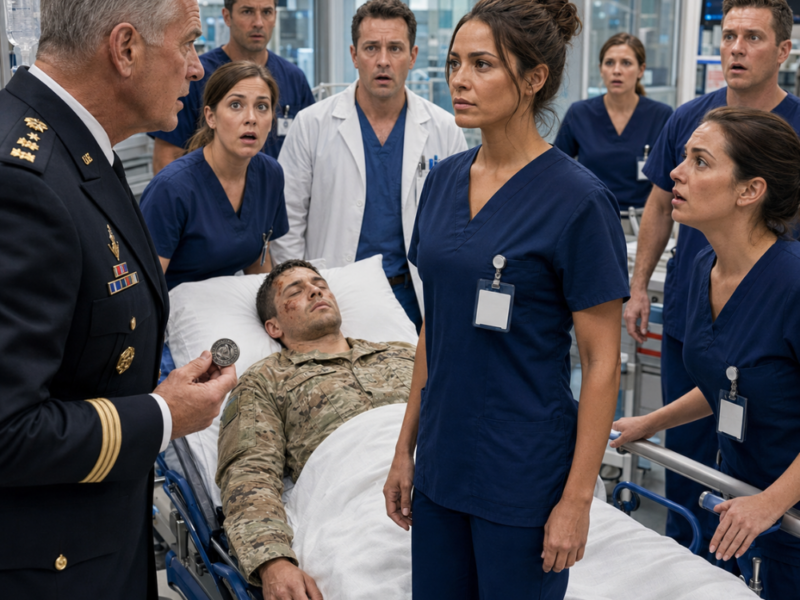
Ghost Doesn’t Miss, Whispered the Colonel—Then Every Nurse in the Room Turned to Her
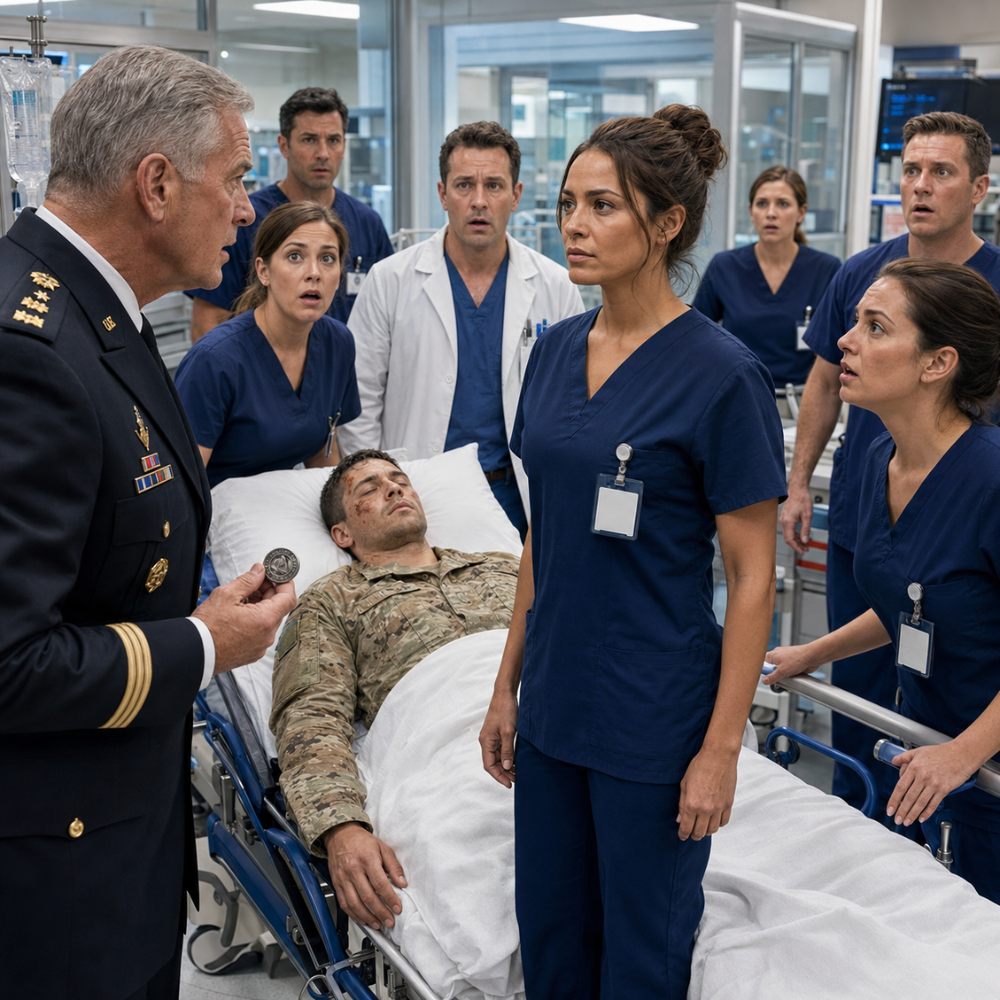
The Quiet Night-Shift Nurse Was Humiliated for Months—Then a Colonel Walked Into the Trauma Bay and Called Her “Ghost”
“Ghost doesn’t miss.”
Colonel Grant Wexford said it so quietly that at first Elena Ashford thought she had imagined it.
Her hands stopped anyway.
Only for a second.
Around her, Meridian General’s trauma bay had fallen into the strange silence that sometimes followed a medical emergency, after the shouting ended but before anyone trusted the numbers on the monitor.
A young soldier lay on the bed beneath bright ceiling lights. His oxygen saturation was climbing again. His blood pressure, though still dangerously low, had begun moving in the right direction. A respiratory therapist adjusted tubing beside him while a surgical resident prepared equipment for the next phase of care.
Three nurses stood near the crash cart.
None of them were looking at the patient anymore.
They were looking at Elena.
So was Dr. Marcus Reyes.
And so was the silver-haired man at the foot of the bed who had ridden in with the ambulance wearing rain on his shoulders and the expression of someone who had expected to watch one of his soldiers die.
Colonel Wexford stared at Elena’s left hand.
More specifically, at the pale scar running along the base of her thumb.
Elena slowly lifted her eyes.
Recognition moved through his face.
Not uncertainty.
Recognition.
“Colonel,” she said.
His jaw tightened.
“Elena.”
Nobody else in the room seemed to breathe.
Dr. Reyes looked between them.
“You two know each other?”
Neither answered him.
Wexford stepped closer.
“I looked for you.”
Elena glanced back at the monitor.
The soldier’s breathing mattered more than whatever history had just walked through the doors.
“You should’ve spent your time on something useful.”
“You vanished.”
“I retired.”
“That is not the same thing.”
“It is if you do it correctly.”
Sophia Reina, Meridian’s senior night nurse, stood near the medication station with one glove still half pulled from her hand.
Four months earlier, Sophia had been the first person in the department to decide there was something unusual about Elena Ashford.
Not dramatic.
Not suspicious.
Just unusual.
Elena was too calm.
Most new emergency nurses developed speed before they developed stillness. They hurried because they believed competence was supposed to look busy. They opened drawers too fast. Rechecked monitors visibly. Spoke in a higher register during codes. Overexplained decisions because they were afraid somebody would think they did not know what they were doing.
Elena never did any of that.
She moved like a person who had long ago learned that wasted motion was a form of risk.
Until that night, nobody at Meridian knew why.
Two hours earlier, Dr. Marcus Reyes had called her “the slowest nurse in the room.”
He had done it in front of six people.
Elena had answered by asking whether he wanted the trauma cart moved closer to Bay One.
That was how she usually handled him.
Not submission.
Not confrontation.
A quiet refusal to participate in whatever argument he was trying to create.
It infuriated him.
Elena had been at Meridian General for four months.
The hospital sat on the outer edge of a midsized North Carolina city, close enough to Fort Calder that the emergency department regularly treated soldiers injured in vehicle accidents, training incidents, heat emergencies, and the ordinary bad luck that followed thousands of young people living and working near heavy equipment.
It was not a military hospital.
That was exactly why Elena had chosen it.
Fort Calder was forty-three minutes away.
Far enough that no one from her old life was supposed to wander through Meridian at midnight.
She rented a small brick house eleven minutes from the hospital, on a street of maples and modest ranch homes where a retired mail carrier collected everybody’s trash cans after storms and the woman across the road left zucchini on doorsteps every July.
Elena kept tomatoes in raised beds behind the house.
She owned one television, rarely turned it on, and paid her utility bills with paper checks even though Sophia had once informed her that “normal people stopped doing that during the first Obama administration.”
She drove a twelve-year-old Subaru with a dent near the rear wheel.
She shopped for groceries on Monday mornings after shift change, when the store was almost empty.
She had no social media.
No spouse.
No children.
No visible photographs in her locker.
When coworkers asked what she had done before nursing school, Elena gave the answer she had prepared years earlier.
“Defense logistics.”
It was close enough to the truth to survive casual curiosity.
The nursing license was real.
So was the bachelor’s degree she earned after leaving the military.
So were her clinical hours and certification records.
Her résumé did not lie.
It simply began later than her life did.
The six years before nursing school existed mostly inside sealed records and the memories of people Elena did not expect to see again.
She preferred it that way.
At thirty-four, she had already spent enough time being useful in rooms where usefulness came with consequences.
Nursing was supposed to be different.
Nobody needed a legend at three in the morning.
They needed someone who remembered that Mrs. Kendricks in Bay Seven was allergic to penicillin even when the charting system temporarily froze.
Someone who noticed the suction canister had not been replaced.
Someone who checked a dosage twice because “probably correct” was not a medical standard.
Elena liked that.
The work was difficult.
But it was honest.
Most nights, the patient did not care who you had been before arriving.
The patient cared whether you remembered the blanket warmer when they were cold.
Marcus Reyes cared very much who he believed Elena was.
He had transferred to Meridian eleven weeks earlier from a major academic trauma center in Atlanta.
His résumé impressed administrators.
Trauma fellowship.
Research publications.
Conference presentations.
Photographs in medical newsletters beside phrases like emerging leader and systems innovation.
At thirty-nine, Reyes carried himself with the certainty of a man who had been rewarded often enough for confidence that he no longer considered doubt a useful clinical tool.
He was not incompetent.
That made the situation harder.
Marcus Reyes was a very good physician when the problem in front of him behaved as expected.
He knew protocols.
He made decisions quickly.
He could organize a crowded trauma room with impressive speed.
He explained procedures clearly to frightened families.
He remembered names of hospital donors and could make chief residents laugh during meetings where no one else wanted to be.
His weakness appeared whenever information came from someone he had already decided was less competent than he was.
The first incident with Elena involved a fourteen-year-old boy and a bicycle accident.
The teenager had caught his forearm on a metal fence.
The wound was deep but clean.
Reyes began closing it while the boy’s mother stood nearby looking pale.
Elena watched the wound edges.
Then said quietly, “You may get better approximation with a mattress stitch at the midpoint.”
Reyes stopped.
Not because he considered the suggestion.
Because a nurse had spoken while he was working.
He set the needle driver down carefully.
“Did you go to medical school while I was getting coffee?”
The boy’s mother laughed uncertainly because Reyes had smiled.
Elena did not.
“No.”
“Then let’s keep the physician work with the physicians.”
She could have told him she had closed wounds in conditions he would consider unacceptable for camping.
She did not.
She handed him gauze.
The scar later healed thicker than necessary.
Elena noticed during a follow-up visit.
She said nothing.
The second incident involved a medication dose.
A resident entered an order that was technically within an acceptable range but inappropriate for the elderly patient’s renal function.
Elena asked for confirmation.
Reyes sighed loudly.
“We do not have time to audit every decision twice.”
Elena looked at him.
“We have time to verify this one.”
The pharmacist called nine minutes later.
The dose was changed.
Reyes did not mention it.
The third incident mattered more.
An elderly man named Harold Peterson came in complaining of chest tightness and what he described as “a nervous feeling.”
His first electrocardiogram was not dramatic.
Reyes suspected anxiety.
Elena noticed a rhythm change on the monitor.
Subtle.
Intermittent.
She printed a strip.
“Dr. Reyes.”
He glanced over.
“I’d like cardiology to see this.”
“For what?”
She handed him the strip.
“The rhythm is changing.”
He barely looked.
“Mr. Peterson is anxious.”
“He may also be ischemic.”
Reyes smiled.
Mr. Peterson’s daughter stood beside the bed.
“Elena, I promise I remember cardiology from medical school.”
The daughter looked embarrassed for her.
Elena set the strip on the chart.
Forty minutes later, cardiology admitted Mr. Peterson for unstable angina.
Sophia found Elena near the supply room afterward.
“How do you stand that man?”
Elena checked two boxes of syringes against the inventory sheet.
“He’s not difficult to stand.”
“He talks to you like you wandered in from housekeeping.”
Elena put one box away.
“Housekeeping keeps the hospital alive.”
“That isn’t my point.”
“I know.”
Sophia crossed her arms.
“He was wrong.”
“Yes.”
“He embarrassed you in front of the family.”
“Yes.”
“And you’re not angry?”
Elena thought.
“No.”
Sophia narrowed her eyes.
“That is either maturity or something medically concerning.”
Elena almost smiled.
“It costs me nothing for him to be wrong about me.”
“That’s not true.”
“It is if the patient still gets what they need.”
Sophia watched her.
There were days she admired Elena’s calm.
There were other days it irritated her.
People who endured everything gracefully sometimes made it easier for institutions to pretend endurance was an acceptable solution.
“I don’t think he’s going to stop.”
Elena returned to the supply cart.
“I didn’t ask him to.”
That was Elena’s mistake.
Not because she owed herself a confrontation.
Because Marcus Reyes began interpreting silence as confirmation.
He assigned her fewer primary trauma responsibilities.
During a multi-car collision, he placed Elena at intake paperwork while nurses with less emergency experience worked in the trauma bays.
He said, loudly enough for the incoming shift to hear, “We need people who move quickly where the acuity is highest.”
Elena sat at the computer.
Entered patient names.
Verified allergies.
Caught two duplicated charts before registration did.
The work mattered.
She refused to make dignity dependent on assignment.
Still, people noticed.
Sophia noticed.
Paramedics noticed.
Charge nurse David Chen noticed.
A respiratory therapist named Owen Blake noticed.
Nobody filed a complaint.
That bothered Sophia later.
At the time, each event seemed too small.
A joke.
An assignment.
A tone.
A correction.
A decision that could be defended in isolation.
That was often how workplace problems became culture.
Not one enormous violation.
A hundred small decisions everyone learned to survive.
Five days before Sergeant Cole Dempsey came through Meridian’s ambulance doors, Reyes presented a case review during the monthly night-shift meeting.
He discussed medication delays during a prior code.
“Eliminating hesitation under pressure has to be a department priority.”
He did not say Elena’s name.
He did not need to.
Everyone knew which case he meant.
Sophia raised her hand.
Reyes looked mildly annoyed.
“Yes?”
“The delay you’re referencing was caused by Elena verifying a dosage the ordering physician had entered incorrectly.”
Silence.
The ordering physician happened to be Reyes.
He looked at the slide.
“I’ll review the documentation.”
“The pharmacy note is already in the record.”
Reyes gave her a professional smile.
“Thank you, Sophia.”
The slide remained unchanged.
The incident summary was never corrected.
Elena learned about the meeting from Sophia afterward.
“You should make him update it.”
“Why?”
“Because it’s wrong.”
“Did the patient receive the correct medication?”
“Yes.”
“Then the important part is in the patient’s chart.”
Sophia stared.
“You cannot spend your entire life letting people build false narratives because you personally do not need credit.”
Elena stopped walking.
For the first time, Sophia saw something deeper move behind her expression.
Not anger.
Memory.
“Sometimes correcting the narrative creates more attention than the narrative itself.”
Sophia softened.
“What happened to you before you came here?”
Elena looked toward the nurses’ station.
“That is a different conversation.”
“Will we ever have it?”
“Probably not.”
Sophia sighed.
“Fine.”
Elena continued walking.
“You’re very nosy.”
“I’m an emergency nurse. It’s essentially the job.”
The night everything changed began with rain.
Steady, cold rain.
By seven-thirty the ambulance bay reflected orange lights across black pavement.
Elena arrived carrying coffee in a stainless-steel travel mug.
She clocked in.
Reviewed assignments.
Checked the crash cart.
Replaced an expired medication nobody else had noticed.
At nine, she discovered a slow leak in the secondary suction line.
She tagged it for maintenance and pulled a backup portable unit closer to Bay One.
At ten, she helped a retired elementary-school teacher with a urinary infection call her daughter.
At ten-forty-five, she found socks for a homeless veteran who had come in with pneumonia.
At eleven-fifteen, Reyes walked by the station holding his phone.
“My trauma systems paper got accepted.”
Sophia looked up.
“Congratulations.”
Elena was reviewing discharge instructions.
She nodded.
“Congratulations.”
Reyes lingered.
“Journal of Emergency Systems Management.”
“That’s good.”
“You’ve heard of it?”
“No.”
Sophia covered a smile with her coffee cup.
Reyes walked away.
At 11:39 p.m., the ambulance radio changed the night.
“Meridian General, inbound from Fort Calder. One critical trauma. Twenty-six-year-old male. Penetrating chest injury during training accident. Blood pressure eighty over forty palpated. Respiratory distress worsening. ETA eighteen.”
The department moved.
Trauma bay lights came on.
Blood bank alerted.
Surgery paged.
Respiratory therapy called.
Reyes stepped into command naturally.
“Bay One. Elena, secondary support. Sophia, primary nursing. Daniel, airway cart. Get portable chest film standing by.”
Elena said, “Second suction unit is already here.”
Reyes glanced toward it.
“Good.”
She said nothing else.
The next fifteen minutes carried the familiar compressed quality that Elena had always disliked.
Waiting for a critical patient was often worse than receiving one.
Once the patient arrived, there were tasks.
Before arrival, imagination filled the space.
Reyes reviewed the reported injury with the resident.
Penetrating right chest trauma.
Possible hemothorax.
Possible vascular injury.
Elena listened while laying out supplies.
Not because she expected to use them.
Because preparation was a form of respect for uncertainty.
She checked a decompression kit.
Chest tube tray.
Occlusive dressing.
Blood tubing.
No one asked her.
Nobody needed to.
At 11:58, the ambulance doors opened.
Two paramedics pushed the gurney through at a run.
“Cole Dempsey, twenty-six. Penetrating right upper chest during live-fire range malfunction. Initially responsive. Deteriorating en route. Breath sounds diminished right. Pressure seventy-eight systolic. Pulse one-forty.”
Behind them came Colonel Grant Wexford.
He had ridden in wearing civilian pants and a field jacket thrown over a sweatshirt.
His silver hair was wet.
Nothing on him announced rank.
People moved around him anyway.
He had that quality some career military officers developed after decades of making decisions without needing to advertise that they were decisions.
Dempsey was transferred.
Monitors attached.
Oxygen adjusted.
Reyes listened to the chest.
“Portable film.”
Elena stood six feet away.
She saw the neck first.
The trachea drifting.
Then asymmetrical chest rise.
Distended neck veins despite falling pressure.
The pattern was unmistakable.
Her body recognized it before the hospital part of her brain finished naming it.
Tension pneumothorax.
She had seen it in Afghanistan.
Once inside an armored vehicle.
Once beside a dirt road where dust stuck to blood.
Once in a village clinic after an explosion shattered half the windows.
Time changed when it happened.
There was before decompression.
And there was after cardiac arrest.
Sometimes less than a minute separated them.
Elena stepped forward.
“Right tension pneumothorax.”
Reyes did not turn.
“Blood panel first.”
“He needs decompression.”
“I heard you.”
The monitor alarm accelerated.
Oxygen saturation fell.
Eighty-five.
Eighty-two.
Seventy-nine.
Elena looked at the resident.
The resident looked at Reyes.
“Doctor.”
Reyes said, “We wait for film unless he arrests.”
Elena’s eyes moved to Dempsey’s face.
His lips were darkening.
“No.”
Reyes turned.
“What?”
“There isn’t time.”
“Elena, step back.”
“His pressure is collapsing.”
“I am aware.”
“Then decompress.”
“We are confirming placement.”
“The x-ray tech isn’t even here.”
Reyes’s jaw tightened.
“Your job is to support the physician managing the patient.”
Elena’s voice remained level.
“My job is also to escalate an immediate threat to life.”
“I said step back.”
Colonel Wexford stood at the foot of the bed.
Until then he had stayed silent.
He had commanded people through enough emergencies to know outsiders often made things worse when they entered a professional team’s workflow.
But something in Elena’s voice caught him.
The lack of panic.
He looked at her.
Really looked.
The hair was different.
Shorter.
The face older.
No helmet.
No dust.
No rifle strap crossing the shoulder.
But the stillness.
Wexford felt memory shift somewhere deep inside him.
He did not yet trust it.
Reyes pointed toward the supply counter.
“Elena, now.”
The monitor showed seventy-three.
Sophia looked at Elena.
Then at Reyes.
“Marcus.”
He turned.
“She may be right.”
That should have changed everything.
Instead it embarrassed him.
“This is not a committee decision.”
The resident said carefully, “The clinical picture does fit tension physiology.”
Reyes looked at him.
“We confirm.”
Dempsey’s heart rhythm changed.
Elena saw the transition.
The room disappeared.
Not literally.
Meridian remained around her.
But something older moved forward.
Training.
Repetition.
The memory of people who had died while someone waited too long for certainty.
Elena looked at Reyes.
“We are past confirmation.”
The trauma surgeon, Dr. Priya Malhotra, had been paged from another floor and was entering the bay at that exact moment.
She heard the alarm.
Saw the monitor.
Saw Elena with the decompression kit already in hand.
“What have we got?”
Elena answered first.
“Penetrating right chest injury. Acute tension physiology. Severe hypoxia, hypotension, tracheal deviation. No time for imaging.”
Malhotra took one look.
“Agreed. Decompress now.”
Reyes turned.
“I was waiting on—”
“Not anymore.”
Malhotra pointed.
“Elena, assist.”
That one sentence removed the argument.
Elena moved.
Fast.
Controlled.
The emergency procedure was performed immediately under Malhotra’s direction.
Air released.
The pressure in Dempsey’s chest dropped.
His saturation began climbing.
Seventy-three.
Seventy-eight.
Eighty-four.
Blood pressure improved.
A chest tube followed.
Sophia managed medications.
Respiratory therapy stabilized oxygenation.
The resident worked beside Malhotra.
Reyes stood near the edge of the bay.
Nobody ordered him there.
The team had reorganized around the patient.
Competence had done what hierarchy refused to do.
Elena secured tubing.
Checked drainage.
Confirmed the setup.
Her left hand turned slightly beneath the light.
Colonel Wexford saw the scar.
Everything clicked.
Four years earlier, outside a place that appeared in reports only as a grid reference, he had watched a medic close that exact wound with three stitches beneath a battery lantern.
She had refused evacuation because two casualties were in worse condition.
Wexford had called her insane.
She told him officers were not authorized to diagnose insanity.
He remembered laughing despite himself.
The woman had been assigned to a special operations support element.
Officially, she was a combat medic with advanced field training.
Unofficially, the unit trusted her with far more.
Her call sign came over radio channels only when things had gone bad.
Ghost.
Not because she was invisible.
Because she appeared where she was needed and seemed to disappear before anybody figured out how she had gotten there.
Wexford had spent years assuming she was dead.
Now she stood beneath fluorescent lights wearing navy-blue scrubs and a Meridian General employee badge.
He heard himself say it.
“Ghost doesn’t miss.”
Every head turned.
Elena froze.
Then looked at him.
“Colonel.”
Wexford’s throat tightened.
“It is you.”
Dr. Malhotra glanced between them.
“Ghost?”
Elena sighed almost imperceptibly.
“Not medically relevant.”
Wexford laughed once.
The sound came out rough.
“You always hated attention.”
“I continue to.”
Reyes looked at Elena.
“What is he talking about?”
Wexford’s eyes moved toward him.
He had watched the physician dismiss Elena three times in less than ninety seconds.
Now he understood exactly how much expertise Reyes had decided not to hear.
Wexford’s expression changed.
“Doctor, how long has she worked here?”
Reyes straightened.
“Four months.”
“And you didn’t know?”
“Know what?”
Elena said quietly, “Colonel.”
A warning.
He looked at her.
“No.”
She knew that tone.
He had used it with lieutenants who wanted to argue about impossible terrain.
“Grant.”
The use of his first name made Sophia’s eyebrows rise.
Wexford ignored everybody else.
“You disappeared four years ago. People believed you were dead.”
“That was never my problem.”
“It became mine.”
“I’m sorry.”
“You’re not.”
“No.”
Dempsey’s monitor continued improving.
The patient was stable enough for transfer preparation.
Malhotra looked at Wexford.
“Colonel, whatever reunion this is, give my team five minutes.”
He nodded immediately.
“Of course.”
The response surprised Reyes.
This powerful military officer, who had entered the department radiating authority, accepted Malhotra’s clinical boundary without resistance.
Authority recognizing authority.
Elena appreciated the contrast.
They moved Dempsey toward surgery for definitive management.
Once the gurney left, the trauma bay looked suddenly enormous.
Blood-stained gauze.
Opened packaging.
A discarded oxygen mask.
Wet footprints from the ambulance entrance.
Normal evidence of abnormal minutes.
Sophia stripped off her gloves.
“Okay.”
Nobody answered.
She looked at Elena.
“No.”
Elena reached for a supply wrapper.
Sophia pointed at her.
“You are not cleaning right now.”
“It needs cleaning.”
“Housekeeping is coming.”
“I can help.”
“Absolutely not.”
Elena looked toward the door.
Wexford blocked it.
Not intentionally.
He was simply standing there.
“Traitor,” Elena told him.
He almost smiled.
Dr. Malhotra had remained near the computer to enter initial notes.
She looked at Wexford.
“Who is she?”
Elena said, “A nurse.”
Wexford answered at the same time.
“Retired master sergeant.”
Sophia stared.
Elena closed her eyes.
“Grant.”
“What?”
“You could have started with retired soldier.”
“You were never only a soldier.”
Reyes folded his arms.
“What exactly did she do?”
The question sounded different now.
Not mocking.
Defensive.
Wexford turned toward him.
“You want the short version?”
Reyes hesitated.
“Yes.”
“She spent six years attached to units that operated in environments where advanced medical care did not arrive because somebody pushed a hospital button.”
Elena leaned against the counter.
Wexford continued.
“She was a combat medic. Designated marksman. Advanced trauma qualified. She treated casualties under conditions I would not ask most clinicians to imagine.”
He pointed toward the doorway where Dempsey had disappeared.
“My sergeant is alive because she recognized what was happening before you did.”
Reyes’s face tightened.
“Dr. Malhotra authorized the procedure.”
“Yes.”
Wexford stepped closer.
“And thank God she arrived when she did.”
Reyes looked toward Elena.
“You should have told us about this background.”
Elena raised her eyebrows.
“Why?”
“Because it is relevant to competency assignment.”
“You had my nursing credentials.”
“That isn’t what I mean.”
“I know.”
Reyes’s embarrassment became irritation.
“You allowed me to believe you were inexperienced.”
Elena stared at him.
“I did not control what you believed.”
The room went still.
Sophia looked down because she did not trust her face.
Elena continued.
“You knew how long I had been licensed.”
“You knew my certifications.”
“You had access to every competency record Meridian required.”
“What you did not know was whether I had ever worked outside civilian nursing.”
“That was not information you needed in order to treat my clinical input with basic professional respect.”
Reyes opened his mouth.
Closed it.
Wexford watched Elena.
There she was.
Not Ghost.
Elena.
The distinction mattered.
Ghost had solved immediate problems.
Elena had to live with what happened afterward.
Hospital administrator Linda Walsh arrived at 1:08 a.m.
The medical director, Dr. Howard Bennett, came five minutes later wearing khakis, running shoes, and a winter coat over the T-shirt he slept in.
Nobody enjoyed being called to a hospital at one in the morning.
Bennett enjoyed it less when the first sentence he heard was, “A patient almost arrested while the attending refused to treat a clear tension pneumothorax because a nurse suggested it first.”
He looked at Reyes.
“Is that accurate?”
“No.”
Malhotra spoke from the other side of the station.
“It is not inaccurate.”
Bennett rubbed his forehead.
“Conference room.”
Reyes began, “Howard—”
“Conference room.”
The debrief started at 1:22.
Elena asked to return to work.
Bennett said no.
“You were central to the event.”
“I’m scheduled until seven.”
“We’ll survive.”
Sophia whispered, “I’m framing that quote.”
Elena ignored her.
The conference room held a scratched laminate table, ten rolling chairs, and a coffee machine nobody trusted.
Reyes sat beside hospital counsel.
Malhotra sat opposite him.
Sophia, Elena, Wexford, the surgical resident, and charge nurse David Chen filled the remaining seats.
Bennett opened.
“We are discussing immediate patient safety first.”
No one argued.
Malhotra described Dempsey’s presentation.
Severe respiratory compromise.
Hemodynamic instability.
Clinical evidence of tension pneumothorax.
Delay in definitive intervention while waiting for imaging.
She was careful.
Precise.
No accusation beyond what the chart supported.
Bennett asked Reyes, “Why did you wait?”
“I wanted diagnostic confirmation.”
“Under ordinary circumstances?”
“Yes.”
“Were these ordinary circumstances?”
Reyes hesitated.
“The patient was unstable.”
“Then why?”
“I believed the differential remained open.”
Malhotra leaned forward.
“Marcus, his trachea was shifting.”
“I know what was happening.”
“Then why did Elena have to say it three times?”
Reyes looked at her.
“Because clinical authority cannot become whoever speaks most confidently.”
Sophia made a small sound.
Bennett raised one hand.
“Let him finish.”
Reyes continued.
“We have scopes of practice. Liability. Procedure authorization. If nursing staff begin independently diagnosing and performing invasive interventions because they believe the attending is moving too slowly, we have chaos.”
It was the strongest argument he had.
And it was not entirely wrong.
Elena understood that.
Healthcare could not function by heroics.
That was partly why she had left military medicine.
A civilian hospital needed procedure.
Roles.
Checks.
Documentation.
Safety required structure.
Bennett turned to Elena.
“Why did you pick up the decompression kit before Dr. Malhotra entered?”
“Because the patient was deteriorating.”
“Would you have performed the intervention without a physician order?”
The room waited.
Elena answered honestly.
“I don’t know.”
Reyes sat back.
Hospital counsel immediately wrote something.
Elena continued.
“I know I was prepared to keep escalating until somebody acted.”
“Did you believe Dr. Reyes understood the urgency?”
“Yes.”
“Then what was the problem?”
Elena looked at him.
“He did not believe me.”
Silence.
Bennett said, “That is not exactly a clinical answer.”
“It is the clinical answer.”
Elena folded her hands.
“He had enough information.”
“The resident raised the same concern.”
“Sophia raised it.”
“I raised it.”
“He delayed because accepting the diagnosis required accepting that one of us saw it before he did.”
Reyes’s face reddened.
“That is speculation.”
“Yes.”
Elena nodded.
“The motivation is speculation.”
“The delay is not.”
That became the center of the review.
Not Elena’s military history.
Not the call sign.
Not Wexford’s stories.
The delay.
By three in the morning, Bennett suspended Reyes from leading major trauma resuscitations pending formal peer review.
He remained employed.
He retained ordinary clinical duties under supervision while the hospital followed its process.
Reyes hated that.
But hospitals did not function like action movies.
Nobody tore off a badge.
Nobody marched him through the lobby.
There were bylaws.
Credentialing committees.
Peer review protections.
Lawyers.
Documentation.
And the uncomfortable possibility that a physician could make a serious error without being a permanently bad physician.
Elena respected the process.
Sophia found it deeply unsatisfying.
“He almost got somebody killed.”
They stood at the nurses’ station after the meeting.
“He delayed treatment,” Elena corrected.
“That is a polite way of saying it.”
“It is an accurate way.”
“You are exhausting.”
“I have been told.”
Sophia leaned closer.
“Master Sergeant?”
Elena sighed.
“No.”
“Ghost?”
“No.”
“Designated marksman?”
“No.”
“Did you actually perform surgery in a building with no walls?”
“No.”
Sophia relaxed.
“Thank God.”
“It had one wall.”
Sophia stared.
Elena walked away.
Colonel Wexford remained at Meridian until nearly four.
Dempsey had stabilized after surgery.
The projectile had not damaged a major vessel.
His prognosis was cautiously good.
Wexford sat beside the young sergeant’s bed in the surgical ICU.
Elena entered to check on another patient and found him there.
“You’re still here.”
“He is my soldier.”
“He has nurses.”
“I noticed.”
She looked toward Dempsey.
Sedated.
Ventilated.
Alive.
Wexford said, “Sit.”
“No.”
“Elena.”
“I’m working.”
“You were removed from assignment for the rest of the shift.”
“Administrative punishment.”
“Five minutes.”
She sat.
He looked at her.
“Four years.”
“Yes.”
“Not one message.”
“You weren’t family.”
“That is a cruel technicality.”
“It is still technically true.”
Wexford shook his head.
“I submitted three requests after Kestrel Hollow.”
Elena’s gaze hardened.
“Don’t use that name here.”
He stopped.
“Sorry.”
“That life is finished.”
“I know.”
“Do you?”
Wexford leaned back.
“I thought you were dead.”
“That was intentional.”
He stared.
Elena corrected herself.
“The ambiguity was intentional.”
“Why?”
She looked through the glass toward the ICU hallway.
A nurse pushed an IV pump past.
A custodian emptied trash.
Ordinary work.
“Because people kept asking what came next.”
“What did?”
“Another deployment.”
“Another assignment.”
“Another classified medical training program.”
“Another unit asking whether I could teach what I knew.”
She looked at him.
“I was thirty.”
Wexford said nothing.
“I had spent six years becoming useful in one very specific way.”
“And?”
“I didn’t know who I was when nobody needed that version of me.”
Wexford’s face softened.
“So you became a nurse.”
“Eventually.”
“Why not medicine?”
“I didn’t want eight more years of people telling me when I was allowed to touch a patient.”
He laughed.
Then winced at the irony.
“You found Reyes.”
“Yes.”
“That went well.”
“He is one physician.”
“You let him talk down to you for eleven weeks.”
Elena looked at him.
“I survived worse.”
“That is not an argument.”
“No.”
She knew.
Wexford continued.
“You keep acting like being able to endure something means enduring it is neutral.”
Elena stared toward Dempsey.
“You sound like Sophia.”
“I like Sophia.”
“You’ve known her three hours.”
“She frightens administrators.”
“So do you.”
“Yes, but I outrank most of mine.”
Elena almost smiled.
Wexford grew serious.
“Why didn’t you report him?”
“Because most of the time his behavior cost me pride, not patients.”
“Tonight it cost a patient.”
“Yes.”
“That line moved.”
“Yes.”
Wexford nodded.
“At least you know.”
Elena looked at him.
“Are you done?”
“No.”
“Of course not.”
He reached into his jacket and removed a unit coin.
Elena recognized the emblem.
Her eyes narrowed.
“I do not want that.”
“I wasn’t offering it.”
He turned it between his fingers.
“Dempsey will.”
“If he wakes up and remembers tonight, tell him he owes the hospital.”
“He’ll remember the person who saved him.”
“Dr. Malhotra saved him.”
“So did you.”
Elena stood.
“Good night, Colonel.”
“Will you call me?”
“No.”
“Can I call you?”
She thought.
“Once.”
“Per day?”
“Per year.”
He laughed.
“I’ll negotiate.”
“Then you get zero.”
“Same Elena.”
She walked away.
The formal review began nine days later.
Dr. Reyes arrived with counsel.
Elena arrived alone.
Sophia tried to convince her otherwise.
“You need someone.”
“I need coffee.”
“You need an advocate.”
“I need the hospital to read its own records.”
Sophia followed her toward administration.
“You are impossible.”
“So I’ve heard.”
The hearing took place in a conference room on the seventh floor.
A court reporter recorded testimony.
Hospital peer review chair Dr. Ellen Markham presided.
Also present were the chief nursing officer, risk management, the medical director, a trauma surgery representative, and counsel.
They began with the Dempsey case.
Reyes argued protocol.
He argued that waiting for imaging, while ultimately incorrect, was within a range of defensible judgment before the patient’s condition fully declared itself.
Malhotra disagreed.
The resident disagreed.
The recorded vital signs created their own timeline.
At 11:59:12, severe hypoxia.
At 11:59:39, blood pressure worsened.
At 12:00:04, Elena documented concern for tension physiology.
At 12:00:21, resident verbalized similar concern.
At 12:00:44, Reyes repeated request for imaging.
At 12:01:07, Malhotra entered.
At 12:01:19, emergency decompression authorized.
The committee asked whether earlier action would have been standard.
Malhotra answered yes.
Then the hearing moved backward eleven weeks.
That was where Reyes’s problem became larger.
Sophia testified about the medication incident.
The chest pain case.
Assignments.
Public comments.
The case review that remained inaccurate after the record was corrected.
Charge nurse David Chen confirmed that Elena had repeatedly been placed in lower-acuity roles despite competency evaluations equal to or better than newer nurses assigned above her.
Respiratory therapist Owen Blake testified about Reyes’s pattern of reacting poorly when questioned by nonphysicians.
Two additional nurses came forward.
Neither spoke dramatically.
That made the testimony stronger.
One described being lectured for paging twice when a patient deteriorated.
Another described Reyes rewriting the wording of a nursing note rather than discussing the clinical disagreement.
The committee asked Elena if she believed Reyes had targeted her.
She thought.
“Yes.”
“Why?”
“He decided I was inexperienced.”
“Was that belief unreasonable based on your civilian nursing tenure?”
“No.”
The room shifted slightly.
Reyes’s attorney looked surprised.
Elena continued.
“I was relatively new to civilian nursing.”
“Then what was inappropriate?”
“He used the assumption as a filter.”
She looked toward the committee.
“Once he decided I was less capable, information coming from me became less valuable before he evaluated the information itself.”
Dr. Markham asked, “And your military background?”
“I do not think it should be central.”
“Why not?”
“Because the other nurses he dismissed do not have my background.”
That sentence changed the hearing.
Elena continued.
“If the lesson becomes ‘Dr. Reyes should have listened because I used to be a combat medic,’ then we have learned the wrong thing.”
The chief nursing officer leaned forward.
“What is the right lesson?”
“He should have evaluated accurate clinical input based on the patient, the evidence, and the competency of the staff member giving it.”
Elena paused.
“He did not need to know I had treated chest trauma overseas to avoid humiliating a nurse for raising a reasonable concern.”
No one interrupted.
“I do not want a system where nurses receive respect only after proving they secretly have extraordinary résumés.”
Sophia, sitting behind her, felt tears sting unexpectedly.
That was the argument Elena had refused to make for herself.
Now she made it for everybody else.
The hearing continued six hours.
Reyes did not collapse dramatically.
He answered.
Defended himself.
Acknowledged some communication mistakes.
Denied bias.
Said the department was confusing high standards with hostility.
Some points were legitimate.
Others became difficult to sustain against repeated records.
At the end, Dr. Markham asked him one question.
“During the Dempsey resuscitation, when Nurse Ashford raised the possibility of tension pneumothorax, did you seriously consider she might be correct?”
Reyes looked toward Elena.
Then back at the committee.
“I considered the full differential.”
“That is not my question.”
Silence.
Dr. Markham repeated it.
“Did you consider she might be correct?”
Reyes’s answer took too long.
“I believed my judgment was more reliable at that moment.”
“Why?”
“Because I was the attending physician.”
The answer ended more than he realized.
Not because attending authority did not matter.
It did.
Because authority was supposed to increase responsibility, not replace reasoning.
The committee issued findings later.
Reyes was not immediately fired.
His trauma privileges remained suspended.
He was placed under a formal performance improvement and professional-conduct review.
Required remediation.
Communication training.
Supervised trauma shifts.
Review of prior complaints.
He resigned two weeks later.
Some staff called it avoiding accountability.
Elena disagreed.
“He left.”
“That is accountability of a kind.”
Sophia looked at her.
“Do you enjoy ruining satisfying endings?”
“Yes.”
Reyes never apologized directly.
Elena did not chase one.
What mattered more came quietly.
Meridian changed its escalation policy.
If a nurse or respiratory therapist believed a physician’s decision created immediate patient risk, they could activate a rapid clinical escalation through the charge nurse or medical director without waiting for the disagreement to become personal.
The rule had existed vaguely before.
Now it became explicit.
Documented.
Taught during orientation.
Sophia called it the Ashford Rule.
Elena hated that.
“No.”
“Too late.”
“Take my name off it.”
“It isn’t officially called that.”
“Then stop calling it that.”
“I cannot control culture.”
“You are culture.”
Sophia smiled.
“Exactly.”
The hospital also reviewed all incident reports Reyes had filed against nursing personnel.
Three were amended.
One formal warning against a respiratory therapist was removed after administrators concluded the employee had raised a legitimate clinical concern.
That mattered to Elena more than anything involving herself.
Another change surprised her.
Dr. Malhotra began attending nursing safety meetings once a month.
Not as leadership.
As a clinician.
The first meeting became awkward when no nurse wanted to criticize physician decisions with a trauma surgeon sitting there.
Malhotra noticed.
She stood.
“I’m leaving.”
Sophia frowned.
“You just got here.”
“That is why nobody is talking.”
She pointed toward the door.
“Send me the issues afterward.”
Then she left.
Elena smiled.
Respect sometimes looked like knowing when your presence distorted the room.
Sergeant Dempsey recovered.
It took longer than the original story would later make it sound.
He spent eleven days hospitalized.
Then weeks rebuilding stamina.
His right lung function gradually returned.
The injury left a scar and a deep irritation with hospital food.
Two months after the accident, he walked back into Meridian wearing jeans, boots, and a Fort Calder sweatshirt.
Sophia saw him first.
“Oh, look who survived hospital meatloaf.”
Dempsey smiled.
“Barely.”
He carried a small velvet box.
“Is Nurse Ashford here?”
Sophia pointed toward Bay Three.
“She’s busy.”
“I can wait.”
“You’re Army.”
“That is most of the job.”
He waited forty minutes.
Elena finally came out after helping discharge a patient.
She stopped when she saw him.
“You look better.”
“So do you.”
“I was not injured.”
“Colonel said you’re difficult.”
“Colonel talks too much.”
Dempsey smiled.
He held out the box.
“This is for you.”
“No.”
“You haven’t opened it.”
“I know what shape a challenge-coin box is.”
“You’ve done this before.”
“Yes.”
“Take it anyway.”
Elena sighed.
Dempsey opened the box.
Inside lay a heavy unit coin.
One side showed the battalion insignia.
The other had his name engraved beneath the date of the accident.
“You didn’t have to do this.”
“I know.”
“Then why?”
Dempsey shifted.
He had rehearsed.
She could tell.
“My mom made Christmas dinner reservations.”
Elena waited.
“Six weeks before the accident.”
He looked embarrassed.
“She plans everything.”
“Sounds dangerous.”
“She is.”
He smiled.
“After the accident, she kept saying she thought she was going to have an empty chair.”
Elena’s face softened.
Dempsey looked at the coin.
“I don’t remember most of the trauma bay.”
“Good.”
“I remember a voice.”
“Whose?”
“Yours.”
Elena looked away.
“You kept saying ‘stay with us.’”
She did not remember saying it.
Nurses said things automatically.
Stay with me.
Keep breathing.
You’re okay.
Look at me.
Words could become tools.
“My mom wanted to come.”
“I’m glad she didn’t.”
Dempsey laughed.
“She wrote you something.”
He handed her an envelope.
Elena stared at it.
For a second the hospital around them felt too loud.
She took the coin.
Then the letter.
“Thank you.”
Dempsey nodded.
“You saved my life.”
Elena shook her head.
“A team saved your life.”
“You were on the team.”
“Yes.”
“That’s enough.”
He left before she could argue.
Elena put the coin inside her scrub pocket.
She did not open the letter until she got home.
Her kitchen was dark except for the light above the stove.
Rain tapped the windows.
She made tea.
Sat at the table.
Opened the envelope.
Mrs. Dempsey wrote by hand.
Three pages.
She thanked everyone at Meridian.
Mentioned Dr. Malhotra.
Sophia.
The surgical team.
The ICU nurses.
She did not turn Elena into a single hero.
Elena appreciated that immediately.
Near the end was one sentence she read twice.
I hope whoever you had to be before you became our son’s nurse has found something gentle enough to make the trade worthwhile.
Elena stopped.
The tea cooled.
Outside, a car passed along the wet street.
For years people had asked whether she missed the military.
Nobody had ever asked whether the life afterward was worth what she gave up.
She folded the letter.
Put it in the kitchen drawer beside the challenge coin.
Then sat there longer than she intended.
Colonel Wexford visited twice before his unit rotated overseas for a training cycle.
The second time, he arrived carrying a folder.
Elena met him in the hospital cafeteria because she refused to let him turn the nurses’ station into a military reunion.
He bought coffee.
She bought yogurt.
He placed the folder between them.
“What is it?”
“An administrative correction.”
“I’m retired.”
“Records remain.”
“I don’t care.”
“I do.”
Elena looked at him.
Wexford continued.
“When your separation went through, parts of your file stayed unresolved because the program was compartmentalized.”
“That sounds like bureaucracy.”
“It was bureaucracy.”
“So why fix it?”
“Because ambiguity becomes somebody else’s interpretation.”
Elena smiled faintly.
“You have been talking to Sophia.”
“I like Sophia.”
“Stop saying that.”
Wexford tapped the folder.
“Within what can legally be documented, your record now clearly states honorable separation and voluntary retirement from active operational service.”
Elena did not open it.
“You spent time on this.”
“Yes.”
“Why?”
“Because people should not have to become legends in emergency rooms before records tell the truth about them.”
She looked at him.
He smiled.
“I’ve been listening.”
“That is new.”
“Retirement has made you rude.”
“I was always rude.”
“True.”
They drank coffee.
Wexford asked whether she had considered working at Fort Calder’s hospital.
“No.”
“Training?”
“No.”
“Consulting?”
“No.”
“Teaching tactical medicine twice a year?”
Elena hesitated.
He noticed.
“Twice.”
“No deployment.”
“No operational attachment.”
“Civilian contract.”
“You can leave whenever you want.”
Elena narrowed her eyes.
“Who wrote those conditions?”
“Sophia.”
“Traitor.”
Wexford smiled.
Elena eventually agreed to teach one weekend.
Not because she wanted the old life back.
Because young medics deserved good training.
She wore civilian clothes.
No call sign.
No stories she was not ready to tell.
The first class asked about combat.
Elena said, “We are here to discuss hemorrhage control.”
Someone asked if she had ever treated somebody under fire.
She said, “Yes.”
Then pointed toward the training mannequin.
“Your patient is deteriorating.”
The class learned quickly.
Back at Meridian, curiosity lasted roughly six weeks.
People asked Elena questions.
Did she really have sniper training?
She said she had weapons qualifications appropriate to assignments.
Had she killed anyone?
She refused to answer.
Had she been in special operations?
She said military personnel were sometimes attached to specialized units.
Had she saved Wexford’s life?
She said Wexford exaggerated.
He did.
Had she actually repaired a chest wound on a door?
“It was not a whole door.”
That answer only made things worse.
Eventually the questions stopped.
Hospitals had too many current crises to preserve legends indefinitely.
A new physician arrived.
Dr. Priya Malhotra accepted a permanent role.
She was forty-two.
Indian American.
Raised in Ohio.
Former county trauma surgeon.
No patience for unnecessary ceremony.
On her first week, she asked Elena for input during a difficult airway.
Not because of Ghost.
Because Elena was standing closest and had noticed something.
“Tube’s catching.”
Malhotra looked.
“Angle?”
“Anterior.”
“Agreed.”
They adjusted.
The airway was secured.
Nobody made a speech.
That mattered more to Elena than the night Wexford recognized her.
Months passed.
Spring arrived.
Elena replanted tomatoes.
Sophia began bringing two coffees on shared shifts.
She never asked whether Elena wanted one because Elena always drank it.
One night, while restocking the crash cart, Sophia said, “Do you miss it?”
Elena knew what she meant.
“Sometimes.”
Sophia waited.
“I miss knowing exactly when a job starts.”
“And ends?”
“Yes.”
“Hospital work never ends.”
“No.”
“You save one person, somebody else arrives.”
“Yes.”
“You hate that?”
Elena thought.
“No.”
“Then what do you miss?”
“The clarity.”
She placed a package of sterile gauze into the drawer.
“In the military, missions had objectives.”
“Success.”
“Failure.”
“Extraction.”
“Home.”
She closed the drawer.
“Healthcare is slower.”
Sophia leaned against the cart.
“Is that bad?”
“No.”
Elena looked toward the bays.
“It is more honest.”
“How?”
“Most lives do not have clean endings.”
Sophia considered.
“That sounds depressing.”
“It is freeing.”
They continued restocking.
Sofia asked, “Do you regret leaving?”
“No.”
“Never?”
“No.”
“What did you trade?”
Elena looked at the supplies in her hands.
“Certainty.”
“For?”
She listened.
A patient laughing with his daughter in Bay Five.
A baby crying somewhere down the hall.
A microwave beeping in the break room.
Rain hitting the ambulance awning.
Ordinary life.
“This.”
Sophia smiled.
“Worth it?”
“Most days.”
That was enough.
Nine months after Dempsey’s accident, another rainy Thursday arrived.
Meridian’s ambulance bay lights turned wet pavement orange again.
A new nurse named Molly Jenkins started her first night shift.
Twenty-six.
Fresh out of a busy residency program.
Nervous enough to apologize every time she opened the wrong drawer.
Elena was assigned to precept her.
Molly knew the rumors.
Everybody did.
She tried not to stare.
At ten, they restocked Bay Three.
Elena showed her where spare tubing was stored.
“Second drawer.”
Molly nodded.
“And if suction one fails?”
“Portable unit stays here.”
“Why?”
“Because the wall line leaks occasionally after maintenance.”
Molly looked impressed.
“You know everything in this department.”
“No.”
“It feels like it.”
“That goes away.”
Molly hesitated.
“Can I ask something?”
“You’re going to anyway.”
“Were you really called Ghost?”
Elena stopped.
Across the station, Sophia looked up.
Molly immediately regretted asking.
“Sorry.”
Elena placed the tubing into the drawer.
“Yes.”
“That’s all?”
“That is the answer.”
“Why?”
“No.”
Molly nodded quickly.
“Okay.”
Elena looked at her.
“You’re disappointed.”
“A little.”
“That will also go away.”
Molly smiled.
Near midnight, Bay Four’s monitor chimed.
Elena’s head turned before anyone called her.
She listened.
Not an alarm yet.
A change.
She walked toward the room.
Molly followed.
At the nurses’ station, Sophia watched them go.
David Chen stood beside her.
“The new one asked?”
“About Ghost?”
“Yes.”
“What’d Elena say?”
“Yes.”
“That’s it?”
“Obviously.”
David smiled.
Molly disappeared into Bay Four behind Elena.
The department continued.
Phones.
Monitors.
Coffee.
Paperwork.
A family arguing quietly about who would drive Grandma home.
A paramedic looking for a missing glove.
A resident searching for a pen that was clipped to his own shirt.
Nothing legendary.
That was the point.
Elena had spent part of her life in places where extraordinary skill was required because ordinary systems had failed or never existed.
Now she worked in a place where the goal was the opposite.
Build systems strong enough that nobody needed a Ghost.
If a patient deteriorated, a nurse could escalate.
If a physician dismissed a concern, there was another route.
If a new employee noticed something, her inexperience did not automatically make the observation worthless.
Meridian was not perfect.
A policy did not erase ego.
Training did not eliminate hierarchy.
People still made mistakes.
Doctors still became defensive.
Nurses still complained about doctors in the medication room.
Doctors still complained about nurses in the physician lounge.
Administrators still sent emails nobody read.
But the department had changed enough that the next Elena Ashford might not need a colonel to walk through the door before someone listened.
That mattered.
Years later, Sophia would remember that night differently from the way people told it.
People preferred the dramatic version.
The arrogant doctor humiliated the quiet nurse.
The soldier arrived.
The colonel revealed she had been an elite operator.
Everyone regretted underestimating her.
The truth was less clean.
Reyes was not punished because Elena secretly outranked everybody in experience.
He faced review because his decision-making endangered a patient.
Elena was not valuable because she once had a call sign.
She was valuable because she noticed what was happening in front of her and spoke.
The hospital did not become better because everyone learned the quiet nurse was extraordinary.
It became slightly better because administrators finally asked why an ordinary nurse would have needed to be extraordinary before her voice counted.
That was the lesson Sophia eventually taught Molly.
Not during Elena’s first week as her preceptor.
Months later.
They sat together in the cafeteria at three in the morning during the rare twenty-minute stretch when no one was actively trying to fall apart.
Molly asked, “Why doesn’t Elena talk about her military career?”
Sophia stirred sugar into coffee.
“Because she doesn’t need us to understand it.”
“But it explains her.”
“No.”
Molly frowned.
Sophia continued.
“That’s what everybody gets wrong.”
She looked toward the emergency department through the cafeteria windows.
“It explains some of what she knows.”
“It does not explain who she is.”
Molly thought about that.
Sophia smiled.
“Also, she enjoys making people uncomfortable.”
“I knew it.”
“Don’t tell her I said that.”
Elena appeared behind them carrying coffee.
“I heard you.”
Sophia sighed.
“You move like a serial killer.”
“I was getting cream.”
“That is exactly what a serial killer would say.”
Molly laughed.
Elena sat.
Ordinary.
That was what she had wanted.
Not invisible.
Not ashamed.
Ordinary.
There was a difference.
For years Elena thought peace meant becoming someone no one recognized.
She eventually learned peace was something harder.
Being recognized and still being allowed to change.
Colonel Wexford knew Ghost.
Sophia knew Elena drank coffee too strong and hated cinnamon gum.
Molly knew Elena checked pediatric doses three times even when the computer calculated them.
Dr. Malhotra knew Elena would raise one eyebrow when she disagreed with a plan.
Mrs. Dempsey knew there would be a Christmas dinner because a nurse had refused to let ninety seconds become five minutes.
All of those versions were true.
None owned her completely.
One evening, almost two years after Dempsey’s accident, Elena got home shortly after eight in the morning.
Spring sunlight filled the kitchen.
She took off her shoes.
Fed the neighbor’s cat that had apparently decided it also lived at her house.
Opened the drawer beside the stove.
Inside were three things.
Dempsey’s challenge coin.
His mother’s letter.
The administrative folder Wexford brought.
She had finally opened it months earlier.
The record was brief.
Cold.
Official.
No poetry.
Master Sergeant Elena Ashford. Honorable service. Voluntary separation.
Enough.
She placed the folder back.
Then walked into the backyard.
The tomato plants needed tying.
A storm the previous night had pushed one sideways.
Elena found twine.
Kneeled in the dirt.
Repaired the stake.
Across the fence, her neighbor Ruth waved.
“Morning, Elena.”
“Morning.”
“Hospital rough?”
“Average.”
“Want zucchini?”
“No.”
“You’re getting zucchini.”
Elena smiled.
“Fine.”
Ruth disappeared.
Elena finished tying the plant.
No one on the street knew about Ghost.
Maybe Ruth knew Elena had served in the military.
Maybe not.
The mail carrier knew she worked nights because he stopped ringing the doorbell before noon.
The cashier at the grocery store knew she bought the same yogurt every week.
The teenager down the block knew Elena would repair a bicycle chain for free if he asked politely.
This was the life she had traded certainty for.
A small house.
Tomatoes.
Bad hospital coffee.
A friend who refused to mind her own business.
A job where most victories were invisible by lunchtime.
She had never felt more herself.
At Meridian, a year after Reyes resigned, the clinical escalation policy came up for annual review.
An administrator proposed simplifying it.
Too many steps, he said.
Elena sat in the back of the meeting.
She almost did not speak.
Then Sophia looked at her.
Elena sighed.
“Keep the independent escalation pathway.”
The administrator asked, “Why?”
“Because hierarchy becomes dangerous when the only appeal is through the person making the disputed decision.”
The room went quiet.
The administrator nodded.
The pathway stayed.
That was all.
No plaque.
No award.
No dramatic music.
A sentence in a policy document survived another year.
Elena preferred it.
Because the best consequence of what happened in Bay One was not that people finally knew who she had been.
It was that one day, long after everybody stopped talking about Ghost, a new nurse might stand beside a deteriorating patient and say, “Something is wrong.”
And the room would listen before asking whether she had earned the right to speak.
That was enough.
More than enough.
Years later, when Colonel Grant Wexford finally retired, his unit held a dinner.
Elena did not attend.
He expected that.
She mailed one card.
No long letter.
No sentimental memory.
Just six words.
You were occasionally useful. Enjoy retirement.
Wexford framed it.
Sophia heard about that and laughed for almost five minutes.
“You are the coldest person I know.”
“I wished him well.”
“You insulted him.”
“Affectionately.”
“Is that how the military works?”
“No.”
“That is how I work.”
Sophia handed her coffee.
“I know.”
By then, Elena had become charge nurse twice a week.
She resisted the promotion for months.
“I don’t like management.”
“You like preventing bad decisions.”
Sophia pointed out.
“That is unfortunately management.”
Elena accepted.
She led the same way she worked.
Quietly.
No speeches.
No public humiliation.
If a nurse made an error, Elena asked what happened before deciding why.
If a physician became dismissive, she named it early instead of letting resentment become tradition.
If somebody said, “I have a bad feeling about this patient,” Elena did not laugh.
She asked what they were seeing.
Not every feeling was correct.
Not every concern became a crisis.
That was fine.
Listening was not obedience.
Respect did not require agreement.
Those distinctions had cost Meridian a near tragedy to learn.
Elena intended to make them ordinary.
One night, a nervous first-year resident challenged her in front of a family.
“You’re a nurse.”
Elena looked at him.
“Yes.”
He flushed.
That had not been the effect he intended.
He tried again.
“I mean the medical decision is mine.”
“Yes.”
The family looked between them.
Elena continued.
“And my responsibility is to tell you when the clinical data suggests your decision should be reconsidered.”
The resident hesitated.
“What data?”
Elena showed him.
He looked.
Changed the order.
“Thank you.”
“You’re welcome.”
Afterward Molly found Elena near the supply cart.
“You could’ve destroyed him.”
“Why?”
“He used the ‘you’re a nurse’ line.”
“He is twenty-eight.”
“So?”
“His frontal lobe only recently finished construction.”
Molly laughed.
Elena closed the drawer.
“He listened.”
“That is the part that matters.”
There it was again.
The next thing in front of her.
Always.
Maybe that was why Wexford’s old call sign had fit.
People thought Ghost meant disappearance.
Elena knew better.
The best operators were not remembered for entering a room.
They were remembered because the situation was different after they left.
Meridian General was different.
A little.
Enough.
Sergeant Cole Dempsey grew older.
Returned to duty.
Eventually became an instructor.
Every few years, a holiday card arrived at Meridian addressed to Nurse Ashford.
One year it included a photograph of Dempsey holding a baby girl.
The note read:
My mother says you are partially responsible for this noise. I blame you too.
Elena smiled.
Put the photograph in the drawer.
Not on display.
The drawer became fuller over time.
Cards.
A thank-you note from a patient’s daughter.
A photograph of a recovered motorcyclist.
A child’s drawing of a nurse with impossibly large arms.
Nothing from combat.
That history lived elsewhere.
This drawer belonged to the life after.
One December morning, Sophia found Elena looking through it.
“What is that?”
“Nothing.”
Sophia leaned over.
“You have a secret sentimentality drawer.”
“No.”
“That is exactly what this is.”
Elena closed it.
“Go home.”
Sophia grinned.
“Ghost has feelings.”
“I am calling security.”
“They know me.”
“That can be fixed.”
Sophia walked away laughing.
Elena shook her head.
Then opened the drawer again.
Dempsey’s mother’s letter remained at the bottom.
She unfolded it.
Read the final line once more.
I hope whoever you had to be before you became our son’s nurse has found in this second life something worth the trade.
Elena looked across the emergency department.
Molly was helping an elderly patient into a wheelchair.
Malhotra argued with the printer.
David complained that somebody had stolen his lunch again.
Sophia stood at the station telling a paramedic he could not bring a muddy stretcher across her clean floor.
The fluorescent lights were too bright.
The coffee was terrible.
Nobody had slept enough.
Bay Five needed cleaning.
A family in Bay Eight was waiting for news.
A monitor started chiming.
Elena folded the letter.
Put it away.
Then stood.
Yes.
It had been worth it.
Not because this life was gentler.
Hospitals were not gentle places.
People arrived frightened.
Broken.
Bleeding.
Grieving.
Sometimes they left with less than they brought.
Sometimes the best anyone could do was sit beside a family and make the worst hour of their lives slightly less lonely.
But the violence here had rules.
The urgency had purpose.
The person on the bed was not an objective.
Not a casualty count.
Not an extraction problem.
They were Mr. Peterson, whose daughter needed to hear that cardiology was coming.
Mrs. Kendricks, who wanted extra blankets.
Cole Dempsey, whose mother had Christmas reservations.
People.
That was the trade.
Elena walked toward the chiming monitor.
A young nurse looked up.
“Something’s changing.”
Elena stepped beside her.
“What do you see?”
The nurse began explaining.
Elena listened.
That was the part nobody turned into legends.
Listening.
It was not dramatic enough.
It was also, Elena had learned, the difference between authority and competence far more often than people wanted to admit.
The colonel had once recognized Ghost because Ghost never missed.
The nurses at Meridian eventually learned something more important.
Elena Ashford did not need to be right every time.
She needed the room to remain honest enough that anybody could be right.
Even the newest nurse.
Even the quietest person.
Even the person somebody had already decided was ordinary.
Especially them.









