
Everyone Feared The Mafia Boss’s Fiancée—Until The Maid Punched Her In Front Of Every
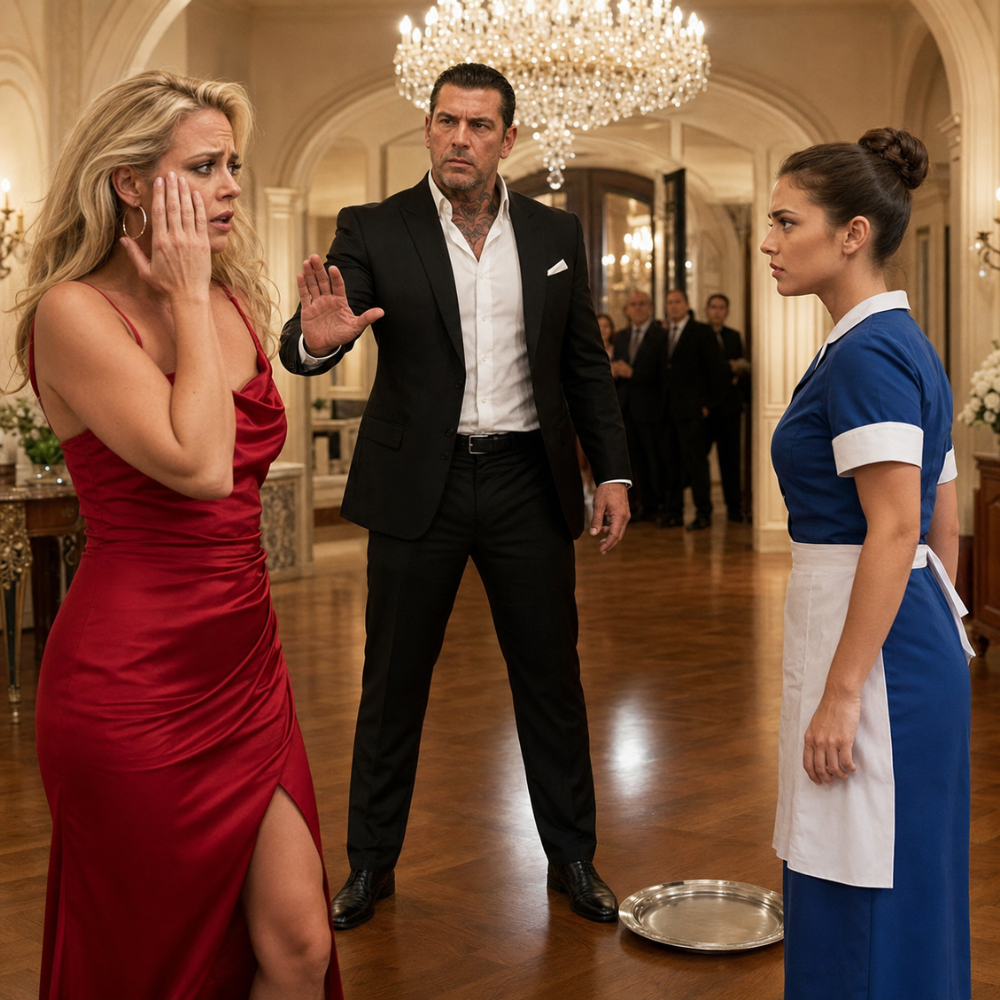
Everyone feared the mafia boss’s fiancée until the new maid finally stood up to her—and the man who owned the house chose not to stop it.
The porcelain tray hit the marble hard enough to make everyone in the east corridor flinch.
Six coffee cups shattered at once.
A silver creamer spun toward the wall.
One saucer rolled in a slow circle before settling upside down beneath a narrow console table.
And seventeen-year-old Addie Flores dropped to her knees so quickly that Laura Beckett wondered whether the girl had learned to apologize before she even knew what had gone wrong.
“I’m sorry, Miss Bain. I’m so sorry.”
Addie reached for the largest broken piece.
Her hands were already shaking.
“Don’t.”
Laura said the word from twenty feet away.
Addie froze.
So did almost everybody else.
Laura left the linen cart near the wall and crossed the corridor at an ordinary pace.
No rush.
No dramatic entrance.
She crouched beside the girl and picked up a folded cloth from the cart.
“Use this first.”
Addie stared at her.
Laura wrapped the cloth around the sharp porcelain edge.
“You’ll cut yourself.”
The young woman standing over them did not move.
Celeste Bain wore a cream silk blouse, fitted trousers and a diamond ring that caught the morning light every time her hand shifted. At thirty-eight, she was one of those women people described as elegant before they realized elegance was not the same thing as kindness.
Her voice was soft.
That was what made everyone listen.
“I don’t believe I was finished.”
Laura continued gathering porcelain.
“The floor is dangerous.”
Celeste’s expression cooled.
“I was speaking to Addie.”
“I heard you.”
Something changed in the corridor.
The room had already been quiet.
Now the silence became watchful.
There were eight members of staff nearby.
Bess Avery, the head housekeeper, stood near the service stairs.
Percy Cole from the grounds crew held a potted fern he had been moving toward the conservatory.
The cook, Marlene, had appeared from the kitchen.
Nobody looked directly at Celeste.
Nobody except Laura.
Addie whispered, “Laura, please.”
The fear in the girl’s face was not for herself anymore.
That told Laura almost everything she needed to know.
She finished collecting the largest pieces and stood.
“It was an accident.”
Celeste tilted her head.
“Excuse me?”
“The tray.”
Laura nodded toward the floor.
“She tripped on the rug edge.”
Addie’s eyes widened.
Laura had seen it.
The corner of the runner had curled upward where the cleaning crew had moved furniture earlier.
Celeste looked down.
Then back at Laura.
“And?”
“And accidents happen.”
“You’ve worked here approximately two hours.”
“Two hours and twenty minutes.”
Someone behind Laura made a tiny sound that might have been a cough.
Celeste smiled.
It was not friendly.
“You’re very observant.”
“I try to be.”
“You should try being less interested in matters outside your duties.”
Laura met her eyes.
“I’ll keep that in mind.”
For one suspended moment, nobody seemed willing to breathe.
Then Bess stepped forward.
“I’ll have the floor cleaned immediately.”
Celeste looked at Addie.
“You can finish your shift in the laundry room.”
Addie nodded rapidly.
“Yes, ma’am.”
“And tomorrow we’ll discuss whether you still have a position here.”
Laura’s jaw tightened.
Celeste saw it.
That pleased her.
Then she walked away.
Her heels clicked against the marble until she disappeared beyond the staircase.
Nobody moved for another three seconds.
Percy let out his breath.
“You’re insane.”
Laura looked at him.
“I’ve been told worse.”
He set down the fern.
“No.”
His voice dropped.
“You don’t understand.”
Laura looked toward Addie.
The girl was trying very hard not to cry.
“I understand enough.”
Bess stepped closer.
“You need to be careful.”
Laura picked up the last piece of broken china.
“I usually am.”
“Not that kind of careful.”
Laura stood.
Bess looked toward the staircase before continuing.
“Miss Bain doesn’t forget.”
“Neither do I.”
Bess’s face tightened.
“That was not meant as a challenge.”
“Neither was my answer.”
Laura returned the cloth to the cart.
Then she looked at Addie.
“Go wash your hands.”
The girl hesitated.
“Now.”
Addie hurried toward the kitchen.
Bess watched her leave.
Then turned back to Laura.
“You’ve been here one morning.”
Laura nodded.
“Yes.”
“And you already managed to become noticeable.”
“I’ll survive.”
Bess did not smile.
“That is what everybody thinks when they arrive.”
The Harwick estate sat outside Baltimore at the end of a private road shaded by oaks old enough to have been there before any Harwick had money.
The house itself had been built in the 1920s.
Limestone exterior.
Slate roof.
Iron balconies.
A long rear lawn dropping toward a line of trees.
From the county road, almost none of it could be seen.
That was intentional.
Garrett Harwick’s family had spent three generations understanding the value of privacy.
Some of that money came from shipping.
Some from construction.
Some from businesses that newspaper profiles described carefully and federal filings described more carefully still.
People in Baltimore knew the Harwick name.
Most preferred not to discuss exactly why.
Garrett had inherited more than property.
He had inherited relationships.
Debts.
Loyalty.
Fear.
The kind of informal power that rarely appeared on organizational charts and almost never needed to introduce itself.
He was fifty-one.
Never married.
No children.
Celeste had become the closest he had come.
They had been engaged eleven months.
The wedding was scheduled for spring.
That fact had changed the house more than Garrett realized.
Laura sensed it before lunch on her first day.
Fear had a domestic rhythm.
Doors closing softly.
Conversations stopping when footsteps approached.
Employees using each other’s names freely until one particular person entered.
Nobody laughing in the hall.
Nobody sitting unless a task required it.
A cook apologizing before she had finished explaining.
A seventeen-year-old girl kneeling on broken porcelain while eight adults looked at the floor.
Laura knew the atmosphere because she had grown up inside a smaller version of it.
Her father had worked twenty-two years for men who believed a paycheck purchased more than labor.
He drove.
Delivered.
Waited.
Answered calls at two in the morning.
Missed birthdays.
Missed doctor appointments.
Told his family the sacrifices would eventually produce security.
Then he got sick.
A heart condition first.
Then complications.
The people he had served sent flowers.
After six weeks, they replaced him.
No pension.
No long goodbye.
No miraculous loyalty in return for everything he had surrendered.
Laura had been nineteen.
Her mother worked mornings at a school cafeteria, afternoons cleaning offices and weekends at a grocery store bakery for almost four years.
Laura never forgot that.
Fear could produce extraordinary obedience.
Obedience could look like loyalty from the top of a table.
They were not the same thing.
She had carried that distinction into every house where she worked.
Laura was not fearless.
She considered that description insulting.
Fearless people often failed to notice danger.
Laura noticed everything.
She simply had rules about which fear deserved authority.
Hard work did not frighten her.
Wealth did not.
Raised voices did not, though she disliked them.
She was afraid of people who considered humiliation an efficient management technique.
People who treated dependence as permission.
People who expected silence because they had enough money to make honesty expensive.
She recognized those people.
Celeste recognized Laura too.
Not the history.
The resistance.
By Wednesday morning, Laura’s workload had doubled.
Nobody announced it.
There was no written instruction saying Make the new maid regret speaking.
The work simply appeared.
Two guest rooms already assigned to another employee were added to Laura’s list.
The west hall windows, scheduled monthly, suddenly needed cleaning.
Silver polishing moved from Thursday to Wednesday.
Her lunch break disappeared behind an “urgent” linen inventory.
Bess delivered each addition with visible discomfort.
“I’m sorry.”
Laura looked at the schedule.
“Why?”
Bess hesitated.
“I didn’t write it.”
“I know.”
Laura folded the paper.
“When should the windows be done?”
“Before four.”
“Fine.”
Bess stared.
“That’s it?”
“What else would you like?”
“I thought you might object.”
“I’ll object if the work becomes impossible.”
“And if it’s merely unfair?”
Laura looked at her.
“That depends on why.”
She completed everything.
Not quickly enough to look frantic.
Not slowly enough to invite criticism.
She took pride in doing a job well even when the person assigning it did not deserve the satisfaction.
That evening, Percy found her cleaning the last window in the west hall.
“You know she’s trying to break you.”
Laura wiped the glass.
“I noticed.”
“Then why are you doing all of it?”
“Because windows don’t know who assigned them.”
Percy frowned.
“That makes no sense.”
“They needed cleaning.”
“That’s not the point.”
Laura checked for streaks.
Percy leaned against the wall.
“You’re going to make her worse.”
“She was already bad.”
“You don’t know how bad.”
Laura folded the cloth.
“No?”
Percy looked toward the staircase.
“Two months ago she slapped Marlene.”
Laura’s hand stopped.
“The cook?”
“Yes.”
“Why?”
“She sent salmon out seven minutes late.”
Laura stared.
Percy continued.
“Last spring she threw a glass at one of the gardeners.”
“Did it hit him?”
“No.”
“As if that matters.”
“It mattered to us.”
Percy lowered his voice.
“We all have jobs.”
“That sentence explains too much.”
“I know.”
He rubbed his palms together.
“Bess has a son in college.”
“Marlene takes care of her sister.”
“Addie’s mother works nights at the hospital.”
“My dad’s medical insurance comes through my job here.”
Laura looked at him.
“I’m not calling anybody a coward.”
“Good.”
Percy smiled bitterly.
“Because we already do that to ourselves.”
Laura put the cleaning bottle into her cart.
“You shouldn’t.”
He studied her.
“You really think you’re different?”
“No.”
“Then what?”
Laura considered.
“I think there comes a day when swallowing something costs more than saying it.”
Percy looked toward the floor.
“And you know which day that is?”
“No.”
Laura pushed the cart toward the service hall.
“But I know you usually recognize it afterward.”
Garrett Harwick had seen the first corridor incident.
Nobody knew.
He had been on the upper landing when the tray fell.
He watched Laura walk forward.
He watched everybody else stay still.
He had watched similar scenes before.
That was the fact that began bothering him.
Not because Celeste had changed suddenly.
Because she had not.
She had been showing him who she was in pieces for almost two years.
A sharp correction in front of staff.
A driver dismissed for taking the wrong route.
A housemaid fired after asking for Christmas Eve off.
A gardener made to wait outside the side entrance rather than enter through the foyer after delivering flowers.
Garrett noticed these things.
Then explained them away.
Celeste ran the household.
Garrett ran everything else.
He spent most days in meetings, phone calls and offices.
He had built a life around dividing responsibility clearly.
That was efficient.
It was also how he had permitted cruelty to become someone else’s department.
From the landing, he watched Laura kneel beside Addie.
He heard her say, “Accidents happen.”
Nobody in Garrett’s world talked that way when a stronger person had already decided an accident needed a target.
He expected Laura to regret it immediately.
Celeste never tolerated being contradicted.
The punishment began the next morning.
Garrett saw that too.
He said nothing.
At first.
That silence would embarrass him later.
On Thursday Celeste corrected Laura in the breakfast room in front of six staff members.
“You fold pillowcases differently from the rest of the house.”
Laura looked at the pillowcase in her hands.
“It’s folded in thirds.”
“We fold them in quarters.”
“Bess told me thirds.”
Every head turned slightly toward Bess.
Celeste smiled.
“Then Bess was mistaken.”
Laura unfolded the linen.
“Fine.”
Celeste waited.
Laura refolded it.
No embarrassment.
No apology.
No visible injury.
Celeste wanted more.
“You’ve worked in homes before?”
“Yes.”
“What kind?”
“Several.”
“Anyone I would know?”
“Probably not.”
Celeste’s smile sharpened.
“Then perhaps we should assume the standards here are different.”
Laura finished the fold.
“Every house thinks that.”
Marlene’s hand stopped above a coffee cup.
Percy stared at the wall.
Celeste looked at Laura.
“Is that supposed to be amusing?”
“No.”
“What is it supposed to be?”
“True.”
Celeste stepped closer.
“You have a peculiar way of speaking to your employer.”
Laura looked directly at her.
“You don’t employ me.”
The room froze.
Technically, Laura had been hired by the Harwick estate management company.
Garrett’s company.
Celeste managed staff scheduling.
She did not sign payroll.
Everyone knew that.
Nobody said it.
Celeste’s face changed.
Only slightly.
“I think you should remember whose home you work in.”
Laura nodded.
“I do.”
Then she carried the folded linens away.
That afternoon, Celeste summoned Bess.
“What exactly did the agency tell you about her?”
“Laura?”
“No, the pope.”
Bess stiffened.
“Sixteen years household service.”
“References?”
“Excellent.”
“Why did she leave her last position?”
“The owner sold the property.”
“Before that?”
“Three years with a family in Philadelphia.”
“Reason for leaving?”
“The elderly woman she cared for died.”
Celeste turned toward the window.
“She has an attitude.”
Bess chose her words carefully.
“She is direct.”
“That is not a virtue in domestic staff.”
Bess looked down.
Celeste noticed.
“What?”
“Nothing.”
“You disagree.”
Bess’s throat tightened.
“I think directness can be useful.”
Celeste turned.
“You’ve become very philosophical.”
“No, ma’am.”
“There.”
Celeste smiled.
“That’s better.”
Bess left with her hands shaking.
By Friday morning, the house had the atmosphere of a workplace waiting for weather.
Nobody knew exactly what Celeste intended.
Everybody knew something was coming.
It arrived at ten.
A message went through the internal staff system.
All household employees to the main reception hall.
Immediately.
Marlene turned off the stove.
Percy came inside still wearing work gloves.
Addie stood near the kitchen door twisting her fingers together.
Laura finished setting down a vase before walking in.
Celeste stood beneath the central chandelier.
Charcoal dress.
Hair pulled back.
Diamond ring.
Her expression was almost sorrowful.
That was when Bess became afraid.
Celeste had three tones.
Cold.
Polite.
Disappointed.
Disappointed was the most dangerous because it allowed her to act cruelly while performing reluctance.
“Something is missing.”
Nobody spoke.
Celeste lifted her wrist.
“A bracelet.”
Rose gold.
Italian.
Gift from Garrett.
Considerable sentimental value.
“I have looked everywhere.”
Her eyes moved across the staff.
“I hope very much that this is a misunderstanding.”
Laura felt the room preparing itself.
Not to defend her.
To survive what came next.
Celeste’s gaze settled on her.
Laura said, “I didn’t take it.”
Addie closed her eyes.
Percy stopped breathing.
Celeste tilted her head.
“I don’t believe I asked you anything.”
“You were about to.”
One guard near the door looked down.
Celeste began walking.
Slowly.
The reception hall was large enough for the distance to become part of the performance.
She stopped in front of Laura.
“You have been here four days.”
“Correct.”
“And somehow, in four days, you have made yourself the center of several unnecessary difficulties.”
“I don’t think I’m the center.”
Celeste smiled without warmth.
“You should.”
Laura held her eyes.
“I didn’t take your bracelet.”
“You’ve said that.”
“Yes.”
“That does not make it true.”
“No.”
Laura nodded.
“The fact that I didn’t take it makes it true.”
Somebody inhaled sharply.
Celeste’s expression went flat.
“Empty your pockets.”
Laura did.
Handkerchief.
Key card.
Two hair pins.
A receipt from the drugstore.
Nothing else.
Celeste looked.
“Your apron.”
Laura untied it and set it on the table.
Nothing.
Celeste’s face tightened.
“Your room.”
“You can search it.”
“I wasn’t asking permission.”
Laura looked at her.
“That is exactly why I’m giving it.”
The words landed harder than Laura expected.
Celeste stepped closer.
“You seem to think dignity is the same thing as authority.”
“No.”
Laura’s voice stayed level.
“I think dignity is mine whether I have authority or not.”
The hall became completely silent.
Garrett stood beyond the doorway.
He had come down from his study after hearing that Celeste had assembled the entire staff.
He stopped where only Bess could see him.
Celeste did not.
Laura did.
Not immediately.
Her attention remained on the woman in front of her.
Celeste’s hand rose.
The gesture was practiced.
Not a wild swing.
Not loss of control.
That was what made Laura react.
This was not an emotional accident.
Celeste expected to strike her.
Expected Laura to accept it.
Laura’s right hand came up.
She caught Celeste’s wrist before contact.
The movement surprised Celeste.
Laura released her immediately.
“Don’t.”
One word.
Celeste stared.
Every person in the hall knew the moment could still end.
Celeste could step back.
Call security.
Fire Laura.
Say something cruel and leave.
Instead she raised her other hand and grabbed the front of Laura’s uniform.
Laura had spent much of her twenties caring for an aunt who ran a neighborhood boxing program for girls.
She knew how to move when someone came into her space.
The response was instinctive.
Short.
Controlled.
One compact strike.
Enough to break Celeste’s grip and send her stumbling sideways into a narrow upholstered bench.
Not a beating.
Not a dramatic brawl.
One decisive reaction.
Celeste sat down hard.
Shock erased every polished expression she had ever practiced.
Two security men moved instantly.
“Enough.”
Garrett’s voice came from the doorway.
The guards stopped.
Celeste turned.
Her hand went to her jaw.
“Garrett.”
He entered.
Nobody spoke.
Garrett looked at Celeste.
Then Laura.
Then the assembled staff.
His gaze rested on Addie’s frightened face.
Marlene’s lowered eyes.
Percy’s rigid shoulders.
Bess’s hands clasped so tightly they had gone white at the knuckles.
He stopped in front of Laura.
“Why?”
Laura did not pretend not to understand.
“She tried to hit me.”
Garrett waited.
Laura continued.
“And because she has hit other people in this house.”
Celeste stood.
“That is a lie.”
Laura turned toward her.
“Ask them.”
Celeste laughed sharply.
“Of course they’ll say anything now.”
Garrett looked at Bess.
Bess went pale.
He did not say her name.
He did not need to.
She swallowed.
Then said, “Miss Bain struck Marlene in June.”
Celeste stared at her.
Marlene looked up.
Bess continued.
“She threw a glass near Thomas from the grounds crew in April.”
Percy stepped forward.
“She slapped Addie last month.”
Addie began crying.
Celeste turned on them.
“You ungrateful—”
“Stop.”
Garrett’s voice stayed quiet.
Celeste froze.
For the first time in two years, the word had been directed at her.
Garrett looked at Laura.
“Did you take the bracelet?”
“No.”
“Do you know who did?”
“No.”
He looked at Celeste.
“Where did you last have it?”
“Yesterday.”
“Where?”
“My sitting room.”
Garrett turned toward Bess.
“Lock the room.”
Celeste’s eyes widened.
“Excuse me?”
“Nobody enters until security checks it.”
“This is absurd.”
Garrett looked at the guards.
“Review cameras.”
Then to everyone else:
“Back to work.”
Nobody moved.
Garrett’s eyes sharpened.
“I said back to work.”
The staff scattered.
Laura picked up her apron.
Celeste stepped toward Garrett.
“You are not seriously taking her side.”
Garrett watched Laura leave.
Then looked at his fiancée.
“No.”
Celeste’s shoulders relaxed one fraction.
“I’m finally looking at my own.”
That stopped her.
The bracelet was found forty-three minutes later.
In Celeste’s dressing room.
Inside a velvet travel case she had packed herself.
Security footage showed nobody entering the room after Celeste.
There had been no theft.
Maybe she had forgotten where she put it.
Maybe she had known.
Garrett never proved the second possibility.
He did not need it for the larger decision.
He sat in his study with Bess that afternoon.
She looked terrified.
“How long?”
Bess stared.
Garrett repeated.
“How long has she been hitting people?”
“Mr. Harwick—”
“How long?”
“Almost from the beginning.”
He looked toward the window.
“You never told me.”
Bess’s face changed.
Garrett heard the accusation in his own sentence.
He corrected it.
“No.”
He rubbed one hand over his jaw.
“I never made it safe to tell me.”
Bess said nothing.
Garrett continued.
“I want names.”
“For what?”
“Anyone she has struck, threatened, improperly disciplined or had dismissed.”
Bess looked at him.
“Are you going to punish them for not reporting it?”
Garrett’s eyes came back to her.
“No.”
“Are you certain?”
The question hit him harder than anything else that day.
His head housekeeper, employed in his home for nine years, did not know whether telling him staff had been abused would lead to punishment.
What did that say about the man who owned the house?
“Yes.”
His voice changed.
“I’m certain.”
Bess gave him names.
Seven.
Garrett spent the afternoon confirming what he could.
By six, Celeste’s bags were packed.
She walked into his study without knocking.
Two suitcases waited in the front hall.
“You’re humiliating me.”
Garrett closed the file in front of him.
“No.”
“Your staff is packing my clothes.”
“You asked them to.”
“I asked them because you told me to leave.”
“Correct.”
Celeste stared.
“Our wedding is in seven months.”
“Not anymore.”
Her face emptied.
“You’re ending an engagement over a maid?”
“No.”
“Then over what?”
Garrett stood.
“Over the fact that seven people who work in my home believed being hit was part of keeping their jobs.”
Celeste’s voice sharpened.
“They are employees.”
“Yes.”
“They make mistakes.”
“So do I.”
“That is not the same.”
Garrett looked at her.
“That sentence is exactly why you’re leaving.”
Celeste laughed.
“You think Laura Beckett is some moral revelation?”
“No.”
He stepped around the desk.
“I think she was the first person in this house willing to say something I should have seen without help.”
Celeste folded her arms.
“And suddenly you’re a good man?”
“No.”
That answer caught her.
Garrett continued.
“I’m the man who let it happen.”
He walked toward the door.
“That is enough reason to stop.”
Celeste did not leave quietly.
She called him cruel.
Disloyal.
Embarrassing.
She accused Laura of manipulating him.
She reminded Garrett of dinners, vacations, alliances, introductions she had made.
She talked about how the city would interpret the broken engagement.
Garrett listened.
Then opened the front door.
“You should go.”
Celeste stared at him.
“You’ll regret this.”
“Probably.”
His voice stayed calm.
“I have regretted more expensive things.”
She walked out.
The car left the gravel drive ten minutes later.
The estate became quiet.
Not celebratory.
Nobody cheered.
People who had spent years monitoring danger did not know how to celebrate its absence immediately.
The next morning, small things changed.
Marlene hummed while preparing eggs.
Percy whistled near the kitchen garden.
Addie laughed at something Bess said and then looked startled by the sound, as though she had forgotten the house allowed it.
Laura noticed.
She also noticed Garrett.
He was different after Celeste left.
Not suddenly kinder.
Laura did not trust sudden transformation.
He simply paid more attention.
He came into the kitchen one morning and asked Bess about staff schedules.
Actually asked.
Did not announce.
He restored healthcare benefits for several employees that Celeste had convinced him were unnecessarily generous.
The memo arrived from accounting with no speech attached.
Paid personal days were reinstated.
A grievance procedure appeared.
Anonymous reporting routed to an outside lawyer.
Percy read the memo twice.
“Is this because of you?”
Laura looked at him.
“Why would it be?”
“You punched his fiancée.”
“Former fiancée.”
“That seems connected.”
Laura folded towels.
“Maybe he finally read his own payroll.”
Percy laughed.
She liked that people laughed now.
Twelve days after Laura arrived, Garrett found her in the east garden.
She had volunteered to trim rose beds neglected during the upheaval.
Late afternoon light lay gold across the grass.
Laura worked with her sleeves rolled.
She knew Garrett was at the gate before he spoke.
“You don’t have to do that.”
“The roses?”
“Yes.”
“They need it.”
“That isn’t your assignment.”
Laura clipped a dead stem.
“They don’t know.”
Garrett walked toward the stone bench.
He sat.
That surprised her.
Powerful men often entered working spaces only long enough to issue instructions.
Garrett stayed.
Laura turned after a while.
“You need something?”
“No.”
“Then you’re supervising.”
“No.”
“Watching?”
“Apparently.”
She put the clippers into her basket.
“That sounds unhealthy.”
A faint line appeared beside his mouth.
“You’ve been here twelve days.”
“Yes.”
“In twelve days, you’ve altered the entire household.”
Laura looked at him.
“I cleaned things.”
“You knocked my fiancée onto a bench.”
“She grabbed me.”
“You exposed two years of employee mistreatment.”
“No.”
Laura picked up another stem.
“Your employees did that.”
Garrett studied her.
“You separated us.”
“No.”
She met his eyes.
“Celeste did.”
Silence.
Garrett nodded once.
“Fair.”
The answer surprised her.
He looked toward the roses.
“I’ve spent most of my adult life around people who tell me what they think I want to hear.”
“That sounds lonely.”
He looked at her.
“Not frightening?”
“Why?”
“Most people consider it an advantage.”
“It probably is in negotiations.”
Laura sat on the low stone edge surrounding the bed.
“In a house, it sounds exhausting.”
Garrett laughed once.
A real laugh.
Small.
Almost rusty.
Laura stared.
“What?”
“Nothing.”
“You looked surprised.”
“I was.”
He leaned forward.
“You’re not afraid of me.”
Laura considered.
“I’m careful around you.”
“That is not the same.”
“No.”
“Why?”
She looked toward the house.
“I’m afraid of men who use power to replace character.”
Garrett’s expression sharpened.
“And me?”
“I haven’t decided what you use yours to replace.”
He stared.
Laura almost regretted it.
Almost.
Then Garrett nodded.
“That is probably the most honest answer anyone has given me this month.”
“Low bar.”
“Yes.”
Another silence.
Birds moved through the hedges.
Garrett folded his hands.
“My father believed fear was the only dependable currency.”
Laura looked at him.
“He said people’s loyalty changes.”
Garrett’s voice became distant.
“Greed changes. Love changes. Fear is predictable.”
“Your father was wrong.”
Garrett’s eyes returned to hers.
“Quick answer.”
“Easy question.”
“How?”
“Fear makes people compliant.”
Laura pointed toward the house.
“Look at your staff under Celeste.”
“They did what she wanted.”
“Yes.”
“Isn’t that the point?”
“No.”
Laura shook her head.
“Compliant people do what you want while leaving becomes expensive.”
She looked directly at him.
“Loyal people stay when leaving becomes easy.”
Garrett was silent.
Laura continued.
“Your staff was afraid to tell you what happened.”
“I know.”
“Do you?”
His jaw tightened.
“They weren’t loyal to Celeste.”
“They were surviving her.”
“And me?”
Laura waited.
“That answer bothers you.”
“Yes.”
“Good.”
She did not enjoy cruelty.
But honesty sometimes needed room to hurt.
Garrett looked toward the ground.
Laura picked up the clippers again.
“My father worked for men like your father.”
Garrett looked up.
“Twenty-two years.”
“What happened?”
“He got sick.”
She cut a stem.
“They sent flowers.”
Her mouth tightened.
“Then replaced him.”
Garrett said nothing.
“My mother worked three jobs.”
“We lost our house.”
“I learned something.”
Laura looked at him.
“People who demand loyalty from below usually mean obedience.”
The garden held the sentence.
Garrett rubbed his thumb across one knuckle.
“I let Celeste do what she did.”
“Yes.”
No comfort.
No automatic absolution.
Laura had learned that some apologies were weakened by people rushing to make the speaker feel better.
Garrett nodded.
“That was a failure of character.”
“Yes.”
Again.
He looked at her.
“Do you ever soften anything?”
“When it needs softening.”
“And this?”
“No.”
Garrett stood.
“Finish the roses.”
Laura raised an eyebrow.
“That sounded like an order.”
He almost smiled.
“Please finish the roses.”
“Better.”
“And go inside before dark.”
“That one still sounded like an order.”
“It’s getting cold.”
Laura looked toward the lowering sun.
“Fine.”
He walked back to the house.
Laura watched him.
Something had shifted.
She did not trust it.
She noticed anyway.
Over the next month, Garrett changed through decisions too small for newspapers.
He ate breakfast with household staff twice.
The first time everyone nearly stopped chewing.
By the fourth Sunday, nobody did.
He asked Marlene whether kitchen staffing was sufficient.
She said no.
He hired another person.
He asked Percy why the grounds budget kept showing unused money.
Percy said Celeste had blocked equipment replacement.
Two weeks later, the crew had new machinery.
When Addie asked whether she could reduce hours during her final school semester, Bess expected hesitation.
Garrett said, “Of course.”
Then asked why a seventeen-year-old had been scheduled forty-two hours the previous month.
Nobody had a good answer.
That policy changed too.
Laura watched.
Her opinion of him became inconvenient.
She had entered the estate prepared to dislike Garrett Harwick.
Not emotionally.
Practically.
Men with reputations like his usually offered plenty of evidence.
He was not gentle.
He had not become harmless.
There were phone calls that ended with his face hardening in ways Laura did not want to understand.
Men arrived in dark suits and left speaking more carefully.
Garrett carried a life outside the estate that Laura did not romanticize.
But she watched him choose restraint where he once would have chosen force.
He began separating fear from authority.
Not because Laura transformed him through magic.
Because she had named something he was already tired enough to hear.
That distinction mattered to her.
One evening, she found him alone in the breakfast room.
A stack of documents sat open.
Coffee gone cold.
“You’re working late.”
He looked up.
“So are you.”
“I’m putting away table linens.”
“Clearly more important.”
Laura glanced at the papers.
“Trouble?”
Garrett closed the file.
“Always.”
She turned to leave.
“Laura.”
She stopped.
“Yes?”
“How do you know whether someone is loyal?”
She looked back.
“You don’t.”
His expression showed irritation.
“That’s not useful.”
“Most true things aren’t.”
He leaned back.
“Then what do you do?”
“You stop testing people.”
Garrett became still.
Laura continued.
“You give them choices.”
“Watch what they choose.”
“Over time.”
He looked toward the documents.
“My entire life has been built around knowing before the other person knows I’m asking.”
“That sounds exhausting too.”
“Everything sounds exhausting to you.”
“Bad systems usually are.”
Garrett laughed.
Laura went back to work.
The threat arrived six weeks after Celeste left.
Not dramatically.
No car bombing.
No men at the gate.
A business disagreement on the south side of Baltimore escalated.
A group that had interpreted Garrett’s recent restraint as weakness began testing boundaries.
A warehouse lease interfered with.
A driver threatened.
One of Harwick’s legitimate construction offices vandalized overnight.
Nothing that would make national news.
Enough to make Garrett’s security chief tighten the estate.
Laura noticed additional guards before anyone told her why.
Bess found her near the linen room.
“There’s a problem.”
“What kind?”
“The kind where staff is being moved temporarily.”
Laura frowned.
“Moved where?”
“Secondary property.”
“For how long?”
“Days.”
“Maybe a week.”
“Who ordered it?”
Bess looked at her.
Laura sighed.
“Of course.”
By morning, staff had instructions.
Pack one bag.
Transportation at noon.
Essential personnel only remained.
Garrett had insisted everyone who did not need to be on-site leave.
Laura listened.
Then unpacked.
At eleven, Bess entered her room.
“Your bag.”
“Put away.”
“Laura.”
“Tell Garrett thank you.”
Bess closed her eyes.
“No.”
“No what?”
“I am not carrying that message.”
Laura smiled.
“Coward.”
“Absolutely.”
Bess pointed toward the hall.
“You tell him.”
Garrett found Laura in the library.
She was reshelving books.
“You’re supposed to be ready.”
“I was.”
He stopped.
“Where is your bag?”
“Closet.”
A long pause.
“This is not optional.”
Laura put a book into place.
“No.”
His face hardened.
“What?”
“It isn’t optional for your employees.”
She turned.
“I’m not leaving.”
“You are employed here.”
“Yes.”
“I am responsible for security.”
“Yes.”
“Then why are we arguing?”
“Because you’re confusing responsibility with ownership.”
Garrett crossed the room.
He stopped several feet away.
“That’s unfair.”
“Is it?”
“If something happens—”
“What?”
His voice rose slightly.
“If something happens to you.”
The library went quiet.
Garrett stopped.
Started again.
“I know how to protect people by moving them.”
His voice lowered.
“By limiting options.”
“By controlling the situation.”
Laura waited.
“I don’t know how to care about somebody’s safety without doing that.”
There.
Not a command.
A confession.
Laura’s anger softened.
Not entirely.
Enough.
“I know.”
Garrett looked at her.
“You know?”
“You’re obvious.”
He almost smiled.
Then did not.
“This situation is real.”
“I know.”
“You could be hurt.”
“I know.”
“You’re staying anyway.”
“Yes.”
“Why?”
Laura thought about giving him the easier answer.
I don’t scare easily.
It was not true.
She looked toward the rain beginning against the windows.
“My father stayed in bad situations his whole life because he thought leaving meant abandoning people.”
Garrett frowned.
“I thought you believed he was exploited.”
“He was.”
“Then why repeat him?”
“I’m not.”
Laura crossed her arms.
“He stayed where no one respected his choice.”
“I’m staying because this is mine.”
Garrett’s eyes narrowed.
“This house?”
“This decision.”
That stopped him.
Laura continued.
“If I leave because you order me to, then all your talk about learning the difference between control and loyalty means nothing.”
He stared.
“That is manipulative.”
“It might be.”
She nodded.
“Still true.”
Rain hit the windows harder.
Garrett turned away.
His shoulders were rigid.
Laura watched him.
“You can make the house safer without moving me.”
“I can make you safer by moving you.”
“Maybe.”
“Probably.”
“Yes.”
Laura stepped closer.
“But I decide what risk I accept.”
His jaw tightened.
“I hate that.”
“I know.”
He turned.
For once Garrett Harwick looked genuinely uncertain.
Not about a business deal.
Not about physical danger.
About another person.
“I have spent thirty years making sure anything I care about is protected.”
He stopped.
The word care had escaped before he decided whether to use it.
Laura heard.
So did he.
Neither rescued him.
Garrett looked at her.
“You are the first thing in a very long time I feel strongly about that I cannot put somewhere safe and call the problem solved.”
Laura’s throat tightened.
She could have joked.
She did not.
“My mother used to say strong men often spend their whole lives being strong in the wrong direction.”
Garrett’s expression shifted.
“What does that mean?”
“She meant they learn how to carry.”
Laura looked at him.
“Not how to share weight.”
The rain filled the silence.
“She said needing someone scared some men more than losing them.”
Garrett exhaled.
“That sounds uncomfortably specific.”
“She had experience.”
Laura stepped closer.
“You’re learning.”
His eyes stayed on hers.
“Slowly.”
“Yes.”
“Poorly.”
“Also yes.”
He almost smiled.
Then held out his hand.
Not taking hers.
Offering.
Laura stared at it.
Large.
Scarred.
Careful.
She placed her hand in his.
His fingers closed gently.
The man half the city feared let out a breath like someone setting down a box he had carried for years.
Laura squeezed once.
Then said, “I’m still not leaving.”
Garrett closed his eyes.
“Of course not.”
The staff moved.
Laura stayed.
So did Bess after deciding somebody needed to supervise a reduced household.
Percy remained because grounds security overlapped with estate maintenance.
Marlene volunteered to cook.
Garrett argued with all of them.
Lost selectively.
The dispute outside the estate resolved within a week.
Not cleanly enough to become a fairy tale.
Not violently enough to become another Harwick legend.
Lawyers became involved.
Business partners applied pressure.
A competing faction backed away when several legitimate contracts and political relationships shifted against them.
Garrett used influence instead of spectacle.
The city noticed.
Men who had expected him to prove strength through aggression found something less satisfying and more durable.
He refused to perform.
One evening, his security chief said, “They think you’ve gotten soft.”
Garrett looked at him.
“Do you?”
The man hesitated.
“No.”
“Why?”
“Because you’re still getting what you want.”
Garrett nodded.
“Then let them be confused.”
The estate returned to ordinary life.
But ordinary had changed.
Sunday morning coffee became accidental tradition.
Bess left a large pot in the front sitting room.
Marlene brought pastries.
Percy arrived in muddy boots until Bess finally threatened his life over the carpet.
Addie came before her afternoon shift.
Garrett appeared the first Sunday and everyone became silent.
He sat.
Drank coffee.
Asked Percy about a football game.
The second Sunday was marginally less awkward.
By the sixth, Laura sat beside Garrett on the settee.
Their shoulders touched.
Nobody pretended not to notice.
Nobody said anything either.
Laura preferred that.
She had spent her life making geography simple.
Employer.
Employee.
Upstairs.
Downstairs.
Public room.
Service hall.
Her father’s life had taught her what happened when people confused dependence with intimacy.
She would not repeat it.
So before anything changed formally between her and Garrett, she resigned.
Bess stared at the letter.
“What are you doing?”
“My job.”
“You hate it?”
“No.”
“Then why?”
Laura looked toward Garrett’s closed study.
“Because I need to know what happens when I’m not paid to stay.”
Bess understood immediately.
“Oh.”
“Yes.”
“Have you told him?”
“No.”
Bess smiled for the first time Laura had ever seen her enjoy someone else’s discomfort.
“Good luck.”
Garrett read the resignation twice.
Then put it down.
“No.”
Laura stared.
“No?”
“I don’t accept it.”
“That isn’t how resignation works.”
“It should be.”
“It isn’t.”
He stood.
“You’re leaving?”
“I’m leaving employment.”
“That sounds deliberately technical.”
“It is.”
Garrett walked around the desk.
“Why?”
Laura gave him the truth.
“Because I care about you.”
He became still.
“And I will not spend the next year wondering whether every feeling I have is tangled up with living under your roof because you sign my paycheck.”
Garrett’s face changed.
Laura continued.
“I won’t become Celeste in reverse.”
“What does that mean?”
“She believed being close to you gave her authority over everyone below her.”
Laura met his eyes.
“I won’t build a relationship on a structure that gives either one of us an excuse not to know whether the other is choosing it freely.”
Garrett looked toward the window.
“What are you going to do?”
“Work.”
“Where?”
“Another house.”
He hated the answer.
Laura saw it.
“Don’t.”
“Don’t what?”
“Call somebody.”
He looked almost offended.
“I didn’t say anything.”
“Your face did.”
“I could help you find something.”
“I know.”
“References.”
“I already have them.”
“Where?”
“Bess.”
Garrett looked betrayed.
Laura smiled.
“Everybody is learning autonomy.”
He did not smile.
“When do you leave?”
“Two weeks.”
“That soon?”
“Yes.”
Garrett nodded.
The next two weeks were difficult.
Not dramatic.
That would have been easier.
They had coffee.
Talked.
Passed each other in hallways.
Sometimes Garrett looked as though he wanted to issue an order and then remembered he had promised himself not to.
Laura found that strangely endearing.
On her last day, the staff held lunch in the kitchen.
Marlene made too much food.
Addie brought a cheap grocery-store cake decorated with purple icing.
Percy gave Laura gardening gloves despite the fact that Laura had never expressed any desire to become a gardener.
Bess hugged her.
Garrett did not attend.
Laura expected that.
Then she walked toward the side entrance carrying one suitcase.
His car waited.
Garrett stood beside it.
Laura stopped.
“I can take the bus.”
“I know.”
“You arranged a car anyway.”
“Yes.”
“Control problem.”
“Severe.”
She smiled.
He opened the passenger door.
“Where are you going?”
“Apartment first.”
“And job?”
“Part-time household management for an older couple in Towson.”
“Safe?”
Laura stared.
Garrett corrected himself.
“Good employers?”
“Bess checked them like she was performing a federal background investigation.”
“Excellent.”
Laura put her suitcase into the trunk.
Then turned.
Garrett looked almost uncomfortable.
“I don’t know what the correct thing is here.”
“That’s new.”
“Yes.”
Laura waited.
He said, “Can I call you?”
Her expression softened.
“Yes.”
“How often?”
“Garrett.”
“I’m asking.”
“Start with when you have something to say.”
“That could be every day.”
“Then we’ll see whether I answer.”
He smiled.
Laura stepped closer.
She kissed his cheek.
His eyes closed for half a second.
Then she got into the car.
For the first time in thirty years, Garrett watched someone he cared about leave without trying to stop her.
That became one of the most important things he ever learned.
Laura’s apartment was small.
Second floor above a pharmacy.
The radiator clanked.
A neighbor practiced trumpet badly.
She loved it.
Garrett hated the stairs.
“You could live somewhere with an elevator.”
“You could learn stairs.”
“I know stairs.”
“You complain like they’re political.”
He visited twice a week.
Not every day.
They had dinner.
Walked.
Argued.
Laura met him in public places where nobody cared who Garrett Harwick was.
A diner waitress called him sweetheart.
He looked offended.
Laura laughed.
They went grocery shopping once.
Garrett stood in the cereal aisle for five minutes.
“You’re overthinking cornflakes.”
“There are forty options.”
“That is not a crisis.”
“It is poor market discipline.”
Laura abandoned him.
He eventually chose Raisin Bran.
Their relationship became ordinary in ways Garrett had never expected.
And the ordinary pieces transformed him more than Laura’s punch ever had.
She disliked one restaurant.
They never went again.
She told him she needed an evening alone.
He survived.
He made plans without consulting her.
She objected.
He apologized.
She overreacted once to a canceled dinner because she had expected him to repeat the emotional distance of previous men in her life.
She apologized too.
Nobody won.
That was new for Garrett.
His world had been built around winners.
Laura taught him that many disagreements did not require one.
The Harwick organization continued changing.
Legitimate businesses expanded.
Riskier operations shrank.
Garrett had spent decades telling himself his father’s rules were the only way to keep people safe.
Laura asked a question that would not leave him alone.
Safe for whom?
So Garrett began removing himself from businesses that required fear to function.
It took years.
There was no cinematic announcement.
Lawyers.
Sales.
Settlements.
Partnerships dissolved.
Assets moved into licensed companies.
Employees transferred.
Some men left angry.
Some relieved.
One longtime associate told Garrett, “Your father would hate this.”
Garrett answered, “He’s dead.”
That became the end of the discussion.
At the estate, Bess became household director.
Not head housekeeper.
Director.
She received authority over budget and staffing.
Marlene ran the kitchen without anyone commenting on timing unless they had volunteered to cook themselves.
Percy became grounds manager.
Addie finished school, then enrolled in community college.
Garrett paid tuition through an employee education program available to everyone.
Not a private favor.
Laura insisted on that.
“No debts disguised as gifts.”
He understood.
Celeste did not disappear from the world.
That was important too.
She went to New York.
Stayed with a friend.
Hired a lawyer.
Sent letters demanding property she claimed remained at the estate.
Garrett returned everything.
No games.
No punishment.
She spoke badly about him socially.
Called Laura manipulative.
Described herself as the victim of a violent employee and a disloyal fiancé.
Some people believed her.
Garrett learned another difficult lesson.
You could know your own truth without controlling everyone else’s opinion.
He hated that too.
Months later, Celeste filed a civil claim related to the confrontation.
The estate’s camera had captured enough.
So had witness statements.
Laura had stopped Celeste’s first strike by catching her wrist and had reacted only after Celeste grabbed her clothing and advanced again.
Lawyers handled it.
The matter settled without admission.
Laura hated even that.
“It feels like paying her.”
Garrett said, “It’s paying to stop paying lawyers.”
“That is annoyingly practical.”
“I have talents.”
Celeste’s lawsuit accomplished one useful thing.
It forced Garrett to confront publicly what had happened in his household.
Not in a press conference.
In sworn testimony.
He was asked when he first knew Celeste mistreated staff.
Garrett could have said the day Laura defended herself.
Instead he answered:
“Long before.”
The attorney paused.
“You knew?”
“I knew enough to ask questions.”
“Did you?”
“No.”
“Why not?”
Garrett looked down at his hands.
“Convenience.”
That answer became the hardest one.
Not ignorance.
Convenience.
Celeste ran the house.
Staff remained productive.
Garrett’s life stayed undisturbed.
He had traded their comfort for his.
That truth followed him.
He used it.
Harwick companies established independent employee-complaint systems.
No complaint about a senior executive could be routed back through that executive.
Health benefits became standardized.
Retaliation policies gained actual enforcement.
His lawyers called these governance improvements.
Laura called them basic adulthood.
Garrett framed neither phrase.
Years later, Bess told Laura the house no longer felt like an estate.
“What does it feel like?”
“A workplace.”
Laura laughed.
“That sounds worse.”
“No.”
Bess smiled.
“That’s the compliment.”
People worked there.
They went home.
They had sick days.
They said no.
Nobody treated employment like feudal loyalty.
The distinction would have offended Garrett’s father.
That pleased everyone.
Garrett and Laura married three years after her resignation.
They waited partly because Laura insisted.
Partly because Garrett’s life needed simplification before marriage could become anything except another structure around her.
The ceremony happened in the east garden.
The same garden where Laura had told him fear created compliance, not loyalty.
Bess stood with Laura.
Percy handled flowers and complained about every decision.
Marlene refused catering help and cooked for eighty people while loudly accusing everyone of incompetence.
Addie, now twenty-one, came home from college for the weekend.
Garrett wore a dark suit.
Laura wore ivory.
No enormous society wedding.
No magazine photographs.
No political donors invited simply because protocol suggested it.
The guest list contained people they actually wanted.
That was revolutionary enough.
Before the ceremony, Garrett stood alone near the rose beds.
Percy found him.
“You nervous?”
“No.”
“You look nervous.”
“I’m considering logistics.”
“You’re getting married.”
“Exactly.”
Percy laughed.
“Laura’s going to eat you alive.”
Garrett looked toward the house.
“I’m aware.”
He smiled.
When Laura appeared, Garrett stopped pretending he was not nervous.
She walked toward him on her own.
No one gave her away.
Her mother had died years earlier.
Her father was gone too.
Laura said she did not need to be transferred from one person to another symbolically or otherwise.
Garrett wisely agreed.
Their vows were short.
Laura said, “I promise not to mistake disagreement for disloyalty.”
Garrett looked at her.
Then said, “I promise not to mistake protection for control.”
Everyone who knew them understood exactly why those sentences mattered.
Afterward, Marlene’s food was excellent.
Percy got drunk enough to make a toast he regretted.
Bess cried.
Addie danced until midnight.
Garrett spent part of his own wedding helping move chairs because one of the rental workers had hurt his back.
Laura watched from across the lawn.
That image stayed with her.
Not because rich men moving chairs deserved applause.
Because Garrett no longer seemed aware the task was beneath him.
There was no beneath.
Only work someone needed help doing.
They did not have children.
Not by tragedy.
By choice.
Laura had spent much of her life caring for siblings, parents and employers.
Garrett had spent his trying to control outcomes.
Neither felt something missing.
Their house remained full anyway.
Sunday coffee continued.
Staff became former staff, friends, children of friends.
Addie eventually married.
Percy had twins.
Marlene retired and still arrived twice a month to complain that the current chef overused herbs.
Bess bought a condo near Annapolis and discovered she hated condominium boards with astonishing passion.
Laura and Garrett hosted Thanksgiving.
The first year, Garrett tried making mashed potatoes.
Nobody let him again.
Life became ordinary.
That was their success.
Not becoming legendary.
Becoming boring enough to be happy.
Garrett’s reputation changed slowly.
Some people still feared him.
Some always would.
He did not chase correction.
The people closest to him knew what mattered.
He had stopped needing fear to be the first thing entering a room.
That was enough.
One autumn morning, nearly fifteen years after Laura first walked through the gate, she sat in the front sitting room with coffee.
Garrett was beside her reading a newspaper.
Outside, the grounds were turning gold.
The house moved around them.
A vacuum somewhere upstairs.
Someone laughing in the kitchen.
The back door opening.
Normal sound.
Garrett lowered the newspaper.
“You know what I keep thinking about?”
“That is always dangerous.”
“The corridor.”
Laura looked over.
“What corridor?”
“The first day.”
She knew.
Garrett folded the paper.
“Everyone moved backward.”
Laura smiled.
“I walked forward.”
“Yes.”
“You’ve mentioned this before.”
“I know.”
“Frequently.”
“I’m old. Repetition is permitted.”
“You’re sixty-six.”
“Ancient.”
Laura drank coffee.
Garrett looked toward the doorway.
“I keep wondering what would’ve happened if you hadn’t.”
“Addie would’ve cleaned the porcelain.”
“No.”
“I mean after.”
Laura considered.
“Celeste would’ve stayed longer.”
“Yes.”
“You would’ve continued pretending the household wasn’t your concern.”
Garrett winced.
“Very romantic.”
“You asked.”
He smiled.
Laura continued.
“Eventually something else would’ve happened.”
“Somebody else might’ve said something.”
“Maybe.”
Garrett shook his head.
“I’m not sure.”
Laura looked at him.
“That’s the wrong lesson.”
“What?”
“That everything depended on me.”
Garrett frowned.
“It did.”
“No.”
She put down her cup.
“It depended on a house full of people being pushed to a point where one person finally moved.”
She nodded toward the kitchen.
“Bess told the truth.”
“Marlene confirmed it.”
“Percy spoke.”
“Addie survived enough to stay.”
“You listened.”
Garrett looked unconvinced.
Laura continued.
“I was first that week.”
“That’s all.”
He sat quietly.
Then said, “You punched my fiancée.”
Laura sighed.
“She grabbed me.”
“I know.”
“You make it sound recreational.”
“It remains one of the more memorable management interventions in Harwick history.”
Laura laughed.
“Idiot.”
Garrett smiled.
Then became thoughtful.
“What did you think of me that day?”
“Which part?”
“When I walked into the hall.”
Laura looked out the window.
“Honestly?”
“Always.”
“I thought you were weak.”
Garrett stared.
“That is not the answer I expected.”
“You had all the power in the room.”
She turned to him.
“And everyone else was paying for your refusal to use it responsibly.”
He absorbed that.
“Fair.”
“What did you think of me?”
Garrett considered.
“That you were going to become a problem.”
Laura smiled.
“I was.”
“Yes.”
He reached for her hand.
“The best one I ever had.”
She groaned.
“That was terrible.”
“I liked it.”
“Of course.”
They sat together.
For years, people outside the Harwick estate told the story as though one punch changed everything.
It was the easiest part to repeat.
The new maid hit the feared fiancée.
The mafia boss watched.
The fiancée disappeared.
That version had drama.
It also missed almost everything important.
The punch lasted less than a second.
The real change took years.
It happened when Bess stopped assuming honesty would cost her job.
When Garrett admitted convenience had become complicity.
When Laura resigned rather than let affection grow inside a financial dependency.
When Garrett watched her leave and did not punish her for choosing herself.
When an employee handbook became more important than a boss’s mood.
When Addie could ask for fewer shifts during school without fear.
When people learned that disagreement did not mean betrayal.
When Garrett stopped confusing fear with loyalty.
When Laura stopped confusing self-reliance with never needing anyone.
Those were harder transformations.
Nobody applauded them.
No one told stories about the Sunday Garrett listened to Percy complain about landscaping budgets for forty minutes.
Nobody romanticized the afternoon Laura apologized after accusing Garrett of controlling something he had actually been trying to discuss.
No one cared that Bess finally took a full two-week vacation and turned off her phone.
Those details mattered more.
Fear is loud when it enters a house.
Its departure can be almost invisible.
The first sign may be a girl laughing in the kitchen.
A gardener whistling.
A housekeeper taking vacation.
A powerful man being told no and surviving it.
Laura never considered herself brave because she hit Celeste.
That idea bothered her.
Physical resistance had been the simplest choice available in that second.
The harder bravery had come before and after.
Kneeling beside Addie when everybody warned her not to.
Saying aloud what the house already knew.
Leaving Garrett after realizing she cared about him.
Trusting him enough to return by choice.
Allowing herself to love a man whose history contained things she did not excuse.
Holding him accountable without appointing herself responsible for saving him.
Garrett never called Laura his conscience.
He tried once.
She stopped him.
“I’m not responsible for your morality.”
He nodded.
“Fair.”
“You don’t get to outsource character to your wife.”
“Understood.”
That became another rule.
He had to choose.
Again and again.
So did she.
That was what loyalty turned out to be.
Not obedience.
Not permanence at any cost.
Repeated choice under conditions where leaving remained possible.
Garrett’s father had been right about one thing.
Love fluctuated.
So did loyalty.
People became tired.
Angry.
Disappointed.
Afraid.
But that did not make fear superior.
It made choice meaningful.
A person who could leave and stayed told you more than a person trapped by consequences.
A person who could disagree and still remain told you more than someone silenced by risk.
Garrett spent the second half of his life learning to build relationships where people were free enough to disappoint him.
It may have been the hardest thing he ever did.
Laura spent hers learning that accepting care did not make her dependent in the way her father had been.
She could need Garrett without belonging to him.
He could protect her without managing her.
They failed at both sometimes.
Then corrected.
One winter, Garrett had pneumonia and refused hospitalization until Laura threatened to call Bess.
“You wouldn’t.”
“I would.”
“That is emotional terrorism.”
“It is community intervention.”
He went to the hospital.
Another year, Laura injured her knee and tried to continue doing everything herself.
Garrett found her carrying laundry downstairs.
“What are you doing?”
“Laundry.”
“You have a cane.”
“Observant.”
He took the basket.
“I can carry it.”
“I know.”
“Then give it back.”
“No.”
She glared.
Garrett stopped.
Then offered the basket.
Laura stared at it.
He smiled.
“Choice.”
She hated him for learning.
Then let him carry the laundry.
Those were victories too.
By the time Garrett turned seventy, the Harwick estate no longer had live-in domestic staff except a caretaker couple who preferred the arrangement.
The large staff structure had become unnecessary.
Garrett’s legal companies were run by professionals.
Laura managed a small nonprofit supporting long-term household employees who had lost benefits when employers died, downsized or moved into care.
It had begun because of her father.
Garrett funded the startup only after Laura created an independent board and made certain he had no control over grants.
“You really enjoy taking my money and removing my authority.”
“Deeply.”
The program helped drivers, caregivers, housekeepers, cooks and grounds workers navigate retirement accounts, health coverage and employment transitions.
Laura called it Beckett House only after Garrett lost the naming argument.
He wanted her father’s name.
Laura eventually agreed to name the emergency assistance fund after him instead.
Thomas Beckett Continuity Fund.
The first recipient was a sixty-two-year-old housekeeper whose employer died without warning after twenty-seven years.
When Laura handed the woman an approval letter covering three months of insurance premiums, she thought about her mother working three jobs.
Some debts could not be repaid backward.
They could be paid forward.
Garrett understood.
His own charitable work changed too.
No gala photographs.
No oversized checks.
He hated oversized checks anyway.
He funded systems.
Employee legal clinics.
Health insurance transition pools.
Scholarships without naming rights.
The city barely noticed.
Garrett discovered he preferred that.
At a business dinner near the end of his career, an old associate asked what had happened to him.
“You used to enjoy being feared.”
Garrett thought.
“No.”
He shook his head.
“I enjoyed never having to wonder whether someone would do what I asked.”
“What’s the difference?”
“About thirty years.”
The man laughed.
Garrett did not.
He had learned the cost.
People did what he asked.
Then hid what he needed to know.
Fear made rooms efficient.
It also made them stupid.
Nobody corrected the powerful man.
Nobody warned him his fiancée was abusing staff.
Nobody told him when benefits had been cut unfairly.
Nobody contradicted a bad assumption.
A leader surrounded by frightened people eventually became dependent on incomplete information.
Laura had called that weakness before Garrett knew how much it applied.
He never forgot.
On the twentieth anniversary of Laura’s first day at the estate, Addie arrived carrying a box.
She was thirty-seven now.
Married.
Two children.
She had become a physician assistant.
Laura hugged her.
“What’s this?”
Addie placed the box on the kitchen table.
“Open it.”
Inside was a porcelain coffee cup.
Old Harwick pattern.
Blue edge.
Gold line.
Laura looked confused.
Addie smiled.
“I found one online.”
Garrett, seated nearby, started laughing.
Laura looked between them.
Addie continued.
“The tray.”
“Oh, Lord.”
“I thought we should replace one.”
“You were seventeen.”
“I know.”
“You do not owe anybody a coffee cup.”
“I know.”
Addie’s smile changed.
“That’s why I wanted to.”
Laura touched the rim.
For years, she had remembered broken porcelain as a symbol of fear.
Now a single cup sat in her hands because the girl once kneeling on marble had grown into a woman who could choose what memory meant.
Laura cried.
She disliked crying in kitchens.
Nobody respected her preference.
Addie hugged her.
Garrett looked away because he knew better than to comment.
Later that evening, Laura placed the cup on a shelf near the breakfast room.
Not hidden.
Not precious.
Just there.
Garrett came beside her.
“Sentimental.”
“Quiet.”
“You’re becoming soft.”
Laura looked at him.
“No.”
She smiled.
“Loyal.”
He nodded.
That word no longer sounded like obedience in their house.
Outside, evening settled over the estate.
The same limestone walls.
Same iron gates.
Same private road.
Buildings could hold history without being controlled by it.
Laura understood that.
So did Garrett.
Twenty years earlier, she had entered through the side gate carrying one bag and instructions to keep her head down.
She had stayed four days before somebody tried to punish her for refusing to participate in humiliation.
People remembered the strike.
Laura remembered the moment before it.
Celeste’s hand rising with absolute confidence.
The expectation underneath the gesture.
You will allow this because everyone else has.
That was the real thing Laura broke.
Not Celeste’s authority.
The expectation.
Years later, when young employees at Beckett House asked Laura how to know when to stand up, she never told them to punch anyone.
Quite the opposite.
“Document first.”
“Speak clearly.”
“Use policies.”
“Get witnesses.”
“Leave if you can.”
“Get help.”
Then someone inevitably asked, “But what if none of that works?”
Laura would think of the marble hall.
“Then protect yourself.”
That was all.
No glorification.
No fantasy that courage required physical confrontation.
Most courage looked boring.
A complaint form.
A resignation letter.
A call to a lawyer.
Saying no in a room where everyone expects yes.
Garrett’s transformation had begun because one employee refused to pretend she did not see another person being humiliated.
Laura’s transformation began later, when she realized standing up for everybody else was easier than admitting she wanted something for herself.
Garrett.
A life with him.
A partnership she could not control in advance.
She had spent years believing independence meant never becoming vulnerable enough to lose anything.
Garrett showed her another possibility.
He never demanded trust.
He became trustworthy in repeated pieces.
Then Laura chose.
That distinction remained the foundation of their marriage.
Near the end of one Sunday morning, with coffee cooling on the table and rain beginning outside, Garrett set down his newspaper.
“Laura.”
“Yes?”
“Do you think I’m still feared?”
She looked at him.
“By whom?”
“People.”
“Some.”
He nodded thoughtfully.
“Does that bother you?”
“No.”
She waited.
He looked toward the window.
“It used to matter.”
“I know.”
“Now I think I’d rather be trusted.”
Laura smiled.
“That’s unfortunate.”
“Why?”
“Trust requires maintenance.”
Garrett sighed.
“Everything worth having apparently does.”
“Roses.”
“Houses.”
“Marriages.”
“Employee benefit plans.”
Laura laughed.
“You’ve become deeply romantic.”
“I have range.”
She reached for his hand.
His knuckles were older now.
The scars softer.
Still Garrett.
He turned his palm up beneath hers.
In the kitchen, someone laughed.
Rain ran gently against the windows.
Nobody stopped laughing because the owner of the house might hear.
Garrett listened.
Then smiled.
Laura noticed.
She always noticed.
Fear had once been the most reliable sound in the Harwick estate because fear was mostly silence.
Years later, safety had a sound too.
Footsteps without hesitation.
Doors closing normally instead of softly.
A teenager laughing.
A gardener whistling.
A cook criticizing the owner’s mashed potatoes.
A wife telling her husband he was wrong.
A husband hearing it without turning disagreement into threat.
The difference had taken years to build.
And unlike fear, it had to be chosen again every day.
That was precisely why it meant more.
The feared mafia boss had once believed strength meant people moved when he entered.
Laura Beckett taught him something harder.
Real strength was building a room where nobody had to.









