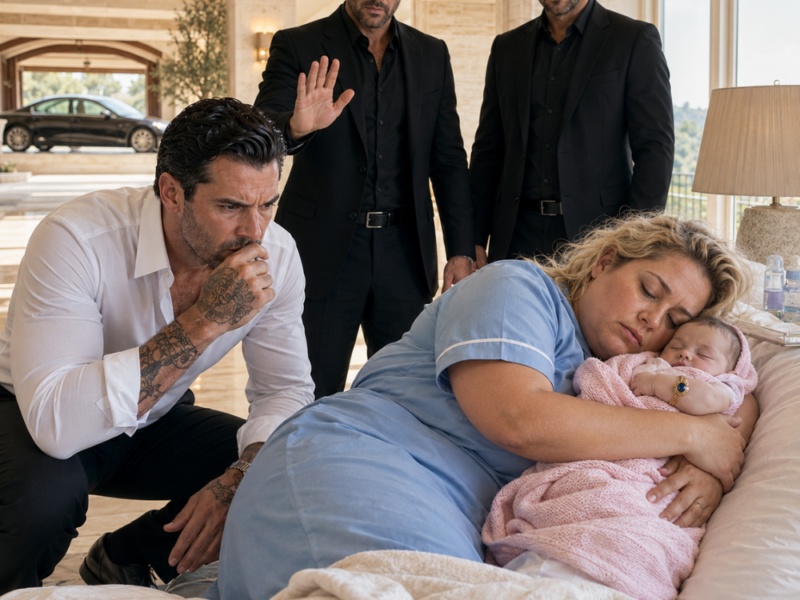
“Don’t Wake Her,” the Guard Warned—Then the Mafia Boss Saw Who She Was Holding
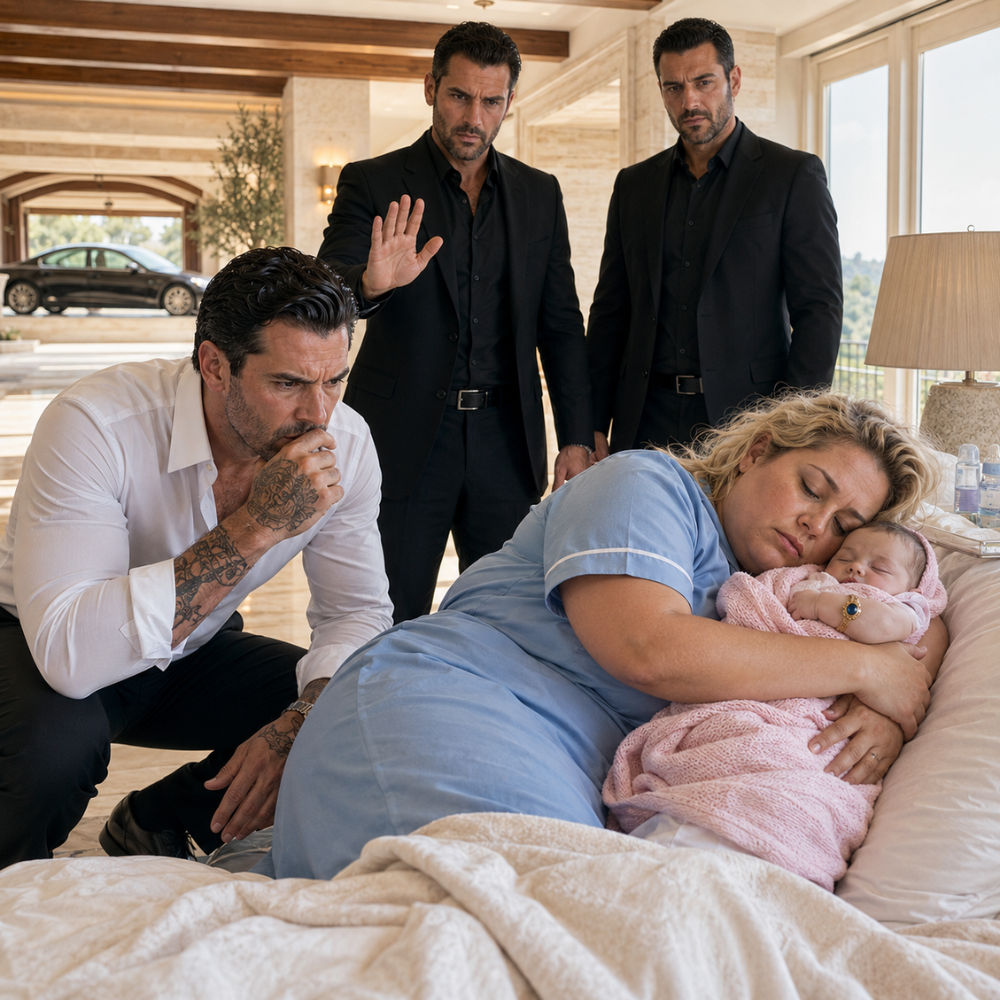
The Crime Boss Expected a Kidnapper in His Basement—Instead, He Found a Plus-Size Nurse Asleep With His Missing Nephew in Her Arms
“Don’t wake her.”
Gabriel Holmes stopped at the bottom of the basement stairs.
For sixteen years, Vincent D’Amico had stood beside him through raids, funerals, broken partnerships, federal subpoenas, and enough late-night emergencies that neither man bothered pretending they still surprised each other.
Gabriel had never heard him whisper like that.
Rain battered the narrow basement windows of the Holmes estate in South Boston. Water ran from Gabriel’s black overcoat onto the concrete floor. Somewhere above them, a security alarm chimed once and went silent.
“What did you say?”
Vincent stood in front of the steel storage-room door.
“Just look first.”
Gabriel’s jaw tightened.
Three months.
For three months his brother’s infant son had been missing.
For three months Gabriel had slept in fragments and torn apart every story anyone gave him about what happened on Hanover Street the night Antonio and Isabella Holmes were killed.
Cars questioned.
Cameras reviewed.
Police reports copied.
Private investigators hired.
Old enemies interviewed through attorneys.
New enemies created simply because grief made suspicion easy.
And still no Douglas.
His nephew had been twelve weeks old when the shooting happened.
The official police narrative said the baby was not found at the scene.
One car seat.
One bloodstained blanket.
No child.
Gabriel understood what missing children usually meant in his world.
At first, he had refused to.
Then the optimism became harder to maintain.
He had buried Antonio.
Buried Isabella.
Left a tiny space between their names on the family monument because his mother insisted Douglas might still come home.
Gabriel never told her he had started believing otherwise.
Tonight Vincent called shortly after midnight.
We found a woman in Dorchester with a baby matching Douglas’s age.
No birth records under her name.
No pediatrician registration.
Cash formula purchases.
Living in an abandoned apartment under somebody else’s lease.
Gabriel had driven through the storm already furious.
He expected a kidnapper.
A paid intermediary.
Someone who knew who ordered the attack and had kept a child hidden as leverage.
He stepped toward the door.
Vincent moved aside.
“She fought us when we went in.”
Gabriel looked at him.
“You touched her?”
“We didn’t know what we had.”
“That isn’t an answer.”
Vincent rubbed the back of his neck.
“One of the guys grabbed her. She swung a lamp. Another tried to take the baby.”
“And?”
Vincent almost smiled.
“She nearly put him through a wall.”
Gabriel’s expression remained cold.
“Why is she asleep?”
“Exhaustion.”
“You drugged her?”
“No.”
“Doctor checked her?”
“From the doorway. She refused anyone getting near the baby.”
Gabriel looked at the door.
“You brought a civilian and an infant into my basement without calling police.”
Vincent stared at him.
“Boss, three months ago somebody inside Boston law enforcement helped erase half the evidence from Hanover Street.”
“That does not make this okay.”
“No.”
Vincent lowered his voice.
“But I thought you should see before we moved them again.”
Gabriel pushed the door open.
The room had once been a temperature-controlled wine storage area. After his father died, Gabriel stopped buying wine and used it for secured records.
The old racks remained along one wall.
A metal cot sat near the opposite side.
One lamp burned overhead.
On the cot slept a woman Gabriel had never seen.
She looked perhaps thirty-five.
Dark curls tangled around her face.
Faded jeans.
Oversized gray cardigan.
Cheap sneakers still on her feet.
A bruise had formed along one cheek.
Gabriel’s eyes immediately went to it.
Then everything else in the room disappeared.
A baby slept against the woman’s chest.
Wrapped in a blue blanket.
One tiny hand lay outside the fabric.
Around the fingers was a silver chain.
Gabriel took one step closer.
St. Jude medal.
Antonio’s.
Gabriel knew every scratch.
Their mother had bought matching medals for both sons after Antonio survived meningitis as a child.
Antonio wore his until the day he died.
Gabriel’s version sat inside a drawer upstairs.
His knees weakened.
He reached the cot.
Douglas.
His brother’s son.
Alive.
Gabriel knelt.
The child’s hair had darkened.
His cheeks were fuller.
But Antonio’s mouth was there.
Isabella’s long lashes.
Gabriel covered his face briefly.
Three months of certainty collapsed so quickly that grief had nowhere to go.
He reached toward the blanket.
The woman moved instantly.
Her body curled tighter around Douglas before her eyes were even fully open.
“No.”
Gabriel withdrew his hand.
She woke.
Saw him.
Panic transformed her.
She pushed herself backward until her shoulders met the concrete wall.
Both arms locked around the child.
“Don’t touch him.”
Gabriel raised his hands.
Douglas stirred.
The woman immediately lowered her voice.
“It’s okay.”
She rocked him.
“Shh. I’ve got you.”
Gabriel remained kneeling.
Vincent stood by the door.
The woman looked between them.
Then her eyes returned to Gabriel.
Recognition came.
“You’re Gabriel Holmes.”
It was not admiration.
It was fear.
Gabriel said, “Yes.”
She pulled Douglas closer.
Gabriel noticed something else.
She did not look physically imposing in the way the men who worked for him did.
She was heavyset, broad through the hips and shoulders, with a soft, full body that strangers probably underestimated.
Yet everything about the way she positioned herself around Douglas communicated one thing.
To reach him, somebody would have to go through her first.
Gabriel had spent his adult life around expensive security.
Armed professionals.
Reinforced vehicles.
Encrypted systems.
He had never seen protection expressed more clearly than in the curve of one exhausted woman’s body around a sleeping child.
“What’s your name?” he asked.
She hesitated.
“Chalice Imhof.”
“How did you get my nephew?”
“Before I answer anything, I want him examined by a pediatrician.”
“He will be.”
“Not one of your people.”
Gabriel looked at Vincent.
Vincent raised his eyebrows.
Gabriel turned back.
“You don’t trust my doctors.”
“I don’t trust anyone whose paycheck depends on you.”
That answer would normally have irritated him.
Tonight it made sense.
“Mass General?”
She watched his face.
“What about it?”
“We can take him there.”
“No private entrance.”
“Fine.”
“No Holmes security deciding what gets written down.”
Gabriel looked at her carefully.
“You’ve been hiding him from me.”
“Yes.”
“Why?”
“Because your sister-in-law asked me to.”
The room changed.
Gabriel became completely still.
“Isabella?”
“Yes.”
“She spoke to you?”
“For less than a minute.”
Vincent moved closer.
Gabriel lifted one hand.
“Leave us.”
“Boss.”
“Outside.”
Vincent hesitated.
Then stepped through the door and left it open.
Gabriel remained on the floor.
“Tell me.”
Chalice looked down at Douglas.
The baby had settled.
His fingers opened and closed around the medal.
“I was working nights at Mass General.”
“You’re a nurse?”
“Emergency department.”
Gabriel noticed the way she said was.
“What happened?”
Chalice took a breath.
“Your brother and Isabella came in through trauma intake shortly after midnight.”
Gabriel’s face tightened.
He had read the hospital timeline dozens of times.
But the official file contained almost nothing about the baby.
“Isabella was conscious?”
“Barely.”
“What about Antonio?”
Chalice looked away.
“I didn’t treat him.”
Gabriel understood.
Dead on arrival.
He had known.
Hearing it from someone who had been there still hurt.
Chalice continued.
“Isabella was holding Douglas when EMS brought her in.”
“The baby had blood on him, but it wasn’t his.”
“I was asked to take him to a pediatric bay while the trauma team worked on her.”
“What happened next?”
“A Boston police detective came through the curtain.”
“Name?”
“Michael Orr.”
Gabriel’s eyes darkened.
Detective Orr had been assigned to liaise with the Holmes family after the shooting.
Two weeks later he disappeared from duty citing a family emergency.
Then stopped answering calls.
Chalice continued.
“At first I thought he was there because of the shooting.”
“Then he asked me where the Holmes baby was.”
“How?”
“What do you mean?”
Gabriel leaned slightly forward.
“Exact words.”
Chalice thought.
“He said, ‘Where’s the Holmes kid?’”
“Then?”
“I told him the baby was being evaluated.”
“He asked whether anybody else knew where I had taken him.”
Gabriel’s expression changed.
“That scared me.”
“Why?”
“Because that is not a question you ask if you are trying to protect a newborn.”
She continued.
“He had his hand near his weapon.”
“He told me he had orders to take custody of Douglas immediately.”
“I asked for paperwork.”
“He became angry.”
Gabriel almost smiled despite everything.
“You asked him for paperwork.”
“I’m a nurse.”
“That sounds like an explanation.”
“It is.”
Chalice continued.
“I stalled him.”
“How?”
“I told him the baby might have aspirated blood and needed imaging.”
“Was that true?”
“No.”
Gabriel stared.
She shrugged slightly.
“I needed two minutes.”
“What did you do?”
“I moved Douglas through the laundry corridor into an employee stairwell.”
“Why didn’t you call another officer?”
“I tried.”
“What happened?”
“The hospital desk line kept routing me back through a police command number attached to Orr.”
Gabriel nodded slowly.
Someone had controlled the response.
Chalice’s voice became quieter.
“Then I crossed paths with Isabella.”
Gabriel stopped breathing normally.
“They were moving her toward surgery.”
“She woke up.”
“For maybe thirty seconds.”
Chalice looked at him.
“She saw Douglas under my coat.”
“I had him against me.”
“She grabbed my wrist.”
“What did she say?”
“First, ‘Don’t give him to the police.’”
Gabriel closed his eyes.
“Then?”
“She asked my name.”
“I told her.”
“She said, ‘Chalice, please.’”
The woman’s voice broke for the first time.
“She told me not to bring him to you.”
Gabriel opened his eyes.
“Why?”
“She said you were blind.”
His face hardened.
Chalice continued quickly.
“Not cruel.”
“Blind.”
“She said you were grieving and trusting the wrong people.”
Gabriel looked toward the doorway.
Vincent stood out of sight.
“Did she name anyone?”
“Yes.”
Gabriel’s heartbeat changed.
“Who?”
Chalice held Douglas tighter.
“Your uncle.”
The answer landed with such quiet force that Gabriel felt almost no emotion initially.
“Carmine?”
“Yes.”
“Carmine Holmes.”
“Yes.”
“That was exactly what she said?”
“She said, ‘Carmine arranged Hanover.’”
Gabriel sat back against his heels.
His uncle had been his father’s closest adviser.
After Gabriel’s father died, Carmine helped keep the family businesses from collapsing.
When Antonio was murdered, Carmine sat beside Gabriel at the funeral.
Held Gabriel’s mother’s hand.
Spent three months pointing suspicion toward rival South Boston crews and an Irish-owned logistics company with whom Antonio had been negotiating.
Gabriel had trusted him.
More importantly, he had acted on that trust.
Business contracts severed.
People threatened.
Alliances broken.
An entire neighborhood rumor machine fed by grief.
“What else did Isabella say?”
“She said, ‘Keep Douglas away until Gabriel sees clearly.’”
“That’s it?”
“Then they took her through the doors.”
Chalice looked down.
“I heard later she died.”
Gabriel’s eyes burned.
“You left the hospital with him.”
“Yes.”
“Three months.”
“Yes.”
“Why didn’t you contact anyone?”
“I didn’t know who was safe.”
“You could have contacted me anonymously.”
“Would you have believed a stranger saying your uncle killed your brother?”
Gabriel did not answer.
Chalice nodded.
“That’s what I thought.”
She adjusted Douglas’s blanket.
“The first week, I assumed police would announce that Detective Orr was under investigation.”
“Nothing.”
“The second week, I saw a news report quoting your uncle about the shooting.”
“He was standing beside you.”
“Then I knew I couldn’t hand Douglas back without understanding who controlled access to you.”
Gabriel’s face tightened.
“You thought my own house was compromised.”
“I still do.”
That would have sounded paranoid from almost anyone else.
Not tonight.
Chalice continued.
“I slept in my car for twelve nights.”
“Then a motel in Quincy.”
“Then Dorchester.”
“How did you feed him?”
“Formula.”
“Cash.”
“Some donated supplies from a church pantry.”
“Diapers?”
“Same.”
“You abandoned your job.”
“I stopped showing up.”
“You’ll lose your license.”
“Maybe.”
“Your apartment?”
“Gone.”
“Everything?”
Chalice looked down at herself.
“I have a duffel bag.”
Gabriel stared at her.
“What did you get out of this?”
Her eyes lifted.
“Douglas.”
The answer embarrassed him.
Not her.
Him.
He had spent years assuming people acted because of money, fear, loyalty, resentment, or leverage.
Chalice had burned her own life down around one decision that offered none of those rewards.
She noticed his expression.
“Don’t turn this into something noble.”
“What?”
“I was terrified every day.”
“I made bad decisions.”
“I kept him too isolated.”
“He missed regular pediatric care.”
“I should have found a safe attorney sooner.”
She swallowed.
“I did the best I could with the information I had.”
That was more believable than heroism.
Gabriel nodded.
“You protected him.”
“Yes.”
“For Isabella.”
“Yes.”
“Not me.”
“No.”
He almost smiled.
“Good.”
Chalice frowned.
“Good?”
“I’m trying to remember that not everything valuable needs to belong to me first.”
The sentence surprised both of them.
Douglas made a small noise.
Chalice shifted him.
“He’s hungry.”
Gabriel stood immediately.
“What do you need?”
“Formula.”
Vincent appeared at the door.
“We have formula upstairs.”
Chalice looked at him.
“What kind?”
Vincent glanced at Gabriel.
Gabriel said, “Get everything.”
“That doesn’t help.”
Chalice named the brand and type.
Vincent left.
Gabriel moved toward the door.
Chalice said, “Wait.”
He turned.
“If we leave this room, you do not take him from me without asking.”
Gabriel looked at her.
“He is my family.”
“He is a baby.”
“That is not an answer.”
“It is the only answer that matters right now.”
She looked down at Douglas.
“He knows me.”
“He has slept against me for three months.”
“If you rip him away because you have a last name and security, he won’t understand any of that.”
Gabriel stood silent.
Then nodded.
“Agreed.”
They moved upstairs.
Chalice refused the main guest wing.
Too many windows.
Too many hallways she did not know.
Vincent suggested a secure family apartment inside one of Gabriel’s Beacon Hill properties.
Gabriel rejected it.
“Too many people know about it.”
Chalice looked at him.
“You see?”
He did.
His own trust network had become the problem.
They instead went to a furnished condo in Back Bay owned by a holding company that had never been used for family gatherings.
Gabriel rode in the front seat.
Chalice and Douglas rode in back.
Nobody touched the baby.
At two-thirty in the morning, an independent pediatrician met them there.
Dr. Lisa Tran had no relationship with the Holmes family beyond having treated Vincent’s daughter after appendicitis two years earlier.
Chalice approved.
Douglas was underweight but otherwise surprisingly healthy.
Vaccinations behind schedule.
Mild iron deficiency suspected.
No injuries.
Good developmental responses.
Dr. Tran looked at Chalice.
“You’ve been doing his care alone?”
“Yes.”
“What’s your background?”
“ER nurse.”
“That explains some of it.”
She turned toward Gabriel.
“Who has legal guardianship right now?”
The room went quiet.
Gabriel said, “His parents are dead.”
“That wasn’t my question.”
“No one formally.”
“Then you need a family-law attorney before anybody starts deciding where this baby lives.”
Gabriel’s instinctive irritation appeared.
Dr. Tran looked at him.
“He is not a corporate asset.”
Chalice almost smiled.
Gabriel nodded.
“Understood.”
That was the second person in one night who had told him essentially the same thing.
Douglas was a child.
Not an heir.
Not a symbol.
Not proof that Antonio continued.
A child.
Gabriel called attorney Margaret Doyle at seven the next morning.
By ten, emergency custody proceedings were being prepared through Massachusetts Probate and Family Court with documentation that Gabriel was the nearest surviving adult relative willing to assume care.
Chalice was listed as Douglas’s current caregiver and material witness.
Gabriel’s attorney wanted the child moved immediately to a Holmes-controlled residence.
Gabriel said no.
Margaret looked surprised.
“Why?”
“He stays with Chalice until a child-development specialist tells us transition will not harm him.”
“Gabriel.”
“I have known him fourteen hours.”
“She has known him three months.”
Margaret looked at Chalice.
Chalice looked equally surprised.
“Fine.”
Margaret closed the folder.
“We’ll document a temporary caregiver arrangement.”
That was how life began changing.
Not with revenge.
Paperwork.
Emergency hearings.
Medical appointments.
Lawyers.
The pieces of Isabella’s last warning were investigated by people who knew how to distinguish evidence from grief.
Gabriel did not trust Boston police enough to rely on one department alone.
His attorney contacted the Massachusetts Attorney General’s office and federal investigators already looking into corruption surrounding organized crime and municipal contracting.
That meant surrendering control.
Gabriel hated it.
Vincent hated it more.
“You’re giving outsiders family information.”
“They already have half of it.”
“We can find Carmine ourselves.”
“That is what he wants.”
Vincent looked at him.
Gabriel continued.
“For three months he pointed me toward everyone except himself.”
“I reacted exactly as he expected.”
“He understands how I behave.”
Gabriel’s voice became colder.
“So I’m changing the behavior.”
The investigation into Carmine began quietly.
Financial records showed shell consulting payments connected to Detective Orr.
Building-camera archives placed one of Carmine’s drivers near Hanover Street the week before Antonio’s death.
Phone metadata suggested multiple conversations between Carmine and a private security contractor used by a rival syndicate.
Nothing alone proved murder.
Together, the shape became difficult to ignore.
Then came the estate logs.
Vincent discovered Carmine had accessed Gabriel’s security schedule repeatedly after Antonio’s death.
Rooms.
Travel.
Visitor lists.
Even Margaret Doyle’s office appointments.
“You were right,” Vincent told Chalice one evening.
They were at the Back Bay condo.
Chalice sat on the rug feeding Douglas.
She looked up.
“About what?”
“The house.”
“What about it?”
“Compromised.”
“That doesn’t make me happy.”
Vincent leaned against the wall.
“I didn’t say it should.”
He looked at the fading bruise on her cheek.
“I’m sorry about that.”
Chalice touched it.
“You grabbed me?”
“One of the guys did.”
“You ordered the entry.”
“Yes.”
“You could’ve knocked.”
“We thought you were holding a kidnapped child.”
“Still.”
Vincent nodded.
“Still.”
She studied him.
“You people apologize strangely.”
“I haven’t had much practice.”
“I noticed.”
Gabriel heard from the hallway.
Something like a smile appeared.
Chalice looked over.
“You listening?”
“Yes.”
“Rude.”
“Yes.”
Douglas finished the bottle.
Chalice shifted him to her shoulder.
Gabriel watched.
He had expected finding his nephew to close grief.
It did not.
Douglas brought Antonio into every room.
The tilt of the baby’s head.
The shape of one ear.
A tiny frown Antonio had made since childhood.
Sometimes Gabriel had to leave.
Chalice noticed.
She never followed.
One afternoon, after Douglas fell asleep, Gabriel stood by the window.
“I don’t know how to do this.”
Chalice was washing bottles.
“Do what?”
“Be whatever I’m supposed to be to him.”
She turned off the water.
“Uncle?”
“That sounds small.”
“It isn’t.”
“My brother is dead.”
“Yes.”
“His father should be here.”
“Yes.”
Gabriel’s jaw tightened.
Chalice continued.
“You cannot be Antonio.”
“I know.”
“So stop making that your job.”
“What is my job?”
“Be Gabriel.”
He looked at her.
“That is not always comforting.”
“Then become a better Gabriel.”
Simple.
Cruel.
Accurate.
She returned to bottles.
Gabriel looked at Douglas.
He began.
The first custody hearing took place three weeks later.
Small courtroom.
Wood benches.
Family court clerk.
No dramatic press because records involving the infant remained protected.
Gabriel wore a dark suit.
Chalice sat beside attorney Ruth Manning, whom she hired independently using funds Gabriel offered and she refused.
The state had assigned a guardian ad litem to represent Douglas’s interests.
That offended Gabriel initially.
Then the guardian asked questions nobody in the Holmes family would have.
Who would provide daily care?
Would Gabriel’s business activities create security risks?
Would the child have stable medical care?
Was the Holmes estate appropriate given the possibility of internal betrayal?
What relationship had Douglas formed with Chalice?
Did separating them immediately serve him?
Gabriel answered.
Sometimes uncomfortably.
When asked whether Chalice should remain involved, he said:
“Yes.”
“For how long?”
“As long as she wants and Douglas benefits.”
Chalice looked at him.
The guardian asked:
“Are you asking Ms. Imhof to become an employee?”
“No.”
“What role?”
Gabriel hesitated.
“Whatever she chooses.”
That answer mattered.
Temporary guardianship went to Gabriel, subject to court supervision and security recommendations.
Chalice remained authorized caregiver during transition.
A pediatric attachment specialist recommended gradual change.
Gabriel moved out of the compromised family compound temporarily.
Not into a fortress.
Into a townhouse in Brookline owned personally, with conventional residential security and no revolving stream of associates.
Chalice took the guest suite on the first floor.
“Temporary,” she said.
Gabriel agreed.
Douglas received his own nursery.
The first night, he cried for forty minutes.
Gabriel stood in the hallway feeling useless.
Chalice walked in.
Picked Douglas up.
The crying stopped.
Gabriel looked annoyed.
“What?”
“He knows my smell.”
“That seems unfair.”
“Spend more time holding him.”
“I hold him.”
“For ten minutes until he cries.”
Gabriel frowned.
“He cries.”
“Yes.”
“That usually means something is wrong.”
“Sometimes babies cry because they are babies.”
“That is inefficient.”
Chalice laughed.
“You really have never done this.”
“No.”
“Sit.”
Gabriel sat in the rocking chair.
She placed Douglas in his arms.
He stiffened.
“Relax your shoulders.”
“They’re relaxed.”
“No human being has ever been less relaxed.”
Gabriel looked down at his nephew.
Douglas stared.
Then grabbed his shirt.
Chalice smiled.
“There.”
“What?”
“He likes you.”
“You can tell?”
“He hasn’t screamed.”
“High standard.”
“Start where you are.”
The household became strange.
Gabriel, feared in half the city, learning bottle temperatures.
Vincent arriving with security reports and leaving with diaper cream because Chalice added it to a grocery list.
Margaret Doyle discussing federal cooperation while Douglas chewed on a silicone teething ring.
Chalice trying to rebuild her professional life.
Mass General had reported her as missing after her disappearance.
Hospital administration initially placed her nursing privileges under review because she removed a patient from the facility without authorization.
That patient had been a baby.
The circumstances extraordinary.
Still, procedure mattered.
Chalice cooperated.
She met with licensing counsel.
Gave sworn statements.
Provided the evidence she had preserved.
The Board of Registration in Nursing reviewed the case.
She was not treated as either hero or criminal.
Good.
She did not want mythology.
Months later, after investigators confirmed substantial law-enforcement corruption surrounding the shooting and documented that Chalice had reasonably feared immediate danger to Douglas, the hospital resolved her employment matter without disciplinary action against her license.
She did not return to Mass General immediately.
“I’m not ready.”
Gabriel said, “You don’t need money.”
She looked at him.
“That is not why nurses work.”
He corrected himself.
“Right.”
She began therapy.
That surprised him.
“Why?”
“Because I spent three months sleeping with one eye open.”
“You survived.”
“That does not mean my nervous system received the memo.”
Gabriel thought about that.
Two weeks later he started therapy too.
He told no one except Chalice.
She did not praise him.
“Good.”
“That’s it?”
“Yes.”
“I expected more.”
“Therapy is not a medal.”
“Apparently nothing with you is.”
“Exactly.”
The investigation eventually broke Carmine’s protection.
Not because Gabriel stormed a warehouse.
Because Detective Orr resurfaced.
Federal agents arrested him in Rhode Island on unrelated fraud and corruption charges.
Faced with evidence of payments and the prospect of a long sentence, Orr began cooperating.
He identified Carmine as the intermediary who arranged security information before the Hanover Street attack.
The motive had not been simple family hatred.
Antonio had been preparing to separate Holmes Logistics from older illicit partnerships and sell several legacy interests.
Carmine believed Antonio’s reforms would destroy decades of leverage and expose older financial conduct.
Gabriel, grieving and furious after the murders, became useful.
Carmine directed his anger outward.
A rival neighborhood crew.
Irish contractors.
Anyone except the family insider.
Gabriel sat in Margaret Doyle’s conference room when federal prosecutors laid out the evidence.
Photographs.
Transfers.
Phone logs.
Cooperating witness statement.
He stared at one photograph of Carmine leaving a restaurant with Orr.
“When?”
“Two days before Hanover.”
Gabriel’s hands remained flat on the table.
“What happens now?”
The prosecutor looked at him.
“We build the case.”
“How long?”
“As long as it takes.”
Gabriel hated the answer.
But he had spent months learning that impatience was one of the tools Carmine had used against him.
So he waited.
Carmine was indicted the following spring along with several others on racketeering, conspiracy, bribery, and violent-crime-related charges.
Gabriel did not kill him.
That became news in certain parts of Boston where people had expected blood.
One newspaper columnist wrote that the Holmes family had “gone legitimate.”
Gabriel showed Chalice.
She read it.
“Have you?”
“No.”
“Then don’t frame it.”
“What would you call it?”
“Learning.”
He stared.
“That sounds less impressive.”
“Good.”
Carmine requested a meeting before trial.
Gabriel almost refused.
Then accepted with attorneys present at a federal detention facility.
No private room.
No threats.
Carmine looked older.
“So this is what you became?”
Gabriel sat across the table.
“What?”
“Someone who lets prosecutors handle family.”
“Yes.”
Carmine laughed.
“Your father would be ashamed.”
“No.”
Gabriel leaned back.
“My father died leaving us a system where nobody could question the person at the top.”
“You used that.”
“You killed my brother.”
Carmine’s face barely moved.
Gabriel continued.
“And I spent months doing exactly what you expected because I thought rage was the same thing as leadership.”
Carmine studied him.
“The nurse changed you.”
Gabriel thought of Chalice.
“No.”
“What then?”
“She made it harder for me to avoid seeing what I already was.”
He stood.
“Enjoy your trial.”
That was the last private conversation they had.
Chalice did not attend the trial.
She spent that morning at a nursing interview.
A community hospital in Cambridge.
The manager asked about the three-month gap.
Chalice told the truth in the version allowed by sealed court records.
“I became the temporary caregiver for an infant in a criminal investigation.”
The manager stared.
“That is an unusual sentence.”
“Yes.”
“Do you expect continued security issues?”
“No.”
“Do you want to return to emergency nursing?”
Chalice thought.
“Not yet.”
She accepted a position in pediatric outpatient care.
Lower adrenaline.
More predictable schedule.
She surprised herself by loving it.
Children did not care about her size except when they wanted a comfortable lap during vaccinations.
One four-year-old named Owen looked at her and said:
“You’re squishy.”
His mother nearly died of embarrassment.
Chalice smiled.
“Correct.”
Owen climbed into the exam chair.
“You’re not mad?”
“No.”
“You look like my aunt.”
“Is she nice?”
“She gives me pancakes.”
“Then I accept the comparison.”
Her body had protected Douglas.
But Chalice grew tired of people treating that fact like some poetic reason she deserved respect.
She deserved respect before she saved anyone.
That was harder for Gabriel to learn than he realized.
The first time he called her beautiful, she stopped him.
They were in the Brookline kitchen.
Douglas asleep upstairs.
Gabriel said:
“You’re beautiful.”
Chalice looked suspicious.
“What?”
“You heard me.”
“I did.”
“Problem?”
“You’ve spent six months telling me I’m strong because I protected Douglas.”
“Yes.”
“Now beautiful.”
“Yes.”
“Are you about to turn me into some symbol?”
Gabriel blinked.
“No.”
“Good.”
She pointed a spoon toward him.
“Because I was fat before Douglas.”
“I’m aware.”
“I was worth looking at before the crime story made me interesting.”
Gabriel’s face changed.
“That is not what I meant.”
“I know.”
She softened.
“But I need you to know it too.”
He nodded.
“I noticed you the first night.”
Chalice stared.
“You saw me bruised, exhausted, wearing a cardigan from Target.”
“Yes.”
“You need higher standards.”
“I’m trying.”
She laughed.
The attraction between them developed slowly because anything faster would have been wrong.
Gabriel held too much power.
Money.
Legal guardianship of Douglas.
Housing.
Security.
Chalice refused to blur gratitude, dependency, and romance.
So she moved out.
Gabriel hated it.
He did not stop her.
She rented an apartment in Jamaica Plain.
Second floor.
Old radiators.
Neighbors who argued about recycling.
A downstairs couple with a beagle that barked at delivery trucks.
Normal.
Douglas remained with Gabriel, but Chalice visited three evenings a week and most Sundays during the transition.
The first night she slept alone in her apartment, she cried.
Not because she missed Gabriel.
Because there was no baby breathing against her chest.
For three months Douglas had been the reason she survived each day.
Now she had to learn what life felt like when nobody needed her every minute.
Therapy helped.
So did grocery shopping.
Laundry.
Going to work.
Complaining about MBTA delays.
Ordinary irritation turned out to be deeply healing.
Gabriel began bringing Douglas to the park.
At first with two security men.
Chalice mocked him.
“He’s six months old.”
“He has enemies.”
“He wants a swing.”
“Both can be true.”
Eventually security stayed farther away.
One Saturday, Gabriel sat beside a grandmother on a park bench while Douglas slept in a stroller.
She asked:
“First baby?”
Gabriel almost said nephew.
Then simply answered:
“Yes.”
The woman smiled.
“You look terrified.”
“I am.”
“Good.”
He looked offended.
She continued.
“The dangerous parents are the ones who think they know everything.”
Gabriel told Chalice later.
“She liked me.”
“She insulted you.”
“Affectionately.”
“Welcome to normal society.”
The custody order became permanent guardianship after almost a year, with extensive oversight because Douglas was the heir to considerable family assets.
Gabriel created a trust.
Independent professional trustee.
Margaret Doyle.
One outside fiduciary.
No Gabriel sole control.
When asked why, he said:
“Because loving him does not make me immune from being wrong.”
That sentence would have been impossible a year earlier.
Douglas’s trust expressly prohibited using his assets for family business until adulthood and required independent financial education before he could access principal.
Chalice read the documents.
“You’ve become boring.”
“Margaret is responsible.”
“Thank her.”
Gabriel did.
Carmine’s trial ended with convictions on multiple federal counts.
Several co-defendants pleaded guilty.
Detective Orr testified.
The Boston Police Department conducted an internal review of officers with ties to organized crime investigations.
Some were disciplined.
Some cleared.
Some resigned.
Chalice’s decision to flee the hospital remained controversial in professional circles.
A medical ethics committee later reviewed the case anonymously for training.
Was taking Douglas out of the hospital technically improper?
Yes.
Was there a credible imminent threat?
Also yes.
Should she have found a safer institutional escalation route?
Ideally.
Did the compromised law-enforcement response make those options difficult?
Absolutely.
The lesson became more useful when nobody pretended Chalice made perfect decisions.
She had made frightened decisions under uncertainty.
Some saved Douglas.
Some increased risk.
Hero stories were simpler.
Real life taught more.
Gabriel and Chalice’s first actual date happened eighteen months after the basement.
She insisted on choosing the restaurant.
A diner in Watertown.
Gabriel looked at the laminated menu.
“You brought me here intentionally.”
“Yes.”
“Why?”
“To see whether you can eat somewhere without valet parking.”
“I can.”
“Prove it.”
He ordered meatloaf.
Chalice ordered pancakes.
“For dinner?”
“They serve them.”
“That does not answer the philosophical objection.”
“I reject the philosophy.”
They talked for two hours.
Not about Antonio.
Not Carmine.
Not the murders.
Not security.
Chalice told him about nursing school.
A professor who once failed her clinical note because her handwriting was too neat and therefore “suspiciously copied.”
Gabriel told her about Antonio stealing a snowplow as a teenager.
“He stole a snowplow?”
“Borrowed.”
“From who?”
“The city.”
“That is theft.”
“He returned it.”
“Your family has creative legal definitions.”
“Had.”
She smiled.
At the end, Gabriel walked her to her car.
Chalice’s Honda had survived the three months she lived out of it and somehow continued functioning.
Gabriel looked at the rust along one wheel well.
“This vehicle is a crime.”
“It is paid off.”
“I can buy you—”
“No.”
He stopped.
Good.
“Can I ask why you keep it?”
Chalice thought.
“Because there was a month when it was the only place Douglas and I were safe.”
Gabriel looked at the car differently.
Then:
“May I kiss you?”
She looked surprised.
“You asked.”
“I’m learning.”
Chalice smiled.
“Not tonight.”
He nodded.
“Okay.”
She kissed him three dates later.
Her choice.
That distinction mattered.
Their relationship did not become some grand dark romance where Gabriel’s violence became sexy because he loved the right woman.
Chalice would not allow that story.
She told him so.
“I am not interested in being the woman who makes a dangerous man gentle.”
Gabriel looked at her across a coffee shop.
“Then what are you interested in?”
“A man responsible for making himself better.”
“That sounds less poetic.”
“Much healthier.”
He nodded.
“I’ll try.”
He did.
Gabriel accelerated the legal transition of Holmes companies away from businesses vulnerable to criminal influence.
Warehousing became the largest division.
Commercial real estate second.
Construction logistics.
Cold-chain medical transport.
His brother Antonio had been trying to do much of the same.
Gabriel once wondered whether following Antonio’s plan meant he had lost his own identity.
Chalice answered:
“Maybe you’re finishing what both of you wanted.”
“That is different.”
“Yes.”
“What if people think I went soft?”
“Do you care?”
He thought.
“Less every year.”
“Good.”
Vincent remained security director.
He hated outside compliance officers.
“They ask questions.”
“That is their function,” Gabriel said.
“They ask me.”
“Especially useful.”
Vincent stared.
“Chalice did this.”
Gabriel smiled.
“Mostly.”
The old Holmes estate in South Boston was sold three years after Douglas came home.
Gabriel did not want to raise him there.
Too many rooms designed for meetings adults would not explain.
Too many locked doors.
He bought a large but ordinary house in Milton.
Chalice called that description offensive to ordinary houses.
“It has seven bathrooms.”
“Six and a half.”
“Exactly.”
Gabriel and Douglas moved in first.
Chalice remained in Jamaica Plain.
She liked her apartment.
That frustrated Gabriel.
Good.
He needed more experiences where money failed to create the answer he wanted.
Douglas began preschool.
The first morning Gabriel showed up wearing a suit.
Every other father wore jeans.
Chalice looked at him.
“You look like you’re closing the preschool.”
“I have work afterward.”
“Take the tie off.”
“No.”
Douglas grabbed it with yogurt-covered fingers.
Gabriel looked down.
Chalice smiled.
“Natural consequences.”
He removed the tie.
The preschool teacher, Ms. Shaw, explained pickup rules.
Gabriel’s security detail needed identification like everyone else.
Vincent looked offended.
Ms. Shaw did not care.
Chalice loved her immediately.
Douglas grew into a curious, serious boy who asked questions Gabriel found alarming.
“Why don’t I have a dad?”
Gabriel had prepared for this.
He still felt unprepared.
“You did.”
“Where is he?”
“He died.”
“Why?”
Gabriel looked toward Chalice.
She did not answer for him.
Good.
He looked back at Douglas.
“Someone hurt your mom and dad.”
“Did you hurt the person?”
Gabriel went still.
Children had brutal instinct for the relevant question.
“No.”
“Why?”
“Because police and courts handled it.”
Douglas considered.
“Did you want to?”
“Yes.”
Chalice looked at Gabriel.
Honest.
“What stopped you?”
Gabriel thought.
“A lot of things.”
Then:
“You.”
Douglas frowned.
“Me?”
“I wanted the world you grew up in to work differently.”
The boy accepted that faster than adults might.
“Can I have applesauce?”
“Yes.”
Conversation over.
Years passed.
Gabriel and Chalice eventually married.
Not because Douglas needed a mother.
Chalice had made that boundary explicit.
“I am not marrying you to formalize childcare.”
“I know.”
“Say it.”
“You are not Douglas’s replacement mother.”
“Good.”
Douglas called her Chalice until he was eight.
Then one day, while sick with the flu, he called from his room:
“Mom?”
She froze in the hallway.
Gabriel looked at her.
Neither moved for two seconds.
Then Chalice went in.
She never corrected Douglas.
Never demanded he repeat it.
Never told the story at parties.
Some names arrived because children chose them.
Their wedding was held at a small hotel in Cambridge.
Forty-two guests.
No syndicate display.
No security visible, though Vincent was somewhere pretending to be a cousin.
Chalice wore a deep green dress.
Gabriel had once thought women had to resemble a particular kind of polished elegance to belong beside men like him.
That version of Gabriel embarrassed him now.
Chalice entered the room laughing because one heel had caught in a carpet seam.
She looked nothing like the women who once decorated his family’s formal dinners.
She looked exactly like herself.
That was enough.
During vows, Gabriel said:
“You protected someone I loved before you had any reason to care whether I deserved it.”
Chalice looked at him.
He continued.
“I spent most of my life believing protection meant control.”
“You taught me that it can also mean making room for another person’s choices.”
Her eyes filled.
Chalice’s vow was shorter.
“I promise to love you without helping you lie to yourself.”
The guests laughed.
Gabriel nodded.
“That seems likely.”
Antonio and Isabella’s photographs sat on a table near the ceremony.
Not hidden.
Douglas placed flowers beside them afterward.
When he was old enough, Chalice told him the complete story of the hospital.
Not the dramatic internet version.
The real one.
“I was scared.”
Douglas sat across the kitchen table.
“How scared?”
“Very.”
“Did you know I would survive?”
“No.”
“Did you know Uncle Gabriel would find us?”
“No.”
“Then why did you keep me?”
Chalice looked at him.
“Because your mother asked me to.”
“Was that enough?”
“At first.”
“And later?”
She smiled.
“Later I loved you.”
Douglas looked down.
Teenagers had complicated reactions to sincerity.
He said:
“That’s weird.”
“It is.”
“Thanks.”
“You’re welcome.”
The abandoned Dorchester building was demolished years later.
Chalice drove past the block once.
A new apartment building stood there.
Ground-floor coffee shop.
People walking dogs.
No sign of the room where she had spent so many nights listening for footsteps.
She pulled over.
Sat in her car.
Not the old Honda.
That finally died.
A newer used Toyota she bought herself despite Gabriel’s repeated offers.
She looked at the building.
The past felt close.
Then farther away.
One evening in those ninety days, Douglas had developed a fever.
Chalice had no pediatrician.
No safe emergency department she trusted.
She spent hours terrified, checking his temperature and hydration until it broke.
That memory remained one of the worst.
Not gunfire.
Not Orr.
Not being taken by Vincent’s men.
A baby with a fever and no safe place to ask for help.
That was what later inspired the Antonio and Isabella Family Safety Program.
Not Gabriel.
Chalice.
The program funded confidential medical advocacy for witnesses and families involved in organized-crime investigations, domestic violence cases, trafficking prosecutions, and other situations where seeking care could expose vulnerable people.
Chalice insisted it be run independently.
No Holmes branding beyond donor disclosure.
No Gabriel on the board.
He complained.
“You remove me from every foundation.”
“Yes.”
“I pay for half.”
“Exactly.”
“Why is that a problem?”
“Because money should support governance, not become governance.”
Gabriel sighed.
“You and Margaret Doyle have ruined philanthropy.”
“Good.”
The program partnered with hospitals across Massachusetts.
Safe intake.
Independent legal referrals.
Temporary childcare.
Secure transportation coordinated with law enforcement when appropriate.
Chalice returned to graduate school part-time and became a nurse practitioner specializing in family and emergency medicine.
Graduation happened on a rainy May morning.
Douglas was ten.
He cheered too loudly.
Gabriel looked proud in a way Chalice found suspicious.
“What?”
“You did it.”
“Yes.”
“You’re a nurse practitioner.”
“Yes.”
“I can fund a clinic.”
“No.”
He closed his mouth.
Progress.
Months later, Chalice decided she did want a clinic.
She approached Gabriel.
He stared.
“You’re asking me?”
“For investment.”
His face brightened.
“Absolutely.”
“Wait.”
He visibly restrained himself.
“What are the terms?”
Chalice smiled.
“Now you’re learning.”
They structured the project like adults.
Independent board.
Mixed funding.
Community health center in Dorchester.
Sliding-scale care.
Mental health services.
Pediatric care.
Legal-medical partnership.
No one needed a gangster’s permission to receive treatment.
Chalice loved that irony.
The clinic opened five blocks from where she had hidden Douglas.
On opening morning, an elderly woman came in complaining about blood pressure.
A young mother brought a baby with eczema.
A construction worker needed stitches after a minor accident.
Nothing dramatic.
Chalice spent twelve hours there.
Gabriel arrived near closing carrying takeout.
“You missed dinner.”
“I work in healthcare.”
“I remembered.”
They ate at the nurses’ station.
Gabriel looked around.
“This is better than the old building.”
“Most things are.”
“Do you ever miss emergency medicine?”
“Sometimes.”
“Do you miss running?”
She looked at him.
“Never.”
He nodded.
“Good.”
The crimes that once defined Gabriel’s family became old history slowly.
Not erased.
Older associates retired.
Some businesses sold.
Federal monitors completed their work.
Contracts became cleaner.
Young executives joining Holmes Logistics knew Antonio as the founder of the modernization strategy rather than the victim of a famous family betrayal.
Gabriel preferred that.
He did not want Douglas inheriting grief as an occupation.
When Douglas turned eighteen, the trust review required him to attend financial education sessions.
He hated them.
“Why do I need six hours about fiduciary duty?”
Gabriel looked at him.
“Because money makes stupidity scalable.”
Chalice laughed.
“That was good.”
Douglas groaned.
“You two are impossible.”
He chose college in Colorado.
Gabriel almost objected.
Far away.
Different security.
No family network.
Then he remembered every lesson of the previous eighteen years.
“What school?”
Douglas told him.
“Why?”
“Environmental engineering.”
Gabriel nodded.
“Good.”
“That’s it?”
“What did you expect?”
“A strategic meeting.”
“Would you like one?”
“No.”
“Then good.”
Chalice watched.
The boy Gabriel once might have treated as heir to an empire now got to become an engineering student.
Maybe that was the most important thing any of them accomplished.
Vincent retired when Douglas was twenty.
He lasted four months.
Then returned as “security consultant.”
Chalice stared.
“That is employment.”
“Consulting.”
“You have an office.”
“Temporary.”
“You have a parking space.”
“Administrative issue.”
Gabriel said nothing.
Chalice pointed at both men.
“You are emotionally incapable of retirement.”
Vincent smiled.
“Probably.”
On the anniversary of Antonio and Isabella’s deaths, the family stopped holding formal memorials after the tenth year.
Douglas asked.
“Can we just have dinner?”
Gabriel looked surprised.
“At home?”
“Yes.”
“No speeches.”
“Yes.”
“Can Chalice make the lasagna?”
Chalice objected.
“I run a medical clinic.”
Douglas smiled.
“And make better lasagna than Uncle Gabriel.”
“That is not difficult.”
So they had dinner.
Photographs on a shelf.
No black clothing.
No business associates.
They told stories.
Antonio once accidentally drove Gabriel’s car into a snowbank.
Isabella hated mushrooms.
Douglas’s mother sang off-key.
His father cheated at cards.
That was memory becoming human again.
Not martyrdom.
Not revenge.
People.
Years later Gabriel and Chalice returned to Hanover Street together.
The restaurant where Antonio and Isabella had eaten before the attack had changed ownership twice.
Now it was a bakery.
Gabriel stood outside.
“Do you want to go in?” Chalice asked.
“No.”
“Okay.”
They kept walking.
Two blocks later Gabriel said:
“I spent three months thinking grief gave me permission to destroy whatever I suspected.”
“Yes.”
“You say that quickly.”
“We’ve discussed it.”
“A lot.”
“Yes.”
He looked toward her.
“Why did Isabella call me blind?”
Chalice thought.
“Because you trusted the people closest to you more than the evidence in front of you.”
“That sounds accurate.”
“She still trusted you to become better.”
“How do you know?”
“She told me to hide Douglas until you could see.”
Chalice looked at him.
“She did not tell me never to return him.”
Gabriel stopped.
He had never noticed the distinction.
Chalice smiled.
“She knew you better than you thought.”
For a long moment he said nothing.
Then:
“I wish she had lived long enough to insult me directly.”
“She probably does somewhere.”
He laughed.
That night they went home.
No armored convoy.
No guards in the kitchen.
One security system.
Neighbors who complained when Gabriel’s landscaper arrived too early.
A recycling schedule taped to the refrigerator.
The life did not look like an empire.
Good.
Empires required subjects.
Families needed people.
The basement room where Gabriel first found Chalice and Douglas became something else before the estate was sold.
Chalice insisted on seeing it once.
Gabriel unlocked the door.
The cot remained.
Wine racks.
Concrete walls.
She stood quietly.
“This is smaller than I remember.”
Gabriel leaned against the doorway.
“Fear does that.”
She looked at him.
“You were on your knees.”
“Yes.”
“I thought you were going to take him.”
“I wanted to.”
“What stopped you?”
“You.”
“How?”
Gabriel considered.
“You looked at me like you had already decided you would lose everything before letting me make the wrong decision for that child.”
Chalice smiled faintly.
“I probably would have.”
“I know.”
He looked toward the cot.
“I used to think that was courage.”
“What do you think now?”
“Love.”
Chalice shook her head.
“Both.”
She walked out.
Gabriel closed the door.
Years after they sold the property, people still told stories about the Holmes family.
Stories improved themselves with retelling.
Vincent kicked down an apartment door.
True enough.
Chalice fought six armed men.
False.
Gabriel executed Carmine on an airport runway.
Completely false.
Douglas was hidden in a church basement.
No.
Chalice smuggled him through Canada.
No.
Gabriel fell in love the moment he saw her.
Chalice laughed hardest at that one.
“He thought I kidnapped his nephew.”
Douglas asked:
“Did he?”
“Yes.”
Gabriel said, “Briefly.”
Chalice looked at him.
“You had me taken to a basement.”
“Very briefly.”
Douglas shook his head.
“How are you married?”
“Therapy,” Chalice said.
Gabriel nodded.
“An unreasonable amount.”
They laughed.
The cleaner version of the story was less dramatic.
It was also better.
One frightened nurse made an imperfect decision under extraordinary circumstances.
One grieving uncle had to learn that power could make a person easier to manipulate, not harder.
One murdered mother left behind enough truth to interrupt a conspiracy.
One corrupted detective eventually testified.
One trusted uncle discovered family loyalty did not protect him from evidence.
A court decided where a baby belonged.
Doctors documented what fear had made difficult.
Attorneys created structures no single person could override.
A child grew up.
A woman who thought she was invisible became impossible for one family to forget.
Not because of her size.
Not because she became beautiful after being noticed.
She had always been visible to herself.
That was the part Gabriel eventually understood best.
Chalice had used invisibility as a survival tactic because other people’s prejudice gave her cover.
Men like Orr looked past her.
People at motels underestimated her.
Strangers saw a tired heavy woman with groceries and assumed nothing important could possibly be happening.
Their blindness protected Douglas.
But it also revealed something ugly.
Society often gave large women a strange kind of invisibility until it wanted to judge their bodies.
Chalice had lived with that contradiction for years.
Gabriel once asked:
“Did it hurt?”
“What?”
“People not seeing you.”
She thought.
“Sometimes.”
“And now?”
“Some people see me too much.”
He frowned.
She smiled.
“That is not better.”
“What is?”
“Being treated like a person instead of a body somebody is either ignoring or evaluating.”
Gabriel nodded.
“Fair.”
That principle became part of how Chalice ran the clinic.
Waiting-room chairs designed for varied bodies.
Blood-pressure cuffs in multiple sizes.
Gowns that actually closed.
No weighing patients in public hallways.
Staff training on weight stigma.
Treatment based on clinical evidence rather than assumptions.
A young patient once cried after a visit.
Chalice asked why.
“No doctor has ever talked to me without blaming everything on my weight.”
Chalice sat beside her.
“Weight can matter medically.”
The girl’s face fell.
Chalice continued.
“So can everything else.”
She smiled.
“We investigate the problem you came in for.”
That patient returned.
Then brought her mother.
Small systems.
Dignity in furniture.
Dignity in language.
Dignity in asking before touching.
Gabriel saw the connection when he visited the clinic one evening.
Wide chairs.
Accessible exam tables.
Private scales.
“You designed all this?”
“With the staff.”
“Why didn’t hospitals already have it?”
“Because people assume the person who does not fit the environment is the problem.”
Gabriel looked around.
“That sounds familiar.”
“It should.”
He never forgot.
Their marriage aged.
So did they.
Gabriel’s hair turned silver.
Chalice’s knees disliked winter.
Douglas finished school, married, and moved back to Massachusetts.
The first time he brought his daughter to visit, Chalice held the baby.
Gabriel watched from the doorway.
Same instinct.
Same protective curve of her arms.
Chalice looked up.
“What?”
“Nothing.”
“You’re doing the face.”
“What face?”
“The sentimental one.”
Gabriel smiled.
“I remember the first time I saw you holding him.”
Douglas looked over.
“Me?”
“Yes.”
“What did you think?”
Gabriel considered lying.
Chalice waited.
“I thought you were a kidnapper.”
Douglas laughed so hard he woke his daughter.
Chalice stared.
“Excellent work.”
“Truth matters.”
“Timing also matters.”
She rocked the baby.
Gabriel came closer.
Then stopped.
“Can I?”
Chalice handed him his grandniece.
Not nephew’s daughter in some dynastic sense.
Just a baby.
He held her.
Carefully.
Douglas smiled.
Three generations in one ordinary living room.
The family once obsessed over heirs.
Now Gabriel mostly cared whether somebody had brought enough diapers.
Progress could look ridiculous.
That was fine.
On the clinic’s fifteenth anniversary, staff convinced Chalice to speak.
She hated speeches.
Gabriel enjoyed that.
“Now you know.”
“Know what?”
“What it feels like to have everyone waiting for you to talk.”
“I prefer trauma codes.”
“That is disturbing.”
She stood at the small podium.
No media.
Employees.
Patients.
Community partners.
A few donors.
Chalice looked around.
“When we opened, people kept asking me what inspired this place.”
She smiled.
“I usually gave a boring answer about access to care.”
A few people laughed.
“The real answer is that I once spent three months afraid to take a baby to a doctor.”
The room quieted.
“I had medical training.”
“I lived in one of the best medical cities in the country.”
“And I still believed the system around me was unsafe enough that asking for help might hurt the person I was protecting.”
She paused.
“That should bother us.”
Gabriel watched from the back.
Chalice continued.
“So we built something where the first question is not, ‘Who are you connected to?’”
“Not, ‘Can you afford this?’”
“Not, ‘Why didn’t you come sooner?’”
“The first question is, ‘What do you need?’”
She stepped away from the podium.
That was enough.
Afterward, Gabriel found her near the coat rack.
“Good speech.”
“It was forty-three seconds.”
“Excellent speech.”
“Your standards are declining.”
“Age.”
They left together.
Outside, Boston traffic moved beneath a pale evening sky.
A city of brick, glass, old grudges, new construction, hospitals, universities, neighborhoods that changed and neighborhoods that refused.
Gabriel had once believed cities belonged to whoever controlled enough territory.
Age corrected him.
Cities belonged to people living ordinary lives inside them.
Nurses getting off shift.
Parents buying formula.
Bus drivers.
Children walking home.
People sitting in clinics.
People arguing about parking.
Men who owned buildings had influence.
They did not own the city.
Gabriel had learned the difference.
Chalice had helped.
Not by becoming his queen.
She hated that kind of language.
Once at a charity dinner, a man introduced her as “the woman behind Gabriel Holmes.”
Chalice smiled.
“No.”
The man panicked.
“I meant—”
“I know.”
She pointed toward Gabriel.
“He’s the man beside me.”
Gabriel laughed.
The introduction was corrected.
That evening became one of his favorite stories.
Years later, when someone asked Douglas what he remembered about Chalice saving him, he answered:
“Nothing.”
The interviewer seemed disappointed.
Douglas continued.
“I was a baby.”
“Everything I know comes from other people.”
“What did they tell you?”
“That she was brave.”
“Do you believe that?”
“Yes.”
“But she says she was scared.”
Douglas smiled.
“Those are not opposites.”
He had learned well.
Chalice once believed her body made her invisible.
Gabriel once believed fear made him powerful.
Douglas grew up knowing both ideas were incomplete.
A body could become shelter.
Fear could become information.
Power could become restraint.
Family could be chosen as much as inherited.
And surviving one terrible night did not mean spending the rest of life living inside it.
The basement door closed decades ago.
The crimes became court records.
The headlines yellowed.
The old house belonged to someone else.
What remained was smaller.
Better.
A woman named Chalice.
A man named Gabriel.
A child who grew up.
And one promise made by a dying mother to a nurse nobody else thought important enough to notice.
Keep him safe.
Chalice had.
Then, slowly, the people around her learned how to make safety something she did not have to provide alone.









