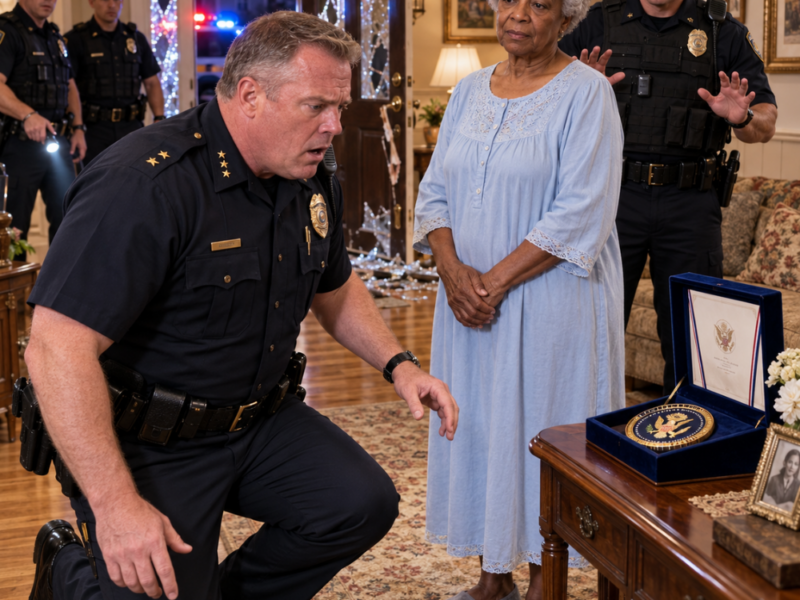
Cops Smash Black Widow’s Door at 3AM — Captain Falls to His Knees Seeing the President’s Seal
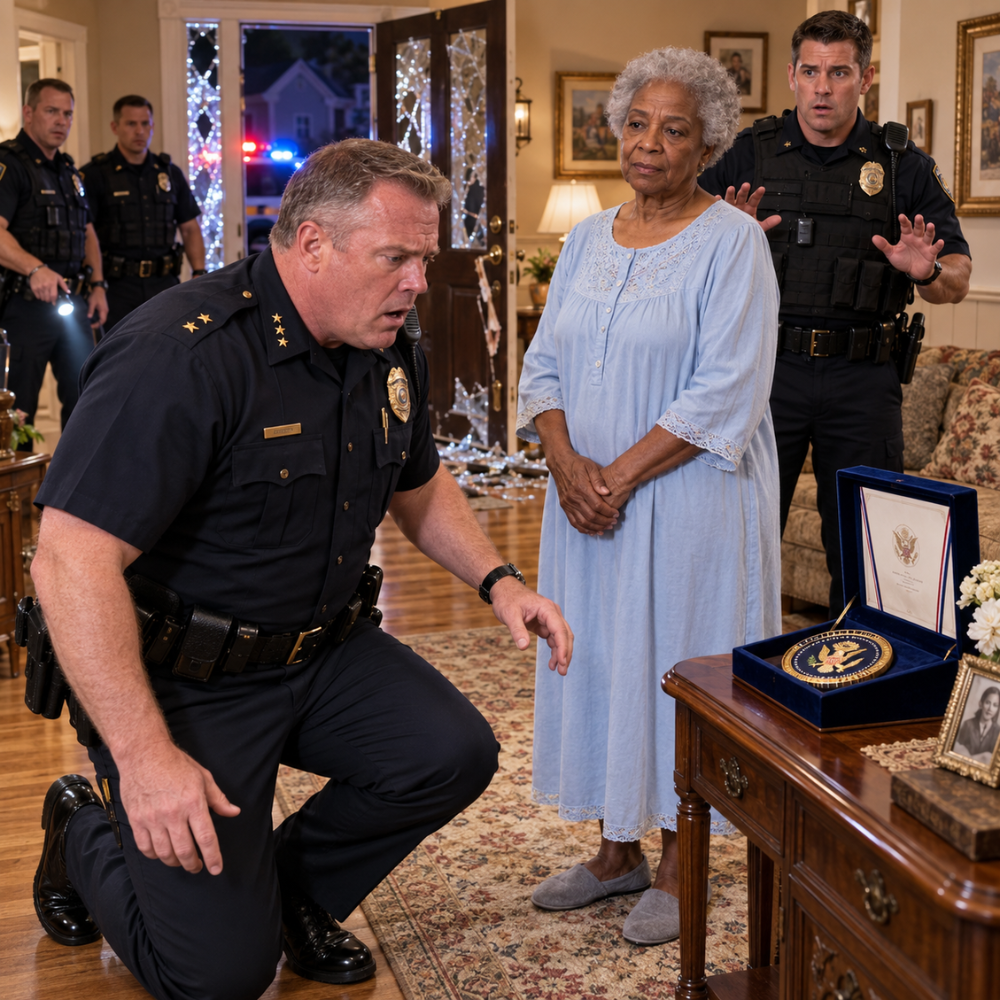
They raided a 68-year-old Black widow’s home at 3 a.m.—then one phone call exposed the mistake they could no longer bury
The battering ram hit Dorothy Anderson’s front door at 2:58 in the morning, and the sweet potato pie on her kitchen counter jumped in its glass dish.
Dorothy woke before the second strike.
For one disoriented second, she thought a tree had fallen onto the house. Then the deadbolt tore loose, wood cracked somewhere below, and men began shouting.
“Police! Show your hands!”
Her bedroom was dark except for the small green numerals of the alarm clock.
2:58.
Dorothy sat upright.
Boots pounded across the downstairs hardwood.
A lamp fell.
Someone shouted, “Clear!”
Another voice answered from the kitchen.
Dorothy’s heart was beating hard enough to make her nightgown move against her chest, but she did not scream.
At sixty-eight, fear was not new to her.
She had spent thirty years working for the Defense Intelligence Agency, most of them in rooms where bad information could become dead Americans thousands of miles away. She had briefed generals, Cabinet officials, and senior security officers. She had learned to read reports written by people who wanted uncertainty to sound like confidence. She had spent years analyzing what men did when they believed they were being watched and what they did when they believed no one could see them.
None of that made six armed strangers inside her house less frightening.
It only gave her habits.
Listen first.
Count.
Breathe.
Do not move until you understand the room.
Dorothy slipped into the faded blue bathrobe hanging from the bedpost and pushed her feet into slippers.
Another crash came from downstairs.
She heard glass.
Then a man’s voice.
“Kitchen clear.”
A second voice said, “Moving upstairs.”
Dorothy stepped into the hallway.
Light exploded across her face.
“Hands!”
She raised them immediately.
“I’m unarmed.”
“Hands where I can see them!”
“They are where you can see them.”
“Downstairs. Now.”
Dorothy looked past the flashlight.
Four men were already climbing toward her.
Police uniforms.
Tactical vests.
One officer carried a long flashlight in his left hand. Another had his service weapon angled toward the floor.
Dorothy’s left knee had bothered her since a fall five winters earlier, and stairs were slower than they once were.
“I’m coming.”
“Move.”
“I am moving.”
She held the railing with one hand.
“Both hands up.”
“If I take my hand off this railing, I may fall.”
The officer closest to her stared as if the inconvenience offended him.
“Then don’t fall.”
Dorothy descended one careful step at a time.
At the bottom, someone grabbed her right arm.
A second officer took the left.
Pain flared through her shoulder.
“Easy.”
“Keep moving.”
“This is my home.”
“Ma’am, stop talking.”
Dorothy was brought into the kitchen and pushed into the oak chair where she had eaten lunch twelve hours earlier.
The room looked wrong already.
One cabinet door hung open.
A vase from the hallway had shattered near the entrance.
Rain-cold air moved through the house from the ruined front door.
Mud darkened the tile.
Her pie still sat on the cooling rack.
At least that had survived.
For the moment.
Dorothy placed her hands flat on the kitchen table.
One of the younger officers stood near the refrigerator.
His nameplate said SWANSON.
He looked at her, then at the room.
Unlike the others, he seemed uncomfortable.
Dorothy stored that detail.
A broad man entered a few seconds later.
Mid-forties.
Square face.
Gray beginning at his temples.
His nameplate read HARGROVE.
The other officers altered themselves slightly when he entered.
Shoulders straighter.
Eyes toward him.
Command.
He looked around Dorothy’s kitchen and then down at her.
“Well,” he said. “This should be simple.”
Dorothy did not answer.
Hargrove removed one glove.
“We received information that narcotics are being stored at this property.”
Dorothy looked at him.
“Do you have a warrant?”
His expression changed.
Not much.
Enough.
“We have probable cause.”
“What is the probable cause?”
“That is not something I need to debate with you at three in the morning.”
“An anonymous accusation does not ordinarily let you enter a private home without a warrant.”
The younger officer near the refrigerator looked down.
Hargrove stared at Dorothy.
“You an attorney?”
“No.”
“Then let us do our job.”
“I would be happy to let you perform any lawful duty you have.”
The words came naturally.
Too naturally.
Dorothy had spent a career speaking carefully to powerful men.
Hargrove heard something else.
Resistance.
He leaned toward her.
“Here’s what is going to happen. My officers are going to search this house. You are going to sit there quietly. If we find something, you come with us.”
“And if you don’t?”
His smile was thin.
“Then maybe this will be over sooner.”
Dorothy looked toward the destroyed front door.
“You have already searched the house.”
“We’ve cleared it for officer safety.”
“That is different from searching drawers and cabinets.”
Hargrove straightened.
“Buckley.”
A heavyset officer near the counter turned.
“Yeah, Captain?”
“Start here.”
Buckley smiled.
Dorothy knew immediately that he had been waiting for permission.
He opened the cabinet above the stove.
Canned vegetables.
Flour.
Rice.
A box of cornbread mix.
He moved items quickly at first.
Then more carelessly.
A bag of rice fell and split.
White grains scattered across the tile.
Dorothy watched them roll beneath the table.
Buckley opened another cabinet.
Her mother’s white dinner plates were stacked on the second shelf.
They had blue flowers around the edges and one small chip in the plate Dorothy used every Thanksgiving.
Buckley pulled the shelf forward too hard.
Two plates slid off.
One broke.
Then another.
Dorothy flinched.
Buckley looked at her.
That was enough encouragement.
“Anything hiding in these?”
“They are dinner plates.”
“Could hide something under them.”
He lifted the stack roughly.
A third plate fell.
Dorothy inhaled through her nose.
Hargrove remained in the doorway watching her.
Not the search.
Her.
That told her more than anything else.
A real search looked for evidence.
This man was looking for reaction.
Buckley turned toward the pie.
Dorothy’s stomach tightened.
He lifted the dish.
“What’s this?”
“A sweet potato pie.”
“I can see that.”
“It is for my church fundraiser.”
Buckley looked toward Hargrove.
Hargrove shrugged.
Buckley placed the pie back on the rack.
For a moment Dorothy thought some limit still existed.
Then he pushed the rack aside with his elbow while opening the cabinet behind it.
The pie tipped.
The glass dish hit the floor.
It shattered.
Orange filling spread across the tile.
Cinnamon and nutmeg filled the kitchen.
Nobody apologized.
Dorothy stared at it.
She had baked that pie the afternoon before while Motown played quietly on the radio.
Her granddaughter had called while it was in the oven.
“Grandma, Sunday dinner still happening?”
“When have I ever canceled Sunday dinner?”
“I’m bringing Sophie.”
“The roommate who doesn’t eat greens?”
“She eats greens.”
“She moved mine around the plate for forty minutes.”
“She was nervous.”
“She can be nervous with cornbread this time.”
Her granddaughter had laughed.
Dorothy had laughed too.
The memory lasted only a second.
Then Buckley said, “Plenty of time to make another.”
Dorothy raised her eyes.
He smiled.
Across the kitchen, Swanson looked sick.
Dorothy noticed a tiny red light near his body-camera mount.
Recording.
She did not let her eyes remain there.
Hargrove had told his team during the briefing to leave their cameras off until he decided the situation was controlled.
Swanson had obeyed at first.
Then, as the officers approached the house, an old academy instructor’s voice returned to him.
If you think you’ll want a record later, turn it on now.
Swanson had done so without telling anyone.
He was twenty-six years old and had been an officer for less than three.
He was not brave enough yet to challenge Hargrove in front of the team.
But he was frightened enough to want a record.
He would spend months deciding what that made him.
Upstairs, officers opened drawers, closets, storage boxes.
Dorothy could track them by sound.
The master bedroom came first.
James’s side of the closet had remained almost untouched since he died three years earlier.
Colonel James Anderson had served thirty-one years in the United States Army.
Three overseas deployments.
Two Bronze Stars.
A career that took him from Germany to Fort Hood to Korea to the Pentagon and eventually back to Virginia.
He and Dorothy met at a retirement reception in 1981 when she was twenty-seven and he was a young major who spent most of the evening trying to understand why she refused to tell him where she worked.
“Government,” she said.
“Government where?”
“Government.”
“Do you have an office?”
“Yes.”
“Does it have a name?”
“Yes.”
“Can I know the name?”
“No.”
James married her anyway.
They bought the house on Maple Lane twenty-two years before the raid.
White shutters.
Brick chimney.
Two rocking chairs on the porch.
A narrow backyard where James insisted every summer he was going to build a better garden.
He never did.
Dorothy planted the tomatoes herself.
After James retired, they became the couple everyone at New Hope Baptist expected to see in the same pew every Sunday.
Then came the heart trouble.
Medication.
Hospital visits.
A winter when James could no longer climb stairs without stopping halfway.
He died at home in their bedroom with Dorothy holding his hand.
She had refused to sell.
People said the house would be too much for her.
Dorothy said she had not spent twenty-two years paying a mortgage to let grief evict her.
Now strangers were pulling through James’s closet.
Upstairs, Buckley removed one of the dress uniforms.
Colonel’s insignia.
Ribbons.
Carefully pressed trousers.
He glanced at it.
“Military guy?”
Swanson stood near the door.
“Looks like it.”
Buckley dropped the jacket onto the bed.
Swanson picked it up.
“Leave it.”
“I’m putting it back.”
Buckley laughed.
“You’re housekeeping now?”
Swanson did not answer.
He hung the jacket where it had been.
Then Buckley pulled out the bottom dresser drawer.
Socks, old handkerchiefs, letters, and a small velvet box fell across the quilt.
The box opened.
Dorothy’s wedding ring rolled out.
Arthritis had made her stop wearing it after James died.
She kept it wrapped in the note he gave her on their fortieth anniversary.
I would choose you with less hair, less money, less patience, and the same terrible habit of correcting my grammar.
The ring rolled off the bed and landed on the hardwood.
Buckley stepped backward.
His boot came down on it.
He did not notice.
Or pretended not to.
The folded burial flag sat on the nightstand inside a triangular mahogany case.
Buckley picked it up.
“Check this?”
“There’s a flag inside,” Swanson said.
“People hide stuff in everything.”
Buckley turned the case over.
Nothing rattled.
He set it down too close to the edge.
It slid.
Swanson reached.
Too late.
The case struck the floor.
The glass cracked diagonally across the front.
Downstairs, Dorothy heard it.
Her hands tightened on the table.
Hargrove saw.
“What was that?”
Dorothy looked at him.
“My husband’s burial flag.”
For the first time, Hargrove seemed unsure.
Only for a moment.
Then he recovered.
“If there’s nothing here, you’ve got nothing to worry about.”
Dorothy almost laughed.
Instead she said, “Captain, people say that when they are not the ones whose things are being broken.”
Hargrove pulled out the chair across from her and sat.
“What did you do for the government?”
Dorothy paused.
That question surprised her.
“Who told you I worked for the government?”
“Books upstairs. Framed photographs. Your husband’s uniforms.”
“You asked what I did.”
“Yes.”
“I was an analyst.”
“For?”
“The federal government.”
“That’s vague.”
“It is intended to be.”
Hargrove leaned back.
“So you were a secretary.”
Dorothy stared at him.
“If calling me that helps you, you may.”
Something about the answer irritated him more than an insult would have.
He stood.
“Search every room.”
The study was at the end of the upstairs hall.
It was the one room Dorothy still used every day.
James had built the bookcases himself.
Military history filled one wall.
Intelligence theory and international affairs filled another.
Her desk sat beneath the window overlooking Elaine Crawford’s backyard.
There were no classified files there.
Dorothy had retired properly.
Every document she was authorized to retain had been reviewed years earlier.
But the room contained pieces of a career she almost never discussed.
A framed photograph of Dorothy in a navy dress shaking hands with a president.
A letter on White House stationery.
A citation folder bearing the presidential seal.
And inside a glass display case on the desk, the Presidential Medal of Freedom.
The award had been given eleven years earlier for national-security service summarized publicly in deliberately broad language.
The citation praised “extraordinary contributions to the protection of American lives and the strengthening of national security.”
What it did not say was that Dorothy had once led an analytic team that identified a pattern inside fragmented intelligence reporting that pointed to a credible threat against a senior American official overseas.
The operation that followed remained partly classified.
Dorothy had never told people on Maple Lane the details.
She did not believe national service improved the taste of tomatoes or made one person’s trash cans more important than another’s.
Buckley entered the study first.
He looked at the medal.
“Church thing?”
Swanson came behind him.
His eyes moved toward the presidential seal.
“No.”
Buckley opened a desk drawer.
Pens.
Notepads.
A magnifying glass.
Old Christmas cards.
Swanson stepped closer to the display.
“Captain should see this.”
Buckley shrugged.
“If it mattered, she would’ve said something.”
That sentence would later appear in more than one courtroom filing.
Not because it was illegal.
Because it captured the assumption behind the entire night.
If Dorothy mattered, she would have announced it in a way they recognized.
If she had power, she would display it.
If she knew important people, she would threaten them.
She had done none of those things.
So they mistook restraint for insignificance.
Hargrove eventually came upstairs.
He glanced into the study.
“What?”
Swanson pointed toward the desk.
“Sir, I think you should look at—”
“Anything illegal?”
“No.”
“Then keep moving.”
Hargrove never walked behind the desk.
He never read the letter.
He never examined the medal.
He returned downstairs.
In the kitchen, the police dog arrived shortly after three-thirty.
Dorothy had nothing against dogs.
She disliked seeing an excited German shepherd pull across the room while a handler encouraged it to investigate her cabinets.
The dog sniffed flour.
Spices.
The pantry.
A bag of baking soda.
Then paused near the lower cabinet beside the stove.
The handler interpreted the behavior as interest.
Buckley opened the cabinet.
Baking soda.
Powdered sugar.
Vanilla.
Cornstarch.
Hargrove pointed.
“Bag the white powder.”
Dorothy stared at him.
“That is baking soda.”
“We’ll test it.”
“You may buy the same box at Kroger for a dollar twenty-nine.”
Buckley smirked.
Hargrove turned toward her.
“You have an answer for everything.”
“No. I have an answer for baking soda because I bought it.”
“Stand up.”
Dorothy did not move immediately.
“Why?”
“You’re coming with us.”
“On what charge?”
“Obstruction.”
“I have been sitting at this table since your officers brought me downstairs.”
“You haven’t stopped interfering.”
“Speaking is not obstruction.”
Hargrove’s jaw tightened.
“Buckley. Cuff her.”
Dorothy looked directly at him.
“My wrists are severely arthritic. Put the cuffs in front if you believe restraints are necessary.”
Buckley moved behind her.
“Hands back.”
“I just told you I have arthritis.”
“Hands back.”
Dorothy tried.
Her shoulders would not rotate comfortably.
Buckley pulled harder.
Pain shot through both arms.
Dorothy inhaled sharply.
“That hurts.”
“Stop fighting me.”
“I am not fighting you.”
The cuffs closed.
Too tight.
Metal pressed against swollen joints.
Dorothy’s fingers began tingling almost immediately.
Swanson stepped forward.
“Captain, maybe we can double-lock them and give her a little room.”
Hargrove looked at him.
“Did I ask?”
“No.”
“Then stay in your lane.”
Swanson stopped.
His camera kept recording.
Dorothy’s eyes watered from pain.
She hated that.
Not because tears meant weakness.
Because Hargrove noticed.
His expression softened into satisfaction.
Dorothy looked at the small white card beside the salt shaker.
“Captain.”
“What now?”
“There is a number on that card.”
Hargrove picked it up.
A federal office number.
A name written beneath it.
HOWARD GILLESPIE.
“Call that number.”
Hargrove turned the card over.
“Who’s Gillespie?”
“A federal agent.”
Buckley laughed from behind her.
Dorothy ignored him.
“Tell him Dorothy Anderson’s residence has been entered by police and that I am being detained.”
Hargrove held the card between two fingers.
“You think I’m calling some friend of yours because you don’t like being handcuffed?”
“No.”
“Then why would I?”
“Because it may save you from making the situation worse.”
That was the wrong sentence.
Hargrove heard threat.
He tossed the card.
It landed near the ruined pie.
“Get her up.”
Across the street, Elaine Crawford was still recording.
Elaine was seventy-one and had lived beside Dorothy for fifteen years.
She was white, widowed, and possessed the kind of stubborn neighborhood curiosity that made delivery drivers both grateful and nervous.
She knew which trash pickup was delayed.
Which child belonged to which house.
Which roofing contractor had damaged the Harrisons’ gutter and denied it until Elaine produced photographs.
She and Dorothy had become friends slowly.
Tomatoes first.
Then borrowed sugar.
Then summer evenings on the porch.
Then the years when James grew ill and Elaine began mowing the strip of lawn between their driveways without asking.
At 2:58, Elaine woke when the ram hit the door.
By 3:03, she was at the upstairs window filming.
At 3:08, she called local dispatch and asked whether police were supposed to be inside Dorothy’s home.
The operator would confirm only that there was police activity on the block.
At 3:26, Elaine saw officers moving through the upstairs rooms.
At 3:41, she saw Dorothy pulled from the kitchen chair.
That was when she remembered the envelope.
Dorothy had given it to her almost six years earlier.
They had been sitting on the porch when Dorothy handed over a sealed white envelope.
“If something strange ever happens here and I cannot call anyone myself, use this.”
Elaine had laughed.
“You’re making me sound like a spy.”
“I was a spy-adjacent bureaucrat for thirty years. Humor me.”
“Should I keep it in a freezer?”
“Kitchen drawer is fine.”
Elaine had forgotten about it.
Until now.
She ran downstairs.
Opened the drawer beside the telephone.
Receipts.
Batteries.
Takeout menus.
The white envelope remained in the back beneath an instruction manual for the toaster.
She tore it open.
Inside was one phone number.
FEDERAL SECURITY CONTACT — AFTER HOURS.
She dialed.
The call went first to a duty desk associated with the FBI’s Richmond field office.
Elaine spoke too quickly.
“My neighbor is Dorothy Anderson. Police broke into her house. She told them to call someone named Gillespie. They won’t. She is handcuffed right now.”
The duty officer asked for the address.
Elaine gave it.
Then there was a pause.
Not a normal pause.
The sound of someone reading something.
“Mrs. Crawford, stay on the line.”
“I’m not going anywhere.”
A second voice joined.
Male.
Calm.
“This is Supervisory Special Agent Howard Gillespie. Are you inside Mrs. Anderson’s residence?”
“No. I’m across the street.”
“Can you see her?”
“Yes.”
“Is she injured?”
“I don’t know. They have her hands behind her.”
“Do you see a warrant team? Federal agents?”
“No. Local police.”
Gillespie’s tone changed.
“Do not approach the house.”
“I wasn’t planning to.”
“Keep the line open.”
Dorothy Anderson was not under some lifelong personal Secret Service guard because she had received a medal.
The truth was less glamorous and more plausible.
Several retired intelligence officials associated with an old counterintelligence case had been placed on a federal notification list years earlier after a foreign actor made threats toward people connected to the investigation.
Most of the time, the designation meant nothing.
No agents outside Dorothy’s house.
No motorcade.
No special treatment.
It meant that if a credible security incident occurred at her residence, certain federal offices were to be notified.
That file was why Gillespie knew her address before Elaine finished repeating it.
It was also why he did not dismiss the call.
Gillespie contacted the local police watch commander first.
“What operation is happening on Maple Lane?”
The commander hesitated.
“I don’t have an authorized operation at that address.”
“Do you have officers there?”
A longer pause.
“Yes.”
“Under whose command?”
“Captain Hargrove.”
“Is there a warrant?”
“I’m checking.”
“Check faster.”
Within minutes, Gillespie had learned enough to become alarmed.
No search warrant was logged.
No emergency entry had been approved by the watch commander.
The narcotics unit had not opened a case.
The operation appeared to have originated directly from Hargrove after what he described as a “credible anonymous tip.”
Gillespie headed for Maple Lane with two federal agents while the local chief and duty commander were contacted.
No fleet of secret government vehicles descended on the neighborhood.
No dramatic federal army.
Three vehicles arrived within minutes of one another because three different chains of authority had suddenly realized the same thing.
Something was wrong.
Dorothy had reached the broken front doorway when the first unmarked SUV turned onto Maple Lane.
Buckley was holding her arm.
Hargrove walked ahead.
The headlights stopped him.
Another vehicle pulled in behind the first.
Then a marked police supervisor’s car.
Hargrove turned.
“What now?”
Gillespie stepped from the SUV.
Dark suit.
Raincoat.
Silver hair.
He did not run.
He walked across the lawn toward the ruined door.
Elaine watched through her window.
Swanson’s camera captured his arrival from inside the house.
Gillespie showed identification.
“Howard Gillespie. FBI.”
Hargrove’s posture changed.
Not fear yet.
Irritation.
“We’re in the middle of an investigation.”
“So am I.”
Gillespie looked past him.
Dorothy stood near the hallway with her hands cuffed behind her.
“Mrs. Anderson?”
“I’m all right.”
Gillespie saw her wrists.
“Who authorized this search?”
Hargrove answered.
“I did.”
“Under what warrant?”
“We had probable cause and exigent circumstances.”
“What exigent circumstance?”
Hargrove hesitated.
“Possible narcotics destruction.”
“What did you observe before entry?”
“Credible intelligence.”
“That was not my question.”
The local night commander arrived behind Gillespie.
Lieutenant Raymond Sellers.
His face was tight.
“Hargrove.”
“Lieutenant.”
“Where’s the warrant?”
Hargrove looked from Sellers to Gillespie.
“We had an anonymous source indicating drugs were being moved tonight.”
“Did you conduct surveillance?”
“Limited.”
“How long?”
No answer.
“Did anyone observe drugs?”
“No.”
“Did anyone observe evidence being destroyed?”
“No.”
Sellers looked toward Dorothy.
“Take the cuffs off.”
Hargrove started to speak.
“Now.”
Buckley reached for his key.
His hands were unsteady.
Dorothy brought her wrists forward slowly when the cuffs opened.
Dark red pressure marks circled both joints.
She rubbed them gently.
Gillespie said, “Do you need an ambulance?”
“No.”
“We should have you checked.”
“Later.”
“Dorothy.”
It was the first time anyone had used her first name.
She looked at him.
“Howard, I have six strangers in my house, half my kitchen on the floor, and my front door hanging from one hinge. Give me five minutes before somebody else tells me where I need to go.”
Gillespie almost smiled.
“Fair.”
Hargrove stared.
“Dorothy?”
Gillespie turned.
“Mrs. Anderson and I have known each other professionally for many years.”
Hargrove looked toward the stairs.
Then toward the study.
The calculation began.
“Professionally how?”
Dorothy answered herself.
“Defense Intelligence Agency.”
Silence.
Buckley looked toward Swanson.
Swanson already knew what was coming.
Gillespie walked upstairs with Lieutenant Sellers and Hargrove.
Dorothy remained in the kitchen.
She did not need to witness the discovery.
In the study, Gillespie switched on the desk lamp.
He looked at the medal.
The presidential citation.
The photograph.
Then at Hargrove.
“You searched this room?”
“My officers did.”
“And nobody thought any of this was relevant?”
Hargrove said nothing.
Gillespie picked up the citation folder.
“Mrs. Anderson served thirty years in national security.”
He set it down.
“She received the Presidential Medal of Freedom.”
Hargrove’s face lost color.
But Gillespie did not let the moment become what Hargrove instinctively wanted it to become.
This was not worse because Dorothy had once briefed presidents.
It was not worse because she had a famous medal.
Gillespie pointed toward him.
“Do not make the mistake of thinking that is why you have a problem.”
Hargrove stared.
“If she had spent thirty years working at a grocery store, you would still need lawful authority to break down her door.”
Lieutenant Sellers looked toward the broken hallway.
“That’s the problem.”
Gillespie nodded.
“The medal only guarantees that people are going to ask very quickly why nobody bothered to follow the rules.”
For the first time, Hargrove looked frightened.
Dorothy never saw him collapse to his knees.
There was no theatrical surrender in the hallway.
What happened was quieter.
And, to Dorothy, more telling.
Hargrove sat down in the chair beside her study door without being asked.
He looked at his hands.
For nearly a minute, the man who had spoken through the entire raid had nothing to say.
Downstairs, Dorothy found the card Hargrove had tossed near the pie.
She wiped cinnamon filling from one corner.
When Hargrove eventually came back into the kitchen, she held it between two fingers.
“I told you to make the call.”
He looked at her.
Dorothy’s voice held no triumph.
Only exhaustion.
Lieutenant Sellers ordered the officers outside.
Weapons remained holstered.
No one was arrested on the lawn.
Real investigations do not happen that quickly.
Names were collected.
Body-camera units preserved.
Dispatch records flagged.
The house photographed.
The chief of police, Gerald Davenport, arrived before five in the morning wearing khakis, an oxford shirt buttoned wrong at the collar, and the expression of a man who had been awakened into the worst morning of his career.
He stood in Dorothy’s kitchen.
Looked at the broken plates.
The destroyed pie.
Her wrists.
Then the ruined doorway.
“Mrs. Anderson.”
Dorothy was drinking coffee because she refused to let the police destroy that part of the morning too.
“Chief.”
“I’m sorry.”
She looked at him.
“You don’t know enough yet to know what you are sorry for.”
Davenport accepted that.
“No, ma’am.”
He turned toward Hargrove, Buckley, and Swanson.
“All three of you are relieved of field duty pending review.”
Buckley’s mouth opened.
Davenport stopped him.
“Not here.”
Swanson touched his camera.
“Chief.”
“What?”
“My body camera is on.”
Every head turned.
Hargrove stared at him.
“You what?”
Swanson’s face went pale.
“I activated it before entry.”
“You were told—”
Davenport cut him off.
“Captain.”
Hargrove stopped.
The camera had recorded seventy-eight minutes before its battery died.
Enough.
Almost everything important.
By sunrise, Dorothy’s house was finally empty of police.
Except for Chief Davenport and a city evidence technician documenting damage, everyone had gone.
Gillespie insisted on driving Dorothy to an urgent-care clinic after she changed clothes.
Before leaving, Dorothy walked upstairs.
She found James’s flag case cracked on the bedroom floor.
Her wedding ring beneath the bed.
The gold band had a fresh scratch.
She held it beneath the lamp.
Then opened the velvet box and placed it inside.
The note was still there.
She touched James’s handwriting with one finger.
“I know,” she whispered.
In the kitchen, Elaine arrived wearing sweatpants beneath her nightgown and a winter coat thrown over both.
She stopped in the doorway.
“Oh, Dorothy.”
Dorothy looked around.
Rice covered the floor.
Pie filling had dried near the cabinet.
Three plates were broken.
The oak front door would need complete replacement.
Elaine began crying.
Dorothy put down the broom.
“Now what are you crying for?”
“I watched them.”
“You called.”
“I should’ve gone over.”
“And gotten yourself handcuffed too?”
Elaine laughed through tears.
“You always make everything sound practical.”
“It usually is.”
Elaine hugged her.
Dorothy held on.
That was the first moment her control slipped.
Not with Hargrove.
Not with the cuffs.
Not when she heard James’s flag case break.
With Elaine.
Dorothy pressed her forehead against her neighbor’s shoulder and cried silently for perhaps thirty seconds.
Then she stepped back.
“I need to call my granddaughter before she sees this on television.”
Elaine wiped her face.
“Television?”
Dorothy looked toward the street.
A local news van had already turned onto Maple Lane.
“Apparently.”
Dorothy’s granddaughter, Jasmine, answered immediately.
“Grandma?”
“I’m fine.”
“What happened?”
“Something foolish.”
“Mom called me. She said police broke into your house.”
“They did.”
“Are you hurt?”
“My wrists hurt.”
“I’m coming home.”
“You have class.”
“Grandma.”
Dorothy recognized the tone.
The same one she used herself.
“All right.”
“I’ll be there in two hours.”
“Drive carefully.”
“Do not tell me to drive carefully right now.”
Dorothy almost smiled.
“See you soon, baby.”
The first television report aired shortly after seven.
Dorothy refused to stand in front of the house for an interview.
Elaine did not.
She showed the reporter her video.
The shattered door.
Police entering.
The noise.
Dorothy being led toward the front hall in handcuffs.
The reporter requested permission to copy the footage.
Elaine agreed after speaking to Dorothy.
By noon, the story had moved beyond local news.
The first headline emphasized Dorothy’s Medal of Freedom.
That irritated her.
The second called her a “national intelligence hero.”
That irritated her more.
When Jasmine arrived, she found Dorothy sitting at the kitchen table with a temporary plywood panel covering the doorway.
“Grandma.”
Dorothy stood.
Jasmine crossed the room and hugged her.
Then looked at the bruising around her wrists.
Her expression changed.
“Who did that?”
Dorothy sat back down.
“Sit.”
“I want names.”
“You sound like your grandfather.”
“Good.”
Dorothy poured coffee.
“It isn’t good. He once argued with a parking enforcement officer for forty-five minutes.”
“Was he right?”
“That was never the point with James.”
Jasmine did not laugh.
She looked around the kitchen.
“What happens now?”
“I find a lawyer.”
“I thought you knew federal agents.”
“I do.”
“Then let them handle it.”
Dorothy shook her head.
“That is exactly what I am not going to do.”
“Why?”
“Because if Howard fixes this for me because he knows me, we learn nothing.”
Jasmine frowned.
“He came because you were on some federal list.”
“Yes.”
“That helped.”
“It did.”
Dorothy looked at the ruined doorway.
“And that bothers me.”
“Why?”
“Because the Constitution did not apply to me more at three in the morning because I once sat in a classified briefing room.”
Jasmine grew quiet.
Dorothy continued.
“If that raid was unlawful, it was unlawful before Howard knew my address.”
That sentence became the center of everything Dorothy did afterward.
She hired civil-rights attorney Malcolm Price, a former federal prosecutor whose office occupied the second floor of a converted row house in Richmond.
Price arrived at Dorothy’s home with one legal pad and no television crew.
He listened.
Then asked permission to photograph her wrists.
“Yes.”
“The house?”
“Yes.”
“Do you want us speaking publicly today?”
“No.”
“Tomorrow?”
“No.”
He nodded.
“What do you want?”
Dorothy looked toward the living room where a carpenter was measuring the destroyed frame.
“The truth established before everybody turns this into a story about a medal.”
Price wrote that down.
“Anything else?”
“Yes.”
“Go ahead.”
“I want to know why my house.”
That question opened the second half of the case.
The local department placed Hargrove, Buckley, and Swanson on administrative leave.
Swanson voluntarily surrendered his body-camera footage to investigators.
Hargrove retained counsel.
Buckley did too.
The city announced an outside review.
The FBI Civil Rights Division and U.S. Attorney’s Office began evaluating the raid because of potential deprivation-of-rights issues.
Dorothy gave a formal interview two days later.
She described everything in order.
No embellishment.
No speculation.
When asked whether Hargrove had used racial language, she repeated the statements she remembered.
He had referred dismissively to “you people.”
The radio transmission later produced something worse.
As the team approached Maple Lane, Hargrove had said, “Older Black female, lives alone. Should be easy.”
The sentence did not prove every motive investigators wanted to understand.
It did, however, become impossible to dismiss as professional language.
The anonymous tip was reviewed next.
The caller claimed drugs were being stored in Dorothy’s detached garage and moved at night.
There was one problem.
Dorothy did not have a detached garage.
She had a narrow attached carport converted into a storage room fourteen years earlier.
Any officer who had driven past the property could see that.
Hargrove had not.
Investigators also found that the tip had never been routed through the department’s narcotics-intelligence process.
No corroboration.
No controlled surveillance.
No attempt to verify vehicles.
No criminal history.
No request for a warrant.
Hargrove had taken the call himself from a source he described later as “reliable.”
When asked why, his answer shifted.
At first, he said dispatch forwarded the information.
Dispatch records disproved that.
Then he claimed a confidential contact had reached him directly.
Investigators asked for the contact.
Hargrove cited source protection.
The phone records eventually answered for him.
The number belonged to a prepaid device.
Purchased the previous evening at a gas station eight miles away.
Security video showed the purchaser.
Not Hargrove.
A man named Wesley Pike.
Pike worked as a property acquisition consultant for Ridgemont Development Group.
That name meant nothing to federal investigators at first.
It meant something to Dorothy.
She walked upstairs to her study and removed a folder.
RIDGEMONT.
Three offers.
The first: $465,000.
The second: $510,000.
The third: $575,000.
All cash.
All for a house Dorothy had no desire to sell.
The final letter included a politely worded sentence she had found irritating enough to underline.
Given the rapid redevelopment of Maple Lane, we strongly encourage you to reconsider while favorable acquisition terms remain available.
Dorothy had written one sentence across the bottom.
No.
Ridgemont had purchased four homes on Maple Lane and two lots behind them.
Its proposed redevelopment required a continuous footprint.
Dorothy’s property sat almost directly in the middle.
Elaine’s house sat beside it.
She had also refused an offer.
But Dorothy had received more persistent contact.
Phone calls.
Letters.
A real-estate agent at the door.
Once, a man photographed the side yard without introducing himself.
Dorothy had taken his license plate down.
That plate belonged to a Ridgemont subcontractor.
Malcolm Price stared at the folder.
“You kept all of this?”
Dorothy looked offended.
“I spent thirty years in intelligence.”
“Right.”
“I keep Christmas receipts.”
The FBI traced Pike’s relationship to Hargrove.
They had known each other for years.
Pike was a former county deputy who left law enforcement and moved into private security and property consulting.
He and Hargrove had exchanged dozens of messages.
Most harmless.
Golf.
Football.
Complaints about city politics.
Then investigators found the relevant ones.
Three days before the raid, Pike sent Dorothy’s address.
Old holdout on Maple. Possible dope activity according to contractor. Might be worth a look.
Hargrove replied:
She alone?
Pike:
Widow. Older. No trouble.
Hargrove:
Easy enough.
That was bad.
Then came another exchange.
Pike wrote:
If she gets nervous about the area maybe she finally takes the offer.
Hargrove did not object.
He responded with a laughing emoji.
That did not prove Hargrove entered Dorothy’s house specifically intending to help Ridgemont acquire it.
But it transformed the investigation.
The anonymous tip had not simply fallen from the sky.
It had come from a man with a financial interest in making Dorothy uncomfortable in her own home.
A man Hargrove knew.
A man whose motive Hargrove never disclosed.
Worse, Pike had invented the garage.
When investigators confronted him, he initially denied making the call.
Gas-station footage and phone-location records undermined that denial.
He then claimed a subcontractor had given him the information.
No subcontractor could be identified.
Ridgemont suspended him.
The company’s attorney issued a statement saying management had no knowledge of unlawful conduct.
Dorothy did not comment.
She was busy trying to get her house repaired.
That became its own battle.
The city offered emergency reimbursement.
Dorothy declined to sign the first release because it contained language waiving certain claims.
Malcolm Price read it and smiled.
“You really do not need me.”
“I need you to confirm when I’m being unreasonable.”
“You’re not.”
“That is unfortunate.”
A local carpenter named Samuel Price—no relation to Malcolm—replaced the front door.
He had seen the television coverage.
When Dorothy asked for the invoice, he handed her one.
The labor line read zero.
Dorothy frowned.
“You worked three days.”
“Yes, ma’am.”
“You have employees.”
“Yes.”
“I am paying you.”
“No, ma’am.”
Dorothy crossed her arms.
Samuel did too.
Elaine sat on the porch enjoying the argument.
Finally Dorothy said, “Fine. I’ll pay for the wood.”
“You already did.”
“How?”
“Your church called.”
Dorothy looked toward Elaine.
Elaine suddenly became very interested in a hanging plant.
“What did you do?”
“Nothing.”
“Elaine.”
“People wanted to help.”
“I did not authorize a fundraiser.”
“That is why we didn’t ask.”
Dorothy sighed.
The fundraiser paid for the door, broken flooring, cracked window glass, replacement dishes, and restoration of James’s flag case.
Any money left over went to a local legal-aid organization at Dorothy’s insistence.
The wedding ring was repaired by a jeweler two neighborhoods away.
He polished the scratch until Dorothy could barely find it.
She began wearing the ring again.
Jasmine noticed at Sunday dinner.
“You haven’t worn that in years.”
“My fingers have been behaving.”
“Grandma, arthritis doesn’t reverse because Grandpa is spiritually intervening.”
Dorothy lifted one eyebrow.
“You have become very confident since sophomore year.”
“I’m a junior.”
“Even worse.”
The body-camera footage became the turning point.
Swanson’s camera had captured Hargrove entering without a warrant.
Buckley destroying property.
The cuffs.
Dorothy requesting that they be loosened because of arthritis.
Hargrove refusing the federal contact.
The dog search.
The dismissive remarks.
It also captured Swanson’s failures.
He recorded.
He did not intervene enough.
In one moment, he suggested loosening the cuffs.
In others, he stood quietly while property was mishandled.
He would later admit that preserving evidence felt safer than confronting his captain.
Investigators did not treat him as a hero.
Neither did Dorothy.
When Malcolm told her Swanson wanted to cooperate, she said, “Good.”
“That’s all?”
“What would you like me to say?”
“People online are calling him the officer who saved the case.”
Dorothy looked at her attorney.
“He saved a recording.”
“That recording matters.”
“Yes.”
“So does his silence while the recording was being made.”
Malcolm nodded.
Dorothy continued.
“People keep wanting everyone in this story to be one thing.”
She counted on her fingers.
“Hero. Villain. Victim. Savior.”
She shook her head.
“Life is not that tidy.”
Swanson eventually entered into an agreement with prosecutors.
He admitted violating departmental duties and failing to intervene appropriately.
He lost his job.
He avoided incarceration.
He agreed to testify truthfully.
Some activists criticized the deal as too lenient.
Some police groups called it too harsh.
Dorothy refused to join either side publicly.
“He will live with what he did and did not do,” she told Jasmine. “That is not nothing.”
The grand-jury investigation lasted months.
By then, Maple Lane had become recognizable on national television.
Dorothy hated that.
People drove slowly past the house.
Some left flowers.
A man from Ohio mailed her a Bible.
A woman from Arizona sent twenty dollars with a note saying she was sorry.
Dorothy returned the cash.
News programs requested interviews weekly.
She declined most.
When she finally agreed to one, she chose a local public-radio station.
The interviewer asked what it felt like to learn that the raid might have been connected to Ridgemont’s attempts to buy her property.
Dorothy sat in the studio with headphones over her silver hair.
“It made me angry.”
“Because of the money?”
“Because someone looked at an older woman living alone and saw a lever.”
“Do you think race played a role?”
Dorothy paused.
“I know the captain used language that made race relevant. I know eleven of the fourteen prior complaints now being reviewed against him came from Black residents.”
She took a breath.
“But I am careful with conclusions. Investigators should establish motive from evidence.”
The host waited.
Dorothy continued.
“I can tell you what I felt.”
“What?”
“That he expected me to be easy.”
“Because you were Black?”
“Because I was Black. Because I was old. Because I lived alone. Because I was a woman. Because he thought nobody important was watching.”
She leaned toward the microphone.
“People rarely choose only one reason to underestimate someone.”
The interview was replayed across the country.
Dorothy disliked that too.
The indictments came six months after the raid.
Former Captain Wade Hargrove faced federal charges including deprivation of rights under color of law, obstruction, falsification connected to official documentation, and conspiracy allegations related to the manufactured tip.
Trent Buckley faced civil-rights and property-related charges arising from his conduct inside the home.
Wesley Pike was charged separately for his role in fabricating information and obstructing the investigation.
Some counts would later change through motions and plea negotiations.
That was how federal cases worked.
The early headlines made everything sound final.
Nothing was final.
Hargrove pleaded not guilty.
Buckley pleaded not guilty initially.
Pike eventually negotiated a plea.
The city settled Dorothy’s civil claim before the criminal trial.
The dollar figure was significant.
Dorothy refused to discuss it publicly.
What mattered to her was the consent judgment attached to the settlement.
Body cameras could no longer be disabled during planned entries except under narrowly documented circumstances.
Anonymous tips required corroboration before being used to seek residential search authority.
Emergency entries required supervisory review afterward within hours.
Officers had to document the specific exigency they relied upon.
An independent civilian review office would receive serious home-entry complaints automatically.
“Policies are paper,” Elaine said when Dorothy showed her the agreement.
“Yes.”
“You spent your whole life reading paper.”
“Yes.”
“Does it work?”
Dorothy folded the document.
“Only if people are punished for ignoring it.”
The criminal trial began almost fourteen months after the raid.
Dorothy had turned sixty-nine by then.
She wore a navy dress.
Not because it matched the photograph with the president.
Because she liked the dress.
Reporters read symbolism into it anyway.
The courtroom in Richmond was smaller than television made it look.
Wood paneling.
Cream walls.
A seal behind the judge.
No dramatic chandeliers.
No crowds shouting.
The jury entered.
The judge reminded everyone that Hargrove and Buckley were presumed innocent unless prosecutors proved each charge beyond a reasonable doubt.
Dorothy appreciated that.
Rights mattered most when inconvenient.
The prosecutor’s opening statement began with the front door.
Not the medal.
Not Dorothy’s classified career.
The door.
At 2:58 a.m., officers entered a private home without a warrant.
The government would have to prove why that entry was unlawful and why the defendants’ conduct afterward crossed criminal lines rather than merely reflecting poor judgment.
Defense attorneys argued that Hargrove believed he was acting on urgent narcotics information.
That raids are confusing.
That mistakes happen under stress.
That Buckley’s property handling, while careless, did not prove criminal intent.
Then Swanson testified.
He looked older than Dorothy remembered.
He admitted Hargrove ordered cameras kept off.
He admitted he turned his on because he felt uneasy.
“Why didn’t you stop Captain Hargrove from entering?”
The prosecutor asked.
Swanson looked toward the jury.
“Because he was my captain.”
“That did not answer the question.”
Swanson swallowed.
“Because I was scared of him.”
“Did you believe the entry was lawful?”
“I told myself it was.”
“Did you see a warrant?”
“No.”
“Did you ask?”
“No.”
“Why?”
Swanson stared at his hands.
“Because asking would’ve meant I was questioning him.”
The prosecutor waited.
“And?”
“And I wanted my career.”
Dorothy looked at him.
There was no satisfaction in hearing that.
Only recognition.
The truth often arrived late because people first tried every cheaper option.
Elaine testified next.
She described waking to the ram.
Recording from her window.
Calling local dispatch.
Finding Dorothy’s federal contact envelope.
The defense asked whether she disliked Hargrove personally.
“I had never met him.”
“Were you angry when you filmed?”
“Yes.”
“So your interpretation may have been influenced by anger.”
Elaine looked at the attorney.
“My camera was influenced mostly by where I pointed it.”
Several jurors smiled.
The judge did not.
Elaine continued.
“I can be angry and still know what I saw.”
The body-camera recording was played in sections.
Dorothy had already seen it with Malcolm.
That did not make hearing her own voice easier.
Do you have a warrant?
My wrists are arthritic.
Call this number.
She listened to Hargrove laugh.
Listened to Buckley dismiss the ruined pie.
Listened to herself trying to remain composed.
When the audio captured Hargrove saying, “Older Black female. Alone. Should be easy,” someone in the gallery inhaled sharply.
The judge warned the room against reactions.
Dorothy looked straight ahead.
Then came the study.
The camera briefly captured the Presidential Medal of Freedom on the desk.
Buckley’s voice:
“Church thing?”
Swanson:
“No.”
Buckley:
“If it mattered, she would’ve said something.”
Dorothy closed her eyes.
That line affected her more than the others.
Because it was the whole story.
Not that her medal should have protected her.
That they believed a person had to prove importance before deserving care.
When Dorothy took the stand, the prosecutor did not ask about the medal first.
He asked about Maple Lane.
“How long had you lived there?”
“Twenty-two years.”
“With whom?”
“My husband until his death.”
“Was anyone else living in the residence on the night of the entry?”
“No.”
“Did you possess illegal narcotics?”
“No.”
“Had you given police permission to enter?”
“No.”
“Did anyone show you a search warrant?”
“No.”
Dorothy described waking.
The stairs.
The kitchen.
The plates.
The pie.
The flag.
The cuffs.
She did not cry.
Not because she had promised herself not to.
Because she had cried already.
With Elaine.
With Jasmine.
Once alone while sweeping rice from beneath the refrigerator after everyone left.
The courtroom did not get the only version of her grief.
The prosecutor asked, “Mrs. Anderson, why did you ask Captain Hargrove to call Agent Gillespie?”
“Because my federal security file contained an emergency contact protocol.”
“Did you believe that gave you special legal rights?”
“No.”
“Why not?”
Dorothy looked toward the jury.
“Because rights that depend on your résumé are privileges.”
The courtroom became very quiet.
“The rules protecting my home were supposed to apply before anyone learned who I was.”
The defense attorney objected that the answer went beyond the question.
The judge overruled in part and instructed the jury to focus on facts rather than general policy.
Dorothy nodded.
Cross-examination lasted nearly two hours.
Hargrove’s lawyer was polite.
That made him more effective.
“Mrs. Anderson, you were frightened that morning.”
“Yes.”
“Angry.”
“Yes.”
“You believed almost immediately that the officers had no legal basis to be there.”
“I asked for the warrant.”
“You challenged Captain Hargrove repeatedly.”
“I asked questions.”
“You told him he was acting unlawfully.”
“Yes.”
“So it would be fair to say the conversation became adversarial.”
Dorothy considered.
“It became adversarial when his team broke down my door.”
The lawyer paused.
A few jurors looked down.
He changed direction.
“You have extensive intelligence training.”
“Yes.”
“Training in remaining calm under pressure.”
“Some.”
“So your calm demeanor on the video does not necessarily prove the officers were not facing a tense situation.”
Dorothy looked at him.
“I cannot testify about what they felt.”
“Exactly.”
“I can testify that I was sitting in a chair.”
The prosecutor concealed a smile.
The defense lawyer continued.
“Did you ever tell Captain Hargrove you were a Medal of Freedom recipient?”
“No.”
“Did you tell him you had worked for the DIA?”
“He asked. I said I had been an analyst.”
“But you remained vague.”
“Yes.”
“Why?”
Dorothy leaned back slightly.
“Because none of that was necessary for him to decide whether he had a warrant.”
The lawyer looked at his notes.
That line ended up in every evening news summary.
Dorothy wished it had not.
The case against Buckley shifted during trial.
The video was damaging.
So was his own interview with investigators.
His attorney began negotiating.
Before closing arguments, Buckley entered a plea to reduced federal charges and agreed to accept responsibility for using unreasonable force in the handcuffing and for conduct associated with destruction of property during the unlawful entry.
Hargrove continued to trial.
His defense focused on the anonymous tip and claimed he reasonably believed evidence was about to be moved.
Then the government introduced Pike’s messages.
Old holdout on Maple.
She alone?
Widow. Older. No trouble.
If she gets nervous maybe she finally takes the offer.
The laughing emoji.
Hargrove’s attorney argued ugly messages were not the same as criminal conspiracy.
That was legally true.
The prosecutor needed more.
They produced phone records showing Hargrove and Pike spoke for seven minutes less than an hour before the raid.
Hargrove claimed they discussed the narcotics tip.
Pike, who had already pleaded guilty to obstruction and making false statements, testified differently.
He admitted the tip was manufactured.
“Why?” the prosecutor asked.
“To pressure Mrs. Anderson.”
“Pressure her to do what?”
“Sell.”
“Did Captain Hargrove know that?”
Pike hesitated.
The prosecutor waited.
“He knew we wanted the property.”
“Did you tell him the narcotics information was false?”
“Not exactly.”
“What did you tell him?”
“That we needed her to get uncomfortable.”
“And what did he say?”
Pike looked toward Hargrove.
“He said police visits make everybody uncomfortable.”
The defense attacked Pike’s credibility aggressively.
He had lied before.
He had a cooperation agreement.
He wanted a reduced sentence.
All true.
That meant the jury had to decide what to believe.
The prosecutor did not ask them to believe Pike alone.
She asked them to look at the messages.
The phone call.
The lack of warrant.
The absence of corroboration.
The nonexistent garage.
Hargrove’s decision to lead a raid rather than conduct surveillance.
The body-camera statements.
The false report written afterward claiming officers observed “furtive activity consistent with evidence destruction” before entry.
No camera or witness showed any such activity.
That report became central.
Poor judgment could explain rushing.
Bias could explain language.
Arrogance could explain conduct.
But inventing a factual justification afterward was something the jury could measure more cleanly.
Hargrove testified in his own defense.
Dorothy watched.
Without the uniform, he looked smaller.
Not harmless.
Simply human.
That distinction mattered.
He said he had spent twenty-three years in policing.
He described dangerous entries.
Drug houses.
Officers injured after hesitating.
People who flushed evidence while police waited.
“I made a decision.”
His attorney asked, “Did you intend to violate Mrs. Anderson’s rights?”
“No.”
“Did you know Mr. Pike had fabricated the narcotics information?”
“No.”
“Did you enter that house because Mrs. Anderson is Black?”
“No.”
“Did you believe evidence was in danger?”
“Yes.”
On cross-examination, the prosecutor asked why no warrant had been sought.
“Not enough time.”
“How long did you know about the tip?”
“Several hours.”
“Did you contact a judge?”
“No.”
“A prosecutor?”
“No.”
“A narcotics supervisor?”
“No.”
“Conduct surveillance?”
“Limited.”
“How limited?”
“We drove past.”
“How many times?”
Hargrove paused.
“Once.”
“Did you see drugs?”
“No.”
“Packages?”
“No.”
“Unusual traffic?”
“No.”
“Anyone entering or leaving?”
“No.”
The prosecutor displayed the tip report.
“It says drugs were being moved through a detached garage.”
“Yes.”
“Did Mrs. Anderson have a detached garage?”
“No.”
“When did you learn that?”
“At the residence.”
“Before or after you broke down the door?”
Hargrove’s attorney objected to tone.
The judge instructed the prosecutor to continue without argument.
She did.
“After.”
The prosecutor walked back to counsel table.
Then returned.
“Why does your report say officers observed movement inside consistent with evidence destruction?”
Hargrove looked at the screen.
“That was information relayed to me.”
“By whom?”
Silence.
“Captain?”
“I don’t recall.”
“No officer’s report says they saw movement.”
“I would need to review.”
“You wrote the sentence.”
“It was a chaotic morning.”
The prosecutor allowed the silence to stretch.
“Was the morning chaotic before or after you created it?”
The judge sustained the defense objection before Hargrove answered.
But the question had already landed.
Closing arguments were not dramatic.
The prosecutor talked about sequence.
Tip.
No verification.
No warrant.
Entry.
Search.
Detention.
False justification afterward.
“Law enforcement officers are allowed to make mistakes,” she told jurors. “They are not allowed to manufacture the facts necessary to make those mistakes look lawful.”
Hargrove’s attorney reminded jurors that hindsight was easy.
That police confront uncertain situations.
That Pike was a liar.
That offensive language was not itself proof of every charged offense.
He was right about that.
He asked the jury not to let outrage replace the burden of proof.
Dorothy respected the argument even while hoping it failed.
The jury deliberated for seven hours.
Dorothy spent most of that time in a small witness room with Jasmine, Elaine, and Malcolm Price.
Elaine brought sandwiches nobody wanted.
Jasmine attempted homework.
Dorothy read thirty pages of a mystery novel and absorbed none of them.
At four-fifteen, the court clerk knocked.
Verdict.
Hargrove stood.
Dorothy sat behind the prosecution table.
The foreperson read the first count.
Guilty.
The second.
Guilty.
One obstruction-related count.
Guilty.
One conspiracy count.
Guilty.
On another narrower charge, not guilty.
Dorothy felt Elaine squeeze her hand.
She did not smile.
Hargrove closed his eyes.
The judge thanked the jury.
Sentencing would come later.
Outside, microphones waited.
Dorothy stopped at the courthouse steps because she knew if she refused again, reporters would simply spend three days discussing her refusal.
She faced them.
One reporter asked, “Mrs. Anderson, do you feel justice was done?”
Dorothy looked toward the courthouse.
“I think a jury did its work.”
“Do you forgive Captain Hargrove?”
“That is not a legal question.”
“Do you believe he targeted you because of race?”
“Evidence about his motives was presented. People can read the record.”
“What do you want people to understand?”
Dorothy paused.
Then said the only thing that mattered to her.
“Please stop telling this story as if the shocking part is that they did this to someone with a medal.”
The cameras went still.
“The shocking part is that they believed they could do it to someone they thought had none.”
She walked away.
Sentencing took place two months later.
Hargrove addressed the court.
He apologized to Dorothy.
He said years in law enforcement had made him too willing to treat suspicion as certainty.
He admitted he had allowed Pike’s relationship with him to corrupt his judgment.
He stopped short of admitting every motive prosecutors alleged.
Dorothy did not need more.
When given the opportunity to speak, she carried one sheet of paper to the lectern.
She did not read from it.
“My husband spent thirty-one years in the Army.”
She looked toward the judge.
“I spent thirty years in intelligence.”
She glanced toward Hargrove.
“I mention that because service taught both of us the same lesson. Authority is borrowed.”
The room remained silent.
“It belongs to an office, a law, a Constitution, a public trust. It does not belong personally to the person wearing the title.”
Dorothy touched the lectern.
“What frightened me most was not that Captain Hargrove had power.”
She shook her head.
“We need police officers to have lawful power. What frightened me was how quickly he treated that power as his own.”
The judge sentenced Hargrove to a substantial federal prison term.
Not the maximum.
More than the minimum requested by the defense.
His law-enforcement certification was later revoked through a separate process.
The city pension board handled retirement consequences under applicable rules rather than as part of the criminal sentence.
Buckley received a shorter custodial term under his plea.
Pike received prison time for the fabricated tip and obstruction conduct.
Swanson received probation and lost his law-enforcement career.
None of the outcomes satisfied everyone.
That was true of almost every real consequence.
Outside the courthouse, supporters wanted a celebration.
Dorothy went home.
Elaine came over.
They sat on the porch.
No television.
No reporters.
Just iced tea.
The new marigolds had finally bloomed along the walkway.
Dorothy replanted them herself.
Yellow.
Same as before.
Elaine looked toward the flowers.
“You sure you didn’t want to go to that dinner Malcolm organized?”
“I have spent fourteen months being looked at.”
“I understand.”
“I would like an evening in which nobody asks me what justice means.”
Elaine laughed.
“Fair.”
They rocked quietly.
Across the street, Karen Mills stood near her mailbox.
She had moved to Maple Lane less than a year before the raid.
Dorothy had waved when Karen first arrived.
Karen had looked away.
Not deliberately, she later claimed.
Dorothy had never decided whether she believed that.
Karen crossed the street.
She carried an envelope.
Elaine watched her approach.
“Company.”
“I see.”
Karen stopped at the porch.
“Mrs. Anderson?”
“Dorothy is fine.”
Karen swallowed.
“I wrote you something.”
She held out the envelope.
Dorothy accepted it.
Karen remained standing.
“You don’t have to read it now.”
“I wasn’t planning to.”
Elaine looked into her tea.
Karen’s face reddened.
“I’m sorry.”
Dorothy waited.
“Not just about the police.”
Karen looked toward her own house.
“I lived across from you eight months before that happened. I never introduced myself.”
“No.”
“I told myself I was busy.”
Dorothy said nothing.
“And then when the cameras came, I suddenly had all these things to say about what a nice neighborhood this was and how shocking it all was.”
Karen’s eyes filled.
“I realized I was more comfortable telling television people I felt bad than I had ever been walking across the street to meet you.”
Dorothy studied her.
“That is probably true.”
Karen nodded.
“I’m sorry.”
Dorothy looked at the envelope.
“What do you want me to do with the apology?”
Karen seemed surprised.
“I don’t know.”
“Good.”
Dorothy placed it on the small table beside her.
“Then change something.”
Karen wiped her cheek.
“I will.”
“You don’t need to report back.”
Karen nodded.
“Good night.”
“Good night.”
She walked home.
Elaine waited until Karen closed her front door.
“That was harsh.”
“No.”
Dorothy took another sip.
“Harsh would have been making her feel better before she did anything.”
Elaine considered that.
“Remind me never to apologize badly.”
“You have fourteen years of practice.”
“Fifteen.”
“See? Improving already.”
Maple Lane changed after the case.
Not magically.
Some changes were obvious.
Neighbors talked more.
The police department held quarterly community meetings people actually attended for a while.
Residents installed more doorbell cameras.
A neighborhood association formed, then almost collapsed during an argument about parking.
Dorothy found that reassuring.
People returning to ordinary petty disagreements meant they were becoming neighbors rather than characters in a national story.
Ridgemont abandoned its original redevelopment plan.
The company sold two of the acquired homes rather than keeping them vacant.
Dorothy kept hers.
So did Elaine.
The city added no plaque outside.
Dorothy would have objected if anyone tried.
Her house was not a monument.
It was where she lived.
She replaced the broken plates with inexpensive white ones from Target.
Jasmine protested.
“Grandma, we could find vintage replacements online.”
“They are plates.”
“They were Great-Grandma’s.”
“And your great-grandmother would haunt me for spending eighty dollars on used dishes.”
The cracked burial-flag case was replaced with another mahogany frame.
The original damaged glass remained in a box in Dorothy’s study.
She could not decide why she kept it.
Perhaps the same reason she kept old receipts.
Evidence that something happened even after it was repaired.
The sweet potato pie returned first.
Two weeks after the raid, Dorothy baked another for New Hope Baptist.
The church women treated it like an object of national importance.
Miss Loretta stood beside the dessert table guarding it.
“No one cuts Dorothy’s pie until she gets here.”
Dorothy arrived carrying greens.
“Why are you protecting the pie?”
“History.”
“Loretta.”
“Nobody touches this one.”
Dorothy laughed.
That laugh felt strange the first time.
Then better.
Church had become complicated after the raid.
People wanted to pray over her.
Feed her.
Bring casseroles.
Sit in her living room.
Some meant well.
Some wanted proximity to a story they had seen on television.
Dorothy discovered she could tell the difference quickly.
Jasmine became her gatekeeper.
“If Grandma doesn’t know you well enough to know your last name, you cannot stop by without calling.”
Dorothy overheard her saying this in the hallway.
“Jasmine.”
“What?”
“You cannot issue visitor policy in my house.”
“Watch me.”
Dorothy smiled despite herself.
Months after sentencing, Virginia Commonwealth University invited Dorothy to speak at a symposium about civil liberties and public accountability.
Her first answer was no.
She had spent most of her professional life avoiding public attention.
Retirement had been supposed to mean gardening, church, Jasmine’s graduation, and telling James he had bought the wrong tomatoes.
Even after James died, she wanted quiet.
Then Jasmine called.
“You should do it.”
“I have already testified.”
“This is different.”
“How?”
“You get to decide what you say.”
Dorothy looked at the invitation.
“What do you think I should say?”
“Exactly what you keep yelling at the television.”
“I do not yell.”
“You strongly brief the television.”
Dorothy agreed.
The auditorium was full.
Students.
Lawyers.
Police officers.
Retired federal employees.
Community organizers.
Local residents.
Elaine sat in the front row wearing a red jacket and looking inordinately proud of herself.
Dorothy stood behind the lectern.
The moderator introduced her career.
Her medal.
The case.
Dorothy thanked her.
Then began with something else.
“The most important person in my story is not a president.”
People shifted.
“It is not an FBI agent.”
She looked toward Elaine.
“It is a retired bookkeeper in a nightgown standing at an upstairs window with a phone.”
Laughter moved through the room.
Elaine covered her face.
Dorothy smiled.
“Elaine did something very simple. She paid attention.”
Dorothy’s expression became serious.
“She could have looked through the curtain, decided police activity was none of her business, and gone back to bed.”
The auditorium was silent.
“She did not know whether I was innocent of anything. She did not know what the officers had been told.”
Dorothy paused.
“She knew only that something looked wrong enough to document and ask questions.”
She rested both hands on the podium.
“I survived that morning with advantages many people do not have.”
“My education.”
“My professional habits.”
“A neighbor willing to act.”
“A federal contact number.”
“An attorney I could hire.”
“A career history that made reporters suddenly treat my dignity as newsworthy.”
She looked across the room.
“That last advantage should make us uncomfortable.”
No one moved.
“I did not deserve careful treatment because I knew powerful people.”
Her voice remained calm.
“I deserved lawful treatment because I was a person in my own home.”
Someone began clapping.
Dorothy raised one hand.
“Please let me finish.”
The room quieted.
“If the lesson is only ‘be careful who you mistreat because they might turn out to be important,’ then we have learned the wrong lesson.”
Elaine wiped her eyes.
Dorothy continued.
“The lesson should be that you do not get to decide who is important before obeying the rules.”
This time, when the applause came, Dorothy allowed it.
She did not count how long it lasted.
Reporters later said nearly two minutes.
Dorothy thought that sounded excessive.
That evening she and Elaine sat on the porch.
Two rocking chairs.
Two glasses of sweet tea.
Maple Lane glowed orange beneath the setting sun.
Children rode bicycles near the corner.
A lawn sprinkler clicked rhythmically three houses down.
Elaine said, “You embarrassed me in front of four hundred people.”
“You wore that red jacket. You wanted to be seen.”
“I was trying to look respectable.”
“You looked like a stop sign.”
Elaine laughed.
They rocked.
After a while, Elaine became quiet.
“I’m sorry it took something terrible for everybody else to see you.”
Dorothy looked toward her.
“You saw me.”
“I did.”
“That mattered.”
Elaine stared at the marigolds.
“I still think I should have done more.”
“You called.”
“I could have gone over.”
“And then there would have been two women in bathrobes in handcuffs.”
Elaine smiled.
“Probably.”
Dorothy rested her head against the chair.
“Everybody wants to imagine courage as doing the biggest possible thing.”
“What is it, then?”
“Doing the useful thing available to you.”
Elaine considered that.
“Calling.”
“Calling.”
“Recording.”
“Yes.”
“Keeping the federal envelope in my kitchen drawer for six years even though I thought you were being dramatic.”
Dorothy smiled.
“Especially that.”
Life became ordinary again slowly.
Not all at once.
Dorothy still woke sometimes when delivery trucks hit potholes near the house.
A slammed car door at night could make her sit upright.
For months, she left the upstairs hallway light on.
She did not tell anyone.
Then one Sunday Jasmine noticed.
“You used to complain Grandpa left lights on.”
“Electricity is cheaper than therapy.”
“Grandma.”
“I have therapy too.”
That was true.
Malcolm had suggested it after the civil settlement.
Dorothy initially objected.
“I spent thirty years dealing with classified crises.”
“And?”
“I know how to manage stress.”
Malcolm looked at her.
“You sleep with the hall light on.”
Dorothy had not told him that.
“Elaine talks too much.”
“Therapist.”
Dorothy went.
She discovered that competence and recovery were not the same thing.
That was irritating.
Useful truths often were.
She learned to stop treating every startle response like a personal failure.
She learned that what happened in her kitchen had shaken something deeper than her confidence in one police department.
It had violated the meaning of home.
That took longer to rebuild than the door.
The morning she first woke at six and realized the hallway light had remained off all night, Dorothy went downstairs.
She made coffee in the same old machine James bought in 1996.
It coughed twice before brewing.
She opened the back door.
Watered the flowers.
Turned the kitchen radio low.
Marvin Gaye filled the room.
For the first time in nearly two years, the kitchen smelled like coffee before it reminded her of broken pie.
Dorothy stood there and listened.
No reporters.
No agents.
No lawyers.
No officers.
Just the refrigerator humming.
The coffee pot.
A bird outside.
Her own house.
At seven-twelve, Jasmine called.
“You awake?”
“I have been awake an hour.”
“You know normal retired people sleep.”
“I have never been normal.”
“Sunday dinner?”
Dorothy looked toward the grocery list on the counter.
“Of course.”
“Sophie wants your greens.”
“I knew she’d come around.”
“She also asked if you’re making pie.”
Dorothy smiled.
“We’ll see.”
“Grandma.”
“We will see.”
After hanging up, Dorothy removed the mixing bowl from the cabinet.
Flour.
Butter.
Sweet potatoes.
Brown sugar.
Cinnamon.
Nutmeg.
She placed everything on the counter.
Then she opened the drawer beside the stove.
Inside lay the anonymous Ridgemont letters.
The old federal contact card.
Karen’s apology.
A copy of the civil settlement.
The broken glass from James’s original flag case wrapped in newspaper.
Dorothy stared at the drawer.
For years, she had kept evidence because evidence made the world manageable.
Files preserved sequence.
Documents resisted people who later said something happened differently.
But she no longer needed every object within reach.
She took out the Ridgemont letters.
The old contact card.
Karen’s note.
Carried them upstairs.
Placed them in a labeled archival box in the study.
Not destroyed.
Not forgotten.
Put away.
Downstairs, she began the pie.
At noon, Elaine knocked once and entered without waiting.
“You baking?”
“You have eyes.”
Elaine looked at the pie.
“Nationally significant.”
“Get out.”
Elaine laughed.
They sat at the kitchen table while it baked.
The replacement plates were plain white.
The new oak door stood straight in its frame.
Dorothy’s wedding ring caught the sunlight when she lifted her coffee.
Elaine pointed.
“You’re still wearing it.”
“Yes.”
“Hands better?”
“No.”
“Then why?”
Dorothy looked at the ring.
“Because I want to.”
Elaine nodded.
Best answer.
By two, Jasmine arrived with Sophie carrying grocery-store flowers.
Sunday dinner filled the house.
Greens.
Cornbread.
Chicken.
Pie.
Jasmine complained that Dorothy had put too much pepper in the greens.
Dorothy told her college had damaged her taste.
Sophie ate two servings.
Elaine stayed for dessert.
At one point, Jasmine looked around the table and smiled.
“What?”
Dorothy asked.
“Nothing.”
“That face is not nothing.”
Jasmine shrugged.
“I just like this.”
Dorothy looked around.
Four women.
A messy kitchen.
Half a pie.
A radio playing softly.
No history being made.
No one being tested.
No one proving anything.
She understood.
“So do I.”
Years afterward, people still occasionally recognized Dorothy in grocery stores.
Fewer every year.
She preferred it that way.
Some said thank you.
Some shared their own stories.
Some simply nodded.
One afternoon at Kroger, a young mother approached while Dorothy was comparing tomatoes.
“Mrs. Anderson?”
Dorothy looked over.
“Yes?”
“My son is a police officer.”
Dorothy waited.
The woman seemed nervous.
“He watched your university speech at the academy.”
Dorothy said nothing.
“He called me afterward.”
“What did he say?”
The woman smiled.
“He said, ‘Mama, if I ever tell you rules are getting in my way, remind me that the rules are the job.’”
Dorothy looked down at the tomatoes.
Then back at the woman.
“I like that.”
“So did I.”
She walked away.
Dorothy placed four tomatoes in her cart.
Near the checkout, she saw a uniformed officer buying a sandwich.
Young.
Tired.
He nodded politely.
Dorothy nodded back.
Nothing happened.
That mattered.
She never wanted the raid to teach her that every badge concealed Hargrove.
That would have given him too much of her life.
She wanted only to remember what the night actually proved.
Power needed limits.
Institutions needed witnesses.
Neighbors mattered.
Paper mattered.
Cameras mattered.
Questions mattered.
And dignity did not begin when someone discovered your résumé.
Dorothy paid for her groceries.
The cashier handed her the receipt.
She folded it neatly and put it in her purse.
Some habits were worth keeping.
Outside, afternoon sun lay across the parking lot.
She loaded the groceries into her car.
Drove home.
Turned onto Maple Lane.
The marigolds were visible before she reached the driveway.
Yellow blooms along the walk.
The oak front door stood beneath the porch light.
Elaine was outside watering tomatoes.
She waved.
Dorothy rolled down the window.
“You’re drowning them.”
“They’re my tomatoes.”
“They’re everybody’s tomatoes when you bring them to my kitchen.”
Elaine pointed the hose at her car.
“Keep driving.”
Dorothy laughed.
She pulled into the driveway.
For a moment she remained behind the wheel looking at the house.
Once, men had come across that lawn believing they were entering the home of someone easy.
An older woman.
Alone.
No criminal record.
No visible influence.
No reason, in their minds, to be careful.
They had been wrong about Dorothy.
But that was never the most important thing they were wrong about.
They were wrong to believe carefulness should depend on who lived behind the door.
Dorothy got out of the car.
She carried one grocery bag in each hand.
Elaine called across the hedge.
“Need help?”
Dorothy looked at the bags.
Then at her neighbor.
Years earlier, she might have said no automatically.
Now she handed Elaine the heavier one.
“Yes.”
Elaine smiled.
“Growth.”
“Do not make it emotional.”
“Wouldn’t dream of it.”
They walked toward the house together.
Dorothy unlocked the oak door.
It opened smoothly.
No splintering wood.
No shouting.
No flashlight in her eyes.
Just home.
She stepped inside first.
Elaine followed with the groceries.
And the door closed quietly behind them.









