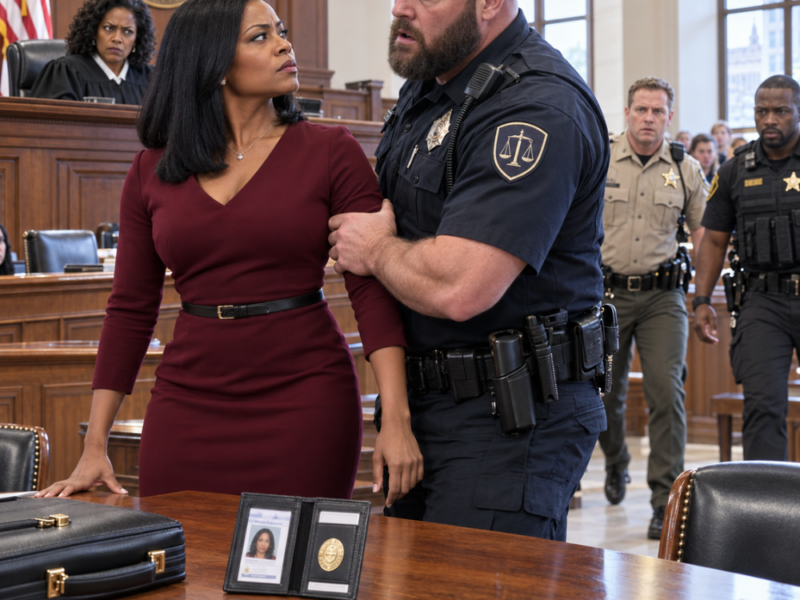
Cop Tries to Arrest a Black Woman in Court—Minutes Later, He’s the One in Handcuffs
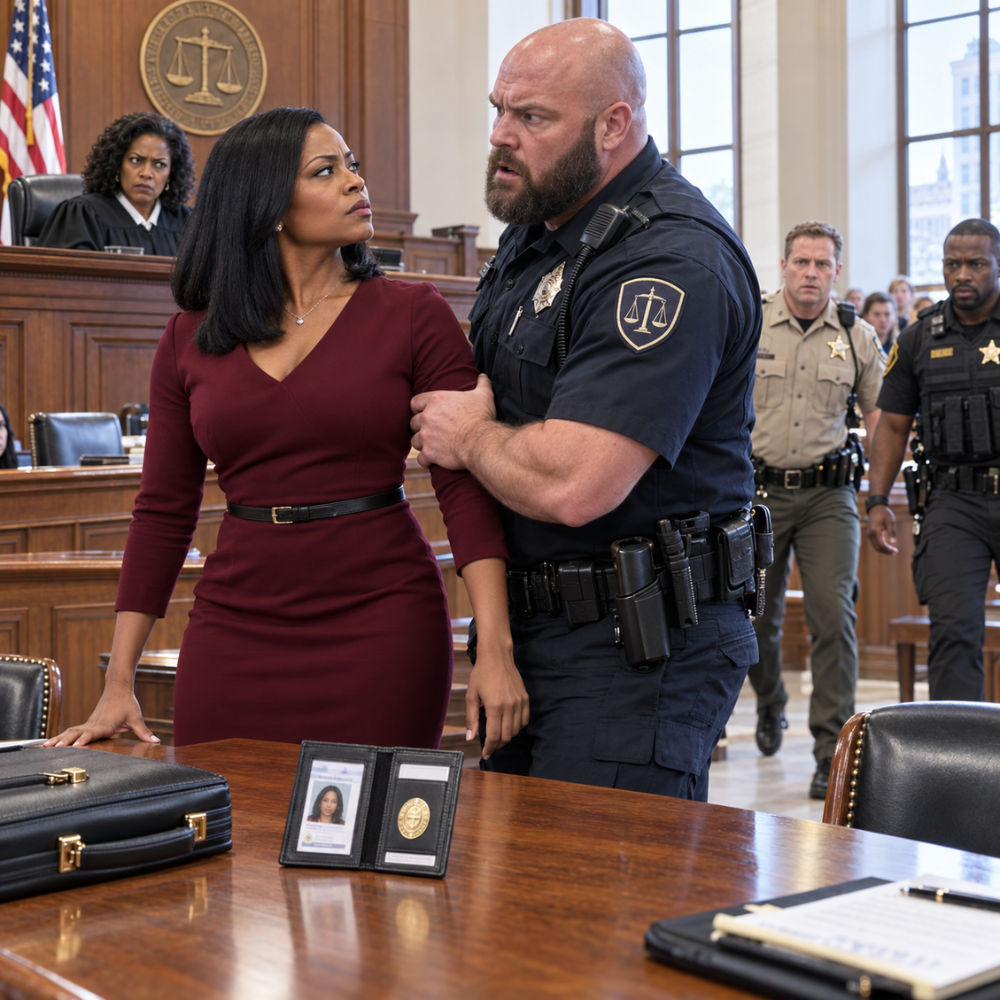
A courthouse officer ordered a forensic engineer to surrender her black case—then the judge asked one question he couldn’t answer
“Put the case down, or I put you down.”
The words cut across the marble lobby of the county courthouse before most people had even seen who said them.
Dr. Maya Bennett stopped three steps beyond the security entrance.
She did not drop the black leather briefcase in her left hand. She did not reach inside her coat. She did not argue, recoil, or perform the frightened obedience the officer seemed to expect.
She simply looked at him.
Officer Eric Dalton stood between her and the narrow corridor leading toward Courtroom 4B, his right hand resting on his duty belt. He was broad-shouldered, mid-forties, and had planted his feet with the confidence of a man who believed the next thirty seconds belonged entirely to him.
Maya had spent seventeen years as a structural engineer, eleven of them specializing in forensic failure analysis. She had been inside buildings after fires, floods, foundation shifts, and partial collapses. She had testified in civil court, federal hearings, arbitration panels, and municipal procurement disputes.
She knew what unstable systems looked like.
Sometimes the first warning was a crack.
Sometimes it was a sound.
Sometimes it was a person answering a question too quickly.
The briefcase at her side contained a hardware-encrypted solid-state drive, printed chain-of-custody records, laboratory certifications, building-access logs, and several documents she had spent months preserving because she no longer trusted the institution whose records she had been hired to verify.
Dalton did not know she had independent copies stored elsewhere.
He did not know the drive had been cryptographically authenticated by a third-party digital forensics specialist.
He did not know she had already documented each attempt to pressure her into changing her conclusions.
Most importantly, he did not know that the threat he had just made had been captured by two courthouse security cameras and a microphone mounted fifteen feet above his head.
“You have three seconds,” he said. “Set the case on the floor.”
Maya shifted her weight slightly, enough to keep the handle secure in her grip.
“On what authority?”
It was not the way frightened people usually asked the question.
Her voice did not rise at the end.
Dalton blinked.
For less than a second, something tightened along his jaw.
Maya noticed.
“Departmental authority.”
“That isn’t a statute.”
His expression changed.
“It’s sufficient.”
“No. It’s a phrase.”
A woman near the metal detector stopped midstep.
A man in a gray suit lowered the phone he had been checking.
Behind Dalton, Deputy Marcus Reed, assigned to courthouse security that morning, went very still.
Maya looked at Dalton again.
“What law, warrant, court order, or stated probable cause gives you authority to seize my private property?”
“You need to cooperate.”
“I am cooperating. I’m standing still. I’m speaking clearly. I’m asking you a direct question.”
“This case may contain restricted material.”
Maya’s attention sharpened.
“You didn’t know it contained anything until I walked in.”
Dalton’s mouth opened.
Then closed.
There.
A fracture line.
Tiny, but visible.
He recovered quickly.
“This is a secure courthouse.”
“I’m aware.”
“You were flagged before entry.”
“By whom?”
“That’s not your concern.”
“It became my concern when you threatened to seize my property.”
Dalton stepped closer.
Maya could see the faint tremor near his left eye.
Adrenaline, she thought.
Not fear.
Not yet.
“Ma’am, step aside.”
He angled his shoulder as though he intended to reach for the case.
Maya’s voice became quieter.
“Touch it, and you’ll be explaining that decision to someone whose job is considerably more senior than yours.”
The double doors to Courtroom 4B opened.
Judge Evelyn Whitaker stepped into the hallway.
She was sixty-two, silver-haired, and had spent twenty-four years on the bench, which meant she had developed a particular intolerance for public officials who mistook volume for authority.
Her black robe moved behind her as she approached.
“Officer.”
Dalton straightened.
The lobby changed immediately.
Judge Whitaker did not raise her voice.
She did not need to.
“Explain what is happening in my hallway.”
Dalton turned toward her.
“Your Honor, this individual is carrying an item that may be relevant to an active department matter. I was securing it.”
Judge Whitaker looked at the briefcase.
Then at Maya.
Then back at Dalton.
“Securing it?”
“Yes, Your Honor.”
“On whose order?”
A pause.
Small.
Maya counted it anyway.
“Standard procedure.”
Judge Whitaker’s expression did not move.
“There is no standard courthouse procedure allowing a police officer to seize a private citizen’s property without a warrant, court order, consent, or probable cause articulated on the record.”
She folded her hands.
“Which of those do you have?”
Dalton said nothing.
People had begun gathering without appearing to gather.
A clerk stood near the courtroom doorway.
Two attorneys who had been walking toward the elevators stopped.
Deputy Reed watched Dalton carefully.
Maya spoke into the silence.
“Your Honor, my name is Dr. Maya Bennett. I’m a licensed forensic structural engineer retained to evaluate a publicly funded renovation of the Central Municipal Police Facility. This case contains verification material related to that work.”
Judge Whitaker turned toward Dalton.
“And he knew that?”
“That is the interesting part,” Maya said. “I had not told him.”
The judge’s eyes narrowed.
Dalton cleared his throat.
“I was informed there might be equipment relevant to a security concern.”
“Informed by whom?”
Dalton hesitated again.
“Department command.”
Before Judge Whitaker could answer, Maya noticed Dalton glance past her.
Not toward the exit.
Toward the main entrance.
A man in a charcoal suit had just entered the building.
He moved through the lobby without hurry.
Captain Richard Hale.
Maya recognized him immediately.
She had spent months exchanging emails with him, sitting across conference tables from him, and listening to him explain why technically inconvenient findings should be “reviewed in context.”
Hale was fifty-four, polished without looking flashy, with graying hair and the practiced ease of someone who had spent most of his career being the person other people called before problems reached the chief.
He greeted Judge Whitaker with a restrained nod.
“Your Honor. I apologize for the disturbance.”
Judge Whitaker did not return the smile.
“Captain Hale.”
“I believe there’s been a misunderstanding.”
Maya said nothing.
Hale turned toward her.
“Dr. Bennett.”
“Captain.”
“I think Officer Dalton may have been overly cautious.”
Dalton’s head moved slightly.
Hale continued as if he had not noticed.
“I take responsibility. But I’d rather resolve this without turning a security concern into something larger.”
Judge Whitaker looked at him.
“What exactly are you proposing?”
Hale’s tone became almost warm.
“We place the device in a sealed evidence container. Dr. Bennett receives a property receipt. Nothing is altered. Nothing is accessed without documentation. Once questions are resolved, her property is returned.”
“No arrest?” Maya asked.
“Of course not.”
“No charge?”
“No.”
“And if I refuse?”
Hale smiled faintly.
“I hope you won’t.”
It was a skillful answer.
It sounded reasonable.
Almost generous.
Maya had seen this style of institutional pressure before.
The threat came first.
Then, once someone with authority appeared, the threat was repackaged as cooperation.
She looked directly at Hale.
“You want me to hand my evidence to the same department whose officer knew I was carrying it before he ever saw me open the case.”
Hale’s smile thinned.
“I’m not sure what you mean.”
“Yes, you are.”
Judge Whitaker’s attention moved between them.
Maya continued.
“Officer Dalton never asked what was in this case. He ordered me to put it down before I identified myself. Then he referred to its contents as restricted material.”
Dalton looked toward Hale.
Maya saw it.
So did the judge.
“That isn’t overzealous,” Maya said. “That is informed.”
Judge Whitaker turned to Hale.
“How did your department know Dr. Bennett would arrive carrying a case?”
“We received a tip regarding a potentially sensitive device.”
“From whom?”
“Anonymous.”
The judge waited.
Hale continued.
“As I’m sure the court understands, we cannot always disclose confidential security information in a public hallway.”
“You can disclose it to me in my courtroom.”
Hale’s expression remained controlled.
“Your Honor—”
“On the record.”
“I only meant that some operational details may be unnecessary.”
Judge Whitaker’s eyes hardened.
“Let the court decide what is unnecessary.”
She turned toward the clerk.
“Open the courtroom.”
Then to everyone else.
“We’re going inside.”
The courthouse lobby exhaled.
Maya walked through the double doors with the black case still in her hand.
Nobody tried to take it again.
Courtroom 4B was smaller than television courtrooms and more ordinary than most people expected.
Dark wood.
A state flag.
A county seal.
Fluorescent lights softened by old ceiling panels.
A jury box empty for the day.
Rows of benches that quickly began filling with attorneys, courthouse employees, and citizens who had witnessed enough of the hallway confrontation to suspect the morning’s routine schedule had just changed.
Maya sat near the front.
The briefcase rested against her left leg.
Officer Dalton sat on a side bench.
Captain Hale remained near counsel table until an attorney from the municipal legal office arrived.
Deputy Reed stood near the rear wall.
Judge Whitaker took the bench.
The clerk activated the recording system.
“Let the record show,” the judge began, “that this proceeding was convened after an attempted seizure of private property in a public courthouse corridor. The court intends first to determine the basis of that attempted seizure.”
She looked at Maya.
“Dr. Bennett, describe what is in the case without revealing anything you believe should remain protected until authentication.”
Maya placed the briefcase flat across her knees and opened it only several inches.
Inside lay a compact matte-black drive inside a protective enclosure and two folders.
“This drive contains an independent forensic archive related to my structural review of the Central Municipal Police Facility renovation.”
“What type of review?”
“Verification of structural work performed under a publicly funded renovation contract.”
“Value?”
“The overall renovation was considerably larger, but approximately $3.8 million was allocated to the structural work presently at issue.”
Judge Whitaker looked toward Hale.
“And why would the police department have an interest in taking this archive before Dr. Bennett presented it anywhere?”
Hale stepped forward.
“May I address that?”
“You may.”
“Dr. Bennett was retained as an outside consultant. Her primary review period ended several months ago. Continued private possession of department-related materials raises security and chain-of-custody concerns.”
Maya watched him closely.
He was good.
He did not deny interest in the drive.
He reframed the interest as institutional responsibility.
“We’re not obstructing her,” Hale continued. “We’re trying to protect public records connected to a secure facility.”
“The review did not end,” Maya said.
Hale looked at her.
Judge Whitaker turned.
“Why not?”
“Because I declined to certify the structural renovation.”
The room became still.
The judge leaned back slightly.
“You refused final sign-off?”
“Yes.”
“Why?”
Maya removed one document.
“The material certifications submitted for structural steel used in three load-bearing sections did not match results from independent laboratory samples I obtained.”
Hale’s attorney shifted.
Maya continued.
“Several inspection dates in the official file also did not correspond to building access records. There were supporting attachments referenced in earlier drafts of the project documentation that disappeared from the current file.”
Judge Whitaker’s expression changed.
“What do you mean by disappeared?”
“They were referenced by filename and index number in earlier versions. Those attachments are no longer present in the file the department currently identifies as complete.”
“Could that be administrative error?”
“Certainly.”
Maya glanced at Hale.
“That was one reason I did not initially characterize it as misconduct.”
“And now?”
“Now an officer attempted to seize my independent archive before I presented it.”
Hale stepped forward.
“Your Honor, discrepancies occur in large public projects. File-management issues do not establish wrongdoing.”
“No,” Maya said.
“They don’t.”
She turned toward Dalton.
“But an officer knowing the physical description and likely contents of my evidence before I disclosed them is a different category of problem.”
Dalton’s shoulders tightened.
Maya addressed him directly.
“You told me my case contained restricted material before I identified its contents. How did you know?”
Dalton looked at Hale.
It lasted less than a second.
But the courtroom saw it.
Judge Whitaker spoke before Hale could.
“Officer Dalton.”
“Yes, Your Honor.”
“Who told you?”
“I was told to expect an individual carrying department-related material.”
“By whom?”
Dalton hesitated.
“Captain Hale.”
The courtroom remained quiet.
Hale did not look at him.
“I told Officer Dalton to remain alert,” Hale said, “because I had reason to believe department materials might be removed from an authorized process.”
Maya frowned.
“Removed from what process?”
“The project review.”
“I created the archive during the project review.”
“That does not make every copy private property.”
“No. But it does make your attempt to seize it interesting.”
Judge Whitaker raised one hand.
“One person at a time.”
She turned to Dalton.
“Did Captain Hale tell you Dr. Bennett would be carrying a black case?”
Dalton looked at the floor.
“Yes.”
Hale’s attorney leaned toward his client.
Judge Whitaker continued.
“Did he tell you it contained a drive?”
Another pause.
“Yes.”
A faint murmur moved through the gallery.
The judge silenced it with a glance.
Maya remained still.
That was the moment she had been waiting for.
Not because Dalton’s admission proved everything.
Because it destroyed the claim that his behavior had begun as spontaneous courthouse caution.
Judge Whitaker turned to Hale.
“You told this officer the physical description and expected contents of Dr. Bennett’s property before she entered this building.”
“I relayed information provided to me.”
“By whom?”
Hale’s attorney stood.
“Your Honor, given the direction this questioning has taken, I would ask that my client be permitted to consult with counsel before responding to anything that could implicate an ongoing administrative or criminal matter.”
Judge Whitaker studied him.
“You may consult.”
Then she looked at Hale.
“But understand the record already shows that your officer confronted a private citizen based on specific information about evidence connected to a disputed project involving your own department.”
Hale said nothing.
“That is not a minor issue.”
“No, Your Honor.”
“Fifteen-minute recess.”
The gavel never came down.
Judge Whitaker simply stood.
Everyone else followed.
Maya remained seated after the judge left.
The gallery dissolved into whispered conversations.
Phones appeared.
Attorneys stepped into the hall.
Dalton spoke briefly with Hale’s counsel.
Hale himself stood alone for a moment near the far table.
Maya opened one of her folders and reviewed building-access logs she already knew nearly by memory.
Her father had once asked why she reread documents she could quote verbatim.
Because memory became confident, she told him.
Paper did not.
Her phone buzzed.
Unknown number.
She stared at the screen.
Then answered.
“This is Dr. Bennett.”
Silence.
Then a low voice.
“Don’t let them take the black case.”
Maya sat straighter.
“How do you know I have it?”
The line went dead.
She stared at the phone.
The call lasted eleven seconds.
She saved the number and made a note of the time.
She did not assume the caller was helping her.
Warnings could be useful and still come from dangerous people.
The courthouse doors opened again.
The clerk called everyone back.
A municipal attorney named Stephen Cole now sat beside Hale.
Judge Whitaker returned.
“Dr. Bennett, I want to go back to the underlying structural review.”
“Yes, Your Honor.”
“Explain what you were originally retained to do.”
Maya stood this time.
“My assignment was to provide independent verification that structural work performed during the renovation matched specifications, material standards, and code requirements attached to the public contract.”
“Routine work?”
“Routine in purpose. Not necessarily in execution.”
“What was your first concern?”
“The steel.”
She removed a laboratory report.
“Three structural sections had been certified as containing steel that met a specific load rating. I obtained samples through authorized testing. Independent laboratory results did not match the submitted material certification.”
“How significant was the difference?”
“Significant enough that I could not certify the installed material as meeting the specified design requirement.”
“Could testing variance explain it?”
“No.”
Hale’s attorney stood.
“Objection to the categorical phrasing.”
Judge Whitaker looked at Maya.
“Can you state that more precisely?”
“Yes. The difference exceeded ordinary testing variation by a margin large enough that I considered the certification materially inconsistent with the sample results.”
“Better.”
Maya nodded.
Judge Whitaker continued.
“What did you do when you discovered it?”
“I notified the project liaison.”
“Hale?”
“Yes.”
“And his response?”
Maya handed the clerk a printed email.
“He asked whether the discrepancy might be characterized as inconclusive pending additional review rather than listed as a failure.”
Judge Whitaker read.
“Captain, do you dispute sending this?”
“No.”
“What did you mean?”
Hale’s voice was tighter now.
“I was asking her to exercise caution. Declaring structural failure in a functioning police facility is serious.”
Maya spoke.
“I did not declare the building was about to collapse.”
Hale looked at her.
“I said the tested material did not match the specification and therefore could not be certified.”
“That distinction is not how the public hears it.”
“My certification is not written for public relations.”
The courtroom became still again.
Judge Whitaker looked down to hide what might have been the beginning of a smile.
Maya continued.
“After I declined to change the finding, other inconsistencies became more difficult to dismiss.”
“What type?”
“Inspection dates.”
She opened another document.
“The project file listed inspections on seven dates. Building access logs did not show activity consistent with those inspections on four of them.”
“Could inspectors have entered without using standard credentials?”
“In theory.”
“Did you check?”
“Yes. I requested visitor records, contractor sign-ins, maintenance overrides, manual entries, and emergency access records.”
“And?”
“None explained the discrepancy.”
Hale spoke.
“Access systems aren’t perfect.”
“No system is,” Maya said.
“That’s why I cross-referenced multiple sources.”
Judge Whitaker looked at her.
“Explain your archive.”
Maya rested one hand on the briefcase.
“When I noticed records changing, I began capturing independent copies of every document I reviewed.”
“Changing how?”
“Attachments disappearing. Filename revisions. Timestamps shifting. Draft language replaced.”
“Could routine file management explain that?”
“Some of it.”
“Some?”
“Yes.”
Maya paused.
“Not all.”
She removed another page.
“I use a hardware-encrypted archive. Every captured document receives a cryptographic hash. That allows later verification that the file has not been altered.”
Judge Whitaker nodded.
“And you alone control this drive?”
“The physical drive, yes.”
A tiny pause.
Judge Whitaker noticed.
“But?”
Maya looked at Hale.
“I don’t use single points of failure.”
“What does that mean?”
“If someone had taken this case from me in the hallway before I reached your courtroom, the evidence would not have disappeared.”
For the first time, Hale’s composure changed in a way Maya considered genuine.
His eyes narrowed.
Not anger.
Calculation.
Judge Whitaker noticed too.
She did not press.
Not yet.
She looked toward Dalton.
“Officer, I want to return to your testimony.”
Dalton sat straighter.
“You initially said Captain Hale gave you general instructions.”
“Yes.”
“You later admitted he told you to expect a black case and a hard drive.”
“Yes.”
“Which statement was accurate?”
“The second one.”
“Why did you give the first?”
Dalton looked toward his attorney, then toward Hale.
“I didn’t think the details mattered.”
Judge Whitaker’s voice became colder.
“They mattered enough for you to threaten a citizen in my hallway.”
Dalton swallowed.
“I was trying to follow instructions.”
“What instructions?”
“To recover the device.”
Maya’s attention sharpened.
Judge Whitaker leaned forward.
“Recover?”
“Yes.”
“Not screen it?”
Dalton said nothing.
“Not verify it?”
“No.”
“Recover it.”
“Yes.”
“From whom?”
Dalton hesitated.
“Dr. Bennett.”
Hale’s attorney stood.
“Your Honor, I believe Officer Dalton should have separate counsel if he intends to provide testimony that could create personal exposure.”
Judge Whitaker looked toward Dalton.
“That may be advisable.”
Dalton appeared as if the suggestion had only now made the seriousness real.
Judge Whitaker called another recess while independent counsel was contacted.
Maya remained at counsel table.
Her phone did not ring again.
Twenty-three minutes later, Dalton returned with an attorney from outside the municipal legal office.
The courtroom reconvened.
Judge Whitaker addressed Maya.
“I am inclined to permit a limited read-only examination of your archive under court supervision. You retain physical control. The court’s secured evidence reader will be used.”
“No objection.”
Judge Whitaker looked toward Hale and Dalton.
“Specific legal objection?”
Hale’s attorney began discussing chain of custody.
The judge raised one hand.
“The court is not taking custody. Dr. Bennett remains in possession. We are verifying materials already gathered under the unusual circumstances created by this morning’s attempted seizure.”
The attorney stopped.
“If you have a statute, rule, or case directly prohibiting this limited review, state it.”
Nobody did.
“Then proceed.”
The clerk brought forward a secured reader.
Maya connected the drive herself.
The case never left her reach.
Rows of files appeared.
Dates.
Hashes.
Certificates.
Photographs.
Inspection reports.
Access logs.
Emails.
Maya scrolled to a folder.
“This is where the independent archive begins to diverge from the department’s current file.”
She selected an access record.
“And this entry is one I did not expect to find.”
Judge Whitaker leaned forward.
“What is it?”
“The structural monitoring room was accessed at 9:47 p.m. on April eighteenth.”
Hale looked at the screen.
Maya displayed the department’s official access summary beside the independent system record.
“The official file says the room remained locked all night.”
“And your record?”
“The local monitoring controller registered a door-open event.”
“For how long?”
“Eleven minutes.”
“Who entered?”
“The controller records a credential number rather than a name in this export.”
“Can the credential be traced?”
“Not by me with certainty. That would require administrative records I do not have.”
Hale finally spoke.
“Systems malfunction.”
Maya turned toward him.
“Possible.”
“Internal clocks drift.”
“Possible.”
“Older hardware especially.”
Judge Whitaker looked toward the clerk.
“Dr. Bennett, did you account for clock drift?”
“Yes.”
She opened another file.
“The monitoring system had been calibrated three days earlier during routine maintenance.”
Judge Whitaker instructed the clerk to compare the records.
Several minutes passed.
The courtroom waited.
The clerk finally looked up.
“The device clock was cross-verified against network time during scheduled maintenance three days before the access event. I see no subsequent service record documenting a clock fault or drift.”
Judge Whitaker turned toward Hale.
“So the timestamp appears reliable.”
Hale’s shoulders lowered slightly.
“It would appear so.”
For the first time since entering the courthouse with his calm smile and reasonable proposals, he sounded like a man who understood how far control had moved away from him.
Maya did not celebrate.
A reliable timestamp was not proof of fraud.
It was one piece.
She had built her career on knowing the difference.
Hale’s attorney stood.
“Before any additional material is introduced, I request proper authentication.”
Judge Whitaker looked at him.
“That request would carry more persuasive force if your client’s department had not spent the morning trying to acquire the same material outside a documented evidentiary process.”
The attorney sat down.
Maya opened a different folder.
“Your Honor, there is an audio file connected to the same monitoring system.”
The courtroom became still.
“What does it contain?”
“Before I play it, I want the record clear. It was automatically captured by equipment in the structural monitoring room. The source file has not been edited or trimmed.”
“Can you authenticate it?”
“I can provide the source metadata, device certificate, and cryptographic hash. I also retained an independent digital forensics specialist weeks ago to verify my archive.”
Hale’s face changed again.
Only slightly.
Judge Whitaker looked at Maya.
“Play it.”
The courtroom speaker crackled.
For a second there was only room noise.
Then a male voice.
“If she doesn’t sign it, we find something. Obstruction. Security. Whatever works. Just get that drive back before it leaves the building.”
The words were compressed by the recording, but clear.
A second voice answered.
“And if a judge asks why?”
“Then it was a security matter. It always is.”
Maya stopped the recording.
No one moved.
The clerk’s fingers hovered above the keyboard.
Dalton had gone pale.
Hale sat completely still.
Judge Whitaker waited.
Silence often had more value in court than accusation.
People rushed to fill it.
Hale did.
“That recording could have been made anywhere.”
Judge Whitaker looked at Maya.
“Reasonable objection. Address it.”
Maya produced the source certification.
“This is the original file hash captured at retrieval. This identifies the monitoring device. This is the hardware certificate linking that unit to the structural monitoring room.”
She placed a third page down.
“And the internal access log places the recording on the same date and time as the unexplained door event.”
Hale’s attorney leaned toward him.
Maya continued.
“One more detail.”
Judge Whitaker nodded.
“In the final two seconds, there is a double chime.”
Maya replayed it.
Two soft electronic tones.
“The system emits that specific alert during an automated calibration diagnostic.”
“How specific?”
“Specific enough that I asked an independent specialist to preserve the acoustic signature for comparison.”
Judge Whitaker listened a second time.
Then a third.
“Where is this specialist?”
“Available.”
“Contact him.”
The judge recessed again.
Twenty minutes later, Daniel Park entered Courtroom 4B carrying a plain laptop case.
He was forty-eight, soft-spoken, and looked less like a television expert witness than someone who might quietly repair a university network and leave before anyone remembered his name.
Maya trusted him partly because he disliked certainty almost as much as she did.
He sat at the temporary evidence table.
Judge Whitaker began.
“Name and occupation.”
“Daniel Park. Independent digital forensics examiner.”
“How long have you been involved?”
“Approximately seven weeks.”
“Who retained you?”
“Dr. Bennett.”
“For what purpose?”
“To create an independent authentication process for her forensic archive.”
“You did not collect her underlying structural evidence?”
“No.”
“You did not perform engineering analysis?”
“No.”
“What did you do?”
“I received selected archive packages, hash values, metadata, and device-verification material. My role was to confirm that files later presented by Dr. Bennett could be tested against independently retained copies.”
Judge Whitaker looked at Maya.
“So there is another copy.”
Park answered.
“Yes.”
The gallery stirred.
The judge silenced it.
“Of everything?”
“No. Not the entire working archive. But enough of the authentication package and key evidence to verify integrity independently.”
“Why was that done?”
Park answered without looking toward Hale.
“Because evidence involving an institution with substantial authority should not exist in only one location.”
The courtroom understood.
The black case had never been the only path to the truth.
Maya thought of the anonymous call.
Don’t let them take the black case.
She looked at Park.
He gave nothing away.
Judge Whitaker asked, “Can you authenticate the audio?”
Park connected his laptop.
He worked quietly for several minutes.
Nobody interrupted.
Finally, he looked up.
“The hash matches the copy I retained.”
“What does that establish?”
“That the file presented today is byte-for-byte identical to the version I received during the authentication process.”
“Device origin?”
“The certificate corresponds to the monitoring hardware registered to the structural monitoring room.”
“The calibration chime?”
“I compared its frequency profile against the manufacturer’s diagnostic signature and technical documentation.”
“And?”
“It is consistent.”
“How strong is that conclusion?”
Park folded his hands.
“I want to be precise.”
Maya almost smiled.
That was why she hired him.
“The chime alone does not prove every allegation discussed today. It does support, with a high degree of confidence, that the recording originated from the identified equipment or an exact reproduction of that hardware environment. Combined with the device certificate, metadata, hash consistency, and access records, the evidence strongly supports that this file originated from the room in question and has not been altered since capture.”
Judge Whitaker nodded.
“Thank you.”
Hale’s attorney stood.
“We request that the equipment specification and authentication process be admitted separately so we retain the opportunity to challenge methodology later.”
“Reasonable.”
The judge turned toward the clerk.
“Enter them.”
She looked back at counsel.
“To be clear, this court is not foreclosing later challenge. If you have an evidence-based basis to dispute the authentication, you may do so through proper procedure.”
She paused.
“What I will not entertain is vague speculation presented in place of evidence.”
Hale’s attorney sat.
Then tried a different approach.
“Even if the recording is authentic, it does not expressly name Dr. Bennett.”
Judge Whitaker looked directly at Hale.
“Captain, would you like to offer an alternative explanation for why your voice appears on an authenticated recording in a secured room instructing someone to recover a drive and, if its owner refuses, to find an obstruction or security charge?”
Hale’s face had lost almost all color.
“I would like to consult with counsel before answering.”
“That is your right.”
He whispered with his attorney.
Dalton stared at the floor.
Judge Whitaker turned to him.
“Officer Dalton.”
“Yes.”
“Earlier you said you were following instructions.”
“Yes.”
“Did Captain Hale instruct you to obtain Dr. Bennett’s case?”
Dalton’s attorney leaned toward him.
They whispered.
Dalton finally answered.
“Yes.”
“Did he tell you what the case looked like?”
“Yes.”
“Did he tell you it likely contained a drive?”
“Yes.”
“Did he tell you what to do if she refused?”
Dalton closed his eyes briefly.
“Not exactly.”
“Then exactly what did he say?”
Dalton swallowed.
“He said if she became difficult, I should treat it as a security issue and hold her until command handled it.”
Hale turned sharply.
“That is not accurate.”
Dalton looked at him.
“You told me to get the case.”
“I told you to secure department-related material.”
“You told me exactly what she would be carrying.”
“Officer—”
“You told me what was on the drive.”
Hale’s attorney touched his arm.
Hale ignored him.
Dalton’s composure fractured.
“If this is obstruction, Captain, it started before I ever saw her.”
The courtroom became tense.
Hale’s voice turned cold.
“You are not going to make this my responsibility alone.”
“I’m not making it anything.”
Dalton leaned forward.
“I’m telling the truth because apparently that’s the only thing in here that might still help me.”
Judge Whitaker raised a hand.
“Gentlemen.”
Both stopped.
“This courtroom is not where you negotiate how responsibility will be divided.”
She looked first at Hale.
Then Dalton.
“The authenticated record suggests direction from command and compliance by an officer. Neither fact erases the other.”
Dalton looked down.
Hale said nothing.
Judge Whitaker instructed courthouse security to separate them and restrict any police-department access to Maya’s evidence, the court reader, and the proceeding record.
Two court deputies moved forward.
Dalton stood first.
His shoulders had changed from the morning.
The confidence was gone.
Hale rose more slowly.
He smoothed the front of his suit jacket.
An automatic gesture.
Maya recognized it as another form of structural behavior.
People under pressure returned to habits.
Hale looked toward Judge Whitaker.
“For the record, I acted in what I believed was the department’s legitimate interest.”
Judge Whitaker’s face remained neutral.
“A department’s legitimate interest does not include manufacturing a legal pretext to seize evidence concerning its own conduct.”
“I dispute that characterization.”
“You may dispute it before the oversight authority.”
Hale looked toward Maya.
As courthouse security prepared to escort him out, he stopped beside her table.
“You could have taken the settlement.”
Maya looked up.
“It would have been simpler.”
“For you.”
“For everyone.”
“No.”
She placed one hand on the briefcase.
“Not for the officers working in a building containing steel that doesn’t match the certification you approved.”
Hale’s face tightened.
“There was no settlement offer.”
“There was.”
His eyes changed.
“Three weeks ago.”
Maya continued.
“A mutual contact of yours suggested a consulting arrangement large enough to compensate me for ‘professional inconvenience’ if I reconsidered whether the remaining discrepancies justified withholding certification.”
For the first time all morning, Hale looked genuinely surprised.
Maya saw it.
Judge Whitaker saw it.
Hale recovered.
“That is a serious allegation.”
“It is documented.”
Maya reached into the folder.
“Like everything else.”
Hale’s attorney moved quickly.
“My client will make no further statement.”
Hale allowed courthouse security to escort him out.
Dalton followed several feet behind.
The two men who had entered the courthouse as parts of the same command structure now left separated by silence.
The doors closed.
Only then did the room breathe again.
Judge Whitaker waited for the whispers to stop.
Then she looked at Maya.
“I want something clear on the record.”
“Yes, Your Honor.”
“Nothing that happened today determines the entire structural or financial question.”
“I agree.”
“What it determines is that serious evidence exists and that people connected to the institution under review attempted to interfere with its preservation.”
“Yes.”
“That changes who should control what happens next.”
“Yes.”
Judge Whitaker leaned back.
“And I do not believe you came here with only one recording.”
For the first time that morning, Maya smiled.
“No, Your Honor.”
Daniel Park, who had been disconnecting his laptop, stopped.
“There’s something else.”
Judge Whitaker looked at him.
“What?”
“I completed a forensic comparison last night between the final structural report currently stored in the department system and an earlier version captured in Dr. Bennett’s independent archive.”
Maya turned.
She knew Park had been comparing versions.
She had not yet seen his final work.
He reconnected the laptop.
The screen displayed two documents side by side.
“The earlier version existed before Dr. Bennett refused to certify the project.”
Judge Whitaker looked at him.
“And the current version?”
“Created later.”
“How much later?”
“Three days.”
“Was the original edited?”
“No.”
Park zoomed in.
“It appears to have been deleted.”
The room fell quiet again.
“How do you distinguish deletion from revision?” Judge Whitaker asked.
“Two reasons. The metadata records a deletion event associated with the original file identifier. The current report has a separate creation timestamp and a different user credential.”
“Can you identify the user?”
“Not a person. The credential belongs to a broad administrative account.”
“Meaning?”
“Multiple authorized users could potentially have accessed it.”
Judge Whitaker made a note.
“What changed between the reports?”
Park highlighted a section.
“The earlier version includes a detailed breakdown of subcontractor invoices tied to the structural work.”
“And the current version?”
“That entire itemized section is gone.”
“What replaced it?”
“One sentence.”
He read it.
“All invoices reviewed and found consistent with contracted work.”
Maya leaned forward.
“So someone replaced a detailed accounting trail with a conclusion.”
“That is a fair description.”
Judge Whitaker sat back.
“Maya.”
It was the first time she used her first name.
“What do you believe happened to the $3.8 million?”
Maya took a breath.
“I don’t know.”
The honesty seemed to surprise several people.
Judge Whitaker did not.
Maya opened the second folder that had remained beneath her papers all morning.
“I know the documentation does not support the current official story.”
“Explain.”
“Of approximately $3.8 million attributed to structural labor and related work, a little over $1.1 million is tied to invoices from a single subcontractor.”
“What is unusual about the subcontractor?”
“The registered business address is a residential condominium.”
“That alone proves nothing.”
“Correct.”
“No listed yard?”
“No.”
“Warehouse?”
“No.”
“Commercial equipment records?”
“None I located through public sources.”
“Employees?”
“I could not verify staffing sufficient for the work described.”
Judge Whitaker nodded.
“What else?”
“Material invoices list a steel grade and quantity that do not align with the independent lab results or observable installed quantities.”
Hale’s attorney was no longer there to object.
Maya continued carefully.
“I am not saying today that someone stole $3.8 million.”
“Why not?”
“Because I cannot prove that.”
“What can you prove?”
“That the technical documentation is incomplete. That at least one version of the accounting trail was deleted. That the replacement file removed detail necessary to trace expenditures. That structural material testing does not match certifications. That several inspection dates are inconsistent with access records.”
She looked toward the courtroom doors through which Hale had been taken.
“And that members of the department attempted to obtain my independent archive before it entered this proceeding.”
Judge Whitaker nodded.
“That is the distinction I wanted.”
Maya continued.
“To determine where the money actually went, someone needs subpoena authority, banking records, vendor records, tax information, and forensic accounting resources I do not possess.”
“So your job was not to solve the financial case.”
“No.”
“What was your job?”
“To make sure the technical evidence survived long enough for somebody with proper authority to investigate it.”
Daniel Park spoke quietly.
“That was also the purpose of the secondary archive.”
Judge Whitaker looked toward him.
“Explain.”
“The archive was never intended to become a substitute for prosecution or a full audit.”
He glanced at the black case.
“It was designed to survive interference.”
Maya looked at him.
Park continued.
“In that sense, what happened in the hallway demonstrated why the redundancy existed.”
Judge Whitaker nodded slowly.
She set down her pen.
“The court will formally refer this matter, including today’s transcript, recordings, authentication results, access discrepancies, and document-deletion evidence, to the state inspector general and appropriate prosecutorial oversight authority.”
The clerk began typing.
“I will also recommend an independent forensic financial audit.”
Maya exhaled slowly.
Judge Whitaker continued.
“I do not consider an internal police review adequate given what occurred here.”
“Understood.”
“Do not mistake today for an ending.”
Maya looked at her.
“I won’t.”
“A financial investigation could take months.”
“I know.”
“Longer.”
“I know.”
“The people responsible may not face consequences quickly.”
“I know that too.”
Judge Whitaker studied her for a moment.
“You sound unusually comfortable with disappointment.”
Maya smiled faintly.
“I work with buildings.”
The judge raised an eyebrow.
Maya explained.
“You don’t repair a foundation by pretending the crack disappeared because you finally found it.”
That brought a tired smile from Judge Whitaker.
“Fair enough.”
She gathered her notes.
“Then I suspect we’ll see each other again.”
“I expect so.”
Daniel Park packed his equipment.
Before leaving, he stopped beside Maya.
“The secondary archive stays untouched unless you need it.”
She looked at him.
“You called me.”
It was not a question.
Park’s expression barely changed.
“I thought you might need reminding.”
“How did you know what was happening?”
“A courthouse clerk contacted me after the commotion began. She had my number in the authentication paperwork you filed.”
Maya nodded.
“You could have identified yourself.”
“I could have.”
“You altered your voice.”
“I spend too much time around cautious people.”
“That is not an answer.”
Park finally smiled.
“I wanted you focused on protecting the case, not on figuring out whether I was already on my way.”
Maya considered that.
“You realize that was annoying.”
“I assumed.”
“Thank you.”
He nodded.
Then left through the side door with the same unremarkable quiet with which he had entered.
Maya remained seated.
The black case rested against her leg.
Exactly where it had been when Dalton ordered her to put it down.
She remembered Hale’s final comment.
You could have taken the settlement.
The irony was that money had never been the reason she refused.
Three months earlier, the police department renovation looked like one of the least interesting assignments on Maya’s calendar.
The Central Municipal Police Facility was a squat four-story building built in the late 1980s.
The city had approved a major renovation after years of complaints about aging mechanical systems, outdated interview rooms, leaking sections of roof, and interior spaces poorly suited to modern policing.
Most of the work was ordinary.
New electrical systems.
Security upgrades.
HVAC replacements.
Office renovations.
Structural reinforcement in several areas where new equipment and altered floor plans changed loads.
Maya’s firm was hired as an independent engineering verifier after the city council added an outside-review requirement to the procurement package.
Nobody expected controversy.
Maya attended kickoff meetings.
Reviewed drawings.
Inspected materials.
Compared contractor certifications.
Then one laboratory report arrived.
The steel samples did not match.
At first, she assumed a labeling error.
She requested a second test.
Same problem.
She asked for original mill certificates.
They arrived.
The numbers did not reconcile.
She notified Hale, the designated project liaison.
His response had been courteous.
Always courteous.
“Could this be a sampling issue?”
“I don’t think so.”
“Could different stock have been installed in different sections?”
“Possibly. That’s why I need additional access.”
“Of course.”
Additional access took eleven days.
When Maya finally entered one of the reinforcement areas, she found inconsistent manufacturer markings.
She photographed them.
Requested invoices.
That was when the project changed.
Documents arrived slowly.
Questions were answered indirectly.
One invoice referenced a subcontractor she had never seen on the original bidder list.
Another showed material quantities that appeared much larger than what she could verify on site.
None of that alone proved corruption.
Large projects were messy.
Maya knew that.
The easiest mistake an investigator could make was treating every inconsistency as sinister once suspicion had begun.
So she forced herself to keep alternative explanations alive.
Clerical error.
Vendor substitution.
Emergency purchase.
Misfiled record.
Old access system.
Incompetent administration.
She wrote each possibility beside the inconsistency it might explain.
Then she tried to disprove her own concerns.
That was when the supporting attachments disappeared.
One Friday morning, a cost-detail appendix referenced in a draft certification file existed.
Monday afternoon, it did not.
Maya emailed records management.
They said they had no record of deletion.
She checked her own copy.
The file existed.
That evening, she called Daniel Park.
They had worked together on a hospital construction dispute two years earlier.
“I need independent preservation.”
“How independent?”
“Assume my work computer disappears.”
“That independent.”
“Yes.”
“Assume your office gets subpoenaed?”
“Yes.”
“Assume somebody claims your files were edited?”
“Yes.”
Park was silent.
Then said, “All right.”
That was how the second archive began.
Maya did not tell Hale.
She did not tell the contractor.
She told her firm’s managing partner and outside counsel, enough to protect herself legally without turning suspicion into accusation.
Three weeks later, Hale invited her to coffee.
Not his office.
Not the project site.
A quiet restaurant near the county administration building.
He asked about her family.
Her workload.
Her firm.
Then, almost casually, he said the city had additional consulting work coming.
“Large work?”
“Potentially.”
“Why are you telling me?”
“You’ve been thorough.”
“That’s what you hired us for.”
“Yes.”
He stirred coffee.
“Sometimes thorough professionals also understand when a project has reached the point where more investigation creates cost without improving safety.”
Maya looked at him.
“What are you asking?”
“I’m asking whether your conclusion has room for professional judgment.”
“It always does.”
“And?”
“My judgment is that I cannot sign the certification.”
Hale smiled.
“You’re certain?”
“No.”
That surprised him.
Maya continued.
“Certainty is not the standard.”
“What is?”
“Whether I have enough reliable evidence to certify compliance.”
“And you don’t.”
“I don’t.”
Hale’s smile faded.
Several days later, a mutual business contact called Maya.
The man discussed a private infrastructure consulting opportunity with compensation far above normal market rates.
Then he said something strange.
“Richard thinks everybody would benefit if the renovation issue stopped becoming adversarial.”
Maya asked him to repeat it.
He did.
She wrote down every word after the call.
Then notified counsel.
That was what she meant when she told Hale the attempted settlement was documented.
She never knew whether the contact understood what he was participating in.
The state audit eventually answered some questions.
Not quickly.
Judge Whitaker had been right about that.
Four months passed before investigators received full banking records.
Seven before the procurement chain was reconstructed.
Maya continued her engineering work during the investigation.
She attended three formal interviews.
Submitted affidavits.
Explained steel classifications to forensic accountants.
Sat through meetings where attorneys asked the same question six different ways.
The black case spent most of that year inside a secure evidence room under court-controlled protocol.
Daniel Park’s independent copy remained separately preserved.
Captain Hale was placed on administrative leave during the investigation.
Officer Dalton was suspended from courthouse-related duty and later entered into a cooperation agreement with state investigators.
His testimony proved useful.
He admitted Hale had instructed him to recover Maya’s evidence before she reached the courtroom.
He also produced messages.
One said:
BENNETT MAY ARRIVE WITH BLACK CASE. DO NOT LET DEVICE LEAVE COURTHOUSE CONTROL.
Another:
IF SHE RESISTS, HOLD FOR SECURITY REVIEW. COMMAND WILL HANDLE.
Those messages did not establish the financial fraud.
They established obstruction.
The financial evidence took longer.
Investigators discovered the subcontractor linked to more than a million dollars in structural invoices had been formed eighteen months before the renovation.
Its listed owner was the brother-in-law of a procurement consultant associated with the project.
The company had few employees.
Most heavy work had actually been performed by another subcontractor receiving substantially less money.
Material invoices had been inflated.
Some steel was billed at a higher specification than what had been delivered.
Inspection records had been altered to create a paper trail supporting work that could not be verified as described.
The $3.8 million had not all disappeared.
That was another important distinction.
Much of the work was real.
Employees had been paid.
Materials had been purchased.
The building had been renovated.
But investigators eventually estimated that more than $1.4 million in structural and material charges lacked legitimate support or appeared inflated through layered subcontracting.
The fraud was less cinematic than newspaper readers wanted.
No briefcase of cash.
No midnight transfer to a foreign account.
Just invoices.
Related companies.
Overbilling.
Altered reports.
Payments divided into amounts that looked unremarkable unless somebody compared them carefully.
Maya had compared them.
Captain Hale had not designed the entire scheme.
The final investigative report made that clear.
Several contractors and one procurement official played larger financial roles.
But Hale had learned enough about the documentation problem to understand the project was in danger.
Instead of exposing it, he tried to manage it.
He pressured Maya to soften the certification.
He supported efforts to recover her independent evidence.
He encouraged Dalton to use a security pretext if necessary.
That was enough.
The criminal case did not resolve for nearly two years.
By then, the courthouse confrontation had become local legend.
The story people repeated was simple.
A police officer threatened a woman over a black briefcase.
A judge walked out.
A recording played.
A captain was exposed.
Maya disliked that version.
It made everything sound inevitable.
Nothing had been inevitable.
If she had not preserved the earlier files, the deletion might never have been provable.
If Park had not created a second authentication path, someone could have claimed Maya changed the evidence.
If Judge Whitaker had treated the hallway argument as ordinary security confusion, the drive might have entered department custody.
If Dalton had maintained the original story, investigators would have needed longer to connect command involvement.
If the court clerk had failed to record the proceeding cleanly, later disputes might have become harder.
Truth had survived because several ordinary people did unglamorous work correctly.
The clerk preserved the record.
Park preserved the archive.
The judge asked precise questions.
Maya kept copies.
Even Dalton, eventually, chose evidence over loyalty.
There was no single hero large enough to explain what happened.
Two years after the courthouse morning, Maya returned to Courtroom 4B for the final sentencing hearing in the obstruction case.
The marble lobby looked exactly the same.
Same metal detector.
Same benches.
Same fluorescent hum.
A different officer stood near security.
He glanced at Maya’s briefcase.
“Morning, Dr. Bennett.”
“Morning.”
“Anything electronic?”
“One laptop.”
“Please place it in the tray.”
She did.
No one threatened her.
No one knew the symbolism mattered except her.
Judge Whitaker was already on the bench when Maya entered.
Her hair was a little grayer.
The courtroom more crowded.
Captain Hale sat beside defense counsel.
He looked older.
Not dramatically.
Just enough.
Officer Dalton sat farther back.
Under the cooperation agreement, he had pleaded to lesser charges and agreed to testify about the obstruction attempt.
The financial defendants had separate cases.
Some had entered pleas.
Others continued fighting.
The judge spoke at length.
Not angrily.
Maya had learned that judges who understood power rarely needed anger to describe its misuse.
“When the public gives authority to law enforcement,” Judge Whitaker said, “it does not give that authority so officials can decide which truths are convenient enough to survive.”
The courtroom was silent.
“A badge does not convert self-interest into public safety.”
Hale looked down.
“A command title does not transform obstruction into procedure.”
Maya watched him.
He never turned toward her.
The judge continued.
“The danger here was not simply an improper instruction in a courthouse lobby. The danger was the belief that institutional authority could be used to control evidence concerning the institution itself.”
Maya thought of the black case.
The recording.
The deleted report.
“That belief is incompatible with public trust.”
Afterward, she found Dalton near the courthouse steps.
He approached carefully.
“Dr. Bennett.”
“Officer Dalton.”
“Former officer.”
Maya nodded.
He had resigned months earlier.
For a moment, neither spoke.
Then he said, “I’m sorry.”
Maya waited.
“I know that doesn’t change what happened.”
“No.”
“I told myself I was following command.”
“You were.”
His expression tightened.
“That doesn’t help as much as I hoped.”
“It shouldn’t.”
He almost smiled.
“I figured you’d say that.”
Maya looked down the courthouse steps.
People came and went carrying legal folders, coffee cups, backpacks.
“You had a choice,” she said.
“I know.”
“You also made a different choice later.”
“To cooperate.”
“Yes.”
“Too late.”
“For the hallway? Yes.”
She looked at him.
“For the investigation, no.”
Dalton nodded.
“That means more than I expected.”
“Don’t make it mean too much.”
He laughed quietly.
“Still an engineer.”
“Always.”
They parted.
Maya never became friends with him.
Forgiveness did not require friendship.
Accountability did not require permanent hatred.
Those distinctions mattered to her.
Months later, the city completed repairs to the police facility.
The questionable steel sections were reinforced or replaced.
New procurement rules required independent document retention.
Major public construction projects received external certification copies stored outside the contracting department.
Financial approvals above specified thresholds required dual review.
No single agency could retain the only copy of its own compliance documentation.
Maya considered that change more important than any headline about the people charged.
Systems failed quietly.
Good reforms had to work quietly too.
One afternoon, almost three years after the original courthouse confrontation, Maya toured the completed facility with a new city engineer.
They stopped beneath one of the reinforced sections.
Fresh fireproofing covered steel no visitor would ever notice.
The engineer beside her looked up.
“Hard to believe all of this started with a material certificate.”
Maya shook her head.
“It didn’t.”
“What started it?”
“Somebody assumed nobody would compare the certificate with the steel.”
They kept walking.
In the structural monitoring room, a new access system blinked beside the door.
The old device that captured Hale’s conversation had been removed and preserved as evidence.
Its replacement logged redundant copies to an external municipal server.
Maya ran one hand lightly along the wall.
“You know,” the city engineer said, “people still tell the story about your briefcase.”
“I know.”
“They say you walked into court knowing you were going to expose everyone.”
Maya laughed.
“That would have been convenient.”
“You didn’t?”
“I walked in hoping a judge would preserve the evidence long enough for someone qualified to figure out what it meant.”
“That sounds less dramatic.”
“Reality usually is.”
They reached the elevator.
The engineer asked, “Were you scared when Dalton threatened you?”
Maya thought about it.
“Yes.”
The answer surprised him.
“You didn’t look scared.”
“That is not the same thing.”
“What were you thinking?”
“Mostly about the camera.”
He laughed.
“Seriously?”
“And whether he had legal authority.”
“You were thinking legally while someone threatened you?”
“I was thinking structurally.”
“That makes even less sense.”
Maya smiled.
“When a structure is under stress, you don’t add unnecessary movement.”
The elevator doors opened.
She stepped inside.
“You identify the load. You preserve the stable points. You wait to see what fails first.”
The young engineer stared at her.
“You really do see everything as a building.”
“Occupational hazard.”
That evening, Maya drove home through ordinary suburban traffic.
She stopped at a grocery store.
Bought milk, pasta, coffee, and the cereal her husband liked but never remembered to put on the list.
At home, the black briefcase sat on a shelf in her office.
Not because she still carried the original evidence.
The drive had long since been transferred under court order.
Maya kept the case because throwing it away felt dishonest.
There was a faint scrape along one corner from the courthouse floor.
A small mark.
Nothing dramatic.
Her husband once asked whether she should put it in a glass display case.
“Absolutely not.”
“Historic artifact.”
“It’s a bag.”
“You were ready to fight a police department over that bag.”
“No. I was ready to ask a question.”
“What question?”
She looked at him.
“On what authority?”
That had always been the center of the story.
Not the threat.
Not the judge appearing.
Not the recording.
Not the captain’s downfall.
Authority.
Who had it?
Where did it come from?
What limited it?
What happened when people used it to protect themselves instead of the public?
Maya had spent her career dealing with loads and limits.
Steel failed when pressure exceeded capacity.
Institutions were more complicated.
They could carry enormous pressure while hiding damage.
A bad beam eventually bent.
A bad culture could survive for years because everyone around it learned to distribute the strain.
One employee altered a file.
Another approved it.
A manager asked fewer questions.
A contractor submitted an invoice.
An officer followed instructions.
A captain called obstruction security.
Nobody needed to believe they were corrupt.
They only needed to make the next compromise slightly easier than the last.
That was why records mattered.
Not because paper was morally superior to people.
Because memory adapted.
Loyalty distorted.
Fear edited.
Power explained itself.
A timestamp simply remained 9:47 p.m.
A hash either matched or it did not.
A deleted file either existed in the earlier archive or it did not.
An invoice either connected to delivered materials or it did not.
Evidence could still be misunderstood.
It could be incomplete.
It could be challenged.
But it forced people to argue about something outside themselves.
That was the protection Maya had built into the black case.
And into the second archive.
Years later, when she taught continuing-education courses for younger forensic engineers, she rarely told the courthouse story in full.
She taught preservation instead.
“Never assume the official file is permanent,” she told them.
“Capture source documents when you review them. Document retrieval dates. Preserve metadata. Keep independent copies where legally permitted. If an investigation becomes adversarial, do not rely on one device, one person, or one institution.”
A young engineer once raised his hand.
“Are you saying assume everybody is dishonest?”
“No.”
“What are you saying?”
“Build systems that don’t require everybody to be honest.”
The room went quiet.
Maya continued.
“That protects honest people too.”
The lesson had taken her years to learn.
Trust and verification were not enemies.
Good institutions used verification so trust did not have to carry more weight than it could bear.
The original police renovation eventually disappeared from public attention.
There were new scandals.
New elections.
New budgets.
New people arguing over new projects.
Captain Hale’s name stopped appearing in the newspaper.
Officer Dalton moved away.
Judge Whitaker retired four years later.
Daniel Park continued working quietly on cases that rarely made headlines.
The building remained.
Officers walked beneath the reinforced steel every day without thinking about the engineer who once refused to certify it.
That pleased Maya.
A repaired structure did not need gratitude.
It needed to hold.
One spring morning, she received a package from Judge Whitaker.
Inside was a small framed copy of the transcript page from the courthouse hallway proceeding.
One exchange had been highlighted.
JUDGE WHITAKER: Which of those three do you have?
OFFICER DALTON: No response.
Beneath it, handwritten in blue ink:
The useful questions are usually shorter than the speeches.
Maya laughed.
She placed the frame on the office shelf beside the black briefcase.
Not in front of it.
Beside it.
The case had never been the important part.
The evidence inside had mattered.
The people who preserved it had mattered.
The questions had mattered.
And the willingness to remain calm while someone with more visible authority insisted that his confidence should be accepted as law had mattered most of all.
That morning in the courthouse, Officer Dalton had believed Maya’s refusal to surrender the case was the problem.
Captain Hale believed the evidence could still be managed if everyone remained reasonable enough to hand it back.
Both men had confused control with legitimacy.
Maya understood the difference.
Power could order someone to put a case down.
Authority had to explain why.
Power could call inconvenient evidence a security concern.
Justice required the claim to survive examination.
Power could delete a report.
Evidence preserved elsewhere could bring it back.
Power could rewrite a file.
A timestamp could expose the change.
Power could tell an officer that obedience ended responsibility.
A courtroom could ask whether he knew the order was wrong.
None of those things guaranteed justice.
Maya knew better than most that justice was rarely one dramatic morning.
The captain did not leave Courtroom 4B and instantly answer for every decision.
The missing money was not recovered before lunch.
The building was not repaired by sunset.
The contractors did not confess because a judge looked sternly at them.
Everything important came afterward.
Audits.
Subpoenas.
Interviews.
Engineering reports.
Bank records.
Procurement files.
Court dates.
Repair contracts.
Appeals.
Policy changes.
Quiet work.
Justice arrived the same way structural failure often did.
One small piece connected to another until the load path became impossible to deny.
The hallway confrontation was only the first visible crack.
The truth had been building behind the wall for months.
All Maya really did was make sure nobody plastered over it before someone looked inside.
And in the end, that was why the black briefcase mattered.
Not because one engineer was brave enough to carry it.
Because when powerful people tried to make its contents disappear, they discovered the evidence had already been preserved somewhere beyond their reach.
The truth did not survive because power suddenly became honest.
It survived because careful people had planned for the possibility that power might not be.









