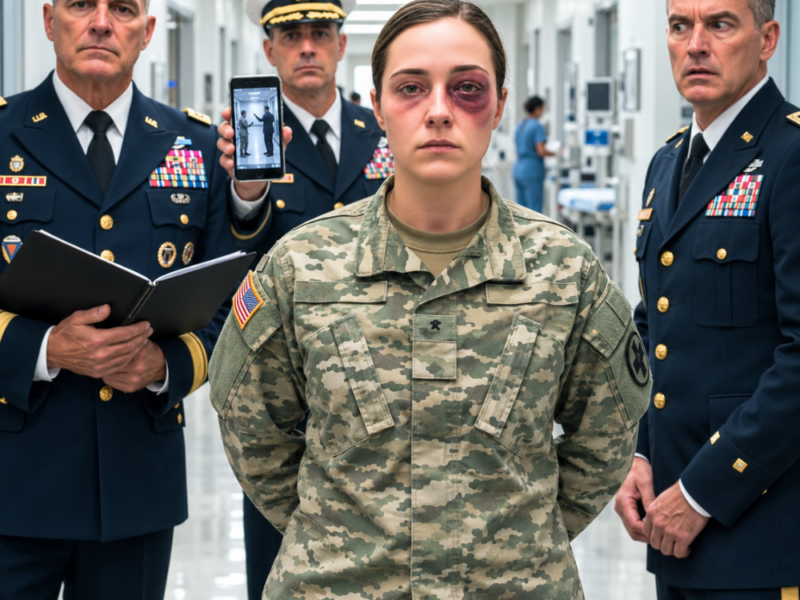
CAPTAIN Struck a NURSE in Public — 10 Minutes Later, GENERALS Arrived and Ended His Career
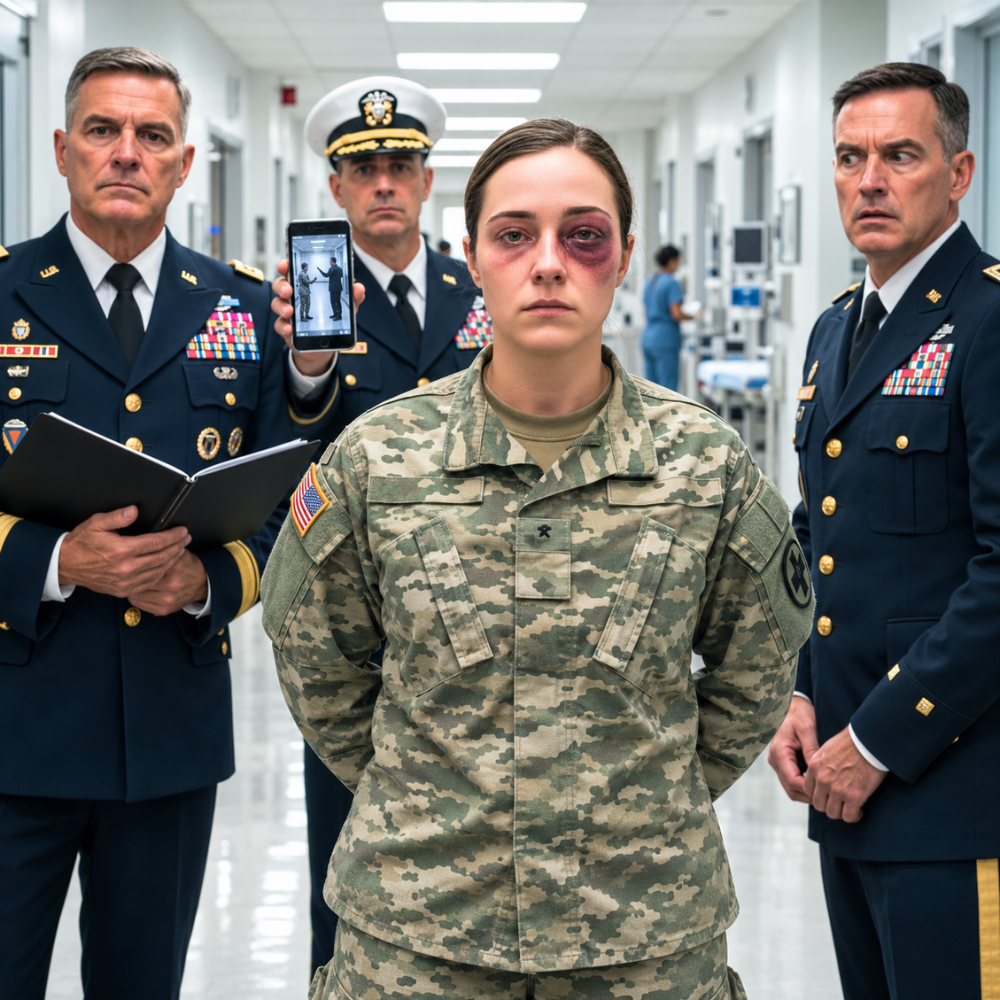
The captain struck a woman in the mess hall because she showed no rank—then three generals walked into his commander’s office
The mess hall went silent before Captain Rafael Cruz understood what he had done.
Two hundred soldiers had been eating lunch beneath humming fluorescent lights when the sound of his hand striking the woman’s face cut through the room.
Forks stopped halfway to mouths.
A chair scraped.
Someone near the beverage station whispered, “Oh, hell.”
The woman did not fall.
She turned her face slightly from the impact, steadied herself, and looked back at Cruz.
That frightened Sergeant Major Luis Ortega more than if she had shouted.
There was no panic in her expression.
No visible rage.
Only a small, controlled breath.
Cruz stood six feet away from her, shoulders squared as though the confrontation had been an inspection he believed he had won.
“You don’t walk onto my installation and ignore military standards,” he said.
The woman touched the side of her mouth with one finger.
“You’ve made your position very clear, Captain.”
Her voice was low.
Cruz’s face tightened.
“You don’t wear rank. You refuse to identify who you work for. You walk through restricted areas asking questions and then stand there like nobody has authority over you.”
She looked at the temporary visitor credential clipped inside her jacket.
It had already been inspected twice that morning.
“This dining facility is not a restricted area.”
“You know what I mean.”
“I usually do.”
A few soldiers lowered their eyes.
Cruz heard the quiet reaction and took it as mockery.
His voice rose.
“I asked you a direct question.”
“And I answered it.”
“No. You dismissed me.”
The woman looked toward the tables.
Some soldiers were watching openly now.
Others had learned long ago that survival on Fort Garrison sometimes meant appearing deeply interested in mashed potatoes.
She turned back to Cruz.
“That’s enough.”
He laughed.
“Excuse me?”
“I said that’s enough.”
Something changed in his face.
Sergeant Major Ortega knew the look.
He had seen it directed at privates in the motor pool, junior lieutenants outside headquarters, mechanics who failed to make a truck ready on an impossible schedule.
Cruz hated being denied the last word.
Especially in public.
“You don’t tell me what’s enough.”
The woman’s eyes never moved.
“Apparently I just did.”
That was when his hand moved.
It happened too fast for anyone nearby to intervene and too publicly for anyone to later pretend it had not happened.
Now the woman stood facing him with a reddening mark near her cheek.
Cruz seemed almost surprised by the room’s reaction.
He had expected his authority to explain everything.
It usually did.
The woman adjusted her jacket.
“That won’t be necessary again.”
Cruz gave a humorless laugh.
“Are you threatening me?”
“No.”
She looked at him for another second.
“Threats are what people use when they have no process.”
Then she turned and walked toward the exit.
No tears.
No dramatic accusation.
Her boots struck the linoleum in a steady rhythm until the doors closed behind her.
The silence lasted perhaps three seconds.
Then the room erupted.
“What the hell was that?”
“Did he actually hit her?”
“Who is she?”
“Some contractor?”
“I heard she’s from Washington.”
“No way.”
At the center of the noise stood Rafael Cruz, still trying to inhabit the version of events in which he had restored order.
“Everybody sit down,” he snapped.
A few soldiers obeyed automatically.
Others did so more slowly.
Cruz pointed toward the doors.
“Some people come onto installations thinking standards don’t apply to them. That ends here.”
Sergeant Major Ortega watched him.
Twenty-six years in uniform had taught Ortega the difference between command presence and insecurity wearing rank.
Good leaders could make a room quiet without demanding quiet.
Cruz needed volume.
He needed witnesses.
He needed people to see him winning.
Ortega picked up his tray.
At the table beside him, Specialist Jamal Rivers stared at the door through which the woman had disappeared.
Rivers had been one of Cruz’s favorite public examples six months earlier.
A minor uniform issue.
Boots insufficiently polished after a maintenance shift in mud.
Cruz had turned it into a twenty-minute humiliation in front of an entire platoon.
Rivers spent the next week on extra duties.
Nobody ever wrote down why.
Ortega looked at him.
“You all right?”
Rivers blinked.
“Yes, Sergeant Major.”
“No, you’re not.”
Rivers lowered his voice.
“Sir, if he does that to somebody in front of two hundred people…”
He did not finish.
Ortega understood.
What did he do when there were six?
Or two?
Or no witnesses at all?
Ortega carried his tray to the return window.
Then he went outside.
October wind moved hard across Fort Garrison’s high-desert landscape.
The fictional installation sat several hours south of Albuquerque, surrounded by flat earth, scrub, training ranges, and distant mountains that seemed closer than they were.
It was not a prestigious posting.
Fort Garrison produced no glamorous recruitment commercials.
Units rotated through.
Careers stalled.
Good soldiers adapted.
Bad leaders sometimes flourished because higher headquarters rarely looked closely unless readiness numbers collapsed.
The woman stood near the edge of the parking area overlooking the flight line.
A C-130 was taxiing in the distance.
She had both hands inside the pockets of a plain field jacket.
No visible rank.
No name tape.
No branch insignia.
That had been intentional, Ortega now suspected.
He stopped several feet away.
“Ma’am?”
She kept watching the aircraft.
“You okay?”
“I’m fine.”
“That looked like more than fine.”
“It was.”
Ortega glanced back toward the mess hall.
“You should get checked.”
“I will.”
“He hit you.”
“Yes.”
“In front of half the brigade.”
“Closer to two hundred.”
Ortega frowned.
“You counted?”
“No.”
She looked at him.
“But somebody will.”
Something in the answer made Ortega study her more carefully.
“You reporting him?”
She turned back toward the runway.
“I don’t think reporting will be the problem.”
Ortega felt the hair rise along his arms.
“You know who I am?”
“Sergeant Major Luis Ortega.”
He looked down automatically at his uniform.
His name and rank were visible.
Of course she knew.
Still, the way she said it suggested she had known before turning.
“Who are you?”
A faint smile touched her face.
“Elena Vance.”
“That’s it?”
“For the moment.”
“You military?”
“Yes.”
“Officer?”
She looked at him.
“That question is more interesting after lunch, isn’t it?”
Ortega almost smiled.
Then became serious.
“Captain Cruz has complaints.”
“I know.”
That stopped him.
“What complaints?”
“Several.”
“You’re investigating him?”
“I’m investigating Fort Garrison.”
The wind pulled at her jacket.
Ortega’s stomach dropped.
“What office?”
Vance looked toward headquarters.
“If everything works correctly, Sergeant Major, you won’t need me to tell you.”
She started walking away.
Ortega called after her.
“Ma’am.”
She stopped.
“Why didn’t you tell him?”
“Tell him what?”
“Who you were.”
Vance thought for a moment.
“Because the point of an unannounced command-climate inspection is to see how people behave before they know who matters.”
She glanced toward the mess hall.
“I did not expect him to strike me.”
That answer mattered.
This had not been some elaborate trap.
She had wanted to observe.
Cruz had chosen the rest.
Vance continued walking.
Ortega stood in the wind feeling as though the installation beneath his boots had shifted several inches.
By 1400, rumors had reached every corner of Fort Garrison.
Motor pool.
Supply warehouse.
Barracks.
Medical clinic.
Range control.
Headquarters.
Nobody knew exactly who Elena Vance was.
That made the speculation worse.
“Inspector General.”
“CID.”
“Pentagon.”
“Army headquarters.”
“I heard she’s civilian intelligence.”
“She told Ortega she’s military.”
“How do you know?”
“My roommate’s girlfriend works at brigade.”
“That sentence has never produced reliable intelligence.”
Private First Class Danny Torres heard five versions before lunch ended.
He worked at the fuel depot and had watched Cruz scream at a civilian mechanic three weeks earlier because a generator failed inspection.
The mechanic later joked about it.
People joked about things they were not allowed to be angry about.
Torres’s supervisor, Staff Sergeant Nolan, leaned against a tool cabinet.
“Whatever she is, Captain’s finished.”
Torres looked skeptical.
“You think?”
“He hit somebody.”
“Officers get away with stuff.”
Nolan looked at him.
“That sentence is why I’m guessing she’s here.”
Across post, Private Kesha Monroe received an ordinary request that became extraordinary the moment she typed Elena Vance’s name.
Monroe worked personnel administration.
Twenty-one years old.
Two years in uniform.
Good enough with Army information systems that supervisors routinely handed her tasks that technically belonged to somebody one grade higher.
Captain Cruz had emailed at 1315.
Need background on visitor Elena Vance for command packet. Find sponsoring organization, grade if applicable, reason on installation.
Routine.
Monroe entered the name.
The system paused.
Then a red banner appeared.
ACCESS RESTRICTED.
AUTHORIZATION LEVEL INSUFFICIENT.
ATTEMPT LOGGED.
Monroe stared.
She had seen access restrictions.
Medical privacy.
Investigative flags.
High-level visitor files.
This looked different.
She tried nothing else.
That decision probably saved her from an unpleasant afternoon.
Instead she called the help desk.
“I’m getting a restriction I haven’t seen before.”
“Name?”
“Elena Vance.”
Silence.
Monroe looked at the phone.
“Hello?”
The technician returned.
“Where are you calling from?”
“Fort Garrison admin. Building C.”
“Do not attempt the record again.”
“I wasn’t going to.”
“Who requested it?”
Monroe swallowed.
“Captain Cruz.”
Another pause.
“Stay at your desk.”
“What?”
“Someone will speak with you.”
The call ended.
Ten minutes later, two investigators arrived.
Not dramatic men in dark glasses.
One Army officer in civilian business attire and one Department of Defense investigator wearing a badge on his belt.
They asked Monroe to step into a conference room.
Her hands shook.
The older investigator noticed.
“You’re not in trouble.”
“That’s usually what people say before paperwork.”
He almost smiled.
“We need to know exactly what Captain Cruz requested.”
Monroe showed them the email.
They photographed it.
“Did he ask you to search anyone else?”
“No, sir.”
“Did he explain why?”
“Said she needed to go into the weekly command packet.”
“Did that sound normal?”
“Mostly.”
“Mostly?”
“He sounded mad.”
“How can an email sound mad?”
Monroe hesitated.
“He writes whole sentences when he’s normal.”
The investigator looked at the message.
Need background on visitor Elena Vance. Find everything.
No greeting.
No signature.
He nodded.
“Fair.”
Monroe asked, “Who is she?”
The officer looked at her.
“Somebody you should not discuss in the office yet.”
“That sounds terrible.”
“For Captain Cruz?”
A pause.
“Potentially.”
Monroe returned to her desk and followed instructions.
She told her supervisor only that an access question had been resolved.
He knew enough not to ask further.
Captain Rafael Cruz, meanwhile, was writing the report that would eventually become one of the most damaging documents in his case.
He sat behind his desk with his tie loosened and his confidence mostly restored.
Paperwork comforted him.
Paperwork meant framing.
Framing meant control.
He typed:
At approximately 1215, I encountered an unidentified female visitor displaying disregard for installation standards and failing to respond appropriately to a lawful request for identification.
He paused.
The word lawful looked good.
He continued.
Subject became verbally confrontational and refused repeated directions to explain her presence.
Then came the difficult part.
The physical contact.
Cruz stared at the screen.
He could write slap.
That looked bad.
He chose another phrase.
I initiated brief physical corrective contact after subject continued to challenge command authority in view of junior personnel.
He read it.
Physical corrective contact.
Better.
Almost professional.
He continued.
Action was intended to restore order and was not intended to cause injury.
He saved the report.
Then added a recommendation that Vance’s installation access be reviewed.
Cruz leaned back.
People became afraid of documentation because most people did not understand how useful it was to write first.
He had learned that early.
If two soldiers had different stories, the one whose memorandum entered the file first often became the center around which later facts were forced to organize themselves.
His phone rang.
Colonel Marcus Decker’s aide.
“Captain Cruz?”
“Yes.”
“Report to the commander’s office.”
“When?”
“Now.”
“What’s it regarding?”
A pause.
“Just come, sir.”
Cruz frowned.
“Lieutenant, I asked—”
The line disconnected.
That annoyed him more than it frightened him.
At first.
The walk across the quad changed that.
Soldiers stopped talking when he passed.
Not unusual after public conflict.
But headquarters looked different.
Two visiting military attorneys stood near the entrance.
A command sergeant major Cruz did not recognize waited outside Decker’s office.
Then Cruz saw the general officer aides.
One.
Two.
Three.
His mouth went dry.
The colonel’s door stood open.
“Captain,” the aide said.
Cruz entered.
Colonel Marcus Decker sat behind the desk.
Fifty-one.
Career infantry officer.
Three years from retirement eligibility at a rank he hoped would become brigadier general if the right evaluation arrived at the right time.
Usually Decker projected certainty.
Now he looked ill.
Three general officers stood near the conference table.
One wore two stars.
Two wore one.
Cruz came to attention.
“Sir.”
The two-star general stepped forward.
Lieutenant General Samuel Pike had flown from Army headquarters that afternoon after receiving a call that had changed several schedules.
“Captain Cruz.”
“Yes, sir.”
“Did you physically strike a woman in the dining facility today?”
Cruz swallowed.
“Sir, there was an incident involving an unauthorized—”
“Did you strike her?”
“Yes, sir, but—”
“Thank you.”
Pike picked up a printed page.
“Is this your report?”
“Yes, sir.”
Pike read.
“Physical corrective contact.”
Cruz’s stomach tightened.
“Yes, sir.”
“What doctrine authorizes captains to use physical corrective contact on civilian visitors?”
“She was being disruptive.”
“That did not answer the question.”
Cruz glanced toward Colonel Decker.
Decker looked away.
“No doctrine, sir.”
Pike placed the paper down.
“Do you know who Elena Vance is?”
“No, sir.”
Pike studied him.
“Major General Elena Vance is assigned to the Department of the Army Inspector General enterprise and currently leads a special assessment team reviewing command climate, retaliation complaints, and installation oversight.”
Cruz heard only the rank at first.
Major General.
Two stars.
The rest arrived slowly.
Inspector General.
Special assessment.
Command climate.
His breathing changed.
Pike continued.
“She was on Fort Garrison under authorized low-visibility inspection status. Her access credentials were valid. She was not required to identify her grade to you.”
Cruz stared straight ahead.
“I didn’t know.”
“No.”
Pike’s voice remained calm.
“That is precisely the concern.”
Cruz blinked.
“Sir?”
“If you require a person to outrank you before you refrain from striking them, your ignorance of her rank does not help you.”
The room became unbearably quiet.
Cruz looked toward Decker again.
Nothing.
Pike continued.
“Effective immediately, you are suspended from command duties pending investigation.”
Cruz’s face went pale.
“Sir, with respect—”
“You will surrender your weapon, access credentials, government phone, and any command-admin privileges.”
“Sir, I have witnesses.”
“Yes.”
Pike looked at the report.
“Approximately two hundred of them.”
Cruz’s mind raced.
He had expected protection.
A private conversation.
Decker closing the door and telling him he had gone too far.
Maybe a reprimand.
Not this.
“You’re ending my career over one moment?”
Pike looked at him.
“No, Captain.”
That answer landed harder.
“We do not yet know what this will end.”
Two military police investigators entered.
Cruz removed his sidearm.
His identification card.
His phone.
The same items he had worn every day without thinking about them.
In less than a minute, he went from the officer who believed the installation belonged to him to a man being escorted through the same hallway while junior soldiers watched.
Sergeant Major Ortega stood near the far wall.
Their eyes met.
Cruz looked away first.
Major General Elena Vance did not attend the meeting.
She was at the clinic having her face examined and giving a statement.
That also mattered.
She had no interest in turning rank into theater.
The photograph showed mild swelling.
No fracture.
No serious injury.
The physical harm was limited.
The institutional question was not.
At 1700, Vance entered a secure conference room with investigators, military attorneys, and representatives from higher headquarters.
Security footage from the dining facility was already preserved.
The video played once.
Cruz confronting her.
Vance answering.
Cruz blocking her.
The strike.
A lawyer stopped the recording.
“We have sufficient basis for a formal investigation into Captain Cruz.”
Vance nodded.
“That is the small question.”
The lawyer looked at her.
“What’s the large one?”
Vance opened a folder.
“Why was he comfortable doing it?”
Nobody answered.
She continued.
“I reviewed preliminary command-climate complaints before arriving.”
She placed several pages on the table.
“Cruz appears repeatedly.”
“Informal or formal?”
“Both.”
“How many?”
“Six formal in eighteen months.”
One investigator looked surprised.
“I was told three.”
“Three survived into the consolidated system.”
Vance turned another page.
“Three were resolved locally before they moved upward.”
“By Colonel Decker?”
“His staff.”
The room changed.
Vance continued.
“Complaints include public humiliation, retaliatory duty assignments, unsafe corrective training, threats to evaluations, and one allegation of physical intimidation.”
“Substantiated?”
“None.”
The attorney frowned.
“All false?”
“That is what we are here to learn.”
Vance looked toward the frozen video image of Cruz raising his hand.
“Men do not usually begin with this.”
Silence.
“They test smaller boundaries.”
She pointed toward the complaints.
“Somebody tells them the smaller violations are leadership style. Somebody tells the complainant not to damage the unit. Somebody closes a file. The behavior grows.”
She sat back.
“I want three years.”
“Three years of what?”
“Complaints. Reassignments. negative evaluations following complaints. Requested transfers. Anonymous climate surveys. Safety reports. Retaliation allegations.”
The senior attorney studied her.
“That becomes an installation-wide audit.”
“Yes.”
“This could disrupt operations.”
“Then operations have already been disrupted. We simply have not measured it.”
The investigation widened overnight.
Not because Vance had been slapped.
Because the slap provided a reason higher headquarters could no longer dismiss the warning signs already sitting in Fort Garrison’s own records.
Specialist Jamal Rivers was interviewed first thing the next morning.
He sat across from two investigators and tried to protect everybody, including the people who had failed him.
“I don’t want to destroy anyone’s career.”
The lead investigator, Sarah Klein, nodded.
“Then don’t.”
Rivers looked confused.
“Tell us what happened. Careers belong to the people who made the decisions.”
That helped.
He described the boot incident.
The shouting.
Being ordered into repetitive physical exercise after a full maintenance shift.
The public insults.
Then the extra duties.
“Did you report it?”
“No.”
“Why?”
Rivers looked down.
“Because Sergeant Webb did.”
“Who?”
“Marcus Webb.”
The investigator searched a database.
“Transferred?”
“Yes.”
“Why?”
“Nobody said.”
“What happened after he complained?”
Rivers gave a bitter smile.
“He became the busiest man on post.”
“How?”
“Midnight duty. Cleanup details. Gate shifts. Every garbage assignment. If something terrible appeared on a roster, Webb’s name appeared next to it.”
“How long?”
“Two months.”
“Then?”
“He requested transfer.”
Klein wrote.
“Was Captain Cruz responsible for the roster?”
“Not directly.”
“Who was?”
“Company leadership.”
“Did Cruz influence them?”
Rivers hesitated.
“I can’t prove that.”
“Good.”
He looked up.
“We only want what you can.”
That sentence moved through the investigation.
What can you prove?
Not what everyone knows.
Not what people whisper.
Proof.
Records showed Marcus Webb had filed a written complaint seven months earlier alleging Cruz threatened his career after Webb raised a vehicle-safety issue.
Three witnesses supported parts of his account.
Colonel Decker personally reviewed the complaint.
Final disposition:
Leadership style conflict. No further action required.
Within three weeks, Webb received unusually poor duty assignments.
Within two months, he requested reassignment.
His previous evaluations had been strong.
His next evaluation declined.
That could have been coincidence.
Investigators kept looking.
Private Monroe’s email became another record.
Cruz had tried to identify Elena Vance after striking her.
Not criminal by itself.
But his report described her as an unidentified intruder even though her visitor credential had been checked at the facility entrance.
Security footage showed Cruz never asking to see it before escalating.
His written account was already failing against the video.
By the second day, fourteen soldiers and civilians had given statements describing similar patterns.
Not all about Cruz.
That was important.
One first sergeant routinely threatened unfavorable evaluations when soldiers requested behavioral-health appointments during training weeks.
A maintenance chief discouraged written safety reports because “brigade sees numbers, not context.”
A company commander had informally reassigned a soldier after she complained about a senior NCO touching her inappropriately.
Some claims would prove unsubstantiated.
Others would hold.
Vance did not want a purge.
She wanted the difference.
Colonel Decker’s interview took four hours.
He began with readiness.
That told Sarah Klein almost everything.
“We were under enormous pressure.”
“For?”
“Inspection results. Training metrics. Personnel shortages.”
“How does that relate to Captain Cruz?”
“He gets results.”
“What kind?”
“High readiness. Vehicles ready. Soldiers at training. Reports on time.”
Klein opened a folder.
“And complaints?”
Decker exhaled.
“He has a hard leadership style.”
“Meaning?”
“Direct.”
“Does direct include threatening careers?”
“I never substantiated that.”
“You had witnesses.”
“I had conflicting statements.”
Klein slid Webb’s complaint forward.
“Three soldiers corroborated the conversation.”
“Not every detail.”
“You interviewed Webb?”
“Yes.”
“Did you interview Cruz?”
“Yes.”
“Then you characterized it as a style difference.”
“I believed both men contributed.”
“How?”
Decker looked at the file.
“Webb challenged him publicly.”
“He raised a vehicle safety concern.”
“Yes.”
“Was the concern valid?”
A pause.
“The vehicle was later removed from service.”
Klein stared.
“So Webb was right.”
“About the vehicle.”
“And he was punished after reporting the captain’s response.”
“I did not order punishment.”
“Did you notice his duty roster?”
“No.”
“Did he tell you?”
Decker’s silence became the answer.
Klein continued.
“He emailed your office twice.”
“I receive hundreds of emails.”
“That is why you have staff.”
Decker’s hands tightened.
“What are you trying to make me say?”
“Nothing.”
She leaned back.
“I am trying to understand what you did.”
He looked down.
“I wanted things quiet.”
There it was.
Klein said nothing.
Decker continued.
“Fort Garrison already had morale problems. We were competing for mission assignments. Another command-climate investigation would have made us look dysfunctional.”
“So you managed complaints informally.”
“Yes.”
“Even when they involved physical intimidation?”
“I thought counseling was better than formal action.”
“Did you counsel Cruz after Webb?”
Decker looked away.
“No.”
“Why?”
“I got busy.”
Klein closed the folder.
“So the complainant received consequences and the officer received none.”
“I wouldn’t put it that way.”
“How would you put it?”
Decker had no answer.
Higher headquarters removed him from command pending a full administrative and legal review.
That happened on Friday.
By Monday, Brigadier General Patricia Sharp arrived as interim installation commander.
Sharp was fifty-seven, blunt, and famous for reading source documents herself.
She called an installation-wide formation.
Nearly three thousand soldiers stood in cold morning air while breath fogged above the ranks.
Sharp had one page of notes.
She did not use it.
“I know you’ve heard rumors.”
Silence.
“Captain Rafael Cruz has been removed from duty pending formal military justice proceedings involving an assault and other allegations.”
A few heads turned.
“Colonel Marcus Decker has been relieved pending investigation into failures of command oversight and retaliation complaints.”
The formation remained still.
Sharp continued.
“I also know some of you do not trust what I’m about to say.”
That got attention.
“You have reasons.”
She looked across the ranks.
“Some of you used reporting channels and believe those channels punished you. Some stayed quiet because you watched what happened to people who didn’t.”
She paused.
“I am not going to stand here and tell you the system worked.”
Nobody moved.
“It didn’t.”
That sentence traveled farther across the formation than any motivational speech would have.
Sharp continued.
“Our job now is to make it work.”
She described temporary reporting channels outside the local chain of command.
Inspector General.
Legal assistance.
Criminal investigators where appropriate.
Protected witness procedures.
Direct hotline access.
Independent review of retaliation claims.
“If you file a complaint, that does not mean the accused is automatically guilty.”
Important.
“It means the complaint gets examined.”
Another pause.
“If you retaliate against somebody for making a protected report, you may become the subject of a second investigation.”
That mattered even more.
Sharp finished.
“Rank is authority to perform a duty. It is not permission to humiliate people.”
Then she dismissed the formation.
Reports began slowly.
Three on the first day.
Two the next.
Some repeated old allegations.
Some described new ones.
Investigators substantiated certain claims and closed others.
A senior NCO accused of bullying was ultimately cleared after witness accounts contradicted the complaint.
Vance insisted that result be communicated clearly.
“If people think accountability means every accusation ends a career, reporting becomes another weapon.”
Sharp agreed.
Another complaint involving deliberate retaliation against a medical appointment was substantiated.
The leader received formal discipline.
A lieutenant accused of threatening a private over a safety report admitted it during questioning.
Removed from leadership.
Training.
Evaluation consequences.
Not prison.
Not every wrongdoing required prison.
That too became part of the rebuilding.
Captain Cruz’s case moved separately.
He retained military defense counsel and a civilian attorney.
His defense was straightforward.
He had been provoked.
He believed Vance represented a security concern.
He did not know her rank.
He lacked criminal intent.
The prosecution did not need to prove he knew her rank to prove assault.
That simplified things.
The more serious question became pattern evidence surrounding abuse of authority.
Prosecutors were careful.
Not every rumor would enter court.
Only properly admissible material.
Vance gave her statement once.
Then went back to work.
She refused television interviews.
Declined invitations to talk about leadership.
A base newspaper reporter asked whether she had intentionally allowed Cruz to strike her.
Vance corrected him immediately.
“No.”
“You could have identified yourself.”
“I could have.”
“Why didn’t you?”
“Because I was conducting an authorized low-visibility inspection and had given him valid installation credentials.”
“So you wanted to see how he treated an ordinary visitor.”
“I wanted to see how the installation treated people before they knew an inspector was present.”
“And the strike?”
“His choice.”
She paused.
“Do not turn somebody else’s misconduct into my clever plan.”
The reporter nodded.
That quote later mattered.
It prevented the story from becoming mythology too quickly.
Vance did not want mythology.
Mythology made one villain responsible for a system.
Systems preferred that.
If everything bad about Fort Garrison belonged to Rafael Cruz, everyone else could feel innocent.
The deeper review showed something else.
Cruz had been enabled.
Decker had avoided conflict.
Company commanders had learned that negative command data hurt careers.
Senior NCOs had been rewarded for low complaint numbers.
Soldiers noticed.
So problems migrated into whispers.
Whispers did not appear on readiness slides.
Readiness slides remained green.
That was how institutions lied without any single person always intending to lie.
Vance presented the first findings to Army leadership six weeks later.
The conference room in Washington contained generals, attorneys, civilian officials, and data people.
One lieutenant general frowned at the numbers.
“You’re telling me complaints increased after General Sharp took command.”
“Yes.”
“And morale improved.”
“Initial survey says yes.”
“That seems contradictory.”
“No.”
Vance clicked to another slide.
“Before the changes, soldiers believed complaints created retaliation.”
“So fewer reported.”
“Yes.”
“Now they trust the process more.”
“So more report.”
The general leaned back.
“Meaning high complaint numbers can sometimes indicate healthier reporting.”
“Exactly.”
He looked annoyed.
“That ruins half our dashboards.”
Vance almost smiled.
“Better dashboards than soldiers.”
The Cruz trial began four months after the mess hall incident.
By then Fort Garrison had moved on enough that lunch again sounded like lunch.
Cruz entered the courtroom in uniform.
No weapons.
No command position.
His civilian attorney tried to frame the confrontation as an unfortunate misunderstanding magnified by Vance’s hidden status.
Under cross-examination, Vance remained calm.
“You did not tell my client you were a major general.”
“No.”
“You did not render a salute.”
“We were indoors in a dining facility, and I was not in uniform.”
“You understand Captain Cruz may have believed you were violating installation procedures.”
“He was free to verify my credential.”
“Did you show it?”
“I had already shown it to the staff member at the entrance. Captain Cruz never asked to see it.”
The attorney paused.
“You could have de-escalated by identifying yourself.”
“Yes.”
“Yet you chose not to.”
“I answered his questions about my authorization.”
“But not your rank.”
“No.”
“Why?”
“Because my rank was irrelevant to whether he could strike me.”
Silence.
The defense attorney turned toward the panel.
“General, isn’t it true you wanted to observe Captain Cruz?”
“I was assessing the installation.”
“So you were evaluating him.”
“I was evaluating many things.”
“You knew complaints existed.”
“Yes.”
“And you allowed the confrontation to continue.”
Vance looked at him.
“Counsel, I expected a captain in the United States Army to remain capable of disagreement without hitting someone.”
The courtroom went still.
No further flourish.
No dramatic speech.
The panel deliberated less than a day.
Cruz was convicted of assault consummated by battery, conduct unbecoming an officer, and several related offenses arising from substantiated abuse-of-authority incidents introduced separately.
The sentence ended his military career.
Dismissal from service.
Confinement.
Loss of benefits associated with the punitive discharge as prescribed by law.
It was serious.
Less theatrical than the internet wanted.
Vance attended sentencing in the back row.
Cruz gave an unsworn statement.
He blamed stress at first.
Then stopped.
“I thought authority meant people should comply with me quickly.”
His voice shook.
“I thought if they didn’t, I was losing control.”
He looked toward the panel.
“That is how I led.”
Vance watched him.
No pleasure.
No pity.
Only recognition.
People became dangerous when they confused obedience with respect.
Outside the courthouse, reporters waited.
Vance gave one sentence.
“Captain Cruz was convicted by a lawful process. The soldiers who reported concerns deserve the attention now.”
Then she left.
Colonel Decker’s proceeding came later.
His wrongdoing was different.
He had not assaulted soldiers.
He had repeatedly failed to address substantiated concerns, discouraged formal reporting, and tolerated retaliatory practices because quiet command statistics improved his reputation.
Some charges were administrative rather than criminal.
His career ended.
He retired at a reduced grade after formal findings and disciplinary action.
Online commenters complained that was too easy.
Vance understood the feeling.
She also understood justice was not a popularity contest.
“What did you want?” Captain Rebecca Hollis asked one evening.
Hollis served as Vance’s aide in Washington.
They were sitting in the Pentagon cafeteria after most offices emptied.
“For Decker?”
“Yes.”
“I wanted the record to be accurate.”
“That sounds like an inspector general answer.”
“It is.”
“Were you angry?”
“Yes.”
“Still?”
“Yes.”
Hollis ate a french fry.
“You hide it well.”
“I’m paid to.”
The larger investigation did not stop at Fort Garrison.
That was where the original script of Vance’s career might have turned into a conspiracy thriller if she had allowed suspicion to replace evidence.
She did not.
Several whistleblowers from other installations contacted her office after reading about the Garrison review.
Some reports involved severe misconduct.
Others involved ordinary personnel disputes.
Every caller believed theirs connected to something larger.
Most did not.
Vance learned to say:
“We will investigate what the evidence supports.”
One report came from Captain Michelle Torres at Fort Liberty.
Torres worked in contracting.
Twenty-nine.
Smart.
Frightened.
She brought emails showing a procurement officer steering small maintenance contracts repeatedly toward three connected vendors.
Not proof of a massive criminal network.
Enough for an audit.
The audit found inflated bids and undisclosed relationships.
The procurement officer received kickbacks.
Two contractors were charged federally.
Torres’s name leaked internally.
Someone tried to move her into a dead-end position.
This time, the new retaliation protocols caught it.
The reassignment was paused.
The person who ordered it was investigated.
Torres stayed.
That outcome spread quietly through the Army.
Not because a general had saved her.
Because a process had.
At Fort Garrison, Sergeant Major Ortega became one of the strongest defenders of the new reporting system.
At first, younger soldiers distrusted him.
He had been there during the old culture.
Why had he not stopped it?
One specialist asked him directly during an NCO professional-development session.
Ortega could have defended himself.
He did not.
“I should have done more.”
The room went quiet.
“I corrected what I saw.”
He looked around.
“But I accepted too many things as personality.”
A sergeant asked, “Like Cruz?”
“Yes.”
“Did you know?”
“I knew he humiliated people.”
“Then why didn’t you report?”
Ortega thought.
“Because I told myself he stayed technically inside the line.”
“What line?”
“Exactly.”
The young soldiers watched him.
Ortega continued.
“I was waiting for one event big enough to justify action.”
He paused.
“That was lazy leadership.”
Nobody expected a sergeant major to say that.
He continued.
“Good leaders respond to patterns before somebody gets hit in a mess hall.”
The quote made it into the base paper.
Vance clipped the article.
She kept almost nothing sentimental.
That she kept.
A year after the incident, she returned to Fort Garrison for a scheduled follow-up.
No disguise.
No plain jacket.
She wore her Army service uniform.
Two stars on her shoulders.
The difference in how people treated her was almost embarrassing.
Doors opened.
People stood.
Colonels smiled.
Young soldiers snapped to attention.
At the mess hall, Ortega handed her coffee.
“See?”
She looked at him.
“See what?”
“Nobody slaps you when you wear stars.”
Vance laughed.
“That is statistically preferable.”
They sat near a window.
The table where Cruz had confronted her was somewhere behind them.
Neither cared which one.
“How’s the base?” she asked.
“Better.”
“Meaning?”
“Complaints up.”
“Good.”
“Retaliation reports down.”
“Better.”
“Maintenance safety write-ups doubled.”
Vance raised an eyebrow.
“That sounds concerning.”
“It means they’re writing them now.”
“Good answer.”
Ortega drank coffee.
“Rivers made sergeant.”
“Jamal?”
“Yes.”
“He staying?”
“Signed reenlistment papers.”
Vance smiled.
“Why?”
“Said he wanted to see whether the place stayed worth serving at.”
“That’s a lot of pressure for one base.”
“He’s young.”
They became quiet.
Then Ortega asked the question he had asked once before.
“You ever wish you had just told Cruz who you were?”
Vance looked across the room.
“Yes.”
Ortega seemed surprised.
“Really?”
“The second before he hit me.”
He laughed.
She smiled.
Then became serious.
“I think people turned that day into something too neat.”
“How?”
“They say I let him hit me to expose the system.”
“You didn’t?”
“No.”
“I suspected there was a command-climate problem.”
She touched her coffee cup.
“I did not know a captain was going to assault me over lunch.”
Ortega nodded.
“That would be a strange inspection plan.”
“Very.”
“So why stay quiet about rank?”
“Because ordinary people on an installation do not get to pull stars out of a pocket.”
She looked at him.
“Contractors. spouses. junior soldiers. civilian employees. They still deserve professional treatment.”
Ortega nodded.
“If I had identified myself at the beginning, Cruz would have saluted metaphorically even if not literally.”
“Probably.”
“And I would have learned nothing.”
“You learned plenty.”
“More than I wanted.”
That follow-up produced data Army headquarters could use.
Complaints did not vanish.
That would have been suspicious.
Resolution times improved.
Anonymous climate surveys showed more soldiers believed misconduct would receive review.
Fear of retaliation declined.
Leadership trust increased slowly.
Slowly mattered.
Real cultural change rarely looked like an inspirational montage.
It looked like a sergeant filing the right memorandum.
A commander explaining why a complaint was closed.
An investigator calling a witness back.
A soldier seeing that another soldier’s career survived speaking up.
Paperwork.
Boring meetings.
Training that people complained about until they needed it.
Vance spent the next five years pushing those ideas into policy.
She did not become the all-powerful figure social media sometimes imagined.
No four-star inspector with unlimited authority.
No ability to arrest senators.
No secret list of officers to destroy.
Her influence was more ordinary and therefore more durable.
Reporting requirements.
External review thresholds.
Retaliation tracking.
Mandatory preservation of complaint records.
Independent oversight when senior officers were accused.
Metrics distinguishing volume of reports from substantiation rates.
Those details were harder to fit on television.
They changed more lives.
Captain Torres eventually testified before a congressional committee about procurement retaliation.
She described the first time she considered reporting.
“What made you believe you might be protected?” a senator asked.
Torres thought.
“I watched what happened at Fort Garrison.”
Vance was sitting behind her.
Torres continued.
“I saw an installation admit its process failed.”
That was what stayed with Vance.
Not that a captain had been punished.
That an institution admitted failure.
Institutions rarely liked doing that.
They preferred reform without confession.
Vance pushed for both.
At a Pentagon leadership course, she told a room of colonels:
“If your complaint numbers are zero, do not automatically congratulate yourself.”
Somebody laughed.
She did not.
“Zero can mean perfection.”
Pause.
“Or fear.”
The room quieted.
“How do we know?” a colonel asked.
“You ask people.”
“Anonymous surveys?”
“Yes.”
“Focus groups?”
“Yes.”
“Inspector General data?”
“Yes.”
“Exit interviews?”
“Yes.”
She leaned forward.
“And then you compare what leaders think is happening with what junior people say is happening.”
One colonel frowned.
“That can become subjective.”
“Culture is subjective until the behavior produces evidence.”
She clicked a slide showing Fort Garrison.
“Then it becomes expensive.”
The reforms drew criticism.
Some officers said commanders were losing authority.
Vance disagreed.
“Unreviewable authority is not strong command.”
She told a service journal.
“It is fragile command protected from feedback.”
Others accused her of creating complaint culture.
Her answer remained the same.
“Investigating a complaint is not the same as believing it automatically.”
She defended leaders falsely accused as aggressively as she defended people ignored.
That surprised critics.
It should not have.
Accountability without fairness was simply another form of power.
Five years after the mess hall incident, a young lieutenant named Erin Shaw came through Vance’s inspector-general training program.
Shaw remained after class.
“General?”
“Yes?”
“My sister left the Army.”
Vance waited.
“She reported sexual harassment.”
Shaw’s jaw tightened.
“Nothing happened to the NCO she reported. Her evaluation dropped. She got transferred. Eventually she got out.”
“I’m sorry.”
“I joined because of her.”
Vance looked at the lieutenant.
“That is a heavy reason.”
“I know.”
“I want to make sure it doesn’t happen to anyone else.”
Vance leaned against the desk.
“Good goal.”
Shaw waited for encouragement.
Vance gave her caution instead.
“Do not turn your sister into permission to believe every complainant automatically.”
Shaw blinked.
“What?”
“If you enter investigations already knowing who is right, you will hurt people.”
The lieutenant looked defensive.
“My sister was telling the truth.”
“I believe you.”
“That’s why I’m here.”
“And the best way to honor her is to build a system strong enough that facts matter more than sympathy.”
Shaw’s expression changed.
Vance continued.
“You investigate thoroughly enough to protect the person reporting and the person accused.”
“That sounds harder.”
“It is.”
“What if the accused outranks me?”
“Evidence does not salute.”
Shaw smiled.
“That sounds like something people would put on a mug.”
“Please don’t.”
They did.
Somebody in the training office printed mugs.
Vance hated them.
Hollis kept one on her desk.
Promotion eventually came.
Lieutenant general.
Three stars.
Not because a single scandal made Vance famous.
Because years of oversight work built a record senior leaders could defend.
At the ceremony, Secretary of the Army Raymond Holt pinned the third star.
Vance’s sister attended.
Hollis stood nearby.
Ortega came from Fort Garrison.
So did Jamal Rivers, now a staff sergeant.
Afterward Rivers waited until the formal handshakes ended.
“General.”
“Staff Sergeant.”
He grinned.
“You remember me?”
“I remember the soldier who said good boots were apparently a strategic resource.”
Rivers laughed.
“That was me.”
“How are you?”
“Good.”
“Really?”
“Really.”
He looked toward the stars.
“Congratulations.”
“Thank you.”
Rivers became serious.
“I almost got out.”
“Ortega told me.”
“I hated the Army.”
Vance waited.
“I thought people like Cruz were what leadership looked like.”
He glanced toward Ortega.
“Then things changed.”
“You changed things too.”
Rivers looked confused.
“You testified.”
“I just told what happened.”
“Exactly.”
Vance extended her hand.
He shook it.
“Don’t give away your part because somebody with stars happened to be visible.”
Rivers nodded slowly.
That became another lesson Vance repeated.
Reform stories often centered senior leaders because cameras liked rank.
But most evidence came from junior people.
Privates.
Specialists.
Sergeants.
Civilian employees.
People who had more to lose than generals did.
Vance wanted their names remembered where they consented.
Marcus Webb’s story remained especially important.
He had transferred away before the investigation.
Unlike the sensational rumors that later circulated online, he had not been murdered.
He was alive.
Tired.
Angry.
Working at another installation and seriously considering leaving the Army.
Investigators contacted him during the Fort Garrison review.
At first he refused.
“I reported once.”
Sarah Klein said, “I know.”
“It cost me.”
“I know.”
“You want me to do it again.”
“Yes.”
Webb laughed bitterly.
“That’s impressive.”
Klein did not defend the system.
“It failed you.”
Silence.
“That is why your statement matters.”
Webb eventually testified.
His records helped establish Decker’s failures and Cruz’s retaliation pattern.
Months later, Vance called him personally.
“I hear you’re separating.”
“That was the plan.”
“Still?”
A pause.
“I don’t know.”
“Why?”
“My new commander asked me to become a safety NCO.”
Vance smiled.
“That seems vindictive.”
Webb laughed.
“Right?”
“You taking it?”
“Maybe.”
He stayed.
Three years later, Sergeant First Class Marcus Webb helped design a retaliation-prevention block for NCO leadership courses.
That, to Vance, meant more than a memorial plaque ever could.
People who survived broken systems should not be required to fix them.
But when they chose to help, institutions should listen.
Cruz wrote Vance from prison once.
The envelope arrived almost six years after the mess hall.
By then he had served most of his sentence.
The letter was handwritten.
General Vance,
I have rewritten this enough times that I’m probably making the same mistake I made as an officer, thinking I can control how something sounds if I choose the right words.
So I’ll keep it simple.
I was wrong.
Not because you were a general.
I was wrong before I knew who you were.
That was the part I refused to understand for a long time.
I thought you humiliated me by not telling me your rank. The truth is that I humiliated myself because I believed I needed rank to decide how to treat you.
I used fear as leadership.
I punished people for embarrassing me.
I treated disagreement as disrespect.
I hurt soldiers.
Prison did not teach me all of that. Losing the ability to give orders did.
I am sorry.
I know the apology does not repair anything.
Rafael Cruz
Vance read the letter twice.
Then placed it in a file.
Hollis asked whether she would answer.
“I don’t know.”
“Do you believe him?”
“Some of it.”
“That enough?”
“For what?”
“Forgiveness.”
Vance looked at her.
“Why does everybody need that word?”
Hollis smiled.
“People like clean endings.”
“I’ve noticed.”
Vance did eventually write back.
Four lines.
Captain Cruz,
Acknowledgment matters.
So does what you do after consequence removes the audience.
I hope you build a life that does not require power over other people.
Elena Vance
No rank.
That was intentional.
Cruz completed his sentence and returned to civilian life.
Vance heard nothing else from him.
That too was acceptable.
Ten years after Fort Garrison, Lieutenant General Elena Vance retired from active military service.
Thirty-four years.
The ceremony took place in a Pentagon auditorium filled with people she would never have invited if ceremonies were left to the person retiring.
Generals.
Civilian officials.
Former inspectors.
Investigators.
Family.
Sergeant Major Ortega, now retired himself.
Major Michelle Torres.
Lieutenant Colonel Rebecca Hollis.
Sergeant Major Jamal Rivers.
Colonel Marcus Webb.
That last one made Vance laugh when she saw him.
“You were leaving the Army.”
Webb smiled.
“Bad plan.”
When Vance approached the podium, the audience stood.
She waited until everyone sat.
“I was told to speak about legacy.”
A few people smiled.
“I dislike the word.”
More smiles.
“It makes people sound finished.”
She looked toward the front row.
“Most of what I’m proud of is unfinished.”
She spoke about Fort Garrison.
Briefly.
Not as legend.
“As many of you know, years ago I conducted an inspection at an installation in New Mexico.”
The room quieted.
“A captain struck me in a dining facility.”
Some people knew the story only through retellings.
Vance continued.
“The internet version says I allowed him to do it because I knew it would expose corruption.”
She shook her head.
“That is not true.”
A few people looked surprised.
“I was doing my job. He made a terrible decision.”
She paused.
“What mattered was what happened after.”
She looked toward Ortega.
“A sergeant major admitted he had normalized warning signs.”
Toward Rivers.
“A specialist told investigators what retaliation looked like.”
Toward Webb.
“A sergeant who had every reason to distrust the system agreed to speak one more time.”
Toward Torres.
“Other officers watched and decided maybe they could report too.”
Then Hollis.
“Investigators documented rather than dramatized.”
Vance returned her gaze to the room.
“That is how systems change.”
No swelling music.
No slogan.
“Not because one person is brave enough to absorb a slap.”
She paused.
“Because enough people decide the next choice will be different from the last one.”
Vance spoke about reporting protections.
Independent review.
False allegations.
Substantiated allegations.
Command responsibility.
The importance of preserving evidence.
Then she said the thing she most wanted younger officers to hear.
“Rank should increase accountability.”
The room was completely silent.
“Not decrease exposure to it.”
She looked at the generals.
“If you believe your stars mean you deserve more protection from scrutiny than the private standing in front of you, then you have misunderstood what those stars are for.”
Nobody moved.
Vance smiled faintly.
“Fortunately, I am retiring, so several people in this room can relax.”
Laughter broke the tension.
She finished.
“The institution is better than when I entered it.”
A pause.
“It is not good enough.”
Another.
“That is not cynicism.”
She looked toward the young officers near the back.
“It is your job description.”
Then she stepped away.
The applause lasted longer than she liked.
That evening, Hollis met her outside with two coffees.
“Still black?”
Vance accepted one.
“You remembered.”
“I have worked for you too long.”
They walked toward the Pentagon steps.
“What are you actually doing Monday?” Hollis asked.
“Sleeping.”
“That’s a lie.”
“Consulting Tuesday.”
“There it is.”
Vance had joined a small nonprofit advisory group helping public agencies and corporations build independent accountability systems.
Not glamorous.
Policy.
Whistleblower protections.
Data retention.
External review.
The same problems without uniforms.
She liked the idea.
Hollis looked toward the parking lot.
“You scared?”
“Of civilian life?”
“Yes.”
Vance considered.
“Some.”
Hollis smiled.
“Fear is information?”
Vance groaned.
“I regret saying that where people could hear me.”
“Too late.”
They reached Vance’s car.
Hollis looked at her.
“You know what I remember from Fort Garrison?”
“What?”
“Not the slap.”
Vance waited.
“The first briefing after.”
“Why?”
“You said, ‘The question isn’t what Cruz did. The question is why he thought it would work.’”
Vance looked toward the Pentagon.
“I said that?”
“I wrote it down.”
“Dangerous habit.”
“You taught us documentation.”
They hugged.
Briefly.
Then Hollis walked away.
Vance sat behind the steering wheel but did not start the engine immediately.
For years people had asked whether Cruz’s assault changed her life.
The answer was yes.
Also no.
Her life had already been shaped by years of inspections where junior soldiers whispered things in hallways and senior leaders insisted everything was fine.
Cruz had not created her belief in accountability.
He had simply given it a moment everyone could see.
That was why the story endured.
A captain believed an unranked woman did not deserve restraint.
He thought authority came from being recognized.
Then he discovered the woman he struck outranked him by several levels.
People loved the reversal.
The hidden general.
The shocked captain.
The career collapse.
Vance understood the appeal.
It still missed the point.
If she had been a cafeteria contractor, Cruz would have been just as wrong.
If she had been a soldier’s wife, just as wrong.
If she had been a private in borrowed civilian clothes, just as wrong.
If nobody important ever learned her name, the act would not have become less wrong.
The danger in the story was believing Cruz’s mistake had been choosing the wrong victim.
His mistake had been believing there was a correct victim.
That was what the reforms tried to remove from the culture.
The idea that some people were safe to humiliate because they could not answer.
The idea that complaints from junior soldiers were inconveniences.
The idea that protecting an institution’s reputation required hiding what damaged it.
The idea that leadership meant never letting anyone see uncertainty.
Years after retirement, Vance returned to Fort Garrison for a leadership conference.
The installation had changed physically.
New headquarters building.
Renovated barracks.
Solar panels covering parking areas.
The desert remained exactly as unimpressed as before.
General Sharp had retired.
A former battalion commander named Denise Walker now commanded the post.
Walker met Vance near the administration building.
“Welcome back.”
“Good to be back.”
“We’ve got lunch in the mess hall.”
Vance laughed.
“Deliberate?”
“Absolutely.”
The room looked almost the same.
Different chairs.
New lighting.
Same basic architecture.
Soldiers ate.
Talked.
Complained about food.
Nobody stopped when Vance entered because Walker had specifically asked staff not to announce her.
Vance liked that.
They collected trays.
A young specialist behind them complained quietly to his friend about a platoon sergeant.
Vance heard only part.
“…told him he’d ruin his NCOER if he reported it.”
Walker heard too.
She did not turn around.
At the table, she took out her phone.
“What are you doing?” Vance asked.
“Making myself a note.”
“You could confront them.”
“Then they’ll stop talking.”
Vance smiled.
“Good.”
After lunch, Walker asked the Inspector General office to examine the allegation discreetly.
The complaint turned out to involve a misunderstanding about evaluation procedure rather than retaliation.
No one punished.
No scandal.
The platoon sergeant received coaching on how his language could reasonably be interpreted.
The soldier received an explanation of the actual process.
File closed.
Vance was delighted.
“This is boring,” Walker said.
“Exactly.”
“You enjoy boring investigations?”
“I have waited years for boring.”
That was what success looked like.
Not dramatic arrests.
Problems caught while still small.
Years later, when reporters wrote retrospective stories about Fort Garrison, they often called it the slap that changed the Army.
Vance corrected them when asked.
“No single slap changed anything.”
“What did?”
“Follow-through.”
That answer rarely became the headline.
It remained true.
A system changed because complaints were preserved.
Witnesses were protected.
Leaders admitted failure.
Investigators separated allegation from proof.
Commanders accepted that higher complaint numbers could mean greater trust.
Junior people saw retaliation punished.
Senior people saw rank provide no exemption.
The work became routine.
Routine was the victory.
At seventy, Vance stopped consulting full-time.
She moved to a smaller house outside Alexandria with a backyard she immediately discovered required more maintenance than expected.
Hollis, now retired too, visited one Saturday.
Vance was fighting a sprinkler head.
“You commanded generals.”
“This is more difficult.”
Hollis laughed.
They sat on the back steps drinking coffee.
“Do you ever think about Cruz?”
“Sometimes.”
“Still angry?”
“No.”
“Forgive him?”
Vance sighed.
“You’re still asking that?”
“I have a long memory.”
Vance looked across the yard.
“I think he became less important.”
Hollis nodded.
“That may be forgiveness.”
“Or age.”
“Same thing eventually.”
Vance smiled.
Her phone buzzed.
A message from an unfamiliar number.
For a moment, old reflexes returned.
Unknown contact.
Possible threat.
Then she opened it.
General Vance,
My name is Anna Reyes. I work compliance for a state transportation agency. I found irregularities in a contracting program and I’m scared to report internally. A colleague gave me your name. Do you know someone I could speak with?
Vance handed the phone to Hollis.
Hollis laughed.
“You retired badly.”
“Apparently.”
“What are you going to do?”
Vance typed.
I know someone.
Then she called a former investigator who specialized in state whistleblower cases.
Not because Vance needed to become the hero again.
Because the entire point had been building networks that did not depend on one person.
She sent the contact.
Put down the phone.
Hollis looked at her.
“That’s it?”
“That’s it.”
“No personal investigation?”
“No.”
“Growth.”
Vance raised her coffee.
“Finally.”
That evening, Vance opened an old storage box in her study.
Military papers.
Awards.
Photographs.
A copy of the Fort Garrison command-climate report.
The official photograph from her promotion.
Cruz’s letter.
Ortega’s base newspaper article.
She found the temporary visitor credential from the day of the mess hall incident.
ELENA VANCE.
AUTHORIZED ASSESSMENT TEAM.
No rank.
She held it for several seconds.
That little card had been valid.
Cruz could have read it.
Verified it.
Called headquarters.
Asked security.
Done almost anything except what he chose.
The badge had not failed.
The person had.
Then the system had been asked what it would do with that failure.
For once, it answered correctly enough to matter.
Vance returned the credential to the box.
No plaque.
No frame.
Just a piece of plastic.
The world preferred dramatic symbols.
Vance preferred records.
She turned off the study light.
Outside, the neighborhood was quiet.
Somewhere a lawn sprinkler clicked.
A dog barked.
A television played through an open window.
Ordinary life again.
When Elena Vance first walked into Fort Garrison’s mess hall, she had been trying to understand why soldiers had stopped trusting their chain of command.
Rafael Cruz answered the question more violently than anyone expected.
But his hand was only the visible part.
Behind it were ignored complaints.
Softened language.
Leaders protecting metrics.
Victims learning silence.
Colleagues deciding someone else would handle it.
The eventual reckoning mattered because it reached those things too.
That was what Vance wanted remembered.
Not that a captain once struck the wrong woman.
That institutions become dangerous when people begin sorting human beings into those who can be mistreated and those who cannot.
Rank should never determine dignity.
Money should not determine whose complaint is heard.
A commander’s reputation should not matter more than the people under that command.
And a system should not require a two-star general to be struck in front of two hundred witnesses before it notices what junior soldiers have been saying for years.
The lesson was not complicated.
It was simply expensive to ignore.
The first person who reports a problem may be wrong.
The second may be wrong too.
Investigate anyway.
Ask questions.
Preserve the record.
Protect the witness.
Protect the accused from assumptions.
Follow evidence instead of hierarchy.
And when the facts finally become clear, act.
Not because a powerful person demands it.
Because that is what the standard required before anyone powerful ever entered the room.
Fort Garrison eventually became just another installation again.
Soldiers complained about chow.
Commanders worried about budgets.
Vehicles broke.
Training ran late.
People filed grievances.
Some were substantiated.
Some were not.
Young lieutenants made mistakes.
Sergeants corrected them.
Inspectors visited.
Reports were written.
Nothing about the place looked legendary.
That pleased Vance most.
Where a slap had once stopped an entire dining hall, years later there was only the ordinary noise of lunch.
Forks.
Conversation.
Chairs.
People laughing.
Nobody imagining that silence was the safest way to survive.
And in the end, that ordinary noise was the clearest proof that something had changed.









