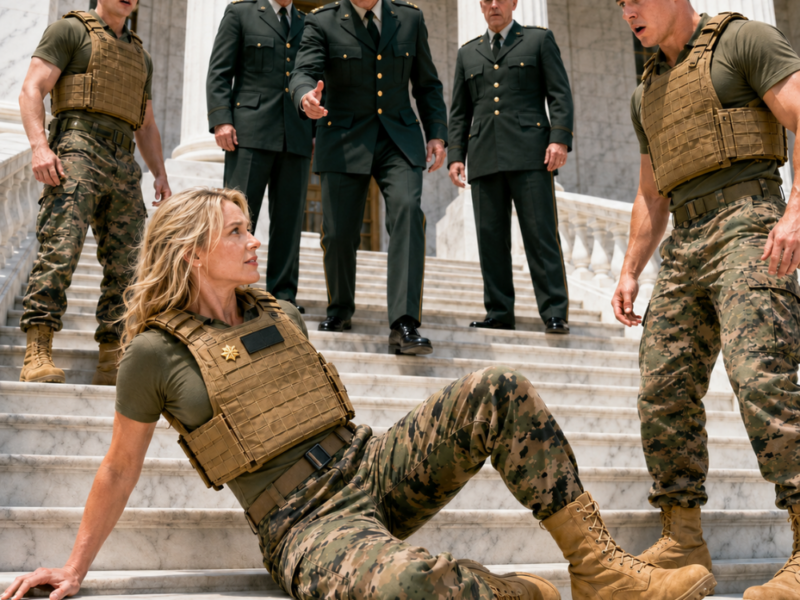
Cadets Shoved Her Down The Stairs — Then Three Generals Arrived And Called Her “Major”
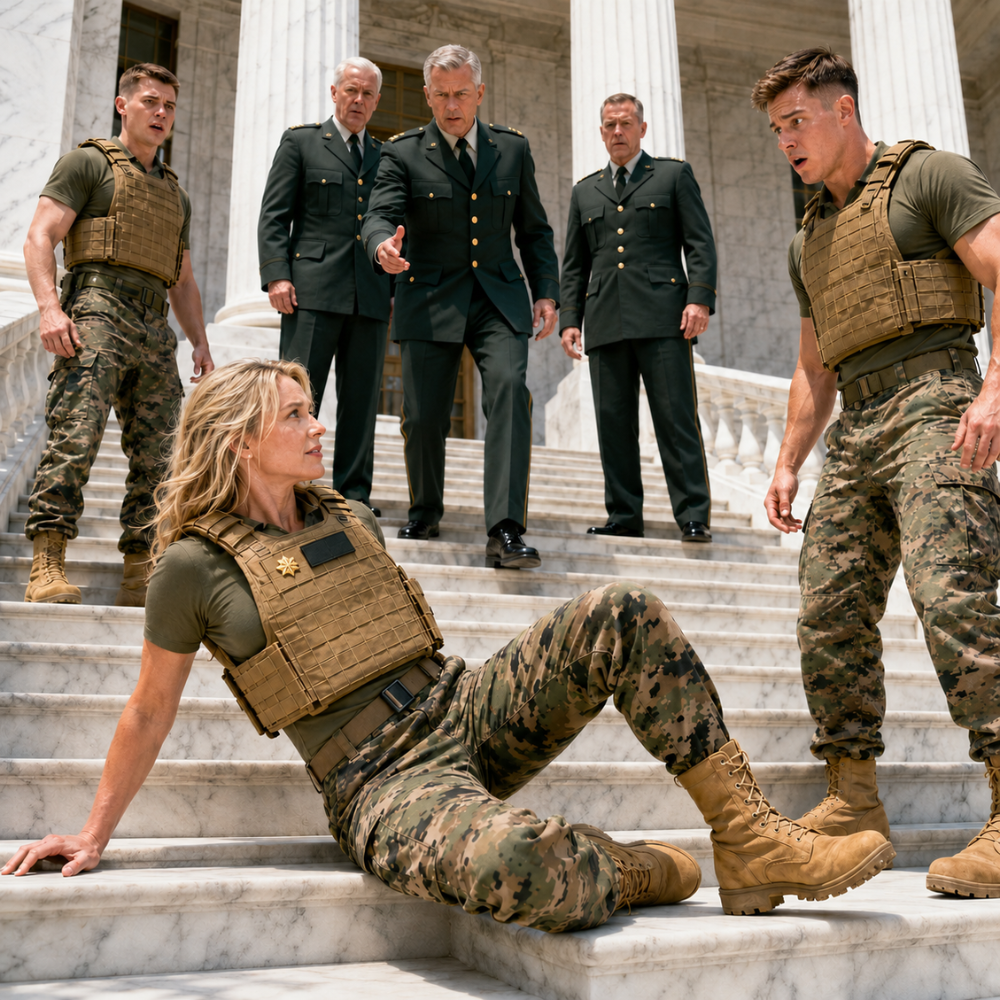
Cadets laughed when she hit the marble steps. Two weeks later, three generals called her “Major.”
Mara Quinn knew she was falling before anyone else did.
Cadet Captain Elias Vance’s boot caught the back of her ankle halfway up the main staircase at Iron Crest Military Academy, just enough to break her balance and just subtle enough to look accidental from a distance.
Her left knee hit first.
Then her palm.
The helmet bag swung forward and struck the edge of a marble step. Her rucksack slipped from one shoulder and caught against the black iron railing.
For two seconds, the grand entrance hall went silent.
Then somebody laughed.
Mara remained where she was.
Not because she was stunned.
She was counting.
Seventeen cadets were visible on the upper landing. At least thirty more had turned from the lobby below. Four had laughed. Most had done nothing. Vance had glanced back once before continuing upward.
That glance mattered more than the fall.
It had lasted less than a second, but Mara had spent years learning how much a face could reveal in less than a second.
Recognition.
Satisfaction.
Then indifference.
“Get out of the way, ghost,” Vance called without turning around. “Some of us have a war to prepare for.”
A few more cadets laughed because laughing at Elias Vance was less about humor than belonging.
Nobody offered Mara a hand.
A warm line of blood ran from her cheekbone toward her jaw where she had caught the edge of the step. She touched it with the back of her fingers, looked at the red smear, and stood.
She retrieved the helmet bag first.
Checked the buckle.
Lifted the rucksack.
Reset the straps.
Then she continued climbing.
She did not look at Vance.
She did not look at the cadets who had laughed.
She did not look toward the mezzanine, where General Adrien Thorne stood with his hands clasped behind his back and watched the entire thing with an expression nobody below could read.
Mara simply kept walking.
That was the first mistake Iron Crest made with her.
The second was assuming she had come there to prove herself.
Iron Crest Military Academy had been built around the idea that discomfort revealed character. Its original buildings were old stone structures arranged around a wide central quad, their interiors filled with polished brass plaques, portraits of decorated graduates, heavy oak doors, and enough institutional tradition to make even the youngest cadet lower their voice without being told.
The main staircase had become part of academy mythology.
The marble steps were steep, unforgiving, and worn faintly at the center by generations of boots. Cadets joked that everyone cursed them during the first week, then defended them forever afterward.
Tradition had a way of turning inconvenience into virtue if enough people inherited it.
Mara had studied the staircase before she ever touched it.
She had studied the dormitory layout, the training grounds, the academy handbook, the disciplinary structure, the company assignments, the reporting channels, the scholarship classifications, the maintenance maps, and the names of the people most likely to shape a first-year cadet’s experience.
Iron Crest believed it was evaluating her.
In truth, Mara had arrived evaluating Iron Crest.
Nobody there knew that yet.
Her official academy file described her as Mara Quinn, twenty-eight years old, originally from Oregon, a late-entry scholarship cadet with strong but unremarkable academic credentials, competent fitness scores, no distinguished family connections, and no notable military lineage.
Every page was accurate enough to survive casual scrutiny.
Every page was also carefully constructed.
Scholarship cadets at Iron Crest were divided into administrative categories that supposedly existed for funding purposes.
Everyone knew they meant more than that.
Category Three cadets, those receiving the largest need-based support, usually ended up in East Barracks.
Nobody had written a policy requiring it.
That would have been too obvious.
It simply happened.
East Barracks had the oldest plumbing, the least reliable heat, lockers nearest the utility wall, and windows that rattled when late-autumn wind moved down from the hills. Its laundry room had four machines for three floors, one of which displayed an OUT OF ORDER sign so faded that generations of cadets had probably seen the same one.
Its mess hall seating was closest to the kitchen doors.
Its gear racks were the oldest.
Its cadets learned quickly that disadvantages did not need to be dramatic to become culture.
Small disadvantages repeated long enough became expectations.
Expectations repeated long enough became hierarchy.
Mara’s roommate was Dena Roth, a premed-track cadet from Wisconsin who had taped a hand-drawn periodic table above her desk and seemed to consider most conversation an unnecessary expenditure of energy.
Dena looked up from a biology workbook when Mara entered their room after the staircase incident.
Her eyes moved to Mara’s cheek.
Then to the dusty knee of her uniform.
Then to the rucksack.
“Bad stairs?”
“I tripped.”
Dena stared at her.
“Sure.”
She returned to her book.
Mara almost smiled.
In the bathroom, she cleaned the small cut, pressed a narrow closure strip across it, then checked her ankle. Tender, but stable. Nothing that would interfere with training if she taped it properly.
She had worked through worse injuries in worse places.
Places not mentioned anywhere in the academy file locked in the administrative system.
Back in the room, she opened the orientation packet and found the schedule for the next three days.
Land navigation.
Tactical planning.
Black Meridian.
Her finger stopped there.
The Black Meridian exercise was one of Iron Crest’s signature events, a full-academy simulated conflict run across nearly forty acres of training grounds. Red Company would attack. Blue Company would defend.
Blue had never won.
Mara had already read the public description before arriving.
Now she found the technical manual listed in the academy library system.
Two hundred thirty pages.
Dena glanced over when Mara stood.
“Where are you going?”
“Library.”
“It’s almost ten.”
“I know.”
“You realize people sleep here.”
“I’ve heard rumors.”
Dena watched her leave.
The following morning, Mara learned two things about Elias Vance.
The first was that he deserved his reputation as one of the academy’s most capable cadets.
The second was that talent had protected him from learning the difference between being followed and being respected.
During a land-navigation exercise, Vance led his group through difficult terrain with minimal compass use. He read contours naturally, adjusted for elevation, recognized landmarks before most cadets saw them, and corrected a minor bearing drift before an instructor could call it.
Mara watched from the middle of the formation.
She had reviewed his record.
Top-tier fitness results.
Distinguished tactical scores.
Third-generation military family.
A private preparatory school with its own junior leadership program.
Recommendations from two academy alumni.
Vance was not pretending to be good.
He was good.
That made the rest of him more complicated.
At the third waypoint, Cadet Miles Okafor misread a grid coordinate and cost the group roughly two minutes.
During the debrief, Sergeant First Class Decker asked Okafor what had happened.
Okafor answered directly.
“I read the last digit wrong, Sergeant. I corrected after I realized the terrain didn’t match.”
Before Decker could continue, Vance smiled.
“Good thing it wasn’t real. Otherwise we’d all be dead because Miles can’t read a compass.”
Three cadets laughed.
Okafor did not.
The smile made the sentence defensible.
That interested Mara.
So did the instructors who pretended not to hear it.
Afterward, she waited until most cadets had returned their equipment.
“Sergeant Decker?”
He looked up from a tablet.
“Quinn.”
“I had a question about the grid format on leg three.”
“What about it?”
“The orientation manual uses six-digit references. The waypoint cards were eight-digit.”
Decker studied her for the first time instead of simply looking at her.
“That bother you?”
“No, Sergeant. I just wanted to make sure the difference was intentional.”
“It was.”
“Higher precision.”
“Yes.”
She nodded.
“Thank you.”
She turned to leave.
“Quinn.”
She stopped.
Decker’s eyes narrowed slightly.
“Most first-years don’t notice that.”
Mara gave him the smallest shrug.
“I noticed.”
Then she walked away.
That night she took the Black Meridian manual to a reading alcove in the East Barracks common room and started on page one.
The manual described the training area, scoring rules, communications structure, sensor systems, safety procedures, equipment allocations, vehicle limitations, building layouts, exercise-control protocols, emergency-stop rules, environmental simulations, and the deliberately unequal design of the exercise.
Red Company had superior numbers.
Better communications.
Better mobility.
More functional equipment.
Blue Company was built to lose slowly.
The objective, according to the manual, was to test leadership under cascading failure.
Mara reached page 187 shortly before midnight.
Dena appeared in the doorway wearing sweatpants and academy socks.
“You’re still reading that?”
“Yes.”
“How much?”
“All of it.”
Dena leaned against the frame.
“Most people skim these things.”
“I know.”
“Some people don’t even open them.”
“I know.”
“You planning to memorize it?”
Mara turned a page.
“Probably.”
Dena shook her head.
“That’s unsettling.”
Then she went back to bed.
Mara finished the manual shortly after one.
She slept four hours.
At 5:30 the next morning, the cadet corps assembled in Iron Crest’s main operations auditorium.
A massive digital topographic display covered the front wall.
Lieutenant Colonel Aaron Priest, the officer who had designed and refined Black Meridian for years, briefed the exercise with the dry precision of a man who had watched hundreds of cadets discover that confidence and control were not the same thing.
“Red Company is the assault force,” he said.
The roster appeared.
“Commanding Red, Cadet Captain Elias Vance.”
No surprise there.
Vance sat three rows ahead of Mara.
“Blue Company is the defensive force.”
A second roster appeared.
Its assigned commander was Cadet Thomas Holt, a second-year cadet who managed not to react visibly but whose shoulders tightened anyway.
Mara’s name appeared midway down the Blue Company list.
Priest continued.
“Blue Company will operate with reduced personnel, degraded communications, one unavailable vehicle, and limited simulated ammunition. That imbalance is intentional.”
Someone behind Mara exhaled.
Priest looked across the room.
“Blue has never won Black Meridian.”
A few Red Company cadets smiled.
“Winning is not Blue Company’s learning objective. Your objective is to demonstrate how a disadvantaged force responds to pressure, attrition, and the breakdown of its original plan.”
Mara looked at the topographic display.
The central training complex sat above a network of old maintenance corridors labeled MERIDIAN INFRASTRUCTURE GRID.
The manual described those corridors as nonoperational for simulation purposes.
Mara had read that sentence three times.
Nonoperational.
Not prohibited.
She looked at the screen for another second.
Then she looked away.
Outside, the sky was still gray with early morning.
Blue Company received exactly what the manual promised.
Older radios.
Reduced equipment.
Less favorable positions.
One training vehicle with a mechanical-failure marker fixed to the windshield.
Holt gathered the company beside the south staging area and explained his defensive plan.
It was reasonable.
It was also doomed.
Mara listened without interrupting.
He planned to hold the outer sectors until Red’s opening pressure forced a withdrawal, then consolidate at a secondary line nearer the center of the complex.
The problem was that the secondary line compressed Blue Company into the exact geometry Red needed for an encirclement.
Mara could see it immediately.
She suspected Vance could, too.
“Questions?” Holt asked.
Mara raised her hand.
“Radio coverage on the east sector. Are we using the standard frequency map?”
“Yes.”
“The issued sets are older models.”
Holt glanced toward the communications case.
“They’re what we’ve got.”
“Understood. Do we know whether the dead zones are the same?”
He paused.
“They should be.”
Mara nodded.
“Thank you.”
They were not.
The technical appendix said so.
Blue’s radios would lose signal in two pockets near the eastern structures.
Holt did not know that.
Mara did.
At 0700, Black Meridian began.
Loudspeakers produced simulated artillery bursts. Strobe systems flashed against the concrete buildings. Exercise-control radios filled the channels with noise. Sensor vests activated.
Blue Company began taking losses almost immediately.
Mara held the south sector beside Cadet Park.
When a strobe fired near his position, Park flinched and dropped his radio handset.
Four seconds.
In ordinary life, nothing.
In a scored tactical simulation, enough to change an outcome.
Mara had positioned herself behind a structural column where the strobe pattern left a narrow dead zone.
She had identified it in the manual.
Then confirmed it during the first minute of the exercise.
Holt’s voice crackled over the radio.
“All Blue elements, Red is advancing through the north corridor. Withdraw to secondary positions.”
Mara stared at the map clipped inside her vest.
If they withdrew now, Red’s western element would close the pocket.
She keyed her radio.
“Holt, Quinn. South sector clear. If we withdraw now, east flank opens.”
A pause.
“Roger, Quinn. Continue as ordered.”
Mara released the key.
“Fair enough,” she whispered.
Then she moved.
The nearest maintenance hatch was roughly twenty yards away beside a row of storage lockers.
She reached it unseen by Red forces.
The handle turned.
The hatch opened.
Mara looked once toward the training area behind her.
Then she climbed down.
The Meridian infrastructure corridor smelled like old concrete, dust, and conditioned air. Electrical conduits ran along the ceiling. Emergency lights provided just enough illumination to navigate without a flashlight.
She moved from memory.
Above her, Black Meridian unfolded almost exactly as designed.
Blue Company lost positions.
Red Company advanced.
Holt’s command net became increasingly crowded.
The sensor system chimed every time a cadet was eliminated.
Mara continued north through the maintenance grid.
She was not breaking the exercise.
She was reading it.
There was a difference.
At the first junction she stopped beneath a communications relay point described in the technical appendix. The relay had a monitoring function intended for training support staff.
Its listed frequency was open within the simulation environment.
Most cadets had probably never reached that appendix.
Mara tuned her radio.
Vance’s voice came through.
“Echo element, confirm Sector Four.”
“Sector Four clear.”
“Blue command should collapse inside ten minutes. Western unit?”
“Still moving through the bottleneck.”
“How far?”
“Forty meters.”
Mara closed her eyes for half a second and pictured the map.
Forty meters put the western element in a narrow corridor parallel to her current location.
She moved.
At the next access hatch, she climbed into a storage room behind Blue Company’s secondary defensive line.
Park’s voice answered when she called him on a low channel.
“Quinn? Where are you?”
“Nearby. Don’t broadcast my location.”
“What?”
“Red western element is entering your corridor in less than two minutes. Put two people behind the equipment barrier at the intersection.”
“Holt told us to consolidate.”
“I know.”
“You’re telling me to ignore the company commander?”
“I’m telling you what Red is about to do. You decide what to do with it.”
Park hesitated.
Mara added, “Their corner sensors lag. If your people are in position before the lead unit clears the turn, you’ll have the angle before their display updates.”
“How do you know that?”
“Page 194.”
“What?”
“The manual.”
There was a long silence.
Then Park said, “Of course.”
Mara descended again.
Minutes later, the western Red unit walked into an ambush it had not expected.
Blue stopped collapsing.
Not everywhere.
Not suddenly.
But enough.
Mara continued through the infrastructure network, appearing at access points only long enough to pass information.
A blind corner.
A communications delay.
A safe power-isolation switch that temporarily removed one exercise camera feed.
A timing pattern.
The location of an unused route.
She never took command.
That was deliberate.
She gave information to people who lacked it.
Then watched what they did.
Park adapted quickly.
Holt, once he realized useful information was arriving from somewhere outside his original plan, stopped resisting it and began giving his element leaders more freedom.
A junior cadet named Marsh recognized a sensor pattern and improvised a defensive rotation without waiting for permission.
Blue Company began doing the one thing the exercise had never trained it to do.
It stopped behaving like a force waiting to lose.
At 0821, Red Company’s vehicle element stalled because of a conflicting routing message and a temporary communications delay.
At 0827, Blue retook an intersection the exercise designers assumed it would have abandoned twenty minutes earlier.
At 0834, Mara reached the access hatch she had been working toward since entering the infrastructure grid.
The hatch opened into a storage room behind Red Company’s command post.
She climbed out.
Her uniform was dusted gray at the knees and elbows.
Her cheek was bruised around the narrow medical strip.
Her sensor vest remained green.
Alive.
On the other side of a thin interior wall, she heard Vance speaking.
His voice was still controlled.
It was simply working harder at control.
“Why is Western still stalled?”
A cadet answered.
“Blue’s responding too quickly.”
“Blue doesn’t have a functioning command structure.”
“Then somebody is feeding them.”
Mara opened the storage-room door one inch.
Four cadets occupied the command post.
Two radios.
A laptop.
A wall display.
Vance stood in the center.
One of his operators frowned at the screen.
“This doesn’t make sense.”
Vance looked at him.
“What?”
“Their responses are coordinated, but not from one command point.”
Mara opened the door.
The radio operator saw her first.
His face went still.
Then Vance turned.
For the first time since the academy staircase, he looked at Mara without any hint of amusement.
“How did you…”
She walked across the room.
Nine steps.
The exercise rules required physical contact to register a command capture.
Mara placed her palm flat against Vance’s shoulder.
The overhead speakers activated instantly.
“Red Company commander neutralized.”
Nobody moved.
Then the exercise-control voice continued.
“Simulation score confirmed. Blue Company tactical victory. Exercise terminated.”
The strobe systems shut off.
The noise track died.
The room filled with ordinary fluorescent light.
Vance stared at Mara.
She lowered her hand.
His expression was not anger yet.
First came disbelief.
Then calculation.
Then something closer to offense, as if reality had violated an agreement nobody else knew existed.
Mara said nothing.
She turned and walked out.
Behind her, one of the Red Company radio operators whispered, “She came through the maintenance grid.”
Another answered just as quietly.
“She read the whole manual.”
Outside the command post, Mara leaned against the corridor wall for one breath.
Only one.
Then she heard boots approaching from the observation level.
Several people.
Senior pace.
Measured.
General Thorne’s voice carried down the corridor.
“Get me her file.”
Mara closed her eyes for half a second.
The operation had just changed.
Sergeant First Class Decker appeared first.
Behind him came an aide.
Then General Thorne.
He stopped several feet away.
“Cadet Quinn.”
“Sir.”
“Walk with me.”
Mara fell into step slightly behind his right shoulder.
Thorne said nothing until they had passed through a fire door and entered the long exterior corridor overlooking the training grounds.
Below them, Red and Blue cadets emerged from the simulation complex wearing the stunned expressions of people whose assumptions had just lost a public argument.
Thorne kept walking.
“The infrastructure grid.”
“Yes, sir.”
“Listed as nonoperational.”
“For simulation purposes.”
He glanced at her.
“You noticed the wording.”
“Yes, sir.”
“And decided it meant the corridors were available.”
“I decided it meant they were not expressly prohibited.”
Thorne stopped.
Mara stopped with him.
“How much of the Black Meridian manual did you read?”
“All of it.”
“When?”
“Last night.”
“All two hundred thirty pages?”
“Yes, sir.”
“And you retained the communications specifications.”
“Yes, sir.”
“The sensor timing.”
“Yes, sir.”
“The maintenance routes.”
“Yes, sir.”
He stared at her.
Most people became uncomfortable under a general’s silence.
Mara had been questioned by people whose silences carried much worse consequences.
She waited.
“You were supposed to lose,” Thorne said.
“I understand.”
“The exercise is designed around Blue losing.”
“I understand that, too.”
“Then what were you actually doing?”
Mara considered the answer.
“The scenario models asymmetric conflict.”
“I know what it models.”
“Yes, sir.”
“What were you doing?”
She looked through the corridor window toward the training complex.
“Red had more resources. Better equipment. Better communications. More people.”
Thorne waited.
“They also expected those advantages to be enough.”
“And?”
“Expectation creates blind spots.”
Something changed in Thorne’s face.
Mara continued.
“Red believed Blue would operate inside the limitations given in the briefing. Blue believed the same thing. Once both sides accepted that assumption, the unused parts of the environment became more valuable than the resources everyone was competing over.”
“You exploited the environment.”
“I used what was documented.”
“You exploited a two-second sensor delay.”
“Page 194.”
Thorne almost reacted.
Almost.
Instead he resumed walking.
“Sergeant Decker said you noticed the grid-reference discrepancy during land navigation.”
“Yes, sir.”
“He also said you corrected a bearing problem without making it obvious you were correcting anyone.”
Mara said nothing.
“You’ve been here seventy-two hours.”
“Yes, sir.”
Thorne stopped at a window.
Across the grounds stood Iron Crest’s main building.
The marble staircase caught the morning sun.
Vance stood below with several Red Company cadets, arms folded.
Thorne looked at Mara.
“Where are you from?”
“Oregon. Originally.”
“Originally.”
“Yes, sir.”
He let the word remain there.
She did not fill the silence.
Eventually he nodded.
“Full debrief at 1300.”
“Yes, sir.”
“Get cleaned up.”
“Yes, sir.”
He walked away.
Mara remained at the window.
Three days into a thirty-day assignment, and the academy commander had started asking the right questions.
That was useful.
It was also dangerous.
The Black Meridian debrief was held in the main operations auditorium.
That alone told Mara the academy considered the result more than a curiosity.
Normally, companies reviewed the exercise separately.
This time every cadet attended.
So did nearly every instructor.
General Thorne sat in the back.
Lieutenant Colonel Priest stood at the front.
“Blue Company tactical victory,” he began. “First in the eleven-year history of the exercise. Red commander captured at 0836. Exercise ended twenty-two minutes before the projected Blue collapse window.”
No one moved.
Priest looked toward Blue Company.
“Cadet Holt. Tactical explanation.”
Holt stood.
Then surprised everyone.
“It wasn’t me, sir.”
He sat back down.
Priest’s eyes moved through the Blue Company seating.
“Cadet Quinn.”
Mara stood.
“Walk us through it.”
She did.
No drama.
No triumph.
No attempt to embarrass anyone.
She explained the infrastructure-grid language, communications monitoring, sensor timing, route exploitation, and the gradual redistribution of information across Blue units.
When relevant, she cited page numbers.
When uncertain, she said so.
When Holt had made a useful decision, she credited him.
When Park had improvised effectively, she said that, too.
She described herself as an information source rather than a commander because that was what she had been.
When she finished, Priest looked at her for several seconds.
“Sit down.”
She did.
Priest turned back to the room.
“Cadet Quinn did not violate exercise rules.”
A faint movement went through the Red Company section.
Priest continued.
“The wording governing the infrastructure grid was mine. It says nonoperational, not prohibited. That distinction created an opening. She found it.”
He paused.
“I will correct the wording next year.”
A few cadets shifted.
“Do not misunderstand what I just said. Correcting the wording does not invalidate what happened today. The larger lesson is exactly why this exercise exists. Every cadet in this room received access to the same documentation. One cadet read the environment differently.”
He looked toward Mara.
“She identified an advantage that existed outside the obvious contest for resources and used it with restraint.”
Priest faced the whole room again.
“That is not cheating. That is thinking.”
The sentence settled heavily over the Red Company rows.
After the debrief, Mara made it almost to the door.
“Quinn.”
She stopped.
Vance stood several feet away with two Red Company cadets.
His voice was controlled.
“Good exercise.”
“Thank you.”
“Interesting approach.”
“It worked.”
“The maintenance grid was a nice trick.”
“It was in the manual.”
His jaw tightened almost imperceptibly.
“So was the section on authorized communications.”
“I used a listed monitoring frequency.”
“You sent instructions using our command format.”
“I sent a routing message on an available channel.”
“You made it sound like command.”
“I used the format being used on the channel.”
“That is an extremely creative interpretation.”
“Lieutenant Colonel Priest said it was within parameters.”
“Priest also said he’s changing the rules.”
“Next year.”
A quiet second passed.
Vance’s two cadets became very interested in the floor.
He stepped closer.
Not enough to be physically threatening.
Just enough to remind her that hierarchy occupied space.
“Where did you learn to read a room like that?”
The question surprised her more than the accusation.
Mara kept her face neutral.
“I read the manual.”
“No.”
His tone changed.
Not louder.
More honest.
“That isn’t what I asked.”
She waited.
“The way you moved. The way you listened to radio traffic. The way you stayed invisible until you were already inside my command post.”
He studied her.
“That is not first-year academy skill.”
Mara met his eyes.
“I read the manual, Cadet Captain.”
A long silence.
Vance finally stepped back.
“Right.”
He turned.
“Good exercise.”
Then he walked away.
One of the cadets beside him, Sergeant Cadet Nathan Reeves, looked back once before following.
Mara noticed that look.
Reeves had been watching her since Black Meridian.
Unlike Vance, he did not seem insulted by not understanding her.
He seemed interested.
That made him more valuable.
Outside the auditorium, Dena found Mara on the stone landing overlooking the quad.
She was eating a granola bar.
“You know everyone’s talking about you.”
“I assumed.”
“Red Company says you cheated.”
“I know.”
Dena folded the wrapper into a square.
“Did you?”
“Priest said no.”
“I didn’t ask Priest.”
Mara looked at her.
Dena returned the look calmly.
After a moment, Mara said, “I used what the exercise gave me. I didn’t damage equipment. I didn’t break access controls. I didn’t alter the scoring system.”
“That sounds like a lawyer’s answer.”
“It’s a technical question.”
Dena considered this.
“Why did you read all two hundred thirty pages?”
Mara looked across the quad.
Vance’s cadets were leaving the operations building.
“Because I don’t have what he has.”
“Vance?”
“Yes.”
“Meaning?”
“Connections. Reputation. Three generations of people teaching him how places like this work.”
Dena waited.
Mara continued.
“If you don’t have advantages other people inherit, you use what is available.”
“The manual.”
“The manual.”
Dena nodded.
Then glanced at Mara’s cheek.
“That bruise is ugly.”
“I know.”
“Going to get worse tomorrow.”
“I know that, too.”
Dena unwrapped another granola bar.
For the next several days, Iron Crest continued operating normally while nobody behaved normally.
Mara felt the change everywhere.
Conversations shortened when she entered rooms.
Instructors called on her more often.
Cadets who had never noticed her suddenly knew her name.
The mess hall seating changed subtly around her.
Some people gave her space because they admired her.
Some because they distrusted her.
Some because Vance distrusted her and social gravity did the rest.
Mara kept her routines unchanged.
Morning reading.
Middle-of-the-pack physical performance.
One useful comment in class, rarely two.
Nothing flashy.
Nothing careless.
On day five, Sergeant First Class Decker found her returning navigation equipment.
“Quinn.”
“Sergeant.”
“General Thorne. His office. Now.”
No explanation.
Decker seemed to consider context an optional luxury.
Thorne’s office was on the third floor of the administrative building.
Mara expected the ceremonial space usually associated with academy commanders.
Instead she found a cramped interior room lined with old operational maps and physical paper files.
Thorne used red pen.
That told her more about him than the portraits outside.
“Close the door.”
She did.
“Sit.”
He remained standing.
Mara sat.
Thorne walked to the window and looked into the narrow air shaft between buildings.
“I made inquiries about you.”
She waited.
“Your academy application is complete. Academic record, medical processing, financial classification, background documentation.”
He turned.
“It is also the most precisely average file I’ve seen in thirty-one years.”
Mara said nothing.
“Nothing is wrong with it.”
Still nothing.
“That is what bothers me.”
He sat across from her.
“Real people are uneven, Quinn. Someone has a brilliant year and a bad semester. Someone is excellent at mathematics and terrible at writing. Someone misses paperwork. Someone has an instructor who hated them.”
He tapped one finger against the file.
“Your record has no texture.”
Mara looked at him.
“Everything is exactly unremarkable.”
“I’m not sure how to respond to that, sir.”
“That was almost a joke.”
“Almost.”
For the first time, something faint moved at the corner of Thorne’s mouth.
Then it disappeared.
“I also found a sealed administrative category attached to your admissions record.”
Mara’s expression did not change.
“My access level does not open it.”
She said nothing.
Thorne leaned back.
“I command this academy.”
“Yes, sir.”
“And there is a file attached to one of my cadets that I cannot access.”
“Yes, sir.”
“Why?”
“I’m not authorized to discuss sealed material.”
“I’m a general.”
“I understand.”
He stared at her.
“The authorization sits above academy command?”
“Yes, sir.”
“How far above?”
Mara did not answer.
Thorne’s eyes sharpened.
“Joint level?”
Still nothing.
He nodded once.
That was enough.
“How old are you?”
“Twenty-eight.”
“Most first-year scholarship cadets are twenty-one or twenty-two.”
“Yes, sir.”
“What did you do before Iron Crest?”
“I’m not authorized to discuss that.”
Thorne stood.
Walked once to the map wall.
Then back.
“You’re here for a reason that is not in this file.”
It was not a question.
Mara treated it accordingly.
Thorne continued.
“Black Meridian. You weren’t trying to impress anyone.”
“No, sir.”
“You spent most of the exercise underground feeding information to other people.”
“Yes, sir.”
“You avoided visible command.”
“Yes, sir.”
“That is not how ambitious cadets behave.”
“No, sir.”
He leaned forward.
“You were watching us.”
Mara met his gaze.
“I think Black Meridian is an effective training exercise.”
Thorne exhaled.
“There it is again.”
“Sir?”
“The answer that is technically true and tells me nothing.”
Mara waited.
He looked down at the file.
Then back at her.
“Dismissed.”
She stood.
At the door, he called her name.
“Quinn.”
She turned.
“The stairs.”
Mara waited.
“First day.”
“Yes, sir.”
“You fell.”
“Yes.”
“You did not report it.”
“No, sir.”
“Vance made contact with your ankle.”
“I cannot confirm intent.”
“I didn’t ask about intent.”
Mara said nothing.
Thorne studied her for another moment.
“You’re very careful.”
“Yes, sir.”
“Get out.”
Mara left.
Halfway down the stairwell, she stopped on the second-floor landing and let the railing take some of her weight.
Her ankle ached.
The tape she had been using since the fall no longer held as tightly as it had in the morning.
She looked through the stairwell window toward East Barracks.
Thorne knew she was not what she appeared to be.
He did not yet know what she was.
That would make him push harder.
Mara had studied his career before arriving.
He was exactly the kind of commander who pushed.
The question was what happened when he reached the wall protecting her real record.
She returned to East Barracks.
Across the quad, a light came on in Thorne’s office.
It was still on at midnight.
At 0100, Mara woke briefly and checked again.
Still on.
She lay back down while the radiator knocked inside the wall.
Somewhere across the courtyard, a general was making phone calls.
Somewhere beyond Iron Crest, those calls were reaching people who knew why Mara Quinn had really come.
Day six began with a new announcement.
Lieutenant Colonel Priest stepped in front of morning formation.
“Beginning day eight, Iron Crest will host an Institutional Standards Division assessment team from Joint Command.”
Several cadets straightened.
Priest continued.
“This is a scheduled review conducted periodically across training institutions. The team will observe operations, conduct interviews, and review administrative systems.”
Behind Mara, Park muttered, “Internal affairs.”
Mara kept her eyes forward.
Priest said, “Carry on as normal.”
Park whispered, “Nobody says that unless they’re worried people won’t.”
Mara almost agreed aloud.
After formation, she encountered Vance in a narrow corridor outside the mess hall.
He had Reeves and another Red Company cadet, Graham Doll, with him.
Nobody could pass without someone yielding.
Vance did not yield.
“Quinn.”
“Cadet Captain.”
“You heard about ISD.”
“Yes.”
“Interesting timing.”
“It is a scheduled review.”
“My father served on an assessment panel.”
Mara waited.
“They don’t prioritize a scheduled visit without a reason.”
“I wouldn’t know.”
“No?”
“No.”
Vance watched her closely.
“A concern report can move a routine review forward.”
“I don’t have access to those channels.”
“No. But someone with a sealed admissions file might.”
The hallway became very quiet.
Mara held his gaze.
“I don’t know what is in my sealed file.”
“Convenient.”
“It is also true.”
He stepped aside.
As she passed, he said, “They’ll interview cadets on the record.”
Mara stopped.
Vance added, “I’d think carefully about what you say.”
She turned.
Reeves was watching both of them.
Mara answered calmly.
“I always do.”
Then she entered the mess hall.
The assessment team arrived two mornings later in two plain government vehicles.
There were five official members.
Mara immediately focused on the sixth person.
A compact woman in civilian clothes walked with the team but did not appear on the distributed staff list. She wore no visible credentials beyond the temporary access badge everyone received at the entrance.
Mara saw her near the main operations room at noon.
Again near East Barracks at 1600.
The woman watched without appearing to.
That was familiar.
On day nine, Mara received an interview appointment.
The assessor introduced himself as Daniel Castillo.
Mid-forties.
Calm voice.
No military theatrics.
He placed a recorder openly on the conference table.
“This interview is voluntary. You may stop at any point. Understood?”
“Yes.”
“How are you finding Iron Crest?”
“Demanding. Well organized.”
“Your instructors?”
“Technically strong.”
“Cadet leadership?”
“Mixed.”
That made Castillo look up.
“In what way?”
“You asked broadly.”
A faint smile.
“Fair point.”
He narrowed the question.
Mara answered only what she had observed.
Vance’s comment to Okafor.
The behavior of junior cadets around senior ones.
Informal status differences between scholarship groups.
The first-day staircase incident.
Castillo’s face remained professionally neutral.
“Did Cadet Captain Vance intentionally cause your fall?”
“I cannot establish intent.”
“What can you establish?”
“His boot made contact with my ankle. I lost balance. I struck the stairs. He looked back. He continued walking. Four cadets laughed. No one offered assistance.”
“Did you report it?”
“No.”
“Why?”
“It did not require medical treatment beyond self-care.”
“That isn’t what I asked.”
Mara looked at him.
Castillo waited.
She said, “I did not believe one incident would tell you anything useful.”
He held her eyes for half a second.
Then wrote something.
At the end of the interview he asked, “Anything else?”
Mara considered.
“Yes.”
Castillo waited.
“Cadet Captain Vance is tactically skilled.”
The assessor’s pen stopped.
Mara continued.
“I want that included.”
“Why?”
“Because accuracy matters.”
Castillo nodded.
“It will be included.”
The leadership evaluation series began three days later.
First-year cadets rotated through command problems designed to measure decisions under pressure rather than technical skill alone.
Mara’s group included Park, Vasquez, and, more interestingly, Reeves.
Whether that grouping was random or deliberate, she could not tell.
During the first scenario, Vasquez received command.
The problem involved a disabled transport vehicle, a simulated casualty, and competing tasks with a forty-minute limit.
Vasquez immediately assigned two cadets to repair the vehicle.
Mara had already checked the repair kit.
Two required bolts were missing.
She watched the team work for four minutes.
Then said, “Vasquez.”
He turned.
“Repair isn’t viable.”
“What?”
“Kit is missing two grade-eight bolts.”
He looked toward the vehicle.
“You sure?”
“Yes.”
“How long have you known?”
“Since we started.”
He stared at her.
“Why didn’t you say anything?”
“Because you had a team checking the repair.”
The evaluator called a time warning.
Mara added, “Now we know it can’t be done inside the window. We need foot evacuation and two task groups.”
Vasquez looked at the vehicle.
Then at Mara.
Then made the decision.
“Do it.”
They completed the scenario.
During the water break, Reeves approached her.
“The bolt thing.”
“Yes.”
“You saw that immediately.”
“Yes.”
He filled a paper cup.
“Vance would’ve seen it, too.”
“I believe you.”
“He would’ve said it differently.”
“How?”
Reeves stared into his water.
“Probably, ‘Who packed this garbage?’ Then he’d fix the problem.”
Mara waited.
“Same technical result,” Reeves said. “Different damage.”
“That is an honest distinction.”
He looked at her then.
“He isn’t a bad tactician.”
“I never said he was.”
“I know.”
Reeves threw the cup away.
“He told me to watch you.”
Mara’s face remained neutral.
“Why?”
“Said you might use the ISD review to go after him.”
“And?”
“He wanted me to tell him what you said during evaluations.”
Mara watched him.
Reeves continued.
“I’m not doing that.”
“That is your decision.”
“Yeah.”
He started to leave.
Then turned back.
“I don’t know what you are, Quinn.”
She said nothing.
“But you’re not just some first-year scholarship cadet.”
He walked away.
At 0310 the following morning, Mara’s academy tablet lit up.
She opened the message in the dark.
Effective immediately, Cadet Mara Quinn was being reassigned from Blue Company to Red Company under an adaptive placement protocol.
Red Company.
Vance.
Direct authority.
In the middle of an institutional assessment.
Mara read the message twice.
Dena slept across the room.
The radiator knocked.
Outside the windows, the campus was black except for the security lights.
Administrative transfers were not processed at three in the morning.
Not normal ones.
Mara lay awake for the remaining two hours before formation.
At 0530, she packed.
The sound of a buckle woke Dena.
She sat up.
“You leaving?”
“Transfer.”
“Where?”
“Red.”
Dena blinked.
“Vance’s Red?”
“Yes.”
“That sounds terrible.”
“It may be useful.”
Dena stared at her.
“Normal people do not answer that sentence that way.”
Mara lifted her rucksack.
Dena became serious.
“You going to be okay?”
Mara considered the question.
“Probably.”
“Probably?”
“It may get complicated first.”
Dena nodded.
“Fine.”
Then she pointed to the periodic table.
“You want that?”
Mara finally smiled.
“No.”
“Your loss.”
Red Company’s facilities were subtly better than Blue’s.
Newer lockers.
Brighter briefing rooms.
A working water dispenser.
Small differences.
The kind everyone could dismiss individually and nobody could honestly deny once they were listed together.
Mara entered the assembly area at 0545.
Conversation changed instantly.
Vance saw her from across the room.
For the first time, his expression betrayed genuine surprise.
She stopped at reporting distance.
“Cadet Quinn reporting for Red Company assignment under adaptive placement protocol, Cadet Captain.”
“I know who you are.”
“Yes, sir.”
Vance looked at her gear.
“Who authorized this?”
“Commandant’s office.”
“When?”
“Notification arrived at 0310.”
His face changed.
“You received it at three ten this morning?”
“Yes.”
He had not arranged the transfer.
Mara saw that immediately.
So did Reeves, who stood several yards away.
Vance looked toward the administrative building.
Then back to her.
“Second element. Reeves will assign your rack.”
“Yes, sir.”
As Mara walked away, she heard Vance speak quietly to Doll.
Doll answered with a single low word.
Reeves met Mara by the second-element lockers.
“You sleep?”
“Not much.”
He pointed to an empty rack.
“That one.”
She set down her rucksack.
Reeves remained there.
“Vance didn’t request you.”
“I know.”
“You could tell?”
“Yes.”
He looked almost amused.
“Of course you could.”
Then he lowered his voice.
“He’ll put you into one of today’s leadership scenarios.”
“I assumed.”
“He’ll give you the position with the least resources.”
“Probably.”
“He’ll watch what you do with it.”
Mara looked at him.
“Why are you telling me?”
Reeves shrugged.
“Because it’s the right thing.”
He started to leave.
Then stopped.
“And because I’ve watched you for almost two weeks, and I’m tired of pretending I don’t see what’s in front of me.”
“What do you see?”
He met her eyes.
“Somebody who learned all this somewhere other than a classroom.”
Then he left.
The afternoon leadership scenario took place in Iron Crest’s high-tech tactical operations room.
The simulation modeled a severe infrastructure failure inside an unstable regional environment.
Three task groups.
Degraded communications.
Civilian evacuation requirements.
Limited transport.
Competing deadlines.
Mara observed the first three rotations.
Vance stood near the evaluator station.
When the fourth rotation began, the assignments were announced.
“Alpha lead, Reeves.”
Reeves moved.
“Bravo support, Doll.”
Doll moved.
“Charlie civilian-management element, Quinn.”
There it was.
The least resourced position.
The least defined mission.
The position most likely to fail without producing a clean metric proving why.
Mara walked to the Charlie station.
Across the room, Vance watched.
She looked at the operational display.
Three hundred simulated civilians.
Two exit routes.
One partially compromised.
Four personnel.
Two transport units.
Delayed communications.
Twenty minutes.
The obvious mission was impossible.
So Mara ignored the obvious mission.
She studied movement patterns.
The simulated population surges followed a recognizable model, not random timing.
Peak congestion at minute nine.
Secondary peak at minute sixteen.
Alpha and Bravo would hit their own resource shortages around minute twelve.
Charlie could not fully evacuate the population.
But Charlie could sequence movement in a way that reduced exposure, then temporarily absorb pressure from Alpha and free equipment for the whole scenario.
At minute eight, Mara keyed the radio.
“Alpha, Charlie.”
Reeves answered.
“Go.”
“I can absorb your overflow at minute twelve. I need one transport unit for ninety seconds.”
“That’s outside your assigned scope.”
“It is within scenario parameters.”
A pause.
Mara said, “Ninety seconds gives your transport back before your compression window.”
Reeves had been watching the same timeline.
“Approved.”
At minute twelve, the exchange happened.
At minute fourteen, Bravo gained capacity because Alpha no longer needed support.
At minute nineteen, Charlie cleared the highest-priority simulated population ahead of the exposure threshold.
The evaluator ended the rotation.
For one second, nobody spoke.
Then a voice came from the back.
“Clear the room.”
General Thorne.
Mara turned.
He stood near the rear observation position.
Beside him was the civilian woman from the ISD team.
Beside her stood a tall gray-haired man Mara had never seen at Iron Crest.
No academy badge.
No uniform.
No introduction.
The evaluator began directing cadets toward the corridor.
Mara had taken four steps when Thorne spoke.
“Quinn. Stay.”
She stopped.
Across the room, Vance had also been told to remain.
Everyone else filed out.
The doors closed.
The gray-haired man walked to the center table and placed a tablet on it.
The screen displayed a personnel-record header.
Mara saw her own name.
She also saw the security classification above it.
Her stomach tightened for the first time since arriving at Iron Crest.
Not fear.
Procedure.
This room should not have been seeing that file.
General Thorne looked at her.
“Major Quinn.”
The word changed everything.
Vance went completely still.
No smirk.
No careful posture.
No social calculation.
For perhaps the first time since Mara had met him, Elias Vance had no prepared expression.
Mara looked at Thorne.
Then at the tablet.
“Sir, this room is not cleared for that material.”
The gray-haired man answered.
“It is now.”
She turned toward him.
“I authorized the clearance before entering.”
Mara looked around the room again.
The evaluators.
The civilian woman.
Thorne.
Vance.
The gray-haired man.
Her understanding shifted.
The man said, “Major Mara Quinn. I’m Director Harlan Saye.”
She knew the name.
Operational placement.
Joint Command.
A man almost never discussed outside restricted briefings.
“Yes, sir.”
“Your cover was lifted thirteen minutes ago. Joint authorization, civilian oversight countersignature.”
He nodded toward the woman.
“Deputy Assessor Carla Fenwick. Institutional climate lead.”
Mara looked at Fenwick.
Then at the supposed evaluation staff.
“You’re not academy evaluators.”
One of them gave a faint smile.
Director Saye answered.
“We are conducting an evaluation. Just not the one most people in this building thought.”
From the far wall, Vance finally spoke.
“What is happening?”
Thorne turned toward him.
“Cadet Captain, hold your questions.”
“With respect, General, you just called a scholarship cadet ‘Major.’”
Thorne’s voice did not get louder.
It simply lost all flexibility.
“Stand fast.”
Vance’s jaw tightened.
He stood fast.
Saye pulled out a chair and sat.
“Major Quinn.”
“Sir.”
“Tell me what you found.”
The debrief lasted nearly an hour.
Mara began with day one.
The stairs.
Physical contact.
The fall.
Vance’s glance.
The laughter.
The lack of assistance.
She stated no motive she could not prove.
Then day two.
Okafor.
The comment.
Instructor silence.
Then the informal company dynamics.
Junior cadets changing their speech when Vance approached.
Scholarship cadets receiving worse logistical placements.
Senior cadets using ridicule under the cover of banter.
Reporting systems that technically existed but were socially dangerous to use.
The Black Meridian aftermath.
Vance’s challenge in the hallway.
His warning before the ISD interview.
The overnight transfer into Red Company.
Fenwick wrote continuously.
When Mara finished, Saye looked at Vance.
“Response?”
Vance uncrossed his arms.
For several seconds he looked at the floor.
Then at Mara.
Then at Thorne.
“The stairs,” he said.
Nobody interrupted.
“I clipped her heel.”
A pause.
“I knew she was falling.”
Fenwick’s pen stopped.
Vance continued.
“I didn’t think it was serious.”
“You saw blood,” Fenwick said.
“Yes.”
“And continued walking.”
“Yes.”
“Why?”
He opened his mouth.
Closed it.
“I don’t have a good answer.”
Fenwick nodded once.
“That is different from not having an answer.”
Vance looked at her.
She continued.
“Two junior cadets provided confidential statements during the first forty-eight hours of our assessment.”
The color in his face changed.
“There are additional incidents?”
“Additional reports.”
“About me?”
“Among others.”
He turned toward Thorne.
“The transfer. I didn’t arrange it.”
“I know,” Thorne said.
“Then who did?”
“I recommended it.”
Vance stared at him.
Thorne continued.
“The commandant approved it in consultation with the assessment team.”
“Why?”
“To observe how you exercised authority when someone you already considered disruptive was placed inside your company.”
Vance looked toward Mara.
“You used me.”
Thorne answered before Mara could.
“We observed you.”
“That isn’t different.”
“It is entirely different.”
Vance’s face hardened.
Thorne leaned back.
“You were given authority. Nobody instructed you to assign Quinn the least-resourced position today.”
Vance said nothing.
“Nobody instructed you to confront her after Black Meridian.”
Silence.
“Nobody instructed you to warn her to think carefully about an institutional interview.”
Vance looked at the table.
Thorne’s voice remained controlled.
“Observation does not create conduct, Cadet Captain. It records it.”
For a long time, nobody spoke.
Then Vance looked at Mara.
“You were assessing the academy.”
“Yes.”
“For how long?”
“Thirty days.”
“What day is this?”
“Thirteen.”
His eyes moved to Saye.
“Black Meridian was part of this?”
“No,” Mara said.
He looked back at her.
“It was a real academy exercise.”
“But you used it.”
“I participated in it.”
“That’s not what I mean.”
Mara considered him.
“No. It isn’t.”
Vance waited.
She continued.
“The exercise produced useful information.”
“About me.”
“About the institution.”
He gave a short humorless breath.
“What’s the difference?”
“A person can be an incident,” Mara said. “A repeated response across different people, different settings, and different levels of authority can become a system.”
Vance looked at her for several seconds.
“And what did your system do?”
Mara held his gaze.
“When someone unexpected performed well, it tried to decide where to put them.”
His face tightened.
“Somewhere manageable.”
“Yes.”
The room became very quiet.
Later, after Fenwick and Saye moved the formal process to a conference room, Thorne kept Mara and Vance behind.
“I don’t conduct consequential conversations about people while excluding the people affected by them,” he explained.
Vance sat at the end of the table.
He looked smaller without appearing physically smaller.
The absence of performance did that.
Thorne looked at Mara.
“For my understanding. Your actual assignment.”
Mara answered.
“Six years in institutional and operational assessment under Joint Command. Before that, intelligence support. Before that, enlisted service.”
“You enlisted at nineteen.”
“Yes.”
“You are twenty-eight.”
“Yes.”
Thorne stared at her for a moment.
“Major by twenty-eight.”
Mara said nothing.
Vance looked at her as if doing the arithmetic produced new problems.
Thorne continued.
“Why Iron Crest?”
Mara spoke carefully.
“Three years of aggregate data suggested a cultural problem not being captured through standard reviews.”
“What data?”
“Retention differences. Reporting patterns. Advancement rates. Anonymous climate feedback. Scholarship-cadet attrition. Instructor response inconsistencies.”
Thorne’s expression changed.
“Why wasn’t I shown that?”
“Some of it was distributed in separate administrative channels. No single report looked conclusive.”
“But together.”
“Together it looked different.”
He leaned back.
“So they sent you.”
“They needed an observer inside the lowest-status layer of the cadet structure.”
“Scholarship Category Three.”
“Yes.”
“The average file.”
“Yes.”
“You were deliberately placed where people would assume you had no influence.”
“Yes.”
Thorne gave a slow nod.
“That explains the stairs.”
Mara shook her head.
“No, sir.”
He looked at her.
“The cover explains why the incident was useful. It does not explain the incident.”
Thorne held her gaze.
Then nodded.
“Fair correction.”
At the end of the table, Vance said, “What happens to me?”
There was no challenge in the question.
Thorne answered plainly.
“The inquiry proceeds.”
“Expulsion?”
“I don’t know.”
“Reduction in command?”
“Possible.”
Vance looked down at his hands.
“I’ve been doing this for years.”
Nobody spoke.
He continued.
“Not that exact thing. Not pushing people down stairs.”
His jaw tightened.
“The comments. The pressure. Making sure people know where they stand.”
He looked toward Mara, but not directly at her.
“My father called it keeping standards high.”
Thorne said nothing.
“My prep-school instructors rewarded it.”
Still nothing.
“Here…”
Vance swallowed.
“Here people laughed.”
Mara watched him.
Vance looked at Thorne.
“I’m not saying that excuses it.”
“Good,” Thorne said.
“I’m saying nobody ever described it to me like evidence before.”
Thorne’s expression softened by a fraction.
“That understanding matters.”
Vance looked up.
“It helps?”
“It matters,” Thorne repeated. “Do not confuse that with erasing consequence.”
Vance nodded.
“What do I do?”
Mara had never heard him ask those words.
Thorne answered.
“You cooperate.”
Vance waited.
“You tell the assessment team the truth. You do not manage the truth. You do not explain every incident until it becomes someone else’s fault.”
He leaned forward.
“You tell them what you did, what you saw, what you ignored, and what you benefited from.”
Vance stared at the table.
Then nodded.
“All right.”
That afternoon, Director Saye walked with Mara across the quad.
Late-autumn sunlight had broken through the cloud cover, turning the academy’s gray stone warm for the first time all week.
“The mission still runs thirty days,” he said.
“I assumed.”
“Senior cover is lifted. Cadet-level cover remains unless operationally necessary.”
“Understood.”
“Thorne knows. Fenwick knows. A handful of administrative personnel know.”
He glanced at Mara.
“Your continued presence gives us longitudinal data.”
“Yes.”
“How’s your ankle?”
Mara looked at him.
“I’m fine.”
“Decker disagrees.”
“Decker notices too much.”
“That is generally what we pay senior NCOs to do.”
She almost smiled.
Saye stopped near the far side of the quad.
“Get it looked at.”
“Yes, sir.”
He stared toward the Iron Crest staircase.
“You could have reported Vance on day one.”
“Yes.”
“You had enough for an incident review.”
“Yes.”
“Why didn’t you?”
Mara looked at the steps.
“An incident creates a process.”
“And?”
“Processes change behavior.”
“That is usually the point.”
“For discipline. Not for observation.”
Saye waited.
“If I had reported him immediately, everyone would have become careful.”
“Instead you waited.”
“I needed to know what happened when nobody believed anyone important was watching.”
Saye’s face remained unreadable.
“Dangerous line.”
“I know.”
“You could have pulled the mission once you had corroboration.”
“Yes.”
“You stayed.”
“Yes.”
“Why?”
“Because isolated incidents are easy to explain away. Patterns are harder.”
He looked at her.
“Black Meridian accelerated your visibility.”
“Yes.”
“Was that intentional?”
Mara considered the most honest answer.
“I knew winning would change how people treated me.”
“That is not the same as answering.”
“I also knew the change would create useful pressure.”
Saye nodded.
“Better.”
He turned to leave.
“Your next placement is being prepared.”
“Different academy?”
“Different kind of institution.”
“When do I brief?”
“After day thirty.”
He walked several steps.
Then stopped.
“Quinn.”
“Sir.”
“Get the ankle checked.”
“Yes, sir.”
Reeves found her later near the equipment cage.
Her transfer to Red Company had been quietly reversed.
She handed her issued Red gear across the counter.
Reeves stood beside her.
“True or false?”
“Depends.”
“You’re not a cadet.”
“I am enrolled as a cadet.”
“That was impressive, but not what I asked.”
Mara folded the equipment receipt.
“What I told you about the manual was true.”
Reeves waited.
“What I did during Black Meridian was real.”
Still waiting.
“The reason I am here is more complicated.”
He nodded slowly.
“You’re assessing Iron Crest.”
Mara did not answer.
“That means yes.”
“It means I didn’t answer.”
“Same difference.”
“No.”
He looked toward the quad.
“Vance asked me about you.”
“What did you tell him?”
“That I suspected something.”
“Did you?”
“After Black Meridian.”
“What gave it away?”
Reeves smiled faintly.
“You won a supposedly unwinnable exercise and looked irritated that people noticed.”
Mara considered that.
“Fair.”
“He’s cooperating.”
“I heard.”
“He told me he plans to tell them everything.”
“That is his decision.”
“Does it change what happens to him?”
“Not the findings.”
Reeves frowned.
“Then what’s the point?”
Mara looked at him.
“It changes what happens after the findings.”
He was quiet.
“That actually matters?”
“For most people, yes.”
They stood together while another group of cadets crossed the quad.
Reeves watched them.
“I thought I understood this place.”
“You understood how it looked.”
He thought about that.
“That’s the problem, isn’t it?”
“Yes.”
The following seventeen days felt different.
The academy still ran classes.
Still held formations.
Still graded drills.
Still served powdered eggs at breakfast and overcooked vegetables at dinner.
Cadets still complained about laundry schedules, fitness tests, equipment inspections, and the coffee in the west-wing vending machines.
Daily life continued because institutions rarely pause simply because something important is happening inside them.
But beneath the routines, the ISD process expanded.
Thirty-one formal interviews.
Several confidential statements.
Instructor testimony.
Administrative records.
Dormitory assignment patterns.
Disciplinary comparisons.
Complaint-routing data.
Scholarship placement decisions.
What had looked like unrelated habits began connecting into a structure.
Three junior instructors admitted they had witnessed conduct they believed crossed leadership lines but had not reported it.
“Why?” Fenwick asked one of them.
The answer was painfully ordinary.
“Because nothing ever happened.”
Another instructor said, “You learn which complaints become paperwork and which become careers.”
A third admitted he had laughed at remarks from senior cadets because silence would have made him look humorless.
None of those answers involved dramatic conspiracy.
That made them more important.
Systems rarely depended on villains meeting behind closed doors.
They survived because ordinary people learned which discomforts were easier to absorb than challenge.
Sergeant First Class Decker called Mara into his office on day twenty-four.
His office smelled of coffee, old paper, and machine oil.
He shut the door.
“Three instructors gave statements.”
“I heard.”
“Two more are considering it.”
“What changed?”
Decker picked up a pen.
Put it down.
“People saw somebody else go first.”
Mara nodded.
Decker looked at her.
“That matters more than policy sometimes.”
“Yes.”
He opened a drawer and removed a folded sheet of paper.
“This was left at admin.”
He slid it toward her.
“For you.”
Mara unfolded it.
The handwriting was angular and precise.
Vance.
Three short sentences.
I’ve been thinking about what you said about systems putting unexpected people somewhere manageable.
I never thought of myself as part of the system.
I do now.
Mara read it twice.
Then folded it.
“He ask for a response?” she said.
“No.”
“Good.”
Decker watched her put the note into her cargo pocket.
“You know what I thought the first day?”
Mara waited.
“I thought you were stubborn.”
“That was reasonable.”
“Then I thought you were talented.”
“Also reasonable.”
“Now I think you are professionally exhausting.”
That surprised a laugh out of her.
Decker smiled.
It disappeared quickly.
“Staying all thirty days. That was harder than walking out once you had enough.”
“Yes.”
“You could have left.”
“Yes.”
“Why didn’t you?”
Mara looked at him.
“Because people are different after they know they’ve been seen.”
Decker waited.
“You only learn something from that if you stay long enough to see what they do next.”
He nodded.
“Fair.”
On day sixteen, Vance had completed a four-hour ISD interview.
Mara did not know what he said.
She did know what happened afterward.
He walked alone across the quad.
Sat on the fourth Iron Crest step.
And remained there in the cold for forty minutes.
No phone.
No friends.
No audience.
Just Elias Vance and the stone.
Mara watched from the East Barracks window.
Dena walked in behind her.
“That him?”
“Yes.”
“What’s he doing?”
“I don’t know.”
“Should somebody talk to him?”
“Maybe.”
“You?”
“No.”
Dena looked at Mara.
“Why not?”
“Some conclusions become weaker when someone hands them to you.”
Dena considered this.
“That sounds annoying.”
“It probably is.”
They left Vance alone.
After forty minutes he stood, adjusted his uniform, and went inside.
On day twenty-seven, Mara encountered Okafor outside the library.
He hesitated.
Then stopped.
“Quinn.”
“Okafor.”
He looked down the hall.
“I gave a statement.”
Mara said nothing.
“About Vance.”
“You don’t owe me an explanation.”
“I know.”
He shoved one hand into his pocket.
“I almost didn’t.”
“Why did you?”
Okafor took his time.
“Because when he made that compass comment, I thought the worst part was what he said.”
Mara waited.
“It wasn’t.”
“What was?”
“Everybody acting like nothing happened.”
He looked at her.
“That makes you wonder if you imagined how bad it felt.”
Mara knew better than to rescue him from the sentence.
Okafor continued.
“When the assessors asked, I realized I could remember the room exactly. Where everyone stood. Who laughed. Which instructor looked down.”
He shook his head.
“That’s not nothing.”
“No.”
He looked at her cheek, now almost completely healed.
“You remembered the stairs the same way, didn’t you?”
“Yes.”
Okafor nodded once.
Then walked away.
Day thirty arrived beneath a flat gray sky.
Rain threatened all morning.
Mara packed the same rucksack she had carried up the Iron Crest steps a month earlier.
Dena sat on her bunk holding the periodic-table sheet she had taped to the wall since day one.
“So,” Dena said.
“So.”
“You’re leaving.”
“Yes.”
“Actual leaving?”
“Yes.”
“No secret second month?”
“No.”
Dena nodded.
“Good.”
Mara tightened a compression strap.
After a few seconds Dena asked, “Are you really a major?”
“Yes.”
“That’s ridiculous.”
Mara glanced at her.
“Thank you?”
“I mean you spent thirty days letting people call you scholarship three.”
“That was the assignment.”
“You ate the bad eggs.”
“Unfortunately.”
“You used our shower.”
“Also unfortunately.”
Dena studied her.
“The Night Glass thing is real?”
Mara stopped packing.
“Where did you hear that name?”
“Marsh heard it from somebody in Red Company. Red Company probably heard it from Reeves. Reeves probably heard something he wasn’t supposed to.”
“That sounds plausible.”
Dena folded the periodic table.
“You read the whole Black Meridian manual because that’s just what you do.”
“Yes.”
“Winning wasn’t the mission.”
“No.”
“You were trying to understand the place.”
“Yes.”
Dena stared at her.
“That is a very strange way to live.”
“It works.”
Dena thought about this.
Then held out her hand.
For half a second, Mara did not understand the gesture.
Then she did.
She shook it.
“Good luck with the next strange place,” Dena said.
“Good luck with medical school.”
“I have to survive organic chemistry first.”
“You will.”
“How do you know?”
Mara lifted her rucksack.
“I read people.”
Dena pointed at the door.
“Get out.”
At 1000, every cadet and instructor at Iron Crest was ordered into the main operations auditorium.
The event had appeared on the official schedule only two hours earlier.
That meant academy leadership had not controlled the timing.
ISD had.
Mara took her usual seat in the Blue Company section.
Middle row.
Middle position.
Her packed rucksack rested beside her boots.
Fenwick stood at the front.
Her summary took forty minutes.
No theatrics.
No dramatic accusations.
Just formal language.
That made it heavier.
“Leadership conduct standards: systemic deficiency identified.”
Nobody moved.
“Cadet welfare reporting mechanisms: structural failure identified.”
A few instructors looked down.
“Institutional climate: pervasive conduct pattern affecting equitable participation, reporting confidence, and leadership development.”
Fenwick turned a page.
“Mandatory remediation period: ninety days.”
Another page.
“External oversight: twenty-four months.”
The room stayed silent.
She did not name Vance.
She did not name the instructors facing separate conduct reviews.
Individual cases had their own procedures.
Instead she described the institution.
Unequal resource patterns.
Normalized humiliation.
Failure to report.
Social pressure around complaint systems.
Leadership models that rewarded effectiveness while ignoring the damage caused in achieving it.
Nobody could dismiss the findings as one sensitive cadet’s opinion.
The report rested on direct observation, records, and thirty-one sworn statements.
When Fenwick finished, Director Saye stepped forward.
“The assessment methodology used at Iron Crest was atypical.”
Mara felt several people near her shift.
Saye continued.
“Joint Command authorized an embedded institutional assessor operating under a constructed cadet identity for thirty days.”
The room changed.
Mara could feel it before he said her name.
“The embedded assessor was Major Mara Quinn.”
Hundreds of heads turned.
Mara looked straight ahead.
A month earlier, many of those same people had watched her kneel on marble with blood on her cheek.
Now nobody made a sound.
“Major Quinn,” Saye said. “Please come forward.”
Mara stood.
She left her rucksack beside the seat.
Walked down the aisle.
Her boots made the only audible sound in the room.
She reached the front.
Turned.
The small mark on her cheek had almost disappeared.
The side door opened.
General Adrien Thorne entered.
Two other generals walked beside him.
Mara recognized both.
General Marcus Hale, director of Joint Command Institutional Standards.
General Julian Cross, senior military liaison to the program that had placed her at Iron Crest.
The three men walked to the front of the auditorium.
No announcement.
No introduction.
Thorne stopped first.
For thirty days, Mara had watched him trying to categorize her.
Talented cadet.
Unusual cadet.
Security problem.
Unknown file.
Embedded assessor.
Major.
Now the answer was finally complete.
Thorne raised his right hand.
General Hale followed.
General Cross followed.
Three generals saluted.
For two seconds, the room forgot how to breathe.
Mara returned the salute.
Then something happened she had not expected.
Sergeant First Class Decker came to attention.
His hand rose.
Lieutenant Colonel Priest followed.
Then another instructor.
Another.
The motion moved through the front rows, then into the cadet sections.
Not everyone was saluting her rank.
Some were saluting the mission.
Some were saluting what the investigation had revealed.
Some were probably saluting because everyone around them was.
Institutions remained institutions, even in meaningful moments.
Mara understood that.
She also understood the difference between ceremony and change.
The ceremony was not the victory.
What happened afterward would decide that.
She lowered her hand.
Thorne lowered his.
When the room settled, he stepped closer.
“Major Quinn.”
“General.”
“Thank you for your service to Iron Crest.”
Mara looked at him.
“Thank you for asking the right questions.”
For the first time, Thorne actually smiled.
Only slightly.
But it was there.
The institutional consequences arrived over the following weeks.
Not all at once.
Real consequences almost never did.
Two instructors who had actively maintained discriminatory placement practices were removed from their posts pending administrative review.
Three others received formal reprimands for failing to report repeated conduct issues.
The anonymous-reporting system was removed from the chain of command that cadets feared would identify them.
Scholarship housing and equipment assignments were audited.
Company-level resource allocations were standardized.
Senior-cadet leadership evaluations were rewritten to include peer-impact metrics instead of rewarding outcomes alone.
Iron Crest also began external oversight expected to last two academic years.
Vance’s case took longer.
Mara read the final finding after leaving the academy.
Level Two leadership deficiency.
Serious.
Documented.
Corrective rather than permanently disqualifying.
He lost his cadet captain rank.
He was reduced to cadet sergeant.
His command authority was restricted for one academic year.
He entered mandatory leadership counseling and would have to earn future authority through the same evaluation process applied to everyone else.
He was not expelled.
The inquiry panel cited several reasons.
His cooperation.
His admission regarding the stairs.
His willingness to identify other incidents without minimizing them.
His acknowledgment that his behavior had been reinforced by an institutional environment that rewarded results without examining interpersonal cost.
The panel assigned accountability to both the individual and the system that had shaped him.
Mara read the decision twice.
Then placed it beside Vance’s handwritten note.
She believed the decision was right.
Not soft.
Not harsh.
Right.
Those were different things.
On her final afternoon at Iron Crest, she carried her rucksack through the main entrance.
Rain had finally started.
A thin November drizzle darkened the stone.
Mara reached the top of the staircase.
Stopped.
Thirty days earlier, she had been on her knees here.
Her cheek bleeding.
Her gear scattered.
Vance walking away.
Cadets laughing.
General Thorne watching from above.
She began descending.
The steps were still steep.
Still inconvenient.
Still marble.
Nothing about the stone had changed.
At the bottom, she turned and looked back.
Iron Crest stood exactly where it always had.
Its columns.
Its flags.
Its portraits.
Its traditions.
Its difficult stairs.
Buildings were innocent of the meaning people assigned them.
They could not humiliate anyone.
They could not protect anyone.
They could not change.
People did those things.
Slowly.
Imperfectly.
Usually after resisting.
A government vehicle waited near the academy gate.
Director Saye stood beside it checking his phone.
He looked up.
“Ready?”
“Yes.”
He opened the rear door.
Mara placed her rucksack inside and climbed in.
They drove through the gates.
For several minutes neither spoke.
Wet autumn trees passed outside.
The academy became smaller in the rear window.
Then disappeared behind the tree line.
Saye looked at his phone.
“Reeves submitted a request this morning.”
Mara turned.
“For what?”
“Transfer to the institutional assessment training track.”
She looked at him.
Saye continued.
“He cited the Iron Crest assessment.”
“What did he write?”
Saye read from the screen.
“‘I spent three weeks watching someone understand a system better than the system understood itself. I want to learn how to do that.’”
Mara looked out the window.
“Is he qualified?”
“Aptitude numbers say yes.”
“And your judgment?”
“Probably.”
Saye put away the phone.
“We’ll see.”
The vehicle continued north.
Rain formed crooked lines across the glass.
Mara thought about Reeves watching without pretending he had all the answers.
Dena and her periodic table.
Okafor remembering exactly who looked down when Vance embarrassed him.
Decker noticing an injured ankle nobody else cared enough to see.
Thorne sitting in his office past midnight because one unanswered question had bothered him enough to keep pulling.
And Vance.
Sitting alone on the fourth marble step for forty minutes after his interview.
No crowd.
No performance.
No one forcing him to stay.
That image mattered to Mara more than the salute.
Consequences imposed from above could control behavior.
They could remove authority.
Change assignments.
Rewrite policy.
Those things were necessary.
But what someone did alone, after the room emptied and nobody was watching, told you whether any of it might last.
Mara could not decide that for Vance.
She could not decide it for Iron Crest.
Her job had never been to manufacture redemption.
It had been to see accurately.
To document thoroughly.
To distinguish between one cruel moment and a culture that made cruel moments easy.
Then to give the truth to people with the authority to act on it.
What they did afterward belonged to them.
Saye checked the time.
“Your next briefing is in seventy-two hours.”
“What kind of institution?”
“You’ll get the file.”
“How long is the file?”
He gave her a tired look.
“You’re going to read the whole thing anyway.”
“Yes.”
“I know.”
For the second time in thirty days, Mara Quinn laughed.
Outside, the rain continued.
Iron Crest was miles behind them now.
By the next morning, cadets would climb those same marble steps on the way to formation.
Some would still complain about them.
Some would still repeat old jokes.
Changes ordered from headquarters would not suddenly make every person kinder or every leader wiser.
That was not how institutions changed.
They changed through hundreds of smaller decisions.
An instructor refusing to laugh.
A cadet reporting what happened.
A commander asking one more question.
A senior student realizing that authority was not ownership.
A person with power choosing not to use humiliation as proof of it.
Weeks later, a first-year cadet would stumble on the Iron Crest staircase while carrying too much gear.
The cadet behind him would catch his rucksack before it hit the floor.
Another would pick up the helmet bag.
Someone would joke about the terrible stairs.
No one would laugh at the cadet.
Nobody would file a report about that moment.
Nobody would write it into an institutional finding.
No general would salute.
It would be too small.
Too ordinary.
That was exactly why it mattered.
The hardest changes to measure were often the ones an investigation had been trying to produce all along.
A place where the person falling was no longer required to prove they deserved help.
A place where competence did not excuse cruelty.
A place where authority meant responsibility before privilege.
A place where nobody had to secretly be a major before other people decided they mattered.
Mara never heard about that particular stumble.
She had already moved on.
By then she was sitting in another temporary room, in another institution, with another file open in front of her.
The document was longer than the Black Meridian manual.
She read every page.
Of course she did.
Because the people nobody bothered to notice often had the clearest view of the room.
And Mara Quinn had built an entire career around one simple truth.
Power was easiest to understand when people believed the person watching them had none.









