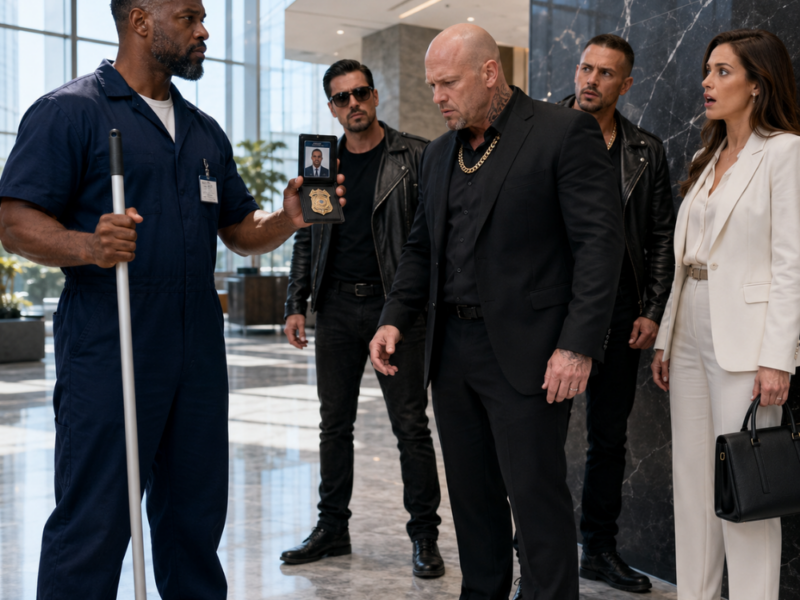
Black Janitor Sees His Beautiful Boss Surrounded by Thugs — Seconds Later, They Discover Who He Real
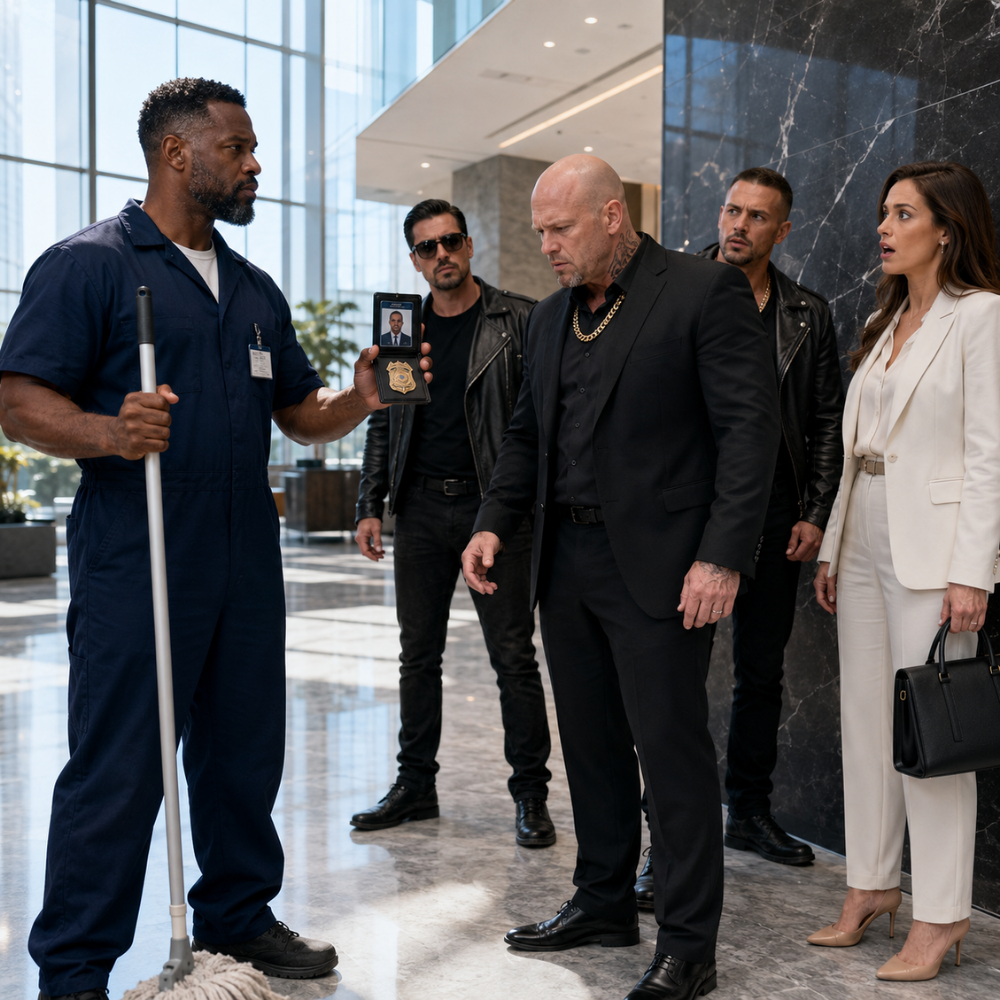
Nobody at Nexus Capital Tower knew why the janitor watched the CEO’s elevator every morning—until five men cornered her before sunrise.
Marcus Webb noticed the men because they were standing wrong.
That was the first thing.
Not their clothes.
Not the contractor badge clipped to one man’s belt.
Not even the fact that five strangers were inside the lobby of Nexus Capital Tower at 6:47 on a Tuesday morning, thirteen minutes before the building officially opened.
It was the way they occupied the space.
People who belonged in the building moved with purpose.
Security officers checked doors.
Cleaners pushed carts.
Early employees crossed the marble floor half-awake with coffee in one hand and phones in the other.
Delivery crews watched elevator indicators.
These men were watching Diana Reyes.
Marcus stood seventy feet away beside a cleaning cart with both hands resting on a mop handle.
He did not move immediately.
That mattered.
Panic distorted information.
Marcus had learned long ago to take one extra second whenever everyone else wanted the first one.
The lobby rose four stories around him.
Steel.
Glass.
Pale marble.
An abstract sculpture near the reception desk that a building memo once claimed was worth more than the entire annual cleaning contract.
At that hour, the immense room felt almost empty.
Only Marcus.
Diana.
Five men.
A maintenance worker disappearing through a service door at the far end.
Diana stood near the elevator bank with a leather briefcase in one hand.
She had entered through the front doors less than thirty seconds earlier.
Marcus knew because he knew her routine.
6:43 to 6:47, most mornings.
Coffee from the place on Wabash if the line was short.
Black umbrella on rainy days.
Dark wool coat from November through March.
Thirty-eighth floor.
Nexus Capital Management.
Chief executive officer.
The only executive in the building who knew Marcus’s last name.
Diana did not scream.
She did not run.
Her chin remained level.
Her left shoulder had moved slightly toward the wall, giving herself one less exposed angle.
Marcus recognized what she was doing.
Buying time.
Calculating doors.
People.
Distance.
The problem was that the nearest lobby security desk was empty.
The first daytime guard did not clock in until seven.
That scheduling gap had always bothered Marcus.
He had mentioned it twice to facilities.
Facilities had acknowledged the email.
Then nothing.
Now one of the men stepped closer to Diana.
Marcus leaned the mop carefully against his cart.
He removed his plastic employee badge from the chest of his blue coveralls and slipped it into his front pocket.
The gesture took less than two seconds.
Then he began walking.
Nobody at Nexus Capital Tower really knew Marcus Webb.
They knew pieces.
He was fifty-two.
Tall.
Broad shouldered beneath coveralls cut loose enough to hide most of it.
Gray beginning at his temples.
A thin scar beneath his left eye.
Badge 0047.
He arrived at 5:12 every morning through the loading entrance.
He carried a black thermos.
He did not drink from it until 6:30.
He cleaned the lobby first.
Then conference floors.
Then the employee café.
He fixed things that were technically not his job because calling maintenance took longer.
The third-floor coffee machine.
A door hinge on twelve.
A sticking supply closet latch.
Once, when a vice president’s heel broke before an investor presentation, Marcus found epoxy in the maintenance cabinet and repaired the shoe well enough to get her through the meeting.
She thanked him.
Then asked his name again two weeks later.
Marcus did not take offense.
That was the job.
People looked through cleaners the way they looked through automatic doors.
They registered function, not person.
Diana Reyes was different.
The first morning Marcus worked the tower, she had passed his cart at 6:45.
“Good morning.”
Marcus looked up.
“Morning.”
She glanced at his badge.
“Marcus.”
“Yes, ma’am.”
“Diana.”
He almost smiled.
“I know.”
She laughed.
“Fair.”
The next morning she said, “Morning, Marcus.”
Three weeks later she asked whether the coffee machine on thirty-eight was salvageable.
Two months later she noticed him wearing a brace around his left wrist.
“You hurt?”
“Old problem.”
“You need different equipment?”
“No.”
“Tell facilities if you do.”
“I will.”
Six months later, when building management changed cleaning contractors and tried to cut overnight staffing, Diana sent a short email asking why the one employee who had never missed a shift was being asked to cover three additional floors.
Marcus learned about the email accidentally.
She never mentioned it.
He liked that.
Diana was thirty-eight when she became chief executive of Nexus Capital.
The financial press liked describing her as self-made.
She disliked the phrase because everybody was made partly by other people.
Her mother worked eighteen years as a school secretary.
Her father, Carlos Reyes, served in the Army before becoming a city transit supervisor.
Diana grew up on the Southwest Side in a brick bungalow where the furnace failed every third February and where her father considered paying full price for anything a moral weakness.
She built Nexus Capital from a two-room office above a print shop.
The company was not enormous by Wall Street standards.
Roughly two hundred million dollars under direct management, several times that amount through advisory relationships, and a client list full of pension funds, family offices, and institutions that valued discretion.
Diana’s gift was not making money quickly.
It was seeing weak structures before they failed.
Debt.
Contracts.
People.
That was why Victor Crane bothered her.
He first appeared in Nexus files through a dormant investment partnership connected to one of their clients.
Forty million dollars had moved through a chain of entities over four years.
Perfectly documented at first glance.
Less perfect when Diana asked the second question.
Who actually owned the intermediaries?
One answer led to another.
A consulting firm.
A private lending company.
A trust registered in Delaware.
A set of transactions involving Raymond Holt, an investor whose sudden death from a heart attack had initially seemed unrelated.
Diana did what compliance people did when something smelled wrong.
She preserved records.
Called outside counsel.
Then notified federal investigators.
She did not confront Crane.
That would have been foolish.
Crane confronted her instead.
Indirectly.
A business acquaintance called with friendly advice.
Victor hears Nexus may have some unnecessary documents.
Another message arrived through counsel.
There are misunderstandings that become expensive when allowed to grow.
Diana forwarded everything to investigators.
Said nothing publicly.
Then the messages stopped.
That worried her more.
She had increased personal security for two weeks.
Then, at the urging of her board and against her own instincts, reduced it after federal contacts said they had no specific threat information.
Crane found the gap.
The building opened at seven.
Diana arrived at 6:46.
The overnight security contractor ended shift at 6:40 in the lobby because of a poorly designed overlap schedule.
The morning guard arrived at seven.
Facilities had called the nineteen-minute gap a “minimal exposure window.”
Marcus had written in an email:
Any predictable gap is not minimal once someone knows it exists.
Nobody replied.
Now he crossed the lobby.
The five men still had not treated him as relevant.
One glanced toward him.
Then away.
Marcus covered another twenty feet.
The man nearest Diana said something too quiet for Marcus to hear.
Diana’s answer carried farther.
“No.”
That was all.
The man smiled.
Another shifted toward the front doors.
Marcus kept walking.
At twenty feet, a man with a close-cropped beard turned fully.
“Hey.”
Marcus did not answer.
“Cleaning’s over there.”
Marcus kept moving.
The man laughed.
“Old man.”
Marcus stopped about fifteen feet away.
Victor Crane finally looked at him.
Marcus knew Crane from photographs.
Forty-eight.
Financial consultant.
Expensive suit.
Careful haircut.
A face built for private dining rooms and charitable boards.
He did not look dangerous.
Marcus had learned never to confuse appearance with intent.
Crane looked Marcus over.
Blue coveralls.
Work shoes.
No visible radio.
No weapon.
No title.
Marcus could almost see the conclusion form.
Nobody.
“Walk away,” Crane said.
Marcus looked toward Diana.
She gave the smallest shake of her head.
Do not.
Marcus looked back at Crane.
“Step away from her.”
One of the men laughed.
Crane did not.
“This has nothing to do with you.”
Marcus’s voice remained quiet.
“It does now.”
Behind Diana, the elevator doors remained closed.
The call button glowed.
No elevator came.
Someone had disabled the bank at the control panel.
Marcus registered that.
Crane nodded toward one of his men.
What followed lasted less than a minute.
Later, people would replay the lobby footage until every movement became mythology.
Online commentators slowed it down.
Veterans guessed Marcus’s training.
Television hosts drew lines across still frames and talked about angles, timing, and discipline.
Marcus hated all of that.
Nothing about the moment felt elegant to him.
It felt fast.
Confused.
Dangerous.
One man moved first.
Marcus redirected him hard enough to put him off balance and create space.
A second tried to close the distance.
Marcus used the cleaning cart as a barrier.
A bucket went over.
Water spread across the marble.
One man slipped badly and stayed down long enough to stop being an immediate problem.
Another grabbed for Marcus’s jacket.
Marcus broke the grip, moved him away, and kept himself between Diana and the group.
He did not chase anyone.
He did not strike after a man stopped advancing.
He did not turn a defensive moment into punishment.
That distinction would matter to him later more than anything the internet saw.
Diana reached the reception desk and triggered the emergency alarm hidden beneath the counter.
Marcus heard it.
Good.
Crane tried to move toward the side corridor.
Marcus blocked him.
“Don’t.”
Crane stopped.
One of his men rose again.
Diana shouted, “Police are coming.”
That changed the calculus.
The two men still capable of leaving tried.
The lobby doors had automatically locked on alarm.
They stopped.
For one second everyone stared at everyone else.
Marcus reached into the utility pouch on his cart.
Not for a weapon.
For two heavy-duty plastic ties used to secure broken cabinet doors and overloaded trash bags.
He slid them across the marble toward Crane.
“Hands where I can see them.”
Crane stared.
“You’re kidding.”
Marcus did not answer.
Sirens were faint in the distance.
Crane looked at his men.
Then at Marcus.
Something in Marcus’s face apparently made the next decision easier.
Crane lowered himself to his knees.
By the time Chicago police entered through the emergency side door, four men were sitting or lying against the reception wall, one had an injured ankle from the fall, and Victor Crane’s wrists were secured in front of him with a plastic tie.
Marcus stood near the cleaning cart.
Breathing harder now.
Diana stood behind the reception desk with both hands flat against the counter.
A patrol officer ran in.
“Hands!”
Marcus immediately raised his.
“Janitor.”
The officer looked around.
Another officer moved toward Crane.
Diana spoke.
“He works here.”
Her voice shook for the first time.
“He helped me.”
More officers arrived.
Then building security.
Then fire department medics.
The lobby filled with radios.
Questions.
Shoes.
The morning quiet disappeared.
Crane stared at Marcus.
“What are you?”
Marcus looked down.
His plastic name badge remained in his pocket.
He pulled it out.
Pinned it back to the blue coveralls.
MARCUS.
No last name.
No title.
He looked at Crane.
“I’m the janitor.”
Diana heard.
She would remember the sentence for the rest of her life.
Not because it was dramatic.
Because Marcus meant it.
He was not revealing a secret identity.
He was correcting a premise.
Being a janitor had never meant being nothing.
Police separated everybody.
Diana gave a preliminary statement.
Marcus gave one.
An officer asked whether Marcus had military or law-enforcement training.
He answered, “Military.”
“What branch?”
“Navy.”
“What did you do?”
Marcus looked at him.
“Enough.”
The officer almost asked again.
Then decided not to.
The lobby cameras had recorded everything.
That simplified immediate questions.
At 7:16, a detective arrived.
At 7:22, federal agents appeared because Crane was already part of an active financial investigation.
By 7:40, Nexus employees began arriving and found the building temporarily closed.
Phones came out.
Rumors spread.
Marcus sat on a bench beside his cleaning cart while a paramedic checked a scrape across his knuckles.
Diana sat three feet away holding a paper cup of water.
Neither spoke for several minutes.
Then she said, “Marcus.”
He looked over.
“Who are you?”
Marcus knew what she meant.
He looked toward the officers.
Then toward the lobby windows.
Morning traffic moved outside.
Normal Chicago.
Buses.
Cabs.
Pedestrians.
He reached into his wallet.
Inside was an old photograph folded twice.
He had carried it twenty-four years.
The edges had gone white.
Marcus opened it and placed it between them on the bench.
Two young men stood in tan uniforms beneath hard desert light.
One was Marcus.
Thinner.
No gray.
No scar beneath the eye.
The other was Carlos Reyes.
Diana’s father.
She stopped breathing.
Her fingers moved toward the photograph.
Then stopped before touching it.
“Where did you get this?”
Marcus looked at the picture.
“Kandahar.”
Diana stared.
“My father.”
“Yes.”
Her eyes filled.
“You knew him?”
Marcus nodded.
“For six months.”
“That’s it?”
“Long six months.”
She picked up the photograph carefully.
Her father looked younger than the photographs she remembered from childhood.
He was smiling.
That surprised her.
Carlos Reyes rarely smiled for cameras.
“What were you doing with him?”
Marcus looked toward the floor.
“I was assigned to a naval special operations support unit.”
Diana’s eyes returned to him.
Marcus continued.
“Your father worked with our team on logistics and field coordination.”
“You were Navy.”
“Yes.”
“He was Army.”
“Yes.”
“How?”
“War makes paperwork flexible.”
A tiny laugh escaped Diana through tears.
Marcus’s face softened.
Then became serious.
“October fourteenth, 2001.”
Diana knew the date.
The date military officers came to their house.
The date her mother stopped answering the door for almost a month.
Marcus continued.
“Our position got hit during a movement outside Kandahar.”
He did not give operational detail.
He never would.
“Your father got me out.”
Diana looked at the scar beneath Marcus’s eye.
“Were you hurt?”
“Yes.”
“He saved you.”
“Yes.”
She closed her eyes.
“What happened to him?”
Marcus looked at the photograph.
“He was helping another man after he helped me.”
Diana already knew the official report.
Enemy fire.
Died during combat operations.
Courage under fire.
Words polished enough for folded flags.
Marcus gave her the human version.
“He stayed.”
She opened her eyes.
Marcus continued.
“He could have left with me.”
“He didn’t.”
Her mouth trembled.
“That sounds like him.”
“Yes.”
A long silence.
Then Marcus said, “He talked about you.”
Diana looked up.
“What?”
“All the time.”
She stared.
“He carried a photograph.”
“You were thirteen.”
“School picture.”
Diana laughed through tears.
“I had terrible braces.”
“He thought you were beautiful.”
That broke her.
She covered her mouth.
Marcus waited.
He did not touch her.
He knew some grief needed distance.
Eventually Diana asked, “Why are you here?”
Marcus looked toward the cart.
She followed his eyes.
“No.”
Her voice sharpened.
“Do not tell me this is coincidence.”
Marcus sighed.
That was answer enough.
“Marcus.”
He looked at her.
“After I left the service, I worked security overseas.”
“Then private training.”
“Then nothing for a while.”
“Your father’s last words to me were about getting home.”
“He knew I had nobody waiting.”
“He told me he had a daughter.”
Marcus swallowed.
“He said, ‘If you ever meet her, make sure she’s okay.’”
Diana stared.
“He said that?”
“Something close.”
Marcus did not turn a dying man’s sentence into poetry.
“I looked for you after I came home.”
“You were still a kid.”
“Then college.”
“Then you disappeared into finance.”
Diana almost smiled.
“Disappeared?”
“Rich people are surprisingly hard to find if they don’t want strangers calling.”
She shook her head.
“So you took a cleaning job.”
“Eventually.”
“Why not come to my office?”
Marcus looked genuinely confused.
“And say what?”
“Your father saved my life, so now I’m here to supervise yours?”
Diana laughed again despite herself.
Marcus continued.
“I didn’t know whether you needed anything.”
“You didn’t.”
“So I worked.”
“You watched.”
“Sometimes.”
“For three years.”
“Yes.”
The weight of it arrived slowly.
Every morning.
Every early elevator.
Every “Morning, Marcus.”
Every day she thought she was the one person in the building decent enough to remember a janitor’s name.
He had been remembering hers for twenty-four years.
Diana looked at the photograph.
“You should have told me.”
Marcus nodded.
“Maybe.”
“Why didn’t you?”
He considered.
“Because your father didn’t save my life so I could turn that into a claim on his daughter.”
Diana’s eyes filled again.
Marcus continued.
“He did what he did because that was who he was.”
“The least I could do was try to live in a way he wouldn’t be embarrassed by.”
The medics moved around them.
Police radios clicked.
Diana held the photograph.
“What do I do with that?”
Marcus almost smiled.
“Nothing.”
“I don’t owe you anything.”
“No.”
That answer mattered more than all the rest.
At 8:32, someone leaked the lobby video.
Nobody ever proved who.
By nine, a local television station had it.
By lunch, national networks.
The footage was less cinematic than social media wanted.
No soundtrack.
No clean action-movie sequence.
A janitor walking toward a problem.
Men underestimating him.
A short struggle.
Diana reaching the emergency alarm.
Police arriving.
Still, the video spread.
People wanted to know who Marcus was.
The internet found more than Marcus wanted.
Master Chief Petty Officer Marcus T. Webb, United States Navy, retired.
Eighteen years active service.
Multiple overseas deployments.
Decorations for valor.
A medical retirement after injuries ended his operational career.
Some records remained restricted.
Enough was public.
A photograph surfaced of Marcus at a Navy ceremony receiving a high-level valor award.
Another from a veterans event years earlier.
Someone connected Carlos Reyes’s name through an old unit citation.
By afternoon, reporters were camped outside Nexus Capital Tower.
Employees discovered they had worked beside a decorated veteran for three years without knowing.
The reaction became uncomfortable.
People who had ignored Marcus suddenly wanted photographs with him.
A vice president who had never greeted him posted a long message about “everyday heroes.”
Marcus saw it on someone’s phone and asked facilities whether he could finish the thirty-eighth-floor restrooms without reporters following him.
The building manager laughed nervously.
“You’re joking.”
“No.”
“Marcus, the entire country is talking about you.”
“The sinks still need cleaning.”
The manager stared.
Marcus picked up his cart.
Work did not disappear because the internet found a new symbol.
Diana released one statement.
Marcus Webb saved my life this morning. For three years, he has worked in our building with professionalism, dignity, and a history none of us thought to ask about. Whatever you imagine when you hear the word janitor, make sure your imagination includes the person.
Geraldine Wu, Nexus’s communications director, suggested adding language about the company honoring Marcus.
Diana removed it.
“We have not earned the right to make this about what Nexus does next.”
Geraldine nodded.
That night, Diana returned to the tower at ten.
Police tape was gone.
The lobby had been reopened.
Morning’s water stain was polished away.
Marcus was mopping near the south corridor.
Exactly where he usually worked.
Diana stood near the entrance.
He looked up.
“Evening.”
She almost laughed.
“Evening?”
“Yes.”
“Marcus, forty million people watched you today.”
“Sounds exhausting.”
“It is.”
“For you?”
“For both of us.”
He continued mopping.
Diana walked closer.
“Would you sit down?”
Marcus looked toward the clock.
“Five minutes.”
“That is the most irritatingly janitorial answer possible.”
He leaned the mop against the cart.
They sat on the same bench where he had shown her the photograph.
Diana placed another photograph between them.
Her copy.
Carlos Reyes in dress uniform holding seven-year-old Diana on one shoulder while she clutched a county-fair stuffed bear.
Marcus looked.
“He talked about that bear.”
Diana’s head snapped around.
“No.”
“Pink?”
“Purple.”
“Memory.”
She smiled.
“He said you cheated at one of the carnival games.”
“My father cheated.”
“Sounds more likely.”
For a moment, Marcus and Diana sat in the bright lobby like two people connected by somebody who had been gone almost twenty-five years.
Then Diana asked, “Why janitorial work?”
Marcus looked toward his cart.
“I needed work.”
“You could have done security.”
“I did.”
“What happened?”
“I got tired of watching doors.”
Diana waited.
Marcus continued.
“Security after the military felt too close.”
“Cleaning didn’t.”
“No.”
“You like it?”
Marcus shrugged.
“I like finishing things.”
He looked around the lobby.
“A floor is dirty.”
“Then it isn’t.”
“Simple.”
Diana understood more than he said.
Some lives had too many unresolved problems.
Clean work had clear endings.
“You could retire.”
“I could.”
“Why don’t you?”
“Too much daytime television.”
She laughed.
Then became serious.
“I want to offer you something.”
Marcus looked at her.
“No.”
“You don’t know what.”
“Security.”
She frowned.
“How?”
“Everybody offered me security today.”
“Head of executive protection.”
“No.”
“Consultant.”
“No.”
“Director.”
“Diana.”
She stopped.
Marcus looked toward the photograph.
“You don’t owe me a career.”
“I know.”
“Do you?”
She stared.
He continued.
“This is exactly why I didn’t tell you.”
“That isn’t fair.”
“It is.”
“I can think you’re qualified without paying a debt.”
Marcus considered.
“Maybe.”
“I have spent fourteen hours discovering you know more about security than everybody we currently pay.”
“That appears to be a separate organizational problem.”
Diana laughed.
He smiled faintly.
“I’ll think about consulting.”
“That is progress.”
“One day a month.”
“Two.”
“One.”
“Marcus.”
“You negotiate for a living.”
“Yes.”
“You should recognize when you’re losing.”
She stared at him.
Then smiled.
“One.”
That agreement lasted four months.
Not because Diana kept pushing.
Because Marcus began reviewing the tower’s security systems.
One day became two.
Then a formal independent audit.
He found predictable gaps.
Inactive badge controls.
Poor shift overlap.
Camera maintenance delays.
Too much reliance on visual uniforms rather than access verification.
Diana listened.
Facilities did not always.
Marcus learned corporate reform was not entirely different from military bureaucracy.
Everyone agreed changes were important until changes interfered with budget cycles.
The morning security overlap was fixed first.
Obviously.
The stolen contractor credential became part of a larger access review.
Then came the uncomfortable issue.
How had Crane known the gap?
Federal investigators found the answer through financial records.
A junior facilities contractor had accepted cash for building schedules.
He had not understood the intended use.
That did not erase his responsibility.
He cooperated.
So did a security subcontractor who had ignored the stolen badge deactivation request.
Crane’s plan depended less on criminal genius than ordinary people failing to finish routine tasks.
Marcus pointed that out in the post-incident meeting.
Everybody expected the decorated veteran to talk about courage.
He talked about email.
“A badge was reported stolen.”
He looked around the conference room.
“The deactivation ticket sat open six weeks.”
The IT manager shifted.
“The overnight camera relay was flagged twice.”
Silence.
“Shift overlap was documented.”
Marcus looked toward Diana.
“This incident was not caused because somebody was insufficiently heroic.”
He turned back to the room.
“It happened because boring work was not completed.”
Diana wrote that sentence down.
Nexus changed its systems.
Not perfectly.
But materially.
Diana also changed.
The incident made her look at the building differently.
Not only security.
People.
She knew Marcus’s name.
Good.
Did she know the overnight doorman’s?
The woman who cleaned the executive bathrooms?
The mailroom staff?
Not all.
That bothered her.
She did not create some embarrassing corporate campaign called SEE THE INVISIBLE.
She considered anything like that insulting.
Instead, she asked Human Resources for data.
Pay.
Benefits.
Contract status.
Turnover.
The cleaning crew worked through an outside vendor.
No paid sick leave beyond a small statutory minimum.
Health coverage expensive enough that several employees declined it.
Diana discovered the people maintaining a building full of investment firms had worse retirement benefits than the interns.
The irony did not require explanation.
She called the building ownership group.
Then the contractor.
Negotiations followed.
Not charity.
Contract terms.
Higher labor cost.
Better benefits.
Some tenant firms complained when common-area charges rose.
Diana paid Nexus’s share without argument.
One CEO called.
“You realize cleaning costs jumped nine percent.”
“Yes.”
“You pushed this?”
“Yes.”
“Why?”
“Because the old contract was inadequate.”
“You’re letting one emotional event influence building economics.”
Diana looked at the labor report.
“No.”
“I’m letting data influence a contract I should have reviewed earlier.”
That ended the discussion.
Marcus found out when his next benefits packet arrived.
He walked into Diana’s office without appointment.
Her assistant looked horrified.
Diana waved him in.
“You changed the contract.”
“Yes.”
“You didn’t need to.”
“I did.”
“Because of me.”
“Partly because you made me look.”
Marcus stared.
Diana continued.
“Then because the numbers were bad.”
He nodded slowly.
“That I can live with.”
“Wonderful.”
“I was deeply worried.”
She smiled.
By spring, Victor Crane accepted a federal plea agreement.
The forty million dollars in disputed funds became part of a larger forfeiture and restitution process.
Several of Crane’s associates faced charges.
The case did not move in a clean straight line.
No real case did.
There were hearings.
Motions.
Arguments over evidence.
One charge was dropped.
Another expanded.
Raymond Holt’s death remained officially natural; investigators found no evidence it had been anything else.
That mattered to Diana.
The internet wanted everything connected.
Reality did not owe people narrative symmetry.
Crane had committed financial crimes and organized an effort to intimidate Diana into destroying evidence.
That was enough.
The men in the lobby received varying charges based on individual actions.
Marcus testified once before a grand jury and once at sentencing.
He hated both.
A prosecutor asked whether he feared for his life.
Marcus answered, “I was concerned.”
The prosecutor tried again.
“Were you afraid?”
“Yes.”
The room seemed surprised.
Marcus was not.
Fear and competence had never been opposites.
At sentencing, Crane’s attorney described the lobby plan as intended only to pressure Diana into surrendering records.
Diana read a victim statement.
She did not dramatize.
“You entered my workplace with men positioned between me and every public exit.”
She looked at Crane.
“You may call that pressure.”
“I experienced it as a clear threat.”
That was all.
Crane received a substantial federal sentence tied mainly to financial crimes, conspiracy, obstruction, and the attempted coercion surrounding Nexus records.
Diana did not attend the press conference afterward.
She went back to work.
Marcus did too.
He never became head of security.
He accepted a consulting retainer with the building for one day a month.
Then two.
But he kept his cleaning job.
People could not understand that.
A television producer offered money for an interview.
No.
A book agent called.
No.
Veterans organizations invited him to speak.
Some he accepted.
Most he did not.
A private security company offered six times his cleaning salary.
No.
Diana finally asked why.
They were sitting in the cafeteria before sunrise.
Marcus drank from the black thermos.
“You could earn more.”
“Yes.”
“You could do work everybody thinks matches your history.”
“I already did that work.”
“You’re good at it.”
“I know.”
She waited.
Marcus looked toward the lobby.
“This is the first job I’ve had where nobody expects me to be the man I was.”
Diana understood.
“Except now everybody does.”
“That is temporary.”
It was.
People adapted.
The first month after the video, employees greeted Marcus constantly.
Too constantly.
Some conversations were awkward.
“Morning, Master Chief.”
Marcus would answer, “Marcus.”
One junior analyst tried saluting him.
Marcus told him never to do that again.
By the third month, the novelty faded.
By the sixth, most people said hello naturally.
The full name stuck.
Marcus Webb.
Not Marcus the janitor.
Not Master Chief Webb.
Just Marcus.
That was progress.
The building manager who had once spoken to him as though recycling instructions might be too complicated apologized.
Badly.
“I hope you know I treat everyone the same.”
Marcus looked at him.
“That might be part of the problem.”
The manager blinked.
Marcus walked away.
Later, the man came back.
“Can I try again?”
Marcus nodded.
“I was condescending.”
“Yes.”
“I’m sorry.”
“Okay.”
No speech.
No friendship.
Accountability did not require intimacy.
Marcus believed that.
Diana’s relationship with her father’s memory changed too.
For years, Carlos Reyes had been a photograph.
A military funeral.
A folded flag.
A handful of stories from his friends.
Her mother rarely discussed the circumstances of his death.
Too painful.
Marcus gave Diana something different.
Ordinary Carlos.
Bad jokes.
Terrible coffee.
A habit of trading hot sauce packets with soldiers.
He snored.
He hated raisins.
He carried two photographs of Diana because he lost the first once and panicked.
He once spent forty minutes telling Marcus how Diana had won a middle-school debate by correcting a teacher’s statistics.
“She was unbearable even then,” Marcus said.
Diana smiled.
“My mother said the same.”
They talked rarely about the final day.
Marcus did not want her relationship with him to become an archive of tragedy.
Diana respected that.
One afternoon she asked, “Did he suffer?”
Marcus became quiet.
She immediately regretted it.
“You don’t have to answer.”
He looked at her.
“No.”
She waited.
“He was focused on other people.”
That was the closest Marcus came.
Diana accepted it.
Her mother, Elena Reyes, met Marcus six months after the lobby incident.
Diana told her first.
Elena sat at the kitchen table in her bungalow.
She was sixty-eight.
Still kept Carlos’s Army photograph beside the refrigerator.
When Diana showed her Marcus’s picture, Elena’s hands began shaking.
“He was there?”
“Yes.”
“Why didn’t he come?”
“He tried to find us.”
Elena stared.
“He worked in your building?”
“For three years.”
Her mother became angry.
Not sentimental.
“Three years?”
“Yes.”
“He knew who you were?”
“Yes.”
“And never told you?”
“Yes.”
Elena stood.
“That is exactly the kind of foolish thing your father would inspire.”
Diana laughed so suddenly she nearly cried.
Marcus came for Sunday dinner.
He brought flowers.
Elena hated flowers as hostess gifts.
She told him so in the first three minutes.
He smiled.
“Good to know.”
Then she hugged him hard enough that Marcus’s expression broke.
Diana looked away.
Dinner lasted four hours.
Elena served too much food.
Marcus told stories.
At one point, Elena disappeared into the bedroom and returned carrying an old metal box.
Inside were Carlos’s letters.
Marcus read one.
Then stopped.
“I shouldn’t.”
Elena pushed the box toward him.
“You were there.”
He shook his head.
“These were for you.”
“They were from him.”
She looked at Marcus.
“So were you.”
That sentence stayed with all three.
Marcus became part of their lives.
Not as replacement family.
No one replaced anyone.
He came for Christmas.
Then Memorial Day.
Then random Sundays.
He helped fix Elena’s porch rail and was furious when Diana’s mother tried to pay him.
Elena eventually stopped trying and began sending him home with food instead.
Marcus accepted that.
There were rules even veterans could not defeat.
Two years after the lobby incident, Diana’s board held a retreat.
One agenda item concerned succession planning.
Diana listened to directors talk about key-person risk.
If Diana became unavailable.
If a founder’s identity became too tied to the company.
The irony was not lost on her.
She remembered Crane.
Remembered standing against the elevator bay.
Remembered Nexus’s security depending on an overlooked janitor noticing something wrong.
Systems should not require accidental heroes.
That principle changed the company.
Security.
Compliance.
Leadership.
Every critical responsibility gained backup.
Every high-risk process had more than one owner.
Dormant accounts received automated review.
Whistleblower systems went outside management.
Access control required fast closure.
Executive travel security became less predictable but also less intrusive.
Marcus helped design some of it.
Mostly by asking annoying questions.
“What happens if that person is sick?”
“Who checks the checker?”
“What if nobody reads the email?”
“What if the CEO says no?”
The board initially found him intimidating.
Then discovered Marcus was not impressed by titles.
That became useful.
One director once said, “Marcus, with respect, this is not a military environment.”
Marcus answered, “Correct.”
Then pointed toward a failed control.
“In the military, somebody would have fixed that after the first warning.”
Diana nearly laughed.
By the third year, Marcus reduced his cleaning hours.
His left knee bothered him.
Age was catching up.
He refused to call it that.
“Wear.”
“That’s age,” Diana said.
“Maintenance.”
“That is denial.”
He shifted to three cleaning mornings a week and formal building-security consulting on two afternoons.
Not executive protection.
Never that.
He helped train guards.
Review procedures.
Run emergency drills.
The guards liked him because he never humiliated them during mistakes.
He would stop a drill.
Ask what happened.
Reset.
Run it again.
One young guard apologized repeatedly after forgetting a radio call sign.
Marcus said, “You’re learning.”
The guard looked surprised.
Marcus added, “Learning is cheaper here than during a real emergency.”
That became the training culture.
Diana noticed.
So did employees.
Nexus Capital grew.
Four hundred million.
Then more.
Diana became wealthier than she had ever expected.
The higher she climbed, the more aggressively she resisted becoming insulated.
She ate in the employee café twice a week.
Not as a performance.
Sometimes alone.
She walked the building.
Knew names.
Not every name.
That became impossible.
But she built systems that did not depend on knowing.
Fair pay.
Anonymous reporting.
Benefits.
Clear escalation.
Marcus approved.
He also reminded her when she became self-congratulatory.
“We raised custodial pay eight percent.”
“Good.”
“That was meaningful.”
“Yes.”
“You could sound happier.”
Marcus drank coffee.
“You fixed something that should have been fixed.”
Diana stared.
“You are impossible to impress.”
“Correct.”
She smiled.
That was one of the reasons she trusted him.
The public story about Marcus continued evolving without his permission.
Every Veterans Day, the lobby video returned online.
Someone would repost it with dramatic music.
Marcus would complain.
One year an influencer added explosions in the background.
Diana showed him.
Marcus stared.
“Was there an explosion?”
“No.”
“Then why?”
“Internet.”
He shook his head.
“What happened to shame?”
“Engagement metrics.”
“Worse.”
He eventually agreed to one interview.
Public television.
No sensational framing.
The interviewer asked, “Why did you intervene?”
Marcus answered, “Because somebody needed help.”
“Did your promise to Diana’s father influence you?”
“Yes.”
“Would you have intervened if she had been a stranger?”
Marcus looked genuinely confused.
“I hope so.”
That clip became less popular than the fight footage.
Marcus preferred it.
Five years after the incident, he formally retired from custodial work.
The overnight crew held breakfast in the staff room.
Not the executive dining space.
Store-bought donuts.
Coffee.
A Costco sheet cake at seven in the morning because facilities had no idea what retirement food should be.
The cake said:
HAPPY RETIREMENT MARCUS
PLEASE STOP FIXING THINGS FOR FREE
He laughed.
Diana attended.
So did Elena Reyes.
The building manager gave Marcus a plaque.
Marcus hated plaques.
He accepted politely.
Then Diana handed him an envelope.
He looked suspicious.
“What?”
“Open it.”
Inside was a contract.
Marcus stared.
“No.”
“You have not read it.”
“Still no.”
“Independent Security and Operations Adviser.”
“Part time.”
“Remote whenever possible.”
“Health benefits.”
“Office if you want one.”
“No office.”
“Fine.”
“Parking.”
“I take the train.”
“Marcus.”
He looked at her.
Diana smiled.
“One day a week.”
He thought.
“You’ve been negotiating this for five years.”
“Persistence.”
“Harassment.”
“Employment opportunity.”
He signed.
One day.
Nobody believed it would stay one.
It did.
Marcus had learned boundaries.
Diana, mostly.
By then the building employees no longer thought of Marcus as a janitor who had secretly been extraordinary.
That frame had always bothered Diana.
It implied janitor and extraordinary were opposites.
Marcus had been both.
Cleaner.
Veteran.
Friend.
Consultant.
A man who repaired coffee machines.
A man who remembered promises longer than other people remembered names.
Human beings did not become more valuable when a prestigious fact about them was discovered.
That was the larger lesson Diana struggled to articulate.
The danger in the viral story was not only that everyone had overlooked Marcus.
It was that many people suddenly believed overlooking him had become shameful because he turned out to be decorated military personnel.
What if he had not been?
What if Marcus Webb had been exactly what the badge suggested?
A fifty-two-year-old custodian.
No classified history.
No medal.
No old photograph.
Would saying good morning matter less?
Would dignity?
Would fair pay?
Would his observations about security become less worthy of hearing?
Diana discussed that in a speech at a business ethics conference.
“The problem was not that we failed to recognize a hero.”
She looked out at several hundred executives.
“The problem was that we thought recognition had to be earned through heroism.”
The room became quiet.
Diana continued.
“Our building had employees whose expertise we never asked about because their uniforms told us what category to place them in.”
“That is bad management before it is bad manners.”
She let that land.
“People see things from where they stand.”
“A cleaner sees facilities differently from a CFO.”
“A receptionist understands access differently from a board member.”
“A driver sees executive behavior nobody sees in meetings.”
“If your organization only listens upward, you are intentionally blinding yourself.”
Marcus watched the speech online.
He texted:
Long.
Diana replied:
It was 14 minutes.
Marcus:
Long.
She smiled.
Elena Reyes died seven years after the lobby incident.
Quietly.
At home.
Diana and Marcus were both there in the final week.
Elena had congestive heart failure and disliked hospice nurses telling her not to overdo things.
At seventy-five, she was still telling everybody what food they should take home.
One afternoon she asked Marcus to sit beside her bed.
Diana left them alone.
Twenty minutes later, Marcus came into the kitchen with red eyes.
He did not say what Elena told him.
Diana never asked.
At the funeral, Marcus sat beside Diana.
No hidden promise.
No obligation.
Choice.
That mattered.
Afterward, Diana gave Marcus the old Army photograph that had lived beside Elena’s refrigerator.
“Take it.”
Marcus shook his head.
“It’s yours.”
“I have copies.”
“So do I.”
Diana looked at him.
“You knew him in a way I didn’t.”
Marcus stared at the photograph.
Then accepted it.
Years later, it sat on a shelf in his apartment beside nothing military.
No medals.
No plaques.
Just Carlos Reyes.
The medals remained in a box.
Diana had seen them once.
Marcus looked embarrassed.
She asked why.
“They belong to the past.”
“History belongs to the past.”
“Exactly.”
“That does not mean it belongs in a box.”
Marcus looked at her.
“You becoming philosophical again?”
“Occupational hazard.”
He smiled.
Diana became chair of Nexus at fifty-two.
Stepped back from daily management.
A younger executive took over.
The first morning Diana entered the building without being CEO, she arrived at 6:46.
Habit.
Marcus was already in the lobby.
Not cleaning.
Just waiting with coffee.
“Retirement treating you badly?”
“Apparently.”
They sat on the bench.
Same bench.
The marble had been refinished twice.
Security desk now staffed continuously.
Cameras upgraded.
Credential controls changed.
The building looked almost identical.
Systems beneath it were different.
Diana looked toward the elevator bank.
“Do you still watch it?”
Marcus knew what she meant.
“Sometimes.”
“Why?”
“Habit.”
She nodded.
Then asked, “Do you regret taking the job?”
“No.”
“Not even a little?”
Marcus thought.
“The pay was terrible.”
Diana laughed.
“You could have told me.”
“You eventually figured it out.”
She looked at him.
“You spent three years protecting me.”
Marcus shook his head.
“No.”
“Marcus.”
“I watched.”
“Mostly.”
“You did not need protection most days.”
“That distinction mattered to him.
Diana understood.
Protection without danger could become surveillance.
Marcus had tried not to make his promise into control.
Her father said watch over her.
Marcus interpreted that as be nearby, not own her choices.
That was perhaps the most respectful part of what he had done.
Diana looked at him.
“Do you think my father meant twenty-four years?”
Marcus smiled faintly.
“No.”
“Then why?”
He looked toward the morning light.
“Promises change.”
“How?”
“At first, I thought keeping it meant finding you.”
“Then making sure you were okay.”
“Then I realized you were okay.”
Diana raised an eyebrow.
“Mostly.”
“Then what?”
Marcus held the coffee cup between both hands.
“After a while, the promise was not about him anymore.”
Diana became still.
“What was it about?”
Marcus looked at her.
“You.”
She looked away.
Marcus added, “And me.”
That was the closest he ever came to saying what their friendship had become.
Neither needed more.
The tower doors opened automatically at seven.
Employees began arriving.
Some recognized Marcus.
Some did not.
Younger staff had joined years after the viral video.
To them, Marcus was simply the older security adviser who occasionally appeared in meetings and complained about unsecured doors.
Diana loved that.
Fame had finally expired.
One young analyst walked past without looking.
Then turned back.
“Morning, Mr. Webb.”
Marcus nodded.
“Morning.”
Diana smiled.
He looked at her.
“What?”
“Nothing.”
He knew.
Years earlier, the internet had treated the story as one extraordinary man teaching arrogant people a lesson.
Time had softened the spectacle and clarified the truth.
Victor Crane’s greatest mistake was not underestimating a former Navy master chief.
It was building a plan around the assumption that the person cleaning the floor was irrelevant.
Nexus’s mistake had been similar.
Security schedules designed without asking cleaners what they observed.
IT tickets deferred.
Overnight staff treated as background.
Executives walking through a building without seeing the people who knew its rhythms better than anyone.
The same blindness existed in less dramatic places everywhere.
Hospitals where aides noticed changes before doctors.
Schools where custodians knew which students hid in hallways at lunch.
Apartment buildings where maintenance workers saw which elderly residents stopped opening doors.
Offices where receptionists knew which clients frightened junior employees.
Homes where caregivers heard what families refused to say.
People near the bottom of formal hierarchies often stood closest to reality.
The problem was that institutions confused low status with low information.
Marcus knew.
Diana learned.
That lesson eventually changed more than security at one tower.
Nexus added frontline staff to building-operations reviews.
Cleaning supervisors attended emergency-planning meetings.
Contract employees received access to the same safety reporting tools as executives.
Facilities complaints could be escalated without management approval.
A janitor reporting a broken lock no longer depended on whether a vice president thought it urgent.
Some directors considered the changes excessive.
Then one fire drill revealed a service-door obstruction nobody in senior management knew existed.
The overnight cleaning supervisor had reported it twice.
After that, nobody complained.
Marcus attended the post-drill meeting.
Diana looked at him.
He said nothing.
He did not need to.
One Saturday, years into retirement, Marcus returned to Nexus because he had left his reading glasses in a conference room.
The lobby was nearly empty.
A young cleaner he did not know was pushing a cart.
She looked maybe twenty-three.
Marcus held the door for her.
“Thanks.”
She smiled.
Then glanced at him.
“You work here?”
“Sometimes.”
“What do you do?”
Marcus thought.
“Annoy people about security.”
She laughed.
“I’m Jasmine.”
“Marcus.”
Something about the name registered.
She looked more closely.
“Oh.”
Marcus sighed.
“No.”
“You’re that—”
“No.”
“The video.”
“Unfortunately.”
Jasmine laughed.
“My dad showed me that.”
“Your father has questionable taste.”
She smiled.
Then said, “They tell us in orientation that cleaners notice things other people miss because of you.”
Marcus stopped.
“What?”
“Security orientation.”
“They say if we see something strange, call it in even if we think it’s above our pay grade.”
Marcus looked toward the reception desk.
The sentence affected him more than awards ever had.
“Good.”
Jasmine nodded.
Then pushed her cart toward the elevator.
“Have a nice day.”
“You too.”
Marcus found his glasses.
On the way out, he called Diana.
She answered from Washington, where she was attending a pension-fund conference.
“What?”
“You changed orientation.”
Diana paused.
“Which orientation?”
“Cleaning staff.”
“Oh.”
“You didn’t tell me.”
“You dislike credit.”
“That is not the same thing.”
She laughed.
“What did they say?”
Marcus told her.
Diana became quiet.
Then said, “Good.”
That was all.
Some changes did not need announcements.
Three months later, Jasmine called building security at 5:30 one morning because a man wearing a delivery jacket was photographing access panels near a service corridor.
He turned out to be an authorized contractor conducting an audit.
False alarm.
Nobody punished Jasmine for calling.
Security thanked her.
That was exactly how Marcus wanted the system to behave.
The cost of one unnecessary check was tiny.
The cost of teaching people not to speak could be enormous.
When Marcus turned seventy, Diana hosted dinner.
Not a gala.
His apartment.
Six people.
Diana.
Her husband by then, a pediatric surgeon named Elliot Chen.
Two former Navy friends.
Jasmine, now facilities operations manager.
And Marcus.
Marcus cooked.
Everyone complained because it was his birthday.
He ignored them.
After dinner, Diana handed him a small wrapped box.
“If this is another plaque—”
“It isn’t.”
He opened it.
Inside was a new leather wallet.
Simple.
Inside the clear pocket, she had placed a copy of the photograph of Marcus and Carlos in Kandahar.
Marcus stared.
Diana said, “The old one is falling apart.”
He looked at her.
“I have the original safe.”
“I know.”
“This is for carrying.”
Marcus ran one thumb along the edge.
“Thank you.”
No jokes.
Diana looked away.
Elliot noticed.
Said nothing.
Marcus placed the wallet in his pocket.
The promise had become part of him long before.
It no longer required the photograph.
Still, he carried it.
That winter, Marcus slipped on ice outside his apartment and fractured his wrist.
Diana found out through Jasmine.
Marcus had not told her.
She arrived at the hospital furious.
“You are seventy.”
“I know.”
“You live alone.”
“I know.”
“You broke your wrist.”
“Apparently.”
“You did not call.”
“I called a taxi.”
Diana stared.
“You are impossible.”
Marcus smiled.
“Likewise.”
She sat.
Then they both started laughing.
For decades, Marcus had believed protecting people meant being the one who arrived.
He had more trouble learning to let others arrive for him.
That became his late-life lesson.
Diana drove him home.
Stocked his refrigerator despite his complaints.
Elliot arranged follow-up care.
Jasmine organized a rotating schedule for building friends to check in.
Marcus hated every minute.
He also allowed it.
Progress.
One evening during recovery, Diana brought soup from a place Marcus liked.
He sat by the window with his cast.
“You know your father would enjoy this.”
“What?”
“Me being useless.”
“He would call it character development.”
Marcus laughed.
Then became quiet.
“He would be proud of you.”
Diana looked down.
“You can’t know that.”
“Yes.”
“No.”
Marcus waited.
Then corrected himself.
“I think he would.”
Better.
Diana smiled.
“Thank you.”
They ate soup.
Nobody owed anyone.
That was what the relationship had finally become.
Not debt.
Not duty.
Not a soldier’s last request.
Friendship chosen after the promise had already been fulfilled.
When journalists occasionally rediscovered Marcus years later, they always asked the same question.
Why did you keep cleaning?
Why not become wealthy from your story?
Why not accept security jobs?
Why not write a book?
Marcus usually gave unsatisfying answers.
“I liked the work.”
“Needed insurance.”
“Didn’t want attention.”
All true.
The deeper answer was harder.
For much of his life, Marcus had been valued for what he could do under pressure.
Mission.
Combat.
Protection.
Strength.
After leaving that world, cleaning gave him a form of usefulness that did not require danger.
Nobody needed him to be extraordinary.
The floor needed mopping.
The coffee machine needed fixing.
The trash needed taking out.
There was relief in that.
Then the lobby incident made everybody look at him through the old lens again.
Hero.
Warrior.
Protector.
Marcus understood why.
He also resisted it.
The person he most wanted to become was not the man in the Navy photograph.
He respected that man.
He simply did not want to live there forever.
Diana understood eventually.
That was why, when Nexus Capital created an annual safety award and suggested naming it after Marcus, she called him before approving it.
“No.”
She expected the answer.
“Any alternative?”
“Yes.”
“What?”
“Name it after whoever reports the problem.”
“That changes every year.”
“Exactly.”
The award became the Quiet Notice Award.
Marcus hated that name too.
Diana kept it.
Each year it recognized an employee or contractor who identified a mundane issue before it became serious.
A blocked fire exit.
A payroll discrepancy.
A malfunctioning lock.
An unusual visitor.
Nothing heroic.
Prevention.
Marcus approved despite pretending not to.
Years later, Diana spoke at his retirement-from-consulting dinner.
This time Marcus allowed one.
Small.
No press.
She stood beside a projector screen that he had forbidden anyone to use for military photographs.
“People think I owe Marcus my life.”
Marcus looked annoyed already.
Diana continued.
“They’re right in one literal sense.”
“But that isn’t the debt that matters.”
She looked around the room.
“Marcus spent years teaching me that gratitude becomes dangerous when it turns another person into an object.”
“Hero.”
“Protector.”
“Employee.”
“Janitor.”
“CEO.”
She looked at him.
“He refused every box we tried to put him in.”
Marcus raised his coffee.
“Speech is getting long.”
People laughed.
Diana smiled.
“I learned something because of that.”
She turned toward the staff.
“The first day I knew Marcus, I thought I was being respectful because I remembered his name.”
“That was a good start.”
“It was not enough.”
She paused.
“Seeing people is not remembering what to call them.”
“It is believing their observations might matter.”
“Believing their work deserves dignity before you discover an impressive biography.”
“Believing they are fully human even when they cannot do anything for you.”
Marcus looked down.
Diana’s voice softened.
“My father asked Marcus to watch over me.”
“For years I thought the extraordinary part was that Marcus kept the promise.”
“Now I think the extraordinary part is how carefully he refused to turn the promise into ownership.”
The room quieted.
“He stayed close.”
“He never demanded access.”
“He never told me how to live.”
“He helped when help was needed.”
“And when it wasn’t, he went back to work.”
Marcus’s eyes had gone suspiciously bright.
Diana saw.
Kept going.
“Most protection fails because it wants gratitude.”
“Marcus wanted nothing.”
“That taught me more about power than any boardroom ever did.”
She stopped.
“Thank you.”
No applause at first.
Marcus hated ceremonial applause.
Then Jasmine began.
Others joined.
Marcus shook his head.
But he stood.
Afterward, Diana found him near the hallway.
“You embarrassed me.”
“That was intentional.”
“Your father would disapprove.”
“My father would have enjoyed it.”
“Probably.”
They smiled.
Marcus looked toward the room.
“You know what bothered me most after the lobby?”
“What?”
“Everybody saying the five men picked the wrong janitor.”
Diana nodded.
“I know.”
“They didn’t.”
“No.”
“They picked the wrong person to hurt.”
“Yes.”
Marcus looked at her.
“Anybody would have been wrong.”
Diana’s expression softened.
“That is the whole lesson.”
Marcus nodded.
No more needed saying.
Nexus Capital Tower still stands on the same Chicago block.
Different tenants now.
Different technology.
Different security contractor.
The marble was replaced after a major renovation.
Marcus complained the new stone was easier to scratch.
Nobody asked why he knew.
The building still opens at seven.
The lobby security desk is staffed continuously.
The cleaning shift overlaps properly.
Every contractor badge expires automatically.
Small changes.
Boring changes.
The kind that keep dramatic stories from happening again.
A framed photograph hangs in a staff-only corridor near the facilities office.
Not Marcus’s military portrait.
Not the viral lobby image.
It shows the overnight cleaning crew at a holiday breakfast.
Marcus stands near the back wearing blue coveralls.
No medals.
No uniform.
No heroic pose.
Diana is beside him holding a paper plate.
Someone in front blinked.
Jasmine is laughing.
Underneath the photograph is one sentence from the safety handbook.
People closest to the work are often closest to the risk. Listen before rank tells you whose voice matters.
Marcus disliked having his photograph there.
Diana ignored him.
By then, both had learned which battles were worth continuing.
When visitors ask about the famous janitor incident, younger employees sometimes have to search their phones because they were children when the video went viral.
That pleases Diana.
Stories should become history.
Systems should remain.
Marcus’s original badge 0047 sits in a drawer in his apartment.
He never framed it.
The plastic is scratched.
Only his first name appears.
MARCUS.
Once, Diana asked why he kept it.
He shrugged.
“Good job.”
She smiled.
That answer made sense.
Not secret warrior.
Not decorated veteran.
Not guardian.
A man who took pride in leaving a marble floor better than he found it.
A man who kept a promise without demanding anyone know.
A man who saw danger because three years of invisible work had taught him exactly what normal looked like.
And a woman powerful enough to run a financial company who eventually understood that the most dangerous blindness in any institution is assuming you already know who matters.
People repeated the lobby story because it made them feel something immediate.
Five men ignored the janitor.
The janitor saved the CEO.
The world discovered he was extraordinary.
But Diana always corrected the last part when she could.
“No,” she would say.
“He was extraordinary before we discovered anything.”
Then she would usually add the part people liked less.
“So was everybody else we weren’t looking at.”
That was the truth Marcus wanted preserved.
Not that overlooked people secretly carried medals.
Most did not.
Some carried grocery lists.
Bad knees.
Child-support payments.
Night-school textbooks.
Insulin.
Photographs of grandchildren.
Second jobs.
Grief.
Plans.
Knowledge nobody had asked them for.
They did not need hidden greatness to deserve being seen.
Marcus Webb happened to have an extraordinary past.
His dignity had never depended on it.
And on the morning Victor Crane entered Nexus Capital Tower believing a cleaning cart meant the man beside it could be ignored, that was the mistake that destroyed everything he had planned.
Not underestimating a veteran.
Underestimating a person.









