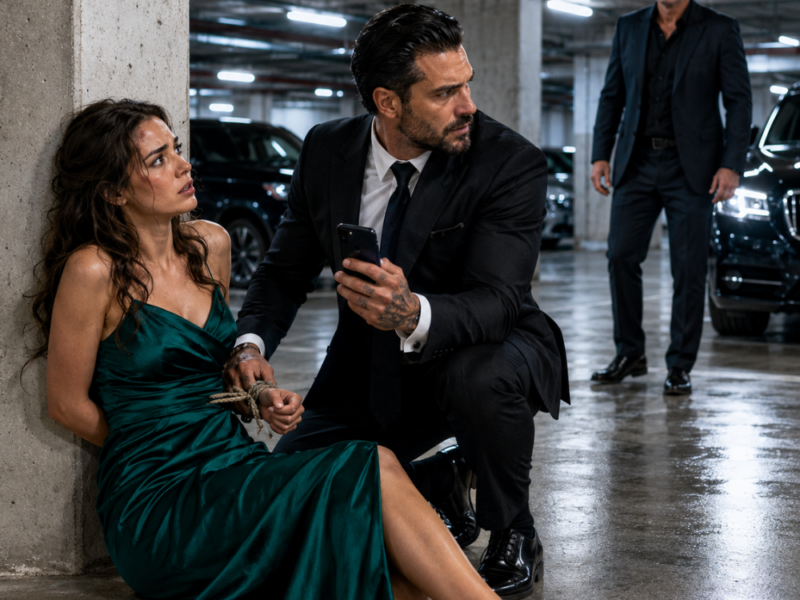
Beaten And Tied Up At The Car Park — The Mafia Boss Saves Her, Then Makes Him Regret
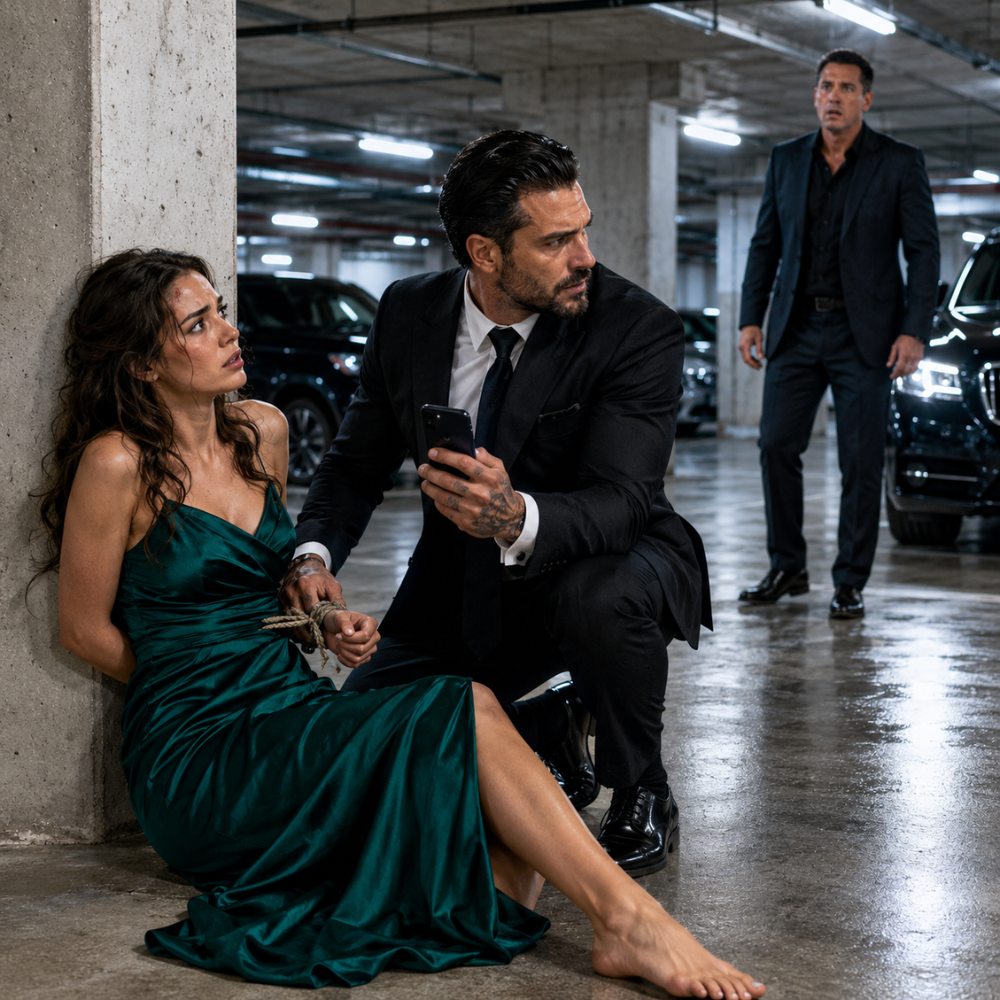
She was left restrained in a hotel parking garage while her fiancé gave a speech upstairs about protecting women, but the feared Atlanta power broker who found her understood almost immediately that one terrible night was only the surface of something much larger
The applause reached the parking garage as a dull vibration through six floors of concrete.
Donya Voronova recognized it anyway.
Kier Aldrin had reached the part of his speech where he lowered his voice.
He always did that before the line people remembered.
She could picture him without seeing him. One hand resting lightly against the podium. Dark suit. White pocket square. Purple awareness ribbon on his lapel. His face arranged into that expression of grave compassion he had perfected over years of charity dinners, television interviews, legislative hearings, and courtroom press conferences.
Four hundred people were probably watching him under warm ballroom lights.
Judges.
Attorneys.
Nonprofit directors.
State legislators.
Corporate donors.
Women who had survived terrible things and believed Kier when he told them he had made protecting people like them his life’s work.
Donya had believed him too.
Now she sat against a concrete support column in the basement parking level, wrists secured behind her, trying to breathe through the panic tightening her chest.
She had lost one shoe near the service elevator.
Her evening dress had torn at the knee.
Her left eye was swelling enough that the yellow parking stripes doubled whenever she tried to focus.
Kier had covered her mouth before leaving.
The garage smelled of warm concrete, exhaust, and rain drifting in from the open ramp.
Everything around her felt brutally ordinary.
A black SUV sat three spaces away.
Someone had abandoned an empty fast-food cup beside a wheel stop.
A fluorescent fixture buzzed overhead.
Beyond the wall, Atlanta traffic moved through a Friday night as if nothing had happened.
Above her, the applause faded.
Then Kier’s amplified voice became faintly audible through the building.
“Too often, we ask why someone stayed.”
Donya closed her eyes.
She knew the rest.
The better question, Kier would say, was why another person believed they had the right to make leaving dangerous.
It had been one of the first things she loved about him.
Eleven months earlier, she had heard him deliver a variation of the same speech at a fundraiser for the Atlanta Children’s Advocacy Center.
Donya had been twenty-four then, halfway through a graduate social work program at Emory, still convinced that people generally became what they claimed to value if they worked hard enough at it.
Kier had seemed to prove the theory.
At forty-three, he was one of Atlanta’s most visible attorneys working in domestic-abuse and family-court advocacy. His photograph appeared on billboards around the city above a slogan his marketing firm had made famous.
Every voice deserves a champion.
He served on three nonprofit boards.
He testified before legislative committees.
He gave continuing-education lectures to younger attorneys on coercive control.
The local newspaper had profiled him twice.
He spoke in the language Donya had been learning in classrooms.
Power imbalance.
Financial dependence.
Isolation.
Trauma response.
Institutional failure.
He seemed to understand not only what vulnerable people experienced, but why so many systems failed them.
After his speech that first night, Donya waited with other guests near the ballroom doors.
She expected a handshake.
Instead Kier asked about her program.
“What kind of social work?”
“Clinical track, probably. Maybe family advocacy.”
“Probably?”
“I’m still figuring out where I’m useful.”
He smiled.
“That usually means you’ll be useful in more places than people who decided too early.”
It was a good answer.
Most of Kier’s answers were.
They had coffee three days later.
Dinner a week after that.
He sent books he thought she would enjoy.
He remembered the name of her favorite professor after hearing it once.
When Donya mentioned that she hated driving through Buckhead traffic at rush hour, Kier rearranged his schedule for their next date without making a performance of it.
He seemed considerate in a way that made other men she had dated feel careless by comparison.
Five months later, they were engaged.
Donya moved into his penthouse.
Her mother in Arizona thought the relationship had moved quickly.
Her roommate from Emory thought it had moved very quickly.
Donya thought they were seeing only the outside.
“They don’t understand him,” she told her friend Macy one afternoon.
Macy folded a pile of laundry on the edge of Donya’s old bed.
“I hope I’m wrong.”
“You don’t like him.”
“I didn’t say that.”
“You make that face every time I say his name.”
“What face?”
“That face.”
Macy sighed.
“He’s intense.”
“He cares.”
“He calls three times if you don’t answer once.”
“He worries.”
“He corrected your coffee order.”
Donya laughed.
“I always get almond milk.”
“You ordered regular.”
“By mistake.”
“Okay.”
Macy folded another sweater.
“Just don’t disappear on me.”
Donya had been offended.
Six months later, she would remember that sentence more clearly than almost anything else about the afternoon.
Just don’t disappear on me.
The change did not happen all at once.
That was the lie people preferred because dramatic changes were easier to recognize.
Kier did not wake one morning and become a different man.
The universe around Donya simply became smaller.
First, Kier began offering advice.
Then advice became concern.
Concern became preference.
Preference became expectation.
Expectation became rule.
When Donya stayed late at Emory, Kier worried about the neighborhood.
When she went for drinks with classmates, he reminded her how many clients he had seen make dangerous decisions after drinking.
When Macy called at eleven one night, Kier asked why anyone who respected a relationship would contact an engaged woman that late.
The argument was never absurd enough to reject immediately.
That was Kier’s gift.
He understood how to move one inch at a time.
Then came the conversation with Donya’s academic adviser.
Kier requested it privately.
He told Dr. Helen Marks that Donya had been overwhelmed.
He mentioned insomnia.
Anxiety.
Difficulty concentrating.
Some of it was true.
Donya was anxious because her relationship had begun making her anxious.
Kier omitted that part.
He did not demand Donya leave school.
He expressed concern.
He asked whether a temporary medical leave might protect her academic standing.
By the time Dr. Marks called Donya into her office, the conversation already sounded decided.
“You’ve been carrying a lot.”
Donya stared.
“I’m fine.”
“Taking one semester away is not failure.”
“I didn’t ask for leave.”
Dr. Marks softened her voice.
“Kier is worried.”
“Kier isn’t my adviser.”
“No.”
The older woman paused.
“But sometimes people close to us see things we can’t.”
Donya walked home from campus that afternoon feeling as though everyone had attended a meeting about her except her.
Kier was waiting in the penthouse kitchen.
When she confronted him, he wrapped both arms around her.
“You’re exhausted.”
“You talked to my professor.”
“Because I love you.”
“You had no right.”
His expression changed for half a second.
Then the concern returned.
“You’re angry.”
“Yes.”
“That’s okay.”
“Stop talking to me like I’m a client.”
“I’m not.”
“You made a decision about my degree.”
“No, sweetheart. The university did.”
Donya stepped away.
Kier watched her.
Then he said the sentence that became the architecture of the next several months.
“Let me take care of things for a while.”
He did.
Her personal phone plan disappeared because Kier said combining accounts made financial sense.
A replacement phone came already connected to his family plan.
Her graduate-school loan refund went into a joint account because he said she should stop worrying about bills while on leave.
He gave her a supplementary credit card.
Generous.
Convenient.
Tracked.
He began choosing restaurants because Donya was “indecisive.”
Then clothing because certain dresses were “wrong for the room.”
Then schedules because she was “still recovering.”
By month eight, Donya could not identify when convenience had become permission.
By month nine, she understood.
By month ten, she began planning to leave.
She did not tell Macy.
She was ashamed of how thoroughly she had allowed the friendship to dissolve.
She did not tell Dr. Marks.
She did not tell her mother because admitting the truth over the phone felt like failing in public.
Instead Donya opened a checking account at a bank Kier never used.
She moved fifty dollars into it.
Then forty.
Then seventy-five.
She took photographs of important documents.
Changed an email password.
Bought a prepaid phone in cash from a pharmacy near Decatur and hid it inside an old graduate-school textbook in the trunk of her car.
She practiced the sentence in the bathroom mirror while Kier worked late.
I am leaving you.
Sometimes she made it through all four words.
Sometimes her throat closed after two.
Tonight, at the Atlanta Children’s Advocacy Center annual gala, she finally said them.
The event took place inside the Lennox Grand, one of downtown Atlanta’s oldest luxury hotels, recently renovated after being purchased by a private investment group controlled by Onyx Soren.
Donya and Kier arrived shortly after seven.
Photographers waited near the ballroom entrance.
Kier placed one hand at the small of Donya’s back.
To the cameras, it looked protective.
Donya knew it was directional.
Smile here.
Turn.
Move.
Stay.
They spent cocktail hour greeting donors.
Kier was receiving a humanitarian recognition later that evening.
At eight-forty, ten minutes before he was due backstage, Donya stepped into the elevator with him.
The doors closed.
Mirrors surrounded them.
Kier checked his phone.
“After the speech, Senator Webb wants five minutes.”
Donya stared at their reflections.
“Kier.”
“Hm?”
“I’m leaving you.”
His thumb stopped moving.
For several seconds, neither spoke.
He looked at her in the mirror.
“What?”
“I’ve already arranged somewhere to stay.”
That part was not true.
She had intended to check into an inexpensive hotel near Emory with the prepaid debit card in her purse.
But she had learned not to sound uncertain.
“I’ll have someone collect the rest of my things.”
Kier looked down at his phone.
Then pressed a button.
Donya watched the illuminated numbers.
B2.
Her chest tightened.
“The ballroom is on six.”
“I know.”
“What are you doing?”
“We’re not having this conversation in an elevator.”
“I’m not having a conversation.”
The doors opened.
Concrete.
Fluorescent lighting.
The low mechanical hum of a garage.
Donya stayed inside.
Kier stepped out.
“Come here.”
“No.”
His face became still.
Not angry.
Still.
Donya felt fear arrive in her body before her mind finished understanding why.
“Kier, I’m going upstairs.”
She reached toward the panel.
He caught her wrist.
Everything after that lived in broken pieces.
Not because she forgot.
Because memory stored danger differently.
A column.
Her shoulder striking concrete.
Kier’s voice much quieter than she expected.
Don’t make this worse.
The sound of her own breathing.
Her evening bag hitting the floor.
The horrifying realization that the man who had spent years explaining coercive control understood it well enough to practice it without improvising.
He hurt her, but he remained measured.
That became important to Donya later.
He was not a man who lost control.
He was a man who believed control belonged to him.
When she could no longer safely follow him upstairs, he secured her where she was unlikely to be seen quickly.
Then he straightened his jacket.
Checked his cuffs.
His voice softened.
“Tomorrow, we’re getting you proper help.”
Donya stared at him.
That sentence frightened her more than the rest.
Proper help.
He had already told people she was unstable.
Already spoken to her school.
Already controlled her phone and finances.
Donya suddenly understood that tonight might not have been the end of anything.
It might have been a transition.
Kier looked at his watch.
“My speech starts in four minutes.”
He touched her hair once, almost tenderly.
“You should have waited until we got home.”
Then he left.
Now footsteps echoed through the garage.
Donya opened her eyes.
Her body went rigid.
Kier had come back.
The footsteps approached from the opposite direction.
A man appeared around the row of parked vehicles.
Tall.
Dark suit.
No tie.
He carried a phone in one hand and several electronic access cards in the other.
Donya recognized him faintly.
Onyx Soren.
His name appeared in Atlanta business pages often enough to become familiar.
Hotels.
Shipping warehouses.
Redevelopment projects.
Security companies.
He had purchased the Lennox Grand through one of his investment groups and spent nearly eighty million dollars renovating it.
There were other stories too.
Older ones.
Stories nobody printed.
Onyx had grown up around freight yards and small trucking operations controlled by men who settled business personally.
Some people called him a legitimate businessman.
Others added the word now.
Donya had once heard Kier describe him as “Atlanta’s most civilized criminal.”
She had assumed it was a joke.
Onyx stopped when he saw her.
For one second, nothing happened.
Then his entire posture changed.
His eyes moved quickly across the scene.
Her face.
Her wrists.
The missing shoe.
The column.
The camera mounted near the exit ramp.
The elevator.
He did not rush toward her.
He crouched several feet away.
“My name is Onyx.”
Donya’s breathing accelerated.
“I’m not going to touch you.”
He placed his phone on the ground where she could see it.
“Can you understand me?”
She nodded.
“I’m calling 911.”
Donya shook her head violently.
Onyx stopped.
“You’re afraid whoever did this will hear?”
She nodded.
“Are they inside the hotel?”
Another nod.
Onyx glanced toward the elevator.
“Do you know if there’s more than one person involved?”
She shook her head.
He thought for a moment.
Then called someone.
“Marcus. Basement two. Come alone. Bring the emergency maintenance kit and call EMS through the service entrance.”
He listened.
“Do not use the public radio channel.”
Another pause.
“Lock the garage video archive immediately. Nothing gets overwritten. Nobody accesses it except you, law enforcement, and counsel.”
He ended the call.
Then looked at Donya.
“I’m going to remove the tape if you want me to.”
She nodded.
Onyx came closer.
“Slowly.”
He said it more to himself than to her.
When his hand approached her face, Donya flinched so sharply she struck the back of her head lightly against the column.
Onyx froze.
“Sorry.”
He waited.
“Look at me.”
Donya did.
“I’m not going to move until you nod.”
She stared at him for two seconds.
Then nodded.
He removed the tape carefully.
Donya took a painful breath.
“He’ll come back.”
“Who?”
“Kier.”
Onyx’s expression changed.
“Kier Aldrin?”
“Yes.”
“Where is he?”
“Upstairs.”
“What’s upstairs?”
Donya almost laughed.
“A fundraiser.”
Onyx looked toward the ceiling.
“What is he doing?”
Her voice came out hoarse.
“Giving a speech about protecting women.”
For the first time, real anger crossed Onyx Soren’s face.
It lasted less than a second.
Then it disappeared.
Footsteps approached.
A gray-haired hotel security director named Marcus came around the corner carrying a medical kit.
He stopped when he saw Donya.
“Jesus.”
Onyx held up one hand.
“Quiet.”
Marcus nodded.
Onyx used a small cutter from the emergency kit to release the restraints.
Her hands fell forward.
Pain burned through her wrists as blood returned.
She tried to stand.
Her legs failed immediately.
Onyx started toward her, then stopped.
“Can I help you?”
Donya hated that she needed to answer.
She hated everything about needing permission to need help.
“Yes.”
He supported her carefully under one arm.
Marcus brought a wheelchair from the service hall.
When Donya saw it, she shook her head.
“I don’t want anybody upstairs seeing me.”
“They won’t.”
Onyx removed his jacket.
He did not wrap it around her.
He placed it across the back of the chair.
“You can use that if you want.”
Donya pulled it around her shoulders.
Clean wool.
Cedar.
Rain.
Nothing like Kier’s cologne.
The ambulance arrived through the loading entrance.
As paramedics prepared to take her out, Donya caught Onyx’s sleeve.
“The cameras.”
“Preserved.”
“He’ll say I did this to myself.”
“Then the cameras become very inconvenient for him.”
“You don’t understand.”
Her eyes filled.
“He’s been building a story about me.”
Onyx looked at her.
“What kind of story?”
“That I’m unstable.”
“Are there records?”
“Yes.”
“Real ones?”
“No.”
His jaw tightened.
“Then tell the police exactly that.”
“What if they believe him?”
Onyx’s voice remained steady.
“Then we make sure they have enough evidence that belief becomes irrelevant.”
The ambulance doors closed.
Onyx stood in the garage after it left.
Marcus remained beside him.
The hotel’s distant ballroom speakers carried another burst of applause.
Marcus looked upward.
“Aldrin?”
“Yes.”
“You want me to pull him out?”
“No.”
Marcus stared.
Onyx looked at the abandoned shoe beside the column.
“Let him finish.”
“Why?”
“Because right now he still thinks he knows what happened.”
Onyx glanced toward the security camera.
“He doesn’t.”
The hospital emergency department was less dramatic than Donya expected.
Hospitals usually were.
People imagined crisis as constant motion.
Instead there was waiting.
Forms.
Questions.
Vital signs.
A nurse asking whether she could confirm Donya’s address.
A technician wheeling her through imaging.
A doctor shining light into her eyes.
Someone cutting a hospital bracelet from plastic packaging.
The ordinary machinery of care.
Donya was diagnosed with a concussion, an injury near the left eye that did not require surgery, significant bruising, and abrasions around her wrists.
Painful.
Frightening.
Treatable.
The emergency physician, Dr. Fallon Reed, spoke gently without becoming sentimental.
“You’re going to feel terrible for several days.”
Donya almost smiled.
“Medical term?”
“Highly technical.”
“Am I staying?”
“Tonight.”
“I don’t want him knowing where I am.”
“He won’t get information from us.”
“He’s my fiancé.”
“Not relevant.”
The answer came instantly.
Donya stared at her.
Dr. Reed pulled a chair closer.
“Would you like a domestic-violence advocate here before police speak with you?”
Donya looked toward the ceiling.
“I hate that phrase.”
“Domestic violence?”
“Victim advocate.”
“Why?”
“Because it makes me feel like the worst thing that happened tonight became my job title.”
Dr. Reed nodded.
“You don’t have to use it.”
Donya looked at her.
“You can choose your own nouns,” the doctor said.
That nearly made her cry.
Detective Angela Mercer arrived at one-thirty in the morning.
She was forty-six, wore no dramatic badge on a chain, and carried a yellow legal pad.
A hospital advocate named Renee sat beside the window.
Mercer asked before recording.
Asked whether Donya wanted Renee to stay.
Asked whether she needed a break before they began.
Every question contained a choice.
Donya found choices unexpectedly tiring.
Still, she said yes.
Then she began.
The elevator.
The garage.
The previous months.
Kier contacting Emory.
The phone.
The accounts.
The rules.
The isolation.
The first moment fear entered their relationship.
Mercer never asked why Donya had not left sooner.
Instead she asked, “What made leaving difficult?”
Donya looked at her.
The wording landed differently.
“Everything.”
“Start wherever you want.”
So Donya did.
At three in the morning, Mercer closed the notebook.
“We have already obtained the hotel surveillance voluntarily from management.”
“Did it show him?”
“I can’t go through evidence in detail with you yet.”
Donya’s heart sank.
Mercer continued.
“But I can tell you the investigation is active and what you reported is being treated seriously.”
Donya looked toward the door.
“He’ll go on television.”
“Probably.”
“He’ll say he’s worried about me.”
“Probably.”
“He’ll say I disappeared.”
“Maybe.”
“He always gets the story first.”
Mercer stood.
“Stories move fast.”
She put the notebook into her bag.
“Evidence moves slower.”
Donya looked at her.
“But evidence tends to age better.”
Kier Aldrin finished his keynote at nine-thirty.
People lined up afterward.
A superior-court judge shook his hand.
A nonprofit director thanked him for bringing “moral clarity” to difficult work.
A state representative asked if Kier would consider joining a task force.
Kier smiled.
Accepted praise.
Posed for photographs.
By eleven-thirty, most guests had left.
He rode the elevator toward B2.
The doors opened.
He stepped into the garage.
Then stopped.
The column was empty.
One shoe remained.
Nothing else.
Kier stared toward the security camera.
For the first time that evening, the muscles in his face lost their discipline.
His phone rang.
“Mr. Aldrin?”
“Yes.”
“This is Detective Mercer with Atlanta Police. I need to speak with you regarding an incident reported tonight at the Lennox Grand.”
Kier’s expression changed before she finished.
Concern softened his voice.
“Is this about Donya?”
He was performing before he knew who the audience would be.
The next afternoon, Donya woke to sunlight through hospital blinds.
For several seconds she felt peaceful.
Then memory arrived.
Her eyes moved immediately toward the door.
Open.
Renee sat in a chair reading.
“You’re awake.”
“Where’s my phone?”
“Police have the damaged one from your purse. You said there was another?”
Donya stared.
The prepaid phone.
“My car.”
“Hotel garage?”
“Yes.”
Renee nodded.
“We can tell Detective Mercer.”
Donya tried to sit up.
Pain stopped her.
“I need to call my mother.”
“Use mine.”
Donya stared at the offered phone.
She had rehearsed this call too.
Not the words.
The avoidance.
For months she had told her mother everything was wonderful.
Kier was wonderful.
Atlanta was wonderful.
The engagement was wonderful.
She had turned every question into reassurance because truth would have required explanation, and explanation would have required admitting how lost she had become.
Her mother answered on the second ring.
“Hello?”
Donya’s throat closed.
“Mom.”
Silence.
Then, “Donya?”
“Yeah.”
“Honey, whose phone is this?”
Donya began crying.
Her mother’s voice changed instantly.
“What happened?”
“I need you.”
The words felt humiliating for one second.
Then relieving.
“I’m coming.”
“Mom, you don’t even know—”
“I’m coming.”
Her mother arrived from Arizona that night.
Macy came the following morning.
That reunion was worse.
Macy entered carrying coffee and stopped three feet from the bed.
Her face crumpled.
Donya looked away.
“I’m sorry.”
Macy set down the coffee.
“For what?”
“For disappearing.”
Macy’s eyes filled.
“I was so angry at you.”
“I know.”
“I thought you chose him.”
“I thought I did too.”
Macy sat.
Then Donya said the sentence she had feared most.
“You warned me.”
Macy shook her head.
“No.”
“You did.”
“I said I thought he was intense.”
“You told me not to disappear.”
“That doesn’t make what happened your fault.”
Donya stared at her hands.
“I studied this.”
“So?”
“I was literally studying coercive relationships.”
Macy leaned forward.
“Knowing the vocabulary does not make you immune to somebody who knows how to manipulate the vocabulary.”
Donya looked up.
Macy’s voice softened.
“He didn’t fool you because you were stupid.”
She glanced toward the hospital hallway.
“He fooled you because fooling people was part of who he was.”
Onyx visited only after Donya agreed.
He appeared in the doorway carrying a plain brown pharmacy bag.
No flowers.
No enormous gift basket.
No dramatic expression.
“May I come in?”
“Yes.”
He entered.
“What’s that?”
“Loose clothes. Toiletries. Your overnight bag is in Aldrin’s car, and police seized the car.”
Donya looked into the bag.
Sweatpants.
Socks.
A sweatshirt.
Travel shampoo.
Toothbrush.
Everything still had tags.
“You left the receipts.”
“So you can return anything.”
“You’re very concerned about returns.”
“I own hotels. Complaints train you.”
She almost smiled.
Then became serious.
“Did you watch the surveillance?”
“No.”
“Why not?”
“My attorney suggested police should take custody first.”
“You listened?”
“Painfully.”
Donya looked toward the window.
“He’s going to say I’m unstable.”
“He already implied it.”
Her hands tightened.
Onyx noticed.
“What exactly did he say?”
“His attorney told police you had been under emotional strain and may have left after what he described as an argument.”
Donya laughed once.
“He started.”
“Started what?”
“The story.”
She turned back toward him.
“He did this at school too. He tells the reasonable version first.”
Onyx pulled a chair closer.
“Then stop trying to beat him at storytelling.”
Donya frowned.
“What?”
“Let him talk.”
“You don’t understand how persuasive he is.”
“I understand people who rely on being persuasive.”
Onyx rested his forearms against his knees.
“They usually talk too much when evidence makes them nervous.”
Donya watched him.
“Kier says you’re a criminal.”
“That seems rude.”
“You’re not denying it.”
“I have never been convicted of a crime.”
“That is a lawyer answer.”
“I own a lot of lawyers.”
She laughed despite herself.
Onyx smiled slightly.
Then his expression became more serious.
“I grew up around businesses where rules were treated as suggestions.”
“What kind of businesses?”
“Trucking. Warehouses. Security.”
“Illegal?”
“Some people around my father had flexible ethics.”
“That means yes.”
“It means I learned early that a reputation for danger makes people invent half the work for you.”
Donya studied him.
“What changed?”
“My mother died.”
She stopped.
Onyx looked toward the hospital door.
“She cleaned hotel rooms most of her life.”
“That’s why you own hotels?”
“Partly.”
“What happened to her?”
“My father controlled everything.”
Money.
Movement.
Friends.
What she wore.
Whether she visited family.
Onyx did not describe details.
He did not need to.
Donya understood the shape.
“She stayed because leaving felt financially impossible.”
He looked back at her.
“By the time she left, she had almost nothing left except the fact that she was alive.”
“I’m sorry.”
Onyx nodded once.
“So when I heard you in that garage, I recognized something.”
“What?”
“The sound of somebody trying to make fear quiet.”
Donya looked away.
He stood.
“I should go.”
“You just got here.”
“Yes.”
“That’s strange.”
“You need rest.”
“You don’t decide what I need.”
Onyx stopped.
Donya’s face changed.
She had not meant to sound harsh.
He simply nodded.
“You’re right.”
The answer came so easily that she stared.
Onyx sat again.
Donya looked toward the television.
“Stay ten minutes.”
“All right.”
Five days after the gala, Kier held a press conference outside his law office.
Donya watched from a small furnished house in Inman Park owned by one of Onyx’s redevelopment companies.
The police knew where she was.
Her attorney knew.
Her mother and Macy rotated staying with her.
Donya’s new attorney, Camille Foster, sat at the dining table drinking coffee.
Kier appeared on television wearing a charcoal suit and the purple ribbon.
“My fiancée has been through an extremely difficult period.”
Donya’s jaw tightened.
Kier looked directly into the cameras.
“I love her.”
Camille muttered, “Of course.”
“I will not betray Donya’s privacy by discussing her medical or emotional history.”
Donya stood.
“There.”
Camille looked up.
“There what?”
“He’s doing it.”
“Sit down.”
“He’s telling them I have some medical history.”
“Sit.”
Donya sat.
Kier continued.
“I only ask the public to reserve judgment while investigators establish what actually happened.”
A reporter shouted a question about the hotel footage.
Kier’s attorney stepped forward.
Kier raised one hand dramatically.
“We are cooperating.”
Camille turned off the television.
Donya stared at the black screen.
“He sounds reasonable.”
“Yes.”
“That’s what he does.”
“I know.”
“I need to say something.”
“No.”
Donya looked at her.
“Excuse me?”
“No press.”
“He’s lying.”
“Probably.”
“Probably?”
“I’m your lawyer. I use boring words on purpose.”
Donya stood.
“So he gets to paint me as unstable and I sit here?”
Camille waited.
Then said, “Do you want to win a press conference or a case?”
Donya stopped.
“That’s manipulative.”
“Yes.”
“At least you admit it.”
Camille opened a yellow legal pad.
“Kier has spent twenty years learning how to shape public perception. You are injured, furious, frightened, and currently vulnerable to saying something that gets turned into a headline.”
“What am I supposed to do?”
“Recover.”
“That sounds useless.”
“Give police everything.”
“That’s already happening.”
“Give me everything.”
“It is.”
“Then we let the evidence develop.”
Donya looked toward the windows.
“He always got there first.”
Camille’s voice softened.
“This time he got there first with words.”
She tapped her legal pad.
“You got there with video.”
The investigation initially focused on what happened in the garage.
That alone was enough to change Kier’s life.
The hotel cameras captured the elevator ride.
The confrontation after the doors opened.
Kier moving Donya toward the far section of the garage.
The images were partly obscured by parked vehicles and support columns, but investigators could establish enough to contradict his first public narrative.
Additional forensic evidence came from Donya’s clothing, the scene, and her documented injuries.
Kier’s attorney changed strategies.
The statement became more cautious.
A private disagreement had escalated.
Mr. Aldrin deeply regretted the situation.
He denied intending serious harm.
Then detectives executed warrants involving his penthouse, phone records, and certain digital devices.
That was when the story widened.
Not because Onyx secretly hacked Kier’s firm.
Not because a mysterious folder landed conveniently in Donya’s lap.
Reality was slower.
Messier.
More credible.
And eventually more damaging.
One afternoon Donya sat at the Inman Park dining table while Camille reviewed public court records.
Donya had started searching Kier’s previous cases.
She was not accessing confidential files.
Only dockets, orders, publicly available filings, and material from cases already in the court system.
“What are you doing?”
Camille asked.
“Looking.”
“For?”
“I don’t know yet.”
“That is usually when clients cause lawyers headaches.”
Donya ignored her.
Eleven months living around Kier had given her fragments she had never assembled.
Names he mentioned during calls.
Complaints about clients.
Cases he described as unwinnable.
Women who supposedly refused to follow strategy.
One name came back.
Alicia Mercer.
Another.
Fallon Weeks.
Donya searched.
Then another.
By midnight, there were eleven names on a legal pad.
Camille pulled the page toward herself.
“What is this?”
“Kier represented all of them.”
“Yes.”
“They all lost something major.”
“That happens in family court.”
“I know.”
“Protective order denied. Custody changed. Emergency motion rejected.”
Donya pointed.
“Look at why.”
Camille read.
One filing late.
Another missing an affidavit.
Evidence excluded after a procedural failure.
A hearing where a key witness was never subpoenaed.
Nothing impossible individually.
Together, a pattern.
Camille became more interested.
“Did Kier ever discuss these cases with you?”
“Some.”
“Anything privileged?”
“Nothing he should have.”
Camille gave her a look.
“Meaning?”
“He talked at home.”
“What did he say about Fallon Weeks?”
Donya searched her memory.
“She was difficult. Obsessive. He said she ruined her own case because she couldn’t follow advice.”
Camille looked at the docket.
“Her former husband got temporary custody.”
“Then she disappeared.”
That was the first moment the room became truly quiet.
Camille picked up her phone.
“I’m calling Mercer.”
Over the following weeks, investigators found enough irregularities to expand the inquiry.
Former employees received subpoenas.
Some initially defended Kier.
Others did not.
A junior associate remembered being told not to file an emergency motion until the next morning even though the deadline expired at midnight.
A former paralegal described documents removed from an evidence package.
A billing employee remembered consulting invoices from companies that had nothing obvious to do with Kier’s advocacy practice.
Financial investigators followed those.
Some led nowhere.
Others led to men on the opposite side of cases Kier’s clients had lost.
The amounts were not labeled bribes.
People who commit financial crimes rarely use convenient labels.
Consulting.
Strategy.
Risk analysis.
Advisory retainers.
Over five years, investigators identified approximately three million dollars in questionable payments between companies associated with eleven opposing parties and businesses connected to Kier.
Donya sat inside Camille’s office when Detective Mercer explained the developing theory.
“We do not have eleven proven crimes.”
Donya nodded.
Mercer continued.
“We have a financial pattern that requires explanation.”
“And the missed cases?”
“Also a pattern.”
“So he was doing it.”
Camille interrupted.
“Donya.”
“What?”
“Let her finish.”
Mercer folded her hands.
“We believe there is enough evidence to investigate whether Kier deliberately undermined certain clients while accepting undisclosed payments connected to opposing parties.”
Donya stared at her.
The room seemed to tilt.
Those women had gone to Kier because of his reputation.
Because of billboards.
Because judges knew his name.
Because nonprofits recommended him.
Because people like Donya applauded his speeches.
“He wasn’t failing them.”
Mercer said nothing.
Donya’s voice dropped.
“He was selling them.”
Nobody corrected her.
The Fallon Weeks case became the center.
Fallon had been thirty-two when she hired Kier during a brutal custody dispute with Grant Crowell, an Atlanta developer whose companies owned apartment complexes across Georgia.
Public records showed that Fallon sought emergency custody modifications after accusing Grant of intimidation and repeated violations of their temporary parenting agreement.
Kier handled the case.
Important evidence never reached the judge.
A filing missed a deadline.
Fallon lost her emergency motion.
Then, seven months earlier, she disappeared.
Her car was found at an airport parking facility.
A voluntary missing-person investigation eventually went cold.
Grant received expanded custody.
Kier filed documents indicating Fallon had stopped communicating with counsel.
Financial investigators discovered that a consulting company associated with Grant’s business partner transferred four hundred thousand dollars to a Kier-controlled advisory company three days after Fallon disappeared.
It was not proof of kidnapping.
It was not proof Kier knew where Fallon had gone.
It was enough to justify very serious questions.
Then Fallon was found.
Alive.
Not inside a locked room.
Not physically imprisoned.
She was living under another name in a small rental outside Macon.
The truth was less cinematic and, to Donya, more frightening.
Fallon had been convinced she would lose her children permanently if she returned.
Grant had threatened legal ruin.
Kier, her own attorney, reinforced the fear.
According to Fallon, he told her she was already being portrayed as unstable.
He claimed a judge was prepared to issue orders against her.
He advised her to disappear temporarily “until things cooled down.”
Then he stopped answering.
Fallon believed she had no lawful way home.
When federal investigators showed her the actual court record, she broke down.
Not because reality was worse than she feared.
Because portions of what she feared had never been real at all.
Donya met Fallon several weeks later.
Both attorneys approved.
Fallon arrived at Camille’s office in jeans and an oversized cardigan.
She looked smaller than her photograph.
Donya stood.
For a moment neither woman knew what to do.
Then Fallon crossed the room and took Donya’s hands.
“You found my case.”
“No.”
Donya shook her head.
“Detectives found you.”
“You noticed the pattern.”
“I noticed something.”
“That matters.”
Fallon’s eyes filled.
“My children think I abandoned them.”
“They’ll know.”
Fallon looked at her.
“You can’t promise that.”
Donya stopped.
The old Donya would have tried to reassure her anyway.
Instead she said, “No.”
She squeezed Fallon’s hands.
“But you are here to tell them yourself.”
Fallon began to cry.
They sat for two hours.
Not all of it was about Kier.
That surprised Donya.
Fallon had been a second-grade teacher.
She loved mystery novels.
Hated bananas.
Made excellent lasagna.
Her daughter played soccer.
Her son believed every truck was a fire truck.
These details mattered because Kier’s files had reduced Fallon to allegations, motions, psychological descriptions, and procedural failures.
Donya was beginning to understand how easy it was for systems to turn human beings into documents.
On television, Kier became more careful.
His nonprofit boards suspended him.
The state bar opened a disciplinary inquiry.
His firm announced that another partner would oversee client matters.
Then Kier appeared outside the courthouse after a procedural hearing.
“This is a coordinated effort to reinterpret complicated professional decisions as misconduct.”
Donya watched with Camille.
“He still believes he can talk out of it.”
Camille sipped coffee.
“Most lawyers do.”
“You’re a lawyer.”
“I said what I said.”
Donya smiled.
Then Kier continued.
“My professional record speaks for itself.”
Camille reached for the remote.
“That part may become a problem.”
The criminal investigation uncovered something else.
Records found during a lawful search of Kier’s home office included drafts concerning Donya.
Not forged psychiatric commitment orders signed by imaginary doctors.
Something subtler.
Emails to a private physician Kier had consulted.
Notes describing Donya as emotionally unstable.
A draft affidavit in which Kier outlined incidents that either had not happened or had been distorted beyond recognition.
Questions about how emergency psychiatric evaluations could be requested if a person appeared dangerous to herself.
None of those documents alone proved he intended to institutionalize Donya fraudulently.
Taken together with his earlier communications to Emory and his statements after the garage incident, they showed how systematically he had prepared to control the story if Donya left.
Donya read the summary in Camille’s office.
Her hands went cold.
“He was going to make people think I was crazy.”
Camille looked at her.
“He appears to have been laying groundwork.”
“He already did.”
“At school.”
“At school. With friends. With everyone.”
Donya stared at the wall.
“That’s what he meant.”
“What?”
“Tomorrow, we’re getting you help.”
Camille’s face hardened.
Donya closed the folder.
For the first time since the garage, her fear became something else.
Not rage exactly.
Clarity.
“He thought nobody would believe me.”
Camille did not answer.
Donya looked at her.
“Did he?”
“Think that?”
“Yes.”
“Probably.”
Donya took a slow breath.
“Good.”
Camille frowned.
“Why is that good?”
“Because he built everything around the wrong assumption.”
“What assumption?”
“That I’d disappear.”
Donya returned to Emory the following semester.
Two classes.
Not four.
The first morning, she sat in her car for nineteen minutes.
Students crossed campus carrying backpacks and coffee.
A landscaping crew blew leaves from the sidewalk.
Somebody rode past on a bicycle.
Ordinary life moved with almost offensive ease.
Donya eventually opened the door.
Dr. Helen Marks stood when she entered her office.
The adviser looked older than Donya remembered.
“I owe you an apology.”
Donya shut the door.
“Yes.”
Dr. Marks seemed surprised.
Donya sat.
“I thought you were going to say it wasn’t my fault.”
“I was manipulated.”
“I know.”
“I genuinely believed Kier was worried about you.”
“I know.”
“I should have spoken with you separately.”
“Yes.”
“I should have asked more questions.”
“Yes.”
Dr. Marks looked down.
“I’m sorry.”
Donya had imagined this meeting for months.
In every imaginary version, she delivered a speech so perfect that Dr. Marks cried before Donya reached the last sentence.
Real life gave her a woman sitting behind a desk with wet eyes and both hands clenched around a pen.
“I accept your apology.”
Dr. Marks looked up.
“That easily?”
“No.”
Donya stood.
“But I want my degree more than I want to spend another year making everyone Kier fooled suffer.”
That was one of the first times Donya understood that recovery sometimes looked disappointingly practical.
The Atlanta Legal Excellence Awards took place two months after the hotel incident.
Before the investigation, Kier had been scheduled to receive Advocate of the Year.
The award was withdrawn.
The ceremony went forward.
Donya had no obligation to attend.
Then Fallon was invited to speak during a new program on professional accountability.
Donya decided to go.
Camille objected.
“Reporters will be everywhere.”
“I know.”
“Kier may appear.”
“His bond conditions prevent contact with me.”
“They do not prevent you from being in the same public building.”
“Then I’ll be in the building.”
Camille studied her.
“Is this about proving you’re not afraid?”
Donya considered.
“No.”
“Good.”
“I am afraid.”
Camille leaned back.
“That was not the answer I expected.”
“I’m tired of treating fear like it means stop.”
Onyx drove her because she asked.
Nothing more.
The black dress Donya chose had been sitting in her closet since before Kier.
He once told her it was too severe.
She wore it for precisely that reason.
When she came downstairs at the Inman Park house, Onyx stood.
He looked at her for several seconds.
Donya raised an eyebrow.
“What?”
“You look like yourself.”
The words landed harder than beautiful would have.
They entered the High Museum together.
White walls.
High ceilings.
Champagne.
Soft jazz.
Four hundred members of Atlanta’s legal and philanthropic world trying very hard not to stare.
Donya felt the attention immediately.
Her body wanted to leave.
Onyx noticed.
“Want to go?”
She looked toward the entrance.
Then into the room.
“No.”
“Okay.”
He did not say be brave.
Did not say you can do this.
They simply walked.
Kier stood near the center of the reception.
His champagne glass stopped halfway to his mouth when he saw her.
For one raw second, Donya saw the man from the garage.
Then the public face returned.
He handed the glass to a server and crossed the room.
“Donya.”
Onyx shifted slightly.
Not in front of her.
Beside her.
Kier stopped.
“My God.”
Donya stared.
“I’m glad you’re safe.”
The audacity almost took her breath away.
“Do not speak to me.”
His expression became wounded.
“I only wanted—”
“My protective order prohibits contact.”
Nearby conversations quieted.
Kier’s attorney appeared from nowhere.
“Kier.”
He looked toward her.
The attorney gave one small shake of her head.
Kier stepped backward.
Donya’s heart pounded.
Her hands felt cold.
But she remained exactly where she was.
That became enough.
The awards began.
No screens were hacked.
No private evidence was illegally broadcast.
No dramatic ambush replaced due process.
The executive director of the legal association walked to the podium.
“Recent events have forced uncomfortable reflection within our profession.”
The ballroom quieted.
“We will not try pending criminal matters from this stage.”
Donya looked toward Kier.
He sat near the back beside counsel.
“But there is something we can say without prejudging any case.”
The director looked over the room.
“Advocacy is not branding.”
Nobody moved.
“It is not a slogan.”
Donya felt her throat tighten.
“It is not a ribbon.”
The executive director paused.
“And it is certainly not an award.”
Then Fallon Weeks walked onto the stage.
Kier had not known.
His face lost color.
Fallon stood behind the podium with one sheet of paper.
“My name is Fallon Weeks.”
Cameras lifted.
“Seven months ago, some people in this room might have known me as a woman who abandoned her children.”
She took a breath.
“I did not.”
Nothing about her speech violated court orders.
She did not disclose sealed evidence.
She did not ask the audience to convict Kier.
Instead, she talked about trust.
What happens when frightened clients seek help from prestigious people and feel too intimidated to question them.
Why independent review matters.
Why legal sophistication can become another form of power imbalance when only one person in the room understands the rules.
When she finished, most of the ballroom stood.
Donya stood first.
Onyx beside her.
Camille several rows back.
Kier remained seated.
Donya saw him.
Then realized she no longer cared.
The indictment came three weeks later.
Kier was arrested leaving a conference room inside his law office.
No gala.
No cameras staged for maximum humiliation.
No Onyx waiting in the hallway to threaten him.
Federal agents approached.
His lawyer was present.
Kier surrendered without incident.
The charges included fraud-related offenses, obstruction, falsification of records, professional misconduct connected to several client matters, and crimes related to the assault on Donya.
Grant Crowell faced separate charges involving Fallon, financial misconduct, witness intimidation, and custody-related fraud.
The cases took more than a year.
That surprised people who only knew justice from television.
Donya learned to appreciate the slowness.
Kier filed motions.
Prosecutors answered.
Judges held hearings.
Some evidence was admitted.
Some excluded.
Some charges narrowed.
Several former clients filed civil suits.
Kier lost his law license before the criminal matter fully resolved.
His billboards disappeared.
The first time Donya saw an empty billboard frame where his face had been, she pulled into the nearby grocery store.
Not for symbolism.
She needed milk.
Inside she bought bread, bananas, coffee, cereal, laundry detergent, and two cans of tomato soup.
The soup made her smile.
At the hospital, the morning after the garage, a nurse had brought tomato soup.
Donya had realized she did not know whether she liked it because Kier used to decide what she ate before formal events.
She tasted it then.
She liked it.
Now she placed two cans in her cart.
A ridiculous act of freedom.
Nobody cared.
That made it better.
Onyx never asked Donya to move into his house.
Never positioned himself as permanent protection.
He made a guest property available while she needed privacy, but the lease documents went through Camille.
When Donya rented her own apartment in Decatur, Onyx carried exactly two boxes before she ordered him to stop.
“You’re going to throw out your back.”
“I own a logistics company.”
“That does not make you physically qualified for logistics.”
“It should.”
“It doesn’t.”
He set down the box.
“You’re bossy.”
Donya stared.
Onyx immediately smiled.
“Bad word?”
“Not yet.”
She laughed.
The relationship between them grew in tiny increments.
Coffee.
Dinner.
Long pauses where neither felt obligated to fill silence.
One Tuesday afternoon, a thunderstorm rolled across Atlanta while Donya sat on the screened porch at the temporary house.
Thunder cracked directly overhead.
Her body reacted before thought.
Arms up.
Shoulders tight.
Breath gone.
Onyx had been inside speaking with Camille.
He saw.
He did not say, It’s only thunder.
Did not approach and force Donya to prove she was fine.
He picked up a blanket.
Walked toward the doorway.
Held it where she could see it.
“Cold?”
“Maybe.”
He placed the blanket over the back of her chair.
Not on her.
Then returned inside.
Donya pulled it around herself.
She stared into the rain for almost an hour.
Months later, she would tell him that was when something changed.
Not the garage.
Not the rescue.
The blanket.
Because he gave her something comforting without deciding she had to accept it.
Kier’s kindness had always contained invisible debt.
Onyx’s disappeared once offered.
One evening Donya finally asked him about his mother.
They sat on opposite ends of a sofa in her new apartment.
“She cleaned hotels?”
“Twenty years.”
“Did she like it?”
“No.”
“Why didn’t she leave?”
Onyx looked at her.
“You know the answer.”
Donya did.
Money.
Fear.
Children.
Shame.
Hope.
The exhausting mathematics of survival.
“She thought leaving meant losing everything,” Onyx said.
“What happened?”
“She stayed too long.”
Donya waited.
“She eventually left my father.”
“That’s good.”
“Yes.”
But his expression said the victory had come late.
“She died a few years later.”
“I’m sorry.”
Onyx nodded.
“I bought the Lennox Grand because she cleaned rooms there for eleven years.”
Donya stared.
“You never told me that.”
“It sounds sentimental.”
“It is sentimental.”
“I dislike being sentimental.”
“You’re terrible at hiding it.”
He looked toward the window.
“My mother spent years moving through hotels where rich people treated her like furniture.”
“And your father?”
“He was supposed to be the person who saw her.”
Onyx’s jaw tightened.
“He was the person who made her smallest.”
Donya looked at him.
“That’s why you knew what you were looking at in the garage.”
“Yes.”
“You recognized it.”
“I recognized fear.”
He looked back at her.
“Not you.”
The distinction mattered.
Donya’s criminal case against Kier ended through a negotiated plea after months of litigation.
He admitted to several felony offenses involving obstruction, fraudulent records, professional misconduct, and the assault.
Additional counts were resolved or dismissed under the agreement.
The sentence was long enough that newspapers called it the collapse of one of Atlanta’s most prominent legal careers.
Donya did not attend every hearing.
She attended sentencing.
Kier looked smaller inside the courtroom.
That surprised her.
For months, memory had enlarged him.
In the penthouse, his moods filled every room.
On television, his face occupied entire screens.
In her nervous system, he became weather.
In court, he was one man in a dark suit sitting beside his lawyer.
Human-sized.
That was perhaps the most important thing she saw all day.
When the judge invited Donya to speak, she walked to the lectern.
She had written twelve pages.
Then reduced them to four.
Then two.
When she began, she did not look at Kier.
“I spent a long time trying to understand how someone who knew so much about coercion could become so skilled at practicing it.”
The courtroom remained silent.
“I used to think the contradiction was hypocrisy.”
She looked toward the judge.
“Now I think the knowledge was part of the method.”
Kier’s head lowered.
“You knew which words frightened systems.”
Mental health.
Stability.
Concern.
Professional judgment.
“You knew how quickly a woman could become a problem once the right respectable person called her one.”
Donya paused.
“You also knew shame would help you.”
She looked toward the gallery, where Fallon sat with Camille.
“I was ashamed because I thought studying abuse should have made me impossible to abuse.”
Her voice strengthened.
“It did not.”
Then Donya finally looked at Kier.
“You used my shame to keep me quiet.”
He met her eyes.
“It doesn’t work anymore.”
That was all.
No shouting.
No promise that he would regret everything.
He already did.
Not because Onyx punished him.
Because the structures Kier had manipulated eventually turned toward him.
The bar.
The courts.
His former colleagues.
His clients.
His own financial records.
His own statements.
The professional reputation he built as armor became evidence of how much trust he had violated.
Grant Crowell’s case proceeded separately.
Fallon eventually regained substantial custody rights.
The reunification process was slow.
Supervised meetings.
Counseling.
School pickups.
Ordinary dinners.
No judge could return the lost months.
No verdict could erase what her children believed during her absence.
Fallon understood that.
She still kept going.
Six months after Kier’s sentencing, Donya and Fallon opened a nonprofit in Atlanta’s Old Fourth Ward.
The office occupied the first floor of a renovated brick building between a coffee shop and a physical-therapy clinic.
The rent was below market because Onyx owned the building.
Donya refused free rent.
He charged the nonprofit what another nonprofit tenant paid.
“That is still probably a favor,” Donya told him.
“It is a lease.”
“At a good rate.”
“It is an economically rational community-investment strategy.”
“You sound ridiculous when you try not to admit you’re helping.”
“I know.”
The organization was called Second Look.
The name came from Fallon.
Its purpose was simple.
Survivors involved in complicated protective-order or family-court cases could request independent reviews from volunteer attorneys and trained advocates.
Second Look did not promise to prove corruption.
Most cases contained none.
Sometimes lawyers were simply overworked.
Sometimes clients misunderstood what had happened.
Sometimes clerical mistakes could still be corrected.
Sometimes legitimate legal strategies looked strange from outside.
But sometimes something was wrong.
Deadlines repeatedly missed.
Evidence never filed.
Clients pressured into decisions they did not understand.
Conflicts of interest.
Professional neglect.
Second Look existed so people who already felt powerless did not have to wonder alone.
Opening day was chaotic.
The copier jammed.
A volunteer spilled coffee near the front desk.
The internet failed for twenty-seven minutes.
Macy brought a Costco sheet cake with SECOND LOOK written in blue frosting.
Fallon’s daughter pinned a drawing to the bulletin board.
A house.
Large yellow door.
Four stick figures.
HOME written across the roof in purple crayon.
Fallon stared at it.
Then pretended to organize folders until she could breathe normally again.
Onyx arrived carrying a cardboard box.
Donya looked inside.
Legal pads.
Pens.
Extension cords.
A stapler.
“You brought office supplies.”
“You said no dramatic gifts.”
“You actually listened.”
“Occasionally.”
“You own hotels and brought a stapler.”
“It’s an excellent stapler.”
Fallon tested it.
“He’s right.”
Donya rolled her eyes.
Second Look handled its first fifty reviews within a year.
Most were not scandals.
That made Donya proud.
They helped a grandmother understand why a protective order had expired.
Found a clerical error in a custody filing for a hotel housekeeper.
Connected a restaurant server with a lawyer after her original attorney stopped returning calls.
Helped a hospital technician document financial coercion that had not been explained clearly in her first hearing.
Some people left disappointed because the review confirmed their attorneys had done everything properly and the court simply ruled against them.
Donya considered that important too.
Trust could not be repaired by promising every frightened person that every bad result came from corruption.
Sometimes justice meant understanding what actually happened.
Fallon’s drawing stayed on the bulletin board.
So did a photograph from Emory the day Donya finally graduated.
Her mother flew in.
Macy came.
Fallon brought both children.
Camille sat behind them.
Detective Mercer arrived late and stood near the aisle.
Dr. Marks hugged Donya after the ceremony.
Onyx waited until everyone else finished.
Donya crossed the lawn toward him in her graduation gown.
“You look smug.”
“I am.”
“You did nothing.”
“I provided emotional support.”
“You sent me soup twice.”
“Exactly.”
“That was your contribution to graduate education?”
“It was expensive soup.”
Donya laughed.
Onyx handed her a small box.
She narrowed her eyes.
“What is this?”
“Not jewelry.”
“Good.”
She opened it.
A black notebook.
Plain.
On the first page, Onyx had written one sentence.
For whatever you choose next.
Donya closed the cover.
Her eyes filled.
Onyx immediately looked worried.
“Too much?”
“No.”
“Sentimental?”
“Extremely.”
“I knew it.”
She hugged him.
Around them, families shouted names.
Parents arranged graduates for photographs.
A grandfather carried three bouquets and a folding chair.
A toddler cried because someone took away a balloon.
Normal American graduation chaos.
Donya stood inside it and felt something she had once thought would never return.
Ordinary happiness.
Not triumph.
Not survival.
Not vindication.
Happiness that required no explanation.
Her relationship with Onyx changed later that summer.
Not after a dramatic rescue.
Not after a dangerous confrontation.
After dinner.
They were closing Second Look on a Tuesday evening.
Fallon had already left.
Donya turned off the front office lights.
Onyx waited near the door.
“Do you remember the thunderstorm?”
“Yes.”
“You put a blanket on my chair.”
“I remember.”
“You didn’t put it on me.”
He looked confused.
“I thought you might not want me coming that close from behind.”
“That’s why?”
“Yes.”
Donya laughed softly.
“I thought you were emotionally strange.”
“I am emotionally strange.”
She stepped closer.
“I spent eleven months with a man whose kindness always turned into a receipt.”
Onyx said nothing.
“He would do something nice and later explain what it meant I owed him.”
Donya looked toward the dark office.
“You cut me free in a garage and never once acted like the rest of my life belonged to you because of it.”
“It doesn’t.”
“I know.”
She looked back at him.
“That’s why this is different.”
“What is this?”
Donya closed the distance between them.
She kissed him.
The choice belonged entirely to her.
When she stepped back, Onyx looked almost startled.
“You sure?”
“Yes.”
“That seems worth checking.”
“It was.”
Their first date happened a week later.
Donya picked the restaurant.
Paid half the bill.
Onyx complained.
Donya told him to survive it.
He did.
They did not move quickly.
Sometimes Donya needed space.
Onyx learned not to mistake distance for rejection.
Sometimes Onyx tried to solve problems Donya had only wanted to discuss.
Donya learned to say, “I’m not asking you to fix this.”
Eventually he learned to ask first.
“Listening or solving?”
“Listening.”
“All right.”
Other nights:
“Listening or solving?”
“Solving.”
Onyx reached for his phone.
“Excellent.”
“Not with money.”
He put the phone down.
“Cruel.”
Two years after the garage, Donya appeared on a local public-radio program about professional accountability.
Near the end, the interviewer asked a question she had heard many times.
“Do you think of Onyx Soren as the man who saved you?”
Donya thought before answering.
“He helped save my life that night.”
The interviewer waited.
“But I don’t like the version of the story where one powerful man rescued me from another powerful man.”
“Why?”
“Because then I disappear again.”
Donya folded her hands.
“Onyx found me. He called for help. He preserved evidence. He gave me somewhere safe to recover.”
She paused.
“I will always be grateful.”
“What came after?”
“Choices.”
The interviewer smiled.
“What kind?”
“Very boring ones.”
“Such as?”
“Answering detectives when I wanted to hide.”
“Going to therapy.”
“Going back to school.”
“Calling friends I had pushed away.”
“Getting my own phone plan.”
The interviewer laughed.
“That mattered?”
“More than you’d think.”
“Why?”
“Because it was mine.”
Donya smiled.
“I could turn it off.”
She continued.
“Recovery sounds dramatic when people summarize it. Mostly it was grocery shopping. Homework. Court dates. Learning to sleep. Learning not to apologize every time I disagreed with somebody.”
Her smile faded.
“Learning that a person being disappointed with me was not an emergency.”
The interviewer stopped writing.
“What does freedom feel like now?”
Donya thought of tomato soup.
Thunder.
A black notebook.
A cheap apartment key.
Fallon arguing with the copier.
Onyx asking, listening or solving?
“It feels ordinary.”
Years passed.
Second Look expanded into Savannah and Macon.
Fallon became its family-court outreach director.
Camille joined the board.
Detective Mercer retired from Atlanta Police and immediately began volunteering often enough that Donya accused her of failing retirement.
Dr. Marks developed a university training program on coercive control and institutional manipulation.
Onyx sold several of his older security businesses and put more money into transitional housing.
People continued calling him dangerous.
Donya occasionally encouraged the rumor when she wanted contractors to finish repairs faster.
Onyx accused her of abusing his reputation.
She called it community efficiency.
They married when Donya was thirty-two.
Onyx proposed on the same screened porch where the thunderstorm had once sent Donya’s nervous system backward in time.
Rain tapped against the roof.
He held out a ring.
Donya stared.
“You planned rain?”
“I own hotels, not weather.”
“That sounds exactly like something a secret weather owner would say.”
He smiled.
Then his expression became serious.
“I don’t want you to need me.”
“Good start.”
“I don’t want to rescue you.”
“Even better.”
“I would like you to choose me anyway.”
Donya’s eyes filled.
“That was annoyingly good.”
“I practiced.”
“I can tell.”
“Was that a yes?”
“Yes.”
Their wedding had forty-six guests.
A backyard ceremony.
Folding chairs.
Too much food.
A Costco sheet cake because Donya refused to spend seven hundred dollars on dessert.
Onyx considered the cake undignified until he ate two pieces.
Fallon gave a toast.
Macy cried before she began hers.
Donya’s mother danced with Onyx.
Thunder rolled somewhere far beyond the trees late in the evening.
Donya heard it.
Her body did not react.
She looked toward the sky.
Onyx noticed.
He said nothing.
Donya reached for his hand.
Five years after Second Look opened, the Lennox Grand offered its ballroom for the nonprofit’s annual fundraising dinner.
At first Donya refused.
Then she changed her mind.
“I want that room.”
Onyx looked at her across the kitchen table.
“You sure?”
“Yes.”
“I can get you any venue in Atlanta.”
“I know.”
“Why there?”
“Because I want to walk into it because I chose to.”
The fundraiser sold out.
Attorneys.
Social workers.
Judges.
Former clients.
Hospital advocates.
Hotel employees.
Nonprofit donors.
Nothing about the evening was designed around Kier.
Donya insisted on that.
He had once occupied too much space in her life.
She would not let him become the permanent theme of everything she built afterward.
Before the program began, Donya slipped into an elevator alone.
Pressed B2.
The doors opened.
The parking garage looked smaller than memory.
That startled her.
A family loaded suitcases into an SUV.
A hotel housekeeper pushed a supply cart toward the service hall.
Someone nearby was arguing into a phone about airport traffic.
Ordinary life.
Donya walked toward the column.
The old yellow paint had been covered by gray.
She stopped several feet away.
Her heartbeat accelerated.
Nothing dramatic.
Just her body recognizing geography.
Donya breathed.
Five things she could see.
Cars.
Exit sign.
Concrete.
A blue suitcase.
A security camera.
Four things she could touch.
Her dress.
The floor beneath her shoes.
Her wedding ring.
The edge of her phone.
Three things she could hear.
Ventilation.
Traffic.
Footsteps.
Donya turned.
Onyx approached from the elevator.
She frowned.
“I said I wanted to come alone.”
“I’m going to my office.”
“Your office is six floors up.”
“I parked down here.”
“You own a reserved parking space upstairs.”
He paused.
“Coincidence?”
“Terrible lie.”
“Agreed.”
Donya looked back at the column.
Onyx stayed several yards away.
“Want me to leave?”
“No.”
He waited.
Donya stood there another minute.
Then said, “It’s smaller.”
“What?”
“The garage.”
Onyx looked around.
“Pretty standard garage.”
“It used to feel enormous.”
He understood.
Donya walked back toward him.
The elevator doors opened.
She stepped inside.
Onyx followed.
Before the doors closed, Donya put out one hand and stopped them.
She looked back.
The column.
The ramp.
The fluorescent lights.
For years she had believed healing meant reaching a day when none of it mattered.
She knew better now.
It mattered.
It simply did not own her.
Donya released the door.
The garage disappeared.
The elevator rose.
When the ballroom doors opened six floors above, applause filled the hallway.
Donya paused.
Onyx looked at her.
She smiled.
“Different sound.”
Then she stepped into the room.
Onstage that evening, Donya told the audience something she had spent years learning.
“People like stories where one moment changes everything.”
The room quieted.
“A door opens.”
“A person is rescued.”
“A villain is exposed.”
She smiled faintly.
“Real life usually does not work that neatly.”
Fallon watched from the front row.
Camille sat beside her.
“Someone helping you out of danger can change a night.”
Donya looked across the ballroom.
“But rebuilding a life happens afterward.”
She spoke about grocery stores.
Counseling offices.
College applications.
Court forms.
Phone plans.
Dinner with friends.
Learning to disagree.
Learning that needing help did not create debt.
Learning that fear and weakness were not the same thing.
Then Donya looked toward the hotel employees standing near the ballroom doors.
“Years ago, the man who hurt me built a career on one word.”
Advocacy.
She did not say his name.
“He treated advocacy like something a powerful person gives to someone without power.”
Donya shook her head.
“That is not what I believe anymore.”
She rested both hands against the podium.
“Advocacy is making sure people still have choices.”
The ballroom became still.
“It is not speaking over someone because you think you know what is best.”
“It is not rescuing someone and then expecting gratitude to become obedience.”
“It is not building a brand around pain that belongs to other people.”
She looked toward Fallon.
“Sometimes advocacy is simply making sure a person gets a second look before a bad decision becomes permanent.”
Applause began.
Donya waited.
Then continued.
“There was a time when I thought the worst thing Kier Aldrin took from me was safety.”
The room quieted again.
“It wasn’t.”
She paused.
“He made me stop trusting my own judgment.”
Donya looked across the room.
“That took longer to rebuild.”
Her voice remained steady.
“But I did.”
No dramatic final slogan.
No threat.
No promise that cruelty always received perfect punishment.
Donya had lived too much life to believe the universe kept such tidy books.
Bad people sometimes escaped consequences.
Good people sometimes lost.
Systems failed.
Cases ended imperfectly.
Apologies came late.
Some damage could not be returned to sender.
But people could still build.
Fallon rebuilt her relationship with her children.
Donya rebuilt her career.
Onyx rebuilt parts of the city his mother once cleaned without anyone noticing her.
Dr. Marks rebuilt a training program after admitting she had made a mistake.
Second Look rebuilt trust one file at a time.
That was enough.
After the dinner ended, Donya remained inside the empty ballroom while staff cleared glasses.
Onyx found her near the stage.
“You ready?”
“In a minute.”
He stood beside her.
Donya looked around the room.
“Do you remember the first night?”
“Yes.”
“What part?”
Onyx considered.
“The shoe.”
She looked at him.
“What?”
“The one you lost.”
“Why?”
“It was sitting beside the column after the ambulance left.”
He stared toward the ballroom floor.
“I remember thinking somebody upstairs was giving a speech while a shoe was downstairs proving everything he said was a lie.”
Donya smiled sadly.
“I remember applause.”
“From upstairs?”
“Yes.”
“What do you think when you hear it now?”
She looked toward the doors where the last guests had disappeared.
“Depends who it’s for.”
Onyx smiled.
They walked toward the elevator.
Donya pressed the lobby button.
Not B2.
She had already been back.
She did not need to prove anything twice.
The elevator descended.
Onyx reached for her hand.
Then stopped.
Even after all those years, sometimes he still waited.
Donya noticed.
She slid her fingers between his.
The doors opened into the hotel lobby.
Outside, Atlanta shimmered after rain.
Cars passed along Peachtree Street.
A couple argued gently beneath an umbrella about where they had parked.
A delivery driver hurried toward a side entrance.
Two hotel employees stood near the desk discussing tomorrow’s schedule.
Nothing about the city acknowledged the shape of Donya’s past.
That once would have felt insulting.
Now she liked it.
The world was larger than the worst thing that had happened to her.
Kier had spent years believing power meant writing the story before everyone else.
He controlled clients by controlling information.
Controlled Donya by controlling access.
Controlled reputation through speeches, boards, billboards, and carefully selected words.
In the end, the one thing he never understood was that another person’s life was not a story he could permanently author.
He could delay Donya.
Frighten her.
Confuse other people about her.
Make her question herself.
But he could not become the final sentence.
Years after that parking garage, Donya no longer introduced herself through what he had done.
She was a social worker.
A nonprofit founder.
A wife.
A daughter.
A friend.
An irritatingly persistent board member.
A woman who liked tomato soup.
A terrible gardener.
Someone who still disliked thunderstorms but no longer mistook every loud sound for danger.
Someone who knew that an open door mattered more when you were allowed to decide whether to walk through it.
Onyx had found her beside a concrete column and cut away what physically held her there.
That took minutes.
The rest had taken years.
And every part of the rest belonged to Donya.
The courtroom testimony.
The grocery-store aisles.
The graduate-school hallway.
The new phone number.
The nonprofit paperwork.
The apology she accepted.
The apologies she refused.
The relationships she repaired.
The boundaries she learned to speak without explaining.
The life she chose after somebody else had worked very hard to convince her she was incapable of choosing anything.
That was the part Kier never planned for.
The woman he tried to silence did not spend the rest of her life talking about him.
Eventually, she had more important things to say.









