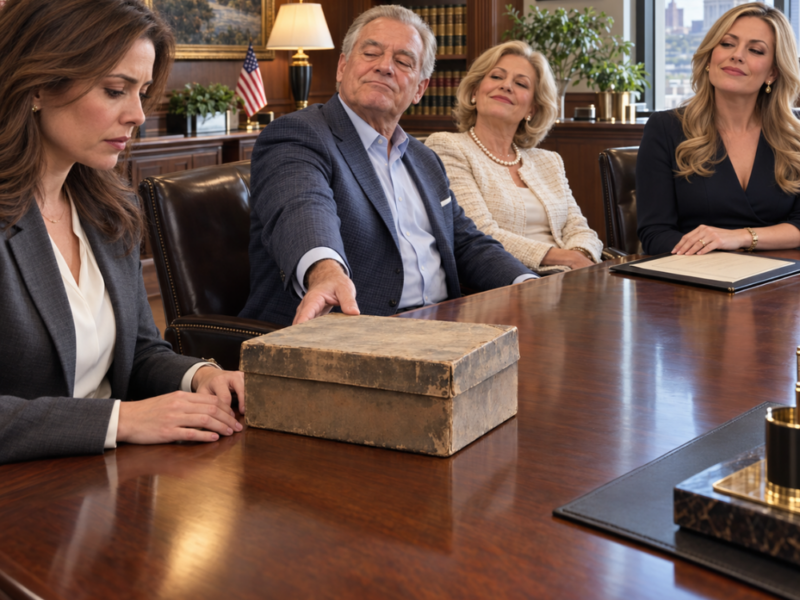
AT THE ESTATE MEETING, DAD GAVE MY SISTER THE DEED AND ME AN OLD SHOEBOX. ‘THAT’S ALL YOU’RE WORTH. MOM LAUGHED ACROSS THE TABLE. I OPENED IT ALONE THAT NIGHT AND CALLED THE LAWYER BEFORE SUNRISE.
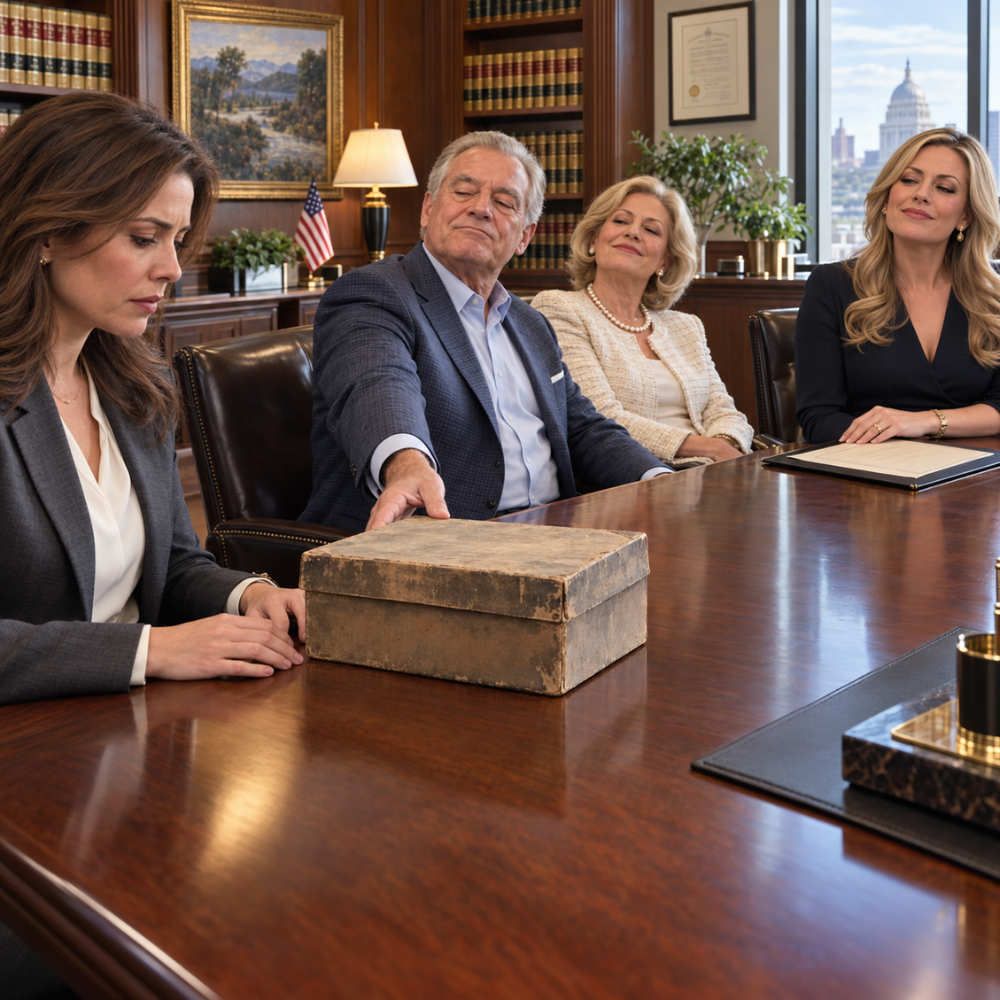
At the estate meeting, Dad gave my sister the deed and handed me an old shoebox. What I found inside rewrote my entire life.
My name is Nia Bell, and I was thirty-three years old when my family decided to measure my entire life with an old shoebox.
It happened on a Saturday morning in my parents’ dining room during a meeting my father kept calling necessary.
Harold Bell liked that word.
Necessary was what he called things when he wanted obedience to sound mature. Necessary meant the decision had already been made. Necessary meant my mother had chosen the tablecloth, the seating arrangement, and the tone everyone was expected to use before I ever walked through the door.
It meant I was supposed to arrive, sit down, listen, and accept whatever had been arranged for me.
My parents lived on Juniper Lane in Haven Falls, New York, in a two-story brick Colonial that had belonged to my grandmother Beatrice. She bought the property in the early 1960s, when a Black woman in our county needed more paperwork, more patience, and considerably more nerve than most people to buy a house anywhere near Heron Lake.
My family had polished that history into a legend.
My father told it at church dinners. My mother told it at chamber luncheons. There was a framed photograph of Grandma Beatrice standing beside the original For Sale sign hanging near the staircase, and beneath it a brass plate engraved with the words SHE BUILT WHAT THEY SAID WE COULD NOT HAVE.
It was a good story.
They simply never told it in a way that made much room for me.
I arrived twenty minutes early.
I always arrived early.
I photographed weddings for a living, and weddings had taught me that a room usually told the truth before the people inside it did.
You could tell which parents disliked each other from the way they positioned their chairs. You could tell when a bride had cried in the bathroom by the extra concealer around her nose. You could tell which aunt had been given an invitation out of obligation because her place card would somehow end up at the farthest table from the dance floor.
Coffee cups told stories.
Hands told stories.
So did windows, coats, half-finished glasses of water, and empty chairs no one mentioned.
That morning, my mother, Marlene Bell, had already placed six coffee cups around the walnut dining table.
Six cloth napkins had been folded into perfect triangles.
She only made triangles when she wanted something to feel official.
My sister, Tasha, sat beside her husband, Jamal. Across from them was our cousin Andre, the son of my father’s late brother, Darius.
No one had told me Andre was coming.
He was thirty-seven and worked as a wedding planner in Burlington Ridge, where he had built a reputation for solving disasters without raising his voice. I had watched him calm screaming mothers of brides, stalled caterers, missing florists, and one groom who disappeared for forty minutes before his ceremony because he had locked himself in a hotel bathroom.
That morning, Andre looked nervous.
My mother poured coffee for Tasha.
Then Jamal.
Then Andre.
When my father entered, she poured his.
She did not pour mine.
I walked to the sideboard, filled my own cup, added a little cream, and carried it to the table without commenting.
It was the kind of small thing I had spent most of my life pretending not to notice.
Andre caught me in the hallway before everyone sat down.
“Nia.”
He kept his voice low.
“Do you know why Uncle Harold asked me here?”
“No.”
“He called Monday. Said I needed to witness something.”
“Did he say what?”
Andre glanced toward the dining room.
“He said I’d understand when the family understood.”
That sounded exactly like my father.
Harold Bell had a gift for wrapping cruelty in language that sounded like duty.
He entered a moment later carrying a leather portfolio beneath one arm.
He was sixty-three, a deacon at New Covenant Fellowship, a trustee for the local school district, and the face of Bell Family Portrait Studio on every chamber brochure printed in Haven Falls for the past twenty years.
People trusted my father.
That mattered.
He had the kind of calm voice that made other people lower theirs. He wore dark suits even when nobody required one. His hair had gone silver at the temples, which somehow made strangers assume wisdom had arrived there too.
He was the man local couples asked to photograph their anniversaries.
The man teachers called when the school foundation needed a fundraiser.
The man Reverend Granger described as dependable.
Harold had spent most of my life convincing rooms that he was patient, principled, and tired only because so many other people depended on him.
He did not greet me.
He sat at the head of the table, opened the leather portfolio, and removed a notarized document.
Then he slid it toward Tasha.
“The Mercer Street property goes to your sister,” he said.
He was speaking in my direction, though not exactly to me.
“The full transfer was recorded Tuesday. Tasha has the temperament to carry the business forward.”
Tasha stared down at the deed.
Her fingers trembled slightly as she opened it.
The Mercer Street building was worth far more than the studio business itself. It was an old three-story commercial property two blocks from downtown, purchased years earlier before that section of Haven Falls became popular with boutiques, law offices, and restaurants.
Bell Family Portrait Studio occupied the ground floor.
The upstairs units had been leased to a tax preparer and a physical therapist.
The building was the asset everyone in the family understood.
Tasha was twenty-nine, married to Jamal, and the mother of Isaiah and Ila. For most of her life, she had believed that being chosen meant she had earned something.
For most of mine, I had believed the opposite side of that equation.
Tasha looked at my father.
“Dad, what about Nia?”
My mother laid one hand over Tasha’s wrist.
It looked gentle.
It was not.
Tasha stopped talking.
My father reached beside his chair.
He lifted an old brown shoebox onto the table.
The lid sagged at the corners. Two brittle rubber bands held it closed. A faded shipping label remained stuck across the top.
Even upside down, I could read part of the sender line.
E. Reed.
Care of Bellamy Legal Offices.
My father shoved the box across the walnut table.
It stopped against my coffee cup.
“This came from that strange man by the water,” he said.
Then he looked directly at me.
“That is all you are owed, Nia. Take it and get out.”
My mother laughed.
I want to be precise about that laugh, because memory has a way of softening sharp things after enough years.
She did not gasp from embarrassment.
She did not give an uncomfortable little chuckle.
She leaned back in her chair, burgundy lipstick bright against her brown skin, and laughed as though she had been holding it in all morning.
But she did not look at me while she did it.
She looked at my father.
That was what stayed with me.
The laugh was not really for the room.
It was for him.
A private reward.
Jamal studied his folded hands.
Andre went still around his coffee cup.
Tasha stared at her lap.
For several seconds, I waited for one person to say my name in a way that made me feel real.
No one did.
So I stood.
I picked up the shoebox with both hands.
Then, because I had been raised to leave no evidence of discomfort, I pushed my chair neatly beneath the table.
I walked past the family portraits in the hallway.
Past the framed chamber award.
Past a photograph of my father shaking hands with the mayor.
Past the church plaque with his name engraved in brass.
Then I went through the mudroom and stepped outside.
Andre followed me.
“Nia.”
His professional calm was gone.
“I’m sorry. I didn’t know.”
I stopped on the back step.
He rubbed one hand over his face.
“My dad said something once about Elias Reed before he died. I never understood it. Maybe I should have.”
“What did he say?”
“Not enough.”
Andre reached into his jacket and handed me his business card.
His office number was printed on the front. On the back, he wrote his personal cell.
“Any hour,” he said. “I mean it.”
Any hour.
Any weather.
Any lens.
Elias Reed had said almost the same thing to me when I was eight years old.
I could not answer Andre.
I walked to my car, placed the shoebox on the passenger seat, and drove twelve minutes to my apartment on Brier Street.
I had lived there for eleven years.
One bedroom above a laundromat.
Eight hundred ninety dollars a month when I first signed the lease, though the rent had climbed since then. Radiators that clanked in January. A narrow kitchen window overlooking an alley lined with trash cans and rain barrels. A downstairs dryer that made the floor tremble whenever somebody washed a comforter.
People sometimes asked why I stayed.
The answer was simple.
I had learned young that when I lived under my parents’ roof, they owned the lock as well as the door.
My apartment was imperfect.
It was also mine.
I placed the shoebox on the kitchen table.
Then I left it there for three hours.
People imagine that when the truth finally reaches you, it announces itself.
Mine sat quietly beside a chipped coffee mug while I washed dishes that were already clean.
I wiped the counter twice.
I folded a kitchen towel.
I reorganized three jars of spices.
I did everything except touch the box.
I kept seeing my mother’s hand settle over Tasha’s wrist.
That neat pressure.
The way my sister’s mouth had closed around the question she should have been allowed to finish.
And I kept hearing my father’s choice of words.
Owed.
Not loved.
Not left.
Owed.
Before I explain what I found inside the box, you have to understand who Elias Reed was.
To my parents, he was the odd man by the water.
Sometimes my father used harsher language when he thought no children were listening.
Elias lived about a hundred yards from the back of my parents’ property in a cedar cabin on Heron Lake Road. The two properties were separated by a narrow stretch of woods and a finger of water that made voices travel strangely on quiet mornings.
He drove an old green Volvo that coughed before starting.
He wore boots older than some of my cousins.
He carried a Leica camera as naturally as other men carried car keys.
Four of his photographs belonged to the permanent collection at the North County Museum, though if you listened to my father talk about him, you would have thought Elias was some failed eccentric who had misplaced a normal life.
Elias was not a failed man.
He was a quiet one.
My family treated those things as if they meant the same.
He began teaching me photography in May 2001.
I was eight.
Tasha was a baby.
My mother was exhausted in the particular way new mothers sometimes become exhausted when everyone praises the baby and nobody notices the woman slowly disappearing behind bottles, laundry, doctor visits, and polite smiles.
My father had gone away for a weekend workshop.
I wandered into the backyard after lunch and eventually found Elias sitting on his dock.
He raised one hand.
“Come here, Nia.”
He handed me an old Kodak camera.
I held it upside down.
Elias smiled.
I became offended.
“I know how to use it.”
“No, you don’t.”
“I do.”
“Then stop covering the lens with your finger.”
I moved my finger.
He did not laugh at me again.
Instead, he crouched beside me and adjusted my grip.
Then he said something I would remember for the rest of my life.
“Light touches what you love before it reaches the film. Your job is deciding how long to let it stay.”
Elias could say things like that because he did not say many things.
He never decorated himself with wisdom.
He gave instructions.
Then he waited to see what you did with them.
Over the next twenty-five years, he taught me without ever calling himself my teacher.
Aperture on Saturday mornings.
Contact sheets after church.
How to expose darker skin without flattening a face into shadow.
How candlelight could turn from gold to mud depending on the wall behind it.
How older cameras sometimes rendered brown skin poorly because the people who calibrated early film and processing standards had not built those systems with every face in mind.
He taught me to compensate.
More important, he taught me not to apologize for needing to.
When I was fifteen, he loaned me a Leica M6.
“When do you need it back?” I asked.
“Indefinitely.”
“How long is indefinitely?”
“Long enough for you to stop asking.”
When I moved into the Brier Street apartment at twenty-two, Elias showed up with walnut boards, brackets, screws, and a level.
He built a shelf over my desk.
He never announced that he was helping me.
He simply found the studs in the wall, attached the shelf, cleaned up the sawdust, and left before I could make my gratitude uncomfortable.
My father complained for a week about the noise Elias made cutting the walnut in his driveway.
That was how they existed beside each other.
Close.
Civil when necessary.
Never warm.
I thought I understood why.
I did not.
Elias died on April 12 from chronic heart failure.
I learned the exact language later from his attorney, Marcus Bellamy.
The funeral was three days afterward at New Covenant Fellowship.
My parents did not attend.
My father stood in the kitchen that morning, reading the newspaper on his tablet, and said, “Don’t embarrass yourself over a neighbor.”
I went anyway.
There were eight people in the sanctuary.
Reverend Paul Granger spoke for less than five minutes.
Ruth Anne Price, Elias’s longtime neighbor, cried quietly near the aisle.
A woman I did not recognize sat two rows behind me wearing a gray wool coat despite the mild weather. She watched me after the service with the expression of someone waiting for a locked door to open.
She left before I could ask her name.
Later, I learned she was Celeste Morgan, the photography curator at the North County Museum.
By then, she had already seen enough of Elias’s archive to know that much of my life was inside it.
Three weeks after the funeral, a delivery service brought the shoebox to my parents’ house.
My father signed for it.
Tasha later told me he stood in the mudroom reading the return label before carrying the box into the kitchen.
“That man sent Nia something through a lawyer,” he told my mother.
My mother looked at the label.
She was chopping onions.
Her knife paused.
Only for a second.
Then she kept cutting.
“We’ll give it to her at the meeting,” my father said.
“It fits.”
At 11:47 that night, sitting alone in my apartment, I finally cut the rubber bands.
They snapped apart from age.
One corner of the lid tore when I lifted it.
The first thing inside was a black-and-white photograph.
Five by seven.
Fiber paper.
My mother stood beside Heron Lake, six months pregnant, one hand on the curve of her belly.
She was laughing at whoever held the camera.
I knew my mother’s face.
I had photographed it for church directories, Christmas cards, anniversary dinners, retirement banquets, and family gatherings.
I knew her polite smile.
Her disappointed smile.
Her public smile.
Her church smile.
Her expression of gracious concern.
Her expression of contained anger.
I had never seen the face in that photograph.
She looked young.
Unguarded.
Almost free.
I turned the picture over.
Elias had written six words in pencil.
For the day she asks.
Beneath the photograph was a leather journal, worn soft at the spine.
Inside were thirty-three dated entries.
One for every birthday I had lived.
I opened the first.
It had been written eleven days after I was born.
You are eleven days old.
Your mother let me hold you today.
She cried longer than the baby did.
I promised her I would never say the word father in any room where you could hear it.
I do not know whether that promise was mercy or fear.
I closed the journal.
My hands had started shaking.
I was not ready for the rest of it.
Beneath the journal lay a brass key attached to a paper tag.
118 Heron Lake Road.
Elias’s cabin.
Under the key was a seven-page legal document.
Last Will and Testament of Elias Jerome Reed.
Dated December 14, 2024.
Filed with the county Surrogate’s Court.
I read the central clause three times because my mind kept refusing to accept the grammar.
To Nia Rochelle Bell of Haven Falls, New York, I leave my residence at 118 Heron Lake Road, all contents therein, my photographic archive in physical and digital form, and the remaining balance of my accounts at Freedom County Bank, without condition.
At the bottom of the final page, Marcus Bellamy had added a handwritten note.
Call before sunrise. Do not wait for business hours.
Under the will was an envelope sealed with dark red wax.
On the front, Elias had written:
For the day you want to know.
I opened it.
Inside was a laboratory report from Hudson DNA Services dated October 22, 2024.
Sample One: buccal swab provided by client.
Sample Two: cellular material recovered from ceramic mug.
Probability of paternity:
99.997 percent.
I did not cry.
My body chose something older than crying.
I lowered myself to the kitchen floor because suddenly I did not trust my knees.
The ceramic mug.
I remembered it immediately.
My birthday in 2024 had fallen on a Thursday. I visited Elias the following Saturday, as I often did.
He made coffee.
I used the chipped blue mug I had damaged when I was fifteen.
I had turned the broken side toward the wall on his drying rack so nobody would cut a lip on it.
Elias had kept the mug.
His cardiologist had told him that fall his heart was deteriorating faster than expected.
So he had tested what he already believed he knew.
Then he had placed the proof somewhere no one could dismiss with a laugh, a family story, or a church voice.
The final object in the shoebox was a black USB drive tied with thread to a paper tag.
Play the final file first.
Beneath it were Marcus Bellamy’s business card and one more folded note.
Nia,
I recorded forty-two hours of lessons over the years and eleven minutes three days before I died.
Call Marcus before sunrise.
There is a museum board meeting on May 26.
You decide.
At the bottom, Elias had signed:
Your father,
Elias Reed.
Those words did not make me whole.
That surprised me.
Part of me had imagined that if I ever discovered the missing explanation for my childhood, it would rush through me and fill every empty place.
Instead, the truth illuminated the emptiness.
It showed me the exact shape of what had been missing.
I heard Harold in the dining room.
That is all you are owed.
Then I looked at the final line Elias had written.
Your father.
In pencil.
Perhaps because ink would have felt too permanent after thirty-three years of silence.
I called Marcus Bellamy at 3:38 in the morning.
He answered on the third ring.
“Nia?”
He did not sound surprised.
“I opened the box.”
He exhaled.
“I’ve been waiting.”
I told him about the photograph.
The journal.
The DNA test.
The will.
The USB.
I expected him to give me some explanation over the phone.
Instead he said, “Come to my office at eight. Bring everything. Come alone.”
Marcus’s office was above a shoe-repair shop on Saran Road.
He was sixty-eight, silver-haired, and wore a brown cardigan that made him look more like a retired professor than an attorney.
A sleeping spaniel occupied most of the space beneath his desk.
I looked down.
Marcus noticed.
“Elias wanted me to keep her after he died. Her name is Junie.”
The dog snored.
Marcus smiled faintly.
“She has slept through most of his probate.”
I almost laughed.
The sound became trapped somewhere behind my ribs.
Marcus motioned toward a chair.
Then he placed a leather folder on the desk.
I recognized it.
Elias used to carry contact sheets in it.
“He gave me the first material for this file in 1985,” Marcus said. “He updated it every few years.”
“Why?”
“Because he was afraid.”
“Of my father?”
Marcus considered that.
“Of several people. Mostly himself.”
He opened the folder.
“His instruction was simple. If anyone ever used your worth as a weapon against you, you were to receive the complete record in one sitting.”
The first document was a photocopy of a postcard.
Savannah.
September 1992.
On the back, in Elias’s handwriting, were the words:
The baby will have your eyes. I hope she has my patience and not my fear.
I looked up.
“Where did you get this?”
“Harold found it.”
“When?”
“1999.”
My stomach tightened.
“He knew?”
“He knew enough to suspect. He found the postcard in your mother’s lockbox. He never confronted Elias. According to everything Elias documented, Harold never asked your mother for a direct answer either.”
“Then what did he do?”
Marcus removed his glasses.
“He changed toward you.”
I remembered 1999 immediately.
Third grade.
That was the year Harold stopped calling me Pumpkin.
One week I was Pumpkin.
The next week I was Nia.
Clear.
Flat.
As though my own name had become a correction.
Tasha remained Baby Girl.
I once asked my mother why.
“You’re old enough to stop needing foolishness,” she told me.
I believed her because children believe the person who controls breakfast.
Marcus placed another document on the desk.
It was dated March 3, 1993.
Signed by Elias Reed.
Samuel Bell.
Beatrice Bell.
My grandparents.
The language was formal and careful.
Elias agreed that he would not publicly claim paternity.
He would not pursue a parental role.
He would remain, in all public respects, a neighbor.
On that same day, Samuel and Beatrice had sold him the lake parcel beside their property for one dollar.
I stared at my grandmother’s signature.
The B trembled.
“It wasn’t really enforceable the way they seemed to imagine,” Marcus said. “But people often mistake shame for law.”
“How did they know?”
“Marlene told them when she was seven months pregnant.”
I could barely look at him.
“She knew the dates. She believed telling Harold would end the marriage and destroy the life both families had been building. So she went to his parents instead.”
“And they arranged this?”
“Samuel did most of the talking. Beatrice cried.”
“Elias agreed?”
“Yes.”
“Why?”
“He believed living close enough to know you was better than being removed entirely.”
I laughed once.
There was nothing funny in it.
“So everybody found a solution.”
Marcus’s expression did not change.
“Yes.”
“For everybody except me.”
“Yes.”
The quiet certainty of that answer hurt more than if he had tried to soften it.
He continued.
“Your mother accepted a life where everyone owed her silence. Elias accepted proximity without acknowledgment. Your grandparents protected the Bell family name. Harold accepted resentment because resentment allowed him to avoid asking questions he might not like answered.”
“And me?”
Marcus folded his hands.
“You were made to carry the cost before you were old enough to pronounce the word.”
It was almost too neat a sentence.
But sitting in that office at eight in the morning, watching sunlight creep across a legal pad while Junie snored beneath the desk, it did not sound polished.
It sounded like an old man trying to tell me something terrible in the least cruel way he could.
“Who else knew?”
Marcus pulled out a sheet of yellow paper.
Several names appeared on it.
Samuel Bell.
Beatrice Bell.
Darius Bell.
Those three were crossed out.
Below them:
Marlene Bell.
Harold Bell.
Ruth Anne Price.
Reverend Paul Granger.
Celeste Morgan.
And at the bottom, in Elias’s handwriting:
For the day Nia becomes the last name on the page.
“Tasha?” I asked.
Marcus shook his head.
“She does not know. At least Elias believed she didn’t.”
I leaned back.
Everyone talks about the power that comes with learning the truth.
They do not talk enough about the exhaustion.
Power is often just the name people give you after you have been denied information for years and are finally permitted to stop guessing.
Marcus moved to the next issue.
The museum.
Celeste Morgan and the North County Museum wanted to acquire or exhibit Elias’s archive.
An appraisal from Swanbridge Auctions valued the complete collection at roughly $1.4 million.
A private buyer in Westchester had offered $1.1 million for everything.
No exhibit.
No local attention.
No public questions.
Just climate-controlled storage behind a private gate.
But Elias had placed one restriction in the will.
The choice belonged to me.
“Why the museum?” I asked.
Marcus looked at me for a long time.
“Because Elias wanted the photographs of you seen in a room where nobody could call you difficult simply for standing inside your own story.”
I lowered my eyes.
There was more.
Much more.
Elias’s archive contained records of sixty photographs Bell Family Portrait Studio had sold, published, submitted for awards, or licensed under Harold Bell’s name.
Photographs I had taken.
Some were wedding portraits.
Some senior portraits.
Some political campaign images.
Some family sessions.
Several had won regional awards.
Metadata and archived raw files identified my camera body.
My presets.
My file structure.
My timing.
My edits.
Elias had quietly purchased magazines, exhibition catalogs, brochures, and studio materials whenever my work appeared publicly under Harold’s name.
He kept records.
Dates.
Camera serial numbers.
Original filenames.
The tonal curve he had taught me to build years earlier.
The same look my father later described at professional conferences as the Bell signature.
I thought anger would arrive first.
Instead, I felt embarrassment.
I remembered applauding him.
I remembered standing at banquet tables with paper plates balanced in my hand while older photographers congratulated Harold on his eye for people.
I remembered my father glancing at me across the room with a faint smile.
A reminder.
The studio was feeding me.
The family was giving me opportunity.
Be grateful.
I had mistaken my training for manners.
By the time I left Marcus’s office, the sun was fully up.
But I had already made one other trip that morning.
At 5:12, before meeting Marcus, I had driven to 118 Heron Lake Road.
The brass key from the shoebox turned easily.
That bothered me.
I had expected the lock to resist somehow.
I wanted the house to have questions for me.
Instead, the door opened as though it had been waiting.
The cabin smelled like cedar, coffee, dust, and the faint chemical memory of an old darkroom.
The kettle remained on the stove.
The chipped blue mug stood on the drying rack.
The damaged side faced the wall.
His boots were beneath a bench.
Two rolls of film sat beside the kitchen sink.
Nothing in the room seemed to understand that Elias was dead.
His porch faced the Bell property across the water.
From the old wooden chair beside the railing, I could see the bedroom window where I had slept as a child.
The maple tree I climbed when I was ten.
The steps where Harold posed Tasha and me for Easter photographs after church.
Elias had watched that house for decades.
Close enough to see me grow.
Too far away to call me his daughter.
I stood on the porch and realized something that would take me much longer to accept.
There were no clean people in this story.
Elias had loved me.
He had also obeyed a silence that harmed me.
Harold had raised me.
He had taught me to ride a bicycle, paid for braces, driven me to urgent care after I broke my wrist at thirteen, and sat awake when I had pneumonia.
He had also punished me for a truth I did not create.
My mother had once been frightened, young, and trapped by choices she believed would destroy everything around her.
She later turned that fear into a structure the rest of us were required to live inside.
My grandparents thought they were preserving a family.
They buried a child beneath the preservation.
None of it fit neatly into revenge.
And that made it harder.
On Tuesday afternoon, I went to see Ruth Anne Price.
She lived two properties beyond Elias’s cabin in a white cottage with green shutters and geraniums crowded across the porch.
Ruth Anne was seventy-four, widowed, with silver twists tucked beneath a scarf.
She had known me since I was a child.
When I arrived, she was sitting at the end of her dock with a cloth-covered notebook in her lap.
She held it out to me.
“This is not a diary.”
“What is it?”
“A witness log.”
I opened it.
The first entry was dated May 12, 2001.
3:14 p.m. Nia came over in a green sweater. Held the camera upside down for two full minutes. Became angry when Elias smiled.
I put one hand over my mouth.
There were hundreds of entries.
Dates.
Times.
Short observations.
Nia learned aperture.
Nia developed her first roll.
Nia stayed late after her parents argued.
Nia brought Elias a slice of birthday cake.
Nia cried today and pretended it was allergies.
Nia got accepted to community college.
Nia moved to Brier Street.
Nia brought a shelf board and insisted it was straight. It was not.
I looked up.
“Why didn’t you tell me?”
Ruth Anne gazed across the lake.
“Tell you what?”
“That he was my father.”
She was quiet for a while.
Then she said, “I told Elias I would not lie for him. But I agreed to wait with him.”
“That sounds like the same thing.”
“To somebody who has been denied the truth, I imagine it does.”
Her answer irritated me because it did not defend itself.
I almost wanted her to argue.
Instead, Ruth Anne reached into her cardigan and removed a folded Polaroid.
I was twelve in the photograph.
Elias stood behind me on the dock, adjusting the Leica strap around my neck.
I was laughing.
Not smiling.
Laughing with my whole face.
The photograph had been creased twice.
The way people fold something to fit into a wallet.
“He carried that until he died,” Ruth Anne said.
I stared at it.
Some part of me resisted the tenderness.
That surprised me too.
I had spent so many years constructing explanations for my loneliness that evidence of love felt suspicious.
On Wednesday, Marcus drove with me to the North County Museum.
Celeste Morgan met us at the archive entrance.
She was fifty-six, tall, sharp-eyed, and dressed in a charcoal blazer over a cream blouse.
She shook my hand with both of hers.
“There’s something downstairs you need to see.”
The archive room was cool enough to make me wish I had brought a sweater.
Sixty photographs lay across archival tables.
Twenty-one were of me.
Me at ten, halfway up the maple tree.
Me at fourteen, holding a Rolleiflex as though somebody might arrest me if I dropped it.
Me at eighteen, sitting on my parents’ porch with a paperback open across my knees.
Sunlight caught the coils near my crown.
Me at twenty-two carrying a cardboard moving box from my parents’ garage toward my car.
Me at twenty-seven laughing beside a woman selling peaches at the farmers market.
I had never seen myself like that.
Not posed.
Not corrected.
Not asked to lift my chin.
Not told to smile with my teeth.
Celeste let me move from photograph to photograph without speaking.
Eventually she said, “Elias told me something once.”
I looked at her.
“He said the moment a subject realizes she is being watched, she begins protecting herself from the watcher. He wanted photographs of you from before you protected yourself.”
I turned back toward the images.
Then Celeste opened another folder.
“These are the Bell studio records.”
Invoices.
Publication records.
Award submissions.
Magazine tear sheets.
Metadata reports.
Copies of client agreements.
Elias had been methodical.
He recorded the serial number of my Canon body.
My file naming conventions.
My custom processing curve.
The original capture dates.
In several cases, the studio renamed my files before submitting them under Harold’s authorship.
Celeste watched me read.
“You should understand something,” she said. “This is not a rumor. It isn’t an allegation supported by family memory. There is a documentation trail.”
I nodded.
“Does my father know you have this?”
“Not yet.”
“When will he?”
“When you decide.”
That answer frightened me more than I expected.
I had spent most of my life inside decisions other people made.
Suddenly every adult in the room was waiting for mine.
Celeste told me the museum wanted to open the exhibit on Saturday, May 23.
The board would vote three days later on keeping the collection for a longer run, assuming I agreed.
The private buyer remained an option.
I looked again at the photographs.
“The exhibit.”
Marcus turned toward me.
“You’re certain?”
I answered before the old part of me could ask permission.
“Yes.”
Celeste smiled, but only briefly.
Then we began paperwork.
That evening, Tasha called.
I let it ring.
A minute later, she sent a text.
Mom knows you met Marcus.
What is happening?
Please don’t make me ask her first.
I was sitting on Elias’s dock.
I stared at the message for almost an hour.
Then I replied with one sentence.
Ask her about Savannah, 1992.
The message showed Read at 8:11 p.m.
Tasha did not respond.
My mother began calling the following morning at 7:14.
Eleven calls in twenty-two hours.
The first voicemail was soft.
“Baby, come home. We need to talk.”
The second was softer.
“You don’t know what you think you know.”
By the fifth, she was crying without tears in her voice.
By the seventh, I was ungrateful.
By the eleventh, she had recovered the version of herself that negotiated wedding deposits and church committees.
“Nia,” she said calmly, “whatever Marcus has shown you, there is context. Harold doesn’t need to be there. Come sit with me woman to woman.”
Woman to woman.
As though she had not spent thirty-three years deciding when I was her daughter and when I was evidence.
I saved every voicemail.
On Friday afternoon, I drove to Mercer Street to retrieve the external drive containing fifteen years of my client masters.
My key no longer worked.
I tried it twice.
Then I stepped back.
Through the front glass, I could see my father standing near the reception desk.
His arms were folded.
Behind him hung framed portraits I had lit, photographed, culled, color-corrected, and prepared for print.
He walked to the locked door.
I could hear him through the glass.
“Everything in here is Bell Family Portrait Studio property.”
“I need my client files.”
“If you want files, bring a lawyer.”
“Those masters are mine.”
“If you want the building, talk to your sister. She owns it now.”
I did not knock again.
I took out my phone and photographed the new lock.
A camera had taught me that proof was sometimes the only witness that never became tired, frightened, embarrassed, or loyal to the wrong person.
Back in my car, I remembered something Elias had told me in 2019.
Harold had misplaced the studio side-door key twice that year.
Elias repaired a jammed hinge for him and quietly made a copy of the replacement.
He had laughed when he told me.
“I don’t plan to use it.”
“Then why copy it?”
“Because I refuse to become a man who has to knock while somebody locks my daughter out.”
At the time, I thought he meant daughter affectionately.
The next morning, I opened the desk drawer in Elias’s cabin.
Four keys sat inside.
Each had a paper tag.
Studio side door.
Studio darkroom.
Bell house mudroom.
Marlene office cabinet.
My parents had spent decades believing Elias had accepted being outside.
He had accepted being outside with keys.
Underneath them was a sealed card.
The handwriting belonged to Grandma Beatrice.
I recognized the small, trembling letters from birthday cards she sent during her final years.
The envelope was addressed to Elias.
He had never opened it.
I stood there for a long time.
Then I did.
Inside was one sentence.
I am sorry we made a child pay for our fear.
I sat at Elias’s desk with the letter in my hand.
Then I returned the studio keys to the drawer.
I did not use them.
Celeste already had enough documentation.
Marcus could deal with my client files through legal channels.
I did not want my first act of freedom to involve entering the studio like a thief.
Harold had already done enough stealing for both of us.
That night, I finally read more of Elias’s journal.
In 2013, he wrote that my mother had come to the cabin.
Marlene says Nia will not survive the truth.
I believed her because the alternative requires admitting I have been a coward.
In 2018:
Ruth Anne says patience has become my excuse.
I am seventy now.
Every year I tell myself I am protecting Nia.
Every year she learns one more way to mistake distance for peace.
I read that line three times.
There was nothing heroic about it.
That mattered.
Elias was not writing himself into a noble role.
He was an old man finally looking directly at damage he had helped preserve.
At 11:47 that night, my mother sent a text.
I cannot survive this.
I stared at those four words.
There it was again.
The same burden.
The same structure.
In 2013, she had told Elias that I could not survive the truth.
Now, when the truth no longer belonged to her, she told me she could not survive it.
My mother possessed many gifts.
One of them was turning her collapse into work someone else was expected to perform.
I did not answer.
Instead, I called Andre.
He picked up from a parking lot after a rehearsal dinner.
I could hear traffic behind him.
“Nia?”
“I need to know what your father heard before he died.”
Andre became quiet.
Finally he said, “In 2018, Dad was visiting Grandma Beatrice at memory care every Tuesday.”
I waited.
“One afternoon she told him they had made Elias sign a paper.”
“What paper?”
“She didn’t explain. She said it had been the right thing for Harold and the wrong thing for the child.”
My fingers tightened around the phone.
“What child?”
Andre exhaled.
“That’s what Dad asked.”
“And?”
“She said your name.”
I closed my eyes.
“Did your dad confront Harold?”
“He tried.”
“What happened?”
“Uncle Harold said Grandma was confused and grief was making her invent things. Dad was sick by then. He told me he didn’t want to drop a match into a room if he couldn’t stay long enough to help put out the fire.”
I became angry.
Then sad.
Then angry again.
So many adults had spent my entire life calling their fear protection.
Andre waited.
Finally he asked, “Are you going to expose them?”
I looked across the dark lake.
Two windows glowed in my parents’ house.
I knew those rooms.
I knew which floorboard near the dining room squeaked.
I knew the drawer where Marlene stored batteries.
I knew the cabinet holding her good china.
I knew that house well enough to walk through it in darkness.
“I’m going to put the work on the wall,” I said.
“That’s it?”
“That’s enough.”
I paused.
“They can decide what they exposed by standing in front of it.”
After midnight, I called Celeste.
“Send the invitations.”
“To whom?”
“Everybody.”
“Nia.”
“My parents. Tasha. Andre. Reverend Granger. Ruth Anne. Everyone who needs to see it.”
The exhibit opened Saturday, May 23, at six in the evening.
Eighty-four names were on the guest list.
The second-floor gallery had walnut floors, white walls, exposed cedar rafters, and the quiet museum lighting that makes even ordinary objects seem willing to tell the truth if you stand still long enough.
Celeste and I hung the final pieces together the day before.
The photograph of my mother went on the main wall.
At eye level.
The label was simple.
Marlene, June 1992.
Elias Reed.
No accusation.
No explanation.
Name.
Date.
Maker.
It was enough.
Ruth Anne arrived at 6:06.
Marcus at 6:15.
Reverend Granger at 6:18.
Andre at 6:20, still wearing a suit from another person’s wedding.
My parents entered at 6:23.
Harold wore charcoal.
My mother wore the burgundy dress she had worn to the estate meeting.
She saw the photograph first.
Her face did not change.
Her right hand rose to her collarbone.
Harold looked from the photograph to the wall beside it.
Then he saw my work.
The sixty photographs.
The documentation.
The dates.
He understood the room before anyone spoke.
Tasha and Jamal arrived at 6:41.
Tasha passed our parents without stopping.
She went directly to the photograph of Marlene.
For more than a minute, she stood perfectly still.
Then her shoulders moved once, as if she had taken a breath that hurt.
At 6:48, Celeste stepped to the microphone.
She did not perform outrage.
That was one reason I trusted her.
She spoke like a person who knew documentation could do its own work.
“For twenty-five years, Elias Reed taught a young photographer across the water how to see. Tonight, this gallery presents two intersecting archives.”
She gestured toward one wall.
“On the left are twenty-one images from Reed’s long study of a girl growing into an artist under circumstances that kept the nature of their relationship unnamed.”
Then toward the other.
“On the right are sixty photographs sold, published, submitted, or credited through Bell Family Portrait Studio under Harold Bell’s authorship, accompanied by metadata and process records identifying the photographer as Nia Bell.”
The room became quiet in a way applause never could.
Celeste turned toward me.
“Please welcome our co-curator, Nia Bell.”
I walked to the microphone.
I had written three versions of a speech.
By four that afternoon, every one of them sounded false.
So I brought nothing.
I looked at the photograph of my mother.
Then the wall of my work.
Then my father.
Then the people waiting for me to make the room easier.
I decided not to.
“Two Saturdays ago, my father pushed a shoebox across a dining room table and told me it was all I was owed.”
Nobody moved.
“My mother laughed. My sister looked away. I left with the box because I did not know what else to do with something designed to make me feel small.”
Harold’s face remained still.
“Inside that box was a will. A house key. A journal. A DNA report. And a letter from Elias Reed, the man many people in this town were encouraged to dismiss as a strange neighbor.”
I looked toward Elias’s photograph on the far wall.
“Elias was my biological father.”
Somebody near the back inhaled sharply.
“He was also the man who taught me the work hanging in this gallery.”
I let the room settle again.
“I’m not standing here to ask strangers to solve my family. I’m here to correct authorship.”
I turned toward the sixty photographs.
“The photographs in this exhibit that were previously credited to Harold Bell were made by me. The supporting records are available to the museum board and to the organizations that purchased, published, exhibited, or awarded them.”
I could feel my father watching me.
“As for everything else, I’m still learning what it means to have been loved by someone who remained too far away, and harmed by someone who stood close enough to raise me.”
That sentence was not elegant.
It was probably the truest thing I said all night.
I stepped away from the microphone.
Harold remained seated for eight seconds.
I counted because my body needed something to do.
Then he stood.
He retrieved his coat.
My mother stood too.
She gripped the back of a chair with both hands before following him.
They did not speak to me.
My father closed the gallery door carefully behind them.
Not a slam.
Harold still believed control could be heard in the absence of one.
Tasha stayed.
She remained in front of the photograph of our mother until most of the room had emptied.
Eventually, I walked beside her.
She did not look at me.
“Grandma Beatrice said something once,” she whispered.
I waited.
“I was eighteen. Mom was washing dishes. Grandma said, ‘You owe Harold everything for taking that child.’”
Tasha swallowed.
“Mom told me Grandma meant taking care of you. I believed her.”
She finally turned.
Her mascara had run down one cheek.
“Because I wanted to.”
I did not tell her it was okay.
It was not.
“Can I come find you tomorrow?” she asked.
Every old reflex inside me wanted to say yes.
I wanted my sister to choose me fast enough to erase every time she had not.
But the body keeps accounts the mouth tries to forgive too early.
“Come next week.”
Tasha nodded.
“I need this week.”
“I understand.”
She did not hug me.
That was kind of her.
I do not think she knew it.
Haven Falls rearranged itself over the next seven days.
Small towns are skilled at pretending private matters remain private right up until everyone knows which motel somebody checked into.
On Monday, Harold left the Juniper Lane house.
He moved into the Roseway Motel off Route 9 with two suitcases and the same leather portfolio he had carried into the estate meeting.
Tasha said he left around three in the afternoon without telling Marlene where he was going.
On Tuesday, the North County Museum board voted to keep the exhibition open through Labor Day.
On Wednesday, the Haven Falls Chamber of Commerce ended its exclusive photography arrangement with Bell Family Portrait Studio.
That evening, North County Arts Review published a feature titled The Uncredited Eye.
The article did something I appreciated.
It did not turn my family into gossip.
It focused on the evidence.
Authorship.
Attribution.
Archives.
How creative work disappears inside family businesses when labor is treated as obligation rather than ownership.
My mother’s letter arrived that same night.
Eight pages.
Cream stationery.
Her initials embossed at the top.
She did not apologize.
She wrote that she had been young.
She wrote that Elias made her feel seen during a period when Harold was building the studio and rarely home.
She wrote that Beatrice and Samuel insisted the arrangement was best for everyone.
She wrote that Harold made his own choices after finding the postcard.
She wrote that one day, when I truly understood marriage, I would understand she had been trying to keep a family alive.
I read the letter once.
Then I drove to Elias’s cabin.
I sat on the stone patio behind the kitchen.
I considered keeping it for documentation.
Marcus already had copies of everything relevant.
So I struck a kitchen match.
The paper curled.
Her words darkened at the edges, folded inward, and disappeared into ash.
I did not feel triumphant.
I felt tired.
There is a particular exhaustion that comes when you finally stop defending someone to yourself.
It does not always feel like freedom.
At first, it feels like losing a job you have been performing since childhood.
For years, I had translated my mother.
She is tired.
She is scared.
She had a hard childhood.
She means well.
She loves differently.
She had no choice.
I had spent half my life standing between her behavior and my own judgment, explaining one to the other.
Suddenly that work was over.
The emptiness it left behind was enormous.
Reverend Granger visited on Thursday.
He brought banana bread wrapped in aluminum foil.
He did not preach.
We sat on Elias’s porch for twenty minutes.
Finally, he said, “Harold tried to resign his deacon position.”
“What did you tell him?”
“That resignation isn’t the same thing as accountability.”
I looked at him.
“He asked whether the church was done with him permanently.”
“And?”
“I told him permanence depends on repentance, not reputation.”
For the first time, Reverend Granger sounded tired.
Then he looked directly at me.
“You do not have to monitor his soul, Nia.”
That was the closest anyone from New Covenant came to apologizing for a room that had praised my father for decades.
It was enough for that day.
Ruth Anne came Friday with soup.
Chicken, greens, carrots, dumplings heavy enough to communicate affection without requiring a conversation.
She sat at my kitchen table and did not make me narrate my pain for her comfort.
After nearly an hour, she said, “You didn’t break them.”
I looked at her.
“You opened a window in a house that already had smoke in it.”
I ate three spoonfuls because she was watching and because my body had to remain in the story whether I wanted it to or not.
That was the first night I slept without waking at 3:38.
The following Saturday, May 30, Tasha knocked on my apartment door.
I opened it wearing jeans and a black T-shirt.
I was holding tea I had forgotten to drink.
Tasha stood on the concrete landing with a shoebox in her arms.
Hers was purple.
A Nike box from running shoes she had owned in college.
She looked embarrassed.
“I brought you a shoebox too.”
Despite everything, I nearly smiled.
Tasha looked down.
“It’s not enough.”
I stepped aside.
“I know it isn’t. But it’s what I have.”
We sat at the same kitchen table where I had opened Elias’s box three weeks earlier.
Tasha removed the lid.
The first item was a thin gold bracelet.
Old.
The clasp had been worn smooth.
“Grandma Beatrice gave this to me in 2018,” she said.
I recognized it vaguely from childhood photographs.
“She was already in memory care. She told me my sister would never wear it.”
“Why?”
“I asked.”
Tasha rubbed her thumb over the clasp.
“She said, ‘Because it belonged to my mother, and my mother’s blood is only in one of you.’”
I went still.
“I thought she was confused,” Tasha continued. “I put it away and never asked again.”
She placed the bracelet on the table between us.
Then she removed a thick stack of paper.
A spreadsheet.
“What’s this?”
“The studio booking list.”
I began reading.
Dates from 2011 through 2025.
Clients.
Session types.
Deposits.
Photographer notes.
Invoice numbers.
Tasha pointed to one column.
“I went through all of them.”
She swallowed.
“Nine hundred forty-one bookings list you as primary photographer in the internal notes. Dad’s name is on the invoices or final records.”
I stared at the pages.
Fifteen years.
Weddings.
Senior portraits.
Christmas sessions.
Newborn photographs.
Anniversary dinners.
Corporate headshots.
Generations of Haven Falls residents smiling into my lens while someone else’s name appeared on the receipt.
“I don’t know how to repair it,” Tasha said. “But I want to help.”
I kept reading.
After several minutes, she asked, “Can I ask you something strange?”
I looked up.
“Teach me one thing about a camera.”
“What?”
“One thing. That’s all.”
My sister had benefited from a lie she did not create.
She had also defended the comfort that lie gave her.
She had looked away at the dining room table.
She had stayed at the museum.
Both were true.
“Come to the cabin tomorrow morning.”
Her eyes widened.
“Really?”
“Bring nothing.”
Tasha left the bracelet on my kitchen table.
She did not ask whether I forgave her.
That was the correct question not to ask.
Sunday morning, I made coffee in Elias’s kettle.
Then I sat at his desk beside the window.
For the first time since opening the shoebox, I plugged the black USB drive into my laptop.
There were dozens of audio files.
I selected the one labeled FINAL.
Elias’s voice filled the room.
Older than I remembered.
Rough.
A faint mechanical beep sounded somewhere in the background.
“Nia.”
He paused.
“I counted last week. I photographed you one thousand one hundred forty-two times.”
I covered my mouth.
“I never sold one.”
Another pause.
“That does not make me noble. Keeping can be selfish too.”
His breathing was audible.
“I want you to understand the difference between guarding something because it is precious and hiding it because you are afraid. I spent too many years pretending those were the same.”
The room felt impossibly small.
“There is a Leica M3 in the cabinet beside the fireplace. Not the M6. The old one.”
I looked toward the cabinet.
“Take it to the lake once before sunrise.”
His voice weakened.
“Photograph the moment before the light arrives.”
Another breath.
“You always understood that moment better than I did.”
For several seconds, I thought the recording had ended.
Then he spoke again.
“I am sorry I taught you how to look at everything except me.”
The file stopped.
I sat there until Tasha knocked at 7:45.
Then I walked to the cabinet.
Inside a leather case was the Leica M3.
Film already loaded.
Twelve exposures remaining.
I carried it outside.
Tasha stood on the porch wearing jeans, sneakers, and a sweatshirt from Isaiah’s elementary school fundraiser.
I handed her the camera.
She held it awkwardly.
“Like this?”
“No.”
She adjusted.
“This?”
“No.”
“You could be nicer.”
“So could you.”
She looked at me.
For one second, neither of us knew whether we were allowed to laugh.
Then we did.
Only a little.
I guided her hands around the camera.
“Light touches what you love first,” I said.
Tasha’s expression changed.
“Did he say that?”
“When I was eight.”
I showed her the lens.
“Then the film. Your job is deciding how long to let the world stay before you take it.”
Tasha lowered the camera.
Her eyes filled.
“Was he a good father?”
I looked across Heron Lake.
I thought about Elias crouching beside an eight-year-old girl on a dock.
I thought about him teaching me exposure.
Building my shelf.
Saving magazines.
Documenting every stolen photograph.
I also thought about a man signing away the word father because a group of frightened adults convinced themselves that peace required a child’s ignorance.
I thought about Harold buying my school shoes.
Harold teaching me to drive.
Harold waiting beside my hospital bed when I broke my wrist.
Harold finding a postcard and deciding that an eight-year-old child should pay for what adults had done before she was born.
People want one sentence to make a life coherent.
Lives rarely cooperate.
“He was my father,” I finally said.
Tasha waited.
“That’s the answer I have today.”
I showed her how to advance the film.
How to steady the camera against her palm.
How to breathe before pressing the shutter.
She took two frames.
She did not ask whether they were good.
When she left, she stood in the doorway for a moment.
“Thank you.”
Not I’m sorry.
Not yet.
Thank you was what she had.
I could live with what was true.
Later that week, Marcus filed the paperwork for Reed & Bell Photography LLC.
Single member.
Nia Rochelle Bell.
Seeing my name on the registration felt stranger than I expected.
For years, Bell had been my father’s name, the studio name, the family name, the name printed on invoices above photographs I had taken.
Now Reed and Bell sat beside each other on a single page.
Not reconciled.
Not explained.
Simply present.
Celeste offered me a two-year residency with the North County Museum to develop a follow-up exhibition about unattributed Black portrait photographers and uncredited family-business labor in small-town studios.
I did not accept immediately.
For the first time in my adult life, nobody rushed me toward a decision because it benefited them.
I discovered I liked having time.
The Mercer Street studio remained closed.
Tasha owned the building, but she did not reopen Bell Family Portrait Studio.
The old sign still hung over the sidewalk.
Its paint had faded through too many winters.
One afternoon, Tasha told me she planned to remove it.
“When?” I asked.
“When I can do it without shaking.”
“There’s time.”
She nodded.
Harold never returned to Juniper Lane.
The last I heard, he had rented a small apartment near a cousin two towns over.
He stopped attending chamber breakfasts.
The school board placed him on leave while it reviewed the museum documentation and the attribution issue.
New Covenant removed his name from the weekly program.
I heard all of this from other people.
I did not go looking for updates.
Reverend Granger was right.
I did not need to monitor Harold’s soul.
My mother never wrote again.
For a while, I kept expecting another envelope.
Nothing came.
I learned that silence can mean different things.
Sometimes silence is punishment.
Sometimes it is manipulation.
Sometimes it is shame.
And sometimes it is simply the sound a person makes when nobody else is carrying the conversation for them anymore.
I kept my apartment on Brier Street.
I also kept Elias’s cabin.
Financially, I did not need both.
Emotionally, I could not yet choose.
There had been too many years when every room I occupied felt borrowed.
Keeping two keys in my pocket for a while did not feel greedy.
It felt like my nervous system learning new arithmetic.
The original shoebox sits on the walnut shelf Elias built above my desk.
I removed the legal papers, the DNA report, the journal, and everything Marcus said needed archival protection.
Inside the box, I keep only one thing.
The Polaroid Ruth Anne gave me.
I am twelve years old.
Elias is fixing the Leica strap around my neck.
I am laughing.
Not protecting myself.
Not performing gratitude.
Not trying to earn anybody’s approval.
Just laughing.
On top of the box rests a small cedar plaque I found in Elias’s desk.
He had burned seven words into the wood with a soldering iron.
The eye remains, even when uncredited.
I found something else beneath the walnut shelf in my apartment, in a place I somehow missed for eleven years.
Carved into the underside were my initials and a date.
NRB.
August 14, 2007.
I ran my fingertips over those letters until the edges stopped feeling like an accusation.
Eventually, they began to feel like proof.
One evening, long after the museum opening, I carried the Leica M3 to Elias’s dock.
I set up the tripod before sunrise.
I did not photograph the sun.
I photographed the ninety seconds before it appeared.
That strange interval when the water was not yet bright but had stopped being dark.
The shoreline slowly separated itself from the sky.
The trees returned.
The dock boards took shape beneath my feet.
Nothing arrived all at once.
That was what I had forgotten.
Light does not always enter dramatically.
Sometimes the world becomes visible by degrees.
One edge at a time.
One shape.
One fact.
One name.
One photograph.
People occasionally ask whether I have forgiven my parents.
I never know how to answer without performing some version of myself designed to make the person asking feel comfortable.
Forgiveness is a word people often use when they want a clean ending.
I do not have one.
I have boundaries.
I have records.
I have a sister who comes to the cabin on Sundays with her children.
Isaiah is learning to skip stones badly.
Ila laughs as though the lake invented sound specifically for her.
Tasha owns a camera now.
Nothing expensive.
Sometimes she asks me questions.
Sometimes we sit on the porch without speaking.
Both require more courage than they appear to.
We have not rebuilt our childhood.
You cannot.
What we are doing is smaller.
More difficult.
We are telling the truth in the present tense.
The museum exhibition remains open through Labor Day.
I visit occasionally when the gallery is quiet.
Sometimes strangers stand in front of Elias’s photographs of me and study them longer than I expect.
I never tell them who I am.
I watch them look.
Then I leave.
The Leica M3 still contains undeveloped film.
There are fewer exposures now.
I know I should take the roll to the lab.
I will.
Just not yet.
Some images need to be carried in darkness for a while before they are ready to become visible.
My father was right about one thing.
The shoebox was all he gave me that morning.
He was wrong about what it held.
He thought he was handing me an insult.
He thought he was showing everyone at the walnut table what he believed I was worth.
Instead, he gave me a key to a house.
A record of my work.
Thirty-three years of a dead man trying to find the courage to tell the truth.
Evidence that the story I had been taught about myself was incomplete.
And, finally, the right to decide what happened next.
For most of my life, I believed being overlooked meant there was something missing in me.
Now I know better.
Sometimes the work was always there.
Sometimes the love was there too, imperfect and frightened and far too quiet.
Sometimes an entire family can stand around the truth for decades and call their silence protection.
The truth remains anyway.
Like an image waiting in undeveloped film.
Like morning gathering beneath dark water.
Like an eye that keeps seeing even when nobody writes down the correct name.









