
A Poor Maid Punched the Mafia Boss to Save Him — What He Did Next Terrified Everyone
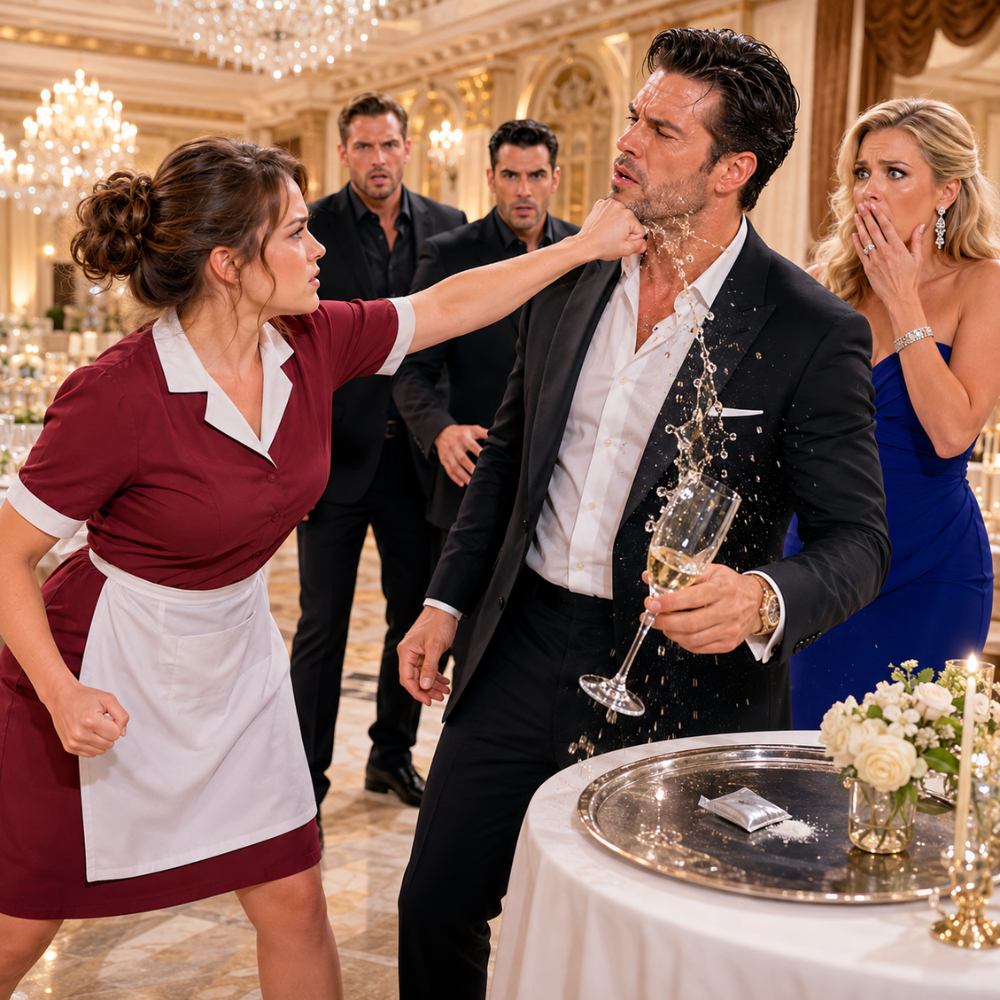
The Poor Maid Punched New York’s Most Feared Crime Boss in Front of 300 Guests—Then He Learned Why She Had Been Watching His Champagne
Lena Hart had three seconds to decide whether a stranger’s life was worth losing her job over.
The champagne glass was already in Victor Romano’s hand.
Three hundred people were standing beneath crystal chandeliers in the Grand Ballroom of the Grandeur Hotel, their own glasses raised while a string quartet waited for the guest of honor to finish his toast. Cameras from two society magazines were pointed toward the stage. A former mayor sat near the front. Hedge-fund managers, developers, museum trustees, surgeons, actors, and old New York families filled tables draped in white silk.
Victor Romano smiled at the room.
Then lifted the champagne toward his mouth.
Lena saw the tiny red mark on the stem.
She saw Leon Mercer watching from table eighteen.
She saw Clara Whitmore, Victor’s fiancée, holding perfectly still.
And she heard again the sentence she had overheard less than forty minutes earlier.
During the toast, when everyone’s attention is somewhere else.
Lena stepped forward.
Victor barely had time to look at her.
She pulled the tray away with one hand and struck him across the jaw with the other.
The glass flew.
It hit the marble floor and shattered.
For half a second nobody reacted.
Then the ballroom exploded.
A security officer grabbed Lena.
Someone screamed.
Two guests ducked beneath their table.
Victor stumbled against the chair behind him, caught himself, and touched his split lower lip.
His head of security, Dmitri Volkov, was already between Victor and Lena.
“What did you do?”
Lena could barely breathe.
“The glass.”
Dmitri seized her wrists.
“What about it?”
“Don’t let anyone touch it.”
Victor stared at her.
Lena looked toward the shards sparkling beneath the chandelier.
“That glass was switched.”
The room fell quiet again.
Victor’s gaze moved from Lena to the floor.
Then to Clara.
Then Leon.
He did not accuse anyone.
He simply said, “Nobody leaves.”
That was the moment power began moving across the ballroom.
Not because Victor Romano had suddenly become more dangerous.
Everyone already believed he was dangerous.
It moved because the least powerful person in the room had noticed something the people closest to him had expected nobody to see.
Six hours earlier, Lena had been cleaning toothpaste from a bathroom mirror on the thirty-second floor.
She was twenty-four and had worked at the Grandeur for eighteen months.
Most guests never learned her name.
Some called her miss.
Some called her housekeeping.
A surprising number simply continued telephone conversations while Lena entered, made the bed, collected wet towels, replaced water bottles, and disappeared again.
Luxury hotels trained staff to move efficiently without making a guest feel observed.
Lena became exceptionally good at it.
She noticed everything.
A watch left beside the sink.
An asthma inhaler on a nightstand.
Which guest preferred the curtains cracked open in the morning.
Which executive threw documents into the trash without shredding them.
Which newly married couple stopped speaking the moment the elevator doors opened.
She noticed not because she was curious about rich people.
She noticed because attention was part of the job.
Her mother, Maria, had taught her that long before the hotel did.
“When you don’t have money,” Maria used to say, “you learn to notice trouble before trouble gets expensive.”
The Hart family lived in a fourth-floor walk-up in the Bronx.
One bedroom.
A narrow kitchen with a radiator that clanked all winter.
A refrigerator door that needed to be lifted slightly before it would close.
Family photographs taped to one wall because the landlord did not want nails.
Lena slept behind a curtain in the living room.
Her younger brother Daniel had the bedroom because his adaptive communication equipment and school materials took up more space.
Daniel was fifteen and had never spoken aloud.
A neurological condition diagnosed in early childhood left him unable to produce normal speech, but his mind worked perfectly well.
His tablet spoke for him.
When he was angry, the synthetic voice sounded bizarrely cheerful.
Lena loved that.
Their mother had been diagnosed with metastatic lung cancer two years earlier.
The first year was treatment.
The second became management.
Appointments.
Scans.
Pharmacy receipts.
Insurance letters.
Copays that appeared suddenly and always seemed to carry deadlines.
Maria qualified for assistance programs, but illness still generated expenses nobody mentioned when explaining coverage.
Transportation.
Home equipment.
Special nutritional supplements.
Time Lena lost from work.
Daniel’s school needs.
A family could drown in the inches between what insurance covered and what sickness actually cost.
That afternoon, Lena’s phone buzzed while she was stocking clean towels.
Daniel’s text came first.
MAMA BAD DAY. BREATHING HARDER. MEDICINE HELPED. WHEN HOME?
Then a message from Dr. Reyes at Mercy Hospital.
Lena, please call Monday. We need to review your mother’s recent scan and treatment options.
Lena leaned against the housekeeping cart.
She knew what careful medical language sounded like.
Treatment options rarely meant good news.
She typed:
Home before midnight. Make sure she drinks water. Love you.
Daniel replied:
LOVE YOU. ALSO MILK GONE.
Lena almost laughed.
Cancer, rent, milk.
Life refused to organize emergencies by seriousness.
She added milk to the note in her phone.
Then her supervisor appeared.
“Hart.”
Mrs. Evelyn Chen had worked at the Grandeur for thirty-one years and could inspect a bathroom at twenty paces.
Lena straightened.
“Yes, ma’am?”
“You’re moving upstairs tonight.”
“Upstairs where?”
“Ballroom.”
Lena stopped.
“I don’t work events.”
“You do now.”
“Why?”
“Marissa called in sick. Agency replacements aren’t arriving until eight. Gala doors open at seven.”
Mrs. Chen handed her a garment bag.
“Change into event service.”
Lena looked at the formal vest through the plastic.
“I’ve never done champagne service.”
“You can carry a tray.”
“That’s not the same.”
“Marcus will train you.”
Mrs. Chen started walking away.
Lena followed.
“What event?”
The supervisor stopped.
For the first time, hesitation crossed her face.
“Romano Children’s Foundation.”
Lena knew the surname immediately.
Everybody in New York did.
Victor Romano’s legitimate holdings included commercial real estate, freight logistics, restaurants, and private equity investments.
The newspapers also regularly connected his family to older organized-crime investigations without always being able to prove what rumor insisted was obvious.
Victor himself had never been convicted of a serious felony.
That did not make people comfortable.
The name carried history.
Mrs. Chen lowered her voice.
“Victor Romano is tonight’s guest of honor.”
Lena stared.
“I’d rather stay on thirty-two.”
“I’d rather own a house in Connecticut.”
Mrs. Chen looked tired.
“Neither is happening tonight.”
“Mrs. Chen—”
“Lena.”
The use of her first name meant the conversation was serious.
“I need you.”
That worked better than a threat.
Lena sighed.
“What time?”
“Six forty-five at the ballroom service entrance.”
Then Mrs. Chen added, “And listen carefully. You are staff, not a guest. You do not join conversations. You do not stare. You do not improvise. You do exactly what the event manager tells you.”
Lena looked at the garment bag.
“Stay invisible.”
Mrs. Chen nodded.
“Exactly.”
The ballroom looked like a different building from the basement locker room where Lena changed.
The service level had stained tile, fluorescent lights, metal lockers, and an employee vending machine that occasionally accepted money without producing anything.
The Grand Ballroom had white marble floors, sixteen-foot floral arrangements, crystal chandeliers, and floor-to-ceiling windows facing Central Park.
Marcus Bell found Lena near the service doors.
He was fifty-two, tall, calm, and had worked banquet service long enough to regard wealthy people as a weather pattern.
“You’re the emergency substitute.”
“That sounds flattering.”
“It isn’t.”
He handed her an empty tray.
“Balance.”
She did.
“Good.”
He placed six water glasses on it.
“Walk.”
She crossed the corridor.
“Turn.”
She did.
“Fine. You’ll survive.”
“That’s the entire training?”
“No. That’s the part that keeps glass off people.”
Marcus showed her the seating map.
Tables fifteen through twenty-two.
Champagne only.
Each place setting matched a numbered service tag.
Some guests requested alcohol-free sparkling wine.
Others had special selections.
The host table had separate service.
“Don’t freestyle.”
“I was warned.”
“Mrs. Chen?”
“Yes.”
Marcus nodded solemnly.
“Then you’ve already been threatened by the scariest person in the building.”
Lena smiled.
For the first time that evening, she relaxed.
At seven, guests arrived.
Lena had cleaned enough penthouses to know wealth existed.
She had never seen so much of it gathered in one room.
A diamond necklace at table nine could probably have paid off Maria’s medical debt.
A woman near table fourteen wore a bracelet Lena recognized from a magazine advertisement because the price had made her laugh aloud.
She tried not to calculate.
Marcus noticed anyway.
“Don’t.”
“What?”
“Convert everything into rent.”
Lena looked at him.
“I wasn’t.”
“You were looking at that necklace and doing division.”
She smiled despite herself.
“Maybe.”
“You’ll make yourself miserable.”
“My mother’s oncology bill could fit around someone’s neck in this room.”
Marcus’s expression softened.
“That’s different.”
“No. It’s math.”
He nodded.
“Still don’t do it all night.”
Lena carried her first tray.
Most guests did exactly what Mrs. Chen predicted.
Nothing.
They took glasses without looking at her.
Some continued speaking while she reached between chairs.
One man shifted his elbow but never paused his story about a yacht renovation.
An older woman near table nineteen looked directly at Lena.
“Thank you.”
“You’re welcome.”
“What’s your name?”
Lena almost missed the question.
“Lena.”
“Thank you, Lena.”
The woman returned to her conversation.
Such a small thing.
Still, Lena remembered.
At seven-thirty, Victor Romano arrived.
The room changed before Lena saw him.
People straightened.
Conversations paused.
Several heads turned toward the entrance.
Victor entered wearing a dark tuxedo with no visible attempt to be theatrical.
He did not need one.
At forty-one, he moved with the relaxed confidence of someone accustomed to rooms making space.
Dark hair.
Silver beginning near his temples.
A face that looked more tired than newspaper photographs suggested.
Beside him walked Clara Whitmore.
Clara belonged to the kind of New York family whose surname appeared on buildings.
A Whitmore had funded a university library.
Another had sat on the Metropolitan Museum board.
A third had married into European banking wealth.
Clara was thirty-five, elegant, blonde, and dressed in pale blue silk.
Her hand rested lightly on Victor’s arm.
They looked perfect together.
Marcus leaned toward Lena.
“Wedding’s in May.”
“You read gossip sites?”
“My wife does.”
“Same thing.”
Marcus smiled.
“They’re calling it the society wedding of the year.”
Lena watched Clara.
“What?”
Marcus followed her gaze.
“She keeps checking the room.”
“So?”
“I don’t know.”
“Then stop studying the boss’s fiancée before one of those security guys notices.”
Lena moved on.
At eight-fifteen, the foundation program began.
A video about children in foster care played across large screens.
Lena watched from the service corridor while staff prepared the next round.
She had expected sentimental manipulation.
There was some of that.
Fundraising often used emotion strategically.
But Victor’s foundation appeared to fund actual transitional housing, school support, and legal assistance for older foster teenagers.
Lena felt slightly embarrassed by her own cynicism.
Then Marcus handed her a tray.
“Eighteen and nineteen.”
She moved toward table eighteen.
Conversation there had shifted lower while the foundation executive spoke from the stage.
Lena approached from behind one guest.
A man said:
“Security’s watching the perimeter.”
A woman answered:
“That’s the point.”
Lena continued walking.
“During the toast?”
“Yes.”
The man laughed softly.
“Nobody will be looking inward.”
Lena reached the table.
“Champagne?”
The conversation stopped.
She did not look directly at either speaker.
She had learned years ago that peripheral vision was useful.
The man was Leon Mercer.
Victor’s chief strategic adviser.
Lena recognized him from the event program.
The woman was Clara Whitmore.
She was supposed to be at the front table.
Yet she stood beside Leon with one hand touching his wrist.
Too familiar.
Too private.
Lena served the glasses.
“Thank you,” Leon said.
His tone was easy.
He looked at her for less than a second.
To him, Lena was exactly what the hotel had trained her to be.
Background.
Clara returned to table one.
Lena moved to table nineteen.
Her heart beat faster.
There were harmless explanations.
Security planning.
Event timing.
Fundraising choreography.
She reminded herself of all of them.
Then, back in the service corridor, she saw Leon.
He entered from the opposite end carrying a small padded wine case.
Patricia, the senior banquet captain, met him.
“Mr. Mercer.”
“Mr. Romano’s private bottle.”
He handed over a champagne bottle and one wrapped crystal glass.
“Victor likes the vintage for the toast.”
Patricia checked the event sheet.
“I don’t have a private bottle listed.”
“Last-minute request.”
Leon smiled.
“His security chief knows.”
From twenty feet away, Lena saw Dmitri speaking into an earpiece near the ballroom door.
He was not watching.
Patricia accepted the case.
Lena’s stomach tightened.
She approached Marcus.
“Does Victor normally bring his own champagne?”
“How would I know?”
“You’ve worked this event before.”
“Two years.”
“Did he?”
Marcus thought.
“Maybe once.”
“Do private glasses get marked?”
“Sometimes.”
“How?”
“Why are you asking?”
Lena looked toward Leon.
He was already gone.
“Nothing.”
Marcus studied her.
“You look like you’re about to either faint or commit a crime.”
“Hopefully neither.”
The executive director finished his presentation.
Victor took the stage.
Applause rose.
Lena expected arrogance.
Instead, Victor spoke briefly.
He said he grew up in Brooklyn with parents who understood work better than comfort.
He spoke about teenagers aging out of foster care without family support.
About children whose lives could be changed by one adult returning a phone call.
His delivery was controlled.
No tears.
No theatrical pause.
Lena believed him anyway.
“My mother cleaned houses,” Victor said.
“She used to tell me that people reveal who they are in the way they treat someone they don’t need.”
Lena stopped moving.
That sentence landed strangely inside her.
Victor continued.
“Most of us in this room have more than we need.”
“So tonight the question is simple.”
“What kind of people are we going to be with the excess?”
Applause.
Then Victor thanked Clara.
“Without her, this event would not have happened.”
Clara stood.
Smiled.
Perfect.
Victor thanked Leon next.
“My adviser, who has saved me from more bad decisions than I’ll admit publicly.”
Leon stood.
His smile was modest.
The loyal friend.
The trusted woman.
The surface story was flawless.
Lena had seen another one underneath.
Then Victor said, “Raise a glass.”
Patricia lifted the special tray.
“Marcus.”
He approached.
Lena grabbed his sleeve.
“What?”
“Let me take it.”
“No.”
“Please.”
“Lena.”
“Please.”
Something in her face stopped him.
“What did you see?”
“I don’t know.”
“That is not reassuring.”
“I heard something.”
“What?”
“I can’t explain here.”
Marcus looked toward the room.
Then at the tray.
“Do you think the drink is wrong?”
Lena hesitated.
“Yes.”
His face changed.
“Then tell security.”
“What if security already cleared it?”
“That’s their job.”
“Marcus.”
“What?”
“If I’m wrong, I’m fired.”
“If you’re right?”
Lena looked toward Victor.
Marcus followed.
Then slowly handed her the tray.
“If anything happens, I never agreed to this.”
“Fair.”
Lena crossed the ballroom.
Victor descended from the stage.
Dmitri approached to perform the routine security check on the personal service.
The glass sat on the tray.
Gold tag.
Table one.
Seat one.
Then Lena saw a tiny red mark low on the stem.
She glanced toward Leon.
Watching.
Clara too.
Victor held out his hand.
Dmitri reached first.
“I’ll take it.”
Lena thought of Daniel.
When he was six, three older boys cornered him behind their apartment building because they knew he could not yell.
Lena had been nine.
She jumped onto the largest boy’s back.
Got suspended for biting him.
Maria had been furious.
Then, that evening, Lena heard her mother telling an aunt on the telephone:
“I’m angry because she could have gotten hurt.”
A pause.
“But God help me, I’m proud she didn’t walk away.”
Lena never forgot.
Smart and right were not always the same thing.
Sometimes you chose the thing you could live with afterward.
Dmitri’s fingers neared the glass.
Lena pulled the tray away.
Victor turned.
“What—”
Her fist connected.
The glass shattered.
Everything changed.
Dmitri had Lena’s wrists before she understood he had moved.
Victor touched his mouth.
A small line of blood appeared.
“Who sent you?”
“No one.”
Dmitri tightened his grip.
“Name.”
“The glass.”
Victor’s eyes sharpened.
Lena pointed.
“Leon brought it.”
That was the first time Leon Mercer’s face changed.
Only slightly.
Clara did not move at all.
Victor saw both reactions.
Then looked at the floor.
“Preserve the glass.”
Dmitri said, “Boss?”
“Now.”
Hotel security was called.
So was NYPD.
Victor’s private team controlled the immediate area but, at Lena’s insistence, the broken glass and remaining liquid were left for outside investigators rather than privately removed.
That decision mattered later.
Detective Michael Morrison arrived with two officers and a forensic technician.
He was fifty-four and unimpressed by wealth.
Victor apparently appreciated that.
“Everyone wants to tell me how important they are,” Morrison said.
Victor answered, “I’m not going anywhere.”
“Good.”
The glass was documented.
Samples collected.
Service trays secured.
Kitchen and corridor cameras preserved.
Leon objected.
“This is unnecessary.”
Morrison looked at him.
“Someone punched a man because she believed his drink was tampered with.”
Leon smiled tightly.
“Which sounds like a misunderstanding.”
“Then evidence will be boring.”
Morrison turned toward Lena.
“Miss?”
“Hart.”
“Lena Hart.”
“Yes.”
“Why did you hit him?”
Everyone nearby listened.
Lena looked at Clara.
Then Leon.
“I believed the glass was dangerous.”
“Based on what?”
She hesitated.
Victor said, “Tell him.”
Lena did.
The whispering conversation.
Security focused outward.
During the toast.
Leon delivering the private bottle.
The red mark.
Morrison wrote everything down.
“Why not just stop the glass?”
“I tried.”
Victor raised an eyebrow.
“You went directly to punching.”
Lena looked at his lip.
“You were faster than expected.”
For one absurd second, Victor almost smiled.
Dmitri did not.
The preliminary chemical screen performed later that night indicated the champagne contained a toxic substance inconsistent with normal beverage contents.
The final laboratory result would take longer.
Enough was known immediately to treat the event as a suspected intentional poisoning.
Morrison separated witnesses.
Clara requested an attorney.
Leon did the same.
Victor looked toward Lena.
“You saved my life.”
Morrison interrupted.
“We’re not establishing that yet.”
Victor looked at him.
Morrison shrugged.
“Evidence first.”
Something about that pleased Lena.
Victor nodded.
“Evidence first.”
Lena was questioned for nearly an hour in a hotel conference room.
No zip ties.
No basement chair.
No private interrogation by Victor’s people.
The original story had almost taken that direction in the first chaotic minutes.
Dmitri suggested taking Lena somewhere secure.
Victor refused.
“She stays with police or hotel management until we know what happened.”
That choice would become the first reason Lena began reconsidering what she thought she knew about him.
After giving her statement, she returned to the service corridor.
Mrs. Chen waited.
The supervisor closed the office door.
“What have you done?”
Lena sat.
“I think I stopped somebody from being poisoned.”
“You punched Victor Romano.”
“Yes.”
Mrs. Chen closed her eyes.
“Do you have any idea what kind of paperwork that sentence creates?”
Lena laughed accidentally.
Then began crying.
Mrs. Chen’s face softened immediately.
“Oh, honey.”
“I’m sorry.”
“Stop.”
She handed Lena a tissue from the desk.
“Are you hurt?”
“No.”
“Did security hurt you?”
“No.”
“Police?”
“No.”
“Good.”
Mrs. Chen sat opposite.
“Then we deal with the rest.”
“I’m fired.”
“No.”
Lena looked up.
“Hotel counsel says you remain employed pending investigation.”
“That sounds worse.”
“It is corporate language. Everything sounds worse.”
Lena wiped her eyes.
Mrs. Chen continued.
“Mr. Romano told management he does not want any employment decision made because of your intervention.”
“That sounds like protection.”
“It is.”
“I don’t want to owe him.”
Mrs. Chen studied her.
“Good.”
“What?”
“Keep thinking that way.”
The supervisor leaned closer.
“Powerful men love gratitude because gratitude can become obedience.”
Lena listened.
“If he thanks you, say you’re welcome.”
“If he offers money, get an attorney.”
“If he offers protection, understand what it means before accepting.”
“And if anybody tells you saving his life means your life belongs to him now, come find me.”
Lena smiled weakly.
“You don’t even like me.”
“I like all my employees.”
“You threaten to fire us weekly.”
“Management style.”
Lena laughed again.
Mrs. Chen pointed toward the tissue box.
“Go home.”
“What about my shift?”
“You punched the guest of honor.”
“I think we can cover your tables.”
Marcus drove her to the Bronx because Lena was too shaken for the subway.
His Honda smelled like peppermint gum and takeout.
At a red light, he said:
“You know, normal people just call security.”
“I know.”
“Your hand okay?”
“It hurts.”
“Good.”
She looked at him.
“Good?”
“Maybe you’ll remember next time that people’s faces contain bone.”
Lena smiled.
Then became quiet.
“My mother’s getting worse.”
Marcus glanced at her.
“What?”
“Nothing.”
“No. You said it.”
Lena looked out the window.
“I got a message before the gala.”
Marcus did not offer advice.
He simply drove.
The Bronx streets felt almost aggressively ordinary after the ballroom.
Bodega lights.
Delivery scooters.
People carrying grocery bags.
A bus sighing at a stop.
Someone double-parked outside a laundromat.
Marcus stopped at a grocery store before Lena’s building.
“What are we doing?”
“You said you needed milk.”
She stared.
“How did you know?”
“You told Patricia during setup.”
Lena almost cried again.
Marcus bought milk and a rotisserie chicken.
Lena objected.
He told her to stop being annoying.
Upstairs, Daniel opened the door.
His tablet immediately said:
WHY FACE BAD.
Lena touched her swollen knuckles.
“Work accident.”
Daniel looked suspicious.
Maria lay propped on the bed.
She looked smaller than that morning.
“Come here.”
Lena sat beside her.
Maria touched her cheek.
“What happened?”
“Long story.”
“Tell me tomorrow.”
“Okay.”
“You ate?”
“No.”
Daniel’s tablet said:
MARCUS BROUGHT CHICKEN.
Maria smiled.
“Smart man.”
For twenty minutes, life returned to its normal scale.
Paper plates.
Chicken.
Milk.
Daniel complaining through a synthetic voice that Lena had purchased the wrong cereal the day before.
Maria eating three bites and claiming she was full.
No multimillion-dollar foundation.
No Victor Romano.
Then Lena’s phone rang.
Unknown number.
She answered.
“Ms. Hart?”
“Yes.”
“This is Detective Morrison.”
Her stomach tightened.
“We have enough preliminary laboratory information to treat the champagne as deliberately contaminated.”
Lena closed her eyes.
She had been right.
“We need you available tomorrow for another statement.”
“Of course.”
Morrison continued.
“One more thing.”
“Yes?”
“Do not speak privately with anyone from Romano’s organization about what you witnessed without your own counsel present.”
That surprised her.
“Why?”
“Because right now, you are a material witness.”
“Your interests are not automatically the same as Mr. Romano’s.”
Mrs. Chen had said almost the same thing.
“Understood.”
The next call came from Victor.
Lena nearly ignored it.
Then answered.
“Hello?”
“Lena.”
His voice sounded strange on the telephone.
Less powerful.
Simply male.
“Detective Morrison just called.”
“I know.”
“How?”
“His office notified my counsel.”
“Right.”
A pause.
Victor said:
“I want to pay for an attorney for you.”
“No.”
He went quiet.
Lena continued.
“Not your attorney.”
“I said an attorney for you.”
“Paid by you.”
“Yes.”
“That creates another problem.”
Victor considered.
“You’re right.”
Lena blinked.
She had expected argument.
He said:
“I’ll have my lawyer give you the contact information for an independent witness-assistance organization.”
“You can choose someone yourself.”
“No payment from me.”
“That would be better.”
Another pause.
“Your family.”
Lena’s shoulders tightened.
“What about them?”
“I had my people look into you before I called.”
“That is incredibly creepy.”
“Yes.”
He did not pretend otherwise.
“I know about your mother.”
Lena stood.
“Do not contact her.”
“I haven’t.”
“My brother either.”
“I won’t.”
Victor’s voice softened.
“I was going to offer medical help.”
“No.”
He stopped.
“Okay.”
That one word mattered.
Not because Lena trusted him.
She did not.
But powerful people rarely accepted no on the first attempt in her experience.
“Thank you,” Victor said.
“For what?”
“You already know.”
“I did what I thought was right.”
“You nearly lost your job.”
“That was my choice.”
“I understand.”
“Do you?”
“No.”
Victor paused.
“But I’m trying to.”
The call ended.
The next morning Lena met attorney Rebecca Stein in a small office near Foley Square.
Rebecca was forty-seven, wore reading glasses on a chain, and began the meeting with a sentence Lena immediately liked.
“I represent you.”
“Not the police.”
“Not the hotel.”
“Not Victor Romano.”
“You.”
Lena nodded.
“Good.”
Rebecca reviewed the facts.
“You did not agree to take money from Romano?”
“No.”
“Sign anything?”
“No.”
“Promise cooperation?”
“No.”
“Excellent.”
“Why?”
“Because gratitude becomes legally messy very quickly when the grateful person is also the target of an attempted homicide.”
Rebecca opened a yellow legal pad.
“From now on, if Romano wants to pay anything connected to your losses, he talks through counsel.”
“If he wants to help your mother, you decide whether the offer creates obligations.”
“If anyone threatens you, call police first.”
“Not Romano security.”
Lena thought about the name.
“What if the police are compromised?”
Rebecca looked up.
“Do you have evidence they are?”
“No.”
“Then we do not build our decisions around a movie.”
Lena smiled.
“Fair.”
The investigation moved faster than Clara or Leon expected.
Hotel surveillance showed Leon bringing an unlisted bottle into the service corridor.
His claim that Victor requested it was contradicted by Victor, Dmitri, and event staff.
Another camera showed Clara speaking privately with Leon shortly before service.
That proved secrecy.
Not murder.
The lab confirmed a dangerous toxic compound in the champagne.
Fingerprints and handling evidence were complicated because banquet service involved multiple staff.
Police recovered the bottle.
The bottle itself had passed through enough hands to limit its evidentiary value.
Morrison told Lena:
“Real investigations are disappointing.”
“Why?”
“Everyone wants one perfect clue.”
He pointed toward several folders.
“Usually we get twenty imperfect ones.”
The financial story became more important.
Clara’s family was not penniless, as gossip later claimed.
But Whitmore family assets were heavily leveraged.
A trust loan was due.
Several properties had been pledged against failing investments.
Clara’s marriage to Victor would stabilize her financial position through a negotiated marital settlement scheduled to be executed within weeks.
Leon had helped design parts of that arrangement as Victor’s adviser.
He knew where the money would move.
He also knew Victor had recently revised his corporate governance.
More outside directors.
More independent audits.
Less informal control through family associates.
For someone like Leon, that threatened influence.
Then investigators discovered something else.
Leon had been a confidential source for a federal financial investigation into several of Victor’s older companies.
That fact did not make Leon a law-enforcement officer.
It did not excuse anything he did independently.
It did complicate the case.
The source handling records showed Leon sometimes provided accurate information.
He also withheld information about his own conflicts of interest.
Federal prosecutors became involved.
Victor was furious when he learned.
Not because Leon spoke to investigators.
Because Leon had spent months telling Victor federal agents were the enemy while privately using them as leverage.
Rebecca warned Lena:
“Stay away from all of it.”
“I am.”
“No, you are curious.”
“I’m a little curious.”
“Curiosity is expensive.”
Lena smiled.
“Mrs. Chen says the same thing about minibar inventory.”
Rebecca pointed her pen.
“Listen to Mrs. Chen.”
Two days after the gala, Clara came to the Grandeur.
Lena was back on housekeeping.
Normal uniform.
Normal cart.
She had requested ordinary work because sitting at home made her think too much.
Mrs. Chen agreed only after the hotel increased security near staff-only floors.
Lena stepped off the service elevator and found Clara waiting near the linen room.
The sight was so unexpected that Lena stopped.
Clara wore cream wool.
No photographer.
No assistant.
“Ms. Hart.”
Lena looked toward the hallway camera.
“Miss Whitmore.”
“I want five minutes.”
“My lawyer says not to speak privately with anyone involved.”
Clara smiled.
“I’m not asking you to discuss the investigation.”
“Then what?”
“Victor.”
Lena’s stomach tightened.
Clara stepped closer.
“You should understand who you saved.”
“I know enough.”
“No.”
Clara’s tone remained perfectly polite.
“You know the version he shows when he wants gratitude.”
Lena gripped the housekeeping cart.
“I don’t feel gratitude.”
Clara’s smile thinned.
“Good.”
She looked at Lena’s uniform.
“Because men like Victor do not give things.”
“They acquire obligations.”
Lena thought of Victor offering help.
Then stopping when she said no.
“What do you want?”
“I want you to tell the police you may have misinterpreted what you heard.”
Lena stared.
Clara continued smoothly.
“You overheard part of a conversation.”
“You were nervous.”
“Your mother is sick.”
“You were working an unfamiliar assignment.”
“Stress affects memory.”
The cruelty was elegant because each sentence sounded reasonable alone.
Lena said:
“You want me to change my statement.”
“I want you to avoid overstating certainty.”
“I told them exactly what I heard.”
“Did you?”
Clara tilted her head.
“Or did a frightened hotel employee attach meaning afterward?”
Lena felt the old class instinct rise.
The one that told her educated, wealthy people knew how to make ordinary people doubt the vocabulary of their own lives.
Clara continued.
“You have already attracted enormous attention.”
“The hotel is protecting you.”
“Victor is interested in you.”
“Reporters know your name.”
“That can feel intoxicating when no one has noticed you before.”
There it was.
Polite cruelty.
Lena looked directly at her.
“You think because I clean rooms, being noticed is the most valuable thing anyone can give me.”
Clara’s expression changed.
Lena continued.
“It isn’t.”
“What is?”
“Being believed when I tell the truth.”
Clara went still.
Lena pushed the cart past her.
Then stopped.
“One more thing.”
Clara turned.
“You called me a frightened hotel employee.”
“I am frightened.”
Lena nodded toward the camera.
“That’s why this conversation is happening where something is recording.”
She walked away.
That evening Rebecca obtained the footage.
Morrison took another statement.
Clara’s attorney called the encounter an innocent attempt to apologize.
That argument lasted until the audio was reviewed.
No explicit threat.
No confession.
But pressure on a material witness became another piece.
Not enough by itself.
Twenty imperfect pieces.
Victor learned about the hallway conversation through his attorney.
He called Lena.
She did not answer.
He sent one text.
I heard. Are you safe?
Lena replied:
Yes.
That was all.
He did not call again.
Three days later, Maria was hospitalized.
Not because of Victor’s world.
Cancer.
The ordinary emergency Lena had feared long before the gala.
Maria’s breathing worsened overnight.
Lena and Daniel spent seven hours in the emergency department beneath lights that made everyone look pale.
A pulmonary specialist discussed progression.
A clinical-trial program at Memorial Sloan Kettering had an opening that might fit Maria’s tumor profile.
No guarantees.
Additional testing required.
Lena listened.
Then asked the question families always asked.
“How much?”
The social worker explained insurance coverage, trial-funded treatment portions, travel support, and financial assistance.
Not free.
Not impossible.
Lena cried from relief.
Rebecca called later.
“I spoke to Romano’s counsel.”
Lena stiffened.
“Why?”
“He wants to cover any uncovered medical expenses.”
“I said no.”
“I know.”
Rebecca continued.
“He proposed instead donating to the hospital’s general patient-assistance fund without restrictions.”
Lena thought.
“That could help other families.”
“Yes.”
“And not be tied to my mother.”
“Correct.”
“Would I owe him anything?”
“No.”
“Then I don’t care if he does it.”
Victor donated two million dollars anonymously.
The hospital disclosed it later because tax filings eventually did.
He did not tell Lena.
She found out months afterward.
That changed something.
Not love.
Not yet.
Trust moved in inches.
The turning point in the criminal investigation came from Leon himself.
He contacted Lena through an email address investigators were monitoring with her consent.
I’m sorry for what happened. I think Victor is manipulating you. We should talk somewhere safe.
Rebecca read it.
Morrison read it.
Federal Agent Sarah Chen read it.
Nobody told Lena to respond immediately.
That disappointed her.
“I thought we could use this.”
Agent Chen looked at her.
“You are not bait.”
Victor, present through counsel, said nothing.
Lena noticed.
Chen continued.
“If we arrange communication, it will happen under a formal investigative plan.”
“No improvising.”
“No private security operation.”
“No secret recording you’re personally responsible for.”
“And you can say no.”
Lena looked toward Victor.
He met her eyes.
Then said:
“She should say no.”
Everyone looked at him.
Lena raised an eyebrow.
“Interesting.”
Victor continued.
“You’ve already done enough.”
Agent Chen’s expression was almost amused.
Lena thought for a long time.
Then said:
“I want to respond.”
Rebecca leaned closer.
“Why?”
“Because Leon contacted me.”
“He thinks I am someone he can manipulate.”
“I want to hear what he asks for.”
Chen nodded slowly.
“Then we do it correctly.”
That was how the controlled meeting began.
Not a fake death.
Not an elaborate private revenge operation.
Law enforcement chose a conference room inside a Midtown hotel with audio recording authorized and monitored.
Lena arrived with Rebecca.
Leon believed she came alone.
He entered wearing a dark suit and the same expensive calm he carried at the gala.
“Lena.”
“Mr. Mercer.”
“You can call me Leon.”
“I’d rather not.”
His smile faltered.
They sat.
Leon began with concern.
He talked about Victor’s criminal history.
About Lena’s mother.
Her brother.
How vulnerable families could become when powerful men offered favors.
Some of it was true.
That made manipulation more effective.
Lena listened.
Then said:
“What do you want?”
Leon sighed.
“I want you to correct something.”
“Same thing Clara wanted.”
His face changed.
“She spoke to you?”
“Yes.”
“She shouldn’t have.”
“Why?”
“Because she’s frightened.”
“Of what?”
“Victor.”
Lena waited.
Leon continued.
“You heard part of our conversation at the gala.”
“We were discussing another matter.”
“Security planning?”
“Yes.”
“During the toast?”
“Yes.”
“Then why did you bring Victor an unlisted champagne bottle?”
Leon paused.
“He asked for it.”
“He says he didn’t.”
“Victor lies.”
“Probably.”
Lena folded her hands.
“Did you poison the glass?”
“No.”
“Did Clara?”
“No.”
“Then why are we here?”
Leon leaned forward.
“Because Victor will destroy everybody to protect himself.”
“You think if Clara and I become the story, he survives every other investigation.”
Lena watched him.
“So you want me to say I’m unsure.”
“You are unsure.”
“No.”
She shook her head.
“I am unsure what your conversation meant.”
“I am not unsure about the words.”
Leon’s voice hardened for the first time.
“You’re a housekeeper.”
Lena stared.
He corrected quickly.
“I don’t mean that disrespectfully.”
“Of course not.”
“You don’t have investigative training.”
“No.”
“You heard fragments.”
“Yes.”
“So be careful about destroying lives over fragments.”
Lena looked at him.
“You sound worried.”
“I am worried about you.”
“No.”
She smiled slightly.
“You’re worried the fragments fit.”
Leon stood.
The meeting ended shortly afterward.
No confession.
Real people did not conveniently confess because a clever witness asked the perfect question.
But Leon had made several statements investigators could compare with surveillance and recovered communications.
Then federal agents obtained warrants based on broader evidence.
Phones.
Financial accounts.
Digital messages.
A private messaging thread between Leon and Clara contained the most damaging evidence.
Not detailed murder instructions.
Enough to establish intent.
References to “the toast.”
Discussion about whether security would test Victor’s glass.
A message from Clara asking whether “the staff girl” could be used if the situation attracted scrutiny.
Another from Leon saying Lena’s debts made her “believable.”
That line destroyed something in Lena.
Not because they had targeted her.
Because their entire plan depended on a theory about poverty.
Desperate maid.
Sick mother.
Disabled brother.
Of course she would accept money.
Of course investigators would believe it.
Of course society would find the story plausible.
Lena sat in Rebecca’s office reading the summary.
“They picked me before I picked up the tray.”
Rebecca nodded.
“Based on shift assignments, probably.”
“They knew my mother was sick?”
“Investigators found evidence Leon accessed hotel staffing information through an event subcontractor.”
Lena looked down.
“They didn’t know me.”
“No.”
“That made it easier.”
“Yes.”
The truth sentence formed before Lena knew she would say it.
“People with power don’t have to hate you to ruin you.”
Rebecca looked at her.
Lena continued.
“Sometimes they only have to believe nobody important will question what happens to you.”
Rebecca wrote the sentence on her legal pad.
“What?”
“That’s going in your victim-impact statement someday if you want it.”
Lena almost smiled.
Arrests followed after weeks, not days.
Leon was taken into federal custody on charges involving attempted homicide conspiracy, evidence tampering, fraud, and obstruction.
Clara surrendered through counsel.
Both denied significant parts of the government’s case.
Their lawyers challenged searches.
Questioned witness interpretations.
Attacked Victor’s credibility.
Pointed to his criminal associations.
That was fair territory.
Prosecutors did not need Victor to be morally clean.
They needed evidence.
The chemical testing.
Digital communications.
Financial motive.
Service-corridor footage.
Leon’s handling of the unlisted bottle.
Clara’s witness contact.
The monitored conversation.
Forensic recovery from devices.
One piece after another.
Victor cooperated with prosecutors through his attorney.
That decision created new problems for him.
Once federal investigators began examining the poisoning case, they also had access to evidence concerning his older business activities.
He could not invite law enforcement into one part of his world and insist they stay away from another.
His attorneys warned him.
Victor cooperated anyway.
Several of his companies entered compliance agreements.
One paid civil penalties for reporting failures.
An older logistics subsidiary was investigated for labor and accounting violations.
Victor stepped back from direct management during parts of the review.
No miracle transformation.
No government agency suddenly declaring him good because he had nearly been murdered.
Lena respected that more.
Actions had consequences in both directions.
When she saw Victor for the first time after Leon’s arrest, he looked exhausted.
They met in Rebecca’s conference room.
Neutral territory.
Victor had requested the meeting.
Rebecca remained present.
“Thank you,” he said.
Lena smiled tiredly.
“You need new material.”
“I mean it.”
“I know.”
Victor looked toward Rebecca.
“Can I speak freely?”
Rebecca said, “You can speak. Lena decides what she answers.”
He nodded.
Then looked at Lena.
“I was wrong about something.”
“Only one?”
A faint smile.
“I thought the most dangerous people around me were enemies.”
“And?”
“The people who knew my routines were more dangerous.”
Lena thought of Clara.
Leon.
“Trust without verification.”
“Exactly.”
Victor looked at the table.
“You saw them more clearly in one night than I did in years.”
“No.”
Lena shook her head.
“I saw one suspicious conversation and one glass.”
“You had history with them.”
“That made you less objective.”
He considered.
“Fair.”
“Also, I was invisible.”
Victor looked up.
Lena continued.
“They performed for you.”
“They didn’t perform for me.”
“That isn’t intelligence.”
“It is class.”
Silence.
Victor absorbed that.
The insight affected how he later reorganized his companies.
Anonymous compliance reporting.
Outside audit committees.
Employee hotlines not routed through management.
Independent HR investigations.
No executive able to quietly erase a complaint alone.
He learned an uncomfortable principle.
The people with the least status often saw the most operational truth.
Drivers knew which executives arrived drunk.
Receptionists knew who demanded exceptions.
Assistants knew who rewrote meeting notes.
Housekeeping knew which guests destroyed rooms.
Warehouse workers knew whether safety policies existed only on paper.
Victor’s old structure valued loyalty upward.
His new one had to value information even when information embarrassed the top.
Lena watched from a distance.
She did not work for him.
Not yet.
Her life was already changing.
Maria qualified for the trial.
The treatment was difficult.
Nausea.
Fatigue.
Hospital days.
No miracle.
At the three-month scan, the tumors had not disappeared.
They had stopped growing.
Dr. Reyes used the phrase partial response.
Lena cried in the hallway.
Daniel’s tablet said:
IS PARTIAL GOOD?
Lena laughed through tears.
“Today it is.”
Daniel considered.
Then typed:
THEN WE EAT CAKE.
They bought a Costco sheet cake because Maria loved the white frosting and considered boutique bakeries “a scam for people who need prettier boxes.”
Half the cake went to nurses.
The other half stayed in Maria’s refrigerator until everyone was tired of it.
Ordinary happiness.
Lena returned full time to the Grandeur.
Management offered a supervisory role after the press attention.
She refused initially.
“I don’t want a promotion because I hit someone.”
Mrs. Chen looked offended.
“I recommended you six months ago.”
“What?”
“You never applied.”
“I didn’t know.”
“Exactly.”
Mrs. Chen slid an old evaluation across the desk.
Attention to detail. Strong judgment. Reliable. Excellent under pressure. Could move into floor supervision if confidence improves.
Lena stared.
“You wrote this before the gala?”
“Yes.”
“Why didn’t you tell me?”
“I told you to apply.”
“You said, ‘There’s an opening if anyone here intends to do something with their life.’”
Mrs. Chen frowned.
“That was clear.”
“No.”
“Management communication.”
“Terrible.”
“Take the job.”
Lena did.
The raise was modest.
The authority mattered less than expected.
What mattered was writing schedules.
She learned quickly that poor employees suffered most from unpredictable scheduling.
A last-minute change could mean missing a childcare pickup.
Losing a second job shift.
Paying for a cab.
Missing class.
Mrs. Chen had understood this.
Lena began posting schedules earlier.
Created shift-swap rules.
Pushed management to formalize emergency leave.
Small things.
She started studying hospitality management at night through an employer tuition program.
Daniel teased her.
His tablet announced:
SISTER HAS HOMEWORK. JUSTICE.
Lena threw a dish towel at him.
The first time Victor asked whether she wanted to work with him, she said no.
They met by accident at a foundation event nearly eight months after the gala.
The ballroom was smaller.
Different hotel.
Lena attended as a guest because the Grandeur had been recognized for donating transitional housing support.
She wore a green dress Maria chose.
Victor approached carrying sparkling water.
“No champagne?”
“Never again.”
Lena laughed.
He looked healthier.
Less armor in the face.
“How’s your mother?”
“Stable.”
“Daniel?”
“Annoying.”
“Good.”
Victor hesitated.
“I’m building a compliance and employee-relations office across the legal companies.”
“Congratulations.”
“I want you involved.”
“No.”
He blinked.
“I haven’t described the job.”
“You want me because of the gala.”
“Partly.”
“That’s not enough.”
“No.”
He thought.
“Because you understand what hierarchy hides.”
Lena studied him.
“That sounds rehearsed.”
“It was.”
“Still no.”
Victor smiled.
“Fair.”
He did not ask again for six months.
During those six months Lena finished two management courses.
She helped the Grandeur revise service-staff reporting procedures after another employee complained about harassment by a repeat VIP guest.
Hotel leadership initially worried about losing the client.
Lena said:
“If a customer’s value depends on employees having fewer rights around him, he’s not valuable.”
Mrs. Chen looked at her.
“That’s expensive.”
“So is a lawsuit.”
The client was banned after an investigation confirmed repeated behavior.
Lena became assistant housekeeping manager at twenty-six.
She hated the title.
Daniel loved it.
BOSS SISTER.
“Please stop.”
BOSS SISTER NEEDS MILK.
Some things never changed.
The criminal case against Clara and Leon took more than a year to resolve.
Leon eventually pleaded guilty to multiple federal charges.
Clara’s case proceeded farther before she entered a plea agreement after key evidentiary rulings went against her.
The sentences were serious.
Not the instant twenty-five-year judgments internet versions later invented.
Years.
Supervised release eventually.
Financial penalties.
Civil claims.
Destroyed reputations.
Victor attended neither sentencing.
Lena attended Clara’s.
Rebecca asked why.
“I need to see the room.”
“What room?”
“The one where money doesn’t get to rewrite everything.”
The federal courtroom was smaller than Lena expected.
Wood paneling.
Muted carpet.
Fluorescent light.
No dramatic gavel.
Clara entered in plain clothes through counsel, having remained detained after violating certain release conditions earlier in the case.
She looked thinner.
Older.
Still composed.
The judge reviewed evidence, law, guideline factors, victim impact.
When Lena’s turn came, she stood.
Her hands shook.
She did not look at Clara initially.
“My name is Lena Hart.”
She paused.
“I was working hotel service the night Victor Romano was poisoned.”
Everyone knew that.
Still, she wanted the first sentence to place work at the center.
“They planned to use me because they thought my life made the accusation believable.”
Now she looked at Clara.
“Sick mother.”
“Low wage.”
“Family debt.”
“Hotel maid.”
“They did not need to know me.”
“They only needed a story about what someone like me would do for money.”
The courtroom stayed quiet.
“People with power don’t have to hate you to ruin you.”
“They only have to believe no one important will question what happens to you.”
Clara looked down.
Lena continued.
“I am not asking the court to punish her because she underestimated me.”
“I am asking the court to consider what she was willing to do to people she considered replaceable.”
She sat.
Rebecca squeezed her hand.
After the hearing, Lena did not feel triumphant.
She felt tired.
Outside, reporters waited.
Rebecca guided her toward a side exit.
Victor stood across the street beside a dark sedan.
He had not told Lena he was coming.
She approached.
“You said you weren’t attending.”
“I didn’t.”
“You are twenty feet from the courthouse.”
“Different building.”
She smiled.
“How did it feel?” he asked.
“Ordinary.”
“What?”
“The courtroom.”
Lena looked back.
“I expected justice to feel bigger.”
Victor nodded.
“Maybe ordinary is the point.”
She looked at him.
“That is surprisingly healthy.”
“Therapy.”
“You go?”
“Yes.”
She laughed.
“Now I know the poisoning changed you.”
Victor smiled too.
They had coffee.
Not a date.
At least not officially.
The next month, Victor invited her to dinner.
Lena said no.
“Why?”
“Because I don’t know if you want dinner with me or gratitude with better lighting.”
He stared.
Then nodded.
“That is fair.”
He waited.
Three months later Lena invited him.
A diner in the Bronx.
Victor arrived in a dark sweater and looked alarmingly normal.
Maria had stabilized enough to be home part time.
Daniel came too.
Victor did not complain.
In fact, Lena suspected Daniel had been the real point of the evening after Victor spent forty minutes debating baseball statistics with the speech tablet.
Daniel typed:
YOU ARE LESS SCARY THAN NEWS.
Victor answered:
Your sister says the same thing.
Lena said, “I do not.”
Daniel immediately typed:
SHE DOES.
Maria laughed harder than she had in months.
Victor watched the family.
Something inside his face softened.
After dinner, he and Lena walked one block.
“I understand why you did it now.”
“Did what?”
“Hit me.”
Lena smiled.
“No, you don’t.”
“Daniel.”
“Partly.”
Victor stopped near a bus shelter.
“What’s the other part?”
Lena thought.
“Because the guard was going to taste it.”
His expression changed.
“Dmitri.”
“Yes.”
“If I let him take the glass, he might be the one who died.”
Victor had never considered that.
Lena continued.
“I didn’t punch you because your life mattered more.”
“I did it because I needed the glass away from everybody.”
Victor stared at her.
Then smiled faintly.
“That’s better.”
“What?”
“I have spent years hearing the story as you choosing me.”
“You chose everyone.”
Lena shook her head.
“I chose the fastest stupid thing I could think of.”
He laughed.
“Still.”
They became friends before anything else.
Victor asked questions.
Lena answered some.
She asked more difficult ones.
What had he actually done in his old businesses?
Who had been harmed?
What was he doing to repair what could be repaired?
He did not get to say, “It’s complicated,” and leave it there.
He told her about labor practices he had ignored.
Threats made by men operating under his authority.
Businesses acquired through pressure he had once considered normal.
He did not ask Lena to bless any of it because he donated to charity now.
Good deeds did not erase bad ones.
Lena made that clear.
“You don’t become decent by finding one nice person and treating her well.”
Victor looked at her.
“What do I do?”
“Treat people you do not need well.”
The sentence was his own mother’s philosophy, returned to him through a hotel maid.
He recognized it.
“That’s annoying.”
“Growth.”
Victor’s companies paid back wages after an internal review found violations under old contractors.
Two disputed commercial acquisitions entered mediation with former owners.
An employee pension issue was corrected.
Not everything had a solution.
Some people refused apologies.
Victor learned to live with that.
Accountability did not guarantee reconciliation.
That lesson helped Lena trust him.
Slowly.
When he eventually offered her a job again, she read the description before answering.
Director of Employee Operations and Compliance Outreach.
Not assistant.
Not personal aide.
A real role reporting partly to an independent committee.
Salary competitive with similar positions.
Education support.
No direct supervision by Victor.
Lena stared.
“You changed the structure.”
“Yes.”
“Because of me?”
“Because you were right.”
She looked at the independent reporting line.
“Who suggested this?”
“My lawyer.”
“Good lawyer.”
“She dislikes me.”
“Excellent.”
Lena accepted only after Rebecca reviewed the employment agreement.
The Grandeur held a retirement lunch for Mrs. Chen two years later.
Lena had planned to stay at the hotel longer, but the new role gave her a chance to build systems affecting thousands of workers.
Mrs. Chen pretended not to be emotional.
Then cried while cutting a Costco sheet cake.
“You could’ve bought a real cake,” Lena said.
“This feeds forty people for twenty dollars.”
“Thirty.”
“Inflation is criminal.”
Marcus raised a glass.
“To Evelyn.”
Mrs. Chen immediately said:
“If anyone calls me inspiring, I’m leaving.”
Nobody did.
Lena hugged her afterward.
“Thank you.”
“For what?”
“Making me work the gala.”
Mrs. Chen looked horrified.
“Do not put that on me.”
Lena laughed.
“Fair.”
Her new work surprised her.
She had assumed boardrooms were where powerful people made decisions.
Often they were where decisions arrived already softened by assistants, attorneys, managers, and spreadsheets.
Lena spent more time visiting warehouses, hotels, and offices.
She asked employees questions Victor’s executives rarely asked.
What policy makes your job harder?
What would you report if you knew your manager couldn’t punish you?
What does headquarters think is happening that isn’t?
The answers were practical.
Broken break-room refrigerator.
Supervisor changing hours after time sheets were approved.
Unsafe loading-dock procedure.
Hotel manager refusing written harassment complaints from housekeepers because a guest spent heavily.
Lena documented.
Followed up.
Learned labor law.
Learned compliance systems.
Finished her degree.
The hidden structure she had once seen at the gala became visible everywhere.
The surface story in organizations was usually written by people at the top.
The truth often lived with the people cleaning afterward.
Victor eventually learned to ask one question before executive meetings.
“What does Lena’s team say?”
She hated the phrase.
“My team has names.”
He corrected himself.
“What does employee operations say?”
“Better.”
Their romance began three years after the gala.
Slow enough that Lena’s family, attorneys, coworkers, and even Dmitri stopped wondering whether it was gratitude dressed as attraction.
Their first official date was at a small Italian restaurant in Queens.
No private dining room.
No security at the table.
Dmitri sat somewhere else and complained by text.
Lena looked at Victor’s phone buzzing.
“Do not answer.”
“He worries.”
“He’s dramatic.”
“He watched you punch me.”
“He should know I can protect myself.”
Victor smiled.
“I certainly do.”
During dessert, he said:
“I noticed you the night of the gala before you hit me.”
Lena raised an eyebrow.
“When?”
“You served my table earlier.”
“I did not.”
“You brought water.”
“That was someone else.”
Victor frowned.
Lena laughed.
“That is the most honest thing you’ve ever said.”
“What?”
“You thought you noticed me and didn’t.”
He looked embarrassed.
“Apparently.”
“That is the whole story, Victor.”
He nodded slowly.
“Yes.”
He did not turn it into a romantic lie.
He had not noticed Lena before she became important to him.
That was precisely what she had spent years saying about power.
People saw service when service malfunctioned.
They saw workers when workers stopped being convenient.
Victor had been part of that.
Acknowledging it mattered.
He started paying more attention before emergencies.
Their relationship eventually became serious.
Maria’s cancer remained stable for longer than anyone initially expected.
Then progressed again.
No miracle.
Lena had learned to distrust miracle language.
The trial bought time.
Three years.
Birthdays.
Daniel’s school graduation.
Christmas.
Arguments.
A weekend at the Jersey Shore Maria complained was too windy.
A Sunday when everyone ate bad takeout and watched an old movie.
Time.
When treatment stopped working, Maria chose hospice.
Victor offered every specialist in the world.
Lena said no before her mother could.
Maria smiled.
“My girl.”
Victor sat quietly.
Maria looked at him.
“You understand?”
“Yes.”
“She’s tired of fighting the disease.”
Maria nodded.
“Good.”
She died at home with Lena and Daniel beside her.
Victor stayed in the kitchen.
Not the bedroom.
Lena found him there afterward.
He stood immediately.
“I’m sorry.”
She walked into his arms.
No speeches.
The funeral lunch took place in a church basement.
Paper plates.
Chicken trays.
Baked ziti.
Mrs. Chen attended.
Marcus.
Rebecca.
Dmitri looked deeply uncomfortable near a folding table full of casseroles.
Daniel used his speech device to tell a story about Maria once chasing a mouse with a broom while screaming louder than anyone believed possible.
Everyone laughed.
Lena cried.
Grief was allowed to be both.
Victor sat in the third row during the service.
He did not move forward because of his name.
He waited for Lena to decide where he belonged.
That was love in a form Lena trusted.
Daniel moved into a supported college program and later trained in graphic design.
He never stopped using the text-to-speech device.
He also never stopped insulting Victor through it.
VICTOR TIE UGLY.
Victor looked down at the tie.
“It’s Italian.”
Daniel typed:
ITALY CAN BE WRONG.
Lena nearly fell off the sofa laughing.
Years after the gala, Victor proposed.
Not on a rooftop.
Not with photographers.
Not in a penthouse.
He asked at Lena’s kitchen table after dinner.
Daniel was in the other room.
Dirty plates still stacked beside the sink.
Victor placed a small ring box on the table.
Lena stared.
“You learned.”
“I was told expensive scenery can make important decisions feel like transactions.”
“Who told you?”
“You.”
“Smart woman.”
“Frequently unbearable.”
He opened the box.
Simple ring.
Elegant.
“Lena Hart.”
She looked at him.
“I love you.”
“I know.”
“I want to marry you.”
“I know.”
“You are ruining the suspense.”
“I’m nervous.”
That surprised her.
Victor Romano, once the man an entire ballroom feared, looked genuinely frightened.
Good.
Fear meant the answer mattered and he knew it did not belong to him.
Lena touched the ring.
“Yes.”
Victor closed his eyes.
Then laughed softly.
“Really?”
“Yes.”
He reached for her hand.
Stopped.
“Can I?”
She smiled.
“Yes.”
He slipped on the ring.
Daniel entered.
Looked at them.
His device said:
FINALLY.
They married six months later.
Forty guests.
No society gala.
Mrs. Chen insisted on attending even though she had moved to Florida and now complained continuously about New York weather.
Dmitri served as Victor’s witness.
Rebecca served as Lena’s.
Daniel gave a toast.
He typed it days in advance.
The synthesized voice filled the small rooftop garden.
My sister spent most of her life thinking people did not see her.
That was never true.
We saw her.
Mama saw her.
I saw her.
The problem was that people who had more money thought seeing mattered only when they were the ones doing it.
Daniel paused while everyone laughed.
Then the device continued.
Victor was one of those people.
Victor looked wounded.
Daniel smiled.
Then:
He improved.
More laughter.
Lena covered her face.
Daniel’s final lines were simpler.
Lena protected me when I could not speak.
She protected Mama when Mama got sick.
She protected a stranger because she thought nobody else would do it fast enough.
Victor did not make Lena important.
He was lucky enough to learn that she already was.
Lena cried then.
Victor did too.
No one pretended otherwise.
After the wedding, their life remained complicated.
Victor still dealt with the consequences of his family history.
Civil investigations.
Compliance obligations.
Old associates who disliked the direction of the legal companies.
Board members who thought Lena’s influence had become too large.
Lena corrected them.
“My influence exists because I have a job.”
Victor learned not to intervene unless requested.
Their marriage contract included separate property and independent counsel.
Some relatives called that unromantic.
Lena called it adulthood.
Daniel called it:
PAPERWORK LOVE.
The phrase stuck.
The Romano Children’s Foundation changed too.
Lena joined only after the board became independent.
No direct Victor control.
No family dominance.
Outside audits.
Programs were evaluated by outcomes rather than gala photographs.
The annual event remained expensive.
Lena tried to cancel it.
Fundraising staff refused.
“You make three million dollars from one night.”
Lena sighed.
“Fine.”
But ticket prices lowered.
More foster-care alumni invited without being turned into display objects.
No giant screens of crying children.
No emotional exploitation videos.
A young woman who had aged out of foster care became board chair.
At the tenth anniversary of the poisoning attempt, the foundation held the gala in the same Grandeur Ballroom.
Lena had avoided the room for years.
Now she returned as a board member.
Mrs. Chen flew in from Florida solely to criticize table placement.
Marcus had become banquet director.
He hugged Lena.
Then looked at Victor.
“Still drinking champagne?”
Victor shook his head.
“Never again.”
“Trauma.”
“Common sense.”
Lena smiled.
During setup, she wandered into the service corridor.
Same steel doors.
New flooring.
Different staff.
A young server balanced a tray.
Nervous.
Lena recognized herself.
The girl looked up.
“Sorry, ma’am. Am I in your way?”
“No.”
Lena stepped aside.
“What’s your name?”
“Rosa.”
“First gala?”
“Yes.”
“Marcus training you?”
“Yes.”
“Then you’ll be fine.”
Rosa smiled.
“Thank you.”
Lena continued walking.
That was the change she cared about most.
Not being recognized.
Recognizing others.
The ballroom filled.
Victor gave no long speech.
He had learned restraint.
Lena spoke instead.
Not about the poisoning.
About the foundation.
Then one reporter shouted from the back:
“Mrs. Romano, is it true this is the room where you punched your husband?”
Laughter spread.
Lena looked at Victor.
His hand touched his jaw theatrically.
She smiled.
“Yes.”
The reporter continued.
“Do you regret it?”
Lena thought about the question.
The punch had become legend.
People told it like one wild moment created everything afterward.
It hadn’t.
It created consequences.
Some good.
Some frightening.
The real changes came later.
Choosing counsel.
Refusing money tied to silence.
Telling the truth carefully.
Letting investigators do their work.
Victor accepting oversight.
Maria choosing hospice when medicine ran out of answers.
Daniel finding his own life.
Lena going to school.
Workers using complaint systems nobody thought glamorous enough for magazines.
A thousand decisions after the dramatic one.
“No,” Lena said.
“I don’t regret stopping the glass.”
She paused.
“But I do wish I’d had enough time to just knock it out of his hand.”
The room laughed.
Victor called:
“So do I.”
Lena looked toward him.
“What I learned afterward mattered more.”
The ballroom quieted.
“You can save someone’s life and still not owe them your life.”
Victor lowered his gaze.
“You can be grateful without becoming obedient.”
“You can love someone powerful without giving up your own power.”
“And you can do the right thing for a person without pretending everything that person has ever done was right.”
She looked across the tables.
“That distinction probably saved both of us.”
Applause came slowly.
Then grew.
Lena stepped away from the microphone before anyone could turn it into a larger moment.
Later, while staff cleared dinner plates, she watched Rosa moving between tables.
Guests mostly ignored her.
One woman thanked her by name.
Lena noticed.
Of course she did.
Victor came beside her.
“You’re doing the thing.”
“What thing?”
“Watching staff.”
“Somebody should.”
He smiled.
“You still notice everything.”
“Occupational damage.”
“What did you notice about me tonight?”
Lena studied him.
“Your shoes hurt.”
Victor looked offended.
“They do not.”
“You shifted weight every four minutes during dinner.”
“That is weirdly specific.”
“Buy comfortable shoes.”
“They’re handmade.”
“Money cannot repair bad decisions.”
He laughed.
People nearby glanced over.
The sound still surprised some of them.
Victor Romano had spent much of his younger life cultivating a reputation that depended on people never imagining him laughing freely in public.
Age had made the reputation less useful.
Good.
Their marriage did not erase his past.
Neither did Lena’s success erase where she came from.
She kept the Bronx apartment for years after she could easily afford something larger.
Not from romantic attachment to poverty.
Because Daniel liked the neighborhood.
Because Maria’s photographs were still taped to one wall.
Because the bodega owner downstairs continued putting aside the cereal Daniel liked.
Eventually they sold nothing.
It was a rental.
The landlord renovated after they moved.
Someone else slept behind a curtain in the living room.
That fact stayed with Lena.
People often treated escape from poverty as proof the system worked.
Lena knew better.
Her life changed because of a bizarre night almost no one should reasonably expect to reproduce.
A family should not need a daughter to save a billionaire before getting decent medical options.
A worker should not need a famous protector before harassment complaints matter.
A disabled teenager should not need proximity to wealth before accessing excellent education.
Lena used her influence accordingly.
The company expanded paid family medical leave.
Not just executives.
Warehouse workers.
Housekeepers in Romano-owned hotels.
Drivers.
Entry-level office staff.
Victor objected initially to the cost projection.
Lena slid the spreadsheet back.
“How much did Clara’s attempted murder cost the company?”
He stared.
“That is not comparable.”
“Fear is expensive when people have no safe choices.”
She pointed to turnover figures.
“Look at retention.”
The policy passed.
Two years later, employee retention improved enough that finance stopped calling the program expensive.
Lena framed the email.
Victor accused her of enjoying vindication too much.
Correct.
The hidden power structure of the gala eventually became the way Lena understood institutions.
Everyone that night believed Victor held the most power because he had money, security, influence, and a name people feared.
Clara appeared powerful because of family status.
Leon because he controlled information.
Dmitri because he controlled physical security.
The hotel because it controlled Lena’s paycheck.
Police because they controlled the investigation.
Each form of power mattered.
But no one had all of it.
Victor’s security could not protect him from insiders he trusted.
Clara’s pedigree could not defeat records.
Leon’s information advantage collapsed when independent systems compared evidence.
The hotel could schedule Lena, but it could not force her to ignore danger.
Police had authority, but evidence set limits.
And Lena?
She had observation.
A voice.
The ability to refuse a false version of what she saw.
It turned out those were forms of power too.
Smaller.
Often slower.
But real.
Years after Maria died, Lena found an old text while cleaning a phone backup.
Daniel’s message from gala night.
MAMA BAD DAY. BREATHING HARDER. MEDICINE HELPED. WHEN HOME?
She sat at her kitchen table and stared.
Victor entered.
“What happened?”
Lena showed him.
He sat beside her.
For a while neither spoke.
Then she said:
“I kept telling myself I worked that night because I had no choice.”
“You needed the money.”
“Yes.”
“But I had choices.”
“Bad ones.”
“Still choices.”
She looked at him.
“That bothers me now.”
“Why?”
“Because people call me brave for punching you.”
She smiled faintly.
“But there were a hundred smaller moments before that when I stayed quiet because I thought I couldn’t afford not to.”
Victor listened.
“Mrs. Chen threatening schedules.”
“Guests talking to us like furniture.”
“The hotel client who harassed staff before we changed policy.”
“I wasn’t brave then.”
“You were surviving.”
“That explanation can become too comfortable.”
Victor thought.
“So what do you do with it?”
Lena looked toward Maria’s old photograph.
“Make sure the next girl has better options.”
That became enough.
Lena never wanted a statue.
No foundation named after her.
No scholarship called the Punch Heard Around Manhattan, despite Daniel suggesting it repeatedly for comedy.
She preferred policy.
Paid leave.
Independent reporting.
Tuition assistance.
Predictable scheduling.
Medical grants not controlled by supervisors.
Complaint systems employees could access from personal phones.
The kinds of improvements nobody filmed.
At Victor’s companies, managers complained about bureaucracy.
Lena considered complaints a positive sign.
A rule nobody disliked probably was not restraining anyone.
Once, during an executive meeting, a regional director said:
“We are letting frontline employees second-guess managers.”
Lena looked at him.
“Yes.”
“That undermines authority.”
“No.”
She folded her hands.
“It tests authority.”
He frowned.
“What’s the difference?”
“If your decision survives evidence, you keep it.”
“If it doesn’t, your title should not rescue it.”
Victor, sitting at the far end of the table, said nothing.
Afterward, the director complained privately.
Victor answered:
“She’s right.”
That was all.
The first time Lena met Clara after the case ended was accidental.
Nearly twelve years later.
Clara had completed her sentence and supervised release requirements.
She lived outside the city.
Lena was leaving a nonprofit conference when she saw a woman standing near the hotel lobby coffee shop.
Older.
Hair shorter.
No expensive entourage.
Clara.
Both stopped.
Victor was not there.
Lena could have walked away.
Clara said:
“Lena.”
She used the name differently now.
No threat.
Lena waited.
“I won’t keep you.”
“Okay.”
Clara looked down.
“I wrote you letters.”
“I know.”
Rebecca had forwarded three.
Lena never answered.
“I don’t expect forgiveness.”
“Good.”
Clara nodded.
“I wanted you to know something.”
Lena almost laughed.
The sentence sounded familiar.
“What?”
“The night I came to the hotel after the gala, I told myself I was protecting the foundation.”
“The children.”
“The scandal.”
“I believed my own language while I was speaking.”
Lena stared.
Clara continued.
“That’s the frightening part.”
“Not that I lied to you.”
“That I could make the lie sound responsible enough to myself.”
Lena thought of polite cruelty.
How often harm arrived wearing reasonable clothes.
Clara looked at her.
“I was wrong.”
“Yes.”
“I’m sorry.”
Lena waited for explanation.
None came.
That was new.
“Thank you for saying it.”
Clara’s eyes filled.
“Is that all?”
“Yes.”
Lena walked away.
She did not forgive on command.
She did not need Clara destroyed forever either.
Both could be true.
That evening she told Victor.
He was quiet.
“Do you want to know how I feel?”
Lena asked.
“Yes.”
“I don’t know.”
He nodded.
“Good answer.”
She smiled.
“You’re learning.”
“Slowly.”
“Very.”
At sixty, Mrs. Chen had warned Lena that powerful people did not do favors without expecting returns.
Mrs. Chen had been right often enough to be useful.
She had also been incomplete.
Good help existed.
But good help returned choice.
Rebecca had taught Lena that.
A doctor offering options.
A lawyer explaining consequences.
A friend driving home without demanding the story.
A man offering help and stopping when told no.
A company funding assistance without controlling recipients.
Those were different.
Lena later told young managers:
“If help makes the person helping more powerful over you, read the fine print.”
They laughed.
She did not.
When Daniel turned thirty, he gave Lena a framed image he designed himself.
A simple illustration.
A champagne glass falling.
A fist nowhere in sight.
Underneath:
THE GLASS WAS NOT THE IMPORTANT PART.
Lena stared.
“What’s this?”
Daniel’s newer communication device used a natural voice he had selected himself.
“The first thing everybody asks is whether your hand hurt.”
“It did.”
He continued.
“They miss the point.”
“What point?”
Daniel smiled and typed.
YOU NOTICED.
Lena looked at the illustration again.
Yes.
That was the story.
Not the punch.
Observation.
The thing powerful people dismissed because they assumed service workers did not understand what they heard.
Lena hung the picture in her office.
Employees asked about it.
She rarely explained.
Years later, Victor stood there reading it.
“He’s right.”
“Daniel usually is.”
“I hate that.”
“He enjoys it.”
Victor touched the frame.
“You saved my life because you noticed.”
“Yes.”
“What if you had been wrong?”
Lena thought.
“I would’ve apologized for punching you.”
Victor laughed.
“Generous.”
“And probably lost my job.”
“Not if I had anything to say.”
“That would have been another problem.”
He nodded.
“True.”
Lena looked at him.
“The reason the story still bothers me is people love the idea that instinct was enough.”
“It wasn’t.”
“No.”
She pointed to the framed picture.
“Instinct stopped the glass.”
“Evidence did everything after.”
Victor looked at her.
“Maybe that’s why we survived each other.”
“What?”
“You always made me prove the next step.”
She smiled.
“Romantic.”
“Paperwork love.”
“Daniel ruined us.”
“Completely.”
They went home.
No penthouse.
They had sold it years earlier.
Too much glass.
Too little neighborhood.
They lived in a brownstone on the Upper West Side with a kitchen Victor actually used badly and a small terrace Lena filled with plants.
Maria would have said the rent was obscene.
Even after they owned it.
Lena could hear her.
Waste of money.
Too many stairs.
Nice windows.
Daniel came for Sunday dinner.
Dmitri, retired but incapable of staying retired, came twice a month.
Mrs. Chen visited when in town and reorganized Lena’s linen closet without permission.
Victor complained.
Lena reminded him not all forms of organized control were criminal.
That did not make him feel better.
Their life had become ordinary enough that nobody from the gala would have recognized its shape.
Good.
The night Lena punched Victor Romano remained the story strangers preferred.
One violent second.
One shattered glass.
One impossible reversal.
But Lena knew lives did not change in seconds.
They changed afterward.
When the noise stopped.
When nobody was applauding.
When the person with power had to decide whether gratitude meant ownership.
When the witness had to decide whether fear meant silence.
When investigators had to distinguish dramatic theory from provable fact.
When a sick mother had to choose whether more treatment was worth the cost to her body.
When a brother who could not speak aloud learned his voice did not need to sound natural to matter.
When an employer learned that invisible workers were often only invisible to people who had stopped looking.
That was the real story.
On the final night of the foundation’s twentieth annual gala, Lena stood near the same ballroom service entrance where she had once taken Victor’s glass from Marcus.
A young employee rushed past carrying champagne.
“Careful,” Lena said.
The woman stopped.
“Sorry, Mrs. Romano.”
“You’re fine.”
The server looked nervous.
“I know who you are.”
Lena smiled.
“That makes one of us.”
The woman laughed awkwardly.
Then asked:
“Is it true?”
“Probably not.”
“I haven’t asked yet.”
“Still probably not.”
The server smiled.
“Did you really punch him?”
“Yes.”
Her eyes widened.
“Wow.”
Lena looked across the ballroom.
Victor stood near a table talking to Daniel.
Older now.
Silver hair.
Less feared.
More accountable.
The young server asked:
“Were you scared?”
“Terrified.”
“Then how did you do it?”
Lena thought about nine-year-old Daniel behind the apartment building.
Maria’s voice.
Mrs. Chen.
The red dot.
The glass.
All the things that came afterward.
“I knew I could live with being wrong.”
The young woman frowned.
“I don’t understand.”
Lena looked at her.
“I couldn’t live with saying nothing if I was right.”
That answer seemed to satisfy her.
She returned to work.
Lena watched her disappear between tables.
Not invisible.
Working.
There was a difference.
Victor approached.
“What were you telling her?”
“That you bruise easily.”
“Defamation.”
“Documented fact.”
He smiled.
Then offered Lena his arm.
She did not take it immediately.
After twenty years, he still waited.
That was why she eventually did.
Together they walked into the ballroom.
No one raised a special glass for Victor anymore.
He preferred sparkling water.
Lena had never asked him to stop champagne.
He simply had.
At dinner, someone toasted him anyway.
Victor lifted the water.
Then looked toward Lena.
For one second, she saw the old room layered over the new one.
The glittering glass.
Clara watching.
Leon waiting.
A twenty-four-year-old housekeeper with three seconds and no plan.
Victor smiled.
Lena raised her own glass.
This time nothing shattered.
And because they had spent years building a life where trust no longer required blindness, neither of them mistook the quiet for safety.
They had learned something better.
They knew how to look.









