
A Millionaire Woman Ordered Security to Remove Him—Then the Chairman Said,Touch Him and You’re Fired
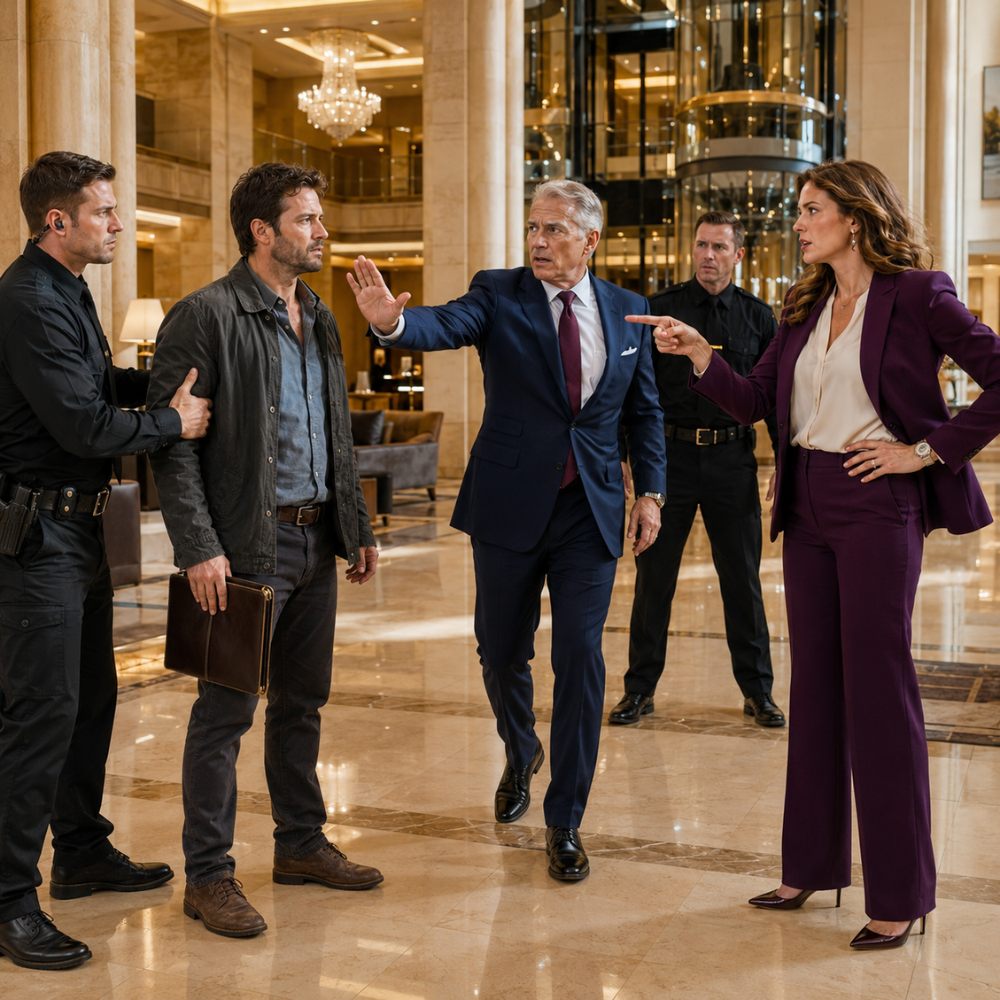
The Millionaire Ordered Security to Throw Him Out—Then the Chairman Saw the Envelope in His Hand
The security guard’s hand had already closed around Everett Hale’s upper arm when Graham Whitmore stepped into the marble lobby.
“Touch him again and you’re fired.”
The words were not shouted.
They did not need to be.
Everything in the lobby stopped.
The receptionist froze with one hand above her keyboard. A junior analyst near the elevators turned halfway around and forgot to finish whatever he had been saying into his phone. Two security guards looked at each other.
And Celeste Waverly, who had ordered Everett removed less than thirty seconds earlier, stared at the seventy-one-year-old chairman as though she had misheard him.
Graham Whitmore rarely raised his voice.
That was one reason people listened when he lowered it.
“Let him go.”
The guard immediately released Everett’s arm.
Everett stepped back, rubbing the place where fingers had pressed through the sleeve of his faded work jacket.
He was forty-two, lean from years of physical labor, with graying brown hair cut short because he still trimmed it himself in the bathroom mirror. His boots were clean but worn pale across the toes. The cuffs of his blue work shirt had been repaired by hand.
Nothing about him fit the lobby around him.
Belmont Holdings occupied thirty-eight floors of a glass tower in the center of Philadelphia’s business district. Its ground floor was designed to make people feel the weight of money before anyone discussed it.
Italian marble.
Brass elevator doors.
Fresh white orchids replaced every Monday.
A twelve-foot company logo carved into pale limestone.
There were chairs in the waiting area that cost more than Everett’s first pickup truck.
He had noticed all of it when he walked in.
He had also decided none of it mattered.
He had come to deliver an envelope.
That was all.
The envelope remained in his left hand.
Brown paper.
Soft at the corners.
A strip of old clear tape across the back.
Graham saw it.
The color left his face.
“Where did you get that?”
Everett looked at the chairman.
“From your brother.”
Celeste’s expression changed.
Graham took one step closer.
“My brother has been dead fifteen years.”
“Yes, sir.”
Everett’s voice was quiet.
“I know.”
Graham stared at him.
Then at the envelope.
For one strange second, the vast lobby seemed too small.
Celeste moved toward them.
“Graham, this man came in without an appointment. He refused to leave when reception explained—”
Graham raised one hand.
She stopped.
He never looked away from Everett.
“Your name.”
“Everett Hale.”
Recognition arrived slowly.
Not the instant recognition of a familiar face.
Something deeper.
A memory dragging itself across fifteen years.
Graham whispered, “Riverside.”
Everett nodded.
“The Riverside Convention Center project.”
Graham’s hand tightened around the head of his walking cane.
“You were on Adrian’s crew.”
“I supervised structural framing.”
“You were there the day…”
“Yes.”
Graham stopped.
Nobody in the lobby moved.
Celeste looked from one man to the other.
Whatever she had assumed about Everett five minutes earlier was already beginning to collapse.
Graham pointed toward the executive elevators.
“Come upstairs with me.”
Everett glanced toward Celeste.
“I don’t need to cause trouble.”
“You haven’t.”
Graham finally looked at the security guards.
“Mr. Hale is my guest.”
The guards nodded.
Then he looked at Celeste.
“You too.”
Her back straightened.
“Of course.”
They rode to the thirty-sixth floor in silence.
The elevator was large enough for eight people to stand comfortably without touching.
Everett still felt crowded.
He could smell the leather of Graham’s briefcase, the citrus perfume Celeste wore, and the faint industrial soap from his own hands.
He had washed them in the restroom of a SEPTA station that morning after replacing a damaged stair rail at a rowhouse renovation in South Philadelphia.
He had not planned to spend the morning inside corporate headquarters.
He had planned to work until noon.
Then drive across town to meet his daughter.
Maren had a portfolio interview at Drexel University that afternoon.
She wanted to study architecture.
Everett had told his boss he needed half a day.
The envelope had been in his truck.
Again.
For years it traveled with him only on days he thought he might finally deliver it.
Most days, it remained inside a locked steel box beneath winter blankets in his bedroom closet.
That morning he had looked at it while searching for Maren’s birth certificate.
He had stood there with the closet door open and thought about all the excuses he had made.
Too busy.
Too far.
No appointment.
Graham Whitmore would never see him.
Someone would assume he wanted money.
Again.
And one day, Everett understood, the excuses would become permanent.
He would die.
The envelope would go to a daughter who did not know what it contained.
A promise would turn into clutter.
So he had put it in his work jacket.
After finishing the stair rail, he drove downtown.
He fed a meter with quarters.
Walked into Belmont Holdings.
And discovered that fifteen years had changed everything except the first question people asked when they looked at him.
What do you want?
Celeste had asked it without saying the words.
She had come through the lobby shortly after Everett arrived.
Tailored cream suit.
Dark hair pulled into a neat low twist.
A slim watch at her wrist.
At thirty-eight, Celeste Waverly had the kind of presence business magazines described as commanding.
She had inherited Waverly Development from her father at thirty-one and doubled its portfolio in seven years.
Two hundred employees.
Luxury residential towers.
Commercial redevelopment.
Public-private infrastructure projects.
She sat on Belmont’s board because Belmont owned a substantial stake in her company.
She was also scheduled that morning to present a major redevelopment proposal to Graham.
That was why she was in the lobby before nine.
Everett had been standing at reception.
“I’m here to see Mr. Whitmore.”
The receptionist smiled politely.
“Do you have an appointment?”
“No.”
“May I ask the purpose of your visit?”
Everett held up the envelope.
“I need to give him something that belonged to his brother.”
The receptionist’s smile became uncertain.
“His brother?”
“Adrian.”
Celeste had heard the name while passing.
She stopped.
“Excuse me.”
Everett turned.
Celeste studied him.
“You’re asking to see Graham Whitmore?”
“Yes, ma’am.”
“Without an appointment.”
“Yes.”
“To give him an envelope.”
“Yes.”
“What is inside it?”
“I don’t know.”
That answer had decided everything for her.
“You don’t know?”
“No.”
“And you expect the chairman of Belmont Holdings to accept an unopened package from a stranger?”
Everett looked down at the envelope.
“It isn’t from me.”
“Then from whom?”
“Adrian Whitmore.”
Celeste’s eyes cooled.
“Mr. Hale, Adrian Whitmore died many years ago.”
“I know.”
“Then I’m going to ask you to leave.”
Everett had not argued.
“I understand how it looks.”
“Good.”
“But if Mr. Whitmore is in the building, please tell him Everett Hale came with something from Riverside.”
Celeste’s patience had ended there.
“Security.”
Everett had turned toward the guards.
“Ma’am, I’m not here for money.”
“I didn’t say you were.”
She did not need to.
Everett knew the look.
The same look he had seen at banks when he entered wearing work clothes.
At school offices when Maren needed a fee extension.
At a dealership after his credit collapsed following his wife’s medical bills.
People who wanted something usually learned to recognize the moment another person decided what they wanted before they had asked.
Everett held the envelope against his chest.
“I’ll leave if Mr. Whitmore tells me to leave.”
Celeste’s expression hardened.
“This is private property.”
“Yes.”
“You have been asked to leave.”
“Yes.”
“Then why are you still standing here?”
“Because I’ve been leaving with this envelope for fifteen years.”
She had no idea what that meant.
The guards arrived.
Then Graham entered.
Now the elevator reached thirty-six.
The doors opened into executive offices overlooking the Delaware River.
Graham led them past framed photographs of Belmont projects.
Hospitals.
Bridges.
Apartment towers.
University buildings.
One photograph made Everett stop.
Riverside Convention Center.
Completed fourteen years earlier.
A plaque beneath the photograph credited Belmont Holdings and several contractors.
Adrian Whitmore’s name was not there.
Everett stared.
Graham saw him.
“He was removed from the official project history.”
“Why?”
Graham did not answer.
Not immediately.
That answer, Everett realized, was part of the envelope.
They entered Graham’s office.
Unlike the lobby, it did not try very hard to impress anyone.
Old walnut desk.
Books.
Family photographs.
A brass lamp.
A coffee mug from Temple University.
One wall held architectural drawings from Belmont’s earliest developments.
Graham closed the door.
Then he turned toward Everett.
“Sit.”
Everett remained standing.
“I’m dirty.”
Graham looked at the chairs.
“They’ll survive.”
Everett sat.
Celeste chose the chair beside him but left enough space to make clear they were not together.
Graham moved behind his desk.
His eyes stayed on the envelope.
“Tell me about Adrian.”
Everett swallowed.
He had spent fifteen years imagining this conversation.
In every version, it was easier.
“Your brother hired me when I was twenty-six.”
Graham smiled faintly.
“That sounds like him.”
“I was assistant framing supervisor on a hotel project in Camden. He came through one morning. Asked why we were two days behind.”
“What did you tell him?”
“That his engineering change order was stupid.”
Graham laughed once.
The sound surprised Celeste.
Everett continued.
“I didn’t know who he was.”
“That also sounds like Adrian.”
“He asked what I would change. I told him. Next week, I got offered a supervisory job at Riverside.”
Graham looked toward the photograph on the credenza.
“My brother liked people who told him no.”
“He liked arguing.”
“That too.”
Everett smiled.
The expression faded.
“About six months into Riverside, he started asking strange questions.”
“What kind?”
“Why certain subcontractors kept changing names. Why invoices on concrete deliveries didn’t match actual quantities. Why some change orders were approved without signatures from field managers.”
Celeste leaned forward.
“You knew this?”
“Not then.”
Everett shook his head.
“I knew Adrian was worried. I didn’t know what he thought he’d found.”
Graham’s face tightened.
“At the time, Adrian was chief operating officer.”
“I know.”
“He was also under review for unauthorized project changes.”
Everett looked confused.
“By who?”
“The board.”
“That makes no sense.”
“I know that now.”
Graham looked down.
“Back then, financial irregularities were appearing on projects he oversaw. Payments. Contracts. Approvals with his credentials attached.”
Everett understood.
“They blamed him.”
“Yes.”
“After he died?”
“Especially after.”
The office became quiet.
Rain clouds moved slowly beyond the windows although the morning forecast had promised sun.
Everett placed the envelope on Graham’s desk.
“Then you need this.”
Graham did not touch it.
“Did Adrian give it to you?”
“Yes.”
“When?”
Everett looked at his hands.
“The accident.”
Celeste’s posture changed.
Everybody who knew Belmont’s history knew how Adrian Whitmore died.
A temporary steel support failed during a late-stage inspection at Riverside.
A section of construction decking collapsed.
Two men were injured.
Adrian died before reaching the hospital.
The official investigation found a combination of material fatigue and improper installation.
No criminal wrongdoing.
No sabotage.
A terrible accident.
That was the story.
Everett had never publicly challenged it.
“What happened?” Graham asked.
Everett took a breath.
“He came to the site before seven.”
“Adrian hated mornings.”
“He’d been there all night.”
Graham’s eyes changed.
Everett continued.
“He looked terrible. Had that envelope inside his jacket. Asked me if I had somewhere safe to keep something.”
“What did you say?”
“I asked whether he was finally admitting his office wasn’t safe.”
For the first time Graham smiled through pain.
“He laughed?”
“Yes.”
Everett looked down.
“He gave me the envelope. Told me if anything happened to him, I was supposed to put it directly in your hand.”
“Why you?”
“I asked him that.”
“What did he say?”
“That I was too stubborn to be intimidated.”
Graham closed his eyes briefly.
“Still sounds like him.”
Everett continued.
“Then the support failed.”
He did not describe the accident in graphic detail.
Fifteen years had not erased enough of it for that.
Only sounds remained clearly.
Metal.
Shouting.
Dust.
A radio somebody kept yelling into.
Everett climbing through debris.
Finding Adrian conscious but fading.
Holding his hand.
Adrian trying to say something.
“Did he talk?”
“A little.”
“What?”
Everett’s throat tightened.
“He said, ‘Don’t let them make me the thief.’”
Graham looked away.
Celeste pressed her lips together.
Everett continued.
“I told him I wouldn’t.”
Graham walked to the window.
For nearly a minute nobody spoke.
Then he said, “Open it.”
Everett looked at the envelope.
“That isn’t mine to open.”
“It’s mine?”
“Yes.”
Graham returned.
His hands trembled when he picked it up.
He turned it over.
Then stopped.
On the back, above the old strip of tape, handwriting had faded to brown.
For Graham.
If I can’t explain it myself.
Graham sat down.
Celeste had never seen him look old.
Not really.
He had always seemed like those men who remained physically defined by the position they held.
Chairman.
Founder.
Patriarch.
Now he looked seventy-one.
He slid a letter opener beneath the flap.
Inside were folded pages.
Photocopies.
Photographs.
An old flash drive.
A small picture of two young men standing beside a concrete foundation.
Graham lifted it.
He and Adrian were in their twenties.
Hard hats.
Work boots.
No gray hair.
No Belmont tower.
Behind them stood the first commercial building their father had helped finance.
Graham stared.
“I haven’t seen this picture in forty years.”
Everett said nothing.
Graham opened the first handwritten page.
Adrian’s writing sloped strongly to the right.
Graham read silently.
His face changed.
Then he handed the first page to Celeste.
She read.
Graham, if this gets to you without me, assume nothing in the Riverside audit is what it appears to be.
Celeste looked up.
Graham opened another sheet.
Then another.
Victor Langford’s name appeared repeatedly.
At the time, Langford had been Belmont’s executive vice president for procurement.
Elegant.
Trusted.
Charitable.
A fixture at country-club dinners and hospital fundraisers.
He left Belmont nine months after Adrian died.
Publicly, the departure was described as retirement.
He moved to Florida.
Within five years, he had become wealthy enough to purchase a Gulf-front home and invest in several private-equity funds.
Nobody at Belmont had thought much of it.
Executives became wealthy.
That was not unusual.
Adrian’s papers suggested something else.
Shell subcontractors.
Duplicated invoices.
Inflated materials costs.
Payments routed through legitimate vendors and then redirected.
Copies of canceled checks.
Photographs of site deliveries.
Handwritten comparisons between material received and material billed.
At first glance, millions might have disappeared across multiple construction projects.
But there was something worse.
Adrian had apparently discovered his own electronic approval credentials being used on contracts he never authorized.
Someone had not merely stolen from Belmont.
Someone had made Adrian look responsible.
Graham sat down slowly.
“No.”
Celeste took another page.
“This is his handwriting?”
“Yes.”
“You’re sure?”
Graham looked at her.
“I shared a bedroom with him for eighteen years.”
He lifted a photocopy.
“These are internal purchase-order numbers.”
Celeste read more.
“Some of this can be verified.”
“All of it should be.”
Graham reached for his desk phone.
Then stopped.
He looked at Everett.
“Did you read any of this?”
“No.”
“Not once?”
“No.”
“Fifteen years?”
Everett almost smiled.
“A promise does not get easier to break because it gets older.”
Celeste looked at him.
That sentence hurt.
Not because Everett aimed it at her.
Because he did not.
He did not seem interested in humiliating her.
That somehow made her humiliation worse.
Graham asked, “Why didn’t you bring it sooner?”
Everett leaned back.
“I tried.”
Graham’s face tightened.
“When?”
“The week after the funeral.”
“To this building?”
“You were still at the old headquarters then.”
“Yes.”
“I came twice.”
Graham stared.
“I never knew.”
“I spoke to reception. Then an assistant.”
“Name?”
“I don’t remember.”
“What did you say?”
“That I had something from Adrian.”
“What happened?”
“They asked whether I was involved in the accident.”
“I said yes.”
“Then?”
“They said legal counsel would contact me.”
“Did they?”
“No.”
Everett folded his hands.
“I called again a few weeks later. Someone said all Riverside matters had to go through insurance.”
Graham closed his eyes.
Everett continued.
“I told them it wasn’t an insurance claim.”
“They asked whether I was seeking compensation.”
Celeste looked down.
He had heard the same question in this building fifteen years later without anyone asking it aloud.
“What happened after that?” Graham asked.
“Life.”
One word.
A whole decade inside it.
Everett’s wife, Dana, became ill three years after Adrian’s death.
Ovarian cancer.
She was thirty-two.
Maren was six.
For nineteen months Everett learned a new vocabulary.
Deductibles.
Infusion.
Imaging.
Clinical trial.
Unpaid leave.
Family Medical Leave Act.
Hospice.
He learned which hospital vending machine sold peanut butter crackers for less than the cafeteria charged.
He learned that people could have insurance and still lose nearly everything.
He learned how medical bills arrived weeks after funerals.
After Dana died, Everett sold their house.
Paid debt.
Moved with Maren into a two-bedroom rental above a dry cleaner.
He worked commercial construction until an economic downturn eliminated his supervisory position.
Then residential renovation.
Roofing.
Kitchen demolition.
Municipal repairs.
Whatever paid.
There were years when he forgot about Belmont for months at a time.
Then he would open the steel box.
See the envelope.
Remember Adrian.
Try again.
Once he mailed Graham a certified letter.
It was signed for.
No answer.
Another time he drove to Belmont’s headquarters.
A security officer told him the chairman no longer accepted unscheduled visitors.
He left.
“I should’ve pushed harder,” Everett said.
Graham shook his head.
“No.”
“I promised him.”
“You tried.”
“Not enough.”
“Everett.”
Graham’s voice hardened.
“You were raising a child after burying your wife.”
Everett looked away.
“You do not get to take my company’s failure and make it your moral debt.”
Celeste heard the words.
So did Everett.
After a moment, he nodded.
Graham turned toward Celeste.
“Cancel the board meeting.”
Her head came up.
“Graham, the Richmond financing team is already—”
“Cancel it.”
She stopped.
“Of course.”
“Call Martin Delaney.”
Belmont’s general counsel.
“And Patricia Ng.”
Chief audit executive.
“Tell them to come to this office and bring no staff.”
Celeste stood.
Graham added, “Nothing leaves this room digitally until legal counsel establishes preservation procedures.”
She nodded.
Business mode took over.
For the next two hours the office became an evidence room.
Martin Delaney arrived first.
Sixty-two.
Gray suit.
No wasted words.
Patricia Ng came nine minutes later carrying a legal pad and two archive-access request forms.
They did not assume Adrian’s documents were authentic because Graham recognized the handwriting.
They photographed the envelope.
Logged its condition.
Recorded Everett’s account.
Placed copies in tamper-evident evidence sleeves.
The flash drive remained unopened until a forensic specialist could image it safely.
Everett watched all of this from the corner.
He looked uncomfortable.
Patricia noticed.
“You okay?”
“I thought I’d hand over an envelope.”
She smiled faintly.
“At Belmont, envelopes have committees.”
Everett almost laughed.
By one in the afternoon, his phone vibrated.
Maren.
Dad, portfolio check-in starts at 1:30. Where are you?
Everett stood so quickly his chair scraped.
“Oh, no.”
Graham looked up.
“What?”
“My daughter.”
He checked the time.
“I’m supposed to meet her at Drexel.”
“Go.”
Everett reached for his jacket.
Martin interrupted.
“We may need additional details.”
“You have my number.”
Graham stood.
“I’ll have a car take you.”
“No, sir.”
“It’ll be faster.”
“My truck is parked on Market.”
“Everett.”
“It costs eighteen dollars every fifteen minutes where I parked.”
That produced the first genuine laugh in the office.
Even Celeste smiled.
Graham shook his head.
“Go get your truck.”
Everett reached the door.
Graham called after him.
“Everett.”
He turned.
Graham held the old photograph.
“Thank you.”
Everett nodded.
“Clear his name.”
Then he left.
Maren Hale was waiting outside Drexel’s architecture building wearing black slacks, a thrift-store blazer, and the expression of a nineteen-year-old who had spent twenty minutes believing her father had forgotten the most important afternoon of her year.
Everett hurried across the sidewalk.
“I’m sorry.”
“You said one fifteen.”
“I know.”
“It’s one twenty-eight.”
“I know.”
“Dad.”
“I know.”
She looked at him.
“What happened?”
Everett opened his mouth.
Closed it.
Maren knew him too well.
“You look weird.”
“That’s encouraging.”
“Not bad weird.”
She looked at the Belmont visitor sticker still attached to his jacket.
Her eyes narrowed.
“You went there.”
Everett looked down.
He had forgotten the sticker.
Maren’s irritation disappeared.
“You gave them the envelope?”
“Yes.”
“What happened?”
“They opened it.”
“And?”
Everett looked toward the architecture building.
“You have an interview.”
“Dad.”
“Maren.”
She crossed her arms.
He recognized the pose.
Dana used to do the same thing.
“After.”
“Promise?”
Everett smiled.
“Yes.”
They went inside.
Maren’s portfolio was stored in a large black case Everett had repaired twice with duct tape before finally buying replacement hinges from a hardware store.
Inside were drawings of rowhouses redesigned for multigenerational families.
A community library with a rooftop garden.
Affordable apartments arranged around a shared courtyard.
A small house designed for someone using a wheelchair.
Her work was not perfect.
It was thoughtful.
Everett sat outside the interview room while professors looked through her drawings.
He could not stop thinking about Graham.
Adrian.
Celeste.
The envelope.
Fifteen years collapsed in strange pieces.
He remembered Adrian eating a cheesesteak on a construction trailer step.
Dana complaining Everett came home covered in drywall dust.
Maren at six drawing houses with purple roofs.
A foreclosure notice.
A hospital receipt.
The steel box under winter blankets.
People imagined promises as noble things.
Most promises were inconvenient.
They sat in closets.
Cost time.
Made you drive across town when parking was expensive.
Survived long enough to become embarrassing.
Everett had not preserved Adrian’s envelope because he was heroic.
He preserved it because every time he considered throwing it away, he remembered a dying man asking him not to.
That was enough.
Maren emerged twenty-five minutes later.
“Well?”
“I don’t know.”
“That bad?”
“One professor smiled.”
“Could be good.”
“She might just smile.”
“Terrifying.”
Maren sat beside him.
“Now tell me.”
Everett did.
Not every detail.
Enough.
When he finished, she stared.
“So you were carrying evidence of corporate fraud in your closet my entire childhood?”
“Apparently.”
“Dad.”
“I didn’t know what was inside.”
“That is somehow worse.”
“I promised not to read it.”
Maren looked at him.
Then shook her head.
“You’re impossible.”
“Inherited trait.”
“From who?”
“Your mother.”
She smiled.
Then grew serious.
“They treated you badly?”
Everett knew what she meant.
“In the lobby.”
“Yes.”
He rubbed the faint bruise forming near his arm.
Maren saw it.
“Who did that?”
“Security.”
“Why?”
“Misunderstanding.”
Her eyes flashed.
“Because of how you looked.”
Everett hesitated.
“Partly.”
“You always say partly when you’re trying not to make me angry.”
He looked at her.
“Being angry is easy.”
“So?”
“Deciding what to do with it is the expensive part.”
Maren was quiet.
Everett had spent nineteen years trying to teach his daughter that poverty did not require bitterness.
Some days he succeeded.
Other days he was not sure.
“What happened to the woman who ordered security?”
“Her name is Celeste.”
“I didn’t ask her name.”
Everett smiled.
“She saw she was wrong.”
“Did she apologize?”
“Not yet.”
“Then she hasn’t seen enough.”
Everett laughed.
Maren leaned against him.
After a moment, she said, “You did the right thing.”
He stared across the campus.
“I hope so.”
“No.”
She nudged him.
“You did.”
Back at Belmont, Celeste stood behind Graham while forensic auditors created a preliminary inventory of Adrian’s documents.
By three-thirty, Patricia Ng had found the first confirmation.
One invoice listed a subcontractor called Meridian Structural Supply.
The company had billed Belmont for more than $1.8 million across several projects.
Corporate records showed Meridian registered to a mailbox service in Wilmington.
Its listed president was a man who had died two years before the company’s largest contracts.
Another vendor shared a bank routing trail with Meridian.
Then another.
Nothing yet proved Victor Langford stole anything.
But Adrian had not invented the entities.
The records were real.
Celeste sat across from Patricia.
“How was this missed?”
“We don’t know yet.”
“Belmont had external auditors.”
“Yes.”
“Procurement controls.”
“Yes.”
“Board review.”
“Yes.”
Patricia looked at her.
“Controls are only as good as the people feeding them information.”
Celeste thought about the lobby.
About Everett saying the envelope belonged to the company.
About herself deciding he was the problem before hearing him.
Different scale.
Same reflex.
If an organization trusted appearances more than questions, people learned which appearances to maintain.
At five-thirty, Graham found Celeste alone in a conference room.
She had canceled her presentation.
Her Richmond redevelopment documents remained unopened.
“You should go home.”
She looked up.
“I don’t think I can.”
Graham sat.
They had known each other for almost twenty years.
Celeste’s father, Harrison Waverly, had been one of Graham’s oldest business partners.
After Harrison died, Graham became something halfway between mentor and surrogate uncle.
That closeness made what he said next worse.
“You humiliated him.”
Celeste looked down.
“Yes.”
“Why?”
“I thought he might be a security issue.”
“Why?”
“He had no appointment.”
“Hundreds of people enter that lobby without appointments.”
“He was insisting on seeing you.”
“So do angry shareholders.”
Celeste’s jaw tightened.
“I made a judgment.”
“Yes.”
Graham’s voice remained calm.
“That is what concerns me.”
She looked at him.
“You think I judged him because his clothes were worn.”
“I think you need to answer that yourself.”
Celeste said nothing.
Graham continued.
“You’re one of the smartest executives I know.”
“That sounds like the beginning of something unpleasant.”
“It is.”
He leaned back.
“Intelligence makes prejudice more efficient when people use it to justify instincts they never examine.”
Celeste flinched.
“I’m not prejudiced against poor people.”
Graham raised an eyebrow.
The speed of her defense embarrassed her.
She tried again.
“I grew up around construction.”
“In your father’s house.”
“He worked for everything he had.”
“Yes.”
“And then you inherited a company worth eighty million dollars.”
Celeste looked toward the windows.
“That doesn’t mean my work since then is irrelevant.”
“I didn’t say it was.”
Graham softened.
“But inheritance can become invisible to the person standing on top of it.”
Celeste stared at the conference table.
Her father had taught her that people came asking for favors when they smelled weakness.
After his death, she inherited not only the company but his suspicion.
An employee with childcare problems was unreliable.
A foreman behind on his mortgage was a theft risk.
A subcontractor asking for faster payment lacked discipline.
A stranger in worn boots asking for the chairman probably wanted money.
She had called those beliefs realism.
Maybe some were.
Maybe some were excuses.
“What do I do?” she asked.
Graham stood.
“First?”
He looked at her.
“Apologize without expecting forgiveness.”
The investigation lasted eleven weeks.
It became larger before becoming clearer.
Belmont hired an outside forensic accounting firm.
Old storage boxes were retrieved from an off-site warehouse in New Jersey.
Backup tapes were restored.
Retired employees were interviewed.
County incorporation records were compared with procurement files.
Banks responded to subpoenas and civil discovery where available.
Some records were gone.
Others survived because accountants rarely threw away anything without a policy telling them to.
Adrian’s flash drive contained spreadsheets.
Emails.
Scanned invoices.
An audio recording of a meeting with Victor Langford.
Enough to establish that Adrian had suspected a procurement scheme and had tried to stop it.
The forensic report concluded that multiple shell vendors had been used to overbill Belmont and affiliated companies by more than nine million dollars over roughly seven years.
Some money flowed into accounts connected to Langford.
Other payments went through intermediaries.
Two former executives had received undisclosed consulting fees.
The scheme had been buried partly by falsified approvals using Adrian’s credentials.
That was the most painful finding for Graham.
The internal record used for years to describe Adrian as financially reckless was itself contaminated.
Belmont’s attorneys referred the findings to law enforcement.
Some potential offenses were too old to prosecute cleanly.
Others overlapped with later financial activity and remained reviewable.
Civil recovery became its own complicated process.
Graham did not care about headlines.
He cared about one sentence.
He called Everett the afternoon the final forensic report arrived.
“Adrian was telling the truth.”
Everett was on a ladder replacing fascia on a duplex.
He climbed down before answering.
“You’re sure?”
“Yes.”
“His name?”
“We are correcting the company record.”
Everett closed his eyes.
Graham continued.
“The board has voted unanimously to revoke the findings of the old internal review.”
Everett leaned against the ladder.
“Good.”
There was silence.
Graham seemed to expect something more.
Everett understood.
“You okay?”
“No.”
The honesty surprised him.
Graham continued.
“I spent fifteen years believing my brother died with secrets.”
“He did.”
“Not those secrets.”
“No.”
“I was angry at him.”
Everett looked toward the roofline.
“People get angry at dead people.”
“You say that like you know.”
“My wife died.”
Graham was quiet.
Everett continued.
“I spent two years angry she left me with everything.”
“That sounds terrible.”
“It was.”
“You loved her.”
“More than anything.”
Everett smiled faintly.
“Love doesn’t make grief polite.”
Graham breathed out.
“Would you come see me?”
“When?”
“Whenever you can.”
Everett glanced at the duplex.
“I have work.”
“I’ll compensate your employer.”
“No.”
Graham sighed.
“You really enjoy making generosity difficult.”
“I’ll come Friday.”
Friday morning Everett returned to Belmont.
Same boots.
Different reception.
The security guard who had grabbed his arm was not at the desk.
A woman named Angela stood there instead.
“Mr. Hale?”
“Yes.”
“Mr. Whitmore is expecting you.”
The sentence felt strange.
Celeste waited beside the elevators.
Everett saw her and slowed.
“Good morning.”
“Morning.”
She looked nervous.
That surprised him.
“May I speak with you before we go upstairs?”
Everett nodded.
They moved toward the lobby seating area.
Celeste remained standing until he sat.
Then she sat across from him.
“I owe you an apology.”
Everett looked at her.
“Yes.”
That was not the response she expected.
She almost smiled.
Then did not.
“I ordered security to remove you before I understood why you were there.”
“Yes.”
“I made assumptions based on your appearance.”
“Yes.”
Her face reddened slightly.
Everett waited.
He was not going to rescue her from her own apology.
Celeste continued.
“I told myself it was about procedure.”
She folded her hands.
“Some of it was.”
Everett nodded.
“But not all.”
“No.”
“No.”
She looked at him.
“I was wrong.”
He studied her for a moment.
“Okay.”
“Okay?”
“You apologized.”
“I don’t expect that to erase it.”
“It doesn’t.”
Celeste accepted that.
Everett leaned back.
“You want me to tell you I wasn’t offended?”
“No.”
“I was.”
“I know.”
“You want me to say I understand why you did it?”
She hesitated.
“No.”
“Good.”
Everett smiled slightly.
“Because I don’t.”
To her surprise, Celeste laughed.
A small, embarrassed sound.
Everett continued.
“My daughter was angrier than I was.”
“She sounds reasonable.”
“She’s nineteen.”
“That doesn’t contradict reasonable.”
Everett smiled.
Celeste became serious again.
“I’ve been thinking about how often I do this.”
“Call security?”
“Decide the person before hearing the problem.”
Everett considered.
“That’s harder to fix.”
“I know.”
“Then fix that.”
She looked at him.
“Just like that?”
“No.”
He shook his head.
“Probably not just like anything.”
The elevator arrived.
Graham waited upstairs.
On his desk lay two folders.
One was the final forensic report.
The other contained an offer.
Graham began carefully.
“I would like Belmont to compensate you.”
Everett shook his head.
“You haven’t heard the amount.”
“Doesn’t matter.”
“Everett.”
“I didn’t keep the envelope as a service contract.”
“I know.”
“Then don’t turn it into one.”
Graham leaned back.
“I am trying to make something right.”
“You can’t make fifteen years right with a check.”
“That isn’t what I meant.”
“I know.”
Everett softened.
“But money does strange things to memories.”
Graham looked at him.
“You could use it.”
That was true.
Everett’s truck needed transmission work.
His credit cards were not paid off.
Maren’s college costs frightened him.
The duplex where they lived had raised rent twice in three years.
Everett did not romanticize poverty.
Money would help.
That was what made accepting it complicated.
“What are you actually offering?”
Graham named a figure.
Everett went still.
It was more money than he had earned in several years combined.
“No.”
“Why?”
“Because then every time I look at my daughter’s college bill, I’ll wonder whether I sold Adrian’s last request.”
“You didn’t sell anything.”
“Then don’t pay me for it.”
Graham rubbed his forehead.
“You are extremely difficult.”
“So I’ve heard.”
Celeste sat near the window, watching.
Graham opened the second folder.
“Then let’s discuss something else.”
Everett looked suspicious.
“What?”
“A foundation.”
“No.”
“You don’t even know what it is.”
“You said foundation in a rich man’s office. That usually means money.”
Graham ignored him.
“I want to establish the Adrian Whitmore Scholarship.”
Everett stopped joking.
“For what?”
“Students from working families pursuing architecture, engineering, construction management, skilled trades, or related fields.”
Everett looked toward Celeste.
She smiled slightly.
“This was his idea,” she said. “I helped refine it.”
Graham continued.
“The first class would include ten students.”
“That’s a lot.”
“Belmont can afford it.”
“What does this have to do with me?”
Graham opened the folder.
“We would like the scholarship criteria to recognize perseverance, community contribution, and financial need.”
Everett understood before Graham finished.
“No.”
“Everett.”
“No.”
“Maren has applied to architecture school.”
“How do you know?”
“You mentioned her.”
“That does not mean she gets a scholarship because her father knew your brother.”
“She would still have to qualify.”
“No.”
Graham leaned forward.
“Why are you making this difficult?”
“Because she should not spend four years wondering whether everybody thinks she got in through me.”
“Scholarship is not admission.”
“She’ll still know.”
Celeste spoke for the first time.
“What if she competes?”
Everett looked at her.
“Explain.”
“Independent committee.”
“No Graham.”
“No me.”
“No Belmont executives.”
“Outside educators and industry professionals.”
“Blind review where practical.”
“Financial need verified separately.”
“If Maren qualifies, she qualifies.”
“If she doesn’t, she doesn’t.”
Everett looked at Graham.
“You’d accept that?”
“Yes.”
“Even if she loses?”
Graham sighed.
“I am not accustomed to people negotiating against gifts.”
“Get used to me.”
Celeste smiled.
Later that day, Everett told Maren.
She reacted exactly as he expected.
“No.”
He laughed.
“That was my answer.”
“Then why are we talking?”
“Because Celeste suggested independent review.”
Maren’s expression changed at the name.
“Lobby woman?”
“Yes.”
“She apologized?”
“Yes.”
“Properly?”
Everett smiled.
“You would’ve approved.”
“Doubtful.”
He explained the scholarship.
Maren looked at the application packet.
“Architecture?”
“And engineering. Construction management.”
She read the criteria.
“Essay.”
“Yes.”
“Portfolio.”
“Yes.”
“Financial disclosure.”
“Unfortunately.”
Maren looked at him.
“Do you want me to apply?”
Everett thought carefully.
“I want you to decide.”
“What would Mom say?”
That question still hurt, even after twelve years.
Everett looked toward the kitchen window.
“She’d say apply.”
“Why?”
“Because your mother loved free money.”
Maren laughed.
“She did.”
“She would also tell you earning help doesn’t make you less independent.”
Maren studied the application.
“I’ll think about it.”
She applied two weeks later.
She did not tell Graham.
Neither did Everett.
The scholarship announcement changed Belmont Holdings in ways Everett never expected.
Some employees treated Adrian’s restored reputation as old corporate history.
Others began asking questions.
Why had concerns failed to reach Graham?
Why had staff assumed Everett wanted compensation?
How many complaints disappeared because a receptionist or junior manager filtered them?
How often did senior leadership hear only what lower levels believed leadership wanted to hear?
Patricia Ng’s audit expanded beyond the old fraud.
Not into scandal.
Into culture.
Anonymous employee surveys produced uncomfortable results.
Workers on construction sites believed corporate leadership did not care about safety concerns unless delays became expensive.
Junior employees feared that admitting mistakes would affect promotion.
Administrative staff had informal lists of people who should “never reach executives.”
Some were legitimate security concerns.
Others were former employees, small vendors, angry customers, and people who had simply called too many times.
Celeste requested the full report.
Graham asked whether she was sure.
“No.”
She answered honestly.
“That’s why I need it.”
Waverly Development had its own problems.
Nothing criminal.
Something more ordinary.
And therefore easier to normalize.
A project manager who missed work because his mother had dementia received a poor reliability rating.
A young estimator undergoing chemotherapy used every vacation day before admitting why.
A site superintendent delayed reporting a subcontractor’s safety concern because he feared Celeste would view the delay as weakness.
When Celeste read the examples, she recognized her own management philosophy.
No excuses.
Results first.
Everyone has problems.
Handle yours.
She had thought toughness created excellence.
Sometimes it created silence.
Changing that did not mean turning a company into a charity.
Celeste still fired people.
Still rejected bad proposals.
Still demanded deadlines.
But she started asking different questions.
What happened?
What did you know at the time?
What support would have prevented this?
Was the error careless, dishonest, or human?
Those distinctions changed things.
Not dramatically at first.
Small signals.
A construction superintendent admitted a scheduling mistake before it cost two weeks.
An accountant reported a vendor discrepancy without fearing punishment for having approved the first invoice.
A receptionist told Celeste that an elderly subcontractor had been trying to reach someone for three months regarding unpaid retainage.
Previously, Celeste might have handed it to finance.
This time she asked to see the file.
The man was owed $18,400.
A paperwork error had trapped the payment in a closed project code.
Celeste called him herself.
“Mr. Jensen?”
“Yes?”
“This is Celeste Waverly.”
Silence.
“From Waverly Development?”
“I know who you are.”
She almost smiled.
“We owe you money.”
Another silence.
“That’s not usually how these calls go.”
“I’m trying something new.”
He laughed.
The money reached him two days later.
Celeste did not put it in a company newsletter.
That mattered too.
Change felt less like change when performed for witnesses.
Everett continued working.
He rejected Graham’s offer of an executive role.
The idea made him laugh.
“I own one suit.”
“We can buy you more.”
“That is not the main problem.”
“What is?”
“I hate meetings.”
Graham looked offended.
“I’ve built an empire from meetings.”
“That explains a lot.”
Everett instead accepted occasional paid consulting work reviewing construction field practices.
Not because Graham rescued him.
Because Everett knew construction.
That distinction mattered deeply to him.
He wanted a contract.
Defined scope.
Hourly rate.
Taxes.
No charity.
Graham complied.
Everett’s first site visit involved a mixed-income housing project Belmont funded in North Philadelphia.
He spent six hours with foremen, apprentices, and inspectors.
At the end, he produced five pages of notes.
Only one sentence concerned executive strategy.
The break area needs a microwave that works.
Graham read it.
“That’s your recommendation?”
“There are seventeen others.”
“I’m asking about the microwave.”
“Forty workers. Twelve-hour winter shifts. One broken microwave.”
“Buy a microwave.”
“Exactly.”
Celeste visited the site the following month.
Everett stood beside a drafting table showing three apprentices how to read a structural plan.
The same worn boots.
Different jacket.
One young man frowned at the drawing.
“If the column is here, why does the beam schedule show the connection four inches off?”
Everett smiled.
“Good.”
“What?”
“You noticed.”
“Is the drawing wrong?”
“Maybe.”
“Maybe?”
Everett tapped the plan.
“First lesson of construction: paper can be wrong.”
Celeste heard that as she approached.
It sounded like Adrian’s entire story.
Everett noticed her.
“Morning.”
“Morning.”
The apprentices straightened.
Celeste smiled.
“You don’t have to stand like that.”
One sat immediately.
The other two remained standing.
Progress.
She looked toward Everett.
“Can we talk?”
“Sure.”
They walked outside.
The February air was cold enough to sting.
Celeste put her hands into her coat pockets.
“I wanted you to know the board approved the new employee review procedure.”
Everett waited.
She continued.
“No major disciplinary action based solely on one senior executive’s judgment when mitigating circumstances are disputed.”
“Sounds expensive.”
“HR said the same.”
“Probably means it’s useful.”
Celeste smiled.
“We also created an employee emergency fund.”
“What kind?”
“Short-term grants for medical emergencies, housing crises, funeral travel, childcare disruptions.”
“Loan?”
“Grant.”
“Who approves?”
“Independent committee.”
Everett nodded.
“Good.”
Celeste looked toward the building.
“I keep wondering if I’m overcorrecting.”
“Probably.”
She turned.
He smiled.
“That doesn’t mean stop.”
“How do you know when change is real?”
Everett considered.
“When it costs you something.”
“What has this cost me?”
“Control.”
Celeste looked at him.
He continued.
“You used to decide fast.”
“Yes.”
“Now you have to listen longer.”
“That is inefficient.”
“Yes.”
Everett grinned.
“Congratulations.”
She laughed.
Months passed.
Maren was accepted to Drexel’s architecture program.
The letter arrived by email at 4:12 on a Tuesday afternoon.
Everett was replacing cabinets in a house near Manayunk.
His phone rang.
“Dad.”
He knew from her voice.
“What?”
“I got in.”
Everett sat down on a five-gallon bucket.
“You got in?”
“I got in.”
He closed his eyes.
A contractor across the room looked over.
Everett held up one finger.
Maren started crying.
Then laughing because she hated crying.
“How much aid?” Everett asked.
“Dad.”
“What?”
“I got in thirty seconds ago.”
“College is expensive.”
“You are incapable of a normal emotional response.”
“I am emotional about tuition.”
She laughed harder.
Three weeks later, another letter arrived.
Adrian Whitmore Scholarship Committee.
Maren opened it at their kitchen table.
Everett refused.
“This is your mail.”
“What if it’s bad?”
“Then you’ll know before me.”
“That’s terrible parenting.”
“Open it.”
She did.
Her eyes moved across the first paragraph.
Then stopped.
Everett’s heart dropped.
“No?”
Maren looked up.
“Full tuition.”
He stared.
“For one year?”
“Renewable four years.”
Everett sat very still.
Maren read the amount.
He looked away.
“Dad.”
“I’m fine.”
“You’re crying.”
“Dust.”
“In the kitchen?”
“Old building.”
Maren came around the table.
She hugged him.
Everett closed his eyes.
For years, his idea of success had been narrow.
Rent paid.
Food in refrigerator.
Heat on.
Maren’s shoes fitting.
A working car.
No collection calls before eight in the morning.
Survival reduced dreams to practical sizes.
Now his daughter would study architecture without carrying a debt large enough to decide the first decade of her adult life.
He thought about Dana.
She should have been there.
That joy contained grief without canceling it.
Maren stepped back.
“Do you think they chose me because of you?”
Everett looked at her.
“I asked the same question.”
“And?”
“I called the committee.”
“You did not.”
“I did.”
“Dad.”
“They refused to tell me ranking details.”
“As they should.”
“But Graham confirmed nobody from Belmont voted.”
Maren looked down at the letter.
“So I earned it.”
“Yes.”
Everett smiled.
“And somebody helped.”
She nodded.
“Both can be true.”
“Yes.”
He thought of Dana.
She would have liked that answer.
Belmont held a private event six months later to restore Adrian Whitmore’s name formally.
Not a gala.
Graham refused.
“My brother would haunt me if I rented a ballroom.”
Instead they gathered in the lobby on a Thursday afternoon.
Employees.
Former coworkers.
Family.
Construction crews from nearby sites who could leave work.
Coffee.
Sandwich trays.
A sheet cake from Costco that Everett personally recommended because, as he told Graham, “No memorial requires a forty-dollar pound cake.”
A large photograph of Adrian was mounted near the elevators.
Not the polished executive portrait Belmont had used in annual reports.
The photograph from the envelope.
Adrian and Graham as young men beside their first foundation.
Beneath it, a plaque read:
ADRIAN WHITMORE
1958–2011
Builder, Brother, and Guardian of the Work
His concerns were ignored. His integrity was not lost.
Graham stood in front of employees.
He did not protect himself in the speech.
That mattered.
“My brother tried to tell this company the truth.”
His voice shook.
“We failed to hear him.”
Silence.
“I failed to hear him.”
Nobody moved.
“For years after his death, our official records allowed suspicion to remain attached to his name.”
Graham looked toward Everett.
“That record survived because institutions often trust what is filed more than what is true.”
He paused.
“Adrian’s truth survived because one man kept a promise.”
Everett wanted to disappear.
Maren squeezed his hand.
Graham continued.
“Everett Hale did not benefit from carrying those documents.”
“He was not paid.”
“He was not promoted.”
“He was not welcomed when he tried to reach us.”
“Yet he kept them.”
Graham looked across the lobby.
“We talk in business about value.”
“Assets.”
“Revenue.”
“Equity.”
“Return.”
He glanced at Adrian’s photograph.
“Some value never appears on a balance sheet.”
Celeste stood near the front.
The same place where she had ordered Everett removed months earlier.
Her eyes filled.
After Graham finished, she stepped to the microphone.
Everett looked at her.
She had not told him she planned to speak.
“On the morning Mr. Hale entered this lobby, I saw his clothes before I heard his purpose.”
Celeste’s voice remained steady.
“I saw that he had no appointment.”
“I saw an old envelope.”
“I saw someone I assumed needed something from us.”
She looked at Everett.
“I was wrong.”
Employees turned toward him.
He wanted badly to become invisible.
Celeste continued.
“I apologized to him privately. I am repeating that apology publicly because the mistake was public.”
She paused.
“But apology is not the important part.”
“The important part is what an organization does after it discovers that its instincts have become habits.”
She described new review processes.
Independent escalation channels.
Employee assistance.
Audit protections.
Listening sessions at construction sites.
No dramatic claims that Belmont had become perfect.
“We have not fixed culture,” she said.
“Culture is not a memo.”
Everett smiled.
“That sounded like him,” Maren whispered.
Celeste continued.
“We are practicing something we should have practiced all along.”
“Listening before deciding.”
When the event ended, Graham asked Everett to remain.
Workers carried away empty coffee containers.
Employees returned to elevators.
Maren walked around Adrian’s photograph studying the old construction site behind him.
Graham approached Everett.
“One more thing.”
Everett sighed.
“You always have one more thing.”
Graham handed him a smaller plaque.
Everett read it.
EVERETT HALE
For Keeping His Word When No One Was Watching.
Everett looked up.
“No.”
Graham frowned.
“No?”
“Take it down.”
“Why?”
“Because this is Adrian’s wall.”
“You’re part of his story.”
“I’m alive.”
Graham stared.
“That is your argument?”
“Yes.”
Everett handed the plaque back.
“Buy another microwave.”
Graham laughed so loudly the remaining employees turned.
Celeste covered her mouth.
Maren shook her head.
“You’re impossible.”
Everett looked at his daughter.
“So I’ve heard.”
Graham did not place Everett’s plaque beside Adrian’s.
He respected the request.
Instead, months later, he added Everett’s name to the scholarship’s founding history.
Everett allowed that only because Maren told him he was being ridiculous.
Years passed.
Belmont changed leadership.
Graham reduced his schedule.
Celeste eventually became chair of the board.
Not because Everett transformed her overnight.
Life did not work that way.
She still had sharp edges.
She still made impatient decisions.
Still disliked excuses.
Still asked for numbers before stories.
But people discovered something new.
She changed her mind publicly.
When wrong, she said so.
When employees raised concerns, she asked questions before deciding whether the concern was inconvenient.
She developed a habit of visiting project sites without a photographer.
One foreman joked that everyone knew she was coming because executives suddenly ordered the portable toilets cleaned.
After hearing that, Celeste began arriving unannounced.
The first time she discovered a malfunctioning heater in a site trailer during January, she called operations.
The regional director apologized.
Celeste said, “Don’t apologize to me. I work in a heated office.”
The heater was replaced that afternoon.
Everett heard the story later.
He sent her one text.
Progress.
She replied:
Still inefficient.
He answered:
Good.
Maren thrived in architecture school.
Not effortlessly.
She failed a structures exam her first semester.
Called Everett crying.
“I’m stupid.”
“No.”
“I got a sixty-two.”
“That is not architecture. That is arithmetic with revenge.”
“Dad.”
“Retake.”
She did.
By junior year, her work focused increasingly on affordable housing.
Not glamorous towers.
She became interested in rehabilitating old industrial buildings into mixed-income apartments without erasing the neighborhoods around them.
For her senior thesis, she designed a residential complex with units affordable to nurses, teachers, construction workers, bus drivers, and single-parent households.
Everett studied the model.
“You put the laundry room near the courtyard.”
“So parents can see kids while doing laundry.”
He nodded.
“Your mother would’ve liked that.”
Maren smiled.
“I know.”
Belmont later offered to fund a pilot based partly on her research.
Maren nearly refused because she feared people would think her father’s relationship with Graham had created the opportunity.
Celeste called her.
“I’m going to tell you something your father taught me.”
“That sounds dangerous.”
“It often is.”
Celeste continued.
“Being offered an opportunity is not the same as being unqualified for it.”
Maren was quiet.
“What if people talk?”
“They will.”
“How do you deal with that?”
“You do good work.”
“That’s it?”
“No.”
Celeste smiled through the phone.
“You also keep receipts.”
Maren laughed.
She accepted a junior design position after graduation through the company’s standard interview process.
Everett insisted on seeing the HR documentation proving no one had bypassed hiring criteria.
Maren threatened to change her last name.
He stopped asking.
Graham retired fully at seventy-eight.
His farewell luncheon was held in the same lobby.
This time Everett wore a suit.
Maren had bought it for him.
“It actually fits,” she said.
“My old suit fit.”
“Your old suit was purchased when President Bush was in office.”
“Which one?”
“That makes it worse.”
Graham laughed when Everett arrived.
“Look at you.”
“Don’t get used to it.”
Celeste greeted him.
No security guards approached.
Everett noticed.
He always noticed.
During the luncheon, Graham stood beside Adrian’s photograph.
His hair was almost entirely white now.
He used the cane every day.
“Do you regret coming back?” he asked Everett quietly.
“To Belmont?”
“To all of it.”
Everett thought.
“No.”
“Even after the lobby?”
“That was one morning.”
Graham looked at him.
“You’re generous.”
“No.”
Everett shook his head.
“I just don’t like giving bad people or bad moments more years than they already took.”
Graham considered that.
“Celeste wasn’t bad.”
“I know.”
“She could’ve been.”
“What changed her?”
Everett looked across the lobby.
Celeste was listening to a janitorial supervisor explain something about new night-shift scheduling.
She had taken out her phone and was writing notes.
“She decided embarrassment was cheaper than staying wrong.”
Graham smiled.
“That sounds like something Adrian would say.”
“Probably stole it from him.”
They stood together.
Then Graham asked the question Everett had secretly wondered for years.
“What did Adrian say about me?”
Everett looked at him.
“When?”
“At the end.”
Everett had never told him everything.
Not because Adrian asked him not to.
Because some last words belonged to the right moment.
“He said you were going to blame yourself.”
Graham’s face changed.
“He knew me.”
“Yes.”
“What else?”
Everett looked at Adrian’s photograph.
“He said, ‘Tell Graham I was trying to protect what we built together.’”
Graham closed his eyes.
Everett continued.
“And then he said, ‘Tell him he was still my brother even when he was impossible.’”
Graham laughed through tears.
“That was Adrian.”
Everett nodded.
“He loved you.”
“I know.”
“For a long time I wasn’t sure.”
“That was grief.”
“Yes.”
Graham looked at him.
“You carried that too?”
“Just until you needed it.”
“Why wait?”
Everett smiled.
“You finally looked ready.”
Years later, after Graham died peacefully at home, Everett attended another funeral connected to the Whitmore family.
This time he did not stand in the back.
Celeste reserved a seat beside Maren.
The service was held at an old Episcopal church where Graham and Adrian had been baptized.
Photographs covered a table near the entrance.
One showed Graham and Everett arguing over construction plans.
Another showed Graham beside Maren at her architecture graduation.
And in the center sat the photograph from Adrian’s envelope.
Two brothers in hard hats beside a concrete foundation.
Maren stood with Everett after the service.
“You okay?”
“Yes.”
“That means no.”
“I’m sad.”
“Better answer.”
They walked outside.
Celeste joined them.
She was fifty-one now.
Still elegant.
Less interested in proving it.
“We’re going back to Belmont for lunch.”
Everett shook his head.
“I’m heading home.”
“No.”
He looked at her.
She smiled.
“I learned from you.”
“Learned what?”
“Sometimes no is just the beginning of a negotiation.”
Maren laughed.
Everett sighed.
“Fine.”
At Belmont, the lobby remained marble.
The orchids remained expensive.
Executives still walked quickly.
Money had not stopped looking like money.
But the building felt different to Everett.
Not because everyone suddenly became kind.
Because institutions could change how they handled unkindness.
The reception desk now included a formal escalation process for visitors presenting legal documents, employee concerns, whistleblower materials, or safety complaints.
Security personnel received de-escalation training.
Executives could not order someone physically removed merely because they found the person inconvenient unless security criteria were met.
It was not romantic.
It was policy.
Everett trusted policy more than inspirational speeches.
Celeste once asked why.
“Because good intentions retire,” he said.
“Policies stay in the handbook.”
She added the quote to a leadership presentation.
Everett demanded royalties.
She sent him twelve dollars.
He cashed the check.
Maren eventually became a licensed architect.
Her first major project as lead designer was not a skyscraper.
It was a sixty-eight-unit affordable housing development in a former manufacturing district.
Belmont financed part of it.
Waverly Development managed construction.
The Adrian Whitmore Scholarship Foundation funded internships for six students on the project.
Everett served as field consultant.
On opening day, Maren handed him a hard hat.
He looked at the building.
Brick.
Large windows.
Courtyard.
Laundry visible from the children’s play area.
Just like her college design.
“You kept it.”
“What?”
“The laundry.”
“Of course.”
Everett smiled.
The first residents arrived the following week.
A hospital aide with two children.
A retired school custodian.
A city bus driver.
A young couple expecting their first baby.
People whose lives would never appear in annual reports unless someone chose to count them.
Maren watched families carry boxes inside.
“You know what I thought architecture was when I was little?”
Everett looked at her.
“Drawing houses.”
“Making beautiful things.”
“Still is.”
“Partly.”
She looked toward the entrance.
“I think it’s deciding who gets to feel like a building was made for them.”
Everett stopped.
He thought about Belmont’s marble lobby fifteen years after Adrian’s death.
A place that had silently announced who belonged.
Then his daughter’s building.
Wide doors.
Benches near elevators.
A community room visible from the entrance.
Nothing hidden behind intimidation.
“Your mother would’ve loved that.”
Maren smiled.
“You always say that.”
“She had opinions.”
“She had a lot of opinions.”
“So do you.”
“Genetics.”
Everett laughed.
At the dedication ceremony, Celeste spoke last.
She hated long ceremonial speeches now.
Experience had taught her most people wanted food.
“I’ll be brief.”
Nobody believed her.
She looked toward Everett.
“Many years ago, a man walked into a building I thought I understood.”
Everett sighed.
Maren grinned.
Celeste continued.
“I believed the most important question was whether he belonged there.”
She paused.
“I was asking the wrong question.”
The courtyard became quiet.
“The question should have been: What is he trying to tell us?”
She looked toward the new apartments.
“Buildings teach people things.”
“They teach us where to stand.”
“Which doors are for us.”
“Which rooms are private.”
“Whether we are welcome.”
“Organizations do the same.”
Celeste glanced at Everett.
“I once believed power meant controlling the door.”
She looked toward Maren.
“I eventually learned good leadership means being careful about who gets shut outside it.”
Everett nodded.
That was better than kindness.
More precise.
Kindness depended on mood.
Dignity required structure.
After the ceremony, Everett wandered through the community room.
On one wall hung a small framed photograph.
Adrian and Graham beside their first foundation.
Everett stared.
Maren appeared behind him.
“You approve?”
“You put Adrian here?”
“The scholarship helped fund the internship program.”
Everett nodded.
Below the photograph was a line from Adrian’s original letter.
Buildings fail when the people responsible stop listening to what the structure is telling them.
Everett read it twice.
“Did he actually write that?”
“Yes.”
“Sounds like Adrian.”
Maren stood beside him.
“Dad.”
“Yeah?”
“Do you ever think about what would’ve happened if Graham hadn’t come into the lobby that morning?”
Everett smiled faintly.
“All the time.”
“You would’ve left?”
“Probably.”
“Would you have come back?”
He looked at the photograph.
“I don’t know.”
That answer bothered both of them.
Fifteen years of truth had nearly returned to a steel box because one person made a judgment in less than a minute.
Maren slipped her arm through his.
“Scary.”
“Yes.”
Everett looked toward the windows.
Families were crossing the courtyard.
Children running.
Boxes opening.
Life starting.
“But Graham did come in.”
“That was luck.”
“Partly.”
Maren used his word against him.
Everett smiled.
“What was the rest?”
“You stayed long enough for him to see you.”
Everett considered.
Maybe.
People liked clean lessons.
Never judge anyone by appearance.
Be kind.
Keep promises.
Admit when you are wrong.
All true.
None complete.
Appearance sometimes mattered.
Security mattered.
Companies needed boundaries.
Not every stranger with an envelope carried truth.
Not every complaint was valid.
Not every apology earned forgiveness.
Not every hardship made someone noble.
The deeper lesson was harder.
Human beings made decisions with incomplete information.
Power made those decisions more consequential.
That was why people with power had to become suspicious of their own certainty.
Celeste’s first mistake had not been noticing Everett’s clothes.
Everybody noticed.
Her mistake had been allowing observation to become conclusion before curiosity had a chance to speak.
Graham’s company made a similar mistake fifteen years earlier.
Adrian became associated with irregularities.
The paperwork pointed toward him.
People trusted the paperwork.
Then death prevented him from defending himself.
A convenient conclusion hardened into history.
Everett had carried the inconvenient version in a brown envelope.
No one rewarded him.
No one knew.
That was why the promise mattered.
Not because keeping it made him special.
Because keeping it preserved another person’s chance to be understood accurately.
Everett never became wealthy.
He became comfortable.
There was a difference.
His consulting work grew.
He paid off debt.
Bought a modest rowhouse with a narrow backyard.
Replaced the kitchen himself and regretted starting halfway through.
Maren bought him a dishwasher.
He complained it was unnecessary.
Then used it every day.
He kept Dana’s photograph on the mantel.
Adrian’s envelope was eventually returned to the Whitmore family archive after forensic copies were preserved.
The steel box in Everett’s closet became empty.
For weeks, opening the closet felt strange.
Something that had followed him through grief, eviction, hospital bills, job changes, and Maren’s childhood was gone.
One afternoon he put old tax returns in the box.
Maren discovered them.
“You turned the most dramatic object in our family history into tax storage?”
“It locks.”
“You’re impossible.”
Everett smiled.
“So I’ve heard.”
Celeste visited occasionally.
Never without calling.
The first time she came to Everett’s rowhouse, she arrived in a black sedan that took up half the block.
Mrs. Alvarez next door watched through blinds.
Everett opened the door.
“You’re creating rumors.”
Celeste looked toward the neighbor’s window.
“About what?”
“She thinks I joined organized crime.”
“Should I leave?”
“No. Now I want to see where this goes.”
They drank coffee at his kitchen table.
Celeste looked around.
Maren’s drawings.
Dana’s photograph.
A grocery coupon clipped to the refrigerator.
A bucket beneath a small plumbing leak Everett had not fixed yet because, as a construction professional, he believed repairs in his own house should wait until they became humiliating.
Celeste noticed.
“You know people who can fix that.”
“I know me.”
“And?”
“I’m busy.”
She laughed.
Then grew serious.
“I came because we’re revising the executive leadership program.”
“That sounds dangerous.”
“I want you to speak.”
“No.”
“Why not?”
“I’m not an executive.”
“That’s the point.”
Everett sighed.
“What do you want me to tell them?”
“The lobby story.”
“No.”
“Why?”
“Because they’ll clap.”
Celeste stopped.
He continued.
“They’ll hear a poor construction guy carried an envelope, rich people learned humility, everybody became better.”
“That isn’t what happened.”
“I know.”
“So tell them that.”
Everett looked at her.
“Tell them what?”
“That I’m still impatient.”
“You are.”
“That Graham still ignored things after Adrian.”
“He did.”
“That the company still makes mistakes.”
“It does.”
“That you didn’t forgive me because I became a better person overnight.”
“No.”
Celeste smiled.
“Exactly.”
Everett thought.
“What do I get?”
She laughed.
“I knew there was a price eventually.”
“Lunch.”
“Done.”
“Not executive lunch.”
“What’s executive lunch?”
“Salad with ingredients nobody recognizes.”
“What do you want?”
“Cheesesteak.”
Celeste sighed.
“Fine.”
Everett spoke to the leadership class.
No stage.
No motivational music.
He stood in a conference room in work boots and told thirty senior managers something none expected.
“Celeste did the reasonable thing.”
Celeste, sitting in back, raised an eyebrow.
Everett continued.
“A stranger entered corporate headquarters without an appointment, asked for the chairman, and carried a sealed package nobody had screened.”
Managers looked relieved.
“Security should notice that.”
Celeste smiled.
Then Everett added, “Where she went wrong was deciding the security question also answered the human question.”
The room became quiet.
“You can protect a building without humiliating somebody.”
“You can enforce policy without pretending policy tells you a person’s worth.”
“You can say no and still listen.”
He looked across the managers.
“And if you have authority, your first impression becomes dangerous faster than everybody else’s because people start acting on it.”
No applause immediately.
Good.
Everett preferred thought.
At the end, one executive asked, “How do you prevent bias if you can’t eliminate instinct?”
Everett shrugged.
“I build houses.”
The room laughed.
Then he answered.
“Maybe you don’t eliminate the first thought.”
“You slow down the second action.”
Celeste wrote that down.
Years later, she still used it.
Slow down the second action.
Not a perfect philosophy.
A useful one.
Graham’s photograph eventually joined Adrian’s in Belmont’s lobby after Graham’s death.
The brothers stood on opposite sides of the reception area.
One photograph showed Graham late in life, silver-haired, smiling.
The other showed Adrian young and alive beside that first foundation.
Between them hung a small plaque describing the Adrian Whitmore Scholarship.
No photograph of Everett.
His choice.
But his name appeared in one paragraph.
The scholarship was established after Everett Hale fulfilled a fifteen-year promise to preserve records that restored Adrian Whitmore’s reputation and helped Belmont Holdings confront failures in its own culture.
Visitors occasionally asked reception who Everett Hale was.
The answer changed depending on the receptionist.
“A construction consultant.”
“A friend of the Whitmores.”
“The guy with the envelope.”
Once, a new security guard asked Celeste.
She was chairwoman by then.
“Who exactly was he?”
Celeste looked across the lobby.
She remembered worn boots.
A brown envelope.
Her own certainty.
Then Graham’s voice.
Touch him again and you’re fired.
She smiled.
“He was the man who taught this building to listen.”
The guard looked confused.
Celeste continued walking.
That was fine.
Some lessons took time.
Everett would have approved.









