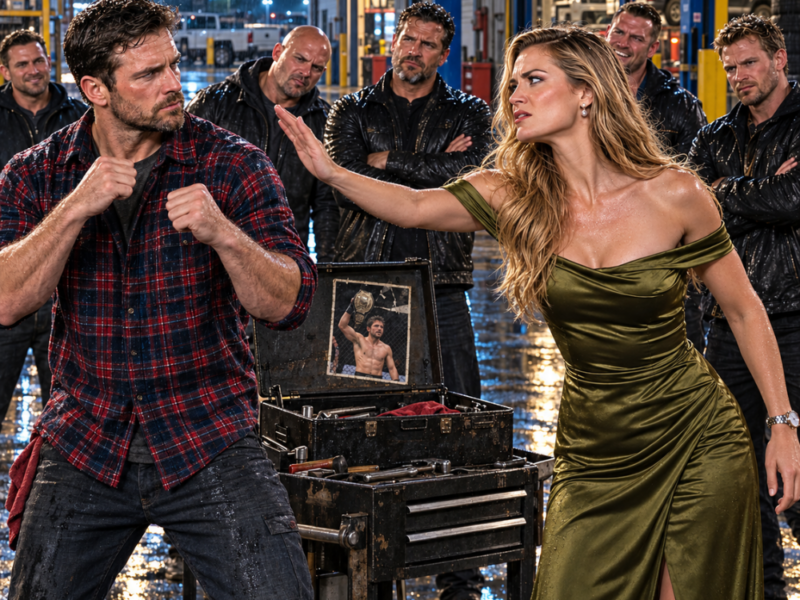
A Billionaire’s Fiancée Sent 5 Men to Teach a Poor Single Dad a Lesson—Unaware He Was a MMA Champ!
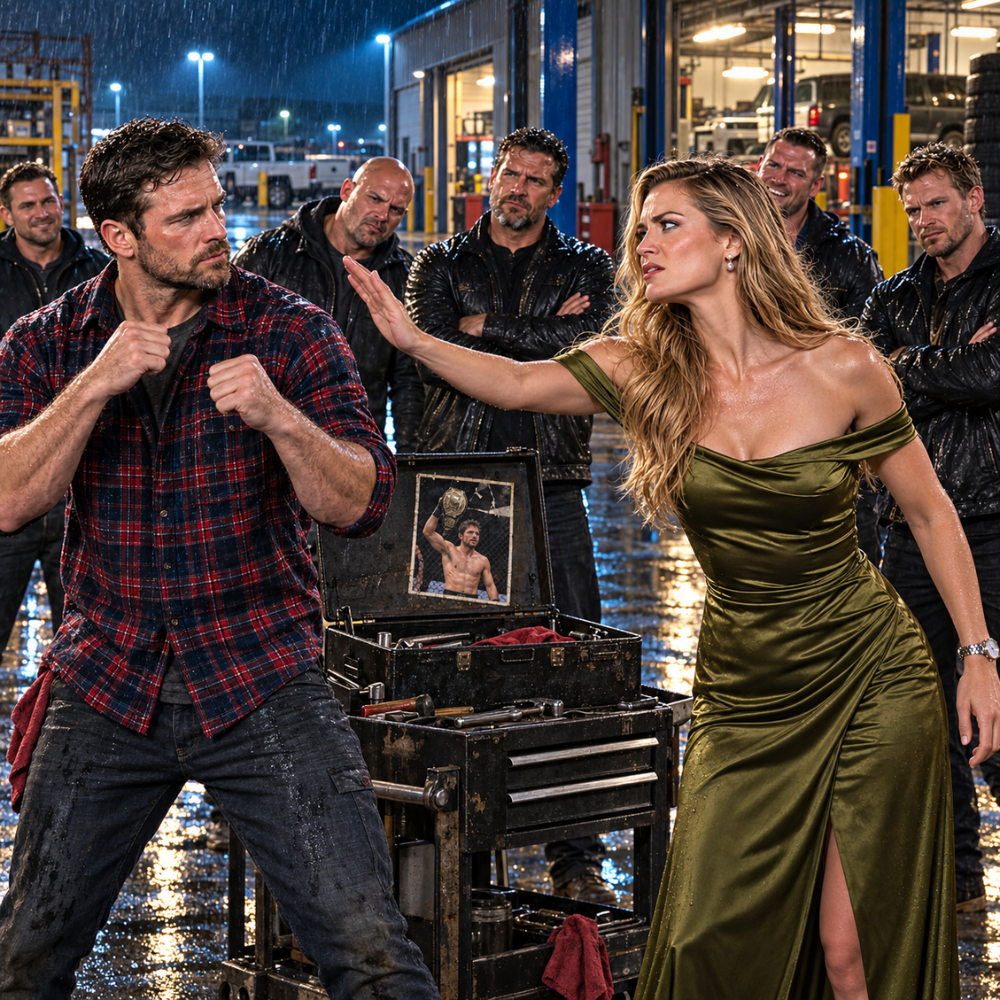
Five men were sent to scare a quiet mechanic—then one of them recognized the undefeated fighter who had vanished years ago
The first man swung before Callum Vance finished setting his tool bag on the wet pavement.
Callum moved his head perhaps two inches.
The fist passed his cheek without touching him.
That was all.
No dramatic counterpunch.
No angry threat.
No sudden change in his expression.
But the man who had thrown the punch stopped smiling.
Rain swept across the narrow street behind Vance Auto Repair, turning the glow from the old parking-lot lamps into blurred orange streaks. Four other men stood several feet away beneath the awning of a closed laundromat, heavy jackets darkened by the weather, watching what they had expected to be a simple intimidation job become something they did not yet understand.
Callum looked at the man in front of him.
“You should go home.”
Ronan Creed laughed.
He was forty-six, thick through the shoulders, with the compact build of someone who had once trained seriously and had spent the years since turning strength into a profession. He had worked private security for executives, musicians, and wealthy families, and over time the line between protection and intimidation had grown less important to some of his clients.
Tonight’s instruction had sounded straightforward.
Frighten a mechanic.
No serious injury.
No police.
No attention.
Just make sure he understood that people above his station could make his life uncomfortable whenever they chose.
Ronan rolled one shoulder.
“That wasn’t the answer I expected.”
Callum glanced toward the black SUV parked at the curb.
“I don’t know you.”
“No.”
“And you don’t know me.”
Ronan smiled.
“I know enough.”
Callum almost looked tired.
“That’s usually when people make mistakes.”
Behind Ronan, Brock Maddox laughed.
Brock was the largest of the five, a former amateur heavyweight who had never developed enough discipline to match his size. Beside him stood Jace Holloway and Marlon Voss, both men who had spent years around combat sports before discovering that wealthy clients paid better than small regional promotions.
Kieran Flint stood farthest back.
He had not laughed.
From the moment Callum avoided Ronan’s first punch, Kieran had been studying him.
The stance.
The shoulders.
The absence of wasted movement.
Something felt familiar.
Ronan stepped forward again.
Callum raised one hand.
Not into a fighting guard.
A stop.
“I have a daughter waiting at home.”
“Then this can be quick.”
“Good.”
Ronan frowned.
Callum continued.
“Leave.”
Brock came forward.
“Man, you really don’t understand what’s happening.”
Callum looked at him.
“I understand five grown men followed me from work because somebody with money is angry.”
That wiped some of the confidence from the group.
Ronan’s eyes narrowed.
“Who said anything about money?”
“Nobody works this hard for free.”
The rain drummed on the metal awning.
Brock stepped closer.
“What, you think you’re tough?”
“No.”
The answer confused him.
Callum continued.
“I think I’m wet and I’d like to go home.”
Brock reached for his shirt.
Callum caught his wrist.
The movement was so quick and so small that for an instant nobody understood what had happened.
Brock’s posture folded.
Not violently.
His balance simply disappeared.
Callum turned the wrist enough to stop the grab and guided the larger man down onto one knee.
Brock stared up at him.
Callum released him immediately.
“I said I don’t want to hurt anybody.”
Jace stopped smiling.
Marlon shifted his feet.
Ronan finally understood that what he had seen was not luck.
“Where did you train?”
Callum ignored him.
Brock stood, humiliated.
That was more dangerous than pain.
“Again,” he said.
“Brock.”
Ronan’s warning came too late.
Brock lunged.
Callum stepped aside, redirected his momentum, and put him against the side of the SUV without throwing a punch.
The entire exchange lasted less than three seconds.
Callum stepped away.
Brock stayed against the vehicle, breathing hard.
Kieran pulled out his phone.
Not to record.
To search.
He typed a name he could not quite remember.
Old fight archive.
Former champion.
Southside.
Twenty-eight wins.
Black Wolf.
A grainy photograph appeared.
A younger man stood beneath white cage lights wearing black gloves.
Lean.
Broad through the back.
No smile.
The same eyes.
Kieran enlarged the image.
Then looked toward Callum.
“Oh, no.”
Ronan turned.
“What?”
Kieran did not answer.
“What?”
He held up the screen.
Ronan stared.
The rain seemed louder.
Brock finally pushed away from the SUV.
“What is it?”
Kieran swallowed.
“That’s him.”
“Who?”
Kieran looked at Callum.
“The Black Wolf.”
Brock laughed once.
Nobody joined him.
Ronan took the phone.
The archive page was more than a decade old.
CALLUM VANCE
28–0
FORMER MIDDLEWEIGHT CHAMPION
RETIREMENT STATUS: INACTIVE
The photograph beneath it showed the same face, younger but unmistakable.
Ronan slowly handed the phone back.
Callum picked up his tool bag.
“You found your answer.”
Ronan stared.
“You’re Callum Vance.”
“Yes.”
“The Callum Vance.”
“I only know one.”
“What happened to you?”
Callum looked down the road toward his neighborhood.
“I went home.”
He started walking.
Ronan stepped aside without being asked.
None of the other men tried to stop him.
Brock rubbed his wrist.
“You’re just letting him leave?”
Ronan watched Callum disappear into the rain.
“Yes.”
“Why?”
Ronan turned toward him.
“Because the job was to scare him.”
He looked at the other men.
“And I have no intention of finding out what happens if we actually make him angry.”
Callum Vance was thirty-nine years old and, until that night, almost nobody in his present life knew he had once been famous.
At Vance Auto Repair, he was simply Cal.
The name stitched above the pocket of his gray work shirt was actually CALLUM, but years of washing had faded the last three letters until customers rarely noticed.
He arrived at seven each morning.
Usually first.
Unlocked the side door.
Started the coffee.
Checked the work board.
He had an unusual patience with complicated mechanical problems.
Electrical faults nobody could trace.
Engines that developed mysterious sounds only after warming.
Transmissions that shifted perfectly for every mechanic except the customer who owned the car.
Callum liked machines because machines did not care about reputation.
Either the system worked or it did not.
A famous man could not negotiate with a failed fuel pump.
A poor man could repair it just as well as a rich one if he understood what he was looking at.
Walt Mercer owned the garage.
He was sixty-seven, gray-haired, permanently irritated by modern electronics, and fond of telling customers that the computerized parts of automobiles represented a conspiracy against men who knew how to use wrenches.
Callum had worked for him nearly six years.
Walt knew there was history.
Everybody did.
The scars across Callum’s knuckles were too symmetrical to come from auto work.
He occasionally moved around falling equipment with reactions that seemed impossible.
Once, a transmission jack slipped while an apprentice stood beneath a raised pickup. Callum had moved the kid clear before Walt understood the jack was falling.
“What are you?” Walt asked afterward.
“Employed, hopefully.”
Walt never pressed again.
That was one reason Callum stayed.
His daughter, Hannah, was thirteen.
She believed her father had once “done some boxing.”
That was how Callum described it when she was eight and found a pair of old gloves buried inside a moving box.
“You won anything?”
“A few things.”
“Were you famous?”
“No.”
That answer was not technically true.
But fame was difficult to explain to a child whose primary concern was whether you remembered to sign her field-trip permission slip.
Callum had been famous enough.
Sports-radio debates.
Magazine covers.
Television appearances.
Sponsorship proposals.
People asking for photographs while he tried to eat dinner.
At twenty-nine, he had been undefeated.
At thirty, he disappeared.
No farewell tour.
No retirement documentary.
No final championship celebration.
He simply declined the next fight.
Then another.
Then terminated his promotional contract.
Within eighteen months, the sport found new heroes.
That was what sports did.
Callum liked being forgotten.
He rented a small two-bedroom duplex eight blocks from the garage.
The kitchen flooring curled near the refrigerator.
The back porch needed paint.
His pickup required three attempts on cold mornings.
None of that bothered him.
Hannah did.
In the best possible way.
She was the reason he packed lunches at six-thirty.
The reason he refused overtime on Tuesdays because she had orchestra rehearsal.
The reason an undefeated fighter once considered terrifying in a cage now spent Wednesday evenings arguing over algebra homework.
The morning after the attack, Callum cooked eggs.
Hannah entered the kitchen wearing one sock.
“Why are you limping?”
“I’m not.”
“You are.”
“Wet shoes yesterday.”
She stared.
Callum looked at the pan.
“You need another sock.”
“Deflection.”
“You’re thirteen.”
“And observant.”
He placed eggs on her plate.
She pointed toward the faint redness on his wrist.
“What happened?”
“Some guys made a bad decision.”
“What kind?”
“The kind where everyone eventually went home.”
Hannah considered that.
“Did you fight?”
“No.”
“Dad.”
“I protected myself.”
“That means yes.”
“It means eat your eggs.”
She rolled her eyes.
He smiled.
At eight-fifteen, Ronan Creed called Vivienne Sterling.
She answered from the kitchen of a penthouse forty floors above downtown.
“What?”
“We’re done.”
Vivienne had been reading email.
She looked toward the windows.
“Good.”
“No.”
Ronan’s voice sounded different.
She stopped.
“What happened?”
“You told me he was a mechanic.”
“He is.”
“You told me he had no relevant background.”
“He fixes cars.”
“Vivienne.”
She frowned.
“What?”
“The man’s Callum Vance.”
Silence.
The name meant nothing for perhaps two seconds.
Then a memory surfaced.
A sports commercial.
An old magazine cover in a gym.
Lucian once mentioning a fighter he had admired.
Vivienne opened a browser on the tablet beside her.
CALLUM VANCE FIGHTER.
The results appeared instantly.
Images.
Videos.
Headlines.
Undefeated champion disappears from competition.
Black Wolf walks away at 28–0.
What happened to Callum Vance?
Vivienne stared.
The man in the photographs had shorter hair.
No grease on his hands.
No faded work shirt.
But the face was the same.
“What did he do to you?”
Ronan laughed without humor.
“Almost nothing.”
“That doesn’t make sense.”
“It makes perfect sense if you know what you’re looking at.”
“Did anyone get hurt?”
“No.”
Vivienne exhaled.
Ronan continued.
“He could have.”
She stared at the article.
“You’re exaggerating.”
“No.”
“What do you want?”
“To tell you the arrangement is over.”
“I paid you.”
“Keep the rest.”
“Ronan.”
“Do not call me about him again.”
The line disconnected.
Vivienne remained at the counter.
For the first time since the garage, embarrassment began overtaking anger.
She had sent five men to frighten somebody because he had not shown her enough deference while repairing her car.
Even inside the version of events she had told herself, it sounded grotesque.
Yet shame was not the first thing she felt.
Curiosity was.
Why would a man who had once earned championship money be fixing alternators in a neighborhood garage?
The question bothered her all morning.
It bothered Lucian Ashford more.
Lucian was forty-three and had spent most of his adult life turning one successful investment into ten.
His company, Ashford Capital, owned commercial real estate, private debt portfolios, sports-media interests, and minority positions in several entertainment businesses.
He came from money.
Then multiplied it.
That distinction mattered enormously to him.
Lucian liked to believe wealth proved competence.
It was an idea he rarely examined because nearly everyone around him benefited from agreeing.
When Vivienne’s car broke down the previous afternoon, Lucian came with her because they were on their way to lunch.
The vehicle was a 1968 Aston Martin restored mostly for appearance and driven far more often than its age recommended.
Black smoke started rising from beneath the hood twelve minutes from downtown.
Vance Auto Repair was the nearest open garage.
Vivienne hated the place immediately.
Oil stains.
Old vending machine.
Plastic chairs.
A television mounted in one corner playing daytime news with the sound off.
She looked at Callum’s work shirt.
“You’re the mechanic?”
Callum looked around.
“One of them.”
“My driver says the engine is overheating.”
“I heard him.”
“Can you fix it?”
“I haven’t opened the hood yet.”
She disliked the answer.
Not because it was rude.
Because he did not sound impressed.
Vivienne had grown accustomed to people adjusting themselves around her.
Restaurants found tables.
Assistants returned calls.
Store managers appeared.
Her last name carried influence before her engagement.
After announcing she would marry Lucian Ashford, the effect doubled.
Callum treated her like a person whose car had overheated.
Nothing more.
He inspected the engine.
Found a failed cooling component and an ignition problem worsened by improper previous work.
He told her the repair would take approximately two hours.
Vivienne said:
“I have an appointment.”
Callum nodded.
“Then you should probably take another car.”
She stared.
“Can’t you make it faster?”
“I can make it wrong faster.”
Lucian almost laughed.
Vivienne heard him.
That made everything worse.
When Callum returned two hours later with the car running properly, he explained the repair to Lucian because Lucian asked technical questions.
Vivienne interpreted that as disrespect too.
“You could have told me that.”
“You didn’t ask.”
“Obviously I want to know what happened to my car.”
Callum looked at her.
“The thermostat housing failed. Previous ignition timing was also poorly set. We corrected both.”
His tone remained identical.
No apology.
No irritation.
No fear.
“Anything else?”
Vivienne paid.
On the drive home, she complained.
“He looked at me like I was wasting his time.”
Lucian glanced over.
“He looked at everyone like that.”
“You liked him.”
“I don’t know him.”
“You were smiling.”
“He’s good at his job.”
Vivienne stared out the window.
Lucian had forgotten the exchange by dinner.
Vivienne had not.
That was how Ronan received the call.
Not because Callum threatened her.
Because he failed to reassure her that status worked.
The following morning, Lucian heard about the attack from Ronan through a mutual security contact.
He walked into the breakfast room while Vivienne sat at the table reading about Callum’s old fighting career.
“You sent men after the mechanic?”
Her face changed.
“Who told you?”
“That is your concern?”
“They weren’t supposed to hurt him.”
Lucian stared.
“That sentence does not make this better.”
“He embarrassed me.”
“How?”
Vivienne looked away.
Lucian continued.
“He repaired your car.”
“It wasn’t about the repair.”
“No.”
Lucian’s voice cooled.
“It was about him not acting impressed.”
“That’s not fair.”
“Isn’t it?”
Vivienne pushed the tablet toward him.
“Do you know who he is?”
Lucian already did.
The photographs confirmed it.
Callum Vance.
Lucian remembered watching him fight twelve years earlier from ringside seats a business partner had purchased.
The arena had been deafening.
Callum had been the quietest person inside it.
His opponent spent weeks insulting him in interviews.
Callum said almost nothing.
Then dismantled him over four rounds with such controlled precision that Lucian remembered the fight more clearly than championships he had attended afterward.
“He vanished,” Lucian said.
“Yes.”
“Why?”
“Nobody knows.”
Lucian read.
Twenty-eight wins.
No losses.
Several championship defenses.
Then silence.
Vivienne looked toward him.
“Are you scared of him?”
Lucian laughed.
“No.”
But the answer came too quickly.
Vivienne noticed.
Lucian looked at her.
“What did the men say?”
“That he barely touched them.”
“That sounds worse.”
She closed the tablet.
“I made a mistake.”
“Yes.”
“You don’t have to enjoy saying that.”
“I’m not enjoying anything about this.”
He looked through the windows at the city.
“What are you going to do?”
“I don’t know.”
“Apologize.”
Vivienne stared.
“You think I should go apologize to some mechanic?”
Lucian turned.
“Listen to yourself.”
That was the first crack.
Neither recognized it yet.
Vivienne did go.
Two days later, she waited outside Vance Auto Repair until Callum finished work.
No driver.
No assistant.
No black SUV.
She wore jeans, a camel coat, and sunglasses despite the cloudy afternoon.
Walt saw her first.
He leaned toward Callum.
“Your princess is back.”
“She isn’t my princess.”
“Thank God.”
Callum finished tightening a bracket.
Vivienne waited near the office.
When he approached, she removed her sunglasses.
“I need to talk to you.”
“About the car?”
“No.”
“Then I’m off the clock.”
She almost reacted.
Stopped herself.
“That’s fair.”
Callum wiped his hands.
“What?”
Vivienne looked toward Walt.
Callum understood.
He walked outside.
They stood near the side of the building.
“I heard what happened.”
Callum said nothing.
“The men.”
“I assumed you would.”
Her face tightened.
“Did they tell you I sent them?”
“No.”
She blinked.
“Then how—”
“You just did.”
Vivienne closed her eyes.
For the first time around him, she looked embarrassed.
“I’m sorry.”
Callum waited.
“I was angry.”
“I know.”
“I wanted you frightened.”
He nodded.
“I know.”
She looked at him.
“You’re not going to say anything?”
“What should I say?”
“That you forgive me.”
“No.”
The answer stunned her.
Callum continued.
“You apologized.”
“Yes.”
“That means I heard you.”
“You don’t forgive me?”
“I don’t know you well enough for forgiveness to be the important part.”
Vivienne stared.
“What is?”
“That you don’t do it again.”
Her eyes dropped.
Callum continued.
“You thought I had less money than you.”
“Yes.”
“You thought I was nobody.”
Vivienne swallowed.
“Yes.”
“Did that make it acceptable?”
“No.”
“That’s the answer you need.”
He began walking back toward the garage.
Vivienne called:
“Why didn’t you report them?”
Callum stopped.
“I still might.”
She looked alarmed.
He turned.
“But not because I want revenge.”
“What do you want?”
“My daughter left alone.”
That landed.
Vivienne nodded.
“I understand.”
Callum’s expression changed slightly.
“No.”
He said it without cruelty.
“You’re beginning to.”
Lucian approached the situation differently.
He believed there were always explanations if you could buy enough access to information.
He hired a private investigator to examine Callum’s past through lawful public and commercial records.
No crimes.
No large hidden debts.
No scandal.
No gambling history.
No secret fortune.
The man had simply walked away from a career that could have made him wealthy.
That irritated Lucian.
Everybody wanted something.
Money.
Recognition.
Comfort.
Status.
Callum’s apparent refusal to want those things removed the normal leverage.
The investigator eventually found a former sports executive willing to discuss the last years of Callum’s career.
His name was Gerald Pike.
They met inside a quiet steakhouse.
Gerald was seventy-four and drank club soda.
“You’re asking why Vance left?”
“Yes.”
“Why?”
“Curiosity.”
Gerald smiled.
“Men like you rarely pay for curiosity.”
Lucian ignored that.
“What happened?”
Gerald looked around.
Then spoke.
“It was getting dirty.”
“How?”
“Betting money.”
“Fight fixing?”
“Some.”
“Callum involved?”
“No.”
The answer came immediately.
Gerald continued.
“That was the problem.”
“Explain.”
“Promoters wanted certain opponents.”
“Certain rounds.”
“Certain outcomes that could be marketed.”
Lucian leaned forward.
“Callum refused?”
“Callum refused everything.”
“He could have exposed them.”
Gerald looked toward him.
“To whom?”
“Regulators.”
“Media.”
“Police.”
Gerald smiled sadly.
“You think corruption announces itself through one contract marked illegal?”
Lucian said nothing.
“Callum had pieces.”
“Not enough for a clean accusation.”
“He was twenty-nine.”
“Had a daughter on the way.”
Lucian frowned.
“He had a daughter then?”
“His wife was pregnant.”
Callum had never mentioned a wife.
Gerald continued.
“Then she got sick.”
“What happened?”
“Complications after childbirth.”
Lucian became quiet.
“She died when the baby was six months old.”
The explanation changed the entire story.
Callum did not simply walk away from fame because of integrity.
Life had collapsed around the same time.
Gerald continued.
“The sport wanted him back immediately.”
“They had dates.”
“Sponsors.”
“Money.”
“He had a baby at home and a wife buried three months earlier.”
Lucian stared.
“And the corruption?”
“He found out more around the same time.”
“Enough to know he didn’t want his name on it.”
“So he left.”
“Yes.”
“Just like that?”
Gerald looked at him.
“People think walking away from money is easy when they’ve never had a reason worth more.”
Lucian paid for dinner and left.
The sentence stayed with him.
Vivienne learned about Hannah’s mother separately.
She saw Callum waiting outside a middle school one afternoon while she drove past.
Hannah came running out with a violin case.
Callum took her backpack.
She talked nonstop.
He listened.
The image did more to dismantle Vivienne’s assumptions than the old championship footage.
The champion was history.
This was his life.
That evening, she told Lucian:
“I’m ending the Ronan situation completely.”
“It should never have started.”
“I know.”
“I also heard you apologized.”
Vivienne looked toward him.
“Who told you?”
“People.”
“You have too many people.”
“They’re useful.”
Vivienne stared.
“Do you hear yourself?”
Lucian smiled.
“What?”
“You always say that.”
“What?”
“People are useful.”
“That is not what I mean.”
“Sometimes it is.”
Their conversation ended there.
But the crack widened.
At the garage, pressure began arriving in small forms.
Walt received a call from a commercial fleet customer saying future contracts might depend on whether Callum remained employed.
The landlord managing Callum’s duplex suddenly requested a strict lease inspection after years of casual renewals.
A supplier delayed a part order without explanation.
None of it looked dramatic.
That was the point.
Callum noticed.
He did not know Lucian was behind every piece.
In fact, Lucian was not.
One supplier reacted simply because rumors were spreading that trouble surrounded Callum.
Power often worked through anticipation.
People did not need orders.
They guessed what wealthy clients preferred.
Walt called Callum into the office.
“I got another call.”
“Who?”
“Doesn’t matter.”
“Walt.”
The older man pointed a pen.
“I have run this garage thirty-two years.”
Callum waited.
“I have been threatened by union guys, insurance adjusters, tow companies, two ex-wives, and one city inspector who believed exhaust piping was a personal moral issue.”
Callum almost smiled.
“You’re not getting fired.”
“I can find another job.”
“No.”
“I don’t want the shop losing contracts.”
Walt leaned back.
“You know what I hate?”
“Several thousand things.”
“Rich people who think everyone has a price.”
Callum looked down.
Walt continued.
“I do have a price.”
Callum raised an eyebrow.
“It is significantly higher than whatever they’re offering to make me fire you.”
Callum laughed.
“Thanks.”
“I’m not being nice.”
“Of course not.”
“You’re the only mechanic here who understands European electrical systems.”
“There it is.”
Walt returned to paperwork.
Callum’s landlord pressure disappeared after the property manager discovered the inspection request had no legitimate lease basis.
The fleet client eventually backed down.
But Vivienne understood who had started the effort.
She confronted Lucian in his home office.
“Stop.”
He looked up.
“Stop what?”
“You know exactly what.”
“I know many things.”
“Callum.”
Lucian closed the laptop.
“You are very invested in this mechanic.”
“That is not what this is.”
“What is it?”
“Basic decency.”
Lucian laughed softly.
“You sent five men to threaten him.”
“I know.”
“And now you’ve discovered morals?”
Vivienne flinched.
“Yes.”
The answer stopped him.
She continued.
“That is exactly what happened.”
Lucian stared.
“I did something disgusting.”
“I’m trying to understand why.”
“That does not mean you get to do worse because you think it proves some point.”
“What worse thing have I done?”
“You’re trying to squeeze his job and home.”
“I’m showing him how the world functions.”
“No.”
Vivienne shook her head.
“You’re showing me.”
His expression hardened.
“Be careful.”
The phrase changed the room.
Vivienne looked at him.
“Was that a threat?”
“Don’t be dramatic.”
“You sounded exactly like me.”
“What?”
“When I called Ronan.”
Lucian stood.
“This conversation is over.”
Vivienne removed her engagement ring.
Not fully.
She moved it around her finger.
Then stopped.
“No.”
“What?”
“The conversation is not over because you decided it is.”
Lucian stared.
For years, Vivienne had admired his certainty.
Now it looked different.
She left.
Lucian’s response was not a dramatic attack.
It was a party.
A charity dinner held at a private athletics club owned partly by one of Ashford Capital’s funds.
Lucian invited athletes, investors, sports-media executives, donors, and several former champions.
Vance Auto Repair had recently done restoration work on two classic cars scheduled for a silent auction.
Walt was invited.
So was Callum.
Walt refused to attend unless Callum came.
“I hate rich people dinners alone.”
“You’ll hate them with me.”
“Shared suffering.”
Callum almost declined.
Then he discovered proceeds benefited a neighborhood youth recreation program Hannah’s school used.
He agreed.
The dinner hall overlooked an indoor exhibition court.
Dark wood.
White linens.
Very expensive plates containing not enough food.
Callum wore the only suit he owned.
Hannah had chosen his tie.
“Blue makes you look less scary.”
“I don’t look scary.”
“Dad.”
At the dinner, nobody recognized him initially.
Then someone did.
Former light heavyweight champion Ellis Grant stood near the bar.
He was sixty now, gray at the temples, still broad through the shoulders.
He stared at Callum.
“Wolf?”
Callum closed his eyes.
There went anonymity.
Ellis crossed the room.
“Callum Vance.”
People turned.
Within minutes, whispers spread.
Old photographs appeared on phones.
Vivienne watched from the opposite side of the room.
Lucian watched more carefully.
During dinner, one investor asked Callum whether he missed fame.
“No.”
Another asked why he threw away millions.
“I didn’t throw anything away.”
“What would you call it?”
“Leaving.”
The table laughed.
Callum did not.
Lucian raised his glass.
“That’s almost philosophical.”
Callum looked toward him.
“Almost.”
Several people smiled.
Lucian continued.
“I think people romanticize walking away after success.”
Callum said nothing.
“It is easier to reject fame after tasting it than before.”
Ellis looked uncomfortable.
Lucian continued.
“And of course, the world looks very different when years have passed and the spotlight has moved elsewhere.”
The cruelty was polished enough for wealthy rooms.
Callum had experienced better.
He kept eating.
Lucian said:
“Still, there’s something admirable about accepting a simpler station in life.”
Vivienne’s face tightened.
Callum placed his fork down.
Walt muttered:
“Don’t.”
Callum looked at him.
“I’m not doing anything.”
“That is what worries me.”
Before Callum responded, Ellis Grant stood.
“Lucian.”
Conversation slowed.
Ellis looked around.
“You people are making jokes about a man half this room would have paid to stand beside fifteen years ago.”
Lucian smiled.
“We’re discussing careers.”
“No.”
Ellis looked at Callum.
“You’re discussing status.”
Nobody spoke.
Ellis continued.
“I was offered a fight with Callum Vance in 2011.”
Someone asked:
“What happened?”
“I said no.”
Laughter began.
Ellis did not smile.
“I was ranked number two.”
The laughter stopped.
“I said no because I watched him dismantle three men better than me.”
He looked toward Lucian.
“He didn’t end up here because the fighting world rejected him.”
“He rejected us.”
Callum sighed.
“Ellis.”
“I’m old. Let me be dramatic.”
A few people laughed.
The tension softened.
Lucian did not.
“What was so special?”
Ellis smiled.
“Ask Rafe Mercer.”
That name changed Callum’s face.
Vivienne noticed.
Lucian did too.
Rafe Mercer had been Callum’s last major opponent.
The fight had become famous for its ugliness.
Rafe fouled repeatedly.
Callum still won.
Afterward, rumors circulated about gambling irregularities.
Nothing substantial became public.
Lucian had recently learned Rafe was still alive and teaching at a private combat gym outside the city.
He smiled.
“What if I did?”
Callum looked toward him.
“Did what?”
“Asked Mercer.”
“No.”
The answer was immediate.
Lucian raised his eyebrows.
Callum continued.
“Whatever you’re planning, don’t.”
“Planning?”
“You always think an audience improves things.”
Several guests went silent.
Lucian smiled.
“Maybe some legends should be tested.”
“No.”
Callum stood.
“Good night.”
Lucian’s voice hardened.
“Afraid?”
Callum stopped.
He looked toward him.
“No.”
“Then why leave?”
“Because my daughter has school tomorrow.”
The answer produced more embarrassment than any threat could have.
Callum walked away.
Walt followed.
Ellis shook his head at Lucian.
“You really don’t know when you’ve lost a room.”
Lucian’s face tightened.
The proposed exhibition became a reality anyway, but not the way Lucian imagined.
Ellis contacted Callum first.
“Rafe wants to talk.”
“No.”
“Listen.”
Callum remained silent.
Ellis continued.
“He says somebody’s been using the old fight to promote a private exhibition.”
“Lucian.”
“Probably.”
“I’m not participating.”
“I know.”
“Then what?”
“Rafe thinks there are documents you should see.”
That changed things.
Callum met Rafe Mercer at a diner.
Not an arena.
Rafe was forty-five now.
Gray threaded through his beard.
A shoulder injury limited his right arm.
He looked nothing like the furious man from old fight footage.
They sat across from each other.
Rafe drank coffee.
Callum drank water.
“Been a while.”
“Yes.”
“You still hate me?”
“No.”
Rafe looked disappointed.
“Would make this easier.”
“Why are we here?”
Rafe opened a folder.
Old contracts.
Payment records.
Emails.
Callum stared.
“You kept these?”
“I kept everything after the commission interviewed me.”
“What do you want?”
“To stop carrying it.”
Callum read.
The documents supported what he had suspected years earlier.
Several promoters had arranged undisclosed betting positions tied to fight timing and opponent selection.
Rafe had been pressured financially too.
Not to lose.
To prolong certain contests.
Callum’s final fight had become problematic because he refused instructions about pacing.
The financial entity behind some of the payments eventually connected to an investment company that had later been absorbed into an Ashford-controlled sports holding company.
Callum stared at the name.
“This predates Lucian controlling Ashford.”
“Some of it.”
“Not all.”
Rafe nodded.
“He inherited part.”
“And expanded part.”
“Yes.”
Callum closed the folder.
“Does this prove crimes?”
“No idea.”
“Then lawyers look at it.”
Rafe nodded.
“That’s why I called you.”
The proposed exhibition no longer mattered.
Evidence did.
Callum contacted an attorney through Ellis.
The attorney contacted sports regulators and law enforcement.
No arena-screen revenge.
No vigilante broadcast.
No theatrical reveal designed to ruin somebody publicly.
That belonged to the version of justice Callum had already rejected years earlier.
Investigators spent months reviewing the financial material.
Lucian did not know immediately.
Vivienne ended the engagement before any charges existed.
She returned the ring inside its original box.
Lucian stared at it on his desk.
“You’re leaving me over a mechanic.”
“No.”
She stood across from him.
“I’m leaving because of who I became around you.”
He laughed.
“That sounds rehearsed.”
“It isn’t.”
“You sent the men.”
“I know.”
“You don’t get to pretend you’re better.”
“I’m not.”
Vivienne looked at him.
“That is the difference.”
Lucian’s smile disappeared.
She continued.
“I did something terrible because I thought power meant people should fear consequences for disappointing me.”
Her voice shook.
“Then I watched you do the same thing better.”
He stared.
“And I saw where I was going.”
Vivienne left.
The criminal investigation eventually found enough evidence to support charges against several people involved in historical sports-betting and financial misconduct.
Lucian’s involvement was complicated.
He had not created the system that existed during Callum’s career.
Evidence showed older Ashford associates had investments linked to betting entities.
Years later, Lucian approved transactions that helped conceal certain liabilities and continued relationships he had reason to know were questionable.
He was charged with financial offenses involving disclosure and conspiracy, not with personally ordering Callum out of the sport.
That distinction mattered.
The dramatic story people later told was that Lucian Ashford destroyed the Black Wolf’s career.
Reality was messier.
Lucian had inherited a corrupt structure.
Then chose to protect profitable pieces of it.
Callum had discovered enough corruption to know he wanted out.
His wife’s death made leaving even easier to understand.
No single villain forced him away.
A broken system offered him millions to compromise at exactly the moment life taught him money could not protect what mattered.
He chose Hannah.
That was the truth.
Rafe cooperated.
So did several former promoters.
One elderly executive admitted that Callum’s refusal had cost people millions in betting exposure.
“That’s why they hated you,” Ellis told him later.
“I thought it was my personality.”
“That too.”
Callum smiled.
Public interest returned once his name appeared in court records.
Reporters gathered outside Vance Auto Repair.
Walt hated it.
“Somebody parked in the customer bay.”
“That’s a television truck.”
“I know what it is.”
“You can’t tow television.”
“Watch me.”
Callum gave exactly one interview.
He stood outside the garage after closing.
Hannah watched from inside beside Walt.
A reporter asked:
“Did you leave fighting because matches were fixed?”
“Partly.”
“Why stay silent?”
“I didn’t have enough proof to accuse every person people wanted me to accuse.”
“Why not return after regulators investigated?”
Callum thought.
“Because my wife had died.”
The reporters became quiet.
He rarely discussed Rebecca publicly.
“Hannah was six months old.”
He looked toward the garage window.
“The world kept offering me fights.”
“I needed to learn how to be somebody’s father.”
Another reporter asked:
“Do you regret walking away?”
“No.”
“Not even the money?”
“No.”
“Why?”
Callum smiled faintly.
“Money is useful.”
He paused.
“It isn’t a reason by itself.”
That quote spread.
Brands called.
Promoters called.
Streaming platforms.
Documentary producers.
One athletic company offered him enough for a two-year ambassador deal that Walt had to sit down after hearing the number.
“You turned it down?”
“Yes.”
“Are you brain damaged?”
“Possibly from fighting.”
“I’m serious.”
“So am I.”
Walt stared.
Callum continued.
“I don’t want it.”
“You could buy a house.”
“I can already buy a smaller house eventually.”
“You could buy this garage.”
Callum stopped.
Walt noticed.
“There.”
“What?”
“Something you actually want.”
Six months later, Callum purchased Vance Auto Repair.
Walt stayed.
The name remained because changing the sign was expensive and conveniently already correct.
Callum used a portion of his recovered fight royalties and a modest legal settlement from historical contract claims to make the purchase.
Not celebrity endorsement money.
His money.
The back storage area became a training room.
No cage.
No aggressive posters.
Mats.
Heavy bags.
A small weight area.
Three nights a week, local teenagers could attend free classes.
Not only martial arts.
Walt taught basic automotive maintenance.
Change a tire.
Check oil.
Understand brakes.
Read a diagnostic code without treating the scanner like an oracle.
Callum taught movement.
Balance.
Control.
De-escalation.
He refused to call it a fight academy.
One boy complained.
“That sounds lame.”
“Good.”
“Why?”
“Lame keeps people from showing up because they want to punch strangers.”
The boy considered it.
“That makes sense.”
“I know.”
Hannah did homework on an overturned milk crate near the office.
At fourteen, she finally watched one of her father’s old fights.
Callum came home and found the television paused on an image of his younger self.
He stopped.
“Hannah.”
She looked at him.
“You lied.”
“I simplified.”
“You said you did some boxing.”
“I did.”
“That is like saying Taylor Swift sings sometimes.”
Callum laughed.
She pointed at the screen.
“You were famous.”
“For a while.”
“You were undefeated.”
“Yes.”
“Why didn’t you tell me?”
He sat.
“Because I didn’t want you growing up as somebody’s daughter from television.”
“I’m already your daughter.”
“That’s different.”
Hannah looked toward the frozen image.
“Mom knew?”
“Yes.”
“Did she like you fighting?”
“No.”
“Smart.”
“Yes.”
Hannah became quiet.
“Did you quit for me?”
Callum considered it.
“Not exactly.”
“For Mom?”
“Not exactly.”
“Then why?”
He looked at his daughter.
“I quit because the life stopped being one I wanted.”
She stared.
“That’s it?”
“That’s enough.”
Hannah smiled.
“You’re weird.”
“I know.”
Vivienne returned to the garage almost a year after the rain-soaked night.
She came alone.
No expensive vintage car.
She drove a used Volvo.
Walt watched her enter.
“You lost?”
“No.”
“Car broken?”
“No.”
“Then I’m concerned.”
Callum looked up from an invoice.
“Hi.”
“Hi.”
Vivienne stood near the desk.
Her clothing was still expensive.
Just less theatrical.
“You have a minute?”
“Sure.”
They sat outside the garage.
Callum handed her coffee.
She took it.
“I’m not here to ask forgiveness.”
“Good.”
She smiled.
“I learned.”
“What do you want?”
Vivienne looked toward the training room where several students were arriving.
“I’m starting over.”
Callum waited.
“I left the foundation boards.”
“Why?”
“Some because of Lucian.”
“Some because I realized I’d built a life around being invited places.”
Callum sipped coffee.
“What are you doing now?”
“Working.”
“That’s vague.”
“I deserve that.”
She smiled.
“I joined a nonprofit housing organization.”
Callum raised an eyebrow.
“Entry level.”
“That must be painful.”
“Extremely.”
She laughed.
Then became serious.
“I keep thinking about what I did to you.”
Callum said nothing.
“I wanted somebody to feel fear because I was embarrassed.”
“Yes.”
“I don’t know how to understand the person who thought that was acceptable.”
“You understand her perfectly.”
Vivienne frowned.
“What?”
“She was you.”
The answer hurt.
Callum continued.
“Pretending she was a different person won’t help.”
Vivienne looked down.
“Then how do people change?”
“Practice.”
“That sounds annoyingly simple.”
“It is simple.”
“Not easy.”
“No.”
She looked toward him.
“Do you think I can?”
“I don’t know.”
Vivienne smiled sadly.
“Still not offering reassurance.”
“No.”
“What do you offer?”
Callum looked toward the garage.
“A chance not to do it tomorrow.”
She absorbed that.
“Then the day after.”
“Yes.”
“One day at a time.”
“That’s most things.”
They sat quietly.
No romance.
No suggestion she would become Callum’s reward for surviving conflict.
Callum did not need that.
Vivienne did not need to transfer dependence from one powerful man to another.
They became acquaintances.
Then, slowly, friends.
She occasionally volunteered at the garage’s youth program, initially doing the least glamorous work Callum could find.
Registration forms.
Cleaning tables.
Ordering pizza.
One evening, a teenager recognized her from old society-page photographs.
“Weren’t you engaged to that billionaire guy?”
Vivienne looked toward Callum.
He pretended not to listen.
“Yes.”
“What happened?”
“He turned out not to be the person I thought.”
The teenager nodded.
“That sucks.”
Vivienne smiled.
“I wasn’t either.”
That answer stayed with Callum.
Lucian’s case took nearly three years.
He was convicted of several financial offenses related to disclosure failures and unlawful transactions.
Other allegations were dismissed.
Some defendants were acquitted.
Rafe testified.
Callum testified only about what he had personally observed during his career and the documents provided to him.
He did not exaggerate.
Prosecutors once asked:
“Did Mr. Ashford force you to retire?”
“No.”
The attorney paused.
“Can you explain?”
“He did not manage my career then.”
“Did entities later connected to Ashford interests participate in financial schemes affecting the sport?”
“The documents indicate connections.”
“But your retirement was your decision.”
“Yes.”
“Why is that important?”
Callum looked toward the jury.
“Because if I blame one man for every choice, I become dishonest too.”
That line appeared in several articles.
Lucian heard it from the defense table.
For perhaps the first time, he looked at Callum without contempt.
The court imposed financial penalties and a prison sentence significantly shorter than sensational headlines predicted.
Callum did not attend sentencing.
He was changing brake pads with a seventeen-year-old apprentice named Malik.
Walt turned on the radio.
The news mentioned Lucian.
Callum reached over and turned it off.
Malik looked surprised.
“You don’t want to hear?”
“No.”
“Why?”
“Because the torque specification on that bracket matters more right now.”
Malik stared.
“You are the weirdest famous person ever.”
“I’m not famous.”
“My mom knows who you are.”
“That is disturbing.”
The garage grew.
Not financially at first.
In people.
Students.
Volunteers.
Parents.
A local community college established a partnership allowing older students to earn introductory automotive credits.
A retired physical therapist helped with injury prevention in the training program.
A police officer from the neighborhood volunteered to teach a session about legal self-defense and de-escalation.
Callum hesitated before approving that.
Not because he distrusted every officer.
Because he did not want the program becoming anybody’s recruiting platform.
The officer agreed.
“Fair.”
Callum liked him immediately.
The kids learned something Callum wished more combat gyms emphasized.
Leaving was a skill.
Recognizing danger early was a skill.
Apologizing was a skill.
Calling an adult was a skill.
Knowing when not to fight was a skill.
During one session, a sixteen-year-old named Devin asked:
“Coach, what if somebody disrespects you?”
Callum leaned against the wall.
“What about it?”
“You just let them?”
“What does disrespect do?”
Devin frowned.
“Makes you look weak.”
“To whom?”
“Everybody.”
Callum looked around.
“Everybody, raise your hand if you care what Devin’s random enemy thinks.”
Laughter.
Devin rolled his eyes.
Callum continued.
“If someone’s opinion can make you risk your future, they control you.”
The room became quiet.
“Strength is useful.”
He pointed toward the heavy bags.
“So is knowing when strength is unnecessary.”
That became the sentence painted above the training-room entrance.
Not the internet version.
Not something about wolves.
Simply:
STRENGTH INCLUDES KNOWING WHEN NOT TO USE IT.
Walt complained it was too long.
“You couldn’t just write DON’T BE STUPID?”
“Parents object.”
“Cowards.”
Hannah graduated high school five years after the night Ronan stopped Callum in the rain.
She planned to study mechanical engineering.
Callum tried not to look too proud.
Failed.
At her graduation dinner, Hannah gave him a box.
Inside was one of his old championship gloves.
Callum stared.
“Where did you get this?”
“Uncle Ellis.”
Callum closed his eyes.
“I told him not to call himself Uncle Ellis.”
“He doesn’t listen.”
“No.”
Hannah had mounted the glove inside a simple wooden frame.
Underneath was a small brass plate.
CALLUM VANCE
28–0
DAD: STILL UNDEFEATED AT MAKING TERRIBLE PANCAKES
Callum laughed so hard he had to sit down.
“That is disrespectful.”
“You taught me to ignore disrespect.”
“Not from children.”
“I’m eighteen.”
“Worse.”
She hugged him.
Callum held her longer than necessary.
Rebecca should have been there.
That grief never disappeared completely.
It simply learned where to sit.
Later, after everyone left, Callum placed the framed glove on a shelf in his office at the garage.
Not in the training room.
His career belonged to him.
It did not need to become the kids’ mythology.
He wanted them to respect discipline, not worship records.
Years passed.
The old Black Wolf story faded again.
Callum preferred it.
Every few years, a documentary producer called.
He declined.
One finally asked:
“What would make you say yes?”
Callum thought.
“If the story isn’t about me.”
“What would it be about?”
“Why athletes need independent financial protections.”
The producer paused.
“That is less cinematic.”
“Yes.”
“That’s what you want?”
“Yes.”
They made the documentary.
It focused on fighter contracts, gambling oversight, medical protections, and young athletes without financial education.
Callum appeared for eleven minutes.
He considered that nine too many.
The film did well enough to help push one regional commission toward stronger disclosure rules.
That satisfied him more than another highlight reel.
Rafe Mercer became involved too.
His relationship with Callum remained strange.
Not friendship exactly.
Not hostility.
Shared history.
Rafe visited the garage once a year.
The kids immediately loved him because he exaggerated old fight stories.
Callum corrected every detail.
“I knocked you down twice.”
“Once.”
“Twice.”
“You slipped the second time.”
“History is written by survivors.”
“You lost.”
“Details.”
One afternoon, Rafe watched students working on brake assemblies.
“You ever think about how different everything would’ve been if we stayed?”
Callum considered it.
“No.”
“Never?”
“Thinking doesn’t change it.”
Rafe nodded.
“I regret a lot.”
“So do I.”
“You don’t act like it.”
Callum looked at him.
“That doesn’t mean anything.”
Rafe smiled.
“You always were terrible television.”
“Thank you.”
Vivienne eventually became executive director of the housing organization where she had started as a program assistant.
She hated when magazines described her career shift as “leaving luxury behind.”
She still had money.
Still owned expensive clothes.
Still liked excellent restaurants.
Change did not require theatrical poverty.
What changed was how she understood entitlement.
She donated much of the settlement she received after separating finances from Lucian to tenant legal-aid funds.
Callum refused to praise her excessively.
“That’s annoying,” she told him.
“What?”
“I did something good.”
“Yes.”
“You could acknowledge growth.”
“I just said yes.”
She laughed.
Their friendship survived partly because Callum never converted remorse into sainthood.
Vivienne had done something terrible.
She took responsibility.
Then behaved differently over time.
That was growth.
No need to rewrite the past.
When Ronan Creed resurfaced years later, it happened unexpectedly.
He walked into the garage at closing.
Callum recognized him immediately.
Ronan’s hair had gone mostly gray.
“Car trouble?”
“No.”
“Then this place is becoming a very strange confession booth.”
Ronan smiled.
“I wanted to say something.”
Callum waited.
“The night in the rain.”
“Yes.”
“I stopped taking those jobs.”
Callum looked at him.
“Because of me?”
“At first.”
Ronan admitted it.
“I was scared.”
“That’s not character development.”
“No.”
He laughed.
“Later I realized something.”
Callum waited.
“I spent years calling myself security while doing things that made people less safe.”
The garage was quiet.
Ronan continued.
“I work legitimate executive protection now.”
“Good.”
“I check licenses.”
“Better.”
“I say no.”
Callum nodded.
“That’s the important one.”
Ronan looked toward the training room.
“You teach kids?”
“Yes.”
“Need another instructor?”
“No.”
The answer came immediately.
Ronan laughed.
“Fair.”
Callum continued.
“Maybe later.”
Ronan nodded.
That was enough.
Callum never needed the men from that rainy street humiliated.
He did not want Brock beaten.
Ronan ruined.
Vivienne disgraced.
Lucian destroyed.
The older he became, the less satisfying destruction looked.
Consequences mattered.
Boundaries mattered.
Legal accountability mattered.
But turning an enemy’s suffering into entertainment felt too similar to the world he had left.
The old fight business had loved humiliation.
A knockout replayed from seven angles.
Slow motion.
Commentators shouting.
A defeated man turned into somebody else’s advertisement.
Callum became tired of that long before he retired.
He wanted the students at his garage to understand something different.
Winning did not require someone else becoming worthless.
One Saturday, a boy named Marcus lost his temper during sparring.
His partner landed a clean controlled touch.
Marcus swung too hard in return.
Callum stopped the session.
“Gloves off.”
Marcus stared.
“What?”
“Sit.”
“I’m fine.”
“Sit.”
The boy dropped onto a bench.
Callum sat beside him.
“What happened?”
“He embarrassed me.”
“How?”
“Everybody saw.”
“Everyone saw you get touched in a training drill.”
Marcus looked down.
Callum continued.
“Then you decided embarrassment gave you permission to ignore control.”
The boy said nothing.
Callum thought briefly of Vivienne.
Ronan.
Lucian.
Different rooms.
Same logic.
Someone made me feel small, therefore I am entitled to make them smaller.
Callum tapped the boy’s glove.
“That thought will ruin your life if you feed it.”
Marcus looked toward him.
“So I just take it?”
“No.”
“You learn.”
“What’s the difference?”
“Everything.”
Callum made him apologize to his partner.
No punishment beyond sitting out the session.
The next week Marcus returned.
Better.
That was the work Callum cared about now.
Preventing the next bad decision before it needed a courtroom.
On the tenth anniversary of buying the garage, the neighborhood surprised Callum with a block party.
He hated surprises.
Walt, now eighty-two and supposedly retired, appeared anyway.
“You look terrible.”
“So do you.”
“Respect your elders.”
“No.”
A city council member presented the program with a community-service citation.
Callum accepted because Hannah threatened him.
Afterward, someone played old footage of his championship days on a projector.
Callum groaned.
Kids gathered.
In the video, a twenty-seven-year-old Callum moved around the cage with frightening speed.
The younger students stared.
“That was you?”
“No.”
“Coach.”
“AI.”
Hannah laughed from behind him.
“You’re impossible.”
The footage ended.
Applause.
Callum stepped forward reluctantly.
“I know everybody likes the fighting part.”
Several kids cheered.
He waited.
“But that is not why this place exists.”
The room quieted.
“I spent a lot of years learning how to win physical fights.”
He looked around at students who had grown up inside the garage.
“Most of the hardest things in my life could not be punched.”
Rebecca dying.
Raising Hannah alone.
Walking away from money.
Living quietly when people thought quiet meant failure.
Being threatened.
Watching power try to turn humiliation into obedience.
None could be solved in a cage.
“The strongest decision I made in fighting,” Callum said, “was leaving.”
The kids listened.
“The strongest decision Ronan made was eventually refusing dirty work.”
Ronan, standing near the back, looked surprised.
“The strongest thing Vivienne did was admit what she had done without asking the victim to make her feel better about it.”
Vivienne lowered her eyes.
“And the strongest thing Hannah did…”
Hannah narrowed hers.
“Careful.”
Callum smiled.
“…was surviving my cooking.”
Laughter broke the seriousness.
Good.
He preferred it that way.
Later that night, the block emptied.
Callum locked the garage.
Rain had started.
Not heavy.
Just enough to darken the pavement.
For a moment he stood beneath the awning.
The weather reminded him of the night five men appeared outside the old shop.
At the time, people later assumed that was when his hidden life returned.
It wasn’t.
Callum had never lost the fighter.
He simply stopped organizing his identity around him.
The champion remained useful occasionally.
Fast reflexes.
Discipline.
Awareness.
But the mechanic mattered.
The father mattered more.
The coach.
The employer.
The man who knew teenagers’ names and which one needed extra dinner because food at home was unreliable.
The person you used to be did not have to remain the loudest person inside you.
Hannah pulled up to the curb.
She was twenty-three now.
Home from graduate school.
The passenger window lowered.
“You walking?”
“I live three blocks away.”
“It’s raining.”
“I have survived rain.”
“Dad.”
Callum sighed and got into the car.
She drove.
At the first light, she asked:
“You ever miss it?”
“What?”
“The cage.”
Callum looked through the windshield.
“Sometimes.”
“Really?”
“Yes.”
“What part?”
“The simplicity.”
She frowned.
“People punching you is simple?”
“Compared with life?”
Hannah laughed.
“Fair.”
He looked toward her.
“Your mom used to ask the same question.”
Hannah became quiet.
“What did you tell her?”
“That I didn’t.”
“Were you lying?”
“A little.”
She smiled.
Callum continued.
“I missed being good at something everybody could measure.”
“Win or lose.”
“Yes.”
“Life doesn’t do that.”
“No.”
The light changed.
Hannah drove.
Callum looked toward the wet streets.
Years earlier, Lucian Ashford believed money proved power.
Vivienne believed status gave her authority over people beneath her.
Ronan believed physical intimidation produced respect.
Brock believed size decided outcomes.
The fighting world once believed twenty-eight wins explained Callum Vance.
They had all been wrong in different ways.
Power was not the ability to make another person afraid.
Fear disappeared once the threat disappeared.
Money could buy compliance.
Not character.
Fame could command attention.
Not peace.
Physical skill could end a fight.
It could not tell you whether the fight should have begun.
Callum understood those things because he had learned them expensively.
He never considered himself enlightened.
He still got angry.
Still said things he regretted.
Still occasionally wanted to punch men who deserved, in his private opinion, at least a carefully worded inconvenience.
The difference was distance.
Between feeling and action.
Training created that distance.
Age widened it.
Hannah gave it purpose.
The rain softened as they reached his house.
Callum opened the car door.
“Dinner tomorrow?”
Hannah asked.
“Yes.”
“You cooking?”
“Yes.”
“I may be busy.”
“Disrespectful.”
“Boundaries.”
He laughed.
“Good night.”
Inside, Callum turned on the kitchen light.
His house remained modest.
Not because poverty was virtuous.
Not because he rejected comfort as a principle.
He had eventually bought the duplex, renovated it, and replaced the kitchen floor.
His truck started on the first try now.
He had enough savings.
Enough security.
Enough.
That word mattered.
People who never defined enough could be controlled forever by more.
Lucian had learned that too late.
Callum had learned it before losing everything that mattered.
Or perhaps because he lost the person who mattered most.
Rebecca’s photograph remained on the bookshelf.
Callum touched the frame occasionally.
That night he did.
“You’d hate the community award.”
He imagined her answer.
You love it.
“No.”
You cried.
“Rain.”
He smiled.
Then went upstairs.
At the garage the following morning, students began arriving before Callum finished his coffee.
One needed help with a transmission lesson.
Another had a college application.
Someone had left gloves on the floor.
Normal problems.
Beautifully normal.
Above the training-room entrance, the painted words remained.
STRENGTH INCLUDES KNOWING WHEN NOT TO USE IT.
Nobody who read them needed to know Callum had once been undefeated.
The sentence did not become truer because a champion said it.
That was perhaps the final thing he had learned about worth.
The world loved credentials after it discovered them.
Former champion.
Twenty-eight and zero.
Black Wolf.
Businessman.
Billionaire.
Fiancée.
Security expert.
Those labels changed how quickly people listened.
They did not change what was right before the labels appeared.
Vivienne’s decision to send men after Callum had been wrong when she believed he was an ordinary mechanic.
It did not become wrong because he turned out to be dangerous.
That distinction mattered more than the reveal.
If five men had frightened a mechanic with no fighting history, the act would have been worse, not less significant.
Callum’s hidden skill merely prevented the intended intimidation from succeeding.
It did not create his dignity.
He had that before the first punch.
Lucian’s money never made his choices more legitimate.
Ronan’s strength never made the assignment honorable.
Callum’s championship record never gave him permission to hurt people unnecessarily.
Power did not create right.
It only increased the consequences of being wrong.
That idea became the foundation of everything taught inside the garage.
Years later, a local reporter interviewing graduates of the youth program asked one former student what made Coach Vance different.
The young man laughed.
“He never wanted us impressed by him.”
“What did he want?”
“To be useful.”
The reporter smiled.
“That’s it?”
The young man thought.
“He wanted us to know we could leave.”
“Leave what?”
“A fight.”
“A bad job.”
“People who treat you badly.”
“An identity that stopped fitting.”
He looked toward the garage.
“He said walking away isn’t always losing.”
That quote reached Callum.
Hannah showed him.
“Well?”
“What?”
“That’s pretty good.”
Callum nodded.
“The kid was listening.”
“You taught him.”
“He taught himself.”
Hannah rolled her eyes.
“You’re allergic to credit.”
“Probably.”
“That is not humility anymore.”
Callum looked toward her.
“What is it?”
She smiled.
“Old habit.”
Callum considered that.
She was right.
Even he still had things to unlearn.
So when the garage’s twentieth anniversary arrived years later and Hannah insisted his old championship belt be displayed for one night, he finally agreed.
It sat on a table beside student certificates, automotive credentials, photographs, and one cracked leather glove.
People took pictures.
Callum did not hide.
He did not perform either.
The belt was something he had earned.
He no longer needed to make it smaller simply because fame had once become unpleasant.
Walking away from a life did not require pretending nothing valuable happened inside it.
That was another form of peace.
At the end of the event, Callum picked up the belt.
A ten-year-old student stared.
“Is it heavy?”
Callum handed it to him.
The boy’s arms dropped.
“Whoa.”
Callum laughed.
“Careful.”
The boy looked at the gold plates.
“How many people did you beat for this?”
“Several.”
“Were you the strongest?”
“No.”
The boy frowned.
“But you won.”
“Strength isn’t one thing.”
“What were you best at?”
Callum thought.
“Waiting.”
“That’s boring.”
“Very.”
The boy handed back the belt.
Callum placed it inside its case.
Across the room, Ronan was helping stack chairs.
Vivienne stood beside Hannah discussing housing policy.
Walt had fallen asleep in a folding chair and loudly denied it when anyone mentioned snoring.
None of those people would have been in the same room twenty years earlier.
Life was strange that way.
People changed.
Some did not.
Consequences separated them.
Time tested the rest.
Callum looked around.
He had once stood beneath arena lights while thousands of strangers shouted his nickname.
This was smaller.
No television cameras.
No championship purse.
No commentators.
A repair garage with a training room.
Young people cleaning tables.
Coffee gone cold.
Someone hunting for a missing socket wrench.
Callum had never been more certain he was where he belonged.
The five men sent to frighten him on that rainy night had expected to discover how weak an ordinary mechanic became when surrounded.
Instead, they discovered who he had been.
Callum spent the years afterward proving something more important.
Who he had been was never the reason he deserved respect.
That belonged to him before anybody recognized the photograph.
Before the record.
Before the belt.
Before money entered the conversation.
A person’s worth was not a secret credential waiting to justify decent treatment.
It was the starting point.
Callum had learned that inside a world obsessed with winners.
Vivienne learned it after treating a stranger like his social position made him disposable.
Ronan learned it after confusing paid intimidation with strength.
Lucian learned it only after wealth stopped controlling the outcome.
And the students at Vance Auto Repair learned it in the simplest way possible.
Every time someone lost balance on the mat, the other person offered a hand.
Every time anger rose, training stopped until control returned.
Every time somebody asked how hard Callum could still hit, he changed the subject.
Because by then the answer no longer interested him.
The question that mattered was harder.
When do you have enough power to hurt somebody and still choose not to?
Callum had spent half a lifetime learning that answer.
By the end, he did not need an undefeated record to prove it.
He only needed to keep opening the garage every morning and teach it again.









