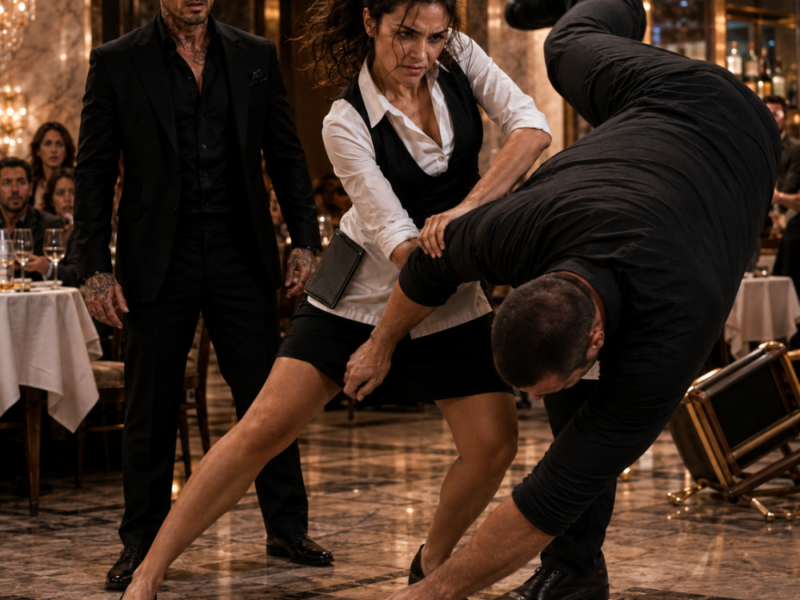
A 7-Foot Assassin Charged The Mafia Boss—Then A Rookie Waitress Dropped Him Instantly
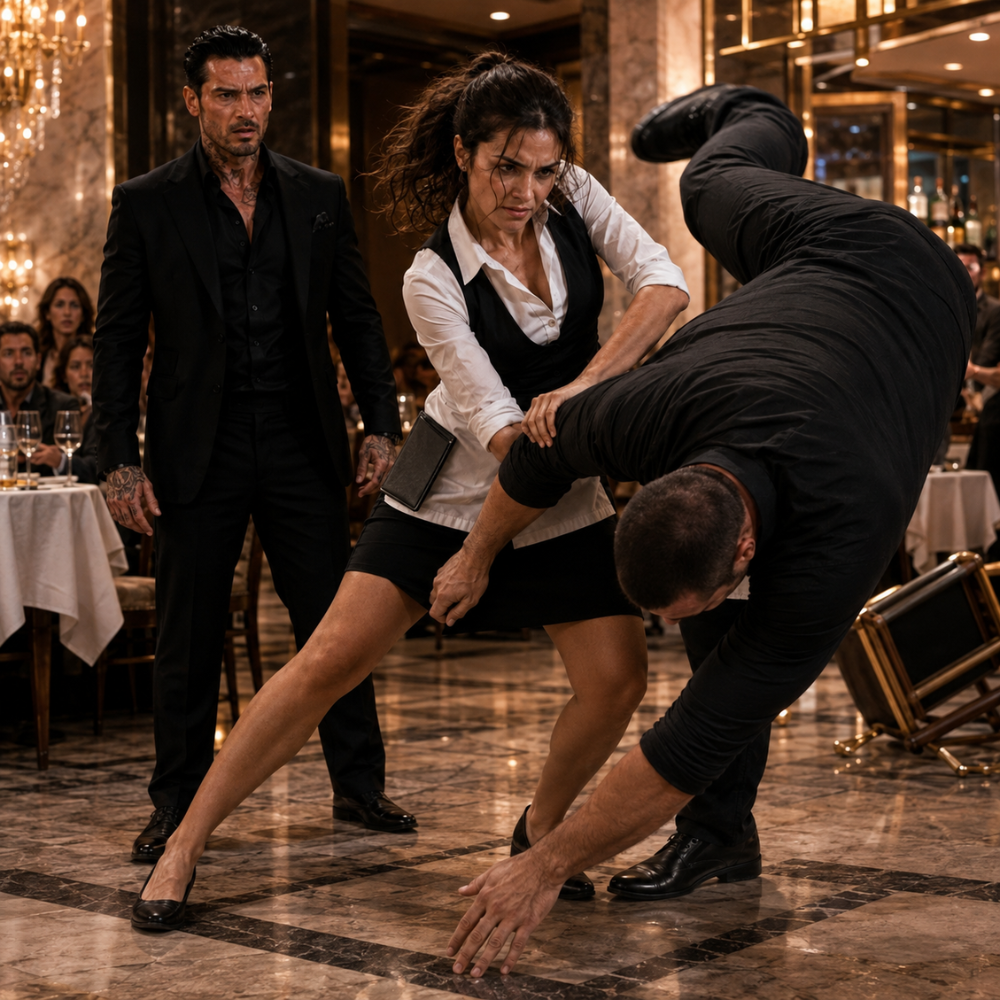
A seven-foot attacker charged the most feared man in the restaurant—then the exhausted young waitress beside him changed the entire night.
The skillet started sliding before Sadie Parker realized what was happening.
One second it was sitting solidly on the black serving tray balanced against her left forearm. The next, a thin sheen of butter and oil carried it toward the edge.
Sadie caught it with her right hand.
Heat flashed through her fingers.
She sucked in a sharp breath.
The heavy cast-iron pan tilted dangerously, garlic potatoes shifting against one side, but she managed to force it back onto the center of the tray before anything spilled onto the white tablecloth.
Nobody at the table moved.
Nobody except the man sitting nearest the wall.
Dominic Russo stopped turning his water glass.
Sadie kept her eyes on the food.
“Bone-in ribeye, rare.”
She placed the plate in front of him.
Her burned fingers were already throbbing.
Dominic looked at the hand she was trying to hide.
“Anything else, sir?”
“Ice.”
“For the water?”
“For your hand.”
Sadie finally looked at him.
He did not look like the kind of man people whispered about.
That surprised her.
She had expected something more theatrical from Dominic Russo. Gold rings, expensive watches, loud confidence, the swagger of somebody who wanted the entire room to know he was important.
Instead he wore a dark charcoal suit, a white shirt with the collar loosened, and an expression of profound exhaustion.
He looked like a businessman who had not slept properly in a month.
Which, Sadie supposed, might have been more frightening.
The three men seated around him were another matter.
They looked exactly like the kind of men Carl had warned her about.
Broad shoulders.
Expensive suits.
Hands that rarely strayed far from their jackets.
Eyes that continued scanning the restaurant even after Sadie placed their dinners in front of them.
Sadie nodded once.
“I’ll bring some ice.”
She turned away.
Behind her, Carl Marino hovered near the hostess station pretending to examine reservations that had already been seated.
He had cornered Sadie in the kitchen ten minutes earlier.
“Table four,” he had whispered. “You understand who that is?”
“A customer who ordered his steak rare.”
“Sadie.”
“I know who Dominic Russo is.”
“You don’t act like it.”
Sadie had lifted the tray.
“I have been here since eleven this morning, Carl. My rent is due Friday. My hand smells like onions. I have not had a real meal since breakfast. I don’t currently have enough energy to be impressed by organized crime.”
Carl had stared at her.
“That is exactly the kind of sentence you should never say out loud.”
She had walked away before he could answer.
Now she pushed through the swinging kitchen doors and placed the tray on the stainless-steel counter.
Hector, the grill cook, looked at her hand.
“What happened?”
“Potatoes tried to kill me.”
“You need cold water.”
“I need Friday.”
“What’s Friday?”
“Rent.”
“Ah.”
Hector pointed toward the sink.
“Cold water first. Landlord second.”
Sadie shoved her hand beneath the faucet.
The cold water hurt before it helped.
She clenched her teeth.
The skin across the first two fingers was bright red.
Nothing severe, she told herself.
She had burned herself before.
She had cut fingers, bruised knees, twisted ankles, carried trays until her shoulders ached, and once worked an entire Saturday with a fever because the electric company did not accept influenza as payment.
At twenty-two, Sadie had already learned that pain came in categories.
There was pain you went to a doctor for.
There was pain you could afford to notice.
And there was pain you put under running water for three minutes because table seven still needed coffee.
This was the third kind.
She wrapped her fingers loosely in a clean towel and went back to work.
Outside, rain hammered against the restaurant windows.
Lombardi’s sat on a narrow street in an older East Coast neighborhood where the sidewalks had been patched so many times the concrete looked quilted. The restaurant had survived three owners, two recessions, a kitchen fire, and one disastrous attempt to modernize the menu with kale.
It still looked almost exactly as it had twenty years earlier.
Dark oak paneling.
Cream tablecloths.
Brass sconces.
Red leather booths.
Black-and-white photographs of city officials and local athletes whose careers had ended before Sadie was born.
It was the kind of place where businessmen brought clients because their fathers had brought clients.
It was also the kind of place where everybody knew which tables not to ask questions about.
Dominic Russo always got table four.
Sadie had served him twice before.
He tipped well.
He spoke little.
That was the extent of their relationship.
By nine-thirty, the dinner rush had thinned.
A couple near the bar split tiramisu.
Two insurance executives lingered over coffee.
An elderly man at table nine read the sports page while his wife finished a glass of wine.
Sadie wiped down the service station beside the entrance.
Her burned hand pulsed inside a loose napkin wrapped around two fingers.
Two hours, she thought.
Maybe less.
She had thirty-seven dollars in cash tips in her apron.
Another fifty would make the week survivable.
She had begun doing the familiar arithmetic.
Rent.
Electricity.
Bus pass.
Laundry.
Groceries.
She had learned to measure food differently since moving into her apartment.
A rotisserie chicken was not one dinner.
It was dinner, lunch, another dinner, and soup if she saved the bones.
Eggs were nine meals if she was careful.
A jar of peanut butter could stretch longer than dignity.
The rain intensified.
Water ran down the front windows in thick sheets.
Sadie was reaching for a stack of clean coffee cups when the front doors opened.
Not normally.
They flew inward hard enough to strike the brass stops.
Cold wind swept into the room.
Several people turned.
A man stood in the doorway.
Sadie’s first thought was that he looked too large for the space.
He was enormously tall, close to seven feet, broad enough that his soaked coat made him appear even larger. Rainwater dripped from the hem onto the entrance mat.
He did not remove his hat.
He did not look toward the hostess.
He looked directly toward table four.
Sadie noticed the change in the restaurant before she understood why.
Dominic’s men stopped eating.
One of them, Paul Caruso, placed his fork down.
Not gently.
The second guard turned halfway in his chair.
The third stood.
The huge stranger moved one hand inside his wet coat.
Sadie heard Carl say, “Oh, God.”
What happened next lasted only seconds.
The stranger pulled a handgun.
A muffled crack snapped through the dining room.
Paulie dropped sideways against the booth.
Another shot struck the wall near the second guard.
People screamed.
Chairs scraped.
Someone overturned a table.
Sadie flattened herself against the service station.
The room became motion and sound.
Dominic’s remaining security moved.
One dragged Paulie lower behind the booth.
Another reached for a weapon.
The attacker fired again, forcing him back.
Sadie did not know whether anyone had been seriously wounded.
She did not look long enough to find out.
She dropped behind the counter.
Her knees hit hardwood.
A sugar bowl shattered nearby.
For one astonishing moment she thought about how angry Carl would be about the sugar bowl.
Then another shot cracked across the room and reality returned.
People crawled between tables.
A woman cried beneath the bar.
Hector appeared briefly through the kitchen doors, saw the dining room, and vanished again.
“Back!” somebody shouted.
Sadie pressed both hands to her mouth.
Her burned fingers screamed.
The huge man dropped his firearm.
Maybe it jammed.
Maybe it emptied.
Maybe he no longer needed it.
From inside his coat he pulled a heavy steel pipe.
Sadie saw Dominic now.
He had moved out of the booth.
He held a small handgun but did not have a clean line of sight because other people were still scrambling across the dining room.
The attacker lowered his shoulder.
And charged.
Dominic was fifteen feet away.
Sadie was closer.
Much closer.
She was crouched beside a stainless-steel hot-water urn used for tea service.
It had been filled less than ten minutes earlier.
She saw the giant coming.
Not toward her.
Past her.
Toward Dominic.
But panic did not make distinctions.
The man was enormous.
He was moving fast.
He was holding a steel pipe.
Sadie wanted distance.
Nothing more complicated than that.
She grabbed the urn by both handles.
Her injured hand nearly failed.
The attacker’s shoulder clipped the service counter.
The impact shook the station.
Sadie lost her footing.
Her shoe slid across a patch of water.
The urn tipped toward her.
She reacted.
She shoved it away from her body.
Hard.
The heavy cylinder struck the attacker low across the legs just as he passed.
Its lid came loose.
Hot water spilled across the floor.
The man tried to adjust.
His boot lost traction.
One knee buckled.
Momentum did the rest.
He went down hard.
The steel pipe flew from his hand.
It spun across the polished floor and stopped beneath an empty table.
The attacker slid into the base of the hostess stand and stayed there.
Sadie landed against the service cabinet.
For several seconds she could hear nothing except her own breathing.
The dining room smelled of wet wool, spilled coffee, garlic, and broken wine.
The attacker groaned once.
One of Dominic’s guards kicked the pipe farther away.
Another moved quickly to secure the dropped handgun.
“Everybody stay down.”
Nobody needed convincing.
Sadie stared.
She had not defeated anybody.
She had fallen.
She had tried to keep a hot metal container from landing on herself.
That was all.
But the man who had been charging toward Dominic Russo was now on the floor and no longer moving toward anyone.
Sadie’s stomach rolled.
She crawled behind the service station and leaned over the trash can.
Nothing came up except a dry, painful cough.
Her hands shook violently.
Footsteps approached.
Slow.
Controlled.
Sadie kept her head down.
A pair of black leather shoes stopped near her.
She looked up.
Dominic Russo stood above her.
His shirt collar was open now.
A small cut near his temple showed where broken glass had caught him.
His gun pointed toward the floor.
He stared at Sadie.
Not at the attacker.
Not at the chaos.
At her.
“What’s your name?”
Sadie swallowed.
He had seen her twice before.
Apparently he had never needed her name.
“Sadie.”
“Last name?”
“Parker.”
He nodded.
Behind him, his men were moving quickly.
One was helping Paulie sit upright. He was injured, but conscious.
Somebody near the kitchen shouted that emergency services had been called.
Carl was crouched beside a table, staring into space.
Dominic reached into his coat.
Sadie flinched.
He removed a folded stack of money.
He placed it on the service counter beside her.
“Go home.”
Sadie stared at the bills.
“What?”
“You’re done for tonight.”
“I can’t just—”
“Yes.”
His voice was not loud.
It did not need to be.
Sadie looked at the dining room.
“What about the police?”
Dominic’s eyes held hers.
“You slipped. The urn fell. You understand?”
She did not.
Not really.
He continued.
“You reacted to danger. Nothing more.”
A siren sounded faintly outside.
Dominic stepped back.
“Go home, Sadie.”
She stood on unsteady legs.
Her apron was wet.
Her burned hand throbbed.
The money remained on the counter.
“I don’t want this.”
Dominic looked at it.
Then at her.
“It isn’t payment.”
“That makes it worse.”
Something changed in his expression.
Briefly.
Almost amusement.
“Take it.”
Sadie did.
Not because she wanted to.
Because the sirens were getting closer, Carl was staring at her, and she suddenly wanted nothing in the world except the peeling walls of her own apartment.
She changed in the employee restroom, put on her coat, and left through the kitchen entrance.
Rain hit her face.
She walked two blocks before she realized she had forgotten her umbrella.
She kept walking.
By the time she reached the bus stop, she was soaked.
The money felt impossibly heavy inside her purse.
Her apartment occupied the fourth floor of a narrow brick building above a laundromat and a tax-preparation office.
The radiator clanged all winter.
The hallway always smelled faintly of onions because the family on the second floor cooked late.
The woman across from Sadie watched game shows at a volume suitable for an airport terminal.
Sadie loved every ugly inch of the place when she came through the door that night.
She locked the deadbolt.
Then locked it again, even though it was already locked.
Her hands started shaking harder.
The crash came all at once.
She sat on the edge of the bed.
Her teeth chattered.
Her shoulders jerked.
She could not get warm.
She pulled off the damp work uniform and stuffed it into a garbage bag because she could not stand the smell of Lombardi’s on it.
Then she noticed the money.
She had forgotten it for almost twenty minutes.
The bills were folded into two bundles.
Sadie counted them once.
Then again.
Five thousand two hundred dollars.
She sat on the floor.
Her rent was eight hundred and fifty.
Her checking account had sixty-three dollars.
She owed three hundred and twelve on a credit card.
Her car had died the previous spring, which was why she took the bus.
The largest amount of cash she had ever held before that night had been a college tuition refund check she immediately used to repay her aunt.
Now five thousand dollars sat on her bed.
Sadie put it inside an old sneaker in the closet.
Then, because that felt absurd, she moved it to a cereal box.
Then she worried the apartment had mice.
She put it back in the shoe.
At three in the morning she was still awake.
She kept seeing the attacker running toward table four.
She kept seeing the urn leave her hands.
She kept wondering what would have happened if she had fallen differently.
At five she turned on the television.
Local news covered flooded streets, a house fire in North County, high-school basketball playoffs, and a city council dispute over parking fees.
Nothing about Lombardi’s.
At seven-thirty, Sadie gave up trying to sleep.
Her hand looked worse.
Two fingers were swollen.
She pulled on sweatpants and a gray sweatshirt and walked to the pharmacy three blocks away.
The city had returned to normal.
Delivery trucks blocked half the street.
A sanitation worker argued with a building superintendent.
Somebody walked a golden retriever beneath an umbrella.
Sadie wondered how the world could look so ordinary.
Inside the pharmacy she stood in front of the first-aid shelves.
Burn gel.
Gauze.
Pain reliever.
She was trying to read the labels when she sensed someone watching her.
A man stood at the end of the aisle.
Mid-twenties.
Dark hair.
Navy overcoat.
The kind of person who might have been a junior attorney or investment analyst.
Except he was not shopping.
Sadie turned.
Another man stood near the opposite end examining dental floss.
She went still.
The younger man approached.
“Sadie Parker?”
She backed into the shelves.
“I don’t know anything.”
He stopped several feet away.
“My name is Leo Marchetti.”
“That means nothing to me.”
“I work for Mr. Russo.”
Sadie’s pulse climbed.
“He asked me to make sure your hand was treated.”
Leo held out a small paper pharmacy bag.
Sadie did not take it.
“What is that?”
“Burn cream. Gauze. Pain medication. Nothing exciting.”
“I can buy my own.”
“I know.”
“Then why are you here?”
“Because Mr. Russo believes you were injured while assisting him.”
“I didn’t assist him.”
Leo nodded.
“You dropped a hot-water urn while trying not to get run over by a very large man.”
Sadie stared.
“That is a surprisingly accurate description.”
“We’re trying to keep things accurate.”
The second man remained at the end of the aisle.
Sadie lowered her voice.
“Why is he here?”
Leo glanced back.
“Because somebody tried to kill my employer last night.”
“He is not my employer.”
“No.”
Leo looked at her carefully.
“But you may now be known to people who wish Mr. Russo harm.”
Cold settled through Sadie’s stomach.
“Known how?”
“We don’t know yet.”
“I’m nobody.”
“Yesterday that was an advantage.”
Leo extended the pharmacy bag again.
“Take this.”
Sadie finally accepted it.
“Lombardi’s is closed for several days.”
“My shifts?”
“Covered.”
Sadie laughed once.
There was no humor in it.
“You people can’t just decide I still get paid.”
“Apparently we can.”
“I need that job.”
“You have it.”
“When the restaurant reopens.”
Leo took a step back.
“And Sadie?”
“What?”
“Do not spend the cash all at once.”
Her face changed.
He noticed.
“You went into my apartment.”
“No.”
“Then how do you know?”
“Most people with limited savings either hide cash in a kitchen container or a shoe.”
Sadie said nothing.
Leo almost smiled.
“Judging by your face, shoe.”
“You are not funny.”
“I’ve been told.”
He walked away.
The older man followed.
Sadie remained in the aisle until both disappeared.
She went directly home.
The money was still there.
Nothing appeared disturbed.
She checked beneath the bed.
Inside the closet.
Behind the shower curtain.
Then she felt ridiculous and made coffee.
For three days she barely left the apartment.
The burn improved.
The pharmacy ointment helped.
Lombardi’s payroll deposited her normal weekly wages despite the restaurant being closed.
Sadie called Carl.
He answered on the second ring.
“You okay?”
“Are you?”
“Depends how you define okay.”
“What happened after I left?”
“Police came.”
“And?”
“Questions.”
“What did you tell them?”
“The truth. Somebody came in armed. People panicked. Things fell. Everybody’s lucky it wasn’t worse.”
Sadie sat at her tiny kitchen table.
“What about Dominic?”
Carl lowered his voice even though Sadie was the only other person on the call.
“I am not discussing Mr. Russo over the phone.”
“Carl.”
“No.”
“Did anyone die?”
A pause.
“The attacker did not make it.”
Sadie closed her eyes.
Carl continued quickly.
“That is not your fault.”
“I knocked him down.”
“You were trying not to get hurt.”
“I threw the urn.”
“You were falling.”
“How do you know?”
“I watched the security video before police took a copy.”
Sadie opened her eyes.
“They took the video?”
“Yes.”
That reassured her slightly.
A real police investigation meant the entire city did not belong to Dominic Russo.
“Then why wasn’t it on the news?”
“Private business owners don’t usually advertise armed incidents.”
“That was not exactly a customer spilling soup.”
“No.”
Carl sighed.
“Sadie, listen to me. You didn’t choose any of this.”
She looked toward the closet.
“That’s what everybody keeps saying.”
“What does that mean?”
“Nothing.”
“Are you in trouble?”
“I don’t know.”
Carl was quiet.
“Then stay away from people who make trouble feel normal.”
Sadie almost laughed.
“That may be the smartest thing you’ve ever said.”
“Please never tell the kitchen staff I said something smart.”
She promised.
On Friday afternoon she used one of Dominic’s hundred-dollar bills.
The landlord had slid a late notice beneath her door that morning.
Pride did not negotiate with rent.
Sadie bought groceries.
Bread.
Eggs.
Rice.
Coffee.
Chicken thighs.
Frozen vegetables.
The cashier handed her change.
Sadie felt strangely guilty.
As though the money had a smell everyone could detect.
She carried two plastic bags back toward her building.
A black Lincoln sedan sat beside the curb.
The rear door opened.
Leo stepped out.
Sadie stopped.
“No.”
“Good afternoon.”
“No.”
Leo looked at her grocery bags.
“You bought actual food. That’s encouraging.”
“I’m not getting in the car.”
“Mr. Russo would like ten minutes.”
“Tell Mr. Russo I’m busy.”
“With canned soup?”
Sadie tightened her grip on the bags.
Leo’s tone changed.
“He is not summoning you to threaten you.”
“That is exactly what a person says immediately before somebody gets threatened.”
“He wants to speak with you about your safety.”
“My safety was substantially better before I met any of you.”
Leo could not argue with that.
He looked toward her building.
“You can come willingly, or I can stand here until every neighbor on your block starts wondering why a black sedan has been parked outside for twenty minutes.”
Sadie glanced toward Mrs. Alvarez’s second-floor curtains.
They were already moving.
She cursed quietly.
“Ten minutes.”
“Reasonable.”
Leo took her grocery bags.
“What are you doing?”
“Putting these in the trunk.”
“I can carry groceries.”
“I can see that.”
She got into the back seat.
The car drove across downtown into the garment district.
They stopped outside an old tailoring shop.
MORETTI & SONS.
The interior smelled of wool, chalk, steam, and polished wood.
An elderly tailor nodded politely as Sadie passed.
Leo led her through a curtain into a large private fitting room.
Dominic Russo stood in front of a three-way mirror while the tailor pinned the side of a vest.
Dominic saw Sadie in the reflection.
“That’s enough for today, Arthur.”
The tailor collected his pins.
“Of course.”
When he left, Sadie folded her arms.
“You said ten minutes.”
“I didn’t say anything.”
“Your employee did.”
Dominic buttoned his shirt cuff.
“How’s the hand?”
“Attached.”
“The ointment helped?”
“Yes.”
“Good.”
He walked toward the small bar.
Sadie glanced around.
“Is this your office?”
“No.”
“Do you own the tailor shop?”
“No.”
“Does the tailor know who you are?”
“Yes.”
“That sounds exhausting.”
Dominic looked over.
“What?”
“Everybody knowing who you are all the time.”
He poured coffee instead of liquor.
It was barely noon.
Sadie appreciated that.
“You spend the money?” he asked.
She stiffened.
“I paid rent and bought groceries.”
“I’m not asking for an accounting.”
“It feels like you are.”
Dominic leaned against the bar.
“I asked you here because the man at Lombardi’s was connected to people who may eventually identify you.”
“Police have security footage.”
“Yes.”
“Then why do I need you?”
“You don’t.”
The answer surprised her.
Dominic continued.
“You need awareness.”
“Of what?”
“That somebody may believe you intentionally helped me.”
“I didn’t.”
“I know.”
“Then tell them.”
His expression barely changed.
“That isn’t how people in my world resolve misunderstandings.”
“Your world sounds inefficient.”
The corner of his mouth moved.
“So I’ve been told.”
“By who?”
“Nobody recently.”
Sadie understood the implication.
She looked away.
Dominic continued.
“I can move you somewhere safer temporarily.”
“No.”
“A better apartment.”
“No.”
“Hotel.”
“No.”
“Private residence.”
“Absolutely not.”
He watched her.
“You think staying in your current building makes you independent?”
“It makes me home.”
“That building has a broken rear lock.”
Sadie’s head snapped toward him.
“How do you know?”
“I had someone check the exterior.”
“Without asking me.”
“Yes.”
“That is not protection. That is surveillance.”
“Sometimes the difference depends on whether someone is trying to hurt you.”
“No. The difference depends on whether I agreed.”
For the first time Dominic looked genuinely irritated.
“I am trying to keep you alive.”
“And I am trying to continue having a life.”
Silence filled the room.
Sadie’s pulse beat in her throat.
Standing up to Dominic Russo was not part of any reasonable survival plan.
But she was too tired to pretend his money made everything acceptable.
Finally he said, “What do you want?”
“I want Lombardi’s to reopen.”
“It will.”
“I want my shifts.”
“You have them.”
“I want your men away from my apartment unless you have a real reason.”
Dominic considered that.
“Fair.”
Sadie blinked.
She had expected an argument.
“That’s it?”
“No.”
He picked up a folder from a side table.
“There’s something else.”
Of course there was.
He handed it to her.
Inside were photographs of invoices, payroll records, and handwritten inventory sheets.
Sadie looked confused.
“What is this?”
“Numbers.”
“I can see that.”
“Leo tells me you were studying accounting.”
“Community college.”
“You finished two years.”
“How do you know?”
“Public records and a background check.”
“That sentence is deeply creepy.”
“Probably.”
Sadie flipped through the papers.
“Why are you showing me this?”
“Because you noticed Carl charged you for employee meals twice last month.”
She looked up.
“What?”
“Lombardi’s payroll.”
Sadie remembered complaining about twelve dollars missing from a paycheck.
“That has nothing to do with these.”
“It means you notice numbers.”
“So do accountants.”
“Accountants know what people with money expect numbers to look like.”
Dominic nodded toward the folder.
“You know what numbers look like when there isn’t enough money.”
Sadie stared at him.
He continued.
“I have legitimate businesses. Warehouses. Construction. Restaurants. Some managers have started taking advantage of recent confusion.”
“Recent confusion meaning somebody tried to kill you.”
“Yes.”
“And you want me to do what?”
“Review payroll and inventory.”
“No.”
“You haven’t heard the pay.”
“No.”
“Three times what Lombardi’s pays.”
Sadie stopped.
Dominic saw it.
She hated that he saw it.
“You would work regular hours.”
“No guns.”
“No guns.”
“No threatening people.”
“Not your responsibility.”
“No illegal books.”
Dominic hesitated.
Sadie pointed at him.
“That pause answered the question.”
“These businesses pay taxes.”
“That was not the question.”
Dominic sighed.
“Only legitimate company records.”
Sadie looked again at the folder.
Three times her restaurant income.
Her immediate instinct was no.
Her checking account disagreed.
“Temporary,” she said.
“Thirty days.”
“Two weeks.”
“Three.”
Sadie thought about rent.
“Three.”
Dominic extended his hand.
She did not take it.
“I’m not shaking on it.”
“Why?”
“Because with you it feels legally significant.”
This time he actually smiled.
Barely.
Sadie took the folder home.
For the next three weeks she worked in a basement office beneath a commercial laundry owned by one of Dominic’s legitimate holding companies.
The work was far less dramatic than she had feared.
Invoices.
Time sheets.
Delivery records.
Inventory.
Vendor contracts.
The basement smelled of detergent and warm concrete. Washing machines thudded overhead.
Sadie drank bad coffee and taught herself spreadsheet shortcuts using a library book she had checked out years earlier.
Within four days she found the first problem.
A warehouse manager had listed twelve temporary workers every week.
Security logs showed only eight entering the building.
The payroll difference disappeared into a subcontractor account.
Sadie printed the discrepancy.
She wrote the dates.
She wrote the amounts.
She wrote one sentence at the bottom.
You are paying four people who do not exist.
Leo collected the report.
The following Monday the warehouse had a new manager.
Sadie did not ask what happened to the old one.
She told herself he had been fired.
She hoped that was true.
The second discrepancy involved a refrigeration contractor billing the same repair to three different businesses.
The third involved a restaurant manager ordering premium seafood that never arrived.
Sadie became good at it.
Disturbingly good.
She understood people who stole small amounts.
That helped.
Wealthy auditors sometimes looked for elaborate schemes.
Sadie looked for the extra eighty dollars.
The duplicate gas receipt.
The padded overtime.
The fake cousin on payroll.
Because she understood what money meant when there was never enough of it.
She also discovered that Dominic’s businesses were more complicated than the rumors suggested.
Some were undoubtedly connected to his reputation in ways Sadie did not want explained.
Others were ordinary.
A concrete company.
Two laundromats.
A seafood wholesaler.
A parking garage.
A tailor shop he did not own but had financed years earlier.
Hundreds of people received normal paychecks.
Many had no idea who ultimately controlled the companies.
Sadie began leaving the basement at reasonable hours.
Her rent stayed paid.
Her refrigerator remained full.
She replaced the broken bedroom radiator.
For the first time since high school, she bought shoes because the old pair hurt rather than because the soles had completely separated.
That frightened her more than poverty had.
Comfort could become a leash.
She understood that.
One rainy Thursday, Dominic came to the basement.
Sadie was comparing two invoices.
“You’re not Leo.”
Dominic closed the door.
“Excellent work.”
“Thank you.”
He looked terrible.
Not injured.
Just worn down.
He removed his overcoat and sat in the folding chair against the wall.
Sadie watched him.
“You need something?”
“Quiet.”
“You came to a laundromat basement for quiet?”
Dominic leaned his head against the concrete.
The machines above them thudded rhythmically.
“Relative quiet.”
Sadie returned to the ledger.
Five minutes passed.
Then ten.
Dominic said nothing.
Sadie stopped pretending she was not curious.
“Bad day?”
His eyes remained closed.
“Yes.”
“Business?”
“Yes.”
“Do I want to know?”
“No.”
“Great.”
She kept working.
Twenty minutes later she noticed his shoulders had relaxed.
The most feared man she had ever met had apparently come to sit in a windowless basement because nobody else expected anything from him there.
Sadie found that unexpectedly sad.
Not sympathetic.
Sad.
There was a difference.
She ran several old draft reports through the shredder.
The machine roared.
Dominic opened his eyes.
“Why are you doing that?”
“You looked like you preferred noise.”
He stared.
Sadie fed another stack.
“You’re welcome.”
When Dominic finally stood, he had rebuilt himself.
Jacket.
Posture.
Expression.
Before leaving, he placed a small box beside her keyboard.
“What’s this?”
“Nothing important.”
“That usually means expensive.”
He left.
Sadie opened the box.
Inside lay a pair of thin black leather gloves.
She frowned.
Then understood.
Her burn had healed into a shiny pink scar across the back of two fingers.
People noticed it.
Sometimes they asked.
She slid one glove onto her right hand.
It fit perfectly.
Too perfectly.
She immediately removed it.
The next morning she wore it anyway.
The illusion that Sadie’s life had become manageable lasted until a Tuesday night three weeks later.
Leo drove her to a meat distribution company near the river to audit three months of inventory.
The facility operated around the clock.
Refrigerated trucks backed into loading docks.
Workers in heavy coats moved boxes through brightly lit corridors.
Sadie worked from a second-floor office overlooking the packaging floor.
At nine-fifteen the main lights went out.
The refrigeration system stopped.
Sadie looked up.
Backup lights flickered on.
Then she heard shouting below.
Not normal workplace shouting.
Urgent.
Sharp.
The sound of something breaking.
Sadie moved toward the office window.
Three unfamiliar men entered from the loading area.
One carried a weapon.
Sadie dropped below the window immediately.
Her body remembered Lombardi’s before her mind did.
The cold floor.
The screaming.
The huge man running.
Her hands began shaking.
She crawled behind the desk.
Someone kicked open the downstairs door.
Footsteps crossed the concrete floor.
Leo had been in the parking lot.
Where was Leo?
Sadie pulled out her phone.
No signal.
The building’s internal wireless network was down.
The office door rattled.
Once.
Twice.
On the third impact the lock broke.
Sadie pressed herself farther beneath the desk.
Two men entered.
She heard drawers opening.
Paper tearing.
“Take the drives.”
Another voice answered.
“Then we’re gone.”
No dramatic speeches.
No explanation.
That frightened her more.
Sadie’s cheek pressed against the carpet.
A dropped pen lay three inches from her face.
She stared at it because focusing on something ordinary kept her breathing quiet.
The men moved through the room.
A file cabinet opened.
Then a loud crash erupted somewhere downstairs.
Both men stopped.
Shouting followed.
More footsteps.
A brief burst of gunfire echoed through the warehouse.
Sadie covered her head.
The office became confusion.
One man ran into the hallway.
The second followed.
Sadie remained under the desk.
She did not know how long.
Eventually the noise stopped.
Footsteps returned.
Slowly.
“Sadie.”
She knew the voice.
She crawled forward.
Dominic appeared at the doorway.
His coat was gone.
His dark sweater was torn at one shoulder.
Two security men stood behind him.
Dominic crossed the room.
“Are you hurt?”
“No.”
“Are you sure?”
“I’m sure.”
He crouched.
Sadie was trembling too badly to stand.
Dominic reached under the desk.
“Come on.”
She grabbed his forearm.
He pulled her out.
For one second she lost her balance and hit his chest.
He steadied her.
“Leo?”
Dominic’s expression changed.
Sadie knew before he answered.
“He was attacked outside.”
“Is he alive?”
Dominic looked at one of the men behind him.
“He’s being taken to the hospital.”
That meant maybe.
Sadie closed her eyes.
Dominic put both hands on her shoulders.
“Look at me.”
She did.
“We are leaving.”
“I need my bag.”
“I’ll get it.”
“My laptop.”
“Leave it.”
“There are payroll files.”
“Sadie.”
His voice sharpened.
“Leave it.”
She nodded.
They went downstairs through a side corridor so Sadie would not have to cross the main floor.
Police sirens approached in the distance.
Dominic placed her in the rear of an SUV.
For the first time, she realized he was shaking too.
Very slightly.
But he was.
Leo survived.
Sadie learned that at three in the morning while sitting in Dominic’s penthouse drinking tea she had not asked for.
The apartment occupied one of the highest floors of a tower overlooking the river.
Everything was clean.
Stone.
Glass.
Dark wood.
There were no family photographs.
No children’s drawings.
No magazines.
No clutter.
It looked staged.
“You live here?”
Dominic sat across from her.
“Sometimes.”
“It looks like a hotel nobody likes.”
He almost smiled.
“You criticize interiors during emergencies?”
“It helps.”
A doctor had been allowed into the apartment after security cleared him.
Dominic had a shallow cut along his left side from broken metal during the warehouse confrontation. The doctor cleaned and bandaged it before leaving.
Sadie watched from across the room.
“You got hurt coming to the warehouse?”
“Yes.”
“Why were you there?”
“Leo missed a check-in.”
“So you came personally?”
“Yes.”
“You have security.”
“Yes.”
“Employees.”
“Yes.”
“People whose job is literally to investigate danger before you walk into it.”
“Yes.”
Sadie leaned back.
“That seems inefficient too.”
Dominic looked at her.
“I heard you were inside.”
Something in his voice changed.
Sadie stopped joking.
“You thought I was dead.”
“I considered the possibility.”
“That isn’t what I asked.”
Dominic looked toward the windows.
Below them, traffic moved across the bridge like distant beads of light.
“Everybody around me understands the risks.”
“I didn’t.”
“No.”
“You brought me into them.”
“Yes.”
There it was.
No excuse.
Sadie appreciated that more than she wanted to.
“You said you were protecting me.”
“I believed I was.”
“Your business got attacked.”
“Yes.”
“And I was there because you hired me.”
“Yes.”
“So the protection created the danger.”
Dominic’s jaw tightened.
“Yes.”
Sadie folded her arms.
“That is a pretty serious flaw in your system.”
He looked back toward her.
“What do you want me to say?”
“I don’t know.”
“Do you want an apology?”
“Can you make one?”
“Yes.”
She waited.
Dominic seemed to find the task more difficult than negotiating with armed enemies.
Finally he said, “I am sorry.”
Sadie raised her eyebrows.
“For?”
He gave her a look.
She refused to rescue him.
Dominic exhaled.
“For assuming that because I could protect you, I had the right to decide what risks you should live with.”
Sadie said nothing.
He continued.
“And for turning a debt I owed you into an obligation you never agreed to.”
The room went quiet.
That surprised her.
“You knew?”
“That you felt trapped?”
“Yes.
“I’m not completely stupid.”
“Debatable.”
A faint smile touched his face.
Then disappeared.
Sadie looked at her hands.
The black leather gloves rested beside her on the sofa.
“I stayed.”
“I know.”
“I could’ve quit.”
“Yes.”
“Would you have let me?”
Dominic did not answer quickly enough.
Sadie looked up.
“That’s the problem.”
“I would now.”
“Now?”
“Yes.”
“What changed?”
Dominic leaned forward, forearms against his knees.
“At Lombardi’s I believed owing you meant I was responsible for you.”
“That sounds almost noble when you say it like that.”
“It wasn’t.”
“No.”
“I had men check your apartment. I decided where you should work. I decided what information you needed.”
“Correct.”
“I treated gratitude like ownership.”
Sadie’s eyes narrowed.
“That sounds suspiciously self-aware.”
“It has been a difficult evening.”
She laughed despite herself.
Then became serious again.
“Why did you really keep me around?”
Dominic looked tired.
Not the public exhaustion she had noticed at Lombardi’s.
Something deeper.
“You didn’t want anything from me.”
“I wanted rent money.”
“Not from me.”
“That changed.”
“You still argued every time I offered you something.”
“You were invasive.”
“You called me inefficient.”
“You are.”
Dominic looked toward the city.
“Most people know me before they meet me.”
Sadie waited.
“They know what I can give them. What I can prevent. What doors I can open. What problems I can create.”
“That sounds lonely.”
“It is practical.”
“That wasn’t what I said.”
He looked back.
“No.”
Sadie thought about the basement.
Dominic sitting beneath the vibrating light, asking for nothing except noise.
She understood more now.
Not enough to excuse him.
Enough to see him.
“I need a choice,” she said.
“You have one.”
“No.”
Sadie shook her head.
“I need an actual choice. Not ‘work for me or I decide what happens to you.’ Not ‘stay because somebody may be looking for you.’ I need enough information to decide what I’m accepting.”
Dominic nodded slowly.
“What information?”
“Everything that affects my safety.”
“Everything?”
“Everything relevant.”
“Some things I cannot tell you.”
“Then I cannot be involved in them.”
He considered that.
“Fair.”
“I choose where I live.”
“Yes.”
“No one enters my apartment.”
“Yes.”
“No one follows me without telling me unless there is a specific credible threat.”
Dominic hesitated.
Sadie stared.
“Yes,” he said.
“I can leave.”
“Yes.”
“And the money?”
“Yours.”
“Not a debt?”
“No debt.”
Sadie sat back.
“You really are having a difficult evening.”
Dominic almost laughed.
Then his phone rang.
He answered.
Listened.
His shoulders lowered.
“Leo’s stable?”
A pause.
“Good.”
He ended the call.
Sadie closed her eyes in relief.
They sat quietly.
Eventually Dominic said, “What are you going to do?”
“Tonight?”
“Tomorrow.”
Sadie looked around the cold apartment.
“I’m going home.”
He nodded.
“And after that?”
“I don’t know.”
“You can return to Lombardi’s.”
“Carl will complain about me being late within three days.”
“Probably.”
“I could go back to school.”
Dominic looked at her.
“You should.”
“That sounded dangerously like advice.”
“It was.”
“You’re improving.”
A car took Sadie home just before sunrise.
No guards entered the building.
Nobody followed her upstairs.
At least nobody she could see.
She slept twelve hours.
When she woke, an envelope had been pushed beneath her door.
She froze.
Then recognized Leo’s handwriting from payroll notes.
Inside was a hospital business card.
On the back:
Still alive. Apparently too stubborn to die. Stop blaming yourself.
Sadie sat on the floor and laughed until she cried.
For the next week she did nothing for Dominic.
That mattered.
She went grocery shopping.
She returned library books.
She washed her clothes.
She sat in a diner with Carl and listened to him complain about insurance inspectors.
Lombardi’s reopened.
The patched front door looked slightly different.
The hostess station had been replaced.
Sadie stood near it on her first night back.
Carl handed her an apron.
“You sure?”
“No.”
“Excellent. That’s how everybody feels here.”
Her first table was a family celebrating a birthday.
The little boy spilled Sprite.
His mother apologized twelve times.
Sadie brought towels.
At table six, an elderly couple split lasagna.
At table nine, a pharmaceutical sales representative sent back salmon because he believed the center was undercooked.
Normal problems.
Sadie nearly cried over the salmon.
Dominic did not come.
Not that night.
Not the next.
Two weeks passed.
Sadie began sleeping better.
The scar on her hand faded from angry pink to pale rose.
She stopped wearing the glove every day.
One afternoon Leo walked into Lombardi’s.
He looked thinner.
A small scar marked the side of his neck.
Sadie carried a pitcher of water toward him.
“You look terrible.”
“So do you.”
“I work here.”
“I was shot.”
“That’s a more competitive excuse.”
Leo sat at the bar.
“Hector said I get soup.”
“Hector likes you?”
“I tipped him.”
“That explains it.”
Sadie poured water.
“How’s Dominic?”
“Busy.”
“That usually means bad.”
“It means busy.”
Leo looked at her.
“He hasn’t contacted you.”
“No.”
“He said he wouldn’t unless you did first.”
Sadie felt something she did not want to identify.
Relief, maybe.
Respect.
Possibly disappointment.
She disliked the third possibility.
Leo stirred his soup.
“He changed several internal procedures.”
“What does that mean?”
“Nothing you need to worry about.”
“That phrase is banned.”
He smiled.
“He reduced the number of people with access to his personal security schedule. Moved legitimate financial work to an outside accounting firm. Closed the basement office.”
Sadie stared.
“The laundromat basement?”
“Yes.”
“Why?”
“He said if you returned, it should be to an actual office with windows.”
Sadie did not know what to say.
Leo ate another spoonful.
“He also asked me to give you this.”
Sadie’s expression hardened.
“You just said he wouldn’t contact me.”
“This isn’t a message.”
Leo placed a business card on the bar.
The card belonged to a partner at a mid-sized accounting firm downtown.
“They have a paid bookkeeping apprenticeship,” Leo said. “Tuition assistance after six months.”
Sadie looked at the card.
“Did Dominic buy the company?”
“No.”
“Invest in it?”
“No.”
“Threaten somebody?”
“No.”
“Call?”
“Yes.”
She pushed the card back.
“That’s still influence.”
Leo nodded.
“So don’t use it.”
She looked at him.
“He said you’d say that.”
“That is irritating.”
“He also said if you want the opportunity, they’ve agreed to interview you based on the work samples you produced from the legitimate companies.”
“My work?”
“Your work.”
“No fake recommendation?”
“Apparently you don’t need one.”
Sadie looked at the card again.
She kept it.
Three days later she interviewed.
The office occupied the eighth floor of an unremarkable downtown building above a bank and a dental practice.
The woman interviewing Sadie was named Claire Dalton.
Fiftyish.
Silver-streaked hair.
No patience for vague answers.
“You have an unusual employment history.”
“Yes.”
“Restaurant work, incomplete community-college degree, then three months of contract bookkeeping.”
“Yes.”
“Why did the contract end?”
Sadie had prepared for this.
“The business restructured its accounting process.”
Technically true.
Claire looked at her.
“What did you learn?”
“That people think large financial problems look large.”
Claire raised an eyebrow.
“Explain.”
“The biggest discrepancy I found came from small entries repeated every week.”
“What kind?”
“Payroll.”
Sadie described the ghost employees without naming the company.
Claire listened.
“What made you notice?”
“The total wasn’t dramatic enough.”
Claire smiled.
“That is the opposite answer most applicants give.”
“It was eighty to a hundred dollars per week per employee. People ignore amounts that seem too small to be fraud.”
“And you didn’t.”
“I’ve lived places where eighty dollars is not small.”
Claire closed the folder.
“You can start Monday.”
Sadie blinked.
“Really?”
“Really.”
She walked outside carrying a benefits packet.
Medical insurance after ninety days.
Tuition reimbursement.
Paid holidays.
A retirement plan she did not fully understand.
She stood on the sidewalk staring at the papers.
Her first instinct was to call her mother.
She did.
Her second was Carl.
He pretended to be offended she was leaving.
Her third was Dominic.
She stared at his number for almost a minute.
Then called.
He answered immediately.
“Sadie.”
“I got the job.”
A pause.
“I know.”
Her eyes narrowed.
“How?”
“Leo.”
“I should have guessed.”
“He was instructed not to interfere.”
“He has a loose definition of interference.”
“So do you.”
Sadie smiled.
“I wanted to say thank you.”
“You got the job.”
“You opened the door.”
“You walked through it.”
“That was almost healthy.”
“I’m trying.”
She could hear city noise behind him.
“Where are you?”
“Outside.”
“That is not a location.”
“It is all you need.”
Fair.
Sadie looked down the street.
“Are we even?”
Dominic was quiet.
“Were we ever keeping score?”
“You were.”
“Not anymore.”
“Good.”
Another silence.
Then Dominic said, “Dinner.”
Sadie almost laughed.
“What?”
“Not a meeting. Not work.”
“Are you asking me on a date?”
“I am attempting to.”
“You sound deeply uncomfortable.”
“I am.”
She leaned against a light pole.
“Public restaurant.”
“Yes.”
“No private room.”
“Fine.”
“No bodyguards at the table.”
“Nearby.”
“Fine.”
“No business.”
“Agreed.”
“No discussing debts.”
“There are none.”
Sadie smiled.
“Friday.”
“Seven?”
“Seven-thirty. I work until six.”
“Seven-thirty.”
“And Dominic?”
“Yes?”
“I choose the restaurant.”
There was a long pause.
“That seems unnecessarily aggressive.”
“Seven-thirty.”
She ended the call.
Friday evening Sadie chose a neighborhood diner six blocks from her apartment.
Not because the food was exceptional.
Because Dominic Russo looked absurd sitting beneath a laminated menu advertising bottomless coffee.
He arrived in a dark suit.
No tie.
Leo sat three booths away pretending to read a newspaper.
Sadie noticed.
Dominic noticed her noticing.
“He refused to sit outside.”
“He’s recovering.”
“So he claims.”
A waitress approached.
“What can I get you?”
Sadie ordered meatloaf.
Dominic ordered the same.
The waitress looked at him.
“Mashed potatoes or fries?”
He hesitated as if nobody had asked him a question that difficult in years.
“Mashed potatoes.”
“Gravy?”
“Yes.”
When she left, Sadie laughed.
Dominic stared.
“What?”
“You control half the commercial property on the waterfront, and gravy made you nervous.”
“I did not know whether it was included.”
“It’s a diner.”
“That does not answer the question.”
She laughed harder.
Something eased across his face.
They talked.
Not about attacks.
Not about payroll.
Not about people who wanted Dominic gone.
Sadie learned his father had been a mason.
His mother had cleaned offices at night.
He had grown up sharing a bedroom with two brothers.
One was dead.
The other lived in Arizona and had not spoken to him in nine years.
Dominic learned Sadie’s mother lived in Pennsylvania with her second husband.
Sadie had moved to the city for college, left when tuition increased, and told herself every semester she would go back next year.
“Why accounting?” Dominic asked.
Sadie dipped a piece of bread into gravy.
“Because numbers are honest.”
Dominic smiled faintly.
“People use numbers to lie every day.”
“People lie. Numbers just stand there.”
“That sounds like something on a coffee mug.”
“I’m profound when there is free bread.”
Their relationship did not become simple after that.
Sadie would have distrusted anything that simple.
Dominic was still Dominic.
People lowered voices when he entered rooms.
Businesses opened doors for him faster than seemed normal.
There were subjects he refused to discuss.
There were nights he canceled dinner without explanation.
Sadie made one rule clear.
“If your life becomes dangerous around me again, you tell me before it reaches my front door.”
He agreed.
Months passed.
Sadie started evening classes.
Two nights each week she took the subway from work to community college, ate dinner from a vending machine, and sat beneath fluorescent lights learning cost accounting and business law.
Dominic paid nothing.
She insisted.
He objected once.
Sadie handed him a spreadsheet showing why she could afford tuition with reimbursement from work.
He never objected again.
The five thousand two hundred dollars from Lombardi’s remained partly untouched.
Sadie finally deposited the remainder into savings.
Not because Dominic had told her to.
Because she had decided it was no longer a symbol.
It was money.
Money could be frightening.
Money could be dirty.
Money could also replace brakes on a used car.
She eventually bought one.
Nothing luxurious.
A six-year-old Honda with seventy thousand miles and a coffee stain on the passenger seat.
Dominic looked personally offended.
“This car has manual cloth seats.”
“Yes.”
“The rear bumper is scratched.”
“Yes.”
“You could buy something safer.”
“It has excellent safety ratings.”
“It is beige.”
“That is not a safety problem.”
“It might be a moral one.”
Sadie kept the Honda.
A year after Lombardi’s, she returned to the restaurant for dinner rather than work.
Carl had promoted Hector to kitchen manager.
A college student named Madison worked Sadie’s old section.
Dominic sat across from her at table four.
The table no longer frightened her.
That surprised her.
The hostess stand had been rebuilt.
The new one was wood rather than stone.
Sadie noticed immediately.
“You changed it.”
Dominic looked toward the entrance.
“Changed what?”
“The hostess stand.”
“I didn’t.”
“Carl?”
“Probably.”
Sadie continued looking at it.
Dominic understood.
“You still think about that night.”
“Sometimes.”
“Me too.”
The waitress brought water.
Sadie turned the glass between her fingers.
“I used to think the biggest thing that happened was the urn.”
Dominic waited.
“It wasn’t.”
“What was?”
“Everything after.”
He nodded.
She looked at him.
“You scared me more than the attacker sometimes.”
“I know.”
“You thought protection gave you permission.”
“I know.”
“You were terrible at asking.”
“I’ve improved.”
“Marginally.”
Dominic smiled.
Sadie continued.
“I also let fear make decisions for me.”
“You survived.”
“So did you.”
They sat quietly.
At the next table a family debated whether to order cheesecake.
Carl argued with a delivery driver near the kitchen.
A server dropped a fork.
Everybody kept eating.
Normal.
Sadie had once thought normal meant safe.
She no longer believed that.
Safety was not a place you reached.
It was something people built.
With boundaries.
Information.
Choices.
People willing to hear no.
Sadie looked at Dominic.
“What?”
he asked.
“Nothing.”
“That is rarely true.”
She smiled.
“One year.”
“Since Lombardi’s.”
“Since a very expensive steak went cold because somebody interrupted dinner.”
Dominic’s expression darkened briefly.
Then softened.
“You changed my life.”
Sadie shook her head.
“I spilled hot water.”
“You changed my life afterward.”
“That I’ll accept.”
Dominic lifted his water glass.
“To afterward.”
Sadie lifted hers.
“To asking permission.”
He gave her a look.
“Do you intend to bring that up forever?”
“Yes.”
They touched glasses.
Later, walking home, Sadie passed the pharmacy where Leo had once cornered her between first-aid supplies and dental floss.
She stopped outside.
Dominic noticed.
“What?”
“First time I met Leo.”
“He terrified you.”
“Yes.”
“He claims he was polite.”
“He blocked both ends of an aisle.”
“That does sound like Leo.”
Sadie laughed.
The city moved around them.
Buses.
Delivery bicycles.
People leaving restaurants.
A woman walking a tiny dog in a raincoat.
Nobody paid special attention to Dominic.
Maybe they did not recognize him.
Maybe people had better things to do.
Sadie preferred the second explanation.
They reached her building.
The rear lock had been repaired months earlier after Sadie complained to the landlord in writing and copied the city housing office.
Dominic had offered to make a phone call.
She had refused.
The lock was fixed anyway.
By bureaucracy.
Sadie considered that a personal victory.
At the entrance Dominic stopped.
“Tomorrow?”
“I have class.”
“Thursday?”
“Work dinner.”
“Friday?”
Sadie considered him.
“You are becoming clingy.”
“I have been told.”
“By who?”
“You.”
“Accurate source.”
Friday worked.
He kissed her cheek.
Nothing dramatic.
Nothing cinematic.
Then he walked back toward the waiting car.
Sadie went upstairs.
Her apartment still had the same kitchen table.
Same narrow hallway.
Same view of the liquor-store sign across the street.
But the radiator worked.
There were textbooks stacked beside the sofa.
A real desk stood where the milk crate television had once been.
On the refrigerator hung a printed grade report.
A.
A.
B-plus.
Sadie had been furious about the B-plus until Claire reminded her she worked full-time.
She opened the freezer and removed leftover chicken.
Her phone buzzed.
Leo.
She answered.
“What?”
“You could say hello.”
“You never call with anything good.”
“I’m offended.”
“What happened?”
“Nothing happened.”
“Then why are you calling?”
“Dominic left his wallet at the restaurant.”
Sadie stared at the phone.
“Why are you telling me?”
“Because he insists he did not.”
“Did he?”
“Yes.”
“Then tell him.”
“I did.”
“And?”
“He told me to check the car.”
“Did you?”
“Yes.”
“And?”
“No wallet.”
Sadie smiled.
“Check beneath table four.”
Silence.
“You know something.”
“Dominic kicked it under the table when he stood up.”
“Why didn’t you tell him?”
“He was criticizing my Honda.”
Leo sighed.
“You are a difficult woman.”
“I learned from professionals.”
She ended the call.
Five minutes later Dominic texted.
You saw the wallet.
Sadie replied.
Maybe.
Another message.
This is extortion.
She typed:
This is accountability.
His response arrived.
Friday. 7:30.
Sadie smiled.
Then ate dinner at her kitchen table while rain began tapping softly against the windows.
A year earlier that sound had kept her awake because every passing car had felt like danger coming up the stairs.
Now it was only rain.
That might have been the strangest part of everything.
The night at Lombardi’s had become a story people around the restaurant told badly.
Depending on who told it, Sadie had thrown the urn deliberately from across the room, tripped a seven-foot attacker with one leg, knocked a weapon away with a serving tray, or performed some mysterious martial-arts maneuver she had learned as a child.
None of it was true.
Sadie corrected people for several months.
Eventually she stopped.
People preferred heroes to accidents.
They preferred clean reasons.
They wanted courage to look like somebody standing tall and knowing exactly what to do.
Sadie knew better.
Sometimes courage looked like panic.
Sometimes it looked like going home afterward and shaking on the edge of a bed.
Sometimes it looked like taking money because rent still existed even after the worst night of your life.
Sometimes it looked like telling a powerful man no.
And sometimes the bravest thing happened long after the danger was gone, when nobody was watching and there was no applause.
For Sadie, it happened on an ordinary Monday evening two years after Lombardi’s.
She sat inside a community-college auditorium wearing a borrowed graduation gown.
Her mother had driven in from Pennsylvania.
Carl and Hector sat three rows behind her.
Claire Dalton was there with two coworkers.
Leo arrived late and pretended he had not.
Dominic sat at the end of the same row as Sadie’s mother.
He looked profoundly uncomfortable beneath fluorescent lights among hundreds of families holding balloons.
Sadie saw him before she walked across the stage.
He did not wave.
He simply stood when her name was called.
So did everyone else.
“Sadie Parker.”
She crossed the stage.
Associate degree in accounting.
Not glamorous.
Not dramatic.
No newspaper would care.
Sadie did.
Afterward she found everyone outside.
Her mother hugged her hard enough to wrinkle the gown.
Carl complained that the ceremony was too long.
Hector had brought cannoli in a bakery box despite rules against food.
Claire handed Sadie an envelope containing notice of her promotion.
Leo stole a cannoli before Hector finished opening the box.
Dominic waited until everyone else had spoken.
Then he approached.
“I brought nothing.”
Sadie smiled.
“That may be the best gift you’ve ever given me.”
“I assumed you’d reject anything expensive.”
“Correct.”
“So I saved time.”
They stood together beneath the campus lights.
Students took photographs nearby.
Parents cried.
Car doors slammed.
Somebody shouted for a missing grandmother.
Ordinary life surrounded them.
Dominic looked at Sadie’s diploma.
“Numbers still honest?”
“Yes.”
“People?”
“No.”
He nodded.
“Fair.”
Sadie looked at him.
“You know what I finally figured out?”
“That beige is unacceptable for a car?”
“No.”
“That was worth trying.”
She nudged him with her shoulder.
“I kept wondering why that night happened to me.”
Dominic’s face grew serious.
“There probably isn’t a reason.”
“Exactly.”
He waited.
“I spent a long time trying to turn it into destiny because accidents are harder to live with.”
“That sounds profound.”
“I have a degree now. I’m allowed.”
He smiled.
Sadie looked across the parking lot where her mother was forcing Leo into a photograph.
“That attacker didn’t come into Lombardi’s because of me.”
“No.”
“I didn’t stop him because I was special.”
“You reacted.”
“I fell.”
“You shoved a thirty-pound metal urn.”
“I was trying not to pour boiling water on my own face.”
“A reasonable priority.”
“The important part came later.”
Dominic looked at her.
“What you chose.”
“What we both chose.”
His expression softened.
He knew exactly what she meant.
He could have used fear to hold her.
For a while, he had.
She could have accepted fear as protection.
For a while, she had.
Neither wanted to remain that person.
Sadie looked at the man people once described to her as somebody who controlled half the city.
Maybe he still controlled things she would never understand.
But he no longer controlled her.
That was why she could stand beside him.
Choice had changed the meaning of the entire relationship.
Her mother called from across the sidewalk.
“Sadie! Picture!”
Sadie sighed.
Dominic stepped back.
“Go.”
“You’re in it.”
“No.”
“Yes.”
“I don’t take family photographs.”
“You do tonight.”
He looked alarmed.
Sadie grabbed his sleeve.
“Come on.”
“Sadie.”
“No negotiating.”
“You have become increasingly authoritarian.”
“I learned from professionals.”
She pulled him toward the group.
Leo grinned.
“Someone finally gave you an order.”
Dominic looked at him.
“Enjoy unemployment.”
“You can’t fire me during a graduation picture.”
“We’ll discuss that.”
Sadie’s mother arranged everyone beneath a campus banner.
Carl tried to hide the bakery box.
Hector refused.
Claire told them all to move closer.
Dominic stood stiffly beside Sadie.
She elbowed him.
“Smile.”
“I am.”
“No, you look like somebody is reading you tax charges.”
“This is my smile.”
“It needs work.”
The camera flashed while everybody was laughing.
That became Sadie’s favorite photograph.
Not because it was perfect.
It was not.
Leo’s eyes were half closed.
Carl had frosting on one thumb.
Her mother was looking slightly away from the camera.
Dominic appeared caught between annoyance and amusement.
Sadie’s graduation cap sat crooked.
The photograph was alive.
Years later, Sadie would keep it framed on the bookshelf in an office with her name on the door.
By then she no longer worked for Claire.
She had completed her bachelor’s degree at night and eventually opened a small accounting practice serving restaurants, contractors, and family-owned businesses.
She understood those clients.
People who kept receipts inside kitchen drawers.
People who knew exactly when payroll cleared.
People who worked Saturday because Saturday was not special when you owned the place.
Lombardi’s became one of her first clients.
Carl became part owner.
Hector ran the kitchen.
Madison, the student who replaced Sadie, graduated from nursing school and still worked occasional holiday shifts because Hector claimed nobody else could handle Christmas Eve reservations.
Dominic remained complicated.
Sadie stopped trying to make him simple.
Life had taught her simple people were usually people you did not know very well.
He changed too.
Not completely.
People rarely did.
But enough.
He learned that protecting someone did not mean surrounding them until they could not breathe.
He learned to ask.
He learned Sadie sometimes said no.
He learned the answer was not an insult.
The first few times were difficult.
Eventually no became just another word.
Sadie learned things too.
Independence did not mean refusing every form of help.
Money was not automatically control.
Trust did not require ignorance.
Love, when it eventually became the word they both used, was not a debt.
It was not rescue.
It was not fear dressed as loyalty.
It was a series of choices repeated often enough to become a life.
One autumn evening, years after the night at Lombardi’s, Sadie stopped by the restaurant after work.
Rain streaked the windows.
She took table four because Carl had decided somewhere along the way that it belonged to her now.
A young waitress approached carrying a tray.
She looked tired.
Maybe twenty-one.
Her shoes were worn.
A textbook stuck out of the bag beneath the service station.
Sadie recognized the kind of exhaustion immediately.
The waitress placed coffee on the table.
Her hand slipped.
A spoon fell.
It struck the floor.
The girl flinched.
“I’m sorry.”
Sadie looked at her.
“You don’t have to apologize for a spoon.”
The waitress smiled nervously.
“Carl gets dramatic.”
“Carl has been dramatic since before you were born.”
“You know him?”
“Unfortunately.”
The girl laughed.
Sadie pointed toward the textbook.
“You in school?”
“Business administration.”
“Community college?”
“Yeah.”
“Night classes?”
“Three days a week.”
“Tough.”
The waitress shrugged.
“Rent.”
One word.
Sadie understood everything inside it.
She reached for the menu.
“What’s good tonight?”
“The branzino.”
“Is it actually good or are you supposed to say that?”
“Actually good.”
“Then I’ll trust you.”
The waitress wrote the order.
Before leaving she glanced toward the framed photograph hanging near the bar.
It had been added a few years earlier.
Carl had insisted.
The photograph showed staff outside Lombardi’s after a charity fundraiser.
Sadie stood near the center.
Dominic beside her.
Hector holding a ridiculous oversized check.
Leo pretending not to smile.
The waitress looked from the photograph to Sadie.
“Wait.”
Sadie knew what was coming.
“Were you the waitress?”
“Which waitress?”
“The one from the story.”
Sadie sighed.
“Oh no.”
“The hot-water thing.”
“Carl told you.”
“Everybody knows.”
“Everybody knows an inaccurate version.”
“Did you really take down a guy almost seven feet tall?”
Sadie looked toward the entrance.
Rainwater traced long silver lines down the glass.
She remembered being twenty-two.
Exhausted.
Broke.
Burned.
Terrified.
Holding a serving tray in a restaurant that suddenly became the most dangerous place in the world.
Then she looked back at the young waitress.
“No.”
The girl frowned.
“But—”
“I slipped.”
“You slipped?”
“Completely.”
“And the urn?”
“I pushed it because I was trying not to get burned.”
The waitress looked disappointed.
“That’s less exciting.”
“It gets worse.”
“What?”
“I cried afterward.”
The girl smiled uncertainly.
Sadie continued.
“I was scared for months.”
“But you still saved him.”
Sadie considered the sentence.
Maybe once she would have argued.
Instead she said, “Maybe.”
The waitress waited.
“But that isn’t the part worth remembering.”
“What is?”
Sadie smiled.
“Everything you do after the frightening thing is over.”
The girl glanced toward her tables.
“I should go.”
“You definitely should.”
She hurried away.
Sadie sat alone for several minutes.
The front door opened.
Dominic entered carrying an umbrella.
He had more gray in his hair now.
His presence still changed rooms, though less dramatically than it once had.
Or maybe Sadie simply noticed it less.
He sat across from her.
“You ordered without me.”
“You’re late.”
“Traffic.”
“Excuse rejected.”
The waitress returned.
She looked at Dominic.
Then at Sadie.
Then seemed to understand the rest of the story.
Sadie almost laughed.
Dominic ordered.
When the waitress left, he asked, “What?”
“Nothing.”
“That expression is never nothing.”
“She asked about Lombardi’s.”
He sighed.
“Carl needs new material.”
“She thinks I took down a giant assassin.”
“You did.”
“I fell into a coffee urn.”
“You have spent years minimizing the only athletic achievement of your life.”
Sadie stared.
“That may be the meanest thing you’ve ever said.”
“Objectively, your athletic record is limited.”
“I hate you.”
“No, you don’t.”
She looked toward the waitress.
“Should I tell her the feared crime boss nearly lost his wallet beneath this exact table?”
Dominic’s eyes narrowed.
“You wouldn’t.”
“I have evidence.”
“You have no chain of custody.”
Sadie laughed.
The restaurant filled gradually around them.
Glasses.
Silverware.
Conversations.
Rain.
The sounds of ordinary people eating dinner at the end of ordinary days.
Sadie rested her hand on the table.
The burn scar was barely visible now.
A pale line across two knuckles.
Dominic noticed her looking at it.
“You could have had that treated.”
“I did.”
“I meant cosmetically.”
“I know.”
“Why didn’t you?”
Sadie considered.
Once the scar had embarrassed her.
Then frightened her.
Then become something she forgot unless somebody asked.
Now she understood it differently.
“Because it reminds me I survived a night I didn’t think I could survive.”
Dominic nodded.
Sadie continued.
“And because it reminds me survival wasn’t the ending.”
He looked at her.
“No.”
“It was the beginning.”
The waitress arrived carrying their plates.
“Branzino.”
She placed Sadie’s dinner down.
Then Dominic’s steak.
The tray shifted slightly.
The waitress corrected it immediately.
Nobody panicked.
Nothing fell.
Sadie smiled.
“Perfect.”
The young woman looked relieved.
“Enjoy.”
She walked away.
Dominic picked up his fork.
Sadie looked at him.
“What?”
“Nothing.”
He raised an eyebrow.
She smiled.
“Eat your dinner.”
Outside, rain continued washing the city streets.
Years earlier Sadie had believed that one terrifying accident had pulled her into somebody else’s world.
She had been partly right.
What she had not understood was that no single night got to decide the rest of a life.
Not violence.
Not fear.
Not poverty.
Not gratitude.
Not even love.
Those things could change the road.
They could close doors.
Open others.
Leave scars.
Create obligations people mistook for destiny.
But eventually there came another moment.
Quieter.
Less dramatic.
A moment when the crisis was over and nobody was telling you what to do.
That was where a life truly changed.
At a kitchen table.
In a classroom.
During a job interview.
Beside a hospital bed.
Across from somebody who finally understood that caring for you did not mean owning your choices.
Sadie had never been a trained fighter.
She had never wanted to be anybody’s hero.
She had been a tired waitress with overdue rent, sore feet, a burned hand, and terrible timing.
She had slipped.
She had pushed.
A dangerous man had fallen.
The city turned that into a legend.
Sadie knew the better story.
The better story was what happened when she stood back up.









