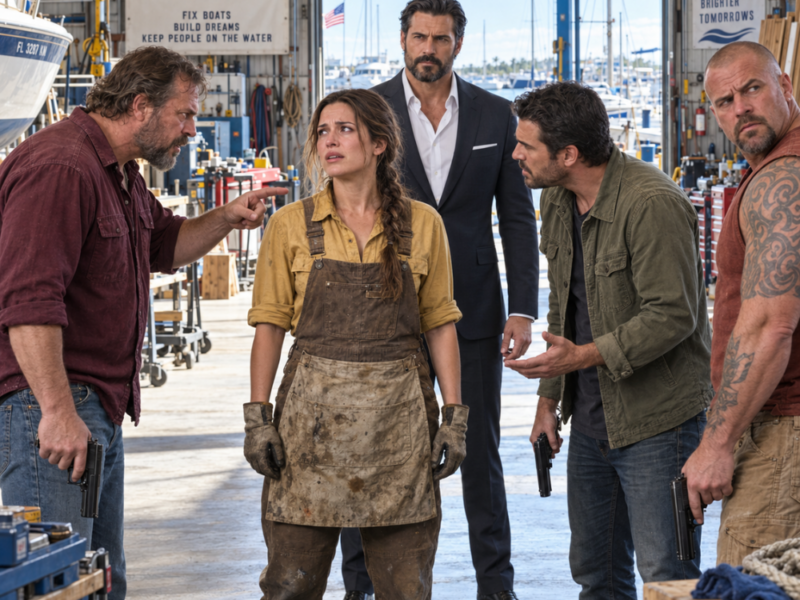
“5 Times A Day,” Three Armed Bullies Threatened A Widow— Unaware Her Brother Was A Feared Mafia Boss
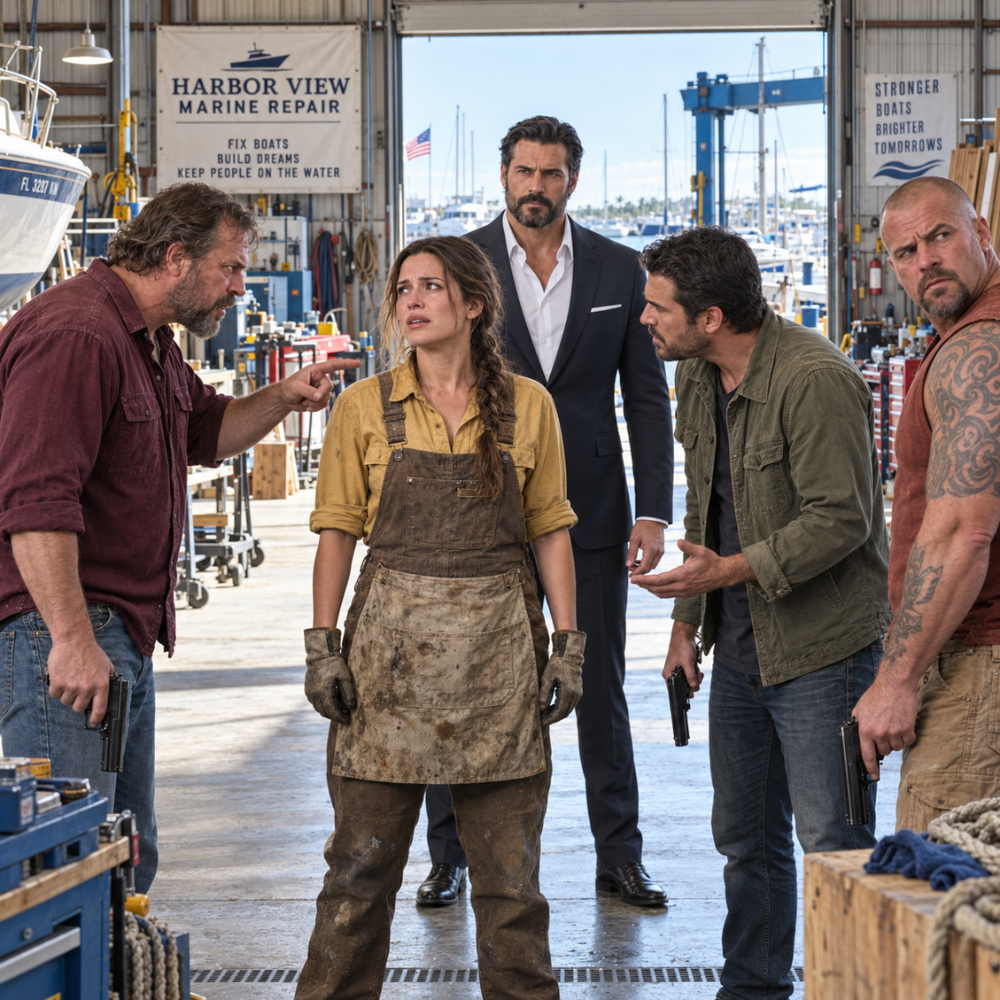
For 49 days, three brothers came to break the widow at Pier Nine—then the brother she hadn’t seen in 18 years came home
At five every morning, the black pickup stopped outside the gate of Delaney Boat Works and leaned on its horn until the lights came on in the little house behind the workshop.
At nine, Boyd Harlo usually came through the gate.
Sometimes he wore a pistol openly on his belt. Sometimes he merely walked around the yard touching Peter Delaney’s tools, tipping over buckets, moving lumber, or knocking a carefully leveled stand half an inch out of square before leaving without a word.
At noon, Russell Harlo came with paper.
His first offer had been $110,000.
Then $105,000.
Then $100,000.
Every few days the number fell.
At six in the evening, something often went wrong.
A power cable disappeared.
A mooring line came loose.
The generator failed for reasons Margaret could not explain.
At eleven thirty, headlights sometimes filled her bedroom window for ten silent minutes before the truck finally rolled away toward the highway.
Once, Boyd fired a shot into the air as they left.
Not close enough to injure anyone.
Close enough to make the point.
Five times a day.
The people in Ashvale Harbor had begun calling it the Five, although most pretended they had never heard the name.
For forty-one days, Margaret Delaney endured it.
She was twenty-eight years old, recently widowed, and walked with a slight drag in her left leg that became worse when she was tired or cold.
The limp had started fourteen months earlier, on the same night her husband died aboard the first boat Delaney Boat Works had ever built from the keel up.
The authorities called what happened a mechanical accident.
Margaret remembered only pieces.
A machine humming beneath her feet.
Peter’s boots overhead.
Metal warm beneath her palm.
A man’s voice speaking somewhere above the engine compartment.
Then nothing until fluorescent hospital lights and a doctor explaining that Peter had not survived.
Peter left her a boatyard at Pier Nine, several pieces of equipment still under loan, a house that leaned slightly toward the water, and enough work to keep the business alive if she could hold on to her customers.
He had also, though Margaret did not yet know it, left her something worth far more.
That was why the Harlos came five times a day.
And why the entire town had learned to look away.
On the morning of the forty-second day, Margaret woke at 4:55 and lay still.
She did not need an alarm anymore.
The harassment had become one.
She stared into the darkness.
Five o’clock arrived.
No horn.
She waited.
5:03.
5:07.
5:12.
Nothing.
Outside the window, the harbor remained quiet except for water folding gently against the pilings and a gull calling somewhere beyond the fog.
Margaret sat up.
Her heart was beating harder than it had on the mornings when the truck actually came.
A person could become accustomed to a knock.
The silence after forty-one days of knocking was something else.
She dressed, made coffee, and opened the workshop at six.
The fishing boat resting on the cradle outside belonged to Coastline Fisheries, a Newport company that had hired Delaney Boat Works for four repairs that month.
Those contracts were the only reason Margaret could still pay for electricity, marine plywood, fasteners, fuel, and the equipment loan Peter had taken out before his death.
She had spent almost two weeks replacing damaged bottom planking on the first boat.
Every new plank had to be shaped, steamed, bent, fitted, checked, removed, adjusted, and fitted again.
Peter had taught her the work during the first years of their marriage.
At the beginning she had only helped.
By the end, there were things her hands did better than his.
Peter never seemed threatened by that.
He bragged about it.
“My wife can fair a hull straighter than I can,” he used to tell customers.
Then he would add, “Do not tell her I admitted it.”
At nine o’clock, Margaret was beneath the hull with a chisel in one hand.
No Boyd.
At nine thirty, still nothing.
By ten fifteen, she realized she had looked toward the gate twelve times.
That frightened her more than any overturned tool rack.
They had trained her to wait for them.
At 11:40, the telephone rang inside the office.
Margaret wiped her hands and answered.
“Delaney Boat Works.”
The man on the other end was Frank Ellis, fleet manager for Coastline Fisheries.
She had known him four years.
He had eaten dinner at her kitchen table.
Peter had repaired his brother’s skiff for free after a storm.
Frank had sent white lilies to the funeral.
He did not ask how she was.
“Margaret, I need to talk to you about the contracts.”
Her stomach tightened.
“What about them?”
There was paper rustling on his end.
“We’re moving the work.”
She stared through the office window at the boat outside.
“Moving it where?”
“A yard farther north.”
“You already awarded it.”
“I know.”
“I ordered material.”
“I know.”
“I’m halfway through the first hull.”
“I know.”
His repeated answer told her he had rehearsed the conversation.
Margaret sat slowly in Peter’s old chair.
“What did I do wrong?”
“Nothing.”
“Did the company complain about my work?”
“No.”
“Have I missed a deadline?”
“No.”
“Then why?”
Frank said nothing.
Margaret waited.
The silence lasted perhaps three seconds.
It was enough.
“Who called you?”
“Margaret.”
“Who?”
“I can’t get involved.”
“You already are.”
His breath came through the receiver.
“I’m sorry.”
“Was it Russell Harlo?”
“I’m sorry.”
The line went dead.
Margaret called back.
It rang once and disconnected.
The second time she got a busy signal.
She placed the receiver gently on the cradle.
For forty-one days, the Harlos had broken things she could repair.
A severed line could be replaced.
A buoy could be retrieved.
A rack could be stood upright.
A damaged cable could be rewired.
Even fear could be worked around.
Now they had stopped breaking things.
They were breaking the business.
That afternoon, two men arrived from Coastline Fisheries to remove the boat.
Neither looked Margaret directly in the eye.
They spoke about towing straps, blocking angles, and whether the cradle would clear the trailer.
Nothing else.
Margaret stood in the doorway while the hull she had spent two weeks rebuilding moved toward the road.
She watched until it disappeared.
Then she returned to the office and opened the ledger.
Rent on a storage lot.
Materials already purchased.
Electricity.
Insurance.
Fuel.
Loan payment.
Cash on hand.
She calculated twice.
Then a third time.
Without the Coastline work, Delaney Boat Works had nineteen days.
She wrote the number in the margin.
That night no headlights came.
At 11:30, Margaret stood behind the curtain anyway.
Nothing.
She understood.
The Harlos were telling her they no longer needed to visit.
The pressure could continue without them.
She went to bed shortly after midnight and dreamed again of the engine compartment.
The dream had visited her every few weeks since Peter died.
Never complete.
Never clear.
There was darkness and metal.
A faint generator vibration.
Then a man’s voice from somewhere above her.
Not shouting.
Not panicked.
A normal voice giving a short instruction.
Margaret could never remember the words.
She woke after one with both hands gripping the blanket.
The doctor in Coos Bay had warned her this might happen.
Her head injury had left a gap in her memory.
Roughly twenty minutes surrounding the explosion simply did not exist in any usable form.
“Do not force it,” the neurologist had told her. “The brain sometimes preserves fragments without preserving sequence.”
She had asked whether memory returned.
“Sometimes.”
“And if it doesn’t?”
“Then you learn to live without those minutes.”
Fourteen months later, Margaret was still trying.
She sat awake until dawn.
She did not know that more than two thousand miles away, in Chicago, her older brother had just closed a file, put on a gray wool coat, and walked out into the cold.
Margaret had not seen August Kowalczyk in eighteen years.
She had been ten when he left.
He had been sixteen.
For the first three years, she waited.
At Christmas.
On birthdays.
When cars stopped in front of the house.
When the phone rang late.
At fifteen, she stopped waiting where anyone could see.
By eighteen, she stopped saying his name.
When their father died, Margaret stood beside the grave and watched the cemetery gate through the entire service.
August never appeared.
When she married Peter, she left one empty chair near the front table.
Peter asked who it was for.
“My brother.”
“He coming?”
“No.”
“Then why the chair?”
Margaret had looked at the empty place.
“I don’t know.”
August did not come.
Money did.
Once a month, for years, deposits appeared in an account established in Margaret’s name.
She sent every dollar back.
At first through the Halverson family, who had taken her in after her father’s death.
Later through the bank.
Every transfer returned.
August never stopped sending them.
He also never came home.
What Margaret did not know was that August had paid someone in Ashvale Harbor to tell him about her life.
At first that person sent careful reports.
School.
Health.
Work.
Marriage.
Then, after Peter’s death, the reports became strangely short.
Margaret is fine.
The workshop is operating normally.
There is nothing unusual to report.
For fourteen months, August had believed them.
Then something finally made him stop believing.
On the forty-third day, Russell Harlo came at noon.
Not five in the morning.
Not late at night.
Noon.
The fishing boats at Pier Seven were unloading.
Men were carrying crates along the dock.
People were eating lunch outside Ruth Abernathy’s diner.
Russell wanted witnesses.
He entered Delaney Boat Works carrying a leather briefcase.
Margaret was working at the bench.
He placed one sheet of paper in front of her.
$85,000.
She looked at the number.
“Yesterday it was ninety.”
“The market changes.”
“The land didn’t.”
Russell smiled.
“Your circumstances did.”
Margaret did not touch the paper.
“Did you call Coastline?”
“I speak to many people.”
“Did you?”
“I’m chairman of the harbor board. Companies ask my opinion.”
“That is not an answer.”
“My memory isn’t what it used to be.”
He smiled again.
That smile was worse than an admission.
Russell placed both hands on the workbench.
“You need to understand something, Margaret. You are running out of money.”
“I know.”
“Your equipment loan is behind.”
“I know.”
“Customers are leaving.”
“Customers are being told to leave.”
He ignored that.
“Every day you wait, the value of this place drops.”
“To you?”
“To anyone.”
Margaret looked at the paper.
Russell lowered his voice.
“You’re twenty-eight.”
“So?”
“You can leave.”
“This is my home.”
“It was Peter’s home.”
“It was ours.”
Russell’s expression shifted.
“You need to decide whether you are preserving a boatyard or preserving a grave.”
Margaret picked up the offer.
She folded it once.
Then again.
Russell watched.
She dropped it into the bin of cedar shavings beneath the bench.
“Pier Nine is not for sale.”
Russell looked at her left leg.
One second.
No more.
Then back to her face.
“Pride is expensive.”
Margaret’s jaw tightened.
“So is land.”
“I’ll come tomorrow.”
“Don’t.”
“The offer will be lower.”
“Then save yourself the paper.”
Russell closed his briefcase.
At the door, he turned.
“You will miss eighty-five thousand when you see tomorrow’s number.”
Margaret waited until his truck disappeared.
Then she took off her apron.
She could not stay alone in the workshop.
Not that afternoon.
She locked the office and walked toward Ruth’s diner at the head of the harbor.
The lunch crowd had thinned.
Four men Margaret had known most of her life sat at adjoining tables.
One had hired Peter three times.
One had stood beside Margaret at the cemetery.
Another sold her varnish.
When Margaret entered, all four looked down.
Nobody greeted her.
That told her they had been talking about her.
She passed without stopping.
Sheriff Dale Fontaine sat near the back finishing mashed potatoes.
He looked up.
Their eyes met.
He gave her a small, polite nod.
Then turned to his coffee.
Margaret had gone to his office twice.
The first time he filed a report.
The second time he told her that while damaged property could be investigated, sounding a horn on a public road was not itself a serious offense.
“I’ll speak to them,” he promised.
“Like a sheriff?”
“Like neighbors.”
Nothing changed.
Margaret sat at the counter.
Ruth placed coffee in front of her.
“You didn’t ask.”
“You were going to say yes.”
Margaret wrapped both hands around the cup.
Ten minutes later, Hollis Bradock entered carrying a tin container.
He was sixty-one, neatly dressed, silver-haired, and spoke in the low, reassuring voice that made people trust lawyers even when they did not understand what lawyers were saying.
Bradock had been Peter’s attorney.
He drafted the will.
Handled probate.
Helped Margaret file insurance paperwork after the accident.
Every Thursday for fourteen months, he brought her pumpkin soup.
He sat beside her.
“How’s the leg?”
“Attached.”
“That is a good start.”
Margaret smiled faintly.
He opened the container.
Warm spice filled the air.
Ruth brought a bowl without being asked.
Bradock listened while Margaret told him about Coastline.
He shook his head.
“I’m sorry.”
“They got to Frank.”
“Probably.”
“You say that like it’s normal.”
“In a town this small, influence rarely needs to announce itself.”
Margaret looked toward the four men eating with their heads down.
Bradock followed her gaze.
Then he rested one hand on the counter.
“Margaret, I need to say something you may not like.”
“Everybody else has.”
“I prepared Peter’s estate plan. I considered him a friend.”
She waited.
Bradock chose his words carefully.
“Eighty-five thousand dollars is not enough for what the place means to you.”
She almost laughed.
“But?”
“But it is money.”
There it was.
“You’re twenty-eight.”
“So Russell reminded me.”
“He is not wrong about that particular fact.”
“Generous.”
Bradock smiled sadly.
“You have an entire life ahead of you.”
“My life is here.”
“Your life can be somewhere else.”
“Why does everyone suddenly care where my life is?”
“Because I have watched what this is doing to you.”
His eyes went to her leg.
“You don’t sleep.”
“How do you know?”
“Ruth tells me.”
Ruth, behind the counter, became very interested in cleaning a coffee cup.
Bradock continued.
“You’re losing weight. Your injury gets worse when you’re exhausted.”
“My leg gets stiff.”
“Your health matters.”
He said health softly.
He said it again before leaving.
“There is no piece of property worth your health.”
Margaret thanked him.
She said she would think about it.
Bradock closed the soup container and walked away looking exactly like a man who had done something kind.
When the door shut, Ruth refilled Margaret’s coffee.
“The whole town knows,” she said.
Margaret looked at her.
Ruth’s eyes stayed on the cup.
“They are simply choosing not to see.”
Saturday was different.
Saturday always had been.
Margaret woke early and swept the workshop.
She arranged six stools around the low table Peter had built years ago.
Paint cans went in the center.
Glue.
Sandpaper.
Small clamps.
A jar of pencils.
Ruth had sent over oatmeal cookies.
At nine, the children came.
Delaney Boat Works had offered a free Saturday model-boat class for eighteen years.
Peter started it at twenty-three because, as he once complained, “Half the kids in a harbor town think boats are fiberglass bathtubs with engines.”
At first, eight children came.
Years later, some of them worked at sea.
One owned an engine shop.
Another joined the Coast Guard.
Margaret had spent seven years helping Peter teach.
After his funeral, she shut the class down for three Saturdays.
On the fourth, Ruth arrived with her grandson Sam at 8:45.
Neither spoke.
Sam stood holding an unfinished wooden hull.
Margaret opened the gate.
She had not missed a Saturday since.
That morning six children crowded around the table.
Sam Abernathy was nine.
He had chosen the most difficult model Margaret offered, a single-masted sailboat.
“Why this one?”
“The others look like adult boats.”
Margaret never understood what that meant.
She respected it anyway.
Sam lifted his boat.
A blue stripe ran along the white hull.
Mostly straight.
Near the stern it wandered slightly.
“My mast keeps leaning.”
Margaret inspected it.
The hole was off the centerline.
Barely.
“You see this?”
“No.”
“Exactly.”
She held the hull toward the light.
“You are off about the width of a hair.”
“That’s nothing.”
“On this boat.”
She placed the model on the table.
“If you enlarged this to fifty feet, your hair becomes a problem people can see from shore.”
Sam frowned.
“So I ruined it?”
“No.”
Margaret handed him an awl.
“You learned where the hole shouldn’t go.”
She marked the centerline and guided his hand.
“Now you do it.”
He drilled again.
The mast stood straight.
Sam’s entire face changed.
“Look!”
Within seconds, all six children gathered around.
The youngest climbed onto his stool.
Margaret steadied him.
Someone spilled paint.
Another child complained that Sam was blocking the light.
Margaret laughed.
The sound surprised her.
She stopped for half a heartbeat.
Six weeks.
That was how long it had been since she heard herself laugh.
The class ended at eleven.
The children returned their boats to Peter’s rack.
Twenty-three little compartments ran along the wall.
A name beneath each one in pencil.
Margaret stood alone after everyone left.
Russell believed she refused to sell because of grief.
Bradock thought it was pride.
Neither understood.
Margaret could sell.
Pay the loan.
Leave.
Rent a small house inland where no trucks arrived before dawn.
She could sleep.
But next Saturday, children would come to the gate.
That was the reason.
Not Peter’s grave.
Peter’s unfinished promise.
Monday brought the last job still scheduled.
A steel engine mount for a trawler owner in Bandon.
$1,200.
Not much.
Enough to buy another week.
The fabrication required fourteen welds.
By Thursday afternoon, Margaret had finished eleven.
At four, she began the long seam along the main brace.
The shop lights flickered.
Once.
Twice.
Then darkness.
Margaret lifted her welding shield.
The sudden cooling had contaminated the seam.
She shone a flashlight over it.
A black line of trapped slag ran through the center.
She knew immediately.
The brace would have to come out.
Removing the brace meant cutting out nearly everything she had completed.
Four days.
Gone.
Margaret walked to the generator.
The cable was connected.
She opened the fuel cover.
Empty.
She had filled it Tuesday.
At the bottom of the tank was a new puncture.
Small.
Clean.
Deliberate.
Margaret closed the cover.
She returned to the workshop.
For the first time in weeks, she did not fix anything.
She sat in Peter’s chair until dark.
Friday morning, the bank called.
Northbend Community Bank.
The woman from credit spoke politely.
Peter’s equipment loan had a remaining balance of $22,800.
The most recent payment was thirty days late.
At sixty days, the account could move toward collections.
Collateral included several major machines used by Delaney Boat Works.
The bank employee offered a number for restructuring.
Margaret wrote it on the back of a paint invoice.
22,800.
Russell’s offer: 85,000.
Remaining after the loan, taxes, legal costs, and immediate debts: enough to begin again somewhere else.
She did the math four times.
It did not change.
That evening Margaret opened the kitchen drawer and removed the transfer papers Bradock had prepared weeks earlier in case she chose to sell.
The buyer line remained blank.
The price line remained blank.
Her signature line waited.
She sat at the table where Peter once wrote invoices.
Pen in hand.
She thought about the Coastline boat.
The ruined weld.
The generator.
The bank.
The headlights.
The horn.
She thought about four familiar men in Ruth’s diner looking into their plates.
She thought about Peter telling her they needed a new roof next spring.
Then Margaret put down the pen.
Not because she had decided to stay.
Because she could not sign alone at midnight.
If she surrendered, the town was going to watch.
Saturday at 8:15, Margaret entered Ruth’s diner carrying the papers in her coat pocket.
She ordered coffee.
Placed the transfer agreement on the counter.
Took a pen from the jar near the register.
She removed the cap.
A tapping sound came from the front window.
Margaret looked up.
Sam stood outside.
He held his finished sailboat against the glass.
The mast was straight.
The blue stripe now reached the stern.
Across the bow, in small painted letters, was a name.
PETER D.
Sam grinned.
“Miss Margaret!”
People inside turned.
“You doing class next Saturday?”
Margaret stared at the boy.
“I need to make sails!”
The pen remained above the signature line.
Sam pressed the model closer to the glass.
Margaret slowly replaced the cap.
Folded the paper.
Put it back inside her coat.
Then she asked Ruth for another cup of coffee.
The following afternoon, an old moss-green sedan turned onto Pier Road.
It parked about a hundred yards from Delaney Boat Works.
The driver remained inside.
Margaret saw the car at four and assumed it belonged to someone from the bank.
At five, it was still there.
At six, still there.
The man inside had spent three hours watching Margaret.
He saw her cut the ruined engine brace free.
One weld.
Then another.
Then another.
He watched her limp become worse as the afternoon cooled.
He watched a black pickup pass slowly at 6:01.
It did not stop.
Only slowed.
The man wrote down the time.
At 6:12, Margaret sat on a steel tool chest.
Covered her face with both hands.
The man’s hand moved toward his door.
One second.
Two.
Three.
Four.
By five, Margaret had lowered her hands.
She stood.
Wiped her palms against her coveralls.
Returned to the welder.
The man did not get out.
At 11:28, two vehicles came down the pier road without headlights.
Thirty yards from the Delaney gate, the lights came on together.
Both beams struck Margaret’s bedroom window.
Then another pair of headlights appeared behind them.
The moss-green sedan had rolled forward and stopped across their exit.
The Harlos’ lights went dark.
A man stepped from the sedan.
Gray coat.
Thirty-four years old.
Thin white scar beneath his left cheekbone.
He walked to Russell Harlo’s truck.
Placed one hand on the hood.
Bent toward the driver’s window.
He said one short sentence.
Margaret could not hear it from the workshop doorway.
She only saw Russell’s face.
The truck reversed.
The second vehicle reversed with it.
Both turned.
Both disappeared toward the highway.
The stranger remained in the yard.
Margaret held a welding torch in one hand.
He turned.
Eighteen years vanished in one second.
August.
Older.
Harder.
Scarred.
But August.
Margaret recognized the stance before the face.
Weight slightly back.
Arms relaxed.
The same way he had stood in their mother’s kitchen the last night she saw him.
Margaret’s first words were not hello.
“Who called you?”
“No one.”
“What are you doing here?”
“I’ve been outside since three.”
“I saw you.”
“You thought I was the bank.”
“Yes.”
August nodded.
Margaret’s anger arrived so fast it surprised even her.
“Why now?”
He did not answer.
“Why not eighteen years ago?”
Nothing.
“Why not when Dad died?”
His face tightened.
“Margaret.”
“Why not when I got married?”
He looked toward the workshop.
“Not tonight.”
“You got that right.”
She lifted the torch slightly.
“I close at midnight.”
August nodded.
“I know.”
“You don’t know anything.”
“I know enough to know those men came at 5:02 this morning, 9:03, 12:01, 6:01, and 11:28.”
Margaret stared at him.
He continued.
“I’m not here to save you.”
“Good.”
“I’m here because somebody has been lying to me for fourteen months.”
She said nothing.
August returned to the moss-green car.
He parked it across the entrance.
That night Margaret lay down at 12:20.
No engine.
No horn.
No lights.
For the first time in forty-eight days, she slept until morning.
Before dawn, August opened the trunk.
Inside was a worn leather briefcase.
The corners had gone pale with age.
He opened it.
Paper.
Nothing else.
One hundred thirty-two envelopes arranged by month.
The first dated eighteen years earlier.
August removed the earliest.
He opened it.
The girl has moved in with the Halverson family.
She attends school.
Her health is good.
There is nothing to worry about.
Initials at the bottom.
D.F.
Dale Fontaine.
August read the next.
Then the next.
He read eighteen years of Margaret’s life in the cold morning beside Pier Nine.
School.
Work at Ruth’s diner.
Technical classes.
A winter illness.
The boatbuilding class.
Her marriage.
That report was thirty-two lines.
Color of the dress.
Number of guests.
Two chairs Peter had built for the reception.
August had known about the wedding.
He had not gone.
He reached the reports from fourteen months earlier.
There was an accident at Pier Nine.
Peter Delaney did not survive.
Margaret was injured and released from hospital care.
Police concluded mechanical failure.
Four lines.
August read them three times.
The next month:
Margaret has returned to work.
The shop remains open.
Situation stable.
Then:
Margaret is fine.
Business is operating normally.
Nothing unusual.
Again.
Again.
Again.
Fourteen months.
Almost identical language.
The newest report was dated two days earlier.
Margaret is fine.
The workshop is doing well.
There is nothing unusual.
Signed:
Dale Fontaine.
August stood beside the car as dawn began to silver the harbor.
He had been paying Fontaine for information for eighteen years.
At first he believed the money simply covered the sheriff’s trouble.
Later the payments became automatic.
Every month, a report arrived.
Every month, August knew just enough about Margaret to feel less guilty for remaining absent.
Now he understood those pages for what they had become.
Permission not to return.
Someone had given him the permission.
And the sheriff had been selling it.
At five o’clock, August said softly to the empty pier:
“I paid a man to lie to me.”
Then he separated the most recent reports from the rest.
Fourteen pages.
Same phrases.
Same reassurance.
Same absence of detail.
A frightened liar changed his story.
A lazy liar changed words accidentally.
A man who repeated identical language for fourteen months was following a script.
August closed the briefcase.
The Harlos were not the only problem.
Perhaps not even the main one.
At 5:02 Monday morning, the horn sounded.
August remained in the car.
He wrote the time.
At 9:03, Boyd entered.
He walked through the yard, kicked a steel support out of alignment, and left.
August wrote it down.
At 9:10, Margaret marched toward the car.
Her limp became pronounced when she was angry.
She struck the window with her knuckles.
August lowered it.
“What are you doing?”
“Watching.”
“He was in my yard.”
“I saw him.”
“He had a gun.”
“I saw that too.”
Margaret’s face flushed.
“You drove two thousand miles to sit in a car and take notes?”
“Yes.”
“Wonderful. The sheriff takes notes too.”
August said nothing.
“I have been handling this for seven weeks.”
“I know.”
“No, you do not know.”
She pointed toward the house.
“You do not know what five o’clock feels like anymore. You do not know what it is to wake before the horn because your body remembers it before your mind does.”
August remained quiet.
“You do not get to show up after eighteen years and watch.”
She was crying now and furious that she was crying.
“I waited for you.”
He looked down.
“Three years, August.”
“I know.”
“No, you don’t.”
She struck the car roof with her palm.
“When Dad died, I watched the cemetery gate.”
August closed his eyes.
“When I got married, I left a chair for you.”
He said nothing.
“I spent eleven days in the hospital after Peter died.”
Her voice broke.
“Ruth came. Teddy Nakushima came. Hollis Bradock came. People I barely knew came.”
She stared at him.
“You didn’t.”
August took every word.
He offered no excuse.
That made Margaret angrier for several seconds.
Then the anger ran out.
She stood breathing hard.
August opened the door.
He stepped out.
Then handed her his notebook.
“Read.”
She almost refused.
Then looked.
Columns of numbers.
5:02.
9:03.
12:01.
6:01.
11:28.
Next day.
5:01.
9:00.
12:02.
5:59.
11:31.
Next.
Nearly identical.
“What is this?”
“The Five.”
“I know what it is.”
“Look at the times.”
Margaret did.
August waited.
She frowned.
“It’s too regular.”
“Yes.”
“They always came on schedule.”
“You knew that emotionally.”
“What does that mean?”
“You knew when to fear them. You didn’t put the times side by side.”
She looked again.
“Why does it matter?”
“Because hatred is unreliable.”
Margaret raised her eyes.
August continued.
“People who hate you oversleep. They get drunk. They get distracted. They miss a day. They show up angry one evening and disappear for three mornings.”
He tapped the notebook.
“This is work.”
Margaret said nothing.
“They are reporting to someone.”
“You don’t know that.”
“No.”
“Then why say it?”
“Because in three days, the largest difference I recorded was four minutes.”
He pointed toward the road.
“To come here at five every morning, somebody has to wake before four thirty. Every day.”
He pointed toward the yard.
“To return at nine, noon, six, and eleven thirty, they have to organize their entire lives around you.”
Margaret felt a chill.
August closed the notebook.
“These men did not invent that schedule.”
“Who did?”
“I don’t know.”
Margaret laughed bitterly.
“So we’re back to notes.”
“No.”
August looked toward the workshop.
“Now we find out why Pier Nine matters.”
The answer arrived faster than either expected.
August used the public phone near the harbor store.
His first call went to an appraiser he knew in Chicago who specialized in industrial waterfront property.
The second went to Oregon maritime planning staff.
The third went to a freight broker in Seattle.
Twenty minutes later, August stood inside the phone booth staring across Ashvale Bay.
When he returned, he wrote one number on Margaret’s workbench.
$4,200,000.
She stared.
“What is this?”
“A conservative current value.”
“For what?”
“Pier Nine.”
Margaret laughed.
August did not.
“You’re serious.”
“Yes.”
“My workshop?”
“Not the workshop.”
He drew a rough line on a scrap of paper.
“Deep-water access.”
Margaret listened.
Ashvale Harbor had applied to participate in a coastal feeder-container route expected to begin the following spring.
The approval was not final, but the public planning process had advanced farther than most residents understood.
Most private piers in the harbor lacked sufficient depth at low tide.
Pier Ten belonged to the harbor authority and was restricted to public-service use.
Pier Nine was different.
Deep approach.
Road access.
Enough land behind it for staging.
“The bottleneck,” August said.
Margaret sat.
“Peter knew ships.”
“He may have known this.”
“Why didn’t he tell me?”
“I don’t know.”
She looked at the number again.
“Russell offered eighty-five thousand.”
“That is why the offer bothers me.”
“Because it’s low?”
“No.”
August leaned against the bench.
“Greedy people offer low.”
“Obviously.”
“But not that low.”
She looked at him.
“Someone who wants a four-million-dollar asset for eighty-five thousand either believes the owner is completely helpless or isn’t buying it for himself.”
Margaret remembered Russell saying the market was deciding.
August continued.
“The Harlos are collecting the property for somebody.”
“Who?”
“That is question one.”
“What is question two?”
August looked toward the house.
“Whether Peter knew.”
The third question waited in the briefcase.
Dale Fontaine.
August met the sheriff in the parking lot outside the station that afternoon.
He did not threaten him.
He placed the fourteen monthly reports on the hood of Fontaine’s patrol car.
The sheriff stopped.
The color changed in his face.
“How long have you been here?”
“Long enough.”
Fontaine looked at the papers.
August asked only what he needed.
“Who gave you the language?”
Fontaine shook his head.
“No one.”
“Those sentences are identical.”
“I wrote them.”
“For fourteen months.”
“Yes.”
“Why?”
The sheriff looked toward the station.
“Because it was easy.”
“Where did the money come from?”
Fontaine hesitated.
“A consulting company in Salem.”
“Name?”
He provided it.
August wrote it down.
“Who owns it?”
“I don’t know.”
“You never asked?”
“I checked the registration.”
“And?”
“P.O. box. Legal filing. Tax number.”
August stared at him.
Fontaine finally looked ashamed.
“It was money.”
“For lying about my sister.”
“At first I sent real reports.”
“I know.”
“Then after Peter died, somebody paid more.”
August’s voice remained even.
“How?”
“Money appeared in the account.”
“Instructions?”
“One envelope.”
“What did it say?”
Fontaine swallowed.
“The three sentences.”
“Who delivered it?”
“I don’t know.”
“You’re the sheriff.”
“I know.”
“Where is the envelope?”
“I burned it.”
August looked away toward the street.
For twenty years, he had known dangerous men.
Men who threatened.
Men who bragged.
Men who wanted witnesses to their power.
The person behind Pier Nine did not seem like that.
No calls.
No meetings.
An envelope in a mailbox.
Regular money.
Prepared language.
Quiet.
August collected the pages.
“Keep sending the reports.”
Fontaine stared.
“What?”
“Same words.”
“Why?”
“Because whoever paid you believes the lie.”
“You want me to continue lying?”
“I want you to tell that person exactly what they expect.”
Fontaine’s eyes narrowed.
“Who are you now, August?”
He looked at the sheriff.
“Her brother.”
At noon the next day, August sat on a wooden crate inside Delaney Boat Works.
Margaret stood in the doorway.
The black truck entered.
All three Harlo brothers were inside.
Russell came carrying the briefcase.
Boyd stayed near the truck.
Wesley, youngest of the three, remained beside the open passenger door.
Russell noticed August.
“Who are you?”
August looked at the briefcase.
“What’s today’s number?”
Russell smiled.
He pulled out a page.
“Eighty thousand.”
Margaret flinched.
August nodded.
“Tomorrow?”
“Depends.”
August rested both hands on his knees.
Then spoke.
Not loudly.
Not dramatically.
He mentioned a commercial loan held by Harlo Marine.
A substantial outstanding balance.
A guarantee tied to a small Portland insurance company.
Russell’s smile disappeared.
“Who are you?”
August continued.
He had done enough legitimate financial investigation in Chicago to learn where Harlo Marine was vulnerable without hacking, stealing, or threatening anyone.
Public filings.
Commercial records.
People willing to answer legal questions.
Russell stepped forward.
“I asked who you are.”
August finally looked at him.
“A man who reads paper.”
Boyd moved his coat aside enough to show the pistol at his hip.
Margaret’s body tensed.
August did not move.
He mentioned a second matter.
A private account associated with Boyd.
Not details that mattered to Margaret.
Only enough that Russell’s head snapped toward his brother.
“What account?”
Boyd said nothing.
“Boyd.”
Nothing.
August watched.
Then he said, “You three come here together because you trust one another more than you trust whoever is paying you.”
Russell stared.
“You don’t know anything.”
“Maybe.”
August looked toward Wesley.
“But I know the person giving orders will never stand in this yard.”
Wesley lifted his eyes.
August continued.
“If this turns ugly, whose name is on the truck?”
Russell said nothing.
“Whose gun is visible?”
Boyd’s jaw tightened.
“Whose company has the harbor-board contracts?”
Russell looked toward the gate.
August stood.
“The person behind you stays clean.”
No threats.
No violence.
Nothing illegal.
Just a question none of the brothers appeared to have asked themselves.
Russell turned.
He dropped the $80,000 offer.
Boyd hesitated.
Then followed.
Wesley entered the truck last.
Margaret watched them leave.
“How did you know about Boyd’s account?”
August picked up the abandoned offer.
“I asked questions.”
“You knew that would turn them on each other.”
“Yes.”
“That is dangerous.”
“Yes.”
“You haven’t changed much.”
He looked at her.
“You don’t know how much I changed.”
That night, the harbor remained quiet.
No 11:30 visit.
Margaret slept badly anyway.
At 3:15, orange light filled the bedroom.
She woke instantly.
The lumber shed was burning.
Margaret ran outside.
August reached the yard first.
The shed stood more than a hundred feet from the house.
Kiln-dried cedar, oak stock, marine plywood, and Peter’s old planer were inside.
Margaret ran toward it.
August caught her arm.
“Let go!”
“No.”
“My lumber.”
“It’s gone.”
“The planer—”
“Gone.”
She struggled once.
He released her but stepped between Margaret and the shed.
Fire spread quickly through the dry stock.
The volunteer department arrived within minutes.
They kept it from reaching the workshop.
By dawn, the shed was a twisted frame over wet ash.
Margaret stood in the ruins.
Years of material.
Peter’s planer.
The oak he drove two hours to buy because the local supplier did not stock the grain he liked.
Gone.
Sheriff Fontaine arrived.
He photographed the site.
Spoke briefly with the fire chief.
Then told Margaret the preliminary cause appeared electrical.
“Old wiring.”
Margaret looked at him.
“You believe that?”
Fontaine would not meet her eyes.
August stood ten feet away.
He understood.
Fontaine still had someone to satisfy.
The sheriff handed Margaret a preliminary report.
She stepped into the burned foundation.
The ash reached above the soles of her boots.
For seven weeks, Margaret had refused to break where anyone could see.
That morning she did.
She dropped to her knees.
The report crumpled in her hand.
She cried.
Loudly.
Ugly.
Without apology.
August did not go to her.
He stayed at the edge of the foundation and let his sister collapse.
Because resilience was not the absence of collapse.
Sometimes the kindest thing another person could do was refuse to turn your grief into something embarrassing.
Margaret cried until she was empty.
Near noon, Teddy Nakushima arrived.
Sixty-six.
Retired welder.
Hands scarred from forty years around heat and metal.
He had taught Peter to weld when Peter was nineteen.
Teddy walked through the ruins.
Then returned to his truck.
He carried out an old blue steel toolbox.
Three drawers.
Hand-welded handle.
He placed it before Margaret.
“Peter gave me this.”
“When?”
“Three days before the accident.”
Margaret looked at August.
“What’s inside?”
Teddy shook his head.
“Never opened it.”
“For fourteen months?”
“He said keep it safe.”
“Why didn’t you bring it before?”
Teddy stared at the burned shed.
“Cowardice.”
He said it without dressing the word.
“I kept thinking somebody would ask.”
“Nobody knew.”
“I knew.”
Margaret said nothing.
Teddy sat on the concrete.
“There’s something else.”
He told her he never believed the accident report.
The official finding claimed fuel vapor accumulated in the engine compartment before ignition.
Teddy and Peter had replaced the fuel system months earlier.
There were safety mechanisms.
A vapor detector.
Shutoff protection.
Nothing was impossible.
Equipment failed.
But the official explanation had always bothered him.
“I asked Dale about the detector.”
“What did he say?”
“Nothing.”
Margaret’s heartbeat quickened.
Teddy continued.
“And you weren’t supposed to be aboard that night.”
“I was finishing the engine mount.”
“I know.”
“Peter knew.”
Teddy looked at her.
“Somebody else knew too.”
August became still.
“What do you mean?”
Teddy looked toward the water.
“I saw another truck near the pier.”
“Whose?”
“I didn’t know then.”
“And now?”
Teddy’s eyes shifted toward the road the Harlos used.
Nobody spoke.
August took the toolbox.
He placed it beneath the bench.
“Don’t open it yet.”
Margaret stared.
“Why?”
“Because if Peter hid something, we open it once and properly.”
That evening, August waited near the Anchorline Tavern.
Wesley Harlo left alone shortly before ten.
He stopped when he saw August.
August placed a photograph on the hood of Wesley’s truck.
Peter.
Crouched beside a model boat.
Smiling.
Wesley looked at the photograph.
Then turned away.
His face collapsed.
“The order wasn’t to hurt him.”
August said nothing.
“We were supposed to ruin the boat.”
Still nothing.
Wesley began talking.
The Margarite had been thirty-nine feet long.
Peter spent two years building her.
If the launch succeeded, Delaney Boat Works would graduate from repair yard to builder.
That meant reputation.
More work.
More money.
Pier Nine would become harder to acquire.
Russell had been told to make sure the boat failed.
Not catastrophically.
Just enough to ruin the launch and damage Peter’s finances.
According to Wesley, Boyd tampered with safety equipment the day before.
The brothers believed the boat would be empty that evening.
Peter usually went home at seven.
Margaret was supposed to be there too.
Then Wesley saw the wheelhouse light after seven.
Two shadows.
He called Boyd.
Boyd told him to stay where he was.
At 7:28, Peter appeared on deck.
He started down the pier.
Then stopped.
Turned.
Ran back.
Margaret was still below.
Wesley looked at August.
“I yelled.”
August’s expression did not change.
“I swear to God, I yelled.”
His voice cracked.
“I ran.”
He covered his face.
“I was too late.”
August waited.
Then asked:
“Who hired Russell?”
“I don’t know.”
“You expect me to believe that?”
“He never told us.”
“Why?”
“Russell likes knowing things nobody else knows.”
Wesley wiped his mouth with his sleeve.
“After the accident, he was terrified.”
“For how long?”
“About three weeks.”
“And then?”
“One day he came home happy.”
“What changed?”
“The sheriff ruled it mechanical.”
August stared at him.
Wesley continued.
“Russell opened a bottle and said we had somebody bigger than this town behind us.”
“Who?”
“I don’t know.”
“Evidence?”
Wesley hesitated.
“Yes.”
August waited.
“I kept things.”
“What things?”
“Enough.”
“Why?”
Wesley laughed bitterly.
“Not conscience.”
He looked toward the tavern.
“Insurance.”
Against his brothers.
Against whoever stood behind them.
August offered Wesley a choice.
Leave.
Disappear somewhere Russell could not easily find him.
Or remain.
Act normal.
Tell the truth through an attorney.
Wesley chose to remain.
“If I vanish, Russell knows.”
“And?”
“He goes to Pier Nine.”
August watched him.
Wesley looked back.
“I stood at the head of that pier once.”
That was all.
Later, August found Margaret sitting at the end of Pier Nine wearing Peter’s coat.
He sat several feet away.
Water moved beneath them.
After a long silence, Margaret asked:
“Why did you leave?”
August looked toward the fog.
“No excuse.”
“I didn’t ask for one.”
“I know.”
He told her.
Their father drank.
Their mother hid the worst of it from Margaret.
August’s bedroom had been above the kitchen.
He heard what Margaret did not.
On the final night, sixteen-year-old August went downstairs.
He intervened during an argument that had become dangerous.
He stopped their father.
The situation ended badly.
Not fatally.
But badly enough that their mother believed August needed to leave before police or relatives turned the incident into something that destroyed both children.
She gave him forty dollars from the kitchen tin.
Told him to take the early bus.
“Never call,” she said.
“What about Margaret?”
“She didn’t see anything.”
“I can’t leave her.”
“She needs one childhood.”
August went.
Chicago.
Forty dollars.
Sixteen years old.
Everything after that was survival.
Some of it respectable.
Some not.
He did not make the story heroic.
Margaret listened.
“When I was fifteen, I found Mom’s hospital papers.”
August looked at her.
“From that night?”
“Yes.”
“I knew something happened.”
She stared at the dark water.
“I just didn’t know why you decided disappearing was easier than telling me.”
August had no answer.
Margaret continued.
“I returned the money because everybody thought I was angry.”
“You were.”
“Yes.”
“But that wasn’t why.”
She wiped her cheek with Peter’s sleeve.
“If I took it, I had to admit I needed you.”
August looked down.
“I needed you when I was ten.”
His face tightened.
“I needed you when I was eleven.”
She spoke more softly.
“And twelve.”
August closed his eyes.
“I couldn’t stand needing somebody who didn’t come.”
The silence lasted a long time.
Then August walked to the car.
He returned with a brown envelope.
Inside were eleven postcards.
None mailed.
Chicago skyline.
Lake Michigan.
A train station.
A bridge.
On the back of the earliest, written by a seventeen-year-old:
Happy birthday. I’m all right.
Another:
Heard you got good grades. Mom always said you were smarter than both of us.
Another mentioned Ruth’s diner.
The final card was dated four months earlier.
I don’t know if you still eat apple pie on your birthday. I do. Every year.
Margaret read all eleven.
“Why didn’t you send them?”
August looked at his hands.
“Writing a postcard was easy.”
“And?”
“Answering why I wasn’t coming home was hard.”
She stared at him.
“So you chose easy.”
“Eleven times.”
Margaret almost smiled through her tears.
“At least you learned counting.”
Then she told him about the voice.
The one remaining fragment from the accident.
Calm.
Short.
An instruction.
She could not remember the words.
Or the speaker.
The next morning, they opened Teddy’s toolbox.
The top drawer held sockets.
The second held wrenches.
The third held tape, blades, and an old flashlight.
Nothing.
Margaret sighed.
“Teddy remembered wrong.”
August measured the box.
Then the interior.
The measurements differed.
He removed the drawers and found a false bottom.
Beneath it was a sealed bundle of documents.
Margaret sat.
The first page was a trust instrument connected to the recorded deed for Lot 41, Pier Nine.
Executed three days before Peter died.
A county-recording stamp on the attached memorandum confirmed the transaction had been legally lodged, though nobody had ever explained it to Margaret during probate.
Peter had placed the property into an irrevocable trust.
Beneficiary:
Margaret Anne Delaney.
Restrictions:
The property could not be sold outright for twenty-five years.
Could not be pledged as collateral.
Could not be transferred to a private buyer.
Long leases were restricted.
The intention was obvious.
Peter had known Pier Nine was going to become valuable.
He had locked the land away from anyone who might pressure Margaret to sell quickly after his death.
Margaret turned pages.
“Why didn’t Bradock tell me?”
August did not answer.
The trustee line answered something else.
August Kowalczyk.
Margaret looked up sharply.
“What?”
August read it again.
He had never met Peter.
Never spoken with him.
Yet Peter had named him trustee.
“How did Peter even know where you lived?”
“I don’t know.”
“He barely talked about you.”
“That doesn’t mean he didn’t look.”
Margaret remembered Peter asking once, years earlier:
“If something happened and you really needed him, would your brother come?”
She had answered:
“No.”
Peter had said nothing.
Page nine contained an incapacity provision.
If Margaret became legally unable to manage her property, control temporarily shifted to the trustee.
If the trustee was unavailable or judicially disqualified, a court could appoint a replacement fiduciary.
August read it twice.
Then the final page.
Peter’s signature.
Witness.
And:
Prepared by Hollis R. Bradock, Attorney at Law.
Margaret stood.
She walked to the workshop doorway.
For fourteen months, Bradock had known.
He had handled Peter’s will.
He had handled probate.
He had brought soup every Thursday.
He had encouraged Margaret to sell a property she did not legally possess the power to sell outright.
August joined her.
Margaret spoke first.
“Everything the Harlos did was useless.”
“Maybe.”
She turned.
“What do you mean?”
“If Bradock didn’t know the trust terms, yes.”
“He drafted them.”
“Exactly.”
Margaret felt cold.
August placed page nine on the bench.
“If somebody knows you cannot sell Pier Nine, then pressuring you to sign a sale contract makes no sense.”
“Unless they thought I would sign without understanding.”
“Still not enough. A title company would find the trust.”
“Then what do they want?”
August tapped the incapacity paragraph.
Margaret read it again.
Legal incapacity.
Court-appointed management.
Her eyes lifted.
“No.”
August said nothing.
“My memory.”
“Yes.”
“The headaches.”
“Yes.”
“The insomnia.”
“Yes.”
“The loan.”
“Yes.”
“The business failing.”
“Yes.”
Margaret stared toward the road.
“He keeps talking about my health.”
August’s eyes hardened.
Three days later, a process server arrived.
The envelope was from county court.
A petition had been filed requesting appointment of a conservator over certain property interests held for Margaret’s benefit.
Petitioner:
Hollis R. Bradock.
The filing was careful.
That was what made it frightening.
It did not call Margaret insane.
It stated facts.
She had suffered a head injury.
She had persistent memory loss relating to the accident.
She had reported insomnia.
Her business had lost substantial revenue.
A secured debt was delinquent.
A fire had destroyed valuable materials.
She had been subjected to sustained harassment.
A previously estranged brother with a criminal history had abruptly appeared and begun influencing financial matters.
Each statement, alone, contained truth.
Together they constructed a portrait.
A fragile widow.
Financially distressed.
Neurologically impaired.
Under the influence of an unsuitable outsider.
The petition asked the court to appoint a temporary neutral fiduciary while Margaret underwent evaluation.
Margaret read it twice.
“He came every Thursday.”
August watched her.
“He sat beside me at the hospital.”
She held the papers tighter.
“He told me he was protecting Peter’s wishes.”
“I know.”
“He brought soup.”
“I know.”
That sentence hurt more than Russell’s threats.
August placed the petition flat on the workbench.
“This is the most dangerous thing they have done.”
“Because it could work?”
“Because nobody has to break a law in front of you for it to work.”
He pointed at the six pages.
“Truth can be arranged dishonestly.”
Margaret lowered herself onto the workshop step.
“What do we do?”
August thought.
“Three things.”
“What?”
“Sleep.”
She stared.
“Eat.”
“You drove across the country to tell me to eat?”
“And get evaluated.”
Her expression changed.
“Neurologist.”
“Yes.”
“I already saw doctors.”
“Fourteen months ago.”
“I’m not going to court and letting strangers decide whether I know my own name.”
“Then bring the court a current doctor before Bradock brings them an old chart.”
Margaret looked at the petition.
August continued.
“Paper is attacking you.”
He tapped the document.
“Answer it with better paper.”
Two days later, a neurologist in Coos Bay evaluated Margaret.
Memory.
Attention.
Executive function.
Language.
Judgment.
Motor recovery.
Her retrograde amnesia around the accident remained.
Nothing else suggested incapacity.
The neurologist wrote a clear report.
Margaret Delaney demonstrated intact cognition and the capacity to make independent legal and financial decisions.
One page.
August read it.
“That’s our seventh page.”
While Margaret handled the medical evaluation, August used professionals for the rest.
A Portland attorney reviewed the trust.
Another lawyer prepared a complaint for the state bar regarding Bradock’s conflict of interest and failure to disclose the trust documents during probate.
Wesley provided a sworn statement to county prosecutors through counsel.
The maritime company considering Ashvale Harbor learned that Pier Nine could not be purchased but might potentially be leased under limited trust provisions.
That mattered.
A lease could save Delaney Boat Works without forcing Margaret to abandon it.
August also learned more about the Harlos’ financial pressure.
He did not need to threaten them.
He only needed to make certain banks and insurers examine obligations they already had a right to examine.
Once outside scrutiny arrived, Russell’s confidence began shrinking.
The Harlos stopped coming five times a day.
The silence was not comforting.
Thursday arrived.
At four o’clock, Bradock’s car stopped outside the gate.
Pumpkin soup.
Same tin container.
Same careful smile.
August stayed inside the workshop.
Margaret received Bradock in the kitchen.
He set down the soup.
“How are you sleeping?”
“Better.”
“The leg?”
“Better.”
“I’m glad.”
He removed his coat.
“I assume you received the court papers.”
“Yes.”
Bradock lowered his head.
“I hoped to explain before that happened.”
“You filed them.”
“I did.”
“Why?”
He sighed.
Then gave the most beautiful explanation Margaret had heard since Peter died.
He cared.
He had watched her suffer.
He worried prolonged pressure was affecting her judgment.
A temporary conservator would protect the property.
Restructure the loan.
Allow Margaret to rest.
Make the Harlos stop.
“It is not punishment.”
“I know.”
“It is protection.”
Margaret looked at him.
“From what?”
“From being forced into decisions while exhausted.”
“Like selling?”
“Exactly.”
That almost made her admire him.
He could stand in her kitchen after encouraging her to sell and reinvent the same history in a gentler voice.
Bradock leaned forward.
“Peter would not want you suffering like this.”
The sentence was soft.
Margaret stared at the soup.
Then Bradock stood to leave.
At the porch, someone outside asked him something Margaret could not hear.
Bradock responded.
“Don’t let anyone stay down there.”
Margaret froze.
The coffee pot remained in her hand.
The kitchen disappeared.
Metal above her.
Generator vibration.
A bolt beneath her wrench.
Peter’s boots moving overhead.
Then a man’s voice coming through the ventilation opening.
Calm.
Slightly tired.
Don’t let anyone stay down there.
The lost twenty minutes did not return fully.
Only one fragment.
But this one came with certainty.
Bradock.
He had been aboard the Margarite.
Bradock turned back.
“You all right?”
Margaret’s face felt cold.
“Little dizzy.”
He stepped toward her.
“I knew it.”
“I’m fine.”
“Sit down.”
Margaret did.
She filled his cup.
Her hand did not shake.
“Maybe you’re right.”
Bradock paused.
“About?”
“The petition.”
He became very still.
“I don’t want a hearing.”
“You don’t?”
“I don’t want strangers discussing my head injury.”
His expression softened.
“That is understandable.”
“I’ll cooperate.”
Bradock exhaled.
Margaret continued.
“One condition.”
“Of course.”
“The Saturday class stays.”
Bradock smiled.
“We can protect that.”
“Peter already did.”
His smile remained.
“How?”
Margaret improvised carefully.
“A use agreement.”
“I don’t remember that.”
“It’s in the workshop safe.”
Bradock’s eyes changed.
Barely.
“There’s a safe?”
“Peter installed it.”
“I see.”
“The door warped during the lumber fire.”
“Then call a locksmith.”
“I don’t want anyone in town knowing.”
Bradock watched her.
“I thought maybe you could help.”
“With a safe?”
“With the document. You drafted most of Peter’s papers.”
Silence.
“What time?”
Margaret looked toward the darkening window.
“Late.”
Bradock waited.
“Eleven.”
He nodded.
“All right.”
After his car disappeared, Margaret entered the workshop.
August sat beside Teddy’s toolbox.
She looked at him.
“I remember the voice.”
August stood.
“It was Bradock.”
At 10:55 that night, fog covered the harbor.
Bradock arrived.
He did not come alone.
Russell Harlo came in the same vehicle.
Boyd arrived behind them.
Wesley drove separately and remained near the road.
Margaret stood beneath the workshop light.
A folding table held papers and a storm lantern.
The wall safe was not warped.
Margaret spun the combination.
The door opened easily.
Bradock’s eyes flicked toward it.
She removed a bundle.
Placed it on the table.
He approached.
“Where’s the class agreement?”
Margaret looked at him.
“Did you know I couldn’t sell Pier Nine?”
Bradock stopped.
Fog drifted between them.
“You drafted the trust.”
His face changed slowly.
“Margaret, you’ve had a difficult few weeks.”
She lifted the signature page.
“Is that yours?”
Bradock looked toward Russell.
Margaret saw it.
A glance.
One second.
Enough.
She continued.
“The night Peter died, you were on the Margarite.”
Bradock said nothing.
“You said, ‘Don’t let anyone stay down there.’”
Russell’s face shifted.
Boyd looked toward Bradock.
Margaret stepped closer.
“Who were you talking to?”
Bradock’s composure finally cracked.
“Nobody.”
“Then why say it?”
“I had come to look at the boat.”
“At seven at night?”
“I was Peter’s lawyer.”
“Boyd had already tampered with the safety equipment.”
Bradock snapped his head toward her.
The movement said more than words.
Margaret saw it.
Russell saw it too.
Bradock recovered quickly.
“I didn’t know what Boyd was going to do.”
There it was.
Out in the fog, somebody gasped.
Bradock stopped.
The harbor emergency loudspeaker system had been activated by people working with state investigators, who had been notified in advance that Bradock was expected to return and that Margaret feared evidence might be destroyed or removed.
His words traveled farther than he realized.
Not to every house in the county.
But far enough.
Across the waterfront, old emergency speakers crackled awake.
Residents heard Bradock’s voice.
I didn’t know what Boyd was going to do.
Lights came on.
One window.
Then another.
Russell turned.
“What did you just say?”
Bradock looked toward the darkness.
Boyd stepped forward.
“Shut it off.”
Nobody moved.
Wesley appeared through the fog.
Empty hands.
He walked between Margaret and his brothers.
Boyd stared at him.
“Move.”
Wesley shook his head.
“I stood watch once.”
“Move.”
“No.”
They had grown up together.
Boyd had once carried Wesley as a child.
Now Wesley looked directly at him.
“I won’t do it again.”
Boyd’s hand remained near his side.
Then slowly dropped.
No heroic fight.
No gunfire.
No final act of violence.
Just a younger brother refusing to keep standing where he had stood before.
August came from the direction of the harbor office.
He placed Peter’s trust file on the folding table.
Then Wesley’s sworn statement.
Then the neurological evaluation.
Then copies of Bradock’s conservatorship petition.
Paper beside paper.
Bradock stared at them.
August spoke.
“You hid Peter’s trust.”
Bradock said nothing.
“You let my sister believe she could sell property Peter had legally protected from sale.”
Nothing.
“You watched the Harlos destroy her business.”
Bradock’s mouth tightened.
“You came every Thursday.”
That was the sentence that broke Margaret.
Not because August shouted.
He did not.
Because he sounded genuinely unable to understand it.
“Soup,” August said.
“You sat at her table with soup.”
Bradock finally looked at him.
“You think you understand this town?”
“No.”
August’s voice remained calm.
“I don’t understand you.”
Vehicles approached through the fog.
State police.
County investigators.
An assistant prosecutor.
The night ended not with revenge but statements.
Questions.
Evidence sealed.
People separated.
Nobody vanished.
Nobody was quietly punished behind a warehouse.
The law had failed Margaret once partly because people allowed convenient conclusions to become permanent.
August refused to repeat that failure by replacing law with himself.
By morning, Ashvale Harbor knew.
Not rumor.
Enough fact.
Wesley’s statement.
Bradock’s words.
Peter’s hidden trust.
The unrevealed deed.
The conservatorship petition.
The false reports.
The sheriff’s payments.
The Harlos’ harassment.
Fontaine arrived at Ruth’s diner shortly after seven thirty.
He removed his badge.
Placed it on the counter.
Ruth stared at it.
Then poured him coffee.
Neither spoke.
He waited there for investigators.
At Pier Nine, people came outside.
Not organized.
No announcement.
Margaret walked from the workshop toward the head of the harbor.
Men and women stood along the road.
The varnish supplier.
Frank Ellis from Coastline, who had driven down from Newport before dawn.
The boat owner who had attended Peter’s funeral.
The four men from the diner.
All the people who had spent weeks looking down.
Margaret walked past them with her limp.
This time, they looked at her.
Not everyone apologized.
Some did.
Some were too ashamed.
Some would probably spend years telling themselves they had been afraid.
Margaret understood fear.
What she did not do was pretend fear erased choice.
Ruth waited outside the diner.
“I’m sorry.”
Margaret stopped.
Ruth’s eyes filled.
“I knew too much to do as little as I did.”
Margaret looked at her for a long moment.
Then nodded.
Not forgiveness.
Not yet.
Acknowledgment.
A week later, Saturday arrived.
At nine, Delaney Boat Works opened.
Nine children came instead of six.
Three parents stayed.
They brought coffee.
Someone donated lumber.
Frank Ellis from Coastline called and asked whether Margaret would reconsider taking the four repair contracts.
She told him:
“One at a time.”
He accepted.
The bank agreed to restructure Peter’s equipment loan after attorneys clarified the trust property itself was not valid collateral for the debt and the remaining secured equipment could be handled separately.
The maritime company entered preliminary discussions about a limited five-year lease arrangement that would use part of Pier Nine without displacing Delaney Boat Works.
Nothing made Margaret rich overnight.
That pleased her.
Real life rarely settled all accounts in one morning.
There were legal fees.
Insurance claims.
Criminal proceedings.
Bar investigations.
Harbor-board hearings.
Repair bills.
Questions that took months.
The Harlos faced charges connected to harassment, property damage, and the Margarite sabotage.
Wesley’s cooperation mattered.
Bradock’s law license was suspended while investigators examined the trust concealment, guardianship filing, financial relationships, and his knowledge of what occurred aboard the Margarite.
Sheriff Fontaine resigned and later entered a plea involving the payments and false reporting.
The deeper financial scheme behind the attempted acquisition of Pier Nine took longer to unwind.
Records eventually showed Bradock had been acting for an investment group that expected the new shipping route to dramatically increase waterfront values.
He could not legally buy Pier Nine once Peter’s trust existed.
So the plan changed.
Pressure Margaret.
Undermine her income.
Document instability.
Use her head injury and financial distress to justify temporary court control.
Replace August as trustee by emphasizing his criminal past.
Then influence the selection of a neutral property fiduciary willing to approve a favorable commercial lease with Bradock’s clients.
The brilliance of the scheme, if such a word belonged anywhere near it, was that no single step had to look extraordinary.
A low offer.
A worried lawyer.
A delinquent loan.
A widow with insomnia.
A petition asking the court to “protect” her.
Truth arranged dishonestly.
That was what August had seen.
Peter had seen enough before his death to become frightened.
Three days before the Margarite accident, he placed Pier Nine in trust.
He named August because Margaret had once told him, during one of the few conversations they ever had about her brother:
“If the whole world was falling down and August knew, he’d come.”
Peter had asked:
“You believe that?”
Margaret answered:
“No.”
Peter apparently had.
The reason made Margaret laugh when she finally understood.
She had spent years insisting August was gone.
Peter had quietly bet the most valuable thing he owned on the possibility that she was wrong.
At 10:30 that first Saturday after the arrests, the children carried Sam’s model sailboat to the end of Pier Nine.
The harbor board had temporarily removed Russell.
A new vote was pending.
Someone had already hung a hand-painted sign over the old one.
PETER DELANEY PIER.
Margaret complained that nobody asked her.
Ruth said:
“You would have argued.”
“Correct.”
“That is why.”
Sam crouched.
He lowered his boat into the water.
Held it for two seconds.
Released.
The hull rocked.
Righted itself.
The mast stood straight.
Sunlight caught the blue stripe.
Nine children cheered.
Margaret laughed.
This time the sound did not surprise her.
Twenty-three days after August arrived, he packed the moss-green car.
Margaret stood beside it.
“You’re leaving.”
“Yes.”
“Chicago?”
“For a while.”
She looked toward the canvas bag on the back seat.
“What exactly do you do there?”
August smiled.
“Paperwork.”
“Liar.”
“That is technically part of it.”
Margaret folded her arms.
“You could stay.”
August looked toward the workshop.
Children’s paintbrushes were drying in jars.
The new lumber rack was half built.
Peter’s old sign leaned against the wall.
“There are things about my life I don’t want parked outside your gate.”
Margaret understood enough not to force the answer.
August opened the trunk.
Inside was a new blue steel toolbox.
Three drawers.
Hand-welded handle.
Made to resemble Teddy’s old box.
He lifted it out.
Placed it beside Margaret.
“I’m not staying.”
She nodded.
Then he added:
“I’ll be back Saturday.”
“Which Saturday?”
August closed the trunk.
“You’ll see.”
Margaret looked at him.
For eighteen years, that kind of answer would have made her furious.
Now she understood something.
The important promise was not never leaving.
It was returning.
August got into the car.
Started the engine.
Drove toward the highway.
At the bend, he looked in the mirror.
Margaret stood beneath the new Pier Nine sign.
One hand resting on the blue toolbox.
The next Saturday, he came back.
Not at five.
At 8:47.
Sam was already waiting outside the gate.
He stared at August suspiciously.
“You know boats?”
“No.”
“You know tools?”
“Yes.”
Margaret called from inside.
“Do not let him near glue.”
August looked offended.
“I can use glue.”
“You could not make a paper airplane when you were sixteen.”
“That is different.”
Sam studied him.
“You Margaret’s brother?”
“Yes.”
“The missing one?”
August looked toward the workshop.
Margaret was smiling.
“Apparently.”
Sam considered him.
“You can sand.”
August took the sandpaper.
That became their beginning.
Not a dramatic reunion in which eighteen lost years disappeared.
They did not disappear.
Margaret still became angry sometimes.
Birthdays still existed that August had missed.
Peter’s funeral.
Their father’s funeral.
School.
Her wedding.
Eighteen years did not dissolve because he arrived at the right moment once.
August understood that.
He never asked her to call the debt paid.
He simply returned.
Some Saturdays.
Then more.
Eventually he rented a room for a month.
Then two.
His work took him back to Chicago and elsewhere, but Ashvale Harbor became a place on his calendar instead of a place in his reports.
Margaret stopped returning his money.
Not because she needed it.
Because she no longer needed refusal as proof that she could survive without him.
The first time she accepted a check, she deposited it into the Saturday class account.
August saw the bank receipt.
“You used my money to buy children paint.”
“Yes.”
“That seems irresponsible.”
“You’re welcome to take it back.”
He shook his head.
“No.”
Margaret smiled.
“Thought so.”
Months later, during a winter storm, she woke before five.
For a moment, her body waited for the horn.
None came.
Rain struck the roof.
Wind pushed at the windows.
Margaret lay still.
Then heard something else.
A car.
Her chest tightened.
Headlights moved across the wall.
She got up.
Looked outside.
The moss-green sedan was near the gate.
August climbed out carrying two paper cups and a bakery box.
He looked up toward her bedroom window.
Margaret opened it.
“What are you doing?”
“Ruth’s power is out.”
“That doesn’t explain you.”
“I have coffee.”
“At five in the morning?”
“Yes.”
Margaret stared down.
August lifted the bakery box.
“Apple pie.”
“It’s February.”
“I know.”
She began laughing.
The Five had taught Margaret that cruelty could become a schedule.
Morning.
Noon.
Night.
Again.
Again.
Again.
Pressure was often most effective when it became ordinary.
A horn.
A lowered offer.
A quiet threat.
A customer disappearing.
One wire.
One late payment.
One sentence from a friendly lawyer about health.
The Harlos had never needed to defeat Margaret in one dramatic confrontation.
They only needed to make surrender feel like rest.
That was what Bradock understood.
The most dangerous pressure in Margaret’s life did not come from the man wearing a gun in her yard.
Boyd frightened her.
Russell humiliated her.
But Bradock sat at her kitchen table.
He brought soup.
He asked about her leg.
He said Peter’s name with tenderness.
He never raised his voice.
He built a legal argument out of her pain and called it protection.
For a long time, Margaret struggled more with that betrayal than with the Harlos.
The mind preferred obvious enemies.
Obvious enemies simplified the world.
A truck at the gate was easy to name.
A man with soup was harder.
One afternoon, nearly a year later, Margaret asked August:
“How did you know?”
They were repairing the Saturday-class table.
“Know what?”
“That Bradock was worse.”
August tightened a clamp.
“I didn’t.”
“You suspected him.”
“I suspected structure.”
She waited.
August continued.
“Russell enjoyed frightening you.”
“Yes.”
“Bradock benefited from you being frightened.”
Margaret thought about that.
“There’s a difference.”
“Yes.”
“Is that something you learned in Chicago?”
“Yes.”
She looked at his scar.
“Bad way?”
August smiled without humor.
“Usually.”
She did not ask more.
He did not offer.
Their relationship improved partly because both learned not every closed door needed to be forced open immediately.
Margaret eventually learned what Peter had discovered.
A year before his death, he noticed unusual interest in waterfront parcels.
Owners received unsolicited offers.
Some sold cheaply.
Soon afterward, shell companies acquired adjacent properties.
Peter became suspicious.
He checked harbor-planning records.
Realized Pier Nine’s depth could make it essential to future shipping.
He mentioned concerns to Bradock.
That had been his mistake.
Bradock already had connections to the investment group attempting to consolidate waterfront control.
Peter sensed something was wrong too late.
The trust was his final protection.
He apparently asked Teddy to hide the documents because he no longer trusted his own lawyer.
Why August?
Peter had never met him.
But Peter understood Margaret.
He knew the brother she insulted most fiercely was the brother whose absence still hurt most.
That meant love remained.
Love did not guarantee August would come.
Peter’s trust simply ensured that if the worst happened and Margaret became vulnerable, somebody outside Ashvale Harbor had legal standing to ask questions.
Peter had guessed correctly.
Eighteen years late.
Still useful.
Margaret visited Peter’s grave on the anniversary of his death.
She brought no flowers.
Peter hated cut flowers.
He used to say they were “an expensive way to watch something die on a table.”
Instead, she brought a small wooden model boat.
Sam had built it.
Not the sailboat.
A simple fishing vessel.
On the bottom, Sam wrote:
THANKS FOR THE CLASS, MR. PETER.
Margaret placed it beside the headstone.
She sat on the grass.
“I know what happened now.”
Wind moved through the pines.
“I wish you had told me.”
She laughed softly.
“You hid a four-million-dollar pier from your own wife.”
She wiped her eyes.
“That was incredibly annoying.”
Then her expression softened.
“You found August.”
Technically Peter had found him on paper.
But in Margaret’s mind, the distinction felt small.
“You were right.”
She sat there until the afternoon cooled.
When she returned to the boatyard, August was teaching Sam how to use a hand plane.
Badly.
Margaret stood in the doorway.
“What are you doing?”
August looked up.
“Teaching.”
“No.”
Sam complained.
“He says I should push harder.”
Margaret closed her eyes.
“Do not listen to him.”
“Why?”
“Because he has never built a boat.”
August objected.
“I am learning.”
“You are ruining pine.”
“I’m improving.”
Margaret walked over.
She repositioned Sam’s hands.
“Feel the grain.”
Sam adjusted.
The plane moved smoothly.
A thin curl of wood lifted.
August watched.
“You could have explained that.”
“I just did.”
“To him.”
“He is teachable.”
Sam laughed.
August shook his head.
Margaret smiled.
That was how the years after Peter slowly rearranged themselves.
Not by forgetting.
By adding.
New Saturdays beside old grief.
New laughter in Peter’s workshop.
New customers.
New trust.
The maritime lease eventually gave Delaney Boat Works enough reliable income to pay off the equipment debt, rebuild the lumber shed, and hire two full-time workers.
Margaret refused proposals to turn Pier Nine into a giant freight yard.
The trust helped.
So did Margaret.
The five-year lease allowed limited cargo staging at the outer section of the property while preserving the workshop, youth class, and local marine access.
Some executives complained.
Margaret told them there were ten other piers.
They reminded her nine were too shallow.
“Then I suppose Pier Nine is valuable.”
The negotiation room went quiet.
August, sitting at the far end, hid a smile.
Margaret negotiated a fair price.
Not $85,000.
Not $4.2 million in a lump sum.
A long-term income structure with renewal protections, environmental obligations, maintenance requirements, and guaranteed access for Delaney Boat Works.
When the contract was signed, she used the same fountain pen she had almost used in Ruth’s diner to sign away the yard.
Ruth attended.
So did Teddy.
Sam sat near the door because he was now twelve and considered himself old enough for legal meetings.
After Margaret signed, August said:
“You read every page?”
“Three times.”
“Good.”
“Did you?”
“No.”
She stared.
He smiled.
“I hired two lawyers.”
“Coward.”
“Efficient.”
They laughed.
Ashvale Harbor changed too.
Not perfectly.
Towns did not become moral because one scandal embarrassed them.
Some people who ignored Margaret later invented stories about how they had secretly supported her.
Some claimed they had always distrusted Bradock.
Ruth corrected them often.
“No, you didn’t.”
People found this irritating.
Ruth did not care.
A new sheriff was elected.
Harbor-board meetings became crowded for almost a year.
Property transactions received scrutiny.
Conflict disclosures that once felt ceremonial began attracting questions.
The old emergency speaker system was eventually modernized.
When contractors removed the small speaker from Margaret’s house, she kept it.
August asked why.
“You want to remember that night?”
“No.”
“Then?”
Margaret held the little metal box.
“It reminded the town how loud silence gets when it finally breaks.”
She mounted it in the workshop above Peter’s class rack.
Sam thought it was ugly.
“It is.”
“Why keep ugly things?”
“To remember not everything important needs to be pretty.”
“That sounds like an old-person answer.”
Margaret was thirty.
She threw a rag at him.
At thirty-five, Margaret no longer limped every day.
Cold mornings still tightened her left leg.
Long hours brought the old drag back.
She stopped treating it like a weakness people were entitled to interpret.
It was simply part of how she walked.
Her memory never fully recovered.
Those missing twenty minutes remained mostly gone.
The voice returned.
Peter running back did not.
The precise moment of the explosion did not.
Margaret eventually stopped asking her brain for them.
She had enough.
Wesley’s testimony.
Forensic evidence.
Teddy’s knowledge.
Bradock’s own words.
Memory was no longer the only thing carrying the truth.
That freed her.
For years, nightmares made Margaret believe recovery meant remembering everything.
Later she understood recovery sometimes meant no longer requiring perfect memory in order to trust yourself.
That was a different kind of certainty.
August changed too.
He never became sentimental.
He still disappeared for work without explaining every detail.
He still wore gray coats.
Still preferred old cars.
Still sat with his back where he could see doors.
But he came to birthdays.
At Margaret’s thirty-first, he brought apple pie.
“Wrong month for pie?” she asked.
“No.”
“You used to buy one every year?”
“Yes.”
“By yourself?”
“Yes.”
“That’s depressing.”
“Correct.”
She cut two slices.
The old postcards eventually went into a drawer in Margaret’s desk.
Not framed.
Not displayed.
They were not proof August had been a good brother.
He had not been.
They were proof he had loved her badly.
There was a difference.
Margaret found that easier to forgive than pretending nothing had been lost.
Forgiveness arrived slowly.
Not as one decision.
Some days she still looked at August and remembered the cemetery gate.
Other days she watched him showing a child how to use a wrench and saw only the man who came back.
Both were true.
Once, years later, August apologized again.
They were repairing the workshop roof.
Margaret said:
“For what?”
“Leaving.”
“You apologized.”
“Not enough.”
She drove another screw into the metal panel.
“August.”
He waited.
“You cannot apologize eighteen years back into existence.”
“I know.”
“Then stop trying.”
“What should I do?”
Margaret looked at him.
“Be here Saturday.”
He nodded.
“I can do that.”
That became the rule.
Not forever.
Saturday.
A promise small enough to keep.
When Sam Abernathy graduated high school, he announced he wanted to study naval architecture.
Ruth cried for two days.
Margaret pretended not to.
Sam received a scholarship partly funded by Delaney Boat Works’ shipping lease income.
Before leaving, he brought the old model sailboat to the workshop.
The blue stripe had faded.
The mast remained straight.
“You keep it.”
Margaret shook her head.
“Yours.”
“It belongs here.”
“Why?”
Sam pointed toward the bow.
Peter D.
“You stopped selling because of this boat.”
Margaret frowned.
“How do you know that?”
“Grandma.”
“Of course.”
Sam placed the model on Peter’s old rack.
“It should stay.”
Margaret let it.
Years later, Pier Nine still held two worlds.
On weekdays, working boats arrived.
Welders repaired frames.
Saws cut planking.
Marine engines came apart and went back together.
At the outer berth, freight sometimes moved under the controlled lease agreement that had made Margaret financially secure without destroying the business.
On Saturdays, work slowed.
Children came.
Some from fishing families.
Some from houses where nobody had ever owned a boat.
They sanded hulls.
Spilled glue.
Painted crooked stripes.
Asked too many questions.
Margaret tapped the table three times when the room became loud.
The Peter Delaney Pier sign weathered gray.
Nobody replaced it.
Margaret preferred it that way.
One autumn afternoon, August sat on the pier beside her.
Both older now.
He watched children launch model boats.
“Do you ever think about selling?”
Margaret smiled.
“Now?”
“Yes.”
“Sometimes.”
He looked surprised.
“What changed?”
“I know I could.”
August nodded.
That was the point.
When Russell Harlo tried to buy Pier Nine, Margaret’s refusal came partly from pressure.
Selling would have meant surrender.
Years later, choice belonged entirely to her.
She could sell.
Lease.
Keep.
Pass the business forward.
Choice changed the meaning of every option.
Margaret looked toward the workshop.
“I probably won’t.”
“Why?”
A little girl ran from the doorway carrying a model hull upside down.
“Miss Margaret! Something broke!”
Margaret stood.
“That.”
August smiled.
Margaret limped toward the workshop.
The little girl held up a snapped mast.
“Can you fix it?”
Margaret examined the break.
“Yes.”
The girl exhaled.
“Good.”
Margaret handed the boat back.
“But you are fixing it.”
The child stared.
“I don’t know how.”
Margaret smiled.
“Then today is useful.”
She followed the girl inside.
August remained at the end of the pier.
For eighteen years he had paid for reports so he could know his sister was all right without accepting the responsibility of being present.
Now he understood what those reports had never told him.
Being all right was not a condition.
It was work.
It was Margaret covering her face for four seconds, then standing.
It was waking before the horn and opening the workshop anyway.
It was returning to the ruined weld.
It was accepting help without surrendering control.
It was telling the truth about anger.
It was refusing a legal document.
It was signing another after reading it.
It was crying in ash.
It was teaching children the following Saturday.
People later told the story as if August came home and saved Margaret.
He disliked that version.
Margaret hated it.
Whenever someone said it in front of her, she corrected them.
“He helped.”
The distinction mattered.
August did not save Delaney Boat Works alone.
Teddy kept the toolbox.
Wesley finally talked.
Ruth eventually stopped being silent.
A neurologist wrote one honest page.
Lawyers did their jobs.
Investigators listened.
Children kept coming Saturday morning.
And Margaret kept the gate open.
Most of all, Margaret had survived forty-nine days before August arrived.
He did not create her strength.
He arrived in time to stop her from being forced to spend all of it alone.
That was different.
On the tenth anniversary of Peter’s death, Margaret stayed late at the workshop.
The children had gone.
Sunlight lay across the water.
The old blue toolbox August gave her sat beneath the bench.
The emergency speaker hung above Peter’s rack.
Sam’s model sailboat rested in the top compartment.
Margaret opened the office ledger.
The page from ten years earlier was still inside.
19 days.
The number she had written after losing Coastline.
She touched it.
At the time, nineteen days had looked like the end of the world.
Now Delaney Boat Works employed fourteen people.
The lease fund supported apprenticeships.
The Saturday class had a waiting list.
The loan was long paid.
Margaret owned less outright than people assumed because Peter’s trust still governed Pier Nine.
She did not mind.
Peter had not built the trust to control her.
He had built it because he knew someone else might try.
There was a difference between protection and possession.
Bradock had never understood it.
David, Russell, Boyd, Fontaine, all of them believed power meant deciding what someone else could do.
Peter’s final act gave Margaret time.
Time until fear passed.
Time until information surfaced.
Time until her brother returned.
Time until she could make decisions without someone standing over her shoulder.
That was what protection should do.
Create room for choice.
Margaret closed the ledger.
Outside, a car horn sounded once.
She froze.
Only for a second.
Then heard August call:
“You closing today or next week?”
Margaret laughed.
She walked outside.
The moss-green sedan was long gone.
August now drove an ordinary blue pickup that Sam claimed made him look “like somebody’s uncle.”
August considered that insulting.
Margaret considered it accurate.
He held a bakery box.
“No.”
“Yes.”
“Apple pie?”
“Yes.”
“It isn’t my birthday.”
“I know.”
“You have lost control of the tradition.”
“It was never well managed.”
Margaret locked the workshop.
They sat at the end of Peter Delaney Pier eating pie from paper plates.
Fog began moving over the bay.
August asked:
“You remember the first night?”
“When you blocked the Harlos?”
“Yes.”
“You said something to Russell.”
“I did.”
“I never heard it.”
August took another bite.
“You still want to know?”
“Yes.”
He looked toward the water.
“I told him, ‘This schedule ends tonight.’”
Margaret waited.
“That’s all?”
“That’s all.”
“I thought it was something frightening.”
“It was to him.”
“Why?”
August smiled.
“Because he knew I had noticed there was a schedule.”
Margaret shook her head.
“You really are a paperwork criminal.”
“Retired.”
“You claim.”
“Mostly.”
They sat quietly.
The water moved.
Somewhere down the harbor, a diesel engine started.
Nothing in Margaret’s body mistook it for the Harlos anymore.
That might have been the clearest sign of healing.
Not forgetting the sound.
Relearning what it meant.
For forty-nine days, Margaret believed survival meant lasting until the next morning.
Then she learned survival could become something larger.
A business.
A class.
A family repaired imperfectly.
A town forced to look at itself.
A brother sitting beside her eighteen years later than he should have.
The Harlos had tried to teach Margaret that surrender was the price of peace.
Bradock had tried to teach her that dependence could be disguised as care.
The town had taught her that good people could become complicit simply by deciding somebody else would act first.
Peter had taught her something better.
Build carefully.
Measure twice.
Never mistake the size of a small error when you know how large the finished structure will become.
A hair on a model boat became feet on the water.
A small lie repeated monthly became eighteen years of distance.
One ignored threat became forty-nine days.
One neighbor looking down made it easier for the next neighbor to do the same.
One question, asked early enough, might have changed everything.
Margaret taught that lesson to every child who sat at Peter’s table.
Not the details of betrayal.
Children did not need those.
She taught them to look.
To ask.
To measure.
To repair what could be repaired.
And to know when a damaged piece needed to be replaced instead of painted over.
On a Saturday many years later, a boy drilling a mast hole made the same mistake Sam once had.
Margaret held the boat toward the light.
“You’re off.”
“By how much?”
“Almost nothing.”
The boy shrugged.
“Then it’s okay.”
Margaret smiled.
“No.”
“Why?”
“Because almost nothing grows when you build bigger.”
He looked confused.
She handed him the awl.
“Try again.”
The boy did.
His second hole landed on the line.
He raised the boat.
The mast stood straight.
Margaret watched his face brighten.
Outside, August’s truck pulled into the yard.
Not early.
Not late.
Saturday.
Margaret glanced toward the gate.
Then returned to the child.
For eighteen years she had believed the worst thing August did was leave.
Eventually she understood the worst part was that both of them had allowed leaving to become permanent long after the original reason disappeared.
Their mother’s fear had started it.
Shame maintained it.
Money disguised it.
Reports institutionalized it.
Silence finished the work.
That was how many things broke.
Not all at once.
Quietly.
Repeatedly.
Until everyone forgot there had once been another way.
Repair worked similarly.
One Saturday.
One conversation.
One truthful document.
One returned visit.
One promise small enough to keep.
Margaret never became grateful for the Five.
She never called Peter’s death a blessing in disguise.
She never thanked betrayal for making her stronger.
Some things were simply wrong.
Some losses remained losses.
Peter should have lived.
August should have come home sooner.
Fontaine should have done his job.
Ruth should have spoken earlier.
Bradock should never have sat at Margaret’s kitchen table pretending concern while building a case against her.
Growth did not make those things necessary.
It only made them survivable.
That mattered.
Years afterward, people still asked Margaret how she endured forty-nine days.
She never liked the question.
It made endurance sound like one heroic decision.
It was not.
She made coffee.
Opened the gate.
Answered the phone.
Fixed the wire.
Retrieved the buoy.
Releveled the stand.
Taught children.
Paid what she could.
Cried when she could not do anything else.
Then stood.
Sometimes four seconds later.
Sometimes the next morning.
Sometimes with help.
That was all.
Resilience was rarely dramatic while it was happening.
Mostly it looked like returning to the workbench.
The people of Ashvale Harbor remembered the night Bradock’s own words came through the emergency speakers.
Margaret remembered something else.
The morning after.
Walking toward Ruth’s diner.
Everyone standing along the road.
Every face lifted.
For seven weeks, she had wondered what it would take for them to look.
She once thought she wanted apology.
What she wanted was acknowledgment.
Look at me.
See what happened.
Know that you saw pieces and chose comfort.
Then do better next time.
Some did.
That was enough.
At the end of August’s life, many years later, Margaret found the old leather briefcase in his Chicago apartment.
Still full of envelopes.
All 132.
The reports.
She sat on his bed and read several.
The early ones contained details she had forgotten.
Margaret won the technical fair.
Margaret burned the pie at Ruth’s diner.
Margaret had influenza.
Margaret began helping at Delaney Boat Works.
Margaret married Peter.
Then the later reports.
She is fine.
The workshop is doing well.
There is nothing unusual.
The lie looked almost insulting in its simplicity.
Margaret touched the page.
For years she blamed August for believing it.
Now, older, she understood why people believed the lie that allowed them to keep living the way they already lived.
August wanted her to be fine.
Fontaine sold him the answer.
Bradock eventually funded that answer because August’s absence served the plan.
Everybody received something.
August received relief.
Fontaine received money.
Bradock received silence.
The Harlos received work.
The town received permission not to interfere.
Margaret was the only person paying the full price.
Until the arrangement broke.
She closed the briefcase.
Inside the front pocket she found one final postcard.
Never mentioned.
Never shown.
Blank photograph of the Oregon coast.
On the back, August had written:
I came back late. Thank you for still opening the gate.
Margaret sat for a long time.
Then laughed through tears.
“Idiot.”
She brought the card home to Pier Nine.
It went into the same drawer as the others.
The next Saturday, children arrived at nine.
Margaret opened the workshop.
Paint.
Glue.
Wood.
Voices.
A girl asked why an old moss-green car photograph hung beside Peter’s sign.
Margaret looked at it.
“Someone important came in that car.”
“Who?”
“My brother.”
“What did he do?”
Margaret considered the question.
“He showed up.”
“That’s all?”
She smiled.
“No.”
Then she thought about eighteen years, forty-nine days, a false report, a hidden trust, pumpkin soup, a boy’s sailboat, and one man sleeping in a car outside his sister’s gate because he understood she was not ready to invite him inside.
“Yes,” Margaret said. “That was the important part.”
The girl nodded, accepting the answer more easily than most adults would have.
Then she returned to her boat.
Margaret stood in the doorway and looked across the yard.
Nothing about Pier Nine resembled the place Russell Harlo believed he could buy for $85,000.
The roof was new.
The lumber shed rebuilt.
Children’s names covered more racks than Peter ever imagined.
The outer berth handled commercial traffic under terms Margaret had negotiated herself.
The house still leaned slightly toward the water.
Margaret never corrected it.
Some imperfections became part of the structure.
She rested one hand on the doorframe.
The harbor was quiet.
No horn at five.
No truck at nine.
No paper sliding across the workbench at noon.
No sabotaged power at six.
No headlights at eleven thirty.
Just ordinary sounds.
Tools.
Gulls.
Water.
Children arguing about paint.
Margaret had once believed peace would come when the Harlos finally stopped.
She had been wrong.
Silence alone had frightened her.
Peace came later.
When the gate could open without her body preparing for danger.
When a vehicle slowing outside was merely a vehicle.
When she could accept help without hearing surrender inside the offer.
When she could think about Peter and remember more than the night he died.
When she could think about August and remember more than the years he was gone.
That was peace.
Not the absence of what hurt.
The return of everything else.
And every Saturday morning at nine, Margaret Delaney unlocked the gate of Pier Nine, turned on the workshop lights, set six, then eight, then sometimes twelve stools around Peter’s old table, and waited for children to arrive.
Because the Harlos had believed the boatyard was valuable for its water depth.
Bradock had believed it was valuable because shipping companies would eventually need it.
Peter had understood both.
But Margaret knew something they did not.
The deepest value of Pier Nine had never fit neatly on a deed.
It was the place where Peter taught children what boats were made of.
The place where a widow learned she could keep working after believing her life had ended.
The place where a brother returned eighteen years too late and discovered late was not always the same thing as never.
The place where a silent town finally found its voice.
And the place where Margaret learned that being helped did not mean being helpless.
Nobody saved her by taking control.
They helped her keep control long enough to choose for herself.
That was why, decades after Russell Harlo dropped an $80,000 offer onto the concrete, Pier Nine still belonged to Peter’s trust and Margaret’s life.
Not because she had been too proud to sell.
Not because she could not move on.
Because once fear stopped deciding for her, she discovered she still wanted to stay.
And that made all the difference.









